





Introduction
In the United States, the term organic is carefully defined and managed by the U.S. Department of Agriculture, with a nationally standardized label that consumers can easily recognize. By contrast, there is no federally established label or universal definition for local food. State governments have developed their own local food programs, such as the PA Preferred label in Pennsylvania and the Colorado Proud label in Colorado, each with distinct eligibility requirements. The definition of local food depends on the policy setting, and it varies widely across U.S. states, countries outside the U.S., and institutions: for example, the 2008 Farm Bill defines local food as food marketed within 400 miles of its origin or produced within the same state; Vermont’s Act 129 requires food to be sourced within Vermont or within 30 miles of sale; Canada’s interim policy defines it as food produced in the province or territory of sale or across provincial borders within 50 km; and the U.K.’s Real Food Calculator sets a 250-mile boundary (extended to 500 miles for meat and seafood) (Printezis, Grebitus, and Hirsch, Reference Printezis, Grebitus and Hirsch2019).
Scholars emphasize that the meaning of local food is context dependent and can be understood through multiple dimensions of proximity, including geographical proximity (the distance between production and consumption), relational proximity (the relationship between producers and consumers), and proximity in values (such as origin, traceability, freshness, and quality). While geographical proximity remains the most commonly used operational measure for defining local food, these additional dimensions capture important aspects of how consumers interpret the concept (Enthoven and Van den Broeck, Reference Enthoven and Van den Broeck2021). From a geographical perspective, a substantial body of research examines how consumers personally define local food in terms of distance or administrative boundaries (Onozaka, Nurse, and Thilmany, Reference Onozaka, Nurse and Thilmany2010; Trivette, Reference Trivette2015; Bazzani and Canavari, Reference Bazzani and Canavari2017; Sneed and Fairhurst, Reference Sneed and Fairhurst2017; Moreno and Malone, Reference Moreno and Malone2021; Carroll and Zepeda, Reference Carroll and Zepeda2024; Machata et al., Reference Machata, L., Morrison and Boyle2024). However, most of these studies focus on linking definitions of local food to perceptions or attitudes rather than directly to willingness to pay (WTP).
By contrast, empirical studies estimating WTP for local food almost always rely on prescribed definitions—such as fixed mileage thresholds or administrative boundaries—to ensure comparability across respondents (Darby et al., Reference Darby, Batte, Ernst and Roe2008; Burnett, Kuethe, and Price, Reference Burnett, Kuethe and Price2011; Grebitus, Lusk, and Nayga, Reference Grebitus, Lusk and Nayga2013; Xu, Loke, and Leung, Reference Xu, Loke and Leung2015; Berg and Preston, Reference Berg and Preston2017; Li, Ahsanuzzaman, and Messer, Reference Li, Ahsanuzzaman and Messer2020). Evidence from this literature is mixed: many studies find that narrower geographic definitions are associated with higher WTP, while others report weak or insignificant relationships. As a result, existing research has largely treated definitions of local either as exogenous labels imposed by researchers or as descriptive personal measures, leaving open the question of whether heterogeneity in consumers’ own definitions is systematically associated with heterogeneity in WTP.
The few studies that attempt to connect personal definitions of local food to WTP face important limitations. Adams and Adams (Reference Adams and Adams2011), for example, use cluster analysis to group respondents based on demographic and attitudinal characteristics, including mileage-based definitions, but find that those with the narrowest definitions do not necessarily report the highest premiums, leaving the relationship between definitions and WTP unresolved. Similarly, Meyerding, Trajer, and Lehberger (Reference Meyerding, Trajer and Lehberger2019)) identify a latent class of consumers who strongly prioritize origin labels, yet this preference does not translate into systematically higher WTP. More recently, Davidson, Khanal, and Messer (Reference Davidson, Khanal and Messer2024) elicit numerical distance-based definitions and show that average thresholds for local are approximately 42 miles, with WTP declining as distance increases. However, strict mileage thresholds can be cognitively demanding and may not fully capture how consumers naturally conceptualize geographic scope in practice. Taken together, prior research documents heterogeneity in definitions and preferences but does not clearly establish whether heterogeneity in consumers’ own definitions of local food is associated with systematic variation in WTP measured under a common informational frame.
In this study, we first elicit WTP for local food using a common prescribed definition (a 50-mile radius) to provide a shared operational anchor. We then examine whether WTP measured under this standardized definition varies systematically across participants’ personal definitions of local food (e.g., local farm, county, state, or national scale). This approach does not seek to identify causal effects of alternative definitions; rather, it allows us to examine heterogeneity in premiums for local food across individuals who conceptualize local differently. In addition, we investigate other potential drivers of heterogeneity, including altruistic behavior (charitable donations), domestic policy focus, and attitudes toward local food. Finally, we explore the factors associated with adopting broader versus narrower personal definitions to provide additional context.
Using data from an online survey of 509 participants, primarily from the Mid-Atlantic region, we find that WTP premiums for local food, measured under the standardized 50-mile definition, generally decline as the geographic scope of personal definitions expands from local farm to county and state levels. An exception emerges among respondents who define local food at the national (U.S.) scale, whose WTP premiums are comparable to those of respondents with the narrowest, farm-based definitions. In addition, altruistic behavior is positively associated with WTP, suggesting that prosocial values extend into food valuation decisions. Because the survey did not include an explicit multistate regional category, we cannot determine if the survey participants with a multistate or region-based personal definition have higher or lower WTP premiums than those with a state-based definition. To address this limitation, we re-estimate the models using alternative baseline specifications, including a combined state–U.S. definition, and show that the relative ordering of WTP premiums remains robust.Footnote 1
This study contributes to the literature by documenting how heterogeneity in consumers’ personal definitions of local food is associated with heterogeneity in WTP when valuations are elicited under a common prescribed definition. Although the survey was conducted during the COVID-19 pandemic and relies primarily on Mid-Atlantic respondents, two factors that may limit external validity, the results provide new insights into how personal definitions and related values shape consumer valuation of local food.
The remainder of this article is structured as follows: Section ‘Background’ provides background, Section ‘Survey design’ details the survey design, Section ‘Empirical strategy’ outlines the empirical strategy, Section ‘Results’ presents the results, and Section ‘Discussion and conclusion’ offers discussion and conclusion.
Background
WTP premium for local food and definitions of local food
Consumers are generally willing to pay a premium for local food, influenced by perceptions of quality, freshness, proximity, and community support. Prior studies show that this premium often exceeds that for other value-added attributes such as fair trade, non-GMO, or reduced sugar (Loureiro and Hine, Reference Loureiro and Hine2002; James, Rickard, and Rossman, Reference James, Rickard and Rossman2009; Adams and Salois, Reference Adams and Salois2010; Onozaka and McFadden, Reference Onozaka and McFadden2011; Feldmann and Hamm, Reference Feldmann and Hamm2015).
Two categories of motivations help explain this premium. Intrinsic motivations relate to personal satisfaction, such as freshness, better taste, and food safety (Schneider and Francis, Reference Schneider and Francis2005; Dunne et al., Reference Dunne, Chambers, Giombolini and Schlegel2011; Onken, Bernard, and Pesek, Reference Onken, Bernard and Pesek2011; Hu et al., Reference Hu, Batte, Woods and Ernst2012; Carroll, Bernard, and Pesek, Reference Carroll, Bernard and Pesek2013; Willis et al., Reference Willis, Carpio, Boys and Young2013; Campbell, DiPietro, and Remar, Reference Campbell, DiPietro and Remar2014; Bogomolova et al., Reference Bogomolova, Loch, Lockshin and Buckley2018). Many but not all of these studies find that these intrinsic motivations lead to strong preferences for local food. One of the exceptions is Neill and Holcomb (Reference Neill and Holcomb2019), which finds that most consumers are actually willing to pay less for tomatoes from small, local farms that are exempt from federal food safety inspections under the Produce Safety Rule (PSR) because of their small size.Footnote 2 Similarly, Harrison et al. (Reference Harrison, Gaskin, Harrison, Cannon, Boyer and Zehnder2013) show that many small- to medium-sized farms and farmers markets report relatively low compliance with sanitation and water-testing practices, which may contribute to consumer perceptions that local food is less safe. Extrinsic motivations reflect broader societal concerns, including support for local farmers, community solidarity, and preservation of local traditions, reduced food miles, and environmental impacts (Minton and Rose, Reference Minton and Rose1997; Onozaka, Nurse, and Thilmany, Reference Onozaka, Nurse and Thilmany2010; Gracia, De Magistris, and Nayga, Reference Gracia, De Magistris and Nayga2012; Lim and Hu, Reference Lim and Hu2016; Brinkley, Reference Brinkley2017; Kautish and Dash, Reference Kautish and Dash2017; Kecinski et al., Reference Kecinski, Messer, Knapp and Shirazi2017; James et al., Reference James, Friel, Lawrence, Hoek and Pearson2018; Printezis and Grebitus, Reference Printezis and Grebitus2018; Cappelli et al., Reference Cappelli, D’Ascenzo, Ruggieri and Gorelova2022; Tian et al., Reference Tian, Croog, Bovay, Concepcion, Getchis and Kelly2022; Zeynalova and Namazova, Reference Zeynalova and Namazova2022). These motivations may not only influence WTP for local food but also shape how consumers personally define what counts as local. For instance, consumers who adopt narrower definitions (e.g., farm or county level) may prioritize freshness and direct support for the local economy, whereas those adopting broader definitions (e.g., national level) may emphasize concerns about domestic economic protection or food security.
Despite extensive research on local food (Brown, Reference Brown2003; Grebitus, Lusk, and Nayga, Reference Grebitus, Lusk and Nayga2013; Xu, Loke, and Leung, Reference Xu, Loke and Leung2015; Bazzani and Canavari, Reference Bazzani and Canavari2017; Berg and Preston, Reference Berg and Preston2017; Printezis and Grebitus, Reference Printezis and Grebitus2018; Printezis, Grebitus, and Hirsch, Reference Printezis, Grebitus and Hirsch2019; Vecchi, Jaenicke, and Schmidt, Reference Vecchi, Jaenicke and Schmidt2022; Yang, Leung, and Tseng, Reference Yang, Leung and Tseng2022), relatively little is known about whether consumers’ personal definitions of local food are systematically related to their WTP for local food. Most empirical studies estimating WTP rely on prescribed definitions, such as fixed mileage thresholds or administrative boundaries (Darby et al., Reference Darby, Batte, Ernst and Roe2008; Burnett, Kuethe, and Price, Reference Burnett, Kuethe and Price2011; Grebitus, Lusk, and Nayga, Reference Grebitus, Lusk and Nayga2013; Xu, Loke, and Leung, Reference Xu, Loke and Leung2015; Berg and Preston, Reference Berg and Preston2017; Li, Ahsanuzzaman, and Messer, Reference Li, Ahsanuzzaman and Messer2020). This approach provides comparability across studies but overlooks the possibility that heterogeneity in WTP is linked to consumers’ own definitions of local. Importantly, the use of prescribed definitions in WTP elicitation does not imply that consumers interpret or value the label uniformly. Prior work suggests that individuals may bring distinct identities, values, and interpretive frameworks to the same informational cue, leading to heterogeneous valuation even when the definition of local is held constant (Higgins and Kruglanski, Reference Higgins, Kruglanski, Higgins and Kruglanski1996; Moreno and Malone, Reference Moreno and Malone2021). As a result, observed variation in WTP under a common definition may reflect differences in underlying interpretations rather than preferences for alternative geographic definitions per se.
At the same time, no universal regulatory standard exists for local food, unlike ‘organic’, which is strictly defined by the USDA. Many state governments promote local food through their own certification programs. For example, Pennsylvania’s PA Preferred program (established in 2004, codified in 2011) requires that at least 75% of a product or its ingredients be grown or harvested in Pennsylvania. In contrast, under the Colorado Proud program, all food products (whether produce, livestock, or processed foods) must be entirely grown, raised, or manufactured within Colorado. For nonfood agricultural items (e.g., pet food, fertilizer), the rules are less strict: at least 50% of the product’s weight must come from Colorado-grown, -raised, or -processed agricultural ingredients.Footnote 3 In addition, several third-party initiatives attempt to certify or signal ‘local’ sourcing. Organizations such as Food Alliance and LocalHarvest provide labeling schemes or directories to connect consumers with local producers and communities.Footnote 4 Policies defining ‘local’ in across the U.S. and around the world—for example, the U.S. Farm Bill, Canada’s interim policy, Vermont’s Act 129, and the U.K.’s Real Food Calculator—differ widely and these differences highlight the absence of a universal standard for local food (Printezis, Grebitus, and Hirsch, Reference Printezis, Grebitus and Hirsch2019).
Beyond official standards, a growing body of research has explored how consumers define ‘local’ in practice (Machata et al., Reference Machata, L., Morrison and Boyle2024, updated annually; Onozaka, Nurse, and Thilmany, Reference Onozaka, Nurse and Thilmany2010; Trivette, Reference Trivette2015; Bazzani and Canavari, Reference Bazzani and Canavari2017; Sneed and Fairhurst, Reference Sneed and Fairhurst2017; Moreno and Malone, Reference Moreno and Malone2021; Carroll and Zepeda, Reference Carroll and Zepeda2024). Many studies link consumers’ definitions of local food to attitudes, identity, or market segmentation rather than directly linking these definitions to WTP. A few studies using cluster or latent class methods highlight heterogeneity in how consumers interpret ‘local’, yet often stop short of testing whether these interpretations systematically relate to differences in WTP (Adams and Adams, Reference Adams and Adams2011; Meyerding, Trajer, and Lehberger, Reference Meyerding, Trajer and Lehberger2019). Davidson, Khanal, and Messer (Reference Davidson, Khanal and Messer2024) ask for WTP for a generic label ‘locally produced’ and then elicit personal definitions by asking for numerical distance thresholds. However, Construal Level Theory (Trope and Liberman, Reference Trope, Liberman, Van Lange, Kruglanski and Higgins2012) suggests that consumers often struggle to perceive or assess geographic distances accurately, relying instead on abstract categories, such as county or state, that are more intuitive than precise mileage.
Building on this literature, we elicit WTP under a prescribed 50-mile definition and then examine whether WTP measured under this common anchor varies systematically with consumers’ personal (categorical) definitions of ‘local’ and related values. In this study, we use 50 miles as a prescribed definition of local food based on prior research. Carroll and Zepeda (Reference Carroll and Zepeda2024) show that consumers are willing to pay a premium only when the distance is within 50 miles, while Trivette (Reference Trivette2015) identifies 50 miles as the most common minimum range cited by local food advocates. Consistently, Adams and Adams (Reference Adams and Adams2011) report that 42% of survey participants define local food as produced within 50 miles. This definition primarily captures the geographical/proximity dimension of local food.
Altruistic behavior–donations
To further elaborate on extrinsic motivations, we focus on altruistic behavior, specifically, charitable donations. In this regard, Willis et al. (Reference Willis, Carpio, Boys and Young2013) demonstrate that people are willing to pay more for local products when bundled with a local food bank donation compared to local food alone. That study, however, does not explicitly claim that local food consumers are more generous or more likely to donate. Rather, the findings imply that these consumers may possess a stronger sense of community identity and a greater willingness to engage in altruistic behaviors, particularly when their purchases align with local initiatives.
Despite this implication, to our knowledge, no study has directly tested whether individuals who donate more to charity are also willing to pay more for local food. This study uses donation behavior as a proxy for altruism to investigate that link.
Domestic policy focus
Local food is also tied to broader policy and political orientations. In classical political theory, local food systems are closely tied to concepts of social justice and national protection (Miller, Reference Miller2008). During the COVID-19 pandemic, this connection became even more salient. For instance, in France, the Agriculture Minister called for ‘food patriotism’, urging consumers to purchase French products even when they were more expensive (Miller, Reference Miller2008; Wang, Reference Wang2021). Similarly, Scotland’s Rural Economy Secretary promoted buying Scottish dairy products to support local farmers. These appeals reflect a broader rise of ‘nation-first’ consumerism and food nationalism, where individuals prioritize local or national interests in response to crises and uncertainty (Wang, Reference Wang2021).
Building on this literature, we expect that individuals with a stronger domestic policy focus will not only report higher WTP for local food but also adopt broader, national-level definitions of local.
Hypotheses
Based on the literature, we examine whether participants with different personal definitions of local food, using intuitive categorical scales (e.g., farm, county, state, national), report different WTP premiums for food produced within a 50-mile radius. We also test other potential drivers of heterogeneity in WTP, including altruistic behavior (charitable donations), domestic policy focus (national vs. global priorities), and attitudes toward local food. In addition, we explore factors associated with broader versus narrower personal definitions of local food. Thus, we propose the following hypotheses:
H1: Under a predefined local food definition (50 miles), individuals who hold broader personal geographic definitions of ‘local’ exhibit lower WTP premiums for local food.
H2: Consumers’ attitudinal values toward local food are associated with their WTP premium for local food.
H3: Consumers’ attitudinal values toward local food are associated with how they define local food.
H4: Donation behavior (altruism) is positively associated with WTP premium for local food.
H5: Domestic policy focus is positively associated with WTP premium for local food.
H6: Domestic policy focus is positively associated with broader definitions of local food.
In the empirical analysis, we distinguish between WTP premiums for local produce and for local meat. All WTP-related hypotheses (H1, H2, H4, H5) are therefore tested for both categories.
Survey design
Sample and recruitment
In this study, we conducted an online survey with 509 validated responses from consumers who were 18 or older and mainly from the Mid-Atlantic region.Footnote 5 The survey was conducted from November 19 to November 29, 2020, with the help of the survey provider Dynata. Participants spent around 10 minutes completing the survey and received a participation fee of $4.
In the survey, participants were first asked to state their WTP for local food under a prescribed definition of local—that is, one that uses a 50-mile radius. Later in the survey, participants were asked how they personally defined local food. In addition, participants were asked about the amount they wanted to donate to charities, their domestic policy focus (i.e., prioritizing national over global issues), their attitudes toward local food, measured by agreement with statements on economic, environmental, safety, taste, and freshness dimensions, each rated on a 5-point Likert scale, and other sociodemographic information.
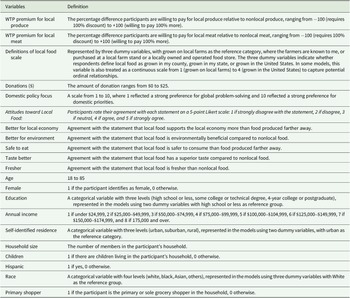
The full survey is provided in Appendix B. Table 1 describes the variables collected via the survey and used in the analyses of this article.
Survey variables used in the analysis

Note: In the survey, education was originally measured using five categories: high school or less, some college, technical degree (2-year college), 4-year college, and postgraduate. For analytical purposes, we combine some categories into three groups to simplify the analysis. Similarly, shopping roles were included: never the shopper, rarely the shopper, secondary shopper, primary shopper, and the only shopper. For analysis, we combine primary shopper and the only shopper into one category (coded as 1), and grouped the others as 0.
Elicitation of WTP for local food
To elicit the WTP premium for local food, this survey employs a series of hypothetical binary choices between local and nonlocal produce, as well as local and nonlocal meat. The structure of the repeated choices follows a staircase procedure, or the so-called ‘unfolding brackets method’ introduced by Cornsweet (Reference Cornsweet1962). Each choice is framed as a comparison between the local food price and the nonlocal food price and thus captures the WTP premium for local food.
First and foremost, the survey defines local food as food ‘grown, produced, or processed within 50 miles’. Participants were then asked a series of WTP-related questions, where the price of local food was systematically adjusted upward or downward to identify their indifference point, accurate to a 5% interval. For example, the initial question asked: ‘If you were buying fruit or vegetables and you could choose at equal prices between local produce and nonlocal produce, which one would you choose?’ If the respondent selected ‘local’, they were then asked, ‘If instead the price of locally grown produce was 50% more expensive than nonlocal produce, which one would you choose?’ If the respondent then selected ‘nonlocal’, the next question presented a midpoint adjustment: ‘If instead the price of locally grown produce was 25% more expensive than nonlocal produce, which one would you choose?’ Since their WTP for local was between 0% and 50%, this 25% step narrowed the range.
Each subsequent percentage adjustment was determined as the midpoint between (i) the highest price the participant was not willing to pay and (ii) the lowest price they were willing to pay. If they selected ‘local’ at 25%, the next question increased the local price to 37.5% above nonlocal, since their WTP was then between 25% and 50%. If they again selected ‘local’, the price was raised to 43.75%. At this point, if they still preferred local, their WTP was identified as 46.88% (the midpoint between 43.75% and 50%). In the survey, we restricted the adjustments to −100% to +100% to capture most consumers’ preferences and to keep the survey practical, as extreme values were not our focus.
From these responses, we obtained two measures: (i) the percentage WTP for local produce and (ii) the percentage WTP for local meat. We define ‘WTP premium’ as the percentage difference in price that participants are willing to pay for local food relative to nonlocal food. This measure ranges from −100 to +100. For example, a WTP premium of +100 means being willing to pay 100% more for local food than for nonlocal food, whereas a WTP premium of −100 means being willing to purchase local food only if it is 100% cheaper than nonlocal food.
Personal definitions of local food
After eliciting participants’ WTP for local food under the prescribed definition, we then asked them about their personal definition of local food. The survey provided five options: (i) local food is grown by a farmer I know; (ii) purchased at a local farm stand or at a locally owned and operated food store; (iii) grown in my county; (iv) grown in my state; or (v) grown in the United States. Participants selected the definitions that aligned with their own understanding. For the analysis, we combined the first two categories into a single definition since both emphasize direct relationships and immediate proximity even more so than the county level. Our survey did not include a personal definition option aimed at a scale between state and national. This sort of intermediate option, a regional scale perhaps, has sometimes been included in local WTP studies anchored in the Mid-Atlantic or Northeast. Because of this potential survey instrument limitation, we will include, as a robustness check, analyses that combine that two largest scales—state and national—into a single category.
Donation task (altruistic behavior)
In this task, participants were asked whether they would like to donate a portion of a $25 bonus to three charitable organizations or retain the full amount for themselves. More specifically, a participant was asked to allocate the $25 among themselves and the three charities. The selected charities included: (1) Farm Aid, which supports family farmers and promotes sustainable agricultural systems; (2) Farmers Market Coalition, which strengthens farmers markets across the United States as community assets; and (3) World Central Kitchen, which provides fresh meals to communities in need. The option to retain the full $25 reflected a self-interested choice. A participant could allocate any portion of the bonus among themselves and the three charities.
All participants were required to make a choice, though only a randomly selected group received the $25 bonus, which was credited to their account by the survey company within 3 weeks. Participants were not informed of the exact probability of receiving the bonus, which was set at 6%. We opted for a larger incentive (the $25 bonus) paired with a small probability, leveraging individuals’ tendency to overestimate small probabilities (Tversky and Kahneman, Reference Tversky and Kahneman1992). Several studies suggest that compensating only a subset of participants does not significantly affect response behavior compared to full payment (Voslinsky and Azar, Reference Voslinsky and Azar2021).
Domestic policy focus
To capture this participants’ domestic policy focus, the survey asked participants: ‘Should your country’s leaders give priority to solving global problems or to solving your country’s problems?’ Responses were recorded on a 1 to 10 scale, with 1 indicating a strong global focus and 10 indicating a strong domestic (national) focus. Higher scores are interpreted as reflecting a stronger domestic policy focus. We adopted a 10-point scale to increase explanatory power, following the approach suggested by Coelho and Esteves (Reference Coelho and Esteves2007).
Empirical strategy
Our primary goal is to elicit WTP premiums for local food under a prescribed definition and to examine how these premiums vary with participants’ personal definitions of local food. We also assess whether heterogeneity in the WTP premium is associated with altruistic behavior (donation) and with domestic policy focus. The dependent variable in our analysis is the participant’s stated WTP premium for local food. Our key explanatory variables include participants’ personal definitions of local at different geographic scales, farm, county, state, and U.S., as well as measures of altruistic behavior, domestic policy focus, and attitudes toward local food. One category is omitted as the reference group for the personal definition variables. To address these objectives, we estimate a model with the following specification:
 $$ {\displaystyle \begin{array}{l}{Y}_i=\alpha +{\beta}_1{CountyScale}_i+{\beta}_2{StateScale}_i+{\beta}_3U.S.{Scale}_i\\ {}\hskip1em +{\beta}_4{Donation}_i+{\beta}_5{DomesticPolicyFocus}_i\\ {}\hskip1em +\hskip2px {\beta}_6{AttitudesTowardLocalFood}_i+\theta {\boldsymbol{X}}_i+{\varepsilon}_i\end{array}} $$
where $ {Y}_i $
is the WTP premium for local food for participant i. Specifically, we estimate the model twice, once with
$ {Y}_i $
is the WTP premium for local food for participant i. Specifically, we estimate the model twice, once with $ {Y}_i $
equal to the WTP premium for local produce, and once with
$ {Y}_i $
equal to the WTP premium for local produce, and once with $ {Y}_i $
equal to the WTP premium for local meat. In (1), the dependent variable
$ {Y}_i $
equal to the WTP premium for local meat. In (1), the dependent variable $ {Y}_i $
is participant i’s stated WTP premium for local, which is continuous but bounded between −100% and +100% due to the survey design and stepwise elicitation method used. To account for this double bounding, we employ a two-limit Tobit regression (Rosett and Nelson, Reference Rosett and Nelson1975), which is suitable for modeling dependent variables with both lower and upper bounds. The covariates Donation, DomesticPolicyFocus, and AttitudesTowardLocalFood are defined in Table 1 and discussed earlier.
X
is a vector of demographic control variables, including age, gender, education level, income, residence, household size, presence of children in the household, race, and whether the participant is the primary shopper in the household.
$ {Y}_i $
is participant i’s stated WTP premium for local, which is continuous but bounded between −100% and +100% due to the survey design and stepwise elicitation method used. To account for this double bounding, we employ a two-limit Tobit regression (Rosett and Nelson, Reference Rosett and Nelson1975), which is suitable for modeling dependent variables with both lower and upper bounds. The covariates Donation, DomesticPolicyFocus, and AttitudesTowardLocalFood are defined in Table 1 and discussed earlier.
X
is a vector of demographic control variables, including age, gender, education level, income, residence, household size, presence of children in the household, race, and whether the participant is the primary shopper in the household. $ {\varepsilon}_i $
is an error term, and the βs and θ are coefficients to be estimated.
$ {\varepsilon}_i $
is an error term, and the βs and θ are coefficients to be estimated.
Our main coefficients of interest, $ {\beta}_1 $
,
$ {\beta}_1 $
, $ {\beta}_2 $
, and
$ {\beta}_2 $
, and $ {\beta}_3 $
, capture the relationship between participants’ personal definitions of local food and their WTP premiums, relative to an omitted reference category. Here, CountyScalei, StateScalei, and U.S.Scalei are binary variables that take a value of 1 if the survey participant i prefers a particular local food definition and 0 otherwise.
$ {\beta}_3 $
, capture the relationship between participants’ personal definitions of local food and their WTP premiums, relative to an omitted reference category. Here, CountyScalei, StateScalei, and U.S.Scalei are binary variables that take a value of 1 if the survey participant i prefers a particular local food definition and 0 otherwise.
As a complementary analysis, we also model how participants’ definitional choices correlate with $ DomesticPolicyFocus $
,
$ DomesticPolicyFocus $
, $ AttitudesTowardLocalFood $
, and the demographic variables in
X
. The model is estimated using an ordered logit, with explanatory variables defined in Table 1:
$ AttitudesTowardLocalFood $
, and the demographic variables in
X
. The model is estimated using an ordered logit, with explanatory variables defined in Table 1:
 $$ {\displaystyle \begin{array}{l}{LocalDef}_i=\alpha +{\beta}_1{DomesticPolicyFocus}_i\\ {}\hskip3.8pc +{\beta}_2{AttitudesTowardLocalFood}_i+\theta {\boldsymbol{X}}_i+{\varepsilon}_i\end{array}} $$
where $ {LocalDef}_i $
is measured on an ordinal scale (1 = local farms; 2 = county; 3 = state; 4 = U.S.). We estimate an ordered logit model with personal definitions ordered from the narrowest to the broadest scale.
$ {LocalDef}_i $
is measured on an ordinal scale (1 = local farms; 2 = county; 3 = state; 4 = U.S.). We estimate an ordered logit model with personal definitions ordered from the narrowest to the broadest scale.
Results
Descriptive statistics
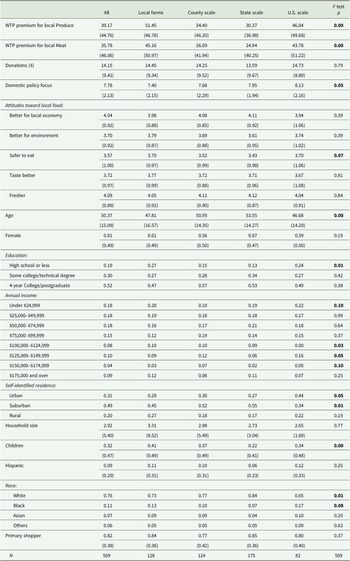
Table 2 presents the variable means for the full sample and subsamples based on participants’ personal definitions of local food. Participants’ WTP premiums for local food are expressed as percentage differences relative to nonlocal food. On average, the WTP premium for local produce is 39%, compared with 36% for local meat. Participants who define local food at the farm scale exhibit the highest premiums (51% for produce and 45% for meat), followed by those adopting a U.S.-scale definition (46% and 44%). WTP premiums are lower among participants using county-scale definitions (34% for produce and 36% for meat) and are lowest for those defining local food at the state scale (30% for produce and 25% for meat). An F test rejects the null hypothesis that all group means are identical. Across all definition groups, WTP premiums are generally higher for local produce than for local meat. More generally, premiums tend to decline as personal definitions broaden from farm to county and state levels, with the U.S.-scale definition representing a notable exception, exhibiting higher premiums than the intermediate county- and state-level definitions.
Variable means, conditional on personal definitions of local food scale
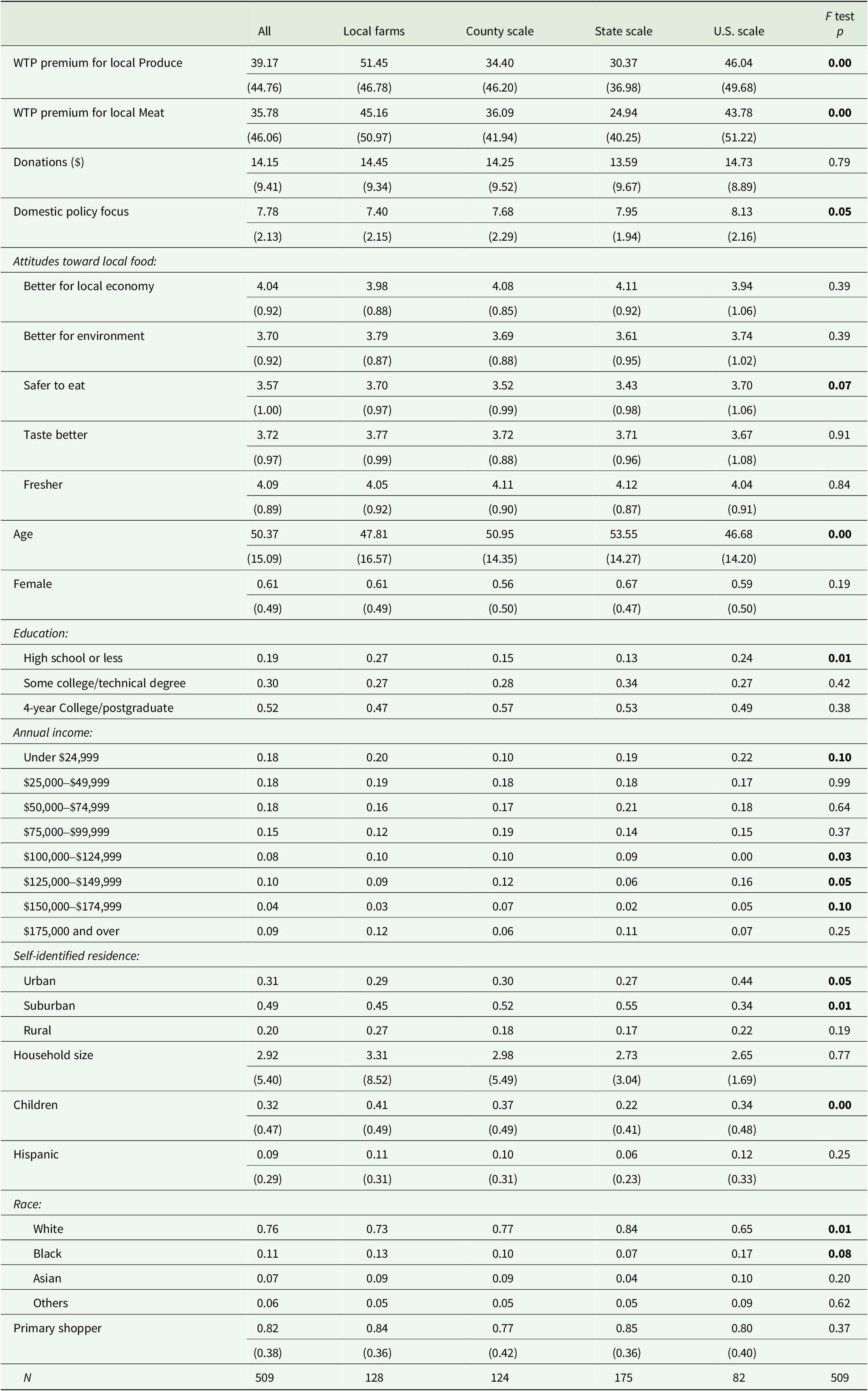
Note: Standard errors appear in parentheses. F test tests values crossed different groups are equal. Bold F test p values indicate statistically significant differences among the four local scale groups for the respective variable. For example, age has a p value of 0.00 (bold), showing significant differences in age across the four local scales.
The average charitable-donation amount is $14.15 of $25. Table A.1 in Appendix A.1 examines the relationship between donation behavior and the WTP premium for local food. Participants who make a positive donation have a significantly higher WTP premium—41% for local produce compared with 30% for nondonors, and 39% for local meat compared with 24% for nondonors.
Average responses to the domestic policy focus question increase as the geographic scale used to define local food becomes broader: those defining local as local farms have an average score of 7.4, followed by 7.7 for the county scale, 8 for the state scale, and 8.1 for the U.S. scale. Overall, participants report a high domestic policy focus, with an average score of 7.8 of 10. Table 2 also reports summary statistics for attitudes toward local food. Across all definition groups, participants generally agree that local food is better for the local economy, environment, taste, safety, and freshness, with mean scores exceeding 3 on a 5-point scale. Attitudinal differences across definition groups are modest overall. The most notable variation appears for perceived food safety: respondents defining local food as farm-based or U.S.-grown report the highest agreement (mean = 3.7), whereas those adopting a state-level definition report the lowest (mean = 3.4).
Finally, Table 2 highlights several demographic differences across the four personal-definition groups, including age, education, income, and racial composition. Residential patterns also differ: 44% of respondents adopting a U.S.-scale definition live in urban areas, whereas more than 50% of those using a state-level definition reside in suburban areas. These differences underscore the importance of controlling for demographic characteristics in the multivariate analysis that follows.
While much of our sample’s demographics align closely with the 2020 United States Census Bureau reports for the national population, our sample’s average age of 50.4 is higher than the national median age of 38.5.Footnote 6 One possible reason for the higher median age is that our study includes participants with a minimum age of 18. In terms of gender distribution, our sample is predominantly female, with 61% of participants identifying as female, compared with the national-level average where women constitute approximately 51% of the population. Additionally, the median household income among our participants is approximately $69,500, slightly higher than the national median income of $67,521. The high proportion of older or retired female respondents, many of whom are primarily engaged in household responsibilities in the Mid-Atlantic region, may be a key factor contributing to this disparity.
Heterogeneity in WTP premiums for local food
Heterogeneity in WTP across personal definitions of local food
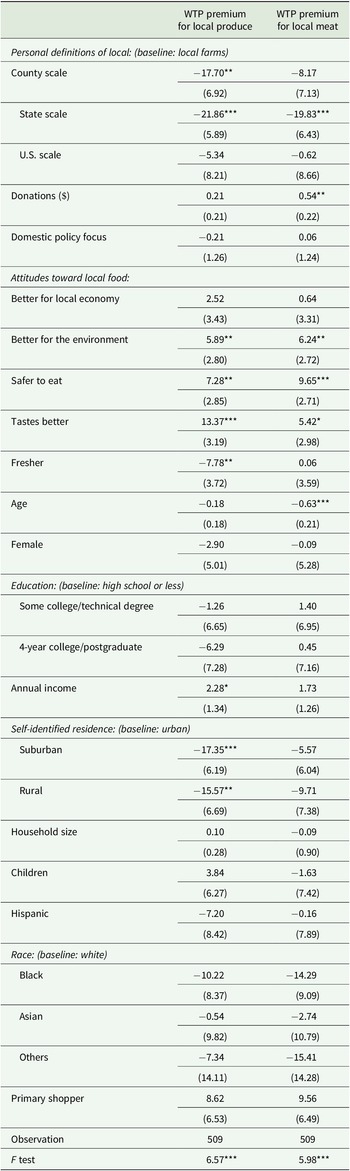
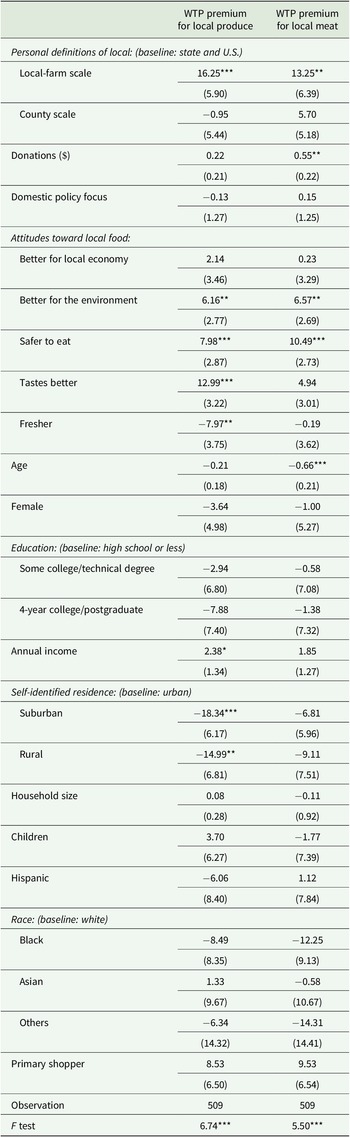
Table 3 presents the marginal effect estimates from the two-limit Tobit models given by (1), estimated separately for WTP premiums for local produce and for local meat.
Heterogeneity in WTP for local food: marginal effects from two-limit Tobit models

Note: F test tests the joint significance. Robust standard errors are shown in parentheses. Significance levels are indicated as follows: *p < 0.1, **p < 0.05, ***p < 0.01.
For both produce and meat, the findings indicate that survey participants with the farm-level personal definition, that is, the reference case, have the highest WTP premiums for local and those with a state-level definition have the lowest WTP premiums. Relative to the farm-level baseline, participants preferring the county-scale definition report an 18-percentage-point lower WTP premium for produce and an 8-point lower premium for meat, though the latter being statistically insignificant. At the state scale, WTP premiums decrease by 22 points for produce and 20 points for meat. By contrast, participants defining local food at the U.S. scale report premiums statistically indistinguishable from the local-farm group. Pairwise hypothesis tests (not reported in Table 3) provide more clarity: For produce, the coefficients on the county scale and the state scale are not statistically different, but the coefficients on the state scale and U.S. scale are. For meat, the coefficients on the county scale and the state scale are statistically different, as the coefficients on the state scale and U.S. scale. These results provide weak support for H1 for produce and partial support for meat, with the U.S.-scale reflecting an important exception to H1. Thus, while our results do suggest heterogeneity of WTP premiums across increasing broad scales of personal definitions, the results do not indicate that this heterogeneity can be explained by a monotonic relationship between definitional scale and WTP premiums.
Donation behavior is positively associated with WTP premiums, but only significant for meat: each additional dollar donated is associated with an approximately 1-=percentage-point increase. This finding indicates that individuals inclined toward charitable giving may also channel this preference into supporting local markets, partially supporting H4.
Domestic policy focus, however, shows no significant association with WTP, contrary to our expectations. Thus, H5 is not supported.
Attitudinal factors play a consistent role. Believing local food is better for the environment increases WTP by approximately 6 points for both produce and meat. Perceiving it as safer to eat raises WTP by 7 points for produce and 10 for meat, with a stronger effect for meat. Participants who believe local food tastes better report premiums 13 points higher for produce and 5 for meat. By contrast, participants who view local food as fresher actually report an 8-point lower premium for produce and no effect for meat. The negative relationship for produce is somewhat unexpected, but is consistent with Li, Ahsanuzzaman, and Messer (Reference Li, Ahsanuzzaman and Messer2020), who find that WTP for local food is largely independent of attributes commonly associated with ‘local’, such as freshness. In the case of meat, the absence of a significant relationship between freshness perceptions and WTP is not surprising, as meat sold through direct marketing channels is predominantly frozen, reducing the relevance of freshness as a distinguishing attribute. Overall, these findings provide partial support for H2.
Demographic factors also matter. Older participants exhibit lower WTP, with each additional year of age associated with a 1-point decrease for meat, though the effect for produce is not significant. Income plays a positive role: each one-level increase in income raises the produce premium by 2 points, with a similar but nonsignificant effect for meat. Residence patterns differ by food type: suburban and rural participants report premiums 17 and 16 points lower for produce than urban participants, but no significant differences emerge for meat. To check robustness, Table A.2 in Appendix A.2 reports results from similar estimations using ordinary least squares (OLS), and the findings remain robust.Footnote 7
Taken together, these results indicate that WTP premiums for local produce are more sensitive to personal definitions of local food and attitudinal factors than are WTP premiums for local meat, highlighting substantial heterogeneity even under a common prescribed definition. To assess whether these patterns depend on the choice of reference category, we then re-estimate the models using alternative baseline definitions that place larger-than-county scales at the point of departure.
Robustness to alternative baselines: larger-than-county definitions
To assess the sensitivity of our findings to the choice of reference category and to address concerns related to the omission of an explicit multistate regional option, we re-estimate the models using alternative baselines that place larger-than-county definitions at the point of departure. Table 4 presents Tobit model estimation results when the state- and U.S.-scale definitions are combined into a single broader definition and used as the baseline reference case.
Heterogeneity in WTP for local food using a combined state–U.S. definition as the baseline

Note: F test tests the joint significance. Robust standard errors are shown in parentheses. Significance levels are indicated as follows: *p < 0.1, **p < 0.05, ***p < 0.01.
Table 4 shows that participants with the local-farm scale definition still have the highest WTP premium for produce, that is, 16 percentage points higher than those with the combined state- and U.S.-scale definition. Participants with a local-farm scale definition also have the highest WTP premium for meat, that is, 13 percentage points higher than those with the combined state- and U.S.-scale definition. Table 4 results also show that the WTP premiums for those with a county-scale definition are not significantly different from those with a combined state- and U.S.-scale definition. This pattern suggests that the primary valuation distinction lies between highly proximate, farm-level interpretations of ‘local’ and broader geographic conceptions, rather than reflecting a smooth administrative gradient across all scales. In other words, once personal definitions extend beyond the farm level, WTP premiums appear to converge. Importantly, this ordering mostly mirrors the structure observed in Table 3, indicating that the core patterns of heterogeneity are generally robust to grouping together participants with a state scale and U.S. scale, a combination that would include participants that might have been included to choose a multistate scale if that choice were available in the original survey.
To provide additional context, we also report summary statistics using the combined state and U.S. category (Table A.3 in Appendix A.3). Respondents in this broader-definition group exhibit higher average domestic policy focus scores, are slightly older on average, and are less likely to have children in the household compared to other groups.
Determinants of personal local-definition choices
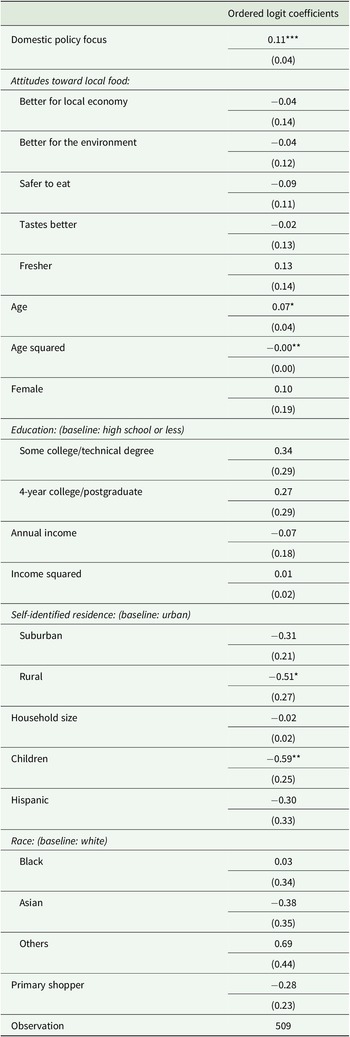
In addition to heterogeneity in WTP, we also examine the determinants of participants’ personal definitions of local food as a complementary analysis. The model in (2) is modified to include squared terms for continuous demographic variables that vary across definitions (see Table 2 for descriptive statistics), such as age and income, to capture potential nonlinear effects. We treat personal definitions of local food as an ordinal outcome, ranging from the narrowest (local farms) to the broadest (U.S. scale), and estimate an ordered logistic regression model. Table 5 reports the results.
Determinants of local food definitions: marginal effects from ordered logit model

Note: The reports coefficients from an ordered logistic regression where the outcome is the local food definition ordered from smallest to largest scale. Robust standard errors are shown in parentheses. Significance levels are indicated as follows: *p < 0.1, **p < 0.05, ***p < 0.01.
The coefficient for domestic policy focus is positive and statistically significant at the 1% level, indicating that individuals who prioritize national over global concerns are more likely to adopt broader, nationally oriented definitions of local food. Age is also positively associated with broader definitions, but the negative coefficient on the squared term suggests a nonlinear effect: the tendency to define local food more broadly increases with age until about 44 years old, after which it declines. Living in a rural area is associated with narrower definitions, suggesting that rural residents tend to favor more localized interpretations, consistent with Carroll and Fahy (Reference Carroll and Fahy2015). Finally, having children in the household is linked to narrower definitions, perhaps reflecting greater concern for local quality or community ties. These findings provide strong support for H6, while failing to support H3, since attitudinal factors are insignificant.
Discussion and conclusion
Our findings reveal substantial heterogeneity in WTP premiums for local food, elicited under a common prescribed 50-mile definition, across consumers who differ in how they personally define the meaning of local. Consistent with expectations, participants who define local food at the most proximate level (local farms) report the highest WTP premiums. As personal definitions broaden to the county and state levels, WTP premiums generally decline, a result that provides partial support for the notion that geographic proximity and familiarity enhance consumer valuation. This pattern aligns with prior studies emphasizing the role of closeness, trust, and perceived connection in shaping preferences for local food (Dickinson and Von Bailey, Reference Dickinson and Von Bailey2005; Choe et al., Reference Choe, Park, Chung and Moon2009).
Importantly, this otherwise monotonic pattern does not extend uniformly across all definitions. Participants who define local food at the national (U.S.) scale report WTP premiums comparable to those of the local-farm group. This deviation suggests that geographic distance alone does not fully explain how consumers value food labeled as local. Instead, broader considerations, such as trust in domestic food systems, perceived quality, or ideologically motivated support for national producers, may also contribute to observed valuation patterns (Kim and Huang, Reference Kim and Huang2021; Zhang, Chen, and Grunert, Reference Zhang, Chen and Grunert2022).
Beyond geographic definitions, our results highlight the importance of altruism and food-related attitudes as additional sources of heterogeneity. Participants who donate more to charity exhibit higher WTP premiums, particularly for meat, suggesting that prosocial orientations extend into food purchasing decisions. Attitudinal beliefs, such as perceiving local food as safer, better tasting, or more environmentally beneficial, are also consistently associated with higher WTP premiums. These findings reinforce the view that preferences for local food reflect a combination of internal motivations and external perceptions. By contrast, domestic policy focus does not exhibit a direct association with WTP premiums, though it is strongly correlated with broader personal definitions of local food. This pattern suggests that policy orientation shapes how consumers conceptualize ‘local’, even if it does not translate directly into higher stated premiums under a prescribed definition.
Results from the ordered logit models further indicate that personal and household characteristics play a meaningful role in shaping how consumers define local food. Rural residents and households with children are more likely to adopt narrower definitions, consistent with stronger place-based ties and quality concerns. Age exhibits a nonlinear association: personal definitions tend to broaden through midlife and then narrow again at older ages. Together, these patterns point to the role of life stage, household context, and community embeddedness in shaping consumers’ interpretations of what constitutes local food.
Several limitations warrant discussion. First, our sample is drawn primarily from the Mid-Atlantic region, an area characterized by large metropolitan populations but relatively limited agricultural land. Virginia, Pennsylvania, New York, West Virginia, Maryland, New Jersey, and Delaware ranked 34th, 35th, 36th, 39th, 40th, 45th, and 46th, respectively, in terms of land in agriculture. Consumer perceptions of ‘local’ in this region may therefore differ from those in more agriculturally intensive areas, which may limit the generalizability of the findings.
Second, WTP was elicited using a prescribed 50-mile definition of local food. This design choice should be interpreted as providing a common operational anchor rather than as an attempt to measure WTP for respondents’ own definitions of local food. Accordingly, we do not claim to identify causal differences in WTP across alternative personal definitions. Instead, our analysis examines how WTP elicited under a shared definition systematically varies across individuals who differ in how they conceptualize local and in the values associated with those conceptions. Although respondents were exposed to a common definition, prior research shows that chronic accessibility continues to exert a reliable effect even under priming conditions, indicating that such primes do not eliminate underlying individual differences in interpretation and valuation (Higgins and Kruglanski, Reference Higgins, Kruglanski, Higgins and Kruglanski1996). Consistent with this perspective, Moreno and Malone (Reference Moreno and Malone2021) demonstrate that collective food identity can shape WTP even when experimental tasks hold ‘localness’ constant across products. More broadly, the effects of primes depend on individuals’ chronic goals and values (Dai et al., Reference Dai, Yang, White, Palmer, Sanders, McDonald, Leung and Albarracín2023), suggesting that heterogeneous responses may persist even under a shared informational anchor. Reflecting this clarification, our primary hypothesis emphasizes heterogeneity in WTP under a predefined local definition rather than causal effects of personal definitions per se.
A third limitation of the survey design is the absence of an explicit multistate regional category between the state and national scales. Prior research emphasizes that many food systems operate at a regional level that spans multiple states, particularly in the U.S. Northeast, where production, processing, and distribution networks are not well aligned with state boundaries (Clancy and Ruhf, Reference Clancy and Ruhf2010; Clancy et al., Reference Clancy, Bonanno, Canning, Cleary, Conrad and Fleisher2017). As a result, some respondents who conceptualize local at a regional scale may have selected either the state or national category, potentially introducing heterogeneity within these broader classifications. Low et al. (Reference Low, Adalja, Beaulieu, Key, Martinez, Melton, Perez, Ralston, Stewart, Suttles, Vogel and Jablonski2015) note that these terms are often used interchangeably, and prior empirical studies document substantial variation in how consumers interpret geographic origin labels (Duram and Oberholtzer, Reference Duram and Oberholtzer2010; Onozaka, Nurse, and Thilmany, Reference Onozaka, Nurse and Thilmany2010). To assess whether the absence of an explicit regional option materially affects our conclusions, we group the state- and U.S.-scale definitions into a single broader category and use it as the baseline reference in a re-estimated model. The general stability of the coefficient estimates across specifications suggests that the core patterns of heterogeneity documented in this study are unlikely to be driven solely by the omission of a multistate regional definition.
Finally, because the survey was conducted during the COVID-19 pandemic, concerns about external validity may arise. Evidence from the U.S. Department of Agriculture shows that food expenditures shifted substantially during the pandemic, reflecting changes in purchasing channels and supply chain disruptions.Footnote 8 Importantly, changes in expenditures do not necessarily imply corresponding changes in underlying food preferences or valuation structures. Chenarides et al. (Reference Chenarides, Grebitus, Lusk and Printezis2021) document that consumption of major food groups remained largely stable for most consumers, while Ellison et al. (Reference Ellison, McFadden, Rickard and Wilson2021) show that core food values, such as taste and quality, were relatively stable during the early stages of COVID-19, which coincides with the timing of our survey. Although local and independent food businesses contributed to supply chain resilience during periods of disruption (Hobbs, Reference Hobbs2021), experimental evidence suggests that pandemic salience does not mechanically inflate WTP for local food and may even reduce stated premiums (Vecchi, Jaenicke, and Schmidt, Reference Vecchi, Jaenicke and Schmidt2022). Because our analysis focuses on relative differences in WTP across consumers facing the same informational anchor, the heterogeneity patterns documented here are less likely to be driven solely by pandemic-induced shifts in purchasing behavior. Nevertheless, caution is warranted in generalizing the magnitude of estimated premiums beyond the COVID-19 context.
Taken together, our results indicate that consumers’ personal definitions of local play an important role in shaping heterogeneity in WTP, even when WTP is elicited under a common, prescribed definition. While a large literature emphasizes heterogeneity in WTP, our findings suggest that heterogeneity in how consumers conceptualize the product itself represents an additional dimension of variation in estimated WTP premiums that has received comparatively less attention in prior work.
More broadly, our results highlight the limitations of relying on a single standardized definition of local food. Consumers who adopt narrower definitions (e.g., farm- or county-scale) consistently report higher WTP premiums than those who define local at the state level, whereas consumers adopting the broadest definition observed in this study (U.S. scale) exhibit premiums comparable to the farm-scale group. This nonmonotonic pattern indicates that geographic proximity alone may not fully explain consumer valuation of local food, and that symbolic, institutional, or identity-based interpretations could also contribute to observed differences in WTP.
Overall, these findings have important implications for both research and practice. For researchers, they highlight the value of explicitly considering definitional heterogeneity when interpreting WTP estimates for local food. For policymakers and marketers, the results suggest that ‘one-size-fits-all’ definitions and promotional strategies, such as uniform state-based branding, may not resonate uniformly across consumers whose understandings of ‘local’ differ in systematic ways. Future research could build on this work by incorporating explicit regional categories, examining postpandemic settings, and linking stated willingness to pay to observed purchasing behavior in real-world markets.
Supplementary material
To view supplementary material for this article, please visit http://doi.org/10.1017/S1742170526100386.
Author contribution
C.-L.H.: writing—original draft, investigation, formal analysis, conceptualization. M.V.: methodology, writing—review and editing, formal analysis, supervision, conceptualization. E.C.J.: writing—review and editing, supervision, formal analysis.
Funding statement
This work was supported by the Institute for Sustainable Agricultural, Food, and Environmental Science (SAFES) at the Pennsylvania State University (Impacts of COVID-19 on Agricultural, Food, and Environmental Systems grant).
Competing interests
The authors declare no conflicts of interest.


 Open access

