

Introduction
In January 2009, during Israel’s conflict with the Palestinian Hamas in Gaza, the Islamist daily Al-Tajdid published a front-page article titled “Ya Amazigh al-Maghrib, Ayn Antum min Filastin?” (O Amazigh of Morocco, Where Do You Stand on Palestine?). The article criticized the noticeable absence of Amazigh associations and activists at solidarity demonstrations for Palestine (Maddy-Weitzman, Reference Maddy-Weitzman2011, 150). Nearly 15 years later, during the Israel-Hamas war that followed Hamas’ attacks on October 7, 2023, the main Kurdish political movements in Turkey and beyond remained mainly on the margins of anti-Israel protests. In February 2024, a small delegation of Kurdish diaspora organizations, including the Kurdish Community of Germany (Kurdische Gemeinde Deutschland-KGD) and the Kurdish Diaspora Confederation (DIKURD) of Kurds from Germany, Denmark, and Austria, traveled to Israel to express solidarity with the Jewish people (Frantzman, Reference Frantzman2024). In April 2025, the Kurdistan Regional Government in Erbil denied a request from the two small Islamist parties to hold a mass rally in support of Gaza (Rudaw, 2025).
This stands in stark contrast to the widespread support and sympathy coming from Turkey, as graphic images of death and destruction in Gaza were continuously broadcast by Turkish television stations and news media. In November 2023, shortly after Israel began its attacks on Gaza, Turkey’s Grand National Assembly (TGNA) removed Coca-Cola and Nestle products from its restaurants, citing these companies’ alleged support for Israel (Reuters, 2023). Kurdish supporters of Free Cause Party (Hür Dava Partisi, HÜDA-PAR), a small political party rooted in the Islamist Kurdish Hizbullah, organized anti-Israel protests in the Kurdish cities of Diyarbakir and Batman. Supporters of HÜDA-PAR and other Islamist Kurdish groups in Diyarbakir aligned with the ruling Justice and Development Party (Adalet ve Kalkınma Partisi, AKP) stormed Starbucks and Burger King in August 2024 while chanting Allahu Akbar and anti-Israel slogans (Duvar, 2024).
Between October 7 and December 31, 2023, during the first months of the war when emotions were exceptionally high, Adiyaman, a Kurdish-majority province with limited support for the pro-Kurdish parties, recorded 20 peaceful protests, per the Armed Conflict Location & Event Data Project (ACLED) (Raleigh and Linke, Reference Raleigh, Kishi and Linke2023). Thirteen of those events condemned Israeli attacks on Gaza and the Palestinians, organized by various parties and civil society organizations. The pro-Kurdish Peoples’ Equality and Democracy Party (Halkların Eşitlik ve Demokrasi Partisi, DEM) organized two protests, one against the police confiscation of containers belonging to civil society organizations and another opposing Turkey’s cross-border military operations against the PKK in Syria and Iraq. HÜDA-PAR similarly organized two events, but both events were to protest Israel’s “attacks” on Gaza and Palestinians. In Şırnak, a stronghold of the Kurdish political movement, ACLED records 37 protest events during the same period, ten of which specifically opposed Israeli attacks on Gaza and the Palestinians. Only one of these protests was (co-)organized by the pro-Kurdish party. In both Kurdish provinces, most of the remaining protests were organized by groups closely aligned with the AKP or HÜDA-PAR.
What explains these starkly different responses from the Kurds in Turkey? Drawing on in-depth qualitative interviews with the members of the TGNA, we outline markedly different portrayals of the Palestinian question and its relevance to the Kurdish struggle for rights and recognition. We further examine the support (or lack thereof) for the Palestinians and attitudes toward Jews in Turkey using a nationwide probability sample collected in November 2024. Findings from the face-to-face interviews and a nationwide public opinion poll reveal different justifications for supporting Palestinians. We explore how contrasting ideological perspectives interact with the shifting regional dynamics to shed light on the limits of cross-national inter-group solidarity.
A theory of intergroup cross-national solidarity
Intergroup solidarity describes a sense of unity, alliance, and mutual support that develops between different groups, even when they might otherwise view themselves as distinct, separate, or adversarial. Most research on intergroup solidarity examines two primary dynamics: why majority groups extend support to minority causes and how minority groups forge alliances with other marginalized groups to confront shared challenges posed by dominant groups or oppressive states (Chayinska et al., Reference Chayinska, Minescu and McGarty2017; EdwardsandKim, Reference Edwards and Kim2019; Reicher et al., Reference Reicher, Cassidy, Wolpert, Hopkins and Levine2006). However, these studies often focus on solidarity dynamics within the same national context (Abdelhadi and O’Brien, Reference Abdelhadi and O’Brien2020; Gurin et al., Reference Gurin, Miller and Gurin1980). Research on how and why ethnic minorities in one country extend political solidarity to ethnic minorities in another country remains limited.
Group Empathy Theory suggests that shared experiences of unfair treatment and discrimination can help minority groups set aside their differences, such as real or perceived competition over limited resources, and foster empathy that improves intergroup relations (Sirin et al., Reference Sirin, Valentino and Villalobos2016). A landmark 1980 study, frequently cited as evidence of strong solidarity with other minority groups among African Americans, shows that Black Americans with the strongest sense of shared deprivation were more inclined to voice political support for addressing the lower-status conditions of women and the poor (Gurin et al., Reference Gurin, Miller and Gurin1980). A more recent study found that Muslim Americans who perceive themselves or their community as targets of discrimination are also more likely to recognize the challenges faced by other marginalized groups and support their causes (Abdelhadi and O’Brien, Reference Abdelhadi and O’Brien2020). These findings reinforce earlier research on the potential for political coalition-building among disadvantaged groups, driven mainly by perceived collective grievances and group consciousness.
A shared sense of common cause with other minority groups is a crucial factor that influences the level of intergroup solidarity. Research indicates that even minimal participation by individuals in the movements of other minority groups can significantly bolster this solidarity. The effect is further magnified when acts of solidarity are communicated to members of the recipient minority groups via mass media or social media platforms (Kim, Reference Kim2023). While the study emphasizes national identity as a key determinant of “shared interest” and a foundational element of intergroup solidarity, this argument can also be applied to contexts where different groups are perceived to share and promote common political objectives, such as the quest for freedom from oppression.
Recent developments in international politics have demonstrated that this effect can also be observed in states’ foreign policy objectives. South Africa’s act to take Israel to the International Court of Justice on charges of genocide, aiming to exert pressure on the Israeli government to end the war in Gaza, illustrates that historical ties and shared experiences of oppression play key roles in determining intergroup solidarity both at the group and state levels. Groups that have endured systemic discrimination, colonialism, or apartheid frequently empathize with others facing comparable struggles. The global struggle against apartheid became a powerful symbol for anti-colonial movements, fostering connections across borders.
South Africans identify with Palestinians due to analogous histories of racial or ethnic injustice and colonialism (Said, Reference Said1992). The historical ties between the South African liberation movement and Palestinian groups during the anti-apartheid struggle were further strengthened through mutual training and ideological alignment, emphasizing solidarity against perceived injustice and oppression (Pontarelli, Reference Pontarelli2024). Similarly, while most European countries offered Israel “unwavering” support during the Israel-Hamas war, Ireland has taken a different approach. For many in Ireland, solidarity with the Palestinians reflects “a shared experience of subjugation by an occupying state.” Such a long-standing position has fostered a profound connection between the two groups, geographically distant yet united in their shared aspirations for justice and freedom. This enduring solidarity continues to influence international discourse and amplify advocacy for Palestinian rights (Kennedy and McSweeney, Reference Kennedy and McSweeny2024).
Realpolitik and the limits of cross-national solidarity
Minority armed groups often express solidarity with the struggles of other minorities, with this support intensifying when the groups share similar political ideologies. This dynamic was particularly visible during the 1970s and 1980s, when both the Palestinian Liberation Organization (PLO) and the Kurdistan Workers’ Party (Partiya Karkerên Kurdistan, PKK) embraced leftist ideologies (Genç, Reference Genc2020). During this period, parts of the PLO operated transnationally, collaborating with leftist movements such as the Revolutionary Armed Forces of Colombia, the German Red Army Faction, and the Japanese Red Army, along with the PKK (Dana, Reference Dana2018). Similarly, in later years, Black-Palestinian solidarity emerged from a shared focus on political and experiential parallels, reflecting “a preoccupation with political and phenomenological sameness” (Hill Reference Hill2018, 953).
These examples overlook the changing domestic and international political dynamics and shifting ideological alignments in explaining whether a minority group chooses to extend political support to a similarly situated minority group in another country. The relationship between political ideology and political solidarity becomes increasingly intricate when solidarity extends to cross-national groups, especially in cases involving minorities in conflicts with their respective states.
The rise of political Islam in Palestine during the 1980s introduced a new ideological dimension to the Palestinian national movement. Notably, the rise of the Islamic Resistance Movement (often known as Harakat al-Muqawamah al-Islamiyya, Hamas) in 1987 marked a pivotal shift, advancing an anti-colonial Islamic agenda that challenged the secular and nationalist dominance of the PLO (Dana, Reference Dana2018). This ideological evolution also altered relationships with other movements, including the Kurdish-Palestinian alliance (Jensehaugen and Tank, Reference Jensehaugen and Tank2022). Palestinians aligned with Hamas increasingly turned to Erdogan’s Turkey as a prominent ally, while segments of the Kurds gravitated toward Israel in reaction to Erdogan’s outspoken support for the Palestinian cause (Genç, Reference Genc2020).
These realignments underscore the complex interplay between transnational solidarity, political ideology, and intergroup dynamics. Evident in Ireland-Palestinian solidarity networks, as movements and politics become more ideologically diverse, solidarity becomes increasingly complex and fragmented (Bitran et al., Reference Bitran, Ilana and Laudenbach2022). The Ireland-Palestine Solidarity Campaign experienced internal division due to significant disagreements over the Hamas-Fatah and Palestinian Authority split in 2006 and 2007. Members were divided on whether to side with Fatah and Hamas or support the Palestinian Authority, reflecting the broader challenge of maintaining solidarity amidst ideological differences (Louvet, Reference Louvet2016).
While factors such as perceived threats, political opportunities, prior social ties, and ideological alignment (Dixon et al., Reference Dixon, Levine, Reicher and Durrheim2012) play a crucial role in facilitating solidarity, cross-minority solidarity can be challenging when there is a shift in shared goals and an emergence of a conflict of interests (Gawerc, Reference Gawerc2021; Rogers, Reference Rogers2004). A shared experience of subjugation (even after the minority secured rights in their countries), along with political ideology, may help explain how the Irish, South African, or Black Americans (Nasir and Morrison, Reference Nasir and Morrison2023) responded to the latest Israel-Hamas conflict. Neither the Irish nor the South Africans are directly affected by the conflict, having long resolved their own conflicts and lacking immediate regional interests tied to the Palestinian issue. This interpretation is consistent with Schreiber et al.’s (Reference Schreiber, Ulug and Drury2026) argument regarding the issue-specific nature of solidarity with Palestinians and the “associated costs” such solidarity entails. In other words, individuals are more likely to express solidarity when doing so entails minimal effort and risk.
Ideological shifts within Palestinian leadership, combined with the United States and Israel’s direct or indirect backing of Kurds in Syria and Iraq, have complicated the cost-benefit analysis for the Kurds. This dynamic is further intensified by the fact that Kurdish demands for recognition have often been suppressed by states that simultaneously endorse Palestinian aspirations for statehood. The contradictions embedded in these alignments are also visible in symbolic politics. In 2017, Palestinians in the West Bank erected a statue honoring Saddam Hussein for his support of their cause,Footnote 1 despite his responsibility for the Anfal genocide against the Kurds in the late 1980s. As Tokdemir (Reference Tokdemir2021, 1035; see also Tokdemir et al. Reference Tokdemir, Akcinaroglu, Ozen and Karakoc2020) demonstrates, “intergroup conflict conditions individuals’ attitudes toward foreign states by triggering ‘the friend of my friend is my friend’ and ‘the friend of my enemy is my enemy’ rationales.”
Tales of two stateless peoples
There are notable parallels between Palestinians and Kurds. Both are stateless people in the broader Middle East, spanning internationally recognized territorial borders. This has turned their decades-long conflicts with Israel and Turkey, respectively, into a transnational conflict. Emerging in the post-World War II era and gaining momentum during the 1960s and 1970s, various factions claiming to represent the Palestinian and Kurdish national causes have taken up arms against what they perceive as “occupying” powers. The PLO and the PKK gradually emerged as the leading political movements in their respective communities.
Influenced by global leftist movements prevalent during the Cold War, the PLO and the PKK adopted similar worldviews and tactics to justify their struggles and rally support for their causes (Genc, Reference Genc2020). The PKK benefited greatly from the Palestinian training camps in Lebanon in the early 1980s. The Palestinian groups in Damascus and camps in Lebanon, notably those of the Palestinian Democratic Front, provided a lifeline for the PKK, which was in its infancy and trying to survive the Turkish state’s heavy repression of the early 1980s (Akkaya, Reference Akkaya2015).
Among the various Palestinian factions, al-Fatah emerged as the principal representative of the Palestinian people. Under Fatah’s leadership, the PLO entered into a series of agreements with Israel between 1993 and 1999, collectively known as the Oslo Peace Accords, which led to the establishment of the Palestinian Authority in parts of the West Bank and the Gaza Strip (Brown, Reference Brown2003; Hassan, Reference Hassan2011). Despite these political gains, Fatah’s predominantly secular-nationalist orientation and its central role in the post-Oslo political order soon faced serious challenges from Islamist Palestinian movements, most notably Hamas (Abu-Amr, Reference Abu-Amr1993). Over the following decade, Hamas consolidated its position as a powerful political and military actor, ultimately expelling Fatah from the Gaza Strip in 2006.
The end of the Cold War also brought about significant changes for the Kurds. Iraq’s invasion of Kuwait in the early 1990s, followed by the US-led military intervention against Saddam Hussein’s regime, enabled the emergence of a de facto Kurdish autonomous region in northern Iraq. These developments allowed the PKK to strengthen its influence over the border areas between Turkey and Iraq, relocating most of its training camps from Lebanon to these newly established zones amid the declining central authority in Iraq. Against the backdrop of these changes, which coincided with the collapse of the Soviet bloc, a historically significant source of direct or indirect military, financial, and diplomatic support for leftist insurgent movements during the Cold War, the PKK leadership offered a robust critique of the Soviet socialist model.
Beginning with the PKK’s Fifth Congress in 1995 and gaining traction after the arrest of its leader, Abdullah Öcalan, in 1999, the PKK underwent a profound transformation. This shift underscored a democratic solution to the Kurdish issue within internationally recognized borders. While the secular Palestinian camp was experiencing a decline in influence due to the rise of Islamist factions, the PKK movement embarked on a distinctly secular, pro-gender equality democratic initiative, advocating for a restructuring of the Turkish political landscape to create space for Kurds and other marginalized groups (Gunes, Reference Gunes2012; Gurses, Reference Gurses2018; Jongerden, Reference Jongerden2019).
In Syria, the Democratic Union Party (PYD), a group inspired by the PKK, steadily emerged as the United States’ most reliable ally in the fight against the Islamic State (IS) during the country’s devastating civil war (Knightsandvan Wilgenburg, Reference Knights and van Wilgenburg2021). These developments significantly strained Turkish-American relations, particularly as PYD-U.S. collaboration was perceived in Ankara as a direct threat to Turkey’s national security. At the same time, Turkey began forging closer ties with Hamas in Gaza.
Diplomatic relations between Turkey and Israel deteriorated sharply following the Israeli raid on the Mavi Marmara on May 31, 2010. The Turkish-owned ferry, part of a flotilla organized by the İnsani Yardım Vakfı (IHH, Humanitarian Aid Foundation), an organization Israel has accused of maintaining ties with Hamas, was attempting to break the Israeli naval blockade of Gaza. The raid, which resulted in the deaths of ten Turkish nationals, marked a turning point in Turkish-Israeli relations and triggered widespread public outrage in Turkey. Although the two countries reached an agreement in 2016 to normalize diplomatic ties, the relationship remained fraught with mistrust and political tension, even as bilateral trade continued largely uninterrupted.
On October 7, 2023, Hamas militants crossed from Gaza into Israel, killing approximately 1,200 people and abducting around 250 hostages, most of whom were civilians, reigniting and escalating these tensions. The ensuing Israel-Hamas war devastated the Gaza Strip, “reducing much of the enclave to rubble” (Tanno and Krever, Reference Tanno and Krever2025), and resulted in more than 66,000 deaths and nearly 170,000 wounded (PBS News, 2025).
These developments further strained Turkish-Israeli relations, as President Erdogan repeatedly characterized Hamas as a “liberation movement” and denounced Israel as a “terrorist state.” In response, Israeli Prime Minister Netanyahu, whom Erdogan labeled the “Butcher of Gaza,” took to social media to accuse Erdogan of “supporting terrorism” and the “terror state of Hamas.” In late December 2023, Erdogan delivered another fiery speech, comparing Netanyahu to Hitler. Netanyahu responded on the social media platform X: “Erdogan, who is committing genocide against the Kurds and who holds the world record for imprisoning journalists who oppose his regime, is the last person who can preach morality to us” (King, Reference King2023).
Around the same time Israel launched airstrikes in Gaza, the Turkish government was bombing Kurdish areas in Northern Syria. In late October 2023, a report from Human Rights Watch expressed serious concerns regarding Turkey’s airstrikes and drone attacks on Kurdish-controlled regions in northeast Syria, highlighting that these operations had caused considerable damage to water and electricity services for millions of people (Zayadin, Reference Zayadin2024).
Erdogan’s Turkey, driven by an assertive foreign policy infused with neo-Ottoman nostalgia (Adısönmez and Al, Reference Adısönmez and Al2025; Yavuz, Reference Yavuz2020) and religious populism (Tepe et al., Reference Tepe, Simonds and Dirksen2022), has sought to position itself as the defender of the Palestinian cause. In contrast, the United States, and to a lesser extent Israel, have come to be perceived as allies of the Kurds, first in Iraq and more recently in Syria. This juxtaposition has fostered a sense of hypocrisy among many Kurds who themselves have a long history of discrimination in their respective countries. Coupled with the Kurdish political movement’s secular orientation, this dynamic has produced a framing of the Palestinian question marked by skepticism and realpolitik, which we elaborate on in the following section.
Kurdish political elites and the Palestinian question
To understand varying positions on the Palestinian question, we conducted 16 in-depth interviews with Members of Parliament (MPs) in Ankara in December 2023. Of these 16 MPs, ten were from the pro-Kurdish DEM, two were from the AKP, two were from HÜDA-PAR, one was from the Republican People’s Party (Cumhuriyet Halk Partisi, CHP), and one was from the Democracy and Progress Party (Demokrasi ve Atılım Partisi, DEVA).
All but three of the MPs were of Kurdish origin, representing constituencies in the predominantly Kurdish provinces of Diyarbakır, Van, Batman, Şırnak, and Agrı, as well as districts in western, Turkish-majority provinces such as Ankara, Kocaeli, and Mersin. Of the sixteen MPs, four were women. While all MPs from the AKP, DEVA, CHP, and HÜDA-PAR were Kurdish, the sample also included three DEM MPs of Turkish ethnicity who have been outspoken on the Palestinian issue.
The Kurdish electorate in Turkey is both extensive and internally diverse, shaped by multiple social and ideological cleavages, including urban-rural, left-right, religious (conservative/Islamist vs. moderate/secular), and sectarian (Sunni vs. Alevi). Politically, however, they are primarily divided between the pro-Kurdish DEM Party and the center-right and center-left parties, most notably the AKP since the early 2000s. Smaller parties also play a role in this landscape: HÜDA-PAR has participated in an electoral alliance with the AKP, while DEVA, as an offshoot of the AKP, shares many of its ideological and policy orientations, thereby appealing to a similar conservative constituency. Among the MPs we interviewed, the sole representative from the CHP, Turkey’s main opposition party, was ideologically and politically closer to the pro-Kurdish DEM Party than to the AKP.
The official party programs of these two broad camps also mirror this political division. HÜDA-PAR’s program identifies “rejuvenating Islamic values” as a core objective and underscores solidarity with Palestinians by maintaining representations in Jerusalem, Gaza, and Ramallah.Footnote 2 The HÜDA-PAR, AKP,Footnote 3 and DEVA PartyFootnote 4 all make explicit references to “morality” and “freedom of faith,” terms that function as code words for Islamic values in Turkish political discourse. By contrast, the DEM Party’s program situates its agenda within a democratic and gender-equal framework encompassing all ethnic, religious, and cultural groups, without once invoking the word Islam.Footnote 5 The CHP, the oldest party in modern Turkey and the current main opposition, grounds its program in secularism (laiklik) and individual freedoms, consistent with its founding principles.Footnote 6
The interviews were conducted in the offices of the MPs and lasted approximately one hour each. We asked the MPs to reflect on how they described the recent Israel-Hamas war, how they situated it within the broader Israeli-Palestinian conflict, and how they interpreted the Turkish government’s stance on the issue. We also asked them to define the Kurdish question in Turkey and to consider whether they perceived any parallels between the Kurdish issue and the Israeli-Palestinian conflict.
Consistent with the DEM Party’s official platform, its representatives framed the Israeli-Palestinian conflict as a political and rights-based issue, rooted in Israel’s democratic deficiencies. In contrast, Kurdish MPs from the AKP and HÜDA-PAR viewed both the Israel-Palestinian conflict and the recent Israel-Hamas war primarily through a religious lens, emphasizing Israel’s “unlawful” claim over Muslim sacred territories and its repression of Muslims more broadly, as the following quote illustrates:
[To us] it is about Jerusalem that goes beyond the Palestinian issue…After all, Jerusalem is the first qibla of the Muslims…They took Jerusalem from us (December 22, 2023).
Reflecting this historical perspective, an MP from HÜDA-PAR attributed the origins of the conflict to what he described as the Zionist ideology driven by the ambition to seize Muslim lands:
In our opinion, this issue is not just an Israel-Palestine issue. It is not even Israel; it is the occupier Israel, namely the Zionists [who are the reason for the conflict]. After all, they do not adhere to the previously established boundaries…They keep occupying lands with an expansionist policy…Zionists are a threat to humanity (December 21, 2023).
Parliamentarians from both AKP and HÜDA-PAR emphasized Muslims’ “righteous claim” to the territories that the Jews claim as their own. One Kurdish MP from the AKP, who had previously served as imam, went even further, suggesting that the underlying cause of the conflict lies in what he described as the “moral corruption of the Jewish people”:
If we consider some issues from a faith-based perspective, we must turn to the Qur’an, which was sent as guidance for all of humanity… Among the groups frequently mentioned in the Qur’an is Bani Israel—the Children of Israel, the descendants of Prophet Jacob, whose name is also Israelullah. The Qur’an refers to them extensively. Why? It discusses the prophets sent to them and their fierce resistance and opposition to their prophets. According to the Qur’an, they martyred, beheaded, and hanged 17 of their prophets. Such was the extreme perversion of this nation (December 22, 2023).
Although not necessarily portraying the conflict as a breach of Muslims’ right to their lands, the Kurdish MP from the DEVA Party also described it in Islamic terms:
Western institutions and value systems have collapsed…The Western system has devoured all the idols it created in this latest attack. This has turned into a genocide, a grave crime against humanity. Imagine, they [Israel] are bombing a church—there is no objection to this. There is a reckoning within the Muslim world (December 22, 2023).
In contrast, Kurdish MPs from the DEM Party, while recognizing Palestinians as an oppressed people, stressed the importance of condemning the violence perpetrated by Hamas. As one DEM parliamentarian put it:
From the very beginning of the Israel-Palestine issue, Kurds have developed a different kind of empathy and a unique political connection, standing in solidarity with oppressed peoples around the world, striving to understand them, and supporting their struggles. This stance has become most visible in the context of the Palestinian issue…Of course, [the DEM] also stands against Hamas’ massacres targeting civilians. Opposing Hamas’ attacks on civilians does not mean a lack of solidarity with the Palestinian people (December 21, 2023).
Some DEM Party participants suggested addressing the issue by prioritizing the needs and security of both peoples and by unequivocally condemning violence against civilians. They emphasized the importance of opposing discrimination against Jewish people while simultaneously holding the Israeli state accountable for its actions, as reflected in the remarks of the DEM MP quoted below:
When defending the Palestinians, it is essential to assess the situation without positioning the Jewish people as adversaries. The Israeli government’s actions towards Palestinians are unacceptable, amounting to racism. But I also see certain IS-like tendencies rooted in the Islamist ideology of Hamas (December 20, 2023).
The evolving political dynamics in the Middle East and changes within the Palestinian leadership have further complicated DEM’s stance on the issue. As a DEM parliamentarian argued, the recent sufferings of Kurds in Turkey and Rojava [Syrian Kurdish regions] curtailed Kurdish reactions. This emotional burden made it difficult for Kurds to demonstrate solidarity:
Our base experienced a schizoid split—a feeling of “Why should I oppose this [any political event that does not concern Kurds]?”…This was the widespread mood among the Kurds: “My house has been set on fire. I’m burning. They come and poke me with a stick, saying, now react to this as well.” That’s why the DEM limited itself to principled objections, emphasizing that Israel’s actions are unacceptable and calling for a democratic platform and a diplomatic solution (December 21, 2023).
For AKP MPs, Israel’s support for the Kurds in Syria was yet another reason to vilify Israel. This stance also served as a basis to discourage any potential Kurdish-Israeli alliance, as expressed by an AKP MP:
Israel has expressed sympathy for the Kurdish demands. Of course, these sympathetic messages were driven by Israel’s stance against Arabs, Persians, and Turks. It is not because Israel loves the Kurds [but] “the enemy of my enemy is my friend.” Otherwise, what do the Kurds and Israel have in common? Kurds are Muslims (December 20, 2023).
An equally divergent picture emerged when asked about whether they see parallels between the Palestinians and Kurds. The DEM MPs drew parallels between the two groups, characterizing both as communities that have faced discrimination from authoritarian states and deserve recognition, as illustrated by the quote below:
Palestinians and Kurds share the same fate. Kurds suffer because they don’t have a state of their own and cannot embrace the states they live in…I showed photos of a Palestinian kid and a kid in Rojava to the Turkish Minister of Defense [and asked him]: How do you explain this? For us, these children’s religion, language, and ethnic identity are not of significance… Israel is building settlements in Palestinian lands. Turkey is doing the same thing in Rojava (December 20, 2023).
HÜDA-PAR and AKP MPs offered a contrasting perspective, contending that the shared faith between Kurds and Turks serves as a basis for peaceful coexistence, unlike the Israelis and Palestinians, who adhere to different religions. For instance, an AKP MP noted that while the Palestinian issue arises from Israel’s unlawful seizure of Muslim lands, the Kurdish issue is solely a consequence of the actions of what he termed as “terrorism” [of the PKK].
There are no parallels between the Palestinian and Kurdish issues. Their sociological, ideological, and historical contexts are entirely different. Israel settled there and created a religious state. Their interpretation of religion commands them to claim the so-called “promised lands.” They believe they are fulfilling the requirements of their faith. Consequently, they oppress and kill the Palestinians, the other rightful inhabitants of those lands…There is no similarity between this issue and the Kurdish issue, none whatsoever (December 20, 2023).
The argument and insights from the in-depth face-to-face interviews presented above suggest that Kurds, compared to the dominant Turks, will be more likely to hold favorable attitudes toward Palestinians. This expectation reflects the broader proposition that marginalized groups may display greater solidarity with other communities perceived as victims of state power (Hypothesis 1).
Yet this baseline expectation does not fully capture the contextual and conditional nature of minority solidarity, which is shaped in part by political positioning and ideological orientation. Among Kurds, those aligned with the Kurdish political movement should be less likely to express negative attitudes toward Jews and Israel. This expectation stems from the strategic and ideological positioning of Kurdish ethno-national actors, whose geopolitical calculations may temper anti-Israeli sentiment (Hypothesis 2).
Lastly, we expect religiosity to exert a dual and potentially polarizing effect. Specifically, higher levels of Islamic religiosity are likely to increase the probability of expressing positive attitudes toward Palestinians while simultaneously heightening negative attitudes toward Jews and Israel. This expectation is consistent with research showing that co-religiosity fosters empathy and prosocial behavior toward religious in-groups while intensifying negative sentiments toward religious out-groups (Ciftci et al., Reference Ciftci, Nawaz and Sydiq2015; Ysseldyk et al., Reference Ysseldyk, Matheson and Anisman2010). Crucially, the strength of this shared religious identity depends on the centrality of religiosity to one’s self-conception. As religiosity becomes more central to individual identity, Muslim in-group solidarity tends to intensify, deepening the experience of co-religiosity and amplifying solidarity-driven sentiments (Yabanci and Elçi, Reference Yabanci and Elçi2026). Consequently, higher levels of religiosity should lead to greater support for Palestinians while reinforcing negative attitudes toward Jews and Israel (Hypothesis 3).
Data and design
To empirically test the hypotheses presented above, we draw on a representative nationwide survey conducted in November 2024 (N = 2,961). The data were collected by KONDA Research and Consultancy, an Istanbul-based public opinion company, using a multistage, stratified, cluster sampling technique from 12 geographic regions, as defined by the Turkish Statistical Institute.
Outcome Variables: We used responses to a series of questions to assess (1) attitudes toward Palestinians, (2) views of Jews, and (3) support for boycotting Israeli products. Participants were asked how they characterized the Israel-Palestine conflict and to indicate how close they felt toward Palestinians. To capture attitudes toward Jews and Israel, we relied on responses to the statement, “Jews are responsible for most of the world’s wars.” Agreement with this antisemitic trope provides additional insight into hostility toward Jews and, indirectly, toward Israel (Fox and Topor, Reference Fox and Topor2021). We also collected data regarding respondents’ actions toward Israeli products, including whether they reported boycotting Israeli goods and, if so, which specific products they chose to boycott.
Explanatory Variables: Our theoretical framework highlights three central dimensions: membership in a marginalized group (captured by self-identification as Kurdish), group consciousness and ideology (operationalized through electoral support for pro-Kurdish political parties), and Islamic religiosity.
Reflecting Turkey’s ethnic divide, most respondents self-identified as Turk (79%). The self-identified Kurds comprised 16% of the sample.Footnote 7 The remaining respondents identified as Arab (1.52%), ethnic other (1.99%), or declined to answer the question on ethnic identity (1.18%).Footnote 8
The governing AKP and the DEM are the most popular political parties among the Kurds. Established in 2012 as the HDP and later rebranded, DEM serves as the central platform for Kurds advocating for political and cultural rights. Shortly before the May 2023 elections, the HDP faced charges of being associated with the outlawed PKK, leading its members to form the Green Left Party (Yesil Sol Parti, YSP) to avoid a potential closure by Turkey’s top court. The term “pro-Kurdish parties” refers to the HDP, YSP, and DEM.
We use responses to the question, “Which party did you vote for in the May 2023 general elections?” to code partisan support, including support for the HDP/YSP and other parties. Among the 2,498 respondents who answered this question, 31% reported voting for the CHP, followed by the AKP (28%), the Nationalist Action Party (MHP) (4.76%), the HDP/YSP (4.12%), and the Good Party (IYI) (1.88%). Approximately 30% reported that they were undecided, did not vote, or voted for smaller parties.
Our measure of religiosity ranges from 1 to 5, with higher values indicating higher levels of religiosity (1 = Atheist; 2 = faithless; 3 = faithful; 4 = Religious; 5 = Devout). The “religious” category was the most popular (45%), followed by the “faithful” (36%) category. Roughly 8% of the sample was “atheist” or “faithless,” and 11% said they were “devout.”
We also controlled for respondents’ sex, age, education, and income level. Sex is dichotomized (1 = female; 0 = male), with female respondents comprising 48.91% of the sample. The education variable is coded from 1 (illiterate) to 8 (doctoral degree). High school graduates comprised approximately a third (35.11%) of the sample, with college graduates making up 22%. The age variable is divided into seven categories: 15–17 years, 18–29, 30–39, 40–49, 50–59, 60–69, and 70 and older. Of the 2,624 respondents who answered this question, 27% were in the 18–29 age group, 10% were aged 60–69, about 5% were 70 or older, and 2% were between 15 and 17 years old. The remaining respondents were approximately evenly distributed among the age groups of 30–39, 40–49, and 50–59 years.
To account for income level, we used responses to the question, “Did you make ends meet last month?” Responses ranged from 1 to 4, with higher numbers indicating greater economic hardship. Only 17% of respondents reported being able to make ends meet while saving some money. Nearly half, 48%, stated that they struggled to make ends meet, while the remaining respondents reported that they could not make ends meet last month.
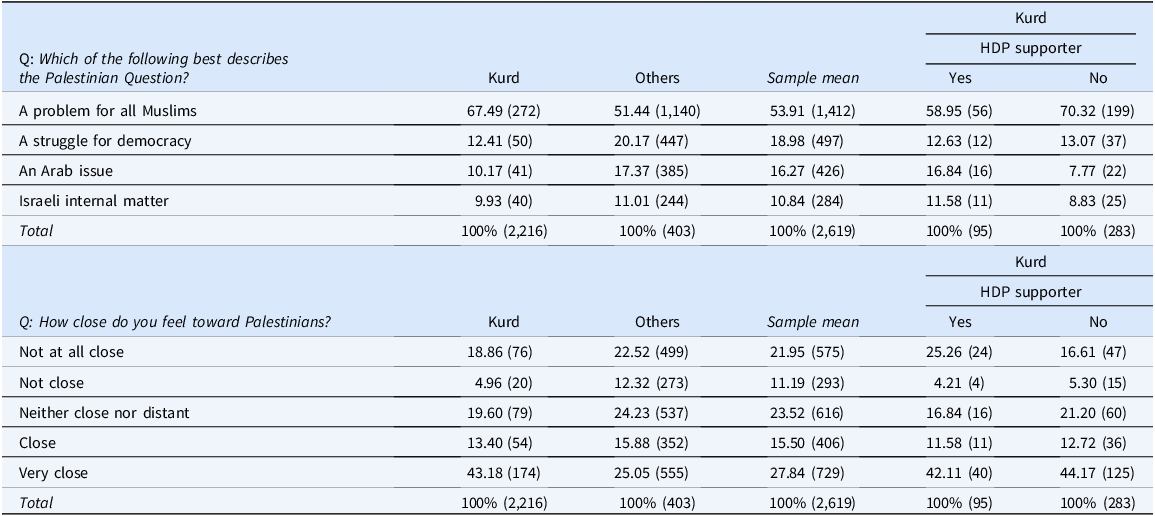
Estimation: We begin by presenting the results of how our outcome variables correlate with the “ethnic” and “party identification” variables. As shown in Table 1, most respondents view the Israel-Palestine conflict as “a problem for all Muslims” (53.91%). The remaining respondents described the Palestinian question as “a struggle for democracy” (18.98%), “an Arab issue” (16.27%), and “an Israeli internal matter” (10.84%). Kurdish respondents are significantly more likely to portray it as a “problem for all Muslims” compared to the rest of the sample (67.49% vs. 51.44%). Over half of self-identified Kurds reported feeling “close” (13.40%) or “very close” (43.18%) to Palestinians, in contrast to roughly 40% of the remaining respondents who expressed similar sentiments [chi2(3) = 38.36; Pr < .001]. However, results from the Kurdish sample indicate that the difference between Kurdish supporters of the HDP and other Kurds in their description of the Palestinian issue and their affinity toward Palestinians is not statistically significant.
Public opinion of the Palestinian question in Turkey

Table 1. Long description
The table presents data on public opinion regarding the Palestinian question in Turkey, segmented by ethnic and political affiliations. It includes responses from Kurds, others, and HDP supporters, detailing their perspectives on whether the Palestinian question is a problem for all Muslims, a struggle for democracy, an Arab issue, or an Israeli internal matter. The table also shows how close respondents feel toward Palestinians. The data reveals that most respondents view the Israel-Palestine conflict as a problem for all Muslims, with significant differences in opinions between Kurds and others. Kurds are more likely to see it as a problem for all Muslims and feel closer to Palestinians compared to the rest of the sample. The table has four main sections, each with specific percentages and sample sizes for different groups. The first section addresses how respondents describe the Palestinian question, while the second section measures their closeness to Palestinians. The table includes percentages and sample sizes for each category, providing a detailed comparison across different demographic groups.
Note: The figures in parentheses indicate the number of respondents in each category.
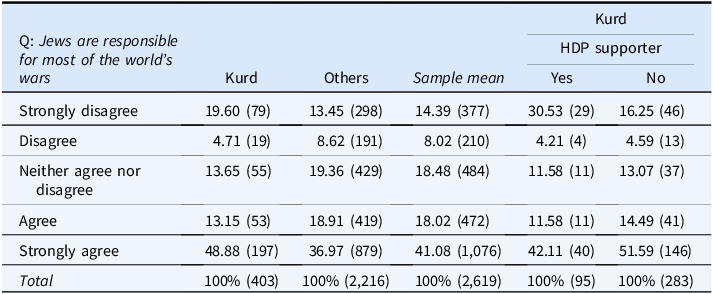
Responses to the question “Jews are responsible for most of the world’s wars,” shown in Table 2, indicate that most participants “agree” (18.02%) or “strongly agree” (41.08%) with the statement.Footnote 9 However, there are notable variations across different groups. Importantly, a smaller proportion of Kurds who support the HDP “agree” or “strongly agree” with this assertion compared to Kurds who support other political parties (53.69% vs. 66.08%). While approximately 30% of Kurdish supporters of HDP “strongly disagree” with the claim that “Jews are responsible for most wars in the world,” only 16% of Kurdish supporters of other parties and 14% of the larger sample stated they “strongly disagree.” These differences, however, are only marginally significant [Chi2 = 9.18(4), Pr = .057].
Antisemitism in Turkey

Table 2. Long description
A table comparing responses to the statement Jews are responsible for most of the world’s wars across different groups in Turkey. The table has five rows and six columns. The columns are labeled Kurd, Others, Sample mean, HDP supporter Yes, and HDP supporter No. The rows are labeled Strongly disagree, Disagree, Neither agree nor disagree, Agree, Strongly agree, and Total. The data shows percentages and counts of responses. Notably, a higher percentage of Kurds strongly agree with the statement compared to others. HDP supporters show a lower agreement rate than non-HDP supporters among Kurds. The sample mean indicates an overall agreement trend.
Note: The figures in parentheses indicate the number of respondents in each category.
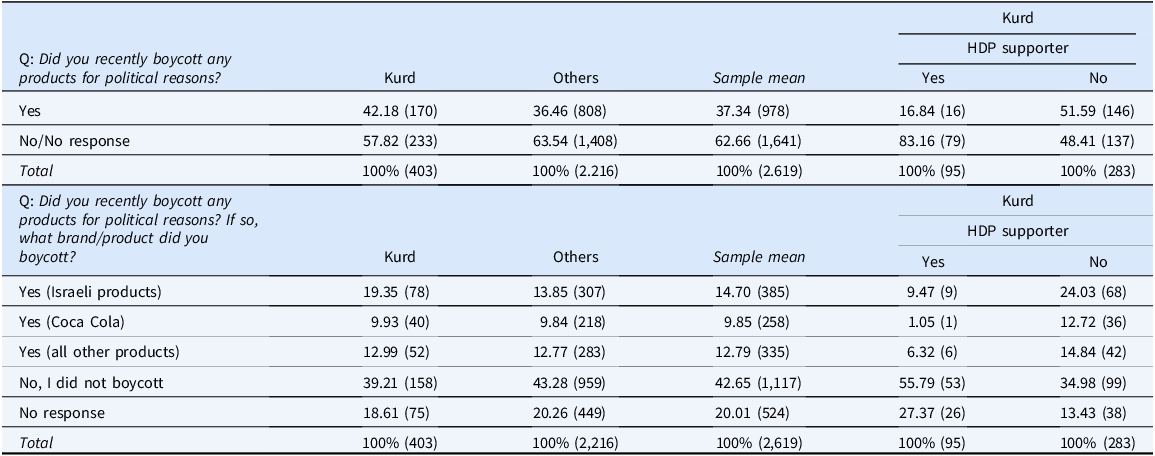
A similar trend is observed for boycott questions. The results in the upper half of Table 3 show responses to a general question about whether respondents have recently boycotted any products due to political reasons. Given the timing of our survey, such political boycotts are likely reactions to Israel’s conflict with Hamas in Gaza. Approximately 60% of all respondents indicated they did not engage in boycotts or chose not to answer the question. From our perspective, the respondents who reported having “boycotted a product for political reasons” hold greater theoretical significance. Among the Kurds who support the HDP, only 16.84% reported participating in the boycott, compared to 51.59% among Kurds supporting other parties, with a sample mean of 37.34% [chi2(1) = 36.06; Pr ≤ .001].
The Boycott and Anti-Israeli sentiment in Turkey

Table 3. Long description
The table presents data on boycott and anti-Israeli sentiment in Turkey, focusing on responses to whether individuals recently boycotted any products for political reasons. The table is divided into two main sections. The first section shows the percentage of respondents who boycotted products, did not boycott, or did not respond, categorized by Kurds, others, and HDP supporters. The second section details the specific brands or types of products boycotted, including Israeli products, Coca Cola, and other products. The table has four rows and six columns, with column headers including Kurd, Others, Sample mean, and HDP supporter with subcategories Yes and No. Notable trends include a higher percentage of boycotts among Kurds compared to others, and a significant difference in boycott participation between HDP supporters and non-supporters among Kurds. The data highlights variations in political boycott behavior across different demographic groups in Turkey.
Note: The figures in parentheses indicate the number of respondents in each category.
Responses to the follow-up question asking participants to specify which product they boycotted further confirm this pattern. As before, roughly 60% of the sample stated they did not boycott or declined to answer this question. It is worth stressing that only 9.47% of Kurds supporting the HDP reported boycotting Israeli products, in contrast to approximately 24.03% of other Kurds. Furthermore, 55.79% of HDP-supporting Kurds stated that they “did not engage in boycotting,” compared to 34.98% of other Kurds. Overall, Kurds are no more or less likely than the rest of the sample to report engaging in a boycott (p = .39). However, this difference between HDP-supporting Kurds and other Kurds is statistically significant at the .001 level.
Multivariate analysis
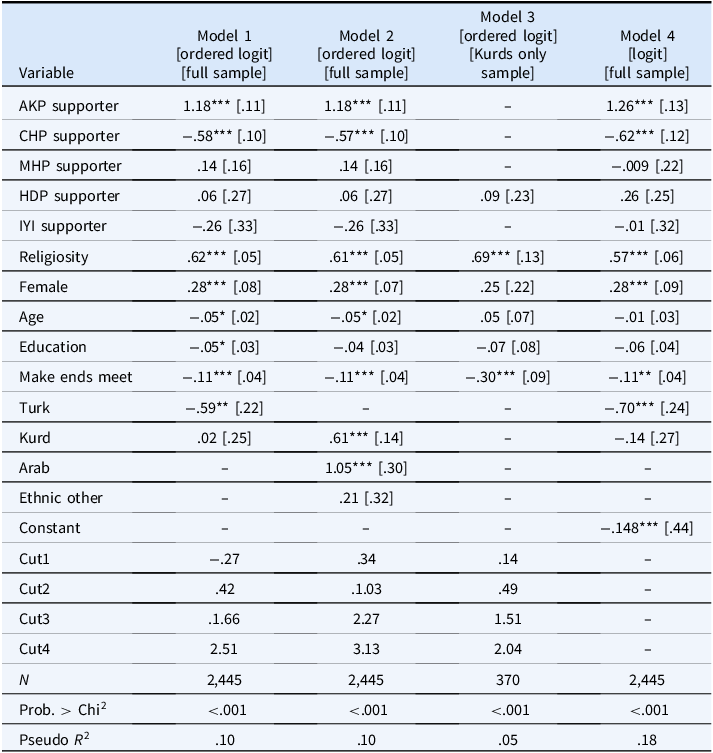
In this section, we test our argument using multivariate analysis that incorporates several control variables. Model 1 in Table 4 reports the results of an ordered logistic regression analyzing responses to the statement “How close do you feel toward Palestinians?” Responses range from 1 to 5, with higher values indicating greater closeness. Compared to supporters of other parties, as well as respondents identifying as “independent” or “undecided” (our reference category), supporters of the AKP are significantly more likely to report feeling close toward Palestinians. By contrast, supporters of the CHP, the principal party representing secular Turks, are significantly less likely to express closeness to Palestinians. The “HDP Supporter” and “Kurd” variables do not significantly predict “closeness” toward Palestinians.
Multivariate regression results for “How close do you feel toward Palestinians?”

Table 4. Long description
A table displaying multivariate regression results for the question ‘How close do you feel toward Palestinians?’ The table includes four models with various variables such as political party supporters, religiosity, gender, age, education, economic status, and ethnicity. It presents coefficients and standard errors for each variable across the models. Notable findings include AKP supporters showing a significant positive relationship with feeling close to Palestinians, while CHP supporters show a significant negative relationship. Religiosity and gender also show significant effects. The table has four columns representing different models and multiple rows for each variable analyzed.
Robust standard errors in brackets. *Significant at 10%; **Significant at 5%; ***Significant at 1% (two-tailed).
When the reference category is changed to “Turks,” self-identified Kurds and Arabs are significantly more likely to express closeness toward Palestinians (Model 2 of Table 4). While these results provide some support for the hypothesis of cross-minority solidarity among marginalized groups, the HDP supporter variable is not a significant predictor of the outcome. This pattern is further confirmed in Model 3, which restricts the analysis to self-identified Kurds.
In Model 4, we employ a logistic regression model distinguishing between respondents who reported feeling “close” or “very close” to Palestinians (coded as “1”) and all other responses (coded as “0”). The results remain consistent with those from Model 1. Taken together, these findings indicate that solidarity among subjugated minorities is not automatically rooted in shared experiences of marginalization but rather mediated by partisan affiliation and the broader political context within which these identities are expressed.
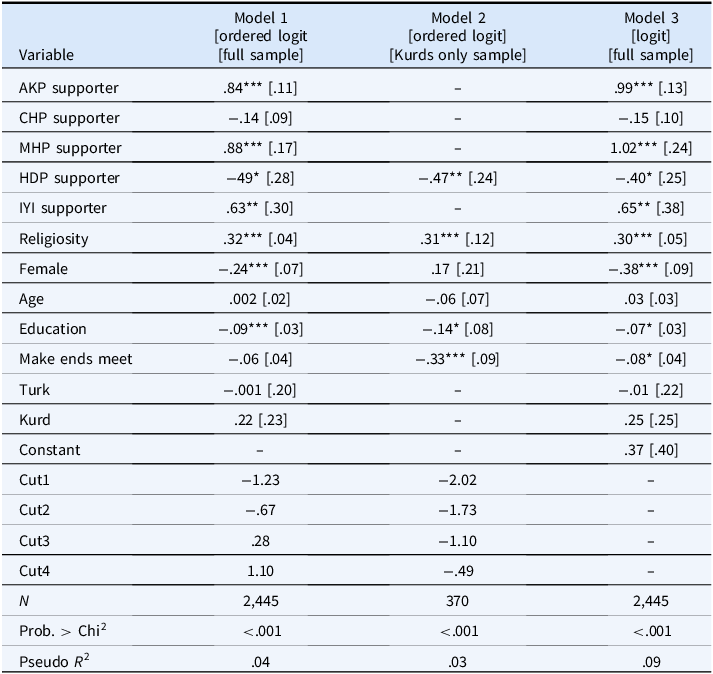
Table 5 presents the results for the statement “Jews are responsible for most of the world’s wars.” This variable ranges from 1 to 5, with higher values indicating greater agreement with the statement. Ordered logistic regression results show that supporters of the governing AKP, its coalition partner MHP, and the opposition IYI are significantly more likely to endorse this claim (Model 1). The coefficient for the CHP is negative, but its effect is not statistically distinguishable from zero.
Multivariate regression results for “Jews are responsible for most of the world’s wars”

Table 5. Long description
The table presents multivariate regression results for the statement Jews are responsible for most of the world’s wars. It includes three models: Model 1 (ordered logit, full sample), Model 2 (ordered logit, Kurds only sample), and Model 3 (logit, full sample). The table has 17 rows and 8 columns. The columns are labeled Variable, Model 1, Model 2, and Model 3, with corresponding coefficients and standard errors. Key variables include AKP supporter, CHP supporter, MHP supporter, HDP supporter, IYI supporter, Religiosity, Female, Age, Education, Make ends meet, Turk, Kurd, Constant, Cut1, Cut2, Cut3, Cut4, N, Prob > Chi2, and Pseudo R2. Notable trends include significant positive coefficients for AKP, MHP, and IYI supporters in Model 1, indicating a higher likelihood of endorsing the statement. The CHP supporter coefficient is negative but not statistically significant. Religiosity shows a positive effect across all models. Education has a negative effect in Models 1 and 2. The table provides insights into the factors influencing agreement with the statement.
Robust standard errors in brackets. *Significant at 10%; **Significant at 5%; ***Significant at 1% (two-tailed).
Consistent with our expectations, supporters of the pro-Kurdish HDP are less likely to agree with the statement about Jews and wars. When the sample is restricted to participants who self-identified as Kurds (Model 2), the negative association for the HDP variable becomes more pronounced. In Model 3, we employ logistic regression to analyze the likelihood of participants “agreeing” with the statement (coded as “1” if participants select either “agree” or “strongly agree” and “0” for all other responses). In substantive terms, being an AKP supporter increases the probability of agreeing with this statement by .22, rising from .54 to .76 when other variables are held at their mean values. Conversely, a change from “0” to “1” on the HDP variable decreases the probability of agreement by .11, dropping from .61 to .50.
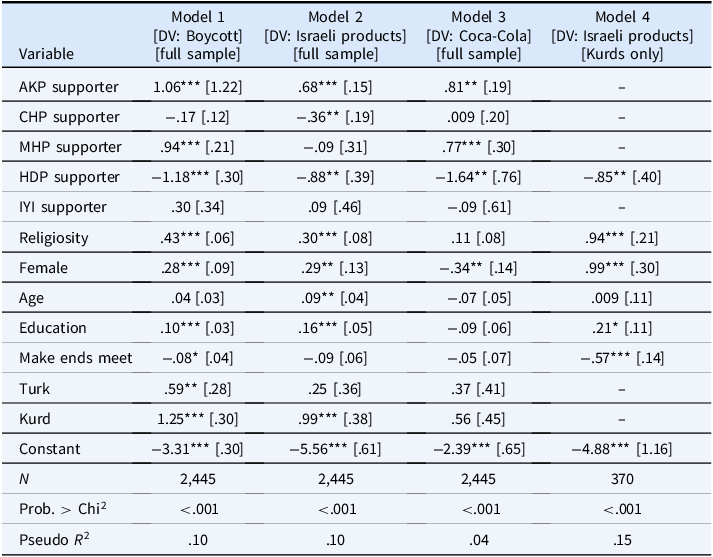
Table 6 presents the results for boycott variables. The AKP and HDP variables consistently predict boycotts, albeit in opposing directions. Being an HDP supporter reduces the probability of engaging in a “boycott” by .22 in Model 1 (down from .36 to .14), holding all other variables at their mean values, whereas the AKP variable increases the same probability by .23. The negative impact of the HDP variable on boycotting Israeli products (Models 2 and 4) and Coca-Cola (Model 3) is comparatively small; it lowers the probability by about .08. Being an AKP supporter increases the same probability by about .06. Limiting the sample to the Kurdish respondents yields similar results (Model 4).
Logit results for boycotting Israel

Table 6. Long description
The table presents logit results for boycotting Israel, comparing four models with different dependent variables. The table has 15 rows and 8 columns. The columns include Variable, Model 1, Model 2, Model 3, and Model 4, each with specific coefficients and standard errors. The rows list variables such as AKP supporter, CHP supporter, MHP supporter, HDP supporter, IYI supporter, Religiosity, Female, Age, Education, Make ends meet, Turk, Kurd, Constant, N, Prob. > Chi2, and Pseudo R2. Notable trends include the consistent impact of AKP and HDP supporter variables on boycott predictions, with AKP increasing and HDP decreasing the probability of boycotting. The table also shows the impact of other variables like Religiosity, Female, Age, Education, and more on the likelihood of boycotting Israeli products and Coca-Cola.
Robust standard errors in brackets. * significant at 10%; ** significant at 5%; *** significant at 1% (two-tailed).
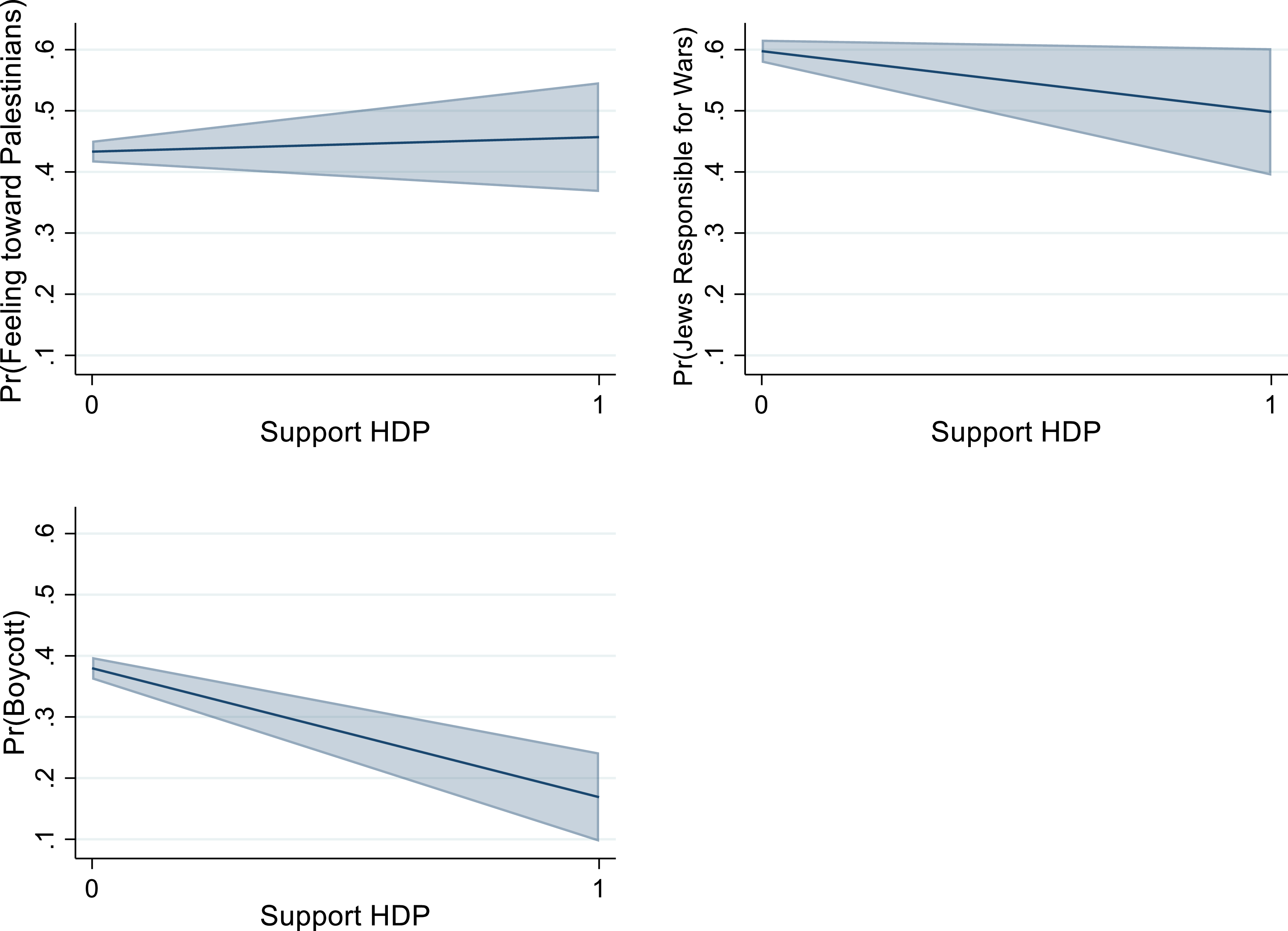
Although Kurds tend to express a stronger sense of “closeness” toward Palestinians (Table 1; Model 2 of Table 4), the overall results underscore the contingent nature of this sentiment. While Kurds in Turkey generally exhibit higher levels of tolerance toward out-group members (Sarigil and Karakoç, Reference Sarigil and Karakoc2016), important internal differences remain. Kurds aligned with the Kurdish political movement, which prior studies characterize as embracing a more secular and inclusive conception of politics (Gurses et al., Reference Gurses, Celik and Balta2020), are significantly less likely to hold Jews responsible for wars or to support boycotts of Israeli goods. Figure 1 illustrates these effects using estimates from Model 4 in Table 4, Model 3 in Table 5, and Model 1 in Table 6.
Predictive margins of support for the HDP with 95% confidence intervals.

Figure 1. Long description
The image contains three line graphs that illustrate the predictive margins of support for the HDP with 95% confidence intervals. Each graph has a horizontal axis labeled ‘Support HDP’ ranging from 0 to 1 and a vertical axis with different labels. The top left graph shows the probability of feeling toward Palestinians, the top right graph shows the probability of Jews being responsible for wars, and the bottom graph shows the probability of boycotting. The shaded areas around the lines represent the 95% confidence intervals. The top left graph indicates a slight increase in the probability of feeling toward Palestinians as support for the HDP increases. The top right graph shows a decrease in the probability of Jews being responsible for wars as support for the HDP increases. The bottom graph illustrates a decrease in the probability of boycotting as support for the HDP increases. All values are approximated.
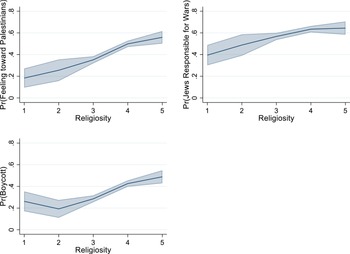
Religiosity, the subject of our third hypothesis, emerges as the most consistent and robust predictor across all models, showing a positive association with feelings of closeness toward Palestinians, endorsement of antisemitic statements, and participation in boycotts of Israeli goods. For example, moving from the lowest level of religiosity (“atheist”) to the highest level (“devout”) increases the predicted probability of agreeing with the statement “Jews are responsible for most of the world’s wars” by .27, from .39 to .66. Figure 2 illustrates these relationships using estimates from Model 4 in Table 4, Model 3 in Table 5, and Model 1 in Table 6.
Predictive margins of religiosity with 95% confidence intervals.

Figure 2. Long description
The image contains three line graphs that illustrate the relationship between religiosity and three different probabilities. The x-axis of each graph represents religiosity on a scale from 1 to 5, while the y-axis represents the probability values ranging from 0 to 1. The first graph shows the probability of feeling toward Palestinians, the second graph shows the probability of Jews being responsible for wars, and the third graph shows the probability of supporting a boycott. Each graph includes a blue line representing the trend and a shaded area indicating the 95% confidence intervals. As religiosity increases, the probability of feeling toward Palestinians and the probability of Jews being responsible for wars both show an upward trend. Similarly, the probability of supporting a boycott also increases with higher levels of religiosity. All values are approximated.
Overall, female respondents are more likely to report feelings of closeness toward Palestinians and to participate in boycotts of Israeli products. However, they are less likely to agree with the statement that “Jews are responsible for most of the world’s wars.” Education exhibits a similarly mixed pattern. Higher levels of education reduce the likelihood of endorsing our measure of antisemitism, yet increase the probability of boycotting Israeli products. Income, by contrast, is more consistently and negatively associated with closeness toward Palestinians, participation in boycotts, and blaming Jews for the world’s wars. Although further research is needed to fully unpack these dynamics, the income effect should be interpreted in light of Turkey’s deepening economic crisis in recent years. Widespread economic hardship may have generated material constraints that limit individuals’ capacity or willingness to engage in politically expressive behaviors.
Conclusion
The cases of the Palestinians and Kurds provide a unique lens through which to examine the commonly assumed Muslim solidarity with the Palestinians. Evidence from both qualitative and quantitative data in Turkey underscores the nuanced and context-dependent nature of such support. This study contributes to the broader literature on intergroup solidarity by demonstrating that solidarity cannot be assumed, even among groups that share a common faith or a history of subjugation.
The AKP government’s pro-Palestinian rhetoric and support for Hamas have complicated how Kurds perceive the Palestinian issue. Beyond considerations of realpolitik, the secular orientation of the Kurdish political movement has further shaped attitudes toward Palestinians and Jews. Politically conscious Kurds find it difficult to fully identify with the Palestinian cause, particularly as Hamas has come to symbolize it in recent years. Supporters of pro-Kurdish parties are also less likely to harbor anti-Jewish sentiments or boycott Israeli goods. Islamic religiosity, however, emerges as the most robust predictor of both affinity toward Palestinians and anti-Israeli or anti-Jewish sentiment. This mirrors findings on Islamist internationalism, where solidarity with the ummah (global Muslim community) drives support for brothers abroad, exemplified by the Islamic Party of Malaysia’s backing of the Palestinian cause (Müller, Reference Müller2010) or Indonesian and Malaysian Muslim solidarity with the Rohingya (Missbanch and Stange 2021).
However, it is also important to note that cross-national solidarity is often constrained by other factors, as this research shows, including political ideology and realpolitik. Aside from the limitations inherent in survey data, the particularities of the Kurdish case in Turkey, and the timing of our survey, which coincided with an intense war in Gaza that dominated media coverage, our findings underscore the dynamic and complex nature of intergroup solidarity. Such solidarity should not be taken for granted; rather, it is shaped to a significant extent by ideology, political alignments, and the broader geopolitical context (Ahram, Reference Ahram, Peters and Pinfold2024; Romano and Rojhilat, Reference Romano, Rojhilat and Danilovich2019; Türkmen Reference Türkmen2018; Yigit, Reference Yigit2025). Solidarity with Palestinians among Muslims, therefore, appears to be as much a product of political positioning as of shared faith or historical experience. While shared religiosity and linked fate suggest a basis for cross-national solidarity, further research is required to unpack its specific limitations and the factors that constrain its realization in practice.
Data availability statement
All data associated with this article are available from the authors upon request and will be made available following publication.
Financial support
No funding was received to conduct this research.
Competing interests
No conflict of interest.
Ayşe Betül Çelik received her Ph.D. in political science from the State University of New York at Binghamton in 2002. She teaches conflict resolution and political science at Sabanci University in Istanbul. She has been a visiting scholar at the American University (2009) and the University of Sydney (2013). Her work focuses on conflict transformation processes, ethnicity, forced migration, peace processes, reconciliation, civil society, and gender in peacebuilding.
Mehmet Gurses is Director of the Kurdish Political Studies Program and Professor of Political Science at the University of Central Florida. He is the author of Anatomy of a Civil War: Sociopolitical Impacts of the Kurdish Conflict in Turkey (University of Michigan Press, 2018) and co-editor, with David Romano and Michael Gunter, of Kurds in the Middle East: Enduring Problems and New Dynamics (Lexington Books, 2020).

 Open access

