


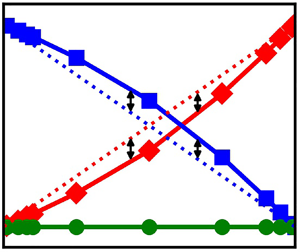



1. Introduction
Cavitation is associated with the formation, growth, oscillation and collapse of vapour and gas filled bubbles due to rapid changes of the pressure in the surrounding liquid. In hydraulic systems, e.g. fuel injection or oil-hydraulics devices, cavitation may have serious complications as generation of sound, vibration and cavitation erosion. One peculiarity of hydraulic systems is the working fluid in terms of e.g. fuel or hydraulic oil, which may consist of several hundred components. Thermophysical properties thus depend, beyond local temperature and pressure, also on the local mixture composition. In recent three-dimensional computational fluid dynamics (3-D CFD) approaches of cavitating flow in hydraulic systems, single-component surrogate fluids have been utilized to model the real mixtures. For example, Schnerr et al. (Reference Schnerr, Schmidt, Sezal and Thalhamer2006) utilized water as a surrogate. Further studies, e.g. Giannadakis, Gavaises & Arcoumanis (Reference Giannadakis, Gavaises and Arcoumanis2008a), Giannadakis et al. (Reference Giannadakis, Papoulias, Theodorakakos and Gavaises2008b), Skoda et al. (Reference Skoda, Iben, Güntner and Schilling2012), Theodorakakos et al. (Reference Theodorakakos, Strotos, Mitroglou, Atkin and Gavaises2014), Koukouvinis et al. (Reference Koukouvinis, Gavaises, Li and Wang2016) and Oerley et al. (Reference Oerley, Trummler, Hickel, Mihatsch, Schmidt and Adams2015), to cite only a few, applied the properties of dodecane, decane, heptane or a diesel-like single-component surrogate fluid to model real diesel fuel. For hydraulic oil, also single-component surrogate fluids were utilized (Schrank, Murrenhoff & Stammen Reference Schrank, Murrenhoff and Stammen2013).
The liquid and vapour phases of single-component surrogate fluids are based on a homogeneous, i.e. spatially and temporally constant, mixture. As for pure substances, the properties of the surrogate fluid are dependent only on temperature and pressure. A prospective local change of properties due to local segregation of mixture components at phase interfaces in cavitating flow is inherently neglected. In fact, in the transmission light study by Dorofeeva, Thomas & Dunn (Reference Dorofeeva, Thomas and Dunn2009) and Dunn et al. (Reference Dunn, Thomas, Davis and Dorofeeva2010) on cavitating kerosene flow in a Venturi nozzle, a significant local fuel segregation was observed. A comparison to pure fluids in terms of water, decane and dodecane revealed significant differences of the cavitation void structures in kerosene. Kerosene is a classical real fuel mixture with a multitude of components, essentially consisting of alkanes and aromatics. The vapour saturation pressure of the separate components varies by three orders of magnitude (Dunn et al. Reference Dunn, Thomas, Davis and Dorofeeva2010), so the particular cavitation structures were traced back to a temporally staggered evaporation and re-condensation of the individual kerosene components (Dorofeeva et al. Reference Dorofeeva, Thomas and Dunn2009; Dunn et al. Reference Dunn, Thomas, Davis and Dorofeeva2010). However, due to inherent limitations of the optical measurement techniques, it remained unclear if the segregation of fuel components or the segregation of fuel and dissolved air by air desorption was the dominating observation, and it may be speculated that both effects arise simultaneously. This observation motivated us to launch this simulation study on local segregation of fuel components associated with bubble dynamics and cavitation.
In 3-D CFD methods, mass transfer cavitation models, as proposed e.g. by Schnerr & Sauer (Reference Schnerr and Sauer2001) and Zwart, Gerber & Belamri (Reference Zwart, Gerber and Belamri2014), are combined with the Navier–Stokes equations for the evaluation of phase transition from liquid to vaporous phase and vice versa. This model class is based on simplified fundamentals of bubble dynamics and mostly uses the simple Rayleigh equation (Plesset & Prosperetti Reference Plesset and Prosperetti1977) to evaluate the mass transfer rate. So far, available mass transfer cavitation models are based on single-component fluids only, to the best knowledge of the authors. Therefore, when fluid mixtures are considered by single-component surrogates, only bulk properties of the mixture enter the cavitation model and the governing equations. In fact, it can be concluded that the fuel segregation during cavitation, observed e.g. by Dorofeeva et al. (Reference Dorofeeva, Thomas and Dunn2009) and Dunn et al. (Reference Dunn, Thomas, Davis and Dorofeeva2010), cannot be reproduced with available mass transfer cavitation models, a fact that reveals inherent limitations of state-of-the-art 3-D CFD methods. Another interesting cavitation model approach is based on statistical associating fluid theory (SAFT) (Rokni et al. Reference Rokni, Gupta, Moore, McHugh, Bamgbade and Gavaises2019; Vidal et al. Reference Vidal, Rodriguez, Koukouvinis, Gavaises and McHugh2020; Kolovos et al. Reference Kolovos, Kyriazis, Koukouvinis, Vidal, Gavaises and McDavid2021) and allows for the description of local changes of phase composition and therefore of fuel mixture properties changes. However, this approach is based on thermodynamic equilibrium, and a local transport of the mixture components is inherently not accounted for. Thus an important step towards a multi-component mass transfer cavitation model demands a reconsideration of local transport processes around single bubbles for a description of a staggered phase transition of low- and high-volatile mixture components, which has not been considered until now and is therefore the subject of this study.
Beyond the segregation of fuel components, desorption of non-condensable gas may occur during dynamics of a single bubble and should be considered in the modelling approach, together with the fuel segregation. Thus far, available studies focused only on single-fluid/non-condensable gas systems, and most of them considered water and air. Approximations with the spatial transport of either vapour or non-condensable gas have been proposed by Nigmatulin & Khabeev (Reference Nigmatulin and Khabeev1975) for the former, or Nigmatulin & Khabeev (Reference Nigmatulin and Khabeev1974), Arefmanesh, Advani & Michaelides (Reference Arefmanesh, Advani and Michaelides1992), Naji Meidani & Hasan (Reference Naji Meidani and Hasan1997, Reference Naji Meidani and Hasan2004), Klein & Iben (Reference Klein and Iben2010) and Vachaparambil & Einarsrud (Reference Vachaparambil and Einarsrud2020) for the latter. Sochard, Wilhelm & Delmas (Reference Sochard, Wilhelm and Delmas1998) have also considered gas–vapour interdiffusion within the bubble as well as the liquid–vapour phase transition, i.e. evaporation and condensation across the interface, but gas diffusion across the interface was neglected. Kamath & Prosperetti (Reference Kamath and Prosperetti1989) considered interdiffusing non-condensable gases in the bubble interior. However, no phase transition over the interface and no vapour content in the bubble were considered. Matsumoto & Takemura (Reference Matsumoto and Takemura1994), Takemura & Matsumoto (Reference Takemura and Matsumoto1994) and Matsumoto & Yoshizawa (Reference Matsumoto and Yoshizawa2005) solved the Navier–Stokes equations with radial resolution of the concentration and temperature field within and outside of the bubble, while a Rayleigh–Plesset equation considering mass transfer (Fujikawa & Akamatsu Reference Fujikawa and Akamatsu1980) determined the time-dependent bubble wall position. Air diffusion and the interface condition for air were modelled by Fick's and Henry's laws, respectively. Phase transition was approximated as a thermal non-equilibrium process by the Hertz–Knudsen relation (Persad & Ward Reference Persad and Ward2016), while Bermudez-Graterol, Nickaeen & Skoda (Reference Bermudez-Graterol, Nickaeen and Skoda2021) could show that an equilibrium condition hardly changed the bubble dynamics even during the collapse phase. Jinbo et al. (Reference Jinbo, Kobayashi, Watanabe and Takahira2015) used an approach similar to that of Matsumoto & Takemura (Reference Matsumoto and Takemura1994) but resolved the bubble interface with a level-set and ghost fluid method. Yamamoto et al. (Reference Yamamoto, Kobayashi, Watanabe, Fujii, Kon and Takahira2019) figured out by a molecular dynamics method that a small amount of non-condensable gas strongly affects the temperature field inside the collapsing bubble. Zein, Hantke & Warnecke (Reference Zein, Hantke and Warnecke2013) performed 3-D simulations with mass and heat transfer together with the transport of vapour as well as air. Assuming homobaricity within the bubble – i.e. the bubble pressure is spatially homogeneous and dependent only on time – Nigmatulin, Khabeev & Nagiev (Reference Nigmatulin, Khabeev and Nagiev1981) and Kawashima & Kameda (Reference Kawashima and Kameda2008), and more recently Hao, Zhang & Prosperetti (Reference Hao, Zhang and Prosperetti2017) and Bermudez-Graterol et al. (Reference Bermudez-Graterol, Nickaeen and Skoda2021), evaluated the spatial velocity distribution within the bubble as well as the temporal evolution of the (spatially constant) bubble pressure by an analytical expression that was derived from the energy equation. In the surrounding liquid, the flow was irrotational and thus potential. A similar approach has been used by other authors (Prosperetti Reference Prosperetti1991; Soh & Karimi Reference Soh and Karimi1996; Delale & Pasinlioğlu Reference Delale and Pasinlioğlu2015; Ali & Ake Reference Ali and Ake2016). Hao et al. (Reference Hao, Zhang and Prosperetti2017) pointed out the effect of bubble content, in terms of both vapour and non-condensable gas, on bubble dynamics. These cited studies are based on pure water/non-condensable gas (mostly air) systems, and no other fluids than water and, least of all, fluid mixtures have been considered.
Studies on bubble dynamics with fluid mixtures and a systematic fluid variation are rare. Plesset (Reference Plesset1970) performed experiments on cavitation erosion in an ultrasound device with binary fluid mixtures of water with acetone, formamide, ethanol or glycerol, and concluded that mixture viscosity and air content affected the erosion rate. Huang & Mohamad (Reference Huang and Mohamad2009) performed single-bubble simulations to reproduce the binary mixture measurements of Plesset (Reference Plesset1970). Their model was based on the Rayleigh–Plesset equation for a single-component surrogate fluid, where linear mixture rules for obtaining the surrogate bulk properties were applied. Thus local fluid segregation was inherently neglected by Huang & Mohamad (Reference Huang and Mohamad2009). Regarding wall heat transfer simulations on pool boiling of binary mixtures (Wang, Xie & Tan Reference Wang, Xie and Tan1996a,Reference Wang, Xie and Tanb), the effect of segregation was taken into account via different concentrations of fluid components both within and outside the bubble. However, the spatial and temporal variation of the mixture composition was not considered. By solving the Navier–Stokes equations, Storey & Szeri (Reference Storey and Szeri1999, Reference Storey and Szeri2000) studied sonoluminescence by a segregation of helium and argon as well as argon and steam, and resolved the spatial and temporal distribution of the components within the bubble. During bubble collapse, an enhanced segregation and a concentration of water or helium, respectively, was observed towards the bubble centre. Beyond diffusion due to concentration gradients, thermal diffusion due to temperature gradients affected the in-bubble flow during a later stage of bubble collapse. In contrast, pressure diffusion due to pressure gradients had an appreciable effect only in a very short time interval, so its effect was considered inessential (Storey & Szeri Reference Storey and Szeri1999, Reference Storey and Szeri2000). A prospective segregation of fluid in the surrounding liquid was not investigated by Storey & Szeri (Reference Storey and Szeri1999, Reference Storey and Szeri2000).
Thus the local segregation of fluid mixture components during bubble dynamics has hardly been considered in previous studies. In fact, the studies by Storey & Szeri (Reference Storey and Szeri1999, Reference Storey and Szeri2000) on helium, argon and steam are the only ones of which we are aware, and even these are restricted to segregation of gaseous components within the bubble, while a segregation of liquid mixture components outside the bubble was not considered. A completely different situation occurs for droplet evaporation. Local segregation of liquid mixture components in fuel droplets has been investigated widely by multi-component evaporation models for gasoline (Gartung, Arndt & Seibel Reference Gartung, Arndt and Seibel2002), diesel (Lippert & Reitz Reference Lippert and Reitz1997), biodiesel fuels or ethanol–gasoline mixtures (Hallett & Beauchamp-Kiss Reference Hallett and Beauchamp-Kiss2010; Hallett & Legault Reference Hallett and Legault2011; Zhang & Kong Reference Zhang and Kong2012; Bader, Keller & Hasse Reference Bader, Keller and Hasse2013), to list only a few. Sazhin et al. (Reference Sazhin, Elwardany, Krutitskii, Deprédurand, Castanet, Lemoine, Sazhina and Heikal2011) provided an overview of multi-component models for fuel droplet evaporation. In more recent studies on binary mixtures, Li et al. (Reference Li, Lv, Diddens, Tan, Wijshoff, Versluis and Lohse2018, Reference Li, Diddens, Segers, Wijshoff, Versluis and Lohse2020) reported evaporation-triggered segregation in 1,2-hexanediol–water droplets, and Millán-Merino, Fernández-Tarrazo & Sánchez-Sanz (Reference Millán-Merino, Fernández-Tarrazo and Sánchez-Sanz2021) observed higher vaporization rates with increasing ambient humidity for ethanol–water droplets. The mixture segregation of the droplet is associated with strongly different and temporally staggered mass flow rates of the individual mixture components at the phase interface. The evaporation rate of high-volatile components is larger than that of low-volatile components, leading to a densification of the liquid fuel within the droplet. The opposite trend was observed during condensation. In the liquid phase within the droplet as well as in the surrounding vaporous phase, a temporal and spatial variation of the local fuel composition occurs that again affects the mixture state and transport properties, e.g. for cold environmental conditions (Lippert & Reitz Reference Lippert and Reitz1997) or flash boiling (Ra & Reitz Reference Ra and Reitz2003; Yang & Reitz Reference Yang and Reitz2009). We assume that such processes occur also during different stages of bubble dynamics, which has, however, not been studied yet. Therefore, the subject of the present study is the assessment of local segregation of fluid mixtures by single-bubble flow simulations. Thereby, we pay particular attention to the peculiarities of multi-component transport in comparison with a conventional single-component bulk fluid treatment (termed a pseudo-fluid in this study). We content ourselves with binary mixtures in this first study on this topic, and choose heptane ( $\mathrm {C7H16}$) and dodecane ( $\mathrm {C12H26}$) as high- and low-volatile components, respectively, since these fluids are common components of real fuels. Since no single-bubble simulation model for fluid mixtures has been presented before, we present a complete governing equation set that comprises an extension of our preceding study on water–air systems (Bermudez-Graterol et al. Reference Bermudez-Graterol, Nickaeen and Skoda2021). No experimental data on mixture bubble dynamics are available, so we must content ourselves with a validation on bubble growth in water. However, the simulation results will provide an insight into the local heat, mass and phase transfer processes of mixture bubble dynamics, and hence may serve as a basis for a purposeful experimental set-up in future studies.
The paper is organized as follows. In §§ 2 and 3, the mathematical model and its numerical solution method are presented. In § 4, results of two example bubble dynamics scenarios are presented: first, bubble oscillation after a rapid pressure drop is investigated in § 4.1; and second, continuous bubble growth in superheated liquid is studied in § 4.2. We finalize the paper with our conclusions and outlook in § 5.
2. Mathematical model formulation
2.1. Model outline and notations
The mathematical model of a single spherical bubble is based on our preceding study on water–air mixtures (Bermudez-Graterol et al. Reference Bermudez-Graterol, Nickaeen and Skoda2021). Homobaricity is assumed within (but not outside) the bubble, which is justified for  $| \dot {R} | \ll a^{G}$ (Nigmatulin et al. Reference Nigmatulin, Khabeev and Nagiev1981), where $a^{G}$ is the speed of sound. This condition is fulfilled for any test case in this study. Homobaricity allows the omission of the full Navier–Stokes equations. Instead of solving the Navier–Stokes equations, the velocity field and the pressure within the bubble are obtained by the energy equation. Outside the bubble, the velocity and pressure fields are obtained by noting that the flow is irrotational. The homobaricity assumption reduces considerably the computational effort and thereby opens the opportunity to embed a large number of single bubbles in a 3-D Euler–Lagrange framework in future studies, which will be picked up in the outlook at the end of this paper. Binary heptane/dodecane mixtures are investigated, referred to as fuel in what follows, together with air. Air is treated as a single-component pseudo-fluid, so the model comprises three species in total. Thus the bubble contains a mixture of vaporous heptane and dodecane as well as non-condensable gas, i.e. air, which are assumed to be thermally and calorically ideal. The bubble is surrounded with an infinite amount of a liquid heptane/dodecane mixture, in which air is dissolved. Both within (superscript $\gamma = {G}$) and outside (superscript $\gamma = {L}$) the bubble, mixture values (subscript ${m}$) are evaluated by a mass fraction weight $y_{\alpha }^{\gamma }=\rho _{\alpha }^{\gamma }/\rho _{m}^{\gamma }$, where $\rho$ is the mass density, and index $\alpha$ means either heptane (subscript $\alpha = {Hep}$), dodecane (subscript $\alpha = {Dod}$) or air (subscript $\alpha = {Air}$). The species add to 1 when $\alpha$ is summed over all $N_{S} = 3$ species:
 \begin{equation} \sum_{\alpha=1}^{N_{S}} y_{\alpha}^{\gamma} = y_{Hep}^{\gamma} + y_{Dod}^{\gamma} + y_{Air}^{\gamma} = 1. \end{equation}
In what follows, the mathematical model is outlined, while details are presented in Appendix A. The assumptions made are listed in § A.1.
2.2. Governing equations
The governing equations are solved in spherical coordinates. For both the gaseous bubble interior and its surrounding liquid, the mass conservation of mixture  $m$ and its components $\alpha$ reads
 $$\begin{gather} \frac{\partial ( \rho_{m}^{\gamma} )}{\partial t}+\frac{1}{r^{2}}\,\frac{\partial}{\partial r}(r^{2}\rho_{m}^{\gamma}{u}^{\gamma})=0 , \end{gather}$$
 $$\begin{gather}\frac{\partial ( \rho_{m}^{\gamma}y_{\alpha}^{\gamma}) }{\partial t} + \frac{1}{r^{2}}\,\frac{\partial}{\partial r}(r^{2}\rho_{m}^{\gamma}y_{\alpha}^{\gamma}{u}^{\gamma})=\frac{1}{r^{2}}\,\frac{\partial}{\partial r}\left(r^{2}\rho_{m}^{\gamma}D_{\alpha}^{\gamma}\,\frac{\partial y_{\alpha}^{\gamma}}{\partial r}\right), \end{gather}$$
where  $u$ is the absolute velocity, $D$ is the diffusion coefficient, $\alpha = {Hep}$, ${Dod}$ or ${Air}$, and $\gamma = {G}$ or ${L}$.
2.2.1. Within bubble
Mixture pressure  $p^{G}$ is assumed to fulfil Dalton's law, $p^{G}= p^{G}_{Hep} + p^{G}_{Dod} +p^{G}_{Air}$. For a thermally ideal gas, it is evaluated by
 \begin{equation} p^{G}=\rho^{G}_{m}\mathfrak{R}_{m}T^{G}, \end{equation}
where  $\mathfrak {R}_{m}$ and $T^{G}$ correspond to the mixture gas constant and the temperature, respectively.
Employing the homobaricity assumption  $\partial p^{G}/\partial r = 0$, an integro-differential expression for the velocity profile is obtained from energy conservation:
 \begin{equation} u^{G} ={-} \frac{r}{3 p^{G}}\,\frac{{\mathrm d}p^{G}}{{\mathrm d}t} + \frac{1}{r^2 p^{G}}\int_0^r \left(G(r)+ \frac{\mathfrak{R}_{m}}{c_{p,m}^{G}}\,\frac{{\mathrm d}p^{G}}{{\mathrm d}t} \right )r^2\,\mathrm{d}r, \end{equation}
with
 \begin{align} G(r) &= \frac{\mathfrak{R}_{m}}{c_{p,{m}}^{G}} \left \{ \frac{1}{r^{2}}\,\frac{\partial}{\partial r} \left(r^{2} \rho_{m}^{G} T^{G} \sum_{\alpha=1}^{N_{S}} \mathfrak{R}_{\alpha}D_{\alpha}^{G}\,\frac{\partial y_{\alpha}^{G}}{\partial r} \right) + \frac{1}{r^{2}}\,\frac{\partial}{\partial r}\left(r^{2} \lambda_{m}^{G}\,\frac{\partial T^{G}}{\partial r} \right) \right.\nonumber\\ &\quad \left. {}+ \frac{T^{G} c_{v,{m}}^{G}}{\mathfrak{R}_{m}}\,\frac{1}{r^{2}} \sum_{\alpha=1}^{N_{S}} \mathfrak{R}_{\alpha}\,\frac{\partial}{\partial r} \left(r^{2} \rho_{m}^{G} D_{\alpha}^{G}\,\frac{\partial y_{\alpha}^{G}}{\partial r} \right ) + \rho_{m}^{G}\,\frac{\partial T^{G}}{\partial r} \sum_{\alpha=1}^{N_{S}} c_{v,{\alpha}}^{G} D_{\alpha}^{G}\,\frac{\partial y_{\alpha}^{G}}{\partial r} \right \}. \end{align}
 By evaluating (2.5) at the bubble wall  $r=R$ and rearranging, an expression for the temporal pressure evolution within the bubble is obtained:
 \begin{equation} \frac{{\mathrm d}p^{G}}{{\mathrm d}t} = \frac{\displaystyle - R^2 p^{G} u_{{w}}^{G} + \int_0^R G(r)\,r^2 \, \mathrm{d}r}{\displaystyle \frac{R^3}{3} - \int_0^R \frac{\mathfrak{R}_{m}}{c_{p,{m}}^{G}}\,r^2 \, \mathrm{d}r }. \end{equation}
 More details are provided in § A.2. An even more detailed derivation of the governing equations for the velocity field and the pressure has been provided in Nickaeen (Reference Nickaeen2020) for a water–air system. As a main advance provided in this study, we have extended the equations from water to discrete alkane mixtures, resulting in (2.5)–(2.7). The velocity  $u_{{w}}^{G}$ at the gaseous side of the bubble wall is obtained by the conservation of mass flux $\dot {m}''= \dot {m}_{Hep}'' + \dot {m}_{Dod}'' + \dot {m}_{Air}''$ through the bubble wall. The mass flux reads $\dot {m}''= \rho _{{m,w}}^{G}(\dot {R} - u_{{w}}^{G})$ and is assumed positive when flowing into the bubble. Thus
 \begin{equation} u_{{w}}^{G} = \dot{R} - \frac{\dot{m}''}{\rho_{{m,w}}^{G}}. \end{equation}
 Note that  $\dot {m}''$ corresponds to the area-specific mass flux, and the actual mass flow $\dot {m}_{\alpha }$ is obtained by $\dot {m}_{\alpha } = A_{{B}} \, \dot {m}''_{\alpha }$ with the bubble area $A_{{B}}=4{\rm \pi} R^2$. Assuming ideal gas, energy conservation reads
 \begin{align}
\rho_{m}^{G} c_{p,{m}}^{G}\,\frac{\partial T^{G}}{\partial
t} &={-}\rho_{m}^{G} c_{p,{m}}^{G} u^{G}\,\frac{\partial
T^{G}}{\partial r} +
\frac{1}{r^{2}}\,\frac{\partial}{\partial r}\left(r^{2}
\lambda_{m}^{G}\,\frac{\partial T^{G}}{\partial r}
\right)\nonumber\\ &\quad + \rho_{m}^{G}\,\frac{\partial
T^{G}}{\partial r} \sum_{\alpha=1}^{N_{S}}
c_{p,{\alpha}}^{G} D_{\alpha}^{G}\,\frac{\partial
y_{\alpha}^{G}}{\partial r}+\frac{{\mathrm
d}p^{G}}{{\mathrm d}t}.
\end{align}
\begin{align}
\rho_{m}^{G} c_{p,{m}}^{G}\,\frac{\partial T^{G}}{\partial
t} &={-}\rho_{m}^{G} c_{p,{m}}^{G} u^{G}\,\frac{\partial
T^{G}}{\partial r} +
\frac{1}{r^{2}}\,\frac{\partial}{\partial r}\left(r^{2}
\lambda_{m}^{G}\,\frac{\partial T^{G}}{\partial r}
\right)\nonumber\\ &\quad + \rho_{m}^{G}\,\frac{\partial
T^{G}}{\partial r} \sum_{\alpha=1}^{N_{S}}
c_{p,{\alpha}}^{G} D_{\alpha}^{G}\,\frac{\partial
y_{\alpha}^{G}}{\partial r}+\frac{{\mathrm
d}p^{G}}{{\mathrm d}t}.
\end{align} With (2.3) ( $\gamma = {G}$), (2.4), (2.5), (2.7) and (2.9), an equation set for the evaluation of the gas field variables $y_{\alpha }^{G}$, $\rho _{m}^{G}$, $u^{G}$ and $T^{G}$, as well as the time-dependent pressure $p^{G}$, is available.
2.2.2. Within liquid
Neglecting viscous effects, the energy equation reads
 \begin{equation} \rho_{m}^{L} c_{m}^{L} \left( \frac{\partial T^{L}}{\partial t} + u^{L}\,\frac{\partial T^{L}}{\partial r} \right ) = \frac{1}{r^2}\, \frac{\partial}{\partial r}\left(r^2 \lambda_{m}^{L}\,\frac{\partial T^{L}}{\partial r} \right ) + \rho_{m}^{L} \sum_{\alpha=1}^{N_{S}} D_{\alpha}^{L}\,\frac{\partial y_{\alpha}^{L}}{\partial r}\,\frac{\partial h_{\alpha}^{L}}{\partial r}, \end{equation}
where  $c_{m}^{L}$ is the specific heat of the liquid mixture. Liquid density $\rho _{m}^{L}$ is variable due to a varying mixture composition in the surrounding liquid phase. However, since the densities of pure liquid heptane and dodecane deviate by less than 10 %, and liquid density variations due to variable mixing ratio are therefore small, we prefer the incompressible formulation of the energy equation in terms of (2.10) that does not include the work done by the pressure force, according to Bird, Stewart & Lightfoot (Reference Bird, Stewart and Lightfoot1960). Nevertheless, slight variations of $\rho _{m}^{L}$ are considered by a mixture equation of state that will be introduced in § A.4.1. This approximation is equivalent to the assumption that liquid compressibility effects due to flow dynamics are neglected in (2.10), and only a locally varying fuel composition accounts for liquid density variations. The second term on the right-hand side of (2.10) corresponds to the heat transport by each of the diffusing species. The spatial change of the enthalpy of the separate species $h_{\alpha }^{L}$ is evaluated by
 \begin{equation} \frac{\partial h_{\alpha}^{L}}{\partial r} = c_{\alpha}^{L}\,\frac{\partial T^{L}}{\partial r} + \frac{1}{\rho_{\alpha}^{L}}\,\frac{\partial p^{L}}{\partial r}. \end{equation}
 The liquid pressure  $p^{L}$ distribution is evaluated by Bernoulli's equation, noting that we have a potential flow around the bubble. A detailed description of the evaluation of $p^{L}$ is provided in § 1 of the supplementary material.
The integral momentum balance is considered by a modified form of the Rayleigh–Plesset equation (Fujikawa & Akamatsu Reference Fujikawa and Akamatsu1980) that takes into account the mass flux  $\dot {m}''$ across the bubble wall:
 \begin{equation} R\ddot{R} + \frac{3}{2}\,\dot{R}^2 - \frac{\ddot{m}'' R}{\rho_{{m,w}}^{L}} - \frac{\dot{m}''}{\rho_{{m,w}}^{L}} \left(\dot{R}+\frac{1}{2}\,\frac{\dot{m}''}{\rho_{{m,w}}^{L}} \right ) + \left( \frac{p_{\infty}^{L} - p_{{w}}^{L}}{\rho_{{m,w}}^{L}} \right) = 0. \end{equation}
 Equation (2.12) governs the bubble interface location in terms of the temporal progression of  $R$, where $\dot {\square }$ denotes the time derivative, and $\ddot {\square }$ denotes the second time derivative. In (2.12), $p_{\infty }^{L}$ can be understood as the driving variable of the bubble motion. Note that although we do not resolve spatially the momentum conservation equation, momentum balance is considered integrally by the solution of (2.12). This equation has been formulated by Fujikawa & Akamatsu (Reference Fujikawa and Akamatsu1980), taking into account liquid compressibility effects. We have adopted the incompressible form here. Assuming incompressibility has been verified in preliminary test simulations, for the test cases considered in § 4. By the terms including the mass flux $\dot {m}''$ in (2.12), local heat and mass transport are coupled to bubble dynamics. The mass flux $\dot {m}''$ is composed of its individual components $\dot {m}''_{Hep}$, $\dot {m}''_{Dod}$ and $\dot {m}''_{Air}$, which govern fuel segregation in the proximity of the bubble wall. It is interesting to note that for the test cases considered, the inclusion of $\dot {m}''$ and $\ddot {m}''$ in (2.12) virtually does not affect bubble dynamics, so it can be omitted in the Rayleigh–Plesset equation.
By the same reasoning on mass conservation as applied to the velocity at the gas side of the bubble wall in terms of (2.8), a relation for the liquid side velocity is obtained:
 \begin{equation} u_{w}^{L} = \dot{R} - \frac{\dot{m}''}{\rho_{{m,w}}^{L}}. \end{equation}
The velocity field in the liquid surrounding the bubble is approximated by the mass conservation, neglecting small variations of the liquid density:
 \begin{equation} u^{L}=\frac{R^2}{r^2} \left( \dot{R} - \frac{\dot{m}''}{\rho_{{m,w}}^{L}} \right). \end{equation}
Equation (2.14) corresponds to an incompressible and irrotational flow.
With (2.3) ( $\gamma = {L}$), (2.10), (2.12) and (2.14), an equation set for the evaluation of the liquid field variables $y_{\alpha }^{L}$, $T^{L}$ and $u^{L}$, as well as the time-dependent bubble radius $R$, has been obtained.
2.3. Boundary conditions
2.3.1. At the bubble centre and in the liquid far field
The bubble centre is assumed to be motionless, and all variables approach the centre with a vanishing gradient. Thus Neumann boundary conditions are formulated for the dependent variables:
 \begin{equation} \left.\frac{\partial \rho_{m}^{G}}{\partial r} \right|_{r=0}=0, \quad \left.\frac{\partial y_{\alpha}^{G}}{\partial r}\right|_{r=0}=0, \quad \left.\frac{\partial u^{G}}{\partial r}\right|_{r=0}=0, \quad \left.\frac{\partial T^{G}}{\partial r}\right|_{r=0}=0. \end{equation}
 At the outer liquid boundary of the computational domain, referred to as the liquid far field (index  $\infty$), $u^{L}$ is readily available by the kinematic condition (2.14) and does not demand any further boundary treatment. In the liquid far field, $y_{\alpha }^{L}$ and $T^{L}$ remain at their initial values (which is explicated in § 2.4) and are formulated as Dirichlet conditions:
 \begin{equation} y_{\alpha,\infty}^{L} = y_{\alpha,0}^{L}, \quad T_{\infty}^{L} = T_{0}^{L}. \end{equation}
 In the Rayleigh–Plesset equation (2.12),  $p_{\infty }^{L}$ is prescribed explicitly as a function of time.
2.3.2. At the bubble wall
For the evaluation of the pressure  $p_{w}^{L}$ at the liquid side of the bubble wall in (2.12), the relation between bubble pressure $p^{G}$ and liquid pressure $p_{w}^{L}$ is given by
 \begin{equation} p_{w}^{L}= p^{G} -\frac{2\sigma_{m}}{R} -\frac{(\dot{m}'')^2(\rho_{{m,w}}^{G} - \rho_{{m,w}}^{L} )}{\rho_{{m,w}}^{G} \rho_{{m,w}}^{L}}, \end{equation}
where  $\sigma _{m}$ is the surface tension of the mixture. Equation (2.17) does not include the effect of viscosity since we found that it has virtually no effect for the test cases considered. According to Fujikawa & Akamatsu (Reference Fujikawa and Akamatsu1980), the last term on the right-hand side of (2.17) can be neglected, which we have also verified in preliminary tests.
Thermal and phase equilibrium is assumed and enables a straightforward formulation of mixture boundary conditions at the bubble wall. Thermal equilibrium means that the temperatures at both sides of the bubble wall are equal:
 \begin{equation} T_{w}^{G} = T_{w}^{L}. \end{equation}
Phase equilibrium means that the liquid and vapour phases have the same chemical potential. At low pressures, assuming that the vapour behaves like an ideal gas, the following relation is often used to describe the vapour–liquid equilibrium (Koretsky Reference Koretsky2012):
 \begin{equation} \gamma_\alpha x_{{\alpha,w}}^{L} p_{\alpha}^{Sat}|_{T_{w}^{L}} = x_{{\alpha,w}}^{G} p^{G}, \end{equation}
with mole fractions  $x_{\alpha,{w}}^{L}$ and $x_{\alpha,{w}}^{G}$, activity coefficients $\gamma _\alpha$, and $\alpha ={Hep}$ or $Dod$. The activity coefficients account for the deviation from ideal solution caused by changes in composition. For chemically similar species, the numerical value of $\gamma _\alpha$ is close to 1. Activity coefficients can be obtained by using models for the excess Gibbs energy, such as, the Wilson equation, NRTL or UNIQUAC (Gmehling et al. Reference Gmehling, Kolbe, Kleiber and Rarey2012). Recognizing the chemical similarity of alkane species heptane and dodecane, we set $\gamma _\alpha$ to be equal to 1 for simplicity. With $\gamma _\alpha = 1$ in (2.19), we obtain Raoult's law. A validation with experimentally measured vapour–liquid equilibria by Maia de Oliveira et al. (Reference Maia de Oliveira, Bezerra Lopes, Dantas Neto and Chiavone-Filho2002) is presented in § A.3.
The heat balance reads
 \begin{equation} q_{w}^{L} -L_{m} ( \dot{m}''_{Hep} + \dot{m}''_{Dod}) = q_{w}^{G}, \end{equation}
where  $L_{m}$ is the latent heat of the fuel mixture. The heat transport by each of the diffusing components has been neglected in (2.20) because it is small, as was verified by preliminary tests. The heat flux is evaluated by Fourier's law in terms of $q_{w}^{L} = \lambda _{{m,w}}^{L} ({\partial T^{L}}/{\partial r})|_{w}$ and $q_{w}^{G} = \lambda _{{m,w}}^{G}({\partial T^{G}}/{\partial r})|_{w}$, and the mixture thermal conductivities $\lambda _{m}^{L}$ and $\lambda _{m}^{G}$ are defined in §§ 2.5 and A.4.
The mass balance for species  $\alpha$ at the bubble wall reads, where $\alpha = {Hep}$, $Dod$ or $Air$,
 \begin{equation} \dot{m}''_\alpha = \dot{m}''_{\alpha,{conv}} + \dot{m}''_{\alpha,{diff}}. \end{equation}
The first term on the right-hand side of (2.21) is the convective mass flux  $\dot {m}''_{\alpha,{conv}} = -\rho _{{m,w}}^{{\gamma }} y_{\alpha,{w}}^{{\gamma }} (u_{w}^{{\gamma }} - \dot {R} )$ of species $\alpha$ in the relative frame of reference, which means relative to the moving bubble wall. The second term, $\dot {m}''_{\alpha,{diff}} =\rho _{{m,w}}^{{\gamma }}D_{{\alpha,w}}^{{\gamma }} ({\partial y_{\alpha }^{{\gamma }}}/{\partial r})|_{w}$, corresponds to diffusion of species $\alpha$. After inserting (2.8) and (2.13) into (2.21) and rearranging, we obtain the mass balance equations for the gas $(\gamma ={G})$ and liquid $(\gamma ={L})$ side, with $\alpha$ and $\beta$ as $Hep$, $Dod$ or $Air$:
 \begin{equation} \dot{m}''_{\alpha} ( 1 - y_{{\alpha,w}}^{{\gamma}}) - y_{{\alpha,w}}^{{\gamma}} \sum_{\substack{\beta=1\\ \beta \neq\alpha}}^{N_{S}} \dot{m}''_{{\beta}} = \rho_{{m,w}}^{{\gamma}} D_{{\alpha,w}}^{{\gamma}} {\left. \frac{\partial y_{\alpha}^{{\gamma}}}{\partial r} \right|}_{w}. \end{equation}
We assume that Henry's law holds. This means that there is a simple linear relation between the concentration of dissolved air and its partial pressure in the gas phase (Sander Reference Sander2015):
 \begin{equation} p_{{Air,w}}^{G} = x_{{Air,w}}^{L} H_{m}, \end{equation}
where  $H_{m}$ is the Henry coefficient. We formulate (2.23) for the mass fraction $y^{L}_{{Air,w}}$, which is detailed in § A.3.
Together with the ideal gas law (2.4),  $p^{G}=\rho ^{G}_{{m,w}}\mathfrak {R}_{{m,w}}T^{G}_{w}$ and the complement (2.1), $\sum _{\alpha =1}^{N_{S}} y_{\alpha,{w}}^{G} = 1$ and $\sum _{\alpha =1}^{N_{S}} y_{\alpha,{w}}^{L} = 1$ a closed boundary equation set for the evaluation of the dependent variables at the bubble wall has been obtained.
2.4. Initial conditions
The bubble is initialized (subscript 0) in mechanical and thermal equilibrium in terms of  $R_0$, $T_0^{G}=T_0^{L}=T_0$ and $p_{\infty,0}^{L}$. The mass fractions $y_{\alpha,0}^{G}$ and $y_{\alpha,0}^{L}$ are prescribed homogeneously, according to the phase equilibrium equation (2.19) and Henry's law (2.23), together with (2.1). The initial bubble pressure $p_0^{G}$ is evaluated by (2.17) by setting $p_{{w,0}}^{L} = p_{{\infty,0}}^{L}$, $\dot {R} =0$, $\ddot {R} =0$, $\dot {m}_0'' = 0$ and $\ddot {m}_0'' = 0$. It should be noted that by (2.23), $y_{{Air,0}}^{L}$ is evaluated by $p_0^{G}$ and thus depends on $R_0$. This initialization might deviate from real situations where the liquid is usually saturated with air at ambient pressure, and not at bubble pressure, which should be considered when comparisons with experimental data are planned. After initialization, the bubble motion is driven by the temporal evolution of $p_{\infty }^{L}$, which will be specified for the particular test cases in § 4.
2.5. Thermophysical properties
For pure fluids, thermophysical properties – e.g. thermal conductivity, heat capacity, latent heat, saturation pressure and diffusion coefficients – depend on temperature and pressure. In fluid mixtures, they depend additionally on the local mixture composition. We present a detailed calculus of properties in § A.4. Here, we discuss briefly their dependence on  $T$ and $p$.
$p$.
In anticipation of the results presented in § 4, this dependence of properties on  $T$ and $p$ has been assessed by preliminary simulations. On the one hand, properties have been evaluated with their full $T$ and $p$ dependence. On the other hand, properties have been evaluated at a fixed reference state, which we chose to be the initial temperature and pressure. Based on a comparison of both variants, we assess the $T$ and $p$ dependence of each property. We do not present the details here, but summarize that while the $T$ dependence of the diffusion coefficients in the gas phase $D^{G}_{\alpha }$ (see (A22) and (A23)) is insignificant, its pressure dependence affects the results significantly. For example, the mass flux at the bubble interface rises by more than 100 % for a rapid pressure drop when $D^{G}_{\alpha }$ is evaluated at the initial pressure instead of the instantaneous value of $p^{G}$. Also, the temperature dependence of vapour saturation pressure $p^{Sat}_{m}$ (A27) is important, albeit to a lesser extent. The $T$ and $p$ dependence of all other properties can be neglected. Of course, this assessment of property impact is not general but certainly confined to the particular test cases under consideration. A more in-depth analysis is considered out of scope here. For convenience, all results presented in § 4 have been obtained with full $T$ and $p$ dependence of properties, and details of their evaluation are provided in § A.4.
Moreover, we consider the dependence of thermophysical properties on local mixture composition as crucial for alkane mixtures. While in this study we accept the uncertainties on mixture composition that have been introduced by the simple Raoult's law as discussed above, we introduce an even more crude simplification by comparison with a pseudo-fuel whose components cannot segregate. For the pseudo-fuel, properties are evaluated at a reference mixture state in terms of the initial mixture composition. Details of this simplified mathematical model are presented in § 2.6.2.
2.6. Variants of the mathematical model
2.6.1. Discrete fuel model (full model)
In the model presented so far, the full transport processes have been considered. A discrete mixture of heptane and dodecane has been described by different mass fractions  $y_{Hep}^{\gamma }$ and $y_{Dod}^{\gamma }$ for both the liquid ( $\gamma ={L}$) and gas ( $\gamma ={G}$) phases. By solving mass fraction equations for each alkane in terms of (2.3), the transport of each individual species is considered so that interdiffusion of both alkanes is enabled, and the fuel may segregate locally. This segregation-prone two-component heptane/dodecane fuel is termed discrete fuel in the following. In the next subsubsection, we introduce a simplification to the discrete fuel model by lumping the fuel species together into one single-component pseudo-fuel.
2.6.2. Pseudo-fuel model (simplified model)
It is interesting to see how bubble dynamics changes when we define a bulk fuel with an invariant mixture composition. In a simplified version of the discrete fuel model, a single-component fuel is introduced with a fuel mass fraction  $y_{Fuel}^{\gamma }$. This is initialized by $y_{{Fuel,0}}^{\gamma } = y_{{Hep,0}}^{\gamma } + y_{{Dod,0}}^{\gamma }$, in which $y_{{Hep,0}}^{\gamma }$ and $y_{{Dod,0}}^{\gamma }$ correspond to the initial mixture composition of heptane and dodecane. This surrogate single-component fuel is termed pseudo-fuel in the following. Per definition, the pseudo-fuel has the same initial composition as the discrete counterpart, but interdiffusion of the alkanes is disabled, and the mixture cannot segregate, which means that its composition is invariable for both the gaseous in-bubble ( $\gamma ={G}$) and the surrounding liquid ( $\gamma ={L}$) phases. For the pseudo-fuel, all mixing rules for the property evaluation specified in § A.4 hold, but in contrast to the discrete fuel, they are evaluated by the invariable, initial mixture state of the pseudo-fuel. It is important to note that as in the liquid phase, also the invariable gaseous phase of the pseudo-fuel model corresponds to the initial composition of the discrete counterpart. Thus the initial bubble content in terms of the fuel/air mixture ratio is the same for both discrete fuel and pseudo-fuel mixtures. The governing equations hardly change compared to the discrete fuel model, with one exception: for the discrete fuel, mass fraction equations (2.3) are solved for each discrete species, i.e. $y_{Hep}^{\gamma }$, $y_{Dod}^{\gamma }$ and $y_{Air}^{\gamma }$. For the pseudo-fuel, only one fuel species exists, so the solution of (2.3) is restricted to $y_{Fuel}^{\gamma }$ and $y_{Air}^{\gamma }$.
2.7. Note on mass conservation and species complement
In case of only two species ( $N_{S}=2$), (2.1) and (2.2) are fulfilled readily when we solve (2.3) for both species, assuming equality of binary diffusion coefficients $D^{\gamma }_{\alpha }$. In fact, by summing (2.3), we obtain (2.2). We encounter a two-species system – e.g. for pure heptane or pure dodecane with air – and this is also the case for the single-component pseudo-fuel (introduced in the preceding subsection) with air. In the case of discrete heptane/dodecane mixtures with air, however, we face a three-species system ( $N_{S}=3$). The diffusion coefficients $D_{\alpha }^{L}$ (see (A17)) and $D_{\alpha }^{G}$ (see (A22)) correspond to equivalent diffusion of species $\alpha$ into the rest of the mixture (Hirschfelder, Curtiss & Byrd Reference Hirschfelder, Curtiss and Byrd1969). Thus generally, summing (2.3) may not result in (2.2), and mass conservation may not be fulfilled. Furthermore, solving (2.3) for all three species may violate the species complement (2.1). In preliminary simulations, we have tested different means to enforce both mass conservation and species complement, and how we calculate mixture density $\rho ^{\gamma }_{m}$ and mass fraction $y^{\gamma }_{\alpha }$ of species $\alpha$. Details are provided in § 2 of the supplementary material. Here, we summarize that exact fulfilment of mass conservation by (2.2) has little effect on the results. This means that regardless how we calculate $\rho ^{\gamma }_{m}$, the effect on the results in § 4 is insignificant. Therefore, gas mixture density $\rho ^{G}_{m}$ is evaluated by the ideal gas law (2.4). Liquid mixture density $\rho ^{L}_{m}$ is also evaluated by an equation of state in terms of (A8). We have verified that by this procedure, (2.2) is fulfilled approximately. We solve (2.3) for only two of three species and ensure species complement by solving (2.1) for the remaining species.
3. Simulation method
The governing equations constitute a coupled nonlinear set of partial differential equations. The numerical scheme and the solution procedure have been presented in detail by Bermudez-Graterol et al. (Reference Bermudez-Graterol, Nickaeen and Skoda2021) for a water–air system. Their extension to alkane mixtures is straightforward, so the simulation method is summarized only briefly here.
The bubble interior and its surrounding liquid are discretized in the radial direction by computational nodes with a grid clustering at the bubble wall to resolve the gradients. In preliminary simulations, an extent of the liquid domain that corresponds to  $r/R=5$ has been found to be adequate for each test case considered. Computational cells are constructed between nodes. A staggered variable arrangement is employed, which means that the velocity is stored at node locations, and all other variables are stored at cell centre locations. Ghost cells are introduced to store the boundary values at the bubble centre, at the bubble interface and in the liquid far field. The bubble wall moves with the velocity $\dot {R}$, and the governing equations are solved by an arbitrary Lagrangian–Eulerian (ALE) method according to e.g. Hirt, Amsden & Cook (Reference Hirt, Amsden and Cook1997), on a grid that moves with the bubble wall.
The mass fraction equations are solved in their conservative form by a finite volume discretization and a central scheme, which means a linear interpolation of cell centre values to node locations. For the other equations, a finite difference scheme is used, where the spatial derivatives are approximated by central differences. All integration operations, e.g. in (2.5)–(2.7), are performed by the midpoint rule. By this combined central finite volume/finite difference scheme, we have obtained a simple and robust second-order-accurate scheme. An evaluation of the magnitude of the Péclet number  $Pe^{num}$ has been performed, since large values of $Pe^{num}$ may promote artificial wiggles in the numerical solution. For any simulation result presented in § 4, $Pe^{num}$ amounts to less than $0.01$ at any location within the bubble and at any time instant. Regarding the liquid side, $Pe^{num}$ is even significantly smaller close to the bubble wall due to a very fine grid, but may grow up to about $10^2$ towards the liquid far field for some cases and time instants. In spite of this rather large value, a careful inspection of the numerical solution field did not reveal any wiggles, since far away from the bubble wall, gradients of any flow variable vanish and the solution is homogeneous.
Time integration is performed by an implicit Crank–Nicolson scheme (Crank & Nicolson Reference Crank and Nicolson1996). Time steps correspond to a maximum Courant–Friedrichs–Lewy (CFL) number of about  $100$, and convergence within each time step is achieved when the dimensionless residuals of each equation have dropped below $1 \times 10^{-8}$.
At the bubble wall,  $12$ unknown boundary quantities in terms $T_{w}^{G}$, $T_{w}^{L}$, $y_{\alpha,{w}}^{L}$, $y_{\alpha,{w}}^{G}$, $\dot {m}_{\alpha }''$ and $\rho _{{m,w}}^{G}$ need to be evaluated, with $\alpha = {Hep}$, $Dod$ or $Air$. Heat balance (2.20), mass balance (2.22), Henry's law (A7) and the ideal gas law (2.4), together with (2.18) and (A6), are solved. These $12$ equations constitute a closed nonlinear equation set that is solved by a Newton method.
The computer program sibub ( $=$ single bubble dynamics) is coded by Fortran 90 and run on a conventional Linux workstation. Program sibub has been validated thoroughly for water in our preceding study (Bermudez-Graterol et al. Reference Bermudez-Graterol, Nickaeen and Skoda2021), which is particularly important since no measurement data on bubble dynamics in binary alkane mixtures are available.
4. Results
4.1. Bubble oscillation after a rapid pressure drop
4.1.1. Case description
A bubble with  $R_0 = 100$ $\mathrm {\mu }\mathrm {m}$ at $T_0 = 293.15 \ \mathrm {K}$ is initialized in a liquid fuel mixture with mass fraction ratio $25 \, \%$ heptane and $75 \, \%$ dodecane, referred to as a $25/75 \, \%$ mixture in what follows. It is important to note that this mixture ratio refers to the liquid fuel mixture outside the bubble, while the mixture ratio of the gaseous phase within the bubble results from the equilibrium initialization. Details on the fuel mixture initialization are provided in § 3 of the supplementary material. The bubble is exposed to a rapid pressure drop from $p_{\infty }^{L} = 10^5$ to $10^4$ Pa within 100 $\mathrm {\mu }$s, which corresponds to a drop rate of $\mathrm {d}p_{\infty }^{L}/\mathrm {d}t = 9 \times 10^8$ Pa s $^{-1}$. The final pressure level is well above the saturation pressure of any mixture component, so no excessive growth by phase change occurs, but the bubble is rather excited to oscillate. A computational grid with $n^{G} = 200$ and $n^{L} = 800$ nodes within and outside the bubble, respectively, with a strong node clustering at the bubble wall, is used, which has been ensured to yield grid-independent results in preliminary simulation runs.
For an oscillating gas bubble, Prosperetti (Reference Prosperetti1991) used the ratio of the thermal penetration length to the initial bubble radius to assess the effect of heat transfer on bubble motion. This ratio corresponds to the inverse Péclet number  $Pe^{G}$ (not to be confused with $Pe^{num}$ in § 3, which characterizes the ratio of convective to diffusive flux in a numerical scheme). Here, $Pe^{G}$ is equivalent to the ratio of thermal diffusion time scale to bubble motion, i.e. dynamic time scale. For small values of $Pe^{G}$, the bubble temperature variation is insignificant, while for large values, most of the gas in the bubble is thermally insulated from the liquid. Fuster & Montel (Reference Fuster and Montel2015) and Bergamasco & Fuster (Reference Bergamasco and Fuster2017) analysed the influence of mass transfer on the dynamic response of oscillating bubbles. We adopt their evaluation of dynamic and thermal diffusion time scale in terms of $t_{dyn}=1/f$ and $t_{diff}=R_0^2/D^{G}_{T}$, with thermal diffusivity $D^{G}_{T} = \lambda ^{G}_{m}/( \rho ^{G}_{m} c^{G}_{p,{m}} )$. In the studies by Prosperetti (Reference Prosperetti1991), Fuster & Montel (Reference Fuster and Montel2015) and Bergamasco & Fuster (Reference Bergamasco and Fuster2017), bubble oscillation due to an enforcing sinusoidal pressure wave with an angular frequency $\omega$ has been investigated. Since we excite our bubble with a one-time pressure drop, the frequency $f$ is evaluated simply by the bubble response frequency. We obtain $Pe^{G}=2$, so according to Bergamasco & Fuster (Reference Bergamasco and Fuster2017), thermal effects will be relevant. When we evaluate $Pe^{G}$ with the mass diffusion coefficient $D_{\alpha }^{G}$ according to (A22), instead of the thermal diffusivity $D^{G}_{T}$, and average over all three species and over time, we obtain $Pe^{G}=0.6$, which is of the same order of magnitude.
4.1.2. Discrete fuel model results
In figure 1(a), the initial phase of the bubble radius oscillation is depicted. The time is related to the thermal diffusion time scale in terms of  $t^* = t/t_{diff}$, where $t_{diff} = 5 \times 10^{-4} \ \mathrm {s}$ for the discrete fuel mixture. As reference, bubbles in pure heptane, pure dodecane and water are considered. Water properties are adopted from Bermudez-Graterol et al. (Reference Bermudez-Graterol, Nickaeen and Skoda2021), and the time axis of any fluid is scaled with the same value $t_{diff} = 5 \times 10^{-4} \ \mathrm {s}$ for convenience. The oscillation is damped by thermal effects, while viscous damping essentially plays no role. The damping effect is most pronounced for pure heptane, which is traced back to a strong initial liquid temperature drop close to the bubble wall, illustrated in figure 1(b). Bubble oscillation is affected by alternating heat and mass flux over the bubble wall. Similar to what was observed for rectified diffusion processes (Hsieh & Plesset Reference Hsieh and Plesset1961; Crum Reference Crum1984), a net heat and mass flux into the bubble arises. While the initial content of any bubble is dominated by air, evaporation changes the bubble content. This is most pronounced for the heptane bubble due to high volatility of heptane, so that its net vapour mass flux is largest. At $t^* = 2$, the heptane bubble contains most vapour, and its final radius is thus greater than that of the others.
Temporal progression of (a) bubble radius and (b) wall temperature, for different fluids. The 25/75 % heptane/dodecane mixture corresponds to the discrete model according to § 2.6.1.

The discrete 25/75 % mixture corresponds to a two-component fuel that is prone to segregation. A more thorough look at the 25/75 % mixture reveals that mass transfer of the different species through the bubble wall is considerably different. According to figure 2(a), the entire mass flow is dominated by  $\dot {m}_{Hep}$, while $\dot {m}_{Dod}$ and $\dot {m}_{Air}$ are approximately two orders of magnitude lower – note the augmented illustration of $\dot {m}_{Dod}$ and $\dot {m}_{Air}$ by a factor of 50 in figure 2(a). The small mass flow of air illustrates that air release is a relatively slow process, compared to fuel component transfer by evaporation. The small dodecane mass flow comes along with its small content within the bubble: in figure 2(b), the mass fraction at the gaseous side of the bubble wall $y_{{\alpha,w}}^{G}$ is presented, where $\alpha = {Hep}$, $Dod$ or $Air$. Heptane and air are present predominantly within the bubble, while dodecane represents only a minor species – note again the augmented illustration of $y_{{Dod,w}}^{G}$. The low amount of dodecane at the inner bubble wall is associated with its low volatility in terms of low vapour saturation pressure $p_{Dod}^{Sat} |_{T_{W}^{L}}$, which is about two orders of magnitude lower than that of heptane, and according to the saturation interface condition in terms of (A6), $y_{{Dod,w}}^{G} \ll y_{{Hep,w}}^{G}$ arises. On the other hand, $y_{{Air,w}}^{G}$ is even slightly bigger than $y_{{Hep,w}}^{G}$ for most instants of time, which means that the amount of air within the bubble is of the same order as the amount of heptane. On the liquid side of the bubble wall, the amount of dissolved air in terms of $y_{{Air,w}}^{L}$ (not shown) has dropped from its initial value to a level within a range of merely $10^{-5}$ to $10^{-4}$, and is thus low. On the other hand, the amount of $y_{{Air,w}}^{G}$ within the bubble is in the range $0.5$ to $0.7$ and thus much bigger than the liquid, which is governed by Henry's law in terms of (A7).

In figure 2(c), the bubble wall velocity contributions in (2.8) and (2.13) are shown. Since  $\dot {m}''/\rho _{{m,w}}^{L} \ll \dot {R}$ (note the strongly augmented illustration of $\dot {m}'' / \rho _{{m,w}}^{L}$), mass transfer does not immediately control the dynamic response of the bubble via (2.12), which reduces to the classical Rayleigh–Plesset equation, when mass flux is neglected. However, the species mass flux $\dot {m}''_\alpha$ enters also the transport equations (2.8), (2.20) and (2.22), and therefore affects the bubble content. This is underlined by $\dot {m}'' / \rho _{{m,w}}^{G}$ in figure 2(c), which has the same order of magnitude as $\dot {R}$. Therefore, bubble response is affected not by mass flow terms in the Rayleigh–Plesset equation (2.12), but rather via the effect of mass transfer on the bubble content, as already pointed out by Bermudez-Graterol et al. (Reference Bermudez-Graterol, Nickaeen and Skoda2021) for an air–water system. Thus staggered mass flow rates $\dot {m}_\alpha$ of the individual mixture components (figure 2a) govern the bubble content, which has been illustrated by the distinctive mass fractions in figure 2(b).
The fact that the mass flows of heptane and dodecane are clearly different indicates a local mixture segregation of the fuel. In figure 3, the temporal progression of the wall-adjacent liquid mass fraction of both fuel components is illustrated. In fact, particularly for early instants of time,  $y_{{Hep,w}}^{L}$ and $y_{{Dod,w}}^{L}$ deviate significantly from their initial values of 25 % and 75 %, respectively. This mixture segregation is quite dynamic at the beginning, and after the oscillation has abated, a rather small deviation from the initial mixture ratio 25/75 % remains, which corresponds to a new equilibrium state. The local de-mixing is illustrated in more detail by the radial distribution of mass fractions of each species, which are evaluated at selected instants of time, marked by the labels 0–5 in figure 2(b). Instants 0–3 correspond to the initial expansion period, and instants 4 and 5 to the subsequent compression period of the bubble motion. For these instants of time, radial profiles of $y_{\alpha }^{L}$ are plotted in figure 4 over the dimensionless radial coordinate $r/R$, where $r/R = 1$ and $r/R > 1$ corresponds to the bubble wall and the surrounding liquid, respectively. Here, we focus on the discussion of the liquid side of the bubble, while the discussion of the bubble interior is left to § 4.1 of the supplementary material.
Temporal progression of (a) dodecane and (b) heptane liquid mass fractions at the bubble wall for a discrete 25/75 % heptane/dodecane mixture.

Radial distribution of species around the bubble for a discrete 25/75 % heptane/dodecane mixture. (a) Heptane, (b) dodecane and (c) air mass fraction within liquid. Time instants 0–5 are marked in figure 2(b).

Clearly, a boundary layer is discernible on the liquid side for any species. In figure 4(c),  $y_{Air}^{L}$ shows a continuous drop from instant $0$ to instant $5$. According to the positive value of $\dot {m}_{Air}$ throughout figure 2(a), air is desorbed continuously from the surrounding liquid into the gaseous phase of the bubble. For compression instants $4$ and $5$, the drop of $y_{Air}^{L}$ stagnates and even slightly attenuates, which is, however, restricted to the immediate wall proximity, as depicted in close-up A in figure 4(c). Both liquid fuel components $y_{Hep}^{L}$ and $y_{Dod}^{L}$ show a more pronounced trend reversal between instant $3$ and $4$, and the spatial gradient clearly changes its sign, according to figures 4(a,b). It is interesting to note that in contrast to the bubble interior, the trend of heptane and dodecane content is opposite in the liquid: during instants $0$–
$0$– $3$,
$3$,  $y_{Hep}^{L}$ shows a positive and $y_{Dod}^{L}$ a negative spatial gradient in the near-bubble liquid. Therefore, heptane gets leaner and dodecane richer in the proximity of the bubble interface. Between instants $3$ and $4$, this trend reverses for both fuel components. Thus there is a clear local segregation of the liquid fuel composition, which is confined to the bubble interface proximity. It is also interesting to note that although the spatial gradients of $y_{{Hep,w}}^{L}$ and $y_{{Dod,w}}^{L}$ are opposite at any instant of time, $\dot {m}_{Hep}$ and $\dot {m}_{Dod}$ are not, according to figure 2(a), which means that fuel components invariably flow in the same direction. In figure 5(a), the entire species mass flow $\dot {m}_{\alpha }$ is illustrated by its convective and diffusive parts, $\dot {m}_{\alpha,{conv}} = - 4 {\rm \pi}R^2 \rho _{{m,w}}^{L} y_{\alpha,{w}}^{L} ( u_{w}^{L}-\dot {R})$ and $\dot {m}_{\alpha,{diff}} = 4 {\rm \pi}R^2 \rho _{{m,w}}^{L} D_{\alpha,{w}}^{L} ({\partial y_{\alpha}^{L}}/{\partial r}) |_{w}$, according to (2.21). Since $\dot {m}_{{Hep,conv}}$ and $\dot {m}_{{Dod,conv}}$ are immediately associated with the same relative velocity in terms of $u_{w}^{L} - \dot {R}$, they inherently flow in the same direction. For heptane, according to figure 5(a)(i), the convective and diffusive parts have the same sign and thus add up to the entire mass flow $\dot {m}_{Hep}$. A different situation becomes apparent for dodecane, according to figure 5(a)(ii): from the opposed $y_{Dod}^{L}$ gradient due to interdiffusion of both fuel species, $\dot {m}_{{Dod,diff}}$ is opposed to its heptane counterpart, and $\dot {m}_{{Dod,conv}}$ and $\dot {m}_{{Dod,diff}}$ cancel out essentially, leading to a level of $\dot {m}_{Dod}$ that is two orders of magnitude lower than $\dot {m}_{Hep}$ – note again the augmented illustration of $\dot {m}_{Dod}$ by a factor of $50$ in figure 5(a)(ii).
Convective and diffusive contributions to the (i) heptane and (ii) dodecane mass flows of a discrete heptane/dodecane mixture at (a) 25/75 %, (b) 99/01 %, and (c)  $0.3/99.7 \, \%$.

The fact that  $\dot {m}_{Dod}$ invariably flows in the same direction as $\dot {m}_{Hep}$ is not at all confined to the particular 25/75 % mixture ratio. To demonstrate this, in figures 5(b,c), the same illustration of convective and diffusive contribution is presented for different liquid mixture ratios. In figure 5(b), a rich heptane mixture in terms of a 99/01 % heptane/dodecane ratio, and in figure 5(c), a lean heptane mixture in terms of a 0.3/99.7 % heptane/dodecane ratio, are shown. The plots are augmented where applicable for clarity of illustration. For the heptane-rich 99/01 % mixture, the $\dot {m}_{Dod}$ level is even significantly lower than for the 25/75 % mixture. With rising dodecane percentage up to the 0.3/99.7 % heptane/dodecane mixture ratio, the entire dodecane mass flow $\dot {m}_{Dod}$ approaches the level of $\dot {m}_{Hep}$, according to figure 5(c). It is interesting to note that in spite of the strongly different levels of $\dot {m}_{Hep}$ and $\dot {m}_{Dod}$, $\dot {m}_{{Hep,conv}}$ and $\dot {m}_{{Hep,diff}}$ are always oriented in the same direction, for any liquid mixture ratio. On the other hand, $\dot {m}_{{Dod,conv}}$ and $\dot {m}_{{Dod,diff}}$ are always oriented in opposite directions, for any liquid mixture ratio. To pursue this observation, we performed simulations with several further binary mixtures of different alkanes, from the very high-volatile hexane (C6H14) to the very low-volatile hexadecane (C16H34). We do not present the results in detail here, but rather summarize that irrespective of the alkane pair and the liquid mixture ratio, $\dot {m}_{conv}$ and $\dot {m}_{diff}$ are always oriented in the same direction for the higher-volatile alkane. On the other hand, $\dot {m}_{conv}$ and $\dot {m}_{diff}$ always flow in opposite directions for the lower-volatile alkane. In other words, the low-volatile component is displaced by the high-volatile component, by means of diffusion. Thus our observation on the particular high-volatile heptane and low-volatile dodecane pair does not seem to be specific for these two alkanes but seems to hold for any binary mixture of alkanes with different volatilities. From here on, we proceed again with the 25/75 % heptane/dodecane pair.
4.1.3. Pseudo-fuel model results
So far, we have studied a discrete mixture of heptane and dodecane by the full model according to § 2.6.1. Now we apply the pseudo-fuel model according to § 2.6.2. Detailed results are depicted in § 4.2 of the supplementary material, where we compare radial profiles of  $y_{Fuel}^{G}$ and $y_{Fuel}^{L}$ for both fuel models. Here, we summarize that for example, $y_{Fuel}^{G}$ and $y_{Fuel}^{L}$ show a dispensable deviation between pseudo-fuel and discrete fuel mixture. The same holds for other flow variables, e.g. velocity and temperature. The difference between discrete fuel and pseudo-fuel is particularly not discernible in the motion of the bubble wall, so local fuel segregation does not affect bubble dynamics. In what follows, we demonstrate that this observation is highly test-case-specific.
4.2. Bubble growth in superheated liquid
4.2.1. Case description
Until this point, we have investigated a pressure drop with a final pressure level above the saturation pressure, so that no continuous growth occurred, but the bubble was rather excited to oscillate. Now a superheated liquid with a constant superheat level  $\Delta T_{{SH}}$ is considered, which means that the pressure level is below the vapour saturation pressure, so that the bubble grows continuously. The superheat level is immediately associated with a pressure difference $\Delta p_{{Tension}}$ by the Clausius–Clapeyron relation, which can be approximated as (Brennen Reference Brennen1995)
 \begin{equation} \frac{\Delta p_{{Tension}}}{\Delta T_{{SH}}} = \frac{\rho_{\textit{vap}}^{G} L_{m}}{T^{L}}, \end{equation}
where  $\rho _{\textit{vap}}^{G}$ is the vapour density at saturation pressure conditions. The early stage of bubble growth is limited by momentum interaction between the liquid and the bubble, and bubble growth rate approaches the asymptotic limit $\dot {R} \sim \mathrm {const.}$ (Plesset & Prosperetti Reference Plesset and Prosperetti1977):
 \begin{equation} \dot{R} =\sqrt{\frac{2}{3}\,\frac{\Delta p_{{Tension}}}{\rho_{m}^{L}}}. \end{equation}
 As the bubble grows, heat transfer becomes more important until it dominates the growth rate, which is then bounded by the heat diffusion in the liquid, and the bubble growth rate approaches the asymptotic limit  $\dot {R} \sim t^{-1/2}$ (Forster & Zuber Reference Forster and Zuber1954; Plesset & Zwick Reference Plesset and Zwick1954):
 \begin{equation} \dot{R} =\frac{\Delta T_{{SH}}\,\rho_{m}^{L} c_{m}^{L}}{\rho_{vap}^{G} L_{m}} \sqrt{\frac{3 \alpha_{m}^{L}}{{\rm \pi} t}}. \end{equation}
 While for an oscillating bubble the Péclet number  $Pe^{G}$ has been used e.g. by Fuster & Montel (Reference Fuster and Montel2015) and Bergamasco & Fuster (Reference Bergamasco and Fuster2017) to discuss thermal effects, for a continuously growing bubble, rather the time when thermal effects become important may be considered. Mikic, Rohsenow & Griffith (Reference Mikic, Rohsenow and Griffith1970) performed ad hoc interpolations between both limiting solutions. They introduced a dimensionless characteristic time $t^+$, where for $t^+ \ll 1$ and $t^+ \gg 1$, respectively, the limiting solutions in terms of (4.2) and (4.3) are retained. Prosperetti & Plesset (Reference Prosperetti and Plesset1978) proposed an approximation similar to that of Mikic et al. (Reference Mikic, Rohsenow and Griffith1970), albeit putting it on a firm theoretical basis. In their more recent study, Chernov et al. (Reference Chernov, Pil'nik, Vladyko and Lezhnin2020) introduced a characteristic time that is convenient for the analysis of the transition stage of bubble growth. In terms of the first critical time $t_{{c1}}$, Brennen (Reference Brennen1995) proposed an instant of time at which inertia-dominated growth transitions to thermally dominated growth:
 \begin{equation} t_{{c1}} = \Delta p_{{Tension}}/ (\rho_{m}^{L} \varSigma^2 ), \end{equation}
with the thermodynamic parameter
 \begin{equation} \varSigma=\frac{[ L_{m} \rho_{\textit{vap}}^{G} ]^2}{T_0^{L} \sqrt{(\rho_{m}^{L})^3c _{m}^{L} \lambda_{m}^{L}}}, \end{equation}
where  $t_{{c1}}$, according to (4.4), is obtained simply by equating (4.2) and (4.3) (Prosperetti Reference Prosperetti2017).
In the simulation, the initial bubble radius  $R_0$ corresponds to the mechanical equilibrium of a vapour bubble, as has been proposed by e.g. Prosperetti & Plesset (Reference Prosperetti and Plesset1978), Lee & Merte (Reference Lee and Merte1996) and Robinson & Judd (Reference Robinson and Judd2004):
 \begin{equation} R_0 = \frac{2 \sigma_{m}}{\Delta p_{{Tension}}}. \end{equation}
 Since we prefer to input a driving pressure rather than a driving temperature in the simulation,  $\Delta T_{{SH}}$ is reformulated to a pressure difference in terms of the tension $\Delta p_{{Tension}}$. The liquid pressure drops from its initial value $p_{m}^{Sat}|_{T_0^{L}}$ instantaneously to its final value $p_{\infty }^{L}$, where the pressure difference $\Delta p_{{Tension}}=p_{m}^{Sat}|_{T_0^{L}}-p_{\infty }^{L}$ corresponds to the nominally prescribed superheat level $\Delta T_{{SH}}$. Note that by using a temperature regression in terms of e.g. (A27), this procedure is more accurate than using a Clausius–Clapeyron approximation according to (4.1). By a large drop rate of $10^9$ Pa s $^{-1}$, for any superheat level considered in the study, the results can be assumed to be drop-rate-independent (Bermudez-Graterol et al. Reference Bermudez-Graterol, Nickaeen and Skoda2021).
In § 4.2.2, we present a validation of the simulation on experimental water data, before we proceed in §§ 4.2.3–4.2.5 with alkane mixtures.
4.2.2. Water at 373.15 K
In the experiments by Dergarabedian (Reference Dergarabedian1953), the tension in the liquid surrounding the bubble is imposed by superheating the liquid to  $373.15 \ \mathrm {K} + \Delta T_{{SH}}$ at atmospheric pressure. Boundary conditions of the test case by Dergarabedian (Reference Dergarabedian1953) are listed in table 1 for different superheat levels. In figure 6, measurement data in terms of the bubble growth rate versus time are presented together with the asymptotic limit by Plesset & Zwick (Reference Plesset and Zwick1954) i.e. (4.3). We choose a dimensionless representation of $(\dot {R}/R_0)t_{diff}$ in dependence on the dimensionless time $t^* = t/t_{diff}$. As in § 4.1, we use the thermal diffusion time $t_{diff}$ as reference time. For convenience, the same $t_{diff} = 5 \ \mathrm {\mu } \mathrm {s}$ of case 3 is used to scale the results of the other cases, $1$,
$1$,  $2$,
$2$,  $4$ and $5$, and $t^*_{{c1}}$ is also listed in table 1. Compared to the abscissa scale of figure 6 spanning the range up to $t^* \approx 10^4$, $t^*_{{c1}}$ is very small for any value of $\Delta T_{{SH}}$, so bubble growth should be thermally controlled in the time range considered, except for a very short initial inertia-driven period. The double logarithmic scale reveals that the data approach the asymptotic limit $\dot {R} \sim t^{-1/2}$, which corresponds to the approximation by Plesset & Zwick (Reference Plesset and Zwick1954) and in fact clearly indicates a thermally controlled bubble growth rate.
Non-dimensional representation of bubble growth in terms of  $\dot {R}$ versus time for water at different superheat levels, corresponding to cases 1–5 in (a)–(e).

Initial and boundary conditions for bubble growth in superheated water at  $373.15 \mathrm {K}$.

In the simulation, we input a driving pressure, so that initial pressure drops from  ${p_{{H_2O}}^{Sat} |}_{T_0^{L}}$ to atmospheric pressure $p_{\infty }^{L} = 1.014 \times 10^5 \mathrm {Pa}$ with saturation temperature ${T_{{H_2O}}^{Sat} |}_{p_\infty ^{L}} = 373.15 \mathrm {K}$. Thus superheat amounts to $\Delta T_{{SH}} = T_0^{L} - {T_{{H_2O}}^{Sat} |}_{p_\infty ^{L}}$. The resulting values of $\Delta p_{{Tension}}$ are listed in table 1. Simulation results have been obtained on a grid with $n^{G}=100$ and $n^{L}=400$ and a strong node clustering towards the bubble wall. In preliminary simulations with a variation of the spatial resolution, grid independence of the results has been assured. The simulation results are also presented in figure 6. In the experiment (Dergarabedian Reference Dergarabedian1953), the time uncertainty when the bubble starts to grow amounts to about 1 ms, which corresponds to $t^* \approx 10^2$, and the data show considerable scatter. The simulation results are well within the scatter of measurement data, and regarding the considerable measurement uncertainty, a good match is obtained. In particular, the simulation results well approach the asymptotic limit by Plesset & Zwick (Reference Plesset and Zwick1954). Further comparisons to experimental data by Lien (Reference Lien1969) and Board & Duffey (Reference Board and Duffey1971), as well as simulation results by Robinson & Judd (Reference Robinson and Judd2004), also reveal a very good match. These results are reported in § 5 of the supplementary material.
4.2.3. Binary heptane/dodecane mixtures at 303.15 K: temporal bubble growth for discrete fuel and pseudo-fuel
For alkane investigations, we choose initial temperature  $T_0^{L} = 303.15 \ \mathrm {K}$. For a constant superheat level $\Delta T_{{SH}}= 10 \ \mathrm {K}$, we vary the liquid mixture ratio in the range from pure heptane to dodecane-rich mixtures. Since fluid properties vary with the mixture ratio, $\Delta p_{{Tension}}$, $t_{{c1}}$ and $R_0$ also vary, according to (4.1), (4.4) and (4.6); $R_0$ varies in the range $12\unicode{x2013}70 \ \mathrm {\mu } \mathrm {m}$, from pure heptane to a 01/99 % heptane/dodecane mixture. For convenience, a uniform initial value $R_0 = 100 \ \mathrm {\mu } \mathrm {m}$ is specified for any mixture ratio, which is well above the equilibrium radius of even the most dodecane-rich mixture considered. The tension $\Delta p_{{Tension}}$ rises for a more heptane-rich mixture percentage, according to figure 7. As shown in the same figure, $t_{{c1}}$ drops considerably with rising heptane percentage, so it can be assumed that thermal effects set in earlier for heptane-rich mixtures.
First critical time  $t_{{c1}}$ according to (4.4) (left abscissa) and tension $\Delta p_{{Tension}}$ (right abscissa) in dependence on heptane percentage.

In figure 8, the time progression of  $\dot {R}$ is presented for selected fuel mixture ratios and both discrete fuel and pseudo-fuel, ranging from $100/0$ % (pure heptane) to a $01/99$ % heptane/dodecane mixture. Again, results are rendered dimensionless by $t_{diff}$. We have evaluated $t_{diff} = 40 \ \mathrm {ms}$ for the $05/95$ % heptane/dodecane mixture, and use this value for any mixture ratio for convenience. Simulations have been run for a very long physical time range up to $t^* = t / t_{diff} \approx 10^6$, which is certainly beyond technical relevance. On the other hand, these long-term runs reveal that for any mixture ratio and for both discrete fuel and pseudo-fuel models, the growth rate approaches the asymptotic limit $\dot {R} \sim t^{-1/2}$. This asymptotic behaviour is best seen from the double logarithmic scale and indicates thermally controlled bubble growth. However, the time range until this regime sets in varies significantly with mixture ratio. Thermal effects set in earlier for heptane-rich mixtures, which is in line with the $t_{{c1}}$ estimation above. It is interesting to note that the time delay to the onset of thermally controlled growth differs considerably between discrete fuel mixtures in figure 8(a) and pseudo-fuel mixtures in figure 8(b). The differences are even more pronounced in the linear representation of the initial growth phase, which is illustrated in close-ups A and B. Differences diminish for rising heptane percentage, so both fuel models converge to the pure heptane curve. On the other hand, differences between the fuel models are most pronounced for dodecane-rich mixtures.
Time progression of bubble growth rate  $\dot {R}$ for (a) discrete fuel and (b) pseudo-fuel mixtures, in the range $100/0\,\%$ to $01/99\,\%$ heptane/dodecane mixture ratio. Pure heptane corresponds to the $100/0\,\%$ heptane/dodecane mixture. The $05/95$ % mixture ratio is marked by a dashed line.

The analysis of bubble growth rate is complemented by the liquid heat flux  $q_{w}^{L} = \lambda _{{m,w}}^{L} (\partial T^{L} / \partial r)|_{w}$ and the bubble vapour content $m_{{vap}}$, whose time progressions are not discussed in detail here but are presented in § 6.1 of the supplementary material. In particular, $q_{{L}}^{{w}}$ shows a pattern similar to that for $\dot {R}$. Distinctive differences between the discrete fuel and pseudo-fuel mixture models are also reflected in $q_{w}^{L}$ and $m_{{vap}}$.
Summarizing, bubble growth dynamics diverges successively between discrete fuel and pseudo-fuel mixture for declining heptane percentage. The differences can be traced back to a local fuel segregation in the discrete fuel model, as shown in what follows, for example for a  $05/95$ % dodecane-rich mixture ratio.
4.2.4. Binary heptane/dodecane mixtures at 303.15 K: local flow and temperature field
As shown above, bubble growth dynamics diverges between the discrete fuel and pseudo-fuel models, most pronounced for dodecane-rich mixtures. In figure 8, the  $05/95$ % heptane/dodecane mixture has been marked by a dashed line. For example, for this mixture ratio, we substantiate the difference by a local flow and temperature field analysis in an early phase of bubble growth. Selected instants of time $0$–
$0$– $9$ have been marked in figure 8, in close-ups A and B. For these instants, radial profiles of the liquid fuel mass fraction $y_{Fuel}^{L} = y_{Hep}^{L} + y_{Dod}^{L}$ are depicted in figure 9(a). The bubble wall is located at $r-R=0$. A distinctive boundary layer of $y_{Fuel}^{L}$ develops whose thickness rises in the course of time. The boundary layer is slightly thicker for the discrete fuel mixture, albeit the differences to the pseudo-fuel mixture results are small. Thus regarding the liquid fuel mass fraction, pseudo-fuel mixture results deviate only slightly from their discrete fuel counterpart. The same holds for the fuel mass fraction within the bubble $y_{Fuel}^{G}$, which is reported in § 6.2 of the supplementary material.
Radial distribution of (a) liquid mass fraction and (b) liquid temperature, for the  $05/95$ % heptane/dodecane mixture for both discrete fuel (left) and pseudo-fuel (right).

Profiles of the liquid temperature  $T^{L}$ are illustrated in figure 9(b). For both discrete fuel and pseudo-fuel mixtures, $\partial T^{L} / \partial r |_{w} > 0$, which means that heat $q_{w}^{L}$ is transferred from the liquid towards the bubble wall. However, $T^{L}$ profiles of the pseudo-fuel mixture temporally precede the discrete fuel mixture profiles, so that the profiles of both fuel models diverge successively with time progress. The different liquid temperature distribution is reflected in significant deviations of the $T^{G}$ distribution, which are also presented in § 6.2 of the supplementary material.
The different terms  $q_{w}^{L}$, $q_{w}^{G}$ and $L_{m} \dot {m}''_{Fuel}$ of the heat balance equation (2.20) are illustrated in figure 10 for the initial phase of bubble growth. In addition to the fuel mixture, pure heptane is included as a reference. For any fuel, $q_{w}^{L}$ is larger than $q_{w}^{G}$ by about three to four orders of magnitude. Thus $q_{w}^{L}$ and $L_{m} \dot {m}''_{Fuel}$ have almost the same magnitude, and the residual heat flux $q_{w}^{G}$ used for heating or cooling the bubble contents is small. This means that essentially the entire amount of $q_{w}^{L}$ is used for vaporization of the liquid by the latent heat flux $L_{m} \dot {m}''_{Fuel}$.
Time progression of heat flux on (a) the liquid side  $q_{w}^{L}$ and (b) the gaseous side $q_{w}^{G}$, and (c) the latent heat flux $L_{m} \dot {m}_{Fuel}''$ and (d) the mass flux $\dot {m}_{Fuel}''$ for the $05/95 \, \%$ heptane/dodecane mixture. As a reference, pure heptane ( $100/0 \, \%$ mixture) is included.

The individual heat flux terms differ between the discrete fuel and pseudo-fuel models. In particular, the liquid wall heat flux  $q_{w}^{L}$ is considerably larger for the pseudo-fuel model than for the discrete fuel model. This observation coincides with a larger radial wall gradient of $T_{w}^{L}$ by $q_{w}^{L} = \lambda _{{m,w}}^{L} (\partial T^{L} / \partial r) |_{w}$. Different liquid temperature profiles can be traced back to differences of latent heat flux $L_{m} \dot {m}''_{Fuel}$. Differences of $L_{m} \dot {m}''_{Fuel}$ in turn correlate with differences of the mass flux $\dot {m}''_{Fuel}$, as a cross-check between figures 10(c) and 10(d) shows. Thus albeit the mass flux is so small that its effect on the Rayleigh–Plesset equation (2.12) is insignificant, its effect on latent heat flux is not, due to the large magnitude of latent heat $L_{m}$. In other words, a kind of leverage effect is induced by $L_{m}$, so that albeit the magnitude of mass flux is small, even slight mass flux differences between the discrete fuel and pseudo-fuel models affect latent heat flux $L_{m} \dot {m}''_{Fuel}$ considerably. Therefore, we can conclude that the different characteristics of bubble growth dynamics that have been observed in figure 8 can be traced back to different latent heat flux characteristics of the discrete fuel and pseudo-fuel models.
Differences of  $\dot {m}''_{Fuel}$ between the discrete fuel and pseudo-fuel models are associated directly with a local segregation of the liquid fuel in the discrete mixture, which is discussed next.
4.2.5. Binary heptane/dodecane mixtures at 303.15 K: local fuel segregation
For the discrete fuel model and for a  $05/95\,\%$ heptane/dodecane mixture ratio, we discuss the radial profiles of the species mass fractions $y_{Hep}^{{\gamma }}$, $y_{Dod}^{{\gamma }}$ and $y_{Air}^{{\gamma }}$, with $\gamma = {G}$ or ${L}$. For the gaseous bubble interior ( $\gamma = {G}$), a rather homogeneous distribution of $y_{Hep}^{G}$, $y_{Dod}^{G}$ and $y_{Air}^{G}$ is present, thus vapour segregation is moderate. Results in the bubble interior are presented in § 6.3 of the supplementary material. The radial profiles of the species mass fractions in the liquid phase ( $\gamma = {L}$) are depicted in figure 11. Distinctive boundary layers develop for any species. Wall mass fraction $y_{{Hep,w}}^{L}$ drops continuously and $y_{{Dod,w}}^{L}$ rises continuously in the course of time. Hence a segregation of liquid fuel occurs in the immediate wall proximity, and the mixture gets leaner and richer, with regard to heptane and dodecane, respectively. This means that the initial mixture ratio $05/95\,\%$ is shifted considerably towards a lower heptane percentage in the bubble wall proximity. This observation also holds for any other mixture ratio besides $05/95\,\%$ heptane/dodecane (not shown here). After summing $y_{Hep}^{L}$ and $y_{Dod}^{L}$, the entire $y_{Fuel}^{L}$ distribution is obtained, which has been shown in figure 9(a). Interestingly, $y_{Fuel}^{L}$ differs only insignificantly between the discrete fuel and pseudo-fuel models, although a characteristic redistribution of $y_{Hep}^{L}$ and $y_{Dod}^{L}$ by local segregation occurs in the discrete model.
Radial distribution of mass fraction in the liquid around the bubble for the discrete  $05/95 \, \%$ heptane/dodecane mixture. (a) Heptane, (b) dodecane and (c) air mass fraction within liquid.

According to (2.2), the species mass flow rate  $\dot {m}_{\alpha }$ is composed of the convective and diffusive mass flow rates, with $\dot {m}_{\alpha,{conv}} = - 4 {\rm \pi}R^2 \rho _{{m,w}}^{L} y_{\alpha,{w}}^{L} ( u_{w}^{L}-\dot {R})$ and $\dot {m}_{\alpha,{diff}} = 4 {\rm \pi}R^2 \rho _{{m,w}}^{L} D_{\alpha,{w}}^{L} ({\partial y_{\alpha}^{L}}/{\partial r})|_{w}$. In figures 12(a,b), $\dot {m}_{Hep}$ and $\dot {m}_{Dod}$ are disaggregated in their contributions $\dot {m}_{{Hep,conv}}$ and $\dot {m}_{{Hep,diff}}$ as well as $\dot {m}_{{Dod,conv}}$ and $\dot {m}_{{Dod,diff}}$, respectively. As already illustrated in § 4.1.2 on the rapid pressure drop, $\dot {m}_{conv}$ and $\dot {m}_{diff}$ are oriented in the same direction for the high-volatile heptane, and flow in opposite directions for the low-volatile dodecane. Due to the small heptane mass fraction $y_{{Hep,w}}^{L}$, the convective part $\dot {m}_{{Hep,conv}}$ of heptane mass flow rate is minor (note the augmentation by factor $10$ illustration of $\dot {m}_{{Hep,conv}}$ in figure 12a), and $\dot {m}_{Hep}$ is governed by the diffusive part $\dot {m}_{{Hep,diff}}$. Additionally, $y_{{Hep,w}}^{L}$ is reduced by local fuel segregation, so convection is lessened even further. For dodecane, according to figure 12(b), the convective and diffusive mass flow rates essentially cancel out, so that in summary, $\dot {m}_{Dod}$ is very small. Summing all species mass flow rate contributions $\dot {m}_{{Hep,conv}}$, $\dot {m}_{{Hep,diff}}$, $\dot {m}_{{Dod,conv}}$ and $\dot {m}_{{Dod,diff}}$, we obtain the entire fuel mass flow rate $\dot {m}_{Fuel}$. In order to clarify that it is the fuel mass flow rate of the discrete fuel model, we term it $\dot {m}_{{Fuel,discr}}$ in figure 12(c). As discussed above, $\dot {m}_{{Fuel,discr}}$ is governed completely by the diffusive heptane mass flow rate $\dot {m}_{{Hep,diff}}$.
Convective and diffusive contributions to the (a) heptane and (b) dodecane mass flows of a discrete  $05/95$ % heptane/dodecane mixture. Panel (c) shows the entire mass flow of the discrete fuel and the corresponding pseudo-fuel mixture, and (d) shows the convective and diffusive parts of the pseudo-fuel mixture.

In figure 12(c), the corresponding result obtained by the pseudo-fuel model,  $\dot {m}_{{Fuel,pseudo}}$, is also shown. Here, $\dot {m}_{{Fuel,pseudo}}$ rises disproportionately fast and is already one order of magnitude larger than $\dot {m}_{{Fuel,discr}}$ at the end of the early time range considered in figure 12 – note the demagnified illustration of $\dot {m}_{{Fuel,pseudo}}$ in figure 12(c).
In figure 12(d),  $\dot {m}_{{Fuel,pseudo}}$ is split into its convective and diffusive parts. Since for the pseudo-fuel, fuel species interdiffusion is by definition absent, mass flow is dominated by the convective part. It should be pointed out that a small diffusion between pseudo-fuel and air is of course present, but it is minor for the test case under consideration. Thus convection governs mass flow in the pseudo-fuel model, while it is diffusion that does so in the discrete model. In summary, the entire mass flow rate $\dot {m}_{{Fuel,pseudo}}$ of the pseudo-fuel is one order of magnitude larger than $\dot {m}_{{Fuel,discr}}$ of the discrete fuel.
Now we have discovered the origin of the differences between discrete fuel and pseudo-fuel model. Obviously, interdiffusion of fuel species and the corresponding fuel segregation dominate the mass transfer for the discrete fuel: the diffusive and convective mass flow rates of dodecane essentially cancel out. On the other hand, the convective mass flow rate of heptane is much smaller than the diffusive mass flow rate, due to the small heptane concentration. In summary, a rather small net mass flow rate of heptane, which is governed by diffusion, enters the bubble interior. Fuel species interdiffusion is by definition absent in the pseudo-fuel. Here, convection governs the mass transfer of the single-component pseudo-fuel. Thus we can conclude that the simplification introduced in the pseudo-fuel – i.e. the absence of fuel species interdiffusion – falsifies the mass flow rate. For example, in the  $05/95$ % heptane/dodecane mixture, the mass flow rate is overestimated by one order of magnitude. This overestimation leads to an enhanced heat transfer by latent heat flux, and to the considerable differences in bubble growth dynamics observed between discrete fuel and pseudo-fuel, as discussed above.
A similar segregation process was observed for the rapid pressure drop in § 4.1 during the bubble expansion phase. For an oscillating bubble, however, expansion and compression have alternated regularly, until bubble oscillation has abated. Hence the direction of the segregation changed regularly, and the residual segregation was moderate, according to figure 3. On the other hand, for continuous bubble growth in superheated liquid, a persistent segregation with wall-adjacent heptane depletion and dodecane enrichment occurs, which shifts the near-wall liquid mixture ratio towards a leaner heptane percentage and a richer dodecane percentage than the initial one.
This result is summarized by an illustration of the species mass fractions at both sides of the bubble wall. In § 6.4 of the supplementary material, more details are presented, while here, we confine ourselves to the liquid side of the bubble wall. In figure 13,  $y_{{Hep,w}}^{L}$, $y_{{Dod,w}}^{L}$ and $y_{{Air,w}}^{L}$ are shown for several initial mixture ratios at $t^* = 10^6$, which is the end of the time range considered. The initial mixture ratio is illustrated by straight dotted lines. Fuel segregation is well discernible by the deviation of the species wall mass fraction from the initial mixture ratio, and is most significant for the $50/50$ % mixture.
Mass fraction of heptane, dodecane and air at the liquid side of the bubble wall for  $t^* = 10^{6}$ and a discrete fuel mixture variation.

5. Conclusions and outlook
A mathematical model has been presented that enables the simulation of segregation of binary alkane mixtures and air due to spherical bubble dynamics. Detailed heat and mass transfer and phase transition are resolved. For example, high-volatile heptane and low-volatile dodecane are considered. Subject to the volatility of the components, the convective and diffusive mass fluxes over the bubble interface are oriented in the same and opposite directions for the higher- and lower-volatile components, respectively. This fuel species interdiffusion and the staggered mass flow of components leads to a local mixture segregation in the liquid surrounding the bubble. A comparative study with a pseudo-fuel whose components cannot segregate reveals that for an oscillating bubble, the local segregation hardly affects bubble dynamics, while for a continuously growing bubble, the growth rate and thus other temporal characteristics are considerably affected, particularly for a low heptane percentage. The simplification introduced in the pseudo-fuel falsifies the mass flow rate. For the conditions considered, the mass flow rate is overestimated by one order of magnitude. Different mass flow rates mainly affect heat transfer due to differences in latent heat flux.
This study demonstrates limitations of a surrogate mixture where both components are treated like a pseudo-fluid. Such surrogates are the basis for e.g. mass transfer cavitation models in recent CFD methods. Bubble growth is often associated with cavitation in terms of evaporation and void creation in this model family. In particular for continuous bubble growth, these first results on bubble dynamics in segregation-prone binary alkane mixtures create doubt about the extent of validity of mass transfer cavitation models for real fluids as e.g. fuels or hydraulic oils. Further studies with a variation of e.g. further mixture components and a broader parameter range are suggested to assess the impact of local mixture segregation on bubble dynamics.
We assume that this study may be the basis for the development of multi-component mass transfer cavitation models, and at the same time, for improved CFD methods for real fluid-mixture applications. In a next step, we plan a direct embedding of a multiplicity of single Lagrange bubbles into the Eulerian framework of a 3-D CFD method. By the homobaricity assumption, the computational effort of each single bubble is reduced considerably and thereby opens the opportunity to embed a large number of single bubbles into a 3-D Euler–Lagrange framework in future studies.
For a more thorough assessment of the mathematical model, a validation by experimental data is indispensable. This study may also serve as a starting point for setting up purposeful experiments on single-bubble dynamics in fluid mixtures.
Supplementary material
Supplementary material is available at https://doi.org/10.1017/jfm.2022.636.
Funding
This work was supported by the German Research Foundation (DFG), grant no. 355240670.
Declaration of interests
The authors report no conflict of interest.
Appendix A. Details of the mathematical model
A.1. Model assumptions
The assumptions made can be summarized as follows.
• The bubble is spherically symmetric, i.e. bubble wall motion and transport processes are considered in the radial direction only.
• Bubble wall motion and the interface location are evaluated by the Rayleigh–Plesset equation.
• Thermal and phase equilibrium is assumed at the bubble wall. This assumption has been justified by a comparative assessment of equilibrium versus non-equilibrium bubble wall boundary conditions (Bermudez-Graterol et al. Reference Bermudez-Graterol, Nickaeen and Skoda2021). For a water–air system, Bermudez-Graterol et al. (Reference Bermudez-Graterol, Nickaeen and Skoda2021) have shown that non-equilibrium affects only insignificantly the heat and mass transfer even during the latest stages of bubble collapse. Moreover, there is no generalized non-equilibrium approach available for fluid mixtures to the best of our knowledge, so we maintain the equilibrium condition in this study.
• The bubble centre is stationary.
• Assuming phase equilibrium, Raoult's law is employed to formulate bubble interface conditions on the concentration.
• Vaporous alkane components and air within the bubble are an ideal mixture of thermally and calorically ideal gases.
• We assume that dissolved air is diluted in the liquid fuel, thus air at the bubble wall obeys Henry's law.
• Homobaricity holds within the bubble, i.e. pressure is homogeneous in the radial direction.
• In the liquid, we note that the flow is irrotational and thus potential, so that pressure obeys Bernoulli's equation.
• Fick's law holds for mass diffusion due to concentration gradients. Since the temperature and pressure levels in this study are moderate, the effects of pressure diffusion due to pressure gradients and thermal diffusion due to temperature gradients are neglected.
It should be noted that the assumption of an ideal gas holds only if the pressure is well below the critical pressure. Also, Henry's law holds only for low pressure. Due to the moderate pressure level in this study, we assume that assuming an ideal gas and Henry's law are valid.
A.2. Governing equations within the bubble
It is assumed that the specific heat and gas constants of vapour components as well as air are constant. Mixture values are evaluated by a weighted mean:
 \begin{equation} \varPhi^{G}_{m}=y^{G}_{Hep} \varPhi^{G}_{Hep} + y^{G}_{Dod} \varPhi^{G}_{Dod} + y^{G}_{Air} \varPhi^{G}_{Air}. \end{equation}
 In (A1),  $\varPhi$ may correspond to internal energy $e$, enthalpy $h$, or specific heat $c_p$ or $c_v$, with $h = e + p/\rho$. The specific gas constant is obtained by $\mathfrak {R}_{\alpha }= \mathfrak {R}_{{Univ}}/M_{\alpha }$, with $\mathfrak {R}_{{Univ}} = 8 314 \, \mathrm {J\ kmol}^{-1}\ \mathrm {K}^{-1}$ and $M_{\alpha }$ as the molar mass of species $\alpha$. Partial pressure is evaluated for a thermally ideal gas by $p^{G}_{\alpha }=\rho ^{G}_{\alpha }\mathfrak {R}_{\alpha }T^{G}$, where $T$ is the temperature. Mixture pressure fulfils Dalton's law, $p^{G}= p^{G}_{Hep} + p^{G}_{Dod} +p^{G}_{Air}$, so the ideal gas law also holds for $p^{G}$:
 \begin{equation*} p^{G}=\rho^{G}_{m}\mathfrak{R}_{m}T^{G}. \end{equation*}
 It should be pointed out that although  $p^{G}$ is spatially homogeneous within the bubble, its contributions $p^{G}_{Hep}$, $p^{G}_{Dod}$ and $p^{G}_{Air}$ usually are not. Since the gaseous species are also calorically ideal, $e_{\alpha }^{G} = c_{v,\alpha }^{G} T^{G}$ and $h_{\alpha }^{G} = c_{p,\alpha }^{G} T^{G}$, and also for the mixture properties, $e_{m}^{G} = c_{v,{m}}^{G} T^{G}$ and $h_{m}^{G} = c_{p,{m}}^{G} T^{G}$ hold.
The mixture energy conservation, neglecting viscous effects, reads
 \begin{equation} \frac{\partial( \rho_{m}^{G} e_{m}^{G})}{\partial t} + \frac{1}{r^{2}}\,\frac{\partial}{\partial r}(r^{2} \rho_{m}^{G} h_{m}^{G} u^{G}) ={-} \frac{1}{r^{2}}\,\frac{\partial}{\partial r}(r^{2} q^{G} ). \end{equation}
 The heat flux  $q^{G}$ is evaluated by
 \begin{equation} q^{G}={-}\lambda_{m}^{G}\,\frac{\partial T^{G}}{\partial r} - \rho_{m}^{G} \sum_{\alpha=1}^{N_{S}} D_{\alpha}^{G} h_{\alpha}^{G}\,\frac{\partial y_{\alpha}^{G}}{\partial r}, \end{equation}
where  $\lambda$ is the thermal conductivity. In the second term on the right-hand side of (A3), $\alpha$ is summed over all $N_{S} = 3$ species, which means $\alpha = Hep$, $Dod$ and $Air$. The first part of the right-hand side of (A3) corresponds to Fourier's law and means the heat transport by conduction, and the second part describes the heat transport by each of the diffusing components. Employing the homobaricity assumption $\partial p^{G}/\partial r = 0$, expressions for the velocity profile and the pressure are obtained according to (2.5)–(2.7).
A.3. Boundary conditions at the bubble wall
Assuming phase equilibrium, Raoult's law in terms of (2.19) with  $\gamma _\alpha = 1$ is employed to formulate interface conditions on the concentration:
 \begin{equation*} \gamma_\alpha x_{{\alpha,w}}^{L} p_{\alpha}^{Sat}|_{T_{w}^{L}} = x_{{\alpha,w}}^{G} p^{G}. \end{equation*}
 In figure 14, experimentally measured vapour–liquid equilibria by Maia de Oliveira et al. (Reference Maia de Oliveira, Bezerra Lopes, Dantas Neto and Chiavone-Filho2002) are presented for temperature and pressure ranges which are relevant for this study. The evaluation of (2.19) shows a very good agreement to data, indicating that the assumption  $\gamma _\alpha = 1$ is an acceptable approximation of the bubble interface condition for the heptane/dodecane mixture.
Vapour–liquid equilibrium for a heptane/dodecane mixture for (a)  $p^{G}=0.4\ \mathrm {bar}$ and (b) $p^{G}=1.0\ \mathrm {bar}$.

Using the mass fractions  $y_{{\alpha,w}}^{L}$ and $y_{{\alpha,w}}^{G}$ rather than mole fractions $x_{{\alpha,w}}^{L}$ and $x_{{\alpha,w}}^{G}$,
 $$\begin{gather} x_{{\alpha,w}}^{L} = y_{{\alpha,w}}^{L}\,\frac{M_{{m,w}}^{L}}{M_{\alpha}}, \end{gather}$$
 $$\begin{gather}x_{{\alpha,w}}^{G} = y_{{\alpha,w}}^{G}\,\frac{M_{{m,w}}^{G}}{M_{\alpha}}, \end{gather}$$
we obtain the phase equilibrium relation
 \begin{equation} y_{{\alpha,w}}^{L}\,\frac{M_{{m,w}}^{L}}{M_{\alpha}}\,p_{\alpha}^{Sat}|_{T_{w}^{L}} = y_{{\alpha,w}}^{G}\,\frac{M_{{m,w}}^{G}}{M_{\alpha}}\,p^{G}, \end{equation}
where  $M_{{m,w}}^{G}$ and $M_{{m,w}}^{L}$ are the mixture molar mass at the gas and liquid sides of the bubble wall, respectively, including all species, i.e. $1/M_{{m,w}}^{G}= \sum _{\alpha =1}^{N_{S}} y_{\alpha,{w}}^{G}/M_{\alpha }$ and $1/M_{{m,w}}^{L}= \sum _{\alpha =1}^{N_{S}} y_{\alpha,{w}}^{L}/M_{\alpha }$, where $\alpha$ is summed over all $N_{S}=3$ species. It is preferred that (A6) is implemented in the computer code rather than (2.19).
Henry's law is given by
 \begin{equation*} p_{{Air,w}}^{G} = x_{{Air,w}}^{L} H_{m}. \end{equation*}
 The Henry coefficient  $H_{m}$ depends on $T_{w}^{G}$ and the liquid mixture state, as will be explicated in § A.4.3. By utilizing the mass fraction rather than the mole fraction, and noting $p_{{Air,w}}^{G} = x_{{Air,w}}^{L}p^{G}$, we obtain
 \begin{equation} y_{{Air,w}}^{L} = \frac{M_{Air}}{M_{{m,w}}^{L} H_{m}}\,y_{{Air,w}}^{G}\, \frac{\mathfrak{R}_{Air}}{\mathfrak{R}_{{m,w}}}\,p^{G}, \end{equation}
where  $M_{{m,w}}^{L}$ is the mixture molar mass at the liquid side of the bubble wall, $1/M_{{m,w}}^{L}= \sum _{\alpha =1}^{N_{S}} y_{\alpha,{w}}^{L}/M_{\alpha }$. Equation (A7) is used to implement Henry's law, rather than (2.23).
A.4. Thermophysical properties
A.4.1. Liquid phase
Due to the small amount of air dissolved in the liquid, we assume that property changes due to dissolved air can be neglected, so that liquid mixture properties  $\rho _{m}^{L}$, $c_{m}^{L}$, $\mu _{m}^{L}$ and $\lambda _{m}^{L}$ are evaluated merely with the alkane mixture components, which means $N_{{F}}=2$ mixture components. The mixture rules are only summarized here, and details can be found in the specific citations. Although most of the rules are compiled in classical textbooks, e.g. Poling, O'Connell & Prausnitz (Reference Poling, O'Connell and Prausnitz2001), we specify the original citation for completeness.
Liquid density  $\rho _{m}^{L}$ reads
 \begin{equation} \rho_{m}^{L}=\left( \sum_{\alpha=1}^{N_{{F}}} \frac{y_{\alpha}^{L}}{\rho_{\alpha}^{L}} \right)^{{-}1}. \end{equation}
 The density of pure alkane  $\rho _{\alpha }^{L}$ is evaluated in dependence on $T^{L}$ by Rackett (Reference Rackett1970), modified by Spencer & Danner (Reference Spencer and Danner1972). The specific heat $c_{m}^{L}$ is evaluated by
 \begin{equation} c_{m}^{L}= \sum_{\alpha=1}^{N_{{F}}} y_{\alpha}^{L} c_{\alpha}^{L}. \end{equation}
 The alkane heat capacity  $c_{\alpha }^{L}$ is evaluated in dependence on $T^{L}$ by the approach of Bondi (Reference Bondi1966). Liquid viscosity $\mu _{m}^{L}$ in (2.17) follows from the mixture rule by Grunberg & Nissan (Reference Grunberg and Nissan1949):
 \begin{equation} \ln\mu_{m}^{L}=\sum_{\alpha=1}^{N_{{F}}} x_{\alpha}^{L}\ln \mu_{\alpha}^{L} + \frac{1}{2} \sum_{\alpha=1}^{N_{{F}}} \sum_{\beta=1}^{N_{{F}}}x_{\alpha}^{L}x_{{\beta}}^{L} \mathcal{G}_{{\alpha,\beta}}. \end{equation}
 The dynamic viscosity of heptane and dodecane are evaluated in dependence on  $T^{L}$ by the regression of van Velzen, Lopes Cardozo & Langenkamp (Reference van Velzen, Lopes Cardozo and Langenkamp1972), and the binary interaction parameter $\mathcal {G}_{{\alpha,\beta }}$ is approximated according to Isdale, MacGillivray & Cartwright (Reference Isdale, MacGillivray and Cartwright1985). The thermal conductivity $\lambda _{m}^{L}$ is approximated by Li's mixing rule (Li Reference Li1976):
 \begin{equation} \lambda_{m}^{L} = \sum_{\alpha=1}^{N_{{F}}} \sum_{\beta=1}^{N_{{F}}} \varPsi_{\alpha}\varPsi_{{\beta}}\lambda_{{\alpha,\beta}}. \end{equation}
Here,  $\lambda _{{\alpha,\beta }}$ is the harmonic mean of the individual thermal conductivities:
 \begin{equation} \lambda_{{\alpha,\beta}} = 2\left( \frac{1}{\lambda_{\alpha}^{L}} + \frac{1}{\lambda_{{\beta}}^{L}} \right)^{{-}1}. \end{equation}
 The dimensionless parameter  $\varPsi _{\alpha }$ is determined by the mole fractions $x_{\alpha }^{L}$ and molar volumes $v_{\alpha }^{L}$:
 \begin{equation} \varPsi_{\alpha} = \frac{x_{\alpha}^{L}v_{\alpha}^{L}}{\sum_{\beta=1}^{N_{{F}}}x_{\beta}^{L}v_{\beta}^{L}}, \end{equation}
with  $v_{\alpha }^{L} = M_{\alpha }/\rho _{\alpha }^{L}$, which has unit m $^3$ kmol $^{-1}$. Thermal conductivity of heptane and dodecane are evaluated according to Latini & Pacetti (Reference Latini and Pacetti1977), again in dependence on $T^{L}$. For the algorithm, we refer to the original paper.
So far, for the evaluation of  $\rho _{m}^{L}$, $c_{m}^{L}$, $\mu _{m}^{L}$ and $\lambda _{m}^{L}$, dissolved air has not been considered due to its small effect. In contrast, air diffusion in the alkane mixture is important. The air diffusion coefficient $D_{Air}^{L}$ is evaluated by the mixing rule of Perkins & Geankoplis (Reference Perkins and Geankoplis1969):
 \begin{equation} D_{Air}^{L} = \frac{1}{(\mu_{m}^{L})^{0.8}}\sum_{\substack{\beta=1}}^{N_{{F}}}x_{{\beta}}^{L}D_{{Air,\beta,o}}^{L}(\mu_{{\beta}}^{L})^{0.8}. \end{equation}
 Due to the low concentration of dissolved air,  $D_{{Air,\beta,o}}^{L}$ is estimated by the assumption of infinite dilution of air in the liquid mixture, according to the Wilke–Chang approximation (Wilke & Chang Reference Wilke and Chang1955)
 \begin{equation} D_{{Air,\beta,o}}^{L} = \frac{7.4 \times 10^{{-}15} \sqrt{\phi_{\beta} M_{{\beta}}}\, T^{L}}{\mu_{{\beta}}^{L} (v_{{b,Air}}^{L} \times 10^3)^{0.6}}, \end{equation}
with the dimensionless association factor  $\phi _{\beta }$ of the solvent $\beta ={Hep}$ or ${Dod}$, which is assumed to equal $\phi _{\beta }=1$ for any alkane, and the molar volume of the solute, i.e. air at its normal boiling point (at atmospheric pressure), is $v_{{b,Air}}^{L}= 0.03\ \mathrm {m^3}\ \mathrm {kmol}^{-1}$.
The diffusion coefficients of the alkanes  $D_{\alpha }^{L}$ are evaluated in two steps. First, an infinite dilution is assumed, and the empirical equation of Hayduk & Minhas (Reference Hayduk and Minhas1982) is employed:
 \begin{equation} D_{{\alpha,\beta,o}}^{L} = 13.3 \times 10^{{-}12}\,\frac{(T^{L})^{1.47} (10^{3} \mu_{{\beta}}^{L})^{\varepsilon}}{ (10^{3} v_{{b,\alpha}}^{L})^{0.71}}, \end{equation}
with  $\varepsilon = 10.2/(10^{3} v_{{b,\alpha }}^{L})-0.791$, which is dimensionless. Here, $\alpha$ corresponds to either $Hep$ or $Dod$, and $\beta$ to the respective other alkane species; $v_{{b,\alpha }}^{L}$ is again the molar volume at its normal boiling point and is given by $v_{{b},\alpha }^{L} = M_{\alpha }/ \rho _{\alpha }^{L}|_{T_{{b},\alpha }}$ with $T_{{b,Hep}}=327$ K and $T_{{b,Dod}}=490$ K. In a second step, from the diffusion coefficient for infinite dilution $D_{{\alpha, \beta, o}}^{L}$, the coefficient at any concentration is derived by the approximation of Vignes (Reference Vignes1966):
 \begin{equation} D_{\alpha}^{L} =(D_{{\alpha, \beta, o}}^{L})^{1-x_{\alpha}^{L}} (D_{{\beta, \alpha, o}}^{L})^{x_{\alpha}^{L}}. \end{equation}
A.4.2. Gaseous phase
In the bubble, a mixture of fuel vapour and air is present. As already noted in § A.2, mixture internal energy  $e_{m}^{G}$ and enthalpy $h_{m}^{G}$ as well as specific isobaric and isochoric heat capacities $c_{p,{m}}^{G}$ and $c_{v,{m}}^{G}$, are linearly weighted by mass fraction and the corresponding vapour and air values of $c_{p,{\alpha }}^{G}$. For vapour ( $\alpha = {Hep}$ or ${Dod}$), $c_{p,{\alpha }}^{G}$ is obtained in dependence on $T^{G}$ by regressions provided by Daubert & Danner (Reference Daubert and Danner1989). We obtain $c_{p,{Air}}^{G}$ by
 \begin{equation} c_{p,{Air}}^{G}=\frac{\kappa_{Air} \,\mathfrak{R}_{Air}}{\kappa_{Air}-1}, \end{equation}
with  $\mathfrak {R}_{Air} = \mathfrak {R}_{{Univ}}/M_{Air}$. The dimensionless isentropic exponent $\kappa _{\alpha }$ is evaluated by the NIST database (Linstrom & Mallard Reference Linstrom and Mallard2016) at $T^{G}= 400$ K and $p^{G}=1.013$ bar. We obtain $c_{v,\alpha }^{G}$ for any species $\alpha$ by
 \begin{equation} c_{v,{\alpha}}^{G}=c_{p,{\alpha}}^{G} - \mathfrak{R}_{\alpha} = \frac{\mathfrak{R}_{\alpha}}{\kappa_{\alpha}-1}. \end{equation}
 The mixture gas constant  $\mathfrak {R}_{m}$ is also evaluated by a linear weighted mean of specific gas constants $\mathfrak {R}_{\alpha } = \mathfrak {R}_{{Univ}}/M_{\alpha }$, with $M_{Hep}=100.2$ kg kmol $^{-1}$, $M_{Dod}= 170.3$ kg kmol $^{-1}$ and $M_{Air}= 28.97$ kg kmol $^{-1}$:
 \begin{equation} \mathfrak{R}_{m} = \sum_{\alpha=1}^{N_{S}}y_{\alpha}^{G} \mathfrak{R}_{\alpha}. \end{equation}
 The thermal conductivity is assumed to be temperature-dependent and evaluated for the heptane/dodecane vapour mixture ( ${vap}$) on the one hand and air on the other hand, and afterwards the mixture rule by Brokaw (Reference Brokaw1955) is employed for approximating the mixture thermal conductivity $\lambda _{m}^{G}$:
 \begin{equation} \lambda_{m}^{G} = \frac{1}{2} \left[(x_{Hep}^{G} + x_{Dod}^{G})\lambda_{{vap}}^{G} + x_{Air}^{G}\lambda_{Air}^{G} + \frac{1}{\dfrac{x_{Hep}^{G}+x_{Dod}^{G}}{\lambda_{{vap}}^{G}}+ \dfrac{x_{Air}^{G}}{\lambda_{Air}^{G}}} \right]. \end{equation}
 The thermal conductivities of the vapour mixture,  $\lambda _{{vap}}^{G}$, and air, $\lambda _{Air}^{G}$, are obtained by the corresponding states method of Chung, Lee & Starling (Reference Chung, Lee and Starling1984), and by the regression of Daubert & Danner (Reference Daubert and Danner1989), respectively. Details on the formulations can be found in the original citations and are omitted here due to their length.
The diffusion coefficient for any species  $\alpha$ is evaluated according to Bird et al. (Reference Bird, Stewart and Lightfoot1960):
 \begin{equation} D_{\alpha}^{G} = (1-x_{\alpha}^{G}) \sum_{\substack{\beta=1\\ \beta \neq\alpha}}^{N_{S}} \frac{x_{\beta}^{G}}{D_{{\alpha,\beta}}^{G}}. \end{equation}
 The diffusion coefficients between separate species  $D_{{\alpha,\beta }}^{G}$ are approximated according to Fuller, Ensley & Giddings (Reference Fuller, Ensley and Giddings1969) and read, rectified by SI units, as
 \begin{equation} D_{{\alpha,\beta}}^{G} = \frac{1.01116 \times 10^{{-}2} (T^{G})^{1.75} (1/M_{\alpha} + 1/M_{{\beta}} ) ^{1/2}}{p^{G} [ (\sum V_{\alpha})^{1/3} + (\sum V_{{\beta}})^{1/3} ]^2}. \end{equation}
 The dimensionless atomic diffusion volumes  $\sum V_{\alpha }$ are obtained by the molecule structures according to VDI e.V. (1994) and are $\sum V_{Hep}=147.2$, $\sum V_{Dod}=249.5$ and $\sum V_{Air}=20.1$.
A.4.3. Bubble wall
Surface tension  $\sigma _{\alpha }$ of alkanes is obtained by data from Daubert & Danner (Reference Daubert and Danner1989), and $\sigma _{m}$ is evaluated by a mole-fraction weight:
 \begin{equation} \sigma_{m}= \sum_{\alpha=1}^{N_{{F}}} x_{\alpha}^{L} \sigma_{\alpha}. \end{equation}
 Latent heat  $L_{m}$ is evaluated by the mixing rule presented by Tamim & Hallett (Reference Tamim and Hallett1995):
 \begin{equation} L_{m}= \sum_{\alpha=1}^{N_{{F}}} \epsilon\,\frac{L_{\alpha}}{M_{\alpha}}, \end{equation}
with  $\epsilon = \dot {m}_{\alpha }'' /\sum _{\alpha =1}^{N_{{F}}} \dot {m}_{\alpha }''$, which is dimensionless. The molar latent heat of alkane species $L_{\alpha }$ is obtained by an approximation according to Watson (Reference Watson1943):
 \begin{equation} L_{\alpha}=L_{{b},\alpha}\,\frac{T_{{c},\alpha} - T_{w}^{L}}{T_{{c},\alpha} - T_{{b},\alpha}}, \end{equation}
where  $T_{{c},\alpha }$ is the critical temperature and corresponds to 540 and 658 K for heptane and dodecane, respectively, and $T_{{b},\alpha }$ is the temperature at normal boiling point and has already been given in § A.4.1. Latent heat at the normal boiling point $L_{{b},\alpha }$ equals $317 \times 10^6$ J kmol $^{-1}$ and $257 \times 10^6$ J kmol $^{-1}$ for heptane and dodecane, respectively.
As for the surface tension, the mixture saturation pressure  $p_{m}^{Sat}$ is evaluated by a mole-fraction weight from the single alkane saturation pressures $p_{\alpha }^{Sat}$, which are obtained by regressions from Daubert & Danner (Reference Daubert and Danner1989):
 \begin{equation} p_{m}^{Sat}= \sum_{\alpha=1}^{N_{{F}}} x_{\alpha}^{L} p_{\alpha}^{Sat}. \end{equation}
 For the evaluation of the mixture Henry coefficient  $H_{m}$, first the Henry coefficients for oxygen and nitrogen are estimated by the mixture rule of Gmehling et al. (Reference Gmehling, Kolbe, Kleiber and Rarey2012):
 \begin{equation} \ln H_{\alpha}= \frac{\displaystyle\sum_{\beta=1}^{N_{{F}}}\frac{y_{\beta,{w}}^{L}}{M_{\beta}}\, H_{\alpha,\beta}}{\displaystyle\sum_{\beta=1}^{N_{{F}}} \frac{y_{\beta,{w}}^{L}}{M_{\beta}}}, \end{equation}
where  $\alpha$ equals either oxygen $\mathrm {O}_2$ or nitrogen $\mathrm {N}_2$. For Henry coefficients $H_{\alpha,\beta }$ of $\mathrm {O}_2$ and $\mathrm {N}_2$ in alkanes, no temperature dependence could be found in the literature, hence they are assumed constant and are summarized in table 2.
Henry coefficients  $H_{\alpha,\beta }$ of $\mathrm {O}_2$ and $\mathrm {N}_2$ in alkanes (Hesse et al. Reference Hesse, Battino, Scharlin and Wilhelm1996).

Once  $H_{{O}_2}$ and $H_{{N}_2}$ have been obtained by (A28), $H_{m}$ is evaluated by a simple mass-fraction weight of oxygen and nitrogen:
 \begin{equation} H_{m}=0.24 H_{{O_2}} + 0.76 H_{{N_2}}. \end{equation}


 Open access

