

Hostname: page-component-77f85d65b8-7lfxl Total loading time: 0 Render date: 2026-04-18T09:47:33.680Z Has data issue: false hasContentIssue false

Impacts of inflow turbulence on the flow past a permeable disk

Published online by Cambridge University Press:  13 November 2024

Yunliang Li
Affiliation:
The State Key Laboratory of Nonlinear Mechanics, Institute of Mechanics, Chinese Academy of Sciences, Beijing 100190, PR China School of Engineering Sciences, University of Chinese Academy of Sciences, Beijing 100049, PR China
Fengshun Zhang
Affiliation:
The State Key Laboratory of Nonlinear Mechanics, Institute of Mechanics, Chinese Academy of Sciences, Beijing 100190, PR China School of Engineering Sciences, University of Chinese Academy of Sciences, Beijing 100049, PR China
Zhaobin Li
Affiliation:
The State Key Laboratory of Nonlinear Mechanics, Institute of Mechanics, Chinese Academy of Sciences, Beijing 100190, PR China School of Engineering Sciences, University of Chinese Academy of Sciences, Beijing 100049, PR China
Xiaolei Yang*
Affiliation:
The State Key Laboratory of Nonlinear Mechanics, Institute of Mechanics, Chinese Academy of Sciences, Beijing 100190, PR China School of Engineering Sciences, University of Chinese Academy of Sciences, Beijing 100049, PR China
*
Email address for correspondence: xyang@imech.ac.cn

Abstract

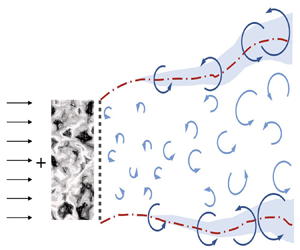
A permeable disk serves as a simplified model for the conversion of wind energy by a horizontal axis wind turbine. In this study, we investigate how inflow turbulence intensity (TI), $I_\infty$, and inflow turbulence integral length scale, $L_\infty$, influence the flow recovery in the wake, the capability of a permeable disk in extracting turbulence kinetic energy (TKE) of the incoming flow, and the statistics of wake-added turbulence using large-eddy simulation. The simulated inflows include various TIs (i.e. $I_\infty =2.5\,\%$$25\,\%$) and integral length scales (i.e. $L_\infty / D =0.5$$2.0$) for two thrust coefficients. Simulation results show that both inflow TI and integral length scale influence flow recovery via enhanced ejections and sweeps across the wake boundary, with the former strongly affecting the position where the wake starts to recover and the latter mainly on the recovery rate. Moreover, it is shown that increasing $I_\infty$ and $L_\infty$ increases the TKE extraction by the disk, occurring mainly at scales ($s$) greater than $0.5D$ and frequencies depending on the inflow integral length scale. As for the wake-added TKE, the inflow TI mainly affects its intensity, while the inflow integral length scale affects both its intensity and the sensitive frequencies, with the spectral distributions in scale space ($s$) being similar and the peak located around $s/D=1.0$ for the considered inflows.

Information

Type
JFM Papers
Copyright
© The Author(s), 2024. Published by Cambridge University Press.

Access options

Get access to the full version of this content by using one of the access options below. (Log in options will check for institutional or personal access. Content may require purchase if you do not have access.)

Article purchase

Temporarily unavailable

Supplementary material: File

Li et al. supplementary movie 1

Contours of filtered instantaneous streamwise velocity fluctuations with the incoming mean streamwise velocity subtracted. The filter width is 0.5D (where D is the diameter of the permeable disk). The thrust coefficient is 0.7. The incoming turbulence intensities are 2.5% and 25%, respectively with the integral length scale 1D.
Download Li et al. supplementary movie 1(File)
File 14 MB
Supplementary material: File

Li et al. supplementary movie 2

Contours of filtered instantaneous streamwise velocity fluctuations with the incoming mean streamwise velocity subtracted. The filter width is 0.5D (where D is the diameter of the permeable disk). The thrust coefficient is 0.7. The incoming integral length scales are 0.5D and 1.5D, respectively, with turbulence intensity 10%.
Download Li et al. supplementary movie 2(File)
File 12.3 MB