




The Revision Theory grows out of the idea that circular definitions can be legitimate. Revision theorists have claimed that ordinary language expresses circularly defined concepts, including truth, rational choice, and property exemplification.Footnote
1
The heart of the Revision Theory consists in providing a fully general semantics and logic for circular definitions. As presented in its locus classicus, Gupta and Belnap [Reference Gupta and Belnap14] (henceforth RTT), the Revision Theory is not just a single theory of definitions, but a genus of semantical theories sharing a common philosophical motivation and technical apparatus. (I will refer to the individual species as ‘revision theories’, in lowercase.) Of the known revision theories, arguably the most attractive have a curious feature: they are $\omega $
-inconsistent, in the sense that, relative to certain legitimate definitions,
$\omega $
-inconsistent, in the sense that, relative to certain legitimate definitions, $\omega $
-inconsistencies become categorically true in the standard model of arithmetic.Footnote
2
These
$\omega $
-inconsistencies become categorically true in the standard model of arithmetic.Footnote
2
These $\omega $
-inconsistencies are not restricted to artificial definitions: even the circular definition of truth produces
$\omega $
-inconsistencies are not restricted to artificial definitions: even the circular definition of truth produces $\omega $
-inconsistencies in languages with sufficiently expressive syntactic resources (see §7). Gupta [Reference Gupta12] goes so far as to argue that
$\omega $
-inconsistencies in languages with sufficiently expressive syntactic resources (see §7). Gupta [Reference Gupta12] goes so far as to argue that $\omega $
-inconsistency is non-optional: the Revision Theory—and indeed any logic of definitions—must tolerate it. To firmly committed revision theorists, true
$\omega $
-inconsistency is non-optional: the Revision Theory—and indeed any logic of definitions—must tolerate it. To firmly committed revision theorists, true $\omega $
-inconsistencies may present themselves as a novel logical discovery. To other philosophers, though, they may look more like a thorn in the side of the Revision Theory.
$\omega $
-inconsistencies may present themselves as a novel logical discovery. To other philosophers, though, they may look more like a thorn in the side of the Revision Theory.
Is the Revision Theory indeed committed to $\omega $
-inconsistency? I argue no. In this paper I develop a collection of new
$\omega $
-inconsistency? I argue no. In this paper I develop a collection of new $\omega $
-consistent semantical and proof systems, and use them to articulate a new revision theory that I call
$\omega $
-consistent semantical and proof systems, and use them to articulate a new revision theory that I call $\mathbf {S}^{\#N}$
. I then use
$\mathbf {S}^{\#N}$
. I then use $\mathbf {S}^{\#N}$
to show why the Revision Theory can and should remain
$\mathbf {S}^{\#N}$
to show why the Revision Theory can and should remain $\omega $
-consistent. I explain how
$\omega $
-consistent. I explain how $\mathbf {S}^{\#N}$
, unlike previous revision theories, withstands Gupta’s [Reference Gupta12, Reference Gupta13] arguments for
$\mathbf {S}^{\#N}$
, unlike previous revision theories, withstands Gupta’s [Reference Gupta12, Reference Gupta13] arguments for $\omega $
-inconsistency, which claim that only
$\omega $
-inconsistency, which claim that only $\omega $
-inconsistent systems have viable proof systems and can preserve the expressive functions of truth. Beyond meeting these challenges for
$\omega $
-inconsistent systems have viable proof systems and can preserve the expressive functions of truth. Beyond meeting these challenges for $\omega $
-consistency, I argue that
$\omega $
-consistency, I argue that $\mathbf {S}^{\#N}$
compares favorably to the best
$\mathbf {S}^{\#N}$
compares favorably to the best $\omega $
-inconsistent theories vis-à-vis a variety of important desiderata. I tentatively conclude that
$\omega $
-inconsistent theories vis-à-vis a variety of important desiderata. I tentatively conclude that $\mathbf {S}^{\#N}$
is the best known revision theory.
$\mathbf {S}^{\#N}$
is the best known revision theory.
As my exemplar of an $\omega $
-inconsistent theory I will take
$\omega $
-inconsistent theory I will take $\mathbf {S}^{\#}$
, the stronger of the two
$\mathbf {S}^{\#}$
, the stronger of the two $\omega $
-inconsistent theories recently defended by Gupta [Reference Gupta12, Reference Gupta13]. The other,
$\omega $
-inconsistent theories recently defended by Gupta [Reference Gupta12, Reference Gupta13]. The other, $\mathbf {S}$
, differs from
$\mathbf {S}$
, differs from $\mathbf {S}^{\#}$
only in small details. On the whole my considerations remain the same when comparing to
$\mathbf {S}^{\#}$
only in small details. On the whole my considerations remain the same when comparing to $\mathbf {S}$
; for the relevant differences see fnn. 22 and 27. My comparison revolves around nine desiderata for revision theories, which I highlight below. I will argue that
$\mathbf {S}$
; for the relevant differences see fnn. 22 and 27. My comparison revolves around nine desiderata for revision theories, which I highlight below. I will argue that $\mathbf {S}^{\#N}$
fares no worse than
$\mathbf {S}^{\#N}$
fares no worse than $\mathbf {S}^{\#}$
on each of these considerations, and strictly better than
$\mathbf {S}^{\#}$
on each of these considerations, and strictly better than $\mathbf {S}^{\#}$
on some. This means that I need not establish how much weight to give to each desideratum—only that it contributes something to a theory’s plausibility—in order to conclude that my theory is preferable to
$\mathbf {S}^{\#}$
on some. This means that I need not establish how much weight to give to each desideratum—only that it contributes something to a theory’s plausibility—in order to conclude that my theory is preferable to $\mathbf {S}^{\#}$
.Footnote
3
$\mathbf {S}^{\#}$
.Footnote
3
To clarify my claims, we should make a further terminological distinction. Besides distinguishing between the Revision Theory (uppercase) and specific revision theories (lowercase), we should also distinguish revision theories from revision systems. A revision system is a mathematical object given by a definition of categorical truth in that system. We can identify the revision system $\mathbf {S}^{\#}$
, for instance, with the relation
$\mathbf {S}^{\#}$
, for instance, with the relation $M\ {\models \!\!\!\!\!^{^{\mathscr D}}_{_{\#}}}\ A$
that holds between a model M, set of definitions
$M\ {\models \!\!\!\!\!^{^{\mathscr D}}_{_{\#}}}\ A$
that holds between a model M, set of definitions $\mathscr D$
, and a sentence A iff A is categorically true in
$\mathscr D$
, and a sentence A iff A is categorically true in $\mathbf {S}^{\#}$
in M relative to
$\mathbf {S}^{\#}$
in M relative to $\mathscr D$
. Importantly, the relation
$\mathscr D$
. Importantly, the relation ${\models \!\!\!\!\!^{^{\mathscr D}}_{_{\#}}} $
, as a mere mathematical object, cannot be correct or incorrect—any more than the empty set is correct or incorrect.
${\models \!\!\!\!\!^{^{\mathscr D}}_{_{\#}}} $
, as a mere mathematical object, cannot be correct or incorrect—any more than the empty set is correct or incorrect.
A revision theory, on the other hand, uses revision systems to make genuine claims about the semantics of languages with circular definitions. The theory associated with the system $\mathbf {S}^{\#}$
says, for instance: “a sentence A of a language
$\mathbf {S}^{\#}$
says, for instance: “a sentence A of a language $\mathscr L^+$
interpreted according to the ground model M and supplemented with definitions
$\mathscr L^+$
interpreted according to the ground model M and supplemented with definitions $\mathscr D$
is categorically true iff
$\mathscr D$
is categorically true iff $M {\models \!\!\!\!\!^{^{\mathscr D}}_{_{\#}}\,\,} A$
.” Such a claim can be correct or incorrect. (Indeed, this paper argues the latter.) In the case of
$M {\models \!\!\!\!\!^{^{\mathscr D}}_{_{\#}}\,\,} A$
.” Such a claim can be correct or incorrect. (Indeed, this paper argues the latter.) In the case of $\mathbf {S}^{\#}$
one can directly read off the revision theory from the corresponding revision system. Matters are less simple for my alternative theory
$\mathbf {S}^{\#}$
one can directly read off the revision theory from the corresponding revision system. Matters are less simple for my alternative theory $\mathbf {S}^{\#N}$
, which is given in terms of a sequence of revision systems
$\mathbf {S}^{\#N}$
, which is given in terms of a sequence of revision systems $\mathbf {S}^{\#0}$
,
$\mathbf {S}^{\#0}$
, $\mathbf {S}^{\#1}$
, …. §3 will provide details. I’ll use the name ‘
$\mathbf {S}^{\#1}$
, …. §3 will provide details. I’ll use the name ‘ $\mathbf {S}^{\#}$
’ both for the revision system
$\mathbf {S}^{\#}$
’ both for the revision system $\mathbf {S}^{\#}$
as well as the corresponding revision theory, trusting context to disambiguate when I am talking about a mathematical object versus a semantical theory. Similarly, context will clarify when ‘N’ is a variable, so that ‘
$\mathbf {S}^{\#}$
as well as the corresponding revision theory, trusting context to disambiguate when I am talking about a mathematical object versus a semantical theory. Similarly, context will clarify when ‘N’ is a variable, so that ‘ $\mathbf {S}^{\#N}$
’ ranges over individual revision systems
$\mathbf {S}^{\#N}$
’ ranges over individual revision systems $\mathbf {S}^{\#0}$
,
$\mathbf {S}^{\#0}$
, $\mathbf {S}^{\#1}$
, …, and when ‘
$\mathbf {S}^{\#1}$
, …, and when ‘ $\mathbf {S}^{\#N}$
’ is a closed term referring to a single revision theory.
$\mathbf {S}^{\#N}$
’ is a closed term referring to a single revision theory.
I’ll begin by presenting the formal systems $\mathbf {S}^{\#}$
and
$\mathbf {S}^{\#}$
and $\mathbf {S}^{\#N}$
, followed by a few examples. §3 will then introduce the semantical theories
$\mathbf {S}^{\#N}$
, followed by a few examples. §3 will then introduce the semantical theories $\mathbf {S}^{\#}$
and
$\mathbf {S}^{\#}$
and $\mathbf {S}^{\#N}$
based on these systems. This section will give a philosophical interpretation of revision strengths, a new parameter appearing in my systems. In subsequent sections I compare the theories
$\mathbf {S}^{\#N}$
based on these systems. This section will give a philosophical interpretation of revision strengths, a new parameter appearing in my systems. In subsequent sections I compare the theories $\mathbf {S}^{\#}$
and
$\mathbf {S}^{\#}$
and $\mathbf {S}^{\#N}$
regarding categorical truth (§4), entailment (§5), proof systems (§6), truth theories (§7), and theoretical simplicity (§9). Along the way, I respond in §§6.3 and 7.2 to Gupta’s arguments for
$\mathbf {S}^{\#N}$
regarding categorical truth (§4), entailment (§5), proof systems (§6), truth theories (§7), and theoretical simplicity (§9). Along the way, I respond in §§6.3 and 7.2 to Gupta’s arguments for $\omega $
-inconsistency. §8 extends the considerations of §7, and §10 summarizes my conclusions with a “scorecard” for the two theories.
$\omega $
-inconsistency. §8 extends the considerations of §7, and §10 summarizes my conclusions with a “scorecard” for the two theories.
1 The semantical systems $\mathbf {S}^{\#}$
and
$\mathbf {S}^{\#N}\hspace{-1pt}$
$\mathbf {S}^{\#}$
and
$\mathbf {S}^{\#N}\hspace{-1pt}$


1.1 Generalized schematic definitions
Our aim in offering a revision semantics is to enrich a classical ground language with circularly defined predicates.Footnote
4
For our ground language $\mathscr L$
we may take any first-order language with identity and the standard classical connectives.Footnote
5
We will call a classical model
$\mathscr L$
we may take any first-order language with identity and the standard classical connectives.Footnote
5
We will call a classical model $M \ (= \langle D, I \rangle )$
for
$M \ (= \langle D, I \rangle )$
for $\mathscr L$
a ground model. D is the domain of M. I, the interpretation function of M, assigns each n-place predicate a set of n-tuples from
$\mathscr L$
a ground model. D is the domain of M. I, the interpretation function of M, assigns each n-place predicate a set of n-tuples from $D^n$
, each individual constant an element of D, and each n-place function symbol a function
$D^n$
, each individual constant an element of D, and each n-place function symbol a function $D^n \to D$
. For a set of sentences
$D^n \to D$
. For a set of sentences $\Gamma $
, I’ll use
$\Gamma $
, I’ll use $M \models \Gamma $
to say that
$M \models \Gamma $
to say that $M \models A$
for all
$M \models A$
for all $A \in \Gamma $
.
$A \in \Gamma $
.
We expand $\mathscr L$
to
$\mathscr L$
to $\mathscr L^+$
by introducing a countable (finite or infinite) set of new unary predicates
$\mathscr L^+$
by introducing a countable (finite or infinite) set of new unary predicates $G_1, G_2, \ldots $
, each defined by a corresponding definition
$G_1, G_2, \ldots $
, each defined by a corresponding definition $\mathscr D_i$
. Let
$\mathscr D_i$
. Let $\mathscr D$
be the set of all such definitions
$\mathscr D$
be the set of all such definitions $\mathscr D_i$
. We may assume that all definitions in
$\mathscr D_i$
. We may assume that all definitions in $\mathscr D$
conform to the highly flexible form of generalized schematic definitions [Reference Gupta13, sec. 145].Footnote
6
A generalized schematic definition of G uses a (generalized) scheme
$\mathscr D$
conform to the highly flexible form of generalized schematic definitions [Reference Gupta13, sec. 145].Footnote
6
A generalized schematic definition of G uses a (generalized) scheme $\phi $
, which is a function:
$\phi $
, which is a function:
-
(i) that maps none, some, or all closed terms t of
$\mathscr L$
to sentences
$\phi _t$
of
$\mathscr L^+$
(which may contain any of
$G_1, G_2, \ldots $
); and -
(ii) that maps one variable x of
$\mathscr L$
to a formula
$\phi _x$
of
$\mathscr L^+$
with only x free.


The scheme $\phi $
is a function in our metalanguage, and need not (though may) be represented in
$\phi $
is a function in our metalanguage, and need not (though may) be represented in $\mathscr L^+$
. Given a scheme
$\mathscr L^+$
. Given a scheme $\phi _i$
for one of our
$\phi _i$
for one of our $G_i$
, we may write a generalized schematic definition as
$G_i$
, we may write a generalized schematic definition as
 $$\begin{align} G_i t =_{Df} \phi_{i,t}; \text{ otherwise, } G_i x =_{Df} \phi_{i,x}. \end{align}$$
The first clause is called the partial-definition clause of 𝒟
i
; the second is the explicit definition clause. $G_i$
is the defined term. We say that
$G_i$
is the defined term. We say that $\phi _{i,t}$
[respectively,
$\phi _{i,t}$
[respectively, $\phi _{i,x}$
] is the definiens for
$\phi _{i,x}$
] is the definiens for $G_i t$
[
$G_i t$
[ $ \! G_i x$
] in
$ \! G_i x$
] in $\phi _i$
(and also in 𝒟
i
). When the domain of
$\phi _i$
(and also in 𝒟
i
). When the domain of $\phi _i$
contains finitely many closed terms and
$\phi _i$
contains finitely many closed terms and $\phi _{i,x} = x \neq x$
, we obtain the partial definition
$\phi _{i,x} = x \neq x$
, we obtain the partial definition
 $$\begin{align} G_i t_0 =_{Df} A_0; \quad G_i t_1 =_{Df} A_1; \quad \ldots ; \; \quad G_i t_n =_{Df} A_n. \end{align}$$
Alternatively, we can let the domain of $\phi _i$
contain only x to obtain the explicit definition
$\phi _i$
contain only x to obtain the explicit definition
 $$\begin{align} G_i x =_{Df} \phi_{i,x}. \end{align}$$
When $\phi _i$
contains terms other than x in its domain, the definition 𝒟
i
carries a presupposition, notated
$\phi _i$
contains terms other than x in its domain, the definition 𝒟
i
carries a presupposition, notated $Pr_{\mathscr D_i}$
, that distinct closed terms in the domain of
$Pr_{\mathscr D_i}$
, that distinct closed terms in the domain of $\phi _i$
refer to different things. We may identify
$\phi _i$
refer to different things. We may identify $Pr_{\mathscr D_i}$
with the set of sentences of the form
$Pr_{\mathscr D_i}$
with the set of sentences of the form $t_1 \neq t_2$
, where
$t_1 \neq t_2$
, where $t_1$
and
$t_1$
and $t_2$
are distinct closed terms in the domain of
$t_2$
are distinct closed terms in the domain of $\phi _i$
. A ground model M is normal for 𝒟
i
iff
$\phi _i$
. A ground model M is normal for 𝒟
i
iff $M \models A$
for all
$M \models A$
for all $A \in Pr_{\mathscr D_i}$
. According to the semantical system presented below, when a model is not normal for a definition 𝒟
i
of
$A \in Pr_{\mathscr D_i}$
. According to the semantical system presented below, when a model is not normal for a definition 𝒟
i
of $G_i$
,
$G_i$
, $G_i$
will be categorically false of everything in the domain.
$G_i$
will be categorically false of everything in the domain.
1.2 Categorical truth in
$\mathbf {S}^{\#}$
and
$\mathbf {S}^{\#N}$


We will define our systems’ key semantical notion of categorical truth by isolating a set of “optimal” hypotheses, or interpretations of the defined terms.
Let $\mathscr L$
be a ground language and
$\mathscr L$
be a ground language and $M \ (= \langle D, I \rangle )$
a ground model for
$M \ (= \langle D, I \rangle )$
a ground model for $\mathscr L$
. A hypothesis for a set of defined predicates
$\mathscr L$
. A hypothesis for a set of defined predicates $G_1, G_2, \ldots $
is a function h that assigns a candidate extension
$G_1, G_2, \ldots $
is a function h that assigns a candidate extension $h(G_i) \subseteq D$
to each defined predicate
$h(G_i) \subseteq D$
to each defined predicate $G_i$
. The set of hypotheses is the set of all such functions, which we will denote
$G_i$
. The set of hypotheses is the set of all such functions, which we will denote $Hyp$
. A ground model M may be supplemented with any
$Hyp$
. A ground model M may be supplemented with any $h \in Hyp$
to produce the model
$h \in Hyp$
to produce the model $M + h$
that is just like M except that each
$M + h$
that is just like M except that each $G_i$
is assigned the extension
$G_i$
is assigned the extension $h(G_i)$
. When there is only one defined term, we’ll abuse notation by treating h simply as the extension of
$h(G_i)$
. When there is only one defined term, we’ll abuse notation by treating h simply as the extension of $G_1$
.
$G_1$
.
We can view circular definitions as instructions for refining hypotheses. Relative to a ground model M, the set of definitions $\mathscr D$
yields a revision rule
$\mathscr D$
yields a revision rule $\delta _{\mathscr D, M} : Hyp \to Hyp $
, defined as follows. For all i, hypotheses h, and
$\delta _{\mathscr D, M} : Hyp \to Hyp $
, defined as follows. For all i, hypotheses h, and $d \in D$
:
$d \in D$
: $d \in \delta _{\mathscr D, M}(h)(G_i)$
iff either
$d \in \delta _{\mathscr D, M}(h)(G_i)$
iff either
-
(i) M is normal for 𝒟 i and there is a term t in the domain of
$\phi _i$
such that
$I(t) = d$
and
$\phi _{i,t}$
is true in
$M + h$
; or -
(ii) M is normal for 𝒟 i , there is no such term t, and d satisfies
$\phi _{i,x}$
in
$M + h$
.


It follows that when M is not normal for 𝒟
i
the extension $\delta _{\mathscr D, M}(h)(G_i)$
is empty. Informally speaking, given a hypothesis h, the revision rule produces revised extensions
$\delta _{\mathscr D, M}(h)(G_i)$
is empty. Informally speaking, given a hypothesis h, the revision rule produces revised extensions $\delta _{\mathscr D, M}(h)(G_1)$
,
$\delta _{\mathscr D, M}(h)(G_1)$
, $\delta _{\mathscr D, M}(h)(G_2), \ldots $
comprising the members of the domain that would satisfy the definientia according to h.
$\delta _{\mathscr D, M}(h)(G_2), \ldots $
comprising the members of the domain that would satisfy the definientia according to h.
We can distinguish optimal hypotheses using revision sequences. Let $On$
be the class of all ordinals, let
$On$
be the class of all ordinals, let $\mathscr S$
be an
$\mathscr S$
be an $On$
-long sequence of elements of
$On$
-long sequence of elements of $Hyp$
, and let
$Hyp$
, and let $\mathscr S_{\beta }$
be the
$\mathscr S_{\beta }$
be the $\beta $
th member of
$\beta $
th member of $\mathscr S$
.Footnote
7
,
Footnote
8
If
$\mathscr S$
.Footnote
7
,
Footnote
8
If $\alpha $
is a limit ordinal, then an element
$\alpha $
is a limit ordinal, then an element $d \in D$
is stably
$d \in D$
is stably $G_i$
[stably not
$G_i$
[stably not $G_i$
] in
$G_i$
] in $\mathscr S$
at
$\mathscr S$
at $\alpha $
iff
$\alpha $
iff
 $$ \begin{align*} \exists \gamma < \alpha \ \forall \beta \ (\text{if } \gamma \leq \beta < \alpha \text{ then } d \in [\notin] \mathscr S_{\beta}(G_i)). \end{align*} $$
We say that d is stable for $G_i$
in
$G_i$
in $\mathscr S$
at
$\mathscr S$
at $\alpha $
iff d is either stably
$\alpha $
iff d is either stably $G_i$
or stably not
$G_i$
or stably not $G_i$
in
$G_i$
in $\mathscr S$
at
$\mathscr S$
at $\alpha $
; otherwise, d is unstable for
$\alpha $
; otherwise, d is unstable for $G_i$
in
$G_i$
in $\mathscr S$
at
$\mathscr S$
at $\alpha $
. A hypothesis h coheres with
$\alpha $
. A hypothesis h coheres with $\mathscr S$
at a limit ordinal
$\mathscr S$
at a limit ordinal $\alpha $
iff for all
$\alpha $
iff for all $G_i$
:
$G_i$
:
-
(i) if
$d \in D$
is stably
$G_i$
in
$\mathscr S$
at
$\alpha $
then
$d \in h(G_i)$
, and -
(ii) if
$d \in D$
is stably not
$G_i$
in
$\mathscr S$
at
$\alpha $
then
$d \notin h(G_i)$
.


Finally, $\mathscr S$
is a revision sequence for a revision rule
$\mathscr S$
is a revision sequence for a revision rule $\rho $
iff
$\rho $
iff $\mathscr S$
is an
$\mathscr S$
is an $On$
-long sequence of hypotheses such that, for all ordinals
$On$
-long sequence of hypotheses such that, for all ordinals $\alpha $
and
$\alpha $
and $\beta $
,
$\beta $
,
-
(i) if
$ \alpha = \beta +1$
then
$\mathscr S_{\alpha } = \rho (\mathscr S_{\beta })$
, and -
(ii) if
$\alpha $
is limit then
$\mathscr S_{\alpha }$
coheres with
$\mathscr S$
at
$\alpha $
.


A hypothesis h is cofinal in a revision sequence $\mathscr S$
iff for all
$\mathscr S$
iff for all $\alpha $
some
$\alpha $
some $\beta \geq \alpha $
is such that
$\beta \geq \alpha $
is such that $\mathscr S_{\beta } = h$
. Cardinality considerations imply that all revision sequences contain cofinal hypotheses (RTT, Theorem 5C.7). A hypothesis h is recurring for a revision rule
$\mathscr S_{\beta } = h$
. Cardinality considerations imply that all revision sequences contain cofinal hypotheses (RTT, Theorem 5C.7). A hypothesis h is recurring for a revision rule $\rho $
iff h is cofinal in some revision sequence for
$\rho $
iff h is cofinal in some revision sequence for $\rho $
. Since the revision process never eliminates recurring hypotheses, we can reasonably consider these optimal for
$\rho $
. Since the revision process never eliminates recurring hypotheses, we can reasonably consider these optimal for $\rho $
.
$\rho $
.
The definitions of categorical truth in $\mathbf {S}^{\#}$
and
$\mathbf {S}^{\#}$
and $\mathbf {S}^{\#N}$
are most transparent when set alongside the corresponding definition of a weaker system,
$\mathbf {S}^{\#N}$
are most transparent when set alongside the corresponding definition of a weaker system, $\mathbf {S}^*$
, presented in RTT. This system is the most well-known
$\mathbf {S}^*$
, presented in RTT. This system is the most well-known $\omega $
-consistent alternative to
$\omega $
-consistent alternative to $\mathbf {S}^{\#}$
. It defines categorical truth as truth on all recurring hypotheses.
$\mathbf {S}^{\#}$
. It defines categorical truth as truth on all recurring hypotheses.
Definition 1.1 (Categorical truth in
$\mathbf {S}^*$
)

Let A be a sentence of $\mathscr L^+$
and M a ground model. A is categorically true, or simply categorical,Footnote
9
in M relative to
$\mathscr L^+$
and M a ground model. A is categorically true, or simply categorical,Footnote
9
in M relative to $\mathscr D$
in the system
$\mathscr D$
in the system $\mathbf {S}^*$
(notation:
$\mathbf {S}^*$
(notation: $M {\models \!\!\!\!\!^{^{\mathscr D}}_{_{\:\! *}}\,\,} A$
) iff
$M {\models \!\!\!\!\!^{^{\mathscr D}}_{_{\:\! *}}\,\,} A$
) iff
 $$ \begin{align*} \forall h \text{ recurring for } \delta_{\mathscr D, M}, M + \delta_{\mathscr D, M} (h) \models A. \end{align*} $$
In $\mathbf {S}^*$
, as well as the systems presented below, a sentence is categorically false iff its negation is categorically true, and pathological iff it is neither categorically true nor categorically false.Footnote
10
$\mathbf {S}^*$
, as well as the systems presented below, a sentence is categorically false iff its negation is categorically true, and pathological iff it is neither categorically true nor categorically false.Footnote
10
Unfortunately, $\mathbf {S}^*$
’s definition of categorical truth is unsatisfactory, for many of the recurring hypotheses contain disruptive artifacts that creep in at limit stages (see Example 6.3). We can clean the recurring hypotheses up by revising them finitely many more times. This motivates Definition 1.2. In this definition,
$\mathbf {S}^*$
’s definition of categorical truth is unsatisfactory, for many of the recurring hypotheses contain disruptive artifacts that creep in at limit stages (see Example 6.3). We can clean the recurring hypotheses up by revising them finitely many more times. This motivates Definition 1.2. In this definition, $\rho ^n (h)$
denotes the result of applying the revision rule
$\rho ^n (h)$
denotes the result of applying the revision rule $\rho\ n$
times to h, with
$\rho\ n$
times to h, with $\rho ^0(h) = h$
.
$\rho ^0(h) = h$
.
Definition 1.2 (Categorical truth in
$\mathbf {S}^{\#}$
)

Let A be a sentence of $\mathscr L^+$
and M a ground model. A is categorically true, or categorical, in M relative to
$\mathscr L^+$
and M a ground model. A is categorically true, or categorical, in M relative to $\mathscr D$
in the system
$\mathscr D$
in the system $\mathbf {S}^{\#}$
(notation:
$\mathbf {S}^{\#}$
(notation: $M {\models \!\!\!\!\!^{^{\mathscr D}}_{_{\#}}\,\,} A$
) iff
$M {\models \!\!\!\!\!^{^{\mathscr D}}_{_{\#}}\,\,} A$
) iff
 $$ \begin{align} \exists n \forall h \text{ recurring for } \delta_{\mathscr D, M}, M + \delta_{\mathscr D, M}^n (h) \models A. \end{align} $$
Again, a sentence is categorically false iff its negation is categorically true.Footnote 11
My new systems $\mathbf {S}^{\#N}$
offer a different way to improve upon
$\mathbf {S}^{\#N}$
offer a different way to improve upon $\mathbf {S}^*$
: rather than revising the recurring hypotheses an arbitrary number of times, as in Definition 1.2, we revise them only up to some fixed natural number N. We may call the parameter N a revision strength.Footnote
12
I’ll postpone further philosophical discussion of revision strengths to §3. For now, we have the following definition.
$\mathbf {S}^*$
: rather than revising the recurring hypotheses an arbitrary number of times, as in Definition 1.2, we revise them only up to some fixed natural number N. We may call the parameter N a revision strength.Footnote
12
I’ll postpone further philosophical discussion of revision strengths to §3. For now, we have the following definition.
Definition 1.3 (Categorical truth in the systems
$\mathbf {S}^{\#N}$
)

Let A be a sentence of $\mathscr L^+$
, M a ground model, and
$\mathscr L^+$
, M a ground model, and $N \in \mathbb {N}$
. A is categorically true, or categorical, in M relative to
$N \in \mathbb {N}$
. A is categorically true, or categorical, in M relative to $\mathscr D$
in the system
$\mathscr D$
in the system $\mathbf {S}^{\#N}$
(notation:
$\mathbf {S}^{\#N}$
(notation: $M {\models \!\!\!\!\!^{^{\mathscr D}}_{_{ \#N}}\,\,} A$
) iff
$M {\models \!\!\!\!\!^{^{\mathscr D}}_{_{ \#N}}\,\,} A$
) iff
 $$ \begin{align*} \forall h \text{ recurring for } \delta_{\mathscr D, M}, M + \delta_{\mathscr D, M}^N (h) \models A. \end{align*} $$
I wishFootnote
13
to stress that, since N is a parameter that may vary, Definition 1.3 defines a sequence of revision systems $\mathbf {S}^{\#0}$
,
$\mathbf {S}^{\#0}$
, $\mathbf {S}^{\#1}$
, etc.
$\mathbf {S}^{\#1}$
, etc.
The term “revision strength” is motivated by the fact that increasing N results in more and more sentences becoming categorical in $\mathbf {S}^{\#N}$
.
$\mathbf {S}^{\#N}$
. $\mathbf {S}^{\#0}$
is just
$\mathbf {S}^{\#0}$
is just $\mathbf {S}^*$
; increasing N results in progressively stronger systems, with
$\mathbf {S}^*$
; increasing N results in progressively stronger systems, with $\mathbf {S}^{\#}$
the limit of this sequence. Relatedly, we have the following proposition, which will be important for my subsequent discussion.
$\mathbf {S}^{\#}$
the limit of this sequence. Relatedly, we have the following proposition, which will be important for my subsequent discussion.
Proposition 1.4. Let $\Gamma $
be a finite set of sentences of a language
$\Gamma $
be a finite set of sentences of a language $\mathscr L^+$
whose circular predicates are defined by
$\mathscr L^+$
whose circular predicates are defined by $\mathscr D$
, and let M be a ground model. Then there is a strength N such that for all
$\mathscr D$
, and let M be a ground model. Then there is a strength N such that for all $A \in \Gamma $
,
$A \in \Gamma $
, $M {\models \!\!\!\!\!^{^{\mathscr D}}_{_{\#}}\,\,} A$
iff
$M {\models \!\!\!\!\!^{^{\mathscr D}}_{_{\#}}\,\,} A$
iff $M {\models \!\!\!\!\!^{^{\mathscr D}}_{_{\#N}}\,\,} A$
.
$M {\models \!\!\!\!\!^{^{\mathscr D}}_{_{\#N}}\,\,} A$
.


2 Examples of circular definitions
Example 2.1 (A finite definition)
Let the ground language $\mathscr L$
contain individual constants a and b, which the ground model M interprets as
$\mathscr L$
contain individual constants a and b, which the ground model M interprets as $0$
and
$0$
and $1$
, respectively. The domain D may contain other objects. We define H explicitly as follows:
$1$
, respectively. The domain D may contain other objects. We define H explicitly as follows:
 $$\begin{align} Hx =_{Df} (x = a \vee x = b) \wedge \neg Ha \wedge \neg Hb. \end{align}$$
For all hypotheses $h \subseteq D$
, the revision rule
$h \subseteq D$
, the revision rule $\delta _{\mathscr D_0, M}$
is as follows:
$\delta _{\mathscr D_0, M}$
is as follows:
 $$ \begin{align*} \delta_{\mathscr {D}_{0,M}} (h) = \begin{cases} \{0,1\} &\text{ if } 0 \notin h \text{ and } 1 \notin h; \\ \varnothing &\text{ otherwise.} \end{cases} \end{align*} $$
The recurring hypotheses are exactly $\varnothing $
,
$\varnothing $
, $\{0\}$
,
$\{0\}$
, $\{1\}$
, and
$\{1\}$
, and $\{0,1\}$
. Table 1 illustrates how
$\{0,1\}$
. Table 1 illustrates how $\mathbf {S}^*$
,
$\mathbf {S}^*$
, $\mathbf {S}^{\#}$
, and
$\mathbf {S}^{\#}$
, and $\mathbf {S}^{\#N}$
treat some pertinent sentences.
$\mathbf {S}^{\#N}$
treat some pertinent sentences.
Semantical statuses of sentences in M relative to 𝒟0
in $\mathbf {S}^*$
,
$\mathbf {S}^*$
, $\mathbf {S}^{\#N}$
, and
$\mathbf {S}^{\#N}$
, and $\mathbf {S}^{\#}$

Note: ‘ $\checkmark $
’ indicates a categorical truth; ‘—’ indicates pathologicality.
$\checkmark $
’ indicates a categorical truth; ‘—’ indicates pathologicality.
The sentence $Ha \leftrightarrow Hb$
is pathological in
$Ha \leftrightarrow Hb$
is pathological in $\mathbf {S}^*$
due to the recurring hypotheses
$\mathbf {S}^*$
due to the recurring hypotheses $\{0\}$
and
$\{0\}$
and $\{1\}$
. These occur only at the limit stages of revision sequences, after which they are immediately revised away. The fact that
$\{1\}$
. These occur only at the limit stages of revision sequences, after which they are immediately revised away. The fact that $\mathbf {S}^{\#1}$
, like
$\mathbf {S}^{\#1}$
, like $\mathbf {S}^{\#}$
, eliminates these imperfections in the revision process already illustrates an improvement over
$\mathbf {S}^{\#}$
, eliminates these imperfections in the revision process already illustrates an improvement over $\mathbf {S}^*$
. §6.3 will expand upon this theme.
$\mathbf {S}^*$
. §6.3 will expand upon this theme.
Example 2.2 (Truth)
By far the most important applications of the Revision Theory are to semantic predicates such as truth. In certain models, truth can be given a generalized schematic definition, as follows. Let us expand a ground language $\mathscr L$
to
$\mathscr L$
to $\mathscr L^+$
by adding a one-place predicate T. Let a full sentential frame for
$\mathscr L^+$
by adding a one-place predicate T. Let a full sentential frame for $\mathscr L^+$
be a pair
$\mathscr L^+$
be a pair $\langle M, \ulcorner \ \urcorner \rangle $
, where M is a ground model whose domain contains every sentence of
$\langle M, \ulcorner \ \urcorner \rangle $
, where M is a ground model whose domain contains every sentence of $\mathscr L^+$
and
$\mathscr L^+$
and $\ulcorner \ \urcorner $
is an injection that:
$\ulcorner \ \urcorner $
is an injection that:
-
(i) maps every sentence
$B \in \mathscr L^+$
, to a closed term
$\ulcorner B \urcorner $
of
$\mathscr L$
that refers in M to B; and -
(ii) maps the formula
$x \neq x$
to x.


In a full sentential frame, we may use $(\ulcorner \ \urcorner )^{-1}$
as a scheme to define T by the truth definition
$(\ulcorner \ \urcorner )^{-1}$
as a scheme to define T by the truth definition
 $$ \begin{align} T\ulcorner A \urcorner =_{Df} A; \text{ otherwise, }Tx =_{Df} x \neq x. \end{align} $$
Its revision rule in M is the Tarski jump, $\tau _{M}$
. For any hypothesis h,
$\tau _{M}$
. For any hypothesis h,
 $$ \begin{align*} \tau_M(h) = \{A \in \mathscr L^+ : M + h \models A\}. \end{align*} $$
That is, $\tau _M$
takes the sentences that were true according to h and puts them in the extension of
$\tau _M$
takes the sentences that were true according to h and puts them in the extension of $\tau _M(h)$
.
$\tau _M(h)$
.
For now I will discuss only the basic outlines of how $\mathbf {S}^*$
,
$\mathbf {S}^*$
, $\mathbf {S}^{\#}$
, and the systems
$\mathbf {S}^{\#}$
, and the systems $\mathbf {S}^{\#N}$
handle self-referential sentences, on which they all agree. (All statements about the systems
$\mathbf {S}^{\#N}$
handle self-referential sentences, on which they all agree. (All statements about the systems $\mathbf {S}^{\#N}$
in this example hold for all values of N.) Later, in §7, I’ll study the differences between the systems. In all three systems,
$\mathbf {S}^{\#N}$
in this example hold for all values of N.) Later, in §7, I’ll study the differences between the systems. In all three systems, $T\ulcorner A \urcorner \leftrightarrow A$
is categorical for any sentence of
$T\ulcorner A \urcorner \leftrightarrow A$
is categorical for any sentence of $\mathscr L$
, i.e., not containing T. In fact, a stronger result holds: when there is no vicious self-reference in
$\mathscr L$
, i.e., not containing T. In fact, a stronger result holds: when there is no vicious self-reference in $\mathscr L^+$
,
$\mathscr L^+$
, $T\ulcorner A \urcorner \leftrightarrow A$
is categorical for all A of the expanded language.Footnote
14
Now suppose that M and
$T\ulcorner A \urcorner \leftrightarrow A$
is categorical for all A of the expanded language.Footnote
14
Now suppose that M and $\ulcorner \ \urcorner $
are such that
$\ulcorner \ \urcorner $
are such that $\mathscr L^+$
contains a liar sentence
$\mathscr L^+$
contains a liar sentence $\lambda = \ulcorner \neg T\lambda \urcorner $
. Then both
$\lambda = \ulcorner \neg T\lambda \urcorner $
. Then both $T\lambda $
and
$T\lambda $
and $\neg T\lambda $
are pathological, and
$\neg T\lambda $
are pathological, and $T\ulcorner \neg T\lambda \urcorner \leftrightarrow \neg T\lambda $
is categorically false. But, since revision semantics preserves logical truths,
$T\ulcorner \neg T\lambda \urcorner \leftrightarrow \neg T\lambda $
is categorically false. But, since revision semantics preserves logical truths, $T\lambda \vee \neg T\lambda $
is categorically true. If
$T\lambda \vee \neg T\lambda $
is categorically true. If $\mathscr L^+$
contains a truth-teller
$\mathscr L^+$
contains a truth-teller $\theta = \ulcorner T\theta \urcorner $
,
$\theta = \ulcorner T\theta \urcorner $
, $T\theta $
and
$T\theta $
and $\neg T\theta $
are pathological, but
$\neg T\theta $
are pathological, but $T\ulcorner T\theta \urcorner \leftrightarrow T\theta $
is categorical (indeed, a logical truth).
$T\ulcorner T\theta \urcorner \leftrightarrow T\theta $
is categorical (indeed, a logical truth).
My final example, a focal point of the subsequent discussion, highlights the crucial differences between $\mathbf {S}^{\#}$
and the systems
$\mathbf {S}^{\#}$
and the systems $\mathbf {S}^{\#N}$
.Footnote
15
$\mathbf {S}^{\#N}$
.Footnote
15
Example 2.3 (An
$\omega $
-inconsistency in
$\mathbf {S}^{\#}$
)


Let $\mathscr L$
contain both
$\mathscr L$
contain both
-
(i) arithmetical symbols: an individual constant
$0$
, a one-place function symbol
$'$
, and a two-place predicate
$<$
; and -
(ii) syntactical symbols: an infinity of constants
$c_0, c_1, \ldots $
(to be used as names of sentences), plus a one-place function symbol g.


We will write $\overline {n}$
for
$\overline {n}$
for $0$
followed by n applications of
$0$
followed by n applications of $'$
;
$'$
; $\geq $
and
$\geq $
and $\leq $
can be defined from
$\leq $
can be defined from $< $
and
$< $
and $=$
in the ordinary way. Further, for a formula A, let
$=$
in the ordinary way. Further, for a formula A, let $\forall i A$
,
$\forall i A$
, $\forall j A$
, … abbreviate
$\forall j A$
, … abbreviate $\forall x (0 \leq x \to A)$
,
$\forall x (0 \leq x \to A)$
, $\forall y (0 \leq y \to A)$
, ….
$\forall y (0 \leq y \to A)$
, …. $\mathscr L^+$
is obtained by adding to
$\mathscr L^+$
is obtained by adding to $\mathscr L$
one-place predicates G and T. Let
$\mathscr L$
one-place predicates G and T. Let $\langle M, \ulcorner \ \urcorner \rangle $
be a full sentential frame for
$\langle M, \ulcorner \ \urcorner \rangle $
be a full sentential frame for $\mathscr L^+$
, in which we stipulate the following:
$\mathscr L^+$
, in which we stipulate the following:
-
•
$D = \mathbb {N} \cup \{A : A \text { is a sentence of } \mathscr L^+\}$
. -
• I gives the mathematical symbols their standard interpretations. In particular,
$\langle d_1, d_2 \rangle \in I(<)$
only if
$d_1, d_2 \in \mathbb {N} $
, and
$I(')$
maps sentences to the dummy object
$\forall x \ x=x$
(which is in D). -
•
$I(g)$
maps each natural number n to its G-predication
$G\overline {n}$
, and maps sentences to
$\forall x \ x=x$
.




We define G explicitly by
 $$ \begin{align*} Gx =_{Df} 0 \leq x \ \wedge \ \neg (G \ is \ closed) \wedge \forall j (j < x \to Gj), \end{align*} $$
where ‘ $G \ is \ closed$
’ abbreviates
$G \ is \ closed$
’ abbreviates $G0 \wedge \forall y (Gy \to Gy')$
. T is defined as in the previous example:
$G0 \wedge \forall y (Gy \to Gy')$
. T is defined as in the previous example:
 $$ \begin{align*} T\ulcorner A \urcorner =_{Df} A; \text{ otherwise, }Tx =_{Df} x \neq x. \end{align*} $$
Let $\mathscr D_1$
be the set consisting of the definitions for G and T. Notice that these definitions are interdependent: some definienda of the truth definition, such as the sentence
$\mathscr D_1$
be the set consisting of the definitions for G and T. Notice that these definitions are interdependent: some definienda of the truth definition, such as the sentence $T\ulcorner G0 \urcorner $
, are themselves defined in terms of the circular predicate G.
$T\ulcorner G0 \urcorner $
, are themselves defined in terms of the circular predicate G.
The revision rule $\delta _{\mathscr D_1, M}$
is as follows. For any hypothesis h,
$\delta _{\mathscr D_1, M}$
is as follows. For any hypothesis h,
 $$ \begin{align*} \delta_{\mathscr D_1, M}(h)(G) &= \begin{cases} \{n \in \mathbb{N} : n \leq m\} &\text{ if } m = \min\{k \in \mathbb{N} : k \notin h(G)\}; \\ \varnothing &\text{ if } \mathbb{N} \subseteq h. \end{cases} \\ \delta_{\mathscr D_1, M}(h)(T) &= \{A \in \mathscr L^+ : M + h \models A\}. \end{align*} $$
One can verify that every subset of $\mathbb {N}$
occurs as
$\mathbb {N}$
occurs as $h(G)$
for some recurring hypothesis
$h(G)$
for some recurring hypothesis $h$
.
$h$
.
The following sentences are all categorical in M relative to $\mathscr D_1$
in
$\mathscr D_1$
in $\mathbf {S}^{\#}$
:
$\mathbf {S}^{\#}$
:
 $$ \begin{align} G0, \ G0', \ G0", \ldots , \ \exists i \neg Gi; \ T\ulcorner G0 \urcorner, \ T\ulcorner G0' \urcorner, \ldots , \ \exists i \neg Tg(i). \end{align} $$
Of those, $\mathbf {S}^{\#N}$
(
$\mathbf {S}^{\#N}$
( $N \geq 3$
) regards only these as categorical:
$N \geq 3$
) regards only these as categorical:
 $$ \begin{align} \begin{aligned} & G0, \ G0', \ldots, \ G\overline{(N-2)}, \ \exists i \neg Gi; \\ & T\ulcorner G0 \urcorner, \ T\ulcorner G0' \urcorner, \ldots, \ T\ulcorner G \overline{(N-3)} \urcorner, \ \exists i \neg Tg(i). \end{aligned} \end{align} $$
It regards these as pathological:
 $$ \begin{align} G\overline{(N-1)}, \ G\overline{N}, \ldots; \ T\ulcorner G\overline{(N-2)} \urcorner, \ T\ulcorner G\overline{(N-1)} \urcorner, \ldots. \end{align} $$
Note that the truth predications become pathological one numeral earlier than the corresponding G-predications.
Standardly, an $\omega $
-inconsistency is defined as a set of sentences
$\omega $
-inconsistency is defined as a set of sentences $\{\exists x \neg A(x), A (0), A (0'), \ldots \}$
for some formula
$\{\exists x \neg A(x), A (0), A (0'), \ldots \}$
for some formula $A $
. For languages that can talk about non-mathematical objects, an
$A $
. For languages that can talk about non-mathematical objects, an $\omega $
-inconsistency should probably be defined instead as a set of sentences
$\omega $
-inconsistency should probably be defined instead as a set of sentences $\{\exists x (0 \leq x \wedge \neg A (x)), A (0), A (0'), \ldots \}$
. On the revised definition, the sentences
$\{\exists x (0 \leq x \wedge \neg A (x)), A (0), A (0'), \ldots \}$
. On the revised definition, the sentences $\exists i \neg Gi$
,
$\exists i \neg Gi$
, $G0$
,
$G0$
, $G0'$
, … form an
$G0'$
, … form an $\omega $
-inconsistency that is categorically true in
$\omega $
-inconsistency that is categorically true in $\mathbf {S}^{\#}$
. As (2) indicates, this
$\mathbf {S}^{\#}$
. As (2) indicates, this $\omega $
-inconsistency is mirrored by a second one,
$\omega $
-inconsistency is mirrored by a second one, $\{\exists i \neg Tg(i), Tg(0), Tg(0'), \ldots \}$
, at the level of truth predications. Turning now to
$\{\exists i \neg Tg(i), Tg(0), Tg(0'), \ldots \}$
, at the level of truth predications. Turning now to $\mathbf {S}^{\#N}$
, we can see in Example 2.3 the role of the bound N in avoiding
$\mathbf {S}^{\#N}$
, we can see in Example 2.3 the role of the bound N in avoiding $\omega $
-inconsistency: bounding the revision process prevents some of the sentences
$\omega $
-inconsistency: bounding the revision process prevents some of the sentences $G \overline {n}$
from becoming categorically true.
$G \overline {n}$
from becoming categorically true.
3 Setting revision strengths
So much for the technical apparatus. What philosophical claims about semantics can we make with these revision systems? As above, we may identify the $\mathbf {S}^{\#}$
theory with the claim
$\mathbf {S}^{\#}$
theory with the claim
-
(S # ) A sentence A of a language
$\mathscr L^+$
interpreted according to the ground model M and supplemented with definitions
$\mathscr D$
is categorically true iff
$M {\models \!\!\!\!\!^{^{\mathscr D}}_{_{\#}}\,\,} A$
.


We could similarly formulate semantical theories corresponding to each of the systems $\mathbf {S}^{\#0}$
,
$\mathbf {S}^{\#0}$
, $\mathbf {S}^{\#1}$
, and so on. An arguably more attractive theory, however, results from letting different revision strengths apply to different languages.Footnote
16
The result is the following
$\mathbf {S}^{\#1}$
, and so on. An arguably more attractive theory, however, results from letting different revision strengths apply to different languages.Footnote
16
The result is the following $\mathbf {S}^{\#N}$
theory:
$\mathbf {S}^{\#N}$
theory:
-
(S #N ) A sentence A of a language
$\mathscr L^+$
interpreted according to the ground model M and supplemented with definitions
$\mathscr D$
is categorically true iff
$M {\models \!\!\!\!\!^{^{\mathscr D}}_{_{\#N}}\,\,} A$
, where N is the revision strength of
$\mathscr L^+$
.


As stated, the $\mathbf {S}^{\#N}$
theory must be supplemented with an account of what it is for N to be the revision strength of
$\mathbf {S}^{\#N}$
theory must be supplemented with an account of what it is for N to be the revision strength of $\mathscr L^+$
. I’ll present such an account below, and expand upon it in §8.
$\mathscr L^+$
. I’ll present such an account below, and expand upon it in §8.
In determining the revision strength of a language, there are two cases to consider. In Case 1, a speaker stipulates the revision strength for her idiolect, or the speakers of a dialect collectively stipulate its revision strength. Of course, this case is extraordinarily rare: it presupposes that the speakers are not only revision theorists but proponents of $\mathbf {S}^{\#N}$
(or some closely related theory). Usually, we are in Case 2: no revision strength is successfully stipulated, either because no speaker attempted to or because they did not have the authority to perform the stipulation. (For instance, I cannot by myself stipulate the revision strength of the English language for the same reason that I cannot by mere stipulation change the conventional meanings of English words.) The most prominent instances of Case 2 are natural languages containing a truth predicate. According to the Revision Theory, truth has a circular semantics. But clearly no natural language’s speakers ever collectively decided upon their language’s revision strength.
$\mathbf {S}^{\#N}$
(or some closely related theory). Usually, we are in Case 2: no revision strength is successfully stipulated, either because no speaker attempted to or because they did not have the authority to perform the stipulation. (For instance, I cannot by myself stipulate the revision strength of the English language for the same reason that I cannot by mere stipulation change the conventional meanings of English words.) The most prominent instances of Case 2 are natural languages containing a truth predicate. According to the Revision Theory, truth has a circular semantics. But clearly no natural language’s speakers ever collectively decided upon their language’s revision strength.
A language’s revision strength in Case 2 must, then, be set to some “default” strength. The following principle provides an attractive way of determining default strengths for a large class of languages:
-
(Agreement) If the circular predicates of
$\mathscr L^+$
are defined by
$\mathscr D$
, and the totality of
$ \mathscr L^+$
-sentences used by its speakers comprises a finite set
$\Gamma $
, then the default revision strength for
$\mathscr L^+$
is the least N satisfying Proposition 1.4 for
$\Gamma $
and
$\mathscr D$
.


In the sense relevant for Agreement, a speaker uses a sentence B of $\mathscr L^+$
roughly iff she uses (in the ordinary sense) some particular token of B in an act of communication.Footnote
17
The upshot of Agreement is that the theory
$\mathscr L^+$
roughly iff she uses (in the ordinary sense) some particular token of B in an act of communication.Footnote
17
The upshot of Agreement is that the theory $\mathbf {S}^{\#N}$
agrees with
$\mathbf {S}^{\#N}$
agrees with $\mathbf {S}^{\#}$
on the categorical truth of all sentences actually in use—which presumably are finite in number. In the dialectical context of comparing the two theories, this fact is very effective. It promises to preempt any complaints that
$\mathbf {S}^{\#}$
on the categorical truth of all sentences actually in use—which presumably are finite in number. In the dialectical context of comparing the two theories, this fact is very effective. It promises to preempt any complaints that $\mathbf {S}^{\#N}$
lacks certain desirable features of
$\mathbf {S}^{\#N}$
lacks certain desirable features of $\mathbf {S}^{\#}$
. One would respond that, as far as concerns the sentences actually in use,
$\mathbf {S}^{\#}$
. One would respond that, as far as concerns the sentences actually in use, $\mathbf {S}^{\#N}$
yields the very same semantics as
$\mathbf {S}^{\#N}$
yields the very same semantics as $\mathbf {S}^{\#}$
. We will see some applications of this idea in §6.3 and §7.
$\mathbf {S}^{\#}$
. We will see some applications of this idea in §6.3 and §7.
So far, Agreement only applies to languages with finite usage. In §8, I generalize Agreement to languages with infinite usage and continue my comparison for such languages.
4 Desiderata on categorical truth
We can now evaluate $\mathbf {S}^{\#}$
and
$\mathbf {S}^{\#}$
and $\mathbf {S}^{\#N}$
according to two desiderata on categorical truth. First, both theories satisfy Strong Conservativeness:
$\mathbf {S}^{\#N}$
according to two desiderata on categorical truth. First, both theories satisfy Strong Conservativeness:
-
(Strong Conservativeness) For all sets
$\mathscr D$
of definitions, models M, and sentences A of ground languages
$\mathscr L$
: if
$\mathscr L$
is interpreted according to M and expanded with
$\mathscr D$
, then A is categorically true iff
$M \models A$
.Footnote
18


In other words, adding definitions leaves the semantics of the ground language untouched. I think we should, with Gupta [Reference Gupta12, p. 185], regard Strong Conservativeness as “non-negotiable.” Strong Conservativeness of $\mathbf {S}^{\#}$
and
$\mathbf {S}^{\#}$
and $\mathbf {S}^{\#N}$
follows from the fact that every revision rule has at least one recurring hypothesis in every model (p. 7).
$\mathbf {S}^{\#N}$
follows from the fact that every revision rule has at least one recurring hypothesis in every model (p. 7).
Our second desideratum is $\omega $
-consistency:
$\omega $
-consistency:
-
(ω-consistency) Where
$\mathscr L$
is the language of arithmetic interpreted by its standard model and possibly expanded with a set
$\mathscr D$
of definitions, no
$\omega $
-inconsistent set of
$\mathscr L$
-sentences is categorically true.


In Example 2.3 we already saw that $\mathbf {S}^{\#}$
makes
$\mathbf {S}^{\#}$
makes $\omega $
-inconsistencies categorically true, and it is clear that an
$\omega $
-inconsistencies categorically true, and it is clear that an $\omega $
-inconsistency would remain if one restricted the ground model’s domain to the natural numbers.
$\omega $
-inconsistency would remain if one restricted the ground model’s domain to the natural numbers.
That the theory $\mathbf {S}^{\#N}$
satisfies
$\mathbf {S}^{\#N}$
satisfies $\omega $
-consistency follows from the fact that each system
$\omega $
-consistency follows from the fact that each system $\mathbf {S}^{\#N}$
is
$\mathbf {S}^{\#N}$
is $\omega $
-consistent. To see why the latter is true, it is informative to consider the related thesis of weak reductionism about circular concepts. Weak reductionism says that, for any set of definitions
$\omega $
-consistent. To see why the latter is true, it is informative to consider the related thesis of weak reductionism about circular concepts. Weak reductionism says that, for any set of definitions $\mathscr D$
and ground model M, there is a set of hypotheses
$\mathscr D$
and ground model M, there is a set of hypotheses $H \subseteq Hyp$
such that for all sentences A of
$H \subseteq Hyp$
such that for all sentences A of $\mathscr L^+$
, A is categorical in M iff
$\mathscr L^+$
, A is categorical in M iff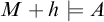 $M + h \models A$
for all
$M + h \models A$
for all $h \in H$
[Reference Gupta13, sec. 174]. If weak reductionism holds, categorical truth can always be understood as supervaluation over some set H of “acceptable” hypotheses. Weak reductionism fails in the system
$h \in H$
[Reference Gupta13, sec. 174]. If weak reductionism holds, categorical truth can always be understood as supervaluation over some set H of “acceptable” hypotheses. Weak reductionism fails in the system $\mathbf {S}^{\#}$
, but in the systems
$\mathbf {S}^{\#}$
, but in the systems $\mathbf {S}^{\#N}$
it holds for
$\mathbf {S}^{\#N}$
it holds for $H = \{h \in Hyp : \exists h' \ h' \text { is recurring and }h = \delta _{\mathscr D, M}^N(h')\}$
. While neither weak reductionism nor its negation strikes me as intrinsically desirable, weak reductionism is one way of achieving
$H = \{h \in Hyp : \exists h' \ h' \text { is recurring and }h = \delta _{\mathscr D, M}^N(h')\}$
. While neither weak reductionism nor its negation strikes me as intrinsically desirable, weak reductionism is one way of achieving $\omega $
-consistency. The next proposition makes this observation precise and establishes that all the systems
$\omega $
-consistency. The next proposition makes this observation precise and establishes that all the systems $\mathbf {S}^{\#N}$
are
$\mathbf {S}^{\#N}$
are $\omega $
-consistent.
$\omega $
-consistent.
Proposition 4.1. Every revision system that satisfies both Strong Conservativeness and weak reductionism about circular concepts is $\omega $
-consistent.
$\omega $
-consistent.
Proof. Straightforward.
In setting up $\omega $
-consistency—or any other feature—as a desideratum, I don’t claim that this feature is decisive, only that it’s attractive to some extent. In the case of
$\omega $
-consistency—or any other feature—as a desideratum, I don’t claim that this feature is decisive, only that it’s attractive to some extent. In the case of $\omega $
-consistency, I suspect this claim is uncontroversial—even among those who ultimately favor
$\omega $
-consistency, I suspect this claim is uncontroversial—even among those who ultimately favor $\omega $
-inconsistent theories. However, it’s worthwhile to briefly dispel a potential misunderstanding about why
$\omega $
-inconsistent theories. However, it’s worthwhile to briefly dispel a potential misunderstanding about why $\omega $
-inconsistency is unattractive. The standard objection to
$\omega $
-inconsistency is unattractive. The standard objection to $\omega $
-inconsistency is that models of
$\omega $
-inconsistency is that models of $\omega $
-inconsistent theories are arithmetically nonstandard.Footnote
19
In the context of the Revision Theory this objection loses its force (RTT, p. 156). The objection assumes, crucially, that ‘model’ is to be understood as a traditional, classical model—what I’ve been calling a ground model. Now, it is true that the theory consisting of the sentences categorically true in
$\omega $
-inconsistent theories are arithmetically nonstandard.Footnote
19
In the context of the Revision Theory this objection loses its force (RTT, p. 156). The objection assumes, crucially, that ‘model’ is to be understood as a traditional, classical model—what I’ve been calling a ground model. Now, it is true that the theory consisting of the sentences categorically true in $\mathbf {S}^{\#}$
in Example 2.3 has no arithmetically standard models in this sense. But that fact is irrelevant: revision theorists think that circular concepts call for a revision semantics, not a classical model theory. The objection attempts, as it were, to fit a square semantics onto circular concepts. Meanwhile, the revision semantics in Example 2.3 does employ an arithmetically standard ground model.
$\mathbf {S}^{\#}$
in Example 2.3 has no arithmetically standard models in this sense. But that fact is irrelevant: revision theorists think that circular concepts call for a revision semantics, not a classical model theory. The objection attempts, as it were, to fit a square semantics onto circular concepts. Meanwhile, the revision semantics in Example 2.3 does employ an arithmetically standard ground model.
In my view there are still two legitimate issues with $\omega $
-inconsistent revision theories. First, the incredulous stare: “What do you mean by saying that some number isn’t G when you also say, of each individual number, that it is?” Stares may not make for eloquent arguments, but being counterintuitive surely counts against a theory. Second, rejecting
$\omega $
-inconsistent revision theories. First, the incredulous stare: “What do you mean by saying that some number isn’t G when you also say, of each individual number, that it is?” Stares may not make for eloquent arguments, but being counterintuitive surely counts against a theory. Second, rejecting $\omega $
-consistency requires denying a number of other attractive principles. Suppose we expand the language
$\omega $
-consistency requires denying a number of other attractive principles. Suppose we expand the language $\mathscr L^+$
of Example 2.3 to
$\mathscr L^+$
of Example 2.3 to $\mathscr L_K^{+}$
by adding a new (non-circular) predicate
$\mathscr L_K^{+}$
by adding a new (non-circular) predicate $K_{\mathbf {t}}(x)$
. We interpret this predicate to be true of precisely the
$K_{\mathbf {t}}(x)$
. We interpret this predicate to be true of precisely the $\mathscr L^+$
sentences categorically true according to
$\mathscr L^+$
sentences categorically true according to $\mathbf {S}^{\#N}$
, for a given N.Footnote
20
We can then show that
$\mathbf {S}^{\#N}$
, for a given N.Footnote
20
We can then show that
 $$ \begin{align} M {\models\!\!\!\!\!^{^{\mathscr D_1}}_{_{\#N}}\,\,} \forall i (K_{\mathbf{t}}(g(i)) \to Gi). \end{align} $$
Roughly, if G is “categorically true of” i, then i is G. We could suitably generalize the claim to apply to circular definitions in any language. Due to $\mathbf {S}^{\#}$
’s
$\mathbf {S}^{\#}$
’s $\omega $
-inconsistency, however, the claim for
$\omega $
-inconsistency, however, the claim for $\mathbf {S}^{\#}$
corresponding to (K) fails to be assertible. Indeed,
$\mathbf {S}^{\#}$
corresponding to (K) fails to be assertible. Indeed, $\mathbf {S}^{\#}$
asserts that while the G-predication of some number is categorical, that number is not G. As I show in a different paper,
$\mathbf {S}^{\#}$
asserts that while the G-predication of some number is categorical, that number is not G. As I show in a different paper, $\omega $
-inconsistency in
$\omega $
-inconsistency in $\mathbf {S}^{\#}$
also results in the categorical falsity of reflection principles for the theory consisting of Peano Arithmetic closed under
$\mathbf {S}^{\#}$
also results in the categorical falsity of reflection principles for the theory consisting of Peano Arithmetic closed under $\mathbf {S}^{\#}$
’s proof system
$\mathbf {S}^{\#}$
’s proof system $\mathbf {C}$
[Reference Schindler23]. Since reflection principles for a theory express its soundness, I argue that
$\mathbf {C}$
[Reference Schindler23]. Since reflection principles for a theory express its soundness, I argue that $\mathbf {S}^{\#}$
pays a heavy price for rejecting these principles.
$\mathbf {S}^{\#}$
pays a heavy price for rejecting these principles.
5 Entailment
In this section I compare the entailment relations of $\mathbf {S}^{\#}$
and
$\mathbf {S}^{\#}$
and $\mathbf {S}^{\#N}$
. To define entailment in the Revision Theory, one begins with the notion of a logical truth: a sentence that is categorically true in all models. We then say that
$\mathbf {S}^{\#N}$
. To define entailment in the Revision Theory, one begins with the notion of a logical truth: a sentence that is categorically true in all models. We then say that $A_1, \ldots , A_n$
entail B iff the conditional
$A_1, \ldots , A_n$
entail B iff the conditional $A_1 \wedge \ldots \wedge A_n \to B$
is a logical truth. Definition 5.1 generalizes this idea to possibly infinite premise sets. Part (i) is Gupta’s [Reference Gupta12, Reference Gupta13] definition of entailment for
$A_1 \wedge \ldots \wedge A_n \to B$
is a logical truth. Definition 5.1 generalizes this idea to possibly infinite premise sets. Part (i) is Gupta’s [Reference Gupta12, Reference Gupta13] definition of entailment for $\mathbf {S}^{\#}$
.
$\mathbf {S}^{\#}$
.
Definition 5.1 (Entailment)
Let $\mathscr L^+$
be a ground language expanded with a set
$\mathscr L^+$
be a ground language expanded with a set $\mathscr D$
of definitions, and let
$\mathscr D$
of definitions, and let $ N \in \mathbb {N}$
.
$ N \in \mathbb {N}$
.
-
(i) Sentences
$\Gamma $
of
$\mathscr L^+$
entail the
$\mathscr L^+$
-sentence B in
$\mathbf {S}^{\#}$
relative to
$\mathscr D$
(notation:
$\Gamma {\models \!\!\!\!\!^{^{\mathscr D}}_{_{\#}}\,\,} B$
) iff for all ground models M,
$$ \begin{align*}& \exists n \forall h ( \text{ if } h \text{ is recurring for } \delta_{\mathscr D, M}, \text{ then } M + \delta_{\mathscr D, M}^n (h) \models \Gamma \text{ implies} \\ &\qquad M + \delta_{\mathscr D, M}^n (h) \models B ). \end{align*} $$
-
(ii)
$\Gamma $
entails B in the system
$\mathbf {S}^{\# N}$
relative to
$\mathscr D$
(notation:
$\Gamma {\models \!\!\!\!\!^{^{\mathscr D}}_{_{\#N}}\,\,} B$
) iff for all ground models M,
$$ \begin{align*} &\exists n \leq N \ \forall h ( \text{if } h \text{ is recurring for } \delta_{\mathscr D, M}, \text{ then } M + \delta_{\mathscr D, M}^n(h) \models \Gamma \text{ implies} \\&\qquad M + \delta_{\mathscr D, M}^n(h) \models B). \end{align*} $$


It’s clear from these definitions that every entailment in $\mathbf {S}^{\#N}$
is also an entailment in
$\mathbf {S}^{\#N}$
is also an entailment in $\mathbf {S}^{\#}$
. As Example 5.1 will illustrate, some entailments in
$\mathbf {S}^{\#}$
. As Example 5.1 will illustrate, some entailments in $\mathbf {S}^{\#}$
are invalid in
$\mathbf {S}^{\#}$
are invalid in $\mathbf {S}^{\#N}$
for any value of N. In this respect, the situation regarding entailment differs from that for categorical truth.
$\mathbf {S}^{\#N}$
for any value of N. In this respect, the situation regarding entailment differs from that for categorical truth.
As with categorical truth, one should distinguish entailment-in-a-system, of the sort defined in Definition 5.1, from a theory of entailment. $\mathbf {S}^{\#N}$
’s theory of entailment, for instance, says:
$\mathbf {S}^{\#N}$
’s theory of entailment, for instance, says:
-
(S #N , Entailment) Let
$\mathscr L^+$
be an interpreted language whose logical constants receive their ordinary classical interpretations and which is supplemented with definitions
$\mathscr D$
. Then a set
$\Gamma $
of
$\mathscr L^+$
-sentences entails an
$\mathscr L^+$
-sentence A iff
$\Gamma {\models \!\!\!\!\!^{^{\mathscr D}}_{_{\#N}}\,\,} A$
, where N is the revision strength of
$\mathscr L^+$
.


The corresponding theory of entailment for $\mathbf {S}^{\#}$
is straightforward. The rest of this section compares these two theories.
$\mathbf {S}^{\#}$
is straightforward. The rest of this section compares these two theories.
When the logic of the ground language is first-order classical logic, both theories of entailment have the following attractive feature:
-
(Ground Logic Preservation) Forms of argument that are valid in the ground language continue to be valid after the introduction of circular definitions.
In our present setup, the ground logic is first-order classical logic, but Ground Logic Preservation will continue to hold when $\mathbf {S}^{\#}$
and
$\mathbf {S}^{\#}$
and $\mathbf {S}^{\#N}$
are defined for ground languages with a range of alternative logics. Gupta [Reference Gupta12] regards Ground Logic Preservation, like Strong Conservativeness, as non-negotiable and in Gupta [Reference Gupta13, sec. 49] provides two arguments for Ground Logic Preservation. I am not sure these considerations establish such a strong requirement, but even so, Ground Logic Preservation is clearly attractive. By the end of this section it will emerge that requiring this feature strengthens the considerations in favor of
$\mathbf {S}^{\#N}$
are defined for ground languages with a range of alternative logics. Gupta [Reference Gupta12] regards Ground Logic Preservation, like Strong Conservativeness, as non-negotiable and in Gupta [Reference Gupta13, sec. 49] provides two arguments for Ground Logic Preservation. I am not sure these considerations establish such a strong requirement, but even so, Ground Logic Preservation is clearly attractive. By the end of this section it will emerge that requiring this feature strengthens the considerations in favor of $\mathbf {S}^{\#N}$
.
$\mathbf {S}^{\#N}$
.
I’ll now demonstrate a surprising feature of $\mathbf {S}^{\#}$
: it regards some collections of categorical truths as contradictory.
$\mathbf {S}^{\#}$
: it regards some collections of categorical truths as contradictory.
Example 5.1 (Contradictory categorical truths in
$\mathbf {S}^{\#}$
)

Define $\mathscr L_<$
as the ground language with the non-logical symbols
$\mathscr L_<$
as the ground language with the non-logical symbols $0$
,
$0$
, $<$
, and
$<$
, and $'$
. In its standard model,
$'$
. In its standard model, $\mathbb {N}_< \ (= \langle \mathbb {N}, I_< \rangle )$
,
$\mathbb {N}_< \ (= \langle \mathbb {N}, I_< \rangle )$
, $I_<$
interprets
$I_<$
interprets $0$
,
$0$
, $<$
, and
$<$
, and $'$
as standard.
$'$
as standard. $\mathscr L_<^+$
adds the predicate G to
$\mathscr L_<^+$
adds the predicate G to $\mathscr L_<$
and gives it the explicit definition
$\mathscr L_<$
and gives it the explicit definition
 $$\begin{align} Gx =_{Df} (G \ is \ closed \wedge \exists y \neg Gy \wedge Gx) \vee [\neg (G \ is \ closed) \wedge \forall y (y < x \to Gy)]. \end{align}$$
‘ $G \ is \ closed$
’ still abbreviates
$G \ is \ closed$
’ still abbreviates $G0 \wedge \forall y (Gy \to Gy')$
. We will use
$G0 \wedge \forall y (Gy \to Gy')$
. We will use $AX$
to abbreviate the conjunction of axioms stating that
$AX$
to abbreviate the conjunction of axioms stating that $<$
is a strict linear order,Footnote
21
together with
$<$
is a strict linear order,Footnote
21
together with
 $$ \begin{align} &\forall x \ x \nless 0 \end{align} $$
 $$ \begin{align} &\forall x \ (x = 0 \vee \exists y \ x = y') \end{align} $$
 $$ \begin{align} &\forall x \ x < x' \end{align} $$
 $$ \begin{align} &\forall x \forall y (x < y' \to x < y \vee x = y). \end{align} $$
In $\mathbb {N}_<$
, the revision rule for 𝒟2
has the same effect as the rule for
$\mathbb {N}_<$
, the revision rule for 𝒟2
has the same effect as the rule for $\mathscr D_1$
on hypothetical extensions for G, so that in revision sequences its extension fluctuates endlessly. But now consider a nonstandard model M satisfying
$\mathscr D_1$
on hypothetical extensions for G, so that in revision sequences its extension fluctuates endlessly. But now consider a nonstandard model M satisfying $AX$
; such a model must contain “nonstandard numbers” larger than all the standard numbers. Revision sequences for 𝒟2
in M always culminate in a fixed point
$AX$
; such a model must contain “nonstandard numbers” larger than all the standard numbers. Revision sequences for 𝒟2
in M always culminate in a fixed point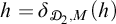 $h = \delta _{ {\mathscr{D}_{2}}, M} (h)$
, after which the extension never changes. At such fixed points,
$h = \delta _{ {\mathscr{D}_{2}}, M} (h)$
, after which the extension never changes. At such fixed points, $G \ is \ closed$
comes out true.
$G \ is \ closed$
comes out true.
Where $\Gamma = \{AX, G0, G0', G0", \ldots , \neg (G \ is \ closed) \}$
, we can use the above facts to show that
$\Gamma = \{AX, G0, G0', G0", \ldots , \neg (G \ is \ closed) \}$
, we can use the above facts to show that $\Gamma {\models \!\!\!\!\!^{^{\!{\mathscr{D}_{2}}}}_{_{\#}}\,\,} \forall x \ x \neq x$
. Nevertheless, all the sentences in
$\Gamma {\models \!\!\!\!\!^{^{\!{\mathscr{D}_{2}}}}_{_{\#}}\,\,} \forall x \ x \neq x$
. Nevertheless, all the sentences in $\Gamma $
are categorically true in the standard model relative to 𝒟2
in
$\Gamma $
are categorically true in the standard model relative to 𝒟2
in $\mathbf {S}^{\#}$
. (See Proposition A.1 in the Appendix.) Note that, since
$\mathbf {S}^{\#}$
. (See Proposition A.1 in the Appendix.) Note that, since $\neg (G \ is \ closed)$
classically entails
$\neg (G \ is \ closed)$
classically entails $\exists x \neg Gx$
, in
$\exists x \neg Gx$
, in $\mathbb {N}_<$
𝒟2
generates an
$\mathbb {N}_<$
𝒟2
generates an $\omega $
-inconsistency, which is partly responsible for the strange result.Footnote
22
$\omega $
-inconsistency, which is partly responsible for the strange result.Footnote
22
Example 5.1 looks disastrous for $\mathbf {S}^{\#}$
’s entailment theory. When we interpret
$\mathbf {S}^{\#}$
’s entailment theory. When we interpret $\mathscr L_<$
standardly,
$\mathscr L_<$
standardly, $\Gamma $
is a correct description of how the world actually is, according to
$\Gamma $
is a correct description of how the world actually is, according to $\mathbf {S}^{\#}$
.
$\mathbf {S}^{\#}$
. $\mathbf {S}^{\#}$
then goes on to say that this description is trivial: it entails everything. But surely the actual world is not trivial!
$\mathbf {S}^{\#}$
then goes on to say that this description is trivial: it entails everything. But surely the actual world is not trivial! $\mathbf {S}^{\#N}$
corrects these problems by eliminating
$\mathbf {S}^{\#N}$
corrects these problems by eliminating $\omega $
-inconsistency. One can easily show that it satisfies a stronger desideratum:
$\omega $
-inconsistency. One can easily show that it satisfies a stronger desideratum:
-
(Categorical Truth Preservation) Entailment preserves categorical truth: in an interpreted classical language expanded with circular definitions, whenever
$\Gamma $
entails A, then A is categorically true if all members of
$\Gamma $
are.


A defender of $\mathbf {S}^{\#}$
has a couple of responses available. The less attractive option is to restrict the theory of entailment to finite premise sets. We can then show that finite entailment in
$\mathbf {S}^{\#}$
has a couple of responses available. The less attractive option is to restrict the theory of entailment to finite premise sets. We can then show that finite entailment in $\mathbf {S}^{\#}$
preserves categorical truth. This move still places
$\mathbf {S}^{\#}$
preserves categorical truth. This move still places $\mathbf {S}^{\#}$
at a significant disadvantage to
$\mathbf {S}^{\#}$
at a significant disadvantage to $\mathbf {S}^{\#N}$
. We can apply the Revision Theory to languages whose ground logic is not compact—for instance, second-order languages under the full semantics. In such cases,
$\mathbf {S}^{\#N}$
. We can apply the Revision Theory to languages whose ground logic is not compact—for instance, second-order languages under the full semantics. In such cases, $\mathbf {S}^{\#N}$
will capture all the entailments of the ground language (i.e., preserve ground logic), whereas
$\mathbf {S}^{\#N}$
will capture all the entailments of the ground language (i.e., preserve ground logic), whereas $\mathbf {S}^{\#}$
will miss out on interesting entailments. Worse, the restriction to finite entailments seems to merely push the problem out of view rather than solve it. If the entailment relation on all premise sets was implausible, that seems to indicate that it was the wrong kind of entailment relation. We should still think it is the wrong kind of entailment relation when restricted to the finite case.
$\mathbf {S}^{\#}$
will miss out on interesting entailments. Worse, the restriction to finite entailments seems to merely push the problem out of view rather than solve it. If the entailment relation on all premise sets was implausible, that seems to indicate that it was the wrong kind of entailment relation. We should still think it is the wrong kind of entailment relation when restricted to the finite case.
A second way to defend $\mathbf {S}^{\#}$
is to employ a different notion of entailment. We could define entailment in
$\mathbf {S}^{\#}$
is to employ a different notion of entailment. We could define entailment in $\mathbf {S}^{\#}$
as categorical truth preservation in all models, and so achieve Categorical Truth Preservation by fiat. We could call the old and new relations local and global entailment, respectively.Footnote
23
$\mathbf {S}^{\#}$
as categorical truth preservation in all models, and so achieve Categorical Truth Preservation by fiat. We could call the old and new relations local and global entailment, respectively.Footnote
23
Definition 5.2 (Global entailment in
$\mathbf {S}^{\#}$
)

Let $\mathscr L$
be expanded to
$\mathscr L$
be expanded to $\mathscr L^+$
with a set
$\mathscr L^+$
with a set $\mathscr D$
of definitions. Sentences
$\mathscr D$
of definitions. Sentences $\Gamma $
of
$\Gamma $
of $\mathscr L^+$
globally entail the
$\mathscr L^+$
globally entail the $\mathscr L^+$
-sentence B in
$\mathscr L^+$
-sentence B in $\mathbf {S}^{\#}$
relative to
$\mathbf {S}^{\#}$
relative to $\mathscr D$
(notation:
$\mathscr D$
(notation: $\Gamma {\models \!\!\!\!\!^{^{\mathscr D}}_{_{\#,g}}\,\,} B$
) iff, for all ground models M,
$\Gamma {\models \!\!\!\!\!^{^{\mathscr D}}_{_{\#,g}}\,\,} B$
) iff, for all ground models M, $M {\models \!\!\!\!\!^{^{\mathscr D}}_{_{\#}}\,\,} \Gamma $
implies
$M {\models \!\!\!\!\!^{^{\mathscr D}}_{_{\#}}\,\,} \Gamma $
implies $M {\models \!\!\!\!\!^{^{\mathscr D}}_{_{\#}}\,\,} B$
.
$M {\models \!\!\!\!\!^{^{\mathscr D}}_{_{\#}}\,\,} B$
.
The trouble with global entailment is now Ground Logic Preservation. The new definition still preserves all valid entailments of first-order logic with identity, but it ceases to preserve a number of very useful meta-rules. The following, all preserved by local entailment in $\mathbf {S}^{\#}$
and
$\mathbf {S}^{\#}$
and $\mathbf {S}^{\#N}$
, are no longer admissible under global entailment:
$\mathbf {S}^{\#N}$
, are no longer admissible under global entailment:
-
(Conditional Proof) If
$\Gamma , A \models B$
, then
$\Gamma \models A \to B$
. -
(Proof by Cases) If
$\Gamma , A \models C$
and
$\Delta , B \models C$
, then
$\Gamma , \Delta , A \vee B \models C$
. -
(Reductio ad absurdum) If
$\Gamma , A \models B$
and
$ \Delta , A \models \neg B $
, then
$\Gamma , \Delta \models \neg A$
. -
(Contraposition) If
$\Gamma , A \models B$
, then
$\Gamma , \neg B \models \neg A$
.Footnote
24

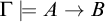





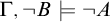
If the ground logic is instead second-order logic with the full semantics, global entailment in $\mathbf {S}^{\#}$
ceases to preserve even ordinary entailments. Where
$\mathbf {S}^{\#}$
ceases to preserve even ordinary entailments. Where $PA^2$
is the conjunction of the second-order Peano axioms, the following argument is semantically valid in second-order logic:
$PA^2$
is the conjunction of the second-order Peano axioms, the following argument is semantically valid in second-order logic:
 $$ \begin{align} PA^2, \neg (G \ is \ closed), G0, G0', \ldots \models \forall x \ x \neq x. \end{align} $$
But when G is defined by 𝒟2
, the argument is globally invalid in $\mathbf {S}^{\#}$
. As before, I think giving up these aspects of ground logic could perhaps be managed, though at considerable cost.
$\mathbf {S}^{\#}$
. As before, I think giving up these aspects of ground logic could perhaps be managed, though at considerable cost.
Note that since the premises of (5) are all categorically true in $\mathbf {S}^{\#}$
on the standard model of
$\mathbf {S}^{\#}$
on the standard model of $\mathscr L_<$
, second-order logic declares a set of categorical truths contradictory. Hence, no matter how
$\mathscr L_<$
, second-order logic declares a set of categorical truths contradictory. Hence, no matter how $\mathbf {S}^{\#}$
defines entailment, it is forced to reject either Categorical Truth Preservation or Ground Logic Preservation for second-order logic. On the other hand,
$\mathbf {S}^{\#}$
defines entailment, it is forced to reject either Categorical Truth Preservation or Ground Logic Preservation for second-order logic. On the other hand, $\mathbf {S}^{\#N}$
achieves both desiderata at once. Either way,
$\mathbf {S}^{\#N}$
achieves both desiderata at once. Either way, $\mathbf {S}^{\#N}$
comes out ahead.
$\mathbf {S}^{\#N}$
comes out ahead.
6 Proof systems
Perhaps the most pressing challenge for an $\omega $
-consistent revision theory is providing a satisfactory way of reasoning with circular definitions. Beyond the minimal requirement of soundness, such a proof system should be strong and well-motivated, with intuitive rules regarding definitions. Proponents of
$\omega $
-consistent revision theory is providing a satisfactory way of reasoning with circular definitions. Beyond the minimal requirement of soundness, such a proof system should be strong and well-motivated, with intuitive rules regarding definitions. Proponents of $\omega $
-inconsistent revision semantics may adopt RTT’s calculus
$\omega $
-inconsistent revision semantics may adopt RTT’s calculus $\mathbf {C}$
, a very natural logic of definitions that I present below. But since
$\mathbf {C}$
, a very natural logic of definitions that I present below. But since $\mathbf {C}$
derives
$\mathbf {C}$
derives $\omega $
-inconsistencies from the Peano axioms given certain definitions, it is not available to
$\omega $
-inconsistencies from the Peano axioms given certain definitions, it is not available to $\omega $
-consistent revision theorists. Lack of a suitable proof system is a major flaw with all previously studied
$\omega $
-consistent revision theorists. Lack of a suitable proof system is a major flaw with all previously studied $\omega $
-consistent revision theories, such as
$\omega $
-consistent revision theories, such as $\mathbf {S}^*$
. Fortunately for
$\mathbf {S}^*$
. Fortunately for $\mathbf {S}^{\#N}$
, however,
$\mathbf {S}^{\#N}$
, however, $\mathbf {C}$
can be weakened to various proof systems
$\mathbf {C}$
can be weakened to various proof systems $\mathbf {C}^N$
, each sound for the corresponding system
$\mathbf {C}^N$
, each sound for the corresponding system $\mathbf {S}^{\#N}$
. Users of a language with revision strength N may reason with the corresponding calculus
$\mathbf {S}^{\#N}$
. Users of a language with revision strength N may reason with the corresponding calculus $\mathbf {C}^N$
.
$\mathbf {C}^N$
.
One of Gupta’s [Reference Gupta12] arguments for $\omega $
-inconsistency is that adopting
$\omega $
-inconsistency is that adopting $\mathbf {C}$
, or some equivalent, appears necessary if one’s proof system is to preserve the particularly compelling class of entailments known as finite natural implication. After presenting
$\mathbf {C}$
, or some equivalent, appears necessary if one’s proof system is to preserve the particularly compelling class of entailments known as finite natural implication. After presenting $\mathbf {C}$
and the calculi
$\mathbf {C}$
and the calculi $\mathbf {C}^N$
, I will explain and respond to Gupta’s argument. Following Gupta, I propose to use finite natural implication as a test of proof systems’ strength; however, I’ll argue that, once we have a collection of proof systems
$\mathbf {C}^N$
, I will explain and respond to Gupta’s argument. Following Gupta, I propose to use finite natural implication as a test of proof systems’ strength; however, I’ll argue that, once we have a collection of proof systems $\mathbf {C}^N$
at our disposal, we can pass Gupta’s test without committing to
$\mathbf {C}^N$
at our disposal, we can pass Gupta’s test without committing to $\omega $
-inconsistency.
$\omega $
-inconsistency.
6.1 The calculus
$\mathbf {C}$

The characteristic feature of deductions in $\mathbf {C}$
is that to each formula is attached an index
$\mathbf {C}$
is that to each formula is attached an index $j \in \mathbb {Z}$
, written as a superscript; e.g.,
$j \in \mathbb {Z}$
, written as a superscript; e.g., $A^j$
.Footnote
25
One can think of the indices as distinguishing between revision stages: a move from index j to
$A^j$
.Footnote
25
One can think of the indices as distinguishing between revision stages: a move from index j to $j+1$
indicates a move to the next stage in a revision sequence.
$j+1$
indicates a move to the next stage in a revision sequence.
The inference rules for definitions illustrate the index policy. If $G_i$
is defined by the explicit definition
$G_i$
is defined by the explicit definition
 $$\begin{align} G_i x =_{Df} \phi_{i,x} \end{align}$$
we have the following Definiendum Introduction and Elimination rules, for all indices j Footnote 26 :
-
(DfI r )
$\phi _{i,x}[t/x]^{j}$
; therefore
$G_{i} t^{j+1}$
. -
(DfE r )
$G_i t^{j+1}$
; therefore
$\phi _{i,x} [t/x]^j$
.


Here $\phi _{i,x} [t/x]$
is the result of uniformly substituting a term t for all free occurrences of x in
$\phi _{i,x} [t/x]$
is the result of uniformly substituting a term t for all free occurrences of x in $\phi _{i,x}$
. One can notice a tight correspondence between the definition rules and the definition’s rule of revision.
$\phi _{i,x}$
. One can notice a tight correspondence between the definition rules and the definition’s rule of revision.
All deductions of classical logic are legitimate in $\mathbf {C}$
, so long as the premises and conclusion bear the same index. Moreover, one may use versions of Reductio and Universal Generalization that relax the restrictions on indices. The rule supplying classical logic is:
$\mathbf {C}$
, so long as the premises and conclusion bear the same index. Moreover, one may use versions of Reductio and Universal Generalization that relax the restrictions on indices. The rule supplying classical logic is:
-
Classical Logic (CL) (i) If the rules of classical first-order logic with identity allow the derivation of B from
$A_1, \ldots , A_n$
, then
$B^j$
may be derived from
$A_1^j, \ldots , A_n^j$
, for any integer j. -
(ii) If
$[B \wedge \neg B]^{j_{n+2}}$
is derivable from
$A_1^{j_1}, \ldots , A_{n+1}^{j_{n+1}}$
, then
$[\neg A_{n+1}]^{j_{n+1}}$
is derivable from
$A_1^{j_1}, \ldots , A_{n}^{j_n}$
. -
(iii) If
$[A_{n+1}(z)]^{j_{n+1}}$
is derivable from
$A_1^{j_1}, \ldots , A_{n}^{j_n}$
and the variable z is not free in
$A_1, \ldots , A_n$
, then
$[\forall z A_{n+1}(z)]^{j_{n+1}}$
is derivable from
$A_1^{j_1}, \ldots , A_{n}^{j_n}$
.


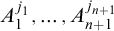




Finally, we may shift the index of any formula not containing defined terms:
-
Index Shift (IS) If A does not contain any defined term, then, for any integers
$j_1$
and
$j_2$
,
$A^{j_2}$
may be deduced from
$A^{j_1}$
.


We now define $\mathbf {C}$
as the proof system consisting of DfI
r
, DfE
r
, CL, and IS. To define derivability in the non-indexed language, say that a sentence B is derivable in
$\mathbf {C}$
as the proof system consisting of DfI
r
, DfE
r
, CL, and IS. To define derivability in the non-indexed language, say that a sentence B is derivable in $\mathbf {C}$
from sentences
$\mathbf {C}$
from sentences $A_1, A_2, \ldots $
on the basis of definition
$A_1, A_2, \ldots $
on the basis of definition $\mathscr D$
(notation:
$\mathscr D$
(notation: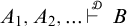 $A_1, A_2, \ldots {\vdash \!\!\!\!^{^{\mathscr D}}_{_{}}\,\,} B$
) iff, for some integer j,
$A_1, A_2, \ldots {\vdash \!\!\!\!^{^{\mathscr D}}_{_{}}\,\,} B$
) iff, for some integer j, $B^j$
can be derived from
$B^j$
can be derived from $A_1^j, A_2^j, \ldots $
using the rules of
$A_1^j, A_2^j, \ldots $
using the rules of $\mathbf {C}$
(notation:
$\mathbf {C}$
(notation: $A_1^j, A_2^j, \ldots {\vdash \!\!\!\!^{^{\mathscr D}}_{_{}}\,\,} B^j)$
. It is straightforward to check that
$A_1^j, A_2^j, \ldots {\vdash \!\!\!\!^{^{\mathscr D}}_{_{}}\,\,} B^j)$
. It is straightforward to check that $\mathbf {C}$
is sound for
$\mathbf {C}$
is sound for $\mathbf {S}^{\#}$
for explicit definitions.Footnote
27
$\mathbf {S}^{\#}$
for explicit definitions.Footnote
27
For an example of a deduction in $\mathbf {C}$
, we can use definition 𝒟0
from Example 2.1 to prove the theorem
$\mathbf {C}$
, we can use definition 𝒟0
from Example 2.1 to prove the theorem $Ha \to Hb$
:
$Ha \to Hb$
:

6.2 The calculi
$\mathbf {C}^{N}$

For reasoning with explicit definitions in the system $\mathbf {S}^{\#N}$
, we can use the calculus
$\mathbf {S}^{\#N}$
, we can use the calculus $\mathbf {C}^N$
, a weakening of
$\mathbf {C}^N$
, a weakening of $\mathbf {C}$
. As before, an index j is attached to each formula in a
$\mathbf {C}$
. As before, an index j is attached to each formula in a $\mathbf {C}^N$
-deduction. Now, however, no negative indices are allowed; indices are always natural numbers. The rules for deductions in
$\mathbf {C}^N$
-deduction. Now, however, no negative indices are allowed; indices are always natural numbers. The rules for deductions in $\mathbf {C}^N$
are otherwise exactly as in
$\mathbf {C}^N$
are otherwise exactly as in $\mathbf {C}$
. The revision strength N determines how liberal our definition of derivability will be. We say that the sentence B of
$\mathbf {C}$
. The revision strength N determines how liberal our definition of derivability will be. We say that the sentence B of $\mathscr L^+$
is derivable in
$\mathscr L^+$
is derivable in $\mathbf {C}^N$
from
$\mathbf {C}^N$
from $A_1, A_2, \ldots $
on the basis of definition
$A_1, A_2, \ldots $
on the basis of definition $\mathscr D$
(notation:
$\mathscr D$
(notation: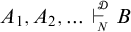 $A_1, A_2, \ldots\ {\vdash \!\!\!\!^{^{\mathscr D}}_{_{N}}}\ B$
) iff, for some natural number
$A_1, A_2, \ldots\ {\vdash \!\!\!\!^{^{\mathscr D}}_{_{N}}}\ B$
) iff, for some natural number $j \leq N$
,
$j \leq N$
, $B^j$
can be derived using the rules of
$B^j$
can be derived using the rules of $\mathbf {C}^N$
from
$\mathbf {C}^N$
from $A_1^j, A_2^j, \ldots $
(notation:
$A_1^j, A_2^j, \ldots $
(notation: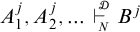 $A_1^{j}, A_2^{j}, \ldots\ {\vdash \!\!\!\!^{^{\mathscr D}}_{_{N}}}\ B^j$
). It is again straightforward to check that
$A_1^{j}, A_2^{j}, \ldots\ {\vdash \!\!\!\!^{^{\mathscr D}}_{_{N}}}\ B^j$
). It is again straightforward to check that $\mathbf {C}^N$
is sound for
$\mathbf {C}^N$
is sound for $\mathbf {S}^{\#N}$
for explicit definitions.
$\mathbf {S}^{\#N}$
for explicit definitions.
If we wished to carry out the above sample derivation in $\mathbf {C}^N$
, we would only need to increment each index by
$\mathbf {C}^N$
, we would only need to increment each index by $1$
. (We assume
$1$
. (We assume $N \geq 1$
;
$N \geq 1$
; $N = 0$
is just classical logic.)
$N = 0$
is just classical logic.)
6.3 A test case: Finite natural implication
Gupta’s desideratum of preserving finite natural implication concerns the specially well-behaved class of finite definitions. Our main example of a finite definition will be 𝒟0
from Example 2.1, which is in fact the only finite definition appearing in this paper. We characterize these definitions as follows. A hypothesis h is finitely reflexive for a revision rule $\rho $
iff there is
$\rho $
iff there is $n> 0$
(called h’s period) such that
$n> 0$
(called h’s period) such that $\rho ^n(h) = h$
. In the model M of Example 2.1, the hypotheses
$\rho ^n(h) = h$
. In the model M of Example 2.1, the hypotheses $\varnothing $
and
$\varnothing $
and $\{0,1\}$
(and only these) are finitely reflexive, with period
$\{0,1\}$
(and only these) are finitely reflexive, with period $2$
. A definition
$2$
. A definition $\mathscr D$
is finite iff, for all ground models M there is a number n such that, for all hypotheses h,
$\mathscr D$
is finite iff, for all ground models M there is a number n such that, for all hypotheses h, $\delta _{\mathscr D, M}^n(h)$
is finitely reflexive. Note that all partial definitions (§1.1) are finite.
$\delta _{\mathscr D, M}^n(h)$
is finitely reflexive. Note that all partial definitions (§1.1) are finite.
An attractive feature of finite definitions is that we can eliminate all “suboptimal” hypotheses after finitely many revision stages. In view of this fact, finite definitions can be given a natural semantics: we declare a sentence A categorically true in M relative to a finite definition $\mathscr D$
iff it is true on all hypotheses finitely reflexive for
$\mathscr D$
iff it is true on all hypotheses finitely reflexive for $\delta _{\mathscr D, M}$
. Finite natural implication is the corresponding implication relation restricted to finite definitions. That is, where
$\delta _{\mathscr D, M}$
. Finite natural implication is the corresponding implication relation restricted to finite definitions. That is, where $\mathscr D$
is finite, B is a finite natural implication of
$\mathscr D$
is finite, B is a finite natural implication of $\Gamma $
(notation:
$\Gamma $
(notation: $\Gamma {\models \!\!\!\!\!^{^{\mathscr D}}_{_{f}}\,\,} B$
) iff for all ground models M,
$\Gamma {\models \!\!\!\!\!^{^{\mathscr D}}_{_{f}}\,\,} B$
) iff for all ground models M,
 $$ \begin{align*} \forall h \left(\text{if } h \text{is finitely reflexive for } \delta_{\mathscr D, M}, \text{ then } M + h \models \Gamma \text{ implies } M + h \models B \right). \end{align*} $$
As I understand it, Gupta’s desideratum for a proof system $\mathbf {C}^{\circ }$
is:
$\mathbf {C}^{\circ }$
is:
-
(FNI)
$\mathbf {C}^{\circ }$
preserves (i.e., is complete for) finite natural implication.

The next proposition, proved in the Appendix, compares $\mathbf {C}$
and the calculi
$\mathbf {C}$
and the calculi $\mathbf {C}^{N}$
with respect to FNI.
$\mathbf {C}^{N}$
with respect to FNI.
Proposition 6.1 (Finite natural implication in
$\mathbf {C}$
and
$\mathbf {C}^N$
)


-
(i)
$\mathbf {C}$
is complete for finite natural implication; -
(ii) none of the individual calculi
$\mathbf {C}^N$
is complete for finite natural implication; but -
(iii) for each finite definition
$\mathscr D$
, some calculus
$\mathbf {C}^N$
is complete for all finite natural implications relative to
$\mathscr D$
.


I’ll unpack the significance of these three claims in turn. Gupta’s argument for $\omega $
-inconsistency from FNI proceeds by observing (i) and that FNI is not satisfied by any known proof system sound for an
$\omega $
-inconsistency from FNI proceeds by observing (i) and that FNI is not satisfied by any known proof system sound for an $\omega $
-consistent semantics. To illustrate the point, consider Example 2.1 again. The sentence
$\omega $
-consistent semantics. To illustrate the point, consider Example 2.1 again. The sentence $Ha \leftrightarrow Hb$
is a finite natural implication of the empty premise set, yet Table 1 implies that no proof system for
$Ha \leftrightarrow Hb$
is a finite natural implication of the empty premise set, yet Table 1 implies that no proof system for $\mathbf {S}^*$
can preserve this entailment. Elsewhere Gupta [Reference Gupta13, sec. 176] refers to this weakness of
$\mathbf {S}^*$
can preserve this entailment. Elsewhere Gupta [Reference Gupta13, sec. 176] refers to this weakness of $\mathbf {S}^*$
as a “fatal flaw.”
$\mathbf {S}^*$
as a “fatal flaw.”
As stated, it is unclear whether the calculi $\mathbf {C}^N$
satisfy FNI: individually, they don’t (claim (ii)), but, collectively, they do (claim (iii)). I suggest that the situation is ultimately favorable for these calculi: given my proposed understanding of revision strengths, claim (iii) is all we should desire. If this is true, finite natural implication does not in fact favor
$\mathbf {C}^N$
satisfy FNI: individually, they don’t (claim (ii)), but, collectively, they do (claim (iii)). I suggest that the situation is ultimately favorable for these calculi: given my proposed understanding of revision strengths, claim (iii) is all we should desire. If this is true, finite natural implication does not in fact favor $\mathbf {C}$
over the calculi
$\mathbf {C}$
over the calculi $\mathbf {C}^N$
.
$\mathbf {C}^N$
.
Whether this is plausible depends on the considerations motivating FNI. First, Gupta claims that a proof system should preserve finite natural implications because they are “intuitively compelling” [Reference Gupta12, p. 190]. (Witness the straightforward proof of $Ha \to Hb$
on p. 17.) I agree that it would be a red flag if the entire apparatus of proof calculi
$Ha \to Hb$
on p. 17.) I agree that it would be a red flag if the entire apparatus of proof calculi $\mathbf {C}^N$
couldn’t capture some finite natural implication. But when we have multiple calculi at our disposal, I see no problem with providing, for each finite definition, the revision strength appropriate to capture its finite natural implications.
$\mathbf {C}^N$
couldn’t capture some finite natural implication. But when we have multiple calculi at our disposal, I see no problem with providing, for each finite definition, the revision strength appropriate to capture its finite natural implications.
Gupta’s second motivation for FNI points out that finite definitions are needed for applications of the Revision Theory, such as to rational choice, and the applications require that we can reason with these definitions.Footnote
28
But when stipulating a set $\mathscr D$
of finite definitions for the purposes of some application, we can always stipulate a revision strength N for which
$\mathscr D$
of finite definitions for the purposes of some application, we can always stipulate a revision strength N for which $\mathbf {C}^N$
preserves finite natural implication. (We just need to say, “Let the revision strength of our dialect be the minimum strength for which finite natural implication is preserved.”) Moreover, the finite definitions employed in applications can be easily transformed into the especially manageable form mentioned by Gupta [Reference Gupta, Chapuis and Gupta10]. His observations there show that from the syntactic form of such definitions one can read off an explicit revision strength that preserves finite natural implications. Even when users of the definition don’t stipulate a strength, Agreement implies that, on the default strength N,
$\mathbf {C}^N$
preserves finite natural implication. (We just need to say, “Let the revision strength of our dialect be the minimum strength for which finite natural implication is preserved.”) Moreover, the finite definitions employed in applications can be easily transformed into the especially manageable form mentioned by Gupta [Reference Gupta, Chapuis and Gupta10]. His observations there show that from the syntactic form of such definitions one can read off an explicit revision strength that preserves finite natural implications. Even when users of the definition don’t stipulate a strength, Agreement implies that, on the default strength N, $\mathbf {S}^{\#N}$
will agree with
$\mathbf {S}^{\#N}$
will agree with $\mathbf {S}^{\#}$
on categorical truth for sentences in use. From this fact one can show that finite natural implications on sentences used in the application are guaranteed to preserve categorical truth.Footnote
29
In summary: the calculi
$\mathbf {S}^{\#}$
on categorical truth for sentences in use. From this fact one can show that finite natural implications on sentences used in the application are guaranteed to preserve categorical truth.Footnote
29
In summary: the calculi $\mathbf {C}^{N}$
provide for each job a tool that can handle it. We need not wish further for a single “supertool” that can perform every job.
$\mathbf {C}^{N}$
provide for each job a tool that can handle it. We need not wish further for a single “supertool” that can perform every job.
7 Truth
In this section I compare $\mathbf {S}^{\#}$
’s and
$\mathbf {S}^{\#}$
’s and $\mathbf {S}^{\#N}$
’s truth theories, that is, their semantical theories for truth predicates. We will see that both of these theories support strong compositional and disquotational principles, which in my view already make them among the best classical theories of truth. I argue that by meeting a third desideratum—preserving truth’s generalization function—
$\mathbf {S}^{\#N}$
’s truth theories, that is, their semantical theories for truth predicates. We will see that both of these theories support strong compositional and disquotational principles, which in my view already make them among the best classical theories of truth. I argue that by meeting a third desideratum—preserving truth’s generalization function— $\mathbf {S}^{\#N}$
pulls ahead of
$\mathbf {S}^{\#N}$
pulls ahead of $\mathbf {S}^{\#}$
for languages with finite usage. Along the way, I will respond to Gupta’s [Reference Gupta12, Reference Gupta13] second argument for
$\mathbf {S}^{\#}$
for languages with finite usage. Along the way, I will respond to Gupta’s [Reference Gupta12, Reference Gupta13] second argument for $\omega $
-inconsistency.
$\omega $
-inconsistency.
7.1 Compositional truth principles
Compositional truth principles say that a conjunction is true iff its conjuncts are; that the negation of a sentence is true iff the sentence is not true; and so on. These principles are key features of how the concept of truth functions in semantics. Unlike other leading classical truth theories, $\mathbf {S}^{\#}$
and
$\mathbf {S}^{\#}$
and $\mathbf {S}^{\#N}$
both validate all the compositional principles.Footnote
30
To make this claim precise, suppose
$\mathbf {S}^{\#N}$
both validate all the compositional principles.Footnote
30
To make this claim precise, suppose $\langle M, \ulcorner \ \urcorner \rangle $
is a full sentential frame for
$\langle M, \ulcorner \ \urcorner \rangle $
is a full sentential frame for $\mathscr L^+$
, which contains a truth predicate. Further suppose that the ground language
$\mathscr L^+$
, which contains a truth predicate. Further suppose that the ground language $\mathscr L$
contains the predicates
$\mathscr L$
contains the predicates $Neg(x,y)$
,
$Neg(x,y)$
, $Conj(x,y,z)$
,
$Conj(x,y,z)$
, $Ui(x,y)$
, and
$Ui(x,y)$
, and $Ref(x,y)$
, which M interprets as follows. For
$Ref(x,y)$
, which M interprets as follows. For $d_1, d_2, d_3 \in D$
,
$d_1, d_2, d_3 \in D$
,
-
•
$\langle d_1, d_2 \rangle \in I(Neg)$
iff
$d_1, d_2 \in \mathscr L^+$
and
$d_1$
is the negation of
$d_2$
; -
•
$\langle d_1, d_2, d_3 \rangle \in I(Conj)$
iff
$d_1, d_2, d_3 \in \mathscr L^+$
and
$d_1$
is a conjunction of
$d_2$
and
$d_3$
; -
•
$\langle d_1, d_2 \rangle \in I(Ui)$
iff
$d_1, d_2 \in \mathscr L^+$
and
$d_1$
is a universal quantification of
$d_2$
; -
•
$\langle d_1, d_2 \rangle \in I(Ref)$
iff
$d_1$
is a closed term of
$\mathscr L^+$
and
$d_1$
refers to
$d_2$
in M.












Then we have the desideratum:
-
(Compositional Principles) Where
$Neg$
,
$Conj$
,
$Ui$
, and
$Ref$
are interpreted as above in a full sentential frame
$\langle M, \ulcorner \ \urcorner \rangle $
, the following principles are categorical:


 $$ \begin{align} &\forall x \forall y [Neg(x,y) \to (Tx \leftrightarrow \neg Ty)] \end{align} $$
 $$ \begin{align} &\forall x \forall y \forall z [Conj(x,y,z) \to (Tx \leftrightarrow Ty \wedge Tz)] \end{align} $$
 $$ \begin{align} &\forall y \exists x Ref(x,y) \to \forall x [\exists y Ui(x,y) \to (Tx \leftrightarrow \forall y (Ui(x,y) \to Ty))]. \end{align} $$
Both $\mathbf {S}^{\#}$
and
$\mathbf {S}^{\#}$
and $\mathbf {S}^{\#N}$
satisfy Compositional Principles—provided, in the latter case, that the language’s revision strength is at least
$\mathbf {S}^{\#N}$
satisfy Compositional Principles—provided, in the latter case, that the language’s revision strength is at least $1$
. In a language where
$1$
. In a language where $\neg $
,
$\neg $
, $\wedge $
, and
$\wedge $
, and $\forall $
are the primitive logical constants (apart from identity), (C¬)-(C∀) are the core compositional principles. If we take some other combination of logical constants as primitive, both theories will render compositional principles for them categorical, too.
$\forall $
are the primitive logical constants (apart from identity), (C¬)-(C∀) are the core compositional principles. If we take some other combination of logical constants as primitive, both theories will render compositional principles for them categorical, too.
7.2 Blind truth ascriptions
As many philosophers have stressed, the truth predicate serves important expressive functions. One of these is to allow us to make so-called blind truth ascriptions, in which one ascribes truth to some sentence one isn’t in a position to explicitly assert. As Horwich [Reference Horwich18, pp. 2–3] writes:
On occasion we wish to adopt some attitude towards a proposition—for example, believing it, assuming it for the sake of argument, or desiring that it be the case—but find ourselves thwarted by ignorance of what exactly the proposition is. We might know it only as ‘what Oscar thinks’ or ‘Einstein’s principle’; perhaps it was expressed, but not clearly or loudly enough, or in a language we don’t understand; or—and this is especially common in logical and philosophical contexts—we may wish to cover infinitely many propositions (in the course of generalizing) and simply can’t have all of them in mind. In such situations the concept of truth is invaluable. For it enables the construction of another proposition, intimately related to the one we can’t identify, which is perfectly appropriate as the alternative object of our attitude.
What Horwich says about propositions also holds for sentences, the bearers of truth considered in this section. For now let us focus on the case of blind ascriptions of truth to single sentences; we will consider the case of generalizations in the next subsection.
In order for my blind ascription ‘What Oscar said is true’ to serve its intended purpose, it must be in some sense equivalent to the sentence Oscar said. A very weak form of equivalence is co-affirmability: we require that a blind ascription of truth to B is affirmable iff B itself is affirmable (cf. [Reference Gupta and Standefer15]). In the Revision Theory, it is plausible to say that a sentence is affirmable iff it is categorically true. Thus the following informal condition should be a desideratum for a revision theory:
-
(Blind Ascription) Where
$t_B$
is a singular term referring to the sentence B, any use of
$Tt_B$
is categorically true iff B is.


Blind Ascription corresponds to a formal constraint on revision systems. Let $\mathscr L^+$
be a language with a set of definitions
$\mathscr L^+$
be a language with a set of definitions $\mathscr D$
that includes the truth definition, and which is interpreted via a full sentential frame
$\mathscr D$
that includes the truth definition, and which is interpreted via a full sentential frame $\langle M, \ulcorner \ \urcorner \rangle $
. Using
$\langle M, \ulcorner \ \urcorner \rangle $
. Using ${\models \!\!\!\!\!^{^{\mathscr D}}_{_{\!\;\circ }}\,\,} $
to indicate categorical truth in an unspecified revision system, we have
${\models \!\!\!\!\!^{^{\mathscr D}}_{_{\!\;\circ }}\,\,} $
to indicate categorical truth in an unspecified revision system, we have
-
(T⊧)
$M {\models \!\!\!\!\!^{^{\mathscr D}}_{_{\!\;\circ }}\,\,} B$
iff
$M {\models \!\!\!\!\!^{^{\mathscr D}}_{_{\!\;\circ }}\,\,} Tt_B$
, where
$t_B$
is any singular term referring to B in M.


 $\mathbf {S}^{\#}$
satisfies (
$\mathbf {S}^{\#}$
satisfies ( ${T}$
⊧) for all sentences B (RTT, Theorem 6C.1). Once again, the situation is more complicated with
${T}$
⊧) for all sentences B (RTT, Theorem 6C.1). Once again, the situation is more complicated with $\mathbf {S}^{\#N}$
, but I will argue that it comes out in
$\mathbf {S}^{\#N}$
, but I will argue that it comes out in $\mathbf {S}^{\#N}$
’s favor. The systems
$\mathbf {S}^{\#N}$
’s favor. The systems $\mathbf {S}^{\#N}$
do not satisfy
$\mathbf {S}^{\#N}$
do not satisfy $({T}$
⊧) in full generality. For a counterexample, we can use the language, ground model, and definitions from Example 2.3. As recorded in (3) and (4),
$({T}$
⊧) in full generality. For a counterexample, we can use the language, ground model, and definitions from Example 2.3. As recorded in (3) and (4), $M {\models \!\!\!\!\!^{^{\mathscr D}}_{_{\#N}}\,\,} G\overline {(N-2)}$
even though
$M {\models \!\!\!\!\!^{^{\mathscr D}}_{_{\#N}}\,\,} G\overline {(N-2)}$
even though $M \not {\models \!\!\!\!\!^{^{\mathscr D}}_{_{\#N}}\,\,} T\ulcorner G\overline {(N-2)} \urcorner $
, whenever
$M \not {\models \!\!\!\!\!^{^{\mathscr D}}_{_{\#N}}\,\,} T\ulcorner G\overline {(N-2)} \urcorner $
, whenever $N \geq 2$
. Nevertheless,
$N \geq 2$
. Nevertheless, $\mathbf {S}^{\#N}$
can salvage a restricted principle. If a proponent of
$\mathbf {S}^{\#N}$
can salvage a restricted principle. If a proponent of $\mathbf {S}^{\#N}$
accepts Agreement, she may claim that, in a language with default strength N, the system
$\mathbf {S}^{\#N}$
accepts Agreement, she may claim that, in a language with default strength N, the system $\mathbf {S}^{\#N}$
satisfies
$\mathbf {S}^{\#N}$
satisfies $({T}$
⊧) for all truth ascriptions
$({T}$
⊧) for all truth ascriptions $Tt_B$
that are ever used. (This fact follows from the more general Proposition 7.1, below.) As I formulated Blind Ascription, this is all the desideratum does and should demand. The expressive functions of truth only require
$Tt_B$
that are ever used. (This fact follows from the more general Proposition 7.1, below.) As I formulated Blind Ascription, this is all the desideratum does and should demand. The expressive functions of truth only require $({T}$
⊧) for the sentences that are in use: any further instances don’t help anyone express anything. An analogy is helpful: a refrigerator light has the function of making the contents of the refrigerator visible. But that function only requires the light to be on when the door is open. No fridge is defective because its light doesn’t stay on 24/7.
$({T}$
⊧) for the sentences that are in use: any further instances don’t help anyone express anything. An analogy is helpful: a refrigerator light has the function of making the contents of the refrigerator visible. But that function only requires the light to be on when the door is open. No fridge is defective because its light doesn’t stay on 24/7.
As with refrigerator lights, economy in performing functions proves valuable in the case of truth: cutting down on excess instances of $({T}$
⊧) allows
$({T}$
⊧) allows $\mathbf {S}^{\#N}$
to dodge Gupta’s second argument for
$\mathbf {S}^{\#N}$
to dodge Gupta’s second argument for $\omega $
-inconsistency. McGee’s Theorem states that any classical truth theory satisfying
$\omega $
-inconsistency. McGee’s Theorem states that any classical truth theory satisfying $({T}$
⊧) and (C)-(C∀) is
$({T}$
⊧) and (C)-(C∀) is $\omega $
-inconsistent when syntax is arithmetized [Reference McGee20].Footnote
31
Gupta [Reference Gupta13] claims that all of these principles are needed for truth to fully serve its expressive functions; hence, truth gives rise to
$\omega $
-inconsistent when syntax is arithmetized [Reference McGee20].Footnote
31
Gupta [Reference Gupta13] claims that all of these principles are needed for truth to fully serve its expressive functions; hence, truth gives rise to $\omega $
-inconsistencies. But, as we have seen, the full principle
$\omega $
-inconsistencies. But, as we have seen, the full principle $({T}$
⊧) is far stronger than needed for truth’s expressive functions. In my view,
$({T}$
⊧) is far stronger than needed for truth’s expressive functions. In my view, $\mathbf {S}^{\#N}$
achieves the optimal response to McGee’s Theorem: we maintain classical logic,
$\mathbf {S}^{\#N}$
achieves the optimal response to McGee’s Theorem: we maintain classical logic, $\omega $
-consistency, the semantical laws, and every instance of
$\omega $
-consistency, the semantical laws, and every instance of $({T}$
⊧) needed for truth’s expressive functions.Footnote
32
$({T}$
⊧) needed for truth’s expressive functions.Footnote
32
7.3 The generalization function
As already noted, truth’s expressive functions allow us not just to blindly affirm single sentences, but to affirm infinitely many sentences in a single breath. If I want to affirm all the axioms of Peano Arithmetic, it’s clearly impossible for me to do so by individually asserting each of the infinitely many axioms. I have no option but to use a generalizing device. The obvious solution is to say “all the axioms of Peano Arithmetic are true.”
We face the same expressive problem in trying to affirm any infinite set of sentences. It is plausible that the truth predicate provides an all-purpose solution. By all appearances, we can use the truth predicate to affirm any infinite set of sentences, provided some way of specifying those sentences. This expressive capacity is one aspect of what is often called truth’s generalization function.Footnote 33
Suppose $\Gamma $
is a set of sentences that we can specify with some predicate
$\Gamma $
is a set of sentences that we can specify with some predicate $\gamma (x)$
true of all and only the sentences in
$\gamma (x)$
true of all and only the sentences in $\Gamma $
. If truth performs the generalization function, saying
$\Gamma $
. If truth performs the generalization function, saying
 $$ \begin{align} \text{Every sentence with the property } \gamma \text{ is true.} \end{align} $$
should be in some sense equivalent to individually affirming each sentence of $\Gamma $
. Again, we can let co-affirmability be our guide in formulating a desideratum, yielding:
$\Gamma $
. Again, we can let co-affirmability be our guide in formulating a desideratum, yielding:
-
(Generalization) Where
$\gamma $
is a non-circular predicate true of precisely the sentences
$\Gamma $
, any use of (G) is categorically true iff all the sentences
$\Gamma $
are categorically true.


To arrive at a formal condition, let $\mathscr L$
be a language that is expanded with a truth predicate T (and perhaps other new predicates) to
$\mathscr L$
be a language that is expanded with a truth predicate T (and perhaps other new predicates) to $\mathscr L^+$
, and let
$\mathscr L^+$
, and let $\langle M, \ulcorner \ \urcorner \rangle $
be a full sentential frame for
$\langle M, \ulcorner \ \urcorner \rangle $
be a full sentential frame for $\mathscr L^+$
. Then the generalization function requires of a revision system
$\mathscr L^+$
. Then the generalization function requires of a revision system ${\models \!\!\!\!\!^{^{\mathscr D}}_{_{\!\;\circ }}} $
:
${\models \!\!\!\!\!^{^{\mathscr D}}_{_{\!\;\circ }}} $
:
-
(Generalization (Formal)) If the
$\mathscr L$
-formula
$\gamma (x)$
is true of precisely the set of
$\mathscr L^+$
-sentences
$\Gamma $
in M, then
$M {\models \!\!\!\!\!^{^{\mathscr D}}_{_{\!\;\circ }}\,\,} \Gamma $
iff
$M {\models \!\!\!\!\!^{^{\mathscr D}}_{_{\!\;\circ }}\,\,} \forall x (\gamma (x) \to Tx)$
.



Truth in $\mathbf {S}^{\#}$
does not always satisfy Generalization (Formal), on account of
$\mathbf {S}^{\#}$
does not always satisfy Generalization (Formal), on account of $\omega $
-inconsistencies. To see this we can again use the language
$\omega $
-inconsistencies. To see this we can again use the language $\mathscr L^+$
, ground model M, and definitions
$\mathscr L^+$
, ground model M, and definitions $\mathscr D_1$
of Example 2.3. Someone who uses
$\mathscr D_1$
of Example 2.3. Someone who uses $\mathscr L^+$
might notice that all the sentences in the set
$\mathscr L^+$
might notice that all the sentences in the set $\Gamma = \{G0, G0', \ldots \}$
are categorically true. She might then reasonably wish to affirm all of
$\Gamma = \{G0, G0', \ldots \}$
are categorically true. She might then reasonably wish to affirm all of $\Gamma $
. Of course, to do so she needs some generalizing device. If the truth predicate T performs the generalization function, then she can affirm all these sentences by asserting
$\Gamma $
. Of course, to do so she needs some generalizing device. If the truth predicate T performs the generalization function, then she can affirm all these sentences by asserting
 $$ \begin{align} \forall x (\exists j \ x = g(j) \to Tx). \end{align} $$
Colloquially, we’d say, “the G-predication of every number is true.” Since the formula $\exists j \ x = g(j)$
is true of precisely the sentences in
$\exists j \ x = g(j)$
is true of precisely the sentences in $\Gamma $
, (GG) is a way of saying that the sentences in
$\Gamma $
, (GG) is a way of saying that the sentences in $\Gamma $
are true. However, (GG) is categorically false according to
$\Gamma $
are true. However, (GG) is categorically false according to $\mathbf {S}^{\#}$
; this is a failure of Generalization (Formal).
$\mathbf {S}^{\#}$
; this is a failure of Generalization (Formal).
It is easy to see that the systems $\mathbf {S}^{\#N}$
, too, don’t always satisfy Generalization (Formal). Whenever
$\mathbf {S}^{\#N}$
, too, don’t always satisfy Generalization (Formal). Whenever $N \geq 2$
, all the sentences
$N \geq 2$
, all the sentences $G0, G0', \ldots , G\overline {(N-2)}$
are categorically true (see (3)); and the formula
$G0, G0', \ldots , G\overline {(N-2)}$
are categorically true (see (3)); and the formula $\exists y \ (y \leq \overline {(N-2)} \ \wedge \ x = g(y))$
is true in M of precisely these sentences. But the generalization
$\exists y \ (y \leq \overline {(N-2)} \ \wedge \ x = g(y))$
is true in M of precisely these sentences. But the generalization
 $$ \begin{align*} \forall x [\exists y (y \leq \overline{(N-2)} \wedge x = g(y)) \to Tx] \end{align*} $$
(“all G-predications of numbers less than or equal to $N-2$
are true”) is pathological according to
$N-2$
are true”) is pathological according to $\mathbf {S}^{\#N}$
. The crucial advantage of the theory
$\mathbf {S}^{\#N}$
. The crucial advantage of the theory $\mathbf {S}^{\#N}$
over
$\mathbf {S}^{\#N}$
over $\mathbf {S}^{\#}$
, though, is that the informal requirement Generalization only ought to apply to sentences that are used by speakers to make generalizations. By appealing to Agreement,
$\mathbf {S}^{\#}$
, though, is that the informal requirement Generalization only ought to apply to sentences that are used by speakers to make generalizations. By appealing to Agreement, $\mathbf {S}^{\#N}$
can once again salvage a restricted principle and save the generalization function. If finitely many sentences of
$\mathbf {S}^{\#N}$
can once again salvage a restricted principle and save the generalization function. If finitely many sentences of $\mathscr L^+$
are used and Agreement yields default strength N, then
$\mathscr L^+$
are used and Agreement yields default strength N, then $\mathbf {S}^{\#N}$
satisfies Generalization (Formal) for every generalization that is ever used. Proposition 7.1 makes this claim precise.
$\mathbf {S}^{\#N}$
satisfies Generalization (Formal) for every generalization that is ever used. Proposition 7.1 makes this claim precise.
Proposition 7.1. Let $\mathscr L^+$
be a ground language expanded with any set
$\mathscr L^+$
be a ground language expanded with any set $\mathscr D$
of definitions that includes the truth definition 𝒯, and let
$\mathscr D$
of definitions that includes the truth definition 𝒯, and let $\langle M, \ulcorner \ \urcorner \rangle $
be a full sentential frame for
$\langle M, \ulcorner \ \urcorner \rangle $
be a full sentential frame for $\mathscr L^+$
. Suppose the
$\mathscr L^+$
. Suppose the $\mathscr L$
-formula
$\mathscr L$
-formula $\gamma (x)$
defines the set
$\gamma (x)$
defines the set $\Gamma $
of
$\Gamma $
of $\mathscr L^+$
-sentences in M, and suppose N is such that
$\mathscr L^+$
-sentences in M, and suppose N is such that $\mathbf {S}^{\#N}$
and
$\mathbf {S}^{\#N}$
and $\mathbf {S}^{\#}$
agree on whether
$\mathbf {S}^{\#}$
agree on whether $\forall x (\gamma (x) \to Tx)$
is categorically true in M relative to
$\forall x (\gamma (x) \to Tx)$
is categorically true in M relative to $\mathscr D$
. Then also
$\mathscr D$
. Then also
 $$ \begin{align*} M {\models\!\!\!\!\!^{^{\mathscr D}}_{_{\#N}}\,\,} \Gamma \text{ iff } M {\models\!\!\!\!\!^{^{\mathscr D}}_{_{\#N}}\,\,} \forall x (\gamma (x) \to Tx). \end{align*} $$
Proof. Straightforward, using the fact that $M {\models \!\!\!\!\!^{^{\mathscr D}}_{_{\#N}}\,\,} B$
iff
$M {\models \!\!\!\!\!^{^{\mathscr D}}_{_{\#N}}\,\,} B$
iff $M {\models \!\!\!\!\!^{^{\mathscr D}}_{_{\#(N+1)}}\,\,} T\ulcorner B \urcorner $
.
$M {\models \!\!\!\!\!^{^{\mathscr D}}_{_{\#(N+1)}}\,\,} T\ulcorner B \urcorner $
.
At first one might have thought that, even if Agreement ensures that truth in $\mathbf {S}^{\#N}$
performs well on the sentences actually in use, once we start generalizing over unused sentences the theory will run into problems. But Proposition 7.1 shows that exactly the opposite is true: it is precisely on generalizations like (GG) that
$\mathbf {S}^{\#N}$
performs well on the sentences actually in use, once we start generalizing over unused sentences the theory will run into problems. But Proposition 7.1 shows that exactly the opposite is true: it is precisely on generalizations like (GG) that $\mathbf {S}^{\#N}$
performs well and
$\mathbf {S}^{\#N}$
performs well and $\mathbf {S}^{\#}$
does not.
$\mathbf {S}^{\#}$
does not.
8 Infinite usage
8.1 A generalization of Agreement
The previous section’s argument involved the assumption that linguistic usage is finite. In this section I briefly discuss default strengths and the expressive functions of truth for languages whose usage is infinite.
First, I’ll show that these languages present no particular problem for setting default strengths, by suitably generalizing Agreement. To settle on a principle, I’ll begin with some examples. The most obvious test case is the language $ \mathscr L^+$
from Example 2.3 with the defined predicates G and T. Imagine now that its speakers use all the sentences
$ \mathscr L^+$
from Example 2.3 with the defined predicates G and T. Imagine now that its speakers use all the sentences $\exists i \neg Gi, G0, G0', \ldots \space $
. If these are the only sentences used, the most natural choice of a revision strength seems simply to be
$\exists i \neg Gi, G0, G0', \ldots \space $
. If these are the only sentences used, the most natural choice of a revision strength seems simply to be $0$
. Trying to maximize the number of sentences whose semantical status agrees with
$0$
. Trying to maximize the number of sentences whose semantical status agrees with $\mathbf {S}^{\#}$
no longer singles out any revision strength. In the absence of good reasons to pick one revision strength over any other, we break the tie by choosing the least candidate.
$\mathbf {S}^{\#}$
no longer singles out any revision strength. In the absence of good reasons to pick one revision strength over any other, we break the tie by choosing the least candidate.
Now imagine that $ \mathscr L^+$
contains, in addition to G and T, a new predicate H, which is given definition
$ \mathscr L^+$
contains, in addition to G and T, a new predicate H, which is given definition $ \mathscr D_0$
from Example 2.1. (This time use ‘
$ \mathscr D_0$
from Example 2.1. (This time use ‘ $0$
’ and ‘
$0$
’ and ‘ $\overline {1}$
’ for ‘a’ and ‘b’, respectively.) The speakers of
$\overline {1}$
’ for ‘a’ and ‘b’, respectively.) The speakers of $ \mathscr L^+$
use all the sentences
$ \mathscr L^+$
use all the sentences $\exists i \neg Gi, G0, G0', \ldots $
, plus the sentence
$\exists i \neg Gi, G0, G0', \ldots $
, plus the sentence $H0 \leftrightarrow H\overline {1}$
. Now it seems that
$H0 \leftrightarrow H\overline {1}$
. Now it seems that $ \mathscr L^+$
’s revision strength should be at least 1, so as to yield optimal results both for
$ \mathscr L^+$
’s revision strength should be at least 1, so as to yield optimal results both for $\exists i \neg Gi$
and
$\exists i \neg Gi$
and $H0 \leftrightarrow H\overline {1}$
. Beyond strength 1, however, there is complete symmetry between the other candidate strengths; we break the tie by choosing the least candidate, 1.
$H0 \leftrightarrow H\overline {1}$
. Beyond strength 1, however, there is complete symmetry between the other candidate strengths; we break the tie by choosing the least candidate, 1.
We can generalize the idea as follows. Define the stabilization point $st(B)$
of a sentence B as the least N for which B is either categorically true or categorically false in
$st(B)$
of a sentence B as the least N for which B is either categorically true or categorically false in $\mathbf {S}^{\#N}$
, if such an N exists; and
$\mathbf {S}^{\#N}$
, if such an N exists; and $0$
otherwise. Even in cases of infinite usage, speakers presumably have a tendency to use sentences with low stabilization points. Our guiding thought is that all sentences reflecting this tendency should stabilize. There may be several ways to cash this idea out. Here is one: we set the revision strength as the largest number at which “especially many” sentences stabilize. More precisely, we stipulate that the strength is the largest n such that, for all
$0$
otherwise. Even in cases of infinite usage, speakers presumably have a tendency to use sentences with low stabilization points. Our guiding thought is that all sentences reflecting this tendency should stabilize. There may be several ways to cash this idea out. Here is one: we set the revision strength as the largest number at which “especially many” sentences stabilize. More precisely, we stipulate that the strength is the largest n such that, for all $m> n$
, more of the used sentences stabilize at n than at m; and it is
$m> n$
, more of the used sentences stabilize at n than at m; and it is $0$
if there is no such n. Formally, this is:
$0$
if there is no such n. Formally, this is:
-
(Infinite Agreement) Let
$\Gamma $
be the totality of
$ \mathscr L^+$
-sentences used by its speakers, and let
$ \Gamma _n = \{B \in \Gamma : st(B) = n\}$
. Then the default revision strength for
$ \mathscr L^+$
is
$\max (\{0\} \cup \{n \in \mathbb {N} : \forall m> n \ |\Gamma _n| > |\Gamma _m|\})$
.





Infinite Agreement entails both Agreement and the strengths suggested in the previous two scenarios. Alternative or more sophisticated versions of Infinite Agreement may be desirable, but for now we at least have a promising proof of concept.
8.2 Truth in languages with infinite usage
When we consider infinite cases, it is less plausible that $\mathbf {S}^{\#N}$
performs truth’s functions strictly better than
$\mathbf {S}^{\#N}$
performs truth’s functions strictly better than $\mathbf {S}^{\#}$
. One can easily construct cases where
$\mathbf {S}^{\#}$
. One can easily construct cases where $\mathbf {S}^{\#}$
but not
$\mathbf {S}^{\#}$
but not $\mathbf {S}^{\#N}$
satisfies the expressive functions for all truth ascriptions in use. Consider again
$\mathbf {S}^{\#N}$
satisfies the expressive functions for all truth ascriptions in use. Consider again $ \mathscr L^+$
with defined predicates G and T, and suppose the only sentences used are
$ \mathscr L^+$
with defined predicates G and T, and suppose the only sentences used are $G0, G0', \ldots $
and
$G0, G0', \ldots $
and $T\ulcorner G0 \urcorner , T\ulcorner G0' \urcorner , \ldots \space $
.
$T\ulcorner G0 \urcorner , T\ulcorner G0' \urcorner , \ldots \space $
. $\mathbf {S}^{\#}$
satisfies Blind Ascription for all the truth predications, but for no choice of N can the system
$\mathbf {S}^{\#}$
satisfies Blind Ascription for all the truth predications, but for no choice of N can the system $\mathbf {S}^{\#N}$
match this feat. This fact somewhat dampens §7’s argument.
$\mathbf {S}^{\#N}$
match this feat. This fact somewhat dampens §7’s argument.
Nevertheless, there is a reasonable case that $\mathbf {S}^{\#}$
does not pull ahead of
$\mathbf {S}^{\#}$
does not pull ahead of $\mathbf {S}^{\#N}$
even when we consider infinite usage. Failures of the expressive functions in the two theories go hand in hand, in a certain sense. The next proposition shows that, whenever
$\mathbf {S}^{\#N}$
even when we consider infinite usage. Failures of the expressive functions in the two theories go hand in hand, in a certain sense. The next proposition shows that, whenever $\mathbf {S}^{\#N}$
inevitably fails to satisfy Blind Ascription on some infinite set of sentences
$\mathbf {S}^{\#N}$
inevitably fails to satisfy Blind Ascription on some infinite set of sentences $\Delta $
, there is a natural generalization about
$\Delta $
, there is a natural generalization about $\Delta $
for which
$\Delta $
for which $\mathbf {S}^{\#}$
fails Generalization. The upshot is that, if we were to devise some way of “counting” failures of expressive functions, there’s no reason to think that
$\mathbf {S}^{\#}$
fails Generalization. The upshot is that, if we were to devise some way of “counting” failures of expressive functions, there’s no reason to think that $\mathbf {S}^{\#N}$
would have the higher count.
$\mathbf {S}^{\#N}$
would have the higher count.
Proposition 8.1. Let $\langle M, \ulcorner \ \urcorner \rangle $
be a full sentential frame for a language
$\langle M, \ulcorner \ \urcorner \rangle $
be a full sentential frame for a language $\mathscr L$
. Expand
$\mathscr L$
. Expand $\mathscr L$
to
$\mathscr L$
to $\mathscr L^+$
with predicates defined by the set of definitions
$\mathscr L^+$
with predicates defined by the set of definitions $\mathscr D$
; in particular,
$\mathscr D$
; in particular, $\mathscr D$
defines the predicate T by the truth definition
$\mathscr D$
defines the predicate T by the truth definition $\mathscr T$
. Suppose
$\mathscr T$
. Suppose $\Delta $
is a set of
$\Delta $
is a set of $\mathscr L^+$
-sentences such that, for all
$\mathscr L^+$
-sentences such that, for all $N \in \mathbb {N}$
, it’s not the case that for all
$N \in \mathbb {N}$
, it’s not the case that for all $B \in \Delta $
,
$B \in \Delta $
,
 $$ \begin{align*} M {\models\!\!\!\!\!^{^{\mathscr D}}_{_{\#N}}\,\,} B \text{ iff } M {\models\!\!\!\!\!^{^{\mathscr D}}_{_{\#N}}\,\,} T\ulcorner B \urcorner. \end{align*} $$
Then there is a set $\Gamma \subseteq \Delta $
such that, if an
$\Gamma \subseteq \Delta $
such that, if an $\mathscr L$
-formula
$\mathscr L$
-formula $\gamma (x)$
defines
$\gamma (x)$
defines $\Gamma $
in M, then it’s not the case that
$\Gamma $
in M, then it’s not the case that
 $$ \begin{align*} M {\models\!\!\!\!\!^{^{\mathscr D}}_{_{\#}}\,\,} \Gamma \text{ iff } M {\models\!\!\!\!\!^{^{\mathscr D}}_{_{\#}}\,\,} \forall x (\gamma(x) \to Tx). \end{align*} $$
Proof. Suppose $(B_n)_{n \in \mathbb {N}}$
is such that
$(B_n)_{n \in \mathbb {N}}$
is such that $M {\models \!\!\!\!\!^{^{\mathscr D}}_{_{\#n}}\,\,} B_n$
and
$M {\models \!\!\!\!\!^{^{\mathscr D}}_{_{\#n}}\,\,} B_n$
and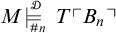 $M {\models \!\!\!\!\!^{^{\mathscr D}}_{_{\#n}}\,\,} T\ulcorner B_n \urcorner $
have different truth values for all n. Since
$M {\models \!\!\!\!\!^{^{\mathscr D}}_{_{\#n}}\,\,} T\ulcorner B_n \urcorner $
have different truth values for all n. Since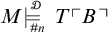 $M {\models \!\!\!\!\!^{^{\mathscr D}}_{_{\#n}}\,\,} T\ulcorner B \urcorner $
implies
$M {\models \!\!\!\!\!^{^{\mathscr D}}_{_{\#n}}\,\,} T\ulcorner B \urcorner $
implies $M {\models \!\!\!\!\!^{^{\mathscr D}}_{_{\#n}}\,\,} B$
, we have, for all n, (i)
$M {\models \!\!\!\!\!^{^{\mathscr D}}_{_{\#n}}\,\,} B$
, we have, for all n, (i) $M {\models \!\!\!\!\!^{^{\mathscr D}}_{_{\#n}}\,\,} B_n$
and (ii)
$M {\models \!\!\!\!\!^{^{\mathscr D}}_{_{\#n}}\,\,} B_n$
and (ii)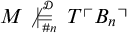 $M \not {\models \!\!\!\!\!^{^{\mathscr D}}_{_{\#n}}\,\,} T\ulcorner B_n \urcorner $
. Where
$M \not {\models \!\!\!\!\!^{^{\mathscr D}}_{_{\#n}}\,\,} T\ulcorner B_n \urcorner $
. Where $\Gamma = \{B_n : n \in \mathbb {N}\}$
, (i) implies
$\Gamma = \{B_n : n \in \mathbb {N}\}$
, (i) implies $M {\models \!\!\!\!\!^{^{\mathscr D}}_{_{\#}}\,\,} \Gamma $
. However, if
$M {\models \!\!\!\!\!^{^{\mathscr D}}_{_{\#}}\,\,} \Gamma $
. However, if $\gamma (x)$
defines
$\gamma (x)$
defines $\Gamma $
in M, (ii) implies
$\Gamma $
in M, (ii) implies $M \not {\models \!\!\!\!\!^{^{\mathscr D}}_{_{\#}}\,\,} \forall x (\gamma (x) \to Tx)$
.
$M \not {\models \!\!\!\!\!^{^{\mathscr D}}_{_{\#}}\,\,} \forall x (\gamma (x) \to Tx)$
.
In the end, I don’t think infinite cases significantly alter my verdict about truth. If one is inclined to place more weight on the case of finite usage, one should still judge $\mathbf {S}^{\#N}$
’s truth theory superior to
$\mathbf {S}^{\#N}$
’s truth theory superior to $\mathbf {S}^{\#}$
’s. Even if not, one should probably judge the theories to be on a par.
$\mathbf {S}^{\#}$
’s. Even if not, one should probably judge the theories to be on a par.
9 Simplicity
At this point, $\mathbf {S}^{\#}$
’s last defense may seem to lie in the charge that
$\mathbf {S}^{\#}$
’s last defense may seem to lie in the charge that $\mathbf {S}^{\#N}$
is, in some way, unnecessarily complicated. There are a few possible routes to this conclusion. Most obviously, the
$\mathbf {S}^{\#N}$
is, in some way, unnecessarily complicated. There are a few possible routes to this conclusion. Most obviously, the $\mathbf {S}^{\#N}$
theory commits to a new notion of revision strengths, and if we include claims like Agreement in its formulation,
$\mathbf {S}^{\#N}$
theory commits to a new notion of revision strengths, and if we include claims like Agreement in its formulation, $\mathbf {S}^{\#N}$
takes longer to state. But no one has proposed a good measure of the number of “notions” in a theory, and a theory’s length is highly language-dependent.
$\mathbf {S}^{\#N}$
takes longer to state. But no one has proposed a good measure of the number of “notions” in a theory, and a theory’s length is highly language-dependent.
Perhaps more promising is to claim that $\mathbf {S}^{\#}$
is more parsimonious in its theory of propositions. On certain fine-grained views of propositions, adding revision strengths seems to complicate the space of propositions. Consider how to develop a theory of propositions, properties, and relations (PRPs) for
$\mathbf {S}^{\#}$
is more parsimonious in its theory of propositions. On certain fine-grained views of propositions, adding revision strengths seems to complicate the space of propositions. Consider how to develop a theory of propositions, properties, and relations (PRPs) for $\mathbf {S}^{\#}$
. The most natural view will probably say, for instance, that a liar sentence
$\mathbf {S}^{\#}$
. The most natural view will probably say, for instance, that a liar sentence $\lambda = \ulcorner \neg T\lambda \urcorner $
expresses the proposition that
$\lambda = \ulcorner \neg T\lambda \urcorner $
expresses the proposition that $\lambda $
is not true. This proposition, like the sentence
$\lambda $
is not true. This proposition, like the sentence $\neg T\lambda $
, is neither categorically true nor categorically false. On this view, truth will be a “circular” property, in the sense that it cannot be assigned a classical extension.Footnote
34
Suppose we adopt a very fine-grained view of propositions, on which the structure and individuation of propositions roughly mirror the structure and individuation of sentences of a formal language that express them. On this view, for each circular definition of G there corresponds one—but only one—proposition expressed by ‘
$\neg T\lambda $
, is neither categorically true nor categorically false. On this view, truth will be a “circular” property, in the sense that it cannot be assigned a classical extension.Footnote
34
Suppose we adopt a very fine-grained view of propositions, on which the structure and individuation of propositions roughly mirror the structure and individuation of sentences of a formal language that express them. On this view, for each circular definition of G there corresponds one—but only one—proposition expressed by ‘ $G0$
’.
$G0$
’.
By contrast, proponents of $\mathbf {S}^{\#N}$
should probably say that, even holding the definition of G fixed, ‘
$\mathbf {S}^{\#N}$
should probably say that, even holding the definition of G fixed, ‘ $G0$
’ could express any of infinitely many propositions—one for each revision strength. To illustrate why, suppose G is defined according to
$G0$
’ could express any of infinitely many propositions—one for each revision strength. To illustrate why, suppose G is defined according to $\mathscr D_1$
(Example 2.3) in both
$\mathscr D_1$
(Example 2.3) in both $\mathscr L_1^+$
and
$\mathscr L_1^+$
and $\mathscr L^+_2$
, and suppose the revision strengths of these languages are
$\mathscr L^+_2$
, and suppose the revision strengths of these languages are $1$
and
$1$
and $2$
, respectively. Then ‘
$2$
, respectively. Then ‘ $G0$
’ will be categorically true in
$G0$
’ will be categorically true in $\mathscr L_2^+$
but not in
$\mathscr L_2^+$
but not in $\mathscr L_1^+$
, so that this sentence cannot express the same proposition in both languages. On the most natural view, given
$\mathscr L_1^+$
, so that this sentence cannot express the same proposition in both languages. On the most natural view, given $\mathscr D_1$
, the language’s revision strength determines which of infinitely many distinct propositions ‘
$\mathscr D_1$
, the language’s revision strength determines which of infinitely many distinct propositions ‘ $G0$
’ expresses. These propositions will also be distinct from the propositions expressed by ‘
$G0$
’ expresses. These propositions will also be distinct from the propositions expressed by ‘ $G0$
’ under any other definition, since we are individuating propositions finely. The result is to multiply our space of circular propositions infinitely many times over, once for each revision strength.
$G0$
’ under any other definition, since we are individuating propositions finely. The result is to multiply our space of circular propositions infinitely many times over, once for each revision strength.
In some sense this proliferation in propositions strikes me as an increase in $\mathbf {S}^{\#N}$
’s complexity. But I should temper the point with two remarks. First, it is still rather obscure in what sense
$\mathbf {S}^{\#N}$
’s complexity. But I should temper the point with two remarks. First, it is still rather obscure in what sense $\mathbf {S}^{\#N}$
’s theory of propositions would be more complex. Of course, the cardinality of the class of all propositions is the same on both views. Second, I assumed quite a fine-grained individuation of propositions. At the other extreme, one could identify propositions with functions from possible worlds to values in the set
$\mathbf {S}^{\#N}$
’s theory of propositions would be more complex. Of course, the cardinality of the class of all propositions is the same on both views. Second, I assumed quite a fine-grained individuation of propositions. At the other extreme, one could identify propositions with functions from possible worlds to values in the set $\{$
categorically true, categorically false, pathological
$\{$
categorically true, categorically false, pathological $\}$
. In that case we could use the same space of functions as propositions for both
$\}$
. In that case we could use the same space of functions as propositions for both $\mathbf {S}^{\#}$
and
$\mathbf {S}^{\#}$
and $\mathbf {S}^{\#N}$
.
$\mathbf {S}^{\#N}$
.
Other aspects of $\mathbf {S}^{\#N}$
may lead us to judge that it is simpler after all.
$\mathbf {S}^{\#N}$
may lead us to judge that it is simpler after all. $\mathbf {S}^{\#N}$
tends to support simple and pleasing generalizations where
$\mathbf {S}^{\#N}$
tends to support simple and pleasing generalizations where $\mathbf {S}^{\#}$
lacks them. Most obviously, only
$\mathbf {S}^{\#}$
lacks them. Most obviously, only $\mathbf {S}^{\#N}$
is
$\mathbf {S}^{\#N}$
is $\omega $
-consistent and satisfies principles like (K) (from §4), weak reductionism, and Categorical Truth Preservation. Simplicity in the principles entailed by a theory seems to indicate simplicity in the theory itself.
$\omega $
-consistent and satisfies principles like (K) (from §4), weak reductionism, and Categorical Truth Preservation. Simplicity in the principles entailed by a theory seems to indicate simplicity in the theory itself.
When I step back, my judgments of simplicity exhibit a kind of bistability: by attending to different features, I can make myself feel that either theory is simpler than the other. And there is not, in my view, any sufficiently plausible general theory of simplicity that could decide between the competing factors. As things stand, we should not give much weight to such precarious judgments in choosing a semantical theory.Footnote 35 As far as I can tell, the desideratum of simplicity comes out as a wash.
A scorecard for $\mathbf {S}^{\#N}$
and
$\mathbf {S}^{\#N}$
and $\mathbf {S}^{\#}$

10 Summary: The scorecard
Table 2 summarizes my conclusions about my nine desiderata: Strong Conservativeness, $\omega $
-consistency, Ground Logic Preservation, Categorical Truth Preservation, FNI (finite natural implication), Compositional Principles, Blind Ascription, Generalization, and simplicity. I’ve marked Ground Logic Preservation and Categorical Truth Preservation together with
$\omega $
-consistency, Ground Logic Preservation, Categorical Truth Preservation, FNI (finite natural implication), Compositional Principles, Blind Ascription, Generalization, and simplicity. I’ve marked Ground Logic Preservation and Categorical Truth Preservation together with $>$
, since
$>$
, since $\mathbf {S}^{\#}$
will fail one or the other, depending on whether entailment is defined locally or globally. My markings for FNI and Blind Ascription and Generalization reflect my conclusions in §§6.3, 7, and 8.2. The ‘
$\mathbf {S}^{\#}$
will fail one or the other, depending on whether entailment is defined locally or globally. My markings for FNI and Blind Ascription and Generalization reflect my conclusions in §§6.3, 7, and 8.2. The ‘ $\approx $
’ marking for Simplicity reflects the previous section’s uncertainty. My comparison of these two theories naturally hasn’t been exhaustive. But as things stand,
$\approx $
’ marking for Simplicity reflects the previous section’s uncertainty. My comparison of these two theories naturally hasn’t been exhaustive. But as things stand, $\mathbf {S}^{\#N}$
is more plausible than
$\mathbf {S}^{\#N}$
is more plausible than $\mathbf {S}^{\#}$
in some respects and at least as plausible in the others. Tentatively, I conclude that
$\mathbf {S}^{\#}$
in some respects and at least as plausible in the others. Tentatively, I conclude that $\mathbf {S}^{\#N}$
is the superior revision theory. Since a case can be made for
$\mathbf {S}^{\#N}$
is the superior revision theory. Since a case can be made for $\mathbf {S}^{\#}$
as the best
$\mathbf {S}^{\#}$
as the best $\omega $
-inconsistent theory—for instance, it attributes the most content to circular predicates—a case can also be made that
$\omega $
-inconsistent theory—for instance, it attributes the most content to circular predicates—a case can also be made that $\mathbf {S}^{\#N}$
is the best known revision theory.
$\mathbf {S}^{\#N}$
is the best known revision theory.
Stepping back further, I think $\mathbf {S}^{\#N}$
strengthens the overall case for the Revision Theory. If there were not a viable
$\mathbf {S}^{\#N}$
strengthens the overall case for the Revision Theory. If there were not a viable $\omega $
-consistent revision theory, I think this should decrease one’s confidence in the overall view. But the Revision Theory need not shoulder the burden of
$\omega $
-consistent revision theory, I think this should decrease one’s confidence in the overall view. But the Revision Theory need not shoulder the burden of $\omega $
-inconsistency. Not only does the move to an
$\omega $
-inconsistency. Not only does the move to an $\omega $
-consistent revision theory come at no significant cost, one even finds unexpected benefits—such as in the areas of truth and entailment.
$\omega $
-consistent revision theory come at no significant cost, one even finds unexpected benefits—such as in the areas of truth and entailment.
A Proofs
Throughout the Appendix, I’ll employ several abbreviations. Given a ground model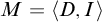 $M = \langle D, I \rangle $
for
$M = \langle D, I \rangle $
for $\mathscr L_<$
, I’ll write:
$\mathscr L_<$
, I’ll write: $d_1 < d_2$
for
$d_1 < d_2$
for $\langle d_1, d_2 \rangle \in I(<)$
,
$\langle d_1, d_2 \rangle \in I(<)$
, $[d_1, d_2]$
for
$[d_1, d_2]$
for $\{d \in D : d_1 \leq d \leq d_2\}$
,
$\{d \in D : d_1 \leq d \leq d_2\}$
, $0$
for
$0$
for $I(0)$
,
$I(0)$
, $n_M$
for
$n_M$
for $I(')^n(0)$
,
$I(')^n(0)$
, $d'$
for
$d'$
for $I(')(d)$
, and
$I(')(d)$
, and $d^{(n)}$
for
$d^{(n)}$
for $I(')^n(d)$
. Let us say that
$I(')^n(d)$
. Let us say that $X \subseteq D$
is closed iff
$X \subseteq D$
is closed iff $0 \in X$
and
$0 \in X$
and $(\forall d \in X)(d' \in X)$
. When writing a revision rule
$(\forall d \in X)(d' \in X)$
. When writing a revision rule $\delta _{\mathscr D, M}$
, I’ll omit the subscripts when they are clear from context.
$\delta _{\mathscr D, M}$
, I’ll omit the subscripts when they are clear from context.
Proposition A.1 (Contradictory categorical truths in
$\mathbf {S}^{\#}$
)

Let $\mathscr L_<$
,
$\mathscr L_<$
, $\mathbb {N}_<$
, 𝒟2
, and
$\mathbb {N}_<$
, 𝒟2
, and $AX$
be as in Example 5.1, and let
$AX$
be as in Example 5.1, and let $\Gamma = \{AX, G0, G0', G0", \ldots , \neg (G \ is \ closed)\} $
. Then
$\Gamma = \{AX, G0, G0', G0", \ldots , \neg (G \ is \ closed)\} $
. Then
-
(i)
$\Gamma {\models \!\!\!\!\!^{^{{\mathscr{D}_{2}}}}_{_{\#}}\,\,} \forall x \ x \neq x$
; and -
(ii)
$\mathbb {N}_< {\models \!\!\!\!\!^{^{{\mathscr{D}_{2}}}}_{_{\#}}\,\,} B$
for all
$B \in \Gamma $
.
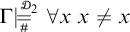


Before proving the proposition, we’ll need to prove a few lemmas.
Fact A.2. Let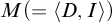 $M (= \langle D, I \rangle )$
be a model for
$M (= \langle D, I \rangle )$
be a model for $\mathscr L_<$
. If h is closed and
$\mathscr L_<$
. If h is closed and $h \neq D $
, h is a fixed point of
$h \neq D $
, h is a fixed point of $\delta _{{\mathscr{D}_{2}}, M}$
.
$\delta _{{\mathscr{D}_{2}}, M}$
.
Lemma A.3. Let M be a model for $\mathscr L_<$
such that
$\mathscr L_<$
such that $M \models AX$
, and let
$M \models AX$
, and let $\mathscr S$
be a revision sequence for
$\mathscr S$
be a revision sequence for $\delta _{{\mathscr{D}_{2}}, M}$
. Suppose
$\delta _{{\mathscr{D}_{2}}, M}$
. Suppose $\mathscr S_{\alpha }$
is not closed, and there is
$\mathscr S_{\alpha }$
is not closed, and there is $d_0 \in D$
such that
$d_0 \in D$
such that
-
(a)
$d_0 \in \mathscr S_{\alpha }$
and
$d_0' \notin \mathscr S_{\alpha }$
; and -
(b)
$\forall d \in D \ (d < d_0 \implies d \in \mathscr S_{\alpha })$
.



Where
 $$ \begin{align*} X &= \{d \in D : d < d_0\} \\ Y &= \{d \in D : \exists n \ d = d_0^{(n)} \}, \end{align*} $$ $\mathscr S_{\alpha + \omega } = X \cup Y$
. Moreover,
$\mathscr S_{\alpha + \omega } = X \cup Y$
. Moreover, $\mathscr S_{\alpha + \omega }$
is closed.
$\mathscr S_{\alpha + \omega }$
is closed.
Proof. Let M, $\mathscr S$
,
$\mathscr S$
, $\alpha $
, and
$\alpha $
, and $d_0$
be as specified. First, we show by induction on n that for all n,
$d_0$
be as specified. First, we show by induction on n that for all n, $1 \leq n < \omega $
,
$1 \leq n < \omega $
,
 $$ \begin{align} &\mathscr S_{\alpha + n} = X \cup [d_0,d_0^{(n)}], \text{ and } \end{align} $$
 $$ \begin{align} &\forall d \in D \ (d < d_0^{(n)} \implies d \in \mathscr S_{\alpha + n}). \end{align} $$
-
• Base:
$n = 1$
. First we show (A.1). From (AX4), (A.3)for all
$$ \begin{align} d < d_0' \implies d < d_0 \vee d = d_0 \end{align} $$
$d \in D$
. Then (a) and (b) imply that all
$d \in X \cup \{d_0, d_0'\}$
satisfy G’s definiens. Hence
$X \cup \{d_0, d_0'\} \subseteq \mathscr S_{\alpha + 1}$
. From
$AX$
we can deduce that if
$d \notin X \cup \{d_0, d_0'\}$
, then
$d_0' < d$
. Consequently, d doesn’t satisfy G’s definiens in
$M + \mathscr S_{\alpha }$
, so
$d \notin \mathscr S_{\alpha +1}$
. So
$\mathscr S_{\alpha +1} = X \cup \{d_0, d_0'\}$
. Statement (A.2) follows from (A.3).
-
• Inductive step. Suppose (A.1) and (A.2) hold for n. We first show (A.1) for
$n+1$
. Suppose
$d \in X \cup [d_0, d_0^{(n)}]$
, and let
$d_1 < d$
. By (AX3),
$d_0^{(i)} < d_0^{(j)} $
whenever
$i < j$
; hence transitivity implies
$d_1 < d_0^{(n)}$
. Equation (A.2) then implies
$d_1 \in \mathscr S_{\alpha + n}$
. This suffices to show that
$d \in \mathscr S_{\alpha + n +1}$
. Now consider
$d_0^{(n+1)}$
. By (AX4), and thus
$$ \begin{align*} d_1 < d_0^{(n+1)} \implies d_1 < d_0^{(n)} \vee d_1 = d_0^{(n)}, \end{align*} $$
$d_1 \in \mathscr S_{\alpha + n}$
. This shows that
$d_0^{(n+1)} \in \mathscr S_{\alpha + n + 1}$
.
Now suppose
$d \notin X \cup [d_0, d_0^{(n+1)}]$
. From
$AX$
we can deduce that
$d_0^{(n+1)} < d$
. But since
$d_0^{(n+1)} \notin \mathscr S_{\alpha +n}$
, d doesn’t satisfy the definiens in
$M + \mathscr S_{\alpha +n}$
; so
$d \notin \mathscr S_{\alpha + n+1}$
. We’ve thus shown that
$\mathscr S_{\alpha +n+1}= X \cup [d_0, d_0^{(n+1)}]$
.Second, we show (A.2). According to (AX4),
$d < d_0^{(n+1)}$
implies that either
$d < d_0^{(n)}$
or
$d = d_0^{(n)}$
. In either case
$d \in \mathscr S_{\alpha +n}$
by the inductive hypothesis, and
$\mathscr S_{\alpha +n} \subset \mathscr S_{\alpha +n+1}$
. This completes the induction.










From (A.1) it follows that all $d \in X \cup Y$
are stably in
$d \in X \cup Y$
are stably in $\mathscr S$
at
$\mathscr S$
at $\alpha + \omega $
, and all
$\alpha + \omega $
, and all $d \notin X \cup Y$
are stably out of
$d \notin X \cup Y$
are stably out of $\mathscr S$
at
$\mathscr S$
at $\alpha + \omega $
. So
$\alpha + \omega $
. So $\mathscr S_{\alpha + \omega } = X \cup Y$
.
$\mathscr S_{\alpha + \omega } = X \cup Y$
.
To show that $\mathscr S_{\alpha + \omega }$
is closed, suppose first that
$\mathscr S_{\alpha + \omega }$
is closed, suppose first that $d \in X$
. Then either
$d \in X$
. Then either $d' < d_0$
or
$d' < d_0$
or $d' = d_0$
, both of which imply
$d' = d_0$
, both of which imply $d' \in \mathscr S_{\alpha + \omega }$
. Alternatively, if
$d' \in \mathscr S_{\alpha + \omega }$
. Alternatively, if $d \in Y$
, then
$d \in Y$
, then $d' \in Y$
by definition of Y.
$d' \in Y$
by definition of Y.
The next three lemmas illustrate the different behaviors of the revision rules for 𝒟2 in standard and nonstandard models.
Lemma A.4. Let $M \ (= \langle D, I \rangle )$
be a model for
$M \ (= \langle D, I \rangle )$
be a model for $\mathscr L_<$
such that
$\mathscr L_<$
such that $M \models AX$
and M is not isomorphic to
$M \models AX$
and M is not isomorphic to $\mathbb {N}_<$
(
$\mathbb {N}_<$
( $M \ncong \mathbb {N}_<$
). If
$M \ncong \mathbb {N}_<$
). If $\mathscr S_{\alpha } = \{0\}$
in a revision sequence
$\mathscr S_{\alpha } = \{0\}$
in a revision sequence $\mathscr S$
for
$\mathscr S$
for $\delta _{{\mathscr{D}_{2}}, M}$
, then
$\delta _{{\mathscr{D}_{2}}, M}$
, then $\mathscr S_{\alpha + \omega }$
is closed and is a proper subset of D.
$\mathscr S_{\alpha + \omega }$
is closed and is a proper subset of D.
Proof. Let M, $\mathscr S$
, and
$\mathscr S$
, and $\alpha $
satisfy the above conditions. Letting
$\alpha $
satisfy the above conditions. Letting $d_0 = 0$
, we use Lemma A.3 to find that
$d_0 = 0$
, we use Lemma A.3 to find that $\mathscr S_{\alpha + \omega } = \{d \in D : \exists n \ d = n_M\}$
, which is closed. It is straightforward to show that any nonstandard model of
$\mathscr S_{\alpha + \omega } = \{d \in D : \exists n \ d = n_M\}$
, which is closed. It is straightforward to show that any nonstandard model of $AX$
contains nonstandard numbers larger than all elements
$AX$
contains nonstandard numbers larger than all elements $n_M$
. Thus
$n_M$
. Thus $\mathscr S_{\alpha + \omega } \subset D$
.
$\mathscr S_{\alpha + \omega } \subset D$
.
Lemma A.5. Let $M \ (= \langle D, I \rangle )$
be a model for
$M \ (= \langle D, I \rangle )$
be a model for $\mathscr L_<$
such that
$\mathscr L_<$
such that $M \models AX$
and
$M \models AX$
and $M \ncong \mathbb {N}_<$
. Then h is recurring for
$M \ncong \mathbb {N}_<$
. Then h is recurring for $\delta _{{\mathscr{D}_{2}}, M}$
only if h is closed and
$\delta _{{\mathscr{D}_{2}}, M}$
only if h is closed and $h \neq D$
.
$h \neq D$
.
Proof. We show that if h is either not closed or $h = D$
, then h is not recurring. Suppose
$h = D$
, then h is not recurring. Suppose $h = \mathscr S_{\alpha }$
in some revision sequence
$h = \mathscr S_{\alpha }$
in some revision sequence $\mathscr S$
for
$\mathscr S$
for $\delta $
.
$\delta $
.
-
• Case 1: h is not closed. We break into two sub-cases.
-
– Case 1.1: There is
$d_0 \in D$
such that-
(a)
$d_0 \in h$
and
$d_0' \notin h$
; and -
(b)
$\forall d \in D \ (d < d_0 \implies d \in h)$
.
By Lemma A.3,
$\mathscr S_{\alpha + \omega }$
is closed (and
$\neq \mathscr S_{\alpha }$
). If
$\mathscr S_{\alpha + \omega } \neq D$
, then it is a fixed point (Fact A.2), which implies that
$h = \mathscr S_{\alpha }$
is not recurring. If
$\mathscr S_{\alpha + \omega } = D$
, then
$\mathscr S_{\alpha + \omega +1} = \varnothing $
, and
$\mathscr S_{\alpha + \omega +2} = \{0\}$
. Lemma A.4 tells us that
$\mathscr S_{\alpha + \omega \cdot 2}$
is closed and is a proper subset of D. By Fact A.2, it is a fixed point, and therefore h is not recurring. -
-
– Case 1.2: There is no
$d_0 \in D$
satisfying (a) and (b). If
$0 \notin \mathscr S_{\alpha }$
, we find that
$\mathscr S_{\alpha +1} = \{0\}$
. Lemma A.4 implies that
$\mathscr S_{\alpha + \omega }$
is closed and a proper subset of D; it is therefore a fixed point, and h is not recurring. So suppose that
$0 \in \mathscr S_{\alpha }$
. We will now show that
$\mathscr S_{\alpha +1}$
, which is is closed and a proper subset of D. It will then follow that
$$ \begin{align*} \{d \in D : \forall d_1 (d_1 < d \implies d_1 \in \mathscr S_{\alpha })\}, \end{align*} $$
$\mathscr S_{\alpha +1}$
is a fixed point, and h is not recurring.
To show that
$\mathscr S_{\alpha + 1}$
is closed, note first that
$ 0$
and
$0'$
are both in
$\mathscr S_{\alpha + 1}$
. Now suppose
$d \in \mathscr S_{\alpha +1}$
,
$d \neq 0$
, and suppose
$d_1 < d'$
. By (AX4), either (i)
$d_1 = d$
or (ii)
$d_1 < d$
. If (i),
$d_1$
must be in
$\mathscr S_{\alpha }$
, else
$d_1$
’s predecessor would satisfy (a) and (b). (Use the fact that
$d_1 = d \in \mathscr S_{\alpha + 1}$
.) If (ii),
$d \in \mathscr S_{\alpha +1}$
implies
$d_1 \in \mathscr S_{\alpha }$
. Hence for all
$d_1 < d'$
,
$d_1 \in \mathscr S_{\alpha }$
; therefore
$d' \in \mathscr S_{\alpha +1}$
. This establishes that
$\mathscr S_{\alpha +1} $
is closed. To show that
$\mathscr S_{\alpha +1} \neq D$
, suppose otherwise for contradiction. Then the revision rule implies
$\mathscr S_{\alpha } = D$
, contradicting the assumption that h is not closed.
-
-
• Case 2:
$h = D$
. Then
$\mathscr S_{\alpha + 1} = \varnothing $
, and
$\mathscr S_{\alpha + 2} = \{0\}$
. Lemma A.4 implies that
$\mathscr S_{\alpha + \omega }$
is closed and a proper subset of D. By Fact A.2 it is a fixed point, so h is not recurring.





Lemma A.6. If $M \ \ (= \langle D, I \rangle )$
is isomorphic to
$M \ \ (= \langle D, I \rangle )$
is isomorphic to $\mathbb {N}_<$
, for all hypotheses h and
$\mathbb {N}_<$
, for all hypotheses h and $n \geq 2$
, there exists k such that
$n \geq 2$
, there exists k such that $\delta _{{\mathscr{D}_{2}}, M}^n(h) = [0, k_M]$
.
$\delta _{{\mathscr{D}_{2}}, M}^n(h) = [0, k_M]$
.
Proof. Suppose $M \cong \mathbb {N}_<$
. Let h be an arbitrary hypothesis, and suppose first that
$M \cong \mathbb {N}_<$
. Let h be an arbitrary hypothesis, and suppose first that $h = D$
. Using the isomorphism, one verifies that
$h = D$
. Using the isomorphism, one verifies that $\delta (h) = \varnothing $
, and
$\delta (h) = \varnothing $
, and $\delta ^n(h) = [0, (n-2)_M]$
for all
$\delta ^n(h) = [0, (n-2)_M]$
for all $n \geq 2$
.
$n \geq 2$
.
Now suppose that $h \neq D$
. Then h must not be closed. We may then deduce that
$h \neq D$
. Then h must not be closed. We may then deduce that $\delta (h) = [0, k_M]$
for some
$\delta (h) = [0, k_M]$
for some $k \geq 0$
. We can further verify that for all
$k \geq 0$
. We can further verify that for all $n \geq 2$
,
$n \geq 2$
, $ \delta ^n(h) = [0, (k+n-2)_M]$
.
$ \delta ^n(h) = [0, (k+n-2)_M]$
.
We’re finally in a position to prove Proposition A.1.
Proof.
-
(i) This is equivalent to the claim that for all M
$$ \begin{align*} \exists n \forall h \text{ recurring for } \delta \ \left(M + \delta^n(h) \not\models \Gamma\right). \end{align*} $$
There are two cases, depending on M.
-
• Case 1:
$M \cong \mathbb {N}_<$
. Let h be recurring for
$\delta $
, and let
$n \geq 2$
. By Lemma A.6,
$\delta ^n(h) = [0, k_M]$
for some k. Thus
$M + \delta ^n(h) \not \models G\overline {k}'$
. -
• Case 2:
$M \ncong \mathbb {N}_<$
. Assume
$M \models AX$
. Let h be recurring, which by Lemma A.5 implies that h is closed and
$h \neq D$
. By Fact A.2, for all
$n \geq 0$
,
$\delta ^n (h) = h$
; hence
$M + \delta ^n (h) \not \models \neg (G \ is \ closed)$
.
-
-
(ii) Clearly
$\mathbb {N}_< \models AX$
. Let h be an arbitrary hypothesis for
$\delta $
. By Lemma A.6,
$\delta ^2(h) = [0, k]$
for some k. This already establishes that
$\mathbb {N}_< {\models \!\!\!\!\!^{^{{\mathscr{D}_{2}}}}_{_{\#}}\,\,} \neg (G \ is \ closed)$
. We can further calculate that for all
$n \geq 2$
,
$\delta ^n(h) = [0, k+n-2]$
. Consequently, for all
$n \geq m + 2$
,
$\mathbb {N}_< + \delta ^n(h) \models G\overline {m}$
, and thus
$\mathbb {N}_< {\models \!\!\!\!\!^{^{{\mathscr{D}_{2}}}}_{_{\#}}\,\,} G \overline {m}$
for all m.


Proposition 6.1 (Finite natural implication in
$\mathbf {C}$
and
$\mathbf {C}^N$
)


-
(i)
$\mathbf {C}$
is complete for finite natural implication; -
(ii) none of the individual calculi
$\mathbf{C}^N$
is complete for finite natural implication; but -
(iii) for each finite definition
$\mathscr D$
, some calculus
$\mathbf {C}^N$
is complete for all finite natural implications relative to
$\mathscr D$
.


Proof.
(i): $\mathbf {C}$
is sound and complete for the weak revision system
$\mathbf {C}$
is sound and complete for the weak revision system $\mathbf {S}_0$
(RTT, Theorem 5B.1), which is easily seen to preserve all finite natural implications.
$\mathbf {S}_0$
(RTT, Theorem 5B.1), which is easily seen to preserve all finite natural implications.
(ii): Fix $N \in \mathbb {N}$
; we construct a counterexample to FNI in
$N \in \mathbb {N}$
; we construct a counterexample to FNI in $\mathbf {C}^N$
. We will use the language
$\mathbf {C}^N$
. We will use the language $\mathscr L_<$
and abbreviation
$\mathscr L_<$
and abbreviation $AX$
from Example 5.1, as well as the notation from the proof of Proposition A.1. Define the new predicate G explicitly by
$AX$
from Example 5.1, as well as the notation from the proof of Proposition A.1. Define the new predicate G explicitly by
 $$\begin{align} Gx &=_{Df} AX \wedge x \leq \overline{N} \wedge \forall y (y < x \to Gy). \end{align}$$
We claim that
-
(a) 𝒟3 is finite;
-
(b)
${\models \!\!\!\!\!^{^{{\mathscr{D}_{3}}}}_{_{f}}\,\,} AX \to G\overline {N}$
; and -
(c)
$\not {\vdash \!\!\!\!^{^{{\mathscr{D}_{3}}}}_{_{N}}\,\,} AX \to G\overline {N}$
.


For (a) and (b), we investigate the behavior of the revision rule $\delta _{\mathscr D_3, M}$
in models M of
$\delta _{\mathscr D_3, M}$
in models M of $AX$
. One can verify the following:
$AX$
. One can verify the following:
-
(d) If
$[0, N_M] \subseteq h$
, then
$\delta (h) = [0, N_M]$
. -
(e) Otherwise, let
$n_M$
be the least element of D excluded from h. Then
$\delta (h) = [0, n_M]$
.


From (d) and (e), we can see that for any h, $[0, N_M] \subseteq \delta ^{N+1}(h) $
, and that for all
$[0, N_M] \subseteq \delta ^{N+1}(h) $
, and that for all $n \geq N+1$
,
$n \geq N+1$
, $\delta ^{N+1}(h) = [0, N_M]$
. The hypothesis
$\delta ^{N+1}(h) = [0, N_M]$
. The hypothesis $[0, N_M]$
is finitely reflexive (with period 1). If M is not a model of
$[0, N_M]$
is finitely reflexive (with period 1). If M is not a model of $AX$
, then
$AX$
, then $\delta (h) = \varnothing $
for all h; and
$\delta (h) = \varnothing $
for all h; and $\varnothing $
is finitely reflexive (again with period 1). Thus we conclude that 𝒟3
is finite.
$\varnothing $
is finitely reflexive (again with period 1). Thus we conclude that 𝒟3
is finite.
In models M of $AX$
,
$AX$
, $[0, N_M]$
is in fact the only reflexive hypothesis. Thus, in these models,
$[0, N_M]$
is in fact the only reflexive hypothesis. Thus, in these models, $M {\models \!\!\!\!\!^{^{{\mathscr{D}_{3}}}}_{_{f}}\,\,} AX \to G\overline {N}$
. If M is not a model of
$M {\models \!\!\!\!\!^{^{{\mathscr{D}_{3}}}}_{_{f}}\,\,} AX \to G\overline {N}$
. If M is not a model of $AX$
, then also
$AX$
, then also $M {\models \!\!\!\!\!^{^{{\mathscr{D}_{3}}}}_{_{f}}\,\,} AX \to G\overline {N}$
. This establishes (b).
$M {\models \!\!\!\!\!^{^{{\mathscr{D}_{3}}}}_{_{f}}\,\,} AX \to G\overline {N}$
. This establishes (b).
For (c), we appeal to the semantical systems $\mathbf {S}_{1a(N)}$
, which stand to
$\mathbf {S}_{1a(N)}$
, which stand to $\mathbf {S}_0$
as the systems
$\mathbf {S}_0$
as the systems $\mathbf {S}^{\#N}$
stand to
$\mathbf {S}^{\#N}$
stand to $\mathbf {S}^{\#}$
. Implication in
$\mathbf {S}^{\#}$
. Implication in $\mathbf {S}_{1a(N)}$
is defined as follows, for
$\mathbf {S}_{1a(N)}$
is defined as follows, for $N \in \mathbb {N}$
:
$N \in \mathbb {N}$
: $\Gamma {\models \!\!\!\!\!^{^{\mathscr D}}_{_{1a(N)}}\,\,} B$
iff, for all ground models M,
$\Gamma {\models \!\!\!\!\!^{^{\mathscr D}}_{_{1a(N)}}\,\,} B$
iff, for all ground models M,
 $$ \begin{align*} \forall h \left(M + \delta_{\mathscr D, M}^N(h) \models \Gamma \text{ implies } M + \delta_{\mathscr D, M}^N(h) \models B\right). \end{align*} $$
See [Reference Schindler24] for a characterization of $\mathbf {S}_{1a(N)}$
. In particular, that paper uses a strategy similar to RTT’s Theorem 5B.1 to prove that for each
$\mathbf {S}_{1a(N)}$
. In particular, that paper uses a strategy similar to RTT’s Theorem 5B.1 to prove that for each $N \geq 0$
,
$N \geq 0$
, $\mathbf {C}^N$
is sound and complete for
$\mathbf {C}^N$
is sound and complete for $\mathbf {S}_{1a(N)}$
for explicit definitions. Thus for (c) it suffices to show that
$\mathbf {S}_{1a(N)}$
for explicit definitions. Thus for (c) it suffices to show that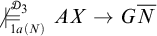 $\not {\models \!\!\!\!\!^{^{{\mathscr{D}_{3}}}}_{_{1a(N)}}\,\,} AX \to G\overline {N}$
.
$\not {\models \!\!\!\!\!^{^{{\mathscr{D}_{3}}}}_{_{1a(N)}}\,\,} AX \to G\overline {N}$
.
For our counterexample, take the standard model $\mathbb {N}_<$
and the hypothesis
$\mathbb {N}_<$
and the hypothesis $\varnothing $
. We calculate
$\varnothing $
. We calculate

Hence, $\mathbb {N}_< + \delta ^{N}(\varnothing ) \not \models AX \to G\overline {N}$
.
$\mathbb {N}_< + \delta ^{N}(\varnothing ) \not \models AX \to G\overline {N}$
.
(iii): Appealing to the completeness of $\mathbf {C}^N$
for
$\mathbf {C}^N$
for $\mathbf {S}_{1a(N)}$
, it suffices to show that, given
$\mathbf {S}_{1a(N)}$
, it suffices to show that, given $\mathscr D$
, there is N such that
$\mathscr D$
, there is N such that $\mathbf {S}_{1a(N)}$
preserves finite natural implications relative to
$\mathbf {S}_{1a(N)}$
preserves finite natural implications relative to $\mathscr D$
. We’ll also use a fact shown by Gupta [Reference Gupta11]: we may reverse the
$\mathscr D$
. We’ll also use a fact shown by Gupta [Reference Gupta11]: we may reverse the $\forall M$
and
$\forall M$
and $\exists n$
quantifiers in the definition of a finite definition. Thus if
$\exists n$
quantifiers in the definition of a finite definition. Thus if $\mathscr D$
is finite, there exists an n such that for all models M and hypotheses h,
$\mathscr D$
is finite, there exists an n such that for all models M and hypotheses h, $\delta _{\mathscr D, M}^n(h)$
is finitely reflexive. Given a finite definition
$\delta _{\mathscr D, M}^n(h)$
is finitely reflexive. Given a finite definition $\mathscr D$
, let us choose such an N as our strength.
$\mathscr D$
, let us choose such an N as our strength.
Now suppose $\Gamma {\models \!\!\!\!\!^{^{\mathscr D}}_{_{f}}\,\,} B$
, and let M be arbitrary. Since
$\Gamma {\models \!\!\!\!\!^{^{\mathscr D}}_{_{f}}\,\,} B$
, and let M be arbitrary. Since $\delta _{\mathscr D, M}^N(h)$
is finitely reflexive for all h,
$\delta _{\mathscr D, M}^N(h)$
is finitely reflexive for all h,
 $$ \begin{align*} \forall h \left(M + \delta_{\mathscr D, M}^N(h) \models \Gamma \text{ implies }M + \delta_{\mathscr D, M}^N(h) \models B\right); \end{align*} $$
thus $\Gamma {\models \!\!\!\!\!^{^{\mathscr D}}_{_{1a(N)}}\,\,} B$
.
$\Gamma {\models \!\!\!\!\!^{^{\mathscr D}}_{_{1a(N)}}\,\,} B$
.
Acknowledgments
For helpful conversations, I would like to thank Douglas Blue, Patrick Chandler, Alexandre da Eira, James Hodgson, and James Shaw, who provided detailed comments on an earlier draft. Thanks also to an anonymous reviewer for several helpful suggestions. Finally, I owe a special debt of gratitude to Anil Gupta, not only for his careful reading and incisive questions, but for his generous mentorship and his vigorous encouragement to write this paper.





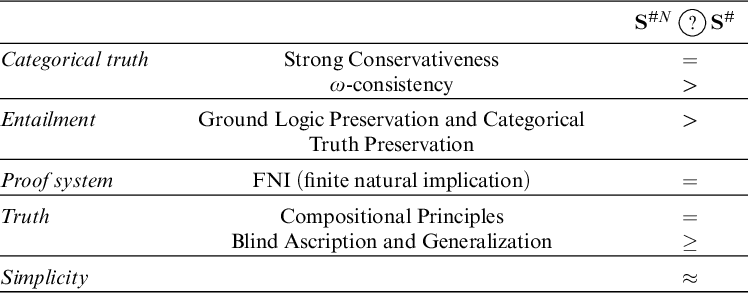


 Open access

