

Introduction
Environmental Labour Studies (ELS) have grown significantly in the past 5 years, focusing mainly on just transition Footnote 1 policies of trade unions, particularly in the Global North but increasingly in the Global South (Räthzel et al Reference Räthzel, Stevis and Uzzell2021). The following text is a contribution to this research area, proposing a broader perspective that includes workers’ whole way of life.
The concept of just transition was first developed by unions in the USA and Canada and aims to link the protection of workers with the protection of nature. I use the term as it is used by most unions, as a strategy to connect workers’ rights to decent, secure, well paid, and healthy jobs with strategies for decarbonisation. The specifics of these policies differ vastly and scholars have developed a variety of concepts to categorise different just transition policies. Researchers are asking whether these policies are efficiently addressing decarbonisation, whether they are just towards workers and nature in a comprehensive way, and whether they remain within the dominant paradigm of the capitalist mode of production or go beyond it. Trade union strategies have been defined as opposed to, hedging, or supportive of decarbonisation (Thomas and Doerflinger Reference Thomas and Doerflinger2020). They are also described as deliberative, supporting collaborative growth, or socialist in terms of whether or not they are acting within or questioning the present capitalist mode of production (Felli Reference Felli2014). Azzi (Reference Azzi, Räthzel, Stevis and Uzzell2021) uses the concepts of consensus and dissensus to assess whether just transition policies disrupt the relationship with established hierarchies and inequalities, and how they relate with other social movements in Latin America. From a Canadian perspective Dobrusin (Reference Dobrusin, Räthzel, Stevis and Uzzell2021) categorises unions in terms of their abilities to form alliances with Indigenous populations. The most sophisticated categorisation of union policies has been developed by Stevis and Felli (Reference Stevis and Felli2020) who created a system to analyse the scale, scope, and forms of justice that characterise planetary justice perspectives.
Another group of scholars analyses the different conditions under which unions are more or less likely to develop just transition policies. For instance, Kalt (Reference Kalt2022) compares policies of unions in the coal mining sector in Germany and South Africa to develop seven conditions leading unions to be either supportive, cautious, or resistant towards the closure of coal mines and the introduction of renewable energies. He also shows that when conditions change, union strategies will change. This implicitly criticises models that define trade union policies by their identities, whether they are business or social movement unions. We have to think of union engagement in environmental transformations as processes that are constantly evolving due to changing conditions. For example, social movement unions such as the National Union of Metal Workers South Africa (NUMSA) can shift from championing renewables to contesting them in court. Trade unions have been criticised as having become part of ‘delayism’, replacing denialism by acknowledging the crisis but advocating for more time to avoid economic and harm to workers’ jobs (Harry et al Reference Harry, Maltby and Szulecki2024; Heffron and McCauley Reference Heffron and McCauley2022). Flanagan and Goods (Reference Flanagan and Goods2022) provide a comprehensive overview and analysis of trade union policies.
However, other than those of Stevis and Felli, these categorisations remain within the parameters common to most just transition policies. These parameters consist in (a) reducing the ecological crisis to the climate crisis, with the effect of centring politics exclusively on the reduction of CO2 emissions, thereby disregarding whether their policies threaten non-human nature, (b) remaining within respective sectors or the borders of nation states and (c) the green growth model. My issue in this paper is with both trade unions’ just transition policies and the ways in which these are framed by researchers. Broadly, neither trade unions nor most researchers address the multidimensional and global character of the ecological crisis.
I use some space in the first section of the paper to set out the crisis, explain the global character of every workplace, and identify the reasons why trade unions have difficulties addressing the character of the ecological crisis. To address this crisis productively, unions need to reinvent themselves from being solely responsible for the workplaces of their members to also having responsibility for workers’ lives across sectors and nation-states. While international solidarity is a central trade union value it hardly plays a role in just transition strategies.
In the second section of the paper, I identify unions and unionists who are developing such a new identity. Sections one and two serve as points of departure for section three where I offer some results of our research project.Footnote 2 This project sought to understand workers’ understanding of the societies we live in, the society they want to live in, and how these ideas connect to their analysis of the ecological footprint of their workplaces and perspectives for changing them. I restrict the analysis in this paper to workers’ ideas of the society they want to live in. My main tool to understand these ideas is the concept of concrete utopias as developed by the German philosopher Ernst Bloch. In the fourth section I reflect upon possible implications of our findings for trade union just transition policies.
Everything is connected – but unions do not connect
Workers, predominantly those in the Global South, have been fighting against the contamination of the air they are breathing, the water they are drinking and using to irrigate their fields and feed their livestock, as well as against expulsions from their land. In contrast to just transitions policies, these are struggles for survival, which have been analysed as ‘the environmentalism of the poor’ (Martinez-Alier Reference Martinez-Alier2002) or, when they take place in the Global North, as labour environmentalism (Bell Reference Bell2020; Barca Reference Barca2024).
The ‘environmentalism of the poor’ and just transition strategies do not connect in the traditional sense of workers supporting each other in their struggles. However, they are connected systemically since the development of the ‘green’ economy requires an increasing amount of minerals and metals, predominantly located in the Global South, leading to the devastation of human and non-human living conditions. More solar panels and wind turbines in the Global North mean more destruction of humans and non-human species in the Global South and in parts of the Global North.
Workers are exploited globally by the same forces; they are dependent on the work of other workers for their own work. Yet, these dependencies exist behind their backs. Workers are not creating connections consciously. In order to understand these connections and perhaps make them fruitful for ‘planetary justice’ (Stevis and Felli Reference Stevis and Felli2020), there are three main issues that need to be considered. These will enable the creation of just transition policies which create justice for humans and non-human species globally.
Issue 1: we are not just facing a climate crisis but a crisis of life on earth
In 2024 the Potsdam Institute for Climate Impact Research (PIC) published their first Planetary Health Check Report (Caesar et al Reference Caesar, Sakschewski, Seaby Andersen, Beringer, Braun, Gerten and Heilemann2024). Planetary health is defined as: ‘the state of the Earth system in terms of its ability to maintain stability, resilience, and life-support functions.’ (Caesar et al Reference Caesar, Sakschewski, Seaby Andersen, Beringer, Braun, Gerten and Heilemann2024, 4). The present mode of production has caused six out of nine essential Earth system processes to breach safe boundaries. These are the climate, the loss of biodiversity, excessive land use, deforestation, overuse of freshwater and its contamination, ocean acidification, modification of biogeochemical flows, and the introduction of novel entities (plastic, genetically modified plants, etc.).Footnote 3 A shift to renewable energy alone will not address the destruction of other life support systems, rather, it will exacerbate it. While the sun and the wind cannot be exhausted, the machines with which their energy is harnessed raise the question of whether their energy can accurately be called ‘renewable’. Solar panels and wind turbines increase the need for minerals and metals enormously. In his insightful book, Hickel (Reference Hickel2020) uses figures from the World Bank to calculate the amounts of minerals needed for the world to get to zero emissions by 2050 based on a green growth model. For the batteries needed to store ‘renewable’ energy a 2700% increase of lithium extraction over current levels would be needed (Hickel Reference Hickel2020, 140). Many of these minerals are not renewable or have very low recycling rates. Recycling could reduce extraction needs. However, lithium recycling, for example, is challenging due to toxicity. Current recycling rates are at 5%, with research suggesting it could increase to 15% by 2040 (Frauenhofer Institute 2023).
Issue 2: every work process is a transformation of nature
In his criticism of the Gotha programme of the German Social Democratic Party, which defined labour as the source of all wealth, Marx argued: ‘Labor [sic] is not the source of all wealth. Nature is just as much the source of use values (…) as labor, which itself is only the manifestation of a force of nature, human labor power’ (Marx 1878 [Reference Marx, Anderson, Ludenhoff, Hudis and Linebaugh2022]). For this reason protecting workers must include protecting nature.
Trade unions have traditionally cared for working conditions, working hours, workers’ wages, and occupational health and safety. In discussions with environmentally engaged unionists, many suggested integrating environmental policies into traditional health and safety responsibilities, as the climate crisis threatens both non-human nature and workers’ health.
While this is a good way of connecting workers’ bodies with broader ecological issues it also has its problems. The socio-ecological crisis poses a different kind of threat to workers’ health and lives. Workers do not feel, see, or smell the effects of the crisis, nor do they get sick from it directly. While workers may be impacted by disasters such as heat waves, floods, droughts, or storms, the relation between these events and the ecological crisis needs a theoretical explanation which workers may or may not believe. While health and safety policies aim to improve existing jobs, just transitions policies may involve job losses and replacements are uncertain. Further, there is no immediate connection between greening a workplace and mitigating the ecological crisis. Though each individual change is necessary, the crisis can only be addressed by common global actions.
To recognise the relationship between a given production process and the ecological crisis there would have to be an understanding of the labour-nature relationship in each process and in the processes preceding and following it. But trade unions have historically focused on protecting workers and their bodies while being oblivious to the role nature plays in each process. The privatisation of nature by capital has alienated workers from nature as a part of the production process. Instead, nature has become workers’ Other, a pristine place to recover from the toils of work (Räthzel and Uzzell Reference Räthzel and Uzzell2013). The just transition policies meant to protect workers and nature do not mention nature (Räthzel and Stevis Reference Räthzel, Stevis, Moore, Scherrer and Van Der Linden2025).
Issue 3: every workplace is global
Changes within one production process impact on all production processes within the Global (Re)Production Networks (GRPN).Footnote 4 Therefore, the analysis of the ecological impact of any product must include its whole lifecycle, from extraction to waste management and the social re-production processes that sustain them. Communities living in the vicinity of existing and newly planned mines are resisting the destruction and appropriations of their land (Riofrancos Reference Riofrancos2017; Svampa Reference Svampa2019; Environmental Justice Atlas 2024). Extraction leads to deforestation, the overuse of fresh water, the destruction of soils and biodiversity, and threatens the health and livelihoods of adjacent communities. Scholars speak of the heralding of a new epoch of capitalist exploitation of labour and the earth in the guise of a ‘green transition.’ Andreucci et al (Reference Andreucci, García López, Radhuber, Conde, Voskoboynik, Farrugia and Zografos2023) define the current mode of energy transition as ‘decarbonisation by dispossession:’
whereby cities and industries in the North are increasingly striving to achieve the status of low-carbon or zero-emissions, while peripheries, primarily in the South (but also in economically and politically marginalized spaces in the global North), are being assigned the role of extraction areas, waste or carbon dumps. (Andreucci et al Reference Andreucci, García López, Radhuber, Conde, Voskoboynik, Farrugia and Zografos2023, 3).
Tunn et al (Reference Tunn, Kalt, Müller, Simon, Hennig, Ituen and Glatzer2024), investigating hydrogen production for the Global North in 28 countries of the Global South, find that this level of extraction reinforces and renews colonial exploitation.
When unions promote just transition policies that ignore extractivism and other forms of destructions within GRPNs they become involuntarily complicit with practices of land grabbing (Harvey Reference Harvey2005) and new practices destroying nature and exploiting workers (Eerola and Komnitsas Reference Eerola and Komnitsas2025; Alkhalili et al Reference Alkhalili, Dajani and Mahmoud2023).
There needs to be an energy transition. However, if this transition is based on the GDP growth model and does not address the full life cycle of renewable energy machinery, the result will only be a shift of the destruction of nature and the exploitation of workers from the end of production processes (emissions) to its beginning (extraction).
Everything is connected – and some workers connect
There are some dissenting voices within unions that are recognising that just transition policies can neither stop at national borders nor support the green growth model. They pick up different elements of what is missing in dominant just transition policies.
The Comisiones Obreras (CCOO) address the GRPNs by advocating to ‘reduce the consumption of energy, water and superfluous goods in the context of the scarcity of raw materials and a global chemical contamination.’ Simultaneously, they emphasise the need to localise production and energy (Confederación Sindical de CCOO 2020). These perspectives are controversial within the union. One main reason why this union has generally less difficulties addressing the ecological crisis as a trade union issue is its origin as a workers’ movement against the Franco dictatorship. From its beginning the union saw its aim not only in fighting for working conditions but also for a socialist society.
Hans Jürgen Urban, member of the directive body of the German Metal Workers Union (IG METALL), addresses the problem of growth. At a conference dedicated to the Quality of Life he argued that the capitalist growth trap resulted in dividing the unions, not in improving the wellbeing of workers, but leading towards a climate catastrophe. A new trade union strategy had to combine a sustainable development of work, society and nature. The first question such a strategy would have to ask, was: ‘what can and what cannot grow?’ The criteria for new investments should not be profits but the needs of people and nature (Urban Reference Urban2022).
A group of aviation workers within UNISON in the UK challenge the growth paradigm and promote the need to include shop-floor workers as agents in the creation of just transition strategies. To include shop floor workers as agents of change they suggest ‘workers’ assemblies’ which would create ‘a collective and deliberative process (that) would allow workers to navigate the changes needed for themselves’ (Safe Landing 2023).
Workers of a former factory in Florence (Guest, Keen and Nettlefolds Limited, GKN) producing parts for luxury cars were dismissed via an email. Their struggle to keep their jobs transformed into a struggle for an alternative production of socially useful and ecologically sensible products. This occurred in part through their cooperation with the Italian group of Fridays for Future (Ferrari and Kaiser Reference Ferrari and Kaiser2023) and their research of similar struggles, like that of the Lucas workers (Wainwright and Elliott Reference Wainwright and Elliott1982). They mobilised researchers, workers from other sectors, artists, and other civil society organisations which helped them develop a plan to produce cargo bikes and solar panels using materials from discarded ones to avoid new extractivism. The historical Lucas case and the present-day GKN case both involved the development of their alternatives in times of crisis. The Lucas workers were about to lose their jobs; the GKN workers have lost them. In his book, Me-Ti: Book of Interventions in the Flow of Things, Brecht wrote ‘revolutions occur in blind alleys. Routine is dangerous.’ (Brecht and Tatlow Reference Brecht and Tatlow2020). This reflects the answer of one member of the Lucas combine committee, who said the condition for creating an alternative production plan for their company was the crisis, workers fearing for their jobs.
There are different ways to react to a crisis. One might try to hold on to the present situation, which is what most just transition policies are about, or one might opt for a deep transformation daring to jump into the unknown. This is what the Lucas workers did and what the ex-GKN workers are doing.
Whether one calls it climate crisis or ecological crisis, few unions deny that there is a crisis. One question we posed in our research project was whether the experience of living in a crisis, even if not directly felt at the workplace, inspires ideas about alternative ways of working and living.
Workers’ images of the world they want to live in
The stories of the Lucas workers in the seventies and of the GKN workers today exemplify that workers have the skills, knowledge and ingenuity to create transformative change. Given their irreplaceable role in all production processes and their role as citizens who can put pressure on politicians, workers have the potential power to create an alternative to the destructive green growth path. But they work under conditions not of their making and lack the power to realise the changes they might wish for. However, the socio-ecological transformation needs a global workers’ movement pushing for it. I use the term workers to include all working people no matter in which sector (service, industry, agriculture, paid and unpaid care work) or country they produce.
Having conducted research with trade union representatives in different countries of the Global North and South we now wanted to know more about shop floor workers’ practices and perceptions of the ecological crisis. Were they aware of the ecological footprints of their workplaces and did they suggest change? Since socio-ecological transformation needs to include not only the mode of production but also its societal contexts, how did shop floor workers perceive our present society and what visions did they have for the society in which they wanted to live?
The question then was, how would we contact shop floor workers?Footnote 5 We decided to attempt something different. Rather than search for shop floor workers we would create a context in which they would come to us. We would offer workshops to discuss how workers could measure the ecological (not just the CO2) footprint of their workplace and develop alternatives. It was clear that this would not be a random selection, that only workers interested in environmental issues would attend such courses. However, these are the workers who can move things forward. They can become ‘organic intellectuals’ (Gramsci Reference Gramsci1971), creating a hegemonic workers’ movement for transformative change.
We contacted trade unions in Spain, Sweden, and the UK with whom we had developed good working relationships in previous projects and sought their assistance to promote our course in their unions. The Swedish unions felt unable to help us. In Spain, we were supported by Comisiones Obreras and the International University of Andalucia (specialising in education for people without formal university qualifications). In the UK, the TUC Wales, the STUC Scotland and the TUC Yorkshire and Humber co-organised our courses. They produced publicity materials and found the venues. They did not interfere with the content of the course. Our research funds paid for travel, food, accommodation of the participants and the respective venues. Together 75 unionists from industry, public services, administration, and agriculture participated in the six courses we offered, three in each country.
Methodological approach
We position our approach in the tradition of Participatory Action Research (PAR), as democratic participation and collective knowledge production for the solution of problems identified by all members involved in research (Chevalier and Buckles Reference Chevalier and Buckles2013). Our aim was to convey three main points. Firstly, we are not just experiencing a climate crisis but a crisis of life. Secondly, every workplace is global. Thirdly, technological fixes are necessary but insufficient because they do not address points one and two.
The main part of the course was devoted to a discussion of workers’ analyses of their workplaces and their ideas for change. Before this and before we made any input ourselves, we wanted to gain some knowledge of workers’ ideas about the present society and the society in which they would want to live. We could have asked questions and might have had interesting discussions. But this would not have included all participants and may not have motivated people to in-depth thinking. We would have recorded the discussions but the participants would not have had a record of them. Therefore, we decided to use the ‘rich picture’ method as developed by Simon Bell and Stephen Morse:
Rich pictures (RPs) were developed as (…) a means to gather information about a complex situation”. They are a tool “used for analysis of a systemic mess or complex situation and provide a space by which participants can negotiate a shared understanding of a context, and (…) involves them sharing their perspectives and learning from that experience (Bell et al Reference Bell, Berg and Morse2019, 602).
The advantage of using pictures to create a shared understanding of a complex situation is that a variety of dimensions appear simultaneously in one picture. As the saying goes, ‘a picture paints a thousand words’ (see the examples of pictures reproduced below).
We asked the participants to convene into smaller groups and together draw two images. Firstly, an image of the society in which we live and then a picture of the society in which they want to live. There is always a certain hesitation when people are asked to draw due to perceived lack of the skill. However, after the exercise, a participant in Scotland commented
a picture is great because you can include so many issues into one place and create a relationship between them
She captured the essence of why pictures are used in social sciences as a means of gathering data. However, Rich Pictures are also used as a way of finding common solutions to complex problems, although this can become problematic in terms of inherent power relations (Macintyre Reference Macintyre2020). We used the method not only to explore people’s visions but also as a way to allow participants to get to know each other.
The drawing did not foreclose discussions but developed them, first in the small groups where people had to agree what to draw, and then in the whole group when participants explained their pictures. We did not follow the discussions in their small groups because it was important to allow participants to develop their views freely. However, we observed that discussions and the drawings were intense as groups needed more than an hour to finish their drawings. When each group explained their pictures for the whole group it served as a starting point for a broader discussion with all participants about the issues developed in each group. The goal of this first method was to embed the analyses that workers did of their workplaces and possible alternatives within their visions of the present and their desired future society. We recorded the descriptions as well as the discussions in the whole group.
The most surprising result of this exercise is the similarity of the pictures. Across countries, regions, genders, generations, and economic sectors, the society people wanted to live in was one where economic growth did not play a role and paid work made up a small part of people’s life. An explanation for this consistency could lie in what Geertz reflected about the usefulness of anthropology:
The essential vocation of interpretative anthropology is (…) to make available to us answers that others, guarding other sheep in other valleys have given and thus to include them in the consultable record of what man has said (Geertz Reference Geertz1973).
This suggests that while people organise their lives differently, what they are organising is similar, that is, how they work and live. While the UK and Spain differ in many ways, they are similar in that capitalism promotes individualism and competition, alienating people from each other, preventing workers from controlling how and what they produce, and where consumption is a signifier of status. Workers in both countries defined the ways they want to live as overcoming these features of their societies.
The images of desirable futures included ideas raised during the discussion of halting the climate crisis: the circular economy, usage of renewable energy, public transport, locally produced food, the 15 minutes city, etc. Most interesting were the ways in which participants embedded these strategies into their broader ideas of a world worth living in. In what follows I will discuss the ideas that were mentioned most often: democratisation, collectivity, global connections, a decrease of salaried work, and growth in general.
Overcoming individualism – democratisation
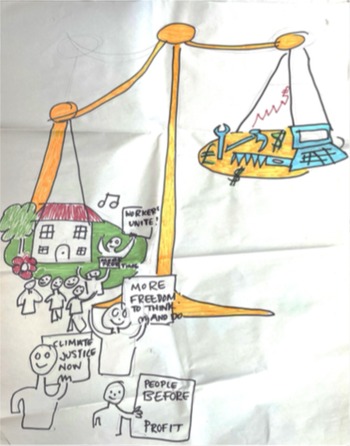
The theme mentioned most often was the need to overcome individualism. One woman from Glasgow, Marie,Footnote 6 formulated this in the following way (Figure 1):
This idea of individualism. So, this is everyone in their respective silos, where you go into the silo of the people with the same people who think the things as you do (…). But what we really need is for the door to be open and for people to be willing to come together and take part in dialogues. (…) We would like to see more democracy, strong democracy happening, sort of on like local and regional levels, things like citizens’ assemblies, the people themselves participating in budget decisions and local authority planning.
Drawing of participants in Glasgow.
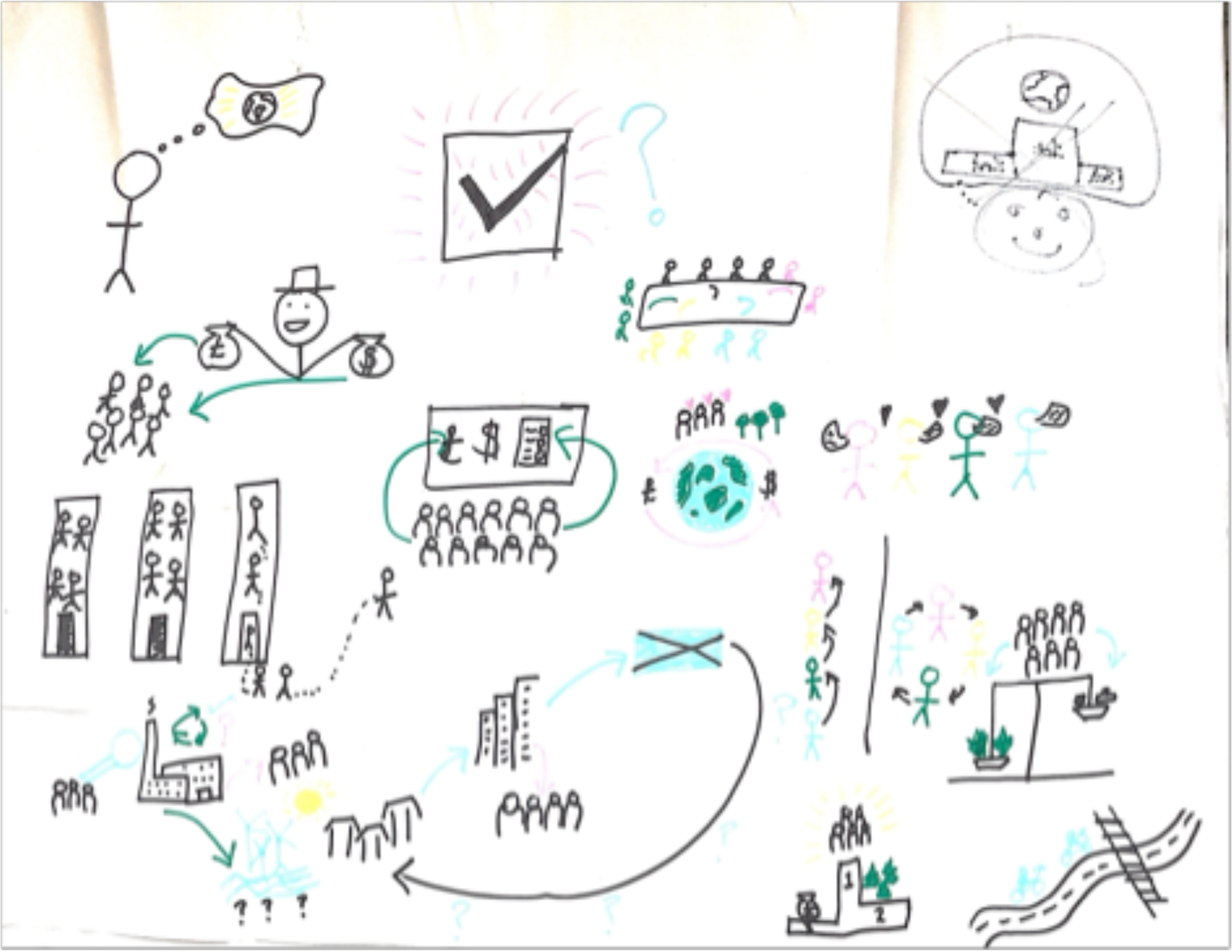
Marie connects coming together with democratic decision making at the local level, which she describes as ‘strong democracy.’ One can recognise in the description of ‘silos’ the present discussion about increasingly divisive societies in which people live enclosed in their respective ‘bubbles.’ There have been over 40 citizens’ assemblies in the UK, particularly at the local government level. Most of them (33 of the 42 documented) focused on climate change and biodiversity. Marie and her group talk about budget decisions that directly affect people’s lives, thereby going beyond citizens’ assemblies that only make suggestions, which politicians can follow or ignore.
In Baeza (Spain) workers argued:
we cannot only wait what our politicians will do without creating social pressure. How can we do this? Well, by organising, organising strikes, doing everything we can, think from the point of view of the social, the collective, from the ecological organisations to the trade unions of the working class and the unions of the students. (…) We cannot trust that our politicians will do things well (…). Probably we have no other means than social pressure.
We can see how different societal histories shape people’s perspectives. In the UK, especially in Glasgow, we met a group of unionists who, as they confirmed, were still suffering from the defeat they, or their families, had experienced under Thatcher. In contrast, in Spain, strikes and demonstrations are still the daily bread of people, organised either by unions or other civil society organisations and distrust in politicians is pervasive. But while the need for democracy and collective action is expressed in different ways, both statements reflect a discontent with politics from above that deprives people of the means to decide their fate and a trust in collective action.
Collectivity in a global perspective
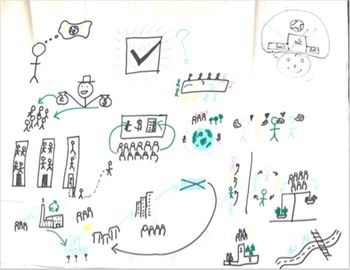
Overcoming individualism also played a central role in the images drawn in Baeza:
We have talked a lot about individualism. After all, the worker is an individual who (…) is not conscious that their work implies that there are other people, that (…) they receive those raw materials (…) from people working in a mine (…). In this society of consumption and individualism, of small groups, like family, friends and maybe a little, your comrades at work, (…) we do not think globally, or about humanity in general. (…) Without wanting to, we ignore the rest of humanity. (Figure 2)
Drawing of participants in Baeza.
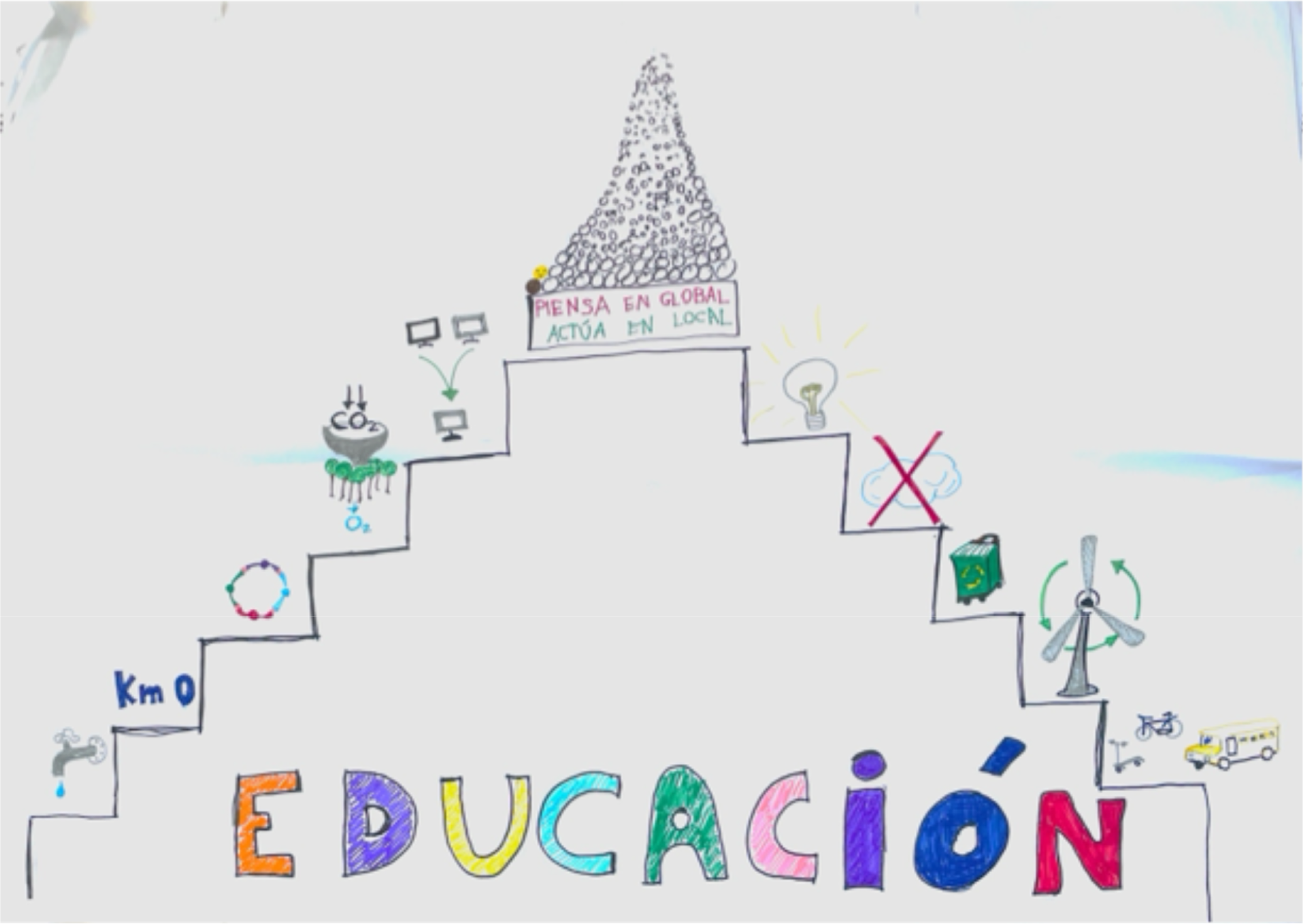
This description from Emilia’s group shifts the need of overcoming individualism from the local to the global level, criticising the reduced forms of collectivity that are practiced in everyday life. This group develop a global perspective from the point of view of their workplaces, positioning them within global value chains. These are perspectives that we do not usually find in just transition documents.
The global perspective was not missing in Marie’s image either. She describes the globus they have drawn in the following way (see Figure 1):
So, what we’ve done here is we’ve put currency symbols at the side {of the globus} and we’ve put arrows to show that the money should flow equally around the world, as opposed to being the thing that we prioritize. And instead, we prioritise people and planet. People represent all the different people in the world. And what’s happening here is the love. Hearts represent more harmony and more respect between people. (…). But Hugh said, which is crucial, it’s still okay to have conflict, (…) It’s fine to have conflict and disagreement, (…) but (…) it ends up harmonious in some way. We’re moving towards a better goal.
This image of money circulating equally across the world and people experiencing love and dialogue with each other despite differences stands in opposition to present experiences of neocolonialism, the cutting of international aid and the construction of difference as a threat to national identity. Conflict is cherished, but as a means to create new ideas.
A critique of growth
Work appears in most images as something that needs to be reduced to create space for other dimensions of life. The reduction of working time has become central in many wage negotiations, although it is not connected to a critique of economic growth as in the images of our participants.
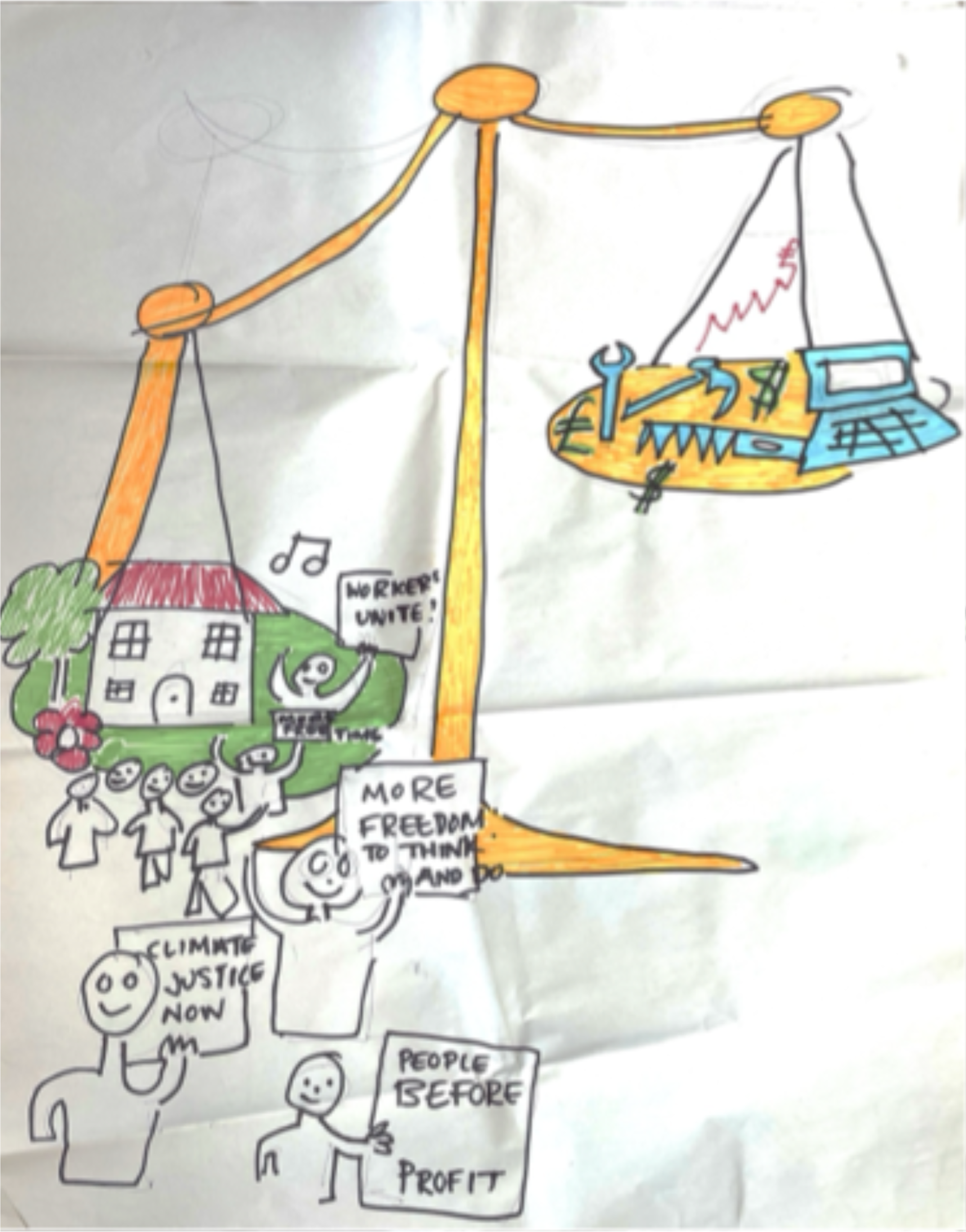
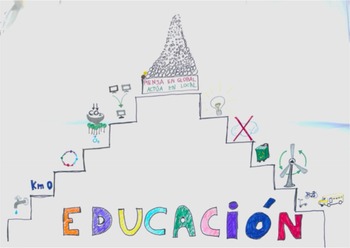
Judith from Glasgow (Figure 3):
And this idea of money coming first and the idea of kind of infinite growth, things are always bigger and better. So, if we kind of thought less about that. Then we’d have more time. (…) People could have a bit more time to sort of breath easy and think about what they want and get together and maybe make bigger changes because they’ve got more time (…) to think about things and socialize and pursue their hobbies and have a more holistic life.
Drawing of participants in Glasgow.
Jose from Baeza:
We know that there are many factors in life, not just work, production, the economy. (…) What would be our ideal life? Well, first reduce the working day, there should be four working days and three days to rest. We also believe in the co-responsibility within families. (…) Part of our lives should be dedicated to this co-responsibility within the home, with our families and with others, whether they are family members or other people, voluntary work and dedicate more time to develop our lives, a more sustainable life. (…) And when it comes to the model of production, well, we are in favour of degrowth, because we need to consume less, recycle more, do the same things as in the circular economy. I think we all agreed on this.
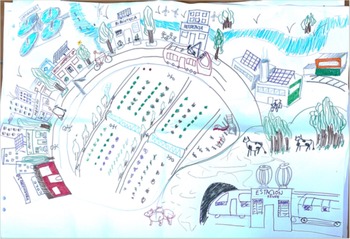
What is noticeable in these descriptions is the way in which public discourses of a sustainable life are interwoven with more far-reaching ideas about a different kind of life altogether. In some images money had disappeared and was replaced by a system of direct exchange of goods and competencies. In Baeza the reduction of working time was connected with the need to develop a culture of collectivity. One group designed an image that included all aspects of a different kind of life: connecting new and old technologies (a factory run by solar panels), integrating nature into the city configuration, public institutions of care, and collective transport (Figure 4).
Drawing of participants in Baeza.
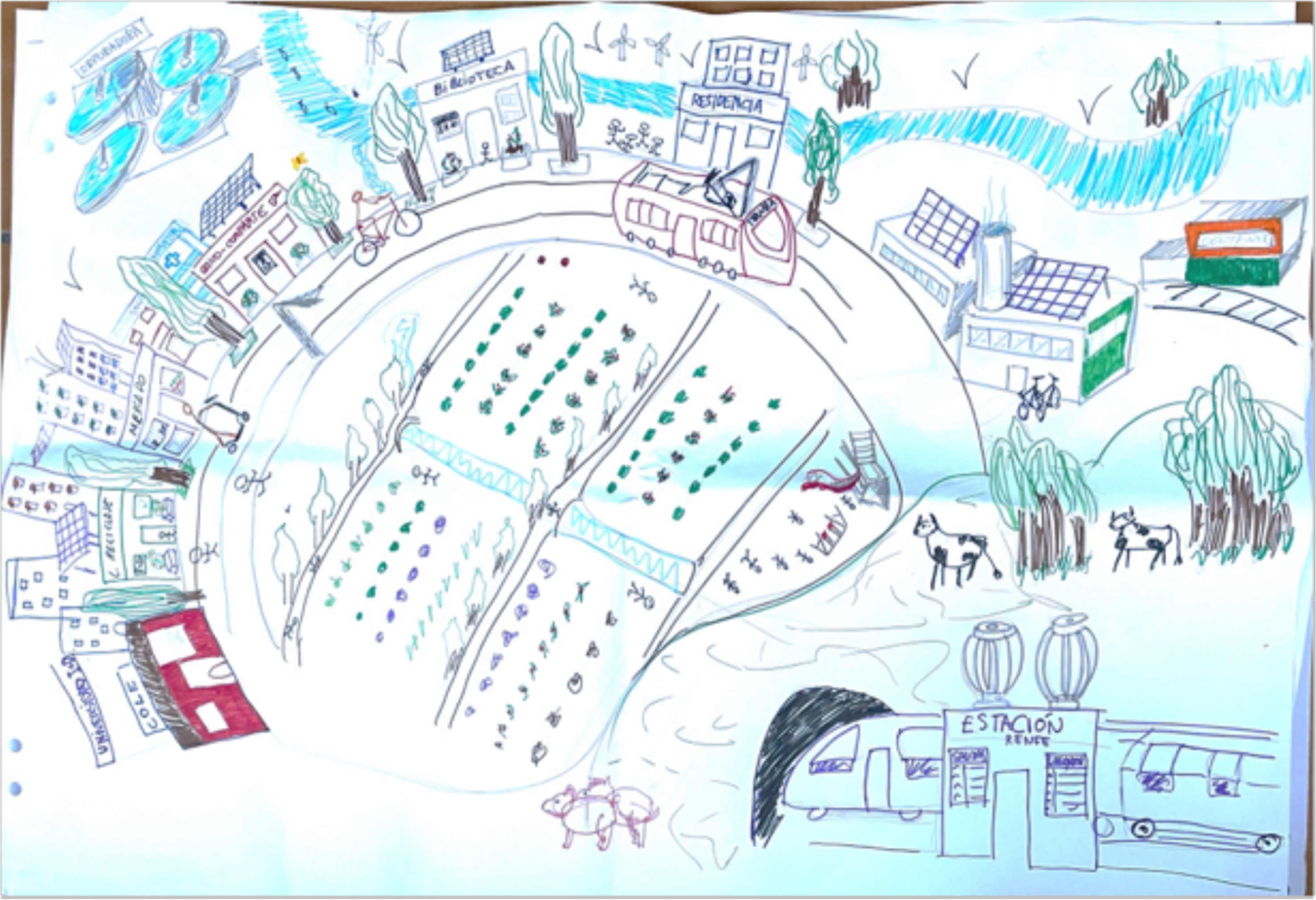
In these images of an ideal life, work played a marginal role. They are about a different kind of life on all dimensions: ways of living together, caring for others, connecting with people on which one’s daily work depends, connecting with nature, and connecting the local with the global.
How can we understand these imaginings of a different world and their significance? It would be possible to say that these are just utopias without relevance for the daily lives of workers. It helps our understanding to go back to the German philosopher Ernst Bloch who differentiated between real utopias and illusory utopias, the latter being images of a fixed perfect world that are not connected to daily lives. Real utopias, in contrast, embody ‘the reality that has not yet been fully achieved but is nevertheless compelling (…) ultimately sole “real reality”’ (Bloch and Plaice, Reference Bloch and Plaice1995). In his analysis of Weimar and fascism in Germany he explains that one of the attractions of fascism was that it was connected with the memories and images of a past that should have happened but never did (Bloch Reference Bloch2009).
We find such elements in the images which the workers in our courses produced and explained. Memories of a past that was supposed to happen were not necessarily memories of what people had experienced themselves but memories that have been passed on in stories, literature, or forms of art. For example, the ideas of conviviality, of care for each other, or of being close to nature. These are ideas that are a constant in human history. What changes is the ways in which they are embedded in historically specific contexts. For the workers in our course they were expressed as counter images to their lives lived today, against individualism, competition, the destruction of nature, and the reality of filling most time of their lives with work under the control of others.
Why are these not illusionary utopias? Because they are not about a perfect life, but are saturated with experiences of solidarity, experiments with communal budgeting, and the knowledge of connections to workers within the life cycles of production that exist but are not experienced. The utopias of a world workers wanted to live in are a complex assembly of memories, hopes, experiences, and dreams. Bloch insists we must take such utopias seriously because
No thing could be altered in accordance with wishes if the world were closed, full of fixed, even perfected facts. Instead of these there are simply processes, i.e. dynamic relationships in which the Become has not completely triumphed. The Real is process; the latter is the widely ramified mediation between present, unfinished past, and above all: possible future. (Bloch and Plaice, Reference Bloch and Plaice1995, 196)
In the last section I will discuss the role such utopias could play for the development of trade unions’ just transition policies.
Conclusions: utopias and the restrictions of the everyday
Let’s begin with experiences during our course that question the significance of the imaginings of another world. In the following discussions, when strategies for the workplaces were discussed the images of the world people wanted to live in faded away and the constraints of the everyday prevailed. These included the difficulty of changing ‘people’s mindsets,’ concerns about achieving even small changes in negotiations with management, the lack of support from trade union officials, the impossibility of accessing information about the supply chain, worries about ensuring a safe workplace, technical problems to reduce greenhouse gas emissions, and making sure recycling took place. In the everyday lives of unionists, these issues took all their time and did not leave space for deeper discussions of a desirable, alternative future. Moreover, as union representatives, their days were filled with the responsibilities of representing their members. This meant helping members with a sheer endless number of everyday problems, from being denied the sufficient number of holidays to not being able to take the appropriate sick leave. Even within the trade union structure, time constraints loomed large. As we were told by unionists who were trying to include shop floor workers into the development of just transitions, the response of their full-time unionists was that there was no time for this. One result of our research is therefore that workers’ images of their desired societies and their everyday work as union representatives were not connected.
One could argue that this disconnect due to a lack of time means that ideas of another future were, after all, illusionary. They did not fit into participants’ daily work as unionists, and even less into their tasks as workers. However, given the dimensions of the ecological crisis it is more unrealistic to think that the mode of production creating the socio-ecological crisis can be the one that solves it. Instead of continuing to measure success in terms of GDP growth and aiming for ever–increasing profits, it is necessary to reconsider what kind of goods and services are needed, and how they can be produced in a way that protects people and nature, and guarantees a dignified life and decent work for everybody on the planet. Nothing less can slow down the crisis. There is, of course, an ongoing discussion about the pros and cons of a degrowth perspective (Lang Reference Lang2024; Warlenius Reference Warlenius2023; Edwards Reference Edwards2025; Van Den Bergh Reference Van Den Bergh2011; Hickel and Kallis Reference Hickel and Kallis2019).
As the participants of our workshops taught us, fundamental questions of another life are real yearnings of environmentally engaged workers. For them, less material growth, more democracy, collectivity, connecting with workers globally, and more time for other practices were a desire, not something to be afraid of. However, they felt also imprisoned in the needs of the everyday which did not connect with their wishes for the future.
In a similar endeavour as ours, Keil and Kreinin (Reference Keil and Kreinin2022) asked whether and how unionists went beyond the ‘treadmill of work’, developing perceptions of the good life. They learnt that narratives in documents and in interviews with unionists were ambivalent. There were no ‘coherent good sense narratives, but rather dispersed statements spelling out aspects of a counternarrative’ (Keil and Kreinin Reference Keil and Kreinin2022). Our results may have differed because participants were specifically asked about the world in which they want to live and because they had the time and space to think about such an alternative world collectively. There are examples in the present and history of workers’ struggles that connect the everyday with perspectives of another kind of society.
For example, in their real-life experiment, the ex-GKN workers have been teaching us (and themselves) how a seemingly ‘pragmatic’ struggle to regain their jobs had to turn into a struggle for a different way of working and living to become realistic. They organised literature and political events, claiming they had ‘a hunger for a new world.’ They developed these perspectives in a broad alliance with civil society organisations. This ‘impossible’ broadening of the struggle cost them the support of their union but simultaneously enabled them to create a mass movement that generated enough social pressure to pass a law through the regional parliament to support the creation of alternative forms of reindustrialisation.
Fifty years ago, the German union IG Metall organised a conference entitled The Quality of Life. They discussed all aspects of life, and already then argued that the growth model had not satisfied workers’ needs and that it was time to ask, what should and what should not grow.
What could be the implications of our results for union just transition policies? For example, that workers at the shop floor level should be included in the development of such policies. This would not only tap into the wealth of ideas and knowledge but also to create time within the trade union structures to discuss the broader needs of transformation. We are facing an unprecedented socio-ecological crisis and therefore, pragmatic politics based on preserving the existing mode of production are unrealistic. The deep-seated fears among workers of losing their livelihoods are well-founded. However, among workers there are also the means, ideas, and the knowledge to transform those fears into alternatives. Trade unions could connect to this rich source of perspectives to help workers overcome the constraints of the everyday. Using organisational powers, unions can connect to workers’ desires for a different way of life and translate them into just transition policies that deserve this name. Real utopias can be realised but they need to be fought for.
Acknowledgements
I want to thank the two anonymous reviewers for their helpful and constructive comments and suggestions. I am particularly grateful to my colleague and friend David Uzzell for his ideas, questions, and suggestions, which allowed me to improve previous drafts. The responsibility for any errors or incoherences is of course all mine.
Nora Räthzel, Professor Emerita at the Institute of Sociology, Umeå University. Research subjects: Environmental Labour Studies, Transnational Corporations, Everyday Practices of Resistance and Subordination.

 Open access

