





Taming the savage beat
An illustration of a Native American man represents America on each record issued by the short-lived American Record Company (1904–6) (Figure 1).Footnote 1 He sits by a gramophone player and holds a disc in his right hand, four others strewn nearby. It is a stereotypical image: he is muscular and shirtless, with a headdress, blanket, moccasins, and arm cuffs. He clutches a ceremonial calumet pipe whose smoke encircles the phonograph, creating an ethereal tableau where the intoxicating melodies and smoky tendrils intertwine. The image is an example of how “Indianness” was conscripted to lend both indelible Americanness and exoticist fantasy to white commercial musical endeavors in the early twentieth century.
Label for the American Record Company. Courtesy of Glenda Goodman.

Anyone familiar with the history of US recording will recognize the iconographic resonance with Nipper the dog cocking his ear to the gramophone in RCA Victor’s iconic logo, which had already been in circulation by the time the American Record Company was founded.Footnote 2 Like Nipper, the Indian man is a captivated consumer, enraptured by recorded sound. He is also being tamed: the partial quote “Music hath charms” used as the American Record Company’s tagline hovering above him references the seventeenth-century English playwright William Congreve’s famous quote, “Music hath charms to soothe the savage breast” from the play The Mourning Bride (1697).Footnote 3 The label is doubly coded with dehumanizing references, visually comparing the man to an obedient dog and textually to the long European tradition of believing that Indigenous people were “savages.” But unlike Nipper, the nameless illustrated man is choosing among records: he is both a character—a record collector—and a caricature.
This article considers how white historians and self-styled experts turned to printed Native American songs as a source of historical evidence and racialized entertainment in the early twentieth century. In a period when racial and ethnic appropriation was the wellspring that fed entertainers of all races, white performers’ racial masking was the norm rather than the exception. Indigenous peoples engaged in this form of appropriation as well.Footnote 4 For instance, Oglala Lakota men from Pine Ridge and Rosebud Reservations achieved a complex form of success performing in Wild West Shows in the late nineteenth century. However, their participation occurred within a framework that stereotyped and commodified Native culture, bolstering the harmful misconception of Native peoples as a monolithic entity perpetually stuck in the past.Footnote 5 In response to such misrepresentations, and as a means of asserting cultural continuity and sovereignty, the ability of Native nations to demonstrate authenticity through rich repertoires of traditional songs and dances has been critically important. This assertion of identity is vital for internal community cohesion, intertribal relationships, and external validation, including interactions with the US government concerning federal recognition. The widespread adoption and evolution of Plains-style powwows across the continent, for example, powerfully illustrates the enduring significance of these living traditions in maintaining and expressing distinct cultural identities.
This article focuses on how, for white performers, the printed songs served to authenticate their historical research and legitimate their redface practices at a time when academic disciplines and popular culture were consolidating in new ways. To tease out this complex intellectual and cultural history, we turn to three Native American songs that were transcribed in the seventeenth century by French Jesuits Jacques Marquette (1637–75) and Louis Jolliet (1645–1700), included in printed books in the eighteenth and nineteenth centuries, and then used by historians and redface entertainers in the twentieth century.Footnote 6 Some sources describe them as songs from the calumet ceremony. Sources indicate that these are Peoria Indian calumet songs.Footnote 7 When the songs were converted to written musical notation, they became mediated artifacts that communicated information about Native American music and about how the white Jesuits heard and interpreted it. The three songs at the center of this article were extracted from their ceremonial context and repurposed as primary sources. Regardless of the questions surrounding the songs’ provenance, they came to index authenticity valued by academics and entertainers alike. Their unfettered reproduction in printed outlets demonstrates the centrality of music and fantasies about Native Americans in twentieth-century America.
In addition to centering Native American songs in scholarly and popular domains, this article considers music notation as an important yet confounding historical source. Documenting Native American music in writing before the advent of recorded sound was a necessary precursor for any subsequent type of use.Footnote 8 We start from the premise that no technology can fully capture a musical performance. Both written notation and recordings are lossy, compromised, and subjective representations; something is preserved, but something is always lost.Footnote 9 In the case of written music, there are two moments of interruption and dislocation: first, transcribing by ear, and second, converting that manuscript transcription to notation printed on a page. Transcribing music involves writing on the fly and from memory; the transcriber catches what they can of the melody, rhythm, harmony, and other musical elements. One may use cursory and incomplete music notation to do so.Footnote 10 There are inevitably discrepancies between the intended sound and the recorded result. The live aural experience of hearing and feeling the vibrations of singing, dancing, or the powerful thrumming of a drum circle are irreplicable. Notation transcribed initially by hand, like any inscription system, is biased—the transcriber captures what they recognize more readily than what is unfamiliar. It also changes when converted to new formats, such as from manuscript to print, and from print to further forms of mass media. Epistemological and ethical questions of fidelity, authenticity, ownership, access, and repatriation surrounding other objects and representations of Native culture adhere to notated music that has come to be used as historical primary sources and props in redface entertainment industries. Considering the fallibility of music notation offers new insights into the very practice of interpreting the historical record, while also questioning what counts as a primary source.
Although examples of notated music are not uncommon in printed sources about intercultural encounters from the seventeenth to twentieth centuries, to our knowledge no other example was reprinted as many times.Footnote 11 We zero in on their appearance in anthologies in the early twentieth century and their recurring use in popular-culture outlets through the mid-twentieth century. The work of educated white women was essential to creating publications that circulated these songs. Emma Helen Blair had a master’s degree from the University of Wisconsin and worked as a librarian, and Edna Kenton was a bohemian lesbian in Greenwich Village whose background as a journalist who wrote for theater and silent film led her to popularize the colonial documents for general consumption. Blair the rigorous researcher and Kenton the flamboyant storyteller demonstrate how the sources could speak to both academic and general publics. Examining the two women’s efforts shows that, even in the face of gender discrimination, white women leveraged their expertise and determined how exactly the songs appeared in print.Footnote 12
The songs became increasingly accessible and decreasingly tied to their original context with each publication. The watershed moment in the songs’ circulation was their inclusion in Volume 59 of the seventy-three-volume The Jesuit Relations and Allied Documents (1900). They were then reprinted in an anthology by Emma Helen Blair in 1911. Blending antiquarian and academic interests, the initial publications took for granted the benefits of increased access to the sources for educated users. Indeed, scholars still use these collections. Edna Kenton published the sources in 1925 and 1927 in books aimed at general readers, and subsequent reprintings of the songs in popular-culture outlets added dramatic and fanciful details, surrounding them with the growing body of caricatured Indian lore and entertainment steeped in redface practices. To the non-Native people whose hands touched and eyes glanced over the pages, the importance of the songs hinged not on how they sounded but on what they represented as tangible evidence of face-to-face intercultural encounters. The songs became a gateway to so-called authentic Indian culture from the past, available not just to scholars but to the general public, especially non-Indian children. Reprinting initially served the purpose of facilitating research but quickly was co-opted to feed the multimedia engine of white peoples’ fantasies about Native Americans in the twentieth century.
By tracking how this access has turned Native American ceremonial performance into a written primary source and then back into performances by white entertainers and children, we bring attention to the contingency of the sources’ creation and ongoing use. This article introduces music notation and musical performance into ongoing discussions about historical methodology. The specific literacy required to understand music notation can cause some scholars to pass over such sources. This article shows how the very way the songs are presented, bibliographically, in primary-source anthologies has encouraged the tendency to overlook them. Thus, despite serious efforts to pay attention to the historical ear and the history of sound and music by historians, the question of what to do with examples of printed, notated music remains open.Footnote 13 This article offers a model for how such sources can be read with skepticism and in context, similar to other primary sources. Yet notated music is always divorced from some of its context—the context in which it is performed, or “realized” to use the musicological term. Thus, examining the songs adds to our understanding about the constructedness of the historical record. The printed songs aren’t themselves music; they are representations of an aural, vocal, embodied experience. Examining them illustrates that the very way printed sources are made comes to influence how historians interpret them. Finally, the transformation of the songs into sources raises questions about authenticity, ownership, and access to Indigenous cultural expressions, to which we return at the end of the article.
From ritual to record: circulating music from the Jesuit Relations
The calumet ceremonies were critical across the riverine heart of Native North America for hundreds of years. They fostered peace and alliance, articulating a space for truces, diplomacy, and trade. The ceremonies were not just diplomatic, but also spiritual. Betrayal of a calumet ceremony was a ghastly violation that faced severe consequences both in this world and the next.Footnote 14 French missionaries and traders understood the diplomatic importance of the calumet as both a visual and and aural symbol that could allow safe passage through territories and provide a kind of material introduction when entering unfamiliar villages. Jacques Marquette and Louis Jolliet heard these calumet songs repeatedly during their journey along the northern Mississippi river in 1672. Marquette’s account was collected by his superior, Claude Dablon; it never appeared in print because the Relations ceased publication after 1673. Instead, manuscript copies went unpublished for half a century.Footnote 15
The three songs first appear in print in Claude-Charles Le Roy de la Potherie’s (1663–1736) Histoire de l’Amérique septentrionale or History of North America, published in Paris in 1722. De la Potherie wrote his four-volume publication in Guadupe, based on his experiences in New France. Volume 2, on Native American customs, was drawn from manuscript sources, including Marquette’s report. The songs served as evidence that demonstrated both Jesuit missionary fortitude and French imperialist information gathering. Each of the three songs is short and monophonic (a single, unharmonized melodic line), each in a treble range (Figures 2a, 2b). The melody is set syllabically, and the syllables sound like Peoria phonemes but are not actual words.Footnote 16 The melody and rhythm are also almost certainly only approximations of what the songs sounded like when sung. There is no information about either tempo or possible accompaniment—no indication of drums, shouts, the force of collective or individual voices straining to reach the high notes. The musical score is a pale trace of a meaningful performance. It would not facilitate the re-creation of that performance, not only because of all the lacking information, but also because the songs were printed in a small format, on the recto and verso of the same sheet, making it hard for performers to read and turn pages while singing.
(a) and (b) Three songs in de la Potherie’s Histoire de l’Amérique septentrionale, vol. 2 (Paris, 1722). Courtesy of the University of Pennsylvania Libraries.

The songs are even more radically separated from the idea of musical performance as they appear in The Jesuit Relations and Allied Documents. In the early twentieth century, an English-speaking reader who wished to learn about Jacques Marquette and Louis Jolliet’s 1673 journey through Illinois country could open Volume 59, published in 1901, and consult pages 118 to 156. In those pages, the reader would find a new translation of the seventeenth-century French text, complete with footnotes that guided the reader to other useful sources. Buried in the back of Volume 59, squeezed among the voluminous footnotes in the scholarly apparatus, is a cramped reproduction of the three calumet songs (Figure 3). Compared to the large, color-printed inserted map accompanying the volume, the space allotted for the music is stingy. It is an afterthought, one of the myriad extra details included to contextualize the main body of the text: the translated narrative of the original primary source.
Calumet songs in the endnotes to Reuben Gold Thwaites, ed., The Jesuit Relations and Allied Documents, vol. 59 (Cleveland, 1901), 311. Courtesy of the University of Pennsylvania Libraries.

Scholars of Native American history, Native American languages, colonial North America, the American West, French history, Atlantic history, and religious studies know The Jesuit Relations and Allied Documents as an indispensable collection.Footnote 17 Compiled by a team at the State Historical Society of Wisconsin overseen by Reuben Gold Thwaites (1853–1913) and published by the Burrows Brothers in Cleveland between 1896 and 1901, the seventy-three-volume set aimed to capitalize on the bibliomania that drove collectors to try to acquire copies of the original French editions of Jesuit reports. Aiming for comprehensiveness, the “Wisconsin edition” included new translations of the original annual Jesuit reports, published in France from 1632 to 1673 by Sebastien and Gabriel Cramoisy.Footnote 18 The Wisconsin edition also included an additional 207 documents to further flesh out the French history of New France. The Cleveland publishers anticipated that the entire series would consist of sixty volumes; they ended up with seventy-three.Footnote 19 It included a robust scholarly apparatus, complete with footnotes and an index that takes up the final two bound volumes of the set. Creating it required a large team of translators, editors, and proofreaders. Under the supervision of Thwaites, the Wisconsin edition reframed the documents; instead of being expressions of Jesuits’ religious faith, they were presented as valuable primary sources. They took on the guise of ethnographic records that provided crucial evidence of Native American life and customs for white readers.Footnote 20 The three songs are the only notated music in the series; they represent a tiny fraction of the vast store of evidence.
Thwaites’s goal with the Wisconsin edition was to make sources accessible. Thwaites had little formal training in history: he attended Yale but earned no postsecondary degrees. Nevertheless, he was made the head of the State Historical Society of Wisconsin in 1887. In 1889, he became president of the American Library Association, and in 1910 he was elected president of the historical society, which morphed into the Organization of American Historians. He was known for supporting modern historical training by opening the archives to graduate seminars, including those run by his close younger associate at the University of Wisconsin, Frederick Jackson Turner (1861–1932). Thwaites called for card catalogs and thematic organization at the State Historical Society of Wisconsin, and was an evangelist for technology. He believed that archival research was essential for historians and that such research needed to be scientifically systematic.Footnote 21 Thwaites’s editorial introduction to the compendium made the publication’s goals clear: the work was to further education, and to make available French manuscripts and print sources to more people who could use them in English for personal edification and scholarly research. “For forty years, these documents have, in part, been more or less familiar to Americanists as a rich storehouse of material. But, hitherto, they have existed only in rare and costly forms,” wrote Thwaites.Footnote 22 With the Wisconsin edition, “students of American history” did not need to have access to a historical society or archive, and could read sources in English translation.Footnote 23
The Wisconsin edition became a collector’s item, partly due to its limited run. The high cost of the collection meant that library acquisition was essential to fulfilling the compilers’ goals of providing access to the sources for scholars. Newspapers noted when series were purchased by the Detroit Public Library, the Alameda Public Library in the Bay Area of California, and the Rhode Island Historical Society. When copies with unique provenance went up for auction, people also took note, as when well-known collector A. S. W. Rosenbach purchased forty-seven volumes for $11,000 from the private New York library of Herman Le Roy Edgar.Footnote 24 Substantial gifts were also noted, as when an almost complete set was donated to the University of Minnesota by James F. Bell, the founder of General Mills, Inc. and a regent of the university, and when the Bodleian Library at Oxford acquired their set via donation.Footnote 25 The edition became expensive collector’s items. They were more accessible linguistically and physically than the rare seventeenth-century French Jesuit Relations, but exceeded most pocketbooks.
None of this access would have been possible without the huge amount of labor that went into The Jesuit Relations and Allied Documents. It involved a meticulous and systematic process, mirroring the methodical creation of the original Jesuit Relations. Texts were transcribed and translated in the libraries where they were housed, then forwarded to Wisconsin for proofing, annotation, and collation. Thwaites relied on a team of female workers to handle intellectual and editorial work that he considered menial, such as copying, indexing, and organizing information on thousands of index cards. Emma Helen Blair, one of these women, played a central role by compiling the comprehensive two-volume index and crafting the majority of the ethnographic footnotes and annotations, particularly those concerning place names. Blair’s insightful annotations transformed the publication into a valuable and accessible resource, both as an ethnographic document and as a navigable scholarly reference tool.Footnote 26
Women’s work: compiling compendia
While North American exploration, priesthood in the Society of Jesus, and being a professional historian were male domains, learned women were vital in turning these songs into primary sources accessible to scholars and the public. Their knowledge production complicates given narratives of intellectual history as the domain of erudite men. White women’s use of these songs shaped perceptions of Native American culture in both scholarly and popular contexts. Unsurprisingly, women’s work went unacknowledged, yet it served as the foundation for publications that advanced men’s nationally recognized careers. As more white women entered higher education at the turn of the twentieth century, their labor became more evident, even as gendered gatekeeping persisted. Emma Helen Blair and Edna Kenton both attended major land grant universities and went on to publish books that recirculated the three songs. The women represent two approaches to disseminating evidence: one grounded in rigorous historical methodology, the other spiced with a freewheeling bohemian flair. They also show two ways in which the songs were launched still further from their tribal origins.
A Wisconsin native, Emma Helen Blair had attended high school in Boston before returning to Wisconsin to attend Ripon College, after which she taught in the Milwaukee Public Schools before starting her postgraduate work in her forties (Figure 4). She earned a master’s degree in history, studying under historian Frederick Jackson Turner at the University of Wisconsin from 1892 to 1894. There she worked with sources she would later edit and compile. In two of Turner’s lecture courses offered at the University of Wisconsin History Department and the Extension School in 1893 (“The History of the West” and “The Colonization of North America: From the Earliest Times to 1763”), required readings included primary-source materials from Louis Jolliet, Jacques Marquette, and their French explorer contemporary Nicolas Perrot (1644–1717), as well as secondary-source material from Turner’s friend, Thwaites.Footnote 27 Blair subsequently worked under Thwaites, first as the librarian in charge of the State Historical Society of Wisconsin’s map and manuscript collections, then as his editorial assistant. In addition to assisting Thwaites (who was two years her junior), Blair released publications of primary-source collections, including a fifty-five-volume set on the Philippines, until her death from cancer in 1911.Footnote 28
Photograph of Emma Helen Blair at her desk in the Historical Society offices, taken by Reuben Gold Thwaites (W013DDA). Courtesy of the Wisconsin Historical Society.

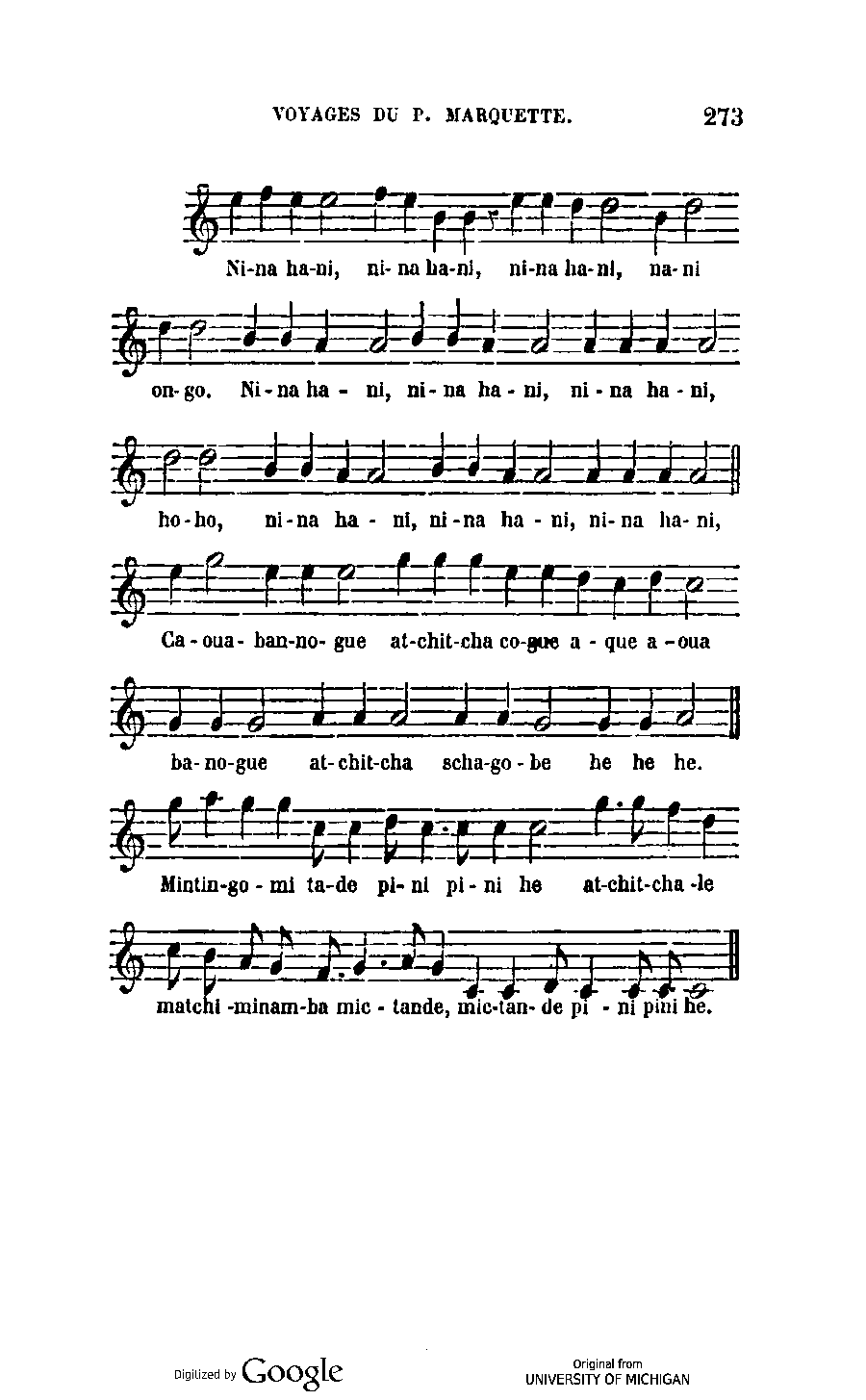
Blair was the assistant editor for the entire Wisconsin edition, and as such she was responsible for much of the compiling, indexing, and footnoting. We can thank Blair for including the calumet songs in the back of Volume 59 of the Wisconsin edition.Footnote 29 Blair found the songs in an 1861 publication of Marquette’s account issued by the Society of Jesus in Paris titled Mission du Canada (Figure 5).Footnote 30 One can see that the songs were copied exactly—the layout and style of the music notation is the same in the 1861 Mission du Canada publication and the Wisconsin edition. Both of these are printed differently from the original printed version from 1722 (compare Figures 3 and 5 to Figures 2a, 2b). The notes themselves are the same, but the appearance on the page is not. Although every previous publication of the songs, including in Mission du Canada, featured them in the main body of the text, Blair placed them in the endnotes of the Wisconsin edition (see Figure 3). Miniaturized to fit on half a page and thus difficult to read, musical notation became an illustration of the idea of music, rather than providing readers with an example to study closely (let alone sing from). Blair subsequently reproduced a facsimile of the three songs in her edited compendium of primary sources entitled The Indian Tribes of the Upper Mississippi Valley and Region of the Great Lakes (1911), where she labeled the three songs as one “Calumet Song.”
Calumet songs in Mission du Canada: Relations inédites de la Nouvelle-France (1672–1679) (Paris, 1861), 273. Public domain. Original at the University of Michigan.

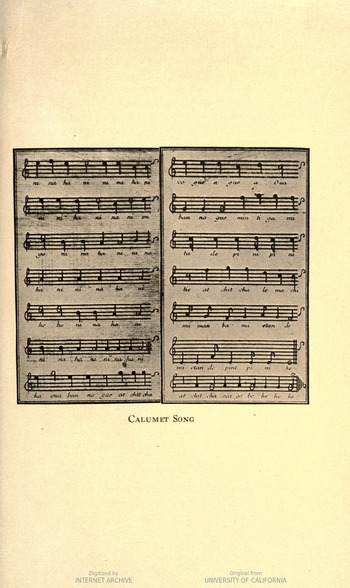
Unlike in the Wisconsin edition, for which Blair used the printed version of the songs that had appeared in Mission du Canada, in The Indian Tribes she returned to the original publication by de la Potherie (Figure 6). Although de la Potherie’s book printed the songs on the recto and verso of a single page, Blair’s book printed the pages side by side. Thus the three songs are visible all at once without requiring a page turn, albeit on a smaller scale than the 1722 original (though they are larger than in the Wisconsin edition). Yet the score appears in a narrative from French explorer Nicolas Perrot, not de la Potherie, even though The Indian Tribes also contains excerpts from de la Potherie. This was intentional: in her notes on the copyedited manuscript for the publication, Blair provided explicit instructions both on where to place the songs and on where to acquire photographic negatives from a copy of de la Potherie.Footnote 31 The songs were thus visually more legible but contextually more obscure.
“Calumet Song,” in Emma Helen Blair, ed., The Indian Tribes of the Upper Mississippi Valley, vol. 1 (Cleveland, 1911). Public domain. Original at the University of California.

Because Blair’s two-volume set was less expensive than the seventy-three-volume Wisconsin edition, owning a copy was more realistic for many people. Blair’s stated goal was to bring out sources that were “almost buried under nearly a century’s dust” and make them known to “the reading public.”Footnote 32 Blair sought to do the lion’s share of the work for her reader, making sources available and verifying that the information was accurate and up to date.Footnote 33 She was abundantly modest, but, when she died, newspapers lauded her contributions to American history.Footnote 34 Blair won honorary degrees from Ripon and the University of Wisconsin, and in 1976 she was featured as “one of the most remarkable women of Wisconsin.” She was credited for her “vigilant accuracy, historical imagination, wide general knowledge, and fine sense of language.”Footnote 35
If Emma Helen Blair exemplifies the diligent historical researcher who laid the groundwork on which historians built, Edna Kenton was the dramatic rule breaker who saw the imagination-stoking potential in primary sources and sought to bring their drama to a wider readership (Figure 7). Kenton shared a Midwestern upbringing and college education with Emma Helen Blair, but their life paths diverged significantly. Born in Springfield, Missouri, Kenton pursued a research and book-publishing career after attending the University of Michigan. Having relocated to Manhattan’s West Village, she immersed herself in overlapping bohemian communities of avant-garde artists, playwrights, radical feminists, and fellow lesbians pursuing ideas of modernity. Kenton thrived in the hotbed of artistic and intellectual dissidence that was early twentieth-century Greenwich Village.Footnote 36 Notably, she fostered long-lasting collaborations with women-only organizations as a charter member of Heterodoxy, a radical women’s group. She cofounded, managed, and wrote plays for the modern theater group the Provincetown Players, and wrote the screenplay for the silent film Bondage (1917) with Universal Pictures.Footnote 37 Kenton rejected social expectations about women’s decorum or dress, eschewing tight-fitting clothes for Japanese-inspired kimonos, which, she argued, were more suitable for active feminist reformers. Describing herself as “stout,” Kenton asserted that “the larger woman doesn’t need a corset any more than the thin woman does … the bliss of having every limb free and untrammeled is one I wouldn’t barter for anything.”Footnote 38
Photograph of Edna Kenton sitting on a roof. Courtesy of Schlesinger Library, Harvard Radcliffe Institute.

Kenton’s polymathic interests led her to the Wisconsin edition, whose sources she saw as gripping narratives that would captivate scholars and general readers. “[T]hese reports—letters, journals, formal Relations or whatever—are travel, exploration and adventure narrations of high dramatic calibre,” she wrote. She praised the Wisconsin edition, but noted that its contents were out of reach for most: “since only 750 sets were published, the Relations of the Jesuits were, for the general reader, as inaccessible as ever.”Footnote 39 Her publication sought to rectify that, and she succeeded in reaching a wider general readership than the prior editions.
Kenton produced a condensed, affordable, and physically manageable version of the Wisconsin edition’s seventy-three volumes in the form of her five hundred-page The Jesuit Relations and Allied Documents: Travels and Explorations of the Jesuit Missionaries in North America (1610–1791), published in 1925. She followed up in 1927 with an expanded two-volume set of excerpts from the Wisconsin edition titled Indians of North America. This required no small amount of work; she privately told her friend W. E. B. Du Bois that she was “working literally from twelve to fifteen hours these days on complicated proof of my two-volume ‘Indians of North America,’ trying, and failing, to keep up with the printer, and with a more complicated cross-reference Index staring me in the face.”Footnote 40 For Kenton, the purpose was primarily to bring what she saw as exciting early American adventures to readers, but she also recognized the materials were “rare source material for the historian, the geographer, the philologist and the ethnologist.”Footnote 41 She lauded the Wisconsin edition for being “a vast storehouse of related data on early American history, the American Indian, and the heroic men who wrote the story,” the term “data” making explicit the connection between the primary sources and academic research.
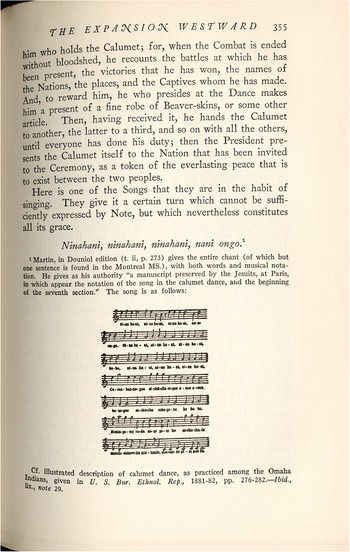
The three calumet songs appear in both of Kenton’s Jesuit source publications, miniaturized, as in the Wisconsin edition.Footnote 42 The songs are more visible in the first book, from 1925, because Kenton used footnotes rather than endnotes (Figure 8). Her 1927 publication used endnotes, which is where the notation appears, awkwardly split across two pages, making it even more complicated for someone to sing if they tried (Figures 9a, 9b). As with the Wisconsin edition, the music represents the idea of songs rather than music that could be realized in a performance.
Calumet songs in Kenton’s compilation, The Jesuit Relations and Allied Documents: Travels and Explorations of the Jesuit Missionaries in North America (1610–1791) (New York, 1925). Courtesy of the University of Pennsylvania Libraries.

(a) and (b) Calumet songs in Kenton’s 1927 compilation, The Indians of North America: From The Jesuit Relations and Allied Documents: Travels and Explorations of the Jesuit Missionaries in New France, 1610–1791, 2 vols. (New York, 1927). Courtesy of the University of Pennsylvania Libraries.

As people and as compilers, Blair and Kenton differed sharply. Kenton’s unconstrained pursuit of liberation, feminist solidarity, and multimodal creative fulfillment contrasts Blair’s life and career path. Blair chose a conventional route for unmarried women: teaching, librarianship, and (less conventionally), higher education and research. She pursued her interests in a man’s world in increasingly professionalized history departments, archives, and historical organizations. She navigated that world by seemingly conforming to the patriarchal expectations facing working women. Thwaites described the team behind the Wisconsin edition as his “young lady assistants,” and we do not know whether Blair pushed back against this patronizing description, grudgingly accepted it, or was unperturbed.Footnote 43 Kenton operated entirely outside academia and often inhabited gender-segregated societies. At the same time, Blair found a place inside, thanks to her position at the Wisconsin State Historical Society, where she immersed herself in the exacting work of collecting, counting, and documenting historical data. Both women faced gendered prohibitions of their time; Blair, particularly, illustrates sidelining of female historians in the period of history’s modern formation as a discipline in academia.
They also differed in their attitudes to the people whose histories they were anthologizing. Kenton played into the trope of the “vanishing Indian,” whereas Blair wrote briefly but compellingly about the current concerns and needs of Native peoples. The first paragraph of Kenton’s 1925 rip-roaring portrayal of the “heroic story of a new country’s colonization” offers the dramatic and untrue statement, “Three hundred years ago America belonged to the Indian; today he is all but vanished, as the ‘lost tribes’ and clans of his race have already gone, leaving behind them no temples, no libraries, no buried cities for record of their past.”Footnote 44 Kenton leveraged this precarity to argue for the significance of the Jesuit Relations for preserving “the folklore, the religion, the mythology, the manners and morals, even the speech and detailed daily living of these vanished people.”Footnote 45 In this way, Kenton aligned with salvage anthropology, a field where women took some of the leadership roles.Footnote 46
None of the publications were issued with any consultation with tribes whose ancestors were Illinois affiliates. Still, Blair acknowledged the current interests and experiences of Native people by including addenda from contemporary scholars and missionaries, including anthropologist Franz Boas and ethnomusicologist and allotment advocate Alice Cunningham Fletcher. She also pointedly argued that her research allowed her to present a more accurate view of Native American history and culture, and thus was able “to place before the reader a more accurate and lifelike view of aboriginal life and character than is usually entertained by readers who know the Indian mainly through newspaper and magazine ‘stories,’ novels, and ‘Wild West shows.’”Footnote 47 Blair the historian cared about the integrity of her work. But Blair also showed a streak of political activism, a chance to speak out against the horrendous treatment of Native Americans. “My work on these volumes will be well repaid if those who read them gain a clearer realization that the Indian is in reality very much the same kind of being that his white brother would have been if put in the red man’s place.” Emphasizing human sameness rather than difference, she called out as “inhuman and brutal” the belief that “there is no good Indian except a dead one.”Footnote 48 If Kenton wanted to introduce readers to the amazing exploits of long ago, Blair wanted to bring moral concerns to her readers’ attention.Footnote 49
Kenton and Blair fed two separating strands of intellectual and cultural history. Blair’s work is part of a lineage of academic research that is situated in themes of justice for Native peoples while following rigorous academic standards. Yet like other educated white women in the Progressive Era, she benefited from state and national laws and policies that dispossessed Native people of their traditional knowledge, cultural expressions, and land, even as she lamented them. Kenton’s work can be seen as feeding into a vein of popular representations of Native American history and culture in which white men are the main actors and caricatured Native peoples are acted upon. Both women were doing innovative work in their time: Blair by systematically creating primary-source anthologies that spoke to modern concerns, Kenton by processing the historical sources through a bohemian intellectual understanding of US modernity in which Native Americans had no present role.Footnote 50
A belief in the need to disseminate information, stories, evidence, and data was at the heart of each anthology in the early twentieth century. Songs were framed as yet another piece of cultural evidence that should be generally available. Yet while the narrative sources were clearly meant to educate, inspire research, and entertain, the purpose of the music was obscure. No guidance was given for how to analyze or interpret the songs as meaningful evidence. The silent, inscrutable musical scores circulated amidst surging interest in representing Native Americans in popular culture. There the songs were far from silent: they were sung and danced, treated not as historical evidence but as gendered playthings for white American boys and men.
Pipedreams and playthings: calumet music and Indian lore in popular culture
Scholarship and popular culture met in 1893 Chicago, which hosted both the American Historical Association and the World’s Fair. In that year Frederick Jackson Turner presented his paper, “The Significance of the Frontier in American History,” at the conference for the American Historical Association. Famously, he proposed that the American frontier was an ever-expanding westward boundary that attracted enterprising white settler families with the economic incentive to cultivate vast, supposedly empty wilderness. Turner’s idea of the frontier coincided with a trend in American musical composition and poetry toward romanticized representations of the West and Native peoples.Footnote 51 Historians attending Turner’s talk also visited the World’s Fair and Buffalo Bill’s Wild West Show, seeing living (quasi-)anthropological and commercial versions of the people whose histories some of them were writing about in the past tense. At the World’s Fair, visitors could see calumet pipes displayed in Minnesota’s exhibit space alongside hatchets and pipestones.Footnote 52 The calumets represented a supposedly bygone era and people. The Wild West Show offered a contrasting vision: robust, virile, allegedly authentic, and, most of all, entertaining skits and tricks in which cowboys and Indians inhabited a thrilling present.Footnote 53 Completing the picture of the US past and present was the fairground’s spatial layout, in which the US future as a technologically advanced, westward-driven imperialist nation was contrasted with nearby “primitive” cultures.
In this context, the calumet became an especially durable symbol of Indianness. The popularization of the calumet, often colloquially referred to as “the peace pipe,” coincided with the electrification of multimedia entertainment, the diversification of commercial formats, the expansion of US imperialism, and the attendant increase in the representation of nonwhite peoples in all manner of vernacular culture.Footnote 54 The three calumet songs appeared in various nonacademic publications throughout the twentieth century, targeting diverse audiences from children’s literature to cartoons, trade circulars, and newspapers. The varied audiences and implied uses of these songs in popular culture show how the songs were often exploited to perpetuate romanticized and inaccurate portrayals of Native American practices. This was done for white entertainment, particularly with amateur reenactment in redface, while falsely relegating the songs—and Native peoples—to the past. More broadly, Native American songs were conscripted into a new form of educational entertainment that, under the guise of legitimate scholarship, socialized new generations into the US’s imperialist racialized regime of power. Under this regime, domination through impersonation was framed as an innocent, fun, and even patriotic activity that aided children’s educational, moral, and personal growth. “Indians” were not the miscreants of dime novels but people whose cultures and traditions were beneficial for “civilized” white Americans to study, then appropriate.Footnote 55
The appropriation of cultural heritage occurred alongside the systematic erasure of Native American cultures through assimilation policies, especially forced boarding-school attendance. These institutions stripped Native children of their language and culture, including by the prohibition of tribal songs. The unconscionable treatment of children at boarding schools is well known today. Forced family separation, not to mention abuse and deaths, wrought horrifying intergenerational consequences. Without rehearsing the litany of traumas, we acknowledge the revolting irony that white children were encouraged to blithely sing and dance to the calumet songs while their Native peers were physically and psychologically punished for the smallest expressions of their cultural identities.Footnote 56 Native children were literally silenced while white children performed their songs.
White children were effectively enlisted into the social reproduction of imperialism through scouting and the consumption of how-to Indian-lore literature.Footnote 57 The rise of national scouting organizations resulted in the commercialization of camping for youths, symbolically positing that all children developed from an inherently savage to a civilized state.Footnote 58 Along with playing soldier, playing Indian was how white American children came of age. Camps created pretend Native American villages, imagining that white children would learn intuitively through immersion in so-called Native culture and wisdom. The figure of the Indian was thus lauded in a way that other “Others” were not. The murderous racial play-acting scouts enjoyed when they pretended to be cowboys and Indians was thrilling, different from the denigrating racist and xenophobic humor that attended caricatures from slave plantations or newly arrived immigrants onstage.Footnote 59
In a 1925 issue of Boys’ Life, the official magazine of the Boy Scouts of America, the calumet songs appeared in a column by the long-time editor and Scouts leader, Dan Beard. In “Dan Beard Tells You How,” readers found instructions for constructing a canoe and performing the “real Calumet dance,” provided in response to requests Beard claimed came from scouts “over and over again.” The visual setting of the music is a culturally heterogeneous confusion: the notation is taken from the de la Potherie publication, and the syllables are swapped out for a medley of patriotic pablum, all surrounded by symbols of the scouts and stylized faux-Plains illustrations (a buffalo, a horse, a teepee, a figure with a calumet, and so on) (Figure 10). Male dancers in silhouette decorate the bottom of the song insert, hunched and in motion, one with a rattle, one raising a calumet pipe, all raising their knees high. Beard encouraged boys, “Remember, this is the real, genuine calumet tune, so when you dance it don’t forget to bring your knees up high as if you were going upstairs and bring your nose down until it is in danger of being hit by your knees—that will give the real Indian touch to it.”Footnote 60 This invitation to play Indian assumed that young boys could rely on a wellspring of stereotypical ideas about Native performance, transforming the calumet from a sacred symbol into a collectible badge of white honor.Footnote 61
Calumet songs in Dan Beard, “Dan Beard Tells You How,” Boys’ Life 15/4 (1925), 14, 36, at 14. Public domain.

Many white boys grew up to be men who still enjoyed playing Indian, and how-to guides also gave Boy Scouts and businessmen step-by-step instructions for replicating “Indian ways.” Under the umbrellas of Indian lore and woodcraft, the volume of writings like “Dan Beard Tells You How,” but aimed at both adults and children, swelled between the 1890s and the 1950s.Footnote 62 Authored primarily by white men and white couples who had lived among tribes and studied with anthropologists at institutions like the Natural History Museum in New York City, these guides brought bohemian intellectual culture into the middle-class mainstream in the form of publications and lectures on “Indian lore.” Authors often engaged in redface performances as well, at once stereotyping Native Americans while citing direct experience and others’ academic work to authenticate their performances.Footnote 63
Julian Harris Salomon (1896–1987) was pivotal in promoting an idealized approach to the American outdoors that appropriated Native American cultures for white consumption. At his career’s peak, he was a highly sought-after camp designer, architect, ethnologist, consultant, and scouting executive with the American Camping Association. He shaped scouting culture for generations and even created the blueprint for Camp David, the retreat used by US presidents.Footnote 64 Salomon collaborated with scouting masters Ernest Thompson Seton and Dan Beard, who used his and other published sources to create the social movement that was scouting.Footnote 65 But first, he was a Boy Scout in Brooklyn starting in 1910 and an Eagle Scout in 1913. He served in the army during World War I. Following a visit to the Blackfoot Reservation in the early 1920s, Salomon published a book detailing how to incorporate Native American traditions into white classrooms and scouting programs.Footnote 66 Salomon claimed that the declining Blackfoot chief, Curley Bear, implored him to preserve his culture for future generations of white children. Regardless of the likelihood that a tribal leader would be concerned about white children in particular, Salomon addressed that young audience in his resulting book.Footnote 67
Salomon’s book condenses diverse Native American cultures into an easily digestible form that could be taken up by youth and adult scouting aficionados. Although The Book of Indian Crafts and Lore does not include the notated songs featured in this article, it demonstrates how the idea of disseminating calumet and other tribal songs through printed music notation took hold in mainstream culture. The chapter on “Dance Steps and Music” includes thirty-five songs and instrumental pieces in music notation.Footnote 68 Salomon explained how to perform some of the “easy” dance steps and included both a discography and a list of Indian-themed instrumental music, noting, “The latter will be found helpful in large pageants, where a band or orchestra is used to create atmosphere, or to supplement Indian instruments and singing.”Footnote 69 The Book of Indian Crafts and Lore was meant to be the starting point for consumers who wanted to pursue their Indianist interests further through sound recordings, musical scores, and their own re-creations. The Book of Indian Crafts and Lore secured Salomon’s place on an active lecture and workshop circuit internationally and on radio and television, helping to disseminate Native American songs and dances further. In those appearances, he would perform for large audiences, “donning part of his notable collection of Indian costumes” and going by the names “Apota” (“the Firemaker”) or “Soaring Eagle.” He made portions of the calumet ceremony a regular part of his show (Figure 11).Footnote 70
Poster for Julian Harris Salomon lecture, 1923. Redpath Chautauqua Collection, Special Collections, University of Iowa Libraries.

Amid the proliferation of “Indian lore” literature and how-to guides by white authors in the early twentieth century, a significant counternarrative began to emerge from prominent Native American intellectuals and writers. These individuals were often educated and trained within white institutions, colleges, and boarding schools, giving them a critical vantage point on the prevailing, often romanticized or inaccurate, portrayals of their cultures. Witnessing this trend, they began to publish their own books, which garnered considerable acclaim and aimed to offer more authoritative perspectives. Among these influential figures were Charles A. Eastman (Ohiyesa), a Dakota physician, whose works included Indian Scout Talks: A Guide for Boy Scouts and Camp Fire Girls (1914), and Arthur Caswell Parker, a Seneca historian and archaeologist, who published The Indian How Book (1927). While these Native authors sought to correct misrepresentations and assert their authority on matters of their own heritage, their position and output were inherently complex. In the process of making Native American customs accessible, particularly to younger, non-Native audiences, their work sometimes involved the simplification of intricate cultural expressions like music and dances.
There was a complex give-and-take between Native and white writers, who each used the other for credentialization. In an effort to legitimize their cultural studies within the dominant academic frameworks of the time, Parker and Eastman cited or built upon the work of white scholars, navigating a fine line as they tried to be more authoritative while also making compromises inherent in cross-cultural representation and commercial publication. Francis La Flesche, Omaha ethnologist and specialist in Omaha and Osage cultures, collaborated on research with Alice Cunningham Fletcher under the auspices of the Smithsonian’s Bureau of American Ethnology. Salomon, in turn, cited Fletcher and La Flesche in his own work. Ernest Thompson Seton, cofounder of Boy Scouts, also cited Fletcher and La Flesche in his The Gospel of the Redman: An Indian Bible (coauthored with his wife Julia). White Indian loreists also sought legitimization from other white academics and institutions. Salomon thanked the academic repositories that supported his research and provided primary sources and illustrations, including the American Museum of Natural History, the Smithsonian Institution, and the Bureau of American Ethnology.Footnote 71 Even Dan Beard, in Boys’ Life, provides a primary-source citation. He mistakenly attributed the songs to the wrong seventeenth-century French source, citing Nicolas Perrot instead of Jacques Marquette. Perrot, however, is the explorer into whose narrative Emma Helen Blair inserted the calumet songs in her 1911 publication; it is likely that Beard consulted Blair’s work on The Jesuit Relations. These authors’ use of citation serves to highlight how important they thought authenticity was to their manifold projects of publication, recirculation, and appropriation.
As the songs appeared in more publications, not only could more people access the music, but citation reinforced the idea that songs were citable primary sources—and that citation was important. Thus we find citations in what may seem like unlikely places. A 1921 weekly edition of Chicago Commerce, published by the Chicago Association of Commerce and Industry, credited Jacques Marquette when including the lyrics as part of a Chicago Festival Play detailing the city’s history up to the Great Fire of 1871.Footnote 72 Citational practice reflected changing politics. The monthly newspaper Indian Trader, published by Native journalists in La Mesa, California and Billings, Montana, wrote about the songs in a June 1971 article called “The Calumet.” The article, which does not include the notated music, interprets the Jesuit sources as confirming a narrative of Native cultural continuity, claiming that “eighteenth-century writings note that long before the arrival of the white man, the calumet was a significant and respected part of the daily lives of the American Indian.” Rather than place the authority in the Jesuit sources, the article explains the history and use of calumets along with a detailed description of ceremonies, dances, or “ballets,” calling on examples from Jesuit writings but denoting, point by point, elements deemed “mysterious” by the missionaries.Footnote 73 Claiming the authority to explain the meaning of these frequently reproduced sources speaks both to the significance of access to the songs and to the mutability of the uses to which access is put.
The paradox of access
What does all this access bring? The three songs’ reconfiguration from ritual practices to printed historical artifacts and, eventually, to tools of cultural appropriation highlights the complexities and ethical challenges inherent in studying and representing Indigenous peoples’ cultures. Reexamining the intellectual history of Native American music through the previously uncredited role of figures like Emma Blair and Edna Kenton in circulating calumet songs offers critical new perspectives on the labor that provides access to sources. Their contributions underscore a broader pattern: the marginalization of women’s work in this field at the turn of the twentieth century, which has typically only acknowledged ethnographers such as Alice Fletcher, Frances Densmore, and Natalie Curtis. Furthermore, women exerted a substantial, yet little-known, impact on the popularization of Native music itself. This influence was often obscured, partly because the visible phenomenon of “playing Indian” belonged predominantly to men and boys within organizations like the Woodcraft Indians and the Boy Scouts of America. Bringing to light the specific efforts of Blair and Kenton thus not only corrects the historical record but also significantly expands and enriches understanding of a foundational era in music scholarship. Indeed, such detailed explorations of overlooked individuals are vital for interdisciplinary approaches, offering crucial case studies that challenge established narratives and deepen the comprehension of cultural history in academic inquiry.
The increasing accessibility of primary sources through the intellectual labor of women like Emma Helen Blair and Edna Kenton had unintended consequences. Their work facilitated the appropriation and misrepresentation of Native American culture. As historians, anthropologists, and ethnomusicologists adopted academic research methods, methods that included careful citation, the three notated songs were reproduced at will and silently shifted to the public domain.Footnote 74 Moreover, for all that the songs were part of a tremendous effort in the early twentieth century to make primary sources more available, the songs’ appearance in printed compendiums fed the myth of the vanishing Indian.Footnote 75 At the same time, as they came to belong to white children and be used for white education and entertainment, they were expropriated from Native American holders of traditional knowledge. In their published forms, the songs came to be seen as freely available for mass use, part of the stream of derivative vernacular entertainment flooding the United States stages, pages, and screens. Such treatment of the songs re-creates the logic of “white possessiveness” that Indigenous and cultural-studies scholar Aileen Moreton-Robinson dissects in the context of Australia.Footnote 76 The idea that white people can and do rationalize owning everything, from land to books to songs, undergirded the treatment of these songs. Thus claimed, they were exploited to reproduce whiteness and white authority.
The songs continue to circulate in scholarship.Footnote 77 They can be found by scanning notated music in Google Books and HathiTrust. They made it through the digital turn in American history. Throughout the second half of the twentieth century, they were absorbed into state history textbooks in Illinois and now are on the official Illinois State History website.Footnote 78 The website attributes the songs to Jacques Marquette and provides a footnote to the Wisconsin edition. The notation is paired with a brief cultural history of Peoria and Illinois, along with small book icons (Figure 12).Footnote 79 This digital realization of the score clearly aims to make the notated music more accessible (particularly to those who are not music-literate). Like prior attempts at making the sources accessible, the result further alienates the songs from their ceremonial context. The digital signals plod through the melody and wordlessly turn the vocal songs into instrumental pieces. It is digitally deracinated and decontextualized, the opposite of redface, but still a misrepresentation.
Screenshot of the Calumet songs on the Illinois State History website.

We acknowledge that this article also recirculates the songs. We did so to establish that notated music sources, created in the context of colonial intercultural encounters and perhaps without the knowledge or permission of tribes, were disseminated widely, and that once published and reprinted as primary sources in the twentieth century, the songs were absorbed into academic scholarship. The transfer of the songs between academic and popular publications not only shows the porousness of the boundaries between those domains. It also shows how printed music notation possessed widespread visual appeal that had little to do with its aural attributes and ceremonial meanings. As a technology, printed music notation allowed for the excerptability of the songs. A question to conclude with, then, is how to cultivate a respectful approach to access that neither essentializes nor overlooks the communities who have devised, performed, and transmitted these songs and could continue to do so.Footnote 80
Access is not unequivocally good. As archivists, librarians, and scholars now argue, when it comes to Indigenous materials that have often been acquired through coercive or unsanctioned means, providing unfettered viewing and listening can betray tribal interests and protocols.Footnote 81 Increasingly in the twentieth and twenty-first centuries, the presumed universal good of freely circulating information is called into question, its underpinnings in liberalism at odds with Indigenous social values that emphasize relationality and reciprocity. Discussions about access now consider Native communities first and foremost; outsider scholars and the general public’s access are not the primary interest.Footnote 82 Relatedly, recent work calls for repatriation as an ethical and moral next step for materials that were collected by early ethnographers, including photography and sound recordings.Footnote 83 This process is always complex. In the case of the three songs considered here, transcribed hundreds of years ago and severed from their home community, there is no clear path for repatriation or even a consensus on to whom they rightfully belong. Ideally, these and other notated musical sources can help present-day tribes identify and reunite with historical songs from which they were violently severed.





 Open access

