


Introduction
Classic Maya governance in the Southern Maya Lowlands was heavily based on institutions and relationships surrounding divine kingship, a system characterised by paramount rulers and their hierarchical relations with other political officials and the wider populace. The materiality of such hegemonic rule manifested through stone monuments of sacred kings (the k’uhul ajaw), the construction of and performance within spatially restricted palaces and the internment of ruling individuals in elaborate tombs in temple-pyramids. It is these material manifestations that are heavily imprinted in contemporary public imaginings of the ancient Maya. Yet Maya peoples engaged with diverse and varied strategies and forms of governance over the longue durée, as was also the case for many of their neighbours in other regions of Mesoamerica and elsewhere (Carballo Reference Carballo2012; Feinman Reference Feinman2018).
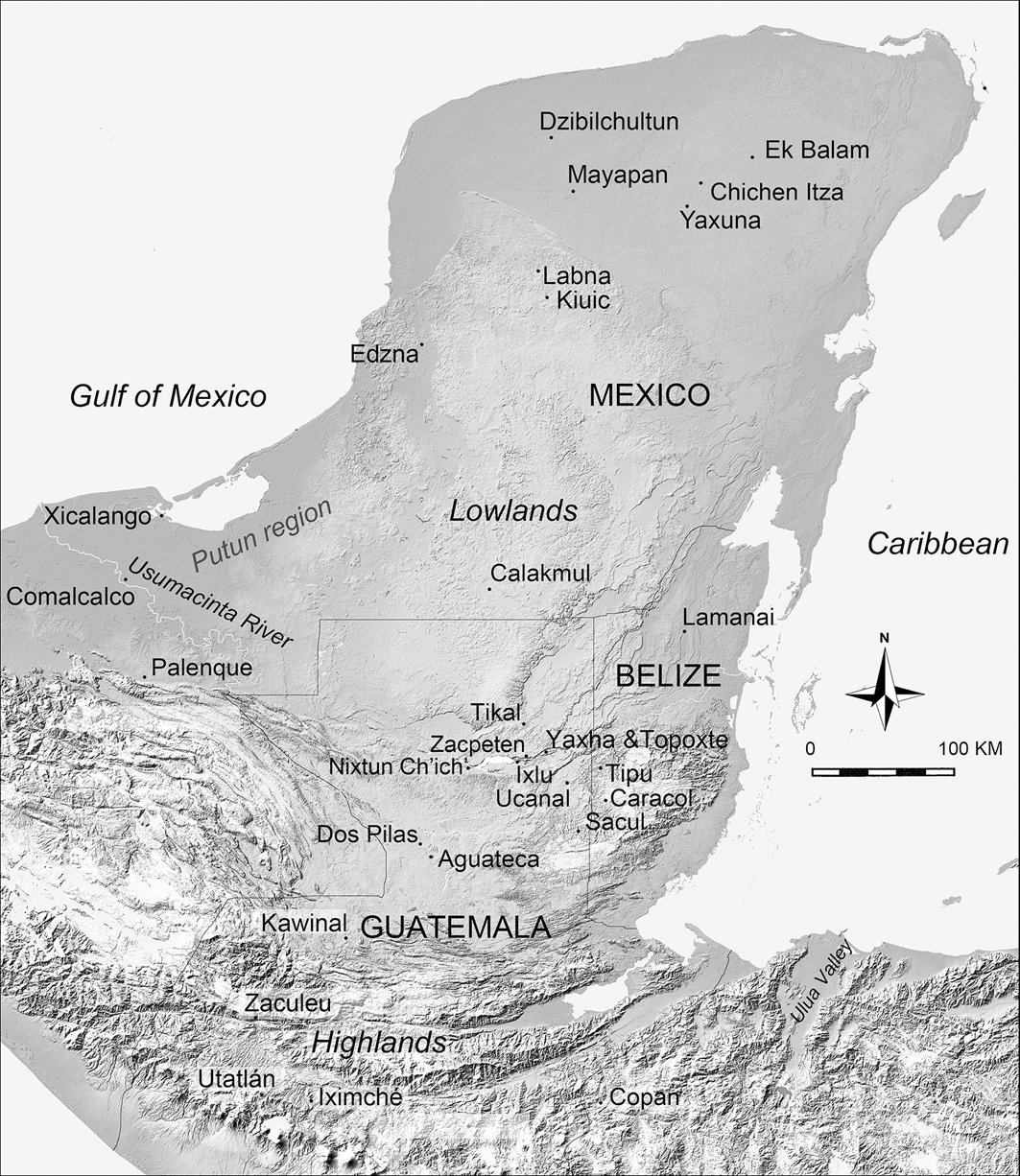
This article presents Terminal Classic (c. AD 810–950/1000) architectural evidence from the Maya city of Ucanal, Peten, Guatemala, for changes in political responsibilities and relationships, wherein more emphasis appears to have been placed on collaborative, consensus-based governance while still maintaining forms of kingship (Figure 1). Such shifts were early antecedents in the region of what would become more pervasive aspects of Maya governmentality throughout the Postclassic (c. AD 1000–1521) and early Colonial (sixteenth–seventeenth centuries) periods (Masson et al. Reference Masson, Schartz and Nichols2006; Rice et al. Reference Rice2018; Rice & Rice Reference Rice and Rice2018; Okoshi et al. Reference Okoshi2021). Excavations of Ucanal Structure K-1 in 2024 by the Proyecto Arqueológico Ucanal (PAU) uncovered a civic-ceremonial building in the form of a colonnaded open hall. This building form may have been present earlier in other regions, particularly the Northern Maya Lowlands (Bey III & May Ciau Reference Bey, May Ciau and Braswell2014; Becquelin & Michelet Reference Becquelin and Michelet2021).
Map of the Maya area showing selected sites mentioned in the text (figure by C. Halperin).

Figure 1 Long description
The map displays the Maya area, highlighting selected sites mentioned in the text. Key locations include Dzibilchultun, Ek Balam, Chichen Itza, Yaxuna, Labna, Kiuic, Edzna, Mayapan, Calakmul, Lamanai, Tikal, Zacpeten, Yaxha, Topoxte, Tipu, Caracol, Sacul, Ixlu, Ucanal, Aguateca, Dos Pilas, Kawinal, Zaculeu, Utatlan, Iximche, and Copan. The map also shows the Gulf of Mexico, the Caribbean, the Usumacinta River, and the Highlands and Lowlands regions. The map is oriented with a compass rose indicating north and a scale bar showing 100 kilometers.
We suggest that Ucanal Structure K-1 may have been a council house (popol nah in Yucatec and other Maya languages; popol pat in Pokoman Maya). Ethnohistoric documents reveal that council houses were regular features within sixteenth-century Maya political centres where the ruling ajaw and other lineage heads assembled to deliberate on political accords, discuss war, adjudicate crimes, feast and prepare for weddings and dances (Miles Reference Miles1957: 768, 773; de Avendaño y Loyola Reference de Avendaño y Loyola1987: 34; Fash et al. Reference Fash1992: 434; Wagner Reference Wagner and Colas2000: tab. 1; Christenson Reference Christenson2022: 166–67). Open halls were part of a levelling of political relations; their spatial configurations promoted both horizontal interactions among lineage heads, diplomates, warriors and other authority figures, and high visibility from public plazas. While such visibility undoubtedly enabled the theatrical spectacle of politics, we highlight the important element of participatory politics, in which the public participated as witnesses in the negotiations, meetings and resolutions of their polities.
Structuring structures
Public buildings, as is the case for other forms of architecture, are not passive reflections of culture, but are enmeshed in a reciprocal relationship between spatial order and social behaviours, political dispositions and ideologies (Lefebvre Reference Lefebvre1991; Low Reference Low2000). As Winston Churchill noted: “We shape our buildings and they shape us” (Hall Reference Hall1966: 106). In other words, they not only have the potential to serve as symbolic ideals and physical seats for the institutions of governments but are also ‘participants’ in how relationships of power are enacted and experienced by more than just those holding political titles of authority. Thus, public buildings (and any landscape configurations) are as much the constituting features of the political order as they are constituted of it (Ashmore Reference Ashmore2002; Smith Reference Smith2003; Kosiba et al. Reference Kosiba2020).
In drawing on the spatiality of governance, many archaeologists have been influenced by the work of Michel Foucault (Reference Foucault1977) in examining the ways in which spatial configurations of architecture were part and parcel of the making of political orders. Hierarchical viewsheds and systems of enclosures, for example, facilitated policing, self-surveillance and embodied political dispositions that reproduced ‘docile bodies’ in the modern era. Archaeologists have found that similar political-spatial dispositions may have been present earlier, among colonial slave plantations in the locations and viewsheds of buildings (Delle Reference Delle1999; Singleton Reference Singleton2001; Wilson Marshall Reference Wilson Marshall2022) and in the strategic positioning of military outposts in ancient imperial contexts (Friedman Reference Friedman2010; Marsh & Schreiber Reference Marsh and Schreiber2015).
Drawing on Foucault’s concept of discipline in more ancient societies, Inomata (Reference Inomata and Ruiz2001, Reference Inomata2006a) has argued that Classic Maya kingship was enacted as a theatrical spectacle with the aid of palace architecture and public plaza-building configurations. These spatial orders not only crystalised a tangible experience of community, they also placed rulers physically and metaphorically at the top of hierarchical relationships, facilitating a visibility that reiterated their supreme political, social and cosmological position in embodied spatial terms (see also Mongelluzzo Reference Mongelluzzo2011; Barrientos Reference Barrientos and Okoshi2021). In both ancient and contemporary political orders, physical structures help structure political dispositions, an aspect of governmentality (also known as the ‘conduct of conduct’) whereby power is distributed and experienced widely throughout the landscape (Foucault et al. Reference Foucault1991: 48, 87–104). However, not all Maya public buildings were a part of this apical ordering of a singular divine king (or queen) and their subordinates.
Ucanal and the making of a new Terminal Classic political order
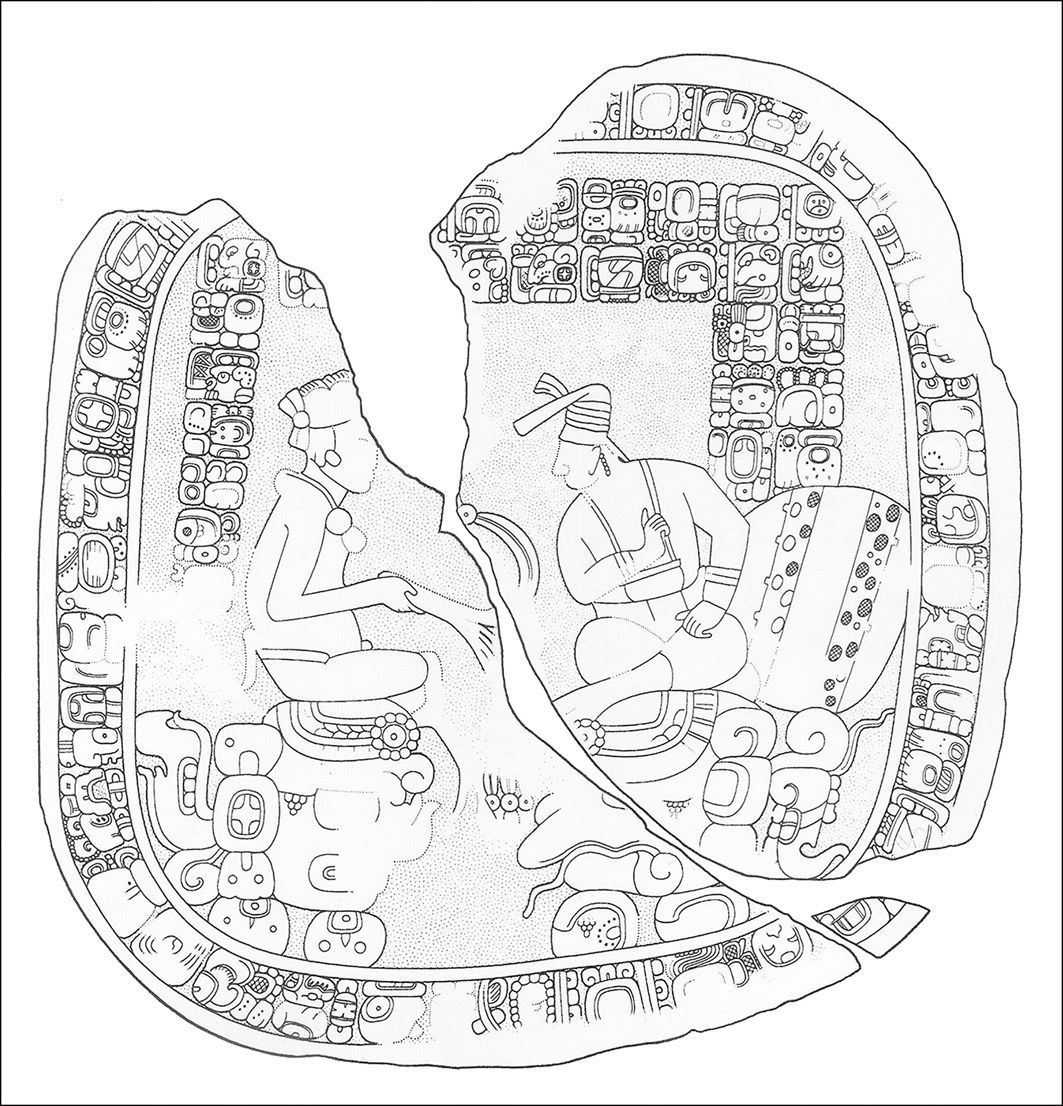
The site of Ucanal, the capital of the K’anwitznal polity, is located in the Southern Maya Lowlands in Peten, Guatemala. Although it was a prominent political capital during the Late Classic period (c. AD 600–810) (Laporte & Mejía Reference Laporte and Mejía2002; Carter et al. Reference Carter2023), epigraphic data and recent archaeological findings suggest that Ucanal experienced a significant political rupture in the early ninth century, at the dawning of the Terminal Classic period, which was followed by a political and urban fluorescence. This pivot point in the politics of the site emerged with a fire event that involved the burning and destruction of human remains and jade and marine-shell ornaments from a Late Classic royal tomb and the deposition of this material in the construction of a new rebuilding of temple-pyramid K-2 in Plaza K—in an act that seemed to reject or destroy aspects of traditional dynastic rule at the site (Halperin et al. Reference Halperin2024). This event coincided with the emergence of a new leader, Papmalil (or Papamalil), a name foreign in origin, perhaps deriving from peoples along the Gulf Coast relating to the Putun or Chontal Maya (Martin Reference Martin2020: 290, 295–96). Papmalil ruled not with a royal title incorporating the K’anwitznal emblem glyph but as an ochk’in kaloomte’, a high title used by powerful overlords (Martin Reference Martin2020: 259–60, 290; Grube Reference Grube and Okoshi2021: 41–42). In the only known representations of him from monuments at Caracol, he is depicted side-by-side with other rulers in a horizontal rather than hierarchical spatial ordering despite being the more dominant figure (Figure 2) (Martin Reference Martin2020: 260).
Caracol Altar 12 depicting Papmalil of K’anwitznal (left) seated facing Caracol ruler, K’inich Toobil Yopaat (right), AD 820 (drawing by N. Grube).

Figure 2 Long description
The drawing of Caracol Altar 12 shows two seated figures facing each other. The figure on the left is identified as Papmalil of Kanwitznal, and the figure on the right is Caracol ruler Kinich Toobil Yopaat. Both figures are adorned with elaborate headdresses and attire. Surrounding the figures are intricate glyphs and symbols, which are likely part of a historical or ceremonial inscription. The scene is set against a detailed background that includes additional glyphs and decorative elements.
Papmalil’s reign and the reign of those that came afterwards ushered in a renaissance at Ucanal. This flurry of activity included new public building constructions, such as a large ‘T’-shaped ballcourt and circular and semi-circular shrine buildings, as well as water infrastructure projects that benefitted, in particular, non-elite residents living in the lower topographic zones of the site (Laporte & Mejía Reference Laporte and Mejía2002; Halperin et al. Reference Halperin2019; Halperin Reference Halperin2020). In turn, non-elite and middle-status residences gained increasing access to imported goods (Halperin et al. Reference Halperin2020; LeMoine & Halperin Reference LeMoine and Halperin2021; LeMoine et al. Reference LeMoine2022), and architectural distinctions between elite and non-elite residences were reduced (Halperin & Garrido Reference Halperin and Garrido2019).
Ucanal Structure K-1
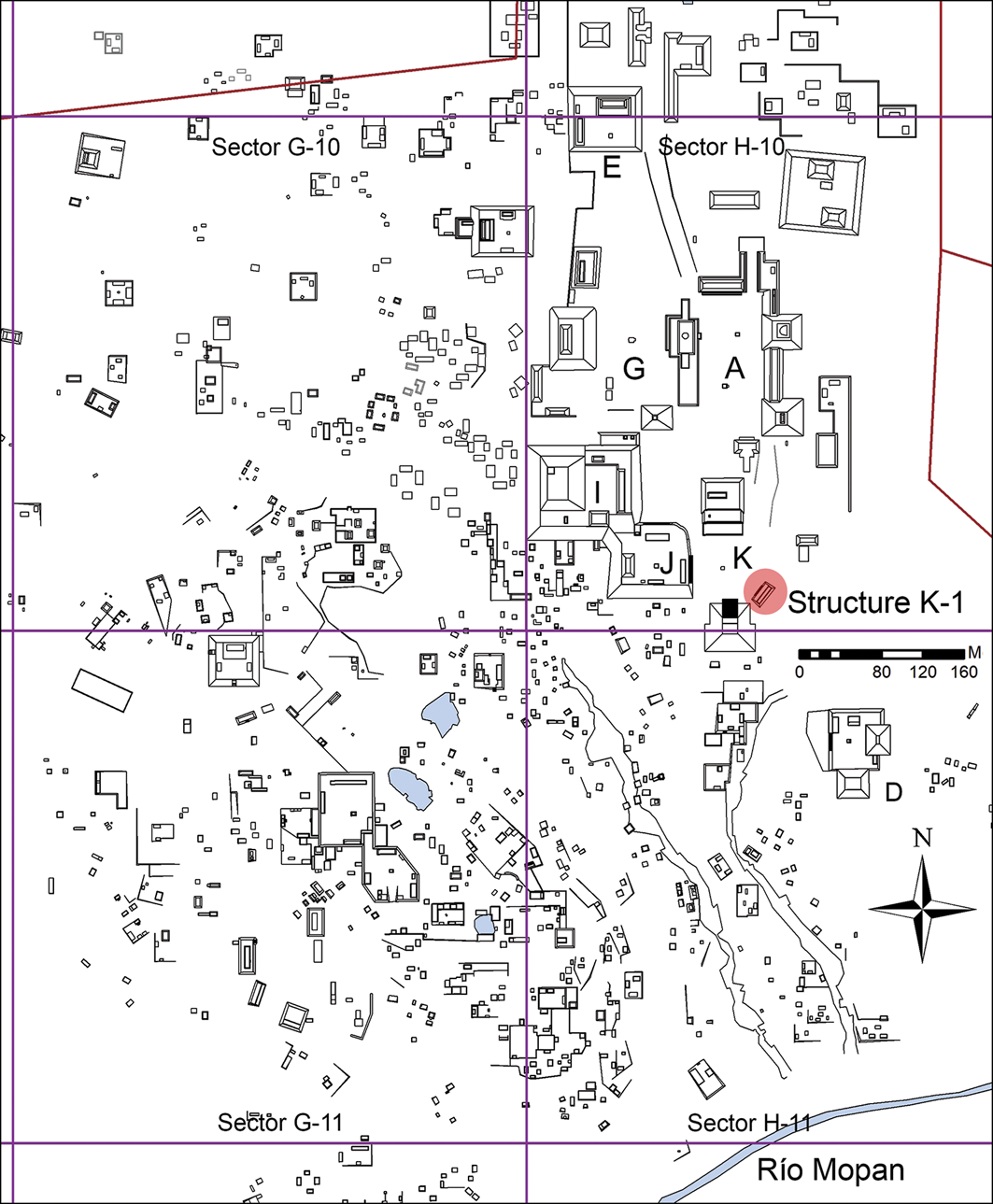
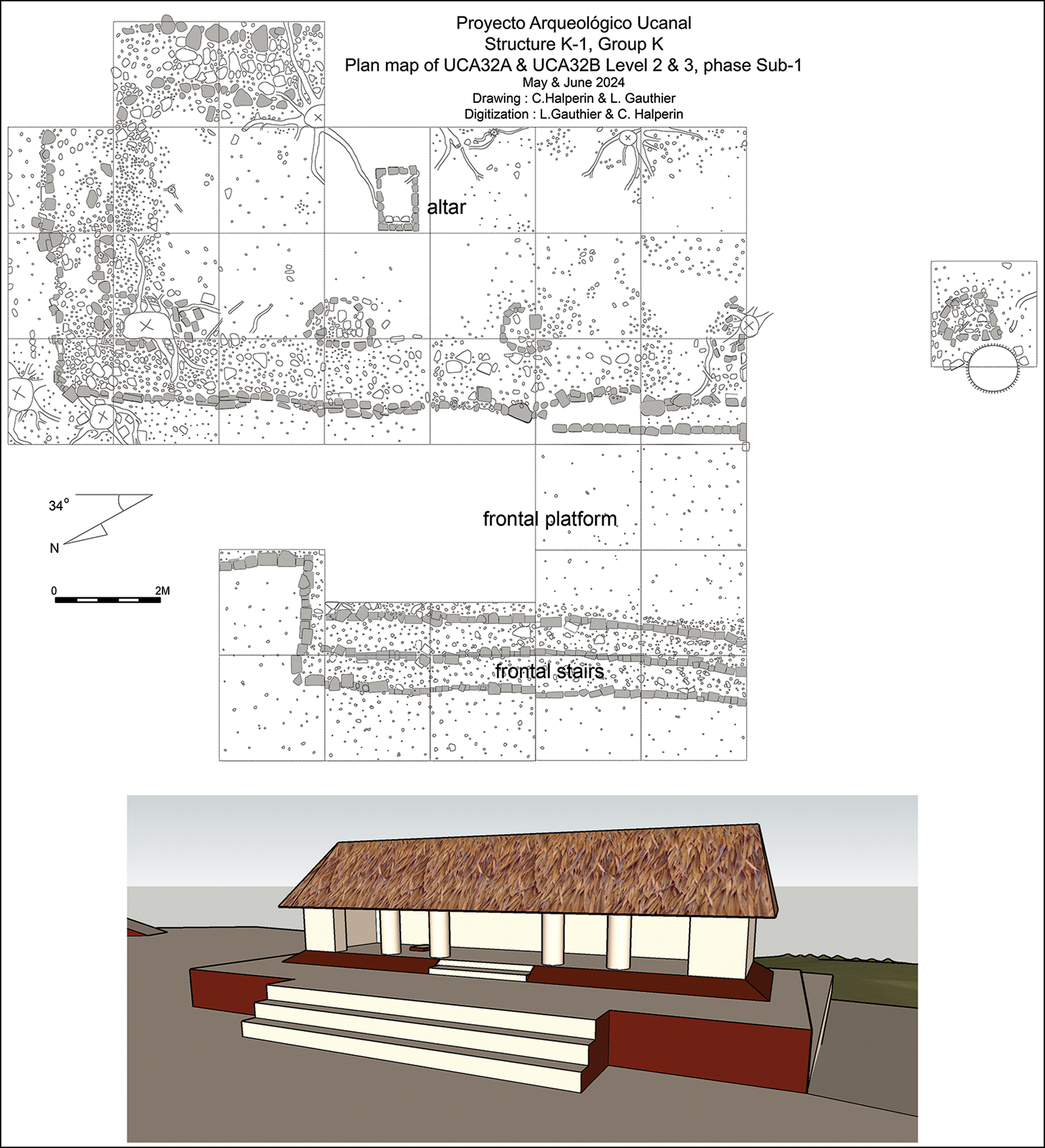
Another public building that was constructed during the Terminal Classic period was Structure K-1 (Figure 3). This building, a colonnaded open hall, is located on the eastern side of a large public plaza, Plaza K. It was built in two phases (Sub-1 and Sub-2), both during the Terminal Classic period, although the columned bases are clearly evident only for the second phase (Sub-1) (Figure 4) (Halperin & Gauthier Reference Halperin, Gauthier, Halperin and Ramos2025). The dating of both phases is based on ceramic analysis as well as a radiocarbon date from the fill of Sub-1 (cal AD 783–880, 1210±20 BP at 95.4% probability using OxCal v.4.4, UOC-26377, UCA32A-18-4-4368). Ceramic typology indicates that the fire-burning event and renovation of temple-pyramid Structure K-2 was slightly earlier than Structure K-1 (Sub-1 and Sub-2).
Plan of the site core of Ucanal showing the location of Structure K-1 at the south-east corner of Plaza K (figure by the Proyecto Arqueológico Ucanal).

Figure 3 Long description
The map displays the site core of Ucanal, highlighting the location of Structure K-1 at the south-east corner of Plaza K. The map is divided into various sectors labeled with letters and numbers, such as Sector G-10, Sector H-10, Sector G-11, and Sector H-11. Key areas and structures are marked, including Plaza K and the Rio Mopan. The map includes a scale in meters and a compass rose indicating the cardinal directions. Various buildings and pathways are depicted, providing a detailed layout of the archaeological site.
Plan of excavations of the Terminal Classic Ucanal Structure K-1, Sub-1, and a 3D sketchup reconstruction of the structure (plan by L. Gauthier & C. Halperin; reconstruction by M. Voltaire).

Figure 4 Long description
The image presents a detailed plan map of UCA32A and UCA32B Level 2 and 3, phase Sub-1, from the archaeological site of Ucanal. The map includes various labeled sections such as the altar, frontal platform, and frontal stairs. The layout is divided into multiple grids, each showing different features and artifacts. The map also includes a scale bar indicating measurements in meters and a compass rose showing the orientation. Additionally, there is a 3D sketchup reconstruction of the structure, providing a visual representation of how the building might have looked. The drawing is credited to C. Halperin and L. Gauthier, with digitization by L. Gauthier and C. Halperin.
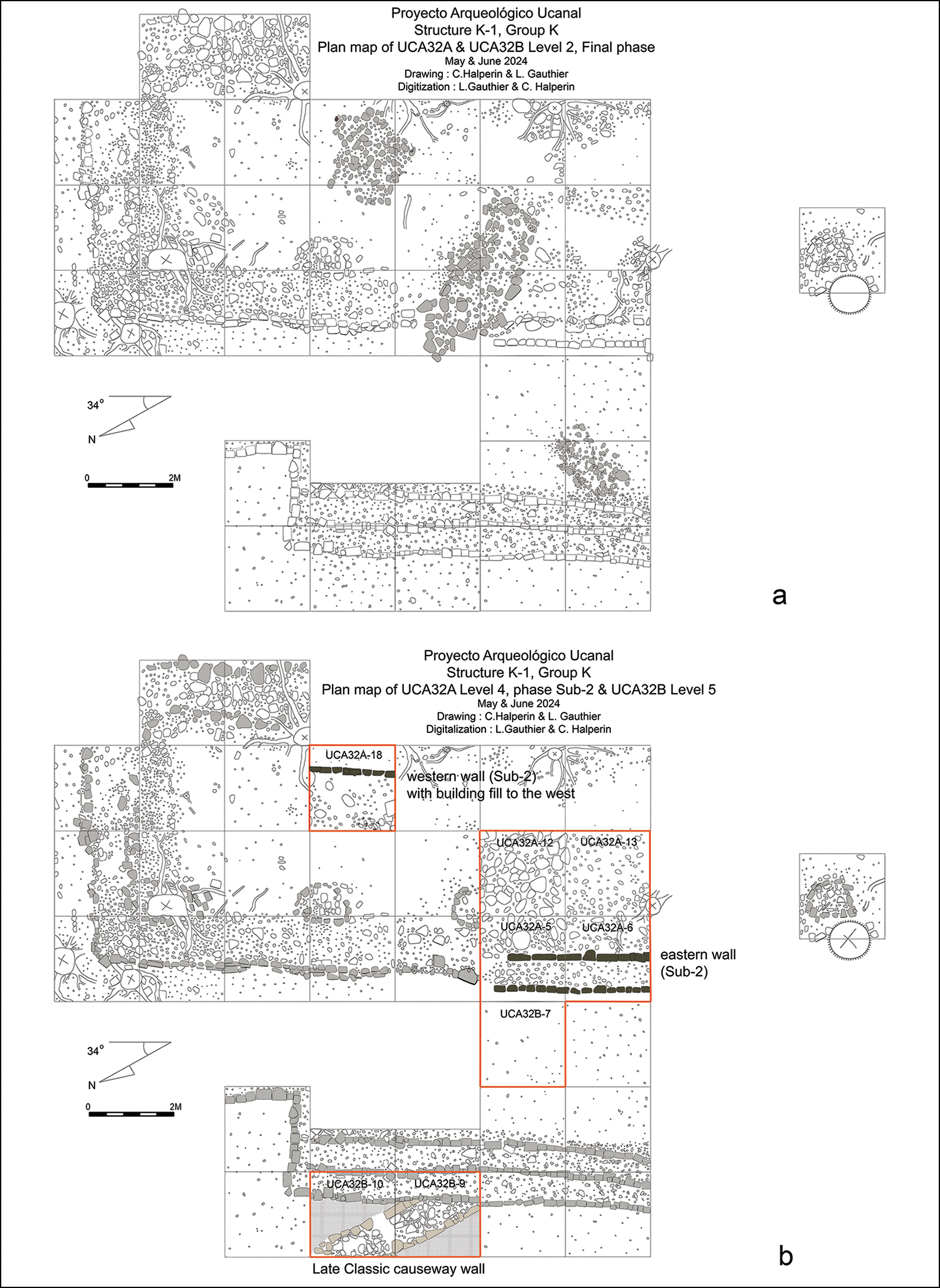
The building orientation of Structure K-1, at 33–34° east of north, differs from architectural alignments in the underlying stratigraphy and from other public buildings throughout the site, which are oriented toward the cardinal directions. Beneath the open hall are the remains of a Late Classic causeway wall and floor features (Sub-3) oriented toward the cardinal directions (Figure 5). These cardinal orientations were returned to in the Postclassic period when three haphazardly built, east–west aligned platforms were constructed on top of the open hall (Structure K-1, Final).
Architectural features before and after the colonnaded open-hall form of Structure K-1 (Sub-1): a) Postclassic period final phase construction of three platforms; b) Late Classic causeway wall and Terminal Classic Sub-2 phase, western and eastern superstructure walls in vertical excavations are highlighted in orange (figure by C. Halperin & L. Gauthier).

Figure 5 Long description
The diagram presents two phases of architectural development of Structure K-1 in Ucanal, Guatemala. The first phase (a) illustrates the Postclassic period final phase construction of three platforms. The second phase (b) highlights the Late Classic causeway wall and the Terminal Classic Sub-2 phase, with western and eastern superstructure walls emphasized in orange. The diagram includes labels for specific architectural features and shows the evolution of the structure over time.
The columned bases of Sub-1 were comprised of a low platform (perhaps no more than 0.25m in their original height) of small, neatly worked cut stones (0.15–0.20m in length) that served as the base for wooden or wooden and stuccoed columns approximately 0.80m in diameter. Since they were located near the ground surface, and as later Postclassic period activities were undertaken on the building, all the columned bases were highly disturbed by tree roots and subsequent use of the building. Nevertheless, a total of four columned bases that made the interior of the building visible to the public plaza could be discerned. This open configuration of the façade contrasts with a Terminal Classic temple on the summit of Ucanal Structure A-7, which possessed two circular columns flanking a more restricted entrance 3.5m wide (Perea Reference Perea, Halperin and Ramos Herandez2025). A small rectangular altar was also found inside Structure K-1, off-centre from the central building axis and preserved under later Postclassic construction. Early Postclassic incense burners were left on top of the altar before buried by rocks (Halperin & Gauthier Reference Halperin, Gauthier, Halperin and Ramos2025; Salas et al. Reference Salas, Halperin and Ramos2025). No evidence of masonry benches was identified, and the walls of the building were likely to have been made of perishable materials, with the base foundation and floor suggesting that the front of the building was open to the plaza below. Likewise, the building possessed a large upper frontal platform accessed by broad stairs that may have also been a stage for activities just in front of the colonnaded superstructure. Due to these features, we argue that it may have served as a popol nah or council house.
Council houses in the Maya area
Several scholars have argued that council houses date back to at least the Late Classic period, with most examples from northern Yucatan (Arnauld Reference Arnauld and Ciudad Ruiz2001; Gallegos Gómora Reference Gallegos Gómora2003; Nondédéo & Lacadena Gárcia-Gallo Reference Nondédéo and Lacadena Gárcia-Gallo2004; Bey III & May Ciau Reference Bey, May Ciau and Braswell2014; Becquelin & Michelet Reference Becquelin and Michelet2021) (Table S1). Political systems in northern Yucatan placed less emphases on the cult of divine kingship—both during the Classic period and afterwards, with fewer sites possessing stela monuments dedicated to named rulers and fewer elaborate tombs of supreme leaders buried within temple-pyramid complexes. Bey III and May Ciau (Reference Bey, May Ciau and Braswell2014) argue that in the Puuc region of northern Yucatan, popol nah were first constructed during the Late Classic period (c. AD 550–750), before the construction of large palace complexes. They suggest that these popol nahs, comprising long rectangular structures with thick masonry walls, became less important or integrated into palace compounds at the end of the Classic period (AD 750–950) coincident with the arrival of k’alomte’ rulers (overlords) from the Southern Maya Lowlands and the centralisation of kingly rule. Collective-ruling governments of segmentary polities then resumed during the Postclassic period, constructing open halls without interior room divisions.
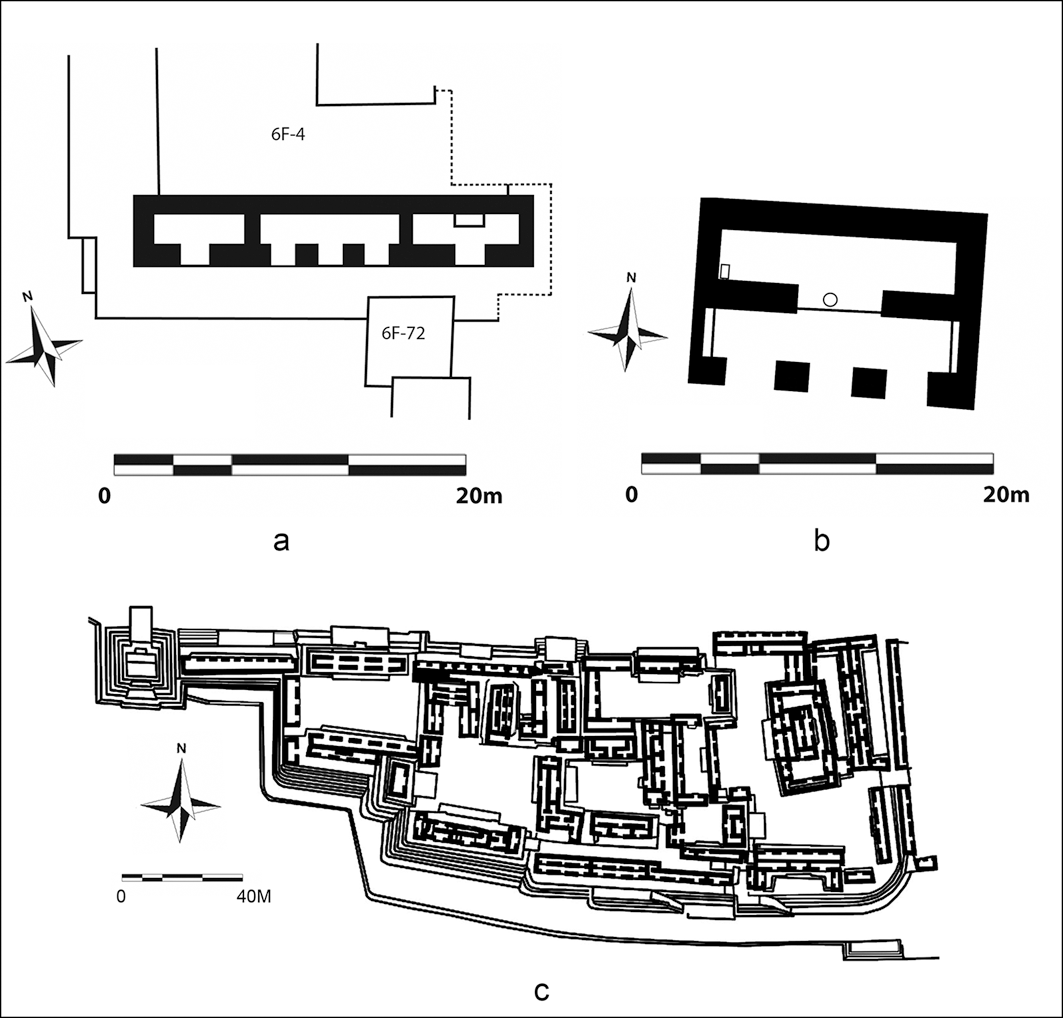
Some purported popol nah in the Maya area are strikingly different from Ucanal Structure K-1 in that interior spaces were small and segmented with stone walls, impeding horizontal-level interactions (Figure 6). For example, the Late Classic Structure 10L-22A (Figure 6b), built c. AD 750 under the reign of the fourteenth ruler of Copan, was identified primarily by its pop (mat or knot design related to the seat of political authority) mosaics and stone glyphs that may have represented satellite political units in the Copan kingdom (Fash et al. Reference Fash1992; although see Stuart & Houston Reference Stuart and Houston1994: 72; Wagner Reference Wagner and Colas2000 for alternative interpretations). Similarly, archaeologists have argued that the Terminal Classic Yaxuna Structure 6F-68 from northern Yucatan also served as a council house due to its pop mosaic façade decorations and its long rectangular form (Figure 6a) (Ambrosino Reference Ambrosino2007: 39, 104–106). In both cases, their segmented and hierarchical internal spatial configurations were not conducive to facilitating neither the assembly of several leaders at once nor horizontal communication. Likewise, a rectangular Late Classic building from Comalcalco (Structure 4) is argued to have been a popol nah based on the pop designs on its façade and four seated sculpted figures at its base (Gallegos Gómora Reference Gallegos Gómora2003). This building does not, however, possess a colonnaded front nor does it open out to a large public plaza.
Late Classic masonry architecture with stone walls and roofs: a) Yaxuna Structure 6F-68 (drawing by L. Gauthier after Ambrosino Reference Ambrosino2007: fig. 3–8); b) Copan Structure 22A (drawing by L. Gauthier after Fash et al. Reference Fash1992: fig. 13); c) palace architecture, Central Acropolis, Tikal (drawing by C. Halperin after Harrison Reference Harrison and Christie2003: fig. 4.2).

Figure 6 Long description
The image contains three architectural diagrams labeled a, b, and c. Diagram a shows Yaxuna Structure 6F-68, featuring a rectangular building with multiple internal divisions and a surrounding corridor. Diagram b depicts Copan Structure 22A, a rectangular building with a central courtyard, multiple rooms, and an open area. Diagram c illustrates the palace architecture of the Central Acropolis at Tikal, a complex layout with numerous interconnected rooms, corridors, and courtyards. Each diagram includes a scale bar indicating 20 meters and a compass rose for orientation. The diagrams highlight the architectural styles and layouts of these structures during the Late Classic period.
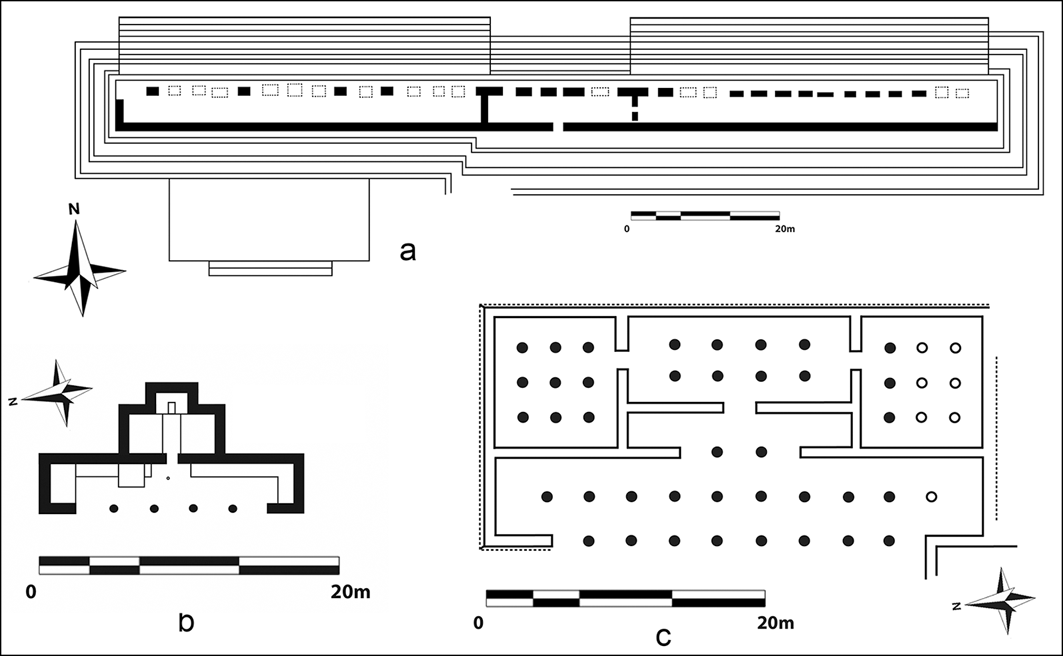
In contrast, Ucanal Structure K-1 shares more features with the column-fronted public buildings labelled as open halls, and with the long masonry civic buildings with multiple doorways and single interior rooms also argued to have been council houses (Ruppert Reference Ruppert1952; Proskouriakoff Reference Proskouriakoff and Pollock1962; Cheek Reference Cheek2003; Bey III & May Ciau Reference Bey, May Ciau and Braswell2014). Differences in size are, however, apparent, with some Late Classic and Terminal Classic examples (‘super popol nahs’; Bey III & May Ciau Reference Bey, May Ciau and Braswell2014) longer than 50m (see Late Classic Copan Structure 10L-223 (phase D), Late to Terminal Classic Ek Balam GT-2, Dzibilchaltun Structure 44 (Figure 7a), Ek Balam Nohochna Structure 424). While the largest of these structures (110–130m long) may have made monumental statements about horizontality, they may have been too large for effective communication and consensus-building across their enormous interior space. The Late and Terminal Classic open halls from the Puuc region of northern Yucatan and elsewhere were also often constructed with thick masonry walls and roofs, similar to the gallery-like long structures that were attached to palaces or Acropolis complexes in Late Classic Southern Maya Lowlands sites (e.g. Aguateca’s M7-26; palace from Palenque see discussion in Arnauld Reference Arnauld and Ciudad Ruiz2001: 368–76). Due to their thick masonry walls, the visibility of interior activities from adjacent plazas was arguably limited.
Terminal Classic architecture from the Northern Lowlands: a) Dzibilchaltun Structure 44, a ‘super popol nah’ constructed with a masonry roof and wall (drawing by L. Gauthier after Arnauld Reference Arnauld and Okoshi2021: fig. 8.5c); b) Chichen Itza Structure 3E3 with sweatbath (drawing by L. Gauthier after Ruppert Reference Ruppert1952: fig. 50); c) Chichen Itza Structure 3D7 (drawing by L. Gauthier after Ruppert Reference Ruppert1952: fig. 41).

Figure 7 Long description
The diagram presents three architectural structures from the Terminal Classic period in the Northern Lowlands. The first structure, labeled 'a', is Dzibilchaltun Structure 44, a super popol nah with a masonry roof and wall. The second structure, labeled 'b', is Chichen Itza Structure 3E3, which includes a sweatbath. The third structure, labeled 'c', is Chichen Itza Structure 3D7. Each structure is depicted with detailed floor plans and orientations, including compass directions and scale measurements.
Maya builders incorporated new architectural features over time, allowing for more open façades and thus, possible inter-visibility between building interiors and public plaza space below. Terminal Classic to Early Postclassic colonnaded halls at some Puuc sites (Labna Structure 7) and at Chichen Itza were built with stone column drums (approximately 0.50–0.70m diameter rather than 1–2m diameter columns or pillars) with beam and mortar roofs (Ruppert Reference Ruppert1935, Reference Ruppert1952; Bey III & May Ciau Reference Bey, May Ciau and Braswell2014) (Figure 7b & c). These architectural features continued to be used in the Postclassic period in the Northern Maya Lowlands at Mayapan. At Chichen Itza, colonnaded buildings have such diverse forms (e.g., colonnaded rooms with square plans or colonnaded multiroom galleries) that they likely possessed varied functions and meanings.
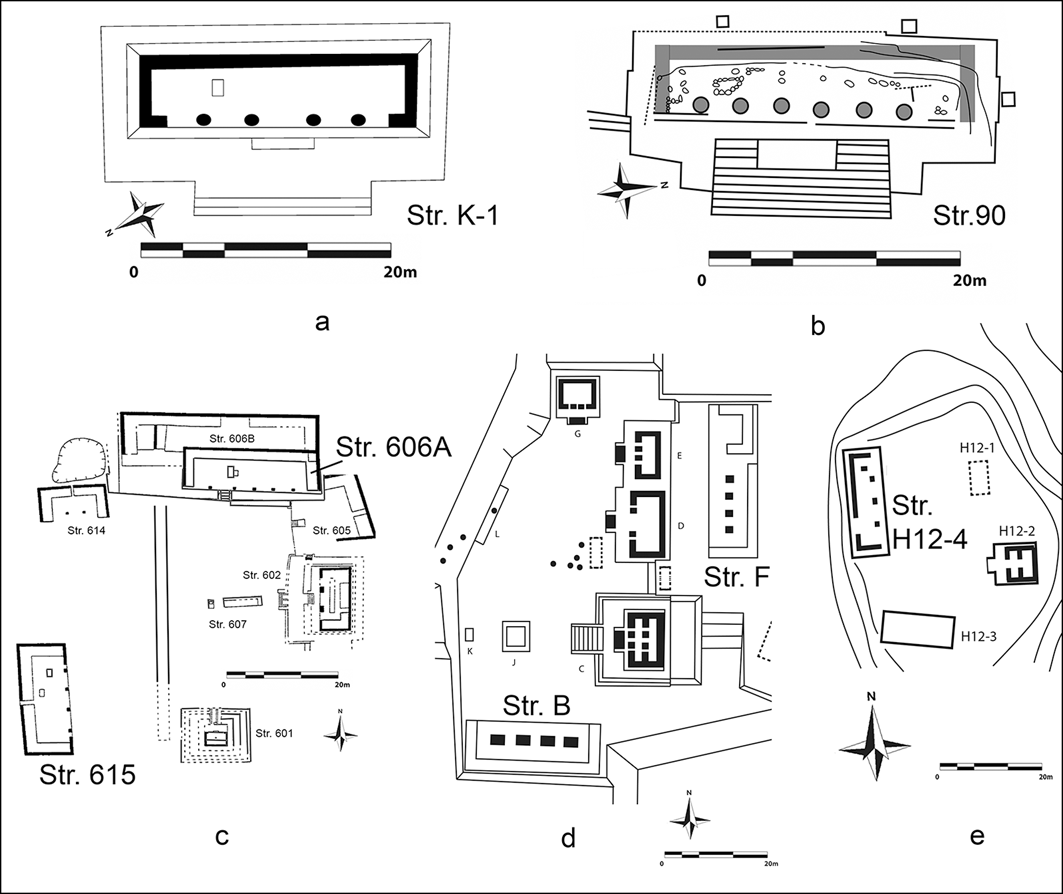
In addition, Maya builders in Peten in the Maya Lowlands and in various regions of the Highlands began to build colonnaded open halls with wooden (or stucco and wooden) columns and walls that sat on masonry bases (between 0.20 and 0.60m high), which also may have allowed for more open façades. Of these, Ucanal Structure K-1 and Structure 90 from Yaxha (Hermes & Źrałka Reference Hermes, Źrałka, Źrałka and Koszkul2012) were among the earliest, dating to the Terminal Classic period (Figure 8). These buildings faced public plazas and were located perpendicular to shrines or temples in what Proskouriakoff (Reference Proskouriakoff and Pollock1962) referred to as ‘basic ceremonial groups’ or ‘temple assemblages’. As with the Terminal Classic open halls from Ucanal and Yaxha, Postclassic versions in the Central Maya Lowlands also possessed low altars set off-centre from the central axis of the building, as if part of the same architectural template (Figure 8c & e). In contrast, Postclassic versions from both the Highlands and Northern Lowlands tended to place their shrines or altars along the central axis at the back wall of the building.
Colonnaded open halls from the Central Maya Lowlands: a) reconstruction of Terminal Classic Ucanal Structure K-1 based on excavations (drawing by C. Halperin); b) Terminal Classic Yaxha Structure 90 (grey perishable wall added; drawing by L. Gauthier after Hermes & Źrałka Reference Hermes, Źrałka, Źrałka and Koszkul2012: fig. 10); c) Postclassic Structures 606A and 615 in Zacpeten Group A (drawing by L. Gauthier after Pugh & Shiratori Reference Pugh, Shiratori, Rice and Rice2018: fig. 12.13); d) Postclassic Structures B and F, Topoxté (drawing by L. Gauthier after Bullard Reference Bullard and Bullard1970: fig. 3); e) Postclassic Structure H12-4, Tipu (drawing by L. Gauthier after Graham Reference Graham and Thomas1991: fig. 15-1).

Figure 8 Long description
The diagram presents the architectural layouts of several Maya structures from different periods and locations in the Central Maya Lowlands. It includes five sub-diagrams labeled a to e. Sub-diagram a shows the reconstruction of Terminal Classic Ucanal Structure K-1, featuring a colonnaded open hall. Sub-diagram b depicts Terminal Classic Yaxha Structure 90 with an added grey perishable wall. Sub-diagram c illustrates Postclassic Structures 606A and 615 in Zacpeten Group A. Sub-diagram d displays Postclassic Structures B and F at Topoxt. Sub-diagram e shows Postclassic Structure H12-4 at Tipu. Each sub-diagram includes detailed layouts of the structures, with labels indicating specific features and measurements.
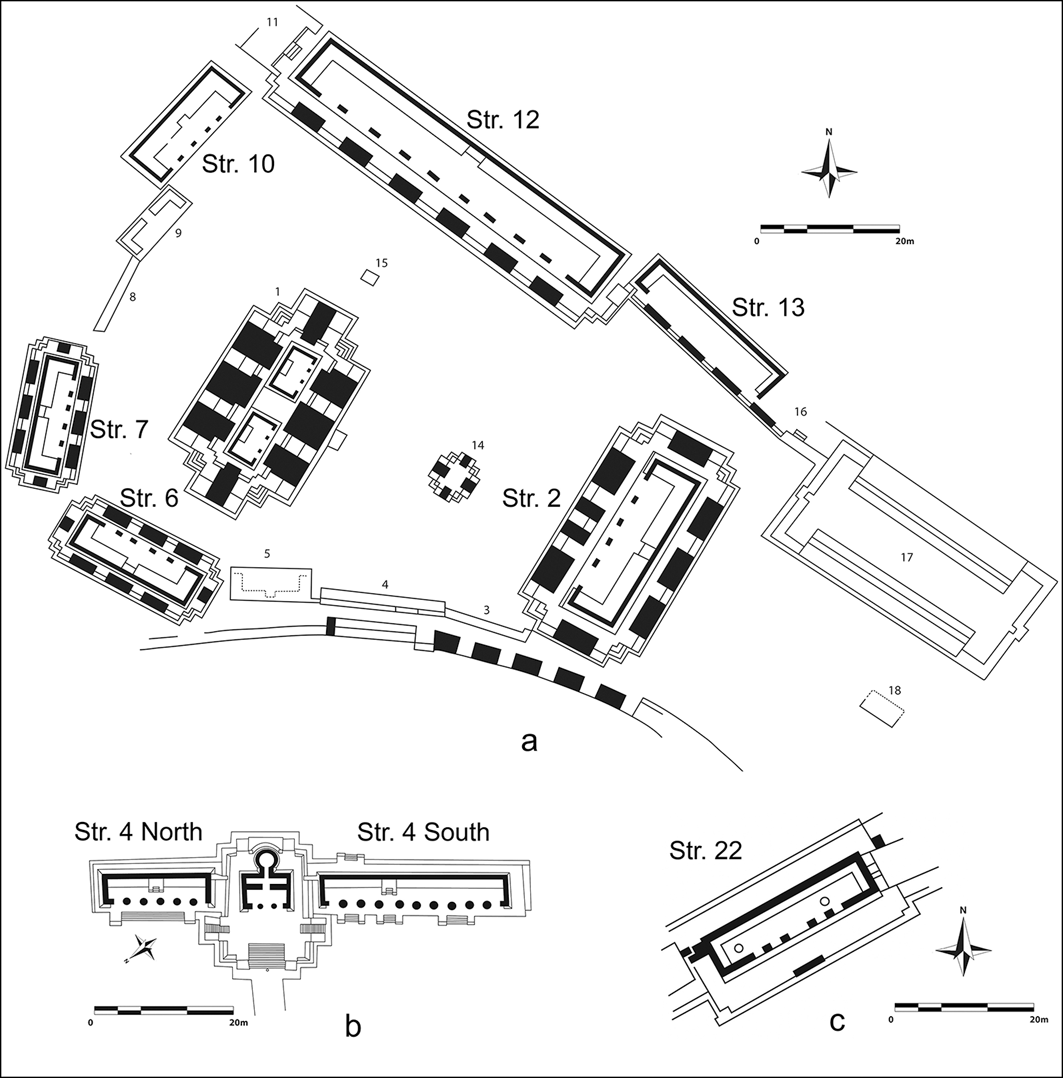
For the Postclassic Maya Highlands, scholars argue that the best candidates for council houses were colonnaded open halls that were between 20 and 35m long, had four to five columns and faced public plazas (Ichon et al. Reference Ichon1980: 24–39, 192; Arnauld Reference Arnauld and Breton1993; van Akkeren Reference van Akkeren and Laporte2006). These features share much in common with Ucanal Structure K-1 (Figure 9; Table S1). In contrast, the larger, colonnaded halls (usually with 8+ columns; e.g. A-12 from Kawinal) from Postclassic Highland sites may have served as nimja (large houses) with mixed administrative and residential uses (van Akkeron Reference van Akkeren and Laporte2006) or military functions (Arnauld Reference Arnauld and Breton1993). As at Mayapan (Proskouriakoff Reference Proskouriakoff and Pollock1962; Masson et al. Reference Masson2014), large Postclassic Highland centres had multiple monumental residential complexes, often of similar sizes, rather than an apical ordering of a single large palace or Acropolis complex that towered over all other residential complexes, as was common in many Classic period Southern Maya Lowland sites (Figure 6c).
Postclassic colonnaded open halls in the Guatemalan Highlands: a) Structures 2, 6, 7 and 10 as possible popol nah buildings (administrative, public) and Structures 12 and 13 as possible nimja (residential and administrative ‘big houses’), Kawinal, Group A (drawing by L. Gauthier after Ichon et al. Reference Ichon1980: fig. 5); b) Structure 4 North and South, Zaculeu (drawing by L. Gauthier after Trik Reference Trik, Woodbury and Trik1953: fig. 7); c) Structure 22, Iximché (drawing by L. Gauthier after Guillemin Reference Guillemin1967: 28).

Figure 9 Long description
The diagram illustrates various structures in the Guatemalan Highlands, including Structures 2, 6, 7, and 10 as possible popol nah buildings, and Structures 12 and 13 as possible nimja. It also shows Structure 4 North and South at Zaculeu, and Structure 22 at Iximche. The diagram includes detailed layouts and orientations of these structures, with labels indicating their respective locations and functions.
Discussion
Ucanal Structure K-1, and other colonnaded open halls, reveal the emergence of new public building forms starting as early as the Terminal Classic period in the Southern Lowlands. The designs of these public buildings may have drawn inspiration from earlier open halls in the Northern Lowlands. They became more widespread outside this region starting in the Terminal Classic and, by the Postclassic period, were common throughout the Maya Highlands and Lowlands. These colonnaded open halls were ‘structuring structures’ in that they conditioned how people interacted with each other, helping facilitate the assembly of multiple leaders in more heterarchical arrangements of consensus-making, diplomacy, conflict resolution and exchange. While consensus-making and collaborative engagements were undoubtedly part of politicking during earlier periods, the highly segmented building arrangements of the Classic period (Figure 6), typified by thick masonry, vaulted stone roofs and small interior spaces, were not conducive to such proxemics in political interactions.
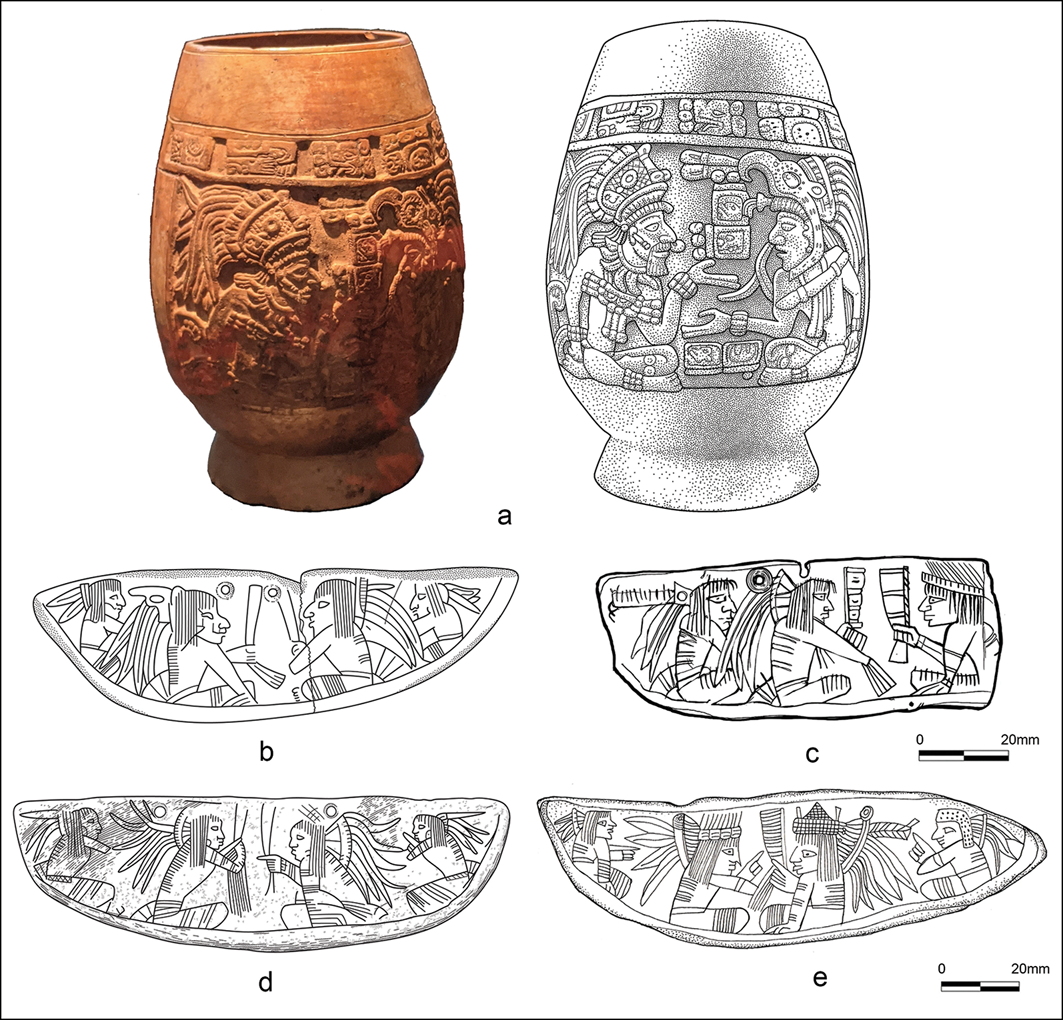
The new Terminal Classic public buildings were, however, only part of the shifting political dispositions occurring during this time. As other scholars have noted (Rice and Rice Reference Rice and Rice2018; Arnauld Reference Arnauld and Okoshi2021; Chase & Chase Reference Chase, Chase and Okoshi2021), figures seated or standing side-by-side, facing each other and of similar relative proportions emerge as a new trope in narrative scenes during the Terminal Classic period (Figures 2 & 10). Many are argued to represent conference scenes or the meeting of dignitaries. Such engagements on seemingly equal footing contrast starkly with previous iconographic tropes in which the k’uhul ajaw was often higher, to the right of and larger than all others in the narrative scene. In addition to stone monuments, such as the depiction of Papmalil from Ucanal (Figure 2), such scenes are also found in other iconographic media, including Fine Orange Molded-carved vases (LeMoine et al. Reference LeMoine2022) and incised lunate-shaped marine shell pendants (Harrison-Buck & Pugh Reference Harrison-Buck and Pugh2020: 511; Carter & Lukach Reference Carter and Lukach2023) (Figure 10).
Terminal Classic period ‘conference scenes’: a) Pabellon moulded-carved vase, Uaxactun, Burial A41 (photograph by C. Halperin; drawing by S. Martin); b) Uaxactun (East Plaza Group A) (drawing by N. Carter; Carter & Lukach Reference Carter and Lukach2023: fig. 2b); c) Vista Alegre, Yucatan (drawing by M. Dumitrescu; Glover & Rissolo Reference Glover, Rissolo and Stanton2023: fig. 20.10); d) Lumholtz, Valley of Mexico (drawing by N. Carter; Carter & Lukach Reference Carter and Lukach2023: fig. 2d); e) San Lorenzo, Belize (Op.243MM/2Pl.J2300#51) (drawing by C. Halperin after Yaeger Reference Yaeger2000: fig. 7.6).

Figure 10 Long description
The image showcases various Maya artifacts and detailed drawings from the Terminal Classic period. The central artifact is a Pabellon moulded-carved vase from Uaxactun, Burial A41, photographed by C. Halperin and drawn by S. Martin. Surrounding this are drawings of different scenes: one from Uaxactun's East Plaza Group A, drawn by N. Carter; another from Vista Alegre, Yucatan, drawn by M. Dumitrescu; a scene from Lumholtz in the Valley of Mexico, also drawn by N. Carter; and a final scene from San Lorenzo, Belize, drawn by C. Halperin after Yaeger. These drawings depict conference scenes and rituals, illustrating the governance and social structures of the Maya civilization during this period.
What is missing from these Terminal Classic ‘conference’ scenes is a sense of the larger public beyond the upper echelons of leadership: the lower-level dignitaries, non-elites, females who wielded power and connected social groups, merchants, craft specialists and farmers, among others who, nonetheless, may have been implicated in deal-making, judicial rulings, diplomatic visits and decisions to go to war. The plaza spaces connected to council houses suggest that these different social groups were a part of these events, participating in these political mechanisations, at the very least, as witnesses and spectators (Voltaire et al. Reference Voltaire2025). As in the Late Classic period (Inomata Reference Inomata and Ruiz2001, Reference Inomata2006a), political consensus involving the general populace was also likely obtained through public theatrical spectacles during later periods. This consensus was forged, in part, through the experiences of awe (engagements with the sacred and sublime), fear (performances with war captives, violent punishments, sacrifices) and remembering (the recounting of history and myth-history) and the embodiment of social status in the hierarchical ordering of space (Inomata Reference Inomata, Inomata and Coben2006b). Foucault’s (Reference Foucault1977) analysis of Early Modern (pre-nineteenth century) spectacles of corporal punishment on public scaffolds in Europe reminds us that the emotive experiences of public witnessing were ways of ensuring moral and political consent. Witnessing, however, was not necessarily passive, as spectators could choose not to attend and protests could form when the crowds did not agree with the punishments (Foucault Reference Foucault1977: 65). It is likely that ancient Maya crowds were not passive either.
For much of the Classic period, political spectacles took place within the context of enclosed and internally segmented palaces in addition to public plazas. The presence of these exclusive and hierarchically arranged palaces in city centres wanes during the Terminal Classic and Postclassic periods, at the same time that colonnaded open halls increase in popularity (Arnauld Reference Arnauld and Ciudad Ruiz2001; Pugh & Shiratori Reference Pugh, Shiratori, Rice and Rice2018; Rice & Rice Reference Rice and Rice2018; Okoshi et al. Reference Okoshi2021). At Ucanal, excavations suggest that there was no Terminal Classic palace. Instead, the largest residential groups may be seen as larger versions of the common patio groups with long rectangular buildings with wooden walls and thatch roofs located at the cardinal directions of the monumental-size platforms. These architectural changes may have been a part of greater demands for government accountability by people on multiple social levels. Such efforts and expectations were not just demanded, however, they were institutionalised within structures that structured political action—as was the case of Ucanal Structure K-1.
Conclusion
Drawing on understandings of landscape that underscore the recursive relationships between people and the built environment, we argue that the emergence of colonnaded open halls in the Terminal Classic period helped condition not only a more co-operative form of Maya governmentality but a more civically engaged populace. The recently excavated open hall from Ucanal, Structure K-1, provides an early example of this new public building form, which would later become an essential component of Postclassic Maya political centres across the Maya Lowlands and Highlands. While the institutions of Maya kingship continued into the Postclassic and Colonial periods, Maya peoples actively reworked their political systems and built new public building forms that fostered collaboration and consensus.
Data availability statement
All artefacts excavated from the site of Ucanal are under the purview of the Instituto de Anthropologia e Historía (IDAEH) as part of the Ministerio de Culture y Deportes, Guatemala. Digital data are housed in the Ancient Mesoamerican Laboratory at the Université de Montréal.
Acknowledgements
Research by the PAU would not be possible without the support and participation of the community of Pichelito located on and by the site of Ucanal, of our colleagues from Barrio Nuevo San José and project laboratory staff headed by Miriam Salas Pol (https://www.ucanal-archaeology.com). We are also grateful to the Departmento de Monumentos Prehistoricos y Coloniales from the Ministerio de Culture y Deportes in Guatemala for their support and permission to work at Ucanal.
Funding statement
Funding for research derived from a Canadian Social Sciences and Humanities Research Council Insight Grant (no. 435-2021-0462), Canadian Social Sciences and Humanities Research Council Insight Development Grant (no. 430-2023-00123) and the Université de Montréal International.
Online supplementary material (OSM)
To view supplementary material for this article, please visit https://doi.org/10.15184/aqy.2026.10329 and select the supplementary materials tab.
Author contributions: CRediT categories
Christina Tsune Halperin: Conceptualization-Equal, Funding acquisition-Equal, Investigation-Equal, Project administration-Equal, Writing - original draft-Equal, Writing - review & editing-Equal. Carmen Ramos Hernandez: Investigation-Equal, Project administration-Equal. Laurianne Gauthier: Investigation-Supporting, Visualization-Equal, Writing - review & editing-Supporting.


 Open access

