





1. Introduction
Speech perception is fundamental to human communication; it enables sequences of sounds to be encoded, recognised, and interpreted meaningfully. Beyond communication, research into speech perception provides insight into how the human auditory system prioritises and organises speech input. And because speech unfolds over time, accurate interpretation of meaning depends upon encoding, not only the properties of particular sounds, but also of the temporal order in which they occur (e.g., order A then B vs. B then A). As it happens, due to processing biases in human auditory speech processing, not all sequences are treated equally – some sequences are inherently more salient and thus more easily discriminated, while others are less salient and more likely to be confused. Examination of such biases, known as “perceptual asymmetries,” offers a window into the real-time processes of speech perception and, in turn, into the mechanisms by which the brain organises and recognises speech units.
Evidence from vowels and consonants shows that perceptual asymmetries align with cross-linguistic typological patterns and are independent of language-specific experience. For example, directional asymmetries in vowel discrimination often favour changes from more central or underspecified vowels to more peripheral, acoustically extreme vowels, mirroring the distribution of vowel inventories across the world’s languages. Similarly, asymmetries in consonant perception frequently privilege transitions towards more unmarked or acoustically salient articulations, paralleling well-documented phonological tendencies such as preferred place-of-articulation contrasts and sonority-based sequencing constraints.
Phoneme identity is basic to language, specifically to word meaning; vowel or consonant variations result in variations of meaning, for example, b a t versus b i t, and bat versus cat. Similarly, lexical tone, comprising word-level variations of the pitch height and/or pitch contour of speech sounds, is also functionally contrastive. For example, in Thai, เสือ (sǔuea, rising tone) means “tiger,” while เสื่อ (sùuea, low tone) means “mat.” Like phoneme identity, toneme identity is also basic to language, to a large percentage, 60%–70%, of the world’s languages that use lexical tone or pitch accent (Yip, Reference Yip2002), languages that are spoken by over half of the world’s population (Fromkin, Reference Fromkin2014). So, research on both phonemes and tonemes is essential for a complete understanding of speech perception, and especially important given their similarities and differences (Burnham et al., Reference Burnham, Kim, Davis, Ciocca, Schoknecht, Kasisopa and Luksaneeyanawin2011; Götz et al., Reference Götz, Liu, Nash and Burnham2023, Reference Götz, Männel, Schwarzer, Krasotkina and Höhle2025; Liu et al., Reference Liu, Götz, Lorette and Tyler2022). Like vowels and consonants, lexical tones are used to convey meaning, that is, phonemes and tonemes are functionally equivalent. Unlike vowels and consonants, tones have a different acoustic basis; phonemes are based on spectral patterns created by the effect of the dynamic vocal tract movements. Tones are based on fundamental frequency patterns created by vibrations of the vocal folds.
In this study, directional asymmetries in the perception of Thai lexical tones are examined in Thai-learning children and adults. By situating perceptual asymmetries in lexical tones here alongside established findings for vowels and consonants, the results of this study should assist in clarifying whether the perceptual biases revealed by perceptual asymmetries, such as prioritisation of certain sequences, operate across functionally equivalent, yet acoustically different, speech domains.
A review of the literature on perceptual asymmetry in vowels, consonants, and lexical tones is followed by a description of the current study and a statement of hypotheses.
1.1. Perceptual asymmetry in vowels
In a landmark study, Polka and Bohn (Reference Polka and Bohn1996) tested 6- to 8-month and 10- to 12-month-old English- and German-learning infants on the discrimination of a native German-only contrast /dut/ versus /dyt/, and a native English-only contrast /dɜt/ versus /dæt/. Using the conditioned head-turn procedure, they manipulated the direction of the change from the background vowel to the change vowel and found that discrimination by both English- and German-learning infants at both ages was better for /y/ ➔ /u/ than for /u ➔ /y/ for the German vowels and/ɜ/ ➔ /æ/ than /æ/ ➔ /ɜ/ for the English vowels.
These results, along with many others, have led Polka and Bohn (Reference Polka and Bohn2011) and subsequently others (Masapollo et al., Reference Masapollo, Polka, Molnar and Ménard2017; Polka et al., Reference Polka, Molnar, Zhao and Masapollo2021) to posit the Natural Referent Vowel (NRV) hypothesis. This framework proposes that vowel perception enhances perceptual prominence through the phonetic and acoustic signals of vowels. According to the NRV framework, the salience of a vowel’s signal increases when adjacent formants of that vowel converge, thus creating spectral prominence. The process is also referred to as focalisation in the Dispersion-Focalisation theory (Schwartz et al., Reference Schwartz, Boë, Vallée and Abry1997, Reference Schwartz, Abry, Boë, Ménard and Vallée2005; Schwartz & Escudier, Reference Schwartz and Escudier1989). Focal vowels, like /i/ with closely converging F2, F3, and F4 formants, concentrate energy into a narrow spectral region. Similarly, in /u/, the convergence of F1 and F2 increases perceptual saliency, making it easier for the listener to detect this vowel compared to a less focal one. As a result, directional asymmetries in vowel discrimination can be explained by the greater discriminability of a less focal to a more focal vowel pair than a more focal to a less focal vowel pair. Thus, in the examples above, the German vowel contrast /y/ versus /u/ was better from the less focal /y/ to the more focal /u/ and similarly for the English vowel contrast from the less focal /ɜ/ to the more focal /æ/ vowel. Although evident in the salient acoustic patterns that arise from converging formants, NRV posits that the asymmetries reflect a phonetic bias that emerges when listeners are perceiving speech, rather than a low-level sensitivity to raw acoustic energy (Polka et al., Reference Polka, Masapollo and Bohn2021). This underlying phonetic bias is supported by findings showing similar asymmetries in the perception of visual speech (Masapollo et al., Reference Masapollo, Polka, Molnar and Ménard2017, Reference Masapollo, Polka, Ménard, Franklin, Tiede and Morgan2018).
Another theory, the Native Language Magnet (NLM) model (Kuhl et al., Reference Kuhl, Conboy, Coffey-Corina, Padden, Rivera-Gaxiola and Nelson2008; Kuhl & Iverson, Reference Kuhl, Iverson and Strange1995), describes asymmetries that are explained by different factors than those in the NRV. Grieser and Kuhl (Reference Grieser and Kuhl1989) and Kuhl (Reference Kuhl1991) tested infants on within-vowel category discriminations of prototypical native language vowels versus poorer exemplars of the same vowel category and found that infants discriminate a change from a prototypical to non-prototypical vowel well, but are less successful when tested in the reverse direction, from a prototypical to a non-prototypical vowel. Polka and Bohn (Reference Polka and Bohn2011) and Ying Liu et al. (Reference Ying Liu, Polka, Masapollo and Ménard2021) point out that the different factors in the NRV and NLM are not mutually exclusive, rather the vowel perception patterns are at different scales; the NLM model is driven by consideration of how language experience shapes subtle differences in prototypicality within particular vowels, whereas the NRV model suggests that directional asymmetries emerge with phonetic properties, particularly focalisation, leading to better discriminability when moving from less focal to more focal vowels.
The NRV results with infants suggest that directional asymmetries emerge in vowel discrimination due to language-general and phonetic factors. However, recent evidence also suggests that asymmetries emerge within the first year of life when infants’ attunement to language-specific features increases. Götz et al. (Reference Götz, Krasotkina, Schwarzer and Höhle2024) tested the discrimination of 6- and 9-month-old infants in a German language environment for a vowel contrast, specifically the more focal /ɪ/ versus the less focal /ɨ/. At 6 months, discrimination was equivalent whether they were habituated to /ɪ/ and tested on /ɨ/ or habituated to /ɨ/ and tested on /ɪ/. However, by 9 months, an age at which infants begin to focus on the sounds in the native language environment, an asymmetry emerged – discrimination of the non-native vowel contrast was better in the habituated to /ɨ/ (less focal) and tested on /ɪ/ (more focal). Thus, not only are there phonetic effects in directional asymmetries, but also a further overlay of language-experience effects.
Experiments with adults support this. Polka and Bohn (Reference Polka and Bohn2011) tested both English-speaking and German-speaking adults on the native German-only contrast /dut/ versus /dyt/, used in the Polka and Bohn (Reference Polka and Bohn1996) infant study. They found that the English-speaking adults showed a directional asymmetry (greater accuracy for the less focal /dyt/ to the more focal dut/ vowel than in the reverse direction). This is the same as the German infants but not German adults (who showed no asymmetries) suggesting that their experience with the German phonemic system made it possible for them to erase or override the perceptual asymmetry.
Taken together, these two studies suggest that perceptual asymmetries arise from a phonetic processing bias rather than a general auditory processing bias. Young infants (< 9 months) are believed to operate at a language-general phonetic level rather than a language-specific phonemic level. This aligns with findings showing perceptual asymmetries in vowel discrimination, regardless of whether the vowel contrast is native or non-native. However, as infants attune to their native language, with age these perceptual biases will become weaker or disappear for native (phonemic) vowel contrasts but persist – even into adulthood – for non-native (phonetic) vowel contrasts.
1.2. Perceptual asymmetry in consonants
There are two studies of directional asymmetry in consonant perception in infancy. Nam and Polka (Reference Nam and Polka2016) tested English-learning and French-learning 5- to 6-month-old infants on a stop versus fricative consonant pair. They found that both English- and French-learning infants noticed a change when /vas/ changed to /bas/ but not when /bas/ changed to /vas/, that is, fricative to labial > labial to fricative. In a subsequent study, the same infants were shown to prefer the labial initial /bas/ over the fricative initial /vas/, and the authors suggest that this perceptual asymmetry for consonants is based on the greater acoustic salience of stops over fricatives. Second, Tsuji et al. (Reference Tsuji, Mazuka, Cristia and Fikkert2015) tested Japanese-learning and Dutch-learning 4- and 6-month-olds on a labial-coronal contrast in word medial consonant clusters, /ompa-onta/, and found that both Japanese- and Dutch-learning 4- and 6-month-old infants responded to the labial to coronal order, /ompa-onta/, that is, habituated to labial and tested on coronal but not to the reverse, habituated on coronal and tested on labial, /onta-ompa/. The independence of this from both language background and age speaks of a universal language effect. The authors suggest that the coronal place is underspecified in the mental lexicon of Japanese and Dutch speakers, so that labial mispronunciations of coronals (e.g., [bɔl] for /dɔl/) do not produce a mismatch but the opposite, /dɔl/ for [bɔl] does, thus resulting in asymmetry. So, in the /ompa-onta/ vs/onta-ompa/ case, /t/ has higher frequency energy compared to /p/, so when /t/ follows /p/, the noisy /t/ burst in the second word is clear evidence for a change, but the opposite is not. Thus, the asymmetry for consonant discrimination is based on salience, such that (less to more salient) > (more to less salient). Similarly, the asymmetry in vowel discrimination is based on salience, where salience increases due to the narrowed focus provided by converging formants, such that (less to more focal) > (more to less focal).
1.3. Perceptual asymmetry in lexical tones
So, for both vowels and consonants, it appears that perceptual asymmetry is a language-general acoustic or phonetic effect independent of specific language experience. What about lexical tones? Is there perceptual asymmetry for lexical tones and, if so, is it based on the same or similar acoustic/phonetic mechanisms as perceptual asymmetry for vowels and consonants?
A high percentage, 60%–70%, of the world’s languages are lexical tone or pitch-accent languages (Yip, Reference Yip2002), and such languages are spoken by over half of the world’s population (Fromkin, Reference Fromkin2014). In tone languages, lexical tones, like consonants and vowels, are phonologically relevant; they function at the lexical level to differentiate word meanings. However, despite this functional similarity, tones are more difficult to characterise. The description of consonants is relatively concrete, based on the voicing (e.g., voiced vs. voiceless), articulatory place (e.g., bilabial, alveolar), and manner of articulation (e.g., stop, fricative). Vowels, likewise, are well-defined by tone height (low-high, reflected in F1), tongue position or advancement (front-back, reflected in F2), and their corresponding location within the F1/F2 space. In contrast to these phonetic, spectral bases, lexical tones are characterised mainly by fundamental frequency, F0 (perceived as pitch height and contour), but can also differ in duration, amplitude, and voice quality register (e.g., creaky voice, vocal doubling) across the time course of the syllable. As the main distinguishing feature of tones is F0, this could be the characteristic on which perceptual asymmetries are based. In this regard, Francis and Ciocca (Reference Francis and Ciocca2003) found that native Cantonese language adults exhibit enhanced tone discrimination when the first syllable of a bi-syllabic sequence has a lower frequency than the second syllable, that is, there is a “low to high > high to low” advantage. However, this characterisation concerns F0 height but not contour. Another characterisation of tonemes that incorporates both height and contour of F0 is the static versus dynamic classification (Abramson, Reference Abramson1978). A relatively uniformly flat contour over time in the syllable is a static (S) tone, which differs from other S tones primarily in pitch height. In contrast, a dynamic tone (D) has a distinctive pitch contour, that is, a change of F0 height over time in the syllable, which differs from other D tones in contour slope or direction, or the number of points of inflection. Tone asymmetry studies have been conducted mainly using the tones of the two major Chinese languages, Cantonese and Mandarin. These languages differ in the number of tones and in the number of static and dynamic tones. Studies using Cantonese and Mandarin tones as stimuli are considered in turn.
Cantonese Tones: Cantonese has six tones, three static (Tone 1, High Level, 55; Tone 3, Mid-Level, 33; Tone 6, Low Level, 22), and three dynamic (Tone 2, High Rising, 25; Tone 4, Falling, 21; Tone 5, Low Rising, 23).
Yeung et al. (Reference Yeung, Chen and Werker2013) examined the discrimination of two Cantonese tones (T3 and T2) in 4- and 9-month-old infants from English-language, Cantonese-language, and Mandarin-language learning environments. Using a habituation paradigm, they found that infants showed better discrimination between the two tones when they were habituated to the dynamic Tone 2 (T2) and then tested on the static T3 (dynamic-to-static [DS]) than when they were habituated to the static T3 and tested on the dynamic Tone 2 (static-to-dynamic [SD]), that is, DS > SD. Using this same Cantonese contrast, Götz et al. (Reference Götz, Yeung, Krasotkina, Schwarzer and Höhle2018) also found that German-learning 18-month-olds showed the same perceptual asymmetry as that found by Yeung et al. (Reference Yeung, Chen and Werker2013) – better discrimination for Tone 2 ➔ Tone 3 (DS) than for Tone 3 ➔ Tone 2 (SD), that is, DS > SD. Thus, there is evidence for a clear DS > SD asymmetry, but only in infants and only for these two tones, Tone 2 and Tone 3 and only in one language, Cantonese.
Mandarin Tones: Mandarin has four tones, one static (Tone 1, High Level, 55Footnote 1), and three dynamic (Tone 2, Rising, 35; Tone 3, Dipping, 213; Tone 4, Falling, 51).
Using a conditioned head-turn procedure, which trains infants to turn their heads towards a sound source when they detect a change in auditory stimuli, Tsao (Reference Tsao2008) examined how Mandarin-learning 12-month-olds discriminate between different Mandarin tone pairs: Tone 1 versus Tone 3, Tone 2 versus Tone 3, and Tone 2 versus Tone 4. Among these contrasts, only the Tone 1–Tone 3 pair involved a static tone (Tone 1: high-level, 55) compared with a dynamic tone (Tone 3: low-dipping, 213), whereas the other two pairs (2–3 and 2–4) both involved dynamic–dynamic (DD) contrasts. Infants showed better discrimination for the Tone 1–Tone 3 pair than for the other two DD contrasts. Moreover, this was the only contrast that exhibited a directional asymmetry: discrimination was better when Tone 1 served as the standard and Tone 3 as the comparison (SD) than in the reverse direction (DS), that is, SD > DS. However, it is of note that the dipping Tone 3 appears to be the most difficult of the four Mandarin tones; in an ERP study with both native Mandarin and non-native adults, Politzer-Ahles et al. (Reference Politzer-Ahles, Schluter, Wu and Almeida2016) found that the mismatch negativity (MMN) of a standard➔deviant was the smallest when Tone 3 was the standard and greatest when Tone 3 was the deviant, suggesting that this is the most difficult tone to establish as a referent (a standard), possibly due to its much shorter duration than the other three tones.
Wayland and Chen (Reference Wayland and Chen2018) tested Mandarin tone discrimination by Mandarin- (native, tone) and English- (non-native, non-tone) language adults. An AX paradigm was used to test each of the four Mandarin tones against each of the other three tones in both directions (target tone first, i.e., A, and target tone second, i.e., X). They found that training on the static Mandarin T1 and test on the other three dynamic tones, that is, Tone 1➔ Tones 2, 3, 4 (S➔D, D, D, respectively) was more difficult than the reverse, Tones 2, 3, 4 ➔ Tone 1 (D, D, D ➔ S, respectively). However, in a later study, Wayland et al. (Reference Wayland, Chen, Hong and Fang2019) reported opposite findings in native Mandarin and native Cantonese listeners. Both language groups found it easier to detect a change from the static T1 to all other Mandarin tones (SD) than the reverse, so SD > DS, except that in the Tone 3 to other tone cases, results were mixed.
In contrast to the many tone-pairs studies above, Liu et al. (Reference Liu, Ong, Tuninetti and Escudero2018) focussed on one static versus one dynamic tone pair, Tone 1, and Tone 4. These two Mandarin tones have equivalent pitch onset that is then level (static) or falling (dynamic) over time. Australian English (non-native non-tone) adults were tested in a standard-deviant ERP study with two blocks of trials. Participants who had a Tone 1 standard – Tone 4 deviant in the first block, the exposure block, showed larger frontal MMN amplitudes in the second block than those who had a Tone 4 standard – Tone 1 deviant in the exposure block, a result that could be considered to support an SD > DS asymmetry but so far only when there is prior exposure, and so far only for non-native non-tone adults.
With respect to these tone studies, it has been suggested that processing load (Liu et al., Reference Liu, Ong, Tuninetti and Escudero2018) and acoustic cues such as spectral dynamicity (Masapollo et al., Reference Masapollo, Zhao, Franklin and Morgan2019) or breathiness (Yang & Sundara, Reference Yang and Sundara2019) may play a role in whether perceptual asymmetry occurs in tone discrimination (Liu et al., Reference Liu, Götz, Lorette and Tyler2022).
Many Tones, Many Language Backgrounds: The Cantonese tone studies show a DS > SD bias but only in infants, only for one tone pair, and only in one language; and the Mandarin tone studies results are mixed for infants versus adults, for native versus non-native listeners, for which particular tones and tone pairs are presented, and may be affected by whether there are exposure blocks, and by acoustic cues – spectral dynamicity, or breathiness.
In the spirit of comprehensiveness, Liu et al. (Reference Liu, Götz, Lorette and Tyler2022) conducted a study of adults’ AX discrimination of in 37 different tone-pairs contrasts in each order, AB and BA, from a wide range of languages (Thai, Cantonese, Mainland Mandarin, and Singaporean Mandarin) and with adults with a variety of language backgrounds – Thai, Cantonese, Mainland Mandarin, or Singaporean Mandarin tone languages, as well as one non-tone language, Australian English. Their findings indicated better AX discrimination of tone pairs in which the initial tone had greater dynamism (such as a sharper pitch contour or an expanded range of pitch contours) than a static second tone (DS) than for pairs in which the first tone was less dynamic than the second tone (SD), that is, a DS > SD asymmetry. This was a general finding across tones, languages, and listeners, both native and non-native tone languages and the non-tone language.
1.4. The present study
Overall, studies examining perceptual asymmetry for lexical tones have yielded inconsistent results. Research on Cantonese tones has reported a DS > SD asymmetry, but only in infants and only for a single tone pair (Tone 2–Tone 3). In contrast, studies on Mandarin tones have produced mixed findings, showing DS > SD, SD > DS, or no asymmetry at all. These inconsistencies may reflect methodological differences across studies. Each experiment used specific tone pairs and participant language backgrounds, and results may have been influenced by non-F0 cues to tone identity, such as duration, register, voice quality, exposure context, and acoustic properties (e.g., spectral dynamics, breathiness). Because the presence and strength of these cues vary across tones and languages, and are difficult to control experimentally, they can obscure underlying patterns of tone perception. Given that lexical tone is defined primarily by F0, F0 remains the most reliable basis for comparing tones both within and across languages. The Liu et al. (Reference Liu, Lai, Singh, Kalashnikova, Wong, Kasisopa, Chen, Onsuwan and Burnham2022) study entails both breadth and quantity: a range of four tone languages; a high number of tone contrasts (all possible tone pairs in each language, all described and contrasted in terms of F0 height and contour, n = 37); and five different language backgrounds of the listeners – so the influence of the subsidiary and variable non-F0 cues is minimised. Based on the Liu et al.’s (Reference Liu, Lai, Singh, Kalashnikova, Wong, Kasisopa, Chen, Onsuwan and Burnham2022) study, the DS > SD hypothesis for perceptual asymmetry of tones is the most feasible, and thus, it forms the base hypothesis for this study.
The studies of perceptual asymmetry for vowels and consonants reviewed above suggest a common theme of salience; asymmetry in vowel discrimination is based on salience where salience is increased by the concentration of energy into a narrow spectral region provided by converging formants, such that (less to more focal) > (more to less focal); and asymmetry in consonant discrimination is based on salience in terms of acoustic energy, such that (less to more salient) > (more to less salient). If the DS > SD hypothesis is supported, and if the same underlying principle of perceptual asymmetry applies across vowels, consonants, and tones, then it would suggest that dynamic tones are less salient than static tones. However, despite the shared functional role of phonemes (vowels and consonants) and tonemes in signalling lexical identity, they may differ in other fundamental ways, for example, in their psycholinguistic representations across languages, or in how phonemes and tonemes are represented within the same language (Burnham et al., Reference Burnham, Kim, Davis, Ciocca, Schoknecht, Kasisopa and Luksaneeyanawin2011). Determining whether further evidence supports the DS > SD hypothesis thus contributes to a deeper understanding of the origins of perceptual asymmetries, and of theoretical issues in speech perception, most notably whether perceptual asymmetries arise from the shared functional role of phonemes and tonemes in signalling lexical identity, or from their distinct spectral (for phonemes) and acoustic (for tonemes) foundations.
None of the above studies consider developmental processes; instead, they all investigate perceptual asymmetry for tones at a single age, typically in either infancy or adulthood. In this study, we introduce age-group differences as a factor; if perceptual asymmetry for tones differs as a function of experience, then this would have important implications for the nature and source of the perceptual asymmetry. We know that children’s understanding of lexical tone evolves during their first decade (Ciocca & Lui, Reference Ciocca and Lui2003). For instance, Mok et al. (Reference Mok, Fung and Li2019) found that children’s lexical tone production and perception by Cantonese-speaking children is still developing at 6 years. And beyond, Burnham and Francis (Reference Burnham, Francis and Abramson1997) showed there is a significant improvement in Thai-speaking children’s discrimination of Thai lexical tones from ages 4 to 6 years, which levels off to no difference between 6 and 8 years and on to adulthood. We also know that speech perception is affected by children’s introduction to script, reading and writing, around 6 years (Burnham, Reference Burnham2003; Burnham et al., Reference Burnham, Kim, Davis, Ciocca, Schoknecht, Kasisopa and Luksaneeyanawin2011; Horlyck et al., Reference Horlyck, Reid and Burnham2012). While all these studies are silent with respect to the development of perceptual asymmetry for lexical tones, they provide a context for the study of the development of perceptual asymmetry in tones.
In this study, we investigate the DS > SD hypothesis with Thai 4-, 6-, and 8-year-old children (and a comparison group of adults) with native Thai tones, and whether there is a change in the strength of DS > SD perceptual asymmetry across the different age groups. The main aim is to investigate whether there is asymmetry for Thai lexical tones, and if so, whether there is evidence for developmental influences.
1.5. Research questions and hypotheses
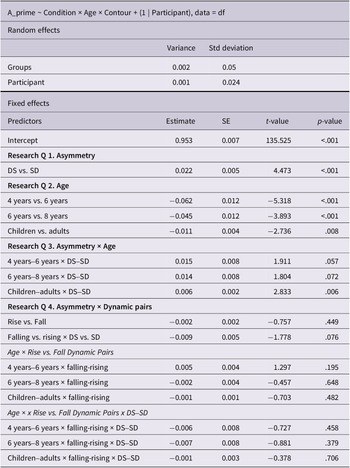
There are four research questions in this study. The first two address the presence, and differences across age groups in perceptual asymmetry for lexical tones; the third examines whether perceptual asymmetry differs across age groups; and the fourth explores whether it is consistent across tone types. Each question and its corresponding hypothesis or possible outcomes are outlined below. Statistics addressing each of these four research questions are under the corresponding numbers 1, 2, 3, and 4 in Table 3 in the results section.
-
1. Is there perceptual asymmetry for lexical tones?
Previous literature suggests there is perceptual asymmetry for lexical tones. Further evidence would strengthen this prior evidence.
The DS > SD Condition Hypothesis: Thai speakers were presented with four pairs of tones, Rising/Low, Rising/High, Falling/Low, and Falling/High, each in the DS or the SD order, thus eight tone pairs. Based on Liu et al. (Reference Liu, Lai, Singh, Kalashnikova, Wong, Kasisopa, Chen, Onsuwan and Burnham2022), we hypothesised a significant Condition effect, with superior discrimination in the DS compared to the SD order across all tone pairs and age groups.
-
2. Are there age-group differences in tone perception accuracy
Age Differences Hypothesis: Thai speakers aged 4, 6, and 8 years, and adults, were tested. Following Burnham and Francis (Reference Burnham, Francis and Abramson1997), we expected differences in tone perception (independent of the strength of any asymmetry) between age groups, such that performance would be lower in 4-year-olds than in 6-year-olds, with similar levels of performance in the 6- and 8-year-old groups, and comparable performance between older children and adults.
-
3. Do age groups differ in the magnitude of perceptual asymmetry for lexical tones?
Neither the DS > SD hypothesis (RQ 1) nor the age-differences hypothesis (RQ 2) makes specific predictions about age-group differences in perceptual asymmetry. The key question, therefore, is whether the magnitude of the DS > SD effect differs between age groups. In the absence of prior empirical evidence to guide specific hypotheses and formal predictions, several Condition × Age Group scenarios are possible, as set out below:
-
a) No age-group differences: Equal levels of DS > SD across child age groups (4, 6, and 8 years) would suggest that perceptual asymmetry is unaffected by linguistic experience in the early years of school, and continued equal levels of perceptual asymmetry into adulthood would suggest no effect beyond the early school years.
-
b) Larger asymmetry in older age groups: Greater DS > SD asymmetry in older children than younger children would indicate age-group differences potentially associated with increased linguistic experience or schooling; a continued increase through to adulthood would suggest an added effect of later linguistic experience.
-
c) Smaller asymmetry in older age groups: Reduced DS > SD asymmetry in older children relative to younger children would suggest age-group differences potentially linked to experience with the phonological system, perhaps facilitated by the onset of reading and implicit learning of grapheme-to-phoneme rules that makes it possible to override the perceptual asymmetry; and smaller asymmetry in adults compared to children would be consistent with cross-sectional differences reported between infants and adults (see Polka and Bohn vowel studies above of infant vs. adults) and would suggest that later linguistic experience allows further erasure of perceptual asymmetry.
-
d) Other non-monotonic age-group differences are possible, for example, a dip or a peak at school onset at 6 years or especially, perhaps, at reading onset (see, e.g., Burnham, Reference Burnham2003; Burnham et al., Reference Burnham, Kim, Davis, Ciocca, Schoknecht, Kasisopa and Luksaneeyanawin2011; Horlyck et al., Reference Horlyck, Reid and Burnham2012) and would require explanation.
-
4. Is perceptual asymmetry for lexical tones consistent across types of dynamic tones?
Dynamic tones differ in slope direction and gradient, and prior research suggests a perceptual advantage for rising tones. Rising glides are detected at lower intensities (Collins & Cullen, Reference Collins and Cullen1978), evoke stable cochlear response latencies (Shore & Nuttall, Reference Shore and Nuttall1985), and elicit larger amplitude frequency following responses (Krishnan et al., Reference Krishnan, Xu, Gandour and Cariani2004; Krishnan & Parkinson, Reference Krishnan and Parkinson2000).
Tone Contour Hypothesis: We therefore predict that tone pairs involving rising tones will be perceived more robustly than those with falling tones, regardless of whether they are paired with high or low static tones. Specifically, the DS > SD effect should be greater when the dynamic tone is rising than when it is falling.
2. Methods
2.1. Participants
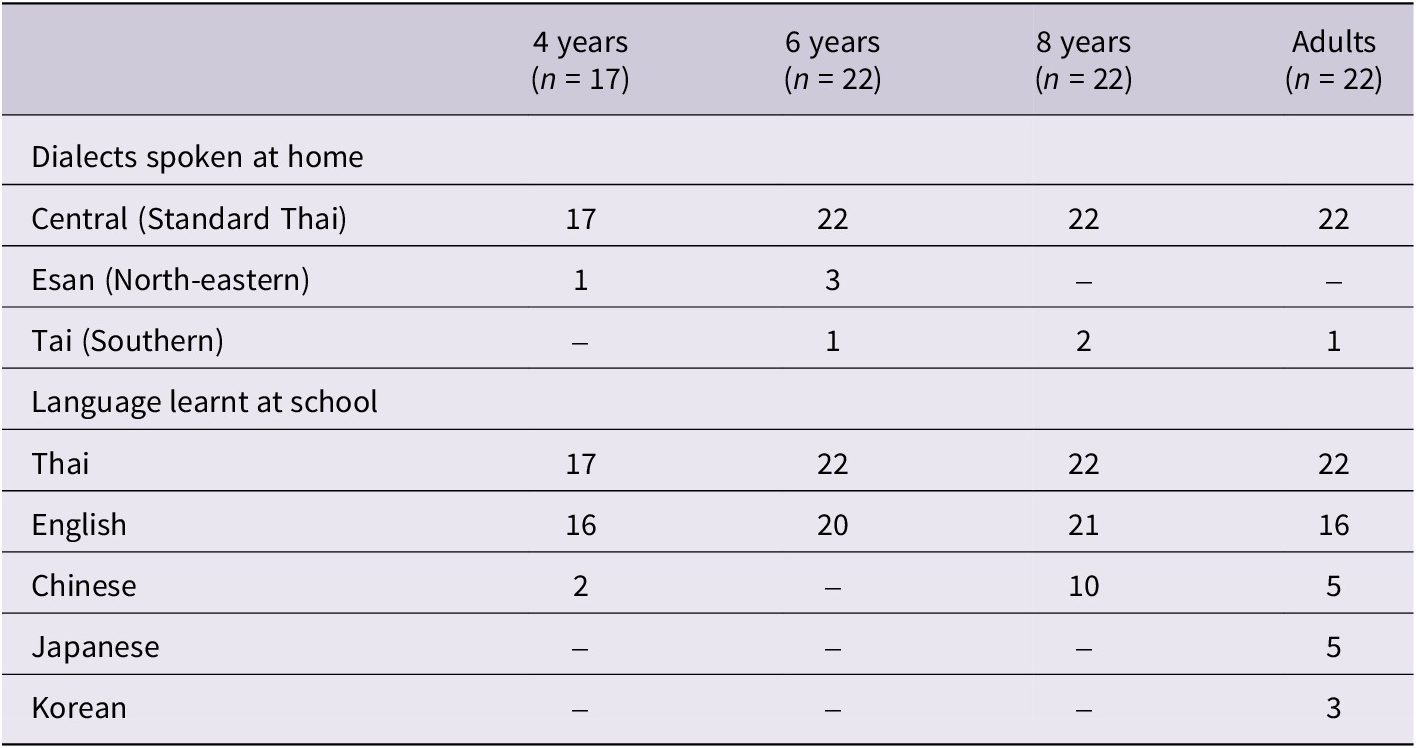
The final sample consisted of 83 participants: 17 4-year-old children (Mage = 4.6 years, SD = 0.34, 8 female, 9 male), 22 6-year-olds (Mage = 6.4 years, SD = 0.43, 13 females, 9 males), 22 8-year-olds (Mage = 8.1 years, SD = 0.16, 16 females, six males), and 22 adults (Mage = 20.9 years, SD = 1.12, 11 females, 11 males). All participants were recruited from Chon Buri, Thailand. Five additional children from the group of 4-year-olds were tested but had to be excluded because (n = 4) scored below 50% in the practice, and (n = 1) child did not make any responses in the experimental phase. All children and adults had Standard Thai as their language spoken at home. Four 4-year-olds, one 6-year-old, four 8-year-olds, and three adults were also exposed to English for more than 4 hours a week in their home environment. Two adults were exposed to Japanese at home for more than 4 hours a week; Table 1 provides detailed information about the children’s and adults’ language background.
Summary of participant characteristics: Dialects spoken at home and languages exposed to at school

Table 1. Long description
The table consists of five columns. The first column lists categories, while the subsequent columns represent age groups: 4 years (n equals 17), 6 years (n equals 22), 8 years (n equals 22), and Adults (n equals 22).
Under the section Dialects spoken at home:
* Central (Standard Thai): 17, 22, 22, 22 across the respective age groups.
* Esan (North-eastern): 1 for 4 years, 3 for 6 years, and none for the older groups.
* Tai (Southern): none for 4 years, 1 for 6 years, 2 for 8 years, and 1 for Adults.
Under the section Language learnt at school:
* Thai: 17, 22, 22, 22 across all groups.
* English: 16, 20, 21, 16 across the respective age groups.
* Chinese: 2 for 4 years, none for 6 years, 10 for 8 years, and 5 for Adults.
* Japanese: Only reported for Adults with a count of 5.
* Korean: Only reported for Adults with a count of 3.
None of the participants reported any hearing impairment or familial risk for learning impairment. We recruited participants from a school in Chon Buri and undergraduate students from Burapha University to participate in the study. Before the experiment, adults provided consent by signing a form, while for the children parental consent was obtained through forms signed by parents or guardians. The ethics committees (Western Sydney University Human Ethics and Burapha University) approved the project.
2.2. Stimuli
Four Thai tones, namely rising, falling, high, and low, were used to create, in line with the research hypotheses, four distinct tone contrasts: (1) rising versus low, (2) rising versus high, (3) falling versus high, and (4) falling versus low. Each tone pair was presented in each order, resulting in eight stimulus pairs. All four pairs of tone contrasts provide a dynamic versus static contrast with the different order within pairs providing a DS versus SD comparison.
For the practice phase, we used two types of stimuli: animal sounds (barking dog, meowing cat, neighing horse, and a crowing rooster) and non-word Thai speech contrasts. These non-word Thai speech contrasts in the practice phase included contrasts that differed in consonants, for example, for different trials/su/−/hu/, or differed in vowels, for example, for different trials /pha/−/pho/ (see the Supplementary Material for a complete list of the used stimuli. The syllable pairs in these contrasts did not differ in lexical tone; both members of the pair were articulated either with a high or with falling tone.
Stimuli for the experimental phase were non-words, structured with specific criteria: each tone was rendered in CV syllables, commencing with one of the following initial consonants /t, k, p, th, kh, ph, f/, followed by one of the vowels /aː, eː, ɜː, ɤː, ɯː, oː/ in one of the four tones. However, not all consonant, vowel, and tone combinations were presented as some of the combinations resulted in real words. In total, we used 42 syllables; see Tables S1 and S2 in the Supplementary Materials for more information. All stimuli were recorded in isolation by a female native Thai speaker in a child-directed speech, and multiple tokens of each CV syllable were recorded for each tone combination. From these, two tokens from each combination were carefully selected for use in the experiment. The tokens were judged by a native Thai listener (the third author) to be accurate and noise-free. The duration of syllables containing the falling tone was, on average, 594.90 ms (SD = 35.72), containing the high tone, on average, 584.65 ms (SD = 26.89), containing the low tone, on average, 583.12 ms (SD = 31.65), and containing the rising tone, on average, 590.12 ms (SD = 35.85), see Figure S1 in the Supplementary Materials. A one-way ANOVA, conducted to examine whether duration differed across tone conditions, revealed that the effect of tone condition on duration was not statistically significant, F(3, 236) = 1.61, p = .187, indicating that duration did not significantly vary across the different tone conditions. A trajectory of the pitch contours is shown in Figure S2 in the Supplementary Materials. All stimuli were normalised for intensity at 70 dB to ensure consistent loudness across all tone conditions.
2.3. Procedure
The experiment was programmed with LabVanced (Finger et al., Reference Finger, Goeke, Diekamp, Standvoß and König2017) and presented to the children on a Samsung Galaxy tablet. Despite using an online experiment builder for programming, the experiment was conducted under close supervision due to its implementation within the school setting, in which children were tested. Children were tested in a private room at the school, in which only the participant and the researcher were present. In each session, three children were tested simultaneously, each with a separate tablet, with one research assistant assigned to each child. Research assistants closely monitored the children’s behaviours and guided them as needed. If a child appeared tired or unfocused, they were given the option to stop the task.
Participants were informed that they would use tablet headphones to engage in a game or task and were encouraged to sit comfortably. Each child received snacks, stickers, and stationery items as a token of appreciation upon completing the task and then waited in a designated area for their teacher to escort them back to the classroom. Adults were tested in a meeting room at the university, where only the participants and researchers were present. Similar to the children’s sessions, participants were instructed to engage in the task using tablet headphones. Sessions were conducted with three participants simultaneously, spaced approximately 2–3 m apart. Upon completing the task, adult participants exited the room independently.
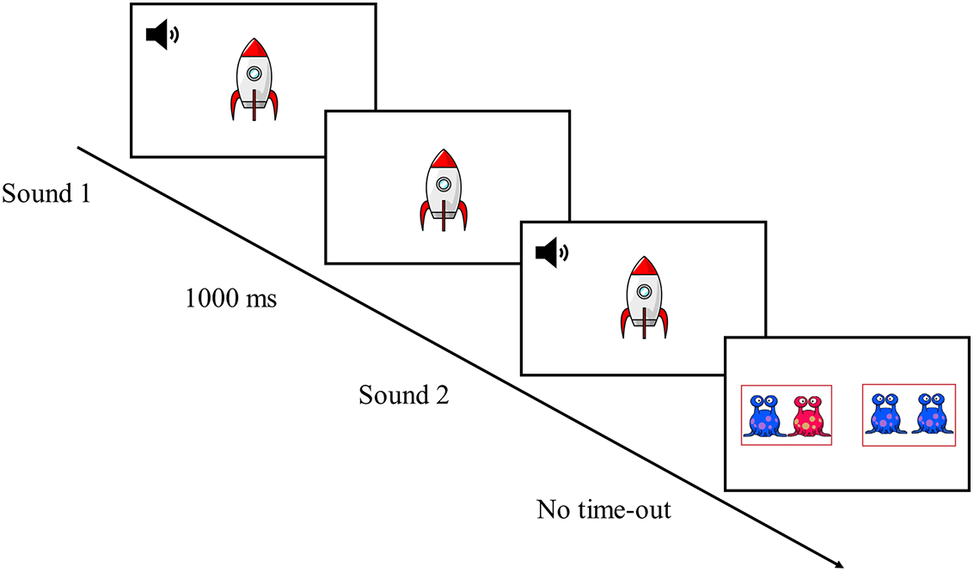
An AX discrimination task was used, wherein the X segments were a syllable with the same CV segments as in A, but which were produced with the same tone or a different tone. Auditory instructions were delivered to both adults and children to initiate the experiment. For the children, the instructions were tailored to be child-friendly, presenting the experiment in the format of a game to engage participants. For instance, an example prompt used was, “Look, that’s an alien, and the other aliens are hiding from him. Is there one alien hiding, or are there two aliens hiding?” Following these instructions, the participant heard an AX sound pair and saw a space rocket on the screen, symbolising that the aliens were hiding behind the space rocket. After the second sound of the AX sound pair was played, two pictures appeared on the screen, each showing either two same aliens or two different aliens. The participant was required to click on one of the pictures: the pair of same aliens if they heard two same sounds, or the pair of different aliens if they heard two different sounds. For an illustration, see Figure 1 (see also, Götz et al., Reference Götz, Sensoy, Schwarzer and Höhle2026).
Example trial structure.

Two practice blocks were presented to acquaint the children and adults with the experimental procedure. The first practice block was designed to familiarise the children with the task, using animal sounds to prompt the identification of either two of the same animal sounds (e.g., two meowing sounds) or two different animal sounds (e.g., a meowing and a barking sound). The aim of the practice blocks was to determine whether children understood the principles of the AX discrimination task so, during this phase, children were given feedback to reinforce (or correct) their understanding of the concepts “same” and “different.” The first practice block consisted of a maximum of 10 trials (five same-animal sounds and five different-animal sounds) but was terminated once the participant made five consecutive correct responses. The second practice block involved speech stimuli, with contrasts comprising changes in consonants or in vowels. Similar to the first practice block, feedback was provided. The second practice phase consisted of a maximum of 12 trials but was terminated once the children reached six consecutive correct responses. Upon meeting these two criteria, it was concluded that the child comprehended the task. Four 4-year-olds were excluded from the analysis because they did not meet one or both criteria but all 6- and 8-year-olds and all adults met the criterion.
The experimental phase consisted of six blocks, each comprising 32 trials, a total of 192 trials. After each block, children were rewarded with a star that appeared on the screen and they were encouraged to accumulate more stars. Half of the trials were “same” trials with identical CV syllables and tones (but not necessarily the same exemplar of that CV), and the other half were “different” trials with identical CV syllables but different tones. In “different” trials, each CV syllable was presented four times, twice with the same tone contrast but in opposite orders – DS and SD, for example, for the /tha:/ syllable, /tha:315/ ➔ /tha:21/, and /tha:21/ ➔ /tha:315/; and twice with another tone contrast, for example, tha:241 ➔ tha:21, and tha:21 ➔ tha:241. In “same” trials each CV-tone syllable was also presented four times. The order of trials was randomised within blocks. An interstimulus interval of 1000 ms separated the presentation of the first (A) and second (X) sounds in the AX trials. This interstimulus interval was chosen to allow phonetic level of encoding, but disallow phonemic encoding (Werker & Logan, Reference Werker and Logan1985). Following presentation of each stimulus pair, two images appeared on the screen. One image depicted two identical objects, while the other presented two distinctly different objects (see also Götz et al., Reference Götz, Sensoy, Schwarzer and Höhle2026, and Figure 1 for an example). Participants were instructed to select the picture that corresponded to their perception of the two auditory stimuli, that is, two same or two different speech sounds.
3. Data analysis
The data were analysed with R (R Core Team, 2024) and the package lme 4 (Bates et al., Reference Bates, Maechler, Bolker and Walker2015) was used to compute the general linear mixed effects models. The lmerTest package (Kuznetsova et al., Reference Kuznetsova, Brockhoff and Christensen2017) was used to calculate p-values (using the Satterthwaite approximation). To investigate developmental differences in tone discrimination and address concerns regarding potential response bias, we analysed A′, a bias-free measure of perceptual sensitivity, across age groups, and conditions (see Masapollo et al., Reference Masapollo, Polka, Molnar and Ménard2017). Similar to previous studies, we used the formula: A′ = 0.5 + (H − FA)(1 + H − FA)/[4H(1 − FA)], in which H = proportion of hits (“different” responses on different trials) and FA = proportion of false alarms (“same” responses on different trials) (Grier, Reference Grier1971). The false alarm rate was the combined error rate observed on same trials involving each vowel within the stimulus pair. A’ ranges from 0.5 (chance level) to 1.0 (perfect discrimination).
Four 4-year-old participants were excluded from the data analysis due to their notably low accuracy rate of one out of eight trials correct in the practice blocks, which presumably indicated a lack of understanding of the task by these participants.
In the experimental phase, of the total of 192 trials, on average, 4-year-old children completed 117.56 (SD = 61.14) trials, 6-year-olds 116.53 (SD = 59.74), 8-year-olds 157.05 (SD = 76.40) trials, and adults 164.77 (SD = 28.93) trials. Each participant completed a minimum of two experimental blocks. An analysis of the first versus last blocks revealed no statistically significant different performance in children or adults (4-year-olds first blocks vs. last blocks: β (SE) = −0.018 (0.015), t = −1.201, p = .231; 6-year-olds: β (SE) = 0.012 (0.0109), t = 1.128, p = .261; 8-year-olds: β (SE) = 0.005 (0.010), t = 0.458, p = .648; adults: β (SE) = 0.005 (0.010), t = 0.524, p = .601), suggesting there was no practice effects across trials at any age; so, the task was relatively easy from the start, even for the 4-year-olds.
The A-prime scores were entered into linear mixed-effect models. The model included three fixed effects: Age (4 years, 6 years, 8 years, adults, coded as linear trend comparing 4- to 6-year-olds, 6- to 8-year-olds, and all children combined to adults); and Condition (DS vs. SD, coded as 0.5/−0.5 respectively) and Contour (rising vs. falling, coded as 0.5/−0.5 respectively). Participants were entered as random effect. The model was: A_prime ~ Age × Condition× Contour + (1 | Participant), data = df. The model’s residuals followed a normal distribution, as indicated by the summary statistics: minimum = −2.55, first quartile (1Q) = −0.16, median = 0.01, third quartile (3Q) = 0.23, and maximum = 2.39.
4. Results
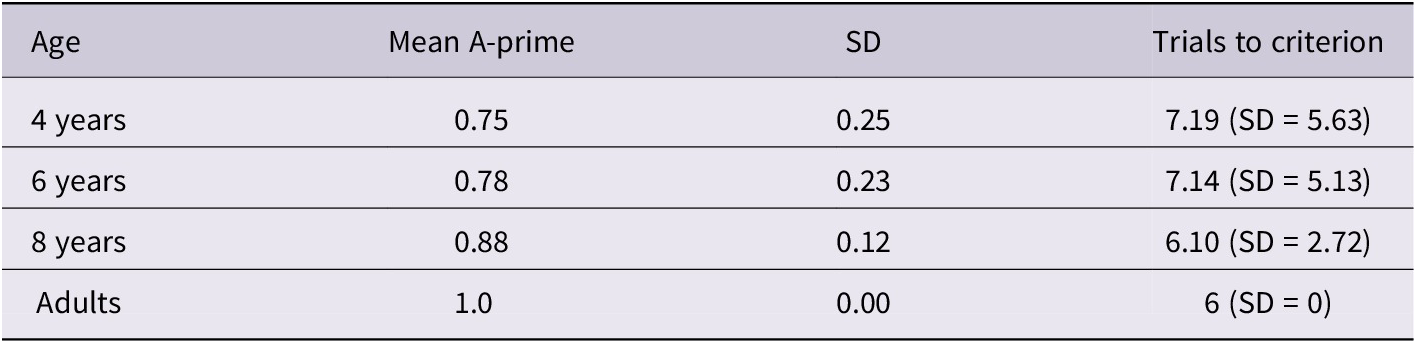
Table 2 shows the A-prime accuracy rates and trials to criterion (6 consecutive correct responses) for participants’ performance in the second practice block, which assessed discrimination based on vowel differences or consonant differences. As can be seen at all ages, participants were relatively accurate and reached the criterion very soon after the criterion of six consecutive correct responses. So, at all ages, participants were adequately familiar with the task.
Results from practice blocks

Table 2. Long description
The table consists of four columns: Age, Mean A-prime, S D, and Trials to criterion.
* Row 1: 4 years. Mean A-prime is 0.75. S D is 0.25. Trials to criterion is 7.19 with an S D of 5.63.
* Row 2: 6 years. Mean A-prime is 0.78. S D is 0.23. Trials to criterion is 7.14 with an S D of 5.13.
* Row 3: 8 years. Mean A-prime is 0.88. S D is 0.12. Trials to criterion is 6.10 with an S D of 2.72.
* Row 4: Adults. Mean A-prime is 1.0. S D is 0.00. Trials to criterion is 6 with an S D of 0.
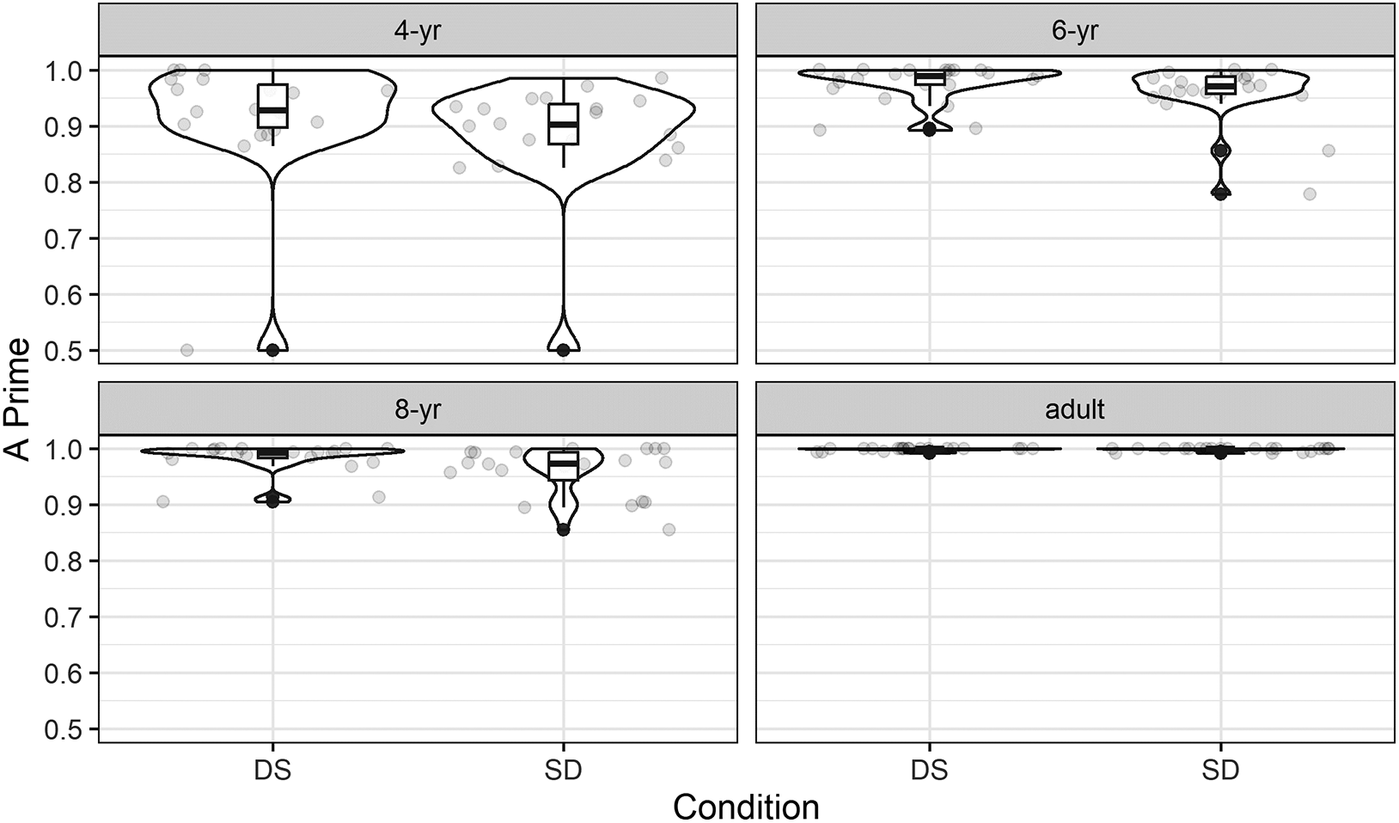
The results of the experimental phase with lexical tones are graphically represented in Figure 2 and the full model output in Table 3.
A-Prime results of condition (DS vs. SD) and age (4-, 6-, 8-year-old children and adults Note: The dynamic–static (DS) tone pairs consist of falling-high, falling-low, rising-high, and rising-low tone contrasts and static–dynamic (SD) tone pairs consist of high-falling, low-falling, high-rise, and low-rise tone contrasts. The grey dots represent individual data points.

Figure 2. Long description
The multi-panel figure consists of four quadrants representing age groups. 4-year-old children at top-left, 6-year-old children at top-right, 8-year-old children at bottom-left, and adults at bottom-right. The Y-axis represents A Prime scores ranging from 0.5 to 1.0. The X-axis categorizes two conditions. D S and S D. Each category contains a violin plot, a box plot, and individual grey data points.
* In the 4-year-old panel, both D S and S D conditions show wide distributions with medians around 0.9 and long tails extending down to 0.5.
* In the 6-year-old panel, the distributions are more concentrated at the top. The D S condition has a median near 0.98, while the S D condition shows a slightly lower median with a tail reaching 0.8.
* In the 8-year-old panel, both conditions show high performance with medians near 1.0. The S D condition has a slightly wider distribution and more outliers below 0.9 compared to the D S condition.
* In the adult panel, both D S and S D conditions show near-perfect performance with almost all data points and medians clustered tightly at the 1.0 mark.
Results of the discrimination task

Table 3. Long description
The table header displays the model formula: A prime tilde Condition times Age times Contour plus open parenthesis 1 vertical bar Participant close parenthesis, data equals d f.
Random effects section:
- Groups: Variance 0.002, Standard deviation 0.05.
- Participant: Variance 0.001, Standard deviation 0.024.
Fixed effects section columns are Predictors, Estimate, S E, t-value, and p-value:
- Intercept: Estimate 0.953, S E 0.007, t-value 135.525, p-value less than .001.
- Research Q 1. Asymmetry (D S vs. S D): Estimate 0.022, S E 0.005, t-value 4.473, p-value less than .001.
- Research Q 2. Age:
- 4 years vs. 6 years: Estimate negative 0.062, S E 0.012, t-value negative 5.318, p-value less than .001.
- 6 years vs. 8 years: Estimate negative 0.045, S E 0.012, t-value negative 3.893, p-value less than .001.
- Children vs. adults: Estimate negative 0.011, S E 0.004, t-value negative 2.736, p-value .008.
- Research Q 3. Asymmetry times Age:
- 4 years to 6 years times D S to S D: Estimate 0.015, S E 0.008, t-value 1.911, p-value .057.
- 6 years to 8 years times D S to S D: Estimate 0.014, S E 0.008, t-value 1.804, p-value .072.
- Children to adults times D S to S D: Estimate 0.006, S E 0.002, t-value 2.833, p-value .006.
- Research Q 4. Asymmetry times Dynamic pairs:
- Rise vs. Fall: Estimate negative 0.002, S E 0.002, t-value negative 0.757, p-value .449.
- Falling vs. rising times D S vs. S D: Estimate negative 0.009, S E 0.005, t-value negative 1.778, p-value .076.
- Age times Rise vs. Fall Dynamic Pairs:
- 4 years to 6 years times falling-rising: Estimate 0.005, S E 0.004, t-value 1.297, p-value .195.
- 6 years to 8 years times falling-rising: Estimate negative 0.002, S E 0.004, t-value negative 0.457, p-value .648.
- Children to adults times falling-rising: Estimate negative 0.001, S E 0.001, t-value negative 0.703, p-value .482.
- Age times Rise vs. Fall Dynamic Pairs times D S to S D:
- 4 years to 6 years times falling-rising times D S to S D: Estimate negative 0.006, S E 0.008, t-value negative 0.727, p-value .458.
- 6 years to 8 years times falling-rising times D S to S D: Estimate negative 0.007, S E 0.008, t-value negative 0.881, p-value .379.
- Children to adults times falling-rising times D S to S D: Estimate negative 0.001, S E 0.003, t-value negative 0.378, p-value .706.
First, there was a significant main effect of Condition with discrimination in DS trials greater than that in SD trials (Estimate = 0.022, SE = 0.005, t = 4.473, p < .001). This supports previous studies in showing that there is perceptual asymmetry in the perception of tones based on the order of presentation, that the D➔S order allows better tone discrimination than the S➔D order, and this effect extends to Thai children.
Second, there were significant linear trend effects across age groups for overall tone discrimination independent of DS versus SD effects. For the children there was a significant increase from 4 (Mean = 0.90, SD = 0.11) to 6 years (Mean = 0.96, SD = 0.04) (Estimate = 0.062, SE = 0.012, t = 5.318, p < .001), and a further increase from 6 to 8 years (Mean = 0.97, SD = 0.04)years (Estimate = 0.045, SE = 0.012, t = 3.893, p = <0.001). There was also a significant increase from childhood (all three ages combined, Mean = 0.94, SD = 0.08) to adulthood (Mean = 1.0, SD = 0.00) (Estimate = 0.011, SE = 0.004, t = 2.736, p = .008). Thus, there is a consistent developmental trajectory for an overall improvement in tone perception per se, with perceptual sensitivity improving significantly across all four ages.
Third, and most importantly for the possible developmental differences in the relative magnitude of DS > SD across age, we consider the Condition × Age interactions. There was no significant interaction of the magnitude of the DS > SD differential at 4 versus 6 years (Estimate = 0.015, SE = 0.008, t = 1.911, p = .057), nor at 6 versus 8 years (Estimate = 0.014, SE = 0.008, t = 1.804, p = .072). However, there was a significant interaction between the magnitude of the DS > SD differential in children combined versus adults (Estimate = 0.006, SE = 0.002, t = 2.833, p = .006), that is, greater perceptual asymmetry in childhood than adulthood. Inspection of Figure 2 suggests that this may be due to a ceiling effect in adults, possibly not allowing sufficient range for differences.
Given the high scores on both DS and SD and a possible ceiling effect for adults, and to be certain that there was, in fact, significant perceptual asymmetry for tone at each child age, we created a second model in which Condition and Age were nested. The nesting allows us to assess the asymmetry at each age. The results showed that children performed significantly better in the DS than the SD condition at 4 years (Estimate = 0.033, SE = 0.008, t = 4.20, p < .001), at 6 years (Estimate = 0.017, SE = 0.007, t = 2.33, p = .022), and at 8 years (Estimate = 0.024, SE = 0.008, t = 3.12, p = .003). However, in adults, there was no differential response to the DS versus SD.
Fourth, to answer the question of whether AX pairs involving rising tones are easier to discriminate than AX pairs involving falling tones, analyses revealed that the falling-rising difference was not significant (Estimate = −0.002, SE = 0.002, t = −0.757, p = .449); that the DS > SD differential in falling versus rising tone pairs did not differ, that is, the Rising/Falling × DS/SD interaction was not significant (Estimate = −0.009, SE = 0.005, t = −1.778, p = .076, but see “Future Studies” in the Discussion); and that the DS > SD differential in falling versus rising tone pairs did not differ across age groups, as there were no significant three-way interactions of Rising/Falling × DS/SD with any of the Age contrasts (see Table 3).
In summary, there was significant perceptual asymmetry for lexical tone at each child age, 4, 6, and 8 years, but despite an improvement over child age in overall tone discrimination (see Research Question 2), there was no change in the degree of perceptual asymmetry for tone across child age. Unexpectedly, there was no significant perceptual asymmetry found for adults, likely due to a ceiling effect for adults’ performance on the task designed to be doable by children.
5. Discussion
Overview: This study investigated perceptual asymmetry in the discrimination of pairs of Thai lexical tones and examined whether the magnitude of this asymmetry and overall discrimination accuracy differ across age groups in Thai-learning children (4, 6, and 8 years) and adults. Results are presented below, with respect to the hypotheses set out earlier.
-
1. The DS > SD condition hypothesis: That there should be better discrimination in tone pairs in which a more dynamic (D) tone preceded a more static (S) tone, that is, DS, than when a more static (S) tone preceded a more dynamic (D) tone, that is, SD. This hypothesis was upheld; there was a main effect of Condition, in which discrimination of DS pairs was indeed better than that of SD pairs, that is, an overall perceptual asymmetry effect. This supports prior research on the asymmetric perception of lexical tones (Yeung et al., Reference Yeung, Chen and Werker2013; Götz et al., Reference Götz, Yeung, Krasotkina, Schwarzer and Höhle2018; Liu et al., Reference Liu, Götz, Lorette and Tyler2022; and to some extent Politzer-Ahles et al., Reference Politzer-Ahles, Schluter, Wu and Almeida2016), and further extends this effect to include evidence from tone-language-learning, Thai children.
-
2. The age-group differences hypothesis: The second hypothesis concerns age-group differences in overall tone discrimination accuracy, independent of Condition. The results showed differences between age groups. Specifically, discrimination accuracy was the highest in adults and 8-year-olds, significantly lower in 6-year-olds and continued to decrease in 4-year-olds. While these findings do not exactly mirror the development of Thai tone perception over child and adult age in a previous study (Burnham & Francis, Reference Burnham, Francis and Abramson1997), they generally support a linear increase in Thai tone discrimination over age groups.
-
3. The Condition × Age interactions: The third question – whether the magnitude of the DS > SD effect differs across age groups – was examined as an exploratory research question rather than a formal hypothesis. The results showed that irrespective of the better overall tone discrimination in older age groups than younger age groups (see 2 above), there was a consistent DS > SD effect, that is, perceptual asymmetry with the degree of asymmetry remaining unchanged across the three child age groups (4, 6, and 8 years). There was no significant condition × child age interaction and post hoc analyses confirmed significant DS > SD effects at each of the three child ages. In contrast, the DS > SD effect in children was significantly higher across the three child groups than in adults, and there was no perceptual asymmetry in adults. However, this null result for Thai adults was quite possibly due to a ceiling effect (Liu et al., Reference Liu, Lai, Singh, Kalashnikova, Wong, Kasisopa, Chen, Onsuwan and Burnham2022; Politzer-Ahles et al., Reference Politzer-Ahles, Schluter, Wu and Almeida2016), so the reduction in asymmetry from children to adults here should be interpreted with caution.
-
4. The effect of tone contour hypothesis: Previous behavioural and neurophysiological evidence suggests a perceptual advantage for rising over falling tones (Collins & Cullen, Reference Collins and Cullen1978; Krishnan et al., Reference Krishnan, Xu, Gandour and Cariani2004; Shore & Nuttall, Reference Shore and Nuttall1985). However, in our results, there was no significant difference between tone pairs with a rising tone as one member of the pair versus tone pairs with a falling tone as one member of the pair. More specifically, there was no interaction of this rising versus falling factor and the DS/SD factor, or even more specifically, of the rising versus falling factor and the DS > SD effect. Accordingly, this suggests that the previously observed advantage for rising tones may not generalise across task types, or more specifically here, across age groups, or to tone pair discrimination tasks contexts, here to DS versus SD tone pairs. However, see Future Studies below.
The results here provide strong support for the DS > SD hypothesis in perceptual asymmetry for lexical tones by 4-, 6-, and 8-year-old children, stronger support than that from most of the other studies set out above with infants (Götz et al., Reference Götz, Yeung, Krasotkina, Schwarzer and Höhle2018; Tsao, Reference Tsao2008; Yeung et al., Reference Yeung, Chen and Werker2013) or adults (Francis & Ciocca, Reference Francis and Ciocca2003; Politzer-Ahles et al., Reference Politzer-Ahles, Schluter, Wu and Almeida2016; Wayland et al., Reference Wayland, Chen, Hong and Fang2019; Wayland & Chen, Reference Wayland and Chen2018). Along with the lack of a DS > SD effect for adults here, this could be taken to show that the DS > SD perceptual asymmetry for lexical tones is greatest in children.
However, we must consider that the lack of an effect here for adults could well have been an artefact. First, in the most powerful study to date with data across tone systems and participants’ language background, the Liu et al. (Reference Liu, Lai, Singh, Kalashnikova, Wong, Kasisopa, Chen, Onsuwan and Burnham2022) “tone atlas” study, there was widespread evidence for a DS > SD effect across stimulus languages and language background of the adult participants. Second, here, tone discrimination per se (irrespective of order) improved over all four ages, the three children and the one adult age group, with the adult scores being close to perfect (at ceiling). This suggests that the task here, which was designed primarily with the children’s task-ability in mind, was way too easy for adults, an ease that may have concealed any DS versus SD order effect.
In such cases, response time measures on correct trials could be used as a complementary dependent variable to detect more subtle perceptual differences when accuracy is at or near ceiling. In the present study, however, response time was not analysed. The task was designed primarily for young children, for whom response timing can be highly variable and influenced by non-perceptual factors such as attention, motor planning, and task engagement. As a result, accuracy was selected as the primary and most reliable outcome measure across age groups. While this choice of analysis ensured the task was suitable for children, it also limited the sensitivity of the adult data, where ceiling-level accuracy may have masked potential order effects.
Future studies could address this limitation by employing tasks that are more demanding for adults and by incorporating response time analyses, either in age-specific task versions or in designs tailored to older participants. Such approaches would allow more sensitive assessment of perceptual asymmetries in adults and help determine whether DS > SD effects persist under conditions that avoid ceiling performance. For the present, we will concentrate on the child results, which were, in fact, the main focus of this study.
Tone perception per se improved across age groups, 4–8 years, a result in accord with previous studies of tone perception (Burnham & Francis, Reference Burnham, Francis and Abramson1997). Nevertheless, the DS > SD differential, the index of asymmetry, remained constant. This shows that the perceptual asymmetry for lexical tones in children is independent of general tone perception proficiency, which adds weight to the status and strength of this bias and to its independent development.
These results point to two possibilities. The first is that perceptual asymmetry for lexical tones (at least Thai tones perceived by Thai language learners) is either present at birth or emerges sometime between birth and 4 years. The second is that perceptual asymmetry for lexical tones develops early as a by- or co-product of linguistic development, just as is the case for vowel and consonant perceptual asymmetries.
Regarding the first possibility, if perceptual asymmetry for tone is present at birth or even in very early infancy, then one might expect that it has little or nothing to do with linguistic or phonological development. Several findings support this interpretation. First, the asymmetry observed in Thai children remained stable between 4 and 8 years of age. This developmental period is associated with major linguistic changes, especially the onset of reading, which shifts attention from phonetic detail towards more abstract phonemic representations (Burnham, Reference Burnham2003; Horlyck et al., Reference Horlyck, Reid and Burnham2012). If lexical-tone asymmetries were shaped by literacy or later phonological development, changes would be expected across this age range. Instead, the stability of the effect suggests that it is established earlier and may reflect low-level perceptual mechanisms.
Evidence from consonant perception is also consistent with an acoustic-salience account. Infants show perceptual asymmetries for stop–fricative contrasts such as /b/−/v/ (e.g., Nam & Polka, Reference Nam and Polka2016; Tsuji et al., Reference Tsuji, Mazuka, Cristia and Fikkert2015). These asymmetries are linked to acoustic properties rather than abstract phonological categories: stops such as /b/ contain rapid amplitude rise times and highly dynamic onsets, whereas fricatives such as /v/ involve slower, more sustained energy patterns. The asymmetry is therefore thought to reflect a general auditory bias favouring rapidly changing acoustic information.
At the same time, several findings suggest that perceptual asymmetries can also be shaped by language experience. Research on vowels shows that perceptual asymmetries are not fixed but interact with linguistic development. Infants initially show a bias favouring discrimination from less focal to more focal vowels (Polka & Bohn, Reference Polka and Bohn2011), even before native-language perceptual attunement emerges (Werker, Reference Werker2024). However, these asymmetries disappear when the vowel contrast is phonemic in the listener’s native language, while remaining for non-native contrasts processed more phonetically. This demonstrates that linguistic experience can modify or override earlier perceptual biases.
The present findings for lexical tones do not fit neatly into either account alone. Here, 4- to 8-year-old Thai children continued to show a DS > SD perceptual asymmetry for lexical tone contrasts that are phonemic in their native language, well beyond the age at which vowel asymmetries are known to diminish as a consequence of perceptual attunement. This finding contrasts with the developmental pattern reported for vowels and suggests that lexical-tone asymmetries are less strongly shaped by later linguistic experience. At the same time, the asymmetry cannot be explained solely by general acoustic processing, as non-speech tone analogues produce the opposite perceptual pattern (Masapollo et al., Reference Masapollo, Zhao, Franklin and Morgan2019). Together, these findings suggest that perceptual asymmetry for lexical tones may originate in early auditory biases linked to acoustic salience, but develop into a speech-specific perceptual mechanism that remains stable despite later linguistic and literacy-related development. Further research on lexical-tone and consonant asymmetries during the first year of life will be necessary to determine when these asymmetries emerge and how they interact with language experience.
5.1. Phonemes and tonemes: Similarities and differences
There is an emerging literature on similarities and differences between the perception of phonemes (consonants and vowels) and tonemes (lexical tones) (Burnham et al., Reference Burnham, Kim, Davis, Ciocca, Schoknecht, Kasisopa and Luksaneeyanawin2011; Liu et al., Reference Liu, Lai, Singh, Kalashnikova, Wong, Kasisopa, Chen, Onsuwan and Burnham2022; Xu Rattanasone et al., Reference Xu Rattanasone, Attina, Kasisopa, Burnham, Winskel and Padakannaya2013). There is a basic similarity that phonemes and tonemes are functionally equivalent with respect to lexical-level meaning. Despite this, there are many differences: there are different developmental trajectories of infants’ perceptual attunement to the phonemes and tonemes of their native language(s) (see Liu et al., Reference Liu, Götz, Lorette and Tyler2022); different trajectories for the use of exaggerated vowels and tones in infant-directed speech (Xu Rattanasone et al., Reference Xu Rattanasone, Burnham and Reilly2013); and different psycholinguistic representations of phonemes and tonemes across languages, or phonemes and tonemes within languages (Burnham et al., Reference Burnham, Kim, Davis, Ciocca, Schoknecht, Kasisopa and Luksaneeyanawin2011).
In addition, there are distinct differences between how the features of vowels, consonants and tones are described. For consonants and vowels, these are related to articulatory features: consonants differ on easily identified places and manners of articulation and on the timing of voicing events; and vowels differ on the height and frontness/backness of the tongue during articulation (which, in turn, are further related to vowel acoustics, the F1 and F2 formants). In contrast, lexical tones are based primarily on pitch, and while pitch is determined by movements of the cricothyroid and other muscles, unlike place of articulation for consonants or tongue height for vowels, there are no clear parameters for the settings of these muscles, such as settings for different features of lexical tones. Neither is there an agreed-upon graphic for describing tones, although there is some work emerging on devising a two-dimensional f0-onset/f0-offset space marking the pitch height at the start and the end of the tone (Barry & Blamey, Reference Barry and Blamey2004; Xu Rattanasone et al., Reference Xu Rattanasone, Attina, Kasisopa, Burnham, Winskel and Padakannaya2013). The literature on the delineation of similarities and differences between phonemes and tonemes, has served to advance empirical research and theoretical implications. How might research on perceptual asymmetries for vowels, consonants, and tones impact theory and future research?
5.2. Theoretical implications
Thirty years of research on perceptual asymmetry in vowels, along with more recent work on consonants, suggests that in both cases, asymmetry arises from the relative salience of two successive phonemes. For vowels, asymmetry is driven by differences in formant convergence: vowel pairs that progress from less focal to more focal (i.e., with more closely spaced formants) are discriminated better than those in the reverse order. For consonants, perceptual asymmetry is closely linked to temporal acoustic salience, particularly differences in amplitude rise time rather than to acoustic energy per se. Consonants with more abrupt, dynamically salient onsets (e.g., stops) are discriminated more accurately when they serve as the target relative to consonants with slower, less dynamic onsets (e.g., fricatives). This results in an asymmetry favouring transitions from less salient to more salient forms. In this sense, within a shared salience-based framework, a less-to-more > more-to-less asymmetry characterises both vowel and consonant perception, although the acoustic cues that define salience differ across these domains. Here, we have confirmed that for tonemes, perceptual asymmetry is in the direction DS > SD, so the question arises whether the DS > SD pattern for tonemes is equivalent to the less-to-more > more-to-less pattern for phonemes.
Currently, there is no clear common metric for phoneme and toneme salience, but if we assume the position that perceptual asymmetry has a common basis for all three phonologically-relevant units, vowels, consonants and tones, then it would follow that DS > SD is equivalent to less-to-more > more-to-less salience, implying that static tones are more salient than dynamic tones.
However, this appears to be counterintuitive; prima facie, it would appear that dynamic tones, with their variations in tone contour, are more salient than static tones. In partial support of such a claim, Burnham and Francis (Reference Burnham, Francis and Abramson1997) compared the percentage of correct discriminations of all the 10 Thai tone pairs and found that 4-year-olds showed better discrimination for tone pairs with two dynamic tones (the DD pair, 81%), than just one dynamic tone (SD pairs, 69%) and no dynamic tones (SS pairs, 67%). Despite the fact that at older ages, 6 years, 8 years, and adults, percentage correct for DD, SD, and SS pairs asymptoted at 95%, 98%, and 99%, the results for 4-year-olds suggest some greater perceptual salience for dynamic than static tones. Unfortunately, as the order of tones in pairs was not tested in that study, no further conclusions about perceptual asymmetry can be drawn. Clearly, there is a need for further research on the nature of perceptual asymmetries and the structural differences between phonemes and tonemes (spectral vs. temporal acoustic) and the functional similarities of phonemes and tonemes (both phonologically relevant at the lexical level).
From a broader typological perspective, the present findings can also be understood in relation to asymmetries in the structure of tone inventories across tonal languages, in a way that parallels well-established patterns in vowel systems. Cross-linguistically, a small set of corner vowels is nearly universally attested and forms the structural core of vowel inventories, while more complex or less stable vowel categories show greater cross-linguistic variability (Maddieson, Reference Maddieson1984). Perceptual asymmetries in vowel discrimination tend to favour transitions towards these corner vowels, which are characterised by greater acoustic focalisation and perceptual stability (e.g., Polka & Bohn, Reference Polka and Bohn2011). A comparable pattern may be observed for tone: level (static) tones are nearly universally attested and often form the core contrasts of tonal systems, whereas contour (dynamic) tones are more variably represented and frequently analysed as phonologically complex (e.g., Maddieson, Reference Maddieson, Dryer and Haspelmath2011). Although these typological tendencies do not imply a direct correspondence between inventory structure and perceptual asymmetry, they provide a useful comparative framework for interpreting the present results. In this light, the DS > SD asymmetry observed here may also reflect a bias towards transitions that terminate in acoustically and functionally stable tonal targets. More generally, as in the case of vowels, perceptual asymmetries in tone may interact with the typological organisation of sound systems, underscoring a distinction between acoustic salience and phonological or functional stability.
5.3. Future studies
While the theoretical considerations presented above remain preliminary, they highlight several important areas where empirical data are currently lacking. For perceptual asymmetry in consonant contrasts, additional data are needed from older infants, children, and adults, with particular attention to cross-linguistic comparisons that consider both contrast type and language background. In the case of vowel perception, there is a clear gap in data from children, which limits our understanding of developmental trajectories in this domain. For lexical tone, further research is required across the lifespan, especially involving infants and adults, and should include cross-language data to examine how linguistic background influences tone perception.
In addition, with respect to Hypothesis 4 regarding tone pairs containing rising versus falling tones, as this vein of research is quite new, then in order to suggest possibilities for future research (and to avoid a Type II error), it may be noted that while the Falling/Rising × DS/SD interaction was definitely not significant, the t-value was −1.778 with a p-level of .076. Post hoc inspection revealed that the DS > SD difference was much greater for tone pairs with a falling tone as one of the pair (DS, 97.2%, SD, 94.2%; difference = 3.0%) than those tone pairs with a rising tone as one of the pair (DS, 95.9%, SD, 94.6%; difference = 1.3%). It is of note that, even though this tendency is in the opposite direction to the hypothesised direction and the overall results here, it does suggest that the dynamicity/salience of tones (see discussion above of the structural differences and functional similarities of phonemes and tonemes) is a critical factor in the perceptual asymmetry of lexical tones. In any further investigation of the DS > SD effect, it would behove researchers to consider, even manipulate, the type of dynamic tone included in the tone pairs, for example, rising, falling, and the type (relative height) of static tone, in addition to other possible stimulus characteristics and variables such as task demands, developmental stage, and so forth.
An ideal future study would employ a longitudinal design spanning infancy, childhood, and adulthood, allowing the same individuals to be followed over time. Such a design, including infants and adults, may be impractical, but even a longitudinal study across child age would allow examination of within-participant changes in perceptual asymmetries across the three major speech domains (consonants, vowels, and lexical tones) using multiple exemplars within each category, and would enable direct comparisons across speech categories.
To adequately examine the role of language experience, such a study should include native speakers of the stimulus tone language, non-native speakers who speak a different tone language, and non-tone non-native language speakers. This design would provide a more integrated understanding of how perceptual asymmetries develop and vary across age groups and linguistic backgrounds. Moreover, because some of the children in the present sample had additional exposure to English at home, future work should also explicitly address the possible influence of multilingual exposure on tone perception. Although current evidence suggests that native tone-language exposure typically remains dominant in tone perception, even in bilingual infants (Kalashnikova et al., Reference Kalashnikova, Singh, Tsui, Altuntas, Burnham, Cannistraci, Chin, Feng, Fernández-Merino, Götz, Gustavsson, Hay, Höhle, Kager, Lai, Liu, Marklund, Nazzi, Oliveira and Woo2024), the potential modulating effects of early exposure to a non-tone language such as English remain understudied and may help refine our understanding of how multiple language inputs shape the development of perceptual asymmetries.
6. Conclusion
We have shown that Thai children have a strong and consistent perceptual asymmetry for lexical tones and better discrimination of DS than SD tone pairs. However, as set out above, there remain a number of lacunae both in tone asymmetry research and in research comparing perceptual asymmetry in vowels, consonants and tones. Here, we have begun the intensive study of perceptual asymmetry for tones, especially over age groups. Further studies of tone, consonant, and even vowel asymmetries will advance knowledge of speech perception and language development, as well as the principles that are general across phonemes (vowels and consonants) and tonemes.
Supplementary material
The supplementary material for this article can be found at http://doi.org/10.1017/S0305000926100737.


 Open access

