Contents
Research Article
On the application of the operational calculus to the expansion of a function in a series of Legendre's functions of the second kind
-
- Published online by Cambridge University Press:
- 20 January 2009, pp. 1-2
-
- Article
-
- You have access
- Export citation
-
In the present note we shall obtain the expansion in a series of Legendre functions of the second kind of an integral function φ (ω) represented by Laplace's integral

where f (x) is an analytic function of x, regular in the circle

where an are constants and qn (ω) = in+1Qn (iω).
Integral equations for Lamé functions
-
- Published online by Cambridge University Press:
- 20 January 2009, pp. 3-15
-
- Article
-
- You have access
- Export citation
Note on a distance invariant and the calculation of Ruse's invariant
-
- Published online by Cambridge University Press:
- 20 January 2009, pp. 16-26
-
- Article
-
- You have access
- Export citation
A note on convergence factors
-
- Published online by Cambridge University Press:
- 20 January 2009, pp. 27-30
-
- Article
-
- You have access
- Export citation
-
In this note
 denotes a divergent series of positive, decreasing terms for which
  are real numbers (convergence factors) such that
  is convergent. We put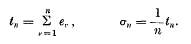
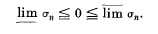
H. Rademacher has shown that
 denotes a divergent series of positive, decreasing terms for which
  are real numbers (convergence factors) such that
  is convergent. We put
A note on small vibrations
-
- Published online by Cambridge University Press:
- 20 January 2009, pp. 31-38
-
- Article
-
- You have access
- Export citation
-
This note exhibits some old results in what is possibly a new form.
The simple harmonic oscillator, whose kinetic and potential energies are given in terms of a single coordinate x by

where b is a positive constant, has the equation of motion

The solution, appropriate to the initial conditions
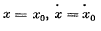 at t = 0 is conveniently written


 at t = 0 is conveniently written
On the methods of extending Dirac's equation of the electron to general relativity
-
- Published online by Cambridge University Press:
- 20 January 2009, pp. 39-50
-
- Article
-
- You have access
- Export citation
On the relations between the numbers of standard tableaux
-
- Published online by Cambridge University Press:
- 20 January 2009, pp. 51-54
-
- Article
-
- You have access
- Export citation
-
§ 1. Corresponding to any partition

which we denote by [a1, . …, ak] or briefly by [a], of the integer n, we can construct a shape which has a1 spaces in the first row, a2 in the second row, . …, ak in the kth and last row. Thus the shape corresponding to the partition [5, 3, 3, 2] of 13 has the form:

The projective invariants of four mediale
-
- Published online by Cambridge University Press:
- 20 January 2009, pp. 55-72
-
- Article
-
- You have access
- Export citation
A type of periodicity of certain quartic surfaces
-
- Published online by Cambridge University Press:
- 20 January 2009, pp. 73-80
-
- Article
-
- You have access
- Export citation
Fornt matter
PEM volume 7 issue 1 Cover and Fornt matter
-
- Published online by Cambridge University Press:
- 20 January 2009, pp. f1-f2
-
- Article
-
- You have access
- Export citation
Back matter
PEM volume 7 issue 1 Cover and Back matter
-
- Published online by Cambridge University Press:
- 20 January 2009, pp. b1-b2
-
- Article
-
- You have access
- Export citation