


The rise of climate change on the global political agenda coincided with the growth of partisan polarization in US politics and, in many ways, their trajectories mirror one another. When the climate crisis first began to attract political attention 30 years ago, Republicans and Democrats responded with similar levels of interest and concern. Today, partisan division overwhelms all other aspects of climate-change politics and environmental politics more broadly (Egan, Konisky, and Mullin Reference Egan, Konisky and Mullin2022; Egan and Mullin Reference Egan and Mullin2017).
Polarization generally is associated with policy inertia in the United States. The close balance in party strength combined with the system’s many veto points demands bipartisan agreement for policies to be enacted and to endure. Thus, for decades, the nation’s deep partisan division on climate has yielded gridlock at the federal level and in most states.
However, three developments are emerging in the shadow of polarization that hold opportunity for meaningful action on climate change. First, as polarization has become more severe and systemic, the two parties have become more internally cohesive on the climate-change issue. For Democrats, this has led to the elevation of climate on the party agenda and a newfound willingness to expend political capital on fighting climate change. Second, the geography of the renewable-energy transition already underway demonstrates the limits of state-policy activity in constraining clean-energy expansion. Even as Republican-led states are backtracking on renewables support and enacting policies to shore up fossil fuels, many of the states leading in clean-energy expansion are under Republican control, in part because these places are more conducive to the production of wind and solar power. Third, the politics of climate-change adaptation have the potential to unfold in ways that depart from the polarized politics of climate-change mitigation. Geography again plays a role, as the distribution of the effects of climate change—especially flooding and wildfires—is projected to disproportionately impact Republican voters and therefore may generate demand from these partisans for policies that address these problems.
DOCUMENTING CLIMATE-CHANGE POLARIZATION
While polarization’s gravity pulls almost every policy domain into its orbit, material and ideological features of climate-change politics have made the issue particularly susceptible to polarization’s effects. Because Republican voters are concentrated in jobs and locations that are reliant on carbon-intensive industries, the party’s embrace of climate-change denialism and resistance to renewable-energy transition is responsive to the interests of its electoral base. Reaching beyond material concerns, solutions proposed to address the climate crisis require government interventions such as taxes and regulation that have long split Americans ideologically (Campbell and Kay Reference Campbell and Kay2014). Capitalizing on this division, fossil fuel and related industries for decades have worked with the conservative movement to advance an antiregulation storyline that has solidified Republican resistance to climate-change science and policy action (Layzer Reference Layzer2012).
For all of these reasons, partisan polarization on climate change in both government and the electorate is as deep as on any issue in American politics today. Differences in lawmakers’ roll-call voting behavior have reached a near maximum. Figure 1 displays scores calculated by the advocacy group League of Conservation Voters derived from all votes cast by members of the US House of Representatives on climate-change–related legislation between 2007 and 2021. The parties’ mean scores on climate-change votes, already strongly divided at the beginning of this period, parted even more by its end.
Roll-Call Voting Scores on Climate-Change Legislation in the US House of Representatives, 2007–2021
Source: League of Conservation Voters

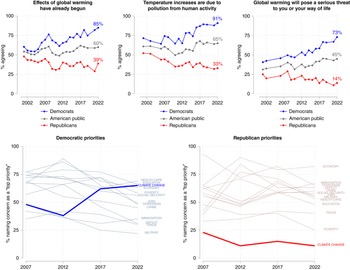
Figure 2 illustrates how this partisan divide is reflected in US public opinion. The top panel depicts Americans’ climate-change attitudes as measured by three Gallup survey items since 2001. The gaps in mean opinion on whether climate change is occurring, why it is happening, and if it represents a near-term threat have grown dramatically over two decades. Because increasing belief and concern among Democrats have been balanced by declines among Republicans, aggregate opinion change about climate has stalled. The bottom panel displays Pew Research Center data since 2007 about the extent to which partisans prioritize climate change relative to other salient policy problems. The proportion of Democrats naming climate as a “top priority” has risen, whereas Republicans consistently have relegated climate change to last place.
US Public Opinion on Climate Change
Top panel: Opinion on the existence, cause, and threat of climate change, 2001–2022. Source: Gallup. Bottom panel: Prioritization of climate change among 13 public problems, 2007–2022. Source: Pew Research Center.

Another key aspect of polarization is increasing within-party homogeneity. The shaded areas in figure 1 display the 10th- to 90th-percentile ranges of scores among partisans in Congress. Whereas both parties once had representatives who regularly voted against their party majorities on climate change, those departures now are extremely rare. Moreover, among the mass public, figure 2 shows that partisan attitudes have reached the point of near unanimity: Democrats are nearing consensus on the belief that climate change is real and human caused, whereas Republicans overwhelmingly resist treating the problem as an urgent priority. The Democrats’ increased coherence on climate change has come with newfound motivation to meaningfully address the problem.
PARTISAN DIVISION AND CLIMATE-CHANGE DEADLOCK
Republican opposition has been the largest obstacle to the establishment of meaningful and enduring policy to reduce US greenhouse gas (GHG) emissions. Although efforts to build a cross-party coalition in Congress once held promise, the hope for bipartisan legislative action faded as polarization took hold and climate denialism became more entrenched in the GOP (Mildenberger Reference Mildenberger2020).
Yet a lack of cohesion within the Democratic Party has been an additional contributing factor to legislative inaction. Nowhere was this more evident than in the party’s failure to pass the American Clean Energy and Security Act (known familiarly as Waxman–Markey) in the first two years of the Obama administration, when the party controlled the presidency, House, and Senate. The bill, which would have established a national cap-and-trade emissions program, encountered resistance from Democrats aligned with labor and those representing carbon-intensive constituencies. The House passed the bill only by winning over Republican votes: more than one of every six Democratic caucus members voted against it. In the Senate, negotiations focused as much on accommodating skeptical Democrats as on overcoming Republican resistance. Advocates ultimately were unable to build a winning coalition, and the bill died in 2010.
After the Waxman–Markey failure, federal policy making largely depended on who controlled the White House. President Obama bypassed Congress via executive action, setting limits on carbon pollution from power plants, raising vehicle fuel-economy standards, and mandating GHG emissions cuts in government operations. Republican President Trump not only overturned many Obama-era policies but also moved to weaken climate expertise and capacity throughout federal agencies. After reclaiming the White House for the Democrats, President Biden used his first day in office to issue executive orders reversing course on many of Trump’s energy and climate policies and starting the process to rejoin the Paris Climate Agreement.
At the state level, increasing Republican antagonism to climate action has spurred policy retrenchment in states that had been early climate leaders (Stokes Reference Stokes2020). The 1990s and early 2000s witnessed a wave of state-enacted policies to promote clean energy and reduce GHG emissions, often with support or even leadership from Republican state officials. Growing opposition to these laws from industry and advocacy groups has led several Republican-led states to roll back these programs. Similar to the federal level, changes in party control of state government often have been followed by changes in climate policy and participation in federal climate initiatives (Basseches et al. Reference Basseches, Bromley-Trujillo and Boykoff2022). Thus, partisan division overlaid with multilevel decision making has served primarily to reinforce climate-policy inaction.
PATHWAYS FOR CLIMATE PROGRESS
Much of the scholarly work on the consequences of climate-change polarization in the United States rightly focuses on gridlock and inaction. Here we highlight three recent developments that have potential to bring about meaningful policy change even as polarization persists.
Partisan Cohesion and Democratic Initiative
The failure of Waxman–Markey represented the high-water mark of the Democratic Party’s fractionalization on climate change. Since then, conflict between unions and environmental groups within the Democratic coalition has declined (Karol Reference Karol2019). The growing prominence of environmental-justice and youth climate groups also has highlighted linkages between climate and civil rights, an area of traditional Democratic concern. Democratic lawmakers’ votes and Democratic voters’ attitudes demonstrate this heightened intraparty consensus (see figures 1 and 2), reflecting the ways that party elites and mass partisan priorities influence one another (Barberá et al. Reference Barberá, Casas, Nagler, Egan, Bonneau, Jost and Tucker2019; Levendusky Reference Levendusky2010).
Rising cohesion on climate change within the Democratic Party may be attributable in part to strategic choices made by advocacy groups. They took lessons from the cap-and-trade defeat to focus more strongly on outside lobbying, directed at mobilizing the concerned public instead of persuading unconvinced officeholders (Hadden Reference Hadden2017). Cohesion also reflects changes in party composition as the Democrats trade seats they once held in areas with carbon-reliant economies for districts populated by educated professionals whose livelihoods are less affected by a clean-energy transition.
The growth in cohesion among Democrats has elevated climate as a party priority and increased the cost of internal defections, expanding the scope of actions that are possible when the party has unified government control. The Democrats’ successful passage of the 2022 Inflation Reduction Act (IRA), coming slightly more than a decade after Waxman–Markey, demonstrates how the party’s approach has changed. Rather than trying to enlist Republicans, advocates of the IRA labored to secure the support of every Democrat in what were ultimately party-line votes in the House and Senate. With party loyalties in the upper chamber split 50–50, securing the vote of Senator Joe Manchin (D–West Virginia)—who represented one of the nation’s most coal-dependent states—was critical to the bill’s passage. Manchin extracted concessions that environmental-justice groups opposed, but the coalition remained intact to enact the most consequential US federal law addressing climate change to date (Plumer and Friedman Reference Plumer and Friedman2022). Both Manchin’s vote and the compromise by progressives are evidence of the Democratic Party’s newly cohesive focus on meaningful climate action and its willingness to take electoral risks. When Democrats have political control, they are now more likely to prioritize climate change and to use tools such as budget reconciliation to circumvent veto points in enacting climate policies.
Clean-Energy Expansion in Republican States
Although recent climate policy making in the states has not followed the same strict partisan lines as at the federal level, the most ambitious policies nevertheless have received little if any Republican backing (Marshall and Burgess Reference Marshall and Burgess2022). Moreover, political leaders in many Republican-dominated states have enacted policies explicitly intended to stall the clean-energy transition (Basseches et al. Reference Basseches, Bromley-Trujillo and Boykoff2022).
Yet focusing only on state-policy activity obscures a different landscape on the ground. Republicans’ ideological misgivings notwithstanding, currently 38% of the nation’s operational clean-power capacity is situated in just four solidly GOP states geographically congenial to wind- and solar-power production: Iowa, Kansas, Oklahoma, and Texas.Footnote 1 This is not merely a legacy from the era when polarization was less severe: Texas led the nation in new wind and solar development in 2021, adding more than two-and-a-half times the clean-energy capacity installed by second-place California.
Increasing cohesion among Democrats has expanded the scope of climate action when the party is in power. In Republican places, growth in clean energy and climate risk may spur policies that support renewable energy and reduce harm from extreme weather, even without recognition of climate change as a driver.
For now, leading GOP politicians have cast their lot with fossil fuels, using renewable energy as a scapegoat for energy-grid vulnerabilities (Hawes and Nowlin Reference Hawes and Nowlin2022). However, as has long been the case for fossil fuels, the localized nature of the clean-energy boom is creating geographically concentrated interests of firms and employees. They have incentives to direct their ballots, lobbying efforts, and campaign donations to advance climate-related spending, investment, and regulations (Lee Reference Lee2020). These workers and business owners are largely represented by Republicans, who increasingly will have to weigh their constituents’ economic interests against the GOP’s climate-skeptical agenda when they cast votes and write budgets.
Partisan Distribution of Climate Impacts
Political attention to climate change in the United States thus far has focused mostly on mitigation policies, which are aimed at reducing GHG emissions to limit global warming. However, as the effects of climate change are becoming more visible and immediate, attention is turning to adaptation policies designed to forestall and ameliorate the harm caused by climate-change–related impacts.
For two reasons, the politics of climate adaptation may not exhibit the same degree of polarization as that of mitigation. First, politicians can promote—and claim credit for—risk-reduction projects without attributing the need for them to climate change (Hai and Perlman Reference Hai and Perlman2022). Although the political economy of disaster preparation does not offer strong incentives for preventive action (Dolšak and Prakash Reference Dolšak and Prakash2018; Healy and Malhotra Reference Healy and Malhotra2009), attitudes about spending on prevention are less partisan than on other forms of climate policy (Bechtel and Mannino Reference Bechtel and Mannino2021).
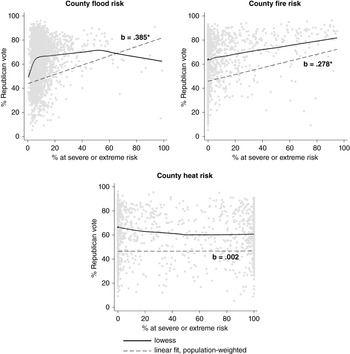
Second, America’s political geography is such that Republican voters ultimately may suffer disproportionately from the climate crisis and therefore stand to benefit more from investments in adaptation. Figure 3 displays the 2020 county presidential vote against the distribution of risks from three major climate impacts—flooding, fire, and heat—as estimated by First Street Foundation, a widely recognized source of climate risk assessment used by insurers, businesses, and government agencies. Relationships between risks and partisanship are shown with smoothed solid lines and linear fits weighted by county population (dashed lines). The relationships between Republican vote and flood and fire risk are strong: GOP counties have much higher percentages of properties at severe or extreme risk during the next 30 years. Republican voters and GOP leaders will have increasing incentive to join Democrats in reducing the damage caused by floods, fires, extreme heat, and intense storms—even if they deny the extent to which these disasters are attributable to climate change. In hurricane-prone Florida, for example, Republican governor and presidential contender Ron DeSantis has committed billions to wetlands restoration and flood resilience—while also blocking any state or local policy initiative for emissions reduction and studiously avoiding any mention of climate change. An approach like DeSantis’s will disappoint many climate advocates, but it suggests that a nation that cannot unite for climate mitigation might still come together to protect against climate impacts.
Partisan Distribution of County Climate Risks
Percentage of county properties at severe or extreme 30-year risk for flood, fire, and heat, by county Republican 2020 presidential vote (Alaska and Hawaii omitted). *p<0.05. Sources: MIT Election Data and Science Lab; First Street Foundation

CONCLUSION
Partisan division in the United States is a crucial barrier to meaningful political action to address climate change. Among both masses and elites, the two parties have grown only farther apart, even as evidence of the climate crisis mounts. But the past need not necessarily be prologue. Increasing cohesion among Democrats has expanded the scope of climate action when the party is in power. In Republican places, growth in clean energy and climate risk may spur policies that support renewable energy and reduce harm from extreme weather, even without recognition of climate change as a driver. These developments suggest that government responses to the climate crisis at the federal and state levels are possible even as American politics and policy making remain firmly in polarization’s grip.
ACKNOWLEDGMENTS
The authors are listed in alphabetical order and contributed equally to this work. We thank symposium editors Jennifer Hadden and Aseem Prakash for their helpful feedback.
DATA AVAILABILITY STATEMENT
Research documentation and data that support the findings of this study (Egan and Mullin Reference Egan and Mullin2023) are openly available at the PS: Political Science & Politics Harvard Dataverse at https://doi.org/10.7910/DVN/CFJRTX.
CONFLICTS OF INTEREST
The authors declare that there are no ethical issues or conflicts of interest in this research.



 Open access

