

1. Introduction
This paper deals with gender assignment in six North Scandinavian languages, looking mainly at gender variation and how various factors contribute to gender change. The gender systems of Scandinavian languages range from the three-gender system of Old Norse (preserved in Icelandic, Faroese, and some Mainland Scandinavian varieties) to the two-gender systems that have evolved in Danish, Standard Swedish, some dialects of Norwegian, and some Swedish dialects. In this study, we focus on gender assignment in six three-gender language varieties of North Scandinavian. We identify the factors that make it more likely for a lexical item to change gender and describe how gender assignment has changed from one variety to another. As a starting point, we take two lesser-known North Scandinavian varieties spoken in Sweden, Jamtlandic and Elfdalian, and compare them to Nysvenska (the variety of Swedish spoken in 1526–1880), Norwegian Nynorsk, Old Norse, and Old Swedish.
We focus on instances where gender assignment in a cognate set is different between the language varieties, using these instances to make generalizations about the assignment principles at work in these varieties. Thus, a diachronic perspective allows us to shed light on synchronic gender assignment principles in the Scandinavian languages. While some studies exist on gender assignment in individual Scandinavian languages (Steinmetz Reference Steinmetz and Faarlund1985; Källström Reference Källström1995; Trosterud Reference Trosterud2001, Reference Trosterud2006), this is the first in-depth study to take a comparative approach.
We begin, in section 2, by presenting the theories of language change and gender assignment on which we base our work. In section 3, we give a brief background on the languages that figure in our study. In section 4, we discuss our hypothesis and method, including data compilation and coding. Section 5 gives an overview of the general patterns and gender distribution of the data. In sections 6 through 10, we discuss each of the various factors that influence gender assignment in our material. In section 11, we present a brief conclusion. The paper is accompanied by four appendices available at [https://github.com/gerdcarling/gendernorthscandinavian]: Appendix A gives the full set of data used in the study, in the form a wordlist coded for cognacy and status. Appendix B explains abbreviations used in this wordlist, and appendices C and D give results from the statistical tests, which are described in further detail in the study.
2. Theoretical Background
Gender of nouns is reflected as agreement on associated words (Corbett Reference Corbett1991:1). This agreement can occur on articles, verbs, possessives, adjectives, demonstratives, pronouns, numerals, adverbs, adpositions, and complementizers (Corbett Reference Corbett1991:106–113). In this study, we focus on gender assignment, or the principles by which nouns receive a gender. Gender assignment is generally determined either by semantic, morpho-logical, or phonological principles; or by a combination of these. However, all gender systems have a semantic core (Corbett Reference Corbett1991:8). Morphological and phonological assignment principles are usually referred to as formal assignment (in contrast to semantic assignment). Some languages (such as Tamil) have predominantly semantic assignment, while others (such as Russian) assign gender based on morphological principles. Still other languages have predominantly phonological assignment principles. The Scandinavian languages assign gender based on a combination of semantic and formal principles, with the strongest assignment principles revolving around the semantic core of biological sex (nouns denoting human males are masculine, and nouns denoting human females are feminine).
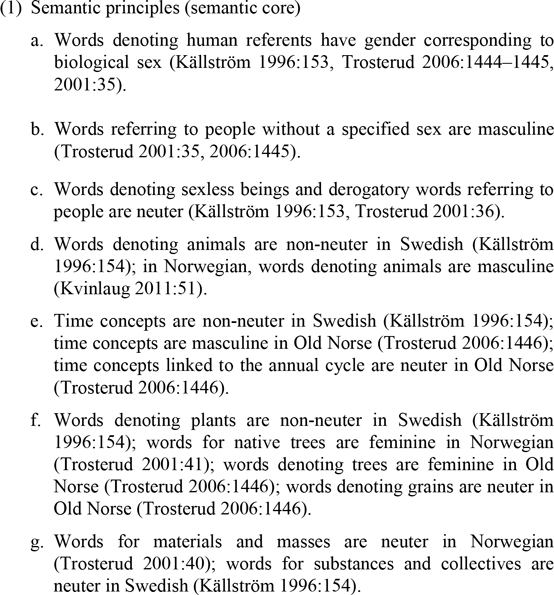
In the literature, gender assignment is typically described in terms of rules, even though tendencies would be a more appropriate term. Gender assignment in general, as well as in our data, is highly variable and diverse, both synchronically as well as diachronically. Very few observed tendencies are exceptionless and would be seen as rules in the Neo-grammarian sense. While various assignment tendencies in Scandinavian are widely recognized in the literature (especially, the tendency to assign gender based on the semantic core and derivational suffixes), gender assignment for large parts of the lexicon is not transparent, though attempts to propose a set of gender assignment rules have been made (Steinmetz 1985, Källström Reference Källström, Kjartan, Ruth and Torp1996, Trosterud Reference Trosterud2001, Reference Trosterud2006). Some of the recognized assignment tendencies that are somewhat well established are listed in 1 and 2.
(1)

(2)
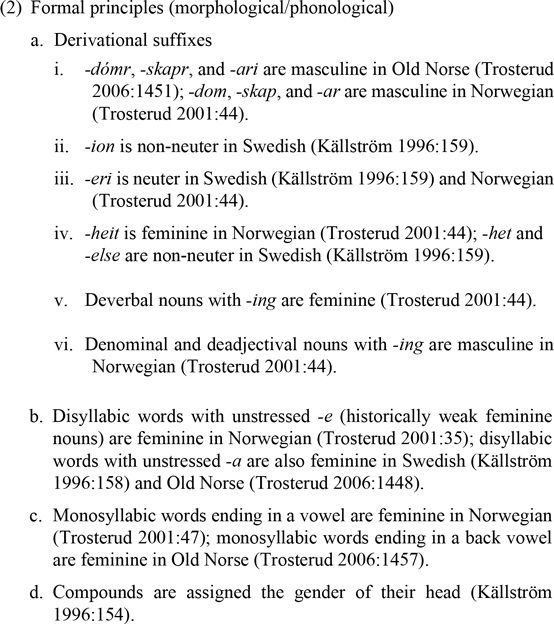
The lists in 1 and 2 show that gender assignment in the Scandinavian languages can be motivated by a variety of semantic and formal principles. While it may not be possible to predict gender for the entire lexicon in these languages, it is still useful to investigate patterns that may exist in gender assignment.
Information is abundant on general differences in gender assignment principles in related languages (Corbett’s Reference Corbett1991 volume contains several examples of this), and some smaller comparative studies on Scandinavian languages exist (Steinmetz 1985, Enger Reference Enger, Dammel, Kürschner and Nübling2010). However, to our knowledge a quantitative analysis using cognate sets has not been attempted. This approach is necessary in order to compare the gender systems of closely related varieties that seem nearly identical on the surface. Our approach allows us to capture specific instances in which gender assignment has changed, and the analysis of various linguistic and extralinguistic factors allows us to pinpoint the causes of these changes and the general trajectory of development of these gender systems. Taking a close look at gender in one language family can contribute to the typological and grammatical study of gender (Matasović Reference Matasović2004:17). In particular, for the Scandinavian language family it should reveal some trajectories for the development of gender assignment within the language family.
3. Background on Six North Scandinavian Language Varieties
In this section, we introduce the six varieties, which we focus on in our article: Old Norse, Norwegian Nynorsk, Old Swedish, Nysvenska, Jamtlandic, and Elfdalian. We also describe the nominal system for each variety. These varieties have different statuses: Whereas the first four are regarded as “languages”, Jamtlandic is traditionally regarded as a “dialect”. Elfdalian has a more complex status: Traditionally considered a dialect, it has now been partially recognized as a language distinct from Swedish (Nyström & Sapir Reference Nyström and Yair2018). In reality, the mainland Scandinavian languages form a dialect continuum, and whether a variety is considered to be a language or a dialect is often based on political considerations rather than on linguistic differentiation. However, this division has practical implications, as languages (especially in the European context) are usually more clearly defined and much better described than dialects. Hence, our description is subject to limitations due to this division.
A challenge arises when one attempts to divide languages into different historical periods, in particular, when older stages are un-standardized and constitute heterogeneous language structures, with variation due to geography, age, and social class. Our picture may not be reliable when records of a language stage are scarce.
The six varieties in this study were chosen as follows: Jamtlandic and Elfdalian—varieties of Swedish with a three-gender system—were chosen as the point of comparison for the other four varieties. We chose Norwegian as a neighboring language to Jamtlandic and Nysvenska as the older, three-gender version of the standard variety that underlies the dialect of Jamtlandic. Old Norse was included as the oldest attested language of the North Scandinavian family and the ancestor to all of the above varieties, and Old Swedish was included for comparison to Old Norse and Nysvenska. We could have included some other three-gender varieties, such as Modern Icelandic and Faroese, but we omitted these in order to constrain the size of the project. We discuss the six languages and varieties referred to above in this section.
3.1. Old Norse and Norwegian (Bokmål and Nynorsk)
In mainstream research, the term Old Norse is generally used to refer to Old Nordic in a broad sense, including all North Germanic languages and dialects of the High Middle Ages. We follow the tradition of mainstream research and refer to the variety in our study as Old Norse, though available sources mainly cover Old Icelandic.
After the Old Norse period, which ended around 1100, the Scandinavian languages can be said to be divided into four main groups: Old Norwegian-Icelandic (which constitute Old West Norse), Old Gutnish, Old Danish, and Old Swedish (which constitute Old East Norse). In reality, the Scandinavian languages constituted a dialect continuum, and its division into languages is somewhat arbitrary (Ottosson Reference Ottosson2005:788–789). We treat Old Norse as the ancestral language to the other languages in our material. However, the term Old Norse more accurately denotes Old West Nordic (that is, Old Icelandic and Old Norwegian, spoken from around 1100 to the mid-14th century), with an emphasis on Old Icelandic due to its massive literary corpus (Ottosson Reference Ottosson2005, Schulte Reference Schulte2005:873). Because Old West Nordic is more conservative than Old Swedish, it can be considered to be an approximation of Old Norse (that is, the language ancestral to Old Swedish, Nysvenska, Norwegian, Jamtlandic, and Elfdalian), although technically the periods for Old West Nordic and Old Swedish overlap to a certain degree.
Nouns in Old Norse inflect for case, number, and definiteness. Old Norse also maintains the three-gender system of Common Scandinavian (Kristoffersen Reference Kristoffersen2005:911). On formal grounds, nouns are traditionally divided into strong (stem ending in vowel) and weak (stem ending in consonant) declensions, and further into inflectional classes based on their ending in the accusative plural (Haugen Reference Haugen2015:57–74).Footnote 1 Gender, number, and case are also marked on adjectives in Old Norse, due to agreement with the noun they modify. Adjectives, like nouns, can have strong and weak inflections (Iversen Reference Iversen1946:70–77, Faarlund Reference Faarlund1994:50–51, Kristoffersen Reference Kristoffersen2005:916, Haugen Reference Haugen2015:82–93).
Old Norse personal pronouns and possessive pronouns also have three genders, four cases, and three numbers. In addition, case and gender can be seen in inflections on quantifiers and demonstratives, which agree with the nouns they denote, anaphorically or cataphorically. Details on pronoun, quantifier, and demonstrative paradigms are not given here; interested readers are directed to relevant studies (Iversen Reference Iversen1946:86–97, Kristoffersen Reference Kristoffersen2005:919–920, Haugen Reference Haugen2015:94–98).
Let us now turn to Norwegian. Present-day Norwegian is characterized by significant dialect diversity in the spoken language. This is a result of the political and linguistic situation in Norway: From 1380 until 1814, Norway was under Danish rule, and the Norwegian written language was replaced by Danish in the 16th century. Because Danish was used as the written standard, the Norwegian dialects were free to develop on their own without the pull of a written Norwegian variety (Askedal Reference Askedal1994:219–220).
In the mid-19th century, after Norway separated from Denmark, two written standards were developed in Norway. These can be regarded as two “written dialects” of one language: Bokmål, a reformed version of Danish, where some regular phonological differences, inflectional, as well as lexical and idiomatic features from spoken Norwegian became reflected in the written form; and Nynorsk, a written standard introduced by Ivar Aasen, based on rural dialects of Norwegian. In Norway, each municipality can choose whether to use Nynorsk, Bokmål or be neutral as to the standard that is written and taught at schools. Bokmål is the standard of the capital Oslo and is used by a majority of the population. For this reason, the Nynorsk standard, as well as the spoken dialects, is gradually changing under the influence of Bokmål (Askedal Reference Askedal2005:1584–1585).
The nominal paradigms in the Bokmål and Nynorsk varieties are largely similar, with the notable exception that in Bokmål the three-gender system is optional (otherwise, a two-gender system is used). In Nynorsk, the three-gender system is not optional. Gender is marked on definite and indefinite articles, possessive pronouns, anaphoric pronouns, and adjectives. Additionally, genders are differentiated in the inflectional paradigms, as in the other gendered varieties (Faarlund et al. Reference Faarlund, Lie and Vannebo1997:149–151). We chose to focus on Nynorsk in this study due to its better-preserved three-gender system. The term Norwegian throughout the remainder of the study thus refers to the Nynorsk standard. Gender can vary between spoken Norwegian dialects, and in written Nynorsk gender usage may vary according to speaker’s variety (Braunmüller Reference Braunmüller, Unterbeck, Rissanen, Nevalainen and Saari2000:43). This results at times in multiple genders in the entries for nouns in Nynorsk dictionaries, which complicates our analysis of this variety.
3.2. Old Swedish and Nysvenska
Old Swedish is divided into two periods: Classical or Early Old Swedish, spoken between approximately 1225 and 1375, and Late Old Swedish, from around 1375 to 1526. The outset of the Old Swedish period coincides with the Older Law of Västergötland, which is the first written document in Swedish using the Latin script, and the end of this period coincides with the translation of the New Testament into Swedish. At this stage, Swedish was still a highly inflectional language. The phonological distinction between Eastern and Western Nordic varieties increased during the Early Old Swedish period, with a southern (that is, Danish) and an eastern center of innovations (Wessén Reference Wessén1955:51ff., Bandle Reference Bandle1973:110ff., Schulte Reference Schulte2005:876). Whereas Early Old Swedish shows a relatively stable inflectional system, Late Old Swedish shows a strong simplification that is believed to have been strengthened by contact with speakers of Low German (Wessén Reference Wessén1970, Jahr Reference Jahr2001:28).
Old Swedish has a nominal paradigm that is nearly identical to that of Old Norse, with minor phonological changes in the inflectional endings. For instance, the Old Norse strong masculine nominative ending -r is extended by a svarabhakti vowel to become -er in Old Swedish, and the weak neuter nominative/accusative ending -u becomes -un. For a more in-depth description of Old Swedish inflection, see Wessén Reference Wessén1955:94–106.
The version of Swedish that we discuss in this paper is Nysvenska, spoken from around 1526 to around 1880. Footnote 2 The Nysvenska period began with the printing of the Gustav Vasa Bible in 1526, and ended around 1880. The development of the Swedish language that occurred during this period was mostly due to the political and social centralization of Swedish society in and around Stockholm. During the time of great power (Stormaktstiden) from 1611 to 1718, Swedish culture flourished, Stockholm grew as a capital, and the language of the nobility was able to spread. Likewise, dialectal speech began to be seen as distinctively low-status. The advent of writing in Swedish strengthened the position of the standard language (Larsson Reference Larsson2005:1270–1271).
The three-gender system in Nysvenska surfaced in a manner similar to present-day Norwegian: on definite and indefinite articles, possessive pronouns, anaphoric pronouns, and adjectives. However, the Nysvenska period was characterized by gradual changes in the grammatical case and gender system. In a process that began in the early 16th century, the masculine and feminine slowly merged into a “common” gender. This left Swedish with a caseless two-gender system by around 1880 (Davidson Reference Davidson1990, Enger Reference Enger2005, Larsson Reference Larsson2005:1275). By putting 1880 as the limit for Nysvenska, we target a language that has preserved, as a rule, the three-gender system of Old Swedish. This means that later changes and the emergence of the common gender are not accounted for in our corpus.
3.3. Jamtlandic and Elfdalian
The province (landskap) of Jämtland, with an area of 34,009 square kilometers, has significant interdialectal variation, where four different dialect groups have traditionally been distinguished: North Jamtlandic, West Jamtlandic, Central Jamtlandic, and South Jamtlandic. Oviksmålet, the variety studied here, belongs to the latter group (Pamp Reference Pamp1978:128). Footnote 3 Pamp (Reference Pamp1978) and Wessén (Reference Wessén1960) consider Jamtlandic to be a Swedish rather than a Norwegian dialect, although it shows some commonality with the Norwegian dialects on the other side of the border (Wessén Reference Wessén1960:38). Moreover, Jämtland was under Norwegian rule between the 12th century and 1645. Dalen (Reference Dalen and Imsen2005) concludes that Jamtlandic, together with Trøndersk, constitute traditionally a central Scandinavian regional dialect, which was later influenced from both West (Norway) and South/South East (Sweden).
Elfdalian is spoken in the municipality of Älvdalen in an area of merely 2,492 square kilometers and has minor regional variation and more considerable variation between generations of speakers. It is a member of the Dalecarlian dialect group, and it has traditionally been considered to be a subgroup “Dalmål”. The term Dalmål refers to various dialects of the region Dalarna, which constitute a subgroup of the so-called Sveamål main group of Swedish dialects (Wessén Reference Wessén1960:30–38). However, a more informed view is that Dalecarlian, different from Dalmål, constitutes a separate language group, which split directly from Old Nordic and formed a branch of its own (Reitan Reference Reitan1930, Sapir Reference Sapir, Ostler, Ferreira and Moseley2017). In spite of Elfdalian being regarded as an East Nordic variety, it has several West Nordic features, which are seen by Levander as archaic relicts, which were once common in dialects west of the Kölen mountain range (Levander Reference Levander1925). It should be mentioned that dialect fragmentation in the region of Dalarna has gone the furthest of the entire Nordic language area, resulting in a whole range of varieties that often lack mutual intelligibility (Levander Reference Levander1925).
By around 1750, a centralized Sweden gave rise to a strong standard Swedish language at the expense of the traditional dialects, including Elfdalian and Jamtlandic. Urbanization, obligatory schooling, migration, and mass media in the 19th and 20th centuries changed the demographic division of society, further accelerating the spread of the standard language. Jamtlandic has been influenced by Norwegian dialects and Swedish to a greater degree than Elfdalian. This can be explained by its history, namely, its earlier contact with first Norway and then Sweden through Christianization (around 1000), while Älvdalen, in contrast, is assumed to have been Christianized 200 years later. Elfdalian showed relatively little influence from Swedish until the beginning of the 20th century (Levander Reference Levander1909).
In some respects, Elfdalian is very archaic. For instance, it preserves nasal vowels before nasal consonants omitted in Proto-Norse, as in Proto-Germanic +lamsa- > Old Norse láss > Elfdalian lą̊s ‘lock’ (Kroonen Reference Kroonen2013). Elfdalian has not undergone V-breaking and V-umlaut, as shown in Proto-Germanic +bewwu > Elfdalian begg (compare Swedish bjugg) ‘barley’ (Kroonen Reference Kroonen, Grünthal and Kallio2015). In addition, Elfdalian shares VC and V:C: syllable types with Old Norse, in contrast to most other Modern Scandinavian/Nordic varieties, which only have V:C and VC: types. Its nouns are declined in three cases and its verbs are conjugated in three persons in plural (one in singular). At the same time, Elfdalian shows many innovative linguistic features compared to Standard Swedish, such as the loss of /h/ and the diphthongization of long /i/, /o/, and /u/. Moreover, Elfdalian has been subject to strong Swedish influence ever since the 20th century. In recent years, attempts to preserve and revitalize Elfdalian have been moderately successful. These attempts began taking shape in 1984 and accelerated in 2005. Thus, there is today a generation of children who speak Elfdalian, although their Elfdalian is heavily influenced by Swedish. Moreover, Elfdalian is semistandardized and it is recognized as a language by SIL International, from which it acquired an ISO language code in 2016. Nevertheless, it has not been recognized by the Swedish authorities as a minority or regional language according to the European Council Language Charter (Sapir Reference Sapir, Ostler, Ferreira and Moseley2017:52–53). Although revitalization efforts are not very pronounced for Jamtlandic, a 2004 municipal initiative to introduce Jamtlandic in schools was accepted with moderate enthusiasm among parents and students in Jämtland (SverigesRadio 2011).
Even though both varieties have undergone some morphological simplification, both Jamtlandic and Elfdalian still distinguish three genders (discussed in more detail below). Conservative features can also be found on other linguistic levels, such as in the lexicon, syntax, and phonology (Nyström & Sapir 2018, Van Epps & Carling Reference Van Epps and Gerd2017). The fact that these rural varieties have preserved a richer inflectional system compared with Standard Swedish can be explained by their relative isolation. Simplification of Swedish inflection, driven primarily by contact with Low German speakers, mainly occurred in the cities, from which it subsequently spread to the rest of the country (Jahr Reference Jahr2001, Enger Reference Enger and Siemund2011). Jamtlandic and Elfdalian were isolated enough to withstand inflectional simplification until recent times.
In the Jamtlandic nominal paradigm, three genders are distinguished on articles, possessive pronouns, adjectives, and anaphoric pronouns. There is a two-way distinction for adjectival marking: The masculine and feminine are marked identically, with a distinct neuter form. In table 1, we present the nominal paradigm in Jamtlandic in the singular, as an example of the way gender surfaces in Scandinavian languages. Note that in the paradigm, only the indefinite article and possessive pronoun (agreement markers) are certain indicators of gender.
The nouns and anaphoric pronouns in Jamtlandic (Van Epps & Carling Reference Van Epps and Gerd2017)
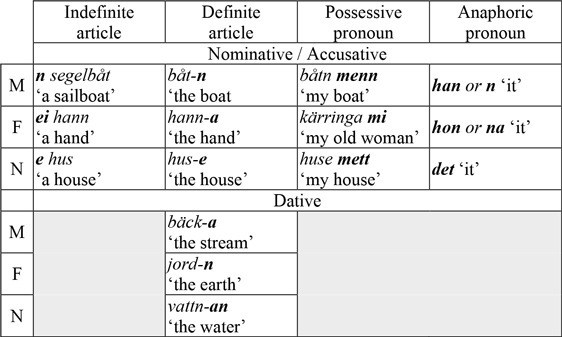
Until recently, Jamtlandic retained remnants of the case system; the dative form was used in singular and plural definite constructions. Today use of the dative is rare and is confined to only a few (mostly elderly) speakers in certain areas of Jämtland. While most speakers still use a three-gender system, influence from the Standard Swedish two-gender system has led to some nontraditional gender agreement (Van Epps Reference Van Epps2013, Van Epps & Carling Reference Van Epps and Gerd2017).
The so-called traditional Elfdalian (spoken by persons born between 1920 and 1940) still distinguishes three genders, with agreement surfacing on definite articles, adjectives, and anaphoric and possessive pronouns (Garbacz & Johannessen Reference Garbacz, Janne, Bentzen, Rosenkvist and Johannessen2015, Nyström & Sapir 2018). Elfdalian also maintains part of the case system (nominative, accusative, and dative; genitive as a case only persists in idioms in Elfdalian). Elfdalian’s three-gender system as well as the case system are, in general, better preserved than these systems in Jamtlandic.
4. Methodology and Data
The quantitative component of this study focuses on the concept of change cognate versus stable cognate. We define change cognate as any set in which the gender varies between the language varieties. Any set in which all languages have matching gender is counted as a stable cognate; this includes sets in which an additional gender is also possible in one language, as in the set arrow (No pil m,f, OSw pil m, Nsv pil m, JL pil m, Elf pil m).Footnote 4
To begin to identify the factors that can contribute to variation in gender assignment, we first looked at which types of words are more likely to show gender variability. We considered morphological factors (Old Norse declension class and Old Norse gender), loan status, frequency, and semantic factors (abstract/concrete, count/mass, and animate/inanimate). Using the program R, we performed a mixed-model regression analysis in which the dependent variable is stability of the cognate set (change cognate or stable cognate), and the independent variables are Old Norse gender, declension type (weak or strong), loan status, frequency in Norwegian and Swedish, and semantic factors (abstract/concrete, count/mass, and animate/inanimate). We set the significance level at p=.05. In the subsections below, we describe the compilation process and organization of the data.
4.1. Field Work and Lexeme List Compilation
A comparative study of our scope requires a broad data set, including lexical items that cover a wide range of semantic fields and phonological patterns. As the basis for our study, we compiled a list of 1,129 cognate sets. We took, as a starting point, the list of concepts found in the World Loanword Database (WOLD) from Haspelmath & Tadmor Reference Haspelmath and Uri2009, which in turn is based on Buck Reference Buck1949. This database is comprised of 1,460 concepts that are divided by semantic field (the semantic classification is from Buck Reference Buck1949). This method allowed us to create a word list with a wide variety of concepts, including both inherited and loan words. The next step was to go through the list, deleting concepts that we judged would be unknown or irrelevant to speakers of Scandinavian languages. For instance, we removed cassava, tapir, manioc bread, and banyan tree. We also removed certain kinship terms that would be clearly assigned a gender semantically (for instance, brother, sister, husband, and wife). The exclusion of these terms does not affect the outcome of statistical tests in our data. Finally, we added some words for modern concepts that did not appear on the original WOLD list. This left us with around 800 concepts to start with.
Our data (see appendix A) have two main sources: field work and dictionaries. To date, there is no dictionary of Jamtlandic that consistently includes information about gender. Therefore, it was necessary for us to do original fieldwork in order to obtain the Jamtlandic lexical items and their genders. We decided to focus on one variety of Jamtlandic (the variety spoken in the Oviken-Myssjö area), rather than attempting to cover multiple subdialects. This decision was made in order to prevent the dataset from becoming unwieldy. In this study, we refer to this language variety as Jamtlandic, although a more precise term would be Oviksmål.
We collected Jamtlandic data from 21 informants from the Oviken-Myssjö area. We met with participants in small groups and went through the word list with them, eliciting the Jamtlandic word and gender for each item on the list. After the elicitation sessions, we reviewed the recordings and entered each Jamtlandic lexical item into a spreadsheet along with its gender. For the other languages, reliable dictionaries exist on which we could base our dataset. We often used a combination of different sources in order to compile as detailed a list as possible.
For Old Norse, we used Heggstad’s Norrøn ordbok (Heggstad et al. Reference Leiv, Hødnebø and Simersen2008), which focuses on Old West Norse. We also used Zoëga’s (Reference Zoëga1910) Concise Dictionary of Old Icelandic. For Norwegian, we used Nynorskordboka from Språkrådet, available online (Hovdenak et al. Reference Hovdenak, Killingbergtrø, Lauvhjell, Nordlie, Rommetveit and Worren2006). This is the first monolingual dictionary for Norwegian Nynorsk, first published in 1986. We also checked the lexical items and genders with a native speaker of Norwegian. For Old Swedish, we used the online resources available at Språkbanken (Borin et al. Reference Borin, Forsberg, Olsson, Uppström, Calzolari, Choukri, Declerck, Doğan, Maegaard, Mariani, Moreno, Odijk and Piperidis2012), which encompasses both Schlyter Reference Schlyter1877 and Söderwall Reference Söderwall1884. Schlyter Reference Schlyter1877 is a dictionary of legal language in Old Swedish. Söderwall Reference Söderwall1884 is a dictionary mainly of literature printed in the collections of Svenska Fornskriftsällskapet [the Swedish Society for Ancient Texts]. For Nysvenska, we used the online version of Svenska akademiens ordbok (1997). This is a historical dictionary of Swedish that covers the Nysvenska and contemporary Swedish periods (from the 1520s up to present day). As such, it lists the gender each lexeme had in Nysvenska, as well as the present-day gender. For Elfdalian, we used the version of Lars Steenslands Älvdalsk ordbok that is available online (Steensland Reference Steensland2010). We also added a few lexemes from fieldwork. We adjusted the orthography from the dictionary to reflect the 2005 Råðdjärum standard orthography for Elfdalian.
In addition, we consulted etymological dictionaries (Hellquist Reference Hellquist1939, Kluge Reference Kluge2002), and the etymological entries in SAOB to track semantic change, and to locate difficult-to-find cognates. We checked each cognate set multiple times to ensure that we did not miss any cognates or partial cognates. The end result was a spreadsheet with 1,129 cognate sets, although many of these sets do not have cognates present in all of the varieties (see table 2 in section 4.3 for further detail).
Number of lexemes and percentage of missing lexemes for each language variety under study

The complete data, obtained in the course of field work and from dictionaries, are given in appendix A. In setting up the lists, a substantial portion of the information was obtained from dictionaries. We are aware that this method has its shortcomings: The data on the lists are dependent on the presence or absence of particular lexemes in the dictionaries.
4.2. Organization of the Data: Cognacy and Other Factors
We organized the data by cognate sets (appendix A), rather than by meaning, so that we could track gender shifts and semantic changes over time. A cognate can be defined as a grammatical or lexical morpheme that shares similarities in its phonemic structure with a morpheme in another language and that depends on shared ancestry (Carling Reference Carling2019:180ff.). These may or may not have the same meaning, as partial or complete semantic shifts may occur between languages (Urban Reference Urban, Bowern and Evans2014). We made notes of all semantic shifts in our data, that is, we marked the lexemes that had a semantic meaning different from the majority of lexemes.
In order to maximize the information about each set, we included partial cognates when full cognates were not available. Most of our data reflect “cognate traits” instead of “root meaning traits” (Chang et al. Reference Chang, Cathcart, Hall and Garrett2015:201–202); cognate forms were included even if a shift in meaning had occurred, which also includes derivation by compounding. This means that we included forms that share a root but are not fully cognate (they contain different derivational suffixes). For these forms we would expect the gender to vary according to the derivational suffix, and we included and coded these forms specifically to investigate the effects of different derivations. For instance, different derivational suffixes are found in adultery (No utruskap m, OSw otrohet f, Nsv otrohet f, JL otroheit f) and doubt 2 (ON úvísleikr m, No uvisse f, OSw ovisselikhet f, Nsv ovisshet f, JL ovissheit f). Likewise, in cases of compounds we included the head (that is, the last member) of the compound for the varieties in which we could not locate the full compound, as in earwax 1 (No øyrevoks m,n, OSw vax n ‘wax’, Nsv öronvax n, JL örvaks n, Elf waks n ‘wax’) and eyebrow (ON brún f, OSw brun f, Nsv ögonbryn n, JL öugbryn n, Elf ogenbråyn n). In addition, there are a few instances in which the head of the compound is the same, but the nonhead is different, as in driver’s license (No førarkort n, Nsv körkort n, JL körkort n, Elf tjörkuort n). In both of these cases, we would expect the gender to be consistent across the language varieties, since gender in Scandinavian compounds is determined by the head of the compound (Källström Reference Källström, Kjartan, Ruth and Torp1996:154).
We did not code compounding as derivation; derivation is used for suffixation only. However, in case of compounds the notion of meaning shift is tricky; semantic variation may depend on derivation due to compounding. In such cases, we used the concept word and the Swedish dialects as a basis and marked semantic change only if the change targets the head word. An example is spider web/fabric (Old Norse kǫngurváfuvefr ‘spider web’, Norwegian vev ‘web’, Old Swedish väver ‘web’, Nysvenska väv ‘web’, Jamtlandic kongrovev ‘spider web’, Elfdalian wev ‘web’). The Old Norse and Jamtlandic forms are compounds with the same meaning, whereas the other terms are noncompounds with the meaning ‘web’. None of the ‘web’ words were marked as semantically changed, since the meaning of the head word is unchanged.
Basing our data on a looser definition of cognate traits, as described above, allows us to explore many more potential causes of gender change than would have been possible using a strict cognacy model (that is, excluding compounds and suffixations).
Furthermore, we used semantic factors to organize our data. In particular, we added columns for semantic factors that might influence gender assignment: animate/inanimate, concrete/abstract, and mass/count (for an explanation of the motivation for these factors, see section 10). We added a column for Old Norse declension (for sets that included an Old Norse cognate) in order to investigate the effects of noun declension on likelihood of gender change, and in order to more effectively explore the diachronic changes from Old Norse to the other language varieties (see sections 5, 6.1, and 6.2).
We also coded frequency data for lexical items in contemporary Swedish (to approximate frequency in Nysvenska and Jamtlandic) and Norwegian. For Swedish, we used Allén’s Nusvensk frekvensordbok (Allén Reference Allén1970), and for Norwegian we used Vestbøstad’s Nynorsk frekvensordbok (Vestbøstad Reference Vestbøstad1989). We analyzed frequency data in order to determine whether the frequency of lexical items had any effect on their likelihood to change gender (see section 7).
In addition, we added a column indicating whether each lexical item was an inherited Scandinavian word or a loan from outside the Scandinavian language family. These data were used to determine whether external loan status has any effect on a lexeme’s likelihood to change gender (see section 8). To determine loan status, we consulted three etymological dictionaries: Hellquist’s etymological dictionary of Swedish, Kluge’s Germanic etymological dictionary, and Torp’s etymological dictionary of Norwegian (Hellquist Reference Hellquist1939, Kluge & Mitzka Reference Kluge and Walther1960, Torp Reference Torp1919). For this study, we classified as a loan any word that is not an inherited Scandinavian word. This includes words that were borrowed into Old Norse from another language family and passed down through the Scandinavian languages. In this study, we do not look at so-called internal loans, that is, loans from within the Scandinavian language family. This is because it can be difficult to identify intra-Scandinavian loans, especially in the case of borrowings from standard languages into nonstandard varieties. Additionally, the gender assigned to internal loans would presumably be influenced to a large degree by the lexeme’s gender in the donor language (since the phonological structures and gender systems of these languages are very similar). Thus, treating intra-Scandinavian loans would require a different type of analysis and is outside the scope of this paper.
4.3. General Patterns and Gender Distribution
Our word list contains 1,129 cognate sets. Of these, 832 contain lexemes that match in gender, and 297 do not; thus, 73.7% of cognate sets are gender matches, and 26.3% are not. Table 2 shows the distribution of lexemes among the languages, along with the percentage coverage of the data for each language.
To get a general idea of the distribution of the data, we calculated the gender distribution for each of the six language varieties in our study. While there is some variation, the overall gender distribution is very similar. Since 26.3% of the cognates have variability in gender assignment, this likely indicates that all genders have lost and gained members since the Old Norse and Old Swedish periods. For instance, in anvil, ON m changes to n (ON steði m, No ste n, OSw stæþ n, Nsv städ n, JL ste n, Elf smiðsteð m), while in honey, ON n changes to m (ON hunang n, No honning m, OSw honagh n,m, Nsv honung m, JL honung m, Elf onungg m).
Gender distribution (percentages) for each language variety under study

The percentage of masculine gender ranges from 38.3% to 45.9%, while the range for feminine gender is 27.4%–32.1%, and the range for neuter is 22.5%–28.2%. Notably, Old Norse is the only variety in which neuter gender outranks feminine gender. Interestingly, Old Swedish and Nysvenska have the highest percentage of feminine gender nouns, although Swedish was destined to lose feminine gender by the late 19th century. In sections 5–10, we discuss the results of the mixed model analysis and dive deeper into the effects of each of these factors on gender assignment.
5. Development of Old Norse Gender and Declension
In this section, we discuss the complex relationship between gender, inflectional class, and the associated phonological endings. We take Old Norse as a starting point, looking at the likelihood of gender change for nouns of each gender and declension class. We then describe the development of Old Norse weak masculine and weak feminine endings in each of the daughter varieties, since these still indicate gender to some degree. Finally, we take a closer look at the specific instances of change for each gender/declension class type to see if we can uncover any patterns in these changes.
5.1. Results of the Mixed Model Analysis
In the Scandinavian dialects, the three-gender systems collapsed into two-gender systems along different pathways. In Danish and Swedish, feminine and masculine fell together, as a result, among other factors, of the quantity change of the unstressed length opposition between -in(f) and -inn(m), which were conflated into -en. The dialects that underwent nasalization (-in > -ã > -a) before the loss of the length opposition preserved the three-gender system. The dialects that lost the opposition without undergoing nasalization, such as standard Danish (including Bokmål) and Swedish, lost the feminine. These languages, and possibly also the dialects under influence of the standards, generally changed feminine to masculine. In Norway, the tendency of automatically changing feminine to masculine was weakened by the position of Nynorsk and Radical (that is, Norwegian-influenced) Bokmål, and likely also governed by semantic and pragmatic features (see Beito Reference Beito1954, Korsæth Reference Korsæth2010). Additionally, as indicated by previous research (Thelander Reference Thelander1975, Rabb Reference Rabb2007, Van Epps & Carling Reference Van Epps and Gerd2017), the feminine gender is more susceptible to change, compared to the masculine gender, in three-gender dialects of Swedish. This is a variation that is observable in the synchronic material, including sociolectal aspects of language use.
With these processes in mind, we generally expect the feminine to have higher instability both synchronically as well as diachronically. Hence, we assume that the lexemes, which have feminine gender in Old Norse, would be more likely to have a different gender in the modern Scandinavian language varieties. In our material, 35.5% of feminine Old Norse nouns, 20.6% of masculine nouns, and 24.6% of neuter nouns have changed their gender.Footnote 5 With masculine gender as the reference level, the effect of Old Norse gender in our model is significant for feminine gender (p=.021) but not for neuter gender (p=.689). This makes sense in the context of the general tendency of gender change in the Germanic languages, in which the masculine gender expands at the expense of the feminine gender (Thelander Reference Thelander1975, Audring Reference Audring, Hüning, Vogl, van der Wouden and Verhagen2006a, Kraaikamp Reference Kraaikamp2017, Van Epps & Carling Reference Van Epps and Gerd2017).
Crosslinguistically, inflectional class is often a good predictor of gender (Corbett Reference Corbett1991:34–50). In particular, declension classes have been shown to predict gender in the Scandinavian languages to a large degree (Källström Reference Källström, Kjartan, Ruth and Torp1996, Trosterud Reference Trosterud2001, Reference Trosterud2006). The relationship between gender and declension is complex; the two are very much interwoven and influence each other (Enger 2001:175–176, Reference Enger2004a). When we look at the effect of weak versus strong declension on the likelihood of gender change, we find a significant difference between strong masculine nouns (our reference level) and strong feminine nouns (p<.001).Footnote 6 There is also a significant effect for weak masculine nouns, though to a lesser degree (p=.042). We do not find a significant difference for the other declension class types (strong neuters, weak feminines, and weak neuters). Table 3 shows the numbers and percentages of change cognates for weak and strong nouns of each gender.
Numbers and percentages of change cognates for weak and strong nouns of each gender in Old Norse

Strong feminine nouns show the highest percentage of change cognates. This is to be expected, since these nouns do not have any overt marking in the nominative that indicates feminine gender. The next highest percentage is shown by weak masculine nouns. Weak masculines end in -i in the nominative in Old Norse; these nouns undergo various changes in the subsequent varieties of Scandinavian, which leads to some degree of variation in gender. This shows that it could be worth looking further for any specific patterns within the declension classes to see if lexemes within one declension class type tend to undergo the same kinds of changes. In sections 5.2, 6.1, and 6.2, we look more closely at these categories and the patterns of change that occur within them.
5.2. Development of Weak Masculine and Feminine Nouns
In this subsection, we discuss the development of weak nouns—masculine and feminine—in Old Swedish, Nysvenska, Norwegian, Jamtlandic, and Elfdalian. In Old Norse, -i was the nominative ending for weak masculine nouns (Proto-Norse +an-stems), whereas -a was the ending for weak feminine nouns (Proto-Norse +ōn-stems) and weak neuter nouns (Proto-Norse +an-stems and +jan-stems). In the modern varieties, the correspond-dence of the final vowel to gender in these nouns is no longer as strong as it was in Old Norse and Old Swedish, because the leveling of the case system has eradicated the former declension classes. However, in the modern varieties there is still some correlation between word-final vowels and gender (Trosterud Reference Trosterud2001:35, Van Epps & Carling Reference Van Epps and Gerd2019). In Old Norse, weak masculine an-stems ended in -i (Haugen Reference Haugen2015:70). In Old Swedish, weak masculine +an-stems ended in -i/-e (Noreen Reference Noreen1904:321). Later, in Nysvenska, former weak masculine nouns took an -e ending (Wessén Reference Wessén1955:138). In Norwegian, the weak masculine -i ending and the weak feminine -a ending merged into -e in some cases (exceptions include the dialects of Østlandet and Trøndelag, in which the oblique form is used for jamvektsord; Enger & Conzett 2016:236–237). Later, -e began to indicate feminine gender in Norwegian, though there are still some masculine nouns that end in -e (Enger & Conzett Reference Enger, Philipp, Sandøy̜, Bjordal and Rognes2016:227). In Jamtlandic, weak masculine nouns end in -e, and those with a long vowel can end in either -e or -a (Van Epps & Carling Reference Carling2019).Footnote 7 In Elfdalian, some of the former weak masculine nouns now end in -e; others end in -i or -å (-å is a newer ending for weak masculine nouns with a long vowel, deriving from the oblique case; Levander Reference Levander1909:18, 21; Steensland Reference Steensland2010:17).
An -a ending still indicated feminine gender in Old Swedish (Noreen Reference Noreen1904:314), and in Nysvenska, former weak feminine nouns took an -a ending (Wessén Reference Wessén1955). In Jamtlandic, most former weak feminine nouns end in -e, and a smaller number end in -u or -a. In Elfdalian, -a is the ending for weak feminine nouns with a long vowel, and -å is the traditional ending for weak feminine nouns with a short vowel (however, some nouns take the new ending -u, deriving from the oblique form; Levander Reference Levander1909:29–33). Table 4 below details the development of Old Norse weak masculine and weak feminine nouns for all language varieties under study.Footnote 8
Development of Old Norse weak noun endings in Old Swedish, Nysvenska, Norwegian, Jamtlandic, and Elfdalian

We would expect reflexes of Old Norse weak masculine and feminine nouns to maintain their gender and adopt the final vowel, as predicted by table 4. To determine to what degree these final vowels correlate with gender, we looked at how well word-final vowels in disyllabic nouns correlate with gender in all six language varieties.Footnote 10
We present a table below similar to table 4 above (with the expected vowels), as well as the numbers and percentages of words with word-final vowel that have the expected gender in our material (table 5).
Numbers and percentages of nouns with vowel endings that have the expected gender.Footnote 11
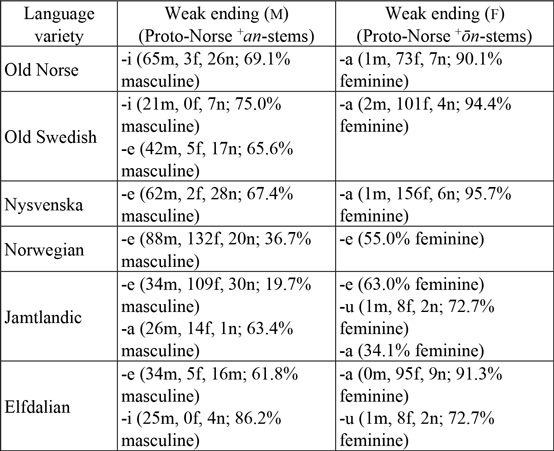
Table 5 may help explain the changes we notice in our data: If a word-final vowel is highly correlated with a single gender, it is plausible that nouns with that final vowel would change their gender to align with the expected gender for that vowel. Overall, the percentages correlate well with the predicted genders. The feminine -a ending in Old Norse, Old Swedish, Nysvenska, and Elfdalian is the one that is most consistently found with the expected gender, with more than 90% of nouns ending in -a having feminine gender in each of these languages.
In Old Norse, the lower percentage of masculine nouns ending in -i (69.1%) is due to 26 strong neuter nouns that end in -i. This is expected, as this is the nominative singular ending for neuter ia-stems in Old Norse (Iversen Reference Iversen1946:50). Overall, the endings that should indicate masculine gender occur with a lower percentage of nouns with the expected masculine gender compared to the feminine endings that occur with feminine nouns. Noteworthy is the situation in Norwegian, in which -e can indicate either masculine or feminine gender (36.7% masculine and 55.0% feminine). However, feminine gender is slightly favored, so it is likely that -e indicates feminine gender unless another factor is present to assign masculine gender.
Based on these findings, one would expect that nouns that acquire an -a ending in Old Swedish, Nysvenska, and Elfdalian could change to feminine if they originally had a different gender. A closer look shows that this is indeed the case: In all of these varieties, every weak masculine noun that changes the -i ending to -a becomes feminine (six lexemes in Old Swedish, ten in Nysvenska, and five in Elfdalian). Some examples are pen (ON penni m, No penn m, OSw pänne m, Nsv penna f, JL penne f, Elf penna f) and lamp or torch 1, danger 2. Additionally, the -i ending in Elfdalian is strongly correlated with masculine gender. A masculine noun ending in consonant should not acquire an -i as a consequence of being masculine, since a word-final consonant is already a marker of masculine gender (see sections 6.1 and 6.2). Nevertheless, it is clear that gender and word-final vowels are correlated (see sections 6.1 and 6.2 for further discussion).
For the other endings, it seems less likely that the gender would change as a result of a phonological change to another vowel. When we look at the development of vowel endings and gender in each language variety, it is evident that this intuition is confirmed. For instance, in Norwegian, 53 weak feminine nouns change the final -a to -e, and 51 of these remain feminine. Likewise, 48 weak masculine nouns modify the final -i to -e, and 47 of these remain masculine. Thus, it seems that -e is not strongly associated with masculine or feminine gender in Norwegian—at least, not strongly enough to cause the gender to change in either direction. In Jamtlandic, -e seems to be a bit more strongly associated with feminine gender: Out of the 24 weak masculine nouns that change -i to -e, nine become feminine. None of the 35 weak feminine nouns that change -a to -e in Jamtlandic become masculine.
6. Patterns of Change: Old Norse/Old Swedish Declension Classes
In this section, we look at each declension class type in detail in order to see what kinds of patterns exist. We focus on situations in which gender change can be correlated with a phonological change.
6.1. Strong Nouns: Masculine, Feminine, Neuter
Let us first consider the nouns that were strong masculines in Old Norse and Old Swedish. Among the Old Norse nouns that take the -r ending in the nominative, 24 out of 197 (12.2%) are change cognates. The strong masculine nouns that do not have the nominative -r ending in Old Norse have more variability in gender assignment in the daughter languages: 27.6% have a different gender than in Old Norse. In one respect, this is to be expected, since they do not have the overt marker of masculine gender. However, the -r ending was lost in Norwegian, Nysvenska, Jamtlandic, and Elfdalian, so the overt marker is no longer there to facilitate main-tenance of masculine gender. The sets of change cognates from the strong masculine noun category can be divided into three main groups, as detailed below.
The first group contains masculine nouns that became feminine in some of the varieties. For these nouns, it is most common that a feminine ending (-a or -e, depending on the language variety) appears in connection with the gender change. An example of this is snowshoe (ON þrjúgr m, No truge f, OSw thro f, Nsv tryga f, JL tryge f, Elf triuoga f). The same change is observed in the cognate sets cat, mouth 3, spindle, rake, doubt 2, button 2, camp 1, fire 2, molar tooth, mule, and bean.Footnote 12 In other cases, the gender changes to feminine without the addition of a word-final vowel, as in in axle 2 (ON ǫxull m, No aksel m, OSw axul m, Nsv axel m, JL aksel f, Elf aksul, aksel m). This change also occurs in cart or wagon and molar tooth.Footnote 13 It is uncertain whether the addition of a vowel causes a gender change, since the gender can change to feminine with or without the addition of a vowel. Furthermore, there are two instances of a word-final vowel being added and the word maintaining masculine gender: kettle 2 (ON ketill m, No kjel, kjele m, OSw kätil m, Nsv kittel m, JL kjel m, Elf ketil m), and post or pole 2.Footnote 14
The second group contains masculine nouns that became neuter in some of the varieties. This change is observed in 15 cognate sets in one or more varieties, as in country (ON landskapr m, No landskap n, OSw landskap n, Nsv landskap n, JL lannskap n, Elf landskap n); field 2, joint, pestle, shield, perjury, spring or well 1, camp 1, fire 2, bunch 1, cross 1, padlock, latch or door-bolt 1, price, tower, shavings 1. In our material, this change from masculine to neuter always happens without the addition of a final vowel or suffix. The reasons for this change are unclear, but semantic factors and morphology may play a role.
The third group contains cognate sets in which the -er ending exists in Old Swedish only. Some nouns that have a masculine -er ending in Old Swedish do not have this ending in Old Norse. Of these, two are feminine in Old Norse: staff (ON pík f, No pigg m, OSw piker m, Nsv pik; JL hannpik ‘tool’ m), and basket 2. Two are neuter: song 1 (ON lát n, No låt m, OSw later m, Nsv låt m, JL låut m, Elf låt m); also hand 1). One noun is also masculine in Old Norse: temples (ON þunnvangi m, No tinning m, OSw thynninger m, Nsv tinning m,f, JL tinning m, Elf tiningg f). In the other language varieties, these words are usually masculine (the two exceptions are temples, which is feminine in Elfdalian, and basket 2, which is feminine in Norwegian).
Let us now consider strong feminine nouns. They have a high rate of change: 36.2% of strong feminine nouns in Old Norse have a different gender in one of the five other language varieties. This high rate of change is likely because there is no overt marker of gender on these nouns; also, this category is indicative of the loss of feminine gender in later stages of Scandinavian (Van Epps & Carling Reference Van Epps and Gerd2017). Additionally, the fact that so many strong feminine nouns have changed gender indicates that word-final consonant indicates masculine gender. Most of the change cognate sets in this category do not have any change in coda sequence. We discuss below only those sets that do have a phonological change, to determine whether any patterns can be established.
Cognate sets of feminine nouns can be divided into two groups. The first group contains nouns in which a suffix is added. One type of gender change (for unfriendliness) is probably due to the addition of the suffix -skap in Norwegian, Old Swedish, Nysvenska, and Jamtlandic (ON úvingan, úvinátta f, No uvennskap m,n, OSw ovinskaper m, JL ovänskap f). This suffix can indicate various genders, but most commonly indicates masculine or neuter gender, as in company (ON selskapr m, No selskap n, OSw selskap n, Nsv sällskap n, JL sällskap n, Elf sellskap n) or in country, leadership, knowledge, tool 4, science).
In praise 3, the Old Norse -an ending is lost in the other varieties, and the gender changes to either masculine or neuter (ON hrósan f, No ros m, OSw ros n, Nsv ros n). This is similar to the situation with newspaper 1, in which the -an ending is also lost. However, in newspaper 1, the gender only changes in one variety (Nysvenska). In unfriendliness, the -an ending is also lost, but is replaced by the suffix -skap in the other varieties (ON úvingan, úvinátta f, No uvennskap m,n, OSw ovinskaper m, JL ovänskap f). It would be tempting to say that loss of -an causes a change in gender, but this does not seem to be the case, as there is one stable cognate—dawn 2—in which -an is lost, but the feminine gender does not change (ON dagan f, No dagning f, OSw daghning f, Nsv dagning f, Elf dagningg f). More evidence would be necessary to determine the situation for words ending in -an in Old Norse.
The second group contains cognate sets in which a vowel is added. This addition of a vowel may or may not be connected to the change in gender. For example, brush 2 is feminine in Old Norse but masculine in all other varieties (ON burst, bust f, No børste m, OSw borste m, Nsv borste m, JL borste m, Elf buost m). In all but Elfdalian, an -e is added to the end of the word. A word-final -e can indicate masculine gender in Old Swedish and Nysvenska, but not necessarily in Norwegian and Jamtlandic, so this is only a partial explanation. In nose, a word-final vowel is added in Norwegian, Old Swedish, Nysvenska, and Jamtlandic, and the gender changes in Norwegian and Jamtlandic (ON nǫs f, No nase m, OSw näsa, næsæ f, Nsv näsa f, JL nåsa m). However, the word-final vowels -e and -a in Norwegian and Jamtlandic, respectively, are not particularly connected to masculine gender, so the reasons for this gender change remain unclear. In conclusion, for strong feminine nouns, we do not find any reliable phonological changes that predict a change in gender.
Finally, let us consider strong neuter nouns. Of those, 23.1% have changed their gender in one or more varieties. As with the strong masculine nouns, in some of the neuter nouns the change to feminine happens in conjunction with the addition of a word-final vowel that indicates feminine gender, as in bee 1 (ON bý n, No bie f, OSw bi, by n, Nsv bi n, JL bi n, Elf bia f, bi n), and also in corner 1, tear, foal, earring 1. In addition, those strong neuters that end in -i occasionally acquire a different gender when the final vowel changes and is reinterpreted as a weak masculine or feminine ending (spleen, bag 3). More commonly, the -i ending changes to -e in all languages, but the gender only changes to feminine in Norwegian, possibly due to a secondary association of Norwegian -e with feminine in cases where semantics does not indicate masculine gender. This occurs in bait (ON beiti n, No beite f, OSw bete n, Nsv bete n, JL beite n, Elf biete n); also trap 3, wheat, seat, silk 1. One lexeme, ANCHOR, becomes masculine in Norwegian and Nysvenska. The reason for this might be that the lexeme ends in /ar/ (in Norwegian) and /are/ (in Nysvenska), which are both identical to the masculine agentive suffix. Some cognate sets (dough (ON deig n, No deig m, OSw degher m, Nsv deg m, JL deig m, Elf dieg m); also evening, song 1, spleen) are masculine in all the language varieties other than Old Norse, for unclear reasons.
6.2. Weak Nouns: Masculine, Feminine, Neuter
Let us begin with weak masculine nouns. Of these nouns, 30.4% have changed their gender. This is the second highest percentage of change cognates, after strong feminine nouns. In many cases, the change in gender can be attributed to a change in the final vowel. The weak masculine change cognates fall into three different groups.
The first group contains cognate sets in which Old Norse -i becomes -e. Usually, words that follow this pattern do not change gender. However, in three cases the gender does change: In ankle (ON ǫkli m, ǫkla n, No ankel m, okle f,n, OSw ankul, ankol m, Nsv ankel m, Elf okkel m), the gender in Norwegian becomes either feminine or neuter, and in anchor (ON akkeri n, No ankar, anker m, OSw ankare n, Nsv ankare m, JL ankar n), the gender in Old Swedish remains neuter. In altar, the same change of masculine to neuter occurs in Nysvenska.
The second group contains cognate sets in which Old Norse -i becomes -a. In Old Swedish, Nysvenska, and Elfdalian, if -i becomes -a, the gender becomes feminine. This is seen in the sets danger 2 (ON fári m, No fare m, OSw fara f, Nsv fara f, JL fære f, Elf fara f); also in lamp or torch 1, pen, itch, manner 1, school, flower, brain, shadow, flame, custom, and sap. Note, however, that the change to -a and to feminine gender does not happen uniformly. For example, in danger 2 the change occurs in all three varieties, but in school and flower the change occurs only in Old Swedish and Nysvenska. In brain, the change occurs only in Nysvenska. In one set, ladder, the -i changes to -a in Jamtlandic and the gender also changes to feminine (ON stigi m, No stige m, OSw stighe m, Nsv stege m, JL sjæga f, Elf stitji m). This is unusual, as -a does not usually indicate feminine gender in Jamtlandic (Van Epps & Carling Reference Carling2019). The change to -a and to feminine gender in Swedish may be at least partially attributed to animacy. With the loss of case, a large group of formerly weak masculine nouns took the oblique ending -a. This tended to occur with inanimates, as these words often occurred in the oblique form (Wessén Reference Wessén1955:138). Since -a was associated with feminine gender, the gender of these nouns changed to feminine.
The third group contains cognate sets in which Old Norse -i is lost. This results in the change from masculine to neuter gender in Norwegian, Jamtlandic, and/or Elfdalian in altar (ON altari m, No altar, alter n, OSw altari n,m, Nsv altare n, JL alhtar n, Elf olter n); also earthquake 2, debris 1, anchor, anvil, and sap. The loss of -i also results in the change from masculine to feminine gender in the sets temples (ON þunnvangi m, No tinning m, OSw thynninger m, Nsv tinning m,f, JL tinning m, Elf tiningg f) and fishing line (OSw brädhe n, Nsv utterbräde n, JL oterbre n). Note that some of these Old Norse forms are trisyllabic, and the final -i in these words was lost in later Scandinavian languages.
Furthermore, 28.4% of weak feminine nouns have changed their gender. The weak feminine change cognates in our data set fit into three groups as well, as follows. The first group contains cognate sets in which Old Norse -a becomes -e. This results in neuter gender in one case, as in drink 2 in Jamtlandic (ON drekka f, No drikke f, OSw drincke, Nsv dricka n, JL drekke n, Elf drikka n), and masculine gender in three cases: fence 1 in Norwegian (ON planka f, No plank, planke m, Nsv plank m, Elf plaunka f), donkey and bruise in Old Swedish, and mountain 3 in Norwegian and Nysvenska. However, there are many more cases, in more than one language, when -a becomes -e yet the noun remains feminine, particularly in Norwegian and Jamtlandic (52 in Norwegian and 35 in Jamtlandic; a few examples are shelf (ON hella f, No hylle f, OSw hylla f, Nsv hylla f, JL hylle f, Elf ille f); also week, club, and owl).
The second group contains weak feminine change cognate sets in which Old Norse -a remains -a. This results in neuter gender in two cases: whetstone 3 in Elfdalian (ON stika f, OSw stikka f, Nsv liesticka f, JL ljåustikke f, Elf stikka n), and drink 2 in Nysvenska and Elfdalian (ON drekka f, No drikke f, OSw drincke, Nsv dricka n, JL drekke n, Elf drikka n), and masculine gender in two cases: part 2 in Jamtlandic, and person in Old Swedish. Nevertheless, the feminine gender is maintained in far more instances in Old Swedish (45 cases), Nysvenska (52 cases), and Elfdalian (36 cases).
The third group contains cognate sets in which Old Norse -a is lost. This results in neuter gender in two cases, namely, clay/mud in Old Swedish and dandruff 1 (ON flasa f, No flas n, OSw flas n, Nsv flas n, JL flas n, Elf fnas n), in all the language varieties. The loss of -a also results in masculine gender in eight cases: fence 1 (ON planka f, No plank, planke m, Nsv plank m, Elf plaunka f) in Norwegian and Nysvenska, basket 1 and latch/door bolt 2 in Nysvenska and Jamtlandic, clay/mud in Old Swedish, plain in Jamtlandic, license plate in Nysvenska, Elfdalian, and Jamtlandic, mountain 3 in Elfdalian, and basket 3 in all the language varieties. Although the loss of -a is a very frequent change, the result is nevertheless that the feminine gender is maintained in several instances: two cases in Norwegian, three cases in Old Swedish, two cases in Nysvenska, one case in Jamtlandic, and eight cases in Elfdalian.
Finally, let us consider weak neuter nouns. They constitute a very small class in Old Norse, and all of them end in -a. These nouns come from Proto-Norse +an-stems (Haugen Reference Haugen2015:73–74). In our material, there are seven weak neuter nouns. Of these, two are change cognates and five are stable cognates. lung (ON lunga n, No lunge f, OSw lunga f, Nsv lunga f, JL longe f, Elf lungga f) in all of the other varieties has feminine gender, and the final vowel changes to -e in Norwegian and Jamtlandic, which tend to have -e for feminine nouns. kidney (ON nýra n, No nyre f,n, OSw niure m, Nsv njure m, JL nure m, Elf niųora n) changes its gender to masculine in Old Swedish, Nysvenska, and Jamtlandic, and the final -a changes to -e in all three of these varieties. In Norwegian, the vowel changes to -e, and the gender can be either feminine or neuter.
For the stable weak neuter nouns in our list, the usual pattern is for word-final -a to become -e in Norwegian and Jamtlandic and remain -a in Old Swedish, Nysvenska, and Elfdalian. Interestingly, this is the same pattern that accompanies a gender change in lung (in Norwegian and Jamtlandic).
6.3. The Weakening of Feminine Gender in Germanic Languages
A salient finding from section 5.1 is that nouns with feminine gender in Old Norse are significantly more likely to change gender in the later Scandinavian languages. In particular, strong feminine nouns (those without a distinctive final vowel) are most likely to change gender (see section 5.2). The feminine gender is in general not as frequent as the masculine gender in our material (accounting for about 28.8% of the nouns, as compared to 43.3% masculine). The tendency of the feminine gender to be more frequently lost and more likely to change, in contrast to the masculine, is a general trend that we observe across Scandinavian and other Germanic languages. However, the process manifests itself differently and is observable both in assignment stability as well as in morphological changes. For instance, due to the conflation of -n and -nn at the end of the Old Norse/Old Swedish period, an important feminine distinction was lost. The languages Standard Swedish, Standard Danish, and the Bergen dialect of Norwegian all lost the feminine gender; or, more precisely, the feminine and masculine gender distinction collapsed into a single uter, or common gender, which is formally more or less identical to the former masculine gender. Some rural varieties of Swedish maintain a three-gender system, although they show signs of influence from Standard Swedish, with the feminine gender losing ground to the masculine gender (Thelander Reference Thelander1975, Rabb Reference Rabb2007, Sandström Reference Sandström2010, Van Epps Reference Van Epps2013, Van Epps & Carling Reference Van Epps and Gerd2017).
The loss in the three-gender varieties is partly morphological and partly analogical: a word-final consonant is a marker of masculine gender, while -e is the default marker of feminine gender, making the strong feminines more prone to change (see sections 6.1 and 6.2). However, all these processes, while separate, are part of the same evolutionary trend for the feminine to be weaker, more unstable, and eventually (in most cases) to be lost in favor of the masculine. In Dutch, a similar process has taken place: While three genders are still distinguished in personal and possessive pronouns, only two genders (common and neuter) are distinguished in articles, relative pronouns, and demonstratives (Audring Reference Audring, Hüning, Vogl, van der Wouden and Verhagen2006a). The fact that one can see the instability of feminine gender already in Old Norse (see above), compared to the other language varieties in our study—languages that maintain a three-gender system—is an indication of how far back one can trace the tendency toward weakening of the feminine gender.
A possible explanation for the loss of feminine gender is connected to the notion of the so-called default gender (Steinmetz Reference Steinmetz, Rauch and Gerald2001). If masculine is seen as the default gender in modern Scandinavian three-gender languages (it is at least the most type-frequent gender), then it follows that a low-frequency noun would more easily switch to masculine gender if the “correct” gender is unknown (Conzett Reference Conzett2004:173). This is assuming, of course, that there is not a clear reason (a phonological ending, derivational suffix, semantic association, etc.) to assign it to another gender.
7. The Effect of Token Frequency
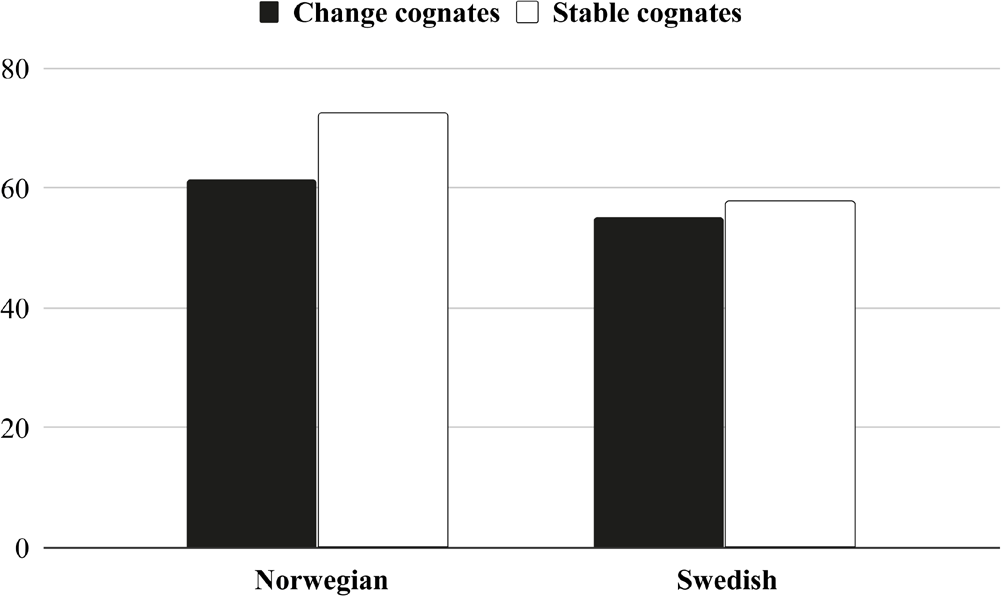
Research into the effects of token frequency on diachronic developments in language has shown that high frequency words tend to resist morphological change (for example, Bybee Reference Bybee2007:10). Based on this, we would expect high frequency words to better maintain their gender. To see whether or not the frequency of a lexical item influences the likelihood of it changing gender, we gathered word frequency data for both contemporary Swedish and Norwegian Nynorsk. Footnote 15 The Swedish data were taken from Sture Allén’s corpus of Swedish (Allén Reference Allén1970), which is based on newspaper material. The Norwegian data come from Vestbøstad’s Nynorsk frekvensordbok (Vestbøstad Reference Vestbøstad1989). The regression analysis shows that log-transformed frequency is a significant predictor of likelihood to change (p=.004 for frequency in Norwegian, and p=.048 for frequency in Swedish).Footnote 16 As predicted, words with a higher frequency tend to be more resistant to change. When we compare the mean frequencies of the change cognates versus the stable cognates, a clear difference can be seen in Norwegian (see figure 2 below): 61.4 for change cognates versus 72.7 for stable cognates. In Swedish, the difference is less pronounced: 55.2 for change cognates versus 57.9 for stable cognates.
Mean log-transformed frequency for stable and change cognates in Norwegian and Swedish.
It is well-known that while phonological change affects the most frequent lexical items first, analogical change tends to affect the most infrequent lexical items first. According to Bybee (Reference Bybee2007:23–24), this is because the two types of changes spread through the lexicon in different manners. Phonological changes are driven by phonetic processes. Since these processes occur in casual speech, phonological change affects first those lexical items that are most frequent in casual speech. In contrast, analogical change affects less frequent lexical items in a language. When it comes to infrequent lexical items, speakers may be less certain of the correct form. In the absence of a clear choice, speakers associate the less frequent lexical item with a more frequent item that is phonologically, morphologically, or semantically similar. Change in grammatical gender can be seen as a type of analogical change, in which assignment rules are organized and reorganized according to morphological, phonological, and functional principles. Speakers are less certain of the gender of an infrequent lexical item, and so they apply the gender of a more familiar lexical item (or, in the absence of a clear assignment generalization, the default gender is assigned).
The connection between frequency and gender change is not unexpected, though gender change has not previously been statistically analyzed across a language family, to our knowledge. Thus, our study constitutes an important contribution to the literature on the effects of word frequency on linguistic change.
8. External Loanwords
In our material, 724 out of 1,129 sets are inherited (64.13%) and 390 sets are external loans (34.54%).Footnote 17 Table 6 shows the numbers of external loans and inherited Scandinavian words in our data for each language.
Numbers and percentages of external loanwords for each language in the material

Table 6 shows that the percentage of external loans in the material has been increasing since the Old Norse period. The primary reason for this is the large influx of loans from Low German in the Hansa period (primarily in the 14th to 15th centuries); this influx is believed to have contributed to the loss of the three-gender system in Danish, Swedish, and the Bergen dialect of Norwegian (Wessén Reference Wessén1970, Jahr Reference Jahr2001).
We find that external loanwords are more likely to have gender variability than native Scandinavian words, as 30.1% of external loans changed their gender, compared to 24.5% of Scandinavian words. According to the regression analysis, this measure is significant (p<.001). This is likely due to the gender of loanwords being less entrenched when they are initially borrowed.
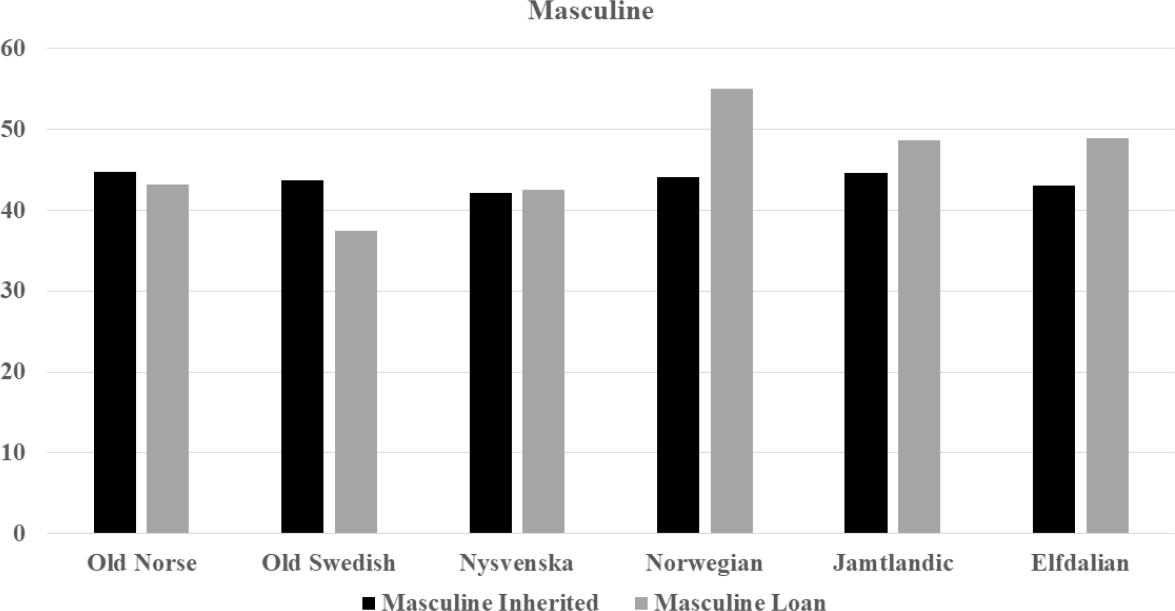
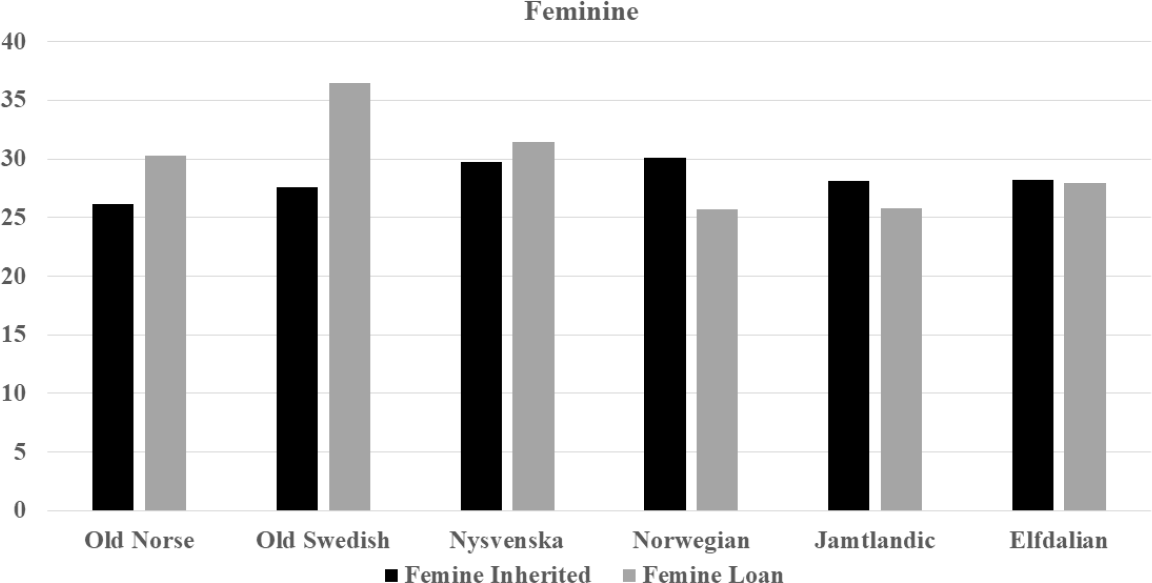
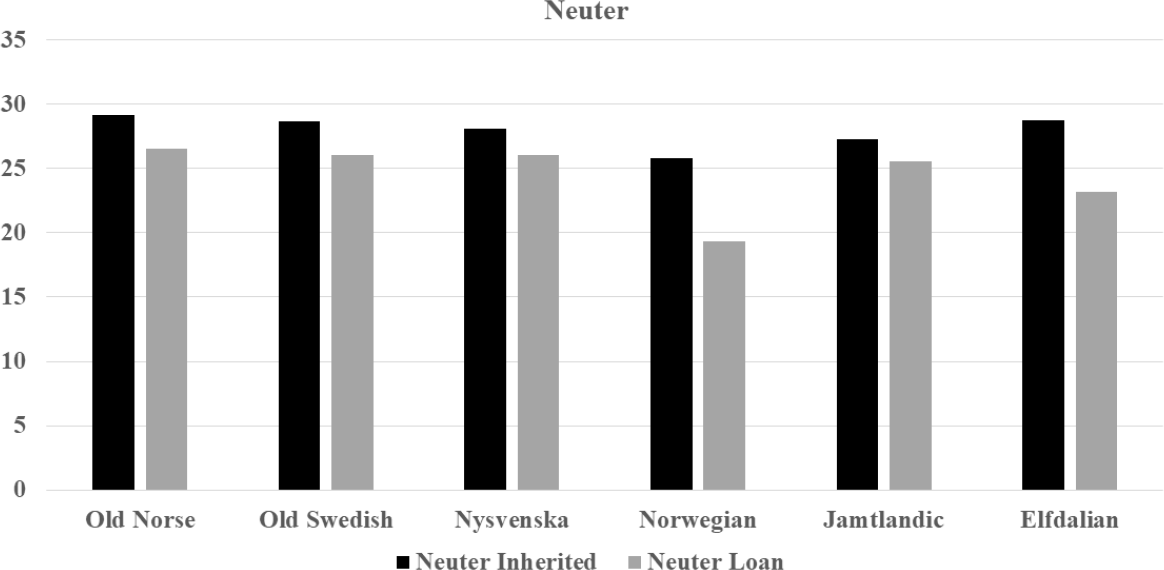
To get a general idea of gender assignment to external loanwords in the material, we looked at the gender distribution of loanwords versus native Scandinavian words. For most of the language varieties, there is not an appreciable difference between loanwords and native words. This is contrary to our expectations: We would expect to see an increase of masculine gender nouns in external loanwords, probably at the expense of feminine gender nouns (to mirror the general trend in Scandinavian languages). Nysvenska, Norwegian, and Jamtlandic show a slight increase in masculine gender nouns. Old Norse and Old Swedish actually have a slightly lower proportion of masculine nouns in external loanwords.
Figures 3–5 below show the distribution of inherited Scandinavian words versus external loanwords in the material.Footnote 18 Even though external loans are more likely to change gender, figures 3–5 show that they are not necessarily more likely to change in any particular direction. The reason for the high likelihood of gender change cannot be ascribed to the loss of a particular gender. One factor that may influence instability of gender assignment is that borrowed lexemes may have an unfamiliar phonological structure, and so those words are not easily assigned a gender. While a loanword can be assigned any one of the three genders, the gender may be fluid in the initial stages of borrowing, leading to lexemes having more than one possible gender.
Gender distribution (%) of masculine nouns among inherited Scandinavian words and external loanwords.
Gender distribution (%) of feminine nouns among inherited Scandinavian words and external loanwords.
Gender distribution (%) of neuter nouns among inherited Scandinavian words and external loanwords.
In order to further explore the reasons for the high likelihood of gender change among loanwords we divided them into three categories: words that existed in Old Norse, words that existed in Old Swedish but not Old Norse, and words that existed in neither Old Norse nor Old Swedish. The external loanwords that existed in Old Norse were most likely passed down from Old Norse to the other Scandinavian languages, while those that existed in Old Swedish were likely passed down to Nysvenska, and possibly to Jamtlandic and Elfdalian. External loans that existed in neither Old Norse nor Old Swedish are newer loans, and they could have been loaned separately into the different modern language varieties.
A look at these three categories of external loanwords shows that loans that existed in Old Norse have the highest percentage of change cognates, namely, 37.2%, compared to 29.3% for loans that did not exist in Old Norse but existed in Old Swedish, and 24.5% for loans that exist only in the modern language varieties (the same percentage as for inherited words). It would appear, therefore, that the loans that existed in Old Norse show most gender variability. We performed a regression analysis comparing external loanwords in each category to native Scandinavian words in terms of their gender variability. This analysis shows that external loanwords that existed in Old Norse are significantly different (p=.002) from the native Scandinavian words, that is, they are significantly more likely to change gender. In contrast, loanwords that existed in Old Swedish but not Old Norse, as well as those that exist only in the modern language varieties, are not significantly more likely to change gender than native Scandinavian words (p=.305, and p=.930, respectively). This distribution seems to indicate that the differences in the overall results are mainly due to instability in gender assignment in Old Norse, which led to variable genders in the cognates in the daughter languages.Footnote 19
The borrowing of words into a language can be seen as a “continuously running experiment” on gender assignment principles (Corbett Reference Corbett1991:71). The existing literature on loanwords and susceptibility to linguistic change shows that the gender of loanwords can be unstable in the early stages of borrowing, but that it stabilizes later on, as the noun becomes more frequent and more integrated into the language (Corbett Reference Corbett1991:77). This view fits in well with our findings: If this is the case, it could mean that variable genders in Old Norse stabilized as different genders in the later Scandinavian languages.
Another possible explanation is that the gender of loanwords could be adopted from the source language. However, it seems unlikely that gender would be borrowed from a language as remote from Scandinavian as Latin, for example; and it is generally agreed that gender can only be influenced by source language in cases where speakers are highly educated and conscious of the gender of the nouns in the source language (Corbett Reference Corbett1991, Enger Reference Enger2001:80ff.). To test whether gender was affected by potential knowledge of the source language we coded the source language for each loanword (to avoid having too many categories, we limited the classify-cation to Old English, German, French, Latin, Greek, English and “other languages”).Footnote 20 When we tested the significance of the source language in a mixed model, it turned out not to be significant (p=.994). This result was mostly expected. In order to get a better sense of how gender assignment is influenced by source language, however, it would be necessary to look at the gender of each word in the donor language as well as in the borrowing languages, which is beyond the scope of our study.
9. Derivational Suffixes
In this section, we discuss the effect of derivational suffixes on gender. The effect of suffixes on the likelihood of gender change was not included in our mixed model because of the small numbers of words in each category; instead, we looked closely at each suffix in turn.
In our list we included as cognates some words that are not full cognates but consist of a root that is common to all the language varieties, plus a derivational suffix that might be different in the various language varieties. These partial cognates often have different genders, based on the varying derivational suffixes. Two examples are freedom and personality, which end in -dom in Norwegian and are masculine and in -het in all the other varieties and are feminine. The suffix -dom indicates masculine gender in Norwegian (Trosterud Reference Trosterud2001:44), whereas Norwegian -het (Trosterud Reference Trosterud2001:44), Jamtlandic -heit (Van Epps & Carling Reference Carling2019), and Elfdalian -iet indicate feminine gender (7 out of 10 instances of these words in our Elfdalian material are feminine).
The words with -ion in our material are masculine in Norwegian, Jamtlandic, and Elfdalian, but feminine in Nysvenska (two of these, religion ‘religion’ and station ‘station’, can be either masculine or feminine). A possible explanation for the different gender of these words could be that Nysvenska is influenced by German, in which these words are feminine. Jamtlandic and Elfdalian would be subject to less influence from German, as rural language varieties. Norwegian Nynorsk is based on the conservative Western Norwegian dialects, so it could also be expected to show less influence from German.
In Scandinavian, deverbal words with -ing are feminine, and denominal and deadjectival words with -ing are masculine (Trosterud Reference Trosterud2001:44, Van Epps & Carling Reference Carling2019). In our material, words with these suffixes mostly follow this rule, though there are some exceptions. We have four cognate sets in which none of the nouns have the predicted gender: queen (ON dróttning f, No dronning f, OSw drotning f, Nsv drottning f, JL drottning f, Elf drottningg f); also soup 3, witch 2, strap 2. With respect to two of these, queen and witch 2, there is a clear semantic explanation: Although these are denominal nouns, they are feminine because they refer to women. As for soup 3 and strap 2, there is no clear explanation. Additionally, we have a few cognate sets in which some of the nouns have the expected gender, and some do not. For instance, in bill, which is deverbal (ON reikningr m, No rekning f, OSw rækning f, Nsv räkning f, JL rekning f, Elf rekkningg f), all except the Old Norse noun have the expected feminine gender. The Old Norse noun is masculine, which is expected based on the strong masculine -r ending it carries. Some sets are mixed, that is, they contain deverbal and denominal/deadjectival nouns; this leads to variable gender, as in dawn 1 (ON lysing f, No lysing, lysning f, OSw lysning, liusning f, Nsv lysning f, JL ljösning m, Elf liuosningg f); also lightning 1, tick 1, woman’s dress. The sets newspaper 2 (OSw tidhing f, Nsv tidning m, JL tining m, Elf tiningg f) and intention (No meining f, OSw mening f, Nsv mening f, JL meining m, Elf meiningg m,f) have the expected gender in some of the varieties, and an unexpected gender in the others, for reasons that are unclear. The remaining 35 sets contain nouns with -ing, all of which have the expected gender (denominal and deadjectival nouns are masculine, and deverbal nouns are feminine).
The suffix -skap indicates various genders in the Scandinavian languages. Our data reflect this, as nouns with -skap vary widely with respect to which gender they receive. Figure 6 shows roughly the gender distribution of nouns carrying this suffix in our material.Footnote 21 From figure 6 one can see that the languages can clearly be divided into three main groups: The first group contains Old Norse, in which all words with -skap are masculine. The next group contains Old Swedish, Norwegian, and Elfdalian, in which -skap can indicate either masculine or neuter gender. In Old Swedish and Norwegian, masculine gender is dominant, while in Elfdalian the two genders show similar distribution. The third group contains Swedish and Jamtlandic, where all three genders are represented for this suffix, with neuter being the dominant gender.
Gender distribution of nouns with the suffix -skapr/-skap (number of words per gender)
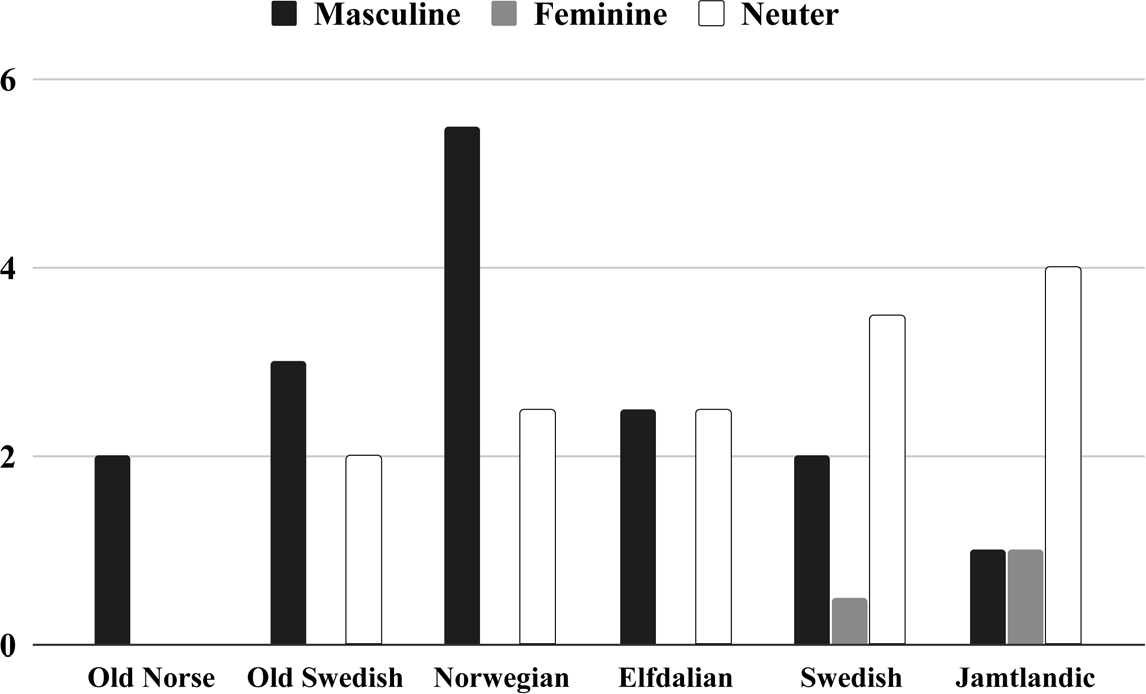
This picture can be compared to the results found in Conzett’s (Reference Conzett2004) in-depth historical study of the suffix -skap. Conzett looks at the gender distribution of nouns with this suffix beginning in the period from Old Norse to present-day Norwegian, Swedish, and Danish. He finds that all words with -skap are masculine in Old Norse (from 800 to 1300). The period from 1300 to 1600 shows the introduction of neuter nouns with -skap in Old Swedish, Old Norwegian, and Old Danish. For the period from 1600 to present day, the percentage of neuter nouns with -skap has increased, so that the neuter nouns now outnumber the masculine nouns (to a greater degree in Swedish and Danish than in Norwegian; see Conzett Reference Conzett2004:182). Our findings for this suffix are similar to Conzett’s, except that we do not see any neuter nouns in Old Swedish.
In addition, we have a few interesting examples, in which a lexeme has changed its phonological form in one or more varieties, so that the ending came to resemble a derivational suffix. As a result, the gender changed as well, to match the gender normally used with the suffix that the new ending resembles.
Such a change is especially common when the new ending resembles the agentive suffix -ar (Norwegian)/-are (Swedish), which in Norwegian and Swedish also makes the noun masculine (Källström Reference Källström, Kjartan, Ruth and Torp1996:159, Trosterud Reference Trosterud2001:44). For example, in combine harvester, the gender becomes masculine in Norwegian once the agentive suffix is added (No skurtreskar m, Nsv skördetröska f, JL skördetröske f, Elf stjördetrusk f). In Swedish, words ending in -a do not have the agentive suffix and are feminine.Footnote 22 However, in the set anchor (ON akkeri n, No ankar, anker m, OSw ankare n, Nsv ankare m, JL ankar n), the gender changes to masculine in Swedish and Norwegian because the endings -ar and
-are, respectively, look the same as the agentive suffix. Indeed, the -ar ending reliably indicates masculine gender in our Norwegian data: Out of 27 words that end in /ar/ (excluding monosyllabic words), only one is not masculine (altar ‘altar’, n). The same generalization holds for the ending -are in Swedish: Only one word with /are/ (altare ‘altar’) is neuter; the remaining 21 are masculine.
10. The Semantic Core and Changes Based on Semantic Association
Since all gender systems have a semantic core, we would expect at least some changes in the gender system to be influenced by a noun’s semantics. Below we investigate semantically motivated change in both broad and narrow semantic categories.
We included three semantic parameters in our mixed model: animate/inanimate, count/mass, and abstract/concrete. These are semantic factors that have been shown to be important for gender assignment and that are inherently connected, as has been observed in typological semantic research (Comrie Reference Comrie1989:178–193). Animacy in particular is central to gender assignment crosslinguistically (see, for instance, the many examples listed in Corbett Reference Corbett1991:7–32). The count/mass distinction has been shown to be particularly important for gender assignment in the Germanic languages. For instance, gender in the Danish dialect of West Jutland has been reorganized along semantic lines, so that all count nouns are now common, and all mass nouns are neuter (Braunmüller Reference Braunmüller, Unterbeck, Rissanen, Nevalainen and Saari2000; Josefsson Reference Josefsson2013:73–94, Reference Josefsson2014:71–74). Gender assignment in Dutch has also been partially restructured in a similar way (Audring Reference Audring2006b, Kraaikamp Reference Kraaikamp2012, Reference Kraaikamp2017). The abstract/concrete distinction is not as important for gender assignment crosslinguistically, but it does figure in some assignment systems (as in Lak; Corbett Reference Corbett1991:25).
We found that inanimate nouns were more likely to change gender than animate nouns: 28.8% of inanimate nouns changed their gender, but only 12.6% of animate nouns changed their gender. According to our model, the difference is significant (p=.003). This is expected, since animate nouns include nouns with human referents, which are assigned either masculine gender (when the sex of the referent is not specified), or masculine or feminine gender according to biological sex (Trosterud Reference Trosterud2001, Reference Trosterud2006; Van Epps & Carling Reference Carling2019). There exist very few exceptions to this assignment principle, and it follows that the gender of these lexical items would be resistant to change.
In our material, mass nouns are slightly more likely to change gender than count nouns: 31.4% of mass nouns show gender variability, while only 24.1% of count nouns show variability. This difference, however, was not significant (p=.905). This finding can be seen as an indication that the modern language varieties we looked at have not generalized the assignment principle “mass nouns are neuter” to a greater degree than was already the case in Old Norse or Old Swedish.
We found that 25.1% of concrete nouns changed their gender, while 31.8% of abstract nouns changed their gender. This difference was not significant (p=.189). This is not entirely unexpected, though some studies have shown an effect for concrete versus abstract nouns in Scandinavian. For example, Davidson (Reference Davidson1990:155) found that in Swedish, nouns with a concrete meaning tended to preserve pronominal gender better than abstract nouns.
In addition to the overarching concepts explored in our mixed model, we addressed the question of whether other semantic factors can play a role in changing the gender of a noun. We have a few cases of nouns referring to humans that are assigned gender based on the biological sex of their referent despite having a derivational suffix that indicates a different gender, as in the case of queen (ON dróttning f, No dronning f, OSw drotning f, Nsv drottning f, JL drottning f, Elf drottningg f) and witch 2. A similar example is guard (No vakt f, OSw vaka f, Nsv vakt m, JL vakt m, Elf wakt f), which was originally feminine in Old Swedish. It retains feminine gender in Norwegian and Elfdalian but becomes masculine in Nysvenska and Jamtlandic because most words in the latter languages referring to humans with no specified biological sex are masculine (Trosterud 2001:35, Reference Trosterud2006:1445; Van Epps & Carling Reference Carling2019).
Another example of a noun with varying gender is spine, which is masculine in Nysvenska, and feminine in Norwegian, Jamtlandic, and Elfdalian. The Nysvenska cognate is a calque from German Rückgrat, which becomes ryggrad in Swedish and acquires masculine gender from grad ‘scale; step’, which is masculine in Nysvenska. The other varieties could have made this noun feminine through folk etymology, by reinterpreting it as rygg+rad and assigning feminine gender to it by analogy with rad ‘row; line’.
In addition, we found a few examples of lexemes that changed gender to align it with the gender of closely related words. Gender assignment by semantic analogy has been documented in various languages, including Scandinavian (Trosterud Reference Trosterud2001, Reference Trosterud2006; Van Epps & Carling Reference Carling2019). Although semantic analogy is a valid motivation for gender change, it should be treated carefully so as not to obscure other assignment principles (Corbett Reference Corbett1991:77). In our data, we propose a few instances of gender change driven by semantic analogy. One example involves the words for the seasons, whose gender seems to be converging toward masculine. In Old Norse, haust ‘autumn’, sumar ‘summer’, and vár ‘spring’ are all neuter, while vinter ‘winter’ is masculine. In all of the other varieties, autumn and summer have become masculine to align with winter. spring is the only nonmasculine season name in Old Swedish, Nysvenska, and Elfdalian (it is feminine in these languages). Interestingly, in Norwegian and Jamtlandic, it has become masculine, possibly to align with the masculine nouns for the other seasons.
Another example of possible semantic change comes from the set molar tooth. This cognate has masculine gender in Old Norse and Norwegian (jaxl and jeksel), and feminine gender in Jamtlandic and Elfdalian (ekkshle and ieksl). In Nysvenska (oxel), the gender can be either masculine or feminine. A clue as to why the gender may have become feminine in some of the varieties lies in the Old Swedish form, axla tan, which contains tan, the word for ‘tooth’. tooth has feminine gender in all the varieties, so the feminine gender of molar tooth in Jamtlandic and Elfdalian could have arisen from the feminine gender of the compound ekkshle tann/ieksl tann/oxel tand ‘molar tooth’: When the second part of the compound was dropped, the gender remained feminine in these varieties. Alternatively, one could simply hypothesize that the feminine gender is due to an analogy with tand/tann, even if it was not originally part of the compound.
11. Conclusion
We have studied gender assignment in six North Scandinavian languages with three-gender systems. Our most important contribution to earlier research in this area is that we have taken a quantitative approach by investigating variation and change in lexical cognates in the six languages, thereby accounting for gender, morphology, and semantic change.
Our results show that the reasons for variation in gender assignment in Scandinavian are many and complex. Through this complexity, we can draw some interesting conclusions from our results. According to our study, the most important factors that influence a lexeme’s likelihood of changing gender are the Old Norse weak/strong declension distinction, Old Norse gender, the animate/inanimate distinction, frequency, and loan status. In addition, derivational suffixes reliably predict gender for those words that contain them.
The general tendency during the period from Old Norse to the modern language varieties has been for phonological assignment principles to become weaker. The most significant changes that led to the weakening of phonological assignment principles are the loss of the nominative -r ending in strong masculine nouns and the various developments of word-final vowels in weak masculine and feminine nouns that weaken the correlation of word-final vowels with gender. These changes have made gender in later stages of Scandinavian languages more difficult to predict. Indeed, these phonological changes may be a factor behind the tendency for the gender system in Scandinavian languages (and Germanic in general) to simplify to a two-gender system. Our research indicates that the Scandinavian gender system may be inherently predisposed toward absorption of the feminine gender into the masculine gender. While many Scandinavian varieties still robustly uphold this distinction, our data show that feminine nouns are more susceptible to changing gender. In addition, the feminine gender has fewer members than the masculine gender (just as the neuter does). There is also a similarity between masculine and feminine in their form as well as in their semantics (both are assigned to animate nouns; Enger Reference Enger2004b). These observations indicate that the feminine gender has a weaker standing in the language varieties we investigated, and thus is more susceptible to pressure to change.
Our exploration of gender in external loanwords shows that the most plausible explanation for gender instability is that many loans into Old Norse had variable gender, which results in different genders in the daughter languages. The gender distribution in external loanwords versus native Scandinavian words is very similar, so there is no tendency to assign a specific gender to loanwords. The analysis of the effects of frequency on gender stability shows that, as expected, less frequent lexical items are more likely to have an unstable gender. This may be because speakers are uncertain of the gender of words that appear infrequently. The relation between gender instability and low frequency can also be connected with the gender assignment to loanwords: Words that are borrowed may be used infrequently at first and have multiple genders. Later, as they become more frequent and more entrenched in the language, their gender stabilizes.
An exploration of the semantic factors involved in gender assignment shows that a wide range of semantic properties can influence gender assignment. In terms of likelihood of gender change, the only factor that we find to be significant is the animate/inanimate distinction. This makes sense, as the animacy hierarchy plays a significant role in gender assignment in Scandinavian (the semantic core is based on biological sex, and words for animals are more likely to be masculine). The strength of the semantic core makes it unlikely that animate nouns will change gender. In addition to this overarching tendency, we find a few examples of words for which a gender change could be explained by semantic association. This means that semantics can potentially be one driver of change in the complex interplay of competing factors in gender assignment.
Looking at assignment differences in closely related languages can help us identify indicators of ongoing change in a gender system. Broadening this research to include other language families will help identify universal tendencies in how gender systems develop over time.


 Open access

