


It is well known that historical studies of the first two centuries of Islam depend on sources other than the literary works written in the second century ah/eighth century ad or later. This is all the more true for the barīd, the official postal system (often combined with an “intelligence service”). Information on the postal system before the reign of the Abbasid caliph al-Wāthiq (227/842–232/847), who commissioned the writing of a book on “Routes and Realms” (Ibn Khurdādhbih's famous Kitāb al-masālik wa-’l-mamālik, the first version of which was produced in c. 232/846–847), is largely based on information of which the historicity is uncertain. Fortunately, the first/seventh- and second/eighth-century Muslim postal system has left substantial documentary and epigraphic traces. Although some documents and inscriptions have been found in Syro-Palestine and as far east as Soghdia (modern Uzbekistan), the bulk of our documentary sources on the early Islamic postal system come from Egypt.Footnote 1 Whereas modern scholarly publications on the institution concentrate on (predominantly Arabic) documents from the Marwanid period and the first years of the Abbasid period, the Egyptian material is equally informative on the first decades after the Muslim conquest. Hence, it enables the development of the postal system to be traced throughout the first century of Muslim rule in Egypt.
In doing so, this article argues that Egypt's postal system developed out of Byzantine practices and that from its beginnings until 132/750 three distinct phases can be identified. These phases are nearly identical to the general periodization of early Islamic history and coincide with the caliphates of the Rightly-Guided caliphs (18/639–41/661), the Sufyanids and early Marwanids (41/661–90/710), and the later Marwanids (90/710–132/750). It will be shown that during these three phases the character of the postal system reflects the nature of Muslim rule at that time, and that changes in the system must be seen in the context of changes in empire-wide policies. The article ends with an edition of P.Khalili II 5, from 135/753, showing hitherto unknown practices regarding the administration and provisioning of postal stations during the first years of Abbasid rule.
Developments in Egypt's postal system
By c. 600 ad, the Byzantine imperial authorities charged local large landholding families or labour corporations with responsibility for the physical and financial maintenance of local sections of the imperial postal system.Footnote 2 This included providing animals to postal stations, contracting stablemen and accountants, and regulating the use of stations by third parties.Footnote 3 This allocation of what was initially an official liturgy to private parties was the result of socio-political changes, especially the increase of the authority of local magnates.Footnote 4 This situation lasted until the end of Sasanian rule over Egypt (619–29). Not only have the main large landholding families disappeared from our sources or had their influence weakened by that time,Footnote 5 but the administration of the postal system itself seems to have undergone some changes. Under Sasanian rule, the administration of the postal system in Upper Egypt was brought under the authority of a sellarios (a title used for officials of different ranks) probably in order to obtain and maintain firm control over the postal system and, hence, the primary means of communication. In P.Oxy. XVI 1862 and 1863, for instance, a sellarios named Rhemē appears as the principal official charged with the administration of a postal station in Pinarachthis, a locality just south of Memphis/Manf. This sellarios was subordinate to another Sasanian official bearing the same title who had his office in the Arsinoitēs/Fayyūm and held authority over probably both Arcadia and the Thebaid.Footnote 6 Such administrative changes by the Sasanians firmly placed the administration of Egypt's postal system (back) in the administrative realm. Although we lack documentation on the postal system during the decade separating Sasanian and Muslim rule, the situation that we encounter in documents dating from the first two decades of Muslim rule over Egypt seems not to have differed much.
Continuity of existing practices characterized the initial phase of the development of the postal system under Muslim rule. By the time Muslims had conquered Egypt in the early 20s/640s, the maintenance and administration of postal stations ultimately fell under the responsibilities of the dux, at that time the highest administrative official outside Fusṭāṭ. He sent entagia for the payment of money, goods or animals destined for postal stations. The Greek document P.Lond. III 1081 (pp. 282–3), for example, mentions a dispute between an administrative official and an agricultural worker (geōrgos) on the estates of a bishop in the district of Hermopolis/Ushmūn. The dux is called amiras in this document, establishing its date as the last four decades of the first/seventh century.Footnote 7 In P.Lond. III 1081, the agricultural worker writes that the dux had sent to him a groom (hippokomos) with a letter ordering him to deliver three horses and two mules (gaidaria) at “the estate-controlled hamlet (epoikion) of my brother, the lord Germanos” (lines 4–5), where a postal station must have existed.Footnote 8 Whereas such entagia stemmed from the bureau of the dux, the pagarch was responsible for the execution of the dux’s orders.Footnote 9 Pagarchs delivered mounts at postal stations or ordered lower officials to do so.Footnote 10 The system must have functioned well. SB Kopt. I 36 (Apollōnopolis Anō/Udfū), dating from 25–26/646, records that third parties could travel via the postal system and that it reached as far south as Oxyrhynchos/al-Bahnasā (line 158).Footnote 11
The Muslim authorities of the 20s/640s and 30s/650s are not recorded as having been involved in the organization of the postal system as much as their Sasanian predecessors had been.Footnote 12 Beside the introduction of the term gaidarion (from the Arabic ghaydhār), “mule”, in documents related to the administration of the postal system (among others),Footnote 13 the influence of the arrival of the Muslims is primarily seen in their efforts to keep Babylon and Fusṭāṭ connected with the rest of the province via a postal station in Babylon. Dated to the mid-first/seventh century, the Greek document CPR XXII 6 shows for the first time requisitions made in the district of Hermopolis/Ushmūn or Arsinoitēs/Fayyūm that are destined for Babylon's postal and/or relay station (allagē). In contrast to the word allagē’s primary meaning of “relay station” in the context of the postal system,Footnote 14 a reference to “sailors of the ships of Babylon's allagē” (ναυτ(αῖς) τ(ῶν) πλοί(ων) τ(ῇ) ἀλλαγ(ῇ) Βαβυ̣λ̣(ῶνος)) in the contemporary document P.Vind.Tand. 31 (Memphis/Manf), line 6, might indicate that Babylon's postal and/or relay station was also geared towards riverine traffic; but the exact meaning of these words remains uncertain at present.Footnote 15 The Muslim authorities' initial concentration on Babylon's connectedness compares well with other facets of their conquest policies of the 20s/640s and 30s/650s,Footnote 16 especially their requisitioning of building material for FusṭāṭFootnote 17 and their directing of tax money to Babylon.Footnote 18 The Muslims' wish to maintain connections between their newly founded capital and the rest of the province may well explain the continued upkeep of postal stations elsewhere in Egypt.Footnote 19
This situation lasted until c. 40/660. After the First Civil War of the late 30s/650s, the new caliph, Muʿāwiya b. Abī Sufyān (r. 41/661–60/680), actively sought to establish or increase his power by initiating reforms that centralized his administration in Damascus as well as that of his governors in the provincial capitals.Footnote 20 The Greek document P.Mert. II 100 (Arsinoitēs/Fayyūm), dated 18 Ramaḍān 49/20 October 669, shows that these reforms directly affected the postal system in Egypt, as they did in Syria and the East of the empire.Footnote 21 With the arrival of Muʿāwiya's rule, then, in Egypt already in 38/658–659,Footnote 22 the second phase in the early history of the postal system begins.
The above-mentioned document P.Mert. II 100 records requisitions made by Pettērios, pagarch of the Arsinoitēs/Fayyūm, to the inhabitants of the village of Stratōn. They should deliver salt and seasoning to an “overseer of the same stable” (line 2: ἐ̣[π]ι̣κ̣[ειμ](ένῳ) το̣ αὐτ(οῦ) στάβλου) who bears a partially lost but still unmistakably Arabic name. The stable is located in the village itself. The requisitions are considered part of the dapanē, a tax for the maintenance of officials, and are explicitly in accordance with an official communication of a fiscal assessment stemming from the bureau of the Arcadian dux Iordanēs (line 2: δ̣(ι’) ἐ̣[π]ιστά(λματος) Ἰορδά̣(νου)).Footnote 23 Such official communications were introduced early in Muʿāwiya's caliphate and were part of the reforms he initiated.Footnote 24 P.Mert. II 100 is the oldest known document that shows the central administration in Fusṭāṭ, represented by the dux in Arcadia, to control the organization of a local postal station. Although Mamluk historians may not be correct in stating that Muʿāwiya was “the first person to establish the barīd in Islam”,Footnote 25 his efforts to centralize the administration placed the existing, official postal system firmly under Muslim control.Footnote 26
At the end of Sufyanid rule over Egypt and the beginning of that of the Marwanids, there is a significant change in the organization of the postal system. Documents belonging to the archive of Papas, pagarch of Apollōnopolis Anō/Udfū, and which have been dated to the end of the Sufyanid period refer for the first time to a beredos, “post-horse” (P.Apoll. 33 and 64), and a beredarios, “official courier” (P.Apoll. 27)Footnote 27 – terms related to the Arabic barīd.Footnote 28 The use of the term beredarios in pre-Islamic Egypt is recorded in a fourth-century document, but not in documents of later date.Footnote 29 From this, it follows that the beredos and beredarios were (re)introduced in Egypt's postal system around the third quarter of the first/seventh century. These “new” elements in the postal system possibly had a Syrian origin, where the term beredarios is recorded as having been used on the eve of the Muslim conquests.Footnote 30 Interestingly, these changes seem to have predominantly affected the part of the administration that was headed by Muslim officials.Footnote 31 Non-Muslim administrators continued to employ members of their staff, such as symmachoi, as messengers throughout the period.Footnote 32 Continuity on the local level is also visible in the pagarch's central role in the organization of the postal system and his authority over its use. According to P.Apoll. 64 and CPR IV 1 (Arsinoitēs/Fayyūm; prob. first/seventh century), for example, a pagarch allows the use of post-horses by third parties.Footnote 33
Within a few decades of the introduction of the post-horse and official courier, the organization of Egypt's postal system drastically changed. Documents from the reign of the caliph al-Walīd (86/705–96/715) and his first successors testify to a starkly increased centralization as well as the Islamization of the postal system. These changes must be considered directly part of or a direct result of the well-known Marwanid reforms, which aimed to support and legitimize the rule of the Marwanids after the Second Civil War (64/683–73/692). The period of the later Marwanids, starting around the year 90/710, constitutes the third phase in the history of the early Islamic postal system.Footnote 34 From the 90s/710s, for instance, comes our first documentation of the ṣāḥib al-barīd, “postal chief”, an official appointed next to the pagarch and directly subordinate to the governor. His main tasks seem to have been the management of the postal stations of the pagarchy in which he was stationed (probably delegated to the stables' superintendents, archistablitai Footnote 35) and the reporting on misbehaviour by local administrators.Footnote 36 Although few aṣḥāb al-barīd of this period are known by name, those who are were Muslims.Footnote 37 Based on ties and loyalty created by a shared religious outlook and social environment, the introduction of this Muslim administrative element outside Fusṭāṭ aimed to increase the power of the central administration outside its headquarters. Indeed, P.Lond. IV 1347 (Aphroditō/Ishqūh), from 91/710, shows how administrative contact between a pagarch and a ṣāḥib al-barīd went via the bureau of the governor in Fusṭāṭ. This administrative novelty fits well with other developments initiated by the Marwanids, in particular the (gradual) Islamization of administrative personnel and the public display of Muslim sovereignty via Islamic inscriptions on milestones set up along the empire's main roads.Footnote 38 This Islamizing policy also affected other personnel in the postal system. Beside a few uncertain names,Footnote 39 all beredarioi mentioned in contemporary documents bear Muslim names. The majority of these beredarioi have no patronymic and some among them are only referred to with a kunya.Footnote 40 In agreement with the impression given in the literary sources, this probably indicates that most of these couriers were slaves or mawālī.Footnote 41
Contemporary documents concerning the financing and maintenance of postal stations likewise testify to the highly centralized character of the later Marwanids' postal system in Egypt. These documents belong to the archive of Basileios, chief administrator of the Upper Egyptian pagarchy of Aphroditō/Ishqūh during the governorate of Qurra b. Sharīk (90/709–96/714). The bureau of the governor in Fusṭāṭ apportioned to each pagarchy an amount in coins to be spent on various specified items. For example, the above-mentioned P.Lond. IV 1347 records that Basileios's pagarchy had to contribute 10 1/2 solidi, meant for the purchase of fodder, bridles and items known as pasmagandia as well as a year's wages for an archistablitēs (2 solidi) and a groom (hippokomos; 1 1/2 solidi), to the maintenance of a postal station in Mounachthē, a village in the neighbouring pagarchy of Antaiopolis-Apollōnopolis.Footnote 42 These expenses can, indeed, be found in the pagarchy's financial records.Footnote 43 That a postal station was not maintained by the pagarchy in which it was located may indicate that it was dependent on the central administration in Fusṭāṭ for its finances and supplies. Elsewhere, I have argued that a similar dependency existed between garrisons, irrespective of their location, and the bureau of the governor.Footnote 44 CPR XXII 43 (provenance unknown; 96/715 or 97/716) shows, however, that some pagarchies did finance their own postal stations.
Despite the governor's tight control over the postal stations, the allocation of a pagarchy's maintenance costs for a postal station among its various communities could differ. This shows that the responsibility to meet the governor's demands lay with the pagarchs and that the central administration was only indirectly involved at the local level. For example, P.Lond. IV 1433, dated 88/707, records that on Tybi 23 (8 Ṣafar/18 January) of that year one Rāshid or Rashīd collected various amounts of money in three villages and three epoikia in the pagarchy of Aphroditō/Ishqūh for the wages of an archistablitēs and the purchase of 3 arouras of trefoil for the postal station in Mounachthē. By contrast, P.Lond. IV 1434, from 98/716, records that each of five communities paid for the costs of specific items only, including the wages of an archistablitēs and a groom, on Pachōn 4 (2 Ramaḍān/29 April) of that year. It is important to note that these contributions were all in coins and that the actual items were not requisitioned. Once collected, the contributions were deducted from that year's tax quota, which the pagarchy needed to send to the central administration in Fusṭāṭ.Footnote 45
The pagarchy further bore the costs for the maintenance of those beredarioi who were within its borders. That these couriers received their wages at their destination is shown by documents such as CPR XIV 33 (Hermopolis/Ushmūn; late first/seventh or second/eighth century), a short receipt for the payment of 3 artabas of barley to the beredarios Sulaym. The unpredictable costs of the maintenance of such visitors, as well as their animals,Footnote 46 were included under the dapanē and then deducted from the tax quota.Footnote 47
It is a document from the early Abbasid period that gives information on how the postal stations themselves were administered and supplied in the mid-second/eighth century. Dating from 135/753, P.Khalili II 5 records the delivery of various types of fodder at specific postal stations; see the edition below. Documents from the early Abbasid period indicate that the transition from Umayyad to Abbasid rule caused no direct changes.Footnote 48 In Egypt, a corpus of six documents from Hermopolis/Ushmūn, spanning the period 127/745–141/759, testify to the unabated continuation of the governor's involvement in the affairs of local aṣḥāb al-barīd and his authority over the use of the facilities of postal stations and mounts (in addition to the continued use of Umayyad documentary formulae).Footnote 49 P.Khalili II 5 shows a similar measure of control over the postal system's organization and administration. Similarly, in the east of the Muslim empire, two documents attest to the continued existence under the early Abbasids of a supplementary tax for the maintenance of the postal system.Footnote 50 The later Marwanids' organization of the postal system, the third phase in its history under Islam, endured into the first years of Abbasid rule. With few other documentary sources for the postal system under the early Abbasids being known,Footnote 51 however, the effects of changes to the postal system introduced by the Abbasids during the first fifty years of their rule cannot yet be traced outside literary source material.Footnote 52
P.Khalili II 5

Light-brown papyrus. The original cutting line is preserved at the bottom of side 1/the top of side 2. Text is missing on the left side and top of side 1 and the left and right sides, as well as the bottom of side 2. Side 1 is written in brownish ink perpendicular to the papyrus' fibres; side 2 is written along the fibres in two hands (cf. below) in black ink. Although doubtless contemporary, the scripts of both sides are not identical. Significant differences are visible in the realization of, e.g., the medial kāf in the word sikka (side 1, lines 4 and 6; side 2, line 6), the final mīm in bi-sm (side 1, line 1; side 2, line 1), the final nūn in the word min (side 1, line 4; side 2, especially lines 5 and 10), and the final hāʾ in the word allāh (side 1, line 1; side 2, line 1). A few diacritical dots are used on side 2.
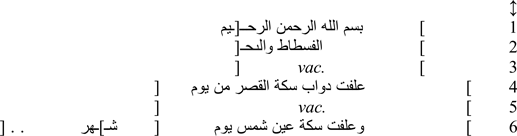
Side 1 is a register documenting the time of the feeding of animals (dawābb) in at least two stations, those of al-Qaṣr and ʿAyn Shams. The register is not finished. Empty spaces after the words “day” and “month” (in lines 3 and 4), where one could specify the time of feeding, are left blank.
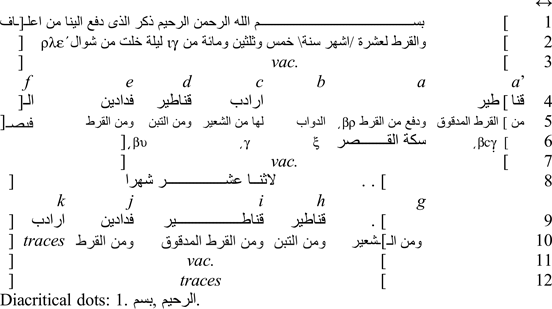
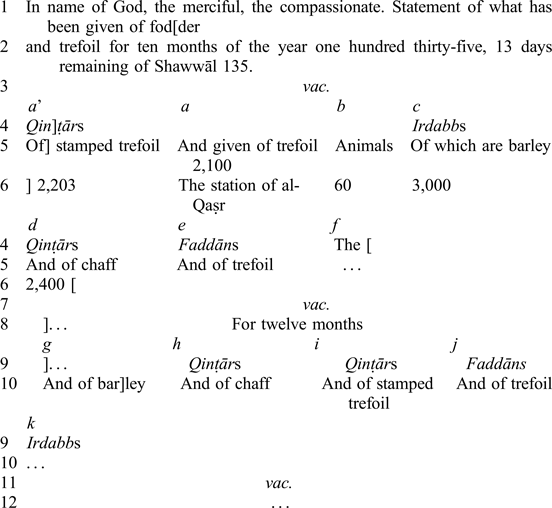
Side 2 is a “statement” (line 1: dhikr) of the amount of fodder delivered to at least one relay station, that of al-Qaṣr (line 6). In its present state of preservation, it consists of two sections, the first being an overview of fodder “for ten months” delivered to al-Qaṣr in the year 135/753 (line 2), the second being another overview that covers an entire year (line 8), probably the same as that of the first section, and possibly related to another station. The second statement is not finished. Amounts of delivered fodder are not specified below the column headings. Line 12 contains the traces of new headings.
The first section contains seven columns. Column a’ and line 5 of column a did not belong to the original statement and were added later. These additions are written in a hand which is different from that of the rest of the first section and seems identical with the hand of section 2. As such, (these parts of) lines 4 and 5 are set apart from the rest of the section. Beside palaeography, the organization of the statement also shows that we are dealing with additions. First, column a starts exactly below lines 1 and 2. This probably attests to the original size of the right margin and suggests that column a’ was added at a later moment in that margin. Second, the phrase lahā min (“of which is/are of”) in column c, line 5, is replaced by wa-min (“and of”) in the succeeding columns on the same line. This indicates that column c was originally the first to state the amount of fodder. Again, column a’ and line 5 of column b, which also contain such information, must have been added later. Therefore, the original document contained, after the opening lines 1 and 2, a column with names of relay stations (a), a column stating the number of animals in each station (b), and then columns stating the amounts of various types of fodder (c and further). The columns of the second section of side 2 are not written exactly below those of the first section.
Side 1
Side 2
Translation
Side 1
1 In the name of God, the merciful, the compas[sionate.
2 Fusṭāṭ and al-..[
3 [
4 I fed the riding animals of the station of al-Qaṣr from day [
5 [
6 And I fed (the riding animals of) the station of ʿAyn Shams, day [mon]th …[
Side 2
Commentary
Side 1
2. Wa-’l-..[. The identity of this toponym remains unknown. Possible interpretations, such as al-Bujūm and al-Nakhāmūn in the eastern deltaFootnote 54 or al-Buḥayra, in medieval times possibly the name of a town in the western delta,Footnote 55 are too remote from Fusṭāṭ and ʿAyn Shams to be considered likely candidates.
4. Al-Qaṣr. Judging from the mention of Fusṭāṭ and ʿAyn Shams in lines 2 and 6, this toponym is in all likelihood to be identified with Qaṣr al-Shamʿ (Babylon), the Byzantine fortress located just to the south of Fusṭāṭ. Al-Yaʿqūbī (d. 292/905 or later) writes explicitly that Qaṣr al-Shamʿ was simply known as al-Qaṣr, “the Fortress”.Footnote 56 This statement is confirmed by this toponym's use in historical sources.Footnote 57 That Qaṣr al-Shamʿ is meant may also be reflected in the 60 animals that are held in al-Qaṣr (line 5). Compared with a postal station in the pagarchy of Antaiopolis-Apollōnopolis, which counted 14 animals in 98/716,Footnote 58 al-Qaṣr surely was a large and, by implication, important station. Another reference to a place called al-Qaṣr, which does not seem to be located in the vicinity of either Fusṭāṭ or ʿAyn Shams, can be found in P.Philad.Arab. 54 (third/ninth–fourth/tenth century; the Arsinoitēs/Fayyūm or Hermopolis/Ushmūn).Footnote 59
6. ʿAyn Shams. The Late Antique history of ʿAyn Shams (Heliopolis), located c. 18 kilometres north of Fusṭāṭ, is poorly understood.Footnote 60 The town appears very infrequently in documentary source material. By the time P.Sijp. 25 (Apollōnopolis Parva or Antaiopolis) was written, probably in 80/699 or 95/714, the town was still the capital of a pagarchy. It is not known if ʿAyn Shams kept this administrative centrality until the late-third/ninth century, when Muslim historians and geographers first mention a kūra, “district”, of ʿAyn Shams.Footnote 61 That P.Khalili II 5, the only Arabic papyrus known to mention ʿAyn Shams, refers to a postal station in the town probably indicates that it continued to be of local importance until the mid-second/eighth century. Third/ninth- and fourth/tenth-century geographers do not mention a postal station at ʿAyn Shams. The city seems not to have been a major stop on itineraries between Fusṭāṭ and the north and north-east.Footnote 62
Side 2
1. Dhikr alladhī dufiʿa ilaynā min aʿl[āf. This title is written on the same line as the basmala. This is an unusual, but not unattested, practice in documents pre-dating the third/ninth century; see K.M. Younes, “Joy and sorrow in early Muslim Egypt: Arabic papyrus letters: text and content” (PhD dissertation, Leiden University, 2013), no. 1, commentary to line 1 (p. 88); see also E.M. Grob, Documentary Arabic Private and Business Letters on Papyrus: Form and Function, Content and Context (Berlin: Walter de Gruyter, 2010), 191–2 (and 191, n. 97 for exceptions) and P.Vente, 2:13 [§ 32].
The tale of the ʿayn in dufiʿa reaches to the bottom of line 2. Instead of ilaynā, the scribe first wrote ilā (“to”) and then corrected it into ilaynā by writing over the alif maqsūra. The reconstruction of the word aʿl[āf is based on the assumption that, like side 1, the trefoil, barley and chaff listed on side 2 were used as ʿalaf, “fodder”. According to classical Arabic grammar, the use of aʿlāf, a “plural of paucity” (Ar. jamʿ qilla) of ʿalaf, indicates that the number of types of fodder in this document ranges between three and ten. See W. Wright, Arabic Grammar (2 vols, Cambridge: Cambridge University Press, 1896–98), 1:234 [§ 307]; cf. S. Hopkins, Studies in the Grammar of Early Arabic: Based upon Papyri Datable to before 300 A.H./912 A.D. (Oxford: Oxford University Press, 1984), 110 [§ 87.f].
2. Khamas wa-thalāthīn wa-miʾa. The word thalāthīn is written with a scriptio defectiva of the ā. See Hopkins, Studies, 9–10 [§ 9.c].
4. (col. a’) Qanā[ṭīr. Hand 2.
5. (col. a’) Min al-qurṭ al-madqūq; (col. a) wa-dufiʿa min al-qurṭ 2,100. Hand 2.
6. ͵βϲγ̣[. The letter that follows the ϲ consists of a separately written vertical and horizontal stroke. While it resembles a τ (“300”), this option is ruled out by the clearly legible ϲ. Only tens, units, and fractions may follow ϲ. The reading τ̣[ʹ (“1/300”), which is theoretically possible, seems unlikely in a description of an amount of trefoil. If the vertical stroke belongs to a letter now broken off, the reading ι̣ (“10”) instead of γ̣ should be considered.
6. Sikkat al-Qaṣr. See the commentary to line 4 of side 1 above.
8–12. Hand 2.
10. Wa-min al-]shaʿīr. The restoration of this entry is based on the beginnings of the entries in columns h to j. Another possible restoration would be la-hā min al-]shaʿīr (“of which are barley”), cf. column c.
12. The traces visible in this line are of letters underneath a piece of papyrus that should be removed.
Abbreviations

 Open access

