





1. Introduction
In philosophy and decision theory, consequentialism reflects the assumption that a person evaluates an act solely based on the possible consequences that this particular act may induce, and nothing more. For a detailed account the reader may consult Hammond (Reference Hammond1988), the overviews by Sinnott-Armstrong (Reference Sinnott-Armstrong2023) and Machina (Reference Machina1989, section 4), and the references therein.
In the game theoretic literature the notion of consequentialism has rarely been discussed explicitly. However, the dynamic games we traditionally use implicitly assume a strong version of consequentialism, by writing down utilities at the terminal histories, and assuming that the player’s preferences are governed by such utilities. We refer to this assumption as utility-based consequentialism. It is also assumed in many well-known decision theoretic models such as von Neumann and Morgenstern (Reference von Neumann and Morgenstern1944), Savage (Reference Savage1954) and Anscombe and Aumann (Reference Anscombe and Aumann1963). Indeed, in these models the proposed axioms guarantee that the decision maker’s preferences can be represented by a utility function on consequences, supplemented in Savage (Reference Savage1954) and Anscombe and Aumann (Reference Anscombe and Aumann1963) by a subjective belief on states.
In classical game theory, the consequences in a dynamic game are typically identified with the terminal histories – that is, streams of realized actions. We refer to this as the realization-based consequence structure. But a player could also care about more than just realized actions, as he may be interested in the counterfactual actions that he, or his opponents, would have taken at unreached parts of the game tree. As an illustration, consider the situation where you have a discussion with your friend Barbara. After a calm start the discussion has entered a stage where you must decide between staying, leaving the room while slamming the door and leaving the room calmly. If you stay, Barbara has the option to either start shouting at you or to teach you a lesson without raising her voice. This leads to the dynamic game form depicted in Figure 1.
Illustration of consequentialism.

Figure 1 Long description
The diagram illustrates consequentialism with a flowchart structure. It shows two main decision points labeled 'You' and 'Barbara'. From 'You', there are two branches labeled 'stay' and 'leave'. The 'stay' branch leads to 'Barbara', which further branches into 'shout' and 'don't shout'. The 'leave' branch leads to another decision point labeled 'You', which further branches into 'slam door' and 'don't slam door'. Each branch represents a possible consequence of the decisions made.
Suppose you are determined to leave, but you still have to decide whether to slam the door or not. One could easily imagine a scenario where you would be prone to slam the door if you believe that Barbara would counterfactually start shouting at you if you were to stay, whereas you would prefer to leave calmly if you believe that Barbara would not start shouting at you in that situation.
If the consequences would only comprise streams of realized actions then you would no longer be qualified as a consequentialist, as your preferences also depend on counterfactual, unrealized actions. However, in this scenario it seems plausible to enlarge the set of consequences, such that a consequence would also contain the counterfactual actions that Barbara would have taken at unreached parts of the game tree. By such a consequentialization, you would now qualify as a consequentialist.
In fact, the preferences outlined above would be allowed by the psychological games model of Battigalli and Dufwenberg (Reference Battigalli and Dufwenberg2009), in which the player’s utility may depend on the full strategies of his opponents, containing those opponents’ actions at information sets he expects not to be reached. For this reason, we define utility-based consequentialism relative to a consequence structure, which may, but need not, coincide with the realized-based consequence structure where the consequences are identified with the streams of realized actions.
The question we wish to investigate in this paper is to what extent the notion of utility-based consequentialism faithfully represents the original idea of consequentialism as described at the beginning of the Introduction. Or is this notion too strong in some scenarios? To address this question we use the decision theoretic framework by Gilboa and Schmeidler (Reference Gilboa and Schmeidler2003) and Perea (Reference Perea2025a), which requires the decision maker to hold a conditional preference relation assigning to every probabilistic belief over the states a preference relation over his acts. The reason we use this framework is that it naturally fits the analysis of games. Indeed, if we apply it to dynamic games, then a player is supposed to hold a preference relation over his own strategies for every possible probabilistic belief about the opponents’ strategies. This naturally reflects the game theoretic element that the ranking of your own strategies crucially depends on what you believe that others will do.
Within this decision-theoretic setting we formulate a preference-based version of consequentialism which states that the ranking of two strategies under a given belief should only depend on the probability distributions over consequences induced by these two strategies under the belief, and nothing more. It is therefore a faithful translation of the original idea of consequentialism to the setting of dynamic games. Like with the utility-based version, we define preference-based consequentialism relative to a consequence structure.
It turns out that utility-based consequentialism always implies preference-based consequentialism, but the other direction may not be true. We offer an example of a three-player game where past choices are imperfectly observed such that a particular player satisfies preference-based, but not utility-based, consequentialism relative to the realization-based consequence structure.
The difference between the two notions in this example is that utility-based consequentialism induces additive preference intensities on consequences for this player, whereas preference-based consequentialism does not. By additive preference intensities on consequences we mean that for every three consequences $x,y$
and
$x,y$
and $z,$
the sum of the intensity by which you prefer
$z,$
the sum of the intensity by which you prefer $x$
to
$x$
to $y$
and the intensity by which you prefer
$y$
and the intensity by which you prefer $y$
to
$y$
to $z$
equals the intensity by which you prefer
$z$
equals the intensity by which you prefer $x$
to
$x$
to $z.$
$z.$
In fact, we show in Theorem 4.1 that for every dynamic game form, utility-based consequentialism relative to the realization-based consequence structure can be characterized by respect of outcome-equivalent strategies and the condition that the conditional preference relation at hand induces preference intensities on consequences that are additive. Here, respect of outcome-equivalent strategies means that the player must be indifferent between two strategies if he assigns probability 1 to an opponents’ strategy combination that, in combination with the two strategies, leads to the same consequence.
In turn, Theorem 4.2 states that preference-based consequentialism relative to the realization-based consequence structure is equivalent to respect of outcome-equivalent strategies and the weaker requirement that the induced preference intensities on consequences need only be additive when applied to every pair of strategies in isolation, but not necessarily for all strategies together. Hence, in general, utility-based consequentialism imposes more restrictions than preference-based consequentialism – the faithful translation of the idea of consequentialism.
In Theorem 5.1 we identify conditions under which the two notions of consequentialism are equivalent, relative to the realization-based consequence structure. More precisely, it is shown that if the dynamic game form either (i) has only two strategies for the player under consideration, or (ii) has observed past choices or (iii) has only two players and satisfies perfect recall, then the two notions of consequentialism are equivalent relative to the realization-based consequence structure, assuming there is an expected utility representation for the conditional preference relation and there are no weakly dominated strategies. For such scenarios, the condition of additive induced preference intensities on consequences is thus implied by preference-based consequentialism alone. These are precisely the situations where writing down utilities at the terminal histories faithfully reflects the original idea of consequentialism relative to the realization-based consequence structure.
The outline of this paper is as follows: In section 2 we introduce our model of a dynamic game and the decision-theoretic framework as described above. In section 3 we lay out the two definitions of consequentialism. In section 4 we provide an example where the two notions of consequentialism are not equivalent, prove that, relative to the realization-based consequence structure, utility-based consequentialism is equivalent to respect of outcome-equivalent strategies and the condition that the induced preference intensities on consequences are additive, and that preference-based consequentialism is equivalent to respect of outcome-equivalent strategies and the condition that the induced preference intensities on consequences are additive for every pair of strategies in isolation. In section 5 we identify a set of sufficient conditions under which the two notions of consequentialism are equivalent, relative to the realization-based consequence structure. In section 6 we provide some concluding remarks. The Appendix contains the proofs of the three theorems, together with some definitions from graph theory, some preparatory results, and a utility transformation procedure, which are needed for the proofs.
2. Model
In this section we start by laying out our model of a dynamic game form, followed by the definition of a strategy and that of a conditional preference relation for a distinguished player.
2.1 Dynamic game forms
In this paper we consider finite dynamic games that allow for simultaneous moves and imperfect information. Formally, a dynamic game form is a tuple $D=(I,P,{I}^{a},({A}_{i},{H}_{i}{)}_{i\in I},Z),$
where
$D=(I,P,{I}^{a},({A}_{i},{H}_{i}{)}_{i\in I},Z),$
where
-
(a) $I$
is the finite set of players;
$I$
is the finite set of players; -
(b)
$P$
is the finite set of past action profiles, or histories; -
(c) the mapping
${I}^{a}$
assigns to every history
$p\in P$
the (possibly empty) set of active players
${I}^{a}\left(p\right)\subseteq I$
who must choose after history
$p.$
If
${I}^{a}\left(p\right)$
contains more than one player, there are simultaneous moves after
$p.$
If
${I}^{a}\left(p\right)$
is empty, the game terminates after
$p.$
By
${P}_{i}$
we denote the set of histories
$p\in P$
with
$i\in {I}^{a}\left(p\right)$
; -
(d) for every player
$i,$
the mapping
${A}_{i}$
assigns to every history
$p\in {P}_{i}$
the finite set of actions
${A}_{i}\left(p\right)$
from which player
$i$
can choose after history
$p$
. The objects
$P,{I}^{a}$
and
$({A}_{i}{)}_{i\in I}$
must be such that the empty history
$\mathrm{\varnothing }$
is in
$P,$
representing the beginning of the game, and the non-empty histories in
$P$
are precisely those objects
$(p,({a}_{i}{)}_{i\in {I}^{a}\left(p\right)})$
where
$p$
is a history in
$P,$
the set
${I}^{a}\left(p\right)$
is non-empty, and
${a}_{i}\in {A}_{i}\left(p\right)$
for every
$i\in {I}^{a}\left(p\right)$
; -
(e) for every player
$i$
there is a partition
${H}_{i}$
of the set of histories
${P}_{i}$
where
$i$
is active. Every partition element
${h}_{i}\in {H}_{i}$
is called an information set for player
$i$
. In case
${h}_{i}$
contains more than one history, the interpretation is that player
$i$
does not know at
${h}_{i}$
which history in
${h}_{i}$
has been reached. The objects
${A}_{i}$
and
${H}_{i}$
must be such that for every information set
${h}_{i}\in {H}_{i}$
and every two histories
$p,{p}^{\prime}$
in
${h}_{i},$
we have that
${A}_{i}\left(p\right)={A}_{i}\left({p}^{\prime}\right).$
We can thus write
${A}_{i}\left({h}_{i}\right)$
for the unique set of available actions at
${h}_{i}.$
Moreover, it must be that
${A}_{i}\left({h}_{i}\right)\cap {A}_{\mathrm{i}}\left({h}_{i}^{\prime}\right)=\mathrm{\varnothing }$
for every two distinct information sets
${h}_{i},{h}_{i}^{\prime}\in {H}_{i};$
-
(f)
$Z\subseteq P$
is the collection of histories
$p$
where the set of active players
${I}^{a}\left(p\right)$
is empty. Such histories are called terminal histories.


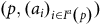


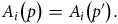





This definition follows Osborne and Rubinstein (Reference Osborne and Rubinstein1994), with the difference that we do not specify utilities at the terminal histories. This is why we call it a dynamic game form and not a dynamic game.
Based on this model we can derive the following definitions: We say that a history $p$
precedes a history
$p$
precedes a history ${p}^{\prime}$
(or
${p}^{\prime}$
(or ${p}^{\prime}$
follows
${p}^{\prime}$
follows $p$
) if
$p$
) if ${p}^{\prime}$
results by adding some action profiles after
${p}^{\prime}$
results by adding some action profiles after $p.$
Let
$p.$
Let $H:={\cup }_{i\in I}{H}_{i}$
be the collection of all information sets for all players. For every two information sets
$H:={\cup }_{i\in I}{H}_{i}$
be the collection of all information sets for all players. For every two information sets $h,{h}^{\prime}\in H,$
we say that
$h,{h}^{\prime}\in H,$
we say that $h$
precedes
$h$
precedes ${h}^{\prime}$
(or
${h}^{\prime}$
(or ${h}^{\prime}$
follows
${h}^{\prime}$
follows $h$
) if there is a history
$h$
) if there is a history $p\in h$
and a history
$p\in h$
and a history ${p}^{\prime}\in {h}^{\prime}$
such that
${p}^{\prime}\in {h}^{\prime}$
such that $p$
precedes
$p$
precedes ${p}^{\prime}.$
Two information sets
${p}^{\prime}.$
Two information sets $h,{h}^{\prime}$
are simultaneous if there is some history
$h,{h}^{\prime}$
are simultaneous if there is some history $p$
which belongs to both
$p$
which belongs to both $h$
and
$h$
and ${h}^{\prime}.$
We say that
${h}^{\prime}.$
We say that $h$
weakly precedes
$h$
weakly precedes ${h}^{\prime}$
(or
${h}^{\prime}$
(or ${h}^{\prime}$
weakly follows
${h}^{\prime}$
weakly follows $h$
) if either
$h$
) if either $h$
precedes
$h$
precedes ${h}^{\prime},$
or
${h}^{\prime},$
or $h,{h}^{\prime}$
are simultaneous.
$h,{h}^{\prime}$
are simultaneous.
The dynamic game form satisfies perfect recall (Kuhn Reference Kuhn, Kuhn and Tucker1953) if every player always remembers which actions he chose in the past, and which information he had about the opponents’ past actions. Formally, for every player $i,$
every information set
$i,$
every information set ${h}_{i}\in {H}_{i},$
and every two histories
${h}_{i}\in {H}_{i},$
and every two histories $p,{p}^{\prime}\in {h}_{i},$
the sequence of player
$p,{p}^{\prime}\in {h}_{i},$
the sequence of player $i$
actions in
$i$
actions in $p$
and
$p$
and ${p}^{\prime}$
must be the same (and consequently, the collection of player
${p}^{\prime}$
must be the same (and consequently, the collection of player $i$
information sets that
$i$
information sets that $p$
and
$p$
and ${p}^{\prime}$
cross must be the same).
${p}^{\prime}$
cross must be the same).
The dynamic game form has observed past choices, also known as observable actions, if every player always observes all choices that have been made in the past. Formally, for every player $i,$
every information set
$i,$
every information set ${h}_{i}\in {H}_{i}$
consists of a single history.
${h}_{i}\in {H}_{i}$
consists of a single history.
2.2 Strategies
A strategy for player $i$
assigns an available action to every information set at which player
$i$
assigns an available action to every information set at which player $i$
is active, and that is not excluded by earlier actions in the strategy. Formally, let
$i$
is active, and that is not excluded by earlier actions in the strategy. Formally, let ${\tilde {s}}_{i}$
be a mapping that assigns to every information set
${\tilde {s}}_{i}$
be a mapping that assigns to every information set ${h}_{i}\in {H}_{i}$
some action
${h}_{i}\in {H}_{i}$
some action ${\tilde {s}}_{i}\left(h\right)\in {A}_{i}\left(h\right).$
We call
${\tilde {s}}_{i}\left(h\right)\in {A}_{i}\left(h\right).$
We call ${\tilde {s}}_{i}$
a complete strategy. Then, a history
${\tilde {s}}_{i}$
a complete strategy. Then, a history $p\in P$
is excluded by
$p\in P$
is excluded by ${\tilde {s}}_{i}$
if there is some information set
${\tilde {s}}_{i}$
if there is some information set ${h}_{i}\in {H}_{i},$
with some history
${h}_{i}\in {H}_{i},$
with some history ${p}^{\prime}\in {h}_{i}$
preceding
${p}^{\prime}\in {h}_{i}$
preceding $p,$
such that
$p,$
such that ${\tilde {s}}_{i}\left({h}_{i}\right)$
is different from the unique player
${\tilde {s}}_{i}\left({h}_{i}\right)$
is different from the unique player $i$
action at
$i$
action at ${p}^{\prime}$
leading to
${p}^{\prime}$
leading to $p.$
An information set
$p.$
An information set $h\in H$
is excluded by
$h\in H$
is excluded by ${\tilde {s}}_{i}$
if all histories in
${\tilde {s}}_{i}$
if all histories in $h$
are excluded by
$h$
are excluded by ${\tilde {s}}_{i}.$
The strategy induced by
${\tilde {s}}_{i}.$
The strategy induced by ${\tilde {s}}_{i}$
is the restriction of
${\tilde {s}}_{i}$
is the restriction of ${\tilde {s}}_{i}$
to those information sets in
${\tilde {s}}_{i}$
to those information sets in ${H}_{i}$
that are not excluded by
${H}_{i}$
that are not excluded by ${\tilde {s}}_{i}.$
A mapping
${\tilde {s}}_{i}.$
A mapping ${s}_{i}:{\tilde {H}}_{i}\to {\cup }_{h\in {\tilde {H}}_{i}}{A}_{i}\left(h\right),$
where
${s}_{i}:{\tilde {H}}_{i}\to {\cup }_{h\in {\tilde {H}}_{i}}{A}_{i}\left(h\right),$
where ${\tilde {H}}_{i}\subseteq {H}_{i},$
is a strategy for player
${\tilde {H}}_{i}\subseteq {H}_{i},$
is a strategy for player $i$
if it is the strategy induced by a complete strategy.Footnote
1
By
$i$
if it is the strategy induced by a complete strategy.Footnote
1
By ${S}_{i}$
we denote the set of strategies for player
${S}_{i}$
we denote the set of strategies for player $i,$
and by
$i,$
and by ${S}_{-i}:={\times }_{j\ne i}{S}_{j}$
the set of strategy combinations for
${S}_{-i}:={\times }_{j\ne i}{S}_{j}$
the set of strategy combinations for $i$
’s opponents.
$i$
’s opponents.
Consider a strategy profile $s=({s}_{i}{)}_{i\in I}$
in
$s=({s}_{i}{)}_{i\in I}$
in ${\times }_{i\in I}{S}_{i}.$
Then,
${\times }_{i\in I}{S}_{i}.$
Then, $s$
induces a unique terminal history
$s$
induces a unique terminal history $z\left(s\right).$
We say that the strategy profile
$z\left(s\right).$
We say that the strategy profile $s$
reaches a history
$s$
reaches a history $p$
if
$p$
if $p$
precedes
$p$
precedes $z\left(s\right).$
Similarly, the strategy profile
$z\left(s\right).$
Similarly, the strategy profile $s$
is said to reach an information set
$s$
is said to reach an information set $h$
if
$h$
if $s$
reaches a history in
$s$
reaches a history in $h.$
$h.$
For a given information set $h\in H$
and player
$h\in H$
and player $i$
we define the sets
$i$
we define the sets
 $$S\left(h\right):=\{s\in {\times }_{i\in I}{S}_{i}\;|\;s\; \mathrm{r}\mathrm{e}\mathrm{a}\mathrm{c}\mathrm{h}\mathrm{e}\mathrm{s}\;h\},$$
 $${S}_{i}\left(h\right):=\left\{{s}_{i}\in {S}_{i}\;|\;\mathrm{t}\mathrm{h}\mathrm{e}\mathrm{r}\mathrm{e}\mathrm{\;}\mathrm{i}\mathrm{s}\mathrm{\;}\mathrm{s}\mathrm{o}\mathrm{m}\mathrm{e}\;{s}_{-i}\in {S}_{-i}\mathrm{\;}\mathrm{s}\mathrm{u}\mathrm{c}\mathrm{h}\mathrm{\;}\mathrm{t}\mathrm{h}\mathrm{a}\mathrm{t}\mathrm{\;}\left({s}_{i},{s}_{-i}\right)\in S\left(h\right)\right\},\mathrm{a}\mathrm{n}\mathrm{d}$$
 $${S}_{-i}(h):=\{{s}_{-i}\in {S}_{-i}\;|\;\mathrm{}\mathrm{t}\mathrm{h}\mathrm{e}\mathrm{r}\mathrm{e}\;\mathrm{i}\mathrm{s}\mathrm{\;}\mathrm{s}\mathrm{o}\mathrm{m}\mathrm{e}\;{s}_{i}\in {S}_{i}\mathrm{\;}\mathrm{s}\mathrm{u}\mathrm{c}\mathrm{h}\mathrm{\;}\mathrm{t}\mathrm{h}\mathrm{a}\mathrm{t}\mathrm{\;}({s}_{i},{s}_{-i})\in S(h)\}.$$
Intuitively, ${S}_{i}\left(h\right)$
is the set of strategies for player
${S}_{i}\left(h\right)$
is the set of strategies for player $i$
that allow for information set
$i$
that allow for information set $h$
to be reached, whereas
$h$
to be reached, whereas ${S}_{-i}\left(h\right)$
is the set of opponents’ strategy combinations that allow for
${S}_{-i}\left(h\right)$
is the set of opponents’ strategy combinations that allow for $h$
to be reached.
$h$
to be reached.
It is well-known that under perfect recall we have, for every player $i$
and every information set
$i$
and every information set ${h}_{i}\in {H}_{i},$
that
${h}_{i}\in {H}_{i},$
that $S\left({h}_{i}\right)={S}_{i}\left({h}_{i}\right)\times {S}_{-i}\left({h}_{i}\right),$
and that under observed past choices it holds that
$S\left({h}_{i}\right)={S}_{i}\left({h}_{i}\right)\times {S}_{-i}\left({h}_{i}\right),$
and that under observed past choices it holds that $S\left(h\right)={\times }_{i\in I}{S}_{i}\left(h\right)$
for every information set
$S\left(h\right)={\times }_{i\in I}{S}_{i}\left(h\right)$
for every information set $h.$
$h.$
For a given strategy ${s}_{i}\in {S}_{i},$
we denote by
${s}_{i}\in {S}_{i},$
we denote by ${H}_{i}\left({s}_{i}\right):=\{{h}_{i}\in {H}_{i}$ $|$
$|$ ${s}_{i}\in {S}_{i}\left({h}_{i}\right)\}$
the collection of information sets for player
${s}_{i}\in {S}_{i}\left({h}_{i}\right)\}$
the collection of information sets for player $i$
that the strategy
$i$
that the strategy ${s}_{i}$
allows to be reached. Similarly, for a given strategy combination
${s}_{i}$
allows to be reached. Similarly, for a given strategy combination ${s}_{-i}\in {S}_{-i}$
and a player
${s}_{-i}\in {S}_{-i}$
and a player $j,$
we denote by
$j,$
we denote by ${H}_{j}\left({s}_{-i}\right):=\{{h}_{j}\in {H}_{j}$ $|$
$|$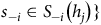 ${s}_{-i}\in {S}_{-i}\left({h}_{j}\right)\}$
the collection of information sets for player
${s}_{-i}\in {S}_{-i}\left({h}_{j}\right)\}$
the collection of information sets for player $j$
that the strategy combination
$j$
that the strategy combination ${s}_{-i}$
allows to be reached.
${s}_{-i}$
allows to be reached.
2.3 Conditional preference relations
Consider a dynamic game form $D$
and a distinguished player
$D$
and a distinguished player $i.$
Then, the acts, or objects of choice, for player
$i.$
Then, the acts, or objects of choice, for player $i$
are his strategies in
$i$
are his strategies in ${S}_{i},$
whereas the states, or the events about which he is uncertain, are the opponents’ strategy combinations in
${S}_{i},$
whereas the states, or the events about which he is uncertain, are the opponents’ strategy combinations in ${S}_{-i}.$
Following Gilboa and Schmeidler (Reference Gilboa and Schmeidler2003) and Perea (Reference Perea2025a), player
${S}_{-i}.$
Following Gilboa and Schmeidler (Reference Gilboa and Schmeidler2003) and Perea (Reference Perea2025a), player $i$
holds for every probabilistic belief about the states a preference relation over his acts. In the definition below we denote by
$i$
holds for every probabilistic belief about the states a preference relation over his acts. In the definition below we denote by $\mathrm{\Delta }\left({S}_{-i}\right)$
the set of probability distributions over
$\mathrm{\Delta }\left({S}_{-i}\right)$
the set of probability distributions over ${S}_{-i}.$
Definition 2.1
(Conditional preference relation) For a given dynamic game form $D,$
a conditional preference relation for player
$D,$
a conditional preference relation for player $i$
is a mapping
$i$
is a mapping ${\succsim }_{i}$
which assigns to every belief
${\succsim }_{i}$
which assigns to every belief ${\beta }_{i}\in \Delta \left({S}_{-i}\right)$
over the opponents’ strategy combinations a complete and transitive preference relation
${\beta }_{i}\in \Delta \left({S}_{-i}\right)$
over the opponents’ strategy combinations a complete and transitive preference relation ${\succsim}_{i,{\beta }_{i}}$
over the strategies in
${\succsim}_{i,{\beta }_{i}}$
over the strategies in ${S}_{i}.$
This concept reflects the crucial game theoretic element that player $i$
’s ranking over his strategies depends on the belief he holds about the opponents’ strategies. For a given conditional preference relation
$i$
’s ranking over his strategies depends on the belief he holds about the opponents’ strategies. For a given conditional preference relation ${\succsim }_{i}$
and two strategies
${\succsim }_{i}$
and two strategies ${s}_{i},{t}_{i},$
we say that
${s}_{i},{t}_{i},$
we say that ${s}_{i}$
weakly dominates
${s}_{i}$
weakly dominates ${t}_{i}$
under
${t}_{i}$
under ${\succsim }_{i}$
if
${\succsim }_{i}$
if ${s}_{i}{{\succsim} }_{i,{\beta }_{i}}{t}_{i}$
for every belief
${s}_{i}{{\succsim} }_{i,{\beta }_{i}}{t}_{i}$
for every belief ${\beta }_{i},$
and
${\beta }_{i},$
and ${s}_{i}{\succ }_{i,{\beta }_{i}}{t}_{i}$
for some belief
${s}_{i}{\succ }_{i,{\beta }_{i}}{t}_{i}$
for some belief ${\beta }_{i}.$
3. Two Notions of Consequentialism
In this section we introduce the preference-based and the utility-based version of consequentialism. As both notions depend on what the player views as the relevant consequences, we start by defining consequence structures.
3.1 Consequence structures
Broadly speaking, consequentialism in a dynamic game form means that the player, when evaluating his strategies, should only care about the possible consequences that these strategies may induce, and nothing more. This, in turn, depends on what the player views as the relevant consequences in the dynamic game. We will model this by a consequence structure.
Definition 3.1
(Consequence structure) A consequence structure for a dynamic game form $D$
is pair
$D$
is pair $(C,c)$
where
$(C,c)$
where $C$
is a finite set of consequences, and
$C$
is a finite set of consequences, and $c:{\times }_{i\in I}{S}_{i}\to C$
is a consequence mapping that assigns to every combination of strategies
$c:{\times }_{i\in I}{S}_{i}\to C$
is a consequence mapping that assigns to every combination of strategies $({s}_{i}{)}_{i\in I}$
the consequence
$({s}_{i}{)}_{i\in I}$
the consequence $c\left(\right({s}_{i}{)}_{i\in I})$
it induces.
$c\left(\right({s}_{i}{)}_{i\in I})$
it induces.
The consequence structure is a personal object, as it specifies what a given player deems important when evaluating his own strategies, in the light of the possible strategies that his opponents may choose. We hereby follow Hammond (Reference Hammond1988), who argues that the consequences should contain everything that the decision maker possibly cares about when making his decisions.
In classical game theory it is typically assumed that the consequences coincide with the terminal histories in the dynamic game form. That is, the player only cares about the realized actions, not about the counterfactual actions that he, or his opponents, would have chosen at unreached parts of the game tree. We refer to this as the realization-based consequence structure.
Definition 3.2
(Realization-based consequence structure) For a given dynamic game form $D$
, the realization-based consequence structure is the pair
$D$
, the realization-based consequence structure is the pair $(Z,z),$
where
$(Z,z),$
where $Z$
is the set of terminal histories in
$Z$
is the set of terminal histories in $D,$
and the mapping
$D,$
and the mapping $z:{\times }_{i\in I}{S}_{i}\to Z$
assigns to every strategy combination
$z:{\times }_{i\in I}{S}_{i}\to Z$
assigns to every strategy combination $({s}_{i}{)}_{i\in I}$
the terminal history
$({s}_{i}{)}_{i\in I}$
the terminal history $z\left(\right({s}_{i}{)}_{i\in I})$
it induces.
$z\left(\right({s}_{i}{)}_{i\in I})$
it induces.
As an illustration, consider the dynamic game form from Figure 1. If, after leaving, you do not care about what Barbara would have done if you had stayed, then the relevant consequence structure would be the realization-based consequence structure $(Z,z)$
in the left-hand panel of Table 1.
$(Z,z)$
in the left-hand panel of Table 1.
Two consequence structures in the dynamic game form of Figure 1

Table 1 Long description
The table presents two consequence structures in a dynamic game form, showing actions and outcomes for two players. The table has two main sections, each with three rows and four columns. The first section, labeled (Z, z), includes actions such as stay, leave and slam door, and leave and don't slam door, with outcomes for shouting and not shouting. The second section, labeled (C, c), also includes actions such as stay, leave and slam door, and leave and don't slam door, with outcomes for shouting and not shouting. Each cell in the table is labeled with a unique identifier, such as z1, z2, z3, z4, c1, c2, c3, c4, c5, and c6, representing different consequences based on the actions and outcomes.
However, if after leaving you do care about what Barbara would have done if you had stayed, then the appropriate consequence structure would be the pair $(C,c)$
in the right-hand panel of Table 1. Note that
$(C,c)$
in the right-hand panel of Table 1. Note that $c\left(\right($
leave, slam door
$c\left(\right($
leave, slam door $),$
shout
$),$
shout $)\ne c(($
leave, slam door
$)\ne c(($
leave, slam door $),$
don’t shout
$),$
don’t shout $)$
and
$)$
and $c\left(\right($
leave, don’t slam door
$c\left(\right($
leave, don’t slam door $),$
shout
$),$
shout $)\ne c(($
leave, don’t slam door
$)\ne c(($
leave, don’t slam door $),$
don’t shout
$),$
don’t shout $)$
in this case, which highlights that you do not only care about the realized actions, but also about Barbara’s counterfactual actions at unreached parts of the game tree.
$)$
in this case, which highlights that you do not only care about the realized actions, but also about Barbara’s counterfactual actions at unreached parts of the game tree.
3.2 Preference-based consequentialism
For a given consequence structure, we call a conditional preference relation preference-based consequentialist if for the ranking of two strategies under a given belief, the player only pays attention to the probability distributions over consequences induced by these two strategies under that particular belief.
To define it formally we need the following piece of notation: For a given consequence structure $(C,c)$
, strategy
$(C,c)$
, strategy ${s}_{i}$
and belief
${s}_{i}$
and belief ${\beta }_{i}\in \mathrm{\Delta }\left({S}_{-i}\right),$
the induced probability distribution
${\beta }_{i}\in \mathrm{\Delta }\left({S}_{-i}\right),$
the induced probability distribution ${\mathbb{P}}_{({s}_{i},{\beta }_{i})}\in \mathrm{\Delta }\left(C\right)$
over consequences is given by
${\mathbb{P}}_{({s}_{i},{\beta }_{i})}\in \mathrm{\Delta }\left(C\right)$
over consequences is given by
 $${\mathbb{P}}_{({s}_{i},{\beta }_{i})}\left(c\right):=\sum _{{s}_{-i}\in {S}_{-i}:c({s}_{i},{s}_{-i})=c} {\beta }_{i}\left({s}_{-i}\right)$$
for all consequences $c\in C.$
Footnote
2
$c\in C.$
Footnote
2
Definition 3.3
(Preference-based consequentialism) A conditional preference relation ${\succsim }_{i}$
is preference-based consequentialist relative to a consequence structure
${\succsim }_{i}$
is preference-based consequentialist relative to a consequence structure $(C,c)$
if for every four strategies
$(C,c)$
if for every four strategies ${s}_{i},{s}_{i}^{\prime},{t}_{i},{t}_{i}^{\prime}$
(not necessarily pairwise different) and every two beliefs
${s}_{i},{s}_{i}^{\prime},{t}_{i},{t}_{i}^{\prime}$
(not necessarily pairwise different) and every two beliefs ${\beta }_{i}$
and
${\beta }_{i}$
and ${\beta }_{i}^{\prime}$
(not necessarily different) with
${\beta }_{i}^{\prime}$
(not necessarily different) with
 $${\mathbb{P}}_{({s}_{i},{\beta }_{i})}={\mathbb{P}}_{({s}_{i}^{\prime},{\beta }_{i}^{\prime})\;}\mathrm{a}\mathrm{n}\mathrm{d}\;{\mathbb{P}}_{({t}_{i},{\beta }_{i})}={\mathbb{P}}_{({t}_{i}^{\prime},{\beta }_{i}^{\prime})}$$
it holds that
 $${s}_{i}{\succsim }_{i,{\beta }_{i}}{t}_{i}\;\mathrm{i}\mathrm{f}\mathrm{\;}\mathrm{a}\mathrm{n}\mathrm{d}\mathrm{\;}\mathrm{o}\mathrm{n}\mathrm{l}\mathrm{y}\mathrm{\;}\mathrm{i}\mathrm{f}\mathrm{\;}{s}_{i}^{\prime}{\succsim }_{i,{\beta }_{i}^{\prime}}{t}_{i}^{\prime}.$$
This definition is similar to the notion of probabilistic sophistication in Machina and Schmeidler (Reference Machina and Schmeidler1992) and Grant (Reference Grant1995), which states that within the Savage framework, the decision maker holds a unique probabilistic belief over states, and compares two acts only on the basis of their induced probability distributions over consequences.
As an illustration, let us go back to the dynamic game form in Figure 1. Suppose you are player 1 and Barbara is player 2. In the definition above choose the belief ${\beta }_{1}$
for you that assigns probability 1 to Barbara shouting, the belief
${\beta }_{1}$
for you that assigns probability 1 to Barbara shouting, the belief ${\beta }_{1}^{\prime}$
that assigns probability 1 to Barbara not shouting, the strategy
${\beta }_{1}^{\prime}$
that assigns probability 1 to Barbara not shouting, the strategy ${s}_{1}={s}_{1}^{\prime}=$ $($
leave, slam door
$($
leave, slam door $)$
and the strategy
$)$
and the strategy ${t}_{1}={t}_{1}^{\prime}=$ $($
leave, don’t slam door
$($
leave, don’t slam door $)$
.
$)$
.
Under the realization-based consequence structure $(Z,z)$
in the left-hand panel of Table 1, we have that
$(Z,z)$
in the left-hand panel of Table 1, we have that ${\mathbb{P}}_{({s}_{1},{\beta }_{1})}={\mathbb{P}}_{({s}_{1}^{\prime},{\beta }_{1}^{\prime})}=\left[{z}_{3}\right]$
and
${\mathbb{P}}_{({s}_{1},{\beta }_{1})}={\mathbb{P}}_{({s}_{1}^{\prime},{\beta }_{1}^{\prime})}=\left[{z}_{3}\right]$
and ${\mathbb{P}}_{({t}_{1},{\beta }_{1})}={\mathbb{P}}_{({t}_{1}^{\prime},{\beta }_{1}^{\prime})}=\left[{z}_{4}\right],$
where
${\mathbb{P}}_{({t}_{1},{\beta }_{1})}={\mathbb{P}}_{({t}_{1}^{\prime},{\beta }_{1}^{\prime})}=\left[{z}_{4}\right],$
where $\left[z\right]$
denotes the probability distribution that assigns probability 1 to consequence
$\left[z\right]$
denotes the probability distribution that assigns probability 1 to consequence $z.$
Hence, if you are a preference-based consequentialist relative to
$z.$
Hence, if you are a preference-based consequentialist relative to $(Z,z)$
, then
$(Z,z)$
, then ${s}_{1}{\succsim }_{1,{\beta }_{1}}{t}_{1}$
if and only if
${s}_{1}{\succsim }_{1,{\beta }_{1}}{t}_{1}$
if and only if ${s}_{1}{\succsim }_{1,{\beta }_{1}^{\prime}}{t}_{1}.$
That is, your preference between
${s}_{1}{\succsim }_{1,{\beta }_{1}^{\prime}}{t}_{1}.$
That is, your preference between $($
leave, slam door
$($
leave, slam door $)$
and
$)$
and $($
leave, don’t slam door
$($
leave, don’t slam door $)$
should not depend on the belief you have about Barbara’s counterfactual attitude if you were to stay. This matches the intuition behind the realization-based consequence structure
$)$
should not depend on the belief you have about Barbara’s counterfactual attitude if you were to stay. This matches the intuition behind the realization-based consequence structure $(Z,z),$
where only realized actions are deemed important, and not counterfactual actions.
$(Z,z),$
where only realized actions are deemed important, and not counterfactual actions.
If, on the other hand, your consequence structure is more fine-grained, and given by $(C,c)$
in the right-hand panel of Table 1, then no such condition will be imposed on your conditional preference relation under preference-based consequentialism. In particular, a conditional preference relation
$(C,c)$
in the right-hand panel of Table 1, then no such condition will be imposed on your conditional preference relation under preference-based consequentialism. In particular, a conditional preference relation ${\succsim }_{1}$
where
${\succsim }_{1}$
where
 $$\left(\mathrm{l}\mathrm{e}\mathrm{a}\mathrm{v}\mathrm{e},\mathrm{s}\mathrm{l}\mathrm{a}\mathrm{m}\mathrm{\;}\mathrm{d}\mathrm{o}\mathrm{o}\mathrm{r}\right)\;{\succ }_{1,{\beta }_{1}}\left(\mathrm{l}\mathrm{e}\mathrm{a}\mathrm{v}\mathrm{e},{\mathrm{d}\mathrm{o}\mathrm{n}}^{\prime}\mathrm{t}\mathrm{\;}\mathrm{s}\mathrm{l}\mathrm{a}\mathrm{m}\mathrm{\;}\mathrm{d}\mathrm{o}\mathrm{o}\mathrm{r}\right)\mathrm{\;}\mathrm{a}\mathrm{n}\mathrm{d}$$
 $$(\mathrm{l}\mathrm{e}\mathrm{a}\mathrm{v}\mathrm{e},{\mathrm{d}\mathrm{o}\mathrm{n}}^{\prime}\mathrm{t}\mathrm{\;}\mathrm{s}\mathrm{l}\mathrm{a}\mathrm{m}\mathrm{\;}\mathrm{d}\mathrm{o}\mathrm{o}\mathrm{r})\;{\succ }_{1,{\beta }_{1}^{\prime}}(\mathrm{l}\mathrm{e}\mathrm{a}\mathrm{v}\mathrm{e},\mathrm{s}\mathrm{l}\mathrm{a}\mathrm{m}\mathrm{\;}\mathrm{d}\mathrm{o}\mathrm{o}\mathrm{r})$$
is compatible with preference-based consequentialism relative to $(C,c).$
That is, under preference-based consequentialism relative to
$(C,c).$
That is, under preference-based consequentialism relative to $(C,c)$
you may prefer to slam the door if you believe that Barbara would have started to shout if you had stayed, and you may prefer to not slam the door if you believe that Barbara would have stayed calm in that counterfactual situation. Also this is in accordance with the particular consequence structure at hand, which reveals that counterfactual actions may matter when evaluating your own strategies.
$(C,c)$
you may prefer to slam the door if you believe that Barbara would have started to shout if you had stayed, and you may prefer to not slam the door if you believe that Barbara would have stayed calm in that counterfactual situation. Also this is in accordance with the particular consequence structure at hand, which reveals that counterfactual actions may matter when evaluating your own strategies.
Using the more fine-grained consequence structure in this example may be viewed as an instance of “consequentialization”, where the set of consequences is enlarged as to make the preferences of the decision maker consequentialist.
3.3 Utility-based consequentialism
Following Gilboa and Schmeidler (Reference Gilboa and Schmeidler2003) and Perea (Reference Perea2025a), we say that a conditional preference relation has an expected utility representation if there is a utility function, assigning to every act-state pair some utility, such that for every belief the decision maker prefers act $a$
to act
$a$
to act $b$
precisely when the first act induces a higher expected utility than the second.
$b$
precisely when the first act induces a higher expected utility than the second.
Definition 3.4
(Expected utility representation) Consider a conditional preference relation ${\succsim }_{i}$
and a utility function
${\succsim }_{i}$
and a utility function ${u}_{i}:{S}_{i}\times {S}_{-i}\to {\boldsymbol R}.$
Then,
${u}_{i}:{S}_{i}\times {S}_{-i}\to {\boldsymbol R}.$
Then, ${u}_{i}$
is an expected utility representation for
${u}_{i}$
is an expected utility representation for ${\succsim }_{i}$
if for every belief
${\succsim }_{i}$
if for every belief ${\beta }_{i}\in \Delta \left({S}_{-i}\right),$
and every two strategies
${\beta }_{i}\in \Delta \left({S}_{-i}\right),$
and every two strategies ${s}_{i},{t}_{i},$
we have that
${s}_{i},{t}_{i},$
we have that ${s}_{i}{\succsim }_{i,{\beta }_{i}}{t}_{i}$
if and only if
${s}_{i}{\succsim }_{i,{\beta }_{i}}{t}_{i}$
if and only if
 $$\sum _{{s}_{-i}\in {S}_{-i}} {\beta }_{i}\left({s}_{-i}\right)\cdot {u}_{i}({s}_{i},{s}_{-i})\ge \sum _{{s}_{-i}\in {S}_{-i}} {\beta }_{i}\left({s}_{-i}\right)\cdot {u}_{i}({t}_{i},{s}_{-i}).$$
If, relative to a given consequence structure, this expected utility representation assigns the same utility to any two strategy combinations that induce the same consequence, then we say that the conditional preference relation is utility-based consequentialist.
Definition 3.5
(Utility-based consequentialism) A conditional preference relation $x{\succsim }_{i}$
is utility-based consequentialist relative to a consequence structure
$x{\succsim }_{i}$
is utility-based consequentialist relative to a consequence structure $(C,c)$
if it has an expected utility representation
$(C,c)$
if it has an expected utility representation ${u}_{i}$
such that for every two strategies
${u}_{i}$
such that for every two strategies ${s}_{i},{t}_{i}$
and every two opponents’ strategy combinations
${s}_{i},{t}_{i}$
and every two opponents’ strategy combinations ${s}_{-i},{t}_{-i}$
with
${s}_{-i},{t}_{-i}$
with $c({s}_{i},{s}_{-i})=c({t}_{i},{t}_{-i})$
it holds that
$c({s}_{i},{s}_{-i})=c({t}_{i},{t}_{-i})$
it holds that ${u}_{i}({s}_{i},{s}_{-i})={u}_{i}({t}_{i},{t}_{-i}).$
A utility function ${u}_{i}$
satisfying the condition above, that
${u}_{i}$
satisfying the condition above, that ${u}_{i}({s}_{i},{s}_{-i})={u}_{i}({t}_{i},{t}_{-i})$
whenever
${u}_{i}({s}_{i},{s}_{-i})={u}_{i}({t}_{i},{t}_{-i})$
whenever $c({s}_{i},{s}_{-i})=c({t}_{i},{t}_{-i}),$
is said to be measurable with respect to the consequence structure
$c({s}_{i},{s}_{-i})=c({t}_{i},{t}_{-i}),$
is said to be measurable with respect to the consequence structure $(C,c).$
Equivalently, utility-based consequentialism can be defined as follows: A conditional preference relation
$(C,c).$
Equivalently, utility-based consequentialism can be defined as follows: A conditional preference relation ${\succsim }_{i}$
is utility-based consequentialist relative to
${\succsim }_{i}$
is utility-based consequentialist relative to $(C,c)$
if there is a utility function
$(C,c)$
if there is a utility function ${w}_{i}:C\to {\boldsymbol R}$
on consequences, such that
${w}_{i}:C\to {\boldsymbol R}$
on consequences, such that ${s}_{i}{\succsim }_{i,{\beta }_{i}}{t}_{i}$
if and only if
${s}_{i}{\succsim }_{i,{\beta }_{i}}{t}_{i}$
if and only if
 $$\sum _{{s}_{-i}\in {S}_{-i}} {\beta }_{i}\left({s}_{-i}\right)\cdot ({w}_{i}\circ c)({s}_{i},{s}_{-i})\ge \sum _{{s}_{-i}\in {S}_{-i}} {\beta }_{i}\left({s}_{-i}\right)\cdot ({w}_{i}\circ c)({t}_{i},{s}_{-i}),$$
for every two strategies ${s}_{i},{t}_{i}$
and every belief
${s}_{i},{t}_{i}$
and every belief ${\beta }_{i}.$
In particular, if we take the realization-based consequence structure $(Z,z),$
then (1) states that the conditional preferences are induced by a utility function
$(Z,z),$
then (1) states that the conditional preferences are induced by a utility function ${w}_{i}$
on terminal histories. This is the traditional way in which consequentialism in dynamic games is modelled. As such, game theory typically assumes utility-based consequentialism relative to the realization-based consequence structure.
${w}_{i}$
on terminal histories. This is the traditional way in which consequentialism in dynamic games is modelled. As such, game theory typically assumes utility-based consequentialism relative to the realization-based consequence structure.
Utility-based consequentialism is also related to Hammond’s (Reference Hammond1988) notion of consequentialism, which states that whenever two decision trees are equivalent in terms of consequences, then the prescribed behavior in the two trees must be equivalent in terms of consequences as well. That is, the prescribed behavior in a decision tree should only depend on the feasible consequences – not on the precise structure of the decision tree. In Theorem 9 of Hammond (Reference Hammond1988) it is shown that his notion of consequentialism, in combination with continuity, implies that the prescribed behavior is governed by a utility function on consequences only.
As an illustration of utility-based consequentialism, consider the dynamic game form from Figure 1, and the conditional preference relation $\succsim $
1 for you that has the expected utility representation
$\succsim $
1 for you that has the expected utility representation ${u}_{1}$
given by Table 2.
${u}_{1}$
given by Table 2.
Expected utility representation in game of Figure 1

Table 2 Long description
The table presents the expected utility representation in a game, focusing on three actions: stay, leave and slam door, and leave and don't slam door. It compares the outcomes of shouting and not shouting. The table has four rows and three columns. The first row is a header with columns labeled shout and don't shout. The subsequent rows are labeled stay, leave and slam door, and leave and don't slam door. The values in the cells represent the utility outcomes for each action and outcome combination. For the action stay, the utility is 2 for shout and 0 for don't shout. For the action leave and slam door, the utility is 3 for shout and 2 for don't shout. For the action leave and don't slam door, the utility is 5 for shout and 4 for don't shout.
Assume the realization-based consequence structure $(Z,z)$
from the left-hand panel in Table 1. Note that
$(Z,z)$
from the left-hand panel in Table 1. Note that $z\left(\right($
leave, slam door
$z\left(\right($
leave, slam door $)$
, shout
$)$
, shout $)=z(($
leave, slam door
$)=z(($
leave, slam door $)$
, do not shout
$)$
, do not shout $)$
but
$)$
but ${u}_{1}\left(\right($
leave, slam door
${u}_{1}\left(\right($
leave, slam door $)$
, shout
$)$
, shout $)\ne {u}_{1}(($
leave, slam door
$)\ne {u}_{1}(($
leave, slam door $)$
, do not shout
$)$
, do not shout $).$
Despite this, it can be shown that
$).$
Despite this, it can be shown that ${\succsim }_{1}$
is utility-based consequentialist relative to
${\succsim }_{1}$
is utility-based consequentialist relative to $(Z,z)$
. Indeed, suppose we add the fixed utility 1 to all utilities in the second column, leading to a new utility function
$(Z,z)$
. Indeed, suppose we add the fixed utility 1 to all utilities in the second column, leading to a new utility function ${v}_{1}$
. Then, for every belief the expected utility differences between strategies will be the same in
${v}_{1}$
. Then, for every belief the expected utility differences between strategies will be the same in ${u}_{1}$
as in
${u}_{1}$
as in ${v}_{1}$
, which implies that also
${v}_{1}$
, which implies that also ${v}_{1}$
will be an expected utility representation for
${v}_{1}$
will be an expected utility representation for ${\succsim }_{1}.$
Moreover, it can be verified that the new utility function
${\succsim }_{1}.$
Moreover, it can be verified that the new utility function ${v}_{1}$
is measurable with respect to
${v}_{1}$
is measurable with respect to $(Z,z),$
and hence
$(Z,z),$
and hence ${\succsim }_{1}$
is utility-based consequentialist.
${\succsim }_{1}$
is utility-based consequentialist.
It is easily seen that, relative to any consequence structure, every conditional preference relation which is utility-based consequentialist is also preference-based consequentialist. However, as we will see in the following section, the other direction is not always true.
To close this section, let us go back to the example from Figure 1 with the conditional preference relation ${\succsim }_{1}$
for you given by the utility function
${\succsim }_{1}$
for you given by the utility function ${u}_{1}$
in Table 2. Suppose we replace the utility
${u}_{1}$
in Table 2. Suppose we replace the utility $3$
by a utility of
$3$
by a utility of $6.$
Then, you prefer
$6.$
Then, you prefer $($
leave, slam door
$($
leave, slam door $)$
to
$)$
to $($
leave, don’t slam door
$($
leave, don’t slam door $)$
if you believe that Barbara would start shouting if you were to stay, whereas the ranking would be reversed if you believe that Barbara would not start shouting in this case. Such a conditional preference relation would not be preference-based consequentialist, and therefore also not utility-based consequentialist, relative to the realization-based consequence structure
$)$
if you believe that Barbara would start shouting if you were to stay, whereas the ranking would be reversed if you believe that Barbara would not start shouting in this case. Such a conditional preference relation would not be preference-based consequentialist, and therefore also not utility-based consequentialist, relative to the realization-based consequence structure $(Z,z)$
. However, it would be utility-based consequentialist, and hence preference-based consequentialist, relative to the more fine-grained consequence structure
$(Z,z)$
. However, it would be utility-based consequentialist, and hence preference-based consequentialist, relative to the more fine-grained consequence structure $(C,c)$
in the right-hand panel of Table 1.
$(C,c)$
in the right-hand panel of Table 1.
Although this conditional preference relation is excluded by the classical approach to dynamic games, which assumes utility-based consequentialism relative to the realization-based consequence structure, it is allowed by the psychological games model of Battigalli and Dufwenberg (Reference Battigalli and Dufwenberg2009). In their definition of a psychological game, the utility of a player may depend on the full strategies used by his opponents – and hence in particular on the counterfactual choices of his opponents at information sets he believes will not be reached. Such counterfactual choices by the opponents may matter for the player’s preferences as they may trigger certain emotions that affect his decision making process, even if these choices are not realized along the course of play. The more fine-grained consequence structure $(C,c)$
above may account for such emotions.
$(C,c)$
above may account for such emotions.
The conditional preference relation above is also ruled out by the notion of consistent behavior norms in Hammond (Reference Hammond1988), which states that the decision at a certain node in the decision tree should only depend on the subtree that follows this node. This is clearly violated by the conditional preference relation at hand, since your preference between slam door and don’t slam door at the lower decision node depends on the choice that Barbara would have made at the upper decision node, which is not included in the subtree that follows the lower decision node.
4. Difference Between the Two Notions
In this section we first present an example where utility-based consequentialism is more restrictive than preference-based consequentialism, at least for some consequence structures. We will see that utility-based consequentialism requires the decision maker to hold additive preference intensities on consequences – a property that is not required by preference-based consequentialism in this example. We proceed by offering a formal definition of additive preference intensities on consequences and show that, in the absence of weakly dominated strategies and relative to the realization-based consequence structure, utility-based consequentialism is equivalent to respect of outcome-equivalent strategies and having additive preference intensities on consequences. Moreover, it is shown that, under the same conditions, preference-based consequentialism is equivalent to respect of outcome-equivalent strategies and having additive preference intensities on consequences for every pair of strategies.
4.1 Example
We will now present an example where utility-based consequentialism is more restrictive than preference-based consequentialism. Consider the dynamic game form in the left-hand panel of Figure 2.
Utility based consequentialism may be stronger than preference-based consequentialism.

Figure 2 Long description
The diagram features three main sections labeled 1, 2, and 3. Section 1 includes nodes labeled h1 with branches labeled a, b, c, and d. Section 2 contains a grid with nodes z1 and z2, and labels e, f, h1', and h2. Section 3 shows nodes connected to z3, z4, z5, z6, z7, and z8, with labels g and h. The right side of the diagram presents a graph labeled Graph G1D with nodes and connections labeled with pairs of letters. The diagram illustrates the relationships and flow between these nodes and labels, representing the structure of utility-based consequentialism.
Note that there are three players. The information sets for player 1 are ${h}_{1}$
and
${h}_{1}$
and ${h}_{1}^{\prime},$
whereas
${h}_{1}^{\prime},$
whereas ${h}_{2}$
and
${h}_{2}$
and ${h}_{3}$
are the unique information sets for players 2 and 3, respectively. The information sets
${h}_{3}$
are the unique information sets for players 2 and 3, respectively. The information sets ${h}_{1}^{\prime}$
and
${h}_{1}^{\prime}$
and ${h}_{2}$
represent a history where players 1 and 2 choose simultaneously. The terminal histories are
${h}_{2}$
represent a history where players 1 and 2 choose simultaneously. The terminal histories are ${z}_{1}, \ldots, {z}_{8}.$
At information set
${z}_{1}, \ldots, {z}_{8}.$
At information set ${h}_{1}^{\prime},$
the action pair
${h}_{1}^{\prime},$
the action pair $(c,e)$
leads to the terminal history
$(c,e)$
leads to the terminal history ${z}_{1}$
whereas
${z}_{1}$
whereas $(d,f)$
leads to the terminal history
$(d,f)$
leads to the terminal history ${z}_{2}.$
The sets of strategies for the three players are
${z}_{2}.$
The sets of strategies for the three players are ${S}_{1}=\left\{\right(a,c),(a,d),b\},$ ${S}_{2}=\{e,f\}$
and
${S}_{2}=\{e,f\}$
and ${S}_{3}=\{g,h\},$
respectively.
${S}_{3}=\{g,h\},$
respectively.
We view the dynamic game form from the viewpoint of player 1. Consider the realization-based consequence structure $(Z,z),$
depicted by Table 3.
$(Z,z),$
depicted by Table 3.
Realization-based consequence structure for the dynamic game form in Figure 2

Table 3 Long description
The table presents the realization-based consequence structure for a dynamic game form, focusing on player 1's perspective. It consists of five rows and five columns, each representing different player strategies and their corresponding outcomes. The columns are labeled with strategy pairs (e, g), (f, g), (e, h), and (f, h), while the rows are labeled with strategy pairs (a, c), (a, d), and a constant value b. Each cell within the table contains specific outcomes denoted by Z values, such as Z1, Z2, Z3, Z4, Z5, Z6, Z7, and Z8. The table illustrates the various consequences that player 1 might face based on the strategies chosen by both players.
It is first shown that every conditional preference relation ${\succsim }_{1}$
for player 1 with an expected utility representation and without weakly dominated strategies is preference-based consequentialist relative to
${\succsim }_{1}$
for player 1 with an expected utility representation and without weakly dominated strategies is preference-based consequentialist relative to $(Z,z)$
. In other words, preference-based consequentialism relative to
$(Z,z)$
. In other words, preference-based consequentialism relative to $(Z,z)$
imposes no additional restrictions.
$(Z,z)$
imposes no additional restrictions.
To see this, consider a conditional preference relation ${\succsim }_{1}$
with an expected utility representation
${\succsim }_{1}$
with an expected utility representation ${u}_{1}$
such that no two strategies weakly dominate one another. To show that
${u}_{1}$
such that no two strategies weakly dominate one another. To show that ${\succsim \mathrm{}}_{1}$
is preference-based consequentialist relative to
${\succsim \mathrm{}}_{1}$
is preference-based consequentialist relative to $(Z,z)$
, consider four strategies
$(Z,z)$
, consider four strategies ${s}_{1},{s}_{1}^{\prime},{t}_{1},{t}_{1}^{\prime}$
and two beliefs
${s}_{1},{s}_{1}^{\prime},{t}_{1},{t}_{1}^{\prime}$
and two beliefs ${\beta }_{1},{\beta }_{1}^{\prime}$
with
${\beta }_{1},{\beta }_{1}^{\prime}$
with ${\mathbb{P}}_{({s}_{1},{\beta }_{1})}={\mathbb{P}}_{({s}_{1}^{\prime},{\beta }_{1}^{\prime})}$
and
${\mathbb{P}}_{({s}_{1},{\beta }_{1})}={\mathbb{P}}_{({s}_{1}^{\prime},{\beta }_{1}^{\prime})}$
and ${\mathbb{P}}_{({t}_{1},{\beta }_{1})}={\mathbb{P}}_{({t}_{1}^{\prime},{\beta }_{1}^{\prime})}.$
We must show that
${\mathbb{P}}_{({t}_{1},{\beta }_{1})}={\mathbb{P}}_{({t}_{1}^{\prime},{\beta }_{1}^{\prime})}.$
We must show that ${s}_{1}{\succsim }_{1,{\beta }_{1}}{t}_{1}$
if and only if
${s}_{1}{\succsim }_{1,{\beta }_{1}}{t}_{1}$
if and only if ${s}_{1}^{\prime}{\succsim }_{1,{\beta }_{1}^{\prime}}{t}_{1}^{\prime}.$
As different strategies for player 1 lead to different terminal histories we must have that ${s}_{1}={s}_{1}^{\prime}$
and
${s}_{1}={s}_{1}^{\prime}$
and ${t}_{1}={t}_{1}^{\prime}.$
If
${t}_{1}={t}_{1}^{\prime}.$
If ${s}_{1}={t}_{1}$
then it trivially holds that
${s}_{1}={t}_{1}$
then it trivially holds that ${s}_{1}{\succsim }_{1,{\beta }_{1}}{t}_{1}$
if and only if
${s}_{1}{\succsim }_{1,{\beta }_{1}}{t}_{1}$
if and only if ${s}_{1}^{\prime}{\succsim }_{1,{\beta }_{1}^{\prime}}{t}_{1}^{\prime}.$
Let us therefore assume that
${s}_{1}^{\prime}{\succsim }_{1,{\beta }_{1}^{\prime}}{t}_{1}^{\prime}.$
Let us therefore assume that ${s}_{1}\ne {t}_{1}.$
Suppose first that ${s}_{1}=(a,c)$
and
${s}_{1}=(a,c)$
and ${t}_{1}=(a,d).$
Since
${t}_{1}=(a,d).$
Since ${\mathbb{P}}_{\left(\right(a,c),{\beta }_{1})}={\mathbb{P}}_{\left(\right(a,c),{\beta }_{1}^{\prime})}$
it follows from Table 3 that
${\mathbb{P}}_{\left(\right(a,c),{\beta }_{1})}={\mathbb{P}}_{\left(\right(a,c),{\beta }_{1}^{\prime})}$
it follows from Table 3 that ${\beta }_{1}(f,g)={\beta }_{1}^{\prime}(f,g)$
and
${\beta }_{1}(f,g)={\beta }_{1}^{\prime}(f,g)$
and ${\beta }_{1}(f,h)={\beta }_{1}^{\prime}(f,h).$
Similarly, as
${\beta }_{1}(f,h)={\beta }_{1}^{\prime}(f,h).$
Similarly, as ${\mathbb{P}}_{\left(\right(a,d),{\beta }_{1})}={\mathbb{P}}_{\left(\right(a,d),{\beta }_{1}^{\prime})}$
it follows that
${\mathbb{P}}_{\left(\right(a,d),{\beta }_{1})}={\mathbb{P}}_{\left(\right(a,d),{\beta }_{1}^{\prime})}$
it follows that ${\beta }_{1}(e,g)={\beta }_{1}^{\prime}(e,g)$
and
${\beta }_{1}(e,g)={\beta }_{1}^{\prime}(e,g)$
and ${\beta }_{1}(e,h)={\beta }_{1}^{\prime}(e,h).$
We thus conclude that
${\beta }_{1}(e,h)={\beta }_{1}^{\prime}(e,h).$
We thus conclude that ${\beta }_{1}={\beta }_{1}^{\prime}.$
But then, it trivially holds that
${\beta }_{1}={\beta }_{1}^{\prime}.$
But then, it trivially holds that ${s}_{1}{\succsim }_{1,{\beta }_{1}}{t}_{1}$
if and only if
${s}_{1}{\succsim }_{1,{\beta }_{1}}{t}_{1}$
if and only if ${s}_{1}^{\prime}{\succsim }_{1,{\beta }_{1}^{\prime}}{t}_{1}^{\prime}$
since
${s}_{1}^{\prime}{\succsim }_{1,{\beta }_{1}^{\prime}}{t}_{1}^{\prime}$
since ${s}_{1}={s}_{1}^{\prime}$
and
${s}_{1}={s}_{1}^{\prime}$
and ${t}_{1}={t}_{1}^{\prime}.$
Suppose next that ${s}_{1}=(a,c)$
and
${s}_{1}=(a,c)$
and ${t}_{1}=b.$
Since
${t}_{1}=b.$
Since ${\mathbb{P}}_{\left(\right(a,c),{\beta }_{1})}={\mathbb{P}}_{\left(\right(a,c),{\beta }_{1}^{\prime})}$
we must have that
${\mathbb{P}}_{\left(\right(a,c),{\beta }_{1})}={\mathbb{P}}_{\left(\right(a,c),{\beta }_{1}^{\prime})}$
we must have that ${\beta }_{1}(f,g)={\beta }_{1}^{\prime}(f,g)$
and
${\beta }_{1}(f,g)={\beta }_{1}^{\prime}(f,g)$
and ${\beta }_{1}(f,h)={\beta }_{1}^{\prime}(f,h).$
Moreover, as
${\beta }_{1}(f,h)={\beta }_{1}^{\prime}(f,h).$
Moreover, as ${\mathbb{P}}_{(b,{\beta }_{1})}={\mathbb{P}}_{(b,{\beta }_{1}^{\prime})}$
it follows that
${\mathbb{P}}_{(b,{\beta }_{1})}={\mathbb{P}}_{(b,{\beta }_{1}^{\prime})}$
it follows that ${\beta }_{1}(e,g)+{\beta }_{1}(f,g)={\beta }_{1}^{\prime}(e,g)+{\beta }_{1}^{\prime}(f,g)$
and
${\beta }_{1}(e,g)+{\beta }_{1}(f,g)={\beta }_{1}^{\prime}(e,g)+{\beta }_{1}^{\prime}(f,g)$
and ${\beta }_{1}(e,h)+{\beta }_{1}(f,h)={\beta }_{1}^{\prime}(e,h)+{\beta }_{1}^{\prime}(f,h).$
Altogether, we thus conclude that
${\beta }_{1}(e,h)+{\beta }_{1}(f,h)={\beta }_{1}^{\prime}(e,h)+{\beta }_{1}^{\prime}(f,h).$
Altogether, we thus conclude that ${\beta }_{1}={\beta }_{1}^{\prime}.$
But then, it trivially holds that
${\beta }_{1}={\beta }_{1}^{\prime}.$
But then, it trivially holds that ${s}_{1}{\succsim }_{1,{\beta }_{1}}{t}_{1}$
if and only if
${s}_{1}{\succsim }_{1,{\beta }_{1}}{t}_{1}$
if and only if ${s}_{1}^{\prime}{\succsim }_{1,{\beta }_{1}^{\prime}}{t}_{1}^{\prime}$
since
${s}_{1}^{\prime}{\succsim }_{1,{\beta }_{1}^{\prime}}{t}_{1}^{\prime}$
since ${s}_{1}={s}_{1}^{\prime}$
and
${s}_{1}={s}_{1}^{\prime}$
and ${t}_{1}={t}_{1}^{\prime}.$
Suppose finally that ${s}_{1}=(a,d)$
and
${s}_{1}=(a,d)$
and ${t}_{1}=b.$
Since
${t}_{1}=b.$
Since ${\mathbb{P}}_{\left(\right(a,d),{\beta }_{1})}={\mathbb{P}}_{\left(\right(a,d),{\beta }_{1}^{\prime})}$
we must have that
${\mathbb{P}}_{\left(\right(a,d),{\beta }_{1})}={\mathbb{P}}_{\left(\right(a,d),{\beta }_{1}^{\prime})}$
we must have that ${\beta }_{1}(e,g)={\beta }_{1}^{\prime}(e,g)$
and
${\beta }_{1}(e,g)={\beta }_{1}^{\prime}(e,g)$
and ${\beta }_{1}(e,h)={\beta }_{1}^{\prime}(e,h).$
Moreover, as
${\beta }_{1}(e,h)={\beta }_{1}^{\prime}(e,h).$
Moreover, as ${\mathbb{P}}_{(b,{\beta }_{1})}={\mathbb{P}}_{(b,{\beta }_{1}^{\prime})}$
it follows that
${\mathbb{P}}_{(b,{\beta }_{1})}={\mathbb{P}}_{(b,{\beta }_{1}^{\prime})}$
it follows that ${\beta }_{1}(e,g)+{\beta }_{1}(f,g)={\beta }_{1}^{\prime}(e,g)+{\beta }_{1}^{\prime}(f,g)$
and
${\beta }_{1}(e,g)+{\beta }_{1}(f,g)={\beta }_{1}^{\prime}(e,g)+{\beta }_{1}^{\prime}(f,g)$
and ${\beta }_{1}(e,h)+{\beta }_{1}(f,h)={\beta }_{1}^{\prime}(e,h)+{\beta }_{1}^{\prime}(f,h).$
Altogether, we thus conclude that
${\beta }_{1}(e,h)+{\beta }_{1}(f,h)={\beta }_{1}^{\prime}(e,h)+{\beta }_{1}^{\prime}(f,h).$
Altogether, we thus conclude that ${\beta }_{1}={\beta }_{1}^{\prime}.$
But then, it trivially holds that
${\beta }_{1}={\beta }_{1}^{\prime}.$
But then, it trivially holds that ${s}_{1}{\succsim }_{1,{\beta }_{1}}{t}_{1}$
if and only if
${s}_{1}{\succsim }_{1,{\beta }_{1}}{t}_{1}$
if and only if ${s}_{1}^{\prime}{\succsim }_{1,{\beta }_{1}^{\prime}}{t}_{1}^{\prime}$
since
${s}_{1}^{\prime}{\succsim }_{1,{\beta }_{1}^{\prime}}{t}_{1}^{\prime}$
since ${s}_{1}={s}_{1}^{\prime}$
and
${s}_{1}={s}_{1}^{\prime}$
and ${t}_{1}={t}_{1}^{\prime}.$
Summarizing, we conclude that
${t}_{1}={t}_{1}^{\prime}.$
Summarizing, we conclude that ${\succsim }_{1}$
is preference-based consequentialist relative to
${\succsim }_{1}$
is preference-based consequentialist relative to $(Z,z)$
.
$(Z,z)$
.
We next show that utility-based consequentialism relative to $(Z,z)$
imposes restrictions that are absent under preference-based consequentialism. To see this, consider a conditional preference relation
$(Z,z)$
imposes restrictions that are absent under preference-based consequentialism. To see this, consider a conditional preference relation ${\succsim }_{1}$
without weakly dominated strategies that is utility-based consequentialist relative to
${\succsim }_{1}$
without weakly dominated strategies that is utility-based consequentialist relative to $(Z,z)$
. Then,
$(Z,z)$
. Then, ${\succsim }_{1}$
has an expected utility representation
${\succsim }_{1}$
has an expected utility representation ${u}_{1}$
which is measurable with respect to
${u}_{1}$
which is measurable with respect to $(Z,z)$
. Note from Table 3 that
$(Z,z)$
. Note from Table 3 that

which is visualized by the graph ${G}_{1}^{D}$
in the right-hand panel of Figure 2. As
${G}_{1}^{D}$
in the right-hand panel of Figure 2. As ${u}_{1}$
is measurable with respect to
${u}_{1}$
is measurable with respect to $(Z,z),$
we must have that
$(Z,z),$
we must have that

which implies that
 $$\left[{u}_{1}(b,(f,g\left)\right)-{u}_{1}\left(\right(a,d),(f,g\left)\right)\right]+\left[{u}_{1}\left(\right(a,d),(f,h\left)\right)-{u}_{1}(b,(f,h\left)\right)\right]$$
 $$=\left[{u}_{1}(b,(e,g\left)\right)-{u}_{1}\left(\right(a,c),(e,g\left)\right)\right]+\left[{u}_{1}\left(\right(a,c),(e,h\left)\right)-{u}_{1}(b,(e,h\left)\right)\right].$$
Since there are no weakly dominated strategies under ${\succsim }_{1},$
it follows from Perea (Reference Perea2025a) that the utility differences
${\succsim }_{1},$
it follows from Perea (Reference Perea2025a) that the utility differences ${v}_{1}({s}_{1},{s}_{-1})-{v}_{1}({t}_{1},{s}_{-1})$
are unique across all expected utility representations
${v}_{1}({s}_{1},{s}_{-1})-{v}_{1}({t}_{1},{s}_{-1})$
are unique across all expected utility representations ${v}_{1}$
for
${v}_{1}$
for ${\succsim }_{1},$
up to a positive multiplicative constant. This means that (2) applies to all expected utility representations
${\succsim }_{1},$
up to a positive multiplicative constant. This means that (2) applies to all expected utility representations ${v}_{1}$
for
${v}_{1}$
for ${\succsim }_{1},$
and is thus a structural property of the conditional preference relation
${\succsim }_{1},$
and is thus a structural property of the conditional preference relation ${\succsim }_{1}.$
In fact, it turns out that the restriction in (2) characterizes all conditional preference relations
${\succsim }_{1}.$
In fact, it turns out that the restriction in (2) characterizes all conditional preference relations ${\succsim }_{1}$
that are utility-based consequentialist.
${\succsim }_{1}$
that are utility-based consequentialist.
But what does (2) intuitively mean? In Perea (Reference Perea2025a) it is argued that for a conditional preference relation ${\succsim }_{1}$
without weakly dominated strategies, the utility difference
${\succsim }_{1}$
without weakly dominated strategies, the utility difference ${v}_{1}({s}_{1},{s}_{-1})-{v}_{1}({t}_{1},{s}_{-1}),$
which is unique up to a positive multiplicative constant, can be interpreted as the intensity by which player 1 prefers
${v}_{1}({s}_{1},{s}_{-1})-{v}_{1}({t}_{1},{s}_{-1}),$
which is unique up to a positive multiplicative constant, can be interpreted as the intensity by which player 1 prefers ${s}_{1}$
to
${s}_{1}$
to ${t}_{1}$
under the belief that the opponents choose
${t}_{1}$
under the belief that the opponents choose ${s}_{-1}.$
This intensity will be negative if
${s}_{-1}.$
This intensity will be negative if ${v}_{1}({s}_{1},{s}_{-1}) \lt {v}_{1}({t}_{1},{s}_{-1})$
. If we assume that
${v}_{1}({s}_{1},{s}_{-1}) \lt {v}_{1}({t}_{1},{s}_{-1})$
. If we assume that ${v}_{1}$
is measurable with respect to
${v}_{1}$
is measurable with respect to $(Z,z)$
, as we do in this example, then
$(Z,z)$
, as we do in this example, then ${v}_{1}({s}_{1},{s}_{-1})-{v}_{1}({t}_{1},{s}_{-1})$
also represents the intensity by which player 1 prefers the consequence
${v}_{1}({s}_{1},{s}_{-1})-{v}_{1}({t}_{1},{s}_{-1})$
also represents the intensity by which player 1 prefers the consequence $z({s}_{1},{s}_{-1})$
to the consequence
$z({s}_{1},{s}_{-1})$
to the consequence $z({t}_{1},{s}_{-1}),$
thus leading to a cardinal interpretation of the utility function.
$z({t}_{1},{s}_{-1}),$
thus leading to a cardinal interpretation of the utility function.
Consider now the first utility difference in (2), which is ${u}_{1}(b,(f,g\left)\right)-{u}_{1}\left(\right(a,d),(f,g\left)\right).$
As
${u}_{1}(b,(f,g\left)\right)-{u}_{1}\left(\right(a,d),(f,g\left)\right).$
As $z(b,(f,g\left)\right)={z}_{7}$
and
$z(b,(f,g\left)\right)={z}_{7}$
and $z\left(\right(a,d),(f,g\left)\right)={z}_{2},$
the utility difference represents the intensity by which player 1 prefers consequence
$z\left(\right(a,d),(f,g\left)\right)={z}_{2},$
the utility difference represents the intensity by which player 1 prefers consequence ${z}_{7}$
to consequence
${z}_{7}$
to consequence ${z}_{2},$
denoted by
${z}_{2},$
denoted by $in{t}_{{z}_{7}\succ {z}_{2}}.$
In a similar way, the second term in (2) represents
$in{t}_{{z}_{7}\succ {z}_{2}}.$
In a similar way, the second term in (2) represents $in{t}_{{z}_{2}\succ {z}_{8}},$
the third term represents
$in{t}_{{z}_{2}\succ {z}_{8}},$
the third term represents $in{t}_{{z}_{7}\succ {z}_{1}},$
whereas the last term represents
$in{t}_{{z}_{7}\succ {z}_{1}},$
whereas the last term represents $in{t}_{{z}_{1}\succ {z}_{8}}.$
Put together, (2) can be read as
$in{t}_{{z}_{1}\succ {z}_{8}}.$
Put together, (2) can be read as
 $$in{t}_{{z}_{7}\succ {z}_{2}}+in{t}_{{z}_{2}\succ {z}_{8}}=in{t}_{{z}_{7}\succ {z}_{1}}+in{t}_{{z}_{1}\succ {z}_{8}}.$$
If we assume that preference intensity between consequences is an additive notion, then both $in{t}_{{z}_{7}\succ {z}_{2}}+in{t}_{{z}_{2}\succ {z}_{8}}$
and
$in{t}_{{z}_{7}\succ {z}_{2}}+in{t}_{{z}_{2}\succ {z}_{8}}$
and $in{t}_{{z}_{7}\succ {z}_{1}}+in{t}_{{z}_{1}\succ {z}_{8}}$
represent the intensity by which player 1 prefers consequence
$in{t}_{{z}_{7}\succ {z}_{1}}+in{t}_{{z}_{1}\succ {z}_{8}}$
represent the intensity by which player 1 prefers consequence ${z}_{7}$
over consequence
${z}_{7}$
over consequence ${z}_{8}.$
As such, condition (3), as well as condition (2), reflect the assumption that the player’s preference intensities on consequences are additive.
${z}_{8}.$
As such, condition (3), as well as condition (2), reflect the assumption that the player’s preference intensities on consequences are additive.
Summarizing, we see that utility-based consequentialism requires player 1’s preference intensities on consequences to be additive, whereas preference-based consequentialism does not impose such condition in this particular example.
It may even happen in this example that preference-based consequentialism allows for non-transitive preferences on consequences. To see this, consider the conditional preference relation ${\succsim }_{1}$
given by the expected utility representation
${\succsim }_{1}$
given by the expected utility representation ${u}_{1}$
in Table 4.
${u}_{1}$
in Table 4.
Non-transitive preferences on consequences for the dynamic game form in Figure 2

Table 4 Long description
A matrix with four rows and four columns representing preference relations. The rows are labeled with consequence pairs (a, c), (a, d), and b, while the columns are labeled with consequence pairs (e, g), (f, g), (e, h), and (f, h). The matrix contains numerical values indicating preference intensities, with notable values including -1 and 1. The matrix is not symmetrical, and there are no specific diagonal elements of significance. The values suggest varying degrees of preference among the consequence pairs.
It follows from our findings above that ${\succsim }_{1}$
is preference-based consequentialist relative to
${\succsim }_{1}$
is preference-based consequentialist relative to $(Z,z)$
.
$(Z,z)$
.
The facts that ${u}_{1}(b,(f,g\left)\right)={u}_{1}\left(\right(a,d),(f,g\left)\right)$
and
${u}_{1}(b,(f,g\left)\right)={u}_{1}\left(\right(a,d),(f,g\left)\right)$
and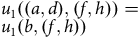 ${u}_{1}\left(\right(a,d),(f,h\left)\right)={u}_{1}(b,(f,h\left)\right)$
seem to suggest that player 1 is indifferent between consequences
${u}_{1}\left(\right(a,d),(f,h\left)\right)={u}_{1}(b,(f,h\left)\right)$
seem to suggest that player 1 is indifferent between consequences ${z}_{7}$
and
${z}_{7}$
and ${z}_{2},$
and is indifferent between
${z}_{2},$
and is indifferent between ${z}_{2}$
and
${z}_{2}$
and ${z}_{8}.$
On the other hand,
${z}_{8}.$
On the other hand, ${u}_{1}(b,(e,g\left)\right) \gt {u}_{1}\left(\right(a,c),(e,g\left)\right)$
and
${u}_{1}(b,(e,g\left)\right) \gt {u}_{1}\left(\right(a,c),(e,g\left)\right)$
and ${u}_{1}\left(\right(a,c),(e,h\left)\right) \gt {u}_{1}(b,(e,h\left)\right)$
seem to indicate that player 1 prefers
${u}_{1}\left(\right(a,c),(e,h\left)\right) \gt {u}_{1}(b,(e,h\left)\right)$
seem to indicate that player 1 prefers ${z}_{7}$
to
${z}_{7}$
to ${z}_{1},$
and prefers
${z}_{1},$
and prefers ${z}_{1}$
to
${z}_{1}$
to ${z}_{8}.$
This can only be if player 1’s preferences over consequences are non-transitive.
${z}_{8}.$
This can only be if player 1’s preferences over consequences are non-transitive.
4.2 Additive preference intensities on consequences
Based on the example above we will now give a formal expression of additive preference intensities on consequences, which is implied by utility-based consequentialism. To this purpose we need the following piece of notation: For a consequence structure $(C,c),$
strategy
$(C,c),$
strategy ${s}_{i},$
a pair of opponents’ strategy combinations
${s}_{i},$
a pair of opponents’ strategy combinations ${s}_{-i},{t}_{-i}$
and a consequence
${s}_{-i},{t}_{-i}$
and a consequence $c\in C$
we write
$c\in C$
we write ${s_{ - i}}\mathop - \limits^{{s_i},c} {t_{ - i}}$
if
${s_{ - i}}\mathop - \limits^{{s_i},c} {t_{ - i}}$
if $c({s}_{i},{s}_{-i})=c({s}_{i},{t}_{-i})=c.$
Definition 4.1
(Additive preference intensities on consequences) Consider a conditional preference relation ${\succsim }_{i}$
with an expected utility representation
${\succsim }_{i}$
with an expected utility representation ${u}_{i}$
and without weakly dominated strategies, and a consequence structure
${u}_{i}$
and without weakly dominated strategies, and a consequence structure $(C,c)$
. Then,
$(C,c)$
. Then, ${\succsim }_{i}$
induces additive preference intensities on consequences relative to
${\succsim }_{i}$
induces additive preference intensities on consequences relative to $(C,c)$
if for every two opponents’ strategy combinations
$(C,c)$
if for every two opponents’ strategy combinations ${s}_{-i}^{*},{t}_{-i}^{*}$
, and every two paths
${s}_{-i}^{*},{t}_{-i}^{*}$
, and every two paths
 $$s_{ - i}^{\rm{*}}\mathop - \limits^{s_i^1,{c^1}} s_{ - i}^2\mathop - \limits^{s_i^2,{c^2}} s_{ - i}^3 \ldots \mathop - \limits^{s_i^{K - 1},{c^{K - 1}}} s_{ - i}^K\mathop - \limits^{s_i^K,{c^K}} t_{ - i}^{\rm{*}}$$
and
 $$s_{ - i}^{\rm{*}}\mathop - \limits^{t_i^1,{d^1}} t_{ - i}^2\mathop - \limits^{t_i^2,{d^2}} t_{ - i}^3 \ldots \mathop - \limits^{t_i^{L - 1},{d^{L - 1}}} t_{ - i}^L\mathop - \limits^{t_i^L,{d^L}} t_{ - i}^{\rm{*}}$$
from ${s}_{-i}^{\mathrm{*}}$
to
${s}_{-i}^{\mathrm{*}}$
to ${t}_{-i}^{\mathrm{*}}$
it holds that
${t}_{-i}^{\mathrm{*}}$
it holds that
 $$\left[{u}_{i}({s}_{i}^{1},{s}_{-i}^{2})-{u}_{i}({s}_{i}^{2},{s}_{-i}^{2})\right]+\left[{u}_{i}({s}_{i}^{2},{s}_{-i}^{3})-{u}_{i}({s}_{i}^{3},{s}_{-i}^{3})\right]+ \ldots $$
 $$\ldots +\left[{u}_{i}({s}_{i}^{K-1},{s}_{-i}^{K})-{u}_{i}({s}_{i}^{K},{s}_{-i}^{K})\right]+\left[{u}_{i}({s}_{i}^{K},{t}_{-i}^{\mathrm{*}})-{u}_{i}({t}_{i}^{L},{t}_{-i}^{\mathrm{*}})\right]$$
 $$=\left[{u}_{i}({s}_{i}^{1},{s}_{-i}^{\mathrm{*}})-{u}_{i}({t}_{i}^{1},{s}_{-i}^{\mathrm{*}})\right]+\left[{u}_{i}({t}_{i}^{1},{t}_{-i}^{2})-{u}_{i}({t}_{i}^{2},{t}_{-i}^{2})\right]+$$
 $$\quad\quad\quad\quad+\left[{u}_{i}({t}_{i}^{2},{t}_{-i}^{3})-{u}_{i}({t}_{i}^{3},{t}_{-i}^{3})\right]+ \ldots +\left[{u}_{i}({t}_{i}^{L-1},{t}_{-i}^{L})-{u}_{i}({t}_{i}^{L},{t}_{-i}^{L})\right].$$
As there are no weakly dominated strategies under ${\succsim }_{i},$
it follows by Perea (Reference Perea2025a) that the sums of the utility differences on the left-hand side and right-hand side are unique up to a (common) positive multiplicative constant. Therefore, the equality is a structural property of
${\succsim }_{i},$
it follows by Perea (Reference Perea2025a) that the sums of the utility differences on the left-hand side and right-hand side are unique up to a (common) positive multiplicative constant. Therefore, the equality is a structural property of ${\succsim }_{i}$
that holds for all expected utility representations
${\succsim }_{i}$
that holds for all expected utility representations ${u}_{i}$
for
${u}_{i}$
for ${\succsim }_{i}.$
Note that the sum of the utility differences on the left-hand side represents
 $$in{t}_{{c}^{1}\succ {c}^{2}}+in{t}_{{c}^{2}\succ {c}^{3}}+ \ldots +in{t}_{{c}^{K-1}\succ {c}^{K}}+in{t}_{{c}^{K}\succ {d}^{L}}$$
whereas the sum of the utility differences on the right-hand side amounts to
 $$in{t}_{{c}^{1}\succ {d}^{1}}+in{t}_{{d}^{1}\succ {d}^{2}}+in{t}_{{d}^{2}\succ {d}^{3}}+ \ldots +in{t}_{{d}^{L-1}\succ {d}^{L}}.$$
The condition in the definition thus states that the sums of the preference intensities in (4) and (5) must be equal. As, under additivity, both sums represent the intensity by which player 1 prefers consequence ${c}^{1}$
to consequence
${c}^{1}$
to consequence ${d}^{L},$
the condition in the definition reflects the assumption that the player’s preference intensities on consequences are additive.
${d}^{L},$
the condition in the definition reflects the assumption that the player’s preference intensities on consequences are additive.
4.3 Characterization of utility-based consequentialism
It turns out that the condition of additive preference intensities on consequences, together with an additional condition called respect of outcome-equivalent strategies (Perea Reference Perea2025b), characterizes precisely those conditional preference relations that are utility-based consequentialist, provided we use the realization-based consequence structure. Respect of outcome-equivalent strategies states that a player must be indifferent between two strategies if he assigns probability 1 to an opponents’ strategy combination that, together with the two strategies, leads to the same consequence. In the definition below, we denote by $\left[{s}_{-i}\right]$
the belief that assigns probability 1 to the opponents’ strategy combination
$\left[{s}_{-i}\right]$
the belief that assigns probability 1 to the opponents’ strategy combination ${s}_{-i}.$
Definition 4.2
(Respect of outcome-equivalent strategies) A conditional preference relation ${\succsim }_{i}$
respects outcome-equivalent strategies relative to a consequence structure
${\succsim }_{i}$
respects outcome-equivalent strategies relative to a consequence structure $(C,c)$
if for every two strategies
$(C,c)$
if for every two strategies ${s}_{i},{t}_{i}$
and every opponents’ strategy combination
${s}_{i},{t}_{i}$
and every opponents’ strategy combination ${s}_{-i}$
where
${s}_{-i}$
where $c({s}_{i},{s}_{-i})=c({t}_{i},{s}_{-i}),$
it holds that
$c({s}_{i},{s}_{-i})=c({t}_{i},{s}_{-i}),$
it holds that ${s}_{i}{\sim}_{i,\left[{s}_{-i}\right]}{t}_{i}.$
We now show that, together with additive preference intensities on consequences, this property characterizes utility based consequentialism, provided we use the realization-based consequence structure.
Theorem 4.1
(Characterization of utility-based consequentialism) Consider a dynamic game form $D,$
a player
$D,$
a player $i$
, a conditional preference relation
$i$
, a conditional preference relation ${\succsim }_{i}$
for player
${\succsim }_{i}$
for player $i$
that has an expected utility representation and under which there are no weakly dominated strategies, and the realization-based consequence structure
$i$
that has an expected utility representation and under which there are no weakly dominated strategies, and the realization-based consequence structure $(Z,z)$
. Then,
$(Z,z)$
. Then, ${\succsim }_{i}$
is utility-based consequentialist relative to
${\succsim }_{i}$
is utility-based consequentialist relative to $(Z,z)$
if and only if
$(Z,z)$
if and only if ${\succsim }_{i}$
induces additive preference intensities on consequences relative to
${\succsim }_{i}$
induces additive preference intensities on consequences relative to $(Z,z)$
, and respects outcome-equivalent strategies relative to
$(Z,z)$
, and respects outcome-equivalent strategies relative to $(Z,z)$
.
$(Z,z)$
.
It is relatively easy to show that under the conditions in the theorem, utility-based consequentialism implies that the conditional preference relation induces additive preference intensities on consequences and respects outcome-equivalent strategies. For showing the former property, we basically follow the steps we have performed in the example of Figure 2.
Showing the other direction is more difficult: Under the conditions in the theorem, and assuming that ${\succsim }_{i}$
induces additive preference intensities on consequences and respects outcome-equivalent strategies, we explicitly show how to transform an arbitrary expected utility representation
${\succsim }_{i}$
induces additive preference intensities on consequences and respects outcome-equivalent strategies, we explicitly show how to transform an arbitrary expected utility representation ${u}_{i}$
into a new expected utility representation
${u}_{i}$
into a new expected utility representation ${v}_{i}$
that is measurable with respect to
${v}_{i}$
that is measurable with respect to $(Z,z)$
. We will now illustrate this direction of the proof by means of the example of Figure 2.
$(Z,z)$
. We will now illustrate this direction of the proof by means of the example of Figure 2.
We will again view the situation from player 1’s perspective. Consider the realization-based consequence structure $(Z,z).$
In the sequel, we will no longer write “relative to
$(Z,z).$
In the sequel, we will no longer write “relative to $(Z,z)$
” everywhere, as it is understood that everything is viewed relative to
$(Z,z)$
” everywhere, as it is understood that everything is viewed relative to $(Z,z).$
The induced consequences are repeated in the left-hand panel of Table 5.
$(Z,z).$
The induced consequences are repeated in the left-hand panel of Table 5.
Consequence structure and expected utility representation in the dynamic game form of Figure 2

Table 5 Long description
The table presents a consequence structure and expected utility representation in a dynamic game form. It consists of two panels, each with four rows and four columns. The columns are labeled with pairs of variables, and the rows are labeled with different scenarios. The left-hand panel shows induced consequences with specific values for each scenario. The right-hand panel shows expected utility values corresponding to the scenarios in the left-hand panel. Each cell in the table contains a unique identifier or value related to the scenario and variable pairs.
Suppose that the conditional preference relation ${\succsim }_{1}$
is given by the expected utility representation
${\succsim }_{1}$
is given by the expected utility representation ${u}_{1}$
in the right-hand panel of Table 5, where
${u}_{1}$
in the right-hand panel of Table 5, where ${x}_{1}, \ldots, {x}_{12}$
represent the 12 utilities. Assume that the utility function
${x}_{1}, \ldots, {x}_{12}$
represent the 12 utilities. Assume that the utility function ${u}_{1}$
is such that
${u}_{1}$
is such that ${\succsim }_{1}$
induces additive preference intensities on consequences, and that there are no weakly dominated strategies for player 1.
${\succsim }_{1}$
induces additive preference intensities on consequences, and that there are no weakly dominated strategies for player 1.
We now transform ${u}_{1}$
, in a step-by-step fashion, into a new expected utility representation
${u}_{1}$
, in a step-by-step fashion, into a new expected utility representation ${v}_{1}$
that is measurable with respect to
${v}_{1}$
that is measurable with respect to $(Z,z)$
. We keep the utilities
$(Z,z)$
. We keep the utilities ${x}_{1},{x}_{2}$
and
${x}_{1},{x}_{2}$
and ${x}_{3}$
in column
${x}_{3}$
in column $(e,g)$
as they are.
$(e,g)$
as they are.
We then move to column $(f,g).$
Note that
$(f,g).$
Note that $z(b,(e,g\left)\right)=z(b,(f,g\left)\right)$
. At column
$z(b,(e,g\left)\right)=z(b,(f,g\left)\right)$
. At column $(f,g)$
we therefore add a constant utility
$(f,g)$
we therefore add a constant utility ${x}_{3}-{x}_{6}$
to the entries in that column such that
${x}_{3}-{x}_{6}$
to the entries in that column such that ${v}_{1}(b,(e,g\left)\right)={v}_{1}(b,(f,g\left)\right).$
Also, $z\left(\right(a,c),(e,g\left)\right)=z\left(\right(a,c),(e,h\left)\right).$
Similarly, we then add a constant utility
$z\left(\right(a,c),(e,g\left)\right)=z\left(\right(a,c),(e,h\left)\right).$
Similarly, we then add a constant utility ${x}_{1}-{x}_{7}$
to the entries in column
${x}_{1}-{x}_{7}$
to the entries in column $(e,h)$
such that
$(e,h)$
such that ${v}_{1}\left(\right(a,c),(e,g\left)\right)={v}_{1}\left(\right(a,c),(e,h\left)\right).$
This leads to the utility function in the left-hand panel of Table 6.
${v}_{1}\left(\right(a,c),(e,g\left)\right)={v}_{1}\left(\right(a,c),(e,h\left)\right).$
This leads to the utility function in the left-hand panel of Table 6.
Construction of utility function ${v_1}$
in the dynamic game form of Figure 2
${v_1}$
in the dynamic game form of Figure 2

Table 6 Long description
The table presents utility values for various strategy combinations in a dynamic game. It consists of four rows and four columns, with row labels on the left and column headers at the top. The row labels are (a, c), (a, d), and b. The column headers are (e, g), (f, g), (e, h), and (f, h). Each cell contains a utility value denoted by x with a subscript number. Notable values include x1, x2, x3, y4, y5, y8, y9, y10, y11, and y12. The table shows how utility values change across different strategy pairs, with specific adjustments made to ensure certain utility values are equal.
Here, the numbers ${y}_{4},{y}_{5},{x}_{3},{x}_{1},{y}_{8}$
and
${y}_{4},{y}_{5},{x}_{3},{x}_{1},{y}_{8}$
and ${y}_{9}$
in the second and third column denote the new utilities for
${y}_{9}$
in the second and third column denote the new utilities for ${v}_{1}$
in those columns.
${v}_{1}$
in those columns.
Finally, we move to the remaining column $(f,h).$
Note that
$(f,h).$
Note that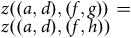 $z\left(\right(a,d),(f,g\left)\right)=z\left(\right(a,d),(f,h\left)\right)$
and
$z\left(\right(a,d),(f,g\left)\right)=z\left(\right(a,d),(f,h\left)\right)$
and $z(b,(e,h\left)\right)=z(b,(\mathrm{f},h\left)\right).$
At column
$z(b,(e,h\left)\right)=z(b,(\mathrm{f},h\left)\right).$
At column $(f,h)\mathrm{}$
we add a constant utility
$(f,h)\mathrm{}$
we add a constant utility ${y}_{5}-{x}_{11}$
to the entries in that column such that
${y}_{5}-{x}_{11}$
to the entries in that column such that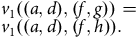 ${v}_{1}\left(\right(a,d),(f,g\left)\right)={v}_{1}\left(\right(a,d),(f,h\left)\right).$
This leads to the utility function
${v}_{1}\left(\right(a,d),(f,g\left)\right)={v}_{1}\left(\right(a,d),(f,h\left)\right).$
This leads to the utility function ${v}_{1}$
in the right-hand panel of Table 6. As
${v}_{1}$
in the right-hand panel of Table 6. As ${v}_{1}$
has been obtained from
${v}_{1}$
has been obtained from ${u}_{1}$
by adding a constant utility to each of the columns, it follows that
${u}_{1}$
by adding a constant utility to each of the columns, it follows that ${v}_{1}$
is also an expected utility representation of
${v}_{1}$
is also an expected utility representation of ${\succsim }_{1}.$
The procedure we have used here is called the utility transformation procedure, and is described formally in the Appendix.
${\succsim }_{1}.$
The procedure we have used here is called the utility transformation procedure, and is described formally in the Appendix.
We will now show that ${v}_{1}$
is measurable with respect to
${v}_{1}$
is measurable with respect to $(Z,z)$
, by proving that
$(Z,z)$
, by proving that ${y}_{9}={y}_{12}.$
Our construction above guarantees that
${y}_{9}={y}_{12}.$
Our construction above guarantees that

Consider the graph ${G}_{1}^{D}$
in the right-hand panel of Figure 2. Note that this graph contains two alternative paths from
${G}_{1}^{D}$
in the right-hand panel of Figure 2. Note that this graph contains two alternative paths from $(e,g)$
to
$(e,g)$
to $(f,h).$
As
$(f,h).$
As ${\succsim }_{1}$
induces additive preference intensities on consequences, we conclude that
${\succsim }_{1}$
induces additive preference intensities on consequences, we conclude that
 $$\left[{v}_{1}(b,(f,g\left)\right)-{v}_{1}\left(\right(a,d),(f,g\left)\right)\right]+\left[{v}_{1}\left(\right(a,d),(f,h\left)\right)-{v}_{1}(b,(f,h\left)\right)\right]$$
 $$=\left[{v}_{1}(b,(e,g\left)\right)-{v}_{1}\left(\right(a,c),(e,g\left)\right)\right]+\left[{v}_{1}\left(\right(a,c),(e,h\left)\right)-{v}_{1}(b,(e,h\left)\right)\right].$$
By combining (6) and (7) we conclude that ${v}_{1}(b,(f,h\left)\right)={v}_{1}(b,(e,h\left)\right),$
and hence
${v}_{1}(b,(f,h\left)\right)={v}_{1}(b,(e,h\left)\right),$
and hence ${y}_{9}={y}_{12}.$
Therefore,
${y}_{9}={y}_{12}.$
Therefore, ${v}_{1}$
is measurable with respect to
${v}_{1}$
is measurable with respect to $(Z,z).$
As
$(Z,z).$
As ${v}_{1}$
is an expected utility representation for
${v}_{1}$
is an expected utility representation for ${\succsim }_{1},$
it follows that
${\succsim }_{1},$
it follows that ${\succsim }_{1}$
is utility-based consequentialist relative to
${\succsim }_{1}$
is utility-based consequentialist relative to $(Z,z)$
.
$(Z,z)$
.
4.4 Characterization of preference-based consequentialism
Above we have seen that, relative to the realization-based consequence structure, utility-based consequentialism can be characterized by requiring that the induced preference intensities on consequences are additive and that the conditional preference relation respects outcome-equivalent strategies. This raises the question: How does preference-based consequentialism relate to additive preference intensities on consequences? The following result shows that this weaker version of consequentialism is equivalent to demanding that every pair of strategies induces additive preference intensities on consequences, together with requiring respect of outcome-equivalent strategies.
To formally state this result we need the following piece of notation. For a given conditional preference relation ${\succsim }_{i}$
and pair of strategies
${\succsim }_{i}$
and pair of strategies $\{{s}_{i},{t}_{i}\},$
we denote by
$\{{s}_{i},{t}_{i}\},$
we denote by ${\succsim }_{i}^{\{{s}_{i},{t}_{i}\}}$
the restriction of
${\succsim }_{i}^{\{{s}_{i},{t}_{i}\}}$
the restriction of ${\succsim }_{i}$
to the strategies
${\succsim }_{i}$
to the strategies ${s}_{i}$
and
${s}_{i}$
and ${t}_{i}.$
That is,
${t}_{i}.$
That is, ${\succsim }_{i}^{\{{s}_{i},{t}_{i}\}}$
ranks, for every belief, only the strategies
${\succsim }_{i}^{\{{s}_{i},{t}_{i}\}}$
ranks, for every belief, only the strategies ${s}_{i}$
and
${s}_{i}$
and ${t}_{i},$
and for every belief
${t}_{i},$
and for every belief ${\beta }_{i}$
we have that
${\beta }_{i}$
we have that ${s}_{i}{\succsim }_{i,{\beta }_{i}}^{\{{s}_{i},{t}_{i}\}}{t}_{i}$
if and only if
${s}_{i}{\succsim }_{i,{\beta }_{i}}^{\{{s}_{i},{t}_{i}\}}{t}_{i}$
if and only if ${s}_{i}{\succsim }_{i,{\beta }_{i}}{t}_{i}$
and
${s}_{i}{\succsim }_{i,{\beta }_{i}}{t}_{i}$
and ${t}_{i}{\succsim }_{i,{\beta }_{i}}^{\{{s}_{},{t}_{i}\}}{s}_{i}$
if and only if
${t}_{i}{\succsim }_{i,{\beta }_{i}}^{\{{s}_{},{t}_{i}\}}{s}_{i}$
if and only if ${t}_{i}{\succsim }_{i,{\beta }_{i}}{s}_{i}.$
Theorem 4.2
(Characterization of preference-based consequentialism) Consider a dynamic game form $D,$
a player
$D,$
a player $i$
, a conditional preference relation
$i$
, a conditional preference relation ${\succsim }_{i}$
for player
${\succsim }_{i}$
for player $i$
that has an expected utility representation and under which there are no weakly dominated strategies, and the realization-based consequence structure
$i$
that has an expected utility representation and under which there are no weakly dominated strategies, and the realization-based consequence structure $(Z,z)$
. Then,
$(Z,z)$
. Then, ${\succsim }_{i}$
is preference-based consequentialist relative to
${\succsim }_{i}$
is preference-based consequentialist relative to $(Z,z)$
if and only if
$(Z,z)$
if and only if ${\succsim }_{i}$
respects outcome-equivalent strategies relative to
${\succsim }_{i}$
respects outcome-equivalent strategies relative to $(Z,z)$
, and for every pair of strategies
$(Z,z)$
, and for every pair of strategies ${s}_{i},{t}_{i}$
the restricted conditional preference relation
${s}_{i},{t}_{i}$
the restricted conditional preference relation ${\succsim }_{i}^{\{{s}_{i},{t}_{i}\}}$
induces additive preference intensities on consequences relative to
${\succsim }_{i}^{\{{s}_{i},{t}_{i}\}}$
induces additive preference intensities on consequences relative to $(Z,z)$
.
$(Z,z)$
.
The proof of this theorem can be found after the proof of Theorem 5.1 in the Appendix, as it relies on some parts of the proof of Theorem 5.1. In view of the Theorems 4.1 and 4.2, the difference between utility-based and preference-based consequentialism can be characterized by the induced preference intensities on consequences: Utility-based consequentialism requires these preference intensities to be additive for the set of all strategies, whereas preference-based consequentialism only demands this property for every pair of strategies in isolation.
An immediate consequence of Theorems 4.1 and 4.2 is that a conditional preference relation ${\succsim }_{i}$
is preference-based consequentialist relative to
${\succsim }_{i}$
is preference-based consequentialist relative to $(Z,z)$
precisely when the restricted conditional preference relation
$(Z,z)$
precisely when the restricted conditional preference relation ${\succsim \mathrm{}}_{i}^{\{{s}_{i},{t}_{i}\}}$
is utility-based consequentialist relative to
${\succsim \mathrm{}}_{i}^{\{{s}_{i},{t}_{i}\}}$
is utility-based consequentialist relative to $(Z,z)$
for every pair of strategies
$(Z,z)$
for every pair of strategies ${s}_{i},{t}_{i}.$
However, for every pair
${s}_{i},{t}_{i}.$
However, for every pair ${s}_{i},{t}_{i}$
a different expected utility representation
${s}_{i},{t}_{i}$
a different expected utility representation ${u}_{i}^{{s}_{i},{t}_{i}}$
may be used that is measurable with respect to
${u}_{i}^{{s}_{i},{t}_{i}}$
may be used that is measurable with respect to $(Z,z).$
In general it may not be possible to “merge” these different utility functions into a single expected utility representation
$(Z,z).$
In general it may not be possible to “merge” these different utility functions into a single expected utility representation ${u}_{i}$
that is measurable with respect to
${u}_{i}$
that is measurable with respect to $(Z,z)$
and that works for all pairs of strategies simultaneously. For this to be possible, we need that
$(Z,z)$
and that works for all pairs of strategies simultaneously. For this to be possible, we need that ${\succsim }_{i}$
induces additive preference intensities on consequences relative to
${\succsim }_{i}$
induces additive preference intensities on consequences relative to $(Z,z).$
5. When the Two Notions are Equivalent
As the example in Figure 2 has shown, there are dynamic game forms where preference-based and utility-based consequentialism are different. The reason is that utility-based consequentialism implies additive preference intensities over consequences, whereas preference-based consequentialism only implies this property for every pair of strategies. The example in Figure 2 shows that the first condition may be more demanding than the second. It may thus be argued that for these scenarios, the notion of utility-based consequentialism imposes more than what is required by the original idea of consequentialism.
We will now provide sufficient conditions under which the two notions of consequentialism are equivalent, provided we use the realization-based consequence structure.
Theorem 5.1
(Equivalence) Consider a dynamic game form $D$
and a player
$D$
and a player $i$
such that either (i) player
$i$
such that either (i) player $i$
only has two strategies, (ii)
$i$
only has two strategies, (ii) $D$
has observed past choices or (iii)
$D$
has observed past choices or (iii) $D$
only has two players and satisfies perfect recall. Moreover, consider a conditional preference relation
$D$
only has two players and satisfies perfect recall. Moreover, consider a conditional preference relation ${\succsim }_{i}$
for player
${\succsim }_{i}$
for player $i$
without weakly dominated strategies that has an expected utility representation. Then,
$i$
without weakly dominated strategies that has an expected utility representation. Then, ${\succsim }_{i}$
is preference-based consequentialist relative to the realization-based consequence structure
${\succsim }_{i}$
is preference-based consequentialist relative to the realization-based consequence structure $(Z,z)$
if and only if
$(Z,z)$
if and only if ${\succsim }_{i}$
is utility-based consequentialist relative to
${\succsim }_{i}$
is utility-based consequentialist relative to $(Z,z)$
.
$(Z,z)$
.
Note that the example from the previous section, where the two notions of consequentialism are not equivalent relative to $(Z,z)$
, violates the conditions (i), (ii) and (iii) above. Indeed, the dynamic game form in the example has more than two strategies for player 1, violates observed past choices and has more than two players. To see that it violates observed past choices, note that player 3, at his information set
$(Z,z)$
, violates the conditions (i), (ii) and (iii) above. Indeed, the dynamic game form in the example has more than two strategies for player 1, violates observed past choices and has more than two players. To see that it violates observed past choices, note that player 3, at his information set ${h}_{3},$
does not perfectly observe what players 1 and 2 have chosen in the past.
${h}_{3},$
does not perfectly observe what players 1 and 2 have chosen in the past.
We will now provide a sketch of the proof. Again, we omit the phrase “relative to $(Z,z)$
” from now on, as we fix the consequence structure
$(Z,z)$
” from now on, as we fix the consequence structure $(Z,z).$
The easy direction is to show that utility-based consequentialism implies preference-based consequentialism. The other direction is more challenging: We must show that, under the conditions of the theorem, every conditional preference relation
$(Z,z).$
The easy direction is to show that utility-based consequentialism implies preference-based consequentialism. The other direction is more challenging: We must show that, under the conditions of the theorem, every conditional preference relation ${\succsim }_{i}$
that is preference-based consequentialist is also utility-based consequentialist. We do so by transforming the utility function
${\succsim }_{i}$
that is preference-based consequentialist is also utility-based consequentialist. We do so by transforming the utility function ${u}_{i}$
that represents
${u}_{i}$
that represents ${\succsim }_{i}$
into an expected utility representation
${\succsim }_{i}$
into an expected utility representation ${v}_{i}$
that is measurable with respect to
${v}_{i}$
that is measurable with respect to $(Z,z)$
, in the same way as we did in the proof of Theorem 4.1.
$(Z,z)$
, in the same way as we did in the proof of Theorem 4.1.
We illustrate this direction of the proof by a new example. Consider the dynamic game form $D$
between player 1 and player 2 in the left-hand panel of Figure 3, with the associated consequence structure
$D$
between player 1 and player 2 in the left-hand panel of Figure 3, with the associated consequence structure $(Z,z)$
in the left-hand panel of Table 7.
$(Z,z)$
in the left-hand panel of Table 7.
Proof sketch of Theorem 5.1.

Figure 3 Long description
The image contains two diagrams. The left diagram shows a graph with nodes labeled 1, 2, and z1 through z4, connected by edges labeled a, b, c, d, e, and f. The right diagram, labeled Graph G1D, shows a similar structure with nodes labeled z1 through z4 and edges labeled with pairs of letters such as (c, f), (d, f), (c, e), and (d, e). The edges are also labeled with a, b, and their positions indicate the relationships between the nodes.
Consequence structure and expected utility representation in the dynamic game form of Figure 3

Table 7 Long description
A table with two panels comparing consequence structures and expected utility representations in dynamic game forms. The table has four rows and four columns. The first panel shows the consequence structure with labels a, b, and u1, and outcomes z1, z2, z3, and z4. The second panel shows the expected utility representation with labels a, b, and u1, and outcomes x1, x2, x3, x4, x5, x6, x7, and x8. The columns are labeled with pairs (c, e), (c, f), (d, e), and (d, f). The table illustrates the direction of the proof in a dynamic game form between two players.
We will view the situation from player 1’s perspective. Suppose that the conditional preference relation ${\succsim }_{1}$
is given by the expected utility representation
${\succsim }_{1}$
is given by the expected utility representation ${u}_{1}$
in the right-hand panel of Table 7. Assume that the utility function
${u}_{1}$
in the right-hand panel of Table 7. Assume that the utility function ${u}_{1}$
is such that
${u}_{1}$
is such that ${\succsim }_{1}$
is preference-based consequentialist relative to
${\succsim }_{1}$
is preference-based consequentialist relative to $(Z,z)$
, and that there are no weakly dominated strategies for player 1.
$(Z,z)$
, and that there are no weakly dominated strategies for player 1.
We now transform ${u}_{1}$
, in a step-by-step fashion, into a new expected utility representation
${u}_{1}$
, in a step-by-step fashion, into a new expected utility representation ${v}_{1}$
that is measurable with respect to
${v}_{1}$
that is measurable with respect to $(Z,z)$
. We keep the utilities
$(Z,z)$
. We keep the utilities ${x}_{1}$
and
${x}_{1}$
and ${x}_{2}$
in column
${x}_{2}$
in column $(c,e)$
as they are.
$(c,e)$
as they are.
We then move to column $(c,f).$
Note that
$(c,f).$
Note that $z(a,(c,e\left)\right)=z(a,(c,f\left)\right)$
. At column
$z(a,(c,e\left)\right)=z(a,(c,f\left)\right)$
. At column $(c,f)$
we therefore add a constant utility
$(c,f)$
we therefore add a constant utility ${x}_{1}-{x}_{3}$
to the entries in that column such that
${x}_{1}-{x}_{3}$
to the entries in that column such that ${v}_{1}(a,(c,e\left)\right)={v}_{1}(a,(c,f\left)\right).$
Also, $z(b,(c,e\left)\right)=z(b,(d,e\left)\right).$
Similarly, we then add a constant utility
$z(b,(c,e\left)\right)=z(b,(d,e\left)\right).$
Similarly, we then add a constant utility ${x}_{2}-{x}_{6}$
to the entries in column
${x}_{2}-{x}_{6}$
to the entries in column $(d,e)$
such that
$(d,e)$
such that ${v}_{1}(b,(c,e\left)\right)={v}_{1}(b,(d,e\left)\right).$
This leads to the utility function in the left-hand panel of Table 8.
${v}_{1}(b,(c,e\left)\right)={v}_{1}(b,(d,e\left)\right).$
This leads to the utility function in the left-hand panel of Table 8.
Construction of utility function ${v_1}$
in the dynamic game form of Figure 3
${v_1}$
in the dynamic game form of Figure 3

Table 8 Long description
The table presents the construction of utility function v1 in a dynamic game form. It consists of four rows and four columns, with row labels a, b, and column headers (c, e), (c, f), (d, e), (d, f). The table includes specific utility values for each state and action combination. Row 1: a, x1, x1, y5, x7. Row 2: b, x2, y4, x2, x8. Row 3: u1, (c, e), (c, f), (d, e), (d, f). Row 4: a, x1, x1, y5, x7. Row 5: b, x2, y4, x2, y4.
Here, the numbers ${x}_{1},{y}_{4},{y}_{5}$
and
${x}_{1},{y}_{4},{y}_{5}$
and ${x}_{2}$
in the second and third column denote the new utilities for
${x}_{2}$
in the second and third column denote the new utilities for ${v}_{1}$
in those columns.
${v}_{1}$
in those columns.
Finally, we move to the remaining column $(d,f).$
Note that
$(d,f).$
Note that $(a,(d,e\left)\right)=z(a,(d,f\left)\right)$
and
$(a,(d,e\left)\right)=z(a,(d,f\left)\right)$
and $z(b,(c,f\left)\right)=z(b,(d,f\left)\right).$
At column
$z(b,(c,f\left)\right)=z(b,(d,f\left)\right).$
At column $(d,f)\mathrm{}$
we add a constant utility
$(d,f)\mathrm{}$
we add a constant utility ${y}_{4}-{x}_{8}$
to the entries in that column such that
${y}_{4}-{x}_{8}$
to the entries in that column such that ${v}_{1}(b,(c,f\left)\right)={v}_{1}(b,(d,f\left)\right).$
This leads to the utility function
${v}_{1}(b,(c,f\left)\right)={v}_{1}(b,(d,f\left)\right).$
This leads to the utility function ${v}_{1}$
in the right-hand panel of Table 8.
${v}_{1}$
in the right-hand panel of Table 8.
We will now show that ${v}_{1}$
is measurable with respect to
${v}_{1}$
is measurable with respect to $(Z,z)$
, by proving that
$(Z,z)$
, by proving that ${y}_{5}={y}_{7}.$
Our construction above guarantees that
${y}_{5}={y}_{7}.$
Our construction above guarantees that

Consider the beliefs ${\beta _1}: = {1 \over 2}[(c,e)] + {1 \over 2}[(d,f)]$
and
${\beta _1}: = {1 \over 2}[(c,e)] + {1 \over 2}[(d,f)]$
and $\beta _1^{\rm{'}}: = {1 \over 2}\left[ {\left( {c,f} \right)} \right] + {1 \over 2}\left[ {\left( {d,e} \right)} \right],$
where
$\beta _1^{\rm{'}}: = {1 \over 2}\left[ {\left( {c,f} \right)} \right] + {1 \over 2}\left[ {\left( {d,e} \right)} \right],$
where $\left[{s}_{2}\right]$
is the probability distribution that assigns probability 1 to player 2’s strategy
$\left[{s}_{2}\right]$
is the probability distribution that assigns probability 1 to player 2’s strategy ${s}_{2}.$
Then, we conclude from the consequence structure
${s}_{2}.$
Then, we conclude from the consequence structure $(Z,z)$
in Table 7 that
$(Z,z)$
in Table 7 that
 $${{\mathbb P}_{\left( {a,{\beta _1}} \right)}} = {{\mathbb P}_{\left( {a,\beta _1^{\rm{'}}} \right)}} = {1 \over 2}\left[ {{z_1}} \right] + {1 \over 2}\left[ {{z_2}} \right]{\rm{\;and}}\;{{\mathbb P}_{\left( {b,{\beta _1}} \right)}} = {{\mathbb P}_{\left( {b,\beta _1^{\rm{'}}} \right)}} = {1 \over 2}\left[ {{z_3}} \right] + {1 \over 2}\left[ {{z_4}} \right].$$
Since ${\succsim }_{1}$
is assumed to be preference-based consequentialist, we know that
${\succsim }_{1}$
is assumed to be preference-based consequentialist, we know that $a{\succsim }_{1,{\beta }_{1}}b$
if and only if
$a{\succsim }_{1,{\beta }_{1}}b$
if and only if $a{\succsim }_{1,{\beta }_{1}^{\prime}}b.$
As there are no weakly dominated strategies for player 1, it can be shown that this implies that
$a{\succsim }_{1,{\beta }_{1}^{\prime}}b.$
As there are no weakly dominated strategies for player 1, it can be shown that this implies that ${v}_{1}(a,{\beta }_{1})-{v}_{1}(b,{\beta }_{1})={v}_{1}(a,{\beta }_{1}^{\prime})-{v}_{1}(b,{\beta }_{1}^{\prime}),$
which means that
${v}_{1}(a,{\beta }_{1})-{v}_{1}(b,{\beta }_{1})={v}_{1}(a,{\beta }_{1}^{\prime})-{v}_{1}(b,{\beta }_{1}^{\prime}),$
which means that
 $${1 \over 2}{v_1}(a,(c,e)) + {1 \over 2}{v_1}({\rm{a}},(d,f)) - {1 \over 2}{v_1}(b,(c,e)) - {1 \over 2}{v_1}(b,(d,f))$$
 $$= {1 \over 2}{v_1}(a,(c,f)) + {1 \over 2}{v_1}(a,(d,e)) - {1 \over 2}{v_1}(b,(c,f)) - {1 \over 2}{v_1}(b,(d,e)).$$
By combining (8) and (9) it then follows that ${v}_{1}(a,(d,f\left)\right)={v}_{1}(a,(d,e\left)\right).$
That is,
${v}_{1}(a,(d,f\left)\right)={v}_{1}(a,(d,e\left)\right).$
That is, ${y}_{5}={y}_{7},$
which was to show. We thus obtain an expected utility representation
${y}_{5}={y}_{7},$
which was to show. We thus obtain an expected utility representation ${v}_{1}$
for
${v}_{1}$
for ${\succsim }_{1}$
which is measurable with respect to
${\succsim }_{1}$
which is measurable with respect to $(Z,z)$
. As such,
$(Z,z)$
. As such, ${\succsim }_{1}$
is utility-based consequentialist relative to
${\succsim }_{1}$
is utility-based consequentialist relative to $(Z,z)$
.
$(Z,z)$
.
In the proof of Theorem 5.1 the construction of the new utility function ${v}_{i}$
proceeds along the same lines. The construction is based on a graph
${v}_{i}$
proceeds along the same lines. The construction is based on a graph ${G}_{i}^{D}$
where two columns (opponents’ strategy combinations)
${G}_{i}^{D}$
where two columns (opponents’ strategy combinations) ${s}_{-i}$
and
${s}_{-i}$
and ${t}_{-i}$
are “connected” by a strategy
${t}_{-i}$
are “connected” by a strategy ${s}_{i}$
if
${s}_{i}$
if ${s}_{-i}$
and
${s}_{-i}$
and ${t}_{-i}$
only differ at one information setFootnote
3
and
${t}_{-i}$
only differ at one information setFootnote
3
and $z({s}_{i},{s}_{-i})=z({s}_{i},{t}_{-i}).$
Such a connection means that the utilities at
$z({s}_{i},{s}_{-i})=z({s}_{i},{t}_{-i}).$
Such a connection means that the utilities at ${s}_{-i}$
and
${s}_{-i}$
and ${t}_{-i}$
are interrelated, since we must make sure that
${t}_{-i}$
are interrelated, since we must make sure that ${v}_{i}({s}_{i},{s}_{-i})={v}_{i}({s}_{i},{t}_{-i}).$
For every connected component in the graph
${v}_{i}({s}_{i},{s}_{-i})={v}_{i}({s}_{i},{t}_{-i}).$
For every connected component in the graph ${G}_{i}^{D}$
we start by copying the utilities of
${G}_{i}^{D}$
we start by copying the utilities of ${u}_{i}$
at a distinguished column
${u}_{i}$
at a distinguished column ${s}_{-i}^{0},$
and step by step we construct the new utilities of
${s}_{-i}^{0},$
and step by step we construct the new utilities of ${v}_{i}$
at the other columns by following sequences of connected columns, in the same way as we have done for the example above. The graph
${v}_{i}$
at the other columns by following sequences of connected columns, in the same way as we have done for the example above. The graph ${G}_{1}^{D}$
for the example above can be found in the right-hand panel of Figure 3. The label
${G}_{1}^{D}$
for the example above can be found in the right-hand panel of Figure 3. The label $a$
at the edge between
$a$
at the edge between $(c,e)$
and
$(c,e)$
and $(c,f)$
indicates that
$(c,f)$
indicates that $z(a,(c,e\left)\right)=z(a,(c,f\left)\right),$
and similarly for the other edges.
$z(a,(c,e\left)\right)=z(a,(c,f\left)\right),$
and similarly for the other edges.
Showing that ${v}_{i}$
is measurable with respect to
${v}_{i}$
is measurable with respect to $(Z,z)$
only poses problems if there is a column
$(Z,z)$
only poses problems if there is a column ${s}_{-i}$
that can be reached through two different paths of connected columns from
${s}_{-i}$
that can be reached through two different paths of connected columns from ${s}_{-i}^{0},$
thus yielding a cycle. This was the case in the graph
${s}_{-i}^{0},$
thus yielding a cycle. This was the case in the graph ${G}_{1}^{D}$
above, since the column
${G}_{1}^{D}$
above, since the column $(d,f)$
could be reached through the path
$(d,f)$
could be reached through the path $(c,e)\to (c,\mathrm{f})\to (d,f)$
but also through the path
$(c,e)\to (c,\mathrm{f})\to (d,f)$
but also through the path $(c,e)\to (d,e)\to (d,f)$
, yielding the cycle
$(c,e)\to (d,e)\to (d,f)$
, yielding the cycle $(c,e)\to (c,f)\to (d,f)\to (d,e)\to (c,e).$
In the proof of Theorem 5.1 we show that the conditions (i), (ii) or (iii) on the dynamic game form in the theorem guarantee that there are at most two strategies,
$(c,e)\to (c,f)\to (d,f)\to (d,e)\to (c,e).$
In the proof of Theorem 5.1 we show that the conditions (i), (ii) or (iii) on the dynamic game form in the theorem guarantee that there are at most two strategies, ${s}_{i}$
and
${s}_{i}$
and ${t}_{i},$
that connect all the columns in the cycle. Similarly to the example above, such a cycle then induces two beliefs
${t}_{i},$
that connect all the columns in the cycle. Similarly to the example above, such a cycle then induces two beliefs ${\beta }_{i}$
and
${\beta }_{i}$
and ${\beta }_{i}^{\prime}$
such that
${\beta }_{i}^{\prime}$
such that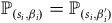 ${\mathbb{P}}_{({s}_{i},{\beta }_{i})}={\mathbb{P}}_{({s}_{i},{\beta }_{i}^{\prime})}$
and
${\mathbb{P}}_{({s}_{i},{\beta }_{i})}={\mathbb{P}}_{({s}_{i},{\beta }_{i}^{\prime})}$
and ${\mathbb{P}}_{({t}_{i},{\beta }_{i})}={\mathbb{P}}_{({t}_{i},{\beta }_{i}^{\prime})}.$
As
${\mathbb{P}}_{({t}_{i},{\beta }_{i})}={\mathbb{P}}_{({t}_{i},{\beta }_{i}^{\prime})}.$
As ${\succsim }_{i}$
satisfies preference-based consequentialism relative to
${\succsim }_{i}$
satisfies preference-based consequentialism relative to $(Z,z)$
, we can derive equalities like (9) to show that
$(Z,z)$
, we can derive equalities like (9) to show that ${v}_{i}$
is measurable with respect to
${v}_{i}$
is measurable with respect to $(Z,z)$
.
$(Z,z)$
.
6. Concluding Remarks
What is the appropriate set of consequences? Our definitions of preference-based and utility-based consequentialism in this paper have been defined relative to some set of consequences, which is meant to reflect the elements that the player in question cares about when evaluating his strategies. This naturally raises the question: What is the appropriate set of consequences for the player?
When analysing the example from Figure 1 we have discussed various options: If you only care about streams of realized actions and nothing else, then the realization-based consequence structure, where consequences are identified with terminal histories, seems most appropriate. If, on the other hand, after leaving the room you care about the counterfactual action that Barbara would have taken if you had stayed in the room, then the set of consequences must be refined to take into account such counterfactual behaviour at unreached parts of the game tree. As an extreme, one could identify consequences with combinations of strategies for you and Barbara here.
But in some situations it can also be natural to coarsen the set of consequences relative to the realization-based consequence structure, by “merging” different terminal histories into one and the same consequence. Suppose, for instance, that the players receive some monetary payoff at each of the terminal histories in the game. In many applications in economics and game theory it is assumed that the players only care about these monetary payoffs (“culmination outcomes” in Hausman’s (Reference Hausman2006) terminology), and not about how these payoffs were realized through a particular stream of actions. In that case, the appropriate set of consequences would be the culmination outcomes which, from a given player’s perspective, are still allowed to contain the monetary payoffs of other players. The set of consequences would have to be coarsened even more if the player in question is assumed only to care about his own monetary payoff, as is often presupposed in economics and game theory.
It could also be that the player cares about the particular streams of actions that lead to the monetary payoffs (“comprehensive outcomes” in Hausman’s (Reference Hausman2006) words). Then, the appropriate set of consequences could be the set of comprehensive outcomes, which would bring us back to the realization-based consequence structure.
Hammond (Reference Hammond1996) argues that the realization-based consequence structure may be cognitively too demanding for a boundedly rational player, as the full set of terminal histories could be too overwhelming if the dynamic game is large. In that case, it seems appropriate to use a coarsening of the realization-based consequence structure, by merging those terminal histories between which the player cannot distinguish into a single consequence. The size of these equivalence classes would then be a measure for the “degree” of bounded rationality of the player. A classical example is chess where a player may decide to identify all terminal histories that lead to a win, a draw, and a loss, respectively. But the player may also care about (some elements of) the sequence of moves involved in a win, draw or loss, which would lead us to refine the player’s set of consequences compared with before.
Writing down utilities at consequences may imply more than consequentialism. The analysis in this paper has shown that writing down utilities at the terminal histories in a dynamic game, resulting in utility-based consequentialism relative to the realization-based consequence structure, may imply conditions that go beyond preference-based consequentialism. Indeed, we have characterized utility-based consequentialism by respect of outcome-equivalent strategies and the condition that the induced preference intensities on consequences are additive, and the example from Figure 2 indicates that the latter condition need not follow from preference-based consequentialism. For such situations it may thus be argued that utility-based consequentialism relative to the realization-based consequence structure, which is typically assumed in game theory, is more restrictive than the original idea of consequentialism.
Possible extensions of our results. We have identified conditions on dynamic game forms under which preference-based consequentialism is equivalent to utility-based consequentialism relative to the realization-based consequence structure, and where the condition of additive preference intensities on consequences is thus implied by preference-based consequentialism alone. An open question is whether these conditions on the dynamic game form can be sharpened to conditions that are both sufficient and necessary for the equivalence. That is, if the conditions are violated, then we can find a conditional preference relation that is preference-based, but not utility-based, consequentialist relative to the realization-based consequence structure.
Additionally, it may be interesting to extend our theorems in this paper, which are restricted to the realization-based consequence structure, to more general consequence structures. Also, Theorem 5.1 relies on the assumption that there are no weakly dominated strategies under the conditional preference relation we consider. It is currently unclear whether, and if so how, this result can be extended to situations that allow for weakly dominated strategies.
Acknowledgements
I would like to thank an associate editor and three anonymous referees for their valuable feedback.
Competing interests
The author declares none.
Andrés Perea is an Associate Professor at Maastricht University. He is the author of Rationality in Extensive Form Games (Kluwer Academic Publishers, 2001), Epistemic Game Theory: Reasoning and Choice (Cambridge University Press, 2012) and From Decision Theory to Game Theory: Reasoning about the Decisions of Others (Cambridge University Press, 2025). His research focuses on the foundations of game theory and decision theory.
7. Appendix
7.1 Definitions from graph theory
An undirected graph $G = (N,E)$
consists of a set of nodes
$G = (N,E)$
consists of a set of nodes $N,$
and a set of edges
$N,$
and a set of edges $E,$
where every edge
$E,$
where every edge $e\in E$
is an unordered pair
$e\in E$
is an unordered pair $(n,{n}^{\prime})\in N\times N$
with
$(n,{n}^{\prime})\in N\times N$
with $n\ne {n}^{\prime}.$
A graph
$n\ne {n}^{\prime}.$
A graph ${G}^{\prime}=({N}^{\prime},{E}^{\prime})$
is a subgraph of
${G}^{\prime}=({N}^{\prime},{E}^{\prime})$
is a subgraph of $G=(N,E)$
if
$G=(N,E)$
if ${N}^{\prime}\subseteq N,$ ${E}^{\prime}\subseteq E$
and every edge
${E}^{\prime}\subseteq E$
and every edge $(n,{n}^{\prime})\in {E}^{\prime}$
is such that
$(n,{n}^{\prime})\in {E}^{\prime}$
is such that $n,{n}^{\prime}\in {N}^{\prime}$
.
$n,{n}^{\prime}\in {N}^{\prime}$
.
In a graph $G=(N,E),$
a path from
$G=(N,E),$
a path from $n\in N$
to
$n\in N$
to ${n}^{\prime}\in N$
is a sequence
${n}^{\prime}\in N$
is a sequence $({n}^{0},{n}^{1}, \ldots, {n}^{K}$ $)$
with
$)$
with ${n}^{0}=n$
and
${n}^{0}=n$
and ${n}^{K}={n}^{\prime}$
such that
${n}^{K}={n}^{\prime}$
such that $({n}^{k},{n}^{k+1})\in E$
for every
$({n}^{k},{n}^{k+1})\in E$
for every $k\in \{0, \ldots, K-1\}$
and all edges
$k\in \{0, \ldots, K-1\}$
and all edges $({n}^{k},{n}^{k+1})$
are pairwise different. A cycle is a path
$({n}^{k},{n}^{k+1})$
are pairwise different. A cycle is a path $({n}^{0},{n}^{1}, \ldots, {n}^{K})\mathrm{}\mathrm{}\mathrm{}$
where
$({n}^{0},{n}^{1}, \ldots, {n}^{K})\mathrm{}\mathrm{}\mathrm{}$
where ${n}^{K}={n}^{0}$
.
${n}^{K}={n}^{0}$
.
A subgraph $CC=({N}^{\prime},{E}^{\prime})$
of
$CC=({N}^{\prime},{E}^{\prime})$
of $G=(N,E)$
is a connected component of
$G=(N,E)$
is a connected component of $G$
if (i)
$G$
if (i) ${E}^{\prime}=\left\{\right(n,{n}^{\prime})\in E$ $|$
$|$ $n,{n}^{\prime}\in {N}^{\prime}\},$
(ii) for every two nodes
$n,{n}^{\prime}\in {N}^{\prime}\},$
(ii) for every two nodes $n,{n}^{\prime}\in {N}^{\prime}$
there is a path from
$n,{n}^{\prime}\in {N}^{\prime}$
there is a path from $n$
to
$n$
to ${n}^{\prime}$
in
${n}^{\prime}$
in $G$
and (iii) for every
$G$
and (iii) for every $n\in {N}^{\prime},$ ${n}^{\prime}\in N\backslash {N}^{\prime}$
there is no path from
${n}^{\prime}\in N\backslash {N}^{\prime}$
there is no path from $n$
to
$n$
to ${n}^{\prime}$
in
${n}^{\prime}$
in $G.$
$G.$
A graph $T=(N,E)$
is a tree if there is some
$T=(N,E)$
is a tree if there is some ${n}^{0}\in N$
such that for every
${n}^{0}\in N$
such that for every $n\in N\backslash \left\{{n}^{0}\right\}$
there is a unique path in
$n\in N\backslash \left\{{n}^{0}\right\}$
there is a unique path in $T$
from
$T$
from ${n}^{0}$
to
${n}^{0}$
to $n.$
In this case, we call
$n.$
In this case, we call $T$
a tree with root
$T$
a tree with root ${n}^{0}.$
A subgraph
${n}^{0}.$
A subgraph $=({N}^{\prime},{E}^{\prime})$
of
$=({N}^{\prime},{E}^{\prime})$
of $G=(N,E)$
is a spanning tree for
$G=(N,E)$
is a spanning tree for $G$
if
$G$
if ${N}^{\prime}=N$
and
${N}^{\prime}=N$
and $T$
is a tree. For a given graph
$T$
is a tree. For a given graph $G,$
it is well-known that for every connected component
$G,$
it is well-known that for every connected component $CC$
of
$CC$
of $G$
there is a spanning tree for
$G$
there is a spanning tree for $CC.$
$CC.$
7.2 Preparatory results
To prove the theorems in this paper we need some preparatory results.
Lemma 7.1
(Implication of preference-based consequentialism) Consider a conditional preference relation ${\succsim }_{i}$
that is preference-based consequentialist relative to
${\succsim }_{i}$
that is preference-based consequentialist relative to $(Z,z)$
, two strategies
$(Z,z)$
, two strategies ${s}_{i},{t}_{i}$
that do not weakly dominate one another under
${s}_{i},{t}_{i}$
that do not weakly dominate one another under ${\succsim }_{i}$
, and an expected utility representation
${\succsim }_{i}$
, and an expected utility representation ${u}_{i}$
for
${u}_{i}$
for $\succsim .$
Then, for all beliefs
$\succsim .$
Then, for all beliefs ${\beta }_{i},{\beta }_{i}^{\prime}\in \Delta \left({S}_{-i}\right)$
such that
${\beta }_{i},{\beta }_{i}^{\prime}\in \Delta \left({S}_{-i}\right)$
such that ${\mathbb{P}}_{({s}_{i},{\beta }_{i})}={\mathbb{P}}_{({s}_{i},{\beta }_{i}^{\prime})}$
and
${\mathbb{P}}_{({s}_{i},{\beta }_{i})}={\mathbb{P}}_{({s}_{i},{\beta }_{i}^{\prime})}$
and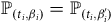 ${\mathbb{P}}_{({t}_{i},{\beta }_{i})}={\mathbb{P}}_{({t}_{i},{\beta }_{i}^{\prime})}$
we have that
${\mathbb{P}}_{({t}_{i},{\beta }_{i})}={\mathbb{P}}_{({t}_{i},{\beta }_{i}^{\prime})}$
we have that ${u}_{i}({s}_{i},{\beta }_{i})-u({t}_{i},{\beta }_{i})=u({s}_{i},{\beta }_{i}^{\prime})-{u}_{i}({t}_{i},{\beta }_{i}^{\prime}).$
Proof. Since ${s}_{i}$
and
${s}_{i}$
and ${t}_{i}$
do not weakly dominate one another, it follows from Perea (Reference Perea2025a) that there is a belief
${t}_{i}$
do not weakly dominate one another, it follows from Perea (Reference Perea2025a) that there is a belief ${\beta }_{i}^{\mathrm{*}}$
with
${\beta }_{i}^{\mathrm{*}}$
with ${\beta }_{i}^{\mathrm{*}}\left({s}_{-i}\right) \gt 0$
for all
${\beta }_{i}^{\mathrm{*}}\left({s}_{-i}\right) \gt 0$
for all ${s}_{-i}\in {S}_{-i}$
such that
${s}_{-i}\in {S}_{-i}$
such that ${s}_{i}{\sim}_{i,{\beta }_{i}^{\mathrm{*}}}{t}_{i}.$
We can choose
${s}_{i}{\sim}_{i,{\beta }_{i}^{\mathrm{*}}}{t}_{i}.$
We can choose $\epsilon \gt 0$
small enough such that
$\epsilon \gt 0$
small enough such that ${\beta }_{i}^{{\mathrm{}}^{\mathrm{\prime}\mathrm{\prime}}}:={\beta }_{i}^{\mathrm{*}}+\epsilon ({\beta }_{i}-{\beta }_{i}^{\prime})$
is a belief. We show that
${\beta }_{i}^{{\mathrm{}}^{\mathrm{\prime}\mathrm{\prime}}}:={\beta }_{i}^{\mathrm{*}}+\epsilon ({\beta }_{i}-{\beta }_{i}^{\prime})$
is a belief. We show that ${\mathbb{P}}_{({s}_{i},{\beta }_{i}^{\mathrm{\prime}\mathrm{\prime}})}={\mathbb{P}}_{({s}_{i},{\beta }_{i}^{\mathrm{*}})}$
and
${\mathbb{P}}_{({s}_{i},{\beta }_{i}^{\mathrm{\prime}\mathrm{\prime}})}={\mathbb{P}}_{({s}_{i},{\beta }_{i}^{\mathrm{*}})}$
and ${\mathbb{P}}_{({t}_{i},{\beta }_{i}^{\mathrm{\prime}\mathrm{\prime}})}={\mathbb{P}}_{({t}_{i},{\beta }_{i}^{\mathrm{*}})}.$
Indeed, for every consequence $z\in Z$
we have that
$z\in Z$
we have that
 $${\mathbb{P}}_{({s}_{i},{\beta }_{i}^{\mathrm{\prime}\mathrm{\prime}})}\left(z\right)={\mathbb{P}}_{({s}_{i},{\beta }_{i}^{\mathrm{*}})}\left(z\right)+\epsilon \left({\mathbb{P}}_{({s}_{i},{\beta }_{i})}\right(z)-{\mathbb{P}}_{({s}_{i},{\beta }_{i}^{\prime})}(z\left)\right)={\mathbb{P}}_{({s}_{i},{\beta }_{i}^{\mathrm{*}})}\left(z\right),$$
since ${\mathbb{P}}_{({s}_{i},{\beta }_{i})}={\mathbb{P}}_{({s}_{i},{\beta }_{i}^{\prime})}.$
In a similar way it can be shown that
${\mathbb{P}}_{({s}_{i},{\beta }_{i})}={\mathbb{P}}_{({s}_{i},{\beta }_{i}^{\prime})}.$
In a similar way it can be shown that ${\mathbb{P}}_{({t}_{i},{\beta }_{i}^{\mathrm{\prime}\mathrm{\prime}})}\left(z\right)={\mathbb{P}}_{({t}_{i},{\beta }_{i}^{\mathrm{*}})}\left(z\right)$
for every consequence
${\mathbb{P}}_{({t}_{i},{\beta }_{i}^{\mathrm{\prime}\mathrm{\prime}})}\left(z\right)={\mathbb{P}}_{({t}_{i},{\beta }_{i}^{\mathrm{*}})}\left(z\right)$
for every consequence $z\in Z.$
Since ${s}_{i}{\sim}_{i,{\beta }_{i}^{\mathrm{*}}}{t}_{i}$
and
${s}_{i}{\sim}_{i,{\beta }_{i}^{\mathrm{*}}}{t}_{i}$
and ${\succsim }_{i}$
is preference-based consequentialist relative to
${\succsim }_{i}$
is preference-based consequentialist relative to $(Z,z)$
, it follows that
$(Z,z)$
, it follows that ${s}_{i}{\sim}_{i,{\beta }_{i}^{\mathrm{\prime}\mathrm{\prime}}}{t}_{i}$
also. As
${s}_{i}{\sim}_{i,{\beta }_{i}^{\mathrm{\prime}\mathrm{\prime}}}{t}_{i}$
also. As ${u}_{i}$
is an expected utility representation for
${u}_{i}$
is an expected utility representation for ${\succsim }_{i}$
we know that
${\succsim }_{i}$
we know that ${u}_{i}({s}_{i},{\beta }_{i}^{\mathrm{*}})={u}_{i}({t}_{i},{\beta }_{i}^{\mathrm{*}})$
and
${u}_{i}({s}_{i},{\beta }_{i}^{\mathrm{*}})={u}_{i}({t}_{i},{\beta }_{i}^{\mathrm{*}})$
and ${u}_{i}({s}_{i},{\beta }_{i}^{\mathrm{\prime}\mathrm{\prime}})={u}_{i}({t}_{i},{\beta }_{i}^{\mathrm{\prime}\mathrm{\prime}}).$
Hence,
${u}_{i}({s}_{i},{\beta }_{i}^{\mathrm{\prime}\mathrm{\prime}})={u}_{i}({t}_{i},{\beta }_{i}^{\mathrm{\prime}\mathrm{\prime}}).$
Hence,
 $$\hskip -215pt0={u}_{i}({s}_{i},{\beta }_{i}^{\mathrm{\prime}\mathrm{\prime}})-{u}_{i}({t}_{i},{\beta }_{i}^{\mathrm{\prime}\mathrm{\prime}})$$
 $$\hskip 10pt=\left({u}_{i}\right({s}_{i},{\beta }_{i}^{\mathrm{*}})-{u}_{i}({t}_{i},{\beta }_{i}^{\mathrm{*}}\left)\right)+\varepsilon \left(\right({u}_{i}({s}_{i},{\beta }_{i})-{u}_{i}({t}_{i},{\beta }_{i}))-({u}_{i}({s}_{i},{\beta }_{i}^{\prime})-{u}_{i}({t}_{i},{\beta }_{i}^{\prime})\left)\right)$$
 $$\hskip -90pt=\epsilon \left(\right({u}_{i}({s}_{i},{\beta }_{i})-{u}_{i}({t}_{i},{\beta }_{i}))-({u}_{i}({s}_{i},{\beta }_{i}^{\prime})-{u}_{i}({t}_{i},{\beta }_{i}^{\prime})\left)\right),$$
where the second equality follows from the definition of ${\beta }_{i}^{\mathrm{\prime}\mathrm{\prime}},$
and the third equality follows from the fact that
${\beta }_{i}^{\mathrm{\prime}\mathrm{\prime}},$
and the third equality follows from the fact that ${u}_{i}({s}_{i},{\beta }_{i}^{\mathrm{*}})={u}_{i}({t}_{i},{\beta }_{i}^{\mathrm{*}}).$
We thus conclude that
${u}_{i}({s}_{i},{\beta }_{i}^{\mathrm{*}})={u}_{i}({t}_{i},{\beta }_{i}^{\mathrm{*}}).$
We thus conclude that ${u}_{i}({s}_{i},{\beta }_{i})-u({t}_{i},{\beta }_{i})=u({s}_{i},{\beta }_{i}^{\prime})-{u}_{i}({t}_{i},{\beta }_{i}^{\prime}).$
This completes the proof. ▪
${u}_{i}({s}_{i},{\beta }_{i})-u({t}_{i},{\beta }_{i})=u({s}_{i},{\beta }_{i}^{\prime})-{u}_{i}({t}_{i},{\beta }_{i}^{\prime}).$
This completes the proof. ▪
Lemma 7.2
(Constant utility carries over) Consider a conditional preference relation ${\succsim }_{i}$
that is preference-based consequentialist relative to
${\succsim }_{i}$
that is preference-based consequentialist relative to $(Z,z)$
, two strategies
$(Z,z)$
, two strategies ${s}_{i},{t}_{i}$
that do not weakly dominate one another, and an expected utility representation
${s}_{i},{t}_{i}$
that do not weakly dominate one another, and an expected utility representation ${u}_{i}$
for
${u}_{i}$
for ${\succsim }_{i}.$
Take two opponents’ strategy combinations
${\succsim }_{i}.$
Take two opponents’ strategy combinations ${s}_{-i},{t}_{-i}$
with
${s}_{-i},{t}_{-i}$
with $z({s}_{i},{s}_{-i})=z({s}_{i},{t}_{-i}),$ $z({t}_{i},{s}_{-i})=z({t}_{i},{t}_{-i})$
and
$z({t}_{i},{s}_{-i})=z({t}_{i},{t}_{-i})$
and ${u}_{i}({s}_{i},{s}_{-i})={u}_{i}({s}_{i},{t}_{-i}).$
Then,
${u}_{i}({s}_{i},{s}_{-i})={u}_{i}({s}_{i},{t}_{-i}).$
Then, ${u}_{i}({t}_{i},{s}_{-i})={u}_{i}({t}_{i},{t}_{-i}).$
Proof. If we define the beliefs ${\beta }_{i}:=\left[{s}_{-i}\right]$
and
${\beta }_{i}:=\left[{s}_{-i}\right]$
and ${\beta }_{i}^{\prime}:=\left[{t}_{-i}\right]$
it follows that
${\beta }_{i}^{\prime}:=\left[{t}_{-i}\right]$
it follows that ${\mathbb{P}}_{({s}_{i},{\beta }_{i})}={\mathbb{P}}_{({s}_{i},{\beta }_{i}^{\prime})}$
and
${\mathbb{P}}_{({s}_{i},{\beta }_{i})}={\mathbb{P}}_{({s}_{i},{\beta }_{i}^{\prime})}$
and ${\mathbb{P}}_{({t}_{i},{\beta }_{i})}={\mathbb{P}}_{({t}_{i},{\beta }_{i}^{\prime})}.$
By Lemma 7.1 we conclude that
${\mathbb{P}}_{({t}_{i},{\beta }_{i})}={\mathbb{P}}_{({t}_{i},{\beta }_{i}^{\prime})}.$
By Lemma 7.1 we conclude that ${u}_{i}({s}_{i},{\beta }_{i})-u({t}_{i},{\beta }_{i})=u({s}_{i},{\beta }_{i}^{\prime})-{u}_{i}({t}_{i},{\beta }_{i}^{\prime}),$
and hence
${u}_{i}({s}_{i},{\beta }_{i})-u({t}_{i},{\beta }_{i})=u({s}_{i},{\beta }_{i}^{\prime})-{u}_{i}({t}_{i},{\beta }_{i}^{\prime}),$
and hence ${u}_{i}({s}_{i},{s}_{-i}) -u({t}_{i},{\mathrm{s}}_{-i})$ $=u({s}_{i},{t}_{-i})-{u}_{i}({t}_{i},{t}_{-i}).$
Since
$=u({s}_{i},{t}_{-i})-{u}_{i}({t}_{i},{t}_{-i}).$
Since ${u}_{i}({s}_{i},{s}_{-i})={u}_{i}({s}_{i},{t}_{-i})$
it follows that
${u}_{i}({s}_{i},{s}_{-i})={u}_{i}({s}_{i},{t}_{-i})$
it follows that ${u}_{i}({t}_{i},{s}_{-i}) ={u}_{i}({t}_{i},{t}_{-i}),$
which completes the proof. ▪
${u}_{i}({t}_{i},{s}_{-i}) ={u}_{i}({t}_{i},{t}_{-i}),$
which completes the proof. ▪
For the following result we need some additional definitions. We say that two strategies ${s}_{i},{t}_{i}\in {S}_{i}$
are minimally different if there is an information set
${s}_{i},{t}_{i}\in {S}_{i}$
are minimally different if there is an information set ${h}_{i}\in {H}_{i}\left({s}_{i}\right)\cap {H}_{i}\left({t}_{i}\right)$
such that (i)
${h}_{i}\in {H}_{i}\left({s}_{i}\right)\cap {H}_{i}\left({t}_{i}\right)$
such that (i) ${s}_{i}\left({h}_{i}\right)\ne {t}_{i}\left({h}_{i}\right),$
and (ii)
${s}_{i}\left({h}_{i}\right)\ne {t}_{i}\left({h}_{i}\right),$
and (ii) ${s}_{i}\left({h}_{i}^{\prime}\right)={t}_{i}\left({h}_{i}^{\prime}\right)$
for all
${s}_{i}\left({h}_{i}^{\prime}\right)={t}_{i}\left({h}_{i}^{\prime}\right)$
for all ${h}_{i}^{\prime}\in \left({H}_{i}\right({s}_{i})\cap {H}_{i}({t}_{i}\left)\right)\backslash \left\{{h}_{i}\right\}.$
In this case, we call
${h}_{i}^{\prime}\in \left({H}_{i}\right({s}_{i})\cap {H}_{i}({t}_{i}\left)\right)\backslash \left\{{h}_{i}\right\}.$
In this case, we call ${s}_{i},{t}_{i}$
minimally different at
${s}_{i},{t}_{i}$
minimally different at ${h}_{i}.$
Two strategy combinations
${h}_{i}.$
Two strategy combinations ${s}_{-i}=({s}_{j}{)}_{j\ne i}$
and
${s}_{-i}=({s}_{j}{)}_{j\ne i}$
and ${t}_{-i}=({t}_{j}{)}_{j\ne i}$
in
${t}_{-i}=({t}_{j}{)}_{j\ne i}$
in ${S}_{-i}$
are called minimally different if there is some
${S}_{-i}$
are called minimally different if there is some $j\ne i$
such that
$j\ne i$
such that ${s}_{j},{t}_{j}$
are minimally different at some
${s}_{j},{t}_{j}$
are minimally different at some ${h}_{j}\in {H}_{j}\left({s}_{j}\right)\cap {H}_{j}\left({t}_{j}\right)$
, and
${h}_{j}\in {H}_{j}\left({s}_{j}\right)\cap {H}_{j}\left({t}_{j}\right)$
, and ${s}_{k}={t}_{k}$
for all
${s}_{k}={t}_{k}$
for all $k\ne i,j.$
In this case, we say that
$k\ne i,j.$
In this case, we say that ${s}_{-i},{t}_{-i}$
are minimally different at
${s}_{-i},{t}_{-i}$
are minimally different at ${h}_{j}$
.
${h}_{j}$
.
Lemma 7.3
(Equal consequences) Consider a dynamic game form $D$
with two players,
$D$
with two players, $i$
and
$i$
and $j,$
that satisfies perfect recall. Let the strategies
$j,$
that satisfies perfect recall. Let the strategies ${s}_{j},{t}_{j}$
be minimally different at the information set
${s}_{j},{t}_{j}$
be minimally different at the information set ${h}_{j}\in {H}_{j}\left({s}_{j}\right)\cap {H}_{j}\left({t}_{j}\right).$
Then, for every strategy
${h}_{j}\in {H}_{j}\left({s}_{j}\right)\cap {H}_{j}\left({t}_{j}\right).$
Then, for every strategy ${s}_{i}$
we have that
${s}_{i}$
we have that $z({s}_{i},{s}_{j})=z({s}_{i},{t}_{j})$
if and only if
$z({s}_{i},{s}_{j})=z({s}_{i},{t}_{j})$
if and only if ${s}_{i}\notin {S}_{i}\left({h}_{j}\right).$
Proof. (a) Suppose first that $z({s}_{i},{s}_{j})=z({s}_{i},{t}_{j}).$
Then,
$z({s}_{i},{s}_{j})=z({s}_{i},{t}_{j}).$
Then, $({s}_{i},{s}_{j})\notin S\left({h}_{j}\right).$
By perfect recall we have that
$({s}_{i},{s}_{j})\notin S\left({h}_{j}\right).$
By perfect recall we have that $S\left({h}_{j}\right)={S}_{i}\left({h}_{j}\right)\times {S}_{j}\left({h}_{j}\right).$
Since
$S\left({h}_{j}\right)={S}_{i}\left({h}_{j}\right)\times {S}_{j}\left({h}_{j}\right).$
Since ${s}_{j}\in {S}_{j}\left({h}_{j}\right)$
we conclude that
${s}_{j}\in {S}_{j}\left({h}_{j}\right)$
we conclude that ${s}_{i}\notin {S}_{i}\left({h}_{j}\right).$
(b) Suppose next that ${s}_{i}\notin {S}_{i}\left({h}_{j}\right).$
Then, by definition,
${s}_{i}\notin {S}_{i}\left({h}_{j}\right).$
Then, by definition, $({s}_{i},{s}_{j})\notin S\left({h}_{j}\right).$
But then,
$({s}_{i},{s}_{j})\notin S\left({h}_{j}\right).$
But then, $z({s}_{i},{s}_{j})=z({s}_{i},{t}_{j}).$
The proof is hereby complete. ▪
$z({s}_{i},{s}_{j})=z({s}_{i},{t}_{j}).$
The proof is hereby complete. ▪
To formally express the condition of two strategies per connected component, which plays an important role in the proof of Theorem 5.1, we need the following definition. For a dynamic game form $D$
with distinguished player
$D$
with distinguished player $i,$
consider the undirected graph
$i,$
consider the undirected graph ${G}_{i}^{D}=(N,E)$
where (i) the set of nodes
${G}_{i}^{D}=(N,E)$
where (i) the set of nodes $N$
is the set of all strategy combinations in
$N$
is the set of all strategy combinations in ${S}_{-i},$
and (ii) the set of edges
${S}_{-i},$
and (ii) the set of edges $E$
contains exactly those pairs
$E$
contains exactly those pairs $({s}_{-i},{t}_{-i})\in N\times N$
where
$({s}_{-i},{t}_{-i})\in N\times N$
where ${s}_{-i},{t}_{-i}$
are minimally different and there is some strategy
${s}_{-i},{t}_{-i}$
are minimally different and there is some strategy ${s}_{i}\in {S}_{i}$
with
${s}_{i}\in {S}_{i}$
with $z({s}_{i},{s}_{-i})=z({s}_{i},{t}_{-i}).$
In this case, we also denote this edge by
$z({s}_{i},{s}_{-i})=z({s}_{i},{t}_{-i}).$
In this case, we also denote this edge by ${s_{ - i}}\mathop - \limits^{{s_i},z} {t_{ - i}},$
where
${s_{ - i}}\mathop - \limits^{{s_i},z} {t_{ - i}},$
where $z=z({s}_{i},{s}_{-i})=z({s}_{i},{t}_{-i}).$
Definition 7.1
(Two strategies per connected component) The graph ${G}_{i}^{D}$
satisfies two strategies per connected component if for every connected component
${G}_{i}^{D}$
satisfies two strategies per connected component if for every connected component $CC$
there are two strategies
$CC$
there are two strategies ${s}_{i},{t}_{i}\in {S}_{i}$
such that for every edge
${s}_{i},{t}_{i}\in {S}_{i}$
such that for every edge $({s}_{-i},{t}_{-i})$
in
$({s}_{-i},{t}_{-i})$
in $CC$
either
$CC$
either $z({s}_{i},{s}_{-i})=z({s}_{i},{t}_{-i})$
or
$z({s}_{i},{s}_{-i})=z({s}_{i},{t}_{-i})$
or $z({t}_{i},{s}_{-i})=z({t}_{i},{t}_{-i}).$
The following result states that the condition of two strategies per connected component is always satisfied under the conditions on the dynamic game form in Theorem 5.1.
Lemma 7.4
(Two strategies per connected component) Consider a dynamic game form $D$
and a player
$D$
and a player $i$
such that either (i) player
$i$
such that either (i) player $i$
only has two strategies, or (ii) there are observed past choices or (iii) there are only two players and perfect recall is satisfied. Then, the induced graph
$i$
only has two strategies, or (ii) there are observed past choices or (iii) there are only two players and perfect recall is satisfied. Then, the induced graph ${G}_{i}^{D}$
satisfies two strategies per connected component.
${G}_{i}^{D}$
satisfies two strategies per connected component.
Proof. (i) If player $i$
only has two strategies, it trivially follows that
$i$
only has two strategies, it trivially follows that ${G}_{i}^{D}$
satisfies two strategies per connected component.
${G}_{i}^{D}$
satisfies two strategies per connected component.
(ii) Assume next that the dynamic game $D$
is with observed past choices. Let
$D$
is with observed past choices. Let ${H}_{i}^{first}$
be the collection of information sets in
${H}_{i}^{first}$
be the collection of information sets in ${H}_{i}$
that are not preceded by any other information in
${H}_{i}$
that are not preceded by any other information in ${H}_{i}.$
For every
${H}_{i}.$
For every ${h}_{i}\in {H}_{i}^{first}$
select two different actions
${h}_{i}\in {H}_{i}^{first}$
select two different actions ${a}_{i}\left({h}_{i}\right),{b}_{i}\left({h}_{i}\right)\in {A}_{i}\left({h}_{i}\right).$
Let
${a}_{i}\left({h}_{i}\right),{b}_{i}\left({h}_{i}\right)\in {A}_{i}\left({h}_{i}\right).$
Let ${s}_{i}^{\mathrm{*}}$
be a strategy with
${s}_{i}^{\mathrm{*}}$
be a strategy with ${s}_{i}^{\mathrm{*}}\left({h}_{i}\right)={a}_{i}\left({h}_{i}\right)$
for all
${s}_{i}^{\mathrm{*}}\left({h}_{i}\right)={a}_{i}\left({h}_{i}\right)$
for all ${h}_{i}\in {H}_{i}^{first},$
and
${h}_{i}\in {H}_{i}^{first},$
and ${t}_{i}^{\mathrm{*}}\mathrm{}$
a strategy with
${t}_{i}^{\mathrm{*}}\mathrm{}$
a strategy with ${t}_{i}^{\mathrm{*}}\left({h}_{i}\right)={b}_{i}\left({h}_{i}\right)$
for all
${t}_{i}^{\mathrm{*}}\left({h}_{i}\right)={b}_{i}\left({h}_{i}\right)$
for all ${h}_{i}\in {H}_{i}^{firs\mathrm{t}}.$
Now, consider an edge $({s}_{-i},{t}_{-i})$
in
$({s}_{-i},{t}_{-i})$
in ${G}_{i}^{D}$
with
${G}_{i}^{D}$
with $\left({s}_{-i}\right)=({s}_{j}{)}_{j\ne i}$
and
$\left({s}_{-i}\right)=({s}_{j}{)}_{j\ne i}$
and $\left({t}_{-i}\right)=({t}_{j}{)}_{j\ne i}$
. Then,
$\left({t}_{-i}\right)=({t}_{j}{)}_{j\ne i}$
. Then, ${s}_{-i},{t}_{-i}$
are minimally different at some
${s}_{-i},{t}_{-i}$
are minimally different at some ${h}_{j}\in {H}_{j}\left({s}_{j}\right)\cap {H}_{j}\left({t}_{j}\right)$
for some player
${h}_{j}\in {H}_{j}\left({s}_{j}\right)\cap {H}_{j}\left({t}_{j}\right)$
for some player $j\ne i,$
and there is some strategy
$j\ne i,$
and there is some strategy ${s}_{i}$
with
${s}_{i}$
with $z({s}_{i},{s}_{-i})=z({s}_{i},{t}_{-i}).$
We distinguish two cases: (1)
$z({s}_{i},{s}_{-i})=z({s}_{i},{t}_{-i}).$
We distinguish two cases: (1) ${h}_{j}\in {H}_{j}\left({s}_{-i}\right)\cap {H}_{j}\left({t}_{-i}\right),$
and
${h}_{j}\in {H}_{j}\left({s}_{-i}\right)\cap {H}_{j}\left({t}_{-i}\right),$
and $\mathrm{}$
(2)
$\mathrm{}$
(2) ${h}_{j}\notin {H}_{j}\left({s}_{-i}\right)\cap {H}_{j}\left({t}_{-i}\right).$
Case 1. Suppose that ${h}_{j}\in {H}_{j}\left({s}_{-i}\right)\cap {H}_{j}\left({t}_{-i}\right).$
As
${h}_{j}\in {H}_{j}\left({s}_{-i}\right)\cap {H}_{j}\left({t}_{-i}\right).$
As $z({s}_{i},{s}_{-i})=z({s}_{i},{t}_{-i})$
and
$z({s}_{i},{s}_{-i})=z({s}_{i},{t}_{-i})$
and $({s}_{-i},{t}_{-i})$
are minimally different at
$({s}_{-i},{t}_{-i})$
are minimally different at ${h}_{j},$
it must be that
${h}_{j},$
it must be that $({s}_{i},{s}_{-i})\notin S\left({h}_{j}\right).$
Since the game is with observed past choices we know that
$({s}_{i},{s}_{-i})\notin S\left({h}_{j}\right).$
Since the game is with observed past choices we know that $S\left({h}_{j}\right)={S}_{i}\left({h}_{j}\right)\times {S}_{-i}\left({h}_{j}\right).$
Note that
$S\left({h}_{j}\right)={S}_{i}\left({h}_{j}\right)\times {S}_{-i}\left({h}_{j}\right).$
Note that ${s}_{-i}\in {S}_{-i}\left({h}_{j}\right)$
as
${s}_{-i}\in {S}_{-i}\left({h}_{j}\right)$
as ${h}_{j}\in {H}_{j}\left({s}_{-i}\right).$
But then,
${h}_{j}\in {H}_{j}\left({s}_{-i}\right).$
But then, $({s}_{i},{s}_{-i})\notin S\left({h}_{j}\right)$
implies that
$({s}_{i},{s}_{-i})\notin S\left({h}_{j}\right)$
implies that ${s}_{i}\notin {S}_{i}\left({h}_{j}\right).$
This can only be if
${s}_{i}\notin {S}_{i}\left({h}_{j}\right).$
This can only be if ${h}_{j}$
is preceded by some
${h}_{j}$
is preceded by some ${h}_{i}\in {H}_{i}^{first}.$
As the game is with observed past choices, there is a unique action ${a}_{i}^{\mathrm{*}}\left({h}_{i}\right)\in {A}_{i}\left({h}_{i}\right)$
that leads to
${a}_{i}^{\mathrm{*}}\left({h}_{i}\right)\in {A}_{i}\left({h}_{i}\right)$
that leads to ${h}_{j}.$
By construction, either
${h}_{j}.$
By construction, either ${s}_{i}^{\mathrm{*}}\left({h}_{i}\right)\ne {a}_{i}^{\mathrm{*}}\left({h}_{i}\right)$
or
${s}_{i}^{\mathrm{*}}\left({h}_{i}\right)\ne {a}_{i}^{\mathrm{*}}\left({h}_{i}\right)$
or ${t}_{i}^{\mathrm{*}}\left({h}_{i}\right)\ne {a}_{i}^{\mathrm{*}}\left({h}_{i}\right).$
This means that either
${t}_{i}^{\mathrm{*}}\left({h}_{i}\right)\ne {a}_{i}^{\mathrm{*}}\left({h}_{i}\right).$
This means that either $({s}_{i}^{\mathrm{*}},{s}_{-i})\;\notin\; S\left({h}_{j}\right)$
or
$({s}_{i}^{\mathrm{*}},{s}_{-i})\;\notin\; S\left({h}_{j}\right)$
or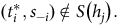 $({t}_{i}^{\mathrm{*}},{s}_{-i})\;\notin \;S\left({h}_{j}\right).$
As
$({t}_{i}^{\mathrm{*}},{s}_{-i})\;\notin \;S\left({h}_{j}\right).$
As ${s}_{-i},{t}_{-i}$
are minimally different at
${s}_{-i},{t}_{-i}$
are minimally different at ${h}_{j}$
we conclude that either
${h}_{j}$
we conclude that either $z({s}_{i}^{\mathrm{*}},{s}_{-i})=z({s}_{i}^{\mathrm{*}},{t}_{-i})$
or
$z({s}_{i}^{\mathrm{*}},{s}_{-i})=z({s}_{i}^{\mathrm{*}},{t}_{-i})$
or $z({t}_{i}^{\mathrm{*}},{s}_{-i})=z({t}_{i}^{\mathrm{*}},{t}_{-i}).$
Case 2. Suppose that ${h}_{j}\;\notin \;{H}_{j}\left({s}_{-i}\right)\cap {H}_{j}\left({t}_{-i}\right).$
Since
${h}_{j}\;\notin \;{H}_{j}\left({s}_{-i}\right)\cap {H}_{j}\left({t}_{-i}\right).$
Since ${s}_{-i}$
and
${s}_{-i}$
and ${t}_{-i}$
only differ at
${t}_{-i}$
only differ at ${h}_{j}$
and afterwards, it follows that
${h}_{j}$
and afterwards, it follows that ${h}_{j}\;\notin\; {H}_{j}\left({s}_{-i}\right),$
which implies that
${h}_{j}\;\notin\; {H}_{j}\left({s}_{-i}\right),$
which implies that $({s}_{i},{s}_{-i})\;\notin\; S\left({h}_{j}\right)$
for every strategy
$({s}_{i},{s}_{-i})\;\notin\; S\left({h}_{j}\right)$
for every strategy ${s}_{i}.$
But then,
${s}_{i}.$
But then, $z({s}_{i},{s}_{-i})=z({s}_{i},{t}_{-i})$
for every strategy
$z({s}_{i},{s}_{-i})=z({s}_{i},{t}_{-i})$
for every strategy ${s}_{i}.$
In particular,
${s}_{i}.$
In particular, $z({s}_{i}^{\mathrm{*}},{s}_{-i})=z({s}_{i}^{\mathrm{*}},{t}_{-i}).$
In view of Cases 1 and 2, two strategies per connected component holds.
(iii) Suppose finally that the dynamic game form $D$
is with two players,
$D$
is with two players, $i$
and
$i$
and $j,$
and that it satisfies perfect recall. Take a connected component
$j,$
and that it satisfies perfect recall. Take a connected component $CC$
in the induced graph
$CC$
in the induced graph ${G}_{i}^{D},$
and let
${G}_{i}^{D},$
and let

Let ${H}_{j}^{first}\left(CC\right)$
be the collection of information sets in
${H}_{j}^{first}\left(CC\right)$
be the collection of information sets in ${H}_{j}\left(CC\right)$
that are not preceded by any other information set in
${H}_{j}\left(CC\right)$
that are not preceded by any other information set in ${H}_{j}\left(CC\right).$
Claim 1. For every ${h}_{j},{h}_{j}^{\prime}\in {H}_{j}^{first}\left(CC\right)$
there is a strategy
${h}_{j},{h}_{j}^{\prime}\in {H}_{j}^{first}\left(CC\right)$
there is a strategy ${s}_{j}$
in
${s}_{j}$
in $CC$
with
$CC$
with ${s}_{j}\in {S}_{j}\left({h}_{j}\right)\cap {S}_{j}\left({h}_{j}^{\prime}\right).$
Proof of claim 1. Take two different ${h}_{j},{h}_{j}^{\prime}\in {H}_{j}^{first}\left(CC\right)$
. Then, by definition, there are edges
${h}_{j},{h}_{j}^{\prime}\in {H}_{j}^{first}\left(CC\right)$
. Then, by definition, there are edges $({s}_{j},{t}_{j})$
and
$({s}_{j},{t}_{j})$
and $({s}_{j}^{\prime},{t}_{j}^{\prime})$
in
$({s}_{j}^{\prime},{t}_{j}^{\prime})$
in $CC$
such that
$CC$
such that ${s}_{j},{t}_{j}$
are minimally different at
${s}_{j},{t}_{j}$
are minimally different at ${h}_{j}$
and
${h}_{j}$
and ${s}_{j}^{\prime},{t}_{j}^{\prime}$
are minimally different at
${s}_{j}^{\prime},{t}_{j}^{\prime}$
are minimally different at ${h}_{j}^{\prime}.$
In particular,
${h}_{j}^{\prime}.$
In particular, ${s}_{j}\in {S}_{j}\left({h}_{j}\right)$
and
${s}_{j}\in {S}_{j}\left({h}_{j}\right)$
and ${t}_{j}^{\prime}\in {S}_{j}\left({h}_{j}^{\prime}\right).$
Since
${t}_{j}^{\prime}\in {S}_{j}\left({h}_{j}^{\prime}\right).$
Since ${t}_{j},{s}_{j}^{\prime}\in CC,$
there is a path
${t}_{j},{s}_{j}^{\prime}\in CC,$
there is a path $({s}_{j}^{1}, \ldots, {s}_{j}^{K})$
in
$({s}_{j}^{1}, \ldots, {s}_{j}^{K})$
in $CC$
from
$CC$
from ${t}_{j}$
to
${t}_{j}$
to ${s}_{j}^{\prime}.$
Hence, there are information sets
${s}_{j}^{\prime}.$
Hence, there are information sets ${h}_{j}^{1}, \ldots, {h}_{j}^{K-1}\in {H}_{j}\left(CC\right),$
such that for every
${h}_{j}^{1}, \ldots, {h}_{j}^{K-1}\in {H}_{j}\left(CC\right),$
such that for every $k\in \{1, \ldots, K-1\}$
the strategies
$k\in \{1, \ldots, K-1\}$
the strategies ${s}_{j}^{k},{s}_{j}^{k+1}$
are minimally different at
${s}_{j}^{k},{s}_{j}^{k+1}$
are minimally different at ${h}_{j}^{k}\in {H}_{j}\left(CC\right).$
This implies that
${h}_{j}^{k}\in {H}_{j}\left(CC\right).$
This implies that ${s}_{j}^{1}$
and
${s}_{j}^{1}$
and ${s}_{j}^{K}$
only differ at information sets in
${s}_{j}^{K}$
only differ at information sets in ${H}_{j}\left(CC\right).$
Recall that
${H}_{j}\left(CC\right).$
Recall that ${s}_{j}^{1}={t}_{j}$
and
${s}_{j}^{1}={t}_{j}$
and ${s}_{j}^{K}={s}_{j}^{\prime}.$
As
${s}_{j}^{K}={s}_{j}^{\prime}.$
As ${s}_{j},{t}_{j}$
are minimally different at
${s}_{j},{t}_{j}$
are minimally different at ${h}_{j}\in {H}_{j}\left(CC\right)$
and
${h}_{j}\in {H}_{j}\left(CC\right)$
and ${s}_{j}^{\prime},{t}_{j}^{\prime}$
are minimally different at
${s}_{j}^{\prime},{t}_{j}^{\prime}$
are minimally different at ${h}_{j}^{\prime}\in {H}_{j}\left(CC\right),$
it follows that
${h}_{j}^{\prime}\in {H}_{j}\left(CC\right),$
it follows that ${s}_{j}$
and
${s}_{j}$
and ${t}_{j}^{\prime}$
only differ at information sets in
${t}_{j}^{\prime}$
only differ at information sets in ${H}_{j}\left(CC\right).$
Hence, ${s}_{j}$
and
${s}_{j}$
and ${t}_{j}^{\prime}$
coincide at information sets in
${t}_{j}^{\prime}$
coincide at information sets in ${H}_{j}$
that precede information sets in
${H}_{j}$
that precede information sets in ${H}_{j}^{first}\left(CC\right).$
As
${H}_{j}^{first}\left(CC\right).$
As ${h}_{j}^{\prime}\in {H}_{j}^{first}\left(CC\right),$
this implies that
${h}_{j}^{\prime}\in {H}_{j}^{first}\left(CC\right),$
this implies that ${s}_{j}$
and
${s}_{j}$
and ${t}_{j}^{\prime}$
coincide at information sets in
${t}_{j}^{\prime}$
coincide at information sets in ${H}_{j}$
that precede
${H}_{j}$
that precede ${h}_{j}^{\prime}.$
Since
${h}_{j}^{\prime}.$
Since ${t}_{j}^{\prime}\in $ ${S}_{j}\left({h}_{j}^{\prime}\right)$
we conclude that
${S}_{j}\left({h}_{j}^{\prime}\right)$
we conclude that ${s}_{j}\in {S}_{j}\left({h}_{j}^{\prime}\right)$
as well. Recall that
${s}_{j}\in {S}_{j}\left({h}_{j}^{\prime}\right)$
as well. Recall that ${s}_{j}\in {S}_{j}\left({h}_{j}\right).$
Therefore,
${s}_{j}\in {S}_{j}\left({h}_{j}\right).$
Therefore, ${s}_{j}$
is in
${s}_{j}$
is in $CC$
and
$CC$
and ${s}_{j}\in {S}_{j}\left({h}_{j}\right)\cap {S}_{j}\left({h}_{j}^{\prime}\right).$
This completes the proof of Claim 1.
${s}_{j}\in {S}_{j}\left({h}_{j}\right)\cap {S}_{j}\left({h}_{j}^{\prime}\right).$
This completes the proof of Claim 1.
Claim 2. Every two ${h}_{j},{h}_{j}^{\prime}\in {H}_{j}^{first}\left(CC\right)$
are preceded by the same sequence of player
${h}_{j},{h}_{j}^{\prime}\in {H}_{j}^{first}\left(CC\right)$
are preceded by the same sequence of player $j$
actions.
$j$
actions.
Proof of claim 2. If ${h}_{j}$
and
${h}_{j}$
and ${h}_{j}^{\prime}$
are not preceded by any player
${h}_{j}^{\prime}$
are not preceded by any player $j$
actions, the statement is trivially true. Suppose now that
$j$
actions, the statement is trivially true. Suppose now that ${h}_{j}$
is preceded by a at least one player
${h}_{j}$
is preceded by a at least one player $j$
action. Let
$j$
action. Let ${a}_{j}^{1}, \ldots, {a}_{j}^{K}$
be the player
${a}_{j}^{1}, \ldots, {a}_{j}^{K}$
be the player $j$
actions that precede
$j$
actions that precede ${h}_{j}.$
We show that
${h}_{j}.$
We show that ${a}_{j}^{1}, \ldots, {a}_{j}^{K}$
also precede
${a}_{j}^{1}, \ldots, {a}_{j}^{K}$
also precede ${h}_{j}^{\prime}.$
Suppose not. Then, there is some action ${a}_{j}^{k}\in {A}_{j}\left({h}_{j}^{k}\right)$
that precedes
${a}_{j}^{k}\in {A}_{j}\left({h}_{j}^{k}\right)$
that precedes ${h}_{j}$
but not
${h}_{j}$
but not ${h}_{j}^{\prime}.$
We distinguish two cases: (1)
${h}_{j}^{\prime}.$
We distinguish two cases: (1) ${h}_{j}^{k}$
precedes
${h}_{j}^{k}$
precedes ${h}_{j}^{\prime},$
and (2)
${h}_{j}^{\prime},$
and (2) ${h}_{j}^{k}$
does not precede
${h}_{j}^{k}$
does not precede ${h}_{j}^{\prime}.$
Case 1.
Suppose that ${h}_{j}^{k}$
precedes
${h}_{j}^{k}$
precedes ${h}_{j}^{\prime}.$
By Claim 1 there is some
${h}_{j}^{\prime}.$
By Claim 1 there is some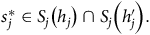 ${s}_{j}^{\mathrm{*}}\in {S}_{j}\left({h}_{j}\right)\cap {S}_{j}\left({h}_{j}^{\prime}\right).$
Since
${s}_{j}^{\mathrm{*}}\in {S}_{j}\left({h}_{j}\right)\cap {S}_{j}\left({h}_{j}^{\prime}\right).$
Since ${s}_{j}^{\mathrm{*}}\in {S}_{j}\left({h}_{j}\right)$
and
${s}_{j}^{\mathrm{*}}\in {S}_{j}\left({h}_{j}\right)$
and ${a}_{j}^{k}$
is the unique action at
${a}_{j}^{k}$
is the unique action at ${h}_{j}^{k}$
that precedes
${h}_{j}^{k}$
that precedes ${h}_{j},$
we have that
${h}_{j},$
we have that ${s}_{j}^{\mathrm{*}}\left({h}_{j}^{k}\right)={a}_{j}^{k}.$
Since
${s}_{j}^{\mathrm{*}}\left({h}_{j}^{k}\right)={a}_{j}^{k}.$
Since ${s}_{j}^{\mathrm{*}}\in {S}_{j}\left({h}_{j}^{\prime}\right)$
and
${s}_{j}^{\mathrm{*}}\in {S}_{j}\left({h}_{j}^{\prime}\right)$
and ${h}_{j}^{k}$
precedes
${h}_{j}^{k}$
precedes ${h}_{j}^{\prime}$
it would follow that
${h}_{j}^{\prime}$
it would follow that ${a}_{j}^{k}$
precedes
${a}_{j}^{k}$
precedes ${h}_{j}^{\prime}$
as well, which is a contradiction.
${h}_{j}^{\prime}$
as well, which is a contradiction.
Case 2.
Suppose that ${h}_{j}^{k}$
does not precede
${h}_{j}^{k}$
does not precede ${h}_{j}^{\prime}.$
By Claim 1 there is some
${h}_{j}^{\prime}.$
By Claim 1 there is some ${s}_{j}^{\mathrm{*}}$
in
${s}_{j}^{\mathrm{*}}$
in $CC$
with
$CC$
with ${s}_{j}^{\mathrm{*}}\in {S}_{j}\left({h}_{j}\right)\cap {S}_{j}\left({h}_{j}^{\prime}\right).$
Take some
${s}_{j}^{\mathrm{*}}\in {S}_{j}\left({h}_{j}\right)\cap {S}_{j}\left({h}_{j}^{\prime}\right).$
Take some ${s}_{i}\in {S}_{i}\left({h}_{j}^{\prime}\right).$
As
${s}_{i}\in {S}_{i}\left({h}_{j}^{\prime}\right).$
As ${s}_{j}^{\mathrm{*}}\in {S}_{j}\left({h}_{j}^{\prime}\right)$
and, by perfect recall,
${s}_{j}^{\mathrm{*}}\in {S}_{j}\left({h}_{j}^{\prime}\right)$
and, by perfect recall, $S\left({h}_{j}^{\prime}\right)={S}_{i}\left({h}_{j}^{\prime}\right)\times {S}_{j}\left({h}_{j}^{\prime}\right),$
we conclude that
$S\left({h}_{j}^{\prime}\right)={S}_{i}\left({h}_{j}^{\prime}\right)\times {S}_{j}\left({h}_{j}^{\prime}\right),$
we conclude that $({s}_{i},{s}_{j}^{\mathrm{*}})\in S\left({h}_{j}^{\prime}\right).$
Since
$({s}_{i},{s}_{j}^{\mathrm{*}})\in S\left({h}_{j}^{\prime}\right).$
Since ${h}_{j}^{k}$
does not precede
${h}_{j}^{k}$
does not precede ${h}_{j}^{\prime}$
it must be that
${h}_{j}^{\prime}$
it must be that $({s}_{i},{s}_{j}^{\mathrm{*}})\notin S\left({h}_{j}^{k}\right).$
Recall that
$({s}_{i},{s}_{j}^{\mathrm{*}})\notin S\left({h}_{j}^{k}\right).$
Recall that ${a}_{j}^{k}\in {A}_{j}\left({h}_{j}^{k}\right)$
precedes
${a}_{j}^{k}\in {A}_{j}\left({h}_{j}^{k}\right)$
precedes ${h}_{j},$
which implies that
${h}_{j},$
which implies that ${h}_{j}^{k}$
precedes
${h}_{j}^{k}$
precedes ${h}_{j}.$
Since
${h}_{j}.$
Since ${s}_{j}^{\mathrm{*}}\in {S}_{j}\left({h}_{j}\right)$
it follows that
${s}_{j}^{\mathrm{*}}\in {S}_{j}\left({h}_{j}\right)$
it follows that ${s}_{j}^{\mathrm{*}}\in {S}_{j}\left({h}_{j}^{k}\right).$
As
${s}_{j}^{\mathrm{*}}\in {S}_{j}\left({h}_{j}^{k}\right).$
As $({s}_{i},{s}_{j}^{\mathrm{*}})\notin S\left({h}_{j}^{k}\right)$
and, by perfect recall,
$({s}_{i},{s}_{j}^{\mathrm{*}})\notin S\left({h}_{j}^{k}\right)$
and, by perfect recall, $S\left({h}_{j}^{k}\right)={}_{i}\left({h}_{j}^{k}\right)\times {S}_{j}\left({h}_{j}^{k}\right),$
we conclude that
$S\left({h}_{j}^{k}\right)={}_{i}\left({h}_{j}^{k}\right)\times {S}_{j}\left({h}_{j}^{k}\right),$
we conclude that ${s}_{i}\notin {S}_{i}\left({h}_{j}^{k}\right).$
Now, let ${t}_{j}$
be a strategy that is minimally different from
${t}_{j}$
be a strategy that is minimally different from ${s}_{j}^{\mathrm{*}}$
at
${s}_{j}^{\mathrm{*}}$
at ${h}_{j}^{k}.$
Since
${h}_{j}^{k}.$
Since ${s}_{i}\;\notin\; {S}_{i}\left({h}_{j}^{k}\right),$
it follows from Lemma 7.3 that
${s}_{i}\;\notin\; {S}_{i}\left({h}_{j}^{k}\right),$
it follows from Lemma 7.3 that $z({s}_{i},{s}_{j}^{\mathrm{*}})=z({s}_{i},{t}_{j}).$
Since
$z({s}_{i},{s}_{j}^{\mathrm{*}})=z({s}_{i},{t}_{j}).$
Since ${s}_{j}^{\mathrm{*}}\in CC$
this would imply that
${s}_{j}^{\mathrm{*}}\in CC$
this would imply that ${t}_{j}\in CC$
and
${t}_{j}\in CC$
and ${h}_{j}^{k}\in {H}_{j}\left(CC\right).$
However, this is a contradiction since
${h}_{j}^{k}\in {H}_{j}\left(CC\right).$
However, this is a contradiction since ${h}_{j}^{k}$
precedes
${h}_{j}^{k}$
precedes ${H}_{j}^{first}\left(CC\right),$
and can therefore not be in
${H}_{j}^{first}\left(CC\right),$
and can therefore not be in ${H}_{j}\left(CC\right).$
We thus obtain a contradiction.
${H}_{j}\left(CC\right).$
We thus obtain a contradiction.
By Cases 1 and 2 we conclude that the actions ${a}_{j}^{1}, \ldots, {a}_{j}^{K}$
preceding
${a}_{j}^{1}, \ldots, {a}_{j}^{K}$
preceding ${h}_{j}$
also precede
${h}_{j}$
also precede ${h}_{j}^{\prime}.$
Hence, all player
${h}_{j}^{\prime}.$
Hence, all player $j$
actions that precede
$j$
actions that precede ${h}_{j}$
also precede
${h}_{j}$
also precede ${h}_{j}^{\prime}.$
In a similar fashion, it follows that all player
${h}_{j}^{\prime}.$
In a similar fashion, it follows that all player $j$
actions preceding
$j$
actions preceding ${h}_{j}^{\prime}$
also precede
${h}_{j}^{\prime}$
also precede ${h}_{j}.$
Thus,
${h}_{j}.$
Thus, ${h}_{j}$
and
${h}_{j}$
and ${h}_{j}^{\prime}$
are preceded by the same player
${h}_{j}^{\prime}$
are preceded by the same player $j$
actions. This completes the proof of Claim 2.
$j$
actions. This completes the proof of Claim 2.
Claim 3. For every two ${h}_{j},{h}_{j}^{\prime}\in {H}_{j}^{first}\left(CC\right)$
we have that
${h}_{j},{h}_{j}^{\prime}\in {H}_{j}^{first}\left(CC\right)$
we have that ${S}_{j}\left({h}_{j}\right)={S}_{j}\left({h}_{j}^{\prime}\right).$
Proof of Claim 3. By Claim 2, ${h}_{j}$
and
${h}_{j}$
and ${h}_{j}^{\prime}$
are preceded by the same player
${h}_{j}^{\prime}$
are preceded by the same player $j$
actions
$j$
actions ${a}_{j}^{1}, \ldots, {a}_{j}^{K}$
at the information sets
${a}_{j}^{1}, \ldots, {a}_{j}^{K}$
at the information sets ${h}_{j}^{1}, \ldots, {h}_{j}^{K}.$
But then, by construction,
${h}_{j}^{1}, \ldots, {h}_{j}^{K}.$
But then, by construction,
 $${S}_{j}\left({h}_{j}\right)=\{{s}_{j}\in {S}_{j}|{s}_{j}\left({h}_{j}^{k}\right)={a}_{j}^{k}\;\mathrm{f}\mathrm{o}\mathrm{r}\;\mathrm{a}\mathrm{l}\mathrm{l}\;k\in \{1, \ldots, K\}\}={S}_{j}({h}_{j}^{\prime}).$$
This completes the proof of Claim 3.
We will now show that the induced graph ${G}_{i}^{D}$
satisfies two strategies per connected component. Take a connected component
${G}_{i}^{D}$
satisfies two strategies per connected component. Take a connected component $CC.$
We distinguish two cases: (1)
$CC.$
We distinguish two cases: (1) ${H}_{j}^{first}\left(CC\right)$
contains only one information set, and (2)
${H}_{j}^{first}\left(CC\right)$
contains only one information set, and (2) ${H}_{j}^{first}\left(CC\right)$
contains at least two information sets.
${H}_{j}^{first}\left(CC\right)$
contains at least two information sets.
Case 1. Suppose that ${H}_{j}^{first}\left(CC\right)$
contains a single information set
${H}_{j}^{first}\left(CC\right)$
contains a single information set ${h}_{\mathrm{j}}^{\mathrm{*}}.$
As
${h}_{\mathrm{j}}^{\mathrm{*}}.$
As ${h}_{j}^{\mathrm{*}}\in $ ${H}_{j}\left(CC\right)$
there are strategies
${H}_{j}\left(CC\right)$
there are strategies ${s}_{j}^{\mathrm{*}},{t}_{j}^{\mathrm{*}}$
in
${s}_{j}^{\mathrm{*}},{t}_{j}^{\mathrm{*}}$
in $CC$
that are minimally different at
$CC$
that are minimally different at ${h}_{j}^{\mathrm{*}}$
and a strategy
${h}_{j}^{\mathrm{*}}$
and a strategy ${s}_{i}^{\mathrm{*}}$
with
${s}_{i}^{\mathrm{*}}$
with $z({s}_{i}^{\mathrm{*}},{s}_{j}^{\mathrm{*}})=z({s}_{i}^{\mathrm{*}},{t}_{j}^{\mathrm{*}}).$
By Lemma 7.3 we know that
$z({s}_{i}^{\mathrm{*}},{s}_{j}^{\mathrm{*}})=z({s}_{i}^{\mathrm{*}},{t}_{j}^{\mathrm{*}}).$
By Lemma 7.3 we know that ${s}_{i}^{\mathrm{*}}\notin {S}_{i}\left({h}_{j}^{\mathrm{*}}\right).$
As all other information sets in
${s}_{i}^{\mathrm{*}}\notin {S}_{i}\left({h}_{j}^{\mathrm{*}}\right).$
As all other information sets in ${H}_{j}\left(CC\right)$
follow
${H}_{j}\left(CC\right)$
follow ${h}_{j}^{\mathrm{*}}$
we conclude that
${h}_{j}^{\mathrm{*}}$
we conclude that ${s}_{i}^{\mathrm{*}}\notin {S}_{i}\left({h}_{j}\right)$
for every
${s}_{i}^{\mathrm{*}}\notin {S}_{i}\left({h}_{j}\right)$
for every ${h}_{j}\in {H}_{j}\left(CC\right).$
Take an edge $({s}_{j},{t}_{j})$
in
$({s}_{j},{t}_{j})$
in $CC.$
Hence,
$CC.$
Hence, ${s}_{j}$
and
${s}_{j}$
and ${t}_{j}$
are minimally different at some
${t}_{j}$
are minimally different at some ${h}_{j}\in {H}_{j}\left(CC\right)$
and there is some
${h}_{j}\in {H}_{j}\left(CC\right)$
and there is some ${s}_{i}$
with
${s}_{i}$
with $z({s}_{i},{s}_{j})=z({s}_{i},{t}_{j}).$
As we have seen above that
$z({s}_{i},{s}_{j})=z({s}_{i},{t}_{j}).$
As we have seen above that ${s}_{i}^{\mathrm{*}}\notin {S}_{i}\left({h}_{j}\right),$
it follows by Lemma 7.3 that
${s}_{i}^{\mathrm{*}}\notin {S}_{i}\left({h}_{j}\right),$
it follows by Lemma 7.3 that $z({s}_{i}^{\mathrm{*}},{s}_{j})=z({s}_{i}^{\mathrm{*}},{t}_{j}).$
Thus, two strategies per connected component is satisfied. In fact, one strategy
$z({s}_{i}^{\mathrm{*}},{s}_{j})=z({s}_{i}^{\mathrm{*}},{t}_{j}).$
Thus, two strategies per connected component is satisfied. In fact, one strategy ${s}_{i}^{\mathrm{*}}$
turned out to be sufficient for the connected component
${s}_{i}^{\mathrm{*}}$
turned out to be sufficient for the connected component $CC.$
$CC.$
Case 2. Suppose that ${H}_{j}^{firs\mathrm{t}}\left(CC\right)$
contains at least two information sets
${H}_{j}^{firs\mathrm{t}}\left(CC\right)$
contains at least two information sets ${h}_{j}^{1}$
and
${h}_{j}^{1}$
and ${h}_{j}^{2}.$
Choose a strategy
${h}_{j}^{2}.$
Choose a strategy ${s}_{i}^{1}\in {S}_{i}\left({h}_{j}^{1}\right)$
and a strategy
${s}_{i}^{1}\in {S}_{i}\left({h}_{j}^{1}\right)$
and a strategy ${s}_{i}^{2}\in {S}_{i}\left({h}_{j}^{2}\right).$
Now, take an edge $({s}_{j}^{\mathrm{*}},{t}_{j}^{\mathrm{*}})$
in
$({s}_{j}^{\mathrm{*}},{t}_{j}^{\mathrm{*}})$
in $CC$
. Then,
$CC$
. Then, ${s}_{j}^{\mathrm{*}},{t}_{j}^{\mathrm{*}}$
are minimally different at some
${s}_{j}^{\mathrm{*}},{t}_{j}^{\mathrm{*}}$
are minimally different at some ${h}_{j}^{\mathrm{*}}\in {H}_{j}\left(CC\right)$
and there is some strategy
${h}_{j}^{\mathrm{*}}\in {H}_{j}\left(CC\right)$
and there is some strategy ${s}_{i}$
with
${s}_{i}$
with $z({s}_{i},{s}_{j}^{\mathrm{*}})=z({s}_{i},{t}_{j}^{\mathrm{*}}).$
By definition of
$z({s}_{i},{s}_{j}^{\mathrm{*}})=z({s}_{i},{t}_{j}^{\mathrm{*}}).$
By definition of ${H}_{j}^{first}\left(CC\right),$
information set
${H}_{j}^{first}\left(CC\right),$
information set ${h}_{j}^{\mathrm{*}}$
weakly follows some
${h}_{j}^{\mathrm{*}}$
weakly follows some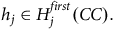 ${h}_{j}\in {H}_{j}^{first}\left(CC\right).$
In fact, by perfect recall,
${h}_{j}\in {H}_{j}^{first}\left(CC\right).$
In fact, by perfect recall, ${h}_{j}^{\mathrm{*}}$
weakly follows exactly one information set in
${h}_{j}^{\mathrm{*}}$
weakly follows exactly one information set in ${H}_{j}^{first}\left(CC\right).$
We distinguish two cases: (2.1)
${H}_{j}^{first}\left(CC\right).$
We distinguish two cases: (2.1) ${h}_{j}^{\mathrm{*}}$
does not weakly follow
${h}_{j}^{\mathrm{*}}$
does not weakly follow ${h}_{j}^{1},$
and (2.2)
${h}_{j}^{1},$
and (2.2) ${h}_{j}^{\mathrm{*}}$
does not weakly follow
${h}_{j}^{\mathrm{*}}$
does not weakly follow ${h}_{j}^{2}.$
Case 2.1. Assume that ${h}_{j}^{\mathrm{*}}$
does not weakly follow
${h}_{j}^{\mathrm{*}}$
does not weakly follow ${h}_{j}^{1}.$
Then, we show that
${h}_{j}^{1}.$
Then, we show that $z({s}_{i}^{1},{s}_{j}^{\mathrm{*}})=z({s}_{i}^{1},{t}_{j}^{\mathrm{*}}).$
Suppose that
$z({s}_{i}^{1},{s}_{j}^{\mathrm{*}})=z({s}_{i}^{1},{t}_{j}^{\mathrm{*}}).$
Suppose that ${h}_{j}^{\mathrm{*}}$
weakly follows
${h}_{j}^{\mathrm{*}}$
weakly follows ${h}_{j}\in {H}_{j}^{first}\left(CC\right)\backslash \left\{{h}_{j}^{1}\right\}.$
As
${h}_{j}\in {H}_{j}^{first}\left(CC\right)\backslash \left\{{h}_{j}^{1}\right\}.$
As ${s}_{j}^{\mathrm{*}}\in {S}_{j}\left({h}_{j}^{\mathrm{*}}\right)$
and
${s}_{j}^{\mathrm{*}}\in {S}_{j}\left({h}_{j}^{\mathrm{*}}\right)$
and ${h}_{j}^{\mathrm{*}}$
weakly follows
${h}_{j}^{\mathrm{*}}$
weakly follows ${h}_{j}$
we conclude that
${h}_{j}$
we conclude that ${s}_{j}^{\mathrm{*}}\in {S}_{j}\left({h}_{j}\right).$
Since we know, by Claim 3, that
${s}_{j}^{\mathrm{*}}\in {S}_{j}\left({h}_{j}\right).$
Since we know, by Claim 3, that ${S}_{j}\left({h}_{j}\right)={S}_{j}\left({h}_{j}^{1}\right)$
it follows that
${S}_{j}\left({h}_{j}\right)={S}_{j}\left({h}_{j}^{1}\right)$
it follows that ${s}_{j}^{\mathrm{*}}\in {S}_{j}\left({h}_{j}^{1}\right).$
Recall from above that
${s}_{j}^{\mathrm{*}}\in {S}_{j}\left({h}_{j}^{1}\right).$
Recall from above that ${s}_{i}^{1}\in {S}_{i}\left({h}_{j}^{1}\right).$
Since, by perfect recall,
${s}_{i}^{1}\in {S}_{i}\left({h}_{j}^{1}\right).$
Since, by perfect recall, $S\left({h}_{j}^{1}\right)={S}_{i}\left({h}_{j}^{1}\right)\times {S}_{j}\left({h}_{j}^{1}\right),$
we conclude that
$S\left({h}_{j}^{1}\right)={S}_{i}\left({h}_{j}^{1}\right)\times {S}_{j}\left({h}_{j}^{1}\right),$
we conclude that $({s}_{i}^{1},{s}_{j}^{\mathrm{*}})\in S\left({h}_{j}^{1}\right).$
Since
$({s}_{i}^{1},{s}_{j}^{\mathrm{*}})\in S\left({h}_{j}^{1}\right).$
Since ${h}_{j}^{\mathrm{*}}$
does not weakly follow
${h}_{j}^{\mathrm{*}}$
does not weakly follow ${h}_{j}^{1}$
we conclude that
${h}_{j}^{1}$
we conclude that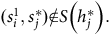 $({s}_{i}^{1},{s}_{j}^{\mathrm{*}})\notin S\left({h}_{j}^{\mathrm{*}}\right).$
As
$({s}_{i}^{1},{s}_{j}^{\mathrm{*}})\notin S\left({h}_{j}^{\mathrm{*}}\right).$
As ${s}_{j}^{\mathrm{*}},{t}_{j}^{\mathrm{*}}$
are minimally different at
${s}_{j}^{\mathrm{*}},{t}_{j}^{\mathrm{*}}$
are minimally different at ${h}_{j}^{\mathrm{*}}$
it follows that
${h}_{j}^{\mathrm{*}}$
it follows that $z({s}_{i}^{1},{s}_{j}^{\mathrm{*}})=z({s}_{i}^{1},{t}_{j}^{\mathrm{*}}).$
Case 2.2. Assume that ${h}_{j}^{\mathrm{*}}$
does not weakly follow
${h}_{j}^{\mathrm{*}}$
does not weakly follow ${h}_{j}^{2}.$
Then, it can be shown in a similar fashion as above that
${h}_{j}^{2}.$
Then, it can be shown in a similar fashion as above that $z({s}_{i}^{2},{s}_{j}^{\mathrm{*}})=z({s}_{i}^{2},{t}_{j}^{\mathrm{*}}).$
By Cases 2.1 and 2.2, the condition of two strategies per connected component is satisfied. Together with Case 1, we see that two strategies per connected component is satisfied whenever the game has two players and satisfies perfect recall. This completes the proof. ▪
Lemma 7.5
(Strategy combinations leading to same consequence) Consider a strategy ${s}_{i}$
and two opponents’ strategy combinations
${s}_{i}$
and two opponents’ strategy combinations ${s}_{-i},{t}_{-i}$
with
${s}_{-i},{t}_{-i}$
with $z({s}_{i},{s}_{-i})=z({s}_{i},{t}_{-i}).$
Then, there are opponents’ strategy combinations
$z({s}_{i},{s}_{-i})=z({s}_{i},{t}_{-i}).$
Then, there are opponents’ strategy combinations ${s}_{-i}^{0},{s}_{-i}^{1}, \ldots, {s}_{-i}^{K}$
such that (i)
${s}_{-i}^{0},{s}_{-i}^{1}, \ldots, {s}_{-i}^{K}$
such that (i) ${s}_{-i}^{0}={s}_{-i},$
(ii)
${s}_{-i}^{0}={s}_{-i},$
(ii) ${s}_{-i}^{K}={t}_{-i},$
(iii)
${s}_{-i}^{K}={t}_{-i},$
(iii) ${s}_{-i}^{k},{s}_{-i}^{k+1}$
minimally different for every
${s}_{-i}^{k},{s}_{-i}^{k+1}$
minimally different for every $k\in \{0, \ldots, K-1\},$
and (iv)
$k\in \{0, \ldots, K-1\},$
and (iv) $z({s}_{i},{s}_{-i}^{k})=z({s}_{i},{s}_{-i}^{k+1})$
for all
$z({s}_{i},{s}_{-i}^{k})=z({s}_{i},{s}_{-i}^{k+1})$
for all $k\in \{0, \ldots, K-1\}.$
Proof. Let the set of players be $I=\{1, \ldots, n\}$
and assume, without loss of generality, that
$I=\{1, \ldots, n\}$
and assume, without loss of generality, that $i=1.$
Let
$i=1.$
Let ${s}_{-i}=({s}_{2}, \ldots, {s}_{n})$
and
${s}_{-i}=({s}_{2}, \ldots, {s}_{n})$
and ${t}_{-i}=({t}_{2}, \ldots, {t}_{n}).$
For every opponent
${t}_{-i}=({t}_{2}, \ldots, {t}_{n}).$
For every opponent $j$
let
$j$
let
 $${H}_{j}^{dif}({s}_{j},{t}_{j}):=\{{h}_{j}\in {H}_{j}({s}_{j})\cap {H}_{j}({t}_{j}\left)\right|{s}_{j}\left({h}_{j}\right)\ne {t}_{j}\left({h}_{j}\right)\}$$
be the collection of information sets where ${s}_{j},{t}_{j}$
differ.
${s}_{j},{t}_{j}$
differ.
Take an opponent $j\in \{2, \ldots, n\},$
and suppose that
$j\in \{2, \ldots, n\},$
and suppose that ${H}_{j}^{dif}({s}_{j},{t}_{j})$
consists of
${H}_{j}^{dif}({s}_{j},{t}_{j})$
consists of ${K}_{j}$
information sets
${K}_{j}$
information sets $\{{h}_{j}^{1}, \ldots, {h}_{j}^{{K}_{j}}\}$
. We define strategies
$\{{h}_{j}^{1}, \ldots, {h}_{j}^{{K}_{j}}\}$
. We define strategies ${s}_{j}^{0}, \ldots, {s}_{j}^{{K}_{j}}$
as follows: Set
${s}_{j}^{0}, \ldots, {s}_{j}^{{K}_{j}}$
as follows: Set ${s}_{j}^{0}:={s}_{j},$
and for every
${s}_{j}^{0}:={s}_{j},$
and for every $k\in \{1, \ldots, {K}_{j}\}$
let
$k\in \{1, \ldots, {K}_{j}\}$
let ${s}_{j}^{k}$
be the unique strategy that (i) coincides with
${s}_{j}^{k}$
be the unique strategy that (i) coincides with ${t}_{j}$
at all information sets
${t}_{j}$
at all information sets ${h}_{j}\in \{{h}_{j}^{1}, \ldots, {h}_{j}^{k}\},$
(ii) coincides with
${h}_{j}\in \{{h}_{j}^{1}, \ldots, {h}_{j}^{k}\},$
(ii) coincides with ${t}_{j}$
at all information sets
${t}_{j}$
at all information sets ${h}_{j}\in {H}_{j}\left({t}_{j}\right)$
that follow an information set in
${h}_{j}\in {H}_{j}\left({t}_{j}\right)$
that follow an information set in $\{{h}_{j}^{1}, \ldots, {h}_{j}^{k}\},$
and (iii) coincides with
$\{{h}_{j}^{1}, \ldots, {h}_{j}^{k}\},$
and (iii) coincides with ${s}_{j}$
at all other information sets in
${s}_{j}$
at all other information sets in ${H}_{j}\left({s}_{j}^{k}\right).$
Then, by construction,
${H}_{j}\left({s}_{j}^{k}\right).$
Then, by construction, ${s}_{j}^{{K}_{j}}={t}_{j},$
and
${s}_{j}^{{K}_{j}}={t}_{j},$
and ${s}_{j}^{k-1},{s}_{j}^{k}$
are minimally different at
${s}_{j}^{k-1},{s}_{j}^{k}$
are minimally different at ${h}_{j}^{k}$
for every
${h}_{j}^{k}$
for every $k\in \{1, \ldots, {K}_{j}\}.$
For every $j\in \{2, \ldots, n\}$
and
$j\in \{2, \ldots, n\}$
and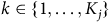 $k\in \{1, \ldots, {K}_{j}\}$
let
$k\in \{1, \ldots, {K}_{j}\}$
let
 $${s}_{-i}^{j.k}:=({t}_{2}, \ldots, {t}_{j-1},{s}_{j}^{k},{s}_{j+1}, \ldots, {s}_{n}).$$
Then, we define the sequence of opponents’ strategy combinations ${s}_{-i}^{0},{s}_{-i}^{1}, \ldots, {s}_{-i}^{K}$
by
${s}_{-i}^{0},{s}_{-i}^{1}, \ldots, {s}_{-i}^{K}$
by
 $${s}_{-i}^{0},{s}_{-i}^{1} \ldots .,{s}_{-\mathrm{i}}^{K}:={s}_{-i},{s}_{-i}^{2.1}, \ldots, {s}_{-i}^{2.{K}_{2}},{s}_{-i}^{3.1}, \ldots, {s}_{-i}^{3.{K}_{3}}, \ldots, {s}_{-i}^{n.1}, \ldots, {s}_{-i}^{n.{K}_{n}}.$$
By construction, ${s}_{-i}^{0}={s}_{-i},$ ${s}_{-i}^{K}={t}_{-i}$
and
${s}_{-i}^{K}={t}_{-i}$
and ${s}_{-i}^{k},{s}_{-i}^{k+1}$
are minimally different for every
${s}_{-i}^{k},{s}_{-i}^{k+1}$
are minimally different for every $k\in \{0, \ldots, K-1\}.$
It remains to show that
$k\in \{0, \ldots, K-1\}.$
It remains to show that $z({s}_{i},{s}_{-i}^{k})=z({s}_{i},{s}_{-i}^{k+1})$
for every
$z({s}_{i},{s}_{-i}^{k})=z({s}_{i},{s}_{-i}^{k+1})$
for every $k\in \{0, \ldots, K-1\}.$
Recall that $z({s}_{i},{}_{-i})=z({s}_{i},{t}_{-i}).$
Let
$z({s}_{i},{}_{-i})=z({s}_{i},{t}_{-i}).$
Let $z:=z({s}_{i},{s}_{-i})=z({s}_{i},{t}_{-i}).$
Then,
$z:=z({s}_{i},{s}_{-i})=z({s}_{i},{t}_{-i}).$
Then, $({s}_{i},{s}_{-i})$
and
$({s}_{i},{s}_{-i})$
and $({s}_{i},{t}_{-i})$
select all the actions on the path to
$({s}_{i},{t}_{-i})$
select all the actions on the path to $z.$
Now, take some
$z.$
Now, take some $k\in \{0, \ldots, K-1\},$
and suppose that
$k\in \{0, \ldots, K-1\},$
and suppose that ${s}_{-i}^{\mathrm{k}},{s}_{-i}^{k+1}$
minimally differ at some
${s}_{-i}^{\mathrm{k}},{s}_{-i}^{k+1}$
minimally differ at some ${h}_{j}\in {H}_{j}.$
Then, by construction,
${h}_{j}\in {H}_{j}.$
Then, by construction, ${s}_{-i},{t}_{-i}$
also differ at
${s}_{-i},{t}_{-i}$
also differ at ${h}_{j}.$
Since
${h}_{j}.$
Since $({s}_{i},{s}_{-i})$
and
$({s}_{i},{s}_{-i})$
and $({s}_{i},{t}_{-i})$
select all the actions on the path to
$({s}_{i},{t}_{-i})$
select all the actions on the path to $z,$
it must be that
$z,$
it must be that ${h}_{j}$
is not on the path to
${h}_{j}$
is not on the path to $z.$
Hence, we conclude that
$z.$
Hence, we conclude that $z({s}_{\mathrm{i}},{s}_{-i}^{k})=z({s}_{i},{s}_{-i}^{k+1})=z$
also. Thus,
$z({s}_{\mathrm{i}},{s}_{-i}^{k})=z({s}_{i},{s}_{-i}^{k+1})=z$
also. Thus, $z({s}_{i},{s}_{-i}^{k})=z({s}_{i},{s}_{-i}^{k+1})$
for every
$z({s}_{i},{s}_{-i}^{k})=z({s}_{i},{s}_{-i}^{k+1})$
for every $k\in \{0, \ldots, K-1\}.$
This completes the proof. ▪
$k\in \{0, \ldots, K-1\}.$
This completes the proof. ▪
Lemma 7.6
(Induced probability distributions on consequences) Consider the realization-based consequence structure $(Z,z),$
two strategies
$(Z,z),$
two strategies ${s}_{i},{s}_{i}^{\prime}\in {S}_{i}$
and two beliefs
${s}_{i},{s}_{i}^{\prime}\in {S}_{i}$
and two beliefs ${\beta }_{i},{\beta }_{i}^{\prime}$
with
${\beta }_{i},{\beta }_{i}^{\prime}$
with ${\mathbb{P}}_{({s}_{i},{\beta }_{i})}={\mathbb{P}}_{({s}_{i}^{\prime},{\beta }_{i}^{\prime})}.$
Then,
${\mathbb{P}}_{({s}_{i},{\beta }_{i})}={\mathbb{P}}_{({s}_{i}^{\prime},{\beta }_{i}^{\prime})}.$
Then, ${\mathbb{P}}_{({s}_{i},{\beta }_{i})}={\mathbb{P}}_{({s}_{i}^{\prime},{\beta }_{i})}={\mathbb{P}}_{({s}_{i},{\beta }_{i}^{\prime})}.$
Proof. For every consequence $z,$
let
$z,$
let ${S}_{i}\left(z\right)$
be the set of strategies
${S}_{i}\left(z\right)$
be the set of strategies ${s}_{i}\in {S}_{i}$
that select all player
${s}_{i}\in {S}_{i}$
that select all player $i$
actions on the path to
$i$
actions on the path to $z,$
and let
$z,$
and let ${S}_{-i}\left(z\right)$
be the set of opponents’ strategy combinations
${S}_{-i}\left(z\right)$
be the set of opponents’ strategy combinations ${s}_{-i}\in {S}_{-i}$
that select all opponents’ actions on the path to
${s}_{-i}\in {S}_{-i}$
that select all opponents’ actions on the path to $z.$
Take some consequence
$z.$
Take some consequence $z$
with
$z$
with ${\mathbb{P}}_{({s}_{i},{\beta }_{i})}\left(z\right) \gt 0.$
Then,
${\mathbb{P}}_{({s}_{i},{\beta }_{i})}\left(z\right) \gt 0.$
Then, ${s}_{i}\in {S}_{i}\left(z\right)$
and
${s}_{i}\in {S}_{i}\left(z\right)$
and ${\mathbb{P}}_{({s}_{i},{\beta }_{i})}\left(z\right)={\beta }_{i}\left({S}_{-i}\right(z\left)\right).$
As
${\mathbb{P}}_{({s}_{i},{\beta }_{i})}\left(z\right)={\beta }_{i}\left({S}_{-i}\right(z\left)\right).$
As ${\mathbb{P}}_{({s}_{i}^{\prime},{\beta }_{i}^{\prime})}\left(z\right)={\mathbb{P}}_{({s}_{i},{\beta }_{i})}\left(z\right) \gt 0$
we have that
${\mathbb{P}}_{({s}_{i}^{\prime},{\beta }_{i}^{\prime})}\left(z\right)={\mathbb{P}}_{({s}_{i},{\beta }_{i})}\left(z\right) \gt 0$
we have that ${s}_{i}^{\prime}\in {S}_{i}\left(z\right)$
and
${s}_{i}^{\prime}\in {S}_{i}\left(z\right)$
and ${\mathbb{P}}_{({s}_{i}^{\prime},{\beta }_{i}^{\prime})}\left(z\right)={\beta }_{i}^{\prime}\left({S}_{-i}\right(z\left)\right).$
Since
${\mathbb{P}}_{({s}_{i}^{\prime},{\beta }_{i}^{\prime})}\left(z\right)={\beta }_{i}^{\prime}\left({S}_{-i}\right(z\left)\right).$
Since ${\mathbb{P}}_{({s}_{i}^{\prime},{\beta }_{i}^{\prime})}\left(z\right)={\mathbb{P}}_{({s}_{i},{\beta }_{i})}\left(z\right)$
it follows that
${\mathbb{P}}_{({s}_{i}^{\prime},{\beta }_{i}^{\prime})}\left(z\right)={\mathbb{P}}_{({s}_{i},{\beta }_{i})}\left(z\right)$
it follows that ${\beta }_{i}\left({S}_{-i}\right(z\left)\right)={\beta }_{i}^{\prime}\left({S}_{-i}\right(z\left)\right).$
But then, we conclude that
${\beta }_{i}\left({S}_{-i}\right(z\left)\right)={\beta }_{i}^{\prime}\left({S}_{-i}\right(z\left)\right).$
But then, we conclude that

As this holds for every $z$
with
$z$
with ${\mathbb{P}}_{({s}_{i},{\beta }_{i})}\left(z\right) \gt 0,$
it follows that
${\mathbb{P}}_{({s}_{i},{\beta }_{i})}\left(z\right) \gt 0,$
it follows that ${\mathbb{P}}_{({s}_{i},{\beta }_{i})}={\mathbb{P}}_{({s}_{i}^{\prime},{\beta }_{i})}={\mathbb{P}}_{({s}_{i},{\beta }_{i}^{\prime})}.$
This completes the proof. ▪
${\mathbb{P}}_{({s}_{i},{\beta }_{i})}={\mathbb{P}}_{({s}_{i}^{\prime},{\beta }_{i})}={\mathbb{P}}_{({s}_{i},{\beta }_{i}^{\prime})}.$
This completes the proof. ▪
7.3 Utility transformation procedure
Consider a conditional preference relation ${\succsim }_{i}$
with an expected utility representation
${\succsim }_{i}$
with an expected utility representation ${u}_{i}$
, and the realization-based consequence structure
${u}_{i}$
, and the realization-based consequence structure $(Z,z).$
The following procedure, which we call the utility transformation procedure, transforms the utility function
$(Z,z).$
The following procedure, which we call the utility transformation procedure, transforms the utility function ${u}_{i}$
into a new utility function
${u}_{i}$
into a new utility function ${v}_{i}$
which is still an expected utility representation for
${v}_{i}$
which is still an expected utility representation for ${\succsim }_{i}$
and that, under certain conditions, is measurable with respect to
${\succsim }_{i}$
and that, under certain conditions, is measurable with respect to $(Z,z)$
. This procedure is used in the proofs of Theorems 4.1 and 5.1.
$(Z,z)$
. This procedure is used in the proofs of Theorems 4.1 and 5.1.
Take a dynamic game form $D,$
a player
$D,$
a player $i,$
and a conditional preference relation
$i,$
and a conditional preference relation ${\succsim }_{i}$
for player
${\succsim }_{i}$
for player $i$
with an expected utility representation
$i$
with an expected utility representation ${u}_{i}.$
Recall from above the definition of the graph
${u}_{i}.$
Recall from above the definition of the graph ${G}_{i}^{D}$
induced by the dynamic game form
${G}_{i}^{D}$
induced by the dynamic game form $D$
for player
$D$
for player $i$
, and fix a connected component
$i$
, and fix a connected component $CC.$
Then, there is a spanning tree
$CC.$
Then, there is a spanning tree $T$
for
$T$
for $CC$
with root
$CC$
with root ${s}_{-i}^{0}$
in
${s}_{-i}^{0}$
in $CC.$
If there are
$CC.$
If there are $K$
nodes in
$K$
nodes in $CC,$
choose a bijective numbering
$CC,$
choose a bijective numbering $m:CC\to \{1, \ldots, K\}$
such that
$m:CC\to \{1, \ldots, K\}$
such that $m\left({s}_{-i}\right) \gt m\left({t}_{-i}\right)$
whenever
$m\left({s}_{-i}\right) \gt m\left({t}_{-i}\right)$
whenever ${s}_{-i}\ne {t}_{-i}$
and
${s}_{-i}\ne {t}_{-i}$
and ${t}_{-i}$
lies on the unique path in
${t}_{-i}$
lies on the unique path in $T$
from
$T$
from ${s}_{-i}^{0}$
to
${s}_{-i}^{0}$
to ${s}_{-i}.$
Hence,
${s}_{-i}.$
Hence, $m\left({s}_{-i}^{0}\right)=1.$
We define the new utilities
$m\left({s}_{-i}^{0}\right)=1.$
We define the new utilities ${v}_{i}({s}_{i},{s}_{-i})$
for the nodes
${v}_{i}({s}_{i},{s}_{-i})$
for the nodes ${s}_{-i}$
in
${s}_{-i}$
in $CC$
by induction on
$CC$
by induction on $m\left({s}_{-i}\right),$
as follows: For the node
$m\left({s}_{-i}\right),$
as follows: For the node ${s}_{-i}^{0}$
with
${s}_{-i}^{0}$
with $m\left({s}_{-i}^{0}\right)=1,$
set
$m\left({s}_{-i}^{0}\right)=1,$
set
 $${v}_{i}({s}_{i},{s}_{-i}^{0}):={u}_{i}({s}_{i},{s}_{-i}^{0})$$
for every strategy ${s}_{i}.$
Now, consider a node ${s}_{-i}\ne {s}_{-i}^{0}$
in
${s}_{-i}\ne {s}_{-i}^{0}$
in $CC,$
and suppose that
$CC,$
and suppose that ${v}_{i}({s}_{i},{t}_{-i})$
has been defined for all strategies
${v}_{i}({s}_{i},{t}_{-i})$
has been defined for all strategies ${s}_{i}$
and all nodes
${s}_{i}$
and all nodes ${t}_{-i}$
in
${t}_{-i}$
in $CC$
with
$CC$
with $m\left({t}_{-i}\right) \lt m\left({s}_{-}\right).\mathrm{}$
Consider the unique path in
$m\left({t}_{-i}\right) \lt m\left({s}_{-}\right).\mathrm{}$
Consider the unique path in $T$
from
$T$
from ${s}_{-i}^{0}$
to
${s}_{-i}^{0}$
to ${s}_{-i},$
and let
${s}_{-i},$
and let $p\left({s}_{-i}\right)$
be the predecessor to
$p\left({s}_{-i}\right)$
be the predecessor to ${s}_{-i}$
on this path. Then,
${s}_{-i}$
on this path. Then, $m\left(p\right({s}_{-i}\left)\right) \lt m\left({s}_{-i}\right)$
which implies that
$m\left(p\right({s}_{-i}\left)\right) \lt m\left({s}_{-i}\right)$
which implies that ${v}_{i}({s}_{i},p({s}_{-i}\left)\right)$
has been defined for all strategies
${v}_{i}({s}_{i},p({s}_{-i}\left)\right)$
has been defined for all strategies ${s}_{i}$
. Moreover, let strategy
${s}_{i}$
. Moreover, let strategy ${t}_{i}\left({s}_{-i}\right)$
be such that
${t}_{i}\left({s}_{-i}\right)$
be such that $z\left({t}_{i}\right({s}_{-i}),p({s}_{-i}\left)\right)=z\left({t}_{i}\right({s}_{-i}),{s}_{-i}).$
Define
$z\left({t}_{i}\right({s}_{-i}),p({s}_{-i}\left)\right)=z\left({t}_{i}\right({s}_{-i}),{s}_{-i}).$
Define
 $${v}_{i}({s}_{i},{s}_{-i}):={u}_{i}({s}_{i},{s}_{-i})+{v}_{i}\left({t}_{i}\right({s}_{-i}),p({s}_{-i}\left)\right)-{u}_{i}\left({t}_{i}\right({s}_{-i}),{s}_{-i})$$
for every strategy ${s}_{i}.$
Then, by construction,
${s}_{i}.$
Then, by construction, ${v}_{i}\left({t}_{i}\right({\mathrm{s}}_{-i}),{s}_{-i})={v}_{i}\left({t}_{i}\right({s}_{-i}),p({s}_{-i}\left)\right).$
In this way we define the new utility ${v}_{i}({s}_{i},{s}_{-i})$
for every strategy
${v}_{i}({s}_{i},{s}_{-i})$
for every strategy ${s}_{i}$
and every node
${s}_{i}$
and every node ${s}_{-i}$
in
${s}_{-i}$
in $CC.$
If we do so for every connected component
$CC.$
If we do so for every connected component $CC$
we define the new utility
$CC$
we define the new utility ${v}_{i}({s}_{i},{s}_{-i})$
for every strategy
${v}_{i}({s}_{i},{s}_{-i})$
for every strategy ${s}_{i}$
and every opponents’ strategy combination
${s}_{i}$
and every opponents’ strategy combination ${s}_{-i}\in {S}_{-i}.$
The description of the new utility function
${s}_{-i}\in {S}_{-i}.$
The description of the new utility function ${v}_{i}$
is hereby complete.
${v}_{i}$
is hereby complete.
We will now show that the new utility function ${v}_{i}$
still represents the conditional preference relation
${v}_{i}$
still represents the conditional preference relation ${\mathrm{}\succsim }_{i}.$
On the basis of (10) and (11) we conclude that
${\mathrm{}\succsim }_{i}.$
On the basis of (10) and (11) we conclude that
 $${v}_{i}({s}_{i},{s}_{-i})-{v}_{i}({t}_{i},{s}_{-i})={u}_{i}({s}_{i},{s}_{-i})-{u}_{i}({t}_{i},{s}_{-i})$$
for every two strategies ${s}_{i},{t}_{i}$
and every node
${s}_{i},{t}_{i}$
and every node ${s}_{-i}.$
As such, for every belief the expected utility difference between any two strategies will be the same under
${s}_{-i}.$
As such, for every belief the expected utility difference between any two strategies will be the same under ${u}_{i}$
as under
${u}_{i}$
as under ${v}_{i}$
, which implies that
${v}_{i}$
, which implies that ${v}_{i}$
represents the same conditional preference relation as
${v}_{i}$
represents the same conditional preference relation as ${u}_{i}.$
Since
${u}_{i}.$
Since ${u}_{i}$
represents the conditional preference relation
${u}_{i}$
represents the conditional preference relation ${\succsim }_{i},$
it follows that
${\succsim }_{i},$
it follows that ${v}_{i}$
represents
${v}_{i}$
represents ${\succsim \mathrm{}}_{i}$
also.
${\succsim \mathrm{}}_{i}$
also.
7.4 Proof of Theorem 4.1
We are now ready to prove Theorem 4.1. The proof of Theorem 4.2 can be found in section 7.6.
Proof of Theorem 4.1. In this proof we omit the phrase “relative to $(Z,z)$
” everywhere, as it is understood that we are always using the consequence structure
$(Z,z)$
” everywhere, as it is understood that we are always using the consequence structure $(Z,z).$
(a) Suppose first that ${\succsim \mathrm{}}_{i}$
is utility-based consequentialist. Then,
${\succsim \mathrm{}}_{i}$
is utility-based consequentialist. Then, ${\succsim \mathrm{}}_{i}$
has an expected utility representation
${\succsim \mathrm{}}_{i}$
has an expected utility representation ${u}_{i}$
on consequences that is measurable with respect to
${u}_{i}$
on consequences that is measurable with respect to $(Z,z)$
. To show that
$(Z,z)$
. To show that ${\succsim \mathrm{}}_{i}$
induces additive preference intensities on consequences, take two opponents’ strategy combinations
${\succsim \mathrm{}}_{i}$
induces additive preference intensities on consequences, take two opponents’ strategy combinations ${s}_{-i}^{\mathrm{*}},{t}_{-i}^{\mathrm{*}}$
, and two paths
${s}_{-i}^{\mathrm{*}},{t}_{-i}^{\mathrm{*}}$
, and two paths
 $$s_{ - i}^{\rm{*}}\mathop - \limits^{s_i^1,{z^1}} s_{ - i}^2\mathop - \limits^{s_i^2,{z^2}} s_{ - i}^3 \ldots \mathop - \limits^{s_i^{K - 1},{z^{K - 1}}} s_{ - i}^K\mathop - \limits^{s_i^K,{z^K}} t_{ - i}^{\rm{*}}$$
and
 $$s_{ - i}^{\rm{*}}\mathop - \limits^{t_i^1{y^1}} t_{ - i}^2\mathop - \limits^{t_i^2,{y^2}} t_{ - i}^3 \ldots \mathop - \limits^{t_i^{L - 1},{y^{L - 1}}} t_{ - i}^L\mathop - \limits^{t_i^L,{y^L}} t_{ - i}^{\rm{*}}$$
from ${s}_{-i}^{\mathrm{*}}$
to
${s}_{-i}^{\mathrm{*}}$
to ${t}_{-i}^{\mathrm{*}}.$
Then,
${t}_{-i}^{\mathrm{*}}.$
Then,
 $$\left[{u}_{i}({s}_{i}^{1},{s}_{-i}^{2})-{u}_{i}({s}_{i}^{2},{s}_{-i}^{2})\right]+\left[{u}_{i}({s}_{i}^{2},{s}_{-i}^{3})-{u}_{i}({s}_{i}^{3},{s}_{-i}^{3})\right]+ \ldots $$
 $$\ldots +\left[{u}_{i}({s}_{i}^{K-1},{s}_{-i}^{K})-{u}_{i}({s}_{i}^{K},{s}_{-i}^{K})\right]+\left[{u}_{i}({s}_{i}^{K},{t}_{-i}^{\mathrm{*}})-{u}_{i}({t}_{i}^{L},{t}_{-i}^{\mathrm{*}})\right]$$
 $$={u}_{i}({s}_{i}^{1},{s}_{-i}^{2})-{u}_{i}({t}_{i}^{L},{t}_{-i}^{\mathrm{*}}).$$
Indeed, since $z({s}_{i}^{k},{s}_{-i}^{k})=z({s}_{i}^{k},{s}_{-i}^{k+1})$
for all
$z({s}_{i}^{k},{s}_{-i}^{k})=z({s}_{i}^{k},{s}_{-i}^{k+1})$
for all $k\in \{2, \ldots, K-1\}$
and
$k\in \{2, \ldots, K-1\}$
and $z({s}_{i}^{K},{s}_{-i}^{K})=z({s}_{i}^{K},{t}_{-i}^{\mathrm{*}}),$
and
$z({s}_{i}^{K},{s}_{-i}^{K})=z({s}_{i}^{K},{t}_{-i}^{\mathrm{*}}),$
and ${u}_{i}$
is measurable with respect to
${u}_{i}$
is measurable with respect to $(Z,z)$
, we have that
$(Z,z)$
, we have that ${u}_{i}({s}_{i}^{k},{s}_{-i}^{k})={u}_{i}({s}_{i}^{k},{s}_{-i}^{k+1})$
for all
${u}_{i}({s}_{i}^{k},{s}_{-i}^{k})={u}_{i}({s}_{i}^{k},{s}_{-i}^{k+1})$
for all $k\in \{2, \ldots, K-1\}$
and
$k\in \{2, \ldots, K-1\}$
and ${u}_{i}({s}_{i}^{K},{s}_{-i}^{K})={u}_{i}({s}_{i}^{K},{t}_{-i}^{\mathrm{*}}).$
In a similar fashion it follows that
 $$\left[{u}_{i}({s}_{i}^{1},{s}_{-i}^{\mathrm{*}})-{u}_{i}({t}_{i}^{1},{s}_{-i}^{\mathrm{*}})\right]+\left[{u}_{i}({t}_{i}^{1},{t}_{-i}^{2})-{u}_{i}({t}_{i}^{2},{t}_{-i}^{2})\right]+$$
 $$+\left[{u}_{i}({t}_{i}^{2},{t}_{-i}^{3})-{u}_{i}({t}_{i}^{3},{t}_{-i}^{3})\right]+ \ldots +\left[{u}_{i}({t}_{i}^{L-1},{t}_{-i}^{L})-{u}_{i}({t}_{i}^{L},{t}_{-i}^{L})\right]$$
 $$={u}_{i}({s}_{i}^{1},{s}_{-i}^{\mathrm{*}})-{u}_{i}({t}_{i}^{L},{t}_{-i}^{L}).$$
Since $z({s}_{i}^{1},{s}_{-i}^{2})=z({s}_{i}^{1},{s}_{-i}^{\mathrm{*}})$
and
$z({s}_{i}^{1},{s}_{-i}^{2})=z({s}_{i}^{1},{s}_{-i}^{\mathrm{*}})$
and $z({t}_{i}^{L},{t}_{-i}^{\mathrm{*}})=z({t}_{i}^{L},{t}_{-i}^{L}),$
and
$z({t}_{i}^{L},{t}_{-i}^{\mathrm{*}})=z({t}_{i}^{L},{t}_{-i}^{L}),$
and ${u}_{i}$
is measurable with respect to
${u}_{i}$
is measurable with respect to $(Z,z)$
, it follows that
$(Z,z)$
, it follows that ${u}_{\mathrm{i}}({s}_{i}^{1},{s}_{-i}^{2})={u}_{i}({s}_{i}^{1},{s}_{-i}^{\mathrm{*}})$
and
${u}_{\mathrm{i}}({s}_{i}^{1},{s}_{-i}^{2})={u}_{i}({s}_{i}^{1},{s}_{-i}^{\mathrm{*}})$
and ${u}_{i}({t}_{i}^{L},{t}_{-i}^{\mathrm{*}})={u}_{i}({t}_{i}^{L},{t}_{-i}^{L}).$
If we combine this with (12) and (13) we conclude that
${u}_{i}({t}_{i}^{L},{t}_{-i}^{\mathrm{*}})={u}_{i}({t}_{i}^{L},{t}_{-i}^{L}).$
If we combine this with (12) and (13) we conclude that
 $$\left[{u}_{i}({s}_{i}^{1},{s}_{-i}^{2})-{u}_{i}({s}_{i}^{2},{s}_{-i}^{2})\right]+\left[{u}_{i}({s}_{i}^{2},{s}_{-i}^{3})-{u}_{i}({s}_{i}^{3},{s}_{-i}^{3})\right]+ \ldots $$
 $$\ldots +\left[{u}_{i}({s}_{i}^{K-1},{s}_{-i}^{K})-{u}_{i}({s}_{i}^{K},{s}_{-i}^{K})\right]+\left[{u}_{i}({s}_{i}^{K},{t}_{-i}^{\mathrm{*}})-{u}_{i}({t}_{i}^{L},{t}_{-i}^{\mathrm{*}})\right]$$
 $$=\left[{u}_{i}({s}_{i}^{1},{s}_{-i}^{\mathrm{*}})-{u}_{i}({t}_{i}^{1},{s}_{-i}^{\mathrm{*}})\right]+\left[{u}_{i}({t}_{i}^{1},{t}_{-i}^{2})-{u}_{i}({t}_{i}^{2},{t}_{-i}^{2})\right]+$$
 $$+\left[{u}_{i}({t}_{i}^{2},{t}_{-i}^{3})-{u}_{i}({t}_{i}^{3},{t}_{-i}^{3})\right]+ \ldots +\left[{u}_{i}({t}_{i}^{L-1},{t}_{-i}^{L})-{u}_{i}({t}_{i}^{L},{t}_{-i}^{L})\right].$$
Hence, ${\succsim \mathrm{}}_{i}$
induces additive preference intensities on consequences.
${\succsim \mathrm{}}_{i}$
induces additive preference intensities on consequences.
To show that ${\succsim \mathrm{}}_{i}$
respects outcome-equivalent strategies, take two strategies
${\succsim \mathrm{}}_{i}$
respects outcome-equivalent strategies, take two strategies ${s}_{i},{t}_{i}$
and an opponents’ strategy combination
${s}_{i},{t}_{i}$
and an opponents’ strategy combination ${s}_{-i}$
such that
${s}_{-i}$
such that $z({s}_{i},{s}_{-i})=z({t}_{i},{s}_{-i}).$
As
$z({s}_{i},{s}_{-i})=z({t}_{i},{s}_{-i}).$
As ${u}_{i}$
is an expected utility representation for
${u}_{i}$
is an expected utility representation for ${\succsim \mathrm{}}_{i}$
that is measurable with respect to
${\succsim \mathrm{}}_{i}$
that is measurable with respect to $(Z,z),$
it follows that
$(Z,z),$
it follows that ${u}_{i}({s}_{i},{s}_{-i})={u}_{i}({t}_{i},{s}_{-i}),$
and hence
${u}_{i}({s}_{i},{s}_{-i})={u}_{i}({t}_{i},{s}_{-i}),$
and hence ${s}_{i}{\sim}_{i,\left[{s}_{-i}\right]}{t}_{i}.$
(b) Assume next that ${\succsim \mathrm{}}_{i}$
has an expected utility representation
${\succsim \mathrm{}}_{i}$
has an expected utility representation ${u}_{i},$
induces additive preference intensities, respects outcome-equivalent strategies, and has no weakly dominated strategies. Use the utility transformation procedure presented above to transform
${u}_{i},$
induces additive preference intensities, respects outcome-equivalent strategies, and has no weakly dominated strategies. Use the utility transformation procedure presented above to transform ${u}_{i}$
into a new expected utility representation
${u}_{i}$
into a new expected utility representation ${v}_{i}.$
We will now show that
${v}_{i}.$
We will now show that ${v}_{i}$
is measurable with respect to
${v}_{i}$
is measurable with respect to $(Z,z).$
Within the graph ${G}_{i}^{D},$
consider a connected component
${G}_{i}^{D},$
consider a connected component $CC$
and the associated spanning tree
$CC$
and the associated spanning tree $T$
with root
$T$
with root ${s}_{-i}^{0}$
chosen in the utility transformation procedure. We prove, for every strategy
${s}_{-i}^{0}$
chosen in the utility transformation procedure. We prove, for every strategy ${s}_{i}$
and every edge
${s}_{i}$
and every edge $({s}_{-i}^{\mathrm{*}},{t}_{-i}^{\mathrm{*}})$
in
$({s}_{-i}^{\mathrm{*}},{t}_{-i}^{\mathrm{*}})$
in $CC$
that
$CC$
that
 $${v}_{i}({s}_{i},{s}_{-i}^{\mathrm{*}})={v}_{i}({s}_{i},{t}_{-i}^{\mathrm{*}})\;\mathrm{w}\mathrm{h}\mathrm{e}\mathrm{n}\mathrm{e}\mathrm{v}\mathrm{e}\mathrm{r}\;z\;({s}_{i},{s}_{-i}^{\mathrm{*}})=z({s}_{i},{t}_{-i}^{\mathrm{*}}).$$
We distinguish two cases: (1) the edge $({s}_{-i}^{\mathrm{*}},{t}_{-i}^{\mathrm{*}})$
is in the spanning tree
$({s}_{-i}^{\mathrm{*}},{t}_{-i}^{\mathrm{*}})$
is in the spanning tree $T,$
and (2) the edge
$T,$
and (2) the edge $({s}_{-i}^{\mathrm{*}},{t}_{-i}^{\mathrm{*}})$
is not in the spanning tree
$({s}_{-i}^{\mathrm{*}},{t}_{-i}^{\mathrm{*}})$
is not in the spanning tree $T.$
$T.$
Case 1. Suppose that the edge $({s}_{-i}^{\mathrm{*}},{t}_{-i}^{\mathrm{*}})$
is in the spanning tree
$({s}_{-i}^{\mathrm{*}},{t}_{-i}^{\mathrm{*}})$
is in the spanning tree $T$
with
$T$
with ${t}_{-i}^{\mathrm{*}}=p\left({s}_{-i}^{\mathrm{*}}\right),$
where
${t}_{-i}^{\mathrm{*}}=p\left({s}_{-i}^{\mathrm{*}}\right),$
where $p\left({s}_{-i}^{\mathrm{*}}\right)$
is the predecessor to
$p\left({s}_{-i}^{\mathrm{*}}\right)$
is the predecessor to ${s}_{-i}^{\mathrm{*}}$
in the utility transformation procedure. Since
${s}_{-i}^{\mathrm{*}}$
in the utility transformation procedure. Since ${t}_{-i}^{\mathrm{*}}=p\left({s}_{-i}^{\mathrm{*}}\right)$
we know by (11) in the utility transformation procedure that
${t}_{-i}^{\mathrm{*}}=p\left({s}_{-i}^{\mathrm{*}}\right)$
we know by (11) in the utility transformation procedure that ${v}_{i}\left({t}_{i}\right({s}_{-i}^{\mathrm{*}}),{s}_{-i}^{\mathrm{*}})={v}_{i}\left({t}_{i}\right({s}_{-i}^{\mathrm{*}}),{t}_{-i}^{\mathrm{*}}).$
Take any strategy
${v}_{i}\left({t}_{i}\right({s}_{-i}^{\mathrm{*}}),{s}_{-i}^{\mathrm{*}})={v}_{i}\left({t}_{i}\right({s}_{-i}^{\mathrm{*}}),{t}_{-i}^{\mathrm{*}}).$
Take any strategy ${s}_{i}$
with
${s}_{i}$
with $z({s}_{i},{s}_{-i}^{\mathrm{*}})=z({s}_{i},{t}_{-i}^{\mathrm{*}}).$
By construction of
$z({s}_{i},{s}_{-i}^{\mathrm{*}})=z({s}_{i},{t}_{-i}^{\mathrm{*}}).$
By construction of ${t}_{i}\left({s}_{-i}^{\mathrm{*}}\right)$
we also know that
${t}_{i}\left({s}_{-i}^{\mathrm{*}}\right)$
we also know that $z\left({t}_{i}\right({s}_{-i}^{\mathrm{*}}),{s}_{-i}^{\mathrm{*}})=z\left({t}_{i}\right({s}_{-i}^{\mathrm{*}}),{t}_{-i}^{\mathrm{*}}).$
Consider the two paths from
$z\left({t}_{i}\right({s}_{-i}^{\mathrm{*}}),{s}_{-i}^{\mathrm{*}})=z\left({t}_{i}\right({s}_{-i}^{\mathrm{*}}),{t}_{-i}^{\mathrm{*}}).$
Consider the two paths from ${t}_{-i}^{\mathrm{*}}$
to
${t}_{-i}^{\mathrm{*}}$
to ${s}_{-i}^{\mathrm{*}}$
given by
${s}_{-i}^{\mathrm{*}}$
given by
 $$t_{ - i}^{\rm{*}}\mathop - \limits^{{t_i}\left( {s_{ - i}^{\rm{*}}} \right),z} s_{ - i}^{\rm{*}}\;{\rm{and}}\;t_{ - i}^{\rm{*}}\mathop - \limits^{{s_i},{z^\prime }} s_{ - i}^{\rm{*}},$$
where $z:=z\left({t}_{i}\right({s}_{-i}^{\mathrm{*}}),{s}_{-i}^{\mathrm{*}})=z\left({t}_{i}\right({s}_{-i}^{\mathrm{*}}),{t}_{-i}^{\mathrm{*}}),$
and
$z:=z\left({t}_{i}\right({s}_{-i}^{\mathrm{*}}),{s}_{-i}^{\mathrm{*}})=z\left({t}_{i}\right({s}_{-i}^{\mathrm{*}}),{t}_{-i}^{\mathrm{*}}),$
and ${z}^{\prime}:=z({s}_{i},{s}_{-i}^{\mathrm{*}})=z({s}_{i},{t}_{-i}^{\mathrm{*}}).$
As
${z}^{\prime}:=z({s}_{i},{s}_{-i}^{\mathrm{*}})=z({s}_{i},{t}_{-i}^{\mathrm{*}}).$
As ${\succsim \mathrm{}}_{i}$
induces additive preference intensities on consequences and
${\succsim \mathrm{}}_{i}$
induces additive preference intensities on consequences and ${v}_{i}$
is an expected utility representation of
${v}_{i}$
is an expected utility representation of ${\succsim \mathrm{}}_{i},$
we conclude that
${\succsim \mathrm{}}_{i},$
we conclude that
 $${v}_{i}\left({t}_{i}\right({s}_{-i}^{\mathrm{*}}),{s}_{-i}^{\mathrm{*}})-{v}_{i}({s}_{i},{s}_{-i}^{\mathrm{*}})={v}_{i}\left({t}_{i}\right({s}_{-i}^{\mathrm{*}}),{t}_{-i}^{\mathrm{*}})-{v}_{i}({s}_{i},{t}_{-i}^{\mathrm{*}}).$$
Since ${v}_{i}\left({t}_{i}\right({s}_{-i}^{\mathrm{*}}),{s}_{-i}^{\mathrm{*}})={v}_{i}\left({t}_{i}\right({s}_{-i}^{\mathrm{*}}),{t}_{-i}^{\mathrm{*}})$
it follows that
${v}_{i}\left({t}_{i}\right({s}_{-i}^{\mathrm{*}}),{s}_{-i}^{\mathrm{*}})={v}_{i}\left({t}_{i}\right({s}_{-i}^{\mathrm{*}}),{t}_{-i}^{\mathrm{*}})$
it follows that ${v}_{i}({s}_{i},{s}_{-i}^{\mathrm{*}})={v}_{i}({s}_{i},{t}_{-i}^{\mathrm{*}}),$
and hence (14) holds.
${v}_{i}({s}_{i},{s}_{-i}^{\mathrm{*}})={v}_{i}({s}_{i},{t}_{-i}^{\mathrm{*}}),$
and hence (14) holds.
Case 2. Suppose that the edge $({s}_{-i}^{\mathrm{*}},{t}_{-i}^{\mathrm{*}})$
is not in the spanning tree
$({s}_{-i}^{\mathrm{*}},{t}_{-i}^{\mathrm{*}})$
is not in the spanning tree $T.$
Let
$T.$
Let
 $$s_{ - i}^0\mathop - \limits^{s_i^0,{z^0}} s_{ - i}^1\mathop - \limits^{s_i^1,{z^1}} s_{ - i}^2 \ldots \mathop - \limits^{s_i^{L - 1},{z^{L - 1}}} s_{ - i}^L\mathop - \limits^{s_i^L,{z^L}} s_{ - i}^{\rm{*}}$$
be the unique path in $T$
from
$T$
from ${s}_{-i}^{0}$
to
${s}_{-i}^{0}$
to ${s}_{-i}^{\mathrm{*}}.$
Moreover, let
${s}_{-i}^{\mathrm{*}}.$
Moreover, let
 $$s_{ - i}^0\mathop - \limits^{t_i^0,{y^0}} t_{ - i}^1\mathop - \limits^{t_i^1,{y^1}} t_{ - i}^2 \ldots \mathop - \limits^{t_i^{M - 1},{y^{M - 1}}} t_{ - i}^M\mathop - \limits^{t_i^M,{y^M}} t_{ - i}^{\rm{*}}$$
be the unique path in $T$
from
$T$
from ${s}_{-i}^{0}$
to
${s}_{-i}^{0}$
to ${t}_{-i}^{\mathrm{*}}$
.
${t}_{-i}^{\mathrm{*}}$
.
As $({s}_{-i}^{\mathrm{*}},{t}_{-i}^{\mathrm{*}})$
is an edge, there is a strategy
$({s}_{-i}^{\mathrm{*}},{t}_{-i}^{\mathrm{*}})$
is an edge, there is a strategy ${t}_{i}$
such that
${t}_{i}$
such that $z({t}_{i},{t}_{-i}^{\mathrm{*}})=z({t}_{i},{s}_{-i}^{\mathrm{*}})=:y.$
Then,
$z({t}_{i},{t}_{-i}^{\mathrm{*}})=z({t}_{i},{s}_{-i}^{\mathrm{*}})=:y.$
Then,
 $$s_{ - i}^0\mathop - \limits^{t_i^0,{y^0}} t_{ - i}^1\mathop - \limits^{t_i^1,{y^1}} t_{ - i}^2 \ldots \mathop - \limits^{t_i^{M - 1},{y^{M - 1}}} t_{ - i}^M\mathop - \limits^{t_i^M,{y^M}} t_{ - i}^{\rm{*}}\mathop - \limits^{{t_i},y} s_{ - i}^{\rm{*}}$$
is an alternative path from ${s}_{-i}^{0}$
to
${s}_{-i}^{0}$
to ${s}_{-i}^{\mathrm{*}}.$
Since
${s}_{-i}^{\mathrm{*}}.$
Since ${\succsim \mathrm{}}_{i}$
induces additive preference intensities on consequences, and
${\succsim \mathrm{}}_{i}$
induces additive preference intensities on consequences, and ${v}_{i}$
is an expected utility representation for
${v}_{i}$
is an expected utility representation for ${\succsim \mathrm{}}_{i},$
it follows from (15) and (16) that
${\succsim \mathrm{}}_{i},$
it follows from (15) and (16) that
 $$\left[{v}_{i}({s}_{i}^{0},{s}_{-i}^{1})-{v}_{i}({s}_{i}^{1},{s}_{-i}^{1})\right]+\left[{v}_{i}({s}_{i}^{1},{s}_{-i}^{2})-{v}_{i}({s}_{i}^{2},{s}_{-i}^{2})\right]+ \ldots $$
 $$\ldots +\left[{v}_{i}({s}_{i}^{L-1},{s}_{-i}^{L})-{v}_{i}({s}_{i}^{L},{s}_{-i}^{L})\right]+\left[{v}_{i}({s}_{i}^{L},{s}_{-i}^{\mathrm{*}})-{v}_{i}({t}_{i},{s}_{-i}^{\mathrm{*}})\right]$$
 $$=\left[{v}_{i}({s}_{i}^{0},{\mathrm{s}}_{-i}^{0})-{v}_{i}({t}_{i}^{0},{s}_{-i}^{0})\right]+\left[{v}_{i}({t}_{i}^{0},{t}_{-i}^{1})-{v}_{i}({t}_{i}^{1},{t}_{-i}^{1})\right]+$$
 $$+\left[{v}_{i}({t}_{i}^{1},{t}_{-i}^{2})-{v}_{i}({t}_{i}^{2},{t}_{-i}^{2})\right]+ \ldots +\left[{v}_{i}({t}_{i}^{M-1},{t}_{-i}^{M})-{v}_{i}({t}_{i}^{M},{t}_{-i}^{M})\right]+\left[{v}_{i}({t}_{i}^{M},{t}_{-i}^{\mathrm{*}})-{v}_{i}({t}_{i},{t}_{-i}^{\mathrm{*}})\right].$$
Note that all edges in (15) and (16), except $t_{ - i}^{\rm{*}}\mathop - \limits^{{t_i},y} s_{ - i}^{\rm{*}},$
are in
$t_{ - i}^{\rm{*}}\mathop - \limits^{{t_i},y} s_{ - i}^{\rm{*}},$
are in $T.$
By Case 1 it therefore follows that
$T.$
By Case 1 it therefore follows that
 $${v}_{i}({s}_{i}^{k},{s}_{-i}^{k})={v}_{i}({s}_{i}^{k},{s}_{-i}^{k+1})\;\mathrm{f}\mathrm{o}\mathrm{r}\;\mathrm{a}\mathrm{l}\mathrm{l}\;k\in \{0, \ldots, L-1\},{v}_{i}({s}_{i}^{L},{s}_{-i}^{L})={v}_{i}({s}_{i}^{L},{s}_{-i}^{\mathrm{*}}),$$
 $${v}_{i}({t}_{i}^{0},{s}_{-i}^{0})={v}_{i}({t}_{i}^{0},{t}_{-i}^{1}),{v}_{i}({t}_{i}^{k},{t}_{-i}^{k})={v}_{i}({t}_{i}^{k},{t}_{-i}^{k+1})\;\mathrm{f}\mathrm{o}\mathrm{r}\;\mathrm{a}\mathrm{l}\mathrm{l}\;k\in \{1, \ldots, M-1\}\;\mathrm{a}\mathrm{n}\mathrm{d}$$
 $${v}_{i}({t}_{i}^{M},{t}_{-i}^{M})={v}_{i}({t}_{i}^{M},{t}_{-i}^{\mathrm{*}}).$$
Combining (17) and (18) then yields ${v}_{i}({t}_{i},{s}_{-i}^{\mathrm{*}})={v}_{i}({t}_{i},{t}_{-i}^{\mathrm{*}}).$
Now, take an arbitrary ${s}_{i}$
with
${s}_{i}$
with $z({s}_{i},{s}_{-i}^{\mathrm{*}})=z({s}_{i},{t}_{-i}^{\mathrm{*}}).$
As we have seen above that
$z({s}_{i},{s}_{-i}^{\mathrm{*}})=z({s}_{i},{t}_{-i}^{\mathrm{*}}).$
As we have seen above that $z({t}_{i},{s}_{-i}^{\mathrm{*}})=z({t}_{i},{t}_{-i}^{\mathrm{*}})$
and
$z({t}_{i},{s}_{-i}^{\mathrm{*}})=z({t}_{i},{t}_{-i}^{\mathrm{*}})$
and ${v}_{i}({t}_{i},{s}_{-i}^{\mathrm{*}})={v}_{i}({t}_{i},{t}_{-i}^{\mathrm{*}}),$
it follows by the same argument as in Case 1 that
${v}_{i}({t}_{i},{s}_{-i}^{\mathrm{*}})={v}_{i}({t}_{i},{t}_{-i}^{\mathrm{*}}),$
it follows by the same argument as in Case 1 that ${v}_{i}({s}_{i},{s}_{-i}^{\mathrm{*}})={v}_{i}({s}_{i},{t}_{-i}^{\mathrm{*}}),$
and hence (14) holds. By Cases 1 and 2 we conclude that (14) holds for every edge
${v}_{i}({s}_{i},{s}_{-i}^{\mathrm{*}})={v}_{i}({s}_{i},{t}_{-i}^{\mathrm{*}}),$
and hence (14) holds. By Cases 1 and 2 we conclude that (14) holds for every edge $({s}_{-i}^{\mathrm{*}},{t}_{-i}^{\mathrm{*}})$
in the connected component
$({s}_{-i}^{\mathrm{*}},{t}_{-i}^{\mathrm{*}})$
in the connected component $CC.$
$CC.$
We finally show that the utility function ${v}_{i}$
so constructed is measurable with respect to
${v}_{i}$
so constructed is measurable with respect to $(Z,z)$
. Take strategies
$(Z,z)$
. Take strategies ${s}_{i},{t}_{i}$
and opponents’ strategy combinations
${s}_{i},{t}_{i}$
and opponents’ strategy combinations ${s}_{-i},{t}_{-i}$
with
${s}_{-i},{t}_{-i}$
with $z({s}_{i},{s}_{-i})=z({t}_{i},{t}_{-i}).$
We will show that
$z({s}_{i},{s}_{-i})=z({t}_{i},{t}_{-i}).$
We will show that ${v}_{i}({s}_{i},{s}_{-i})={v}_{i}({t}_{i},{t}_{-i}).$
As $z({s}_{i},{s}_{-i})=z({t}_{i},{t}_{-i})=:z,$
strategies
$z({s}_{i},{s}_{-i})=z({t}_{i},{t}_{-i})=:z,$
strategies ${s}_{i},{t}_{i}$
select all player
${s}_{i},{t}_{i}$
select all player $i$
actions on the path to
$i$
actions on the path to $z,$
and
$z,$
and ${s}_{-i},{t}_{-i}$ $\mathrm{}\mathrm{}$
select all opponents’ actions on the path to
$\mathrm{}\mathrm{}$
select all opponents’ actions on the path to $z.$
But then,
$z.$
But then, $z({s}_{i},{s}_{-i})=z({s}_{i},{t}_{-i})$
and
$z({s}_{i},{s}_{-i})=z({s}_{i},{t}_{-i})$
and $z({s}_{i},{t}_{-i})=z({t}_{i},{t}_{-i}).$
As $z({s}_{i},{s}_{-i})=z({s}_{i},{t}_{-i}),$
it follows by Lemma 7.5 that we can choose opponents’ strategy combinations
$z({s}_{i},{s}_{-i})=z({s}_{i},{t}_{-i}),$
it follows by Lemma 7.5 that we can choose opponents’ strategy combinations ${s}_{-i}^{0},{s}_{-i}^{1}, \ldots, {s}_{-i}^{M}$
such that (i)
${s}_{-i}^{0},{s}_{-i}^{1}, \ldots, {s}_{-i}^{M}$
such that (i) ${s}_{-i}^{0}={s}_{-i},$
(ii)
${s}_{-i}^{0}={s}_{-i},$
(ii) ${s}_{-i}^{M}={t}_{-i},$
(iii)
${s}_{-i}^{M}={t}_{-i},$
(iii) ${s}_{-i}^{k},{s}_{-i}^{k+1}$
are minimally different for every
${s}_{-i}^{k},{s}_{-i}^{k+1}$
are minimally different for every $k\in \{0, \ldots, M-1\},$
and (iv)
$k\in \{0, \ldots, M-1\},$
and (iv) $z({s}_{i},{s}_{-i}^{k})=z({s}_{i},{s}_{-i}^{k+1})$
for all
$z({s}_{i},{s}_{-i}^{k})=z({s}_{i},{s}_{-i}^{k+1})$
for all $k\in \{0, \ldots, M-1\}.$
By (14) it then follows that
$k\in \{0, \ldots, M-1\}.$
By (14) it then follows that ${v}_{i}({s}_{i},{s}_{-i}^{k})={v}_{i}({s}_{i},{s}_{-i}^{k+1})$
for all
${v}_{i}({s}_{i},{s}_{-i}^{k})={v}_{i}({s}_{i},{s}_{-i}^{k+1})$
for all $k\in \{0, \ldots, M-1\},$
which implies that
$k\in \{0, \ldots, M-1\},$
which implies that ${v}_{i}({s}_{i},{s}_{-i})={v}_{i}({s}_{i},{t}_{-i}).$
Moreover, as $z({s}_{i},{t}_{-i})=z({t}_{i},{t}_{-i})$
and
$z({s}_{i},{t}_{-i})=z({t}_{i},{t}_{-i})$
and ${\succsim \mathrm{}}_{i}$
respects outcome-equivalent strategies, we have that
${\succsim \mathrm{}}_{i}$
respects outcome-equivalent strategies, we have that ${s}_{i}{\sim}_{i,\left[{t}_{-i}\right]}{t}_{i}.$
Since the utility function
${s}_{i}{\sim}_{i,\left[{t}_{-i}\right]}{t}_{i}.$
Since the utility function ${v}_{i}$
represents
${v}_{i}$
represents ${\succsim \mathrm{}}_{i}$
it follows that
${\succsim \mathrm{}}_{i}$
it follows that ${v}_{i}({s}_{i},{t}_{-i})=v({t}_{i},{t}_{-i}).$
Together with the insight above that ${v}_{i}({s}_{i},{s}_{-i})={v}_{i}({s}_{i},{t}_{-i})$
we conclude that
${v}_{i}({s}_{i},{s}_{-i})={v}_{i}({s}_{i},{t}_{-i})$
we conclude that ${v}_{i}({s}_{i},{s}_{-i})={v}_{i}({t}_{i},{t}_{-i}).$
As such, the utility function
${v}_{i}({s}_{i},{s}_{-i})={v}_{i}({t}_{i},{t}_{-i}).$
As such, the utility function ${v}_{i}$
is measurable with respect to
${v}_{i}$
is measurable with respect to $(Z,z)$
. Altogether, we have constructed an expected utility representation
$(Z,z)$
. Altogether, we have constructed an expected utility representation ${v}_{i}$
for
${v}_{i}$
for ${\succsim \mathrm{}}_{i}$
that is measurable with respect to
${\succsim \mathrm{}}_{i}$
that is measurable with respect to $(Z,z)$
. Hence,
$(Z,z)$
. Hence, ${\succsim \mathrm{}}_{i}$
is utility-based consequentialist. This completes the proof. ▪
${\succsim \mathrm{}}_{i}$
is utility-based consequentialist. This completes the proof. ▪
7.5 Proof of Theorem 5.1
Proof of Theorem 5.1. Also in this proof, we omit the phrase “relative to $(Z,z)$
”, since we only consider the consequence structure
$(Z,z)$
”, since we only consider the consequence structure $(Z,z).$
(a) Suppose first that ${\succsim \mathrm{}}_{i}$
is utility-based consequentialist. Then,
${\succsim \mathrm{}}_{i}$
is utility-based consequentialist. Then, ${\succsim \mathrm{}}_{i}$
has an expected utility representation
${\succsim \mathrm{}}_{i}$
has an expected utility representation ${u}_{i}$
that is measurable with respect to
${u}_{i}$
that is measurable with respect to $(Z,z)$
. Hence, for every consequence
$(Z,z)$
. Hence, for every consequence $z$
there is a unique utility
$z$
there is a unique utility ${\widehat{u}}_{i}\left(z\right)$
such that
${\widehat{u}}_{i}\left(z\right)$
such that
 $${u}_{i}\left({s}_{i},{s}_{-i}\right)={\widehat{u}}_{i}\left(z\right)\mathrm{\;}\mathrm{f}\mathrm{o}\mathrm{r}\mathrm{\;}\mathrm{a}\mathrm{l}\mathrm{l}\mathrm{\;}\left({s}_{i},{s}_{-i}\right)\in {S}_{i}\times {S}_{-i}\mathrm{\;}\mathrm{w}\mathrm{i}\mathrm{t}\mathrm{h}\mathrm{\;}z\;({s}_{i},{s}_{-i})=z.$$
For every strategy ${s}_{i}$
and belief
${s}_{i}$
and belief ${\beta }_{i}$
we then have that
${\beta }_{i}$
we then have that

 $$=\sum _{z\in Z} {\mathbb{P}}_{({s}_{i},{\beta }_{i})}\left(z\right)\cdot {\widehat{u}}_{i}\left(z\right).$$
To show that $\succsim \mathrm{}$
is preference-based consequentialist, consider four strategies
$\succsim \mathrm{}$
is preference-based consequentialist, consider four strategies ${s}_{i},{s}_{i}^{\prime},{t}_{i},{t}_{i}^{\prime}$
and two beliefs
${s}_{i},{s}_{i}^{\prime},{t}_{i},{t}_{i}^{\prime}$
and two beliefs ${\beta }_{i},{\beta }_{i}^{\prime}$
with
${\beta }_{i},{\beta }_{i}^{\prime}$
with
 $${\mathbb{P}}_{({s}_{i},{\beta }_{i})}={\mathbb{P}}_{({s}_{i}^{\prime},{\beta }_{i}^{\prime})}\;\mathrm{a}\mathrm{n}\mathrm{d}\;{\mathbb{P}}_{({t}_{i},{\beta }_{i})}={\mathbb{P}}_{({t}_{i}^{\prime},{\beta }_{i}^{\prime})}.$$
Then, in view of (19), ${u}_{i}({s}_{i},{\beta }_{i})={u}_{i}({s}_{i}^{\prime},{\beta }_{i}^{\prime})$
and
${u}_{i}({s}_{i},{\beta }_{i})={u}_{i}({s}_{i}^{\prime},{\beta }_{i}^{\prime})$
and ${u}_{i}({t}_{i},{\beta }_{i})={u}_{i}({t}_{i}^{\prime},{\beta }_{i}^{\prime}),$
which implies that
${u}_{i}({t}_{i},{\beta }_{i})={u}_{i}({t}_{i}^{\prime},{\beta }_{i}^{\prime}),$
which implies that
 $${u}_{i}({s}_{i},{\beta }_{i})-{u}_{i}({t}_{i},{\beta }_{i})={u}_{i}({s}_{i}^{\prime},{\beta }_{i}^{\prime})-{u}_{i}({t}_{i}^{\prime},{\beta }_{i}^{\prime}).$$
Hence, ${s}_{i}{\succsim \mathrm{}}_{i,{\beta }_{i}}{t}_{i}$
if and only if
${s}_{i}{\succsim \mathrm{}}_{i,{\beta }_{i}}{t}_{i}$
if and only if ${s}_{i}^{\prime}{\succsim \mathrm{}}_{i,{\beta }_{i}^{\prime}}{t}_{i}^{\prime}.$
As such,
${s}_{i}^{\prime}{\succsim \mathrm{}}_{i,{\beta }_{i}^{\prime}}{t}_{i}^{\prime}.$
As such, ${\succsim \mathrm{}}_{i}$
is preference-based consequentialist.
${\succsim \mathrm{}}_{i}$
is preference-based consequentialist.
(b) Assume next that ${\succsim \mathrm{}}_{i}$
has an expected utility representation
${\succsim \mathrm{}}_{i}$
has an expected utility representation ${u}_{i}$
and is preference-based consequentialist. Use the utility transformation procedure to transform
${u}_{i}$
and is preference-based consequentialist. Use the utility transformation procedure to transform ${u}_{i}$
into a new expected utility representation
${u}_{i}$
into a new expected utility representation ${v}_{i}$
for
${v}_{i}$
for ${\succsim \mathrm{}}_{i}.$
We will now show that
${\succsim \mathrm{}}_{i}.$
We will now show that ${v}_{i}$
is measurable with respect to
${v}_{i}$
is measurable with respect to $(Z,z)$
.
$(Z,z)$
.
Within the graph ${G}_{i}^{D},$
consider a connected component
${G}_{i}^{D},$
consider a connected component $CC$
and the associated spanning tree
$CC$
and the associated spanning tree $T$
with root
$T$
with root ${s}_{-i}^{0}$
chosen in the utility transformation procedure. We prove, for every strategy
${s}_{-i}^{0}$
chosen in the utility transformation procedure. We prove, for every strategy ${s}_{i}$
and every edge
${s}_{i}$
and every edge $({s}_{-i}^{\mathrm{*}},{t}_{-i}^{\mathrm{*}})$
in
$({s}_{-i}^{\mathrm{*}},{t}_{-i}^{\mathrm{*}})$
in $CC$
that
$CC$
that
 $${v}_{i}({s}_{i},{s}_{-i}^{\mathrm{*}})={v}_{i}({s}_{i},{t}_{-i}^{\mathrm{*}})\;\mathrm{w}\mathrm{h}\mathrm{e}\mathrm{n}\mathrm{e}\mathrm{v}\mathrm{e}\mathrm{r}\;z\;({s}_{i},{s}_{-i}^{\mathrm{*}})=z({s}_{i},{t}_{-i}^{\mathrm{*}}).$$
We distinguish two cases: (1) the edge $({s}_{-i}^{\mathrm{*}},{t}_{-i}^{\mathrm{*}})$
is in the spanning tree
$({s}_{-i}^{\mathrm{*}},{t}_{-i}^{\mathrm{*}})$
is in the spanning tree $T,$
and (2) the edge
$T,$
and (2) the edge $({s}_{-i}^{\mathrm{*}},{t}_{-i}^{\mathrm{*}})$
is not in the spanning tree
$({s}_{-i}^{\mathrm{*}},{t}_{-i}^{\mathrm{*}})$
is not in the spanning tree $T.$
$T.$
Case 1. Suppose that the edge $({s}_{-i}^{\mathrm{*}},{t}_{-i}^{\mathrm{*}})$
is in the spanning tree
$({s}_{-i}^{\mathrm{*}},{t}_{-i}^{\mathrm{*}})$
is in the spanning tree $T$
with
$T$
with ${t}_{-i}^{\mathrm{*}}=p\left({s}_{-i}^{\mathrm{*}}\right),$
where
${t}_{-i}^{\mathrm{*}}=p\left({s}_{-i}^{\mathrm{*}}\right),$
where $p\left({s}_{-i}^{\mathrm{*}}\right)$
is the predecessor to
$p\left({s}_{-i}^{\mathrm{*}}\right)$
is the predecessor to ${s}_{-i}^{\mathrm{*}}$
in the utility transformation procedure. Take any strategy
${s}_{-i}^{\mathrm{*}}$
in the utility transformation procedure. Take any strategy ${s}_{i}$
with
${s}_{i}$
with $z({s}_{i},{s}_{-i}^{\mathrm{*}})=z({s}_{i},{t}_{-i}^{\mathrm{*}}).$
Since
$z({s}_{i},{s}_{-i}^{\mathrm{*}})=z({s}_{i},{t}_{-i}^{\mathrm{*}}).$
Since ${t}_{-i}^{\mathrm{*}}=p\left({s}_{-i}^{\mathrm{*}}\right)$
we know by (11) in the utility transformation procedure that
${t}_{-i}^{\mathrm{*}}=p\left({s}_{-i}^{\mathrm{*}}\right)$
we know by (11) in the utility transformation procedure that ${v}_{i}\left({t}_{i}\right({s}_{-i}^{\mathrm{*}}),{s}_{-i}^{\mathrm{*}})={v}_{i}\left({t}_{i}\right({s}_{-i}^{\mathrm{*}}),{t}_{-i}^{\mathrm{*}}).$
As
${v}_{i}\left({t}_{i}\right({s}_{-i}^{\mathrm{*}}),{s}_{-i}^{\mathrm{*}})={v}_{i}\left({t}_{i}\right({s}_{-i}^{\mathrm{*}}),{t}_{-i}^{\mathrm{*}}).$
As $z\left({t}_{i}\right({s}_{-i}^{\mathrm{*}}),{s}_{-i}^{\mathrm{*}})=z\left({t}_{i}\right({s}_{-i}^{\mathrm{*}}),{t}_{-i}^{\mathrm{*}})$
and
$z\left({t}_{i}\right({s}_{-i}^{\mathrm{*}}),{s}_{-i}^{\mathrm{*}})=z\left({t}_{i}\right({s}_{-i}^{\mathrm{*}}),{t}_{-i}^{\mathrm{*}})$
and $z({s}_{i},{s}_{-i}^{\mathrm{*}})=z({s}_{i},{t}_{-i}^{\mathrm{*}}),$
it follows by Lemma 7.2 that
$z({s}_{i},{s}_{-i}^{\mathrm{*}})=z({s}_{i},{t}_{-i}^{\mathrm{*}}),$
it follows by Lemma 7.2 that ${v}_{i}({s}_{i},{s}_{-i}^{\mathrm{*}})={v}_{i}({s}_{i},{t}_{-i}^{\mathrm{*}}),$
and hence (14) holds.
${v}_{i}({s}_{i},{s}_{-i}^{\mathrm{*}})={v}_{i}({s}_{i},{t}_{-i}^{\mathrm{*}}),$
and hence (14) holds.
Case 2. Suppose that the edge $({s}_{-i}^{\mathrm{*}},{t}_{-i}^{\mathrm{*}})$
is not in the spanning tree
$({s}_{-i}^{\mathrm{*}},{t}_{-i}^{\mathrm{*}})$
is not in the spanning tree $T.$
Let
$T.$
Let $({s}_{-i}^{0}, \ldots, {s}_{-i}^{L})$
be the unique path in
$({s}_{-i}^{0}, \ldots, {s}_{-i}^{L})$
be the unique path in $T$
from
$T$
from ${s}_{-i}^{0}$
to
${s}_{-i}^{0}$
to ${s}_{-i}^{\mathrm{*}},$
where
${s}_{-i}^{\mathrm{*}},$
where ${s}_{-i}^{L}={s}_{-i}^{\mathrm{*}}.$
Moreover, let
${s}_{-i}^{L}={s}_{-i}^{\mathrm{*}}.$
Moreover, let $({s}_{-i}^{L+1}, \ldots, {s}_{-i}^{L+M})$
be the unique path in
$({s}_{-i}^{L+1}, \ldots, {s}_{-i}^{L+M})$
be the unique path in $T$
from
$T$
from ${t}_{-i}^{\mathrm{*}}$
to
${t}_{-i}^{\mathrm{*}}$
to ${s}_{-i}^{0},$
where
${s}_{-i}^{0},$
where ${s}_{-i}^{L+1}={t}_{-i}^{\mathrm{*}}$
and
${s}_{-i}^{L+1}={t}_{-i}^{\mathrm{*}}$
and ${s}_{-i}^{L+M}={s}_{-i}^{0}.$
Then,
${s}_{-i}^{L+M}={s}_{-i}^{0}.$
Then, $c:=({s}_{-i}^{0}, \ldots, {s}_{-i}^{L},{s}_{-i}^{L+1}, \ldots, {s}_{-i}^{L+M})$
is a cycle in
$c:=({s}_{-i}^{0}, \ldots, {s}_{-i}^{L},{s}_{-i}^{L+1}, \ldots, {s}_{-i}^{L+M})$
is a cycle in $CC$
.
$CC$
.
By Lemma 7.4 we know that the graph ${G}_{i}^{D}$
satisfies two strategies per connected component. Hence, there are two strategies
${G}_{i}^{D}$
satisfies two strategies per connected component. Hence, there are two strategies ${s}_{i}^{\mathrm{*}},{t}_{i}^{\mathrm{*}}$
such that for every edge
${s}_{i}^{\mathrm{*}},{t}_{i}^{\mathrm{*}}$
such that for every edge $({s}_{-i}^{k},{s}_{-i}^{k+1})$
in the cycle
$({s}_{-i}^{k},{s}_{-i}^{k+1})$
in the cycle $c$
either
$c$
either
 $$z({s}_{i}^{\mathrm{*}},{s}_{-i}^{k})=z({s}_{i}^{\mathrm{*}},{s}_{-i}^{k+1})\,\mathrm{o}\mathrm{r}\,z({t}_{i}^{\mathrm{*}},{s}_{-i}^{k})=z({t}_{i}^{\mathrm{*}},{s}_{-i}^{k+1}).$$
We distinguish three cases: (2.1) $z({s}_{i}^{\mathrm{*}},{s}_{-i}^{k})=z({s}_{i}^{\mathrm{*}},{s}_{-i}^{k+1})$
for all edges
$z({s}_{i}^{\mathrm{*}},{s}_{-i}^{k})=z({s}_{i}^{\mathrm{*}},{s}_{-i}^{k+1})$
for all edges $({s}_{-i}^{k},{s}_{-i}^{k+1})$
in the cycle
$({s}_{-i}^{k},{s}_{-i}^{k+1})$
in the cycle $c,$
(2.2)
$c,$
(2.2) $z({t}_{i}^{\mathrm{*}},{s}_{-i}^{k})=z({t}_{i}^{\mathrm{*}},{s}_{-i}^{k+1})$
for all edges
$z({t}_{i}^{\mathrm{*}},{s}_{-i}^{k})=z({t}_{i}^{\mathrm{*}},{s}_{-i}^{k+1})$
for all edges $({s}_{-i}^{k},{s}_{-i}^{k+1})$
in the cycle
$({s}_{-i}^{k},{s}_{-i}^{k+1})$
in the cycle $c,$
and (2.3) conditions (2.1) and (2.2) do not hold.
$c,$
and (2.3) conditions (2.1) and (2.2) do not hold.
Case 2.1. Suppose that $z({s}_{i}^{\mathrm{*}},{s}_{-i}^{k})=z({s}_{i}^{\mathrm{*}},{s}_{-i}^{k+1})$
for all edges
$z({s}_{i}^{\mathrm{*}},{s}_{-i}^{k})=z({s}_{i}^{\mathrm{*}},{s}_{-i}^{k+1})$
for all edges $({s}_{-i}^{k},{s}_{-i}^{k+1})$
in the cycle
$({s}_{-i}^{k},{s}_{-i}^{k+1})$
in the cycle $c.$
As the edges
$c.$
As the edges $({s}_{-i}^{0},{s}_{-i}^{1}), \ldots, ({s}_{-i}^{L-1},{s}_{-i}^{L})$
and the edges
$({s}_{-i}^{0},{s}_{-i}^{1}), \ldots, ({s}_{-i}^{L-1},{s}_{-i}^{L})$
and the edges $({s}_{-i}^{L+1},{s}_{-i}^{L+2}), \ldots, ({s}_{-i}^{L+M-1},{s}_{-i}^{L+M})$
are all in the spanning tree
$({s}_{-i}^{L+1},{s}_{-i}^{L+2}), \ldots, ({s}_{-i}^{L+M-1},{s}_{-i}^{L+M})$
are all in the spanning tree $T,$
we know from Case 1 that
$T,$
we know from Case 1 that
 $${v}_{i}({s}_{i}^{\mathrm{*}},{s}_{-i}^{\mathrm{*}})={v}_{i}({s}_{i}^{\mathrm{*}},{s}_{-i}^{L})={v}_{i}({s}_{i}^{\mathrm{*}},{s}_{-i}^{L-1})= \ldots ={v}_{i}({s}_{i}^{\mathrm{*}},{s}_{-i}^{0})$$
 $$\hskip 68pt={v}_{i}({s}_{i}^{\mathrm{*}},{s}_{-i}^{L+M})={v}_{i}({s}_{i}^{\mathrm{*}},{s}_{-i}^{L+M-1})= \ldots ={v}_{i}({s}_{i}^{\mathrm{*}},{s}_{-i}^{L+1})={v}_{i}({s}_{i}^{\mathrm{*}},{t}_{-i}^{\mathrm{*}}).$$
Hence, ${v}_{i}({s}_{i}^{\mathrm{*}},{s}_{-i}^{\mathrm{*}})={v}_{i}({s}_{i}^{\mathrm{*}},{t}_{-i}^{\mathrm{*}}).$
Now, take an arbitrary ${s}_{i}$
with
${s}_{i}$
with $z({s}_{i},{s}_{-i}^{\mathrm{*}})=z({s}_{i},{t}_{-i}^{\mathrm{*}}).$
As
$z({s}_{i},{s}_{-i}^{\mathrm{*}})=z({s}_{i},{t}_{-i}^{\mathrm{*}}).$
As $z({s}_{i}^{\mathrm{*}},{s}_{-i}^{\mathrm{*}})=z({s}_{i}^{\mathrm{*}},{t}_{-i}^{\mathrm{*}})$
and
$z({s}_{i}^{\mathrm{*}},{s}_{-i}^{\mathrm{*}})=z({s}_{i}^{\mathrm{*}},{t}_{-i}^{\mathrm{*}})$
and ${v}_{i}({s}_{i}^{\mathrm{*}},{s}_{-i}^{\mathrm{*}})={v}_{i}({s}_{i}^{\mathrm{*}},{t}_{-i}^{\mathrm{*}}),$
it follows by Lemma 7.2 that
${v}_{i}({s}_{i}^{\mathrm{*}},{s}_{-i}^{\mathrm{*}})={v}_{i}({s}_{i}^{\mathrm{*}},{t}_{-i}^{\mathrm{*}}),$
it follows by Lemma 7.2 that ${v}_{i}({s}_{i},{s}_{-i}^{\mathrm{*}})={v}_{i}({s}_{i},{t}_{-i}^{\mathrm{*}}),$
and hence (20) holds.
${v}_{i}({s}_{i},{s}_{-i}^{\mathrm{*}})={v}_{i}({s}_{i},{t}_{-i}^{\mathrm{*}}),$
and hence (20) holds.
Case 2.2. Suppose that $z({t}_{i}^{\mathrm{*}},{s}_{-i}^{k})=z({t}_{i}^{\mathrm{*}},{s}_{-i}^{k+1})$
for all edges
$z({t}_{i}^{\mathrm{*}},{s}_{-i}^{k})=z({t}_{i}^{\mathrm{*}},{s}_{-i}^{k+1})$
for all edges $({s}_{-i}^{k},{s}_{-\mathrm{i}}^{k+1})$
in the cycle
$({s}_{-i}^{k},{s}_{-\mathrm{i}}^{k+1})$
in the cycle $c.$
Then, it can be shown in the same way as in Case 2.1 that (20) holds for
$c.$
Then, it can be shown in the same way as in Case 2.1 that (20) holds for $({s}_{-i}^{\mathrm{*}},{t}_{-i}^{\mathrm{*}}).$
Case 2.3. Suppose that conditions (2.1) and (2.2) do not hold. Then, there is an edge $({s}_{-i}^{k},{s}_{-i}^{k+1})$
in the cycle
$({s}_{-i}^{k},{s}_{-i}^{k+1})$
in the cycle $c$
with
$c$
with $z({s}_{i}^{\mathrm{*}},{s}_{-i}^{k})\ne z({s}_{i}^{\mathrm{*}},{s}_{-i}^{k+1})$
and an edge
$z({s}_{i}^{\mathrm{*}},{s}_{-i}^{k})\ne z({s}_{i}^{\mathrm{*}},{s}_{-i}^{k+1})$
and an edge $({s}_{-i}^{m},{s}_{-i}^{m+1})$
with
$({s}_{-i}^{m},{s}_{-i}^{m+1})$
with $z({t}_{i}^{\mathrm{*}},{s}_{-i}^{m})\ne z({t}_{i}^{\mathrm{*}},{s}_{-i}^{m+1}).$
Let
$z({t}_{i}^{\mathrm{*}},{s}_{-i}^{m})\ne z({t}_{i}^{\mathrm{*}},{s}_{-i}^{m+1}).$
Let
 $${S}_{-i}^{+}:=\left\{{s}_{-i}^{k}\mathrm{\;}\mathrm{i}\mathrm{n}\,\mathrm{}c\right|z({s}_{i}^{\mathrm{*}},{s}_{-i}^{k-1})\ne z\left({s}_{i}^{\mathrm{*}},{s}_{-i}^{k}\right)\mathrm{\;}\mathrm{a}\mathrm{n}\mathrm{d}\mathrm{\;}z({s}_{i}^{\mathrm{*}},{s}_{-i}^{k})=z({s}_{i}^{\mathrm{*}},{s}_{-i}^{k+1})\}$$
and
 $${S}_{-i}^{-}:=\left\{{s}_{-i}^{k}\mathrm{\;}\mathrm{i}\mathrm{n}\,\mathrm{}c\right|z({s}_{i}^{\mathrm{*}},{s}_{-i}^{k-1})=z\left({s}_{i}^{\mathrm{*}},{s}_{-i}^{k}\right)\mathrm{\;}\mathrm{a}\mathrm{n}\mathrm{d}\mathrm{\;}z({s}_{i}^{\mathrm{*}},{s}_{-i}^{k})\ne z({s}_{i}^{\mathrm{*}},{s}_{-i}^{k+1})\},$$
where ${s}_{-i}^{-1}:={s}_{-i}^{M+L-1}$
and
${s}_{-i}^{-1}:={s}_{-i}^{M+L-1}$
and ${s}_{-i}^{M+L+1}:={s}_{-i}^{1}.$
Then,
${s}_{-i}^{M+L+1}:={s}_{-i}^{1}.$
Then, ${S}_{-i}^{+}$
and
${S}_{-i}^{+}$
and ${S}_{-i}^{-}$
are both non-empty, and have the same number of nodes, say
${S}_{-i}^{-}$
are both non-empty, and have the same number of nodes, say $n.$
$n.$
Define the beliefs
 $$\beta _i^ + : = {1 \over n}\sum\limits_{s_{ - i}^ + \in S_{ - i}^ + } {\left[ {s_{ - i}^ + } \right]} \;{\rm{and}}\;\beta _i^ - : = {1 \over n}\sum\limits_{s_{ - i}^ - \in S_{ - i}^ - } {\left[ {s_{ - i}^ - } \right]} .$$
Hence, ${\beta }_{i}^{+}$
assigns equal probability to all opponents’ strategy combinations in
${\beta }_{i}^{+}$
assigns equal probability to all opponents’ strategy combinations in ${S}_{-i}^{+},$
whereas
${S}_{-i}^{+},$
whereas ${\beta }_{i}^{-}$
assigns equal probability to all opponents’ strategy combinations in
${\beta }_{i}^{-}$
assigns equal probability to all opponents’ strategy combinations in ${S}_{-i}^{-}.$
We will show that
${S}_{-i}^{-}.$
We will show that
 $${\mathbb{P}}_{({s}_{i}^{\mathrm{*}},{\beta }_{i}^{+})}={\mathbb{P}}_{({s}_{i}^{\mathrm{*}},{\beta }_{i}^{-})}\;\mathrm{a}\mathrm{n}\mathrm{d}\;{\mathbb{P}}_{({t}_{i}^{\mathrm{*}},{\beta }_{i}^{+})}={\mathbb{P}}_{({t}_{i}^{\mathrm{*}},{\beta }_{i}^{-})}.$$
To prove this we introduce some additional notation. Fix the direction $({s}_{-i}^{0}, \ldots, {s}_{-i}^{L},{s}_{-i}^{L+1}, \ldots, {s}_{-i}^{L+M})$
of the cycle
$({s}_{-i}^{0}, \ldots, {s}_{-i}^{L},{s}_{-i}^{L+1}, \ldots, {s}_{-i}^{L+M})$
of the cycle $c.$
For every node
$c.$
For every node ${s}_{-i}^{+}\in {S}_{-i}^{+},$
let
${s}_{-i}^{+}\in {S}_{-i}^{+},$
let $fol\left({s}_{-i}^{+}\right)$
be the first node in
$fol\left({s}_{-i}^{+}\right)$
be the first node in ${S}_{-i}^{-}$
(given this direction) that follows
${S}_{-i}^{-}$
(given this direction) that follows ${s}_{-i}^{+},$
and let
${s}_{-i}^{+},$
and let $pre\left({s}_{-i}^{+}\right)$
be the last node in
$pre\left({s}_{-i}^{+}\right)$
be the last node in ${S}_{-i}^{-}$
(given this direction) that precedes
${S}_{-i}^{-}$
(given this direction) that precedes ${s}_{-i}^{+}.$
Now, consider some node ${s}_{-i}^{+}\in {S}_{-i}^{+},$
and let
${s}_{-i}^{+}\in {S}_{-i}^{+},$
and let ${s}_{-i}^{k},{s}_{-i}^{k+1}, \ldots, {s}_{-i}^{l}$
be the sequence of nodes in
${s}_{-i}^{k},{s}_{-i}^{k+1}, \ldots, {s}_{-i}^{l}$
be the sequence of nodes in $c$
(if any) between
$c$
(if any) between ${s}_{-i}^{+}$
and
${s}_{-i}^{+}$
and $fol\left({s}_{-i}^{+}\right)$
(given this direction). Then, by construction,
$fol\left({s}_{-i}^{+}\right)$
(given this direction). Then, by construction,
 $$z({s}_{i}^{\mathrm{*}},{s}_{-i}^{+})=z({s}_{i}^{\mathrm{*}},{s}_{-i}^{k})=z({s}_{i}^{\mathrm{*}},{s}_{-i}^{k+1})= \ldots =z({s}_{i}^{\mathrm{*}},{s}_{-i}^{l})=z({s}_{i}^{\mathrm{*}},fol({s}_{-i}^{+}\left)\right).$$
Similarly, let ${s}_{-i}^{m},{s}_{-i}^{m+1}, \ldots, {s}_{-i}^{r}$
be the sequence of nodes in
${s}_{-i}^{m},{s}_{-i}^{m+1}, \ldots, {s}_{-i}^{r}$
be the sequence of nodes in $c$
(if any) between
$c$
(if any) between $pre\left({s}_{-i}^{+}\right)$
and
$pre\left({s}_{-i}^{+}\right)$
and ${s}_{-i}^{+}$
(given this direction). Then, by construction,
${s}_{-i}^{+}$
(given this direction). Then, by construction, $z({s}_{i}^{\mathrm{*}},{s}_{-i})\ne z({s}_{i}^{\mathrm{*}},{t}_{-i})$
for every edge
$z({s}_{i}^{\mathrm{*}},{s}_{-i})\ne z({s}_{i}^{\mathrm{*}},{t}_{-i})$
for every edge $({s}_{-i},{t}_{-i})$
on the path
$({s}_{-i},{t}_{-i})$
on the path $\left(pre\right({s}_{-i}^{+}),{s}_{-i}^{m},{s}_{-i}^{m+1}, \ldots, {s}_{-i}^{r},{s}_{-i}^{+}),$
and hence
$\left(pre\right({s}_{-i}^{+}),{s}_{-i}^{m},{s}_{-i}^{m+1}, \ldots, {s}_{-i}^{r},{s}_{-i}^{+}),$
and hence $\mathrm{z}({t}_{i}^{\mathrm{*}},{s}_{-i})=z({t}_{i}^{\mathrm{*}},{t}_{-i})$
for every edge
$\mathrm{z}({t}_{i}^{\mathrm{*}},{s}_{-i})=z({t}_{i}^{\mathrm{*}},{t}_{-i})$
for every edge $({s}_{-i},{t}_{-i})$
on the path
$({s}_{-i},{t}_{-i})$
on the path $\left(pre\right({s}_{-i}^{+}),{s}_{-i}^{m},{s}_{-i}^{m+1}, \ldots, {s}_{-i}^{r},{s}_{-i}^{+}).$
As such,
$\left(pre\right({s}_{-i}^{+}),{s}_{-i}^{m},{s}_{-i}^{m+1}, \ldots, {s}_{-i}^{r},{s}_{-i}^{+}).$
As such,
 $$z({t}_{i}^{\mathrm{*}},pre({s}_{-i}^{+}\left)\right)=z({t}_{i}^{\mathrm{*}},{s}_{-i}^{m})=z({t}_{i}^{\mathrm{*}},{s}_{-i}^{m+1})= \ldots =z({t}_{i}^{\mathrm{*}},{s}_{-i}^{r})=z({t}_{i}^{\mathrm{*}},{s}_{-i}^{+}).$$
We can then conclude that
 $${{\mathbb P}_{(s_i^{\rm{*}},\beta _i^ + )}} = {1 \over n}\sum\limits_{s_{ - i}^ + \in {S_{ - i}^+}} {[z(s} _i^{\rm{*}},s_{ - i}^ + )] = {1 \over n}\sum\limits_{s_{ - i}^ + \in S_{ - i}^ + } {[z(} s_i^{\rm{*}},fol\left( {s_{ - i}^ + } \right))]$$
 $$= {1 \over n}\sum\limits_{s_{ - i}^ - \in S_{ - i}^ - } {[z(} s_i^{\rm{*}},s_{ - i}^ - )] = {{\mathbb P}_{(s_i^{\rm{*}},\beta _i^ - )}}.$$
Here, the first equality follows from the definition of ${\mathrm{\beta }}_{i}^{+},$
the second equality follows from (22), the third equality follows from the fact that
${\mathrm{\beta }}_{i}^{+},$
the second equality follows from (22), the third equality follows from the fact that
 $${S}_{-i}^{-}=\left\{fol\right({s}_{-i}^{+}\left)\right|{s}_{-i}^{+}\in {S}_{-i}^{+}\},$$
whereas the last equality follows from the definition of ${\beta }_{i}^{-}.$
Similarly, it follows that
 $${{\mathbb P}_{(t_i^{\rm{*}},\beta _i^ + )}} = {1 \over n}\sum\limits_{s_{ - i}^ + \in S_{ - i}^ + } {[z(} t_i^{\rm{*}},s_{ - i}^ + )] = {1 \over n}\sum\limits_{s_{ - i}^ + \in S_{ - i}^ + } {[z(} t_i^{\rm{*}},pre\left( {s_{ - i}^ + } \right))]$$
 $$= {1 \over n}\sum\limits_{s_{ - i}^ - \in S_{ - i}^ - } {[z(} t_i^{\rm{*}},s_{ - i}^ - )] = {{\mathbb P}_{(t_i^{\rm{*}},\beta _i^ - )}}.$$
Here, the first equality follows from the definition of ${\beta }_{i}^{+},$
the second equality follows from (23), the third equality follows from the fact that
${\beta }_{i}^{+},$
the second equality follows from (23), the third equality follows from the fact that
 $${S}_{-i}^{-}=\left\{pre\right({s}_{-i}^{+}\left)\right|{s}_{-i}^{+}\in {S}_{-i}^{+}\},$$
whereas the last equality follows from the definition of ${\beta }_{i}^{-}.$
By (24) and (25) we thus conclude that (21) holds.
${\beta }_{i}^{-}.$
By (24) and (25) we thus conclude that (21) holds.
Since (i) (21) holds, (ii) the conditional preference relation ${\succsim \mathrm{}}_{i}$
is preference-based consequentialist with expected utility representation
${\succsim \mathrm{}}_{i}$
is preference-based consequentialist with expected utility representation ${v}_{i},$
and (iii) the two strategies
${v}_{i},$
and (iii) the two strategies ${s}_{i}^{\mathrm{*}},{t}_{i}^{\mathrm{*}}$
do not weakly dominate one another, we conclude on the basis of Lemma 7.1 that
${s}_{i}^{\mathrm{*}},{t}_{i}^{\mathrm{*}}$
do not weakly dominate one another, we conclude on the basis of Lemma 7.1 that
 $${v}_{i}({s}_{i}^{\mathrm{*}},{\beta }_{i}^{+})-{v}_{i}({t}_{i}^{\mathrm{*}},{\beta }_{i}^{+})={v}_{i}({s}_{i}^{\mathrm{*}},{\beta }_{i}^{-})-{v}_{i}({t}_{i}^{\mathrm{*}},{\beta }_{i}^{-}).$$
By definition of the belief ${\beta }_{i}^{+}$
we have that
${\beta }_{i}^{+}$
we have that
 $${v_i}(s_i^{\rm{*}},\beta _i^ + ) = {1 \over n}\sum\limits_{s_{ - i}^ + \in S_{ - i}^ + } {{v_i}} (s_i^{\rm{*}},s_{ - i}^ + ),$$
and similarly for ${v}_{i}({t}_{i}^{\mathrm{*}},{\beta }_{i}^{+}),$ ${v}_{i}({s}_{i}^{\mathrm{*}},{\beta }_{i}^{-})$
and
${v}_{i}({s}_{i}^{\mathrm{*}},{\beta }_{i}^{-})$
and ${v}_{i}({t}_{i}^{\mathrm{*}},{\beta }_{i}^{-}).$
Substituting this into (26) yields
${v}_{i}({t}_{i}^{\mathrm{*}},{\beta }_{i}^{-}).$
Substituting this into (26) yields
 $${1 \over n}\sum\limits_{s_{ - i}^ + \in S_{ - i}^ + } {{v_i}} (s_i^{\rm{*}},s_{ - i}^ + ) - {1 \over n}\sum\limits_{s_{ - i}^ + \in S_{ - i}^ + } {{v_i}} (t_i^{\rm{*}},s_{ - i}^ + ) = {1 \over n}\sum\limits_{s_{ - i}^ - \in S_{ - i}^ - } {{v_i}} (s_i^{\rm{*}},s_{ - i}^ - ) - {1 \over n}\sum\limits_{s_{ - i}^ - \in S_{ - i}^ - } {{v_i}} (t_i^{\rm{*}},s_{ - i}^ - ).$$
Since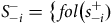 ${S}_{-i}^{-}=\left\{fol\right({s}_{-i}^{+})$ $|$
$|$ ${s}_{-i}^{+}\in {S}_{-i}^{+}\}$
and
${s}_{-i}^{+}\in {S}_{-i}^{+}\}$
and ${S}_{-i}^{-}=\left\{pre\right({\mathrm{s}}_{-i}^{+})$ $|$
$|$ ${s}_{-i}^{+}\in {S}_{-i}^{+}\},$
this implies that
${s}_{-i}^{+}\in {S}_{-i}^{+}\},$
this implies that
 $$\sum _{{s}_{-i}^{+}\in {S}_{-i}^{+}} {v}_{i}({s}_{i}^{\mathrm{*}},{s}_{-i}^{+})-\sum _{{s}_{-i}^{+}\in {S}_{-i}^{+}} {v}_{i}({t}_{i}^{\mathrm{*}},{s}_{-i}^{+})=\sum _{{s}_{-i}^{+}\in {S}_{-i}^{+}} {v}_{i}({s}_{i}^{\mathrm{*}},fol({s}_{-i}^{+}\left)\right)-\sum _{{s}_{-i}^{+}\in {S}_{-i}^{+}} {v}_{i}({t}_{i}^{\mathrm{*}},pre({s}_{-i}^{+}\left)\right).$$
For every two nodes ${\mathrm{s}}_{-i},{t}_{-i}$
on the cycle
${\mathrm{s}}_{-i},{t}_{-i}$
on the cycle $c,$
let
$c,$
let $[{s}_{-i},{t}_{-i}]$
be the ordered set of all the nodes on the cycle (including
$[{s}_{-i},{t}_{-i}]$
be the ordered set of all the nodes on the cycle (including ${s}_{-i}$
and
${s}_{-i}$
and ${t}_{-i}\mathrm{})$
between
${t}_{-i}\mathrm{})$
between ${s}_{-i}$
and
${s}_{-i}$
and ${t}_{-i}$
(in the direction of the cycle
${t}_{-i}$
(in the direction of the cycle $c$
). Recall the edge
$c$
). Recall the edge $({s}_{-i}^{\mathrm{*}},{t}_{-i}^{\mathrm{*}})$
on the cycle
$({s}_{-i}^{\mathrm{*}},{t}_{-i}^{\mathrm{*}})$
on the cycle $c$
we consider. Then, there is some node
$c$
we consider. Then, there is some node ${s}_{-i}^{\mathrm{*}+}\in {S}_{-i}^{+}$
such that either
${s}_{-i}^{\mathrm{*}+}\in {S}_{-i}^{+}$
such that either ${s}_{-i}^{\mathrm{*}},{t}_{-i}^{\mathrm{*}}\in [{s}_{-i}^{\mathrm{*}+},fol\left({s}_{-i}^{\mathrm{*}+}\right)]$
or
${s}_{-i}^{\mathrm{*}},{t}_{-i}^{\mathrm{*}}\in [{s}_{-i}^{\mathrm{*}+},fol\left({s}_{-i}^{\mathrm{*}+}\right)]$
or ${s}_{-i}^{\mathrm{*}},{t}_{-i}^{\mathrm{*}}\in [pre\left({s}_{-i}^{\mathrm{*}+}\right),{s}_{-i}^{\mathrm{*}+}].$
We thus distinguish two cases: (2.3.1)
${s}_{-i}^{\mathrm{*}},{t}_{-i}^{\mathrm{*}}\in [pre\left({s}_{-i}^{\mathrm{*}+}\right),{s}_{-i}^{\mathrm{*}+}].$
We thus distinguish two cases: (2.3.1) ${s}_{-i}^{\mathrm{*}},{t}_{-i}^{\mathrm{*}}\in [{s}_{-i}^{\mathrm{*}+},fol\left({s}_{-i}^{\mathrm{*}+}\right)]$
and (2.3.2)
${s}_{-i}^{\mathrm{*}},{t}_{-i}^{\mathrm{*}}\in [{s}_{-i}^{\mathrm{*}+},fol\left({s}_{-i}^{\mathrm{*}+}\right)]$
and (2.3.2) ${s}_{-i}^{\mathrm{*}},{t}_{-i}^{\mathrm{*}}\in [pre\left({s}_{-i}^{\mathrm{*}+}\right),{s}_{-i}^{\mathrm{*}+}].$
Case 2.3.1. Assume that ${s}_{-i}^{\mathrm{*}},{t}_{-i}^{\mathrm{*}}\in [{s}_{-i}^{\mathrm{*}+},fol\left({s}_{-i}^{\mathrm{*}+}\right)].$
Take some
${s}_{-i}^{\mathrm{*}},{t}_{-i}^{\mathrm{*}}\in [{s}_{-i}^{\mathrm{*}+},fol\left({s}_{-i}^{\mathrm{*}+}\right)].$
Take some ${s}_{-i}^{+}\in {S}_{-i}^{+}\backslash \left\{{s}_{-i}^{\mathrm{*}+}\right\},$
and let
${s}_{-i}^{+}\in {S}_{-i}^{+}\backslash \left\{{s}_{-i}^{\mathrm{*}+}\right\},$
and let
 $$[{s}_{-i}^{+},fol\left({s}_{-i}^{+}\right)]=({s}_{-i}^{+},{s}_{-i}^{1}, \ldots, {s}_{-i}^{k},fol\left({s}_{-i}^{+}\right)).$$
Then, by construction,
 $$z({s}_{i}^{\mathrm{*}},{s}_{-i}^{+})=z({s}_{i}^{\mathrm{*}},{s}_{-i}^{1})= \ldots =z({s}_{i}^{\mathrm{*}},{s}_{-i}^{k})=z({s}_{i}^{\mathrm{*}},fol({s}_{-i}^{+}\left)\right).$$
As all the edges in $[{s}_{-i}^{+},fol({s}_{-i}^{+}\left)\right]$
are in the spanning tree
$[{s}_{-i}^{+},fol({s}_{-i}^{+}\left)\right]$
are in the spanning tree $T,$
it follows by Case 1 that
$T,$
it follows by Case 1 that
 $${v}_{i}({s}_{i}^{\mathrm{*}},{s}_{-i}^{+})={v}_{i}({s}_{i}^{\mathrm{*}},{s}_{-i}^{1})= \ldots ={v}_{i}({s}_{i}^{\mathrm{*}},{s}_{-i}^{k})={v}_{i}({s}_{i}^{\mathrm{*}},fol({s}_{-i}^{+}\left)\right)$$
for all ${s}_{-i}^{+}\in {S}_{-i}^{+}\backslash \left\{{s}_{-i}^{\mathrm{*}+}\right\}.$
Next, take some ${s}_{-i}^{+}\in {S}_{-i}^{+},$
possibly equal to
${s}_{-i}^{+}\in {S}_{-i}^{+},$
possibly equal to ${s}_{-i}^{\mathrm{*}+},$
and let
${s}_{-i}^{\mathrm{*}+},$
and let
 $$[pre\left({s}_{-i}^{+}\right),{s}_{-i}^{+}]=(pre\left({s}_{-i}^{+}\right),{s}_{-i}^{1}, \ldots, {s}_{-i}^{l},{s}_{-i}^{+}).$$
Then, by construction,
 $$z({t}_{i}^{\mathrm{*}},pre({s}_{-i}^{+}\left)\right)=z({t}_{i}^{\mathrm{*}},{s}_{-i}^{1})= \ldots =z({t}_{i}^{\mathrm{*}},{s}_{-i}^{l})=z({t}_{i}^{\mathrm{*}},{s}_{-i}^{+}).$$
As all the edges in $\left[pre\right({s}_{-i}^{+}),{s}_{-i}^{+}]$
are in the spanning tree
$\left[pre\right({s}_{-i}^{+}),{s}_{-i}^{+}]$
are in the spanning tree $T,$
it follows by Case 1 that
$T,$
it follows by Case 1 that
 $${v}_{i}({t}_{i}^{\mathrm{*}},pre({s}_{-i}^{+}\left)\right)={v}_{i}({t}_{i}^{\mathrm{*}},{s}_{-i}^{1})= \ldots ={v}_{i}({t}_{i}^{\mathrm{*}},{s}_{-i}^{l})={v}_{i}({t}_{i}^{\mathrm{*}},{s}_{-i}^{+})$$
for all ${s}_{-i}^{+}\in {S}_{-i}^{+}.$
By (28) and (29) we then conclude that all terms in (27) cancel, except for ${v}_{i}({s}_{i}^{\mathrm{*}},{s}_{-i}^{\mathrm{*}+})$
and
${v}_{i}({s}_{i}^{\mathrm{*}},{s}_{-i}^{\mathrm{*}+})$
and ${v}_{i}({s}_{i}^{\mathrm{*}},fol({s}_{-i}^{\mathrm{*}+}\left)\right),$
which yields
${v}_{i}({s}_{i}^{\mathrm{*}},fol({s}_{-i}^{\mathrm{*}+}\left)\right),$
which yields
 $${v}_{i}({s}_{i}^{\mathrm{*}},{s}_{-i}^{\mathrm{*}+})={v}_{i}({s}_{i}^{\mathrm{*}},fol({s}_{-i}^{\mathrm{*}+}\left)\right).$$
Recall that ${s}_{-i}^{\mathrm{*}},{t}_{-i}^{\mathrm{*}}\in [{s}_{-i}^{\mathrm{*}+},fol\left({s}_{-i}^{\mathrm{*}+}\right)]$
where
${s}_{-i}^{\mathrm{*}},{t}_{-i}^{\mathrm{*}}\in [{s}_{-i}^{\mathrm{*}+},fol\left({s}_{-i}^{\mathrm{*}+}\right)]$
where ${t}_{-i}^{\mathrm{*}}$
follows
${t}_{-i}^{\mathrm{*}}$
follows ${s}_{-i}^{\mathrm{*}}$
in the direction of the cycle. Then, every edge
${s}_{-i}^{\mathrm{*}}$
in the direction of the cycle. Then, every edge $({s}_{-i},{t}_{-i})$
in
$({s}_{-i},{t}_{-i})$
in $[{s}_{-i}^{\mathrm{*}+},{s}_{-i}^{\mathrm{*}}],$
if any, is in the spanning tree
$[{s}_{-i}^{\mathrm{*}+},{s}_{-i}^{\mathrm{*}}],$
if any, is in the spanning tree $T.$
As
$T.$
As $z({s}_{i}^{\mathrm{*}},{s}_{-i})=z({s}_{i}^{\mathrm{*}},{t}_{-i})$
for every such edge, it follows from Case 1 that
$z({s}_{i}^{\mathrm{*}},{s}_{-i})=z({s}_{i}^{\mathrm{*}},{t}_{-i})$
for every such edge, it follows from Case 1 that ${v}_{i}({s}_{i}^{\mathrm{*}},{s}_{-i})={v}_{i}({s}_{i}^{\mathrm{*}},{t}_{-i})$
for every edge
${v}_{i}({s}_{i}^{\mathrm{*}},{s}_{-i})={v}_{i}({s}_{i}^{\mathrm{*}},{t}_{-i})$
for every edge $({s}_{-i},{t}_{-i})$
in
$({s}_{-i},{t}_{-i})$
in $[{s}_{-i}^{\mathrm{*}+},{s}_{-\mathrm{i}}^{\mathrm{*}}],$
if any. As such,
$[{s}_{-i}^{\mathrm{*}+},{s}_{-\mathrm{i}}^{\mathrm{*}}],$
if any. As such,
 $${v}_{i}({s}_{i}^{\mathrm{*}},{s}_{-i}^{\mathrm{*}})={v}_{i}({s}_{i}^{\mathrm{*}},{s}_{-i}^{+\mathrm{*}}).$$
Similarly, every edge $({s}_{-i},{t}_{-i})$
in
$({s}_{-i},{t}_{-i})$
in $[{t}_{-i}^{\mathrm{*}},fol({s}_{-i}^{\mathrm{*}+}\left)\right],$
if any, is in the spanning tree
$[{t}_{-i}^{\mathrm{*}},fol({s}_{-i}^{\mathrm{*}+}\left)\right],$
if any, is in the spanning tree $T.$
As
$T.$
As $z({s}_{i}^{\mathrm{*}},{s}_{-i})=z({s}_{i}^{\mathrm{*}},{t}_{-i})$
for every such edge, it follows from Case 1 that
$z({s}_{i}^{\mathrm{*}},{s}_{-i})=z({s}_{i}^{\mathrm{*}},{t}_{-i})$
for every such edge, it follows from Case 1 that ${\mathrm{v}}_{i}({s}_{i}^{\mathrm{*}},{s}_{-i})={v}_{i}({s}_{i}^{\mathrm{*}},{t}_{-i})$
for every edge
${\mathrm{v}}_{i}({s}_{i}^{\mathrm{*}},{s}_{-i})={v}_{i}({s}_{i}^{\mathrm{*}},{t}_{-i})$
for every edge $({s}_{-i},{t}_{-i})$
in
$({s}_{-i},{t}_{-i})$
in $[{t}_{-i}^{\mathrm{*}},fol({s}_{-i}^{\mathrm{*}+}\left)\right],$
if any. As such,
$[{t}_{-i}^{\mathrm{*}},fol({s}_{-i}^{\mathrm{*}+}\left)\right],$
if any. As such,
 $${v}_{i}({s}_{i}^{\mathrm{*}},{t}_{-i}^{\mathrm{*}})={v}_{i}({s}_{i}^{\mathrm{*}},fol({s}_{-i}^{\mathrm{*}+}\left)\right).$$
By (30), (31) and (32) it follows that ${v}_{i}({s}_{i}^{\mathrm{*}},{s}_{-i}^{\mathrm{*}})={v}_{i}({s}_{i}^{\mathrm{*}},{t}_{-i}^{\mathrm{*}}).$
Now, take some arbitrary ${s}_{i}$
with
${s}_{i}$
with $z({s}_{i},{s}_{-i}^{\mathrm{*}})=z({s}_{i},{t}_{-i}^{\mathrm{*}}).$
As
$z({s}_{i},{s}_{-i}^{\mathrm{*}})=z({s}_{i},{t}_{-i}^{\mathrm{*}}).$
As $z({s}_{i}^{\mathrm{*}},{s}_{-i}^{\mathrm{*}})=z({s}_{i}^{\mathrm{*}},{t}_{-i}^{\mathrm{*}})$
and
$z({s}_{i}^{\mathrm{*}},{s}_{-i}^{\mathrm{*}})=z({s}_{i}^{\mathrm{*}},{t}_{-i}^{\mathrm{*}})$
and ${v}_{i}({s}_{i}^{\mathrm{*}},{s}_{-i}^{\mathrm{*}})={v}_{i}({s}_{i}^{\mathrm{*}},{t}_{-i}^{\mathrm{*}}),$
it follows from Lemma 7.2 that
${v}_{i}({s}_{i}^{\mathrm{*}},{s}_{-i}^{\mathrm{*}})={v}_{i}({s}_{i}^{\mathrm{*}},{t}_{-i}^{\mathrm{*}}),$
it follows from Lemma 7.2 that ${v}_{i}({s}_{i},{s}_{-i}^{\mathrm{*}})={v}_{i}({s}_{i},{t}_{-i}^{\mathrm{*}}).$
Hence, (20) holds.
${v}_{i}({s}_{i},{s}_{-i}^{\mathrm{*}})={v}_{i}({s}_{i},{t}_{-i}^{\mathrm{*}}).$
Hence, (20) holds.
Case 2.3.2. Assume that ${s}_{-i}^{\mathrm{*}},{t}_{-i}^{\mathrm{*}}\in [pre\left({s}_{-i}^{\mathrm{*}+}\right),{s}_{-i}^{\mathrm{*}+}].$
Then, it can be shown in a similar fashion as in Case 2.3.1 that (20) holds.
${s}_{-i}^{\mathrm{*}},{t}_{-i}^{\mathrm{*}}\in [pre\left({s}_{-i}^{\mathrm{*}+}\right),{s}_{-i}^{\mathrm{*}+}].$
Then, it can be shown in a similar fashion as in Case 2.3.1 that (20) holds.
As we have exhausted all cases, we conclude that (20) holds for every edge $({s}_{-i}^{\mathrm{*}},{t}_{-i}^{\mathrm{*}})$
in the connected component
$({s}_{-i}^{\mathrm{*}},{t}_{-i}^{\mathrm{*}})$
in the connected component $CC.$
Moreover, by covering all connected components
$CC.$
Moreover, by covering all connected components $CC,$
we conclude that (20) holds for every edge
$CC,$
we conclude that (20) holds for every edge $({s}_{-i}^{\mathrm{*}},{t}_{-i}^{\mathrm{*}})$
in the graph
$({s}_{-i}^{\mathrm{*}},{t}_{-i}^{\mathrm{*}})$
in the graph ${G}_{i}^{D}.$
We finally show that the utility function ${v}_{i}$
so constructed is measurable with respect to
${v}_{i}$
so constructed is measurable with respect to $(Z,z)$
. Take strategies
$(Z,z)$
. Take strategies ${s}_{i},{t}_{i}$
and opponents’ strategy combinations
${s}_{i},{t}_{i}$
and opponents’ strategy combinations ${s}_{-i},{t}_{-i}$
with
${s}_{-i},{t}_{-i}$
with $z({s}_{i},{s}_{-i})=z({t}_{i},{t}_{-i}).$
We will show that
$z({s}_{i},{s}_{-i})=z({t}_{i},{t}_{-i}).$
We will show that ${v}_{i}({s}_{i},{s}_{-i})={v}_{i}({t}_{i},{t}_{-i}).$
As $z({s}_{i},{s}_{-i})=z({t}_{i},{t}_{-i})=:z,$
strategies
$z({s}_{i},{s}_{-i})=z({t}_{i},{t}_{-i})=:z,$
strategies ${s}_{i},{t}_{i}$
select all player
${s}_{i},{t}_{i}$
select all player $i$
actions on the path to
$i$
actions on the path to $z,$
and
$z,$
and ${s}_{-i},{t}_{-i}$ $\mathrm{}\mathrm{}$
select all opponents’ actions on the path to
$\mathrm{}\mathrm{}$
select all opponents’ actions on the path to $z.$
But then,
$z.$
But then, $z({s}_{i},{s}_{-i})=z({s}_{i},{t}_{-i})$
and
$z({s}_{i},{s}_{-i})=z({s}_{i},{t}_{-i})$
and $z({s}_{i},{t}_{-i})=z({t}_{i},{t}_{-i}).$
As $z({s}_{i},{s}_{-i})=z({s}_{i},{t}_{-i}),$
it follows by Lemma 7.5 that we can choose opponents’ strategy combinations
$z({s}_{i},{s}_{-i})=z({s}_{i},{t}_{-i}),$
it follows by Lemma 7.5 that we can choose opponents’ strategy combinations ${s}_{-i}^{0},{s}_{-i}^{1}, \ldots, {s}_{-i}^{M}$
such that (i)
${s}_{-i}^{0},{s}_{-i}^{1}, \ldots, {s}_{-i}^{M}$
such that (i) ${s}_{-i}^{0}={s}_{-i},$
(ii)
${s}_{-i}^{0}={s}_{-i},$
(ii) ${s}_{-i}^{M}={t}_{-i},$
(iii)
${s}_{-i}^{M}={t}_{-i},$
(iii) ${s}_{-i}^{k},{s}_{-i}^{k+1}$
are minimally different for every
${s}_{-i}^{k},{s}_{-i}^{k+1}$
are minimally different for every $k\in \{0, \ldots, M-1\},$
and (iv)
$k\in \{0, \ldots, M-1\},$
and (iv) $z({s}_{i},{s}_{-i}^{k})=z({s}_{i},{s}_{-i}^{k+1})$
for all
$z({s}_{i},{s}_{-i}^{k})=z({s}_{i},{s}_{-i}^{k+1})$
for all $k\in \{0, \ldots, M-1\}.$
By (20) it then follows that
$k\in \{0, \ldots, M-1\}.$
By (20) it then follows that ${v}_{i}({s}_{i},{s}_{-i}^{k})={v}_{i}({s}_{i},{s}_{-i}^{k+1})$
for all
${v}_{i}({s}_{i},{s}_{-i}^{k})={v}_{i}({s}_{i},{s}_{-i}^{k+1})$
for all $k\in \{0, \ldots, M-1\},$
which implies that
$k\in \{0, \ldots, M-1\},$
which implies that ${v}_{i}({s}_{i},{s}_{-i})={v}_{i}({s}_{i},{t}_{-i}).$
Moreover, as $z({s}_{i},{t}_{-i})=z({t}_{i},{t}_{-i})$
it follows that
$z({s}_{i},{t}_{-i})=z({t}_{i},{t}_{-i})$
it follows that ${\mathbb{P}}_{({s}_{i},[{t}_{-i}\left]\right)}={\mathbb{P}}_{({t}_{i},[{t}_{-i}\left]\right)}.$
Moreover, it trivially holds that
${\mathbb{P}}_{({s}_{i},[{t}_{-i}\left]\right)}={\mathbb{P}}_{({t}_{i},[{t}_{-i}\left]\right)}.$
Moreover, it trivially holds that ${\mathbb{P}}_{({s}_{i},[{t}_{-i}\left]\right)}={\mathbb{P}}_{({s}_{i},[{t}_{-i}\left]\right)}.$
Since
${\mathbb{P}}_{({s}_{i},[{t}_{-i}\left]\right)}={\mathbb{P}}_{({s}_{i},[{t}_{-i}\left]\right)}.$
Since ${\succsim \mathrm{}}_{i}$
is preference-based consequentialist we know that
${\succsim \mathrm{}}_{i}$
is preference-based consequentialist we know that
 $${s}_{i}\;{\succsim \mathrm{\;}}_{i,\left[{t}_{-i}\right]}{t}_{i}\;\mathrm{i}\mathrm{f}\mathrm{\;}\mathrm{a}\mathrm{n}\mathrm{d}\mathrm{\;}\mathrm{o}\mathrm{n}\mathrm{l}\mathrm{y}\mathrm{\;}\mathrm{i}\mathrm{f}\;{s}_{i}\;{\succsim \mathrm{\;}}_{i,\left[{t}_{-i}\right]}{s}_{i}.$$
Clearly, ${s}_{i}{\sim}_{i,\left[{t}_{-i}\right]}{s}_{i},$
and therefore
${s}_{i}{\sim}_{i,\left[{t}_{-i}\right]}{s}_{i},$
and therefore ${s}_{i}{\sim}_{i,\left[{t}_{-i}\right]}{t}_{i}.$
Since the utility function
${s}_{i}{\sim}_{i,\left[{t}_{-i}\right]}{t}_{i}.$
Since the utility function ${v}_{i}$
represents
${v}_{i}$
represents ${\succsim \mathrm{}}_{i}$
we must have that
${\succsim \mathrm{}}_{i}$
we must have that ${v}_{i}({s}_{i},{t}_{-i})=v({t}_{i},{t}_{-i}).$
Together with the insight above that ${v}_{i}({s}_{i},{s}_{-i})={v}_{i}({s}_{i},{t}_{-i})$
we conclude that
${v}_{i}({s}_{i},{s}_{-i})={v}_{i}({s}_{i},{t}_{-i})$
we conclude that ${v}_{i}({s}_{i},{s}_{-i})={v}_{i}({t}_{i},{t}_{-i}).$
As such, the utility function
${v}_{i}({s}_{i},{s}_{-i})={v}_{i}({t}_{i},{t}_{-i}).$
As such, the utility function ${v}_{i}$
is measurable with respect to
${v}_{i}$
is measurable with respect to $(Z,z)$
. Altogether, we have constructed an expected utility representation
$(Z,z)$
. Altogether, we have constructed an expected utility representation ${v}_{i}$
for
${v}_{i}$
for ${\succsim \mathrm{}}_{i}$
that is measurable with respect to
${\succsim \mathrm{}}_{i}$
that is measurable with respect to $(Z,z)$
. Hence,
$(Z,z)$
. Hence, ${\succsim \mathrm{}}_{i}$
is utility-based consequentialist. This completes the proof. ▪
${\succsim \mathrm{}}_{i}$
is utility-based consequentialist. This completes the proof. ▪
7.6 Proof of Theorem 4.2
Proof of Theorem 4.2. Also in this proof, we omit the phrase “relative to $(Z,z)$
”, since we only consider the consequence structure
$(Z,z)$
”, since we only consider the consequence structure $(Z,z).$
(a) Suppose first that ${\succsim \mathrm{}}_{i}$
is preference-based consequentialist. Take two strategies
${\succsim \mathrm{}}_{i}$
is preference-based consequentialist. Take two strategies ${s}_{i},{t}_{i},$
and consider the restricted conditional preference relation
${s}_{i},{t}_{i},$
and consider the restricted conditional preference relation ${\succsim \mathrm{}}_{i}^{\{{s}_{i},{t}_{i}\}}.$
Then,
${\succsim \mathrm{}}_{i}^{\{{s}_{i},{t}_{i}\}}.$
Then, ${\succsim \mathrm{}}_{i}^{\{{s}_{i},{t}_{i}\}}$
is preference-based consequentialist also. As
${\succsim \mathrm{}}_{i}^{\{{s}_{i},{t}_{i}\}}$
is preference-based consequentialist also. As ${\succsim \mathrm{}}_{i}^{\{{s}_{i},{t}_{i}\}}$
only involves two strategies, it follows from the proof of Theorem 5.1, part (b), that
${\succsim \mathrm{}}_{i}^{\{{s}_{i},{t}_{i}\}}$
only involves two strategies, it follows from the proof of Theorem 5.1, part (b), that ${\succsim \mathrm{}}_{i}^{\{{s}_{i},{t}_{i}\}}$
is utility-based consequentialist. By Theorem 4.1 we then conclude that
${\succsim \mathrm{}}_{i}^{\{{s}_{i},{t}_{i}\}}$
is utility-based consequentialist. By Theorem 4.1 we then conclude that ${\succsim \mathrm{}}_{i}^{\{{s}_{i},{t}_{i}\}}$
induces additive preference intensities on consequences and respects outcome-equivalent strategies.
${\succsim \mathrm{}}_{i}^{\{{s}_{i},{t}_{i}\}}$
induces additive preference intensities on consequences and respects outcome-equivalent strategies.
(b) Suppose next that $\mathbin{\lower.3ex\hbox{$\buildrel\succ\over{\smash{\scriptstyle\sim}\vphantom{_x}}$}} {{\rm{\;}}_i}$
respects outcome-equivalent strategies, and that for every pair of strategies
$\mathbin{\lower.3ex\hbox{$\buildrel\succ\over{\smash{\scriptstyle\sim}\vphantom{_x}}$}} {{\rm{\;}}_i}$
respects outcome-equivalent strategies, and that for every pair of strategies ${s_i},{t_i}$
the restricted conditional preference relation
${s_i},{t_i}$
the restricted conditional preference relation $\mathbin{\lower.3ex\hbox{$\buildrel\succ\over{\smash{\scriptstyle\sim}\vphantom{_x}}$}} {\rm{\;}}_i^{\left\{ {{s_i},{t_i}} \right\}}$
induces additive preference intensities on consequences. Let
$\mathbin{\lower.3ex\hbox{$\buildrel\succ\over{\smash{\scriptstyle\sim}\vphantom{_x}}$}} {\rm{\;}}_i^{\left\{ {{s_i},{t_i}} \right\}}$
induces additive preference intensities on consequences. Let ${u_i}$
be an expected utility representation of
${u_i}$
be an expected utility representation of $\mathbin{\lower.3ex\hbox{$\buildrel\succ\over{\smash{\scriptstyle\sim}\vphantom{_x}}$}} {{\rm{\;}}_i}.$
Take a pair of strategies
$\mathbin{\lower.3ex\hbox{$\buildrel\succ\over{\smash{\scriptstyle\sim}\vphantom{_x}}$}} {{\rm{\;}}_i}.$
Take a pair of strategies ${s_i},{t_i}.$
As
${s_i},{t_i}.$
As ${\succsim \mathrm{}}_{i}^{\{{s}_{i},{t}_{i}\}}$
induces additive preference intensities on consequences and respects outcome-equivalent strategies, it follows from Theorem 4.1 that
${\succsim \mathrm{}}_{i}^{\{{s}_{i},{t}_{i}\}}$
induces additive preference intensities on consequences and respects outcome-equivalent strategies, it follows from Theorem 4.1 that ${\succsim \mathrm{}}_{i}^{\{{s}_{i},{t}_{i}\}}$
is utility-based consequentialist. By the proof of Theorem 5.1, part (a), it follows that
${\succsim \mathrm{}}_{i}^{\{{s}_{i},{t}_{i}\}}$
is utility-based consequentialist. By the proof of Theorem 5.1, part (a), it follows that ${\succsim \mathrm{}}_{i}^{\{{s}_{i},{t}_{i}\}}$
is preference-based consequentialist. Thus,
${\succsim \mathrm{}}_{i}^{\{{s}_{i},{t}_{i}\}}$
is preference-based consequentialist. Thus, ${\succsim \mathrm{}}_{i}^{\{{s}_{i},{t}_{i}\}}$
is preference-based consequentialist for every two strategies
${\succsim \mathrm{}}_{i}^{\{{s}_{i},{t}_{i}\}}$
is preference-based consequentialist for every two strategies ${s_i},{t_i}.$
We will now show that $\succsim{{\rm{}}_i}$
is preference-based consequentialist. Take four strategies
$\succsim{{\rm{}}_i}$
is preference-based consequentialist. Take four strategies ${s_i},s_i^{\rm{'}},{t_i},t_i^{\rm{'}}$
and two beliefs
${s_i},s_i^{\rm{'}},{t_i},t_i^{\rm{'}}$
and two beliefs ${\beta _i},\beta _i^{\rm{'}}$
with
${\beta _i},\beta _i^{\rm{'}}$
with ${{\mathbb P}_{\left( {{s_i},{\beta _i}} \right)}} = {{\mathbb P}_{\left( {s_i^{\rm{'}},\beta _i^{\rm{'}}} \right)}}$
and
${{\mathbb P}_{\left( {{s_i},{\beta _i}} \right)}} = {{\mathbb P}_{\left( {s_i^{\rm{'}},\beta _i^{\rm{'}}} \right)}}$
and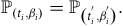 ${{\mathbb P}_{\left( {{t_i},{\beta _i}} \right)}} = {{\mathbb P}_{\left( {t_i^{\rm{'}},\beta _i^{\rm{'}}} \right)}}.$
Then, it follows from Lemma 7.6 that
${{\mathbb P}_{\left( {{t_i},{\beta _i}} \right)}} = {{\mathbb P}_{\left( {t_i^{\rm{'}},\beta _i^{\rm{'}}} \right)}}.$
Then, it follows from Lemma 7.6 that ${{\mathbb P}_{\left( {{s_i},{\beta _i}} \right)}} = {{\mathbb P}_{\left( {{s_i},\beta _i^{\rm{'}}} \right)}}$
and
${{\mathbb P}_{\left( {{s_i},{\beta _i}} \right)}} = {{\mathbb P}_{\left( {{s_i},\beta _i^{\rm{'}}} \right)}}$
and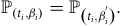 ${{\mathbb P}_{\left( {{t_i},{\beta _i}} \right)}} = {{\mathbb P}_{\left( {{t_i},\beta _i^{\rm{'}}} \right)}}.$
Since
${{\mathbb P}_{\left( {{t_i},{\beta _i}} \right)}} = {{\mathbb P}_{\left( {{t_i},\beta _i^{\rm{'}}} \right)}}.$
Since ${\succsim \mathrm{}}_{i}^{\{{s}_{i},{t}_{i}\}}$
is preference-based consequentialist, it follows from Lemma 7.1 that
${\succsim \mathrm{}}_{i}^{\{{s}_{i},{t}_{i}\}}$
is preference-based consequentialist, it follows from Lemma 7.1 that
 $${u_i}\left( {{s_i},{\beta _i}} \right) - u\left( {{t_i},{\beta _i}} \right) = {u_i}\left( {{s_i},\beta _i^{\rm{'}}} \right) - {u_i}\left( {{t_i},\beta _i^{\rm{'}}} \right).$$
Moreover, as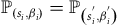 ${{\mathbb P}_{\left( {{s_i},{\beta _i}} \right)}} = {{\mathbb P}_{\left( {s_i^{\rm{'}},\beta _i^{\rm{'}}} \right)}}$
we know from Lemma 7.6 that
${{\mathbb P}_{\left( {{s_i},{\beta _i}} \right)}} = {{\mathbb P}_{\left( {s_i^{\rm{'}},\beta _i^{\rm{'}}} \right)}}$
we know from Lemma 7.6 that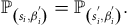 ${{\mathbb P}_{\left( {{s_i},\beta _i^{\rm{'}}} \right)}} = {{\mathbb P}_{\left( {s_i^{\rm{'}},\beta _i^{\rm{'}}} \right)}}.$
As, trivially,
${{\mathbb P}_{\left( {{s_i},\beta _i^{\rm{'}}} \right)}} = {{\mathbb P}_{\left( {s_i^{\rm{'}},\beta _i^{\rm{'}}} \right)}}.$
As, trivially, ${{\mathbb P}_{\left( {{s_i},\beta _i^{\rm{'}}} \right)}} = {{\mathbb P}_{\left( {s_i^{\rm{'}},\beta _i^{\rm{'}}} \right)}}.$
and
${{\mathbb P}_{\left( {{s_i},\beta _i^{\rm{'}}} \right)}} = {{\mathbb P}_{\left( {s_i^{\rm{'}},\beta _i^{\rm{'}}} \right)}}.$
and $\mathbin{\lower.3ex\hbox{$\buildrel\succ\over{\smash{\scriptstyle\sim}\vphantom{_x}}$}} {\rm{\;}}_i^{\left\{ {{s_i},s_i^{\rm{'}}} \right\}}$
is preference-based consequentialist, it follows that
$\mathbin{\lower.3ex\hbox{$\buildrel\succ\over{\smash{\scriptstyle\sim}\vphantom{_x}}$}} {\rm{\;}}_i^{\left\{ {{s_i},s_i^{\rm{'}}} \right\}}$
is preference-based consequentialist, it follows that

As ${s_i}{\sim_{i,\beta _i^{\rm{'}}}}{s_i}$
it follows that
${s_i}{\sim_{i,\beta _i^{\rm{'}}}}{s_i}$
it follows that ${s_i}{\sim_{i,\beta _i^{\rm{'}}}}s_i^{\rm{'}},$
and hence
${s_i}{\sim_{i,\beta _i^{\rm{'}}}}s_i^{\rm{'}},$
and hence ${u_i}\left( {{s_i},\beta _i^{\rm{'}}} \right) = {u_i}\left( {s_i^{\rm{'}},\beta _i^{\rm{'}}} \right).$
Similarly, it can be shown that
${u_i}\left( {{s_i},\beta _i^{\rm{'}}} \right) = {u_i}\left( {s_i^{\rm{'}},\beta _i^{\rm{'}}} \right).$
Similarly, it can be shown that ${u_i}\left( {{t_i},\beta _i^{\rm{'}}} \right) = {u_i}\left( {t_i^{\rm{'}},\beta _i^{\rm{'}}} \right).$
Combining the latter two insights with (33) yields
${u_i}\left( {{t_i},\beta _i^{\rm{'}}} \right) = {u_i}\left( {t_i^{\rm{'}},\beta _i^{\rm{'}}} \right).$
Combining the latter two insights with (33) yields ${u_i}\left( {{s_i},{\beta _i}} \right) - {u_i}\left( {{t_i},{\beta _i}} \right) = {u_i}\left( {s_i^{\rm{'}},\beta _i^{\rm{'}}} \right) - {u_i}\left( {t_i^{\rm{'}},\beta _i^{\rm{'}}} \right).$
Hence,
${u_i}\left( {{s_i},{\beta _i}} \right) - {u_i}\left( {{t_i},{\beta _i}} \right) = {u_i}\left( {s_i^{\rm{'}},\beta _i^{\rm{'}}} \right) - {u_i}\left( {t_i^{\rm{'}},\beta _i^{\rm{'}}} \right).$
Hence, ${s_i} \succsim_{i,{\beta _i}}{t_i}$
if and only if
${s_i} \succsim_{i,{\beta _i}}{t_i}$
if and only if $s_i^{\rm{'}}\succsim_{i,\beta _i^{\rm{'}}}t_i^{\rm{'}}.$
We thus conclude that
$s_i^{\rm{'}}\succsim_{i,\beta _i^{\rm{'}}}t_i^{\rm{'}}.$
We thus conclude that $\succsim_i$
is preference-based consequentialist. This completes the proof. ▪
$\succsim_i$
is preference-based consequentialist. This completes the proof. ▪


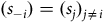


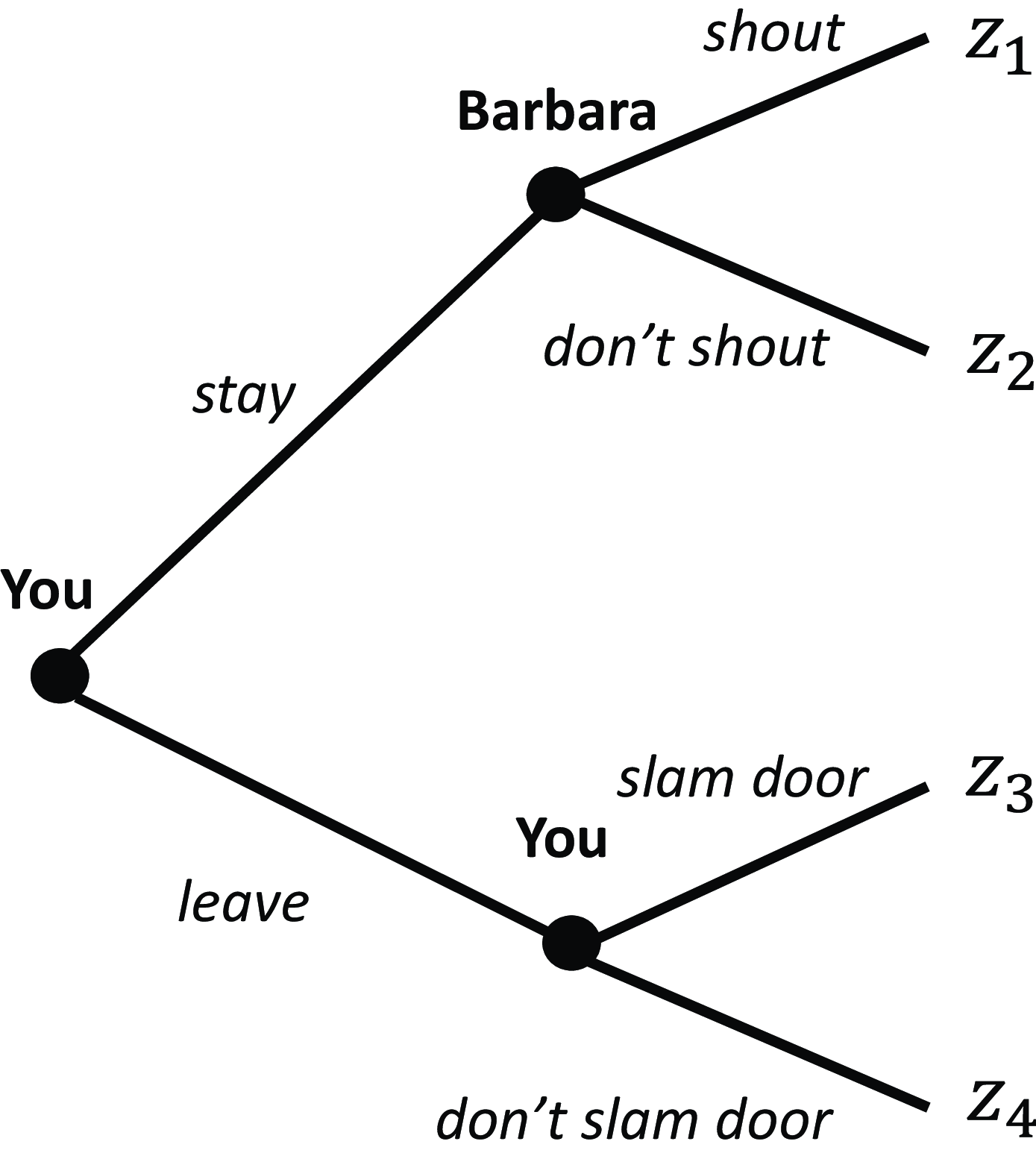
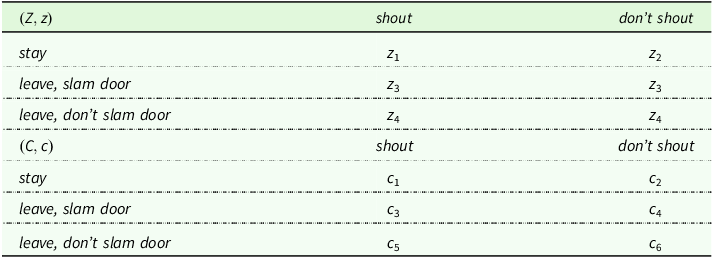

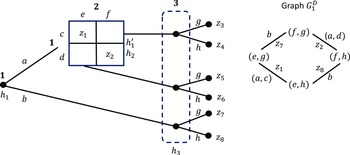


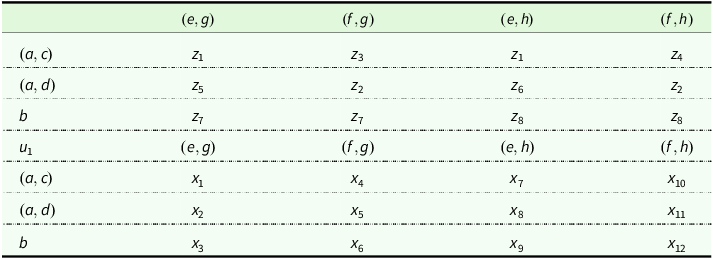
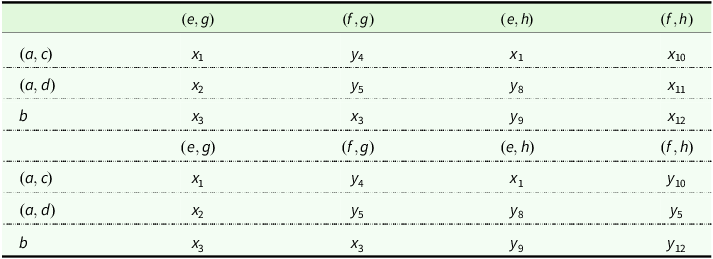
 v1
v1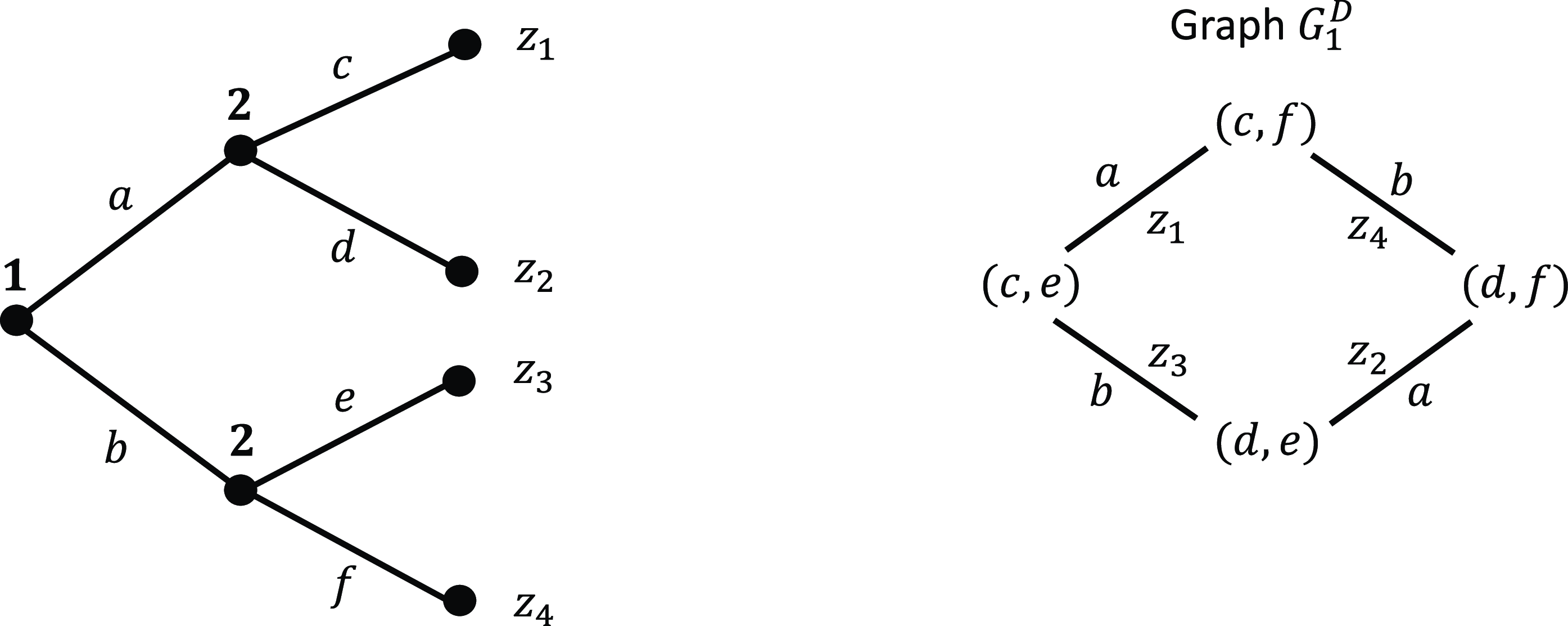
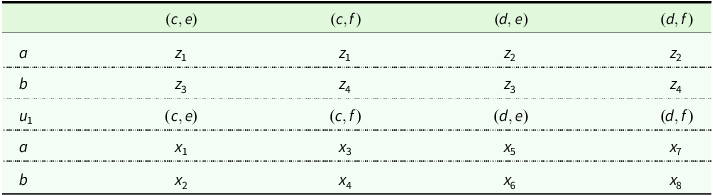
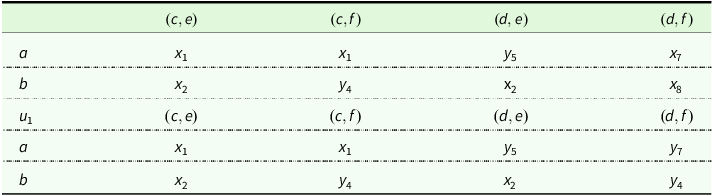
 v1
v1
 Open access

