


Soaring housing prices are a major public concern that impose an especially heavy burden on low- and middle-income households (Ekins and Gygi Reference Ekins and Gygi2022; Joint Center for Housing Studies of Harvard University 2024). One solution to this problem is affordable housing, which attracts widespread support in polls (e.g., Demsas Reference Demsas2021; Elmendorf, Nall, and Oklobdzija Reference Elmendorf, Nall and Oklobdzija2024). However, individual projects frequently encounter intense “Not In My Backyard” (NIMBY) resistance (e.g., Quann Reference Quann2022; Pettypiece Reference Pettypiece2023; Connelly Reference Connelly2023), which is often rooted in negative stereotypes about affordable housing residents and their impacts on local communities (e.g., Tighe Reference Tighe2010; Tighe Reference Tighe2012; Nguyen, Basolo, and Tiwari Reference Nguyen, Basolo and Tiwari2013; Trounstine Reference Trounstine2023). In many cases, these stereotypes and fears may be racialized (e.g., Tighe Reference Tighe2012; Whittemore and BenDor Reference Whittemore and BenDor2019; Douglas et al. Reference Douglas, Chan, Bencharit and Billington2024).
Addressing NIMBY attitudes is essential to alleviating the housing crisis. We specifically examine the effects of reducing misperceptions using an “ask-tell” intervention modeled on Braley et al. (Reference Braley, Lenz, Adjodah, Rahnama and Pentland2023) wherein we correct stereotypes about affordable housing or unfounded perceptions about impacts on local communities. Both interventions significantly increase support for affordable housing and improve expectations about impacts on local communities. Most surprisingly, these effects are often greater for projects closer to the respondent’s home. Our findings suggest that reducing misperceptions can help decrease NIMBY attitudes and increase support for affordable housing.
Theoretical expectations
NIMBY attitudes reflect a desire to protect a place from supposed harms (Devine-Wright Reference Devine-Wright2009). When directed toward affordable housing, these protective actions are often motivated by negative stereotypes or unsupported beliefs about impacts (Tighe Reference Tighe2010; Reference Tighe2012; Trounstine Reference Trounstine2023). For example, respondents may believe that affordable housing is only available to people living below the poverty line (a stereotype misperception) and that it will therefore lead to an increase in crime (an impact misperception).
Given the role that misperceptions seemingly play in opposition to affordable housing, we expect that correcting stereotypes about affordable housing (as people understand the concept) and its impacts should increase support for affordable housing and improve perceptions of its impacts on surrounding communities.
We expect these effects to vary by proximity, however. Research shows that Americans have what Hankinson (Reference Hankinson2018) calls “scale-dependent preferences” toward housing – they support it in theory, but oppose building it near their homes. For instance, proximity to proposed affordable housing predicts commenting frequency in public meetings (Sahn Reference Sahn2024). Receptiveness to corrections may therefore differ by respondent’s proximity to affordable housing. We expect the effects of the corrections to be weaker for proposed construction closer to one’s home, with the greater stakes and perceived impact potentially eliciting defensive processing of information (Liberman and Chaiken Reference Liberman and Chaiken1992).
Based on these theoretical expectations, we preregistered the following hypotheses prior to data collection:
-
H1 (NIMBY attitudes): Respondents will support building affordable housing more the further it is from where they live.
-
H2 (misinformation correction): Participants who receive corrective information will be more likely to support building affordable housing (H2a) and view its impacts more positively (H2b).
-
H3 (effect variation by distance): The effects of the corrections tested in H2 will be stronger as the distance from where the respondent lives increases (state level vs. two miles away vs. 1/8 of a mile away for support, two miles away versus 1/8 of a mile away for effects).
In addition to these hypotheses, we preregistered two research questions for which we had weaker theoretical expectations. We first test for differing effects between corrections targeting stereotypes about affordable housing and corrections targeting misperceptions about its impacts (RQ1). Second, we test if the effects of corrections in H2 vary based on partisanship (RQ2a); the tercile of nonwhite residents in white respondents’ Zip Code Tabulation Areas (RQ2b), which are geographic representations of the areas covered by zip codes;Footnote 1 homeowner status (RQ2c); and prior support for affordable housing (RQ2d).
Methods
Participants
Our study was conducted among U.S. residents aged 18 or older from May 5–9, 2024, on CloudResearch Connect. We first recruited 957 participants on Connect, applying quotas for age, sex, race, and ethnicity.Footnote 2 Since over 55% of the participants identified as or leaned Democrat, we then targeted an oversample of 954 Republicans along with 1,089 more general population respondents to approximately equalize our sample’s partisan composition after 3,000 valid responses following our preregistration. Deviating from our preregistration, we did not apply quotas for sex, age, race, and ethnicity for the oversample, as Connect does not allow this.
We excluded duplicate responses (keeping only each participant’s first entry), participants who declined to provide consent or left the study before the randomization, indicated they were under 18, failed either of two attention checks, or indicated that they would look up answers.Footnote 3
Our final experimental sample consists of 3,001 participants. Approximately 52.6% were female, 66.3% identified as non-Hispanic whites,Footnote 4 and 54.0% held a bachelor’s degree or higher. The median age group was 35–44, and 54.8% were homeowners. Furthermore, we achieved near-perfect partisan balance: 44.5% identified as Democrats or lean Democrat, while 46.2% identified as or lean Republican.
Experimental design
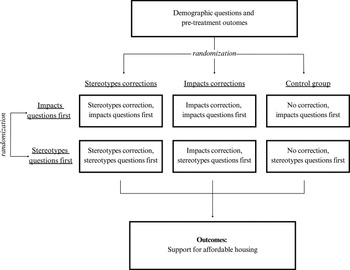
We conducted a preregistered between-subjects survey experiment in which participants were randomly assigned to a stereotypes correction that debunks misperceptions about who lives in affordable housing, where it is located, and how it is funded; an impacts correction that debunks misperceptions about the effects of affordable housing on factors such as property values and crime rates; or to a control condition in which they received no corrective information. An overview of the design is provided in Figure 1.
The treatments were administered using an “ask-tell” correction format, a well-documented approach that uses quizzes to either correct misperceptions or affirm accurate information (e.g., Ahler Reference Ahler2014; Mernyk et al. Reference Mernyk, Pink, Druckman and Willer2022; Braley et al. Reference Braley, Lenz, Adjodah, Rahnama and Pentland2023).
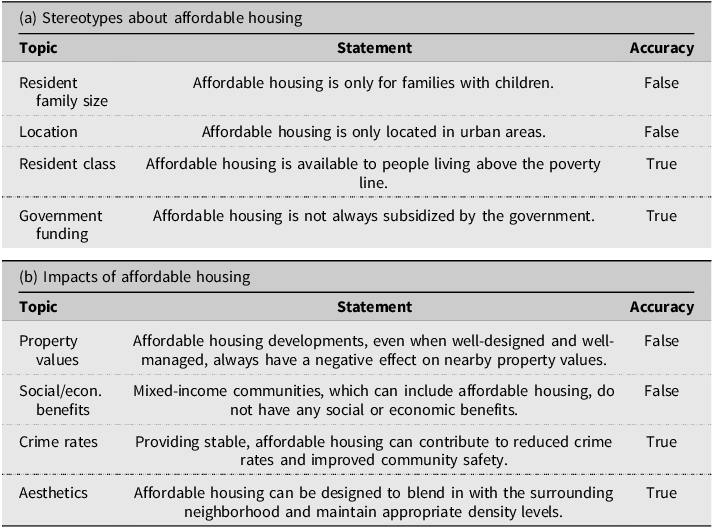
Specifically, all participants were asked to indicate whether the statements in Table 1 are true or false. Four statements measured belief in stereotypes about affordable housing (Table 1) and four measured perceptions of its impacts on neighboring communities (Table 1).Footnote 5 Whether the participant answered questions about stereotypes or impacts first was randomized (see Figure 1). The order of the four statements within each topic was also randomized. We provided two true and two false statements within each topic for balance.
Affordable housing myths and facts
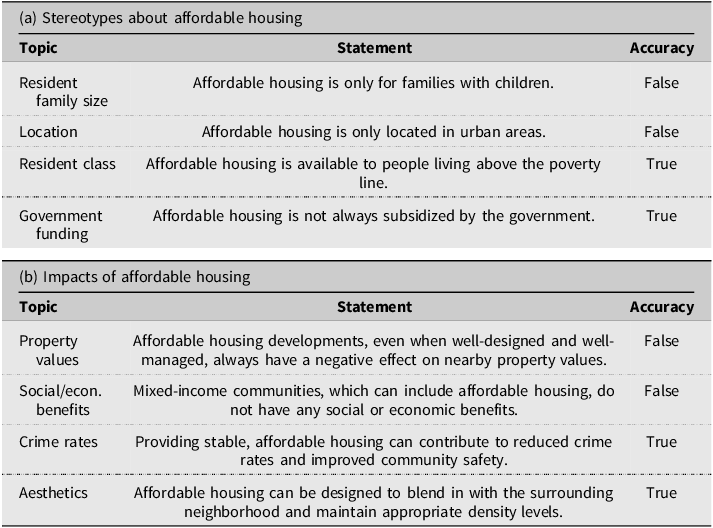
Table 1 Long description
The table presents a comparison of stereotypes and impacts related to affordable housing, organized into two sections: stereotypes and impacts. The first section, labeled (a) Stereotypes about affordable housing, includes four rows and three columns. The columns are labeled Topic, Statement, and Accuracy. The topics covered are Resident family size, Location, Resident class, and Government funding. Each topic has a corresponding statement and an accuracy rating of either true or false. For example, the statement about resident family size is false, while the statement about resident class is true. The second section, labeled (b) Impacts of affordable housing, also includes four rows and three columns with the same column headers. The topics covered are Property values, Social/econ. benefits, Crime rates, and Aesthetics. Each topic has a corresponding statement and an accuracy rating. For instance, the statement about property values is false, while the statement about crime rates is true. The table highlights common misconceptions and accurate perceptions regarding affordable housing.
Experimental design. After completing the pre-treatment section of the survey, respondents were randomized to one of two treatments or to a control group with equal probability. We also independently randomized the order of the stereotypes and impacts questions.
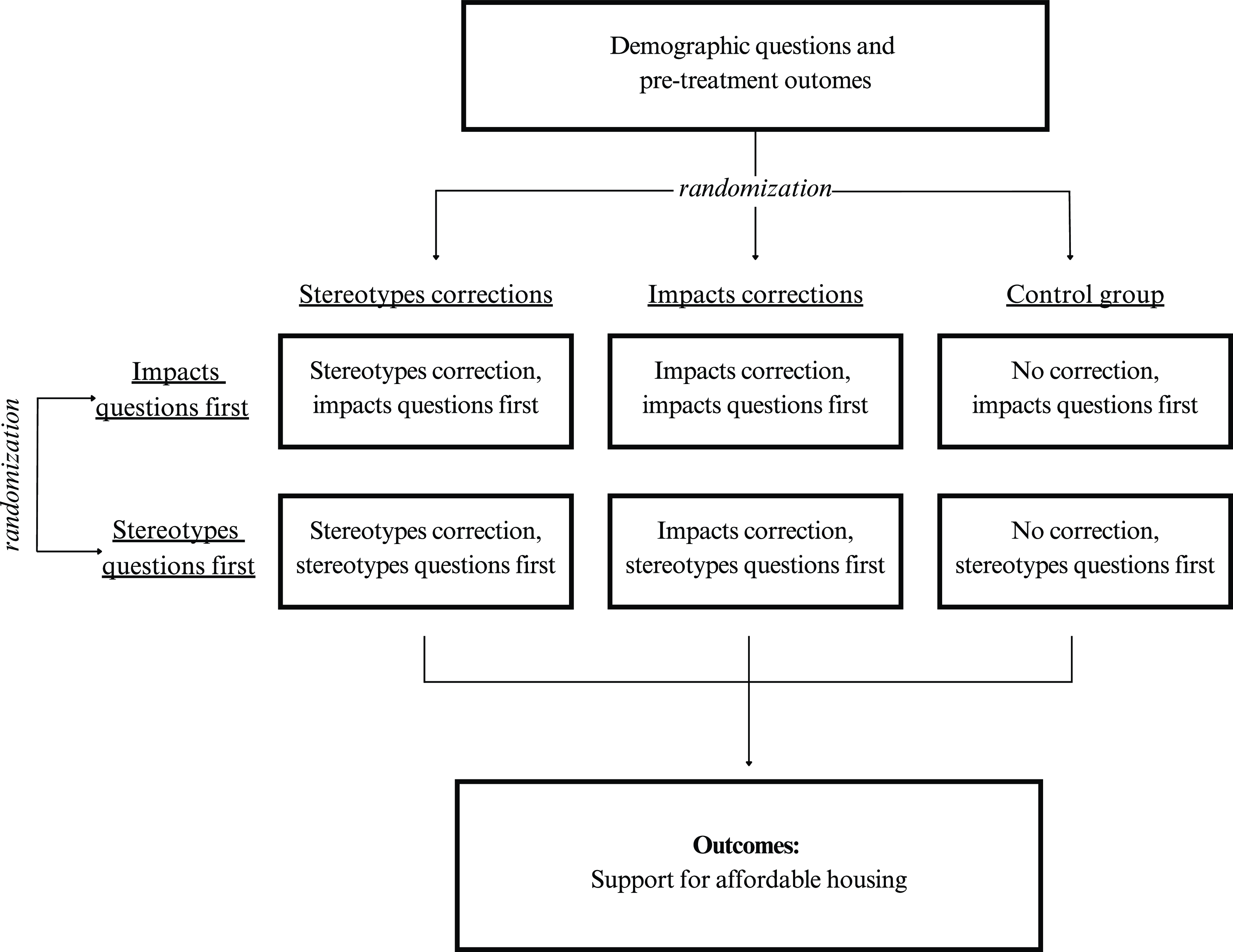
Figure 1 Long description
The flowchart illustrates the experimental design of a survey study. It begins with demographic questions and pre-treatment outcomes. Participants are then randomized into three groups: stereotypes corrections, impacts corrections, or a control group. Within each group, the order of stereotypes and impacts questions is further randomized. The stereotypes corrections group receives stereotypes correction followed by either impacts questions first or stereotypes questions first. The impacts corrections group receives impacts correction followed by either impacts questions first or stereotypes questions first. The control group receives no correction followed by either impacts questions first or stereotypes questions first. The outcomes measured are support for affordable housing.
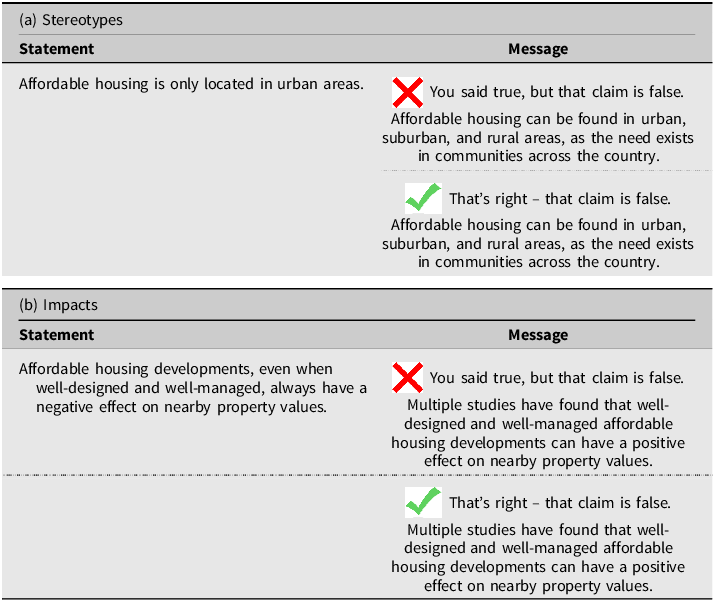
Immediately after rating each statement about a given topic (stereotypes or impacts) as true or false, participants in each correction condition either received a message saying they made the right choice that explained why their answer was correct or a message saying they were wrong that explained the correct answer. Examples of the corrections are provided in Table 2; the full questionnaire is provided in Online Appendix A. Other participants were not corrected.
Example corrections
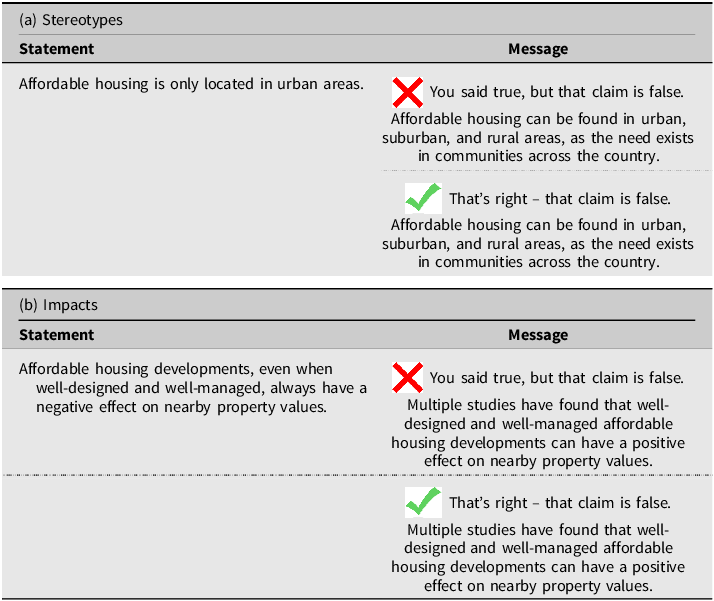
Table 2 Long description
The table is divided into two sections: (a) Stereotypes and (b) Impacts. Each section contains statements about affordable housing and the corresponding messages participants received after rating the statements as true or false. In the Stereotypes section, the statement 'Affordable housing is only located in urban areas' is marked as false, with messages explaining that affordable housing can be found in urban, suburban, and rural areas. In the Impacts section, the statement 'Affordable housing developments, even when well-designed and well-managed, always have a negative effect on nearby property values' is also marked as false, with messages explaining that multiple studies have found positive effects on nearby property values. The table uses red crosses to indicate incorrect statements and green checkmarks to indicate correct statements.
See Online Appendix A for the text of other corrections.
The wording of the treatment conditions and outcome measures follows previous scholarship in not providing a formal or legal definition of the term “affordable housing.” By leaving the term’s meaning open, we better capture people’s beliefs and attitudes toward the concept of “affordable housing” as they understand it and/or encounter it in everyday life (especially important given the heterogeneity in how affordable housing policy is implemented in practice; see Einstein, Palmer et al. Reference Einstein and Palmer2024). For instance, Douglas et al. (Reference Douglas, Chan, Bencharit and Billington2024) didn’t provide respondents with a definition to “best match how they might respond when presented with the term outside of a survey setting and only have their own existing construct of the topic.”
The same questions were then asked again at the end of the survey as a manipulation check.Footnote 6
Survey instrument and outcome measures
All participants first provided pre-treatment measures of demographic characteristics and baseline attitudes, including support for affordable housing and feelings toward their community (Peterson, Speer, and McMillan Reference Peterson, Speer and McMillan2008). Following the experimental manipulation, we again measured support for affordable housing and perceptions of its impacts on neighboring communities. Support for affordable housing was measured as the mean of four-point scales measuring self-reported support for affordable housing and the respondent’s position on a referendum to allocate public funds to it.Footnote 7 Each outcome was measured at varying distances from the participant’s residence. We compared support for affordable housing at the state level with support for it either two miles away or one-eighth of a mile away, which were described as either a “40-minute walk” or a “two-minute walk” away, respectively (Hankinson Reference Hankinson2018). Questions were asked first about the state level and followed by the other two distances in random order.Footnote 8 We also measured the perceived impact of building affordable housing either one-eighth of a mile or two miles away as the mean expected change in traffic, property values, green spaces, crime rates, school quality, and neighborhood diversity on a five-point scale; exact wording in Online Appendix A. Among these, only property values and crime rates were explicitly corrected through our experimental manipulation (Table 1b).
Statistical methods
We used ordinary least squares (OLS) with robust standard errors to estimate the effects of our treatments. To increase the precision of our treatment effect estimates, we selected covariates for each outcome using the lasso from a pre-registered list including demographic variables such as education, age, party, race, and homeowner status; feelings toward political figures and racial groups; and housing-related attitudes and beliefsFootnote 9 (Bloniarz et al. Reference Bloniarz, Liu, Zhang, Sekhon and Yu2016). All analyses follow our preregistered analysis plan unless otherwise specified (https://osf.io/bu4vr/?view_only=98c4693116bc4a28888dc261c6ca4747).
Results
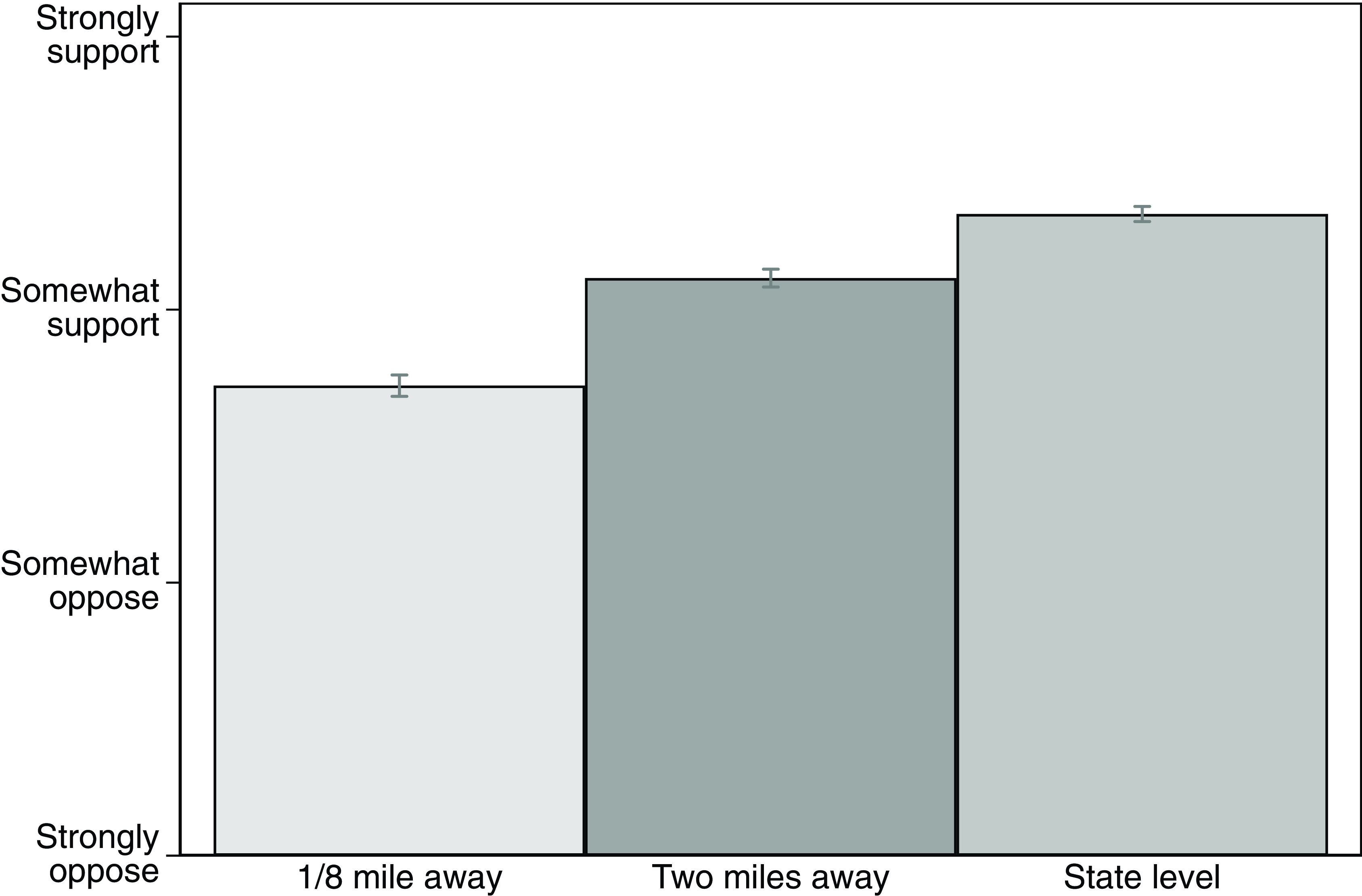
The results are broadly consistent with our expectations. Per H1, we find that support for affordable housing varies by proximity when we compare support for housing at the state level to one-eighth of a mile or two miles away (H1). Mean support and 95% confidence intervals are plotted by distance to the respondent’s home in Figure 2 (see Table B2 for corresponding regression estimates). Mean support for affordable housing at the state level is 3.35 on a four-point scale (between “Somewhat support” and “Strongly support”). Relative to the state level, mean support declines by 0.23 points (d = .28) at two miles and by 0.63 (d = .74) points at one-eighth of a mile (p < .005 for each; see Table B2).Footnote 10
Affordable housing support by distance from respondent. Means and 95% confidence intervals. Support measure is the mean of expressed support for affordable housing at the specified location and vote preference in a referendum to reallocate government funds to affordable housing in that location. See Online Appendix A for stimuli and question wording.
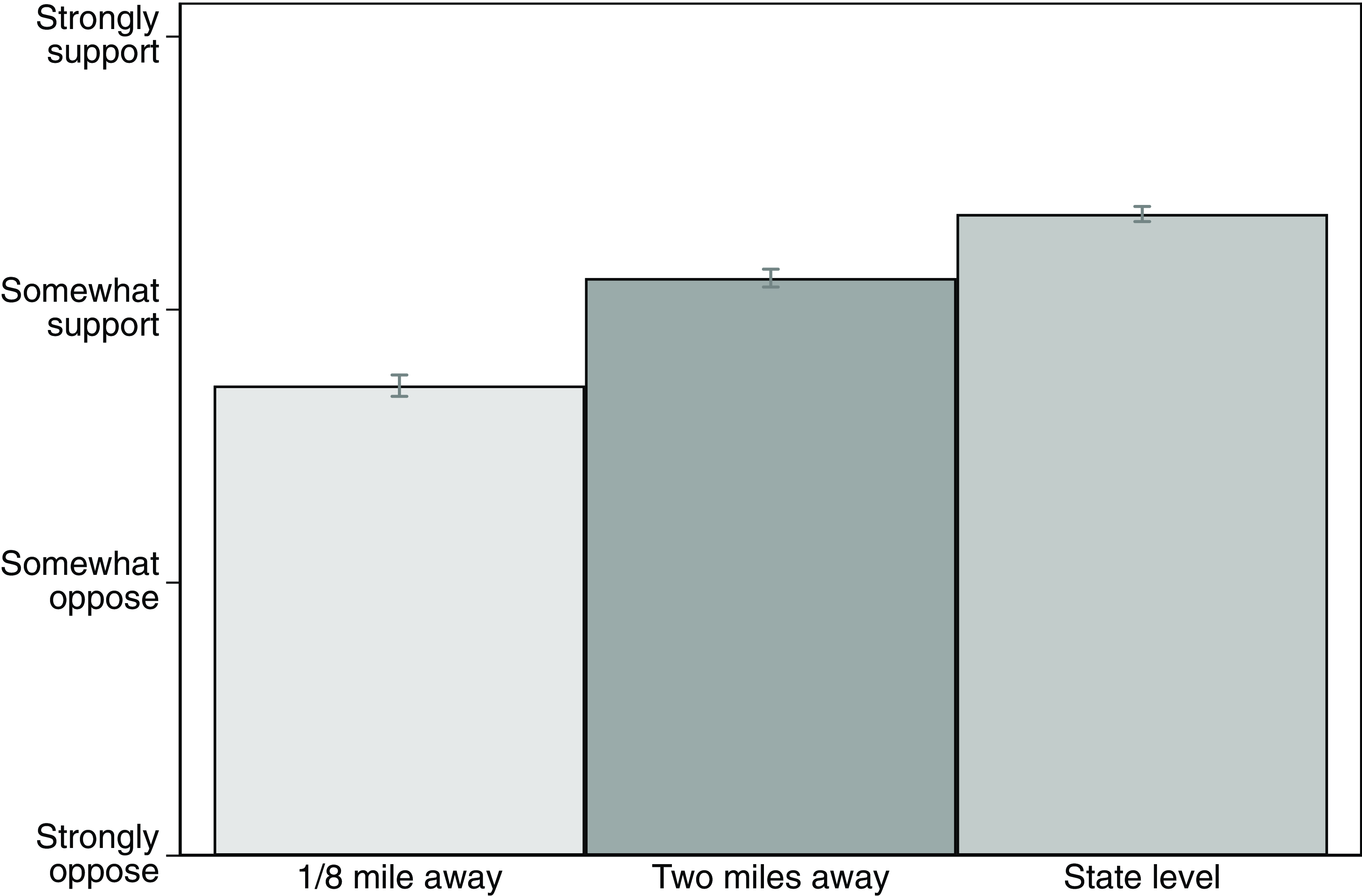
Figure 2 Long description
The bar graph compares the level of support for affordable housing at three different distances from respondents: one-eighth mile away, two miles away, and at the state level. The graph features three vertical bars, each representing a different distance. The x-axis labels the distances, while the y-axis indicates the level of support, ranging from strongly oppose to strongly support. The bars are colored differently: the first bar is white, the second is light blue, and the third is a darker shade of blue. Each bar includes a small horizontal line at the top, representing a 95% confidence interval. The white bar, representing one-eighth mile away, shows the lowest level of support, slightly above the somewhat oppose level. The light blue bar, representing two miles away, shows a higher level of support, reaching the somewhat support level. The dark blue bar, representing the state level, shows the highest level of support, nearing the strongly support level. The graph suggests that support for affordable housing increases with distance from the respondent's location. All values are approximated.
Unexpectedly, we find that measuring outcomes for affordable housing two miles away first had a negative impact on support for affordable housing and its perceived impacts (see Table B3). The initial two-mile distance might act as an anchor, setting a baseline that makes the one-eighth-mile distance feel more proximate or intrusive (Tversky and Kahneman Reference Tversky and Kahneman1974). However, the treatment effects below do not vary by the order in which distances to proposed affordable housing were measured (see Table B4).
The experimental treatments successfully reduced misperceptions about affordable housing. Accuracy rates on questions about stereotypes increased from 78.3% among controls to 95.1% in the stereotypes condition (p < .005). Similarly, the accuracy rate for questions about impacts increased from 76.0% among controls to 89.0% in the impacts condition (p < .005).Footnote 11 We also observe spillovers between conditions; exposure to one treatment increased accuracy for questions related to the other by 4–5 percentage points (see Table B1).
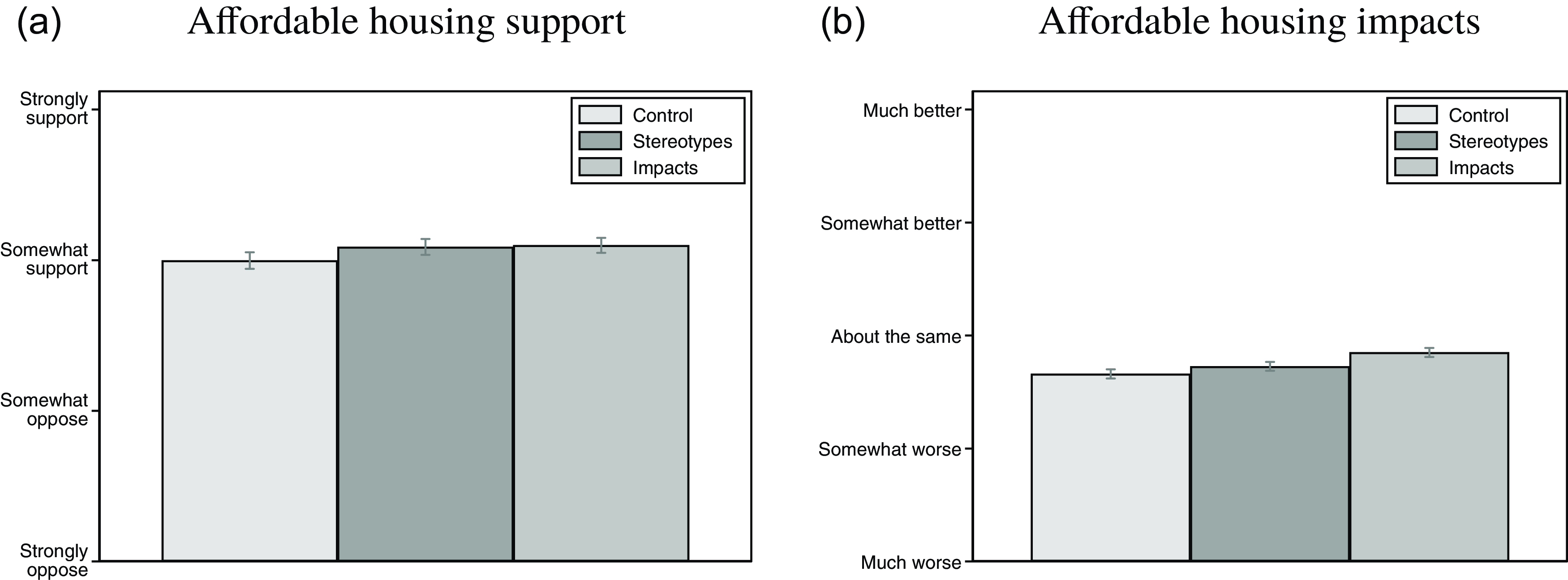
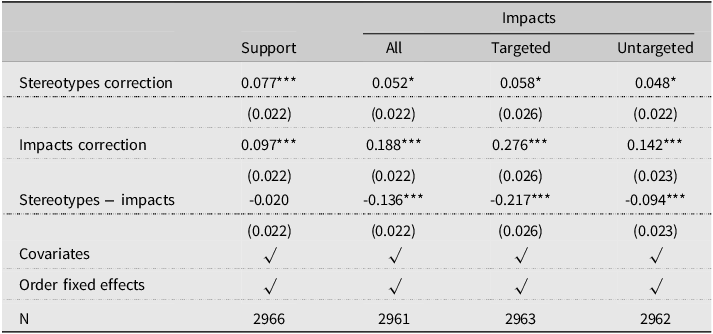
We next assess if participants who receive corrective information are more likely to support building affordable housing (H2a) and view its impacts more positively (H2b). As Figure 3 highlights, respondents who received either treatment expressed greater support for affordable housing across each distance. Per Table 3, support for affordable housing increased by 0.08 (d = .09) for the stereotypes correction and 0.10 (d = .12) for the impacts correction as expected under H2a (p < .005 for each). We also find support for H2b: respondents who received the corrective treatments viewed the impacts of affordable housing at all distances more positively (0.19 [d = .22], p < .005 for the impacts correction versus 0.05 [d = .06], p < .05 for the stereotypes correction).Footnote 12
Affordable housing support and perceived impacts by experimental condition. Means and 95% confidence intervals. Support is the mean of expressed support for affordable housing and vote preference in a referendum to reallocate government funds to affordable housing across each distance. Impacts is the mean of perceived impacts on factors such as traffic across each distance. See Online Appendix A for stimuli and question wording.
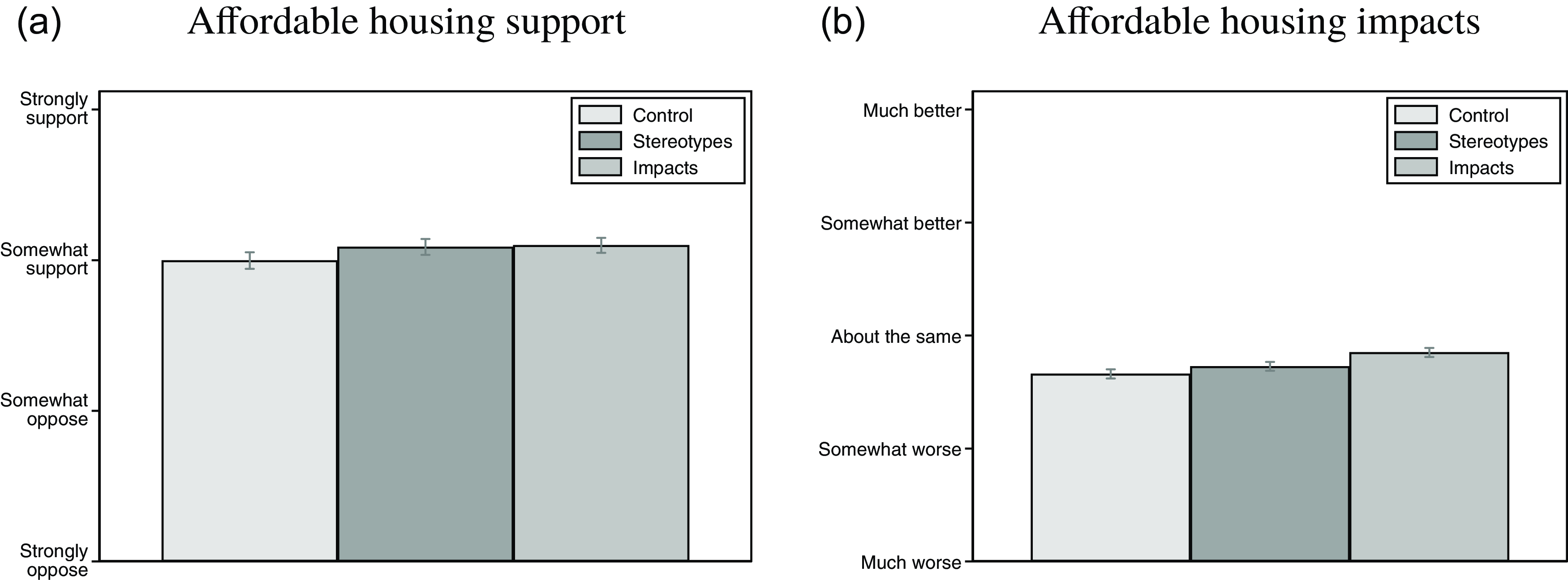
Figure 3 Long description
The bar graph compares affordable housing support and impacts across three conditions: Control, Stereotypes, and Impacts. The x-axis represents the level of support or perceived impact, ranging from 'Strongly support' to 'Strongly oppose' for support and from 'Much better' to 'Much worse' for impacts. The y-axis shows the mean values with 95% confidence intervals. There are three vertical bars for each condition, each representing a different level of support or impact. The Control condition shows moderate support and neutral impacts. The Stereotypes condition shows slightly higher support and slightly negative impacts. The Impacts condition shows the highest support and slightly positive impacts. The graph indicates that support for affordable housing is generally high across all conditions, with some variation in perceived impacts. All values are approximated.
Each model includes pre-treatment covariates selected via the lasso from a pre-registered list (Bloniarz et al. Reference Bloniarz, Liu, Zhang, Sekhon and Yu2016) as well as fixed effects for the order in which respondents received questions about affordable housing stereotypes and impacts as well as order of the outcome measures by distance
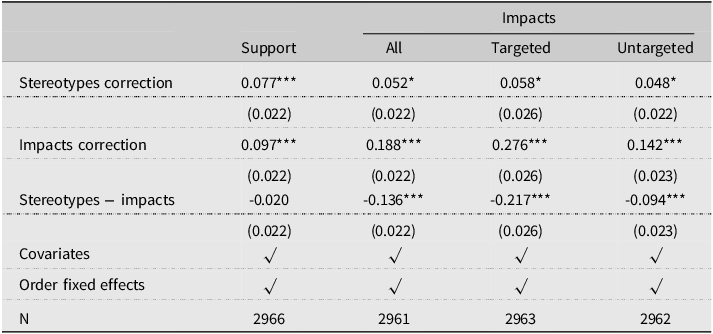
Table 3 Long description
The table presents data on the effects of stereotypes and impacts correction on support for affordable housing across different distances. It includes four main rows: Stereotypes correction, Impacts correction, Stereotypes minus impacts, and Covariates. Each row has four columns: Support, All, Targeted, and Untargeted. The table shows the values and standard errors for each category. For example, Stereotypes correction shows a support value of 0.077 with a standard error of 0.022. Impacts correction shows a support value of 0.097 with a standard error of 0.022. The table also includes fixed effects for the order in which respondents received questions and the order of the outcome measures by distance.
OLS with robust standard errors; * $p \lt 0.05$
, **
$p \lt 0.05$
, ** $p \lt 0.01$
, ***
$p \lt 0.01$
, *** $p \lt .005$
(two-sided). Support is the mean of expressed support for affordable housing at the specified distance and vote preference in a referendum to reallocate government funds to affordable housing across each distance. Impacts is the mean of perceived impacts on factors such as traffic congestion across each distance. Targeted impacts were crime rates and local property values; untargeted were traffic congestion, racial/ethnic makeup of the neighborhood, school quality, and green spaces. Each model includes pre-treatment covariates selected via the lasso from a pre-registered list (Bloniarz et al. Reference Bloniarz, Liu, Zhang, Sekhon and Yu2016) as well as fixed effects for the order in which respondents received questions about affordable housing stereotypes and impacts questions as well as order of the outcome measures by distance. See Online Appendix A for stimuli and question wording.
$p \lt .005$
(two-sided). Support is the mean of expressed support for affordable housing at the specified distance and vote preference in a referendum to reallocate government funds to affordable housing across each distance. Impacts is the mean of perceived impacts on factors such as traffic congestion across each distance. Targeted impacts were crime rates and local property values; untargeted were traffic congestion, racial/ethnic makeup of the neighborhood, school quality, and green spaces. Each model includes pre-treatment covariates selected via the lasso from a pre-registered list (Bloniarz et al. Reference Bloniarz, Liu, Zhang, Sekhon and Yu2016) as well as fixed effects for the order in which respondents received questions about affordable housing stereotypes and impacts questions as well as order of the outcome measures by distance. See Online Appendix A for stimuli and question wording.
Per RQ1, we find no measurable differences between treatments on support (n.s.), but the impacts correction does cause people to view the impacts of affordable housing more positively than does the stereotypes condition (0.14, d = .16; p < .005 for the difference). An exploratory analysis shows that the effects of the impacts correction were larger for the targeted concerns of crime and property values than for others such as traffic and schools (0.28, d = .33 versus 0.14, d = .17, respectively; p < .005 for the difference – see Table B5).
Substantively, the percentage of respondents who said they support affordable housing increased from 60.6% among controls to 63.7% in the stereotypes correction condition and 66.9% in the impacts correction condition. Similarly, the percentage of respondents who said concerns such as crime and traffic would be about the same or better increased from 33.6% among controls to 37.9% with the stereotypes correction and 44.2% for the impacts correction.
The patterns we describe above appear to be consistent across preregistered subgroups. As reported in Tables B6–B9, we find no evidence of consistent heterogeneous treatment effects by partisanship, percentage of nonwhite residents in the zip codes of white respondents, homeowner status, or prior affordable housing support (RQ2a–RQ2d). Exploratory analyses further show that treatment effects did not vary significantly by race or racial attitudes as measured by a feeling thermometer (Tables B12–B13).Footnote 13
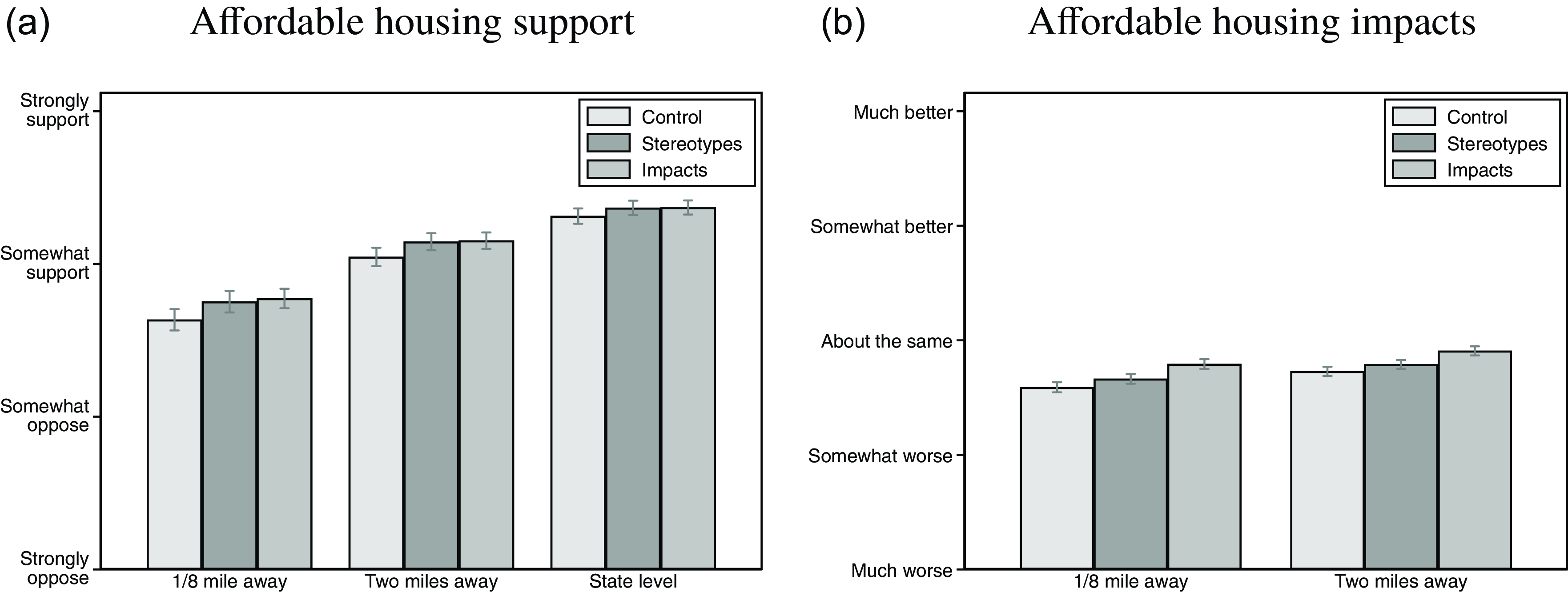
However, as Figure 4 highlights, support for affordable housing actually increased more in response to the impacts correction for developments two miles away and one-eighth of a mile compared to the state level (corresponding regression estimates in Table B10). Contrary to H3, the impacts treatment did not increase support at the state level (0.06, d = 0.07; n.s.) but did so two miles away and one-eighth of a mile away (0.11, d = 0.13 [p < .01] and 0.14, d = 0.16 [p < .005], respectively; both p < .05 versus state level).Footnote 14 The pattern of effects was similar for the stereotypes treatment: 0.05 (d = 0.06) at the state level, 0.10 (d = 0.12) for two miles away, and 0.12 (d = 0.14) for one-eighth of a mile away (n.s., p < .05, and p < .05, respectively). However, contrary to H3, we cannot reject the null of no difference in the effects of the stereotypes treatment on support between one-eighth of a mile away and two miles away for either treatment. Similarly, we find no evidence that treatment effects on the perceived impacts of affordable housing vary between one-eighth of a mile and two miles away (see Figure 4b and Table B11). (We discuss potential explanations for these findings in the conclusion.)
Affordable housing support and perceived impacts by condition and distance. Means and 95% confidence intervals. Support is the mean of expressed support for affordable housing at the specified distance and vote preference in a referendum to reallocate government funds to affordable housing at a given distance. Impacts is the mean of perceived impacts on factors such as traffic at that distance. See Online Appendix A for stimuli and question wording.

Figure 4 Long description
The bar graph compares affordable housing support and perceived impacts by condition and distance. It features vertical bars grouped into three categories: control, stereotypes, and impacts. The x-axis represents distances: one-eighth mile away, two miles away, and state level. The y-axis measures support levels, ranging from strongly oppose to strongly support. For support, the bars indicate that support increases as the distance from the respondent's home increases, with the highest support at the state level. The impacts section shows perceived impacts on local communities, with the x-axis representing distances and the y-axis measuring perceived impacts from much worse to much better. The bars suggest that perceived impacts are relatively neutral, with slight improvements as distance increases. The color scheme uses different shades of gray to represent control, stereotypes, and impacts conditions. All values are approximated.
Conclusion
Our study investigated the effects of correcting misinformation about affordable housing on support for building it and perceptions of its impacts. We find that exposure to corrective information countering stereotypes about affordable housing and unfounded perceptions about its impacts made people more likely to support building affordable housing overall. In some cases, these effects were larger for locations close to where participants live (versus the state level).
Several findings are worthy of further investigation. The stronger correction effects that we sometimes observe at closer distances could result from people thinking in less abstract terms about more proximate developments (Trope and Liberman Reference Trope and Liberman2010) or relying less on heuristics like stereotypes when proximity makes affordable housing more salient (Petty et al. Reference Petty and Cacioppo1986). Another possible mechanism is that two of the impacts correction items specifically concerned effects on nearby areas. Future research should explore the underlying mechanisms for these findings.
It would also be worth investigating why impact correction effects spill over to untargeted concerns. A possible explanation is that affordable housing attitudes are shaped more by symbolic considerations than by practical self-interest. People may base their opinions on feelings about symbols like low-income residents or urban areas, so corrections could improve their overall feelings about housing, spilling over to related issues (Hankinson and de Benedictis-Kessner Reference Hankinson and de Benedictis-Kessner2024; Broockman, Elmendorf, and Kalla Reference Broockman, Elmendorf and Kalla2024). One could also offer a Bayesian interpretation of how people might update stereotypes about affordable housing given information about its impacts.
In addition, it would be worthwhile to examine the longitudinal effects of corrective information in future studies (e.g., Carey et al. Reference Carey, Guess, Loewen, Merkley, Nyhan, Phillips and Reifler2022), especially because any social desirability or experimenter demand effects should dissipate over time. Finally, though our experiment focused on affordable housing attitudes, future research could investigate how similar interventions affect NIMBY attitudes towards other stigmatized establishments such as homeless shelters, halfway houses, and drug treatment centers.
There are several limitations to our study. First, we did not directly mention race, though our intervention discussed often racialized issues such as crime and poverty (Tighe Reference Tighe2012; Whittemore and BenDor Reference Whittemore and BenDor2019). Future studies should test how explicitly addressing race would change the effects of the interventions. Second, because “ask-tell” interventions are often not practical (Braley et al. Reference Braley, Lenz, Adjodah, Rahnama and Pentland2023), future research should consider how to adapt these interventions to real-world contexts. Third, given concerns about accurate self-reporting in surveys, future studies should explore alternative measures that reduce social desirability bias as well as behavioral outcomes that avoid self-reporting altogether. Lastly, because distance was not randomized between participants, the similar treatment effects we observe for one-eighth of a mile versus two miles away may reflect consistency bias. Future research should explore the effect of distance in greater detail.
In addition, participants had highly accurate beliefs about the effects of affordable housing and strong pre-treatment support for building affordable housing, which may have suppressed the effects of our treatments. The effects we observe might have been larger if the information provided were more novel or if participants were initially less supportive of affordable housing. Further research should test these interventions on samples with differing beliefs and attitudes.
Despite these limitations, our findings are encouraging; NIMBY attitudes can shift when people are provided with accurate information about affordable housing. This approach offers a plausible way to combat misconceived notions about the issue, increasing support for a policy that could help address the housing crisis facing the country. These results also demonstrate that factual information can affect attitudes, even on politically controversial issues.
Supplementary material
The supplementary material for this article can be found at https://doi.org/10.1017/XPS.2025.10014
Data availability
Data and code required to replicate all analyses in this article are available at the Journal of Experimental Political Science Dataverse at https://doi.org/10.7910/DVN/DE8RFT (Anderson et al. Reference Anderson, Briman, Ferrin, Hampton, Malhotra, Pandey, Robinson, Sugerman, VanNewkirk, Wang, Yu, Zheng and Nyhan2025).
Acknowledgements
We thank the Dartmouth Center for the Advancement of Learning and the Dartmouth College Dean of Faculty for generous funding support. We are also grateful for feedback from Christopher Elmendorf. All errors are of course our own.
Competing interests
The authors declare they have no competing interests.
Ethical statement
This research was designated exempt by the Dartmouth College Committee for the Protection of Human Subjects (STUDY00032999). It follows APSA’s Principles and Guidance for Human Subjects Research (see Online Appendix C).




 Open access

