




1 Introduction and central issue
1.1 The current chronology of pre-Old English sound changes and its critics
There is a widely accepted chronology of sound laws in Old English philology, covering the transition from Proto-West Germanic to Old English, starting with Luick (Reference Luick1921-40) and later modified by scholars such as Campbell, Brunner, Fulk, Stiles, Hogg and Ringe. This comprises sound laws such as fronting, breaking, i-mutation and Anglian Smoothing. I will refer to this theory as the Standard Theory. Extensive overviews and discussions are given by Campbell (Reference Campbell1977: 50–112), Hogg (Reference Hogg2011 [1992]: 74–168) and Ringe & Taylor (Reference Ringe and Taylor2014: 167–336), to mention a few.
Adjustments of the standard chronology have been put forward on various occasions, such as by Ball & Stiles (Reference Ball and Stiles1983), who altered the relative chronology of smoothing and back mutation, and Toon (Reference Toon, Koopman, van der Leek, Fischer and Eaton1987; referring to criticism by Kuhn from Reference Kuhn1939) and Toon (Reference Toon and Hogg1992), claiming that Anglian Smoothing was still active in the oldest attested texts and hence not ‘pre-historical’. Both refinements did not affect the foundations of the theory.
The crucial features of the Standard Theory are a postulated general fronting of PGmc *a, except before *w and nasals, which was followed by breaking of the *æ > ea before *rC, *lC and *x. Furthermore, the fronted, unbroken *æ could be restored to *a under influence of back vowels in the following syllable. Still, Anglian dialects in particular show much fewer instances of broken vowels than predicted by these three steps. This is supposedly the result of i-mutation, turning a broken *ea into e, and Anglian Smoothing (before ‑(l/r)k/g/x), with a similar effect (æ). Other vowels, in particular short *i and *e, could also be broken; the details can be found in the handbooks. A synoptic overview, also marking the differences between the dialects, is provided in table 1. This shows the main sound laws as reconstructed by the Standard Theory up till the earliest attestations, which are older in Northumbrian and Mercian than in West Saxon. The earliest Northumbrian and Mercian texts will be the basis of my evaluation of the earliest history of Old English (see section 1.2).
Sound laws affecting PGmc *a for Early Old English per dialect according to the Standard Theory with references to the relevant sections in Hogg (Reference Hogg2011). Sound laws that cancel the effect of a previous one, are highlighted in grey.

Some authors have raised questions about the plausibility of some of the reconstructed sound laws, e.g. Howell & Somers (Reference Howell and Somers2008) with reference to Anglian Smoothing. They state that this process is ‘difficult for scholars to adequately explain in either theoretical or phonetic terms’ and that the breaking-smoothing sequence in *nēh > *nēoh > nēh ‘near’ is an ‘apparent paradox’ (p. 187). Still, the historical reality of smoothing is not questioned by the authors.
Krupatkin (Reference Krupatkin1970: 50) is bolder in his criticism when discussing the theory of restoration of fronted PGmc *a, describing the theory of fronting and restoration as an implausible ‘zigzag’ a > æ > a’. Doubts have also been raised by Kortlandt (Reference Kortlandt1999, Reference Kortlandt2008), who, referring to the various stages as given in Fulk (Reference Fulk, Bremmer, Johnston and Vries1998), formulates his objections against this chronology in the following way (Kortlandt Reference Kortlandt1999: 46):
The main difficulty with [the Standard Theory]’s chronology is the unmotivated character of the sound changes: we find backing at stage l, fronting at stage 3, backing at stage 5, fronting at stage 6, backing at stage 7, fronting at stage 9, and backing at stage 11. What was the driving force behind these alternating developments?
The core of the Standard Theory, and – in my view – its most problematic aspect, is the claimed nearly unconditional fronting of PGmc *a, followed by widespread breaking or retraction, all of this taking place before the implementation of i-mutation.Footnote 1 An earlier attempt at inverting the relative order of i‑mutation and breaking, focusing on West Saxon Old English, was presented by Collier (Reference Collier1987), but it has not been met with wide enthusiasm and acceptance. An interesting statement is found in Hogg (Reference Hogg2011: 92), unfortunately without any further references:
Many recent morphological analyses of OE have assumed that breaking was synchronically relevant for historic OE, but this assumption has never been adequately proven, ….Footnote 2
Dyvik (Reference Dyvik1978: 34–5), who revised older theories about breaking and back mutation in North Germanic, assumed a common basis for the tendency towards breaking in pre-stages of Old English and Old Norse, which he dated very early, to the times before the landnam of the Anglo-Saxons.Footnote 3 The latter aspect seems unlikely in the spirit of the conclusions from Kuhn (Reference Kuhn1955), and I will work from the assumption that few to none of the specific North Sea Germanic innovations should be dated before the Anglo-Saxon landnam (Nielsen Reference Nielsen2000: 271–6; Stiles Reference Stiles2013). Haugen (Reference Haugen2004: 56–60) places i-mutation before breaking in his chronology from Early Runic Scandinavian to Old Norse. Old Frisian has some limited application of breaking and back mutation phenomena as well, which are usually dated later than i-mutation (Bremmer Jr Reference Bremmer and Rolf2009: 32–6).
An entirely different approach to the origins of Old English phonology is offered by Schrijver (Reference Schrijver2014: 70). He suggests that Celtic substratum influence was the trigger of many of the Old English vocalic changes, causing a fairly abrupt restructuring of the vowel system by imposing Celtic pronunciation habits on West Germanic vowels, with the result looking like the outcome of a complex set of consecutive sound laws (cf. Nielsen Reference Nielsen, Askedal and Nielsen2015: 274 and Laker Reference Laker2019).
1.2 Trying an alternative approach
Considering the aforementioned criticism on the current chronology of Old English sound changes and the proposed chronologies for Old Norse and Old Frisian, one may consider whether an alternative chronology could be possible. Old English breaking would appear much later than hitherto assumed, namely after the i-mutation.
The most logical candidate for an alternative chronology is the one postulated for Old Frisian, which is the closest relative of Old English (Nielsen Reference Nielsen1985; Ringe & Taylor Reference Ringe and Taylor2014: 139). Its earliest reconstructed history is much ‘simpler’ than the Old English one. A presentation of the generally accepted views on its history can be found in Bremmer Jr (Reference Bremmer and Rolf2009: 21–41). Up till now, a common stage or common chronology for Old Frisian and Old English has been commonly denied in the traditional approach, for instance, by Campbell (Reference Campbell1977: 52, § 131) or Ringe & Taylor (Reference Ringe and Taylor2014: 171, 181 and elsewhere), despite the many similarities between the two languages. Stiles (Reference Stiles, Faltings, Walker and Wilts1995: 211) concludes: ‘it is not possible to construct the exclusive common relative chronology that is necessary in order to be able to establish a[n Anglo-Frisian] node on a family tree’. Archaeological evidence, however, supports the idea that the Germanic settlers of Britain and the post-Migration Frisians shared their origin and maintained close cultural contacts during the first three centuries after the landnam (e.g. Colleran Reference Colleran2016; Nicolay Reference Nicolay2005, Reference Nicolay, IJssenagger and Hines2017; Hines & Behr Reference Hines, Behr and Ludowici2019), suggesting a common demographic basis for the two Germanic dialects: the fifth-century Frisians and the Germanic settlers in Britain were the same people.
In this article, I will compare and assess the performance of two theories that aim to account for pre-Old English phonological developments: (i) the Standard Theory, for which I will rely on Hogg’s (Reference Hogg2011) presentation of the chronology,Footnote 4 and (ii) a chronology based on pre-Old Frisian, with the following core concepts: conditional fronting of PGmc *a, i-mutation, breaking and back mutation, where the relative chronology of the latter two is also stipulated by the Old Norse evidence. This latter theory will be referred to as the Anglo-Frisian hypothesis, and the actually reconstructed chronological series of events as the Anglo-Frisian chronology. I will develop these chronologies in more detail, when comparing their performance.
The performance of the theories will be tested on the oldest extensive Old English sources: the few pieces of Early Northumbrian, as well as the Épinal and Erfurt Glossaries, all from the late seventh or early eighth century (for details see section 2). It makes sense, in my view, to test a reconstruction of prehistoric developments in Old English on the oldest attestations. I will apply both sets of sound laws to the reconstructed Proto-Germanic forms with short *a in the attested lexical items from the aforementioned sources. Either set of sound laws will produce a prediction of an Early Old English form, which can be compared to the actually attested form. The analysis will test which of the two sets of sound laws performs better overall and in terms of specific aspects, such as the prediction of words with and without breaking.
This article concentrates on the pathways of development for PGmc *a in stressed syllables, for which there is a practical and a theoretical reason: the practical reason is the obvious length limitation on a journal article. The theoretical point is that it is in particular the development of PGmc *a that is most complicated in the current approach: 4 out of 8 sound laws presented in table 1 apply to *a only. A theory that works for *a stands a good chance of working for the other vowels as well. A couple of issues will therefore have to be relegated to subsequent studies, in particular:
-
• The development of other vowels than PGmc *a in stressed syllables; relevant for the understanding of the breaking of PGmc *a may be the development of PGmc *au, since they emerge as OE ea and ēa respectively. An alternative hypothesis, assuming a transition from PGmc *au > pre-OE *ā > OE ēa would strengthen the interpretation of short *a in this paper but is not crucial;
-
• The palatalisation of velars before front vowels (churn, chaff, yard); although closely related with the development of PGmc *a and relevant for some of the squestions concerning the relative chronology, this issue would simply require too much space. Both the timing and phonological conditioning for the palatalisation in Old English are problematic, including in current theories (see e.g. Stiles Reference Stiles, Kastovsky and Fisiak1988).Footnote 5
-
• The implications for further developments in late-Old English and Middle English.
The sources under consideration are considered to be ‘Anglian’ and therefore my conclusion can stricto sensu only apply to the non-Saxon branch of Old English. However, the fundamental steps in the Standard Theory for Anglian are the same as for Saxon (West Saxon and Kentish), and with the addition of Anglian Smoothing even more complicated for Anglian than for Saxon. A revision of the ‘Anglian’ prehistoric sound laws may be an incentive to reconsider the ‘Saxon’ history as well, which will, however, stay beyond the scope of this article.
The article is organised in the following way. After a discussion of some methodological issues in section 2, section 3 provides an outline of an alternative theory of the prehistorical changes in pre-Old English. The predictive power of my alternative approach is compared to the performance of the Standard Theory (following Hogg Reference Hogg2011: 74–163) in section 4, based on the material from the two Mercian glossaries. Section 5 discusses various sound changes and the performance of the two theories in more detail, while section 6 considers the Early Northumbrian material. Section 7 brings together the argumentation in a conclusion.Footnote 6
2 Methodological issues
Hogg (Reference Hogg, Kastovsky and Fisiak1988: 186) points to the – well-known – confusion or overlap between chronological and dialectal variation in Old English: some dialects are better attested in particular periods than others and there are wide temporal gaps in the actual text transmission from many regions such as from Northumbria, with only ‘early’ and ‘late’ texts (see e.g. Toon Reference Toon and Hogg1992: 427).
The Early Northumbrian text corpus that was analysed for the present study includes Cædmon’s Hymn (CH) and Bede’s Death Song (BD) in their early Northumbrian shape from the Moore and Leningrad versions, the Leiden Riddle (LR) (Sweet & Whitelock Reference Sweet and Whitelock1967: 181–3), the text from the Franks Casket (FC) (Findell Reference Findell2014: 44–54) and the Ruthwell Cross (RC), although many words were left out from the latter because of the difficult interpretation of their sound value. These sources are commonly dated to the late seventh and early eighth centuries. The Ruthwell Cross is sometimes considered to be somewhat younger than the other texts (Ball & Stiles Reference Ball and Stiles1983: 9).Footnote 7
The main sources for the analysis are the Épinal and Erfurt Glossaries (EpGl, ErfGl), constituting the largest of the early Old English sources (Pheifer Reference Pheifer1974).Footnote 8 When it comes to the dating of the language in the glossaries, we have to consider three potential time layers: the date of the archetype of the glossary, which is already complicated by the fact that the glossary was composed from various other sources;Footnote 9 the date of the copy from which the attested manuscripts were copied (assuming that they are not direct copies from the archetype), and the date of the actually attested manuscripts; see Seiler (Reference Seiler, Nievergelt and Rübekeil2019: 528) for a stemma of the attested manuscripts. The spelling may have been changed at every step in the transmission.
The fundamental question for a historical-linguistic analysis is to what extent the manuscripts reflect (aspects of) the language of the time of their production or the language of the archetype or of any intermediate stage. Ringe & Taylor (Reference Ringe and Taylor2014: 310) state ‘the early Mercian glossaries … contain material from different sources of different dates, inconsistently updated’. The question is: what are the consequences for the identification of consistent sound laws in the glossaries? The rendering of PGmc *a before preserved nasals seems to give us some hope. EpGl has only <a> in those contexts, whereas ErfGl offers a much more diverse picture, with alternating <a> and <o>, seemingly reflecting a phonological rationale (Toon Reference Toon, Koopman, van der Leek, Fischer and Eaton1987: 280).Footnote 10 A comparison of the rendering of /w/ and /þ/ in EpGl, ErfGl and the Corpus GlossaryFootnote 11 showed fairly independent spelling preferences per manuscript (Seiler Reference Seiler, Nievergelt and Rübekeil2019). This increases the likelihood that the language as expressed in the spellings may to a substantial extent reflect the phonological shape of the language of the copyist. I therefore believe that taking the manuscript as a single source and treating variation in a statistical way, rather than considering absolute contrasts or contradictions, offers a good starting-point until proven otherwise.
Pheifer (Reference Pheifer1974: lvii, xci) mentions Aldhelm as a potential initiator and Malmesbury as a potential place for the composition of the archetype around 675, viewing it as a product of a ‘Mercio-Kentish Kirchensprache’, created under the influence of Irish monks (Oliver Reference Oliver1998: 105). But Canterbury is also mentioned as a place of origin of the archetype (Pheifer Reference Pheifer1987: 44; Seiler Reference Seiler, Nievergelt and Rübekeil2019: 535). The year 675 provides a datum post quem (apart from the date of earlier sub-glossaries). The Épinal Glossary is usually dated to c. 700 (e.g. Herren & Sauer Reference Herren and Sauer2015; Seiler Reference Seiler, Dusil, Schwedler and Schwitter2017) and the first quarter of the ninth century is postulated for the Erfurt Glossary, copied from an earlier eighth-century manuscript (Seiler Reference Seiler, Nievergelt and Rübekeil2019).
It is a common view that Épinal represents a more archaic language form, while Erfurt is younger and more corrupted (Chadwick Reference Chadwick1889: 189; Toon Reference Toon and Hogg1992: 423, 425). Oliver (Reference Oliver1998) claims that, at least with respect to the spelling <d> for /θ/ and /ð/, Erfurt is a more mechanical copy of the original (which implies it is more archaic), while Épinal is considered to be more innovative. This last point, however, is not the conclusion Seiler (Reference Seiler, Nievergelt and Rübekeil2019: 535) arrives at. Tiefenbach (Reference Tiefenbach and Blank1989) considers some of the ‘suspicious’ forms in Erfurt as genuine Old High German. However, by labelling them as ‘Old High German’ one runs the risk of circular reasoning and ignoring some part of the evidence. Other forms are of a West Saxon or Kentish type, rather than what one expects in a Mercian source (Pheifer Reference Pheifer1974: xci). In the present analysis, I take the data at face value and include all the material for which I could find a reasonable etymology. Deviations from the trend may have all kinds of reasons, such as the ones mentioned before, but also spelling errors by the scribe, errors in the edition, etc. Such interpretations can be applied afterwards, but not beforehand.
Historical-phonological analyses of EpGl and ErfGl can be found, for instance, in Kolkwitz (Reference Kolkwitz1895) and Chadwick (Reference Chadwick1889). Especially the latter offers a lot of interesting and useful data, providing extensive comparison with the Corpus Glossary as well. However, neither provides a translation and both render total numbers, rather than individual etymologies. For the purpose of the present analysis, a complete dataset was compiled, offering the possibility of arranging every individual attestation according to any criterion, such as root vowel, coda consonant, vowel of the following syllable, both in the proto-form and in the attestation.
As – to the best of my knowledge – no etymological dictionary of the language of the glossaries is available, a list of etymologies was compiled based on various dictionaries. Etymological interpretations in Bosworth-Toller (BT) were often taken as the starting point (Bosworth & Toller Reference Bosworth and Toller1898/1921). Various items in the glossaries are explicitly discussed by Ringe & Taylor (Reference Ringe and Taylor2014; R&T). BT frequently refers to Old Norse/Icelandic cognates, for which the Icelandic etymological dictionary (IOB = Ásgeir Blöndal Magnússon Reference Magnússon1989) offered further interpretations. The Germanic lexical component of Old English often has cognates in Dutch, whose etymologies are found in the Nederlands Etymologisch Woordenboek (NEW; Philippa et al. Reference Philippa, Debrabandere, Quak, Schoonheim and van der Sijs2003). This source can easily be searched online, it is relatively up-to-date and, importantly, it provides a Proto-Germanic reconstruction by default, which is not the case in the Oxford English Dictionary (OED) (Simpson & Weiner Reference Simpson and Weiner2004). Additionally, Proto-Germanic reconstructions were consulted in Kroonen’s (Reference Kroonen2013) Etymological Dictionary of Proto-Germanic (KEPG). In a handful of cases, a Proto-Germanic form was reconstructed by myself, based on the cognates found in the dictionaries.
Still, some cases of doubt and confusion remain, despite all these excellent sources. A major locus of doubt concerns the quality of the vowels in post-root syllables. One reason for this is class shifts and the variability in suffix-alternatives in Germanic. There are also intraparadigmatic alternations, leading to forms with and without i-mutation or retraction within a paradigm. In some cases, the identification of the suffix quality, underlying the Old English form, is straightforward as, for example, in the word haam/ham/hom ‘garment’. According to IOB (s.v. hamur), the PGmc form was either *hamaz- or *hamiz‑. The lack of any sign of i-mutation in the Old English forms suggests that *hamaz- is the source for the Old English forms. In such fairly obvious instances, the form is included in the evaluation. But many doubts remain. Uncertainty about the earlier Proto-Indo-European origin of words was not relevant. Essential was a reliable reconstruction of the Proto-(West) Germanic form. Instances with a doubtful root vowel or suffix quality were excluded from the counting in section 4. Eventually, 303 items out of 336 words with (possibly) a PGmc *a in the root syllable were considered sufficiently and reliably interpreted to be included in the further analysis. Sixteen out of the remaining tokens have issues with the (potential) i-mutation factor, the rest have uncertain etymologies. Importantly, my alternative chronology of sound changes is based on the exhaustive evidence from the glossaries and not a hypothesis on the basis of a selection of examples.
The Northumbrian sources and the Mercian glossaries are primarily taken as ‘earliest attestations’, marking the transition from prehistoric English to historically attested Old English. The time between the attestation of these earliest sources and the landnam in the fifth century is the period where the changes supposedly took place. This prehistoric period of English ends around the year 700. The Standard Theory makes explicit statements about the application of various sound laws in Cædmon’s Hymn or the glossaries. Whether these texts really represent the language of Northumbria or Mercia or any other region is less relevant. The essential question is whether the chronology of sound laws in the Standard Theory provides an adequate description of the development from fifth-century West Germanic to the language attested in these early sources.
3 A new approach to breaking, retraction, raising and smoothing
3.1 Proto-Germanic *a
A pivotal role in the reconstruction of the earliest changes in pre-Old English is taken by PGmc *a. Any alternative reconstruction must find a reasonable solution for its historical developments, including the lexical distribution of breaking to ea. An alternative theory will limit the lexical spread of early fronting and breaking, in order to eliminate retraction and monophthongisation by i-mutation and Anglian Smoothing. The question is: what alternative pathway of developments can be reconstructed? This will be the topic of section 3.3.
The building blocks for a new chronology of changes in Old English, working from an Anglo-Frisian perspective, are the following:
-
1. Early rounding before nasals. A notable feature of EpGl, in contrast to ErfGl, is the consequent rendering of PGmc *a before nasals as <a>;
-
2. Some form of phonologically selective fronting, a priori blocked by back vowels and various consonant combinations;
-
3. The subsequent i-mutation is supposed to cause raising and/or fronting, rather than monophthongisation;
-
4. Breaking is considered a relatively late process, as it is in Frisian and North Germanic:Footnote 12 in the earliest sources (traditionally labelled as non-West Saxon) breaking of PGmc *a is almost completely limited to the context before ‑rC: 24 out of 29 instances in the database with <ea> in Épinal and 11 out of 15 instances in Erfurt, where breaking is less widespread.
3.2 The lexical distribution of a, æ and ea
The theory involving widespread early breaking and the subsequent sound laws of retraction and smoothing grew from the following assumption, formulated by Campbell (Reference Campbell1977: 54, §139 fn.1):
That æ and not a was the sound from which the ea … developed … follows from the assumption … made to account for the phenomenon of breaking: since eo and io arose from e and i, it is practically certain that æa (written ea) arose from æ. That æ is a previous stage in the development of a in forms with retraction is not open to proof, but highly probable, in view of the similarity of the circumstances under which a and ea appear for PGmc a.
The sister language, Old Frisian, has fronting of *a as well, but there it is generally accepted that fronting only took place in a more restricted set of contexts; see discussions in Siebs (Reference Siebs and Paul1901: 1177–89) and Bremmer Jr (Reference Bremmer and Rolf2009: 29–30). The early widespread fronting in Old English, according to the Standard Theory, suggests entirely different pathways for (nearly) identical Old Frisian and Old English forms. The result of this interpretation is that there are many more, unattested steps for English than for Frisian, with exactly the same results; compare the following examples:

A remarkable distributional fact is that breaking is (nearly) absent in a couple of instances in the glossaries:
-
1. before ‑rC + i-mutation (n = 6), with the only exception feormat < *farmjan- (instead of e [Hogg Reference Hogg2011: 118]; see section 5.4). This finds a parallel in the consonantal conditioning theory of breaking in Old Norse (Dyvik Reference Dyvik1978: 11), with breaking of Proto-Norse e before ‑rC and ‑lC, but not when followed by an i-mutation factor.
-
2. before ‑rC, with /r/ < PGmc *-z; the vowel is æ/e (n = 7; 3 instances with i-mutation); otherwise, EpGl has ea before ‑rC without i-mutation, with four exceptions (n = 28). The contrast is statistically significant with p < 0.01.Footnote 13 ErfGl has more <e,ae,ę,a> in the latter contexts, but ea is only found before r < PGmc *r (apart from a few other instances discussed in section 3.6).
This suggests that fronting and not breaking applied when there was a high (semi) vowel in the second syllable or when the /r/ was dental *[r] < PGmc *z. Breaking rather correlates with velar sounds, such as *[r] (see Ringe & Taylor Reference Ringe and Taylor2014: 189) or *[l], which are no obvious environments for fronting.
Broken vowels in dialects with extensive breaking often correlate with a in dialects with less breaking. Such an alternation is found before ‑lC: WS eald ‘old’ corresponds to ald in other dialects, but æld is rarely found. The broken vowel ea alternates with a in the only instance of breaking of *a in CH, and not with a fronted vowel: ‑gard ~ ‑geard and not *-gærd. According to the Standard Theory, the form gard should not exist at all: the sequence g_rd does not fulfil any of the exceptions to fronting in the Standard Theory, nor is it targeted by any of the later sound laws in any of its paradigm forms. One could therefore consider a chronological relationship between the two forms.Footnote 14 In the remaining seven Early Northumbrian (eNorth.) words with PGmc *a before ‑rC, the eNorth. texts have a (four times with preceding w‑), except for aerigfaerae (LR) ‘flight of arrows’ < *arxwō‑. In instances with the same coda consonants as in the eNorth. dataset (‑rd, ‑rð, ‑rn, ‑rƀ, ‑rp, ‑rx) and without i-mutation (n = 12 EpGl, 13 ErfGl), EpGl has 10 times ea, 1 <ae> and 1 <o> (suorn-). ErfGl has 4 x ea, 5 x a (4 times with preceding w‑) but 4 x æ/e. For the context ‑rx see section 3.4.Footnote 15
Finally, an indication for a chronological relation between a and ea without intervening early fronting to *æ comes from the earliest attested place names and personal names in Old English. Van der Schee (Reference Schee2015) presents the evidence for breaking of PGmc *a in names from Latin charters and manuscripts of Bede’s Historia from the seventh century (see esp. p. 234). The oldest attestations (679) spell <a> (bernhardi, gudhardi). Also, in the older Bede manuscripts (M, P, B), the spellings with <a> are dominant (p. 240), only gradually giving way to <ea>-spellings. There is hardly any trace of æ, and certainly not as an intermediate stage between a and ea. This supports the idea that ea developed directly from a. Under the Standard Theory, one has to assume either: (i) that speakers/scribes of a dialect that retained ‑arC gave way to speakers/scribes that developed ea from an earlier not attested *æ, or – as Van der Schee does – (ii) that <a> stands for an ‘underlying’ */ɛa/ and that the whole alternation is merely a spelling issue. A problem for the first interpretation is that various attested words (such as -hard- in the onomastic material and gard in Early Northumbrian) do not represent contexts for retraction in the Standard Theory, implying that they are not supposed to exist at all in any dialect in the seventh century. The second interpretation assumes influence from petrified Latin or Franconian spellings.
All things considered, it seems for the most part that the broken diphthong ea < PGmc *a alternates diachronically and dialectally with a and not with æ. A retention of the a in breaking contexts is also likely from a comparative Germanic perspective: the Old English ‘breaking environments’ have a velarising effect in, for example, Old Frisian and Old High German, as mentioned by Laker (Reference Laker2019: 603).Footnote 16 This implies that fronting in these contexts was not the most logical development and that *a may have formed the input for the breaking. The gard ~ geard-alternation in BD and the seventh-century names in Bede suggest that breaking only developed in the seventh century and gradually spread during the eighth century. The widespread al-spellings in early West Saxon and Kentish sources imply that this process – at least in particular phonological contexts – was still active in the late ninth century (Versloot Reference Versloot2021: 80–2).
3.3 The phonetic conditioning for the breaking of *a to ea
The crucial issue is: how does one get from /a/ to /ɛa/ in a phonologically plausible way if one does not posit an early widespread fronting of *a > *æ? The ‘prototypical’ context for breaking is the position before ‑rC and this context must be the prime focus when searching for a possible explanation for the change.
A solution may lie in lengthening of /a/ before ‑rC. Such a lengthening is also assumed for Old East Frisian (Siebs Reference Siebs and Paul1901: 1178), especially when the following consonant is a tautosyllabic d,m,n,v (< *w,f,ƀ). No lengthening takes place before ‑r + k,g,s,p. The contexts where EpGl and ErfGl both have ea, and which for that reason appear to constitute the core of breaking contexts are: ‑rd, ‑rđ, ‑rt, ‑rb, ‑rw, ‑rm and ‑rr. There is a large overlap between the contexts sensitive to breaking in Old English and the contexts sensitive to lengthening in Old East Frisian; contexts without lengthening in Old East Frisian (‑r + k,g,s; there is no *‑arp in the data) have no breaking in ErfGl (n = 5), but all of them have e,æ, one with i-mutation. The contexts ‑rk, ‑rg are labelled as smoothing contexts in the Standard Theory.Footnote 17
This hypothesis, which will be referred to as the ‘breaking-through-lengthening’ hypothesis, is also supported by Old English itself. It is generally assumed – although never shown in the spelling – that vowels could be lengthened before ‑ld, ‑r + l,n,d,ð,[z], ‑mb, ‑n + d,g (Hogg Reference Hogg2011: 208). The contexts with a nasal do not apply here, because PGmc *a was rounded in that context. According to Brunner & Johnston (Reference Brunner and Johnston1970: 9), this lengthening had already taken place in the eighth century, which brings it close to the date of the breaking as suggested in this article. The context with ‑ld constitutes a major dialectal contrast between Saxon and Anglian in terms of breaking. The context is one of the most robust contexts for lengthening. An explanation for the lack of breaking in Anglian before ‑lC will be presented below. The remaining phonological breaking contexts are very similar to the Frisian lengthening contexts. The common denominator seems to be r + voiced, non-velar consonant. The details may differ per language variety and lemma; cf. PDE wind [i] (noun) – wind [ai] (verb). Unfortunately, not every context is equally well represented in every dataset.
The aforementioned lengthening is not controversial, but the transition of lengthened /a/ to [ɛa] is crucial to the whole debate. It was not without reason that scholars like Luick and Campbell assumed that fronting had to be a widespread phenomenon in pre-Old English to find a phonetic rationale for the [ɛa]-quality.
Faroese provides an interesting potential parallel here. Old Norse (ON) had a long /a:/, which was ‘dark’ and appears as [ɔa] (with breaking!) or [ɔ] in Modern Faroese. But next to this old long /a:/, Faroese developed a new low long vowel through lengthening of ON short /a/ in light syllables. The interesting parallel between Faroese and Old English is that the lengthened ON a is always realised as [ɛa], but without lengthening it remains [a] (Küspert Reference Küspert1988:207, Þráinsson Reference Þráinsson2004: 34,395). Examples can be found within one paradigm, e.g. tak [thɛak] ‘roof (nom.sg.) ~ taks [thaks] (gen.sg.); spakur [spɛakʊr] ‘calm (masc.nom.sg.)’ ~ spakt [spahkt] (ntr.nom.sg.). This means that only the lengthened vowel was broken to [ɛa] and that general fronting of the vowel in its short phase was not a prerequisite for the breaking. A similar length-conditioned breaking of PGmc *a can be found in West Frisian, resulting in [iˑə] from Middle Frisian ā (from OFri. short a with lengthening, but also from OFri. ā); e.g. Old Frisian nama ‘name’ kept a short vowel, appearing as Modern West Frisan namme [namə], but in the verb namia ‘to name’, the vowel was lengthened and subsequently fronted and diphthongised (‘broken’ in the Old English terminology) to neame [niˑəmə].Footnote 18 The parallelism between the Old English ea and the West Frisian transition ā > ea has also been observed by Laker (Reference Laker2007: 179).
The phonetic rationale for breaking suggests that the lengthened vowel was indeed most likely a phonetically somewhat fronted *[a̟ː] or *[æː]. Present-day Dutch has a similar phonetic contrast between /a/ = [ɑ] and /a:/ = [a̟ˑ]. The timbre of the vowel can offer an explanation for the lack of breaking in Anglian before ‑lC. If we assume that the Anglian /a/ was darker than in West Saxon (perhaps because there was a difference between Anglian dark [l] and [l] in West Saxon), this would explain that Anglian had *[ɑˑ] against *[a̟ˑ] in West Saxon. The West Frisian language offers an exact parallel to such a contrast. Fifteenth-century charters from the northeast spell the Old Frisian word ald ‘old’ as <auld>, later <aud>. This comes out as âld [ɔːt] in the modern language (aud [aˑut] in the northeastern dialect of Schiermonnikoog). Charters from the southwest spell <aeld>. The southwestern dialect nearly disappeared during the sixteenth and seventeenth centuries and only survives in the modern dialect of Hindeloopen, where the positive degree is aald with [aː], but the comparative and superlative show breaking to [ɛɔ]: ealder, ealdst. Footnote 19
Given the following observations:
-
– OE ea through breaking shows a distributional overlap with a in varieties without breaking, both diatopically and diachronically;
-
– Broken vowels are nearly absent in contexts where fronted vowels are expected, such as before i,j in the next syllable or an r [r] from PGmc *z;
-
– Faroese and West Frisian provide examples of a short a that was only broken/diphthongised after lengthening;Footnote 20
-
– The core-context for breaking, before ‑rC+voice,-velar, overlaps strongly with acknowledged contexts for lengthening in Old English, with parallels in Old Frisian;
I, therefore, hypothesise that breaking took place via lengthened pre-Old English *a and not a short fronted PGmc *a. This lengthened, phonetically somewhat fronted /a/ was diphthongised to ea. The ‘lengthening’ proposed above was not necessarily phonemic (possibly *[a̟ˑ]), but still enough to allow for some form of glide to develop into a phonetic diphthong. The phonemic status of <ea> is also open to various interpretations (for a longer discussion, see Hogg Reference Hogg2011: 16–20). The general interpretation is that the broken vowels still counted as ‘short’, as evidenced by their use in verse and their development in Middle English (Brunner & Johnston Reference Brunner and Johnston1970: 10). Minkova (Reference Minkova, Honeybone and Salmons2015: 78) concludes that the spelling <ea> for broken short /a/ represents a phonetic reality [e͝a] which was a ‘not-yet-integrated semi-contrast’, in an allophonic relation with [æ]. Whether forms such as PDE arm, hard, OE earm, heard are the result of some form of a Middle English phonological monophthongisation process (i.e. the result of the merging of the two semi-phonemes /e͝a/ and /æ/ with /a/; see Lass & Laing Reference Lass, Laing, Denison, Bermúdez-Otero, McCully and Moore2012: 76), or come from dialects with little or no breaking (cf. Brunner & Johnston Reference Brunner and Johnston1970: 12–13) can be left open here. It is not the primary question for a reconstruction of prehistoric sound changes in Old English.Footnote 21
The distribution in the earliest attestations suggests that breaking was a fairly young process that may have started only in the seventh century and was still spreading in the eighth century. Such an approach avoids the early fronting, the early and widespread breaking and with it Anglian Smoothing. It stays in line with all the evidence of unbroken spellings in early sources, does away with unattested intermediate broken forms and eliminates the necessity to invoke processes like dialect mixture and scribal confusion to ‘account’ for many actually attested forms.
3.4 Breaking before *x and Anglian Smoothing
The PGmc velar fricative *x is in the Standard Theory mentioned as a source of breaking. The context before *(C)x is also a trigger of so-called Anglian Smoothing, and forms with attested breaking are only expected in words where *x disappeared before the vowel could be monophthongised by *x and when it was not monophthongised by i-mutation, which leaves very few lemmas. *x is consistently associated with fronting in the glossaries (EpGl): naecht- ‘night’ < *naxt‑, aec(h)that ‘deliberates’ < *axtōþ, fex ‘kelp’ < *faxsa-; and with i-mutation: ambechtae ‘servant, office’ < *ambaxti-. *x is only preserved in the combination *xt and *xs, but disappeared in other contexts, e.g. steeli ‘steel’ < PGmc *staxlja-, or eo‑ (attested in eorisc ‘water-rush’) < PGmc *axwō-. The monophthong in steeli can be ascribed to i-mutation, but eo- is considered to be a key-witness for the Standard Theory: ‘*aho > *æho > (breaking) *eaho > (smoothing) *æho > ǣo’ (Hogg Reference Hogg2011: 79). Breaking and subsequent smoothing are required in the Standard Theory to avoid retraction: *axu > *æxu > *axu, eventually leading to **ā. This form ā, without fronting, is the Old Frisian form (aha as a name in an even older Latin context), just as e.g. OFri. nacht ‘night’; apparently *x had the sound value *[x] in Frisian and blocked fronting.
A much simpler scheme for the Old English glossary data is obtained if we assume that *x was realised as *[ç] in Anglian (pre-)Old English and allowed fronting to operate. The phoneme /x/ may have had different realisations in pre-Old English and Old Frisian.Footnote 22 An Anglian *[ç] also solves the issue of eo‑, which can now directly be derived from earlier *ax(w)ō with fronting before *[ç] and subsequent contraction after loss of the *x(w): *ax(w)ō- > *æxo > *æo > eo. Footnote 23
Let us now have a look at the evidence in the glossaries for the effects of i-mutation and Anglian Smoothing of PGmc *a in words that are supposed to have breaking in the Standard Theory. The chronology of the processes can be summarised in the following way:

The actual results in EpGl are shown in table 2.
Breaking and smoothing according to the Standard Theory (ST). The theory predicts the tokens to fall in the grey cells (77 per cent correct for non-i-mutation contexts).

The Standard Theory’s prediction about ‘monophthongisation-through-i-mutation’ is borne out well. But the complications of fronting and breaking are not needed: simple i-mutation of *a – or *æ when fronted – will lead to æ or e in the glossaries (see further section 3.5).
The smoothing is not fully effective (7 out of 11) and the actual distribution in EpGl can be predicted in a more efficient way by the assumption that /x/ was *[ç] and that in the contexts of *ax- and *arx, the vowel was fronted and not further affected by any change. General breaking of non-fronted *a before *rC suffices to predict the instances of mear(c) ‘mark’ and uuearg-rod ‘gallows’. The improved result of such a set of sound laws is shown in table 3.
Predicted Anglo-Frisian (A-F) developments in the ST-breaking and -smoothing contexts from table 2 (91 per cent correct for non-i-mutation contexts)

The single exception with a broken vowel instead of a fronted vowel is leax (EpGl), which appears as lex in ErfGl.; for a discussion see section 5.4.
We can therefore conclude that the actual EpGl attestations in contexts with *x and other ST-smoothing contexts do not support the complex set of sound laws from the Standard Theory (fronting, breaking and subsequent monophthongisation by i-mutation and smoothing), and are better predicted by the application of i-mutation to unbroken forms, with a subsequent later, restricted application of breaking.Footnote 24
3.5 The impact of i-mutation
Both EpGl and ErfGl show variation between <ae> and <e> in the i-mutation product of PGmc *a. Hogg (Reference Hogg2011: 118, 123–4) mentions the relevance of the vowel quality: pre-OE *æ is mutated to <e>, whereas *a and *ɑ become <æ>, although the latter soon became <e> as well (Ringe & Taylor Reference Ringe and Taylor2014: 228–9), in particular in light syllable stems (Hogg Reference Hogg2011: 128). The <ae>-spellings are more prominent in EpGl (43 per cent) than in ErfGl (28 per cent), which is in line with the dates of the manuscripts. Hogg’s criteria explain c. 80 per cent of the distribution of the spellings in EpGl. Detailed consideration of various factors shows that the quality of the historical i-mutation trigger, /i/, /i:/ or /j/, is an additional factor, where /i/ has a weaker effect than /i:/ and /j/. Such a difference in effect has hitherto not been observed for i-mutation in West Germanic languages, but see Schulte (Reference Schulte2018: 57–8, and especially Reference Schulte1998: 158–73) for a lengthy discussion of this phenomenon and parallels in North Germanic and other non-Germanic languages. Vaan (Reference Vaan2017: 301–5) highlights the relevance of the trigger /j/ in Dutch, whereas Dutch in general shows very few traces of i-mutation.
There are differences between the two glossaries in respect to the i-mutation factor. The input vowel quality is the most important factor in EpGl. This results in a probabilistic cline, as demonstrated in table 4.
The impact of the input vowel quality and i-mutation factor on the final outcome of i-mutation (only unambiguous ‑i and ‑ī/j; see the discussion below)

In ErfGL, the quality of the mutating factor is more important, as can be seen from the cline in table 5.
The features relevant for the final outcome of the i-mutation process are thus:
-
• The quality of the mutated vowel: at the moment that i-mutation was active, PGmc *a had developed into [æ], [a] or [ɑ] (before nasals). The distinction between [a] or [ɑ] turns out to be irrelevant for the further development, and it is the contrast with /æ/ that matters.
-
• There are three historical i-mutation factors: /i/ has a weaker impact than /i:/ and /j/.
-
• In various paradigms, there is alternation of the mutating factor, such as in class 1 weak verbs, e.g. inf. *framjan – part.pt. *framid, or in the i-stems, e.g. nom.acc.sg. *mari, gen.dat.sg. *marī. We can expect analogical levelling here. Scrutiny of the data shows an effect of root syllable weight with heavy root syllables; these words ‘behave’ as if they had /i/ as a mutating factor, while after light syllables, the inclination to raising is stronger. This could be ascribed to Sievers’ Law, which predicts *‑ij- instead of *‑j after heavy syllables. However, a similar but weaker syllable weight effect can also be observed for words with an invariable mutation factor, so syllable weight should be added as an additional relevant factor that predicts the height of the mutation product.
The impact of the input vowel quality and i-mutation factor on the final outcome of i-mutation (only unambiguous ‑i and – ī/j; see the discussion below)

The detection of these factors explains a lot of the alternations between <e> and <ae> in the glossaries, even when they cannot easily be converted into discrete sound laws. A statistical model that factors in manuscript, mutation factor, syllable weight and input vowel quality can predict 87 per cent of all tokens in both manuscripts correctly. The details can be found in the Appendix.Footnote 25
3.6 Palatal diphthongisation or back mutation?
One of the supposedly older developments in Old English that seems to have left some traces already in the glossaries is what Hogg calls ‘palatal diphthongization’. The process is ‘controversial or dubious’ in many instances (Hogg Reference Hogg2011: 104ff.) and is predominantly found in West Saxon and Northumbrian rather than in Mercian. I will concentrate on positive evidence for this process in the glossaries and the Early Northumbrian material. Where a digraph can be interpreted as the result of breaking, it is not considered to be evidence for palatal diphthongisation, such as in ‑geardas ‘gardens’, with breaking before ‑rd. I considered instances with the initial consonants *k-, *g-, *sk- (no instances with *ja- in the glossaries), followed by PGmc *a with fronting or i-mutation.
Both glossaries have the same two lemmas (out of 16 relevant tokens) with ea < *a that cannot be explained as breaking before rC: sceadu ‘shady place’, ‑sceadan/‑ae ‘damage’. EpGl also has once scaedu‑ alongside ErfGl sceadu‑. The only somewhat unambiguous context in the glossaries is therefore *skæ- < PGmc *ska-, but the glossaries have 6 (EpGl) and 4 (ErfGl) examples without <ea>, such as scaet ‘property’. These instances of sceadu and ‑sceadan/‑ae can therefore better be explained as ‘back mutation’ (Hogg Reference Hogg2011: 149ff.); see also the discussion in section 5.4. The Early Northumbrian material has two instances of ea in four potential candidates for palatal diphthongisation: sceppend (CH) ‘creator’, cæn[d]æ (LR) ‘knew’, sceal (LR) ‘shall’, geatum (LR) ‘ornaments’. The last one can also be an instance of back mutation. The data support the idea that palatal diphthongisation was not common in Mercian and is only found at an initial stage in Early Northumbrian.
3.7 *ax(w)‑ and *aw‑
Seven lemmas with the sequence *aw‑ and the word eo‑ ‘water’ (see section 3.4) will be kept out of the count in section 4 because of their unpredictable inclination to build diphthongs; compare (snid)streo ‘carline thistle’, str[e?]idae ‘spread out (3.sg.prt)’, thrauu ‘rebuke, threat’ < *strawa-, *strawid- and *þrawō-. The various developments are strongly associated with the quality and quantity of the following syllable and must originally have alternated paradigmatically. The direction of the levelling (which is difficult to establish for the language of the glossaries because of the limited number of tokens per lemma) depended probably on the frequency and specific phonology of the various paradigm forms. These forms can therefore not provide evidence about the mainstream developments.
4 The new chronology put to the test
The focus of this section is on testing to what extent an alternative chronology of phonological changes in Old English is borne out and supported by the actually attested evidence from EpGl and ErfGl. The new chronology is based on the line of thinking developed in section 3. This alternative chronology stays much closer to the chronology that can be reconstructed for Frisian and which I for that reason refer to as the ‘Anglo-Frisian chronology’.
The ultimate test of theories is their ability to make predictions about the vowel qualities in the attested sources. Based on the phonological shape of the reconstructed etymon (which is based on the comparative method and hence not solely on the attested Old English forms) and the formulated sound laws, an Old English vowel quality can be predicted for every word in the dataset. Etymologies with issues, either in the root or in the quality of the following syllable, are not included. A total number of 336 lemmas with PGmc (or sometimes Latin) *a has been identified in the glossaries, and the etymologies of 303 words (90 per cent) were considered sufficiently transparent to be included in the analysis.
The following sections present the sound laws and their predictive power for the language of the Mercian glossaries, first as they are applied for PGmc *a in line with the Standard Theory (Hogg Reference Hogg2011), followed by the Anglo-Frisian sound laws. The results for both theories will then be compared. In the overviews below, the following abbreviations are used:
C = any consonant; V = vowel; N = nasal consonant; L = labial consonant
4.1 Sound laws for PGmc *a for early Mercian according to the Standard Theory
The sound laws for PGmc *a deducible from Hogg (Reference Hogg2011), §§ 5.3–5.100, in particular for the early Mercian sources, are summarised as follows:
§ 5.3–5.6: a → [ɑ] = <a/o> / _N
§ 5.13: a → æ, except / _w, _lVback, _lC
§ 5.16–5.18: æ → ea / _x, _rC; j is not considered as a consonant here (Ringe & Taylor Reference Ringe and Taylor2014: 181).
§ 5.29: æ → a / L_r or _rL; ‘At all periods, the change is incomplete and there are many forms with diphthongization …’. According to Campbell, this works in Northumbrian but Hogg explicitly mentions the early Mercian glossaries as well. The effect of this sound law was not included in the results presented in table 6, because it is hardly visible in the data from the glossaries. If implemented consistently, it would lead to 21 wrong predictions for EpGl.Footnote 26
§ 5.35: æ → a / _CVback; [æ → a/æ / _C1C1Vback, /_st/skVback; seems to be absent in the early Mercian glossaries, e.g. aespae ‘aspen’ < PGmc *aspō-, ‑laeppan ‘cloth’ < PGmc *lappan-].
[§ 5.49/52: æ → ea / j_, gj_, kj_, sk_; this rule was not applied for the Mercian glossaries; see section 3.6.]
§ 5.78: ɑ,a → æ / _C(C)i/j; this corresponds to the input vowel quality factor in the i-mutation process, as described in section 3.5.
§ 5.80: æ → e / _ C1(C1)i/j. Additionally: æ → e/æ / _ C1C2i/j; Hogg (p. 128) mentions this rule, but for EpGl the <ae> is clearly dominant and as such implemented here; this corresponds to the syllable weight factor in the i-mutation process, as described in section 3.5. For ErfGl, the product of i-mutation is <e> in the majority of cases (19 out of 30). Even initially rounded or preserved *a comes out as <e> in ErfGl.
§ 5.82: ea → e / _C(C)i/j
§ 5.93/98: ea → æ / _(l/r)k/g/x
Predictive power for the development of PGmc *a in the EpGl, following the two sets of reconstructed sound laws. Only seven words came out with a different vowel (ā, eo, ē, o, ō) and were excluded from the overview. X-axis = predicted vowel quality; Y-axis = attested vowel quality. The dark grey cells mark the correctly predicted tokens. The light grey fields mark the confusion of e and æ in the prediction.

Ringe & Taylor (Reference Ringe and Taylor2014: 221) mention ‘Second fronting’ for EpGl, but Hogg (Reference Hogg2011: 137) says that this is no more than a marginal development in the glossaries and this was therefore not implemented as a sound law for the language of the glossaries.
4.2 The Anglo-Frisian sound laws
4.2.1 Sound laws for PGmc *a for Épinal
The list of changes consists of only three steps in the Anglo-Frisian chronology:
-
1. split of PGmc *a: a → æ except /_lC /_Cu/ō /_rCnon-pal (Cpal = x = [ç], Ci,j, [r] < z)
-
2. i-mutation ‘cline’:
-
a. a → æ /_C(C)i and all ja-stems, i-stems, class 1 weak verbs
-
b. a → e /_C(C)j,ī
-
c. æ → æ /_CCi
-
d. æ → e /_C(C)j,ī, Ci and all ja-stems, i-stems and class 1 weak verbs
-
-
3. lengthening and breaking: a → *[aˑ] → ea / _rC
The evaluation of the predictions from the two theories works as follows (examples from EpGl):
PGmc *spadō(n)- ‘spade’
ST: fronting; no breaking; followed by retraction > *spadan
A-F: no fronting before a single consonant plus back vowel > *spadan
EpGl has <spadan> ⇒ both predictions are correct
PGmc *habuk- ‘hawk’
ST: fronting; no breaking; retraction before ‑Cu- > *habuk
A-F: no fronting before ‑Cu- > *habuk
EpGl has <hebuc> ⇒ both predictions are wrong
PGmc *markō- ‘boundary’
ST: fronting; breaking before *‑rC, smoothing > *mærk-
A-F: no fronting; breaking before *-rC > *meark
EpGl has <fristmearc> ‘respite’ ⇒ A-F’s prediction is correct
PGmc *hanjō- ‘hen’
ST: rounding to [ɑ]; i-mutation of open vowels > *hænn
A-F: rounding to [ɑ]; strong i-mutation effect in light syllable by *j > *henn
EpGl has <haen> ⇒ ST’s prediction is correct
The results of this evaluation are summarised in table 6, which compares the predictions of the two competing theories with the actually attested spellings in the Épinal Glossary. The table demonstrates that in the majority of cases both theories indeed predict the attested spelling, while deviations are found in less than 20 per cent of forms.
Both approaches are almost equally effective. Note that the performance of the Standard Theory was enhanced by not implementing the ‘labial retraction rule’ (æ → a / L_rL; Hogg § 5.29) and a refinement of the retraction rule (Hogg § 5.35). The variable application of i-mutation in heavy syllable stems (Hogg § 5.80) was optimised. This means that in a less lenient interpretation of the Standard Theory, the score would be lower.Footnote 27
The interpretation of the Anglo-Frisian hypothesis is based on the (fine-grained) categorical application of i-mutation, which leads to an accuracy of the prediction for words with i-mutation of 72 per cent. The purely probabilistic cline provides an accurate prediction for words with i-mutation in 84 per cent of the forms (see the Appendix). This corresponds to 12 additional correct items: 244/282 = 87 per cent correct.
Taking those two considerations into account, the performance of the Anglo-Frisian Theory comes out as slightly better than that of the Standard Theory. A methodological advantage of the A-F hypothesis over the Standard Theory is the lower number of sound laws and in a wider sense the harmonisation of the developments within the Anglo-Frisian branch of West Germanic. A more detailed discussion will be offered in section 5.5.
4.2.2 Sound laws for PGmc *a for Erfurt
Chronology of three steps:
-
1. split of PGmc*a: a → [ɑ] = <a/o> / _N
*a: a → æ except / w_r / _lC / _Cu/ō /_rCnon-pal (Cpal = x = [ç], Ci,j, [r] < z)
-
2. i-mutation ‘cline’:
-
a. a [a,ɑ] → æ (e) / _C(C)i and heavy syllable ja-stems, i-stems and class 1 weak verbs
-
b. else: a, æ → e
-
-
3. breaking: (C-w )arC → *[aˑ] → ea.
Similar analysis steps as for EpGl can be applied to ErfGl. The account given by Hogg hardly differentiates between the two glossaries. ErfGl has a development to either <o> or <a> in the position before a nasal (also mentioned by Hogg). Both outcomes were considered to be correctly predicted in both approaches. ErfGl also has a tendency to preserve the *a in the sequence *warC.Footnote 28 It also has a much stronger inclination to develop every mutated PGmc *a to <e> (Hogg Reference Hogg2011: 123) and, therefore, the Standard Theory predicts an e as the result of i-mutation for ErfGl (with good performance). Table 7 summarises the results from the sound laws and their actual match with the attested word forms in the glossary.
Predictive power for the development of PGmc *a in the ErfGl, following the two sets of reconstructed sound laws. Only five words came out with a different vowel (ā, æo, ē, ō) and were excluded from the overview. (See further table 6 for legend.)

The interpretation of the Anglo-Frisian hypothesis is based on the (fine-grained) categorical application of the i-mutation, which leads to a prediction accuracy of 70 per cent with i-mutation. The purely probabilistic cline provides an accurate prediction for words with i-mutation in 91 per cent of the words. This corresponds to 21 additional correct items: 218/274 = 80 per cent correct.
Altogether, the phonological shape of ErfGl is more difficult to predict in both approaches. As in the EpGl, the largest deviations are found in the interchanging of e and æ in either prediction or attestation. Part of it has to do with the variability of the effect of the i-mutation. Further implications of the differences between the two approaches will be discussed in section 5.
4.3 An alternative account: early fronting after all
Comparison between the initial fronting conditions in Frisian and English leads to an alternative interpretation for the context *arC. Frisian has fronted vowels in these contexts, except when preceded by *w, *b and *f, or when followed by a back vowel. This leaves only few exceptions, such as bern ‘child’ and garda ‘yard’.Footnote 29 When we assume a similar early fronting in this specific phonological context (not throughout as in the Standard Theory), the input vowel to breaking is */æ/ in this approach, without the intermediate lengthening of *a. This interpretation will be referred to as ‘early-fronting’ hypothesis.
For EpGl, where breaking is almost entirely restricted to the context *arC, this scenario requires a general fronting to *æ before any *rC. The i-mutation causes raising of this *æ to e (4 out of 6); the remaining two instances are feormat and auuaerdid, the latter with æ after w- (see section 5.4). Breaking is predicted in the 28 instances without i-mutation with assumed *æ (under this approach), and indeed observed in 24 tokens. One of the exceptions is suornodun with PGmc *a between *w_r, which represents the context described as ‘combinative breaking’ by Hogg (Reference Hogg2011: 89). Altogether, 29 out of 34 relevant tokens (85 per cent) in the Épinal Glossary with PGmc *arC are correctly predicted by this set of rules. For the breaking-through-lengthening theory, this would be 30 (88 per cent), so both theories perform almost equally well for EpGl.
The alternative theory is particularly fruitful for the interpretation of Erfurt, when judged by conditions for fronting more similar to Frisian, namely not in the context *war‑. Breaking is then restricted to the contexts before ‑r + voiced, non-velar consonants, but not before ‑rn and ‑rw. The product of i-mutation is expected to be <e> in the etymons under consideration (rule 2b in section 4.2.2). This produces 22 correct predictions (out of 34 = 65 per cent) and 27 (79 per cent) if we are tolerant to alternations of <e> and <ae>. In the earlier presented version of the A-F theory, this was 19 (56 per cent; and 21 with <e> ≈ <ae>). Given variants such as uearte, uaertae and uuertae for ‘wart’ in ErfGl, there is no way to achieve 100 per cent correctness in any interpretation.
This theory has two advantages when compared to the ‘breaking-through-lengthening’ hypothesis, described in section 3.3:
-
1. It is more straightforward in terms of the vowel quality for breaking;
-
2. It increases the overlap with developments of fronting in Frisian, which is likely, because fronting is a very early change and therefore expected to be similar in Frisian and English and it strengthens the similarity between consonantal breaking in Old Norse (on /ɛ/) and Old English (on /æ/).
Its main disadvantage is that it leaves the observed diachronic and diatopic alternation of a and ea in the near absence of æ (section 3.2) unexplained. However, in the glossaries, there is a side-by-side occurrence of broken vowels and front vowels: in the 12 tokens where <ea> appears only in EpGl and not in ErfGl, the latter has 9 fronted vowels before ‑r + g,k,n,t: three times <e> and five times <ae>. Three of them have <a>, all with preceding labial w or b.
An aspect mentioned in this section, which tends to support the ‘breaking-through-lengthening’ hypothesis as described in section 3.3, is the fact that the instances of breaking in ErfGl are concentrated in contexts ‑r + r,ƀ,d,đ,m, which constitute a good overlap with the lengthening contexts, in particular in Old Frisian. Among the 9 tokens with a voiceless consonantal cluster, there is only one instance of breaking, strangely enough after w-: uearte ‘wart’ (next to uaertae and uuertae). The fact that the breaking in ErfGl is concentrated in the voiced contexts suggests that lengthening of the vowel may have been part of the process of breaking.
This allows for yet another interpretation of the observed correspondence between EpGl ea and in particular ErfGl æ: the <ae> may be interpreted as *[æˑ], the intermediate stage for breaking as described in section 3.3. Vowel length is after all not rendered in Old English spelling, and <ae> may represent *[æ], *[æˑ] or *[æː]. Breaking is more widespread in EpGl than in ErfGl, and the dialectal origin of EpGl should be sought nearer to the West Saxon region. The language of ErfGl resembles rather the early Northumbrian dialect (e.g. with respect to the impact of preceding w‑). If indeed breaking originates in West Saxon and gradually spread to the north and northeast, the instances with <ae> in ErfGl could reflect the middle step in the chain /a/ > *[æˑ] > [ɛˑa]. Finally, there is so-called ‘Second Fronting’ that might account for some of the instances of <ae> in ErfGl (see section 5.2), implying an earlier *a.
The conclusion is that both scenarios, the ‘breaking-through-lengthening’ hypothesis and the ‘early fronting’ hypothesis, have their pros and cons. They both perform well on the data from the glossaries, although the ‘early fronting’ hypothesis is slightly more flexible in accommodating the variation in the language of ErfGl. Under any circumstance (including the Standard Theory), we have to assume some variability in the application of sound changes. The ‘early fronting’ hypothesis also stays closer to Frisian fronting and Old Norse consonantal breaking, but leaves other aspects of breaking unexplained, such as the preference for voiced contexts in ErfGl.
However, it is important to notice that both variants of the Anglo-Frisian theory differ from the Standard Theory in a couple of respects:
-
1. they limit the extent of fronting and operate without the fronting-retraction movement;
-
2. they apply i-mutation to a stage of the language with unbroken vowels and do not cause the uncommon effect of i-mutation, entertained in the Standard Theory, namely monophthongisation;
-
3. they operate with an implementation of breaking after i-mutation in fairly specific contexts, without a later correction by i-mutation and a process known in as Anglian Smoothing.
Both scenarios will be considered when discussing changes in words with *arC in section 5. They both mark a clearly different approach than the chronology of the ST.
5 Systematic differences: retraction, breaking, i-mutation, smoothing, second fronting
5.1 General differences between the theories
The figures in section 4.2 show a very similar level of correct predictions for both tested theories. Tables 8 and 9 illustrate that both theories also make very similar predictions on the level of individual tokens: for 92 per cent of the tokens in the Épinal Glossary, the theories predict the same outcome, which is correct in 86 per cent of those cases. The figures for ErfGl are 91 and 74 per cent respectively.
Overlap and difference in the performance of the two theories for EpGl

Overlap and difference in the performance of the two theories for ErfGl

This implies that both theories are successful and fail in largely the same stock of words. The following sections discuss the predictive success of several hypothesised sound laws in either theory. The situation in the EpGl is taken as default in the discussion – derivations in ErfGl will sometimes be discussed separately. In general, both theories have more problems with ErfGl.
5.2 Fronting, ‘second fronting’ and retraction
Both theories are successful in the prediction of developments of words with *aN or *alC without i-mutation in 97 per cent of cases (n = 70). One exception is heamol ‘miserly, niggardly’ instead of predicted *hamol. This could be an instance of back mutation, common in later Mercian sources. ErfGl has healful here, which looks like a spelling error. The second exception is fealga (not in ErfGl), which shows a ‘West Saxon’ type of breaking and a violation of the Anglian Smoothing.
Words that go through initial fronting and subsequent retraction in the Standard Theory (n = 19) are correctly predicted in 11 instances by both theories. Both theories fail on seven cases, such as ‑hebuc (ErfGl ‑haebuc) ‘hawk’ or slęgu (ErfGl slægu) ‘dross, slag’ < PGmc *slagō- with unexpected lack of retraction (ST) or with ‘Second Fronting’. The words sceadu ‘shade’ and ‑sceadan (ErfGl scheadae) ‘damage’ are best explained as instances of back mutation, rather than palatal diphthongisation (see discussion in section 3.6) and presuppose Second Fronting as an early development in the Standard Theory. The A-F chronology has no proper explanation for them either, other than indeed some form of Second Fronting.Footnote 30 The dataset contains 31 tokens, which could show second fronting of æ to e, all of them without i-mutation or Anglian Smoothing (ST). These words actually have <e> in only two instances in EpGl and six in ErfGl. Altogether, if there is anything like Second Fronting in the glossaries, its impact is limited. Such a process of raising would account for the raising of the i-mutation products to /ɛ/, which is stronger in ErfGl than in EpGl (see section 3.5 and next section).
5.3 i-mutation
The categorical interpretation of the i-mutation as found in Hogg (EpGl: *a/ɑ > æ, but *æ is stem weight sensitive; ErfGl: e throughout) performs equally well as the categorical rules, based on the probabilistic cline, as they were applied in sections 4.2.1, (2) and 4.2.2., (2). Inevitably 7 errors are always found in both theories in the context _/g,k, where the distribution in EpGl is exactly 7 <ae> vs 7 <e>. A more reluctant implementation of i-mutation before a velar consonant is definitely in the spirit of the A-F i-mutation cline. As a purely probabilistic pattern, the outcome of i-mutation can be predicted with a higher accuracy by the Anglo-Frisian hypothesis (sections 3.5 and 4.2).
There are 14 instances in table 8 where the ST makes a correct prediction for EpGl and where the A-F hypothesis fails. All these 14 instances involve the application of i-mutation. For ErfGl this proportion is 8 out of 11. Using the probabilistic cline of the A-F hypothesis adds 12 more correct predictions for words with i-mutation for EpGl, which neutralises a large part of the ‘advantage’ of the Standard Theory.
5.4 Breaking and smoothing
Early implementation of breaking is pivotal for the phonological history of pre-Old English in the approach of the Standard Theory. This comes with various problematic side-effects, namely:
-
1. The assumed early widespread breaking in words that never appear with broken vowel in later attestations;
-
2. The fairly uncommon effect of both breaking and smoothing by the same *x;
-
3. The atypical monophthongisation effect of i-mutation;
-
4. The Anglian Smoothing, a process ‘difficult for scholars to adequately explain in either theoretical or phonetic terms’ (Howell & Somers Reference Howell and Somers2008: 187).
The Anglo-Frisian hypothesis posits the beginning of breaking in the late seventh century and assumes that it gradually spread throughout Old English, both in terms of dialects and in terms of phonological contexts. The performance of the ST and the A-F chronology in the prediction of broken forms is, however, not very different, and the A-F chronology performs in fact even slightly better for both manuscripts, as illustrated in table 10.
Performance of the theories with respect to breaking

The first category (‘predicted and not attested’) is more numerous in ErfGl, where it includes four words with ‑rn. Footnote 31 Apart from that, breaking in ErfGl is not widespread when the consonant following the ‑r is velar or voiceless. The spread of broken vowels before rC beyond the contexts of voiced alveolar stops, in particular in EpGl, may be interpreted as an instance of lexical diffusion, defined by Kiparsky (Reference Kiparsky, Joseph and Janda2003: 314) as ‘the analogical generalization of lexical phonological rules’, with expanding underspecification of the phonetic constraints to the position before any rC.
The ‘attested and not predicted’ forms in EpGl with ea in both approaches are fealga, leax, heamol, sceadu and ‑sceadan. The last three have been identified as early instances of back mutation (section 5.2). The forms fealga ‘harrows’ and leax ‘salmon’ are expected to appear as *falga and *læx under both theories. Both words have phonological parallels in EpGl with <e>: sadulfelgae ‘felly’ (ErfGl idem) and fex ‘kelp’; ErfGl has also lex ‘salmon’. In the Standard Theory the broken forms ‘fail’, because here Anglian Smoothing would be in place. Anglian Smoothing is also absent in mear‑/mearc- and uuearg- (see the discussion in section 3.4). Breaking of *a before *xs can be linked to the lengthening hypothesis: diphthongisation to ea, following the lengthening of earlier *a before /ks/, as can be found in Modern West Frisian flaaks ‘flax’, waakse ‘grow’ < OFri. flax, waxa. On the whole, the patterns in EpGl show more similarity to those in West Saxon than ErfGl. The breaking in fealga and leax may be an expression of that nearness. Other parallelisms between the language of EpGl and West Saxon are: (i) the wider impact of breaking of short vowels before -rC than in ErfGl; (ii) no blocking of breaking in the context *w_rC (a strong factor in Early Northumbrian); (iii) the appearance of <ae> for PGmc *ē 1 (alongside dominant <e>); (iv) the consistent spelling of <a> for PGmc *a before nasals, against frequent <o>-spellings in ErfGl.
The word feormat (not included in the tally in section 4.2 because of the irregular <eo>) can be interpreted as support for the A-F chronology. Being derived from *farmjan- ‘to supply’, the word stem is expected to appear as *ferm- both under the Standard Theory and in the Anglo-Frisian chronology, with initial fronting before palatalised /rm/ and further raising through ‘j-mutation’ (probability for <e> in this form is 0.55 in the statistical model). The sequence -erm- is a valid input for breaking of e to eo before ‑rm (cf. geormantlab ‘mallow’) in the Anglo-Frisian chronology, where breaking follows i-mutation. The other six instances with e < *a + i-mutation before rC in EpGl do not show breaking; they stand before rk or rw, i.e. contexts where breaking of PGmc *e is not found in the glossary (cf. uuerci, smeruui, teru). The attested form feormat supports the hypothesis that breaking was later than i-mutation, because a mutated vowel could apparently still qualify for breaking on the basis of its newly acquired quality.
Although a treatment of PGmc *e and a systematic comparison with the Corpus Glossary (CpGl) lie beyond the scope of this article, there is one form that should be mentioned here, as it supports the interpretation given to feormat in the previous paragraph and provides compelling evidence for a later date of breaking than in the Standard Theory. EpGl contains feruuitgeornnis and ErfGl feruitgernis ‘curiosity’ (Pheifer no. 208). The word is a compound of words that appear in West Saxon as fyrwit ‘curiosity’, lit. ‘pre-knowledge’ and geornness ‘eagerness, desire’. The first part has cognates in Icelandic forvitni and Old High German firwizzi ‘curiosity’ and a Gothic verb fariweitjan ‘to investigate’. The Gothic, Old High German and Old English glossary forms of the compound all point to a PGmc prefix *fer- (IOB). This implies a morpheme boundary between fer- and ‑wit in pre-Old English. The vowel *e stood before single *‑r and would not qualify for breaking, which is confirmed by the forms in EpGl and ErfGl. The corresponding form in the Corpus Glossary is feorwitgeornis, with feorwit- < ferwit‑ as the first element of the compound. It seems conceivable that the morpheme structure was no longer recognisable at the time when the Corpus Glossary was written and the root vowel developed as with any other short e before ‑rC, such as in CpGl smeoruue ‘grease’, EpGl s[m]erwi (ms. sperwi Pheifer no. 769, cf. no. 944 smeruui). This could only happen at a relatively late date, when the morpheme structure of the word had become opaque to speakers of Early Old English. This testifies to breaking as an active process at the time of compilation of the Corpus Glossary. The dates of compilation of EpGl (c. 700) and CpGl (ninth century) therefore provide roughly the chronological frame for the historical period of productivity of breaking. An alternative interpretation would be to assume an error in CpGl in the first syllable, triggered by the <eo> in geornes or influence from the existing prefix feor- < PGmc *ferra.
In view of the second hypothesis within the Anglo-Frisian chronology, with early fronting before *rC, we also have to consider instances of unbroken æ or e before rC. There are four such instances in EpGl with <e> after i-mutation, which appear in breaking-unfriendly contexts (see the earlier discussion about feormat). Three words developed <ae> before ‑rC. The form auuaerdid ‘turned’ may show lack of breaking after /w/. The word baers ‘perch’ is expected to show breaking under each approach, whereas faerh ‘farrow’ is expected to show breaking in the ‘early fronting’ theory (as part of the A-F hypothesis) but not in the Standard Theory. Both baers and faerh have a voiceless second consonant in the cluster, a criterion that has been identified to inhibit breaking in ErfGl. The lack of breaking in words with a fronted vowel before ‑rC, which goes against the ‘early fronting’ hypothesis, can be interpreted as a result of the late timing of the process: the words with unbroken vowels fit specific breaking-unfriendly contexts and had not been broken yet by the time of attestation.
5.5 Conclusions regarding the performance of both theories
The Standard Theory and the Anglo-Frisian chronology both perform well and are confronted by roughly the same stock of ‘problematic’ tokens. Under the applied categorical implementation of i-mutation, the Standard Theory performs slightly better for EpGl, but there are good reasons to consider this process as a probabilistic event, governed by a series of phonological factors. This approach to i-mutation eliminates almost all instances where the Standard Theory makes better predictions than the Anglo-Frisian chronology.Footnote 32
Exactly in contexts where the Standard Theory has its most specific implementation, namely early breaking, monophthongisation-through-i-mutation and Anglian Smoothing, the Anglo-Frisian chronology performs slightly better (see tables 2 and 10). When breaking is understood as a relatively late process, following i-mutation and particularly productive in contexts with /r/ + voiced, non-velar consonants, preferably stops, most of the observed variation in both glossaries can be explained.
6 The early Northumbrian texts: CH, BD, FC, RC, LR
A final aspect to be briefly discussed involves the evidence provided by the early Northumbrian texts, which offers some further insight into the chronology issue. It turns out that the vowels in the early Northumbrian texts (section 2) can easily be explained with the Anglo-Frisian chronology: the sound changes are in fact highly compatible with the ones reconstructed for ErfGl.
PGmc *a (n = 41) is rounded 9 times before nasals without i-mutation (n = 14), as in mon- ‘man’ (CH), þonc- ‘thought’ (BD) but can also appear as a (n = 5), as in giþanc (CH) and and (CH). The forms with a are almost only found in unstressed words: ‘and’, ‘then’, ‘when’. A similar, although not entirely identical stress-related bias is found in Old Frisian (Bremmer Jr Reference Bremmer and Rolf2009: 24).
Application of the EpGl-rules for i-mutation provides a moderate prediction (10 correct predictions out of 16 candidates), e.g. sceppend ‘creator’ < *skapjand- or ældu ‘people’ < *aldiō- (cf. OS eldiu) but caestri loc.sg. < *castrī. Three out of the six mismatches are found in FC with ‘unexpected’ æ before ‑g or ‑k. This context is also inconsistent with respect to fronting/raising in EpGl (see section 5.3).
When followed by ‑rC, ‑lC without i-mutation, or by ‑Cu, the a is retained (n = 11), as in fadur ‘father’, all- ‘all’, barnum ‘children’. The word ‑g(e)ard shows alternation between a broken and an unbroken vowel a in the two early CH-manuscripts. An unbroken form in this word is not predicted in any variant of the Standard Theory. Words with warC are not broken in the Early Northumbrian sources, which is also a tendency in ErfGl. The remaining words with *rC are barnum ‘children’ and þarf ‘need’. The former is not broken in ErfGl (‑barn) either, and for the latter there is no cognate or comparable phonological parallel in the glossaries. Both have a labial before or after the vowel. The Northumbrian data comply better with the ‘breaking-through-lengthening’ hypothesis, rather than early fronting before ‑rC, most explicitly evident in the pair gard–geard.
The Leiden Riddle has two instances of palatal diphthongisation: sceal, geatum – the latter may also be an instance of back mutation.
In other contexts, the PGmc *a is fronted in Northumbrian to æ (n = 11) as in æfter ‘after’ < PGmc *after, ‑færæ ‘journey’ < PGmc *farai (dat.sg.).
Wrapping up the evidence from these early Northumbrian texts, the relevant processes are fronting of PGmc *a in non-velar contexts and rounding before nasals in stressed syllables, and finally i-mutation. All these are exactly the processes reconstructable for Frisian with large overlaps in the actual conditioning (Bremmer Jr Reference Bremmer and Rolf2009: 24–33). CH attests to a limited implementation of breaking of PGmc *a before -rd (‑g(e)ard). This limited application of breaking fits my interpretation of it being a fairly late, synchronic process.
The dialect of the earliest Northumbrian sources falls within the limits of variability of the dialect of ErfGl, with the application of rounding before nasals and an inclination to retain *a in the sequence war‑. Breaking and raising of the i-mutation product to e are more advanced in the younger ErfGl. It is impossible to say with certainty whether this difference is a chronological or a dialectal issue, or a matter of pure chance, given the existing variability also within ErfGl and the small number of tokens in early Northumbrian.
7 Conclusion
Criticism has been raised on various occasions against the complicated and dense sequence of sound laws in the Standard Theory. The key issue in the Standard Theory, and the focus of this article, is the assumption that the broken vowel ea could only develop from PGmc *a when it was fronted during the early fronting (Campbell Reference Campbell1977: 54, §139 fn.1) and that breaking was early and general in all dialects. The sound laws for both fronting and breaking were reconstructed as exceptionless and with few contextual constraints. The effect is that many words are predicted with a fronted or broken vowel that was never attested in history, thereby requiring the postulation of additional sound laws in order to retract fronted vowels or monophthongise broken diphthongs. One of the implications of the Standard Theory is that even when Old English and Old Frisian share the same origin and share many later developments and forms, their reconstructed earliest phonological history was quite different.
This article, based on a full corpus study of the oldest larger sources of English (i.e. the Épinal and Erfurt Glossaries) supported by an analysis of the earliest Northumbrian sources, offers a new approach to the phonological history of pre- and early Old English. It dispenses with the axiomata of the Standard Theory and posits a fairly late date for breaking, with it unfolding only briefly before and at the time of the earliest Old English records. Breaking of PGmc *a to ea can be compared phonetically with lengthening, fronting and breaking developments in West Frisian and Faroese. Old Frisian attests to lengthening of short a before consonantal clusters similar to those causing breaking in Old English. Lengthening before such clusters is also described for Old English itself. Both West Frisian and Faroese show fronting and breaking (WFri. to [ɪˑə], Faroese to [ɛa]) of a lengthened /a/, without affecting the vowel quality of the short counterpart, which remains as [a]. As an alternative, it was hypothesised that PGmc *a was fronted before *rC in many sub-contexts, as was the case in Frisian, with later breaking of *ærC > earC. Under either approach, breaking has its core in contexts where the C is [+voice] and [‑velar] and often a stop. From these contexts, it spread through the lexicon by lexical diffusion and rule extension. This development correlates with a geographical dimension in the application of breaking. One may hypothesise that breaking had its origins in West Saxon, from where it gradually spread into the Anglian regions. This seems to be indicated by the nature of the evidence from both glossaries, with EpGl located relatively close to West Saxon and ErfGl exhibiting similarities to the language of the Early Northumbrian texts.
By placing breaking at a later stage in the chronology, and only in those contexts where it eventually appears in the oldest sources, the history of English phonology can be freed from sound laws such as ‘retraction’, ‘combinative breaking’ and ‘Anglian Smoothing’. What is left, are the following changes for PGmc *a, with their approximate absolute and relative chronology:Footnote 33
-
1. Rounding of PWGmc *a before nasals – fifth century;
-
2. Fronting of PWGmc *a in non-velar contexts – late fifth century;
-
3. (Phonologisation of) i-mutation – not later than 600;
-
4. Lengthening and breaking of *a before rC from the seventh century onwards; alternatively breaking of fronted *æ before rC – C is preferably [+voice] and [-back];
-
5. Beginning of back mutation – eighth century.
This chronology of events runs nearly parallel with the developments in pre-Old Frisian. Differences are found at stages 2, 4 and 5. The boundary between contexts of *a which are ‘velar’ or ‘non-velar’ largely overlaps, but differs in a few points in pre-Old Frisian and pre-Old English. The type of breaking in Old English has no direct parallel in Old Frisian, and also back mutation is an exclusively Old English phenomenon, but notice that Old Frisian has its own type of breaking of /e/, in partly overlapping contexts (‑x+x,s,t) as in West Saxon and Kentish. A strong overlap exists between Old English breaking and back mutation and Old Norse breaking, as described by Dyvik (Reference Dyvik1978; see also Haugen Reference Haugen2004: 59–60), with breaking of Proto Norse e before ‑rC and ‑lC clusters and before back vowels in open syllable.
The two theories (ST and A-F) make similarly good predictions about the expected Old English vowel qualities in the Épinal and Erfurt Glossaries. The Anglo-Frisian chronology performs better in the contexts where breaking and smoothing are supposed to be at stake in the Standard Theory and offers a new, probabilistic approach to the raising through i-mutation. The application of ‘Occam’s Razor’ should express a preference for the Anglo-Frisian chronology, because it is more compact and links the developments in Old English, in terms of both chronology and timing, to those in Old Frisian and Old Norse. The limited Early Northumbrian evidence fully corroborates the new theory. The language as found in the Northumbrian material differs marginally from the language of the ErfGl. Finally, the shape of West Saxon may be understood as a further development on top of the prehistoric changes in pre-Old English.
Appendix: Statistical model of i-mutation
70 cases have Y=0; 129 cases have Y=1.
Overall model fit… chi square = 39.5008; df = 4; p = 0.00
coefficients, standard errors, odds ratios and 95% confidence limits:


Avg = average; SD = standard deviation ; Coeff. = coefficient, StdErr = standard error, p = probability; O.R. = Odd’s Ratio; Low--High = 95% confidence limits of the O.R.
Graphic representation of the model
The impact of the combined factors (X-axis) was computed, using the coefficient values from the model. Only combinations of features that contained at least five items are shown in the graph. The dotted line shows the ideal prediction of the model. The model predicts 87 per cent of the tokens correctly, 84 per cent for Épinal and 91 per cent for Erfurt. https://statpages.info/logistic.html (accessed 4 November 2024)

The variables were quantified with value ‘1’ being the feature that favors <e>. Only instances of <ae> and <e> in the two manuscripts were included, 7 instances <eo/æo> and <e(e)> = /e:/> were excluded. The Odd’s Ratio expresses the increased likelihood for the outcome <e> for an item with value ‘1’ compared to an item with value ‘0’, hence: ‘the chance for a lexical item with a pre-i-mutation vowel *æ to appear as <e> in the glossaries is 4.26 times bigger than for items with the vowels *a/ɑ’, etc.
Data i-mutation model




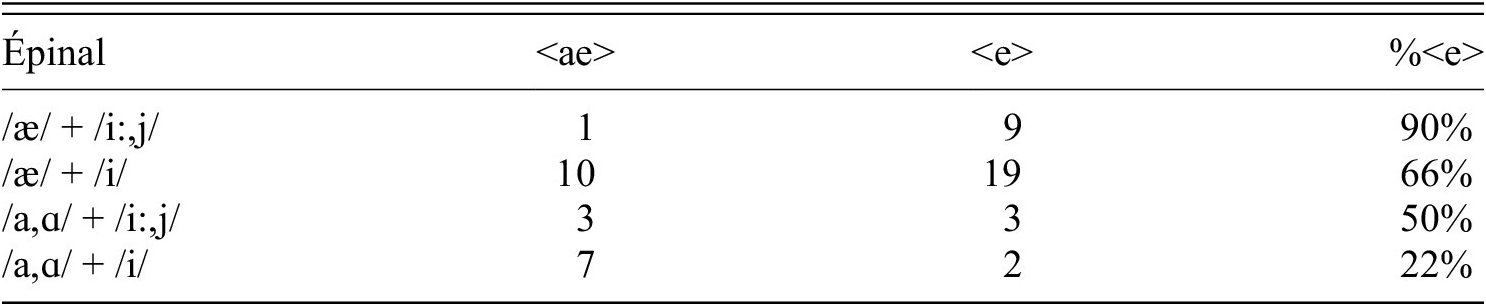
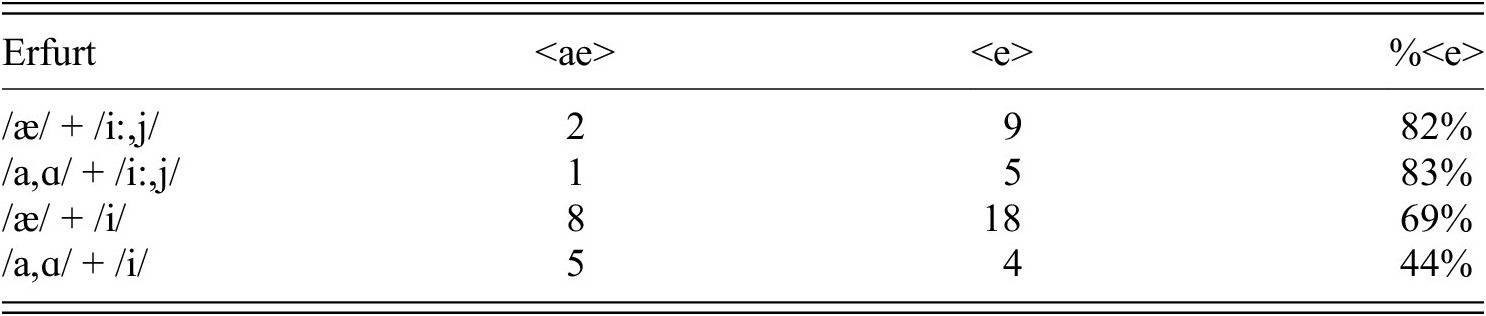
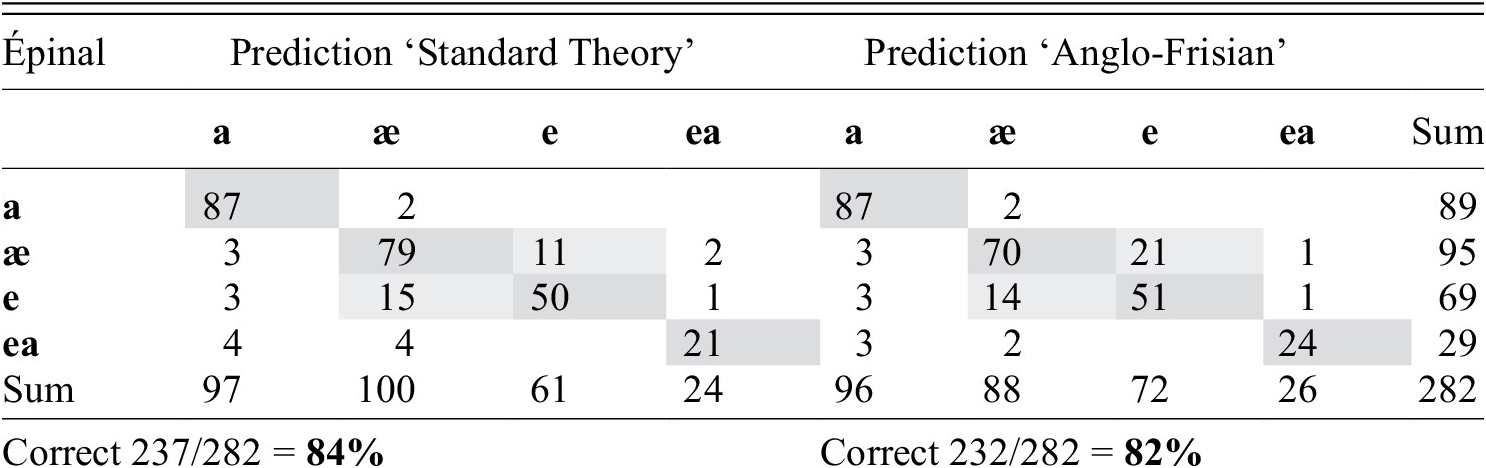
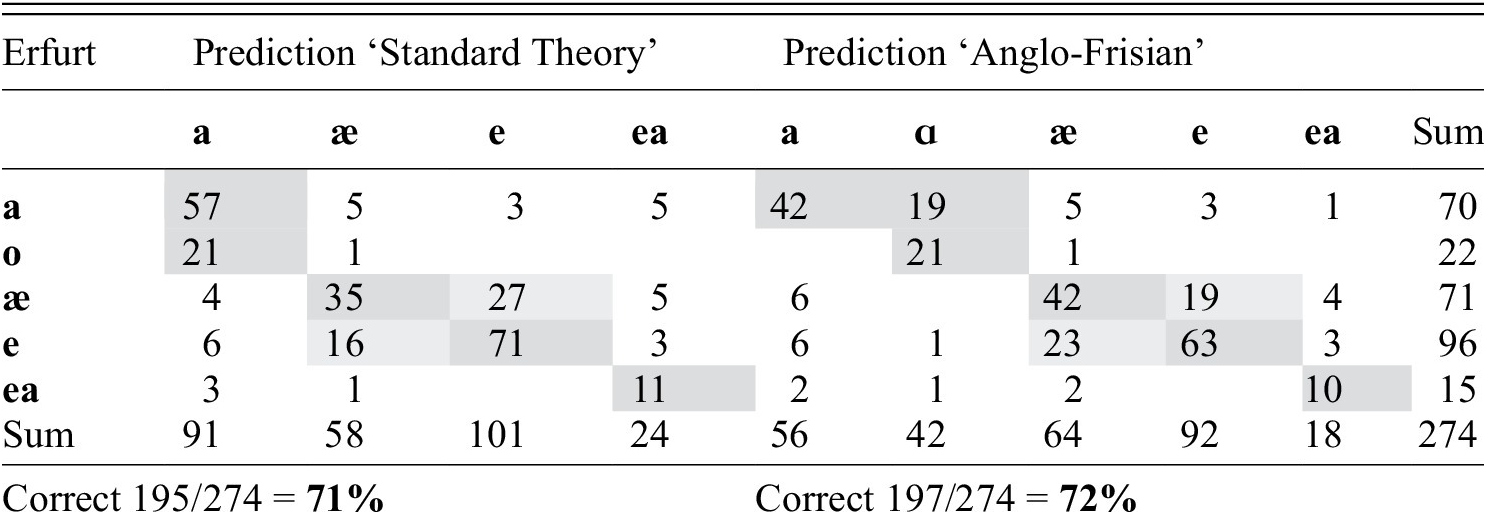
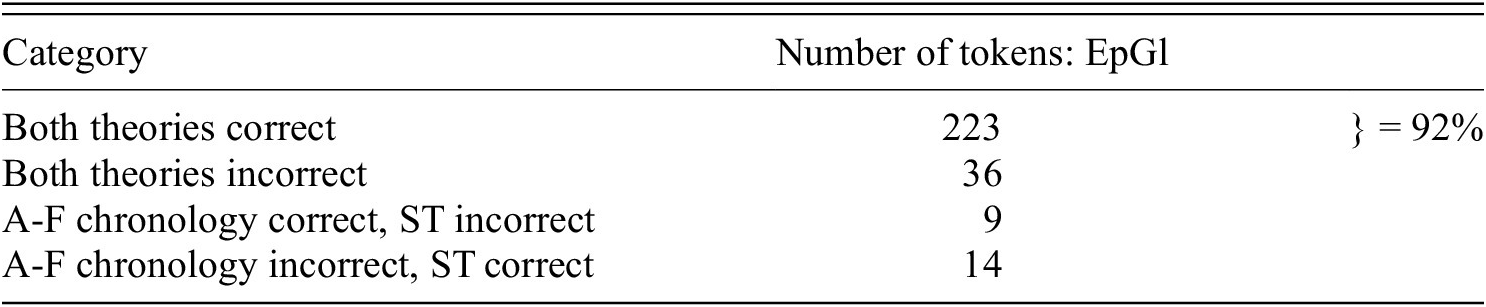
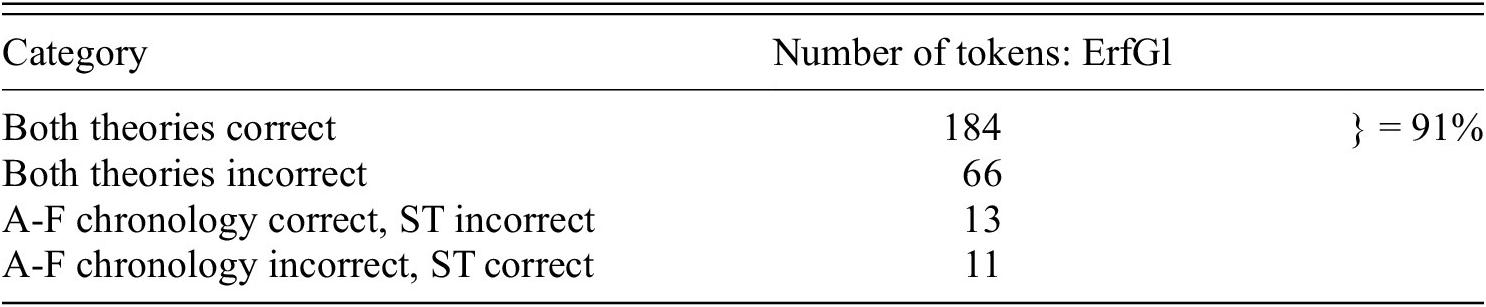
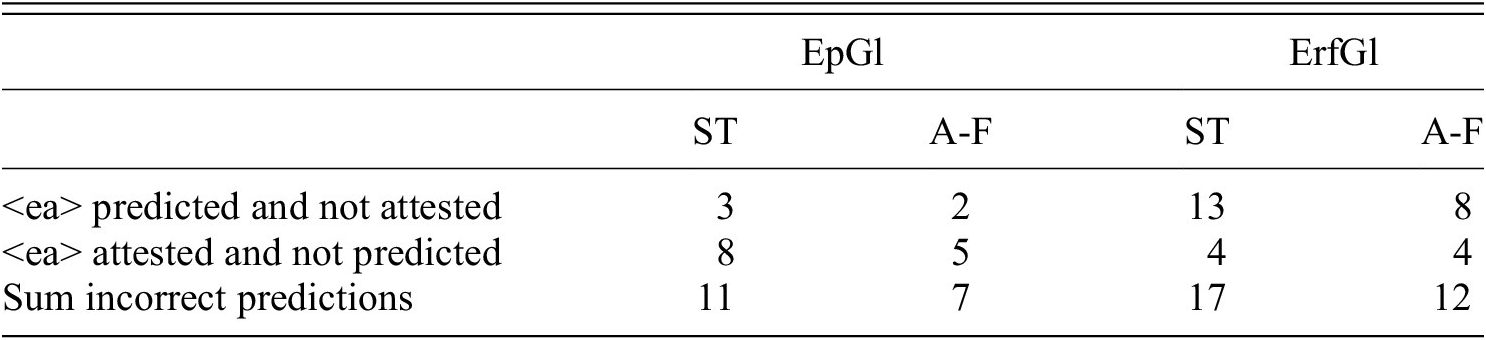

 Open access

