





1 Introduction
Lateral consonants are known to come in many phonetic shapes, even if the number of lateral phonemes for a given language is typically small (i.e., mostly 1, Ladefoged & Maddieson Reference Ladefoged and Maddieson2008). Nevertheless, even in languages with only a single lateral phoneme, often considerable allophonic variation in the articulation and acoustics is found. Constraints on this variation are linguistic (e.g., syllable position) as well as social (e.g., regional or social distribution) in nature. The present study is concerned with velarization in laterals as an allophonic opposition between plain alveolar non-velarized and alveolar velarized laterals in Austrian German. Such an opposition is well researched in varieties of English where, for instance, for British RP canonically the nature of the allophone is determined by syllable position with the non-velarized variant [l] in syllable-onset (‘clear lateral’) and the velarized variant [ɫ] in syllable-offset position (‘dark lateral’, see e.g., Gimson Reference Gimson1984). However, additional factors that have been identified as determining the velarization of English laterals are dialect region (Kirkham et al. Reference Kirkham, Turton and Leemann2020; Carter & Local Reference Carter and Local2007), ethnicity (Kirkham Reference Kirkham2017) and community (Decker & Mackenzie Reference Decker and Mackenzie2017). This broad range of varietal differences in the degree and positional distribution of /l/-velarization has also sparked a long-lasting debate on the phonological status of the lateral in English (see e.g. Turton Reference Turton2017). Similar differences have also been reported in other European languages, for example, in Catalan varieties (Recasens & Espinosa Reference Recasens and Espinosa2005). In Dutch, the velarization of laterals is reported to appear generally in the syllable coda and intervocalically after open back vowels (Mees & Collins Reference Mees and Collins1982). For European Portuguese, in contrast, Rodrigues et al. (Reference Rodrigues, Martins, Silva and Jesus2019) find that a previously assumed difference in velarization depending on position is virtually absent in their data.
In this paper we present acoustic analyses of the Bavarian German dialects in East Austria focusing on the realization of /l/ on a continuum between non-velarized alveolar [l] and strongly velarized alveolar [ɫ]. We use the term ‘velarization’ rather than ‘darkness’, which is used to describe variation in English laterals, because in the German literature this would lead to a possible confusion with retroflex laterals. In studies using auditory classification, presumably retroflex articulation has also been described as ‘dark’ (dunkel) in the German literature (Luick Reference Luick1996). Notably also the term ‘/l/-vocalization’ in the context of Bavarian dialects in Austria differs from the typical use with regard to English. In Austrian German ‘/l/-vocalization’ refers to an elision or substitution of /l/ by an [ɪ]-like vowel rather than a back vowel as has been found in English varieties (see Section 1.3 for more detailed information on both topics).
Like English, German and its varieties has a single lateral phoneme /l/, which by default is assumed to be realized as an alveolar [l] (Kohler Reference Kohler1990; Moosmüller et al. Reference Moosmüller, Schmid and Brandstätter2015). However, studies and reports on both Standard Austrian German (Luick Reference Luick1996) and Austrian German dialects (Kranzmayer Reference Kranzmayer1956; Moosmüller et al. Reference Moosmüller, Schmid and Kasess2016) suggest a range of allophonic alternations depending on various linguistic and social factors. Unfortunately, most of these reports use idiosyncratic terminology, cover only small geographical areas and discuss lateral consonants in the light of historical-comparative dialectology. Velarized [ɫ] in the context of German in Austria so far has almost exclusively been studied and discussed as a socially marked variant of the phoneme /l/ in the dialect of Vienna (Moosmüller Reference Moosmüller2016) and was assumed to be an almost exclusively urban Viennese feature. The present study investigates the rural dialects closest to the city of Vienna in the Austrian federal states of Lower Austria, Upper Austria, Styria and Burgenland. We test whether velarized [ɫ] does also occur outside of Vienna, and if so whether its use is subject to linguistic, regional or social constraints.
This paper starts out by giving an introduction to the acoustics and articulation of lateral consonants in Section 1.1, followed by a description of the German varieties in East Austria in Section 1.2. The descriptions of lateral allophony and variation in said varieties is summarized in Section 1.3 to provide the necessary context for the discussion of /l/-velarization in Section 1.4. This then leads up to the research questions in Section 1.5. Section 2 and its subsections report the details of the present study including materials, data collection, data preparation, and measurements. Results are presented in Section 3 followed by the discussion in Section 4.
1.1 Articulatory and acoustic aspects of lateral sounds
Lateral consonants are commonly defined as obstruents with a lingual constriction along the center line of the palate and openings for air flow at one or both sides of this constriction (Ladefoged & Maddieson Reference Ladefoged and Maddieson2008). In the world’s languages voiced alveolar laterals are the most common and have been described most thoroughly in terms of acoustics and articulation (Stevens Reference Stevens1998; Fant Reference Fant2012). In line with the object of this study, mainly alveolar laterals and their velarization will be discussed here. Additionally, retroflexion as a contrasting manner of articulation is shortly described, since it is necessary to differentiate between velarized and retroflex laterals when dealing with data from East Austrian German (see Section 1.3).
The alveolar lateral [l] and the velarized alveolar lateral [ɫ] exhibit a defining tongue gesture in which the tongue tip or tongue blade forms an occlusion in the alveolar to dental region. This configuration of the vocal tract together with glottis activity leads to a vowel-like formant structure when analyzed in the spectrogram (despite some differences in the expected formant values depending on the model; see Fant Reference Fant2012; Stevens Reference Stevens1998; Johnson Reference Johnson2008). The velarized alveolar lateral [ɫ] is characterized by an additional secondary gesture in which the tongue root is retracted towards the velum or pharyngeal wall. In terms of acoustics, the resulting longer back cavity leads to a comparatively low second formant (Sproat & Fujimura Reference Sproat and Fujimura1993; Narayanan et al. Reference Narayanan, Alwan and Haker1997). Therefore, in the absence of articulatory data, F2 is commonly used as the main acoustic parameter to determine the degree of velarization with lower F2 values corresponding to stronger velarization. Based on various European languages with a phonemic contrast between /l/ and /ɫ/, Recasens (Reference Recasens2012) describes an F2 of 1500–2000 Hz for /l/ and 800–1200 Hz for /ɫ/ as the typical ranges. By comparing Albanian with the Viennese dialect of German, Moosmüller et al. (Reference Moosmüller, Schmid and Kasess2016) showed that the phonological contrast between alveolar /l/ and velarized /ɫ/ in Albanian leads to a relatively clear-cut distribution of F2 values with /l/ exhibiting high (mean value of 1501 Hz) and /ɫ/ exhibiting low F2 values (mean value of 1069 Hz), while the single lateral phoneme in Viennese dialect exhibited variation along a continuum (see Section 1.4). Here we adopt the notion of velarization as a continuum from non-velarized to velarized.
While the focus of the present study is on the alveolar non-velarized to velarized continuum of Austrian German laterals, a brief note on retroflexion and the associated lateral consonant [ɭ] is warranted. Retroflex obstruents are characterized by a contact of the tongue tip or its underside in the postalveolar or palatal region. On basis of the English rhotic, Stevens (Reference Stevens1998) describes the acoustic effects of retroflexion as introducing a new resonance frequency between F2 and F3 at around 1800 Hz associated with the sublingual cavity formed by bending the tongue backwards. This new resonant frequency takes on the role of F3, resulting in a comparatively low F3 in close proximity to F2. At the same time a spectral zero is introduced at around 2000 Hz, weakening F3 and higher formants. F2 and F3 will be used here to differentiate retroflex laterals from velarized ones.
1.2 German in East Austria
The language situation in East Austria is commonly described as diaglossic (Auer Reference Auer, Delbecque, van der Auwera and Geeraerts2005) with Standard Austrian German (SAG) as the high prestige variety and various Bavarian dialects as lower prestige varieties. While SAG is very similar to the spoken Standard in Germany, it retains a variety of distinct features such as devoicing of the lax plosives /b/ and /d/ and the use of /ɛ/ instead of /ə/ in unstressed syllables, to name but two examples (Moosmüller et al. Reference Moosmüller, Schmid and Brandstätter2015). The Bavarian dialects maintain numerous phonological differences compared to SAG, but varieties are in constant contact. The vast majority of speakers in Austria have at least some command over both SAG and one or more dialectal varieties. Especially in East Austria code mixing and code switching is commonplace dependent on pragmatic factors (Moosmüller Reference Moosmüller1991; Soukup Reference Soukup2009).
In this study, the varieties under investigation are the Bavarian base dialects of East Austria. The term ‘base dialect’ is used in the context of Austrian German to specifically denote ‘the most ancient, rural, conservative dialect’ (Auer Reference Auer, Delbecque, van der Auwera and Geeraerts2005: 8–9) to distinguish it from other non-standard varieties. With the exception of the Alemannic speaking federal state of Vorarlberg, the Austrian German dialects are classified as part of the Bavarian dialects. The city of Vienna is regarded as the Eastern center of the Central Bavarian (CB) dialect region due to its position as cultural and political capital of Austria. Since the twelfth century, this manifests itself linguistically in the spread of Viennese features across the whole region, especially along the Danube River (Wiesinger Reference Wiesinger1983, Reference Wiesinger and Russ1990). The Central Bavarian dialect area can be further divided into a Western and Eastern part. Upper Austria houses several dialectal isoglosses forming a transition zone between Western Central Bavarian (WCB) in the Innviertel region in Upper Austria and Flachgau region in Salzburg (continuing to Germany to the West) and Eastern Central Bavarian (ECB) in most of Lower Austria, Vienna and Northern Burgenland (Lenz Reference Lenz2019; Wiesinger Reference Wiesinger and Russ1990). To the South lies a broad transition zone towards the South Bavarian dialect region referred to as South Central Bavarian (SCB). In East Austria, the SCB region encompasses most of Styria and Middle and Southern Burgenland and exhibits a gradual and locally individual change between historically younger Central Bavarian and older South Bavarian characteristics. Naturally, speakers of this linguistically dynamic region tend to have a comparatively broad repertoire of dialectal variants. While some typical Central Bavarian features like /l/-vocalization (see Section 1.3) have become considerably more common in the Northern parts of the region (Vollmann et al. Reference Vollmann, Hobel, Seifter and Pokorny2017), other features like the second Viennese Monophthongization seem to progress at a slower rate if at all (Vergeiner et al. Reference Vergeiner, Jan Luttenberger, Wallner and Britain2023). Note that the regional categorization of the Bavarian dialects as outlined above heavily relies on the assumption of stable rural base dialects, which they are likely not. Nevertheless, since the present study was designed to assess the base dialectal end of the varietal spectrum as closely as possible, we still use it as a guideline, however, with some modification of grouping the locations according to geographic closeness (see Section 2.2). Since to date, /l/-velarization has mainly been treated as a feature of Viennese dialect, the focus of the present study is on East Austria and the areas adjacent to Vienna rather than covering all of Austria. In addition to the Central Bavarian area a number of locations in Northeast Styria and Burgenland in the South Central Bavarian area were included, since historically this region has also regularly adopted Central Bavarian features in its base dialects.
Overview over the variants of /l/ throughout East Austria. Numbers in the first column refer to the more detailed description below. The column /l/-Variant gives the respective IPA symbols, Context the phonotactic context in which the variant occurs. Region describes the approximate geographical distribution, Variety whether the variant occurs in standard or dialect and Reference gives a reference in the literature where the given allophone is mentioned

1.3 Laterals in East Austrian German varieties
As mentioned at the beginning, German is considered to have only a single lateral consonant phoneme realized as alveolar [l] (for Germany, see e.g., Kohler Reference Kohler1990; for Austria see Moosmüller et al. Reference Moosmüller, Schmid and Brandstätter2015). In Standard German the quality of adjacent vowels has been suggested to influence the realization of [l] as briefly noted in the textbook of Neppert & Pétursson (Reference Neppert and Pétursson1992) as well as in two small-scale studies reporting four speakers from Bavaria and Swabia (Recasens et al. Reference Recasens, Fontdevila and Dolors Pallarès1995) and four speakers from Berlin (Recasens Reference Recasens2012). Back vowels adjacent to the lateral consonant lead to a lowering in F2, in line with velarization. Recasens (Reference Recasens2012) reports F2 values ranging from 1734 Hz in /ili/ to 1316 Hz in /ala/.
When it comes to the varieties of German in East Austria, the realization of the phoneme /l/ shows considerable variation depending on phonological context as well as the specific language variety. The alveolar lateral consonant [l] is regarded as the default realization of the phoneme /l/, which alternates allophonically with the velarized alveolar lateral [ɫ], the retroflexed lateral [ɭ] and the palatal or velar laterals [ʎ] and [ʟ]. Furthermore, in Central Bavarian dialects (as opposed to South Central Bavarian dialects), /l/ is deleted or replaced by an [ɪ̯]-like vowel in a process commonly referred to as /l/-vocalization. The different variants that have been mentioned with regard to the Austrian German lateral are summarized in Table 1 and further described below.
1) Velarized alveolar [ɫ] has been described as socially marked Viennese variant of alveolar /l/ (see Section 1.4).
2) The palatal lateral consonant [ʎ] formed with the back of the tongue or the velar consonant [ʟ] formed with the tongue root can appear as an assimilatory product after the palatal and velar consonants /ɡ/, /k/, [ç] and [x] (Moosmüller et al. Reference Moosmüller, Schmid and Kasess2016). This process has been described for historical Standard German in Vienna at the beginning of the twentieth century by Luick (Reference Luick1996: 65). Moosmüller (Reference Moosmüller2016) also assumes such an assimilation for Viennese dialect but suggests the palatalized alveolar lateral [lʲ].
3) The retroflex lateral consonant [ɭ] may be used in consonant clusters after labial consonants, and after back vowels and /a/ both in SAG (Luick Reference Luick1996: 44–45) and Viennese dialect (Moosmüller Reference Moosmüller2016). In Eastern Central Bavarian dialect, retroflex [ɭ] also appears in ambisyllabic word-medial position (e.g., /tøɭːɐ/ Teller ‘plate’)Footnote 1. Additionally, in the South Central Bavarian dialects of Styria and Burgenland, [ɭ] is also found in syllable coda position, contrasting with the /l/-vocalization (see below) of the Central Bavarian dialects (Kranzmayer Reference Kranzmayer1956).
4) In Eastern Central Bavarian dialects, /l/ in syllable coda position is subjected to the so-called ‘/l/-vocalization’: /l/ is not realized as a consonant, but either as an [ɪ]-like element forming a diphthong with the preceding vowel after back vowels (e.g. /hoɪ̯t͡s/ Holz ‘wood’) or omitted while the preceding vowel is rounded after front vowels (e.g. /myç/ Milch ‘milk’). In unstressed syllables, /l/-vocalization does not apply to /l/ after alveolar phones, where /l/ is realized as a syllabic lateral consonant [l̩] and may be velarized to [ɫ̩] (e.g. /sesːl̩/ Sessel ‘chair’). Furthermore, /l/ is not vocalized in diminutive forms like /ɡ̊lasl̩/ or /ɡ̊lasɐl/ Glaserl ‘small glass, cup’, where /l/ is either syllabic or preceded by /ɐ/ (see Kranzmayer Reference Kranzmayer1956: 120–121; Wiesinger Reference Wiesinger and Russ1990: 459, 463 for more extensive overviews).
It has to be noted, that thorough phonetic descriptions of laterals in Austrian German varieties are sparse. Especially in older literature on regional variation, descriptions of laterals tend to be impressionistic and use heterogeneous terminology with regard to the articulatory and acoustic properties of laterals. This may lead to confusion if not read carefully and critically (see the discussion in Pauritsch Reference Pauritsch1984 as an example for the struggle with articulatory descriptions and their interpretations). Aside from the recent studies of Moosmüller et al. (Reference Moosmüller, Schmid and Kasess2016) and Schmid et al. (Reference Schmid, Moosmüller and Kasess2017) focusing on the differentiation between the alveolar realization [l] and [ɫ] in Viennese dialect, the descriptions of lateral realizations in the existing literature rely solely on auditory judgments and introspection. While we deem the descriptions summed up above reasonably reliable, they might prove to be inaccurate or incomplete in the light of improved methodology and technical possibilities. In the context of this study, this is especially important in the distinction between velarized [ɫ] and retroflex [ɭ]. Both have been referred to as dunkel ‘dark’ and their differentiation was accomplished by references to vowel qualities, for instance, in Kranzmayer (Reference Kranzmayer1956) as u-haltig ‘/u/-containing’ for [ɫ] versus ü-haltig ‘/y/-containing’ for [ɭ]. Importantly, in spectrographic analyses those phones can be differentiated by the relative location of the second and third formants (see Section 2.4.1). While the investigation of retroflexion and its interaction with other realizations of laterals presents a desideratum on its own, it is beyond the scope of the present paper. Hence, only velarized laterals in the Central Bavarian dialects (CB) of East Austria will be discussed in detail below.
1.4 Velarization in the context of non-standard varieties of German in East Austria
As of now, /l/-velarization has been discussed almost exclusively in the context of Viennese dialect, which has been described as less of a spatial non-standard variety, but more of a socially differentiating variety (Moosmüller Reference Moosmüller1987). In that context, /l/-velarization has been described as a rather salient feature of lower-class speech, where it was historically observed since the beginning of the twentieth century in Vienna (Koekkoek Reference Koekkoek1953; Kranzmayer Reference Kranzmayer1956). /l/-velarization in Vienna is often associated with the influx of Czech-speaking migrants from Bohemia during the nineteenth and early twentieth century (e.g., Moosmüller et al. Reference Moosmüller, Schmid and Kasess2016), but this view has been debated (e.g., Pohl Reference Pohl, Hans Goebl, Nelde and Wölck1997) since Czech unlike many other Slavic languages only features a single lateral phoneme tending towards a clear apico-alveolar pronunciation (but see, e.g., Šimáčková Reference Šimáčková2009, for a discussion of complex dialectal variation). Due to the lack of historically oriented phonetic studies, the debate on the origin of velarized [ɫ] in Vienna remains inconclusive by now and would also go beyond the scope of the present study. In Viennese dialect in the second half of the twentieth century and later, [ɫ] is reported to occupy a number of phonotactically defined positions as Moosmüller et al. (Reference Moosmüller, Schmid and Kasess2016) found in recordings of homeless people from the 1970s:
-
word-initially, for example /ˈlæːd̥ɛr/ → [ˈɫæːdɑ] leider ‘unfortunately’;
-
after alveolar and postalveolar consonants, for example /ˈsæːd̥ɛl/ → [ˈsæːɫ̩] Seidel ‘small glass of beer’ or /ˈʃlɔːɡ̊ɛn/ → [ˈʃɫɔːŋ̩] schlagen ‘to beat’;
-
in the vicinity of back vowels, for example /ˈholɛr/ → [ˈhoɫɑ] Holler ‘elder’.
[…] if velarization occurs, it only and without exception occurs in the above-mentioned contexts, and never after bilabial or velar consonants (Moosmüller et al. Reference Moosmüller, Schmid and Kasess2016: 491–492).
Therefore, Moosmüller et al. (Reference Moosmüller, Schmid and Kasess2016) suggest that [ɫ] might have completely supplanted [l] (but not [ɭ] after labial and velar sounds) as the lateral phoneme in Viennese dialect. However, the empirical results in Moosmüller et al. (Reference Moosmüller, Schmid and Kasess2016) do not support this hypothesis since female speakers hardly use any velarized laterals and male speakers only in the phonetic context of back vowels. Similar results are reported in Schmid et al. (Reference Schmid, Moosmüller and Kasess2017): Velarized [ɫ] as defined by an absolute F2 of <1300 Hz was only used in 63% of word-initial and 68% word-final laterals when uttered by male speakers. Female speakers used even fewer tokens of velarized [ɫ] with only 6% in word-initial and 46% in word-final position. While contradicting a complete shift towards [ɫ] in Viennese dialect these findings reveal a preference for velarization in word-final position and considerable differences between male and female speakers. As an explanation for the differences in gender Schmid et al. (Reference Schmid, Moosmüller and Kasess2017: 102–103) suggest that women avoid the Viennese dialect due to its low prestige.
Regarding perception, [ɫ] stands as an index for Viennese dialect as a whole, and Viennese speakers are expected to exhibit velarized laterals in order to be recognized as Viennese: Moosmüller (Reference Moosmüller2012) used the recordings of actors trying to speak Viennese dialect to test whether listeners both from Vienna and elsewhere in Austria would notice the absence of [ɫ], but also misapplications of /l/-velarization. These misapplications included the contexts mentioned above in which retroflex [ɭ] would be expected. Both absence and misapplication of [ɫ] resulted in less favorable ratings regarding authenticity of the speaker as genuine Viennese.
Outside of Vienna, the status of /l/-velarization remains largely unaddressed so far. Despite the heavy focus on Vienna in the existing literature, [ɫ] is also briefly mentioned in descriptions of local dialects in Lower Austria (Brunbauer Reference Brunbauer1956) and Upper Austria (Keller Reference Keller1961). There, [ɫ] is reported to occur in word-final position and its acoustic impression is compared to the ‘dark’ lateral in English. For these (sparse) early accounts, a spread from the urban Viennese dialect into the mentioned local rural dialects seems unlikely. In contrast to these remote locations, a recent small-scale study of seven speakers (Rausch-Supola et al. Reference Rausch-Supola, Moosmüller, Leykum, Schmid and Luttenberger2022) found [ɫ] in the local dialect of speakers from Neunkirchen, a small town in Lower Austria (around 12,500 inhabitants) 60 km to the South of Vienna. Neunkirchen is part of an old industrial region with direct railway access to Vienna since the first half of the nineteenth century (Harather Reference Harather2019), hence linguistic influence from Vienna would be possible for this location. However, while a historical spread could not be shown with these data, the study on Neunkirchen provides some acoustic measurements. According to the categorization of /l/ as velarized with an absolute F2  $\lt =$ 1300 Hz, male speakers in Neunkirchen produced around 85% of their laterals in both word-initial and word-final position as [ɫ]. For female speakers, around 12% of word-initial and 63% of word-final laterals were found to be velarized. However, male and female speakers also differed in age. The male speakers were at least forty-five and the female speakers were largely around seventeen years old. Due to this confound, the results of Rausch-Supola et al. (Reference Rausch-Supola, Moosmüller, Leykum, Schmid and Luttenberger2022) have to be interpreted with caution. Nevertheless, the few existing previous studies on /l/-velarization show that the phenomenon is not areally limited to the city of Vienna but also present in the non-standard varieties of the Eastern Central Bavarian dialect region in Upper and Lower Austria. Therefore, it might be a more general ECB feature than previously thought, but in the absence of comprehensive studies this remains to be tested.
1.5 Research questions
As can be inferred from the previous section, lateral allophony seems common in Austrian German, yet a comprehensive account on /l/-velarization outside of Vienna is missing. With Vienna and Neunkirchen only two urban areas have been studied, and these are the only studies where acoustic parameters have been measured. Those studies will serve as a point of reference for studying rural varieties around Vienna in Lower Austria and reaching into adjacent dialect areas. This will allow for a (re)evaluation of dialectological descriptions dating back to the first half of the twentieth century (e.g. Kranzmayer Reference Kranzmayer1956; Brunbauer Reference Brunbauer1956) with acoustic measurements. Furthermore, the German varieties of East Austria present the opportunity to investigate different lateral consonants in the same language, which do not contrast phonemically, but allophonically. As mentioned above, the focus of the present study will be on the alveolar non-velarized to velarized continuum.
Firstly, the present study assesses the areal distribution of /l/-velarization, since so far it has been associated mainly with Viennese non-standard varieties. Secondly, it will assess the contrast between laterals in word-initial and word-final position, since this contrast in position has been found to be an important factor in other Germanic languages including English and is hinted at in the existing studies on Austrian German. Lastly, speaker gender and age (an older vs. a younger group) are investigated as additional social factors. This is because the existing studies on /l/-velarization found male speakers to use [ɫ] more frequently compared to female speakers and age group may offer insights on whether the usage of [ɫ] might differ (or even change) between generations. Specifically, this study addresses the following questions:
Regional distribution: Can we observe /l/-velarization outside of Vienna? If so, is /l/-velarization more common close to Vienna, so as to suggest a spread from the city into its vicinity throughout Central Bavarian dialects? Moreover, does the direction (East-to-West and East-to-South) from Vienna towards different bordering dialect areas influence the use of velarized /l/?
Linguistic factors: What influence has word-initial vs. word-final position on the articulation of laterals in Austrian German? Can we observe the presence or absence of a complementary distribution similar to varieties of English and other European languages?
Social factors: Do we see any tendencies related to female vs. male speakers? Can we observe a difference between two generations of speakers?
As for the regional distribution, distance from Vienna (in kilometers by street) was used as a readily available parameter to roughly estimate whether Vienna could be the origin of /l/-velarization. However, since distance does not necessarily equal connectedness, this approach has limitations with regard to a sociolinguistic perspective (see Britain Reference Britain, Chambers, Trudgill and Schilling-Estes2002 for a discussion of space as a factor in language variation), yet it should provide first insights into this issue.
As for linguistic factors, another potentially relevant factor might be the immediate phonetic context of the lateral (see e.g., Recasens Reference Recasens2012). In practice, however, the exact phrasing of items varied across speakers, which led to variation in the phonetic context preceding the lateral. For example, in the single word translation task, speakers would occasionally include personal pronouns in their utterances when providing conjugated forms of a verbal paradigm, for instance, /d̥ulest/ du liest ‘read 2.SG’, where the lateral then would be preceded by the vowel /u/ rather than a pause. Since this was not controlled for in the recordings, phonetic context was not adopted as a variable.
Finally, with regard to social factors, the number of available speakers per gender and age group was restricted by the corpus (see Section 2.1). Therefore, conclusions about the social stratification of /l/-velarization for single locations have to be taken with caution. Over the whole area, the present study may serve as a vantage point for further studies, since it provides formant values as reference for a range of different female and male speakers, addressing the lack of available data so far. By including two generations, we can give a first general overview over recent developments in the base dialect in the sense of the apparent-time paradigm (Chambers Reference Chambers, Chambers, Trudgill and Schilling-Estes2002).
2 Methods
To address the research questions stated in Section 1.5 and provide an overview on the status of /l/-velarization in East Austrian dialects, we conducted a study based on the recordings of sixty-eight base dialect speakers. Fifty-four items containing /l/ were selected for a first round of expert auditory classification by two phoneticians (the first and the second authors) based on the perceived manner of articulation. Alveolar realizations were then further parametrized by measurements of F1 and F2 to assess the degree of velarization. In Section 2.1 the corpus and the speakers are described in detail, Section 2.2 follows up with a closer description of the area under investigation. Information on the item selection procedure is provided in Section 2.3 and Section 2.4 provides details on the auditory classification and formant measurements.
2.1 Data/Material
Recordings for analyses were taken from the corpus of the Special Research Programme ‘German in Austria’ (SFB, Lenz Reference Lenz2018). The material collected in this corpus is planned to be made publicly available after the project has been concluded. For the present study, a sub-corpus from the recordings of Project Part 02 was selected. It consists of the recordings of sixty-eight speakers from seventeen different locations in East Austria. All locations are small towns below 2,500 inhabitants. For each location, four speakers were recorded, two female, two male, one of each being a younger speaker (eighteen to thirty-five years of age) and one an older speaker (sixty years of age or older). All speakers were selected for suitability as base dialect informants (cf. Chambers & Trudgill (Reference Chambers and Trudgill1998: 29–30). They were born and raised at the location of recording, as were their parents and spouses; they work in manual professions, mostly agriculture at their place of residence or nearby. For every speaker a trained field worker recorded a questionnaire, consisting of:
An introductory part, mostly asking for culinary lexemes to establish the speaker in the setting of the recording.
Three blocks of a sentence translation task (STT). The field worker read aloud a sentence in Standard Austrian German and asked the informant to translate it into their ‘best base dialect’.
Two blocks of a single-word translation task (SWT). This task was similar to the sentence blocks, but most elicitations consisted of only a single word or lexeme.
One block of a picture naming task (PNT). The speaker was presented with an image and had to name the object in the picture. Additional plural and diminutive forms were elicited by finger gestures, keeping verbal input to a minimum.
If a recording was in some way disturbed or the speaker produced hesitations or errors, a repetition of the production was requested. The present study used items from the sentence and word translation tasks as well as the picture naming task as summarized in Table 3 in Section 2.3 below.
Since /l/-velarization is considered socially marked (see Section 1.4; see also Moosmüller Reference Moosmüller1991) a possible concern of using elicited data is that speakers may try to avoid stigmatized variants. However, from a practical perspective the corpus provided the opportunity to keep the circumstances of recording similar over many speakers from different locations. Importantly, for Austria it has recently been shown that translation tasks like the ones used here may elicit more (base) dialectal forms compared to spontaneous speech obtained in interviews or conversations among peers (Fanta-Jende Reference Fanta-Jende, Alexander Werth, Pfenninger and Schiegg2021).
Overview of recording locations, sorted by geographical region (Eastern, Southern, Western). Location gives the name of the location in which recordings were made, Abbreviation refers to the two-letter shorthand used throughout this article, Dialect region refers to the dialect classification in Wiesinger (Reference Wiesinger1983; WCB = Western Central Bavarian, ECB = Eastern Central Bavarian, SCB = South Central Bavarian), Distance gives the location’s distance to Vienna in kilometers when travelled by road

Map of Austria showing the recording locationsFootnote 2. The shapes of the symbols indicate the dialect region of the locations, the color of the shapes indicate the geographical region a location was associated with as defined in our study (see Section 2.2). Dotted lines in the map indicate the dialect borders between the subregions of Central Bavarian (ECB = Eastern Central Bavarian, SCB = South Central Bavarian, WCB = Western Central Bavarian, SB = South Bavarian, see Section 1.2). The small map in the lower left corner shows the location of Austria in Europe.

2.2 Area under investigation
Seventeen locations in the Eastern parts of Austria (locations will be referred to via two-letter abbreviations; see Table 2 and Figure 1) were selected and grouped into three regions largely based on dialect region as outlined in Section 1.2. Specifically, we selected five locations from the easternmost section of the Central Bavarian dialect region to represent the region around Vienna (locations: AB, KA, PU, UW, WE). We will refer to these locations as the ‘Eastern’ region and use it as the reference in our analyses since it represents the area closest to Vienna. Additionally, we selected six locations to the South of Vienna in the South Central Bavarian transition zone (‘Southern Region’ AP, EZ, FA, KB, SS, TU) and five locations in the Central Bavarian region towards the West (‘Western Region’: BD, GP, MI, UB, LS – where LS is added here for geographical proximity). Note that for the grouping into ‘Eastern’ and ‘Western’ we opted for a geographical grouping based on the locations available, also due to the lack of a well-established dialectal border. Figure 1 shows a map of Austria with the selected recording locations and the associated dialect regions.
List of items selected for analyses. ‘Lexeme’ refers to a lexeme translated in the corpus. Note that in this table different forms of the same word, e.g. verb forms, are subsumed under the same label in Lexeme. ‘English translation’ gives a translation of the specific lexeme. ‘Position of /l/’ refers to the position of /l/ in the lexeme with ‘initial’ meaning word-initial, ‘final’ meaning word-final and ‘vocalization’ meaning in a position potentially undergoing /l/-vocalization (see Section 1.3). ‘Task type’ gives the manner of elicitation with ‘STT’ being sentence translation task, ‘SWT’ being single-word translation task and ‘PNT’ being picture naming task (see Section 2.1). ‘n’ refers to the number of items investigated per lexeme and speaker

2.3 Item selection
From the corpus, fifty-four target words were selected as items (see Table 3; roughly the same items for each speaker; for details see below and the materials provided on OSF https://osf.io/3em92/). The selection of items was restricted in multiple ways. Firstly, as described in Sections 1.3 and 1.4, several phonetic contexts had to be excluded due to /l/ being subjected to phonological processes that made the realization of /l/ as an alveolar lateral consonant unlikely. For word-initial /l/, only items with sole /l/ in the syllable onset were selected to avoid assimilatory processes within a consonant cluster. For word-final /l/, the selected items had to be two syllables long with an alveolar phone preceding /l/ so that /l/ would not be affected by the process of Central Bavarian /l/-vocalization where the lateral is realized as [ɪ]-like phone. /l/ in word-medial position was not included since for base dialects in the area under investigation laterals in this position are most likely produced as a retroflex. Combined with the fact that the corpus was not created specifically for the investigation of laterals, the number of available items was restricted, leading to twenty-two items with /l/ in word-final position and thirty-two items with /l/ in word-initial position.
Originally, the study design included the research question how /l/ is realized when the process of /l/-vocalization is not applied. Therefore, the selection includes three ‘control’ items in which /l/ should be affected by /l/-vocalization in Central Bavarian dialects, but not necessarily in South Central Bavarian dialects. However, during the analysis it turned out that in these control items, /l/ was either affected by /l/-vocalization anyway or it was realized as a retroflexed lateral consonant [ɭ]. Since this absence of alveolar realizations rendered the control items irrelevant for the investigation of /l/-velarization, the control items were not analyzed beyond a basic auditory categorization. However, the conditions under which vocalization vs. retroflexion occur might be a topic for further research.
2.4 Data preparation and measurements
All recordings were made with a Røde M2 microphone and Roland R-44 portable recorder. Spectrographic inspection and formant measurements were conducted with the software package Sound Tools eXtended (STx, Noll et al. Reference Noll, Jonathan Stuefer, Hannah Leykum, Luttenberger, Pucher and Schmid2019) using the setting of the profile ‘Speech-Analysis’. As a first step, the lateral realizations in critical items were categorized by a combination of auditory judgment and visual inspection of the spectrogram and oscillogram by phonetically trained researchers (i.e., the first and second authors). The results of this categorization are presented in Section 2.4.1. As a second step, in all realizations that were categorized as alveolar lateral, measurements of the first two formants were taken and used as the basis for statistical analysis by linear-mixed effects models reported in Section 2.4.2.
2.4.1 Lateral categorization
The categorization process was carried out by the first and second authors. As the first step of the analysis, the laterals in the selected items were assessed through listening and visual inspection of the spectrographic information. In total, this encompassed 3,728 items from sixty-eight speakers. Unless an unexpected lexical item was produced and/or no lateral could be detected (and hence that token was labeled ‘N/A’) segmental boundaries for /l/ were determined by visible discontinuities in the spectrogram. In case of adjacent voiceless elements, the onset of voicing in the lateral was chosen as the boundary. For voiced elements, changes in formant structure and overall amplitude were used with transitions not segmented as part of the lateral. For alveolar /l/ in word-initial position, in many cases an alveolar closure was visible in the spectrogram, which was also used as indication for a boundary. Gradual changes from a vowel to the lateral in word-final position that are often reported as difficult to segment due to the similarity of the formant structure (e.g., in English; see Hall-Lew & Fix Reference Hall-Lew and Fix2012) turned out to be not a problem in our corpus. This was due to the phonotactic restrictions in Austrian dialects where the only vowels preceding /l/ had an /ɐ/-quality to them. In these cases, /l/ was segmented based on F1 to start after the transition from /ɐ/ to /l/. (Note that in other vowel contexts laterals tend to be vocalized or produced as retroflex, and those cases were excluded from analyses here; see Section 1.3).
Following segmentation, the laterals were categorized using the available spectral information and auditory judgment. As can be seen in Table 4, 97.3% of all cases fell into five categories. Before we discuss the alveolar lateral realizations (75.2%) that were the main focus of our research questions, we briefly comment on the four most frequent categories besides the alveolars.
The second largest group of laterals in our selected items were retroflex laterals (8.7%). Those were mainly identified via inspection of the spectrogram by having a relatively low F3 (around 1800 Hz) close to F2, as described in the model of Stevens (Reference Stevens1998) and descriptions of /ɭ/ in Tamil (Narayanan et al. Reference Byrd and Kaun1999). As reported in Moosmüller et al. (Reference Moosmüller, Schmid and Kasess2016), retroflexes appeared where /l/ was preceded by a labial due to the specific lexical item used by a given speaker or in the control items. The third largest group of lateral realizations (7.2%) were [ɪ̯]-like vowels as a result of /l/-vocalization. Vowels from /l/-vocalization were mostly found in the control items (see Section 1.3). Additionally, some diminutives from the Western Central Bavarian locations UB and BD exhibited /l/-vocalization also after alveolar phones, which falls in line with the literature (Kranzmayer Reference Kranzmayer1956: 120–121). A fourth sizeable category (3.2%) was formed by realizations of /l/ as a voiceless fricative, which rendered formant measurements impossible. These fricatives occurred mostly in the vicinity of other voiceless segments. A more detailed description of these realizations is beyond the scope of the present study (see also the materials on OSF for a complete list of categorizations).
Categorization of items according to inspection of the spectrograms. ‘Alveolar’ refers to realizations as alveolar lateral consonants with or without velarization as a secondary articulation. ‘Retroflex’ refers to realizations judged as retroflex lateral consonant. ‘Vocalization’ refers to vocalic realization as an [ɪ̯]-like second part of a diphthong formed with the preceding vowel. ‘Fricative’ refers to realizations as voiceless fricative consonants without visible formant structure. ‘Not available’ means missing or altered items without /l/. ‘Other’ subsumes rare realizations such as taps. Only realizations of the Alveolar category were included in further analysis.

2.4.2 Formant measurements
In all realizations categorized as alveolar lateral consonants (n=2804) formant measurements were conducted. To estimate the degree of velarization of these tokens, automatic measurements of the first and second formants (F2) were taken at twenty points evenly spread out throughout the lateral. Every measurement was checked by a trained phonetician through visual inspection of the spectrogram and corrected if necessary. For further analyses, the mean of the middle three measurement points (i.e., points nine to eleven) was used. Since physiological differences in vowel tract length may lead to differences in formant values for the same articulatory configuration, the difference between F2 and F1 was employed as a means of normalization between speakers (Sproat & Fujimura Reference Sproat and Fujimura1993) and used as the input for the statistical analyses.
3 Analyses and results
In the following section, the statistical analyses based on the measurements of F2 in realizations categorized as alveolar lateral consonants (see Section 2.4.2) is presented. Since multiple fixed factors and their interactions were included, a forward modelling approach was chosen. General factors and coding are reported in Section 3.1. Specific models and results are reported in the order of the research questions (see Section 1.5).
3.1 Analyses
All data and code for visualization and statistical analyses is available on OSF (https://osf.io/3em92/), as are all documents that we refer to as Replication package. Statistical analyses were conducted using linear mixed-effects regression models (LMER) as provided by the lme4 package (Bates et al. Reference Bates, Mächler, Bolker and Walker2015) in R (Version 4.1.2, R Core Team 2021). Significance of variables was assessed by means of Satterthwaite’s approximation for degrees of freedom using the lmerTest package (Kuznetsova et al. Reference Kuznetsova, Brockhoff and Christensen2017). In all models the dependent variable was the difference between F2 and F1 in Hertz (F2-F1). Analyses were also run on the raw F2 values in Hertz. These yielded very similar results and are reported on OSF. The smaller the F2-F1 difference and the lower raw F2 the more velarized a given lateral is. The random-effects structure of the models included random intercepts for Speaker and Lexical Item. Fixed factors and their interactions were fitted as described below to answer the different research questions about factors influencing the degree of /l/-velarization in rural Austria. Distance from Vienna (in kilometers by street) was used as a continuous variable. Region was factor coded as Eastern, Southern and Western with Eastern mapped onto the intercept (for details see Section 2.2). The remaining three fixed factors were binary, namely Position of the lateral in the word (initial/final), speaker Gender (male/female), and speaker Age (old/young). Those were contrast coded to 0.5 for the first mentioned and –0.5 for the second mentioned levels. Contrast coding has the advantage that the overall mean (i.e., 0) is mapped onto the intercept and effects can be interpreted as main effects, similar to traditional ANOVAs.
Left panel: global distribution of raw F2 values between 500 and 2500 Hz (number of bins = 100). Right panel: difference between F2 and F1 from 0 and 2000 (number of bins = 100) for all tokens categorized as alveolar lateral consonants.

3.2 /l/-velarization outside Vienna
The first research question was about the occurrence of velarized laterals outside Vienna in the rural base dialects of East Austria and how the degree of velarization is distributed across regions. Therefore, before running any statistical analyses we first assessed the overall distribution of raw and normalized F2 values in our tokens to see to what extent they approximate or reach into values that have previously been classified as velarized laterals. The frequency-density plots in Figure 2 show these distributions for raw F2 values in Hertz in the left panel and normalized values (F2-F1 in Hertz) in the right panel. Critically, raw F2 values range from 571 Hz up to 2729 Hz with a mean value of 1360 Hz and a median of 1366 Hz. Compared to the values reported in the literature, which states 1300–1400 Hz as the cut-off between velarized (below these values) and non-velarized laterals (above these values) (Recasens Reference Recasens2012; Schmid et al. Reference Schmid, Moosmüller and Kasess2017), this shows that the realizations in the present data range from strongly velarized to clearly non-velarized. While the shape of the distribution of raw and normalized values is slightly different, alveolar and velarized realizations are clearly not separated categorically, but fall along a single distribution. Having established this rather wide range of F2 values, we conclude that velarized laterals do occur outside of Vienna. We can hence answer the more detailed questions about the conditioning factors of the degree of /l/-velarization.
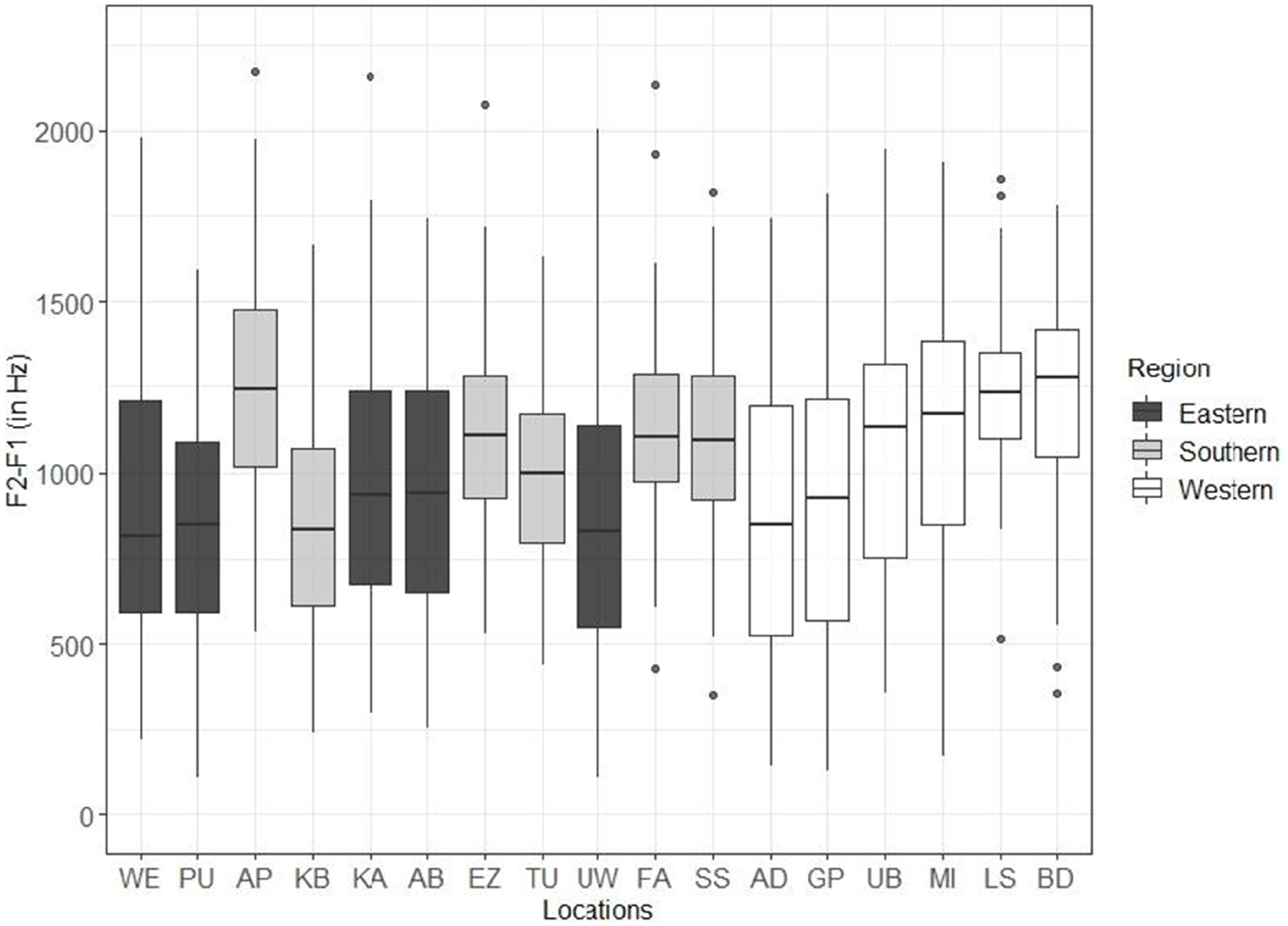
Based on the fact that velarized laterals have originally been described as characteristic feature of the dialect of Vienna it could be hypothesized that fewer velarized tokens will be found the farther away a location is from Vienna. Figure 3 shows the distribution of F2-F1 values for each of our locations sorted by the overall distance from Vienna (distance increasing from left to right). As can be seen in the plot and is confirmed by statistical analyses with Distance from Vienna (in km) as fixed factor in the mixed-effects model described above, there is an overall tendency towards a larger F2-F1 difference, that is, less velarization the further a given location is from Vienna (b(distance)=0.753, SE=0.29, t=2.56 p=0.013, b(Intercept)=877.5, SE=63.5, t=13.81, p<.001).

However, as indicated by the color coding of boxes in Figure 3, this tendency appears to differ between geographical regions that roughly refer to the direction of the location from Vienna. This difference between regions is confirmed in an analysis with the factors Distance from Vienna (in km), Region and their interaction in the statistical model. Notably this model including the factor Region provides a better fit to the data than the model with Distance alone as suggested by a log-likelihood ratio test using the anova() function in R. Note that Region was factor coded with the Eastern Region mapped onto the intercept since these locations are all in the vicinity of Vienna (see Section 2.2). In the model, the fixed effect of Distance then refers to this Eastern Region, and interactions suggest whether for a given Region the effect of Distance differs from the Eastern Region. Results show that there is no overall tendency of fewer velarized laterals the farther the location from Vienna in the Eastern Region (b(distance)=0.26, SE=0.77, t=0.34 p=0.736, b(Intercept)=866.9, SE=99.5, t=8.71, p<.001), and this does not differ for the Southern Region (b(distance:South)=0.040, SE=1.20, t=0.034 p=0.973) but is significantly different for the Western Region (b(distance:West)=2.91, SE=1.18, t=2.46, p=0.017)Footnote 3. Since Region, that is, direction from Vienna appears to matter in the production of velarized laterals, in all subsequent analyses we will use Region rather than Distance to model potential geographical differences in /l/-velarization.
3.3 Linguistic and social conditioning of /l/-velarization
Having established that velarized laterals are produced outside of Vienna and the distance, and specifically the direction from Vienna matters, our second and third research questions refer to linguistic and social factors conditioning the degree of /l/-velarization. Since interactions between Region and the linguistic factor Position in the word as well as the social factors Gender and Age could be expected, we fit a linear mixed-effects model with all these factors and their interactions. Again, the Eastern Region, representing the area surrounding Vienna served as a reference level that was mapped onto the intercept. Effects of the contrast-coded binary factors Position, Age and Gender are then to be interpreted for this Eastern Region and interactions with Region refer to differences in these effects between regions.
Since the results of a first full model suggested that the factors Age and Gender were never involved in interactions with each other, a simpler model was fit to eliminate this interaction from the model (and hence eliminate the non-significant four-way interactions). A model comparison using a log-likelihood ratio test showed that the simpler model did not differ from the more complex one in terms of model fit, justifying the use of the simpler model (see OSF for the full analysis). Table 5 reports the results. In addition, all effects and interactions are illustrated in Figures 4 and 5 grouped by Position, Gender and Age. These figures will be referred to in the interpretation of results which we also grouped by these factors. With regard to Region, the analyses here complement the results for Region and Distance reported above. Overall, the number of velarized laterals was smaller for the Southern and Western regions compared to the Eastern region. This is indicated by the effects of RegionSouth and RegionWest in Table 5, where the positive regression weights suggest larger differences in F2-F1, hence less velarization, for these regions overall.
Results of the mixed-effects model including Region, the linguistic factor Position of the lateral in the word, and the social factors Age and Gender of the speaker. All factors except for Age and Gender were allowed to interact (see text for details and OSF for the full code)

Density plots (left column) and boxplots (right column) for F2-F1 values in Hertz overall (first row) and separated per Region (rows 2-4). Plots show values for each Position of the lateral in the word (i.e., initial vs. final word position - color coded). The boxplots in the right column in rows 2-4 show the data for each of the locations in the given Region separately.

Density plots for F2-F1 values in Hertz for Gender (left column) and Age (right column). The first row shows the overall data, rows 2-4 separate data per Region. Lateral Position in the word is color coded with the darker shades indicating word-initial position and the lighter shades word-final position. Gender and age are also color coded as indicated in the legend.

Position
The effect of Position of the lateral in the word on the degree of /l/-velarization is illustrated in Figure 4, which shows clear differences between the F2-F1 difference in word-initial versus final laterals. Specifically, more velarized laterals are found in final than initial position. In the statistical model this is evidenced for the Eastern Region that has been mapped onto the intercept by the main effect of Position. Note that final position had been coded as 0.5, initial as –0.5, hence the positive regression weight indicates a larger F2-F1 difference, that is, less velarization, for word-initial than final /l/. However, as indicated by the interaction terms with the Region (RegionSouth:Position, RegionWest:Position), the difference between initial and final word position for the F2-F1 difference was smaller for the Southern and Western Regions than for the Eastern Region.
A closer inspection of Figure 4 and specifically the boxplots illustrating the distributions per location in the right panels suggests that the difference in F2-F1 values between initial and final position occurs most regularly for locations in the Eastern Region. In the Western Region, this pattern continues (locations AD, GP), but diminishes with growing distance from Vienna (increasing distance is plotted left-to-right). In the Southern Region, the pattern is much less pronounced or almost absent. Furthermore, only in the Eastern Region, the peak (or plateau) of the distribution for initial /l/ (Figure 4, left panels) appears to be located below a 1000 Hz difference for our F2-F1 measure, suggesting relatively frequent velarization even for word-initial /l/, which is not found in the Western and Southern Regions.
Gender
The effect of Gender is discussed with regard to Region and Position since the two-way interaction with Position as well as the three-way interactions with Position and Region were significant in the model reported in Table 5. The effects and interactions are illustrated in Figure 5. Overall and significantly so, in the Eastern Region male speakers use velarized laterals more than female speakers (effect of Gender). Moreover, the effect of Position with a larger difference in velarization between initial and final position is more pronounced for female than male speakers (Position:Gender). This is likely due to the fact that male speakers tend to velarize more overall, even in word-initial position. This is well illustrated in Figure 5, left panel, in the first row. However, these patterns differ between the Eastern Region and the Southern and Western Regions (RegionSouth:Position:Gender, RegionWest:Position:Gender). There, the strong asymmetry between male and female speakers in the effect of Position found for the speakers of the Eastern Region was much less pronounced.
Age
The social factor Age, which, as already discussed, did not interact with the other social factor Gender, did not show a main effect for the Eastern Region but interacted with Position (Position:Age) such that the difference in the degree of velarization between word initial and final laterals was larger in the younger than older speakers (see Figure 5, right panel in the second row). Specifically, it appears that for the older speakers, laterals in word-initial position are relatively more velarized than for the younger speakers while little difference is found in word-final position. Critically, this pattern differs between the Eastern and the other two Regions (RegionSouth:Position:Age, RegionWest:Position:Age) where according to Figure 5 little difference appears to be found between older and younger speakers in their patterns of differentiating the degree of velarization between word-initial and final laterals.
4 Discussion
The present study is concerned with allophones of the lateral phoneme /l/ in the Bavarian German dialects of East Austria, specifically with the occurrence of the velarized alveolar lateral [ɫ]. [ɫ] as an allophonic realization of /l/ was hitherto studied as a feature of Viennese dialect in the urban non-standard varieties in East Austria (Moosmüller et al. Reference Moosmüller, Schmid and Kasess2016; Rausch-Supola et al. Reference Rausch-Supola, Moosmüller, Leykum, Schmid and Luttenberger2022), yet virtually not studied in rural speakers. To assess the current situation regarding [ɫ] in the rural dialects, acoustic analyses were conducted on recordings from four speakers in each of seventeen locations in the Central Bavarian dialect areas. For each speaker suitable items with /l/ in sole word-initial position (thirty-two items) and with /l/ preceded by an alveolar phone in word-final position (twenty-two items) were selected for analysis. In every item, the realization of /l/ was identified and pre-categorized according to place and manner of articulation. In all alveolar realizations, acoustic measurements of F1 and F2 were taken and the difference F2-F1 was used as a parameter to place the realizations on a continuum from strong velarization (low F2-F1) to little/no velarization (high F2-F1).
Based on our measurements we can state that /l/-velarization occurs frequently in the contemporary rural Central Bavarian dialects of East Austria and is not exclusive to Viennese dialect. From there, we will discuss the areal distribution of F2-F1 values. The geographical distance to Vienna was found to be a significant factor in the overall tendency to velarize with more velarization closer to Vienna. However, this relation between distance and velarization appears to be only true for the locations in the Western Region. In both the Eastern and the Southern Region no significant relation between distance from Vienna and F2-F1 was found. In the Eastern Region, all five locations show a very similar distribution of F2-F1 values, though overall the F2-F1 difference appears relatively low, suggesting frequent /l/-velarization – more than in the Western and Southern Regions. In the Southern Region, internal differences between locations are visible, but do not significantly change with distance. Especially location AP relatively close to Vienna sticks out with one of the highest average F2-F1 values of all locations in the Southern Region.
For the Eastern and the Western Region the overall degree of velarization seems to be related to the respective dialect regions: Since all locations of the Eastern Region are located in the Eastern Central Bavarian (ECB) dialect area, the homogeneity of the Eastern locations does not come as a surprise. The Western Region encompasses locations in the Eastern (ECB) and Western Central Bavarian (WCB) as well as the South Central Bavarian (SCB) dialect areas. The F2-F1 values appear to differ such that the locations in the ECB area of our Western Region have lower F2-F1 values, hence more velarization, similar to locations of the Eastern Region. Therefore, it seems likely that along the East–West axis the border between the ECB and WCB dialect areas also demarcates a drop in the amount of /l/-velarization. Moving on to the Southern Region, which is entirely located in the SCB dialect area, an interpretation seems harder to find. Yet, if one recognizes that location AP while being relatively close to Vienna is also located in an area known to preserve a number of relatively archaic dialect features (see e.g., Moser et al. Reference Moser, Vergeiner, Weihs and Luttenberger2022) the dissimilarity comes at a lesser surprise. With the exception of AP, at least descriptively /l/-velarization seems to decrease the farther one looks to the South. While location KB, which is relatively close to Vienna still falls in line with the ECB locations, the other locations of the Southern Region exhibit overall less /l/-velarization than the locations of the Eastern region. However, our further analyses show that distance from Vienna and Region alone do not show the full picture of /l/-velarization.
Specifically, we found that our linguistic factor Word Position influenced the degree of /l/-velarization. In our data, word-final /l/ exhibits significantly lower F2-F1 values and is hence more velarized compared to word-initial position. This positional pattern holds especially true for the locations of the Eastern Region, but descriptively also for locations closer to Vienna in the Western Region and location KB in the Southern Region (see Figure 4 and OSF https://osf.io/3em92/ for data on individual locations). Except for KB, these locations are part of the Eastern Central Bavarian (ECB) dialect area. Therefore, it might well be argued, that word-final /l/-velarization is a distinct feature of ECB dialects, which corroborates the occasional reports of [ɫ] in that exact position (Brunbauer Reference Brunbauer1956; Keller Reference Keller1961). ECB dialects would then be similar to both English RP (Gimson Reference Gimson1984) and Dutch (Mees & Collins Reference Mees and Collins1982), exhibiting an allophonic pattern absent in Standard (Austrian) German. It also fits with the findings of Schmid et al. (Reference Schmid, Moosmüller and Kasess2017) on Viennese dialect, who find a preference for /l/-velarization to occur in word-final position. Outside the ECB area the positional difference – broadly speaking – seems to diminish with distance to Vienna. In the Southern locations towards Styria, location KB closest to Vienna again follows the ECB pattern. The pattern is less pronounced in TU and EZ and almost absent in FA and SS. These descriptive differences tie in with the notion of Styria and Burgenland as areas in which the dialects exhibit increasingly more South Bavarian features going from North to South. In the case of /l/-velarization and its positional pattern, our data suggests that there is no abrupt change between velarizing and non-velarizing areas, but a gradual transition from positional differentiation in the North to no differentiation in the South. This hypothesis would have to be corroborated by additional data from the South Bavarian dialect area. The situation seems to be very similar at the transition from Eastern Central Bavarian to Western Central Bavarian, although F2-F1 values appear to be overall higher in the Western Central Bavarian locations.
Additionally, the social factors Gender and Age influenced the occurrence of /l/-velarization. With regard to Gender, our analyses showed that male speakers generally velarize more than female speakers. While to some degree these gender differences might be attributed to individual physiological differences (despite our effort to normalize for individual speaker differences by using the F2-F1 measure), interactions between Gender, Region and Position yielded additional insights. Male speakers in the Eastern Region were most likely to exhibit strong velarization even in word-initial position – more than male speakers in the other Regions and more than female speakers in the Eastern Region (see Figure 5, left column). This parallels the specific findings for urban speakers in Vienna and Neunkirchen (Schmid et al. Reference Schmid, Moosmüller and Kasess2017; Rausch-Supola et al. Reference Rausch-Supola, Moosmüller, Leykum, Schmid and Luttenberger2022) where male speakers also tend to use velarized laterals more often compared to female speakers and in fact velarize almost all of their alveolar laterals, not only in word-final position, but also word-initially. This tendency of men to velarize initial /l/ is restricted to the Eastern Region, which probably is the most similar to Vienna in its dialect. The general use of velarized [ɫ] in all word positions also appears to be strikingly similar to what Moosmüller et al. (Reference Moosmüller, Schmid and Kasess2016) reported for the dialect use of homeless Viennese speakers in the 1970s. However, since only male speakers show this tendency for /l/-velarization in all positions, it remains a question as to what other social factors might affect this general /l/-velarization.
Interestingly, Gender did not interact with our other social factor Age group. Age was included in our analyses, since following the apparent-time paradigm (Chambers Reference Chambers, Chambers, Trudgill and Schilling-Estes2002), differences between older and younger speakers can be interpreted to indicate a sound change in the direction of the younger speakers. However, only in the Eastern Region the interaction between Age and Position of the lateral in the word yielded significant results. Younger speakers in the Eastern Region tend to velarize less in word-initial position compared to the older speakers. The hypothesis of Rausch-Supola et al. (Reference Rausch-Supola, Moosmüller, Leykum, Schmid and Luttenberger2022) that velarization is spreading outwards from Vienna does hence not seem to hold true. If we can make any observation on a generational shift in our data, it is towards less velarization in the speakers of the Eastern Region.
In the context of the available literature on /l/-velarization in Austria, our analyses on rural dialects in East Austria allow for a comparison with the studies on the urban non-standard varieties in Vienna (Moosmüller et al. Reference Moosmüller, Schmid and Kasess2016; Schmid et al. Reference Schmid, Moosmüller and Kasess2017) and Neunkirchen in Lower Austria (Rausch-Supola et al. Reference Rausch-Supola, Moosmüller, Leykum, Schmid and Luttenberger2022). Two key findings of these previous studies – a preference for velarization in word-final position and a tendency for male speakers to velarize to a higher degree – could be corroborated in our analysis for the Eastern Region encompassing mainly locations in Lower Austria in the Eastern Central Bavarian dialect region. With regard to word position, our analysis shows that in the contemporary Eastern Central Bavarian dialects there is a strong tendency for the phoneme /l/ in word-final position to be velarized. Due to the geographical vicinity and the similarity in dialect it does not come as a surprise that the dialectal varieties in the Eastern Region behave very similar regarding /l/-velarization compared to Viennese sub-standard varieties. However, since the speakers in our study are decidedly non-urban speakers, it still is noteworthy that any differences in social background appear not to affect this distribution according to our linguistic factor /l/-velarization. At the same time, we could give a first overview on the geographical distribution of /l/-velarization and found that the contrast between /l/ in word-initial and word-final position is reduced or absent outside the Eastern Central Bavarian dialect area. Since some locations do not fit this overall tendency, future studies might want to search for additional explanations regarding variation in /l/-velarization beyond the factors analyzed here, for instance, by recording speakers of different social backgrounds.
In a broader linguistic context, the tendency in our Eastern Central Bavarian data for /l/-velarization to occur more frequently in word-final position resembles the descriptions of other European languages such as English RP (Gimson Reference Gimson1984), Dutch (Mees & Collins Reference Mees and Collins1982) and Catalan (Recasens & Espinosa Reference Recasens and Espinosa2005) and reinforce the notion of word-final /l/ being a likely position for velarization to occur.
5 Summary
From the base dialect corpus of the SFB German in Austria, we were able to provide a first overview over the situation regarding /l/-velarization in East Austrian rural dialects based on F2 measurements. Results showed that /l/-velarization parametrized as a low F2-F1 value appears to be a common feature in the rural dialects of East Austria, exhibiting a complementary pattern based on word-position similar to other Germanic languages like English and Dutch. This pattern can be seen most clearly in locations of the Eastern Central Bavarian dialect area where so far it has only been described as marginal outside of the city of Vienna. Furthermore, this study was able to show that male speakers are more likely to employ velarization in their /l/-realizations compared to women in word-initial position, which parallels empirical findings for the cities of Vienna and Neunkirchen. Age Group, in contrast, appeared to play a lesser role than maybe expected. Only older speakers in the Eastern Region showed more /l/-velarization in word-initial position, however, independently of their gender.
Replication package
The data and code for statistical analyses and the creation of Figures 2–5 is available on OSF: https://osf.io/3em92/
Acknowledgments
We would like to thank David Gschösser for his help on creating the map in Figure 1 and Marisa Hoeschele for proofreading the introduction. This study was supported by the Austrian Science Fund Grant F60 Special Research Programme ‘German in Austria. Variation – Contact – Perception’ (2016–2023).
Competing interests
The authors declare none.
Contribution
JL designed the study and acquired the data. JL and NW conducted the measurements. ER analyzed the data. JL and ER wrote the paper. All authors contributed to the article and approved of the final version. This research was conducted while all authors were at the Acoustics Research Institute of the Austrian Academy of Sciences.




 Open access

