Introduction
Parkinson’s disease (PD) is a neurodegenerative disease characterized by slowly progressive rigidity, tremor, bradykinesia, and postural imbalance due to the depletion of dopamine in the brain. Reference Jankovic1 Patients with PD also have several other features like anxiety, depression, psychosis, constipation, bladder disturbances, sleep abnormalities and anosmia which are considered as ‘non-motor’ symptoms. Reference Tagliati, Chaudhuri and Pagano2 Pharmacotherapy with dopaminergic drugs and deep brain stimulation are the currently available treatment options. Reference Jankovic1
Yoga is a combination of physical exercise and mindfulness. Habitual physical exercise has been known to increase dopamine release. Compared to patients with a sedentary lifestyle, those who regularly exercise have better motor and non-motor functions. Reference Sacheli, Murray and Vafai3 Yoga increases the release of brain-derived neurotrophic factor, which has a role in neurogenesis and synaptic plasticity. Reference Govindaraj, Karmani, Varambally and Gangadhar4,Reference Lee, Moon and Kim5 This can potentially result in reconstitution of basal ganglia function. Yoga can potentially improve autonomic dysfunction in patients with PD by increasing parasympathetic activity and reducing sympathetic tone. Reference Bowman, Clayton, Murray, Reed, Subhan and Ford6–Reference Orimo, Ghebremedhin and Gelpi8 In a recent meta-analysis, the benefit of yoga was found to be comparable or even superior to exercise in patients with PD. Reference Suárez-Iglesias, Santos, Sanchez-Lastra and Ayán9
Transcranial magnetic stimulation (TMS) has been used to study cortical excitability. The TMS studies in PD, especially with regard to silent period (SP) and short interval intracortical inhibition (SICI) have yielded conflicting results. Reference Cantello, Tarletti and Civardi10–Reference Ammann, Dileone and Pagge12 These abnormal parameters are normalized by levodopa. Reference Cantello, Tarletti and Civardi10 The effect of exercise on cortical excitability is also well recognized. Reference Forrester, Hanley and Macko13 Govindaraj et al. observed changes in TMS parameters, especially SICI and SP, after yoga in healthy individuals. Their pilot study found that yoga modulates GABA-B receptor-mediated cortical inhibition. Reference Govindaraj, Mehta, Kumar, Varambally, Thirthalli and Gangadhar14 However, to the best of our knowledge, the effect of yoga on cortical excitability in PD has not been evaluated.
Despite having a strong rationale, yoga studies in PD have failed to show significant improvement in the core motor features. Reference Mailankody, Varambally, Thennarasu and Pal15 However, the practice of yoga may help in improving balance, decreasing falls, and alleviating depression and anxiety in PD as per available literature. Reference Kwok, Kwan and Auyeung16–Reference Myers, Harrison and Rawson18
Hence, we aimed to evaluate the effect of yoga on motor and non-motor symptoms, cortical excitability, inhibitory and facilitatory properties of the brain in patients with PD.
Methods
Subjects
This prospective single group open-label study was undertaken by the departments of Neurology and Psychiatry at the National Institute of Mental Health and Neuro Sciences (NIMHANS), Bangalore, India. The study was registered under the Clinical Trials Registry India (CTRI) (CTRI/2019/02/017564) and was approved by the Institute ethics committee (IEC No.NIMHANS/IEC (BS & NS DIV.) 15th Meeting/2018). All the participants gave written informed consent. Eighteen consecutive patients with PD and motor fluctuations were included in the study. The diagnosis of PD was based on the United Kingdom Parkinson’s Disease Society (UKPDS) Brain Bank Criteria. Reference Litvan, Bhatia and Burn19
All the patients were on stable dosages of anti-PD medications for at least six weeks before recruitment. Patients with PD on treatment suffering from ‘wearing off,’ ‘delayed ON,’ and ‘no ON’ were considered to have motor fluctuations. Reference Jankovic20 Patients with severe cognitive deficits, severe spondylotic disease, or arthritis, which may prevent them from undergoing yoga sessions, and patients who had undergone deep brain stimulation for PD were excluded from the study. Demographic and clinical details were recorded. At baseline, all eighteen patients underwent detailed clinical evaluation. These patients continued to be on conventional treatment (levodopa-carbidopa or dopa agonist as prescribed by the treating Neurologist) for the next month and were reassessed clinically. Subsequently, these patients underwent supervised yoga sessions (with a validated yoga module for PD Reference Kakde, Metri, Varambally, Nagaratna and Nagendra21 for one month (three sessions per week for a total of 4 weeks, each session of 45 minutes), in addition to conventional treatment. The yoga sessions were carried out in the medication ON state. Following this, they were assessed again clinically the next day after completing one month of of supervised yoga session (mean duration = 31.35 ± 1.37 days; range – 29–33 days).
Twelve of the 18 patients underwent TMS in the medication OFF state at baseline and after yoga therapy (day after the last yoga session). One patient did not come for follow-up after the baseline assessment and hence was excluded from the analysis (Figure 1). The TMS parameters of the patients (n = 12) were compared with those of age and gender-matched healthy controls (n = 12) obtained as part of another study by the same team (DST-CSRI. No.SR/CSRI/49/2016).
Flow diagram of the study.

Clinical assessment
The severity of motor symptoms was assessed using the Unified Parkinson’s Disease Rating Scale (UPDRS motor part III), the stage of the disease by Hoehn and Yahr stage and the non-motor symptoms were assessed using the Montreal Cognitive Assessment for cognitive assessment, Hamilton depression rating scale for depression, Hamilton anxiety rating scale for anxiety, non-motor symptoms questionnaire (NMS questionnaire) and World Health Organization quality of life questionnaire (QOL questionnaire). UPDRS motor part III was assessed both in the OFF and ON states. The medication OFF state was defined as at least 12 hours after the last dose of levodopa-carbidopa combination or 18 hours after the last dose of dopamine agonist. Reference Langston, Widner and Goetz22 The medication ON state was determined to have the best improvement in motor symptoms following 1.5 times the usual morning dose of levodopa-carbidopa combination. This was around 60 to 90 minutes after the tablet intake.
Transcranial magnetic stimulation (TMS)
TMS was done using Bistim2 system that combines two Magstim 2002 stimulators with a hand-held figure of eight coil. Procedure and measurements were carried out following the IFCN committee with all the precautions. Reference Rossini, Burke and Chen23 TMS was carried out with patients sitting on the chair comfortably. The motor cortex contralateral to the most clinically affected side was stimulated after identifying the optimal scalp position or the hotspot. The motor response (motor evoked potential, MEP) was recorded on the first dorsal interosseus (FDI) muscle on the most affected side using two Ag-AgCl electrodes placed in a belly-tendon montage. The intensity of the stimulus was increased by 5% to obtain a satisfactory MEP. Resting motor threshold (RMT), central motor conduction time (CMCT), ipsilateral silent period (iSP), contralateral silent period (cSP), SICI, and intracortical facilitation (ICF) were recorded.
The RMT was defined as minimal stimulus intensity required to elicit peak-to-peak MEP of at least 50 µv amplitude in the relaxed FDI during 50% of the ten consecutive trials and expressed in percentage. CMCT (expressed in msec) was calculated as a difference in MEP latency obtained by cortical and cervical spine stimulation. cSP was obtained by stimulating the motor cortex at suprathreshold stimulus (120% of the RMT) during partial contraction of the FDI muscle, whereas for iSP the stimulus intensity was 100% of the total stimulator output on a fully contracted FDI muscle. SICI and ICF were measured as a ratio between the MEP amplitude obtained using two consecutive stimuli (conditioning stimulus and test stimulus) separated by an interstimulus interval (ISI) to the MEP amplitude obtained after test stimulus. The conditioning stimulus was 80% of the RMT, and the test stimulus was 120% of the RMT. For SICI recording, the ISI was 2 msec, and for ICF it was 10 msec. The age and gender-matched healthy controls also underwent the same procedure. The details of the TMS methods are published elsewhere. Reference Agrawal, Bhattacharya and Kamble24
Outcomes
The primary outcome assessed was to look for changes in the UPDRS motor scores (Part III) in the OFF and ON states following four weeks of yoga therapy. The secondary outcomes of the study were to look for changes in the non-motor symptoms and the TMS parameters.
Statistical methods
Based on the percentage change in UPDRS part III motor scores in a drug trial provided by Schrag et al. (effect size = 0.83) sample size was calculated to be 14 with 80% power and 5% type 1 error. Expecting a dropout of 20%, the sample size was estimated to be 18. Reference Schrag, Sampaio, Counsell and Poewe25 Data were analyzed with the Statistical Software for Social Sciences (SPSS) version 22. Shapiro Wilk’s test was used to test the normality of the data. For data that followed a normal distribution, RM-ANOVA was used to compare the scores between the three time points. Non-parametric test- Friedman test followed by Wilcoxon signed ranks test was carried out when the data did not follow the normative distribution. Paired samples t-test was carried out to compare TMS parameters before and after yoga. Correlations were calculated with Spearman’s correlation for non-parametric variables. McNemar test was done for comparison of gait and postural stability subscores in UPDRS as all the patients had scores of 0 or 1. A p value less than 0.05 was considered significant.
Results
Demographic and clinical details (Table 1)
A total of 18 patients (15 male and three female) with PD were recruited. One patient (male) did not come for further visits after baseline assessment and hence was excluded from the analysis. The mean age and duration of illness were 55.5 ± 10.8 years and 4.0 ± 2.5 years, respectively. Levodopa equivalent daily dose (LEDD) was 580.3 ± 318.9 mg.
Motor scores in patients with PD at baseline, interim (after 1 month of conventional care) and post (after 1 month of yoga)

Note : UPDRS = Unified Parkinson’s disease rating scale, H & Y = Hoehn and Yahr stage, PD = Parkinson’s disease, RT = rest tremor, PT = postural tremor, Delta UPDRS denotes the change in UPDRS from OFF to ON stating that values are expressed as mean +/− standard deviation.
Significant values are expressed in bold.
*McNemar test was used further to compare between baseline versus interim scores and interim versus post Yoga scores for gait and postural stability. The postural stability score post yoga was significantly less compared to the interim score (p = 0.039). Nevertheless, the postural stability score did not change significantly during the interim assessment as compared to the baseline (p = 1).
Effect of yoga on the motor and non-motor symptoms (Tables 1 and 2)
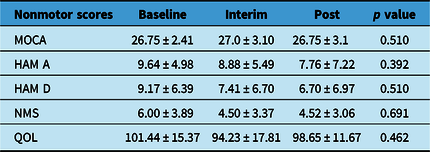
Motor parameters assessed with UPDRS part III, depression, anxiety, and quality of life did not change significantly after the intervention. The individual components of UPDRS motor part- III rigidity, tremor, bradykinesia, gait and postural stability scores were compared between the three time points. The postural stability subscore (component of UPDRS part III) of patients significantly improved following yoga (0.59 ± 0.5 to 0.18 ± 0.4, p = 0.039). A small but significant improvement was noted in the H & Y stage of PD (Baseline 2.08 ± 0.54, post yoga 1.94 ± 0.46; p = 0.04)
Non-motor symptoms in patients with PD at baseline, interim (after 1 month of conventional care) and post (after 1 month of yoga)

Note : MOCA = Montreal Cognitive Assessment; HAM A = Hamilton Anxiety scale; HAM- D = Hamilton Depression scale; NMS = Nonmotor symptoms; QOL = Quality of life.
Comparison of TMS parameters between the cases and healthy subjects
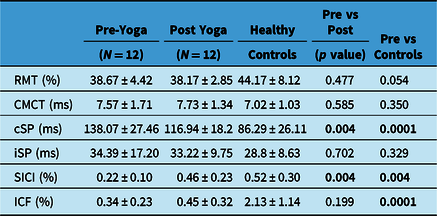
The patients with PD had a significantly longer cSP when compared to that of healthy subjects (Patients- 138.07 ± 27.46 ms, HC-86.29 ± 26.11 ms, p = 0.0001). SICI was significantly enhanced (suggesting stronger inhibition) in patients with PD compared to healthy subjects (Patients-0.22 ± 0.10, HC-0.52 ± 0.30, p = 0.004). The ICF was significantly lower in patients when compared to healthy subjects (Patients-0.34 ± 0.23, HC-2.13 ± 1.14, p = 0.0001). No significant difference was observed between the patients and controls for RMT, CMCT, and iSP (Table 3).
Transcranial magnetic stimulation parameters of the patients before and after yoga

Note: CMCT = central motor conduction time; cSP = contralateral silent period; HC = healthy control; ICF = intracortical facilitation; iSP = ipsilateral silent period; ms = millisecond; RMT = resting motor threshold; SICI = short interval intracortical inhibition.
Significant values are expressed in bold.
Effect of yoga on the TMS parameters (Table 3)
Following yoga, a statistically significant difference was noted in cSP and SICI. There was a reduction in cSP from a baseline of 138.07 ± 27.46 ms to 116.94 ± 18.2 ms after yoga (p = 0.004). (Table 3, Figure 2). SICI value increased from a baseline of 0.22 ± 0.10 to 0.46 ± 0.23 after yoga (p = 0.004) (Table 3, Figure 3). A non-significant improvement in ICF was also observed following yoga.
Bar graphs showing the contralateral silent period (cSP) in patients with Parkinson’s disease before and after yoga.

Bar graphs showing the short interval intracortical inhibition (SICI) in patients with Parkinson’s disease before and after yoga. MEP = motor evoked potential.

Correlation results
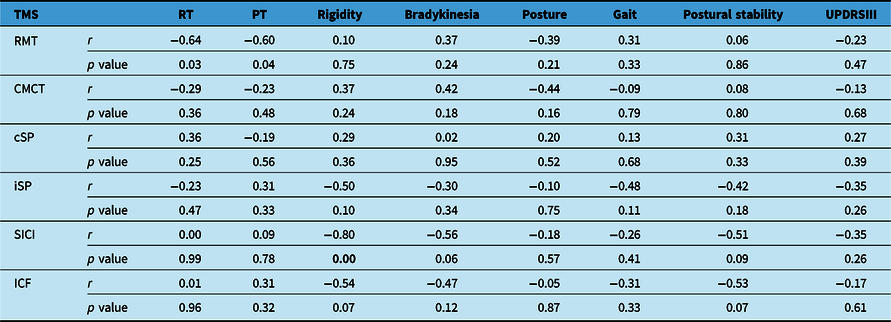
Spearman’s correlation was carried out to look for a correlation between TMS parameters and motor scores. There was a significant negative correlation of SICI with the total rigidity scores measured during the OFF state at the baseline (r = −0.80, p = 0.00) (Table 4).
Correlation of TMS parameters with the motor scores

Note : TMS = transcranial magnetic stimulation; r = correlation co-efficient, Spearman’s rho; CMCT = central motor conduction time; cSP = contralateral silent period; ICF = intracortical facilitation; iSP = ipsilateral silent period; RMT = resting motor threshold; SICI = short interval intracortical inhibition; RT = rest tremor; PT = postural tremor; UPDRS = Unified Parkinson’s disease rating scale.
Significant values are expressed in bold.
Discussion
The effect of yoga on cortical excitability in patients with PD was evaluated for the first time in this study. The postural stability item subscore on the UPDRS part III of the patients significantly improved following yoga (0.59 ± 0.5 to 0.18 ± 0.4, p = 0.039). TMS parameters such as cSP and SICI also improved significantly following four weeks of yoga.
Effect of yoga on the motor and non-motor symptoms
A significant change was observed for the postural stability scores and H & Y stage in patients with PD following yoga. The improvement in H & Y staging could be due to an improvement observed in the postural stability subscore on the UPDRS part III scale. The lack of improvement in rigidity, tremor, or bradykinesia was not surprising given that none of the other studies showed any significant improvement in these scores. Reference Kwok, Kwan and Auyeung16,Reference Van Puymbroeck, Walter and Hawkins17 The significant improvement in depression and anxiety observed in other studies Reference Mailankody, Varambally, Thennarasu and Pal15,Reference Kwok, Kwan and Auyeung16 was not seen in our study. However, the duration of intervention was much shorter in our study (4 weeks) compared to that of certain other studies (8 weeks and 12 weeks). Reference Kwok, Kwan and Auyeung16–Reference Myers, Harrison and Rawson18 Lower baseline scores for depression and anxiety and shorter duration of yoga practice probably account for the lack of significant change after the intervention in our study group.
The improvement in postural instability after yoga mirrors the observation made by other groups. Reference Van Puymbroeck, Walter and Hawkins17,Reference Myers, Harrison and Rawson18,Reference Colgrove and Sharma26–Reference Elangovan, Cheung, Mahnan, Wyman, Tuite and Konczak29 Elangovan et al., in an randomized controlled trial (RCT), objectively evaluated the effect of “Hatha yoga” on postural stability during stance and gait kinematics in twenty patients with PD. They found significant improvement in static balance in patients with PD following 12 weeks of yoga practice. Nevertheless, changes in gait and joint flexibility were not statistically significant. Reference Elangovan, Cheung, Mahnan, Wyman, Tuite and Konczak29
Cherup et al. compared yoga practice with a proprioceptive training program in an RCT and found that patients with PD had significant improvement in balance and proprioception after 12 weeks of yoga. Reference Cherup, Strand, Lucchi, Wooten, Luca and Signorile27 Myers et al. found that the patients with PD had better responses and anticipatory movements to stimuli applied from outside after yoga. Reference Myers, Harrison and Rawson18 Patients with PD had more confidence in balance and ability to manage falls after yoga than the control group. Reference Van Puymbroeck, Walter and Hawkins17 Colgrove et al. found a decline in falls by 25% in the yoga group. Reference Colgrove and Sharma26,Reference Sharma, Robbins, Wagner and Colgrove30 Though the scales used to assess postural instability differed, most of the studies found yoga useful for postural stability. The improvement of postural instability with yoga is noteworthy because current therapeutic approaches in PD lack effective measures to address this problem. Currently, neither pharmacotherapy nor DBS can provide satisfactory improvement in postural stability. Reference Bloem, Grimbergen, Cramer, Willemsen and Zwinderman31,Reference Lin, Wu and Lin32 It should be noted that all the studies using yoga as an intervention including our study, have been carried out in patients with early PD (H & Y stage 1 to 3). Reference Myers, Harrison and Rawson18,Reference Cherup, Strand, Lucchi, Wooten, Luca and Signorile27 Hence, yoga has a role in early PD as an add on to levodopa. In addition, yoga may be indicated in patients with postural instability not responsive to levodopa. The role of yoga in advanced PD and in those whose motor symptoms are poorly responsive to levodopa needs to be determined in future studies.
Effect of yoga on cortical excitability and its implications
A reduction in cSP and SICI following yoga suggests a decrease of GABAergic neurotransmission in the brain. Reference Ziemann33,Reference Kobayashi and Pascual-Leone34 cSP is mediated by GABA-B receptors, whereas SICI is mediated by GABA-A receptors. This suggests that yoga may work through restoring the balance by reducing GABAergic systems. However, 4-week therapy may be inadequate and warrants a longer duration of yoga therapy to demonstrate its effectiveness. Magnetic resonance spectroscopic (MRS) imaging studies in patients as well as brain tissue studies and animal models suggest involvement in GABA in the pathogenesis of PD. Reference Huang, Ren and Zeng35–Reference O.’Gorman Tuura, Baumann and Baumann-Vogel37 GABA is the main inhibitory neurotransmitter in the brain and alteration in GABA levels has been mainly implicated in the axial symptoms of PD. Reference O.’Gorman Tuura, Baumann and Baumann-Vogel37 The SICI was significantly higher in patients with PD than healthy controls. Reference Bhattacharya, Kamble, Yadav, Stezin and Pal11 In comparison, some studies found SICI to be significantly lower in patients with PD. Reference Cantello, Tarletti and Civardi10–Reference Ammann, Dileone and Pagge12 This finding could be due to younger age and earlier age of onset in their study. Reference Bhattacharya, Kamble, Yadav, Stezin and Pal11 One recent study has shown enhanced SICI in patients with PD. Reference Kamble, Bhattacharya and Hegde38 The differences observed between various studies could be due to the TMS protocols employed, sample size, disease duration, etc. Reference Kamble, Bhattacharya and Hegde38 cSP duration was prolonged in our study that reduced significantly following the yoga intervention. This is in contrast to the findings of Govindaraj et al. who showed prolonged cSP following yoga in healthy individuals and not in patients with PD. Our study shows that there is a significant inhibition observed in patients with PD which tends to normalize following yoga intervention.
Structural MRI studies have found that the gray matter density and cortical thickness in several areas, including cingulate gyrus, superior frontal gyrus, inferior parietal lobule, insula, medial frontal gyrus, precentral gyrus, parahippocampal gyrus, superior temporal gyrus, occipital gyrus, and cerebellum are greater in Yoga practitioners. Reference van Aalst, Ceccarini, Demyttenaere, Sunaert and Van Laere39 Hence, it is not surprising to note changes in cortical excitability following yoga. Interestingly, Passman et al. found that patients with PD rely more on cortical areas than subcortical areas for dynamic balancing. Reference Pasman, McKeown and Garg40 When there are problems in static balance in healthy subjects, the premotor cortex, supplementary motor area, and prefrontal cortex were found to be activated. Reference Wittenberg, Thompson, Nam and Franz41
Several other groups have assessed the role of yoga in PD. All these studies, including ours, have small sample sizes. The assessment was carried out only at ON state Reference Kwok, Kwan and Auyeung16,Reference Ni, Signorile and Mooney42, and other studies did not even mention whether the evaluation was carried out at ON or OFF state. Reference Van Puymbroeck, Walter and Hawkins17,Reference Colgrove and Sharma26,Reference Cheung, Bhimani and Wyman43 We assessed the patients both at OFF and ON state and hence could assess whether yoga could produce a change in response to the drug. To the best of our knowledge, our study is the first to evaluate yoga’s effect on cortical excitability objectively. The yoga module we used has been validated. Reference Kakde, Metri, Varambally, Nagaratna and Nagendra21
The major limitations of our study are lack of double blinding and lack of randomization. A recent study of the natural history and progression of PD by Cilia et al. found that more than 50% of the clinical response to levodopa is due to the long-duration response, which is the sustained motor response that is found for several days even after stopping the treatment. Reference Cilia, Cereda and Akpalu44 Our assessment of ‘OFF’ after 12 hours of stopping levodopa and 18 hours of stopping dopamine agonist may therefore be inadequate to assess disease severity and progression.
Conclusions
The postural stability of patients with Parkinson’s disease (PD) improved significantly after four weeks of supervised yoga sessions. However, the other motor or non-motor scores did not improve significantly after yoga. The significant improvement of the cSP and SICI suggests a potential disease-modifying effect of yoga in PD. The inverse correlation of SICI with rigidity also suggests that yoga has a therapeutic implication in the treatment of PD. It is to be noted that this is a short-term study and that longer duration of yoga practice may be needed to produce clinically significant changes in patients with PD. Longer randomized controlled trials with larger sample sizes will be required for more conclusive evidence.
Data availability
Data will be available on request.
Acknowledgments
Department of Science and Technology/ Science and Technology of Yoga and Meditation (DST/SATYAM/2017/76(G) and DST-CSRI. No.SR/CSRI/49/2016.
Author contributions
PM: Conceptualization, organization, execution, statistical analysis, writing of first draft
NK: Organization, execution, manuscript review and critique
AB: Organization, execution
SB: Organization, execution
TA: Organization, execution
KT: Statistical analysis
RA: Organization, execution
SV: Conceptualization, supervision, manuscript review and critique
RY: Conceptualization, supervision, manuscript review and critique
PKP: Conceptualization, supervision, manuscript review and critique
Funding statement
Department of Science and Technology/ Science and Technology of Yoga and Meditation (DST/SATYAM/2017/76(G) and DST-CSRI. No.SR/CSRI/49/2016.
Competing interests
The authors declare that they have no competing interests.
Ethics
The authors confirm that they have received the approval of the Institute Ethics committee (IEC No.NIMHANS/IEC (BS & NS DIV.) 15th Meeting/2018). Written informed consent was obtained from the patients.