





Introduction
In the mid-southern United States, rice is typically produced in flooded fields, which requires straight or contour levees to help maintain a permanent flood throughout the growing season (Hardke et al. Reference Hardke2022). However, furrow-irrigated rice has gained popularity in recent years, and in 2022, 18% of the total rice hectares in Arkansas were furrow-irrigated. While flood-irrigated rice involves establishing a continuous flood at the V5 stage of rice until maturity, furrow-irrigated rice is made possible by creating raised beds with furrows between the hipped rows, allowing the movement of water via gravity from the top end of the field (Counce et al. Reference Counce, Keisling and Mitchell2000; Lunga et al. Reference Lunga, Brye, Henry and Slayden2021). Not only have producers lauded the idea of furrow-irrigated rice potentially decreasing water and equipment use (Chlapecka et al. Reference Chlapecka, Hardke, Roberts, Mann and Ablao2021), but it also makes for an efficient transition into a rice-soybean [Glycine max (L.) Merr.] crop rotation, which is a frequent practice in Arkansas (Nalley et al. Reference Nalley, Massey, Durand-Morat, Shew, Parajuli and Tsiboe2022). A major benefit of crop rotation is being able to integrate herbicide programs targeting troublesome grass species in a broadleaf crop (Burgos et al. Reference Burgos, Butts, Werle, Bottoms and Mauromoustakos2021). However, the different water management practices associated with these two systems influence the emergence pattern and spectrum of weeds within a field (Kraehmer et al. Reference Kraehmer, Jabran, Mennan and Chauhan2016).
As of 2022, the most troublesome weed species in flood-irrigated rice included barnyardgrass [Echinochloa crus-galli (L.) P. Beauv.], sedge species (Cyperus spp.) and weedy rice (Oryza sativa L.), whereas barnyardgrass, Palmer amaranth, and sedges were among the most problematic weeds in a furrow-irrigated rice system (Butts et al. Reference Butts, Kouame, Norsworthy and Barber2022). The permanent flood established by conventional paddy rice can help alleviate weed emergence, especially from terrestrial weeds that cannot survive in anaerobic conditions (Bagavathiannan et al. Reference Bagavathiannan, Norsworthy and Scott2011). Furrow-irrigated rice allows typical upland crop weeds, such as Palmer amaranth, to thrive throughout the growing season due to the aerobic conditions that create a favorable environment for weed emergence and survival (Beesinger et al. Reference Beesinger, Norsworthy, Butts and Roberts2022; Norsworthy et al. Reference Norsworthy, Scott, Bangarwa, Griffith, Wilson and McCelland2011).
Palmer amaranth has historically been among the five most troublesome weeds in major row crop production systems in mid-southern states (Norsworthy et al. Reference Norsworthy, Griffith, Griffin, Bagavathiannan and Gbur2014; Van Wychen Reference Van Wychen2022; Webster and Nichols Reference Webster and Nichols2012). Although the influence of Palmer amaranth emergence on rice yields is unknown, some studies have demonstrated its negative impact on soybean, cotton, and corn (Zea mays L.) yields (Klingaman and Oliver Reference Klingaman and Oliver1994; Massinga et al. Reference Massinga, Currie, Horak and Boyer2001). Previous research has shown that Palmer amaranth densities ≤8 plants m−1 of row can reduce soybean and cotton yields by 78% and 70%, respectively (Bensch et al. Reference Bensch, Horak and Peterson2003; Rowland et al. Reference Rowland, Murray and Verhalen1999). Considering Palmer amaranth has the potential to severely affect crop yields and furrow-irrigated rice hectares are increasing, more research is needed to create management strategies aimed at reducing the growth and development of the weed.
With herbicide-resistant populations of Palmer amaranth being widespread, effective chemical control options for Palmer amaranth are scarce. Typically, herbicides are used to control the most problematic weeds because they are easily accessible and convenient to apply (Priess et al. Reference Priess, Norsworthy, Godara, Mauromoustakos, Butts, Roberts and Barber2022). However, in Arkansas, Palmer amaranth has evolved resistance to eight herbicide sites of action, which is why it is recommended that producers overlap the use of multiple herbicide chemistries to help slow the evolution of herbicide-resistant weed species (Bagavathiannan et al. Reference Bagavathiannan, Norsworthy, Scott and Barber2013; Barber et al. Reference Barber, Smith, Scott, Norsworthy and Vangilder2015; Heap Reference Heap2024). Among those sites of action previously mentioned, microtubule assembly inhibitors (categorized as a Group 3 herbicide by the Herbicide Resistance Action Committee [HRAC] and Weed Science Society of America [WSSA]), acetolactate synthase (ALS) inhibitors (HRAC/WSSA Group 2), and protoporphyrinogen oxidase (PPO) inhibitors (HRAC/WSSA Group 14) are used in rice production but are no longer effective due to confirmation of herbicide-resistant Palmer amaranth populations (Bond et al. Reference Bond, Oliver and Stephenson2006; Gossett et al. Reference Gossett, Murdock and Toler1992; Varanasi et al. Reference Varanasi, Brabham, Korres and Norsworthy2019). Florpyrauxifen-benzyl (Loyant™; Corteva Agriscience, Wilmington, DE) and 2,4-D, both synthetic auxins (HRAC/WSSA Group 4), are generally effective at controlling Palmer amaranth in a furrow-irrigated rice system, but there is also confirmed resistance to 2,4-D (Hwang et al. Reference Hwang, Norsworthy, Piveta, Souza, Barber and Butts2023). Additionally, strict application regulations have been placed on both herbicides due to injury to adjacent susceptible crops from off-target movement (ASPB 2020; Barber et al. Reference Barber, Butts, Boyd, Cunningham, Selden, Norsworthy, Burgos and Bertucci2023; Wright et al. Reference Wright, Norsworthy, Roberts, Scott, Hardke and Gbur2020). The adoption of novel herbicide sites of action for Palmer amaranth control would be beneficial given the status of current common chemical weed control options.
Fluridone (Brake; SePRO Corporation, Carmel, IN), a phytoene desaturase inhibitor (WSSA Group 12), has been commonly used as a soil-applied, preemergence herbicide for control of broadleaf and grass species in cotton crops (Hill et al. Reference Hill, Norsworthy, Barber, Roberts and Gbur2016). Fluridone is highly effective at controlling Palmer amaranth, especially on silt loam soils (Banks and Merkle Reference Banks and Merkle1979). The previous study also showed fluridone having prolonged activity in clay soils, with the herbicide being detected up to 250 d after application. Since most Arkansas rice hectares consist of silt loam soils (Hardke Reference Hardke2022), fluridone has potential value in furrow-irrigated rice production systems. However, before recommending fluridone for use on furrow-irrigated rice, rice tolerance and herbicidal efficacy must be assessed.
Since 2016, studies have been conducted to evaluate rice injury from fluridone carryover, with one study showing that fluridone applied at 224 g ai ha−1 prior to cotton emergence caused no more than 5% injury to rice the following year (Hill et al. Reference Hill, Norsworthy, Barber, Roberts and Gbur2016). Conversely, a 16% and 22% reduction in rice stand was observed with fluridone applied at 448 and 900 g ai ha−1, respectively. As of 2023, fluridone was labeled for postemergence use in dry-seeded rice production beginning at the 3-leaf rice growth stage at a maximum annual use rate of 168 g ai ha−1 (Anonymous 2023). Therefore, the objectives of this research were to 1) assess Palmer amaranth control and rice tolerance to preemergence- and postemergence-applied fluridone at 0.5× and 1× label rates on a silt loam soil, and 2) evaluate the effect of various herbicides combinations, including fluridone, on Palmer amaranth biomass, seed production, and rice grain yield.
Materials and Methods
Palmer Amaranth Control and Rice Injury with Single Applications of Fluridone
Field experiments were initiated in 2022 and 2023 at the Pine Tree Research Station near Colt, Arkansas (35.10887°N, 90.94066°W), on a Calhoun silt loam (fine-silty, mixed, active, thermic Typic Glossaqualfs) consisting of 11% sand, 68% silt, 21% clay, and 1.6% organic matter, pH 7.2. In 2022 and 2023, an additional site was located at the Milo J. Shult Research and Extension Center in Fayetteville, Arkansas (36.09366°N, 94.17344°W), on a Leaf silt loam (fine, mixed, active, thermic Typic Albaquults) consisting of 18% sand, 69% silt, 13% clay, and 1.6% organic matter, with a pH of 6.7. The field experiment was designed to evaluate rice tolerance and Palmer amaranth control with a single fluridone application at a 1× label rate (168 g ai ha−1) in combination with clomazone (Command 3ME; FMC Corporation, Philadelphia, PA) applied preemergence or florpyrauxifen-benzyl applied postemergence in a furrow-irrigated rice system (Table 1). The experiment was conducted as a randomized complete block design with four replications. Before planting, the test site was field-cultivated and hipped into 91-cm and 76-cm wide beds in Fayetteville and Colt, respectively. The trials were kept free of grass weeds and sedge species using fenoxaprop (Ricestar HT; Gowan Company, Yuma, AZ) and halosulfuron (Permit®; Gowan Company), and hand-weeding when necessary. Three split nitrogen applications as urea (460 g N kg−1), were applied at 135 kg N ha−1 in 2-wk intervals following the V5 growth stage. Other nutrients were supplied preplant based on recommendations from the University of Arkansas System Division of Agriculture Marianna Soil Test Laboratory. Unless rainfall occurred, the experimental area was irrigated twice weekly following the V5 rice stage.
Herbicide treatment, timing, and rate for the different programs evaluated in the single fluridone application experiment in 2022 and 2023a,b .

a Abbreviations: EPOST, early postemergence; MPOST, mid-postemergence; PRE, preemergence.
b All florpyrauxifen-benzyl applications included 0.58 L ha−1 methylated seed oil.
At all sites, a hybrid, long-grain rice cultivar ‘Full Page RT7321FP’ (RiceTec, Alvin, TX) was planted at 35 kg ha−1 at a 1-cm depth and 19 cm between rows. Plot dimensions were 3.7 m (four beds) wide by 5.2 m long and 3.1 m wide (four beds) by 5.2 m long in Fayetteville and Colt, respectively. The experiment consisted of seven treatments, including a nontreated control for comparison, with application timings occurring preemergence, early postemergence at 3-leaf rice, and mid-postemergence at rice tillering. Herbicides were applied using a CO2-pressurized backpack sprayer calibrated to deliver 140 L ha−1 at 276 kPa using four TeeJet 110015 AIXR nozzles (Spraying Systems Co., Glendale Heights, IL) spaced 48 cm apart (Table 2).
Planting and herbicide application dates a .

a Abbreviations: EPOST, early postemergence; MPOST, mid-postemergence; PRE, preemergence.
Visible estimations of rice injury and Palmer amaranth control were rated on a 0 to 100 scale, with zero being no plant symptomology and 100 representing complete plant mortality. Ratings were recorded 21 d after preemergence, 7 d after early postemergence, and 14 and 28 d after mid-postemergence. Before rice harvest, Palmer amaranth aboveground biomass was collected from a 1-m2 quadrat within the center of each plot. All harvested biomass was placed in an oven at 66 C for 2 wk, dried to constant mass, and dry biomass weight was recorded. Afterward, each female Palmer amaranth plant was threshed, and the ground plant material was separated from the seeds using a 20-mesh sieve and a vertical air column seed cleaner (Miranda et al. Reference Miranda, Jhala, Bradshaw and Lawrence2021). After cleaning, a 200-seed subsample from three random plots was weighed, and the average weight was used to calculate the number of seeds produced in the square-meter quadrat. Rough rice grain yield was determined by harvesting the center of each plot using an 8-XP small-plot combine (Kincaid, Haven, KS) equipped with a 1.8-m-wide header. The grain yield was adjusted to 12% moisture.
Palmer Amaranth Control and Rice Injury with Single and Multiple Applications of Fluridone
A field experiment was conducted at the Lon Mann Cotton Research Station in Marianna, AR (34.72549°N, 90.73423°W), in 2022 and the Milo J. Shult Research and Extension Center in Fayetteville, AR, in 2023, to assess Palmer amaranth control and rice injury with single and multiple applications of fluridone in combination with clomazone applied preemergence or florpyrauxifen-benzyl applied postemergence. The experiment was conducted as a randomized complete block design with four replications. The soil at the Marianna site was a Convent silt loam consisting of 9% sand, 80% silt, 11% clay, and 1.8% organic matter, pH 6.5. In Fayetteville, the soil was a Leaf silt loam consisting of 18% sand, 69% silt, 13% clay, and 1.6% organic matter, with a pH of 6.6. Before planting, the soil was tilled and hipped into 96-cm-wide and 91-cm wide beds in Marianna and Fayetteville, respectively.
In both years, a hybrid, long-grain rice cultivar ‘Full Page RT 7321FP’ (RiceTec, Alvin, TX) was sown at 35 kg ha−1 at a 1-cm depth with 19 cm between rows. Plot dimensions were 1.9 m (two beds) wide by 5.2 m long and 1.8 m (two beds) wide by 5.2 m long in Marianna and Fayetteville, respectively. A natural population of Palmer amaranth was allowed to germinate after rice planting was completed. The trials were kept free of other undesirable weed species using applications of fenoxaprop or mechanical methods if necessary. The soil for each trial was amended for fertility preplant based on soil test values from the University of Arkansas System Division of Agriculture Marianna Soil Test Laboratory fertility recommendations. Once the rice reached the V5 growth stage, irrigation water was delivered every 2 d unless rainfall occurred. Nitrogen, as urea (460 g N kg−1), was applied at 135 kg N ha−1 in three separate applications in 2-wk intervals beginning at the 5-leaf stage of rice. This trial consisted of nine treatments, including a nontreated control, with application timings occurring preemergence, mid-postemergence, and late postemergence at 42 d after planting (DAP) (Table 3). Herbicide treatments were made using a CO2-pressurized backpack sprayer calibrated to deliver 140 L ha−1 at 276 kPa using four 110015 AIXR nozzles spaced 48 cm apart (TeeJet Technologies, Glendale Heights, IL) (Table 4).
Herbicide treatments, timings, and rates evaluated for the multiple fluridone application experiment in 2022 and 2023a,b .
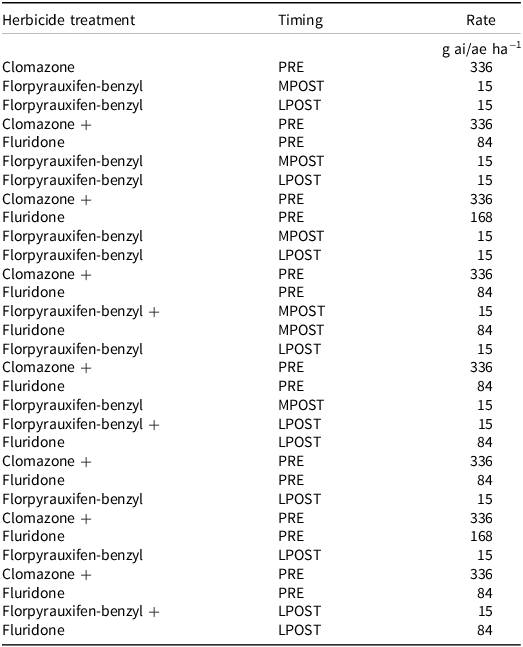
a Abbreviations: LPOST, late postemergence; MPOST, mid-postemergence; PRE, preemergence.
b All florpyrauxifen-benzyl applications included 0.58 L ha−1 methylated seed oil.
Planting and herbicide application dates a .

a Abbreviations: LPOST, late postemergence; MPOST, mid-postemergence; PRE, preemergence.
Visible Palmer amaranth control and rice injury ratings were recorded 21 d after preemergence, 14 d after mid-postemergence, and 14 and 28 d after late postemergence. Visual ratings were based on the same 0 to 100 scale mentioned in the previous experiment. Likewise, Palmer amaranth biomass, weed seed production, and rice grain yield data collection used the same parameters as the single fluridone application experiment.
Data Analysis
All data were analyzed using R studio software (v. 4.3.2) (R Core Team) using the glmmTMB function (glmmTMB package; Brooks et al. Reference Brooks, Kristensen, Van Benthem, Magnusson, Berg, Nielsen, Skaug, Machler and Bolker2017). Data were checked to determine whether the assumptions of normality and homogenous variance were met using the Shapiro-Wilks test and Levene’s test. Rice injury, Palmer amaranth control, Palmer amaranth biomass, Palmer amaranth seed production, and rice grain yield were fitted to a generalized linear mixed-effect model (Stroup Reference Stroup2015). All injury and control data were analyzed using a beta distribution by evaluation timing, whereas Palmer amaranth biomass and seed production at harvest were analyzed using a Poisson distribution (Gbur et al. Reference Gbur, Stroup, McCarter, Durham, Young, Christman, West and Kramer2012). After the residuals failed to violate the Shapiro-Wilks and Levene’s tests, rice grain yield was analyzed using a Gaussian or normal distribution. ANOVA was performed on each model using the car package with a Type III Wald chi-square test (Fox and Weisberg Reference Fox and Weisberg2019). For each herbicide program, estimated marginal means (Searle et al. Reference Searle, Speed and Milliken1980) were obtained using the emmeans package. The Sidak method was used to adjust for multiple pairwise comparisons (Midway et al. Reference Midway, Robertson, Flinn and Kaller2020), and the multcomp package was used to generate a compact letter display to visually distinguish differences among treatments (Hothorn et al. Reference Hothorn, Bretz and Westfall2008). In both experiments, site year and block nested within site year were treated as random effects to draw general conclusions over diverse environments (McLean et al. Reference McLean, Sanders and Stroup1991; Midway Reference Midway2022), and herbicide treatment was considered a fixed effect (Blouin et al. Reference Blouin, Webster and Bond2011).
Results and Discussion
Palmer Amaranth Control and Rice Injury with Single Applications of Fluridone
There were differences among herbicide treatments for visible estimations of Palmer amaranth control 21 d after preemergence when averaged over four site-years (P = 0.0002, Table 5). At 21 d after preemergence, Palmer amaranth control ranged from 40% to 86% among herbicide treatments. Across all site years, Palmer amaranth control was ≥83% when clomazone + fluridone was applied at 21 d after preemergence, which is similar to other research reporting 70% to 94% Palmer amaranth control 3 wk after cotton planting with preemergence applications of fluridone at rates ranging from 224 to 448 g ai ha−1 (Hill et al. Reference Hill, Norsworthy, Barber and Gbur2017). However, the fluridone rates in the study by Hill et al. (Reference Hill, Norsworthy, Barber and Gbur2017) are higher than the maximum annual use rate of 168 g ai ha−1 in rice. In most instances, preemergence treatments that included clomazone + fluridone provided greater Palmer amaranth control than clomazone applied alone 21 d after preemergence. Norsworthy et al. (Reference Norsworthy, Griffith and Scott2008) also reported reduced control of Palmer amaranth when clomazone was applied alone preemergence.
Visible Palmer amaranth control and rice injury for the single fluridone application experiment at 21 d after preemergence, averaged over four site-years a, b .
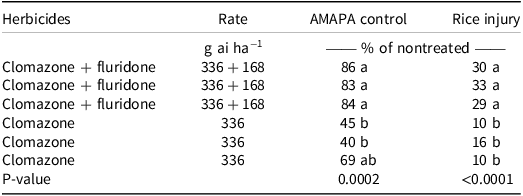
a Abbreviation: AMAPA, Palmer amaranth.
b Means within a column followed by the same letter are not different according to the Sidak method (α = 0.05).
Similarly, rice injury differed among herbicide treatments 21 d after preemergence (P < 0.0001; Table 5). Both clomazone and fluridone disrupt pigment formation in the plant cells of susceptible species, leading to a bleached appearance on plant leaves (Anderson and Roberston Reference Anderson and Roberston1960; Duke et al. Reference Duke, Paul, Becerril and Schmidt1991). Although rice exhibits acceptable tolerance to clomazone, severe rice injury may still occur under various climatic conditions (Zhang et al. Reference Zhang, Webster and Blouin2005); hence, the bleaching symptomology was greater when fluridone was mixed with clomazone. As a result, preemergence treatments containing clomazone alone caused 10% to 16% injury to rice, whereas fluridone with clomazone resulted in 29% to 33% injury 21 d after preemergence. These findings are similar to those observed by Martin et al. (Reference Martin, Norsworthy, Scott, Hardke and Gbur2018), who reported that clomazone and fluridone, applied individually at higher rates, caused 12% and 18% injury to rice, respectively, 4 wk after treatment. Based on results, preemergence treatments containing fluridone + clomazone caused a 2-fold increase in rice injury.
Herbicide treatment was significant for Palmer amaranth control ratings taken 7 d after early postemergence (P < 0.0001; Table 6). Palmer amaranth control ranged from 76% to 92%, and preemergence treatments containing clomazone and fluridone provided greater control than clomazone applied preemergence followed by florpyrauxifen-benzyl applied early postemergence. Waldrep and Taylor (Reference Waldrep and Taylor1976) reported that fluridone provides prolonged residual control of Amaranthus species; hence, greater control of Palmer amaranth was observed at this timing even in the absence of a postemergence herbicide application. Additionally, applying fluridone with florpyrauxifen-benzyl early postemergence did not enhance Palmer amaranth control, which is likely attributed to fluridone having minimal postemergence activity on established weeds (Waldrep and Taylor Reference Waldrep and Taylor1976).
Visible Palmer amaranth control and rice injury for the single fluridone application experiment 7 d after early postemergence, averaged over four site-years a, b, c .

a Abbreviations: AMAPA, Palmer amaranth; EPOST, early postemergence; PRE, preemergence.
b Means within a column followed by the same letter are not different according to the Sidak method (α = 0.05).
c All florpyrauxifen-benzyl applications included 0.58 L ha−1 methylated seed oil.
At 7 d after early postemergence, rice injury evaluations differed among herbicide treatments (P < 0.0001; Table 6). Preemergence treatments that included clomazone + fluridone were more injurious to rice than clomazone applied preemergence followed by florpyrauxifen-benzyl early postemergence. Based on the injury data from similar treatments, clomazone + fluridone applied preemergence caused 27% to 30% injury to rice, whereas injury from clomazone applied preemergence followed by an application of florpyrauxifen-benzyl early postemergence ranged from 8% to 13%. Moreover, fluridone with florpyrauxifen-benzyl applied early postemergence did not cause additional injury to rice compared with herbicide treatments that contained clomazone applied preemergence followed by florpyrauxifen-benzyl applied early postemergence. Hence, rice injury can be minimized with an early postemergence application of fluridone while achieving greater Palmer amaranth control.
The final treatment was applied mid-postemergence, and visible estimations of Palmer amaranth control were significant at 14 d (P = 0.0169) and 28 d (P = < 0.0001) after treatment (Table 7). Palmer amaranth control was similar or comparable (90% o 92%) for all herbicide programs containing a postemergence application of florpyrauxifen benzyl 14 DAT. A previous study also reported similar Palmer amaranth control levels 21 DAT with florpyrauxifen-benzyl applied at 15 and 30 g ae ha−1 (Beesinger et al. Reference Beesinger, Norsworthy, Butts and Roberts2022). At 28 DAT, herbicide programs that included either a single postemergence application of florpyrauxifen-benzyl at 30 g ae ha−1 or sequential early postemergence and mid-postemergence applications of the herbicide at 15 g ae ha−1 provided 97% to 98% Palmer amaranth control. Clomazone applied preemergence followed by an early postemergence application of fluridone and sequential applications of florpyrauxifen-benzyl at early postemergence and mid-postemergence provided 98% control of Palmer amaranth, indicating that control can be optimized with labeled fluridone applications with florpyrauxifen-benzyl. Additionally, these findings support the need for effective postemergence herbicides in combination with soil-applied residuals to achieve extended Palmer amaranth control, as noted by Hill et al. (Reference Hill, Norsworthy, Barber and Gbur2017).
Visible Palmer amaranth control and rice injury for the single fluridone application experiment 14 and 28 d after mid-postemergence, averaged over four site-years a, b .

a Abbreviations: AMAPA, Palmer amaranth; DAT, days after treatment preemergence; EPOST, early postemergence; MPOST, mid-postemergence; PRE, preemergence.
b Means within a column followed by the same letter are not different according to the Sidak method (α = 0.05).
Similarly, rice injury differed among herbicide programs at 14 d (P = 0.0034) and 28 d (P = 0.0232) after the final application (Table 7). At 14 DAT, clomazone applied preemergence followed by florpyrauxifen-benzyl applied early postemergence, followed by fluridone + florpyrauxifen-benzyl applied mid-postemergence resulted in 7% injury; clomazone + fluridone applied preemergence resulted in 15% injury; and clomazone + fluridone applied preemergence followed by florpyrauxifen-benzyl at 15 g ae ha−1 applied mid-postemergence resulted in 17% injury. These results indicate that minimal injury to rice occurs with mid-season fluridone applications mixed with florpyrauxifen-benzyl. As a result, producers can achieve residual Palmer amaranth control later in the growing season with postemergence fluridone applications while mitigating severe injury to the crop caused by a preemergence application. At 28 DAT, clomazone + fluridone applied preemergence followed by florpyrauxifen-benzyl at 30 g ae ha−1 applied mid-postemergence caused 8% injury to rice. Rice injury was reduced to 3% when fluridone was applied mid-postemergence or excluded from the herbicide program, suggesting that rice is more tolerant to fluridone at later growth stages and when applied to foliage (Waldrep and Taylor Reference Waldrep and Taylor1976).
Over four site-years, all herbicide programs affected rough rice grain yield (P = 0.0044; Table 8). Rice yield in the nontreated control was lowest than all other evaluated treatments. For all other herbicide programs, rice yields were similar and ranged from 6,380 to 6,600 kg ha−1. High levels of Palmer amaranth control were achieved early in the season; thus, there was a lack of interference from Palmer amaranth and subsequent impact on grain yield throughout the remainder of the growing season. The yield data observed here indicates that postemergence fluridone applications to rice do not affect rough rice grain yield; hence, Palmer amaranth control can be achieved with labeled rates of fluridone while not affecting grain development.
The influence of herbicide combinations using single fluridone applications on Palmer amaranth seed production, Palmer amaranth biomass, and rice grain yield, averaged over four site-years a, b, c .
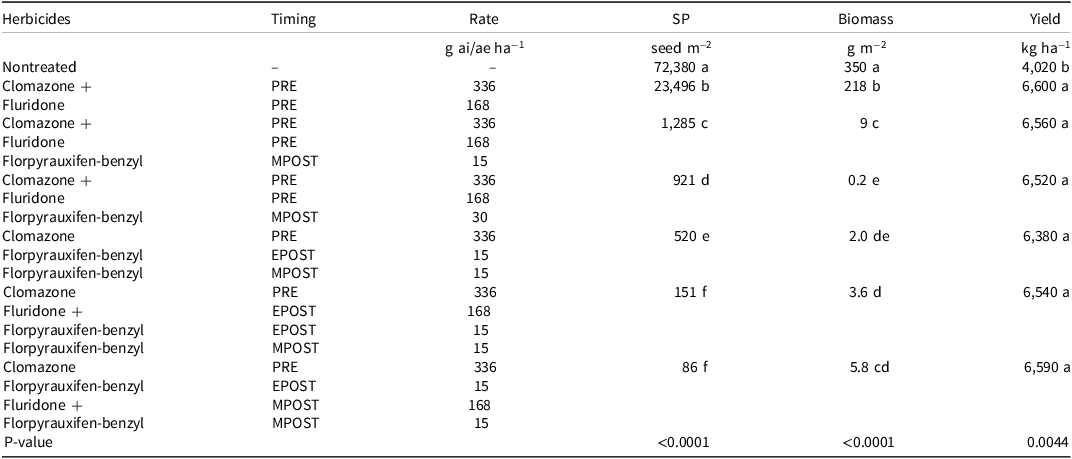
a Abbreviations:; EPOST, early postemergence; MPOST, mid-postemergence; PRE, preemergence; SP, seed production.
b Means within the same column followed by the same letter are not different according to the Sidak method (α = 0.05); the absence of letters indicates no treatment difference was present.
c All florpyrauxifen-benzyl applications included 0.58 L ha−1 methylated seed oil.
Conversely, Palmer amaranth biomass production differed as a function of the herbicide program averaged over the four site-years, and weed biomass ranged from 0.2 to 350 g m−2 (P < 0.0001; Table 8). Compared with the nontreated control, Palmer amaranth biomass production was reduced by all the herbicide programs. However, postemergence treatments that contained florpyrauxifen-benzyl or florpyrauxifen-benzyl + fluridone caused the greatest reduction in Palmer amaranth biomass production, indicating the importance of applying effective postemergence herbicides to rice crops. The preemergence application of clomazone + fluridone followed by florpyrauxifen-benzyl at 30 g ae ha−1 mid-postemergence allowed Palmer amaranth to produce similar quantities of biomass compared with a preemergence application of clomazone with sequential postemergence applications of florpyrauxifen-benzyl at 15 g ae ha−1. These findings indicate that preemergence applications of fluridone may not be necessary to effectively suppress Palmer amaranth biomass production in a furrow-irrigated rice system.
The quantity of weed seed produced by Palmer amaranth was affected by the herbicide program (P < 0.0001; Table 8). Compared with the nontreated control, clomazone + fluridone applied preemergence allowed Palmer amaranth to produce the highest quantity of seed at approximately 23,500 seed m−2. Sequential postemergence applications had the greatest impact on Palmer amaranth seed production relative to treatments that included a single postemergence application. The seed production data reported here is supported by Beesinger et al. (Reference Beesinger, Norsworthy, Butts and Roberts2022), who found that sequential florpyrauxifen-benzyl applications reduced Palmer amaranth seed production to a greater extent than a single application. Additionally, weed seed production was similar among programs in which fluridone was applied either early postemergence or mid-postemergence with florpyrauxifen-benzyl, which may be attributed to the herbicide preventing additional weed emergence and subsequent offspring additions to the soil seedbank.
Palmer Amaranth Control and Rice Injury with Single and Multiple Applications of Fluridone
Averaged over site-year, herbicide treatment affected Palmer amaranth control when it was recorded 21 d after preemergence (P < 0.0001; Table 9). At 21 d after preemergence, Palmer amaranth control improved when fluridone was applied at either 84 or 168 g ai ha−1 in a mixture with clomazone, providing 84% to 91% control across the herbicide treatments we evaluated. Weed control was greatest when clomazone was applied preemergence with fluridone at 84 and 168 g ai ha−1. Herbicide combinations that contained clomazone + fluridone at 84 or 168 g ai ha−1 resulted in 84% to 91% Palmer amaranth control, while clomazone applied alone resulted in only 43% control. These results indicate that applying fluridone along with clomazone preemergence increases Palmer amaranth control relative to clomazone applied alone, as an approximate 2-fold increase in control was observed 21 DAT.
Visible Palmer amaranth control and rice injury for the multiple fluridone application experiment 21 d after preemergence, averaged over 2022 and 2023 a, b .

a Abbreviations: AMAPA, Palmer amaranth; PRE, preemergence.
b Means within a column followed by the same letter are not different according to the Sidak method (α = 0.05); the absence of letters indicates no treatment difference was present.
Visible injury to rice was also different among herbicide treatments 21 d after preemergence (P = 0.0472; Table 9). Relative to the nontreated control, rice injury was greatest with treatments that contained clomazone + fluridone at 168 g ai ha−1. When applied preemergence, clomazone + fluridone at 168 g ai ha−1 caused 32% to 36% injury to rice, which was greater than the 18% injury caused by clomazone applied alone. These results indicate that preemergence applications of fluridone, sprayed at a 1× rate, have a greater effect on rice than treatments that did not include the herbicide. Although rice injury from treatments that contained clomazone + fluridone at 84 g ai ha−1 was not statistically different from the injury that occurred when clomazone was used alone, producers should not apply fluridone until rice reaches the V3 growth stage (Anonymous 2023).
At 14 d after mid-postemergence, visible evaluations of Palmer amaranth control differed among herbicide treatments (P < 0.0001; Table 10). Clomazone + fluridone at 84 g ai ha−1 applied preemergence followed by florpyrauxifen-benzyl was superior to clomazone alone followed by florpyrauxifen-benzyl in controlling Palmer amaranth, with each treatment providing 93% and 87% control on average, respectively. In the absence of a postemergence application of florpyrauxifen-benzyl, Palmer amaranth control ranged from 69% to 94%. Based on the data, integrating fluridone into herbicide programs will add value when targeting Palmer amaranth. However, fluridone is not currently labeled for preemergence use in rice production systems. Additionally, these results indicate the need for effective postemergence herbicides, such as florpyrauxifen-benzyl, for enhanced Palmer amaranth control in a furrow-irrigated rice system.
Visible Palmer amaranth control and rice injury for the multiple fluridone application experiment 14 d after mid-postemergence, averaged over 2022 and 2023 a, b, c .

a Abbreviations: AMAPA, Palmer amaranth; MPOST, mid-postemergence PRE, preemergence.
b Means within a column followed by the same letter are not different according to the Sidak method (α = 0.05).
c All florpyrauxifen-benzyl applications included 0.58 L ha−1 methylated seed oil.
Herbicide treatment also affected rice injury 14 d after mid-postemergence, with injury ranging from 13% to 39% (P < 0.0001; Table 10). Rice injury was greatest when fluridone was applied preemergence at 168 g ai ha−1 in combination with clomazone. Fluridone was less injurious to rice when applied at a rate of 84 g ai ha−1, even if the treatment included a sequential application of the herbicide mid-postemergence at the same rate. A previous study conducted on a precision-leveled field also reported greater rice injury when fluridone was applied to 3-leaf rice at a 1× rate vs. a 0.5× rate 4 wk after application (Butts et al. Reference Butts, Souza, Norsworthy, Barber and Hardke2024). Additionally, preemergence applications of fluridone at the 0.5× rate in combination with clomazone followed by florpyrauxifen-benzyl applied mid-postemergence does not increase rice injury compared with preemergence treatments that did not contain fluridone. There were also no differences in injury with clomazone + fluridone preemergence treatments compared with an identical preemergence treatment followed by an mid-postemergence application of florpyrauxifen-benzyl. Overall, greater rice injury was observed with fluridone applied at a 1× rate, which may be attributed to the extensive persistence of the herbicide in the soil, as reported by others (Banks et al. Reference Banks and Merkle1979).
The final herbicide application occurred late postemergence, and visible Palmer amaranth control ratings differed as a function of herbicide program 14 and 28 d after late postemergence (Table 11). At 14 d after late postemergence, herbicide combinations that contained sequential florpyrauxifen-benzyl applications achieved 90% to 96% Palmer amaranth control. Relative to those treatments, preemergence applications of clomazone with fluridone followed by a single late postemergence application of florpyrauxifen-benzyl were less effective. These results suggest that multiple applications of fluridone or florpyrauxifen-benzyl should be used to optimize Palmer amaranth control. At 28 d after late postemergence, herbicide programs that entailed multiple applications of fluridone and florpyrauxifen-benzyl achieved 97% to 98% control of Palmer amaranth. Hence, applying multiple herbicides with different modes of action is among the best management practices when targeting problematic weed species, such as Palmer amaranth (Norsworthy et al. Reference Norsworthy, Ward, Shaw, Llewellyn, Nichols, Webster, Bradley, Frisvold, Powles, Burgos, Witt and Barrett2012).
Main effect of herbicide program on visible Palmer amaranth control and rice injury 14 and 28 DALPOST, averaged over 2022 and 2023 a, b, c .

a Abbreviations: AMAPA, Palmer amaranth; DALPOST, days after late postemergence; DAT, days after treatment; LPOST, late postemergence; MPOST, mid-postemergence; PRE, preemergence.
b Means within a column followed by the same letter are not different according to the Sidak method (α = 0.05).
c All florpyrauxifen-benzyl applications included 0.58 L ha−1 methylated seed oil.
Herbicide programs that contained multiple applications of fluridone and florpyrauxifen-benzyl caused up to 29% rice injury 14 DAT, a percentage that was comparable to all other programs evaluated in the experiment (Table 11). Similarly, sequential fluridone applications did not exacerbate rice injury compared with single applications of fluridone and florpyrauxifen-benzyl 28 DAT. These injury data suggest that compared to commercial standards, extended weed control can be achieved with more herbicide applications without causing additional rice injury.
Averaged across site-years, rough rice yields differed among the herbicide programs (Table 12). Rice yield was lowest from the nontreated control at 3,580 kg ha−1. Rice yields were similar for all other herbicide programs and ranged from 7,540 to 8,260 kg ha−1. The consistent grain yield across treatments is likely attributed to each program having an late postemergence application of florpyrauxifen-benzyl. Another study also observed maximum rice grain yield with late postemergence applications of florpyrauxifen-benzyl in a furrow-irrigated rice system (Wright et al. Reference Wright, Norsworthy, Roberts, Scott, Hardke and Gbur2020). Since fluridone provides effective early-season control of Palmer amaranth (Grichar et al. Reference Grichar, Dotray and McGinty2020; Hill et al. Reference Hill, Norsworthy, Barber and Gbur2017), rice will likely have a competitive advantage in suppressing additional Palmer amaranth seedlings due to canopy formation. Hence, fewer postemergence herbicides may be required to control the weed sufficiently. Additionally, the visual injury observed with both fluridone and florpyrauxifen-benzyl did not have a long-term effect on rice yield by the end of the growing season.
Influence of different herbicide combinations using single and multiple applications of fluridone on Palmer amaranth seed production, Palmer amaranth biomass, and rice grain yield averaged over 2022 and 2023 a, b, c .

a Abbreviations: LPOST, late postemergence; MPOST, mid-postemergence; PRE, preemergence; SP, seed production.
b Means within the same column followed by the same letter are not different according to the Sidak method (α = 0.05).
c All florpyrauxifen-benzyl applications included 0.58 L ha−1 methylated seed oil.
Palmer amaranth biomass accumulation differed among the herbicide programs (Table 12). Compared with the nontreated control, all herbicide programs successfully reduced Palmer amaranth biomass production. Additionally, those programs that included a preemergence and postemergence application of fluridone and sequential postemergence applications of florpyrauxifen-benzyl had the greatest impact on Palmer amaranth biomass production, allowing no weeds to escape in those plots at the time of rice harvest in both site-years. These results are unsurprising, considering fluridone and florpyrauxifen-benzyl both exhibited noteworthy control of Palmer amaranth when applied preemergence and postemergence, respectively.
Likewise, Palmer amaranth seed production was affected by herbicide program (Table 12), and the nontreated control produced the greatest number of Palmer amaranth seed at 30,700 seed m−2. In recent years, a zero-tolerance threshold approach has been widely recommended for long-term management of Palmer amaranth and preserving herbicide efficacy (Bagavathiannan and Norsworthy Reference Bagavathiannan and Norsworthy2012; Norsworthy et al. Reference Norsworthy, Ward, Shaw, Llewellyn, Nichols, Webster, Bradley, Frisvold, Powles, Burgos, Witt and Barrett2012), in which no weeds are allowed to escape control and produce seed (Norris Reference Norris2007; Norsworthy et al. Reference Norsworthy, Griffith, Griffin, Bagavathiannan and Gbur2014). Considering there was no Palmer amaranth present in plots where fluridone and florpyrauxifen-benzyl were applied multiple times, no offspring were produced at rice harvest after those treatments. Conversely, Beesinger et al. (Reference Beesinger, Norsworthy, Butts and Roberts2022) found that sequential florpyrauxifen-benzyl applications still allowed Palmer amaranth to produce viable seed by rice harvest. Therefore, findings from this research indicate that multiple applications of fluridone in combination with sequential postemergence applications of florpyrauxifen-benzyl will be advantageous in reducing the number of weed seeds returned to the soil seedbank, further supporting the zero-tolerance threshold approach.
Practical Implications
This research highlights the ability of fluridone to provide excellent Palmer amaranth control when integrated into herbicide programs targeting the weed in a furrow-irrigated rice system. However, preemergence fluridone applications caused greater rice injury than herbicide treatments that excluded the herbicide; therefore, producers should not apply fluridone until the V3 rice growth stage, as stated on the herbicide label. Both experiments were placed at the higher end of the field where the soil is drier relative to other portions of the field; therefore, rice injury may be less where there is less moisture compared to the bottom end of a field. Due to its high persistence on a silt loam soil, severe injury from fluridone may occur in areas of a field where water from irrigation or rainfall collects (Banks et al. Reference Banks and Merkle1979) and in fields that have been previously precision-leveled (Butts et al. Reference Butts, Souza, Norsworthy, Barber and Hardke2024). Overall, the results reported here display the flexibility of applying fluridone as a postemergence, residual herbicide along with florpyrauxifen-benzyl for Palmer amaranth control on a silt loam soil. Furthermore, using fluridone at labeled rates does not appear to translate into persistent, season-long rice injury, yet it effectively controls Palmer amaranth while preserving rice yield. Although Palmer amaranth biomass and seed production was reduced with herbicide programs that included fluridone, the weed was still present at harvest in most instances; hence, producers must remain aware of the offspring and sufficient seedbank replenishment potential of the weed, which facilitates the spread of herbicide-resistant genes in future growing seasons.
Acknowledgments
This research was conducted in cooperation with SePRO Corporation. The University of Arkansas System Division of Agriculture supplied facilities and equipment.
Funding
SePRO Corporation and the Arkansas Rice Research and Promotion Board funded this research.
Competing Interests
The authors declare they have no competing interests.


 Open access

