




1 Introduction
1.1 Julia limiting directions
There is an increasingly well-developed iteration theory of transcendental-type quasiregular mappings in space. This was first put on a firm theoretical foundation by Bergweiler and Nicks [Reference Bergweiler and Nicks4] who showed that there is a definition of the Julia set that appropriately generalizes the usual notion of the Julia set in complex dynamics. The big difference in the quasiregular context is that there is no longer any guarantee of local normality of the family of iterates, even outside the Julia set. For this reason, the complement of the Julia set $J(f)$
of a transcendental-type quasiregular mapping f is called the quasi-Fatou set
$J(f)$
of a transcendental-type quasiregular mapping f is called the quasi-Fatou set $QF(f)$
instead of just the Fatou set.
$QF(f)$
instead of just the Fatou set.
The main focus of this paper is on the set of Julia limiting directions $L(f)$
of a transcendental-type quasiregular mapping f. This is sometimes called the radial distribution of
$L(f)$
of a transcendental-type quasiregular mapping f. This is sometimes called the radial distribution of $J(f)$
. We briefly recall the historical development of
$J(f)$
. We briefly recall the historical development of $L(f)$
. The set of Julia limiting directions was first studied by Qiao [Reference Qiao18] for transcendental entire functions in the plane. In this setting,
$L(f)$
. The set of Julia limiting directions was first studied by Qiao [Reference Qiao18] for transcendental entire functions in the plane. In this setting, $L(f) \subset S^1$
. One of the main results of this paper [Reference Qiao18, Theorem 1] shows that if the lower order
$L(f) \subset S^1$
. One of the main results of this paper [Reference Qiao18, Theorem 1] shows that if the lower order $\unicode{x3bb} _f$
of f is finite, then there exists a closed interval
$\unicode{x3bb} _f$
of f is finite, then there exists a closed interval $I\subset S^1$
such that
$I\subset S^1$
such that $I\subset L(f)$
and there is a lower bound on the measure of this interval, that is,
$I\subset L(f)$
and there is a lower bound on the measure of this interval, that is, $m(I)\geq {\pi }/{\max (1/2,\unicode{x3bb} _f)}$
. In particular, if
$m(I)\geq {\pi }/{\max (1/2,\unicode{x3bb} _f)}$
. In particular, if $\unicode{x3bb} _f \leq 1/2$
, then
$\unicode{x3bb} _f \leq 1/2$
, then $L(f) = S^1$
. A number of papers have studied
$L(f) = S^1$
. A number of papers have studied $L(f)$
for meromorphic functions, including [Reference Qiu and Wu19, Reference Wang and Yao23, Reference Wang24, Reference Zheng, Wang and Huang27], as well as for solutions of differential equations, see for example [Reference Wang and Chen22].
$L(f)$
for meromorphic functions, including [Reference Qiu and Wu19, Reference Wang and Yao23, Reference Wang24, Reference Zheng, Wang and Huang27], as well as for solutions of differential equations, see for example [Reference Wang and Chen22].
In higher dimensions, if $f:\mathbb {R}^n \to \mathbb {R}^n$
is a quasiregular mapping, for
$f:\mathbb {R}^n \to \mathbb {R}^n$
is a quasiregular mapping, for $n\geq 2$
, then
$n\geq 2$
, then $L(f)$
is a subset of the
$L(f)$
is a subset of the $(n-1)$
-dimensional unit sphere
$(n-1)$
-dimensional unit sphere $S^{n-1}$
in
$S^{n-1}$
in $\mathbb {R}^n$
.
$\mathbb {R}^n$
.
Definition 1.1. Let $n\geq 2$
and
$n\geq 2$
and $f\colon \mathbb {R}^n\rightarrow \mathbb {R}^n$
be a transcendental-type quasiregular mapping. We say
$f\colon \mathbb {R}^n\rightarrow \mathbb {R}^n$
be a transcendental-type quasiregular mapping. We say $\zeta \in S^{n-1}$
is a Julia limiting direction of f if there exists a sequence
$\zeta \in S^{n-1}$
is a Julia limiting direction of f if there exists a sequence $(x_m)_{m=1}^{\infty } $
in
$(x_m)_{m=1}^{\infty } $
in $J(f)$
with
$J(f)$
with $\lim _{m\rightarrow \infty }|x_m|=\infty $
and
$\lim _{m\rightarrow \infty }|x_m|=\infty $
and $\lim _{m\rightarrow \infty }x_m/|x_m|=\zeta $
. We denote by
$\lim _{m\rightarrow \infty }x_m/|x_m|=\zeta $
. We denote by $L(f)$
the set of Julia limiting directions in
$L(f)$
the set of Julia limiting directions in $S^{n-1}$
.
$S^{n-1}$
.
As $J(f)$
is unbounded for transcendental-type quasiregular mappings, the notion of
$J(f)$
is unbounded for transcendental-type quasiregular mappings, the notion of $L(f)$
as the radial distribution of
$L(f)$
as the radial distribution of $J(f)$
makes sense. In this setting,
$J(f)$
makes sense. In this setting, $L(f)$
was first studied by the first named author in [Reference Fletcher8]. In [Reference Fletcher8, Theorem 2.2], a strong condition on the comparability of the minimum modulus and maximum modulus of f was given which implied that
$L(f)$
was first studied by the first named author in [Reference Fletcher8]. In [Reference Fletcher8, Theorem 2.2], a strong condition on the comparability of the minimum modulus and maximum modulus of f was given which implied that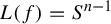 $L(f) = S^{n-1}$
. The main result of this paper is a more direct analog of Qiao’s result relating the growth of a transcendental-type quasiregular mapping to the size of
$L(f) = S^{n-1}$
. The main result of this paper is a more direct analog of Qiao’s result relating the growth of a transcendental-type quasiregular mapping to the size of $L(f)$
.
$L(f)$
.
We denote by $\mu _f$
the order of growth of f and by
$\mu _f$
the order of growth of f and by $m(E)$
the spherical measure of a subset E of
$m(E)$
the spherical measure of a subset E of $S^{n-1}$
. We also denote by
$S^{n-1}$
. We also denote by $T(U)$
the topological hull of
$T(U)$
the topological hull of $U\subset \mathbb {R}^n$
, the union of U with all its complementary bounded components.
$U\subset \mathbb {R}^n$
, the union of U with all its complementary bounded components.
Theorem 1.2. Let $f\colon \mathbb {R}^n\rightarrow \mathbb {R}^n$
be a transcendental-type K-quasiregular mapping of order
$f\colon \mathbb {R}^n\rightarrow \mathbb {R}^n$
be a transcendental-type K-quasiregular mapping of order $\mu _f<\infty $
for which
$\mu _f<\infty $
for which $T(U)\neq \mathbb {R}^n$
for any quasi-Fatou component U. Then, there exists a component
$T(U)\neq \mathbb {R}^n$
for any quasi-Fatou component U. Then, there exists a component $E\subset L(f)$
with
$E\subset L(f)$
with
 $$ \begin{align} m(E)\geq \min(c_n K^{(2-2n)/n}\mu_f^{1-n},\omega_{n-1}), \end{align} $$
where $c_n>0$
is a constant depending only on n and
$c_n>0$
is a constant depending only on n and $\omega _{n-1}=m(S^{n-1})$
.
$\omega _{n-1}=m(S^{n-1})$
.
The requirement that $T(U)\neq \mathbb {R}^n$
for any quasi-Fatou component U is always satisfied for transcendental entire functions in the plane. To see this, suppose there is a component
$T(U)\neq \mathbb {R}^n$
for any quasi-Fatou component U is always satisfied for transcendental entire functions in the plane. To see this, suppose there is a component $U\subset F(f)$
for a transcendental entire function f such that
$U\subset F(f)$
for a transcendental entire function f such that $T(U)=\mathbb {C}$
. Since transcendental entire functions have unbounded Julia sets, U must be a multiply connected unbounded component of
$T(U)=\mathbb {C}$
. Since transcendental entire functions have unbounded Julia sets, U must be a multiply connected unbounded component of $F(f)$
which cannot happen by [Reference Baker1, Theorem 1]. It is still an open question whether the same is always true for transcendental-type quasiregular maps, but we need to make this assumption to apply a growth rate result in sectors contained in the quasi-Fatou set (see Theorem 2.15 below).
$F(f)$
which cannot happen by [Reference Baker1, Theorem 1]. It is still an open question whether the same is always true for transcendental-type quasiregular maps, but we need to make this assumption to apply a growth rate result in sectors contained in the quasi-Fatou set (see Theorem 2.15 below).
We immediately obtain the following corollary from equation (1.1).
Corollary 1.3. Let $f\colon \mathbb {R}^n\rightarrow \mathbb {R}^n$
be a transcendental-type K-quasiregular mapping for which
$f\colon \mathbb {R}^n\rightarrow \mathbb {R}^n$
be a transcendental-type K-quasiregular mapping for which $T(U)\neq \mathbb {R}^n$
for any quasi-Fatou component U. With the notation from Theorem 1.2, if the order of f satisfies
$T(U)\neq \mathbb {R}^n$
for any quasi-Fatou component U. With the notation from Theorem 1.2, if the order of f satisfies
 $$ \begin{align*} \mu_f \leq K^{-2/n} \bigg( \frac{ c_n}{\omega_{n-1} }\bigg)^{1/(n-1)}, \end{align*} $$
then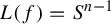 $L(f)=S^{n-1}$
.
$L(f)=S^{n-1}$
.
This condition on the order of f forces there to be a component U of $L(f)$
with
$L(f)$
with ${m(U)\geq \omega _{n-1}}$
. Since
${m(U)\geq \omega _{n-1}}$
. Since $L(f)$
is closed, the closure of U is also contained in
$L(f)$
is closed, the closure of U is also contained in $L(f)$
with
$L(f)$
with $m(\overline {U})\geq \omega _{n-1}$
. As there are no open sets of measure 0 in
$m(\overline {U})\geq \omega _{n-1}$
. As there are no open sets of measure 0 in $S^{n-1}$
, we have
$S^{n-1}$
, we have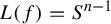 $L(f)=S^{n-1}$
.
$L(f)=S^{n-1}$
.
If $\mu _f < \infty $
, then the right-hand side of equation (1.1) is positive, from which we immediately obtain the following corollary of Theorem 1.2.
$\mu _f < \infty $
, then the right-hand side of equation (1.1) is positive, from which we immediately obtain the following corollary of Theorem 1.2.
Corollary 1.4. Let $f\colon \mathbb {R}^n\rightarrow \mathbb {R}^n$
be a transcendental-type K-quasiregular mapping for which
$f\colon \mathbb {R}^n\rightarrow \mathbb {R}^n$
be a transcendental-type K-quasiregular mapping for which $T(U)\neq \mathbb {R}^n$
for any quasi-Fatou component U. If every component of
$T(U)\neq \mathbb {R}^n$
for any quasi-Fatou component U. If every component of $L(f)$
has zero spherical measure, then
$L(f)$
has zero spherical measure, then $\mu _f=\infty $
.
$\mu _f=\infty $
.
The relevance of Corollary 1.4 is that if we can construct a quasiregular mapping with one Julia limiting direction, say $e_1 = (1,0,\ldots , 0)$
, that is the identity outside a half-beam, we can completely solve the inverse problem: given a closed set
$e_1 = (1,0,\ldots , 0)$
, that is the identity outside a half-beam, we can completely solve the inverse problem: given a closed set $E\subset S^{n-1}$
, we would like to find a transcendental-type quasiregular map f such that
$E\subset S^{n-1}$
, we would like to find a transcendental-type quasiregular map f such that $L(f)=E$
. As notation, let
$L(f)=E$
. As notation, let $H(x_0,\theta ,w)\subset \mathbb {R}^n$
be a closed half-beam with width
$H(x_0,\theta ,w)\subset \mathbb {R}^n$
be a closed half-beam with width $2w>0$
along the center ray
$2w>0$
along the center ray ${R=\{x\in \mathbb {R}^n: ({ x-x_0})/{|x-x_0|} =\theta \}}$
starting at
${R=\{x\in \mathbb {R}^n: ({ x-x_0})/{|x-x_0|} =\theta \}}$
starting at $x_0\in \mathbb {R}^n$
extending in the
$x_0\in \mathbb {R}^n$
extending in the $\theta \in S^{n-1}$
direction.
$\theta \in S^{n-1}$
direction.
Theorem 1.5. Let E be a closed non-empty subset of $S^{n-1}$
. Suppose that there exists a transcendental-type quasiregular mapping
$S^{n-1}$
. Suppose that there exists a transcendental-type quasiregular mapping $f_0:\mathbb {R}^n\to \mathbb {R}^n$
that satisfies:
$f_0:\mathbb {R}^n\to \mathbb {R}^n$
that satisfies:
-
(1) $L(f_0)=\{e_1\}$
;
$L(f_0)=\{e_1\}$
; -
(2)
$f_0(x)=x$
for
$x\in \mathbb {R}^n\backslash H(0,e_1,1)$
.



Then, there exists a quasiregular mapping f with $L(f)=E$
.
$L(f)=E$
.
By Corollary 1.4, it is clear that such a map $f_0$
, and thus also the map f given by the construction in the proof of Theorem 1.5, must be of infinite order.
$f_0$
, and thus also the map f given by the construction in the proof of Theorem 1.5, must be of infinite order.
1.2 Phragmén–Lindelöf principles
The main novelty in our strategy for proving Theorem 1.2 is a new version of the Phragmén–Lindelöf principle which applies to quasiregular mappings in sectors and allows for boundary growth of the form $O(|x|^p)$
for
$O(|x|^p)$
for $p>0$
. To explain why this is important, we first recall that the classical Phragmén–Lindelöf principle states that if S is the sector
$p>0$
. To explain why this is important, we first recall that the classical Phragmén–Lindelöf principle states that if S is the sector $\{z\in \mathbb {C}:|{\arg} (z)|<\theta /2\}$
for
$\{z\in \mathbb {C}:|{\arg} (z)|<\theta /2\}$
for $0<\theta \leq 2\pi $
and
$0<\theta \leq 2\pi $
and $f:S \to \mathbb {C}$
is a holomorphic function satisfying
$f:S \to \mathbb {C}$
is a holomorphic function satisfying $\limsup _{z\rightarrow w}|f(z)|\leq 1$
for all
$\limsup _{z\rightarrow w}|f(z)|\leq 1$
for all $w\in \partial S$
, then either
$w\in \partial S$
, then either $|f(z)| \leq 1$
for all
$|f(z)| \leq 1$
for all $z\in S$
or
$z\in S$
or $\liminf _{r\rightarrow \infty } \log M(r,f) r^{-\pi /\theta }>0$
, where
$\liminf _{r\rightarrow \infty } \log M(r,f) r^{-\pi /\theta }>0$
, where $M(r,f)$
is the maximum modulus function
$M(r,f)$
is the maximum modulus function $\sup _{|z|\leq r}|f(z)|$
.
$\sup _{|z|\leq r}|f(z)|$
.
It is straight-forward to generalize this result to the case when f satisfies ${|f(z)| = O(|z|^p)}$
on the boundary of the sector by considering the holomorphic function
${|f(z)| = O(|z|^p)}$
on the boundary of the sector by considering the holomorphic function $f(z)/z^p$
. This result for holomorphic functions is proved by using the corresponding Phragmén–Lindelöf principle for subharmonic functions applied to the subharmonic function
$f(z)/z^p$
. This result for holomorphic functions is proved by using the corresponding Phragmén–Lindelöf principle for subharmonic functions applied to the subharmonic function $\log |f|$
.
$\log |f|$
.
Many Phragmén–Lindelöf results have been proven for different classes of functions and more general unbounded domains. For example, analogous results have been given for sub-F-extremal maps [Reference Granlund, Lindqvist and Martio11], plurisubharmonic functions [Reference Momm16], meromorphic functions [Reference Kuroda14], slice regular functions [Reference Gentili, Stoppato and Struppa9], and quasiregular mappings [Reference Botvinnik and Miklyukov5, Reference Martio, Miklyukov and Vuorinen15, Reference Rickman20, Reference Rickman and Vuorinen21]. Other unbounded domains in $\mathbb {R}^n$
have also been considered such as strips [Reference Essén7], cylinders [Reference Yoshida25], and cones [Reference Yoshida26].
$\mathbb {R}^n$
have also been considered such as strips [Reference Essén7], cylinders [Reference Yoshida25], and cones [Reference Yoshida26].
As far as the authors are aware, all of these generalizations of the Phragmén–Lindelöf principle in the literature require an $O(1)$
bound on the boundary of the domain under consideration. For our purposes, we will need to consider the situation where a quasiregular mapping from a sector in
$O(1)$
bound on the boundary of the domain under consideration. For our purposes, we will need to consider the situation where a quasiregular mapping from a sector in $\mathbb {R}^n$
, for
$\mathbb {R}^n$
, for $n\geq 2$
, has a bound of the form
$n\geq 2$
, has a bound of the form $|f(x)| = O( |x|^p )$
on the boundary of the sector. Since there are no elementary algebraic considerations of the form
$|f(x)| = O( |x|^p )$
on the boundary of the sector. Since there are no elementary algebraic considerations of the form $f(x) / x^p$
that can be used for quasiregular mappings, this generalization is not straight-forward. We expect our methods to be applicable in other settings too.
$f(x) / x^p$
that can be used for quasiregular mappings, this generalization is not straight-forward. We expect our methods to be applicable in other settings too.
Similar to how subharmonic functions are used to show Phragmén–Lindelöf principles for holomorphic functions, we prove a Phragmén–Lindelöf result for sub-F-extremal functions and apply it to get a corresponding result for quasiregular mappings. In the quasiregular setting, $\log |f|$
is an example of a sub-F-extremal function. We postpone the recollection of this definition until the next section, but just note here that this means
$\log |f|$
is an example of a sub-F-extremal function. We postpone the recollection of this definition until the next section, but just note here that this means $\log |f|$
satisfies a certain nonlinear partial differential equation and obeys a certain comparison principle, analogously to subharmonic functions.
$\log |f|$
satisfies a certain nonlinear partial differential equation and obeys a certain comparison principle, analogously to subharmonic functions.
Next, we define what we mean by a sector in our context and recall a Phragmén–Lindelöf result for sub-F-extremals that we generalize.
Definition 1.6. Let $E\subset S^{n-1}$
be a domain and let
$E\subset S^{n-1}$
be a domain and let $x_0 \in \mathbb {R}^n$
. Define the sector relative to E with vertex at
$x_0 \in \mathbb {R}^n$
. Define the sector relative to E with vertex at $x_0$
to be
$x_0$
to be
 $$ \begin{align*}S_{x_0,E}=\{c(x-x_0)+x_0: c>0,x\in E\}.\end{align*} $$
The following result is [Reference Granlund, Lindqvist and Martio11, Theorem 3.16] in the special case of sectors. Note that the definitions used here will be made more precise in the next section.
Theorem 1.7. [Reference Granlund, Lindqvist and Martio11, Theorem 3.16]
Let $E\subsetneq S^{n-1}$
be a domain and
$E\subsetneq S^{n-1}$
be a domain and $x_0\in \mathbb {R}^n$
. Suppose that
$x_0\in \mathbb {R}^n$
. Suppose that $S=S_{x_0,E}$
is a sector in
$S=S_{x_0,E}$
is a sector in $\mathbb {R}^n$
and that F is a variational kernel of type n in S with structural constants
$\mathbb {R}^n$
and that F is a variational kernel of type n in S with structural constants $\alpha $
and
$\alpha $
and $\beta $
. Let
$\beta $
. Let $u\colon S\rightarrow \mathbb {R}\cup \{-\infty \}$
be a sub-F-extremal in S such that
$u\colon S\rightarrow \mathbb {R}\cup \{-\infty \}$
be a sub-F-extremal in S such that $\limsup _{x\rightarrow y} u(x)\leq 0$
for
$\limsup _{x\rightarrow y} u(x)\leq 0$
for $y\in \partial S$
. Then, either
$y\in \partial S$
. Then, either $u(x)\leq 0$
in S or
$u(x)\leq 0$
in S or
 $$ \begin{align*} \liminf\limits_{r\rightarrow\infty}M_S(r,u)r^{-q}>0, \end{align*} $$
where $M_S(r,u)=\sup _{|x|\leq r,x\in S}u(x)$
,
$M_S(r,u)=\sup _{|x|\leq r,x\in S}u(x)$
, $q=d_n m(E)^{-1/(n-1)}(\alpha /\beta )^{1/n}$
, and
$q=d_n m(E)^{-1/(n-1)}(\alpha /\beta )^{1/n}$
, and $d_n>0$
is a constant depending only on n.
$d_n>0$
is a constant depending only on n.
Applying this result to $\log |f|$
when f is quasiregular, we have the following corollary.
$\log |f|$
when f is quasiregular, we have the following corollary.
Corollary 1.8. Let $E\subsetneq S^{n-1}$
be a domain and
$E\subsetneq S^{n-1}$
be a domain and $x_0\in \mathbb {R}^n$
. Suppose that
$x_0\in \mathbb {R}^n$
. Suppose that ${S=S_{x_0,E}}$
is a sector in
${S=S_{x_0,E}}$
is a sector in $\mathbb {R}^n$
. Let
$\mathbb {R}^n$
. Let $f\colon S\rightarrow \mathbb {R}^n$
be a K-quasiregular mapping such that
$f\colon S\rightarrow \mathbb {R}^n$
be a K-quasiregular mapping such that ${\limsup _{x\rightarrow y} |f(x)|\leq 1}$
for
${\limsup _{x\rightarrow y} |f(x)|\leq 1}$
for $y\in \partial S$
. Then, either
$y\in \partial S$
. Then, either $|f(x)|\leq 1$
in S or
$|f(x)|\leq 1$
in S or
 $$ \begin{align*}\liminf\limits_{r\rightarrow\infty}\:\log M_S(r,f)r^{-q}>0, \end{align*} $$
where $M_S(r,f)=\sup _{|x|\leq r,x\in S}|f(x)|$
,
$M_S(r,f)=\sup _{|x|\leq r,x\in S}|f(x)|$
, $q=d_n m(E)^{-1/(n-1)}K^{-2/n}$
, and
$q=d_n m(E)^{-1/(n-1)}K^{-2/n}$
, and $d_n>0$
is a constant depending only on n.
$d_n>0$
is a constant depending only on n.
Our generalizations of these results are as follows. Recall that $\log ^+ x = \max \{ \log x, 0 \}$
.
$\log ^+ x = \max \{ \log x, 0 \}$
.
Theorem 1.9. Let $E\subsetneq S^{n-1}$
be a domain and
$E\subsetneq S^{n-1}$
be a domain and $x_0\in \mathbb {R}^n$
. Suppose that
$x_0\in \mathbb {R}^n$
. Suppose that $S=S_{x_0,E}$
is a sector in
$S=S_{x_0,E}$
is a sector in $\mathbb {R}^n$
and that
$\mathbb {R}^n$
and that $F\colon S\times \mathbb {R}^n\rightarrow \mathbb {R}$
is a variational kernel of type n in S with structural constants
$F\colon S\times \mathbb {R}^n\rightarrow \mathbb {R}$
is a variational kernel of type n in S with structural constants $\alpha $
and
$\alpha $
and $\beta $
. Let
$\beta $
. Let $u\colon S\rightarrow \mathbb {R}\cup \{-\infty \}$
be a sub-F-extremal in S such that
$u\colon S\rightarrow \mathbb {R}\cup \{-\infty \}$
be a sub-F-extremal in S such that $\limsup _{x\rightarrow y} u(x)\leq C\log ^+|y|$
at each
$\limsup _{x\rightarrow y} u(x)\leq C\log ^+|y|$
at each $y\in \partial S$
for some constant
$y\in \partial S$
for some constant $C>0$
. Then, given
$C>0$
. Then, given $\varepsilon>0$
, either, for all sufficiently large
$\varepsilon>0$
, either, for all sufficiently large $|x|$
in S, we have
$|x|$
in S, we have
 $$ \begin{align*}u(x) \leq C(1+\varepsilon) \log |x|\end{align*} $$
or
 $$ \begin{align*}\limsup\limits_{r\rightarrow\infty}M_S(r,u)r^{-q'}>0,\end{align*} $$
where $q'=d_n m(E)^{-1/(n-1)}(\alpha /\beta )^{1/n}\varepsilon / (1+\varepsilon )$
and
$q'=d_n m(E)^{-1/(n-1)}(\alpha /\beta )^{1/n}\varepsilon / (1+\varepsilon )$
and $d_n>0$
depends only on n.
$d_n>0$
depends only on n.
This theorem weakens the hypotheses of [Reference Granlund, Lindqvist and Martio11, Theorem 3.16] by Granlund, Lindqvist, and Martio from $u(x) = O(1)$
to
$u(x) = O(1)$
to $u(x)=O(\log |x|)$
on
$u(x)=O(\log |x|)$
on $\partial S$
, although their conclusions in the alternative have a
$\partial S$
, although their conclusions in the alternative have a $\liminf $
instead of a
$\liminf $
instead of a $\limsup $
. It is certainly conceivable that Theorem 1.9 could be improved, but for our dynamical applications, this suffices. Using the fact that if f is a quasiregular mapping then
$\limsup $
. It is certainly conceivable that Theorem 1.9 could be improved, but for our dynamical applications, this suffices. Using the fact that if f is a quasiregular mapping then $\log |f|$
is sub-F-extremal, we obtain the following corollary.
$\log |f|$
is sub-F-extremal, we obtain the following corollary.
Corollary 1.10. Let $E\subsetneq S^{n-1}$
be a domain and
$E\subsetneq S^{n-1}$
be a domain and $x_0\in \mathbb {R}^n$
. Suppose that
$x_0\in \mathbb {R}^n$
. Suppose that $S = S_{x_0,E}$
is a sector in
$S = S_{x_0,E}$
is a sector in $\mathbb {R}^n$
. Let
$\mathbb {R}^n$
. Let $f\colon S\rightarrow \mathbb {R}^n$
be a K-quasiregular mapping in S such that
$f\colon S\rightarrow \mathbb {R}^n$
be a K-quasiregular mapping in S such that
 $$ \begin{align*} \limsup\limits_{x\rightarrow y} \log |f(x)|\leq p\log^+|y| + C\end{align*} $$
at each $y\in \partial S$
for some constants C and
$y\in \partial S$
for some constants C and $p>0$
. Then, given
$p>0$
. Then, given $\varepsilon>0$
, either, for all sufficiently large
$\varepsilon>0$
, either, for all sufficiently large $|x|$
in S, we have
$|x|$
in S, we have
 $$ \begin{align*} \log |f(x)| \leq p(1+\varepsilon) \log |x| +C \end{align*} $$
or
 $$ \begin{align*} \limsup\limits_{r\rightarrow\infty}\log M_S(r,f)r^{-q'}>0, \end{align*} $$
where $q'={d_n m(E)^{-1/(n-1)}K^{-2/n}}\varepsilon / (1+\varepsilon )$
and
$q'={d_n m(E)^{-1/(n-1)}K^{-2/n}}\varepsilon / (1+\varepsilon )$
and $d_n>0$
depends only on n.
$d_n>0$
depends only on n.
The remainder of this paper is organized as follows. In §2, we recall background material on quasiregular dynamics and nonlinear potential theory. In §3, we prove Theorem 1.9. In §4, we prove a topological result needed in the proof of Theorem 1.2. Finally, in §5, we prove our main results, Theorems 1.2 and 1.5.
2 Preliminaries
As notation, we let $B(x_0,r)$
denote the open ball centered at
$B(x_0,r)$
denote the open ball centered at $x_0 \in \mathbb {R}^n$
of radius r and let
$x_0 \in \mathbb {R}^n$
of radius r and let $S(x_0,r)$
be the boundary of
$S(x_0,r)$
be the boundary of $B(x_0,r)$
. The unit sphere in
$B(x_0,r)$
. The unit sphere in $\mathbb {R}^n$
is denoted by
$\mathbb {R}^n$
is denoted by $S^{n-1}$
.
$S^{n-1}$
.
2.1 Quasiregular dynamics
We first recall some definitions about quasiregular mappings and their dynamics. For more information on quasiregular mappings, we refer the reader to Rickman’s monograph [Reference Rickman20].
Let G be a domain in $\mathbb {R}^n$
and
$\mathbb {R}^n$
and $X=\mathbb {R}^n$
or
$X=\mathbb {R}^n$
or $X=\mathbb {R}$
. Denote by
$X=\mathbb {R}$
. Denote by $C(G,X)$
the set of continuous functions
$C(G,X)$
the set of continuous functions $G\to X$
. Denote by
$G\to X$
. Denote by $W^{1,n}_{\text {loc}}(G,X)$
the Sobolev space of X-valued functions on G that are locally in
$W^{1,n}_{\text {loc}}(G,X)$
the Sobolev space of X-valued functions on G that are locally in $L^n(G)$
with weak first-order partial derivatives that are also locally in
$L^n(G)$
with weak first-order partial derivatives that are also locally in $L^n(G)$
.
$L^n(G)$
.
Definition 2.1. Let $f\in C(G,\mathbb {R}^n)\cap W^{1,n}_{\text {loc}}(G,\mathbb {R}^n)$
for
$f\in C(G,\mathbb {R}^n)\cap W^{1,n}_{\text {loc}}(G,\mathbb {R}^n)$
for $G\subset \mathbb {R}^n$
. We say f is a quasiregular mapping if there exists a constant
$G\subset \mathbb {R}^n$
. We say f is a quasiregular mapping if there exists a constant $K\geq 1$
such that
$K\geq 1$
such that $|f'(x)|^n\leq K J_f(x)$
for almost every
$|f'(x)|^n\leq K J_f(x)$
for almost every $x\in \mathbb {R}^n$
, where
$x\in \mathbb {R}^n$
, where $|f'(x)|=\max _{{|h|=1}}|f'(x)(h)|$
is the operator norm and
$|f'(x)|=\max _{{|h|=1}}|f'(x)(h)|$
is the operator norm and $J_f(x)$
is the Jacobian of f at x. The smallest such K is called the outer dilatation of f and is denoted
$J_f(x)$
is the Jacobian of f at x. The smallest such K is called the outer dilatation of f and is denoted $K_O(f).$
If f is quasiregular, there also exists a constant $K' \geq 1$
such that
$K' \geq 1$
such that
 $$ \begin{align*} J_f(x)\leq K' \min _{|h|=1} |f'(x)(h)|^n \end{align*} $$
almost everywhere. The smallest constant $K'$
here is called the inner dilatation of f and is denoted by
$K'$
here is called the inner dilatation of f and is denoted by $K_I(f)$
. The maximal dilatation is
$K_I(f)$
. The maximal dilatation is ${K(f)=\max \{K_O(f),K_I(f)\}}$
. A K-quasiregular mapping is one where
${K(f)=\max \{K_O(f),K_I(f)\}}$
. A K-quasiregular mapping is one where $K\geq K(f)$
, so for example, if f is
$K\geq K(f)$
, so for example, if f is $2$
-quasiregular, then it is also
$2$
-quasiregular, then it is also $3$
-quasiregular.
$3$
-quasiregular.
We say that f is an entire quasiregular mapping if f is defined on $\mathbb {R}^n$
and that a non-constant entire quasiregular mapping f is of transcendental-type if f has an essential singularity at
$\mathbb {R}^n$
and that a non-constant entire quasiregular mapping f is of transcendental-type if f has an essential singularity at $\infty $
. Otherwise, we say that f is of polynomial-type.
$\infty $
. Otherwise, we say that f is of polynomial-type.
Given an unbounded sub-domain U of $\mathbb {R}^n$
and a function
$\mathbb {R}^n$
and a function $f:U \to \mathbb {R}^n$
, we define
$f:U \to \mathbb {R}^n$
, we define
 $$ \begin{align*} M_U(r,f) = \sup_{|x| \leq r, x\in U} |f(x) |,\end{align*} $$
as long as $\overline {B(0,r)}$
meets U. In the case where
$\overline {B(0,r)}$
meets U. In the case where $U=\mathbb {R}^n$
and f is quasiregular, the fact that f is an open mapping means that we may simplify this notation and just write
$U=\mathbb {R}^n$
and f is quasiregular, the fact that f is an open mapping means that we may simplify this notation and just write
 $$ \begin{align*} M(r,f) = \sup _{|x| = r} |f(x)|.\end{align*} $$
Transcendental-type quasiregular mappings may be classified via their growth as follows.
Lemma 2.2. [Reference Bergweiler2, Lemma 3.4]
Let $f: \mathbb {R}^n \to \mathbb {R}^n$
be a quasiregular mapping. Then, f is of transcendental-type if and only if
$f: \mathbb {R}^n \to \mathbb {R}^n$
be a quasiregular mapping. Then, f is of transcendental-type if and only if
 $$ \begin{align*} \lim\limits_{r\to \infty} \frac{ \log M(r,f) }{\log r} = + \infty .\end{align*} $$
A related notion to the expression above is the order of growth.
Definition 2.3. The order of an entire quasiregular mapping $f\colon \mathbb {R}^n\rightarrow \mathbb {R}^n$
is
$f\colon \mathbb {R}^n\rightarrow \mathbb {R}^n$
is
 $$ \begin{align*}\mu_f=\limsup\limits_{r\rightarrow\infty}(n-1)\frac{\log\log M(r,f)}{\log r}.\end{align*} $$
Next, consider the iteration of quasiregular mappings. If f is an entire $K_1$
-quasiregular mapping and g is an entire
$K_1$
-quasiregular mapping and g is an entire $K_2$
-quasiregular mapping, then the composition
$K_2$
-quasiregular mapping, then the composition $f\circ g$
is also quasiregular, but the maximal dilatation typically goes up. In general, we have
$f\circ g$
is also quasiregular, but the maximal dilatation typically goes up. In general, we have $K(f\circ g) \leq K_1K_2$
. This means that the iterates
$K(f\circ g) \leq K_1K_2$
. This means that the iterates $f^m$
, for
$f^m$
, for $m\in \mathbb {N}$
, of a quasiregular mapping may be defined, but there is not necessarily a uniform bound on the maximal dilatation of the iterates. This is an obstacle to developing the theory of quasiregular dynamics in exact analogy to that of complex dynamics, as then the normal family machinery which is key in complex dynamics may not be available.
$m\in \mathbb {N}$
, of a quasiregular mapping may be defined, but there is not necessarily a uniform bound on the maximal dilatation of the iterates. This is an obstacle to developing the theory of quasiregular dynamics in exact analogy to that of complex dynamics, as then the normal family machinery which is key in complex dynamics may not be available.
Nevertheless, the Julia set of a transcendental-type quasiregular mapping was defined by Bergweiler and Nicks [Reference Bergweiler and Nicks4] via a blowing-up property and has many of the properties expected of the Julia set. As notation, let $\text {cap}(A,C)$
be the conformal capacity of a condenser as defined in [Reference Rickman20, p. 53], where A is an open set in
$\text {cap}(A,C)$
be the conformal capacity of a condenser as defined in [Reference Rickman20, p. 53], where A is an open set in $\mathbb {R}^n$
and C is a non-empty compact subset of A. It is known that if
$\mathbb {R}^n$
and C is a non-empty compact subset of A. It is known that if $\text {cap}(A,C)=0$
for some bounded open set A containing C, then
$\text {cap}(A,C)=0$
for some bounded open set A containing C, then $\text {cap}(A',C)=0$
for any bounded open set
$\text {cap}(A',C)=0$
for any bounded open set $A'$
containing C. In this case, we use the notation
$A'$
containing C. In this case, we use the notation $\text {cap}(C)=0$
.
$\text {cap}(C)=0$
.
Definition 2.4. Let $f\colon \mathbb {R}^n\rightarrow \mathbb {R}^n$
be a transcendental-type quasiregular mapping. The Julia set of f is defined to be
$f\colon \mathbb {R}^n\rightarrow \mathbb {R}^n$
be a transcendental-type quasiregular mapping. The Julia set of f is defined to be
 $$ \begin{align*} J(f)=\{x\in \mathbb{R}^n: \text{cap}\bigg(\mathbb{R}^n\backslash \bigcup_{k=1}^\infty f^k(U)\bigg)=0 \text{ for every neighborhood } U \text{ of } x\}. \end{align*} $$
The quasi-Fatou set is $QF(f)=\mathbb {R}^n\backslash J(f)$
.
$QF(f)=\mathbb {R}^n\backslash J(f)$
.
We note that Bergweiler [Reference Bergweiler3] initially gave this definition for polynomial-type mappings for which the degree is larger than the maximal dilatation, but as this is not relevant to the current paper, we say no more about this here.
For transcendental-type quasiregular mappings, $J(f)$
is unbounded (see for example [Reference Fletcher8, Proposition 2.1]), so we can study the radial distribution of
$J(f)$
is unbounded (see for example [Reference Fletcher8, Proposition 2.1]), so we can study the radial distribution of $J(f)$
, denoted by
$J(f)$
, denoted by $L(f)$
. Again from [Reference Fletcher8, Proposition 2.1], it follows that
$L(f)$
. Again from [Reference Fletcher8, Proposition 2.1], it follows that $L(f)$
is a closed, non-empty subset of
$L(f)$
is a closed, non-empty subset of $S^{n-1}$
.
$S^{n-1}$
.
2.2 Nonlinear potential theory
Next, we recall some definitions and properties from nonlinear potential theory. For more details on this theory, we refer to Rickman’s monograph [Reference Rickman20] and Heinonen, Kilpeläinen, and Martio’s book [Reference Heinonen, Kipeläinen and Martio13]. As usual, suppose $G\subset \mathbb {R}^n$
is a domain.
$G\subset \mathbb {R}^n$
is a domain.
Definition 2.5. A function $F\colon G\times \mathbb {R}^n\rightarrow \mathbb {R}$
is called a variational kernel of type n in G if F satisfies the following conditions.
$F\colon G\times \mathbb {R}^n\rightarrow \mathbb {R}$
is called a variational kernel of type n in G if F satisfies the following conditions.
-
• For each open
$U\subset \subset G$
and every
$\epsilon>0$
, there exists a compact set
$V\subset U$
with
$m(U\backslash V)<\epsilon $
and
$F\vert _{V\times \mathbb {R}^n}$
is continuous. -
• For almost every
$x\in G$
, the function
$h\mapsto F(x,h)$
is strictly convex and continuously differentiable. -
• There exist positive constants
$\alpha $
and
$\beta $
such that for almost every
$x\in G$
, (2.1)for all
$$ \begin{align} \alpha|h|^n\leq F(x,h)\leq \beta|h|^n \end{align} $$
$h\in \mathbb {R}^n$
.
-
• For almost every
$x\in G$
, we have
$$ \begin{align*}F(x,\unicode{x3bb} h)=|\unicode{x3bb}|^n F(x,h),\end{align*} $$
$\unicode{x3bb} \in \mathbb {R}, h\in \mathbb {R}^n$
.









Denote by $\alpha (F)$
the largest such constant
$\alpha (F)$
the largest such constant $\alpha $
and by
$\alpha $
and by $\beta (F)$
the smallest such constant
$\beta (F)$
the smallest such constant $\beta $
such that equation (2.1) holds. These are called the structural constants for F. We note that variational kernels of type
$\beta $
such that equation (2.1) holds. These are called the structural constants for F. We note that variational kernels of type $p\neq n$
have been studied, but we will focus only on the
$p\neq n$
have been studied, but we will focus only on the $p=n$
case. Henceforth, all variational kernels will be of type n.
$p=n$
case. Henceforth, all variational kernels will be of type n.
Next, we recall the definitions of F-extremals, sub-F-extremals, and super-F-extremals in G and list some properties concerning them. These are the generalizations of harmonic, subharmonic, and superharmonic functions to this setting.
Definition 2.6. A real-valued function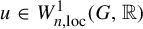 $u\in W_{n,\text {loc}}^1(G,\mathbb {R})$
is called an F-extremal if u is a solution of the Euler equation
$u\in W_{n,\text {loc}}^1(G,\mathbb {R})$
is called an F-extremal if u is a solution of the Euler equation $\nabla \cdot \nabla _h F(x,\nabla u)=0$
in the weak sense, that is,
$\nabla \cdot \nabla _h F(x,\nabla u)=0$
in the weak sense, that is,
 $$ \begin{align*}\int_G \nabla_h F(\cdot,\nabla u)\cdot \nabla \phi \: dm=0\end{align*} $$
for all real-valued functions $\phi \in C_0^\infty (G,\mathbb {R})$
.
$\phi \in C_0^\infty (G,\mathbb {R})$
.
Definition 2.7. An upper semi-continuous function $u\colon G\rightarrow \mathbb {R}\cup \{-\infty \}$
is called a sub-F-extremal if u satisfies the following condition: if a domain U is relatively compact in G and
$u\colon G\rightarrow \mathbb {R}\cup \{-\infty \}$
is called a sub-F-extremal if u satisfies the following condition: if a domain U is relatively compact in G and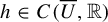 $h\in C(\overline {U},\mathbb {R})$
is an F-extremal in U with
$h\in C(\overline {U},\mathbb {R})$
is an F-extremal in U with $h\geq u$
in
$h\geq u$
in $\partial U$
, then
$\partial U$
, then $h\geq u$
in U. A function
$h\geq u$
in U. A function $v\colon G\rightarrow \mathbb {R}\cup \{\infty \}$
is called a super-F-extremal if
$v\colon G\rightarrow \mathbb {R}\cup \{\infty \}$
is called a super-F-extremal if $-v$
is a sub-F-extremal.
$-v$
is a sub-F-extremal.
Given an unbounded sub-domain U of $\mathbb {R}^n$
such that
$\mathbb {R}^n$
such that $\overline {B(0,r)}\cap U\neq \emptyset $
and a sub-F-extremal
$\overline {B(0,r)}\cap U\neq \emptyset $
and a sub-F-extremal $u\colon U\rightarrow \mathbb {R}$
, we define
$u\colon U\rightarrow \mathbb {R}$
, we define
 $$ \begin{align*} M_U(r,u)=\sup_{|x|\leq r,x\in U}u(x). \end{align*} $$
Lemma 2.8. Let h be an F-extremal, u be a sub-F-extremal, v be super-F-extremal, and $\unicode{x3bb} \in \mathbb {R}$
. Then, we have the following properties:
$\unicode{x3bb} \in \mathbb {R}$
. Then, we have the following properties:
-
• h is a sub-F-extremal and a super-F-extremal;
-
•
$\unicode{x3bb} h$
and
$h+\unicode{x3bb} $
are F-extremals; -
•
$|\unicode{x3bb} | u$
and
$u+\unicode{x3bb} $
are sub-F-extremals; and -
•
$|\unicode{x3bb} | v$
and
$v+\unicode{x3bb} $
are super-F-extremals.


The first property listed in Lemma 2.8 is a consequence of [Reference Granlund, Lindqvist and Martio10, Theorem 4.18], and the remaining follow directly from the definitions. The following F-comparison principle is key to proving Phragmén–Lindelöf-type results.
Theorem 2.9. [Reference Granlund, Lindqvist and Martio12, Lemma 2.3]
Let G be a bounded domain, u be a sub-F-extremal in G, and v be a super-F-extremal in G. If
 $$ \begin{align*}\limsup\limits_{x\rightarrow y}u(x)\leq \liminf\limits_{x\rightarrow y}v(x)\end{align*} $$
for all $y\in \partial G$
and if the left- and right-hand sides of the inequality are neither
$y\in \partial G$
and if the left- and right-hand sides of the inequality are neither $\infty $
nor
$\infty $
nor $-\infty $
at the same time, then
$-\infty $
at the same time, then $u\leq v$
in G.
$u\leq v$
in G.
The connection between variational kernels and quasiregular mappings is revealed by the following definition.
Definition 2.10. Let $f\colon G\rightarrow \mathbb {R}^n$
be a quasiregular mapping. Suppose
$f\colon G\rightarrow \mathbb {R}^n$
be a quasiregular mapping. Suppose $G'\subset \mathbb {R}^n$
is a domain such that
$G'\subset \mathbb {R}^n$
is a domain such that $f(G)\subset G'$
. Let
$f(G)\subset G'$
. Let $F\colon G'\times \mathbb {R}^n\rightarrow \mathbb {R}$
be a variational kernel in
$F\colon G'\times \mathbb {R}^n\rightarrow \mathbb {R}$
be a variational kernel in $G'$
. Define
$G'$
. Define $f^\sharp F\colon G\times \mathbb {R}^n\rightarrow \mathbb {R}$
as
$f^\sharp F\colon G\times \mathbb {R}^n\rightarrow \mathbb {R}$
as
 $$ \begin{align*}f^\sharp F(x,h)= \begin{cases} F(f(x),J_f(x)^{1/n}f'(x)^{-1*}h), & J_f(x)\neq 0,\\ |h|^n, & J_f(x)=0 \text{ or } J_f(x) \text{ does not exist,} \end{cases}\end{align*} $$
where $A^*$
is the adjoint of a linear map
$A^*$
is the adjoint of a linear map $A\colon \mathbb {R}^n\rightarrow \mathbb {R}^n.$
By [Reference Rickman20, Proposition VI.2.6], we know that $f^\sharp F$
is a variational kernel in G with possibly different constants
$f^\sharp F$
is a variational kernel in G with possibly different constants $\alpha $
and
$\alpha $
and $\beta $
. In fact, we can take
$\beta $
. In fact, we can take $\alpha =\alpha (F)K_O(f)^{-1}$
and
$\alpha =\alpha (F)K_O(f)^{-1}$
and $\beta =\beta (F)K_I(f)$
. However, we may have
$\beta =\beta (F)K_I(f)$
. However, we may have $\alpha (f^\sharp F)\geq \alpha (F)K_O(f)^{-1}$
and
$\alpha (f^\sharp F)\geq \alpha (F)K_O(f)^{-1}$
and $\beta (f^\sharp F)\leq \beta (F)K_I(f)$
. In the special case when
$\beta (f^\sharp F)\leq \beta (F)K_I(f)$
. In the special case when $F_I(x,h):=|h|^n$
,
$F_I(x,h):=|h|^n$
, $\alpha (f^\sharp F_I)=K_O(f)^{-1}$
and
$\alpha (f^\sharp F_I)=K_O(f)^{-1}$
and $\beta (f^\sharp F_I)=K_I(f)$
. In particular, if
$\beta (f^\sharp F_I)=K_I(f)$
. In particular, if $f:G\to \mathbb {R}^n$
is quasiregular, then [Reference Rickman20, Corollary VI.2.8] states that
$f:G\to \mathbb {R}^n$
is quasiregular, then [Reference Rickman20, Corollary VI.2.8] states that $\log |f|$
is
$\log |f|$
is $f^{\sharp }F_I$
extremal in
$f^{\sharp }F_I$
extremal in $G \setminus f^{-1}(0)$
, which implies that f is sub-
$G \setminus f^{-1}(0)$
, which implies that f is sub- $f^\sharp F_I$
-extremal in G.
$f^\sharp F_I$
-extremal in G.
Next, we recall the definition of F-harmonic measure $\omega (C,G;F)$
of a set
$\omega (C,G;F)$
of a set $C\subset \partial G$
.
$C\subset \partial G$
.
Definition 2.11. Let $G\subset \mathbb {R}^n$
be a bounded domain, F a variational kernel, and
$G\subset \mathbb {R}^n$
be a bounded domain, F a variational kernel, and $f\colon \partial G\rightarrow \mathbb {R}\cup \{\infty ,-\infty \}$
be any function. The upper Perron class associated to f is defined as
$f\colon \partial G\rightarrow \mathbb {R}\cup \{\infty ,-\infty \}$
be any function. The upper Perron class associated to f is defined as $\mathscr {U}_f=\{u\colon G\rightarrow \mathbb {R}\cup \{\infty \}:\liminf _{x\rightarrow y}u(x)\geq f(y), y\in \partial G, u $
is a super-
$\mathscr {U}_f=\{u\colon G\rightarrow \mathbb {R}\cup \{\infty \}:\liminf _{x\rightarrow y}u(x)\geq f(y), y\in \partial G, u $
is a super- $F $
-extremal and bounded from below in
$F $
-extremal and bounded from below in $G\} $
. Define the function
$G\} $
. Define the function $\overline {H_f}$
by
$\overline {H_f}$
by $\overline {H_f}=\inf \{u:u\in \mathscr {U}_f\!\}.$
Note that if f is bounded, then $\overline {H_f}$
is an F-extremal in G, see [Reference Granlund, Lindqvist and Martio11, p. 106].
$\overline {H_f}$
is an F-extremal in G, see [Reference Granlund, Lindqvist and Martio11, p. 106].
Definition 2.12. Let $G\subset \mathbb {R}^n$
be a bounded domain and
$G\subset \mathbb {R}^n$
be a bounded domain and $C\subset \partial G$
. Let
$C\subset \partial G$
. Let $f\colon \partial G\rightarrow \{0,1\}$
be the characteristic function of C in
$f\colon \partial G\rightarrow \{0,1\}$
be the characteristic function of C in $\partial G$
. The F-extremal
$\partial G$
. The F-extremal $\overline {H_f}$
in G is called the F-harmonic measure of C with respect to G and denoted
$\overline {H_f}$
in G is called the F-harmonic measure of C with respect to G and denoted $\omega (C,G;F)$
.
$\omega (C,G;F)$
.
From the definition, we see that $0\leq \omega (C,G;F)\leq 1$
.
$0\leq \omega (C,G;F)\leq 1$
.
2.3 Sectors
For our applications, we will need estimates on $\omega (C,G; F)$
when G is a subset of a sector in
$\omega (C,G; F)$
when G is a subset of a sector in $\mathbb {R}^n$
and on the growth of quasiregular mappings in sectors in the quasi-Fatou set. Recall the definition of
$\mathbb {R}^n$
and on the growth of quasiregular mappings in sectors in the quasi-Fatou set. Recall the definition of $S_{x_0,E}$
from Definition 1.6. If the context is clear, we typically suppress the subscripts and write
$S_{x_0,E}$
from Definition 1.6. If the context is clear, we typically suppress the subscripts and write $S = S_{x_0,E}$
. It will also be useful to project points from sectors to
$S = S_{x_0,E}$
. It will also be useful to project points from sectors to $S^{n-1}$
.
$S^{n-1}$
.
Definition 2.13. Given $x_0\in \mathbb {R}^n$
, define the projection
$x_0\in \mathbb {R}^n$
, define the projection $\nu _{x_0} : \mathbb {R}^n \setminus \{x_0 \} \to S^{n-1}$
via
$\nu _{x_0} : \mathbb {R}^n \setminus \{x_0 \} \to S^{n-1}$
via
 $$ \begin{align*} \nu_{x_0}(x) = \frac{ x-x_0}{|x-x_0|} .\end{align*} $$
The important feature of sectors is that they have constant angle measure. More precisely, if $S_{x_0,E}$
is a sector with vertex
$S_{x_0,E}$
is a sector with vertex $x_0$
, then the spherical measure of
$x_0$
, then the spherical measure of $\nu _{x_0} (S_{x_0,E}\cap S(x_0,r) ) = m(E)$
is constant for all
$\nu _{x_0} (S_{x_0,E}\cap S(x_0,r) ) = m(E)$
is constant for all $r>0$
.
$r>0$
.
First, we have the following estimate for F-harmonic measure in a sector. To start, we fix a sector $S=S_{x_0,E}$
with vertex
$S=S_{x_0,E}$
with vertex $x_0$
. For
$x_0$
. For $r>0$
, let
$r>0$
, let $S_r = S \cap B(x_0,r)$
. Then, denote the value of the F-harmonic measure
$S_r = S \cap B(x_0,r)$
. Then, denote the value of the F-harmonic measure $\omega (S(x_0,r)\cap \partial S_r, S_r;F)$
at
$\omega (S(x_0,r)\cap \partial S_r, S_r;F)$
at $x\in S_r$
by
$x\in S_r$
by $\omega (x;r)$
. Using the above notation, we have the following estimate on
$\omega (x;r)$
. Using the above notation, we have the following estimate on $\omega (x;r)$
.
$\omega (x;r)$
.
Lemma 2.14. Let $S_{x_0,E}\subset \mathbb {R}^n$
be a sector and F be a variational kernel in
$S_{x_0,E}\subset \mathbb {R}^n$
be a sector and F be a variational kernel in $S_{x_0,E}$
with structural constants
$S_{x_0,E}$
with structural constants $\alpha $
and
$\alpha $
and $\beta $
. Then,
$\beta $
. Then,
 $$ \begin{align*} \omega(x;r)\leq \frac{4|x-x_0|^{q}}{r^{q}}, \end{align*} $$
where $q=d_n m(E)^{-1/(n-1)}(\alpha /\beta )^{1/n}$
and
$q=d_n m(E)^{-1/(n-1)}(\alpha /\beta )^{1/n}$
and $d_n>0$
is a constant depending only on n.
$d_n>0$
is a constant depending only on n.
Proof. In the case where the vertex $x_0=0$
, the result is just a special case of [Reference Granlund, Lindqvist and Martio11, Lemma 3.18]. Let f be the translation
$x_0=0$
, the result is just a special case of [Reference Granlund, Lindqvist and Martio11, Lemma 3.18]. Let f be the translation $f(x) = x+x_0$
and consider the variational kernel
$f(x) = x+x_0$
and consider the variational kernel $f^{\sharp }F$
. By Definition 2.10, it is clear that
$f^{\sharp }F$
. By Definition 2.10, it is clear that
 $$ \begin{align*} f^{\sharp}F(x,h) = F(f(x),h)\end{align*} $$
and that $\alpha (f^{\sharp }F) = \alpha (F), \beta (f^{\sharp }F) = \beta (F)$
. It follows that
$\alpha (f^{\sharp }F) = \alpha (F), \beta (f^{\sharp }F) = \beta (F)$
. It follows that
 $$ \begin{align*} \omega(S(x_0,r)\cap \partial S_r, S_r;F) = \omega ( f^{-1}(S) \cap S(0,r) , f^{-1}(S) \cap B(0,r); f^{\sharp}F), \end{align*} $$
from which we obtain the lemma, again by [Reference Granlund, Lindqvist and Martio11, Lemma 3.18].
Next, we will need the following growth condition on f if a sector is contained in the quasi-Fatou set. To state it, it will help to have the following notation. Denote by d the spherical distance on $S^{n-1}$
. For
$S^{n-1}$
. For $x_0 \in \mathbb {R}^n$
,
$x_0 \in \mathbb {R}^n$
, $\zeta \in S^{n-1}$
, and
$\zeta \in S^{n-1}$
, and $0<\eta \leq \pi $
, let
$0<\eta \leq \pi $
, let $\Omega ( x_0 , \zeta , \eta )$
be the sector
$\Omega ( x_0 , \zeta , \eta )$
be the sector $S_{x_0,E}$
, where
$S_{x_0,E}$
, where $E = \{ y \in S^{n-1} : d(y,\zeta ) < \eta \}$
.
$E = \{ y \in S^{n-1} : d(y,\zeta ) < \eta \}$
.
Theorem 2.15. [Reference Fletcher8, Theorem 4.2]
Let $f\colon \mathbb {R}^n\rightarrow \mathbb {R}^n$
be a transcendental-type K-quasiregular mapping. Suppose that for
$f\colon \mathbb {R}^n\rightarrow \mathbb {R}^n$
be a transcendental-type K-quasiregular mapping. Suppose that for $x_0\in \mathbb {R}^n$
,
$x_0\in \mathbb {R}^n$
, $\theta \in S^{n-1}$
, and
$\theta \in S^{n-1}$
, and $\eta>0$
, the sector
$\eta>0$
, the sector $\Omega (x_0,\theta ,\eta )$
is contained in a component U of the quasi-Fatou set of f for which the topological hull of U is a proper subset of
$\Omega (x_0,\theta ,\eta )$
is contained in a component U of the quasi-Fatou set of f for which the topological hull of U is a proper subset of $\mathbb {R}^n$
. Then, if
$\mathbb {R}^n$
. Then, if $0<\eta '<\eta $
, there exists a constant p depending on
$0<\eta '<\eta $
, there exists a constant p depending on $n, \eta -\eta '$
, and K such that
$n, \eta -\eta '$
, and K such that $\vert f(x)\vert =O(|x|^p)$
for
$\vert f(x)\vert =O(|x|^p)$
for $x\in \Omega (x_0,\theta ,\eta ')$
.
$x\in \Omega (x_0,\theta ,\eta ')$
.
3 Phragmén–Lindelöf principles
In this section, we prove our Phragmén–Lindelöf result for sub-F-extremals in a sector where u is bounded above by $C\log ^+ |x|$
for some constant
$C\log ^+ |x|$
for some constant $C>0$
and then apply it to get a corresponding result for quasiregular mappings.
$C>0$
and then apply it to get a corresponding result for quasiregular mappings.
Proof of Theorem 1.9
Recall that we are assuming that $\limsup _{x\to y} u(x) \leq C \log ^+ |y|$
for all
$\limsup _{x\to y} u(x) \leq C \log ^+ |y|$
for all $y\in \partial S$
. Suppose that the first alternative in the conclusions of Theorem 1.9 does not hold. That is, suppose that given
$y\in \partial S$
. Suppose that the first alternative in the conclusions of Theorem 1.9 does not hold. That is, suppose that given $\varepsilon>0$
, there exists a sequence
$\varepsilon>0$
, there exists a sequence $(x_m)_{m=1}^{\infty }$
in S with
$(x_m)_{m=1}^{\infty }$
in S with $|x_m| \to \infty $
and
$|x_m| \to \infty $
and $u(x_m)> (1+\varepsilon ) C \log |x_m|$
. As
$u(x_m)> (1+\varepsilon ) C \log |x_m|$
. As $|x_m| \to \infty $
, we may re-label and assume that
$|x_m| \to \infty $
, we may re-label and assume that
 $$ \begin{align} \frac{u(x_m)}{\log|x_m|}> C(1+\varepsilon) \end{align} $$
for all m. Given $\delta>0$
, define
$\delta>0$
, define
 $$ \begin{align*} C_m=\frac{u(x_m)}{(1+\varepsilon)\log|x_m|}\quad \text{and}\quad R_m=|x_m|^{1+\varepsilon} e^{-\delta/C_m}-|x_0|. \end{align*} $$
Clearly, we have $C_m> C$
for all m. Also, re-labeling m if needed, we have
$C_m> C$
for all m. Also, re-labeling m if needed, we have
 $$ \begin{align*} \log(R_m+|x_0|)&=(1+\varepsilon)\log|x_m|-\frac{\delta}{C_m}\\ &=(1+\varepsilon)\log|x_m|-\frac{(1+\varepsilon)\log|x_m|\delta}{u(x_m)}\\ &=(1+\varepsilon)\log|x_m|\bigg(1-\frac{\delta}{u(x_m)}\bigg)>0 \end{align*} $$
for all m since $|x_m|\rightarrow \infty $
and equation (3.1) imply that
$|x_m|\rightarrow \infty $
and equation (3.1) imply that $\log |x_m|>0$
and
$\log |x_m|>0$
and $u(x_m)\rightarrow \infty $
.
$u(x_m)\rightarrow \infty $
.
Keeping the notation from earlier, let $S_{R_m}=S\cap B(x_0,R_m)$
. Finally, define
$S_{R_m}=S\cap B(x_0,R_m)$
. Finally, define
 $$ \begin{align*} v_m(x)=u(x)-C_m\log(|x_0|+R_m). \end{align*} $$
The aim is to show that a suitably scaled version of $v_m$
is bounded above by F-harmonic measure on
$v_m$
is bounded above by F-harmonic measure on $\partial S_{R_m}$
. Toward that end, for
$\partial S_{R_m}$
. Toward that end, for $y \in \partial S_{R_m}\cap \partial S$
, we have
$y \in \partial S_{R_m}\cap \partial S$
, we have
 $$ \begin{align} \limsup\limits_{x\to y} v_m(x)= \limsup\limits_{x\to y} [ u(x)-C_m\log(|x_0|+R_m) ] \leq \limsup\limits_{x\to y } [ u(x)-C\log^+|x|] \leq 0. \end{align} $$
Moreover, for $y\in \partial S_{R_m}\backslash \partial S$
, we have
$y\in \partial S_{R_m}\backslash \partial S$
, we have
 $$ \begin{align} v_m(y)=u(y)-C_m\log(|x_0|+R_m)\leq u(y), \end{align} $$
noting that u, and hence $v_m$
, are defined on
$v_m$
, are defined on $\partial S_{R_m}\backslash \partial S$
.
$\partial S_{R_m}\backslash \partial S$
.
Consider ${v_m(x)}/({M_S(|x_0|+R_m,u)})$
, where as usual,
${v_m(x)}/({M_S(|x_0|+R_m,u)})$
, where as usual, $M_S(r,u)=\sup _{x\in S, |x|\leq r}u(x)$
. It follows from equation (3.1) that
$M_S(r,u)=\sup _{x\in S, |x|\leq r}u(x)$
. It follows from equation (3.1) that $u(x_m)>0$
, so we have
$u(x_m)>0$
, so we have $M_S(|x_0| + R_m,u)>0$
. For
$M_S(|x_0| + R_m,u)>0$
. For ${y\in \partial S_{R_m}\cap \partial S}$
, it follows from equation (3.2) that
${y\in \partial S_{R_m}\cap \partial S}$
, it follows from equation (3.2) that
 $$ \begin{align*} \limsup\limits_{x\to y } \frac{v_m(x)}{M_S(|x_0|+R_m,u)}\leq 0. \end{align*} $$
For $y\in \partial S_{R_m}\backslash \partial S$
, it follows from equation (3.3) that
$y\in \partial S_{R_m}\backslash \partial S$
, it follows from equation (3.3) that
 $$ \begin{align*} \frac{v_m(y)}{M_S(|x_0|+R_m,u)}\leq \frac{u(y)}{M_S(|x_0|+R_m,u)}\leq 1. \end{align*} $$
From [Reference Heinonen, Kipeläinen and Martio13, Theorem 11.6], we have
 $$ \begin{align*}\lim_{x\rightarrow y}\omega(x;R_m)=\begin{cases} 0, &y\in \partial S_{R_m}\backslash S(x_0,r),\\ 1, &y\in \partial S_{R_m}\backslash \partial S. \end{cases}\end{align*} $$
Since $0\leq \omega (x,R_m)\leq 1$
for all
$0\leq \omega (x,R_m)\leq 1$
for all $x\in \partial S_{R_m}$
, we have
$x\in \partial S_{R_m}$
, we have
 $$ \begin{align*} \limsup\limits_{x\rightarrow y}\frac{v_m(x)}{M_S(|x_0| + R_m,u)}\leq\liminf\limits_{x\rightarrow y} \omega(x;R_m) \end{align*} $$
for $y\in \partial S_{R_m}.$
As $\omega (x;R_m)$
is an F-extremal in
$\omega (x;R_m)$
is an F-extremal in $S_{R_m}$
, we also have that
$S_{R_m}$
, we also have that $\omega (x;R_m)$
is a super-F-extremal in
$\omega (x;R_m)$
is a super-F-extremal in $S_{R_m}$
by Lemma 2.8. As
$S_{R_m}$
by Lemma 2.8. As $u(x)$
is a sub-F-extremal, again by Lemma 2.8, we have that both
$u(x)$
is a sub-F-extremal, again by Lemma 2.8, we have that both $v_m(x)$
and
$v_m(x)$
and $ {v_m(x)}/({M_S(|x_0|+R_m,u)})$
are sub-F-extremals in
$ {v_m(x)}/({M_S(|x_0|+R_m,u)})$
are sub-F-extremals in $S_{R_m}$
.
$S_{R_m}$
.
By the F-comparison principle, Theorem 2.9, we have
 $$ \begin{align*} \frac{v_m(x)}{M_S(|x_0| + R_m,u)}\leq \omega(x;R_m)\end{align*} $$
for $x\in S_{R_m}$
. In particular, we have
$x\in S_{R_m}$
. In particular, we have
 $$ \begin{align*} v_m(x_m)\leq M_S(|x_0| + R_m,u)\omega(x_m;R_m).\end{align*} $$
Next, by the definitions of $C_m$
and
$C_m$
and $R_m$
, for all m, we have
$R_m$
, for all m, we have
 $$ \begin{align*} v_m(x_m)&=u(x_m)-C_m\log(|x_0|+R_m)\\ &=u(x_m)-C_m\log(|x_0|+ |x_m|^{1+\varepsilon}e^{-\delta/C_m}-|x_0|)\\ &=u(x_m)-C_m [ \log(|x_m|^{1+\varepsilon})+\log(e^{-\delta/C_m})]\\ &=u(x_m)-(1+\varepsilon)C_m\log|x_m|+\delta\\ &=u(x_m)-\frac{(1+\varepsilon)u(x_m)}{(1+\varepsilon)\log|x_m|}\log |x_m| + \delta\\ &=\delta>0. \end{align*} $$
We conclude that for all m, we have
 $$ \begin{align*} 0<\delta\leq M_S(|x_0| + R_m,u)\omega(x_m;R_m).\end{align*} $$
Using the estimate for F-harmonic measure in sectors from Lemma 2.14, for all m, we get
 $$ \begin{align} \delta \leq \frac{ 4M_S(|x_0| + R_m,u) |x_m - x_0| ^q }{R_m^q} , \end{align} $$
where $q=d_n m(E)^{-1/(n-1)}(\alpha /\beta )^{1/n}$
for some constant
$q=d_n m(E)^{-1/(n-1)}(\alpha /\beta )^{1/n}$
for some constant $d_n>0$
, which depends only on n. Here,
$d_n>0$
, which depends only on n. Here, $\alpha $
and
$\alpha $
and $\beta $
are the structural constants of F, and
$\beta $
are the structural constants of F, and $m(E)$
is the spherical measure of E.
$m(E)$
is the spherical measure of E.
Set $r_m = |x_0| + R_m$
. Thus,
$r_m = |x_0| + R_m$
. Thus, $R_m = r_m(1+o(1))$
as
$R_m = r_m(1+o(1))$
as $m\to \infty $
. Moreover, from the definition of
$m\to \infty $
. Moreover, from the definition of $R_m$
, we have
$R_m$
, we have
 $$ \begin{align*} |x_m| &= [ (R_m + |x_0|)e^{\delta / C_m}]^{1/(1+\varepsilon)} \\ &= O( r_m^{1/(1+\varepsilon) } ) \end{align*} $$
as $m\to \infty $
. Therefore,
$m\to \infty $
. Therefore,
 $$ \begin{align*} |x_m-x_0|^q = O( r_m^{q/(1+\varepsilon)} ) \end{align*} $$
as $m\to \infty $
.
$m\to \infty $
.
Combining these with equation (3.4), we conclude that there exists a constant $\unicode{x3bb}>0$
such that
$\unicode{x3bb}>0$
such that
 $$ \begin{align*} \frac{ M_S(r_m,u)r_m^{q/(1+\varepsilon)} }{r_m^{q} } = M_S(r_m,u)r_m^{-q\varepsilon/(1+\varepsilon) } \geq \unicode{x3bb} \end{align*} $$
for all m. Therefore,
 $$ \begin{align*} \limsup\limits_{r\to \infty} M_S(r,u) r^{-q'}> 0 \end{align*} $$
with $q' = d_n m(E)^{-1/(n-1)}(\alpha /\beta )^{1/n} \varepsilon / (1+\varepsilon )$
.
$q' = d_n m(E)^{-1/(n-1)}(\alpha /\beta )^{1/n} \varepsilon / (1+\varepsilon )$
.
We now apply Theorem 1.9 to the special case of $\log |f|$
when f is quasiregular in S.
$\log |f|$
when f is quasiregular in S.
Proof of Corollary 1.10
Let $F_I(x,h)=|h|^n$
be the trivial variational kernel. Then,
$F_I(x,h)=|h|^n$
be the trivial variational kernel. Then, $u(x)=\log |f(x)|$
is a sub-
$u(x)=\log |f(x)|$
is a sub- $f^\sharp F_I$
-extremal in S with
$f^\sharp F_I$
-extremal in S with $\alpha (f^\sharp F_I)=K_O(f)^{-1}$
and
$\alpha (f^\sharp F_I)=K_O(f)^{-1}$
and $\beta (f^\sharp F_I)=K_I(f)$
. By the hypotheses, at each
$\beta (f^\sharp F_I)=K_I(f)$
. By the hypotheses, at each $y\in \partial S$
, we have
$y\in \partial S$
, we have
 $$ \begin{align*}\limsup\limits_{x\rightarrow y}u(x)=\limsup\limits_{x\rightarrow y}\log|f(x)|\leq p\log^+|y|+C.\end{align*} $$
Therefore,
 $$ \begin{align*}\limsup\limits_{x\rightarrow y} [ u(x)- C] \leq p\log^+|y|.\end{align*} $$
As $u(x) - C$
is a sub-
$u(x) - C$
is a sub- $f^{\sharp }F_I$
-extremal by Lemma 2.8, then by Theorem 1.9, given
$f^{\sharp }F_I$
-extremal by Lemma 2.8, then by Theorem 1.9, given $\varepsilon>0$
, we obtain either
$\varepsilon>0$
, we obtain either $u(x)- C\leq (1+\varepsilon ) p \log |x|$
in S for
$u(x)- C\leq (1+\varepsilon ) p \log |x|$
in S for $|x|$
sufficiently large or there exists a constant
$|x|$
sufficiently large or there exists a constant $q=d_n m(E)^{-1/(n-1)}(\alpha /\beta )^{1/n} \varepsilon / (1+\varepsilon )>0$
such that
$q=d_n m(E)^{-1/(n-1)}(\alpha /\beta )^{1/n} \varepsilon / (1+\varepsilon )>0$
such that $\limsup _{r\rightarrow \infty }M_S(r,u)r^{-q}>0$
. Note that
$\limsup _{r\rightarrow \infty }M_S(r,u)r^{-q}>0$
. Note that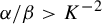 $\alpha /\beta>K^{-2}$
, so
$\alpha /\beta>K^{-2}$
, so
 $$ \begin{align*}\limsup\limits_{r\rightarrow\infty}M_S(r,u)r^{-q'}>\limsup\limits_{r\rightarrow\infty}M_S(r,u)r^{-q}>0,\end{align*} $$
where $q'={d_n m(E)^{-1/(n-1)}K^{-2/n}}\varepsilon / (1+\varepsilon ).$
In the first case, $u(x)\leq C+(1+\varepsilon )p\log |x|$
in S for
$u(x)\leq C+(1+\varepsilon )p\log |x|$
in S for $|x|$
sufficiently large. In the second case, if
$|x|$
sufficiently large. In the second case, if $\limsup _{r\rightarrow \infty } M_S(r,u)r^{-q'}>0$
, then as
$\limsup _{r\rightarrow \infty } M_S(r,u)r^{-q'}>0$
, then as
 $$ \begin{align*} M_S(r,u) = M_S(r , \log |f|) = \log M_S(r,f),\end{align*} $$
we conclude that
 $$ \begin{align*} \limsup\limits_{r\to\infty} [\log M_S(r,f)] r^{-q'}>0 .\\[-42pt] \end{align*} $$
4 Neighborhoods of components of closed sets
In the proof of Theorem 1.2, we will need to show that every component E of $L(f)$
in
$L(f)$
in $S^{n-1}$
has an open neighborhood U which is not too much larger than E and has the property that the boundary of U is contained in the complement of
$S^{n-1}$
has an open neighborhood U which is not too much larger than E and has the property that the boundary of U is contained in the complement of $L(f)$
. We will do this in Lemma 4.7, and to build up to its proof, we will introduce some topological notions here that are not required anywhere else in this paper. For more details and proofs, we refer to Bredon’s monograph [Reference Bredon6].
$L(f)$
. We will do this in Lemma 4.7, and to build up to its proof, we will introduce some topological notions here that are not required anywhere else in this paper. For more details and proofs, we refer to Bredon’s monograph [Reference Bredon6].
Definition 4.1. Let X be a topological space. Define $x\sim y$
if X cannot be written as a disjoint union of open sets
$x\sim y$
if X cannot be written as a disjoint union of open sets $U,V$
containing
$U,V$
containing $x,y$
, respectively. Then,
$x,y$
, respectively. Then, $\sim $
is an equivalence relation, and the equivalence classes are called the quasicomponents of X.
$\sim $
is an equivalence relation, and the equivalence classes are called the quasicomponents of X.
The following two results may be found in [Reference Bredon6, p. 31].
Theorem 4.2. The quasicomponent containing $x\in X$
is the intersection of closed-and- open subsets of X containing x.
$x\in X$
is the intersection of closed-and- open subsets of X containing x.
Theorem 4.3. In compact Hausdorff spaces, components and quasicomponents coincide.
Definition 4.4. A space X is $T_4$
if for any two disjoint closed sets
$T_4$
if for any two disjoint closed sets $F,G$
in X, there exist disjoint open sets
$F,G$
in X, there exist disjoint open sets $U,V$
in X with
$U,V$
in X with $F\subset U$
and
$F\subset U$
and $G\subset V$
.
$G\subset V$
.
The following regularity theorem for Lebesgue measure is well known, and it also applies to spherical measure.
Theorem 4.5. A set $A\subset S^n$
is measurable if and only if for every
$A\subset S^n$
is measurable if and only if for every $\epsilon>0$
, there exist an open set G and a closed set H such that
$\epsilon>0$
, there exist an open set G and a closed set H such that $H\subset A\subset G$
and
$H\subset A\subset G$
and $m(G\backslash H)<\epsilon $
.
$m(G\backslash H)<\epsilon $
.
Lemma 4.6. Let X be a compact Hausdorff space. Let E be a quasicomponent of X and let V be an open neighborhood of E in X. Then, there exists a closed-and-open set C in X such that $E\subset C\subset V$
.
$E\subset C\subset V$
.
Proof. Since V is open in X, $X\backslash V$
is closed in X. Since
$X\backslash V$
is closed in X. Since $X\backslash V$
is closed in a compact Hausdorff space, then
$X\backslash V$
is closed in a compact Hausdorff space, then $X\backslash V$
is compact.
$X\backslash V$
is compact.
Let $x\in E$
and let
$x\in E$
and let $Y_\gamma $
be closed-and-open sets in X containing x. Then,
$Y_\gamma $
be closed-and-open sets in X containing x. Then,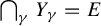 $\bigcap _\gamma Y_\gamma =E$
by Theorem 4.2. Since
$\bigcap _\gamma Y_\gamma =E$
by Theorem 4.2. Since $Y_\gamma $
is closed in X, then
$Y_\gamma $
is closed in X, then $X\backslash Y_\gamma $
is open in X. Therefore,
$X\backslash Y_\gamma $
is open in X. Therefore, $\bigcup _\gamma (X\backslash Y_\gamma )$
is open. Let
$\bigcup _\gamma (X\backslash Y_\gamma )$
is open. Let $y\in X\backslash V$
. Then,
$y\in X\backslash V$
. Then, $y\not \in E$
, so
$y\not \in E$
, so $y\not \in Y_\gamma $
for some
$y\not \in Y_\gamma $
for some $\gamma $
. Hence,
$\gamma $
. Hence, $y\in \bigcup _\gamma (X\backslash Y_\gamma )$
, so
$y\in \bigcup _\gamma (X\backslash Y_\gamma )$
, so $X\backslash V\subset \bigcup _\gamma (X\backslash Y_\gamma )$
. As
$X\backslash V\subset \bigcup _\gamma (X\backslash Y_\gamma )$
. As $\{X\backslash Y_\gamma \}_\gamma $
is an open cover of
$\{X\backslash Y_\gamma \}_\gamma $
is an open cover of $X\backslash V$
, there is a finite subcover
$X\backslash V$
, there is a finite subcover $\{X\backslash Y_i\}_{i=1}^m$
such that
$\{X\backslash Y_i\}_{i=1}^m$
such that $X\backslash V\subset \bigcup _{i=1}^m (X\backslash Y_i)$
.
$X\backslash V\subset \bigcup _{i=1}^m (X\backslash Y_i)$
.
Since $Y_i$
is closed-and-open for all i,
$Y_i$
is closed-and-open for all i,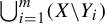 $\bigcup _{i=1}^m(X\backslash Y_i)$
is closed-and-open in X, so
$\bigcup _{i=1}^m(X\backslash Y_i)$
is closed-and-open in X, so
 $$ \begin{align*} X\backslash \bigg(\bigcup_{i=1}^m(X\backslash Y_i)\bigg) \end{align*} $$
is closed-and-open in X. Let $x\in E$
. Then,
$x\in E$
. Then, $x\in Y_\gamma $
for all
$x\in Y_\gamma $
for all $\gamma $
. In particular,
$\gamma $
. In particular, $x\not \in X\backslash Y_i$
for all i, so
$x\not \in X\backslash Y_i$
for all i, so $x\not \in \bigcup _{i=1}^m (X\backslash Y_i)$
. Hence,
$x\not \in \bigcup _{i=1}^m (X\backslash Y_i)$
. Hence, $E\subset X\backslash (\bigcup _{i=1}^m (X\backslash Y_i))$
. Finally, since
$E\subset X\backslash (\bigcup _{i=1}^m (X\backslash Y_i))$
. Finally, since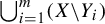 $\bigcup _{i=1}^m (X\backslash Y_i)$
is an open cover of
$\bigcup _{i=1}^m (X\backslash Y_i)$
is an open cover of $X\backslash V$
, then
$X\backslash V$
, then $X\backslash (\bigcup _{i=1}^m (X\backslash Y_i))\subset V$
.
$X\backslash (\bigcup _{i=1}^m (X\backslash Y_i))\subset V$
.
Lemma 4.7. Let $X\subset S^{n-1}$
be closed and let E be a component of X with
$X\subset S^{n-1}$
be closed and let E be a component of X with $m(E)<\unicode{x3bb} <\omega _{n-1}$
. Given
$m(E)<\unicode{x3bb} <\omega _{n-1}$
. Given $\epsilon>0$
, there exists a neighborhood U of E with
$\epsilon>0$
, there exists a neighborhood U of E with $m(U)<\unicode{x3bb} +\epsilon <\omega _{n-1}$
and
$m(U)<\unicode{x3bb} +\epsilon <\omega _{n-1}$
and $\partial U\subset S^{n-1}\backslash X$
.
$\partial U\subset S^{n-1}\backslash X$
.
Proof. Since E is closed in $S^{n-1}$
, E is a measurable set. By Theorem 4.5, there exist an open set
$S^{n-1}$
, E is a measurable set. By Theorem 4.5, there exist an open set $V_1\subset S^{n-1}$
and a closed set
$V_1\subset S^{n-1}$
and a closed set $V_2\subset S^{n-1}$
such that
$V_2\subset S^{n-1}$
such that $V_2\subset E\subset V_1$
and
$V_2\subset E\subset V_1$
and $m(V_1\backslash V_2)<\epsilon $
. Note that this implies that
$m(V_1\backslash V_2)<\epsilon $
. Note that this implies that $m(V_1)=m(V_2\cup (V_1\backslash V_2))=m(V_2)+m(V_1\backslash V_2)\leq m(E)+m(V_1\backslash V_2)<\unicode{x3bb} +\epsilon $
. If
$m(V_1)=m(V_2\cup (V_1\backslash V_2))=m(V_2)+m(V_1\backslash V_2)\leq m(E)+m(V_1\backslash V_2)<\unicode{x3bb} +\epsilon $
. If $X\cap \partial V_1=\emptyset $
, we are done.
$X\cap \partial V_1=\emptyset $
, we are done.
Suppose $X\cap \partial V_1\neq \emptyset $
. Note that
$X\cap \partial V_1\neq \emptyset $
. Note that $V_1$
is open in
$V_1$
is open in $S^{n-1}$
, so
$S^{n-1}$
, so $X\cap V_1$
is open in X and that
$X\cap V_1$
is open in X and that $E\subset X\cap V_1$
. By Lemma 4.6, there exists a closed-and-open set
$E\subset X\cap V_1$
. By Lemma 4.6, there exists a closed-and-open set $C_1$
in X with
$C_1$
in X with $E\subset C_1\subset X\cap V_1$
. Since
$E\subset C_1\subset X\cap V_1$
. Since $C_1$
is closed in X and X is closed in
$C_1$
is closed in X and X is closed in $S^{n-1}$
, then
$S^{n-1}$
, then $C_1$
is closed in
$C_1$
is closed in $S^{n-1}$
. Since
$S^{n-1}$
. Since $C_1$
is also open in X,
$C_1$
is also open in X, $X\backslash C_1$
is closed in X and hence in
$X\backslash C_1$
is closed in X and hence in $S^{n-1}$
. In addition, since
$S^{n-1}$
. In addition, since $V_1$
is open in
$V_1$
is open in $S^{n-1}$
, then
$S^{n-1}$
, then $S^{n-1}\backslash V_1$
is closed in
$S^{n-1}\backslash V_1$
is closed in $S^{n-1}$
. Therefore,
$S^{n-1}$
. Therefore, $C_2=(S^{n-1}\backslash V_1)\cup (X\backslash C_1)$
is closed in
$C_2=(S^{n-1}\backslash V_1)\cup (X\backslash C_1)$
is closed in $S^{n-1}$
.
$S^{n-1}$
.
Note that $C_1\cap C_2=\emptyset $
. To see this, suppose that
$C_1\cap C_2=\emptyset $
. To see this, suppose that $x\in C_2$
. Then, either
$x\in C_2$
. Then, either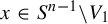 $x\in S^{n-1}\backslash V_1$
or
$x\in S^{n-1}\backslash V_1$
or $x\in X\backslash C_1$
. In the first case, since
$x\in X\backslash C_1$
. In the first case, since $C_1\subset V_1$
, x cannot be in
$C_1\subset V_1$
, x cannot be in $C_1$
. In the second case, x cannot be in
$C_1$
. In the second case, x cannot be in $C_1$
. Hence,
$C_1$
. Hence, $C_1\cap C_2=\emptyset $
. Since
$C_1\cap C_2=\emptyset $
. Since $S^{n-1}$
is
$S^{n-1}$
is $T_4$
, there exist disjoint open sets
$T_4$
, there exist disjoint open sets $U_1, U_2$
in
$U_1, U_2$
in $S^{n-1}$
with
$S^{n-1}$
with $C_1\subset U_1$
and
$C_1\subset U_1$
and $C_2\subset U_2$
.
$C_2\subset U_2$
.
Note that $U_1\subset V_1$
. To see this, let
$U_1\subset V_1$
. To see this, let $x\in U_1$
. Then,
$x\in U_1$
. Then, $x\not \in U_2$
, so
$x\not \in U_2$
, so $x\not \in C_2$
. Therefore,
$x\not \in C_2$
. Therefore, ${x\not \in X\backslash C_1}$
and
${x\not \in X\backslash C_1}$
and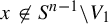 $x\not \in S^{n-1}\backslash V_1$
. Hence,
$x\not \in S^{n-1}\backslash V_1$
. Hence, $x\in V_1$
. Therefore,
$x\in V_1$
. Therefore, $m(U_1)\leq m(V_1)<\unicode{x3bb} +\epsilon $
.
$m(U_1)\leq m(V_1)<\unicode{x3bb} +\epsilon $
.
Finally, note that $\partial U_1\cap X=\emptyset $
. To see this, let
$\partial U_1\cap X=\emptyset $
. To see this, let $x\in X=C_1\cup (X\backslash C_1)$
. If
$x\in X=C_1\cup (X\backslash C_1)$
. If $x\in C_1$
, then
$x\in C_1$
, then $x\subset U_1$
and
$x\subset U_1$
and $x\not \in \partial U_1$
. If
$x\not \in \partial U_1$
. If $x\in X\backslash C_1$
, then
$x\in X\backslash C_1$
, then $x\in U_2$
. Since
$x\in U_2$
. Since $U_2$
is open, there exists a neighborhood of x contained in
$U_2$
is open, there exists a neighborhood of x contained in $U_2$
. If
$U_2$
. If $x\in \partial U_1$
, any neighborhood of x contains a point in
$x\in \partial U_1$
, any neighborhood of x contains a point in $U_1$
. However,
$U_1$
. However, $U_1\cap U_2=\emptyset $
, so this cannot happen. Therefore,
$U_1\cap U_2=\emptyset $
, so this cannot happen. Therefore, $\partial U_1\cap X=\emptyset $
.
$\partial U_1\cap X=\emptyset $
.
5 Proof of main results
In this section, we return to the set of Julia limiting directions for a quasiregular mapping and prove Theorems 1.2 and 1.5. Our aim is to generalize the method of Qiao [Reference Qiao18, Theorem 1] using our Phragmén–Lindelöf result to overcome technical difficulties in higher dimensions. We first need the following lemma. Recall that $\Omega (x_0,\zeta , \eta )$
is the sector
$\Omega (x_0,\zeta , \eta )$
is the sector $S_{x_0,E}$
, where E is the ball
$S_{x_0,E}$
, where E is the ball $\{ y \in S^{n-1} : d(y,\zeta ) < \eta ) \}$
.
$\{ y \in S^{n-1} : d(y,\zeta ) < \eta ) \}$
.
Lemma 5.1. Suppose $f:\mathbb {R}^n \to \mathbb {R}^n$
is a transcendental-type quasiregular mapping. Let
$f:\mathbb {R}^n \to \mathbb {R}^n$
is a transcendental-type quasiregular mapping. Let $\zeta \in S^{n-1} \setminus L(f)$
. Then, there exist
$\zeta \in S^{n-1} \setminus L(f)$
. Then, there exist $k>0$
and
$k>0$
and $\eta>0$
such that the sector
$\eta>0$
such that the sector $\Omega (k \zeta , \zeta , \eta ) \subset QF(f)$
.
$\Omega (k \zeta , \zeta , \eta ) \subset QF(f)$
.
Proof. Suppose the conclusion does not hold. Then, for all $k>0$
and all
$k>0$
and all $\eta>0$
, we have
$\eta>0$
, we have
 $$ \begin{align*} \Omega ( k\zeta, \zeta, \eta) \cap J(f) \neq \emptyset. \end{align*} $$
Note that $\nu _{0}(\Omega (k\zeta ,\zeta ,\eta ))\subset S^{n-1}\cap B(\zeta , \eta )$
. Set
$\nu _{0}(\Omega (k\zeta ,\zeta ,\eta ))\subset S^{n-1}\cap B(\zeta , \eta )$
. Set $\eta _m = 1/m$
, and choose sequences
$\eta _m = 1/m$
, and choose sequences ${k_m \to \infty }$
and
${k_m \to \infty }$
and $z_m \in \Omega ( k_m \zeta , \zeta , \eta _m) \cap J(f)$
. We must necessarily have
$z_m \in \Omega ( k_m \zeta , \zeta , \eta _m) \cap J(f)$
. We must necessarily have $|z_m| \to \infty $
as
$|z_m| \to \infty $
as $m\to \infty $
.
$m\to \infty $
.
For all $\epsilon>0$
, there exists
$\epsilon>0$
, there exists $M \in \mathbb {N}$
such that
$M \in \mathbb {N}$
such that $\eta _m < \epsilon $
for
$\eta _m < \epsilon $
for $m\geq M$
. Then,
$m\geq M$
. Then,
 $$ \begin{align*} \nu_0(z_m) \in \nu_0 [ \Omega ( k_m \zeta, \zeta, \eta_m ) ]\subset B(\zeta , \epsilon ).\end{align*} $$
As this holds for all $\epsilon>0$
, we must have
$\epsilon>0$
, we must have $\nu _0(z_m) \to \zeta $
as
$\nu _0(z_m) \to \zeta $
as $m\to \infty $
. This implies that
$m\to \infty $
. This implies that ${\zeta \in L(f)}$
, which is a contradiction.
${\zeta \in L(f)}$
, which is a contradiction.
Proof of Theorem 1.2
Let f be a K-quasiregular mapping of transcendental-type of order $\mu _f$
, and let
$\mu _f$
, and let
 $$ \begin{align*} M=\min(c_nK^{(2-2n)/n}\mu_f^{1-n},\omega_{n-1})=\min ([(n-1)d_nK^{-2/n}\mu_f^{-1}/2]^{n-1},\omega_{n-1}), \end{align*} $$
where $d_n$
is the constant depending on n from Corollary 1.10 and
$d_n$
is the constant depending on n from Corollary 1.10 and $c_n=[(n-1)d_n/2]^{n-1}$
. Assume toward a contradiction that the component of
$c_n=[(n-1)d_n/2]^{n-1}$
. Assume toward a contradiction that the component of $L(f)$
with the largest measure has measure less than M.
$L(f)$
with the largest measure has measure less than M.
Let $\mathcal {F} =\{U : U \text { is a domain in }S^{n-1} \text { such that } \partial U\subset S^{n-1}\backslash L(f) \text { and }m(U)<M\}.$
Since the component with the largest measure of
$\mathcal {F} =\{U : U \text { is a domain in }S^{n-1} \text { such that } \partial U\subset S^{n-1}\backslash L(f) \text { and }m(U)<M\}.$
Since the component with the largest measure of $L(f)$
has measure less than M, then by Lemma 4.7,
$L(f)$
has measure less than M, then by Lemma 4.7, $\mathcal {F}$
is an open cover of
$\mathcal {F}$
is an open cover of $S^{n-1}$
. Since
$S^{n-1}$
. Since $S^{n-1}$
is compact, there exists a finite subcover
$S^{n-1}$
is compact, there exists a finite subcover $\bigcup _{i=1}^s U_i$
of
$\bigcup _{i=1}^s U_i$
of $S^{n-1}$
for
$S^{n-1}$
for $U_1,\ldots , U_s \in \mathcal {F}$
.
$U_1,\ldots , U_s \in \mathcal {F}$
.
Now, fix $i\in \{1,2,\ldots ,s\}$
and consider
$i\in \{1,2,\ldots ,s\}$
and consider $U_i$
. Let
$U_i$
. Let $S_i$
be the sector
$S_i$
be the sector $S_{0,U_i}$
. Given
$S_{0,U_i}$
. Given $y\in \partial U_i$
, by Lemma 5.1, there exist
$y\in \partial U_i$
, by Lemma 5.1, there exist $k_y>0$
and
$k_y>0$
and $\eta _y>0$
such that
$\eta _y>0$
such that $\Omega (k_yy, y, \eta _y) \subset QF(f)$
. By Theorem 2.15, there exist constants
$\Omega (k_yy, y, \eta _y) \subset QF(f)$
. By Theorem 2.15, there exist constants $\eta _y'\in (0,\eta _y)$
and
$\eta _y'\in (0,\eta _y)$
and $p_y>0$
such that
$p_y>0$
such that $|f(x)|=O(|x|^{p_{y}})$
for
$|f(x)|=O(|x|^{p_{y}})$
for $x\in \Omega (k_yy,y,\eta _{y}')$
.
$x\in \Omega (k_yy,y,\eta _{y}')$
.
Define $V_y=\nu _0[\Omega (k_yy,y,\eta _y')]\subset S^{n-1}$
and consider
$V_y=\nu _0[\Omega (k_yy,y,\eta _y')]\subset S^{n-1}$
and consider $\bigcup _{y\in \partial U_i} V_y$
. This is an open cover of
$\bigcup _{y\in \partial U_i} V_y$
. This is an open cover of $\partial U_i$
. By compactness, there exists a finite subcover
$\partial U_i$
. By compactness, there exists a finite subcover $\bigcup _{j=1}^t V_{y_j}$
that covers
$\bigcup _{j=1}^t V_{y_j}$
that covers $\partial U_i$
. Set
$\partial U_i$
. Set ${p_i=\max _{j=1,\ldots , t}p_{y_j}}$
.
${p_i=\max _{j=1,\ldots , t}p_{y_j}}$
.
Next, for $x\in \partial S_i$
, with
$x\in \partial S_i$
, with $|x|>R$
for R sufficiently large, we have
$|x|>R$
for R sufficiently large, we have $x\in \Omega (k_{y_j}y_j,y_j,\eta _{y_j}')$
for some
$x\in \Omega (k_{y_j}y_j,y_j,\eta _{y_j}')$
for some $y_j$
, and
$y_j$
, and $\nu _0(x)\in V_{y_j}$
. Therefore,
$\nu _0(x)\in V_{y_j}$
. Therefore,
 $$ \begin{align*} x \in \bigcup_{j=1}^t S_{k_{y_j}y_j,V_{y_j}},\end{align*} $$
where $S_{k_{y_j}y_j,V_{y_j}}$
is the sector with vertex
$S_{k_{y_j}y_j,V_{y_j}}$
is the sector with vertex $k_{y_j}y_j$
with respect to
$k_{y_j}y_j$
with respect to $V_{y_j}$
. Hence, as
$V_{y_j}$
. Hence, as $|x|\to \infty $
in
$|x|\to \infty $
in $\partial S_i$
, we have
$\partial S_i$
, we have $|f(x)| = O(|x|^{p_i})$
. Moreover, as
$|f(x)| = O(|x|^{p_i})$
. Moreover, as $\overline { \partial S_i \cap B(0,R) }$
is compact and f is continuous on this set,
$\overline { \partial S_i \cap B(0,R) }$
is compact and f is continuous on this set, $|f|$
is bounded there. We may therefore apply Corollary 1.10 to f on
$|f|$
is bounded there. We may therefore apply Corollary 1.10 to f on $S_i$
with
$S_i$
with $\varepsilon =1$
to conclude that either there exists
$\varepsilon =1$
to conclude that either there exists $p_i'>0$
so that
$p_i'>0$
so that $|f(x)| = O(|x|^{p_i'} )$
as
$|f(x)| = O(|x|^{p_i'} )$
as $|x| \to \infty $
in
$|x| \to \infty $
in $S_i$
, or
$S_i$
, or
 $$ \begin{align*} \limsup\limits_{r\to\infty} \log M_{S_i}(r,f) r ^{-q_i}>0,\end{align*} $$
where $q_i=d_n m(U_i)^{-1/(n-1)}K^{-2/n}/2$
for
$q_i=d_n m(U_i)^{-1/(n-1)}K^{-2/n}/2$
for $d_n>0$
depending only on n.
$d_n>0$
depending only on n.
Suppose this latter case holds. Then, in particular, there exist a constant $\unicode{x3bb}>0$
and a sequence
$\unicode{x3bb}>0$
and a sequence $(r_m)_{m=1}^{\infty }$
with
$(r_m)_{m=1}^{\infty }$
with $r_m \to \infty $
such that
$r_m \to \infty $
such that
 $$ \begin{align*} \log M_{S_i}(r_m,f)>\unicode{x3bb} r_m^{q_i}.\end{align*} $$
Then, the order of f satisfies
 $$ \begin{align} \mu_f&=\limsup\limits_{r\rightarrow\infty}\: (n-1)\frac{\log\log M(r,f)}{\log r}\nonumber\\ &\geq \limsup\limits_{m\to \infty} \: (n-1) \frac{ \log \log M(r_m,f)}{\log r_m}\nonumber\\ &\geq \limsup\limits_{m\to \infty} \: (n-1) \frac{ \log \log M_{S_i}(r_m,f)}{\log r_m}\nonumber\\ &\geq \limsup\limits_{m\to \infty} \: (n-1)\frac{\log(\unicode{x3bb} r_m^{q_i})}{\log r_m}\nonumber\\ &= \limsup\limits_{m\to \infty} \: (n-1)\frac{\log \unicode{x3bb}+q_i\log r_m}{\log r_m}\nonumber\\ &= (n-1)q_i \nonumber\\ &= (n-1)d_n m(U_i)^{-1/(n-1)}K^{-2/n}/2. \end{align} $$
Note that
 $$ \begin{align*}M=\begin{cases} \omega_{n-1} & \text{if }\mu_f \leq K^{-2/n} \bigg( \dfrac{ c_n}{\omega_{n-1} } \bigg)^{1/(n-1)},\\ ((n-1)d_nK^{-2/n}\mu_f^{-1}/2)^{n-1} & \text{if }\mu_f> K^{-2/n} \bigg( \dfrac{ c_n}{\omega_{n-1} } \bigg)^{1/(n-1)}. \end{cases}\end{align*} $$
The inequality (5.1) implies that
 $$ \begin{align*} m(U_i) \geq((n-1)d_nK^{-2/n}\mu_f^{-1}/2)^{n-1}\geq M, \end{align*} $$
which contradicts $m(U_i)<M$
and rules out the second alternative in the Phragmén– Lindelöf result.
$m(U_i)<M$
and rules out the second alternative in the Phragmén– Lindelöf result.
We conclude that $|f(x)|=O(|x|^{p_i'})$
as
$|f(x)|=O(|x|^{p_i'})$
as $|x|\to \infty $
in
$|x|\to \infty $
in $S_i$
. Since this holds for all
$S_i$
. Since this holds for all ${i=1,\ldots ,s}$
and
${i=1,\ldots ,s}$
and $\bigcup _{i=1}^s U_i$
is a cover of
$\bigcup _{i=1}^s U_i$
is a cover of $S^{n-1}$
, we have
$S^{n-1}$
, we have $|f(x)|=O(|x|^p)$
as
$|f(x)|=O(|x|^p)$
as $|x| \to \infty $
in
$|x| \to \infty $
in $\mathbb {R}^n$
for some
$\mathbb {R}^n$
for some $p>0$
, which contradicts Lemma 2.2. Hence, there must be a component of
$p>0$
, which contradicts Lemma 2.2. Hence, there must be a component of $L(f)$
, say E, with
$L(f)$
, say E, with $m(E)\geq \min (c_n K^{(2-2n)/n}\mu _f^{1-n},\omega _{n-1})$
.
$m(E)\geq \min (c_n K^{(2-2n)/n}\mu _f^{1-n},\omega _{n-1})$
.
Turning to the inverse problem for quasiregular mappings, the first named author gave a partial answer to the inverse problem in $\mathbb {R}^3$
, see [Reference Fletcher8, Theorem 2.4]. In [Reference Fletcher8], the case when E consists of the union of the closures of finitely many domains in
$\mathbb {R}^3$
, see [Reference Fletcher8, Theorem 2.4]. In [Reference Fletcher8], the case when E consists of the union of the closures of finitely many domains in $S^2$
was considered and it was shown that there is a quasiregular mapping of finite order such that
$S^2$
was considered and it was shown that there is a quasiregular mapping of finite order such that $E=L(f)$
. This result relied on a construction by Nicks and Sixsmith [Reference Nicks and Sixsmith17] of a quasiregular mapping of transcendental-type equal to the identity in a half-space.
$E=L(f)$
. This result relied on a construction by Nicks and Sixsmith [Reference Nicks and Sixsmith17] of a quasiregular mapping of transcendental-type equal to the identity in a half-space.
To fully answer the inverse problem, one approach would be to construct a quasiregular mapping of transcendental-type with one Julia limiting direction that is equal to the identity outside a half-beam. Given such a construction $f_0$
, the solution to the inverse problem would be as follows.
$f_0$
, the solution to the inverse problem would be as follows.
Proof of Theorem 1.5
Given a closed non-empty set $E\subset S^{n-1}$
and the transcendental-type quasiregular mapping
$E\subset S^{n-1}$
and the transcendental-type quasiregular mapping $f_0$
that is the identity outside
$f_0$
that is the identity outside $H_0 := H(0,e_1,1)$
, we define a quasiregular mapping f inductively as follows.
$H_0 := H(0,e_1,1)$
, we define a quasiregular mapping f inductively as follows.
Let $(\zeta _{k})_k$
be a sequence of distinct points in E which are dense in E. If E is finite, then this sequence is finite. Pick a sequence of points
$(\zeta _{k})_k$
be a sequence of distinct points in E which are dense in E. If E is finite, then this sequence is finite. Pick a sequence of points $(x_{k})_k$
such that
$(x_{k})_k$
such that $x_k / |x_k| = \zeta _k$
and the half-beams
$x_k / |x_k| = \zeta _k$
and the half-beams $H_k := H(x_{k},\zeta _{k},1)$
are pairwise disjoint. Let
$H_k := H(x_{k},\zeta _{k},1)$
are pairwise disjoint. Let $A_{k}\colon \mathbb {R}^n\rightarrow \mathbb {R}^n$
be the composition of a translation by
$A_{k}\colon \mathbb {R}^n\rightarrow \mathbb {R}^n$
be the composition of a translation by $x_{k}$
and a rotation that sends
$x_{k}$
and a rotation that sends $e_1$
to
$e_1$
to $\zeta _{k}$
. Note that
$\zeta _{k}$
. Note that ${A_{k}(H_0)=H_k}$
. Set
${A_{k}(H_0)=H_k}$
. Set $g_k = A_k \circ f_0 \circ A_k^{-1}$
and define
$g_k = A_k \circ f_0 \circ A_k^{-1}$
and define
 $$ \begin{align*}f(x)=\begin{cases} g_k(x) & \text {for }x\in H_k,\\ x & \text{otherwise}. \end{cases}\end{align*} $$
Note that this map is quasiregular, of transcendental-type, and $L(f) \subset E$
. We claim that
$L(f) \subset E$
. We claim that $L(f)=E$
.
$L(f)=E$
.
To see this, we first discuss the map $f_0$
. As
$f_0$
. As $f_0$
is of transcendental-type, the Julia set
$f_0$
is of transcendental-type, the Julia set $J(f_0)$
is unbounded. As
$J(f_0)$
is unbounded. As $H_0$
is closed, for any
$H_0$
is closed, for any $x\in \mathbb {R}^n \setminus H_0$
with a neighborhood
$x\in \mathbb {R}^n \setminus H_0$
with a neighborhood ${U \subset \mathbb {R}^n \setminus H_0}$
, it is clear that the forward orbit
${U \subset \mathbb {R}^n \setminus H_0}$
, it is clear that the forward orbit $O^+_{f_0}(U) = \bigcup _{m=1}^{\infty } f_0^m(U)$
is nothing other than U. Therefore,
$O^+_{f_0}(U) = \bigcup _{m=1}^{\infty } f_0^m(U)$
is nothing other than U. Therefore, $x \notin J(f_0)$
. It follows that
$x \notin J(f_0)$
. It follows that $J(f_0) \subset H_0$
and we must have
$J(f_0) \subset H_0$
and we must have $L(f_0) = \{e_1\}$
.
$L(f_0) = \{e_1\}$
.
Next, given $x\in J(f_0)$
and any neighborhood U of x,
$x\in J(f_0)$
and any neighborhood U of x, $O_{f_0}^+(U)$
omits at most a set of capacity zero, say
$O_{f_0}^+(U)$
omits at most a set of capacity zero, say $E_0$
. Then, for any
$E_0$
. Then, for any $y\in \mathbb {R}^n \setminus E_0$
, there exist
$y\in \mathbb {R}^n \setminus E_0$
, there exist $x_y \in U$
and
$x_y \in U$
and $n_y \in \mathbb {N}$
such that
$n_y \in \mathbb {N}$
such that $x_y,f_0(x_y) , \ldots , f_0^{n_y-1}(x_y)$
lie in
$x_y,f_0(x_y) , \ldots , f_0^{n_y-1}(x_y)$
lie in $H_0$
and
$H_0$
and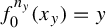 $f_0^{n_y}(x_y) = y$
. This must be the case, as if an orbit ever leaves
$f_0^{n_y}(x_y) = y$
. This must be the case, as if an orbit ever leaves $H_0$
, then it is fixed from that point on by the definition of
$H_0$
, then it is fixed from that point on by the definition of $f_0$
.
$f_0$
.
Using these observations, it is first clear that $J(f)$
is supported on
$J(f)$
is supported on $\bigcup _k H_k$
. Moreover, if
$\bigcup _k H_k$
. Moreover, if $z\in H_k$
satisfies
$z\in H_k$
satisfies $x=A_k^{-1}(z) \in J(f_0)$
and U is a neighborhood of z, then
$x=A_k^{-1}(z) \in J(f_0)$
and U is a neighborhood of z, then $A_k^{-1}(U)$
is a neighborhood of x. If
$A_k^{-1}(U)$
is a neighborhood of x. If $w \in \mathbb {R}^n \setminus A_k(E_0)$
, then
$w \in \mathbb {R}^n \setminus A_k(E_0)$
, then $y:= A_k^{-1}(w) \in \mathbb {R}^n \setminus E_0$
. We find
$y:= A_k^{-1}(w) \in \mathbb {R}^n \setminus E_0$
. We find $x_y,n_y$
as above and set
$x_y,n_y$
as above and set $z_w = A_k(x_y)$
so that
$z_w = A_k(x_y)$
so that $z_w,g_k(z_w), \ldots , g_k^{n_y-1}(z_w)$
lie in
$z_w,g_k(z_w), \ldots , g_k^{n_y-1}(z_w)$
lie in $H_k$
and
$H_k$
and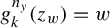 $g_k^{n_y}( z_w) = w$
. It follows that
$g_k^{n_y}( z_w) = w$
. It follows that $\mathbb {R}^n \setminus A_k(E_0) \subset O_{g_k}^+(U)$
. As
$\mathbb {R}^n \setminus A_k(E_0) \subset O_{g_k}^+(U)$
. As $A_k$
is an isometry, it follows that
$A_k$
is an isometry, it follows that $A_k(E_0)$
is of capacity zero and we conclude by Definition 2.4 that
$A_k(E_0)$
is of capacity zero and we conclude by Definition 2.4 that $z\in J(g_k)$
. Moreover, as
$z\in J(g_k)$
. Moreover, as $g_k$
agrees with f in
$g_k$
agrees with f in $H_k$
, this shows that
$H_k$
, this shows that $\mathbb {R}^n \setminus A_k(E_0) \subset O_f^+(U)$
and hence
$\mathbb {R}^n \setminus A_k(E_0) \subset O_f^+(U)$
and hence $J(g_k) \subset J(f)$
for all k. Therefore,
$J(g_k) \subset J(f)$
for all k. Therefore,
 $$ \begin{align*} \bigcup_k J(g_k) \subset J(f). \end{align*} $$
As $L(g_k) = \{ \zeta _k \}$
,
$L(g_k) = \{ \zeta _k \}$
, $\bigcup _k \{ \zeta _k \}$
is dense in E, and
$\bigcup _k \{ \zeta _k \}$
is dense in E, and $L(f)$
is a closed subset of E, it follows that
$L(f)$
is a closed subset of E, it follows that $L(f) = E$
.
$L(f) = E$
.
Acknowledgements
We thank both Aimo Hinkkanen and the referee for carefully reading an earlier draft of this paper and for providing many useful comments which substantially improved upon it.


 Open access

