




Introduction
The resolution of the Food and Agricultural Organization (FAO) of the United States 2020 for seventeen sustainable development goals includes no poverty, zero hunger and responsible consumption and development till 2030. At present, the ever-increasing population of India is a big challenge toward achieving this goal. According to the Census of India 2011, the population of India is 1.2 billion and with 1% annual growth rate it is estimated to increase from 121.1 to 152.2 crores during 2011–2036 period. Agriculture and its allied sectors in India support the livelihood of more than 50% of the population and during the year 2020–2021, gross value added (GVA) showed a growth of 3.4% in the agriculture sector (Kapil, Reference Kapil2021). India is one of the leading producers of rice in the world and more than 100 million metric tons of rice was produced in 2019–2020 (Economic Survey, 2020–2021). According to FAO 2020, global production of rice by 2050 needs to be increased to over 1035 million tons. This is possible by enhancing productivity, diversification and cropping intensity. However, due to increased urbanization and industrialization, the scope of horizontal expansion in agriculture is very limited. Also, the intensive use of chemical fertilizers and pesticides to enhance productivity has resulted in various negative impacts on the environment including soil and water pollution, soil fertility degradation and decline in the population of beneficial insects (Swaminathan, Reference Swaminathan2006; Jewitt and Baker, Reference Jewitt and Baker2007; Liu et al., Reference Liu, Pan and Li2015). The production of greenhouse gases including methane and nitrous oxide in the paddy fields is also a matter of grave concern (Datta et al., Reference Datta, Nayak, Sinhababu and Adhya2009; IPCC, 2018).
Similarly, aquaculture in India also faces some major challenges. India presently is the second-largest producer of fish and contributes 7.58% to the global fish production. In India, fish production has reached 14.16 million metric tons in 2019–2020 and provides livelihood opportunities to more than 28 million people (Economic Survey, 2020–2021). However, the high cost of fish feed and unavailability of land-based nursery ponds for maintaining stocks of fingerlings represent a considerable constraint. Intensive aquaculture has also adversely and irreversibly affected the environment (Yuan et al., Reference Yuan, Xiang, Liu, Kang, He, Kim, Lin, Freeman and Ding2019) including alteration of the local biodiversity and ecosystem due to the invasion of exotic species (De Silva et al., Reference De Silva, Nguyeen, Turchini, Amarasinghe and Abery2009). Moreover, parasite transmission and outbreak of disease in intensive aquaculture is also very common (Blaylock and Bullard, Reference Blaylock and Bullard2014). The discharge of excessive nutrients leads to eutrophication (Bouwman et al., Reference Bouwman, Beusen, Glibert, Overbeek, Pawlowski, Herrera, Muslow, Yu and Zhou2013). Global aquaculture also significantly contributes to greenhouse gases emission. Robb et al. (Reference Robb, MacLeod, Hasan and Soto2017) estimated an average greenhouse emission of 2.12 kg CO2 eq/kg of carp live weight in an Indian pond aquaculture. In addition, the production of fish feed is a major source of methane and carbon-dioxide emission (Robb et al., Reference Robb, MacLeod, Hasan and Soto2017; Yuan et al., Reference Yuan, Xiang, Liu, Kang, He, Kim, Lin, Freeman and Ding2019). The problem is compounded by the social conflicts, gender inequality and food insecurity among local communities due to the increasing transformation of paddy fields into fish and shrimp culture for commercial purposes (Ahmed et al., Reference Ahmed, Allison and Muir2010; Gurung et al., Reference Gurung, Bhandari and Paris2016).
Thus, the cultivation of fish and rice together on the same land area with water resource utilization is one of the most viable solutions for sustainable food production (Ahmed and Turchini, Reference Ahmed and Turchini2021). Rice-fish co-culture has been traditionally practiced in India in many north eastern states and parts of Kerala in southern India. Moreover, with advancement of research in integrated farming systems, the scope for integrated rice-fish farming has improved. Sustainable rice-fish farming provides nutritious food, stabilizes the economic status of vulnerable farmers and minimizes the negative impacts on the environment. The primary aim of this review is to highlight various models of integrated rice-fish farming practiced in India and their ecological and economical significance. We would also contemplate the challenges and constraints of integrated rice-fish farming so that future prospects could be improved.
Different models of integrated rice-fish farming practices in India: traditional and modern
Integrated rice-fish farming has been practiced for a long time in different parts of the world, primarily in south east asia where rice and fish form an important part of the diet. The culture of fish in paddy fields is of two types- alternate and integrated farming (Ahmed and Garnett, Reference Ahmed and Garnett2011). In alternate farming, rotational cultivation of rice and fish is performed on deeply flooded lowlands, while integrated farming is practiced on the rainfed plain and medium lowlands with the simultaneous culture of rice and fish. The different fish species cultured with different rice varieties includes Cyprinus carpio (common carp), Ctenopharyn godonidella (silver carp), Labeo rohita (rohu), Cirrhinus mrigala (mrigal), Channa punctatus (spotted snakehead) and Catla catla (catla) (Bhattacharyya et al., Reference Bhattacharyya, Sinhababu, Roy, Dash, Sahu, Dandapat, Neogi and Mohanty2013; Saikia et al., Reference Saikia, Abujam, Das and Prasad2015; Poonam et al., Reference Poonam, Saha, Nayak, Sinhababu, Sahu, Satapathy, Shahid, Kumar, Jambhulkar, Nedunchezhiyan, Giri, Saurabh, Sangeeta, Nayak and Pathak2019). The average selling price of these edible fish species range from INR 200/kg- INR 275/kg (Prasad, Reference Prasad2020). In India, the rain-flooded lowland areas in Uttar Pradesh, Bihar, West Bengal, Odisha and north eastern states provide suitable conditions for the co-culture of rice and fish (Fig. 1).
Map demonstrating the states of India along with average annual rainfall where rice-fish integrated farming systems are practiced. Traditionally, the rice-fish integrated system has been practiced in the northeastern states of Nagaland, Arunachal Pradesh, West Bengal and in the southern state of Kerala. The modern rice-fish integrated models developed by ICAR-NRRI are being practiced in Uttar Pradesh, Bihar, West Bengal, Odisha and north eastern states (The data for average annual rainfall has been sourced from https://www.mapsofindia.com/maps/india/annualrainfall.htm.).

Traditional methods
Rice-fish integrated farming has been practiced traditionally in many parts of eastern India. Prominent among them are Zabo cultivation in Nagaland, Apatani farming in Arunachal Pradesh, Bhasabandha or Bheri system in Suderbans of West Bengal and Pokkali system in Kerala (Fig. 1). Zabo cultivation (Zabo means impounding runoff water) is majorly practiced by the Chakhesang tribe of Kikruma village in Nagaland. In this agricultural practice, the hill is divided in three-tier: the upper section is reserved as forest area, the middle part of the hill is used for residential purposes and ponds are constructed for rain-water harvesting, and the lower hill area is utilized for rice and fish cultivation. Later, the collected rain water is efficiently utilized for irrigation purposes and as animal drinking water. Cattles are free to gaze in the forest and animal husbandry activities are performed near the ponds, so that animal waste is released in the water which provides nutrients for the paddy cultivation (Nayak et al., Reference Nayak, Nayak, Kumar, Kumar, Panda, Satapathy, Poonam, Mohapatra, Tripathi, Shahid, Chatterjee, Panneerselvam, Mohanty, Sunil and Pathak2020; Amenla and Shuya, Reference Amenla and Shuya2021). The Apatani system, also known as ‘pani-kheti’ or water farming, has been practiced traditionally in the Apatani plateau located in lower Subansiri district of Arunachal Pradesh. In this system, water for irrigation is generally tapped from small streams and channelized to the fields through traditional bamboo and pinewood pipes. Agrarian tribals, especially women are actively engaged in this type of integrated farming. Different strains of carps are simultaneously cultivated with local rice varieties viz. Amo, Mypie and Pyapee. The fry stage of fish, approximately 15–20 mm in size is introduced in the rice fields when rice seedlings are transplanted in the month of April–May. The fish feed on the periphyton that colonize the underwater part of the rice plants and are reared for 3–4 months. The farmers gain an additional earning from a fish production of almost 500 kg/ha in one season (Saikia and Das, Reference Saikia and Das2008). The fish is sold approximately at the rate of INR150/kg (Baruah and Singh, Reference Baruah and Singh2018). Moreover, no chemical fertilizers are added and nitrogen is fixed in the soil by duckweeds Azolla and Lemna. This traditional method has quite a high output and has helped in alleviating poverty in this region. Farmers in this case are estimated to have a 65% higher net income as compared to those practicing rice monoculture (Saikia and Das, Reference Saikia and Das2008). In the estuarine canals and creeks of Sunderbans, West Bengal, prawns and fish are cultivated along with local varieties of rice. Approximately 100–200 kg/ha of fish and prawn are harvested along with 100 kg/ha of rice (Nayak et al., Reference Nayak, Nayak, Kumar, Kumar, Panda, Satapathy, Poonam, Mohapatra, Tripathi, Shahid, Chatterjee, Panneerselvam, Mohanty, Sunil and Pathak2020). In the southern part of India, traditional farming known as Pokkali is practiced in Kerala. In this system, the cultivation of salt-tolerant varieties of rice is alternated with prawn farming in the coastal region. The prawn seedlings feed on the harvested crops, and the rice obtains its nutrients from the waste material excreted by the prawns. Approximately, 70–100 kg/ha rice and 50–200 kg/ha prawns is produced which provides the farmers with considerable income throughout the year (Nayak et al., Reference Nayak, Nayak, Kumar, Kumar, Panda, Satapathy, Poonam, Mohapatra, Tripathi, Shahid, Chatterjee, Panneerselvam, Mohanty, Sunil and Pathak2020).
Modern methods
In India, it is estimated that although 20 million ha of land is suitable for the adoption of integrated rice-fish farming, currently only 0.23 million ha is under rice-fish culture (Mansharamani et al., Reference Mansharamani, Shrivastava and Choubey2020). Hence, to promote integrated rice-fish farming, the Indian Council of Agriculture Research (ICAR) Cuttack, Odisha has developed the following models for the Indian scenario in view of growing population, poverty, and for sustainable environmental conditions (Poonam et al., Reference Poonam, Saha, Nayak, Sinhababu, Sahu, Satapathy, Shahid, Kumar, Jambhulkar, Nedunchezhiyan, Giri, Saurabh, Sangeeta, Nayak and Pathak2019; Nayak et al., Reference Nayak, Nayak, Kumar, Kumar, Panda, Satapathy, Poonam, Mohapatra, Tripathi, Shahid, Chatterjee, Panneerselvam, Mohanty, Sunil and Pathak2020). The modern systems integrate agriculture, horticulture, animal husbandry, aquaculture, and forestry to provide economic stability and better nutrition to farmers without compromising the ecological sustainability.
Crop-livestock-agro-forestry integrated system for lowland rice ecologies
This system includes the cultivation of rice and fish along with poultry, duck farming, and fruit and vegetable production on rain-flooded waterlogged lowland areas. Wide dykes or bunds (2–4 m) covering 20% area are constructed all around the field. Rice is cultivated on 67% of the field and 13% of the area is allocated for pond refuge which is connected on two sides with trenches (Fig. 2). Rice varieties that are high yielding and semi tall such as Sarala, Gayatri, Durga, Varsha Dhan, Naveen etc., are usually preferred. On the dykes, shelter for ducks, goats and poultry are constructed along with bee boxes for apiculture. Various fruit plants including banana, papaya, areca nut and coconut are also planted on the dykes along with seasonal vegetables, mushrooms and different flowers. A variety of fish species with different niches such as surface feeder catla, column feeder rohu and bottom feeder common carp along with giant freshwater prawns in 3:1 ratio are cultured in the trenches. After rice is harvested, the same field is used for the cultivation of various crops including sesame, groundnut, watermelon, sunflower, green gram and vegetables using harvested rainwater. This diversified farming system is validated in Assam with slight modifications in the field design. One hectare of land under this system of cultivation yields 16–18 ton food crops, 0.55 ton of meat, 0.6 ton of fish and prawns and 8000– 12,000 eggs. The production increases significantly by the sixth year of farming (Poonam et al., Reference Poonam, Saha, Nayak, Sinhababu, Sahu, Satapathy, Shahid, Kumar, Jambhulkar, Nedunchezhiyan, Giri, Saurabh, Sangeeta, Nayak and Pathak2019; Nayak et al., Reference Nayak, Nayak, Kumar, Kumar, Panda, Satapathy, Poonam, Mohapatra, Tripathi, Shahid, Chatterjee, Panneerselvam, Mohanty, Sunil and Pathak2020).
Schematic representation of crop-livestock-agro-forestry integrated system. In the main field, rice is grown along with the fish cultivation. This is connected to a water refuge pond. On dykes, various agroforestry plants, seasonal fruits and vegetables are grown along with poultry, livestock and duck rearing.

Rice-fish-duck farming system
Nayak et al. (Reference Nayak, Nayak, Panda, Lal, Gautam, Poonam, Shahid, Tripathi, Kumar, Mohapatra and Jambhulkar2018) developed an integrated farming system for medium shallow rain fed lowlands. In this, rice is grown in the main field covering 85% area, a refuge tank is built on the eastern side of the field (10% of the area) with a shelter house for ducks on the refuge tank connected to the raised dykes (0.5–1 m). Fish and duck are introduced in the rice field after twenty days of rice transplantation. Duck varieties such as Indian runner and other indigenous species are stocked at a density of 200 to 250 and allowed to forage in the rice fields. After the harvest of rice, from January to May vegetables and pulses are grown in the main field. This is a mutually symbiotic system wherein all the interacting partners gain considerably. The dropping of the fish and ducks provide organic nutrients to rice, their burrowing activities aerate the soil, and they continually remove pests and weeds. This type of integrated farming system is especially suitable for small and marginal farmers majorly in tribal areas. It provides year long food and employment to the farm families, increases productivity and enhances environmental sustainability. In the rice-fish-duck farming system, 0.7 ton fish, 25,000 eggs, 0.5–0.7 ton of meat and 9–10 ton rice grain are produced annually (Poonam et al., Reference Poonam, Saha, Nayak, Sinhababu, Sahu, Satapathy, Shahid, Kumar, Jambhulkar, Nedunchezhiyan, Giri, Saurabh, Sangeeta, Nayak and Pathak2019; Nayak et al., Reference Nayak, Nayak, Kumar, Kumar, Panda, Satapathy, Poonam, Mohapatra, Tripathi, Shahid, Chatterjee, Panneerselvam, Mohanty, Sunil and Pathak2020).
Rice-fish-azolla-duck farming system
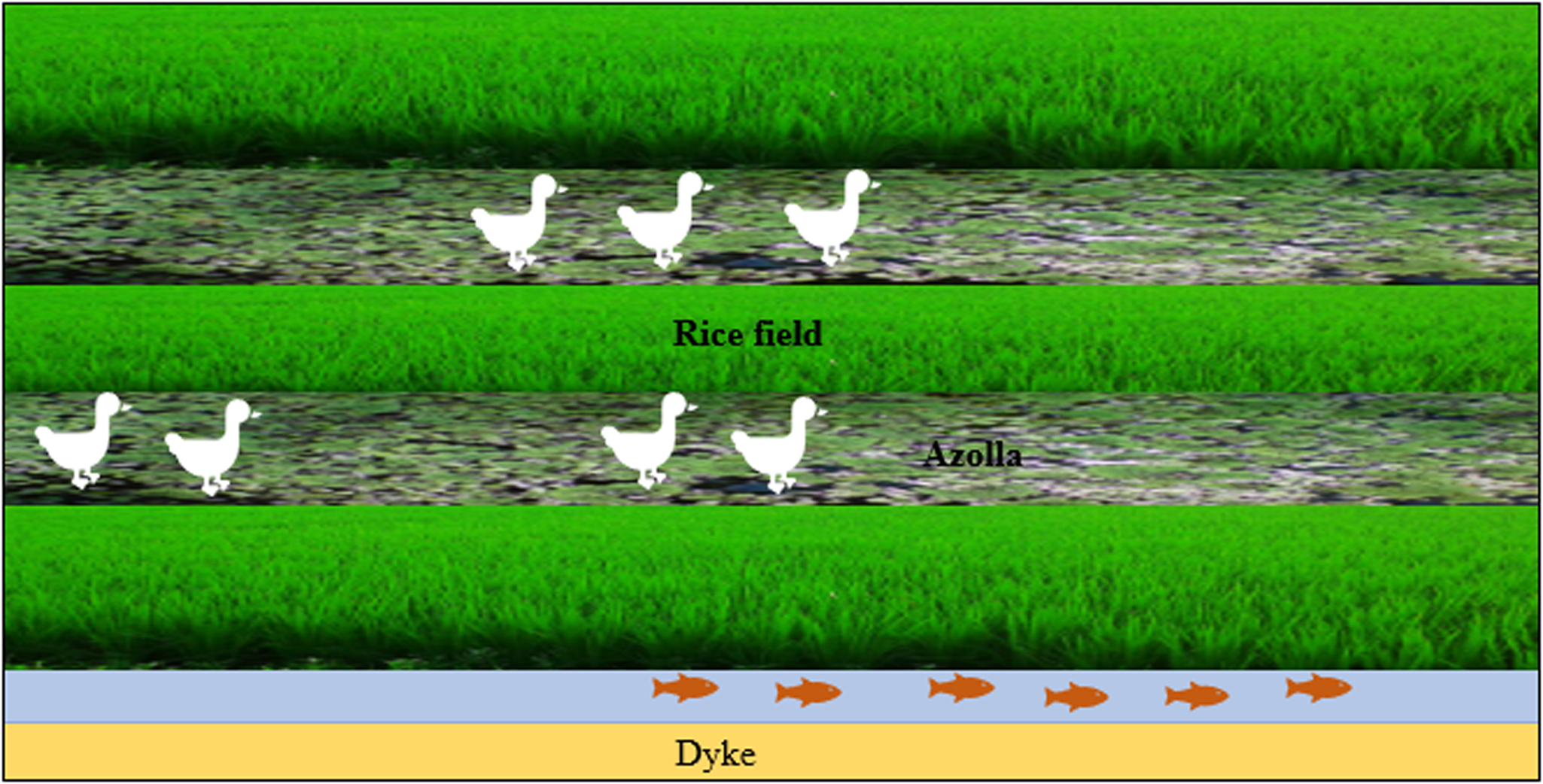
ICAR-National Rice Research Institute has developed a modified rice-fish-duck farming system by introducing azolla, thus minimizing the operational costs (Fig. 3). Azolla is a tropical aquatic fern that grows abundantly in moist soil, shallow ponds and ditches. Along with fixing nitrogen in the soil thus increasing fertility, it also acts as a fodder for livestock. In addition, the azolla increases the dissolved oxygen and creates aerobic conditions. This decreases the population of methanogenic bacteria thereby, reducing the emission of greenhouse gases. The production of 9–10 ton rice grain, 0.6–0.7 ton of meat, 25,000 eggs and 0.7 ton of fish are achieved in the rice-fish-azolla-duck farming system (Poonam et al., Reference Poonam, Saha, Nayak, Sinhababu, Sahu, Satapathy, Shahid, Kumar, Jambhulkar, Nedunchezhiyan, Giri, Saurabh, Sangeeta, Nayak and Pathak2019; Nayak et al., Reference Nayak, Nayak, Kumar, Kumar, Panda, Satapathy, Poonam, Mohapatra, Tripathi, Shahid, Chatterjee, Panneerselvam, Mohanty, Sunil and Pathak2020). It has been reported that rice-fish-azolla farming system generated an additional income of INR 8817/ha and INR 3219/ha over rice monoculture and rice-fish culture, respectively (Singh et al., Reference Singh, Singh, Supriya and Singh2018).
Schematic representation of rice-fish-duck-azolla farming. Azoolla is allowed to grow in the main rice field along with fish and duck rearing.
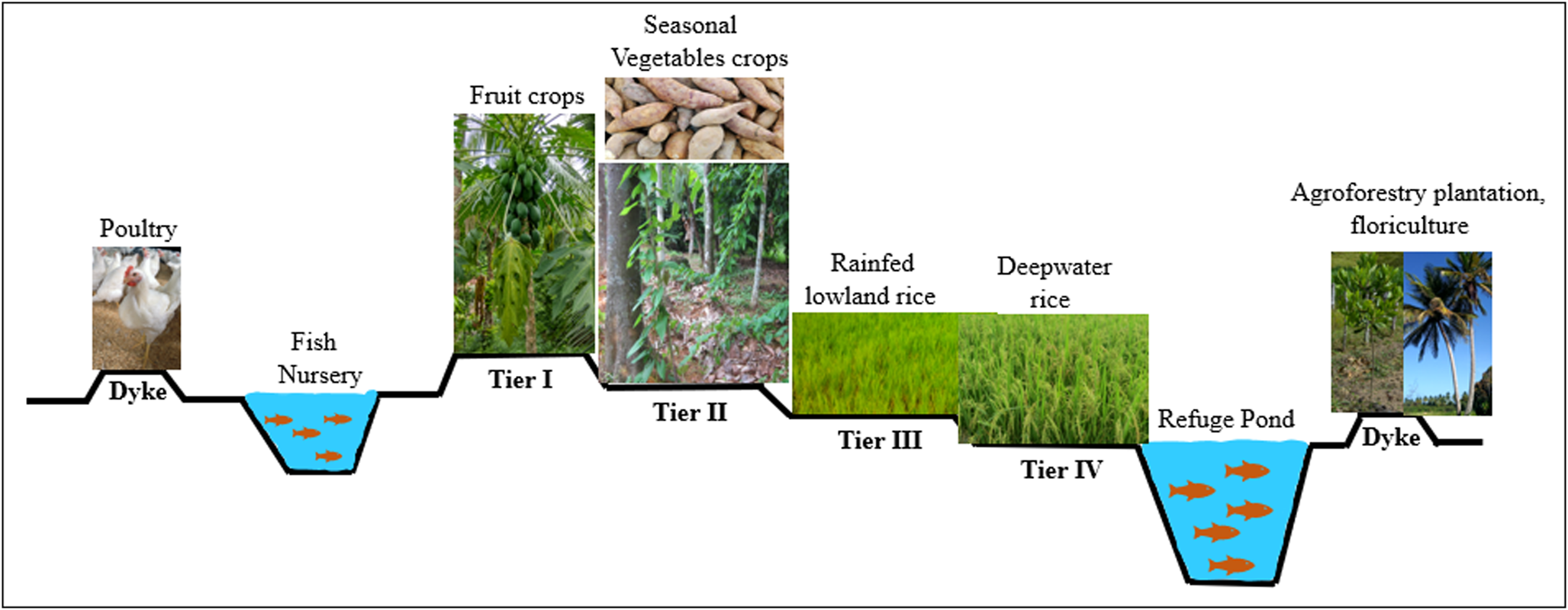
The field is divided into four tiers in this farming system for the cultivation of rice, fish, fruits, and vegetables (Fig. 4). The design of the field includes two upland areas viz. tier I and tier II which covers 15% area of the field. Perennial and seasonal fruit crops such as pineapple, banana, papaya, guava, mango, etc. are grown in tier I, whereas, vegetables and tuber crops including greater yam, elephant foot yam, sweet potato and yam bean are cultivated in tier II. Rice is grown on tier III (20% of the area) that is lowland rainfed area with depth of upto 50 cm and on tier IV (20% of total land area) which is deep water area, 50–100 cm in depth. The rice field is connected to a refuge pond for growing fish and freshwater giant prawns. There are raised dykes or bunds all around covering 25% of total land area. There is a small pond for rearing fish fingerlings. During wet season, different varieties of rice with high yield are grown on lowland water-fed area (Sarla, Gayatri, Pooja) and deep-water area (CR Dhan 508, CR Dhan 505, CR Dhan 500, Jayanti Dhan, Varshadhan) along with the culture of fish and prawn. In the dry season, rainwater harvested in the refuge pond is used for the cultivation of sunflower, sweet potato, ground nut and vegetables on tier III and dry season rice on tier IV after harvesting rice grown in wet season. On the dykes, agro-forestry and plantation crops, are grown and poultry and duck houses are built. One hectare of this kind of multi-tier rice-fish-horticulture-agroforestry based system can annually produce approximately 14–15 ton of food crop, 1 ton of fish and prawns, 0.5–0.8 ton of meat, 10,000 to 12,000 eggs and 3–5 ton animal feed. The productivity of food crops increases substantially after the 8th year, once the perennial trees start producing fruits (Poonam et al., Reference Poonam, Saha, Nayak, Sinhababu, Sahu, Satapathy, Shahid, Kumar, Jambhulkar, Nedunchezhiyan, Giri, Saurabh, Sangeeta, Nayak and Pathak2019; Nayak et al., Reference Nayak, Nayak, Kumar, Kumar, Panda, Satapathy, Poonam, Mohapatra, Tripathi, Shahid, Chatterjee, Panneerselvam, Mohanty, Sunil and Pathak2020).
Schematic representation of multi-tier rice-fish-horticulture-agro-forestry-based farming system. On tier I and II, fruit and vegetables crops are grown and rice-fields are present on tier III and IV. The dykes are used for poultry farming and agroforestry. There is a refuge pond for growing fish and freshwater prawns which is connected to the rice fields. There is also a small pond for rearing fish fingerlings.
Rice- ornamental fish culture
There is a growing market for ornamental fish in India and ornamental fish export has shown an exponential increase over the years (Rani et al., Reference Rani, Immanuel and Ranjan2014). However, at present the production does not meet the demand. Rice-ornamental fish culture is similar to the basic rice-fish cultivation practice in which edible fish is replaced by ornamental fish such as gouramies, guppies, gold fish, carps, zebrafish etc. In this, well-irrigated rice fields having clayey soil with greater water retention capability is preferred. A water refuge covering 15% of the total field is constructed at one end of the field and before introducing the fish, cow dung slurry along with nitrogen-phosphorous-potassium (NPK) fertilizers are added to promote the growth of planktons. The fish feed on planktons and are also provided with commercial feed. Besides, fish also feed on pests and insects including mosquito larvae infesting the rice fields. High yielding and semi-dwarf varieties of rice such as Naveen, IR 64, IR 36 and Lalat are suitable for areas under irrigation during summer season, however rice varieties such as Varsha Dhan, Sarala, Gayatri and Durga are cultivated in medium deep lowlands during the wet season. These rice varieties have in-built tolerance to the diseases and pests. The equal number of male and female ornamental fish are reared in the rice field. The juveniles are cultured in rice fields for a duration of two to six months depending on the species of ornamental fish till the adult size is obtained. In this integrated farming system approximately 25,000-6 lakh ornamental fish can be produced along with rice yield up to 3–5 ton/ha of the field (Poonam et al., Reference Poonam, Saha, Nayak, Sinhababu, Sahu, Satapathy, Shahid, Kumar, Jambhulkar, Nedunchezhiyan, Giri, Saurabh, Sangeeta, Nayak and Pathak2019; Nayak et al., Reference Nayak, Nayak, Kumar, Kumar, Panda, Satapathy, Poonam, Mohapatra, Tripathi, Shahid, Chatterjee, Panneerselvam, Mohanty, Sunil and Pathak2020). The ornamental fish are sold at INR 10–30 per fish (Shinoj et al., Reference Shinoj, Baiju and Vijayagopal2021).
Rice-based farming system under irrigation condition
In the irrigated lowland area, a farm of one acre size is divided into two rice-fish fields covering 30% area, each connected with refuge occupying 15% area and 30% area is allotted as fish nursery ponds for culture of fish fingerlings. In the remaining area, dykes are built around the farm on which agro-forestry plants (neem, bamboo, aonla, teak and sisoo), horticulture crops (pineapple, areca nut, spices, papaya, lemon, litchi, mango and banana), flowers (jasmine and marigold), and different seasonal vegetables are grown. Small duck houses and poultry units are constructed on the dykes for bird rearing. Different seasonal varieties of rice are cultivated throughout the year including summer rice (Sidhant, Vandana) followed by the kharif rice (Varshadhan, CR Dhan 505) and then rabi rice (High protein rice, Naveen) along with fish species such as mrigal, catla and rohu. This system results in the production of 0.8–1.0 ton rice, 0.1 ton fish, 0.05 ton meat, 1.4 ton vegetables and 0.09 ton fruits (Poonam et al., Reference Poonam, Saha, Nayak, Sinhababu, Sahu, Satapathy, Shahid, Kumar, Jambhulkar, Nedunchezhiyan, Giri, Saurabh, Sangeeta, Nayak and Pathak2019; Nayak et al., Reference Nayak, Nayak, Kumar, Kumar, Panda, Satapathy, Poonam, Mohapatra, Tripathi, Shahid, Chatterjee, Panneerselvam, Mohanty, Sunil and Pathak2020).
Significance of integrated rice-fish farming
The inability of rice monoculture and aquaculture to overcome the food demand while maintaining sustainable environmental conditions led to the development of integrated rice-fish farming methods. This practice has several benefits including enhancing productivity with food diversity, increasing the source of income which results in the economic growth of farmers as well as the country, and maintaining the ecological conditions sustainably (Fig. 5).
Schematic representation of significance of integrated rice-fish farming.

Food diversity and productivity
Through the integration of rice-fish farming, the productivity of food using the same land and water resources can be substantially increased as compared to rice monoculture. More than 1000 kg/ha fish production can be achieved in medium rainfed paddy fields within four months (Mohanty et al., Reference Mohanty, Verma and Brahmanand2004). Mishra et al. (Reference Mishra, James, Mohanty and Anand2014) estimated that more than 1600 kg/ha fish can be produced within six months in rainfed rice-fish farms of Eastern India. Moreover, the fish as well as rice productivity can be increased substantially by stocking yearling instead of fry as demonstrated by Dey et al. (Reference Dey, Sarma, Kumar, Mohanty and Kumar2019). The fish in paddy fields increases soil fertility and dissolved oxygen levels in water and feeds on the pests and aquatic weeds, controls the growth of planktons and bacteria, thereby resulting into 8–25% enhancement in rice production under the rice-fish farming system (Mishra and Mohanty, Reference Mishra and Mohanty2004; Mohanty et al., Reference Mohanty, Jena, Thakur and Patil2009). Recently, Dey et al. (Reference Dey, Sarma, Kumar, Mohanty and Kumar2019) reported an increase of 6.73% and 4.36% of paddy straw and grain per hectare, respectively, in rice-fish farming compared to rice monoculture in Bihar. The productivity of rice could be further enhanced in the rice-fish farming system by use of inorganic nitrogen fertilizers as shown in a field experiment conducted by Water Technology Center for Eastern Region (ICAR), Bhubaneswar (Brahmanand et al., Reference Brahmanand, Ghosh and Sahoo2009). Not surprisingly, Ahmed and Turchini (Reference Ahmed and Turchini2021) asserted that annual production of fish and rice could be increased by 27% with the adoption of rice-fish cultivation in 50% rice fields globally available. Further, the integration of poultry, duck farming, horticulture and agro-forestry with rice-fish farming for eggs, meat, vegetables and fruits production results in the diversity of food supplies (Poonam et al., Reference Poonam, Saha, Nayak, Sinhababu, Sahu, Satapathy, Shahid, Kumar, Jambhulkar, Nedunchezhiyan, Giri, Saurabh, Sangeeta, Nayak and Pathak2019). Therefore, adoption of rice-fish farming addresses key objectives including enhancement in food diversity and productivity with efficient utilization of resources and maintenance of sustainable environment (Ahmed and Garnett, Reference Ahmed and Garnett2011; Poonam et al., Reference Poonam, Saha, Nayak, Sinhababu, Sahu, Satapathy, Shahid, Kumar, Jambhulkar, Nedunchezhiyan, Giri, Saurabh, Sangeeta, Nayak and Pathak2019).
Socio-economic stability
For the overall development of a country, the development of each individual, both socially and economically is required. In a developing country like India, where a major portion of the population depends on agriculture and its allied sector for their source of income, the development of the agriculture sector would translate into improved profit and enhance employment opportunities for vulnerable farmers. In a study in Karnataka, it was observed that an additional employment of 41.4% was generated in integrated rice-fish culture and labor use efficiency was also higher as compared to rice monoculture (Channabasavanna and Biradar, Reference Channabasavanna and Biradar2007). Rautaray et al. (Reference Rautaray, Dash and Sinhababu2005) demonstrated that a net profit of INR 11,226 was obtained from 5000 m2 as compared to INR 4000–6248 generated from conventional rice monoculture in rainfed lowland of Assam. The net income of farmers increased further (INR 1,55,920/ha in first season and INR 2,28,090/ha in second season) in case of rice-fish-poultry culture and the post harvest soil nutrient (N, P, and K) was also quite high when compared to rice monoculture or rice-fish culture (Murugan and Kathiresan, Reference Murugan and Kathiresan2005). Thus, with the adoption of integrated rice-fish farming, the income of farmers increased significantly, which stabilizes the economic and social state of the poor (Channabasavanna et al., Reference Channabasavanna, Biradar, Prabhudev and Hegde2009; Datta et al., Reference Datta, Nayak, Sinhababu and Adhya2009; Ahmed and Garnett, Reference Ahmed and Garnett2011) (Table 1). Although a comprehensive socio-economic study has not been conducted in India, reports from other south Aaian countries such as Bangladesh and Vietnam indicate more socio-economic stability among farmers practicing integrated rice-fish culture (Frei and Becker, Reference Frei and Becker2005).
Benefit-cost ratio of different rice-fish integrated farming models compared with rice monoculture

The benefit-cost ratio is calculated by dividing the total output (net gain) with the initial investment (cultivation cost). The value of the benefit-cost ratio equals one depicts neither profit nor loss, value greater than one indicates profit, and value less than one shows net loss.
In addition to being staple food, rice and fish are nutritious food and contribute to the health of the farmers. Fish is rich in proteins, vitamins, micronutrients and fatty acids. The integration of duck, cattle, poultry and horticulture in rice-fish farms provides nutritious food items such as eggs, meat, milk, curd and seasonal vegetables with an increase in the income of farmers (Nayak et al., Reference Nayak, Nayak, Panda, Lal, Gautam, Poonam, Shahid, Tripathi, Kumar, Mohapatra and Jambhulkar2018; Poonam et al., Reference Poonam, Saha, Nayak, Sinhababu, Sahu, Satapathy, Shahid, Kumar, Jambhulkar, Nedunchezhiyan, Giri, Saurabh, Sangeeta, Nayak and Pathak2019). After rice cultivation, waste such as rice straw and husk can be used for household purposes including electricity production, fodder for cattle, constructing roofs and as energy source for cooking food. Thus, rice-fish co-cultivation not only provides opportunities for the livelihood but also strengthens social status and engages in empowering women by providing employment opportunities.
Sustainable environmental conditions
Unregulated agriculture practices and intensive food production presents a major threat to the environment. Integration of rice-fish cultivation is an approach toward sustainable agriculture methods. Fish behavior in rice fields helps in achieving multiple objectives, including maintaining dissolved oxygen levels in water, reduction in weeds and pests abundance, enriching soil fertility, penetration of sunlight and nutrient recycling (Halwart and Gupta, Reference Halwart and Gupta2004; Nayak et al., Reference Nayak, Nayak, Panda, Lal, Gautam, Poonam, Shahid, Tripathi, Kumar, Mohapatra and Jambhulkar2018; Wan et al., Reference Wan, Li, Li, Cavalieri, Weiner, Zheng, Ji, Zhang, Zhang, Zhang, Bai, Chen, Zhang, Tao, Zhang, Lv, Jiang and Li2019). The study conducted by Nayak et al. (Reference Nayak, Nayak, Kumar, Kumar, Panda, Satapathy, Poonam, Mohapatra, Tripathi, Shahid, Chatterjee, Panneerselvam, Mohanty, Sunil and Pathak2020) and Poonam et al. (Reference Poonam, Saha, Nayak, Sinhababu, Sahu, Satapathy, Shahid, Kumar, Jambhulkar, Nedunchezhiyan, Giri, Saurabh, Sangeeta, Nayak and Pathak2019) have shown a significant decrease in pests and increase in weed control efficiency in rice-fish culture and rice-fish-duck culture when compared to rice monoculture. Among fishes, the weed control efficiency of grass carp was found to be highest (63%) followed by silver barb (61%) and common carp (47%). Among Indian carps, only rohu was able to reduce the weed biomass and showed weed control efficiency of 23% (Sinhababu et al., Reference Sinhababu, Saha and Sahu2013). Many fishes play an important role in biocontrol of rice pests such as stem borers, snails, hoppers, gall midge etc. Prominent among them are common carp, magur, koi and colisa that feed on rice pests (Poonam et al., Reference Poonam, Saha, Nayak, Sinhababu, Sahu, Satapathy, Shahid, Kumar, Jambhulkar, Nedunchezhiyan, Giri, Saurabh, Sangeeta, Nayak and Pathak2019).
The phytoplankton and zooplankton in rice field are good source of food for fish (Nayak et al., Reference Nayak, Nayak, Panda, Lal, Gautam, Poonam, Shahid, Tripathi, Kumar, Mohapatra and Jambhulkar2018) and their consumption by fish results in protection against disease outbreak (Matteson, Reference Matteson2000), and reduction in intensive use of pesticides (Xie et al., Reference Xie, Hu, Tang, Wu, Li, Yuan, Yang, Zhang, Luo and Chen2011). The fecal matter of fish contains phosphorous and nitrogen which improves soil fertility, nutrient recycling (Nayak et al., Reference Nayak, Nayak, Panda, Lal, Gautam, Poonam, Shahid, Tripathi, Kumar, Mohapatra and Jambhulkar2018) and reduction in fertilizers application (Xie et al., Reference Xie, Hu, Tang, Wu, Li, Yuan, Yang, Zhang, Luo and Chen2011). When livestock is introduced in rice-fish coculture, livestock manure and the dropping of duck and poultry are added to the field at different times that enhances the organic content of the field and thus the sustainability of the model system. In addition, rice-fish co-cultivation helps in the reduction of N2O greenhouse gases emission upto 9% compared to rice monoculture. However, the emission of methane from rice-fish farming is comparatively higher, but by combining the appropriate fish with rice cultivation this drawback can be less harmful for the environment (Datta et al., Reference Datta, Nayak, Sinhababu and Adhya2009; Bhattacharyya et al., Reference Bhattacharyya, Sinhababu, Roy, Dash, Sahu, Dandapat, Neogi and Mohanty2013).
Challenges
The major constraint of rice-fish farming practice is the initial investment required for building infrastructure. Since most farmers in Eastern India are poor and have small or marginal land holdings, they find the initial investment quite overwhelming. The flood plains of north eastern India are susceptible to floods due to heavy rainfall. This discourages the small and marginalized farmers from adopting rice-fish coculture as more investment is required for building higher and stronger dykes. The traditional and indigenous practices of rice-fish farming are also affected due to social unrest and migration of villagers to urban areas for a better livelihood. The small, wild species of fishes that usually inhabited the rice fields have decreased substantially over the years due to the cultivation of high yielding varieties of rice and rampant use of agrochemicals. Introduction of carp species also pose a challenge to the native species (Das, Reference Das2018). Besides, rice-fish farming is a specialized farming practice and farmers require special skills and awareness to understand the type of fish and rice that can be grown together along with other livestock. Local availability of timely inputs for this practice such as seeds of rice and other crops, fish fingers, young ones of livestock and their availability along with an efficient market chain also remains a major challenge.
Another issue associated with rice-fish integrated farming is the over-stocking of fish fry by farmers to increase productivity. It has been observed that increasing the stocking density of fish fry compromises the growth of fish, as the resources become a limiting factor. Hence it has been suggested that the stocking density should not increase over 25,000/ha for optimal growth of the fishes (Mohanty et al., Reference Mohanty, Verma and Brahmanand2004). In addition, overcrowding of fish could result in infectious disease outbreaks as has been reported in intense aquaculture (Das and Mishra, Reference Das and Mishra2014; Mishra et al., Reference Mishra, Dhiman, Swain and Das2015). In India, in order to prevent these diseases, farmers use various combinations of aqua drugs and chemicals, probiotics, anti-microbial, antiparasitic drugs and antibiotics. ICAR-CIFA (Central Institute of Freshwater Aquaculture) has developed a chemical, CIFAX, which is effective against several fungal and bacterial infections (Mishra et al., Reference Mishra, Rakesh, Dhiman, Choudhary, Debbarma, Sahoo and Mishra2017).
The Indian Council of Agriculture Research (ICAR) in collaboration with National Rice Research Institute (NRRI), has developed various models for rice-fish culture depending on the different topographical conditions in the country and successfully validated and implemented these models at various farm fields. During 2012–2013, Regional Centre for Development Cooperation under the guidance of ICAR-NRRI developed multitier deepwater and rainfed lowland models at various places in Odisha and in 2012, thirteen rice-fish farms, mostly multitier models were developed in West Bengal under Vivekananda Institute of Biotechnology. Other organizations such as Bikramananda Institute of Rural Development, Paradeep Phosphate Ltd, Vivekananda Regional Rural Development Organization and KVK promote rice-fish farms in Odisha, West Bengal and Arunachal Pradesh. These organizations are funded by NABARD (National Bank for Agriculture And Rural Development) and DST (Department of Science and Technology) Project. In addition to these, the government at both central and state level initiate various schemes i.e. Rastriya Krishi Vikash Yojana, National Horticulture Mission and Pradhan Mantri Matsya Sampada Yojana which provides financial support to the small and marginal farmers (Poonam et al., Reference Poonam, Saha, Nayak, Sinhababu, Sahu, Satapathy, Shahid, Kumar, Jambhulkar, Nedunchezhiyan, Giri, Saurabh, Sangeeta, Nayak and Pathak2019; Economic Survey, 2020–2021; Nayak et al., Reference Nayak, Nayak, Kumar, Kumar, Panda, Satapathy, Poonam, Mohapatra, Tripathi, Shahid, Chatterjee, Panneerselvam, Mohanty, Sunil and Pathak2020).
Conclusion
Integrated rice-fish farming may provide a long-sought-after solution for sustainable agriculture by optimum utilization of land and resources. It could go a long way in increasing the prosperity as well as health issues of the marginalized and poor farmers in developing countries including India. In addition, the decrease in pesticide and fertilizers in rice fields could help in environmental conservation and mitigating the effects of climate change. Integrated rice-fish farming could also provide the rural youth with more employment and they could benefit from such entrepreneurship initiatives. However, all this would be possible with adequate governmental support in the form of easy loan availability for setting up initial infrastructure, training and creating awareness among small and marginal farmers, and creating appropriate market links for the rural farmers. In addition, thrust on research areas related to selection and development of rapid growing fish species, biofertilizers, biocontrol agents and water management could increase the profit margins without compromising the environment.
Acknowledgements
The author acknowledge the support provided by the Principal, Maitreyi College, University of Delhi, Delhi. We are thankful to Professor Umesh Rai for his valuable inputs and guidance.
Financial support
Ms. Priyanka Sathoria received financial assistance from UGC funded National Fellowship for Other Backward Classes (F.44-1/2018(SA-III)).
Conflict of interest
The authors' declare no conflict of interest.


 Open access

