




Introduction
Language anxiety, which is a negative emotional reaction that occurs during the perception, production, or processing of the target language (MacIntyre, Reference MacIntyre and Young1999), is one of the most widely studied emotions in second language (L2) research (Gkonou et al., Reference Gkonou, Daubney and Dewaele2017). When anxiety is defined as a state, it is understood as a momentary emotion triggered by a specific stimulus (Spielberger, Reference Spielberger1983); however, when defined as a trait, it is considered a more permanent disposition (Scovel, Reference Scovel1978). For both state- and trait-anxiety, physical symptoms include increased heart rate, trembling, and sweaty palms through activation of the autonomic nervous system (Croft et al., Reference Croft, Gonsalvez, Gander, Lechem and Barry2004; Friedman & Thayer, Reference Friedman and Thayer1998; Witt et al., Reference Witt, Brown, Roberts, Weisel, Sawyer and Behnke2006). Physiological measures, such as heart rate, hair and salivary cortisol levels, skin conductance (sweating), or electro-photonic emissions from fingertips, have thus been adopted to capture changes in state-anxiety during L2 communicative events (Dewey et al., Reference Dewey, Belnap and Steffen2018; Fischer et al., Reference Fischer, Spoerri, Gmuer, Wingeier, Nater, Gaab, Ehlert and Ditzen2019; Gregersen et al., Reference Gregersen, MacIntyre and Meza2014; Kostyuk et al., Reference Kostyuk, Meghanathan, Isokpehi, Bell, Rajnarayanan, Mahecha and Cohly2010; Lindberg et al., Reference Lindberg, McDonough and Trofimovich2021). Physiological response through skin conductance, one of the most commonly used physiological measures, particularly has been shown to measure moment-to-moment stress reactions related to anxiety reliably (e.g., Santos Sierra et al., Reference Santos Sierra, Sánchez Ávila, Guerra Casanova and Bailador del Pozo2011; Setz et al., Reference Setz, Arnrich, Schumm, La Marca, Tröster and Ehlert2010), and it provides researchers with a more dynamic measure of emotional reactions than retrospective approaches or self-report data (e.g., Liu & Jackson, Reference Liu and Jackson2008; MacIntyre & Gardner, Reference MacIntyre and Gardner1994; Matsuda & Gobel, Reference Matsuda and Gobel2004).
Previous skin conductance research has investigated autonomic arousal in stress-inducing conditions, such as during public speaking or during difficult tasks, where increased arousal occurs with increased cognitive load (MacPherson et al., Reference MacPherson, Abur and Stepp2017) and speech-related state-anxiety (Clements & Turpin, Reference Clements and Turpin1996; Croft et al., Reference Croft, Gonsalvez, Gander, Lechem and Barry2004; Kreibig, Reference Kreibig2010). Furthermore, speakers with high trait-anxiety appear to experience higher arousal during speech-related events compared to those with low trait-anxiety (Gregersen et al., Reference Gregersen, MacIntyre and Meza2014; Witt et al., Reference Witt, Brown, Roberts, Weisel, Sawyer and Behnke2006). However, as these studies are experimental with an aim to detect anxiety in stress-inducing contexts or across different conditions, it is less clear how anxiety might fluctuate during an open-ended conversation representative of more informal peer interaction. It is also unknown how a speaker’s daily interactions and perceptions of the conversation might play a role in their emotional reactions.
Focusing on the origin of language anxiety through a psychological lens, anxiety may stem from the speakers, such as from their perception of their interlocutor or the communicative environment (Hashemi, Reference Hashemi2011). For instance, regarding self-perceptions, language anxiety tends to be greater for L2 speakers with more perfectionist qualities who are less satisfied with their oral performance (Gregersen & Horwitz, Reference Gregersen and Horwitz2002) or who perceive their pronunciation as poor (Szyszka, Reference Szyszka2011), often underestimating their actual language competence (MacIntyre et al., Reference MacIntyre, Noels and Clément1997). Similarly, those with greater L2 self-confidence tend to have lower language anxiety (Baker & MacIntyre, Reference Baker and MacIntyre2000; Donovan & MacIntyre, Reference Donovan and MacIntyre2005). Therefore, it is possible that an L2 speaker’s self-perception of their speaking skills (e.g., in terms of how fluently or comprehensibly they speak) or their self-rated proficiency may directly relate to their experience of anxiety during conversation (e.g., Dewaele & MacIntyre, Reference Dewaele and MacIntyre2014).
Furthermore, negative affect can fluctuate due to how a speaker perceives their interlocutor, for example, in terms of their social status and familiarity (Shirvan & Talebzadeh, Reference Shirvan and Talebzadeh2017), or even in terms of how they perceive their interlocutor’s engagement in the conversation. For instance, when interaction conventions vary between speakers, such as the frequency of backchannelling (Cutrone, Reference Cutrone2005; Heinz, Reference Heinz2003), one might interpret listener responses (e.g., mhmm, okay, yeah) as impatience or interruptions (Cutrone, Reference Cutrone2005), which may lead to anxiety, frustration, or miscommunication (Li, Reference Li2006). In a similar vein, speakers’ perceptions of their interlocutor’s speech may increase anxiety levels. For example, Turkish–Dutch bilinguals experienced high anxiety measured through skin conductance when conversing in their less dominant language with a first-language speaker of that language (Sevinç, Reference Sevinç2018), supporting the idea that L2 anxiety often stems from linguistic insecurity (e.g., Heng et al., Reference Heng, Abdullah and Yusof2012). This assumption that speakers’ autonomic arousal may be influenced by how they perceive their interlocutor aligns with the claim that language anxiety, as a psychological construct, stems from the speakers’ own self and their perception of themselves in relation to others (Hashemi, Reference Hashemi2011).
In terms of social factors, greater L2 use can be associated with lower levels of language anxiety (Baker & MacIntyre, Reference Baker and MacIntyre2000; Dewaele, Reference Dewaele2010). In addition, speakers’ L2 social networks, particularly tightly woven ones, play an important role in developing communicative competence (Cenoz & Valencia, Reference Cenoz and Valencia1993; Smith, Reference Smith2002), which can lead to lower levels of communication-related stress. For instance, immigrants with denser and more interconnected L2 social networks appear to experience less communication-related anxiety compared to those with less developed networks (Doucerain et al., Reference Doucerain, Varnaamkhaasti, Segalowitz and Ryder2015). Similarly, L2 speakers may experience higher levels of anxiety when conversing with unfamiliar interlocutors (Dewaele, Reference Dewaele2010). Thus, it is possible that both target language use and social network characteristics may influence psychological or emotional experiences during L2 conversation.
Although various social-psychological factors discussed previously (e.g., self-perceptions of speech, language use, social networks) have been shown to play a larger role in language anxiety than linguistic factors, such as a speaker’s proficiency (Hashemi, Reference Hashemi2011; Sevinç, Reference Sevinç2018; Sevinç & Dewaele, Reference Sevinç and Dewaele2018), their relationship to stress reactivity during conversation remains unknown. While psychophysiological responses related to anxiety have been examined in clinical settings (Cahana-Amitay et al., Reference Cahana-Amitay, Oveis, Sayers, Pineles, Spiro and Albert2015), during public speaking (Kreibig, Reference Kreibig2010), and in language learning contexts (Gregersen et al., Reference Gregersen, MacIntyre and Meza2014), these responses have not been investigated during L2 conversation—a context that is not experimentally stress induced. Although a prior study within the same university community identified verbal and nonverbal conversational features associated with high versus low autonomic arousal, it did not examine the relationship between all levels of autonomic response and speaker characteristics or perceptions (Lindberg et al., Reference Lindberg, McDonough and Trofimovich2021). Therefore, to extend L2 anxiety research, the present report examines a wider range of autonomic arousal levels for L2 speakers engaged in a conversation, exploring associations between arousal and the speakers’ English use, social networks, trait-anxiety, and their self- and interlocutor-perceptions during the conversation. The following research question guided the study: Is there an association between speakers’ autonomic arousal during L2 conversation and measures of their trait- and state-anxiety, their perceptions of the interaction, and their language use?
Method
Participants
The participants were 60 L2 English-speaking students at English-medium universities in Montreal, Quebec, Canada, a bilingual French–English city, with a mean age of 24.6 years (SD = 4.7, range = 18–44). As international students, they had been living in Montreal for a mean of 3.83 years (SD = 4.39, range = 2 weeks–22 years) and had studied English for a mean of 12.33 years (SD = 5.06, range = 2–20). Due to participants’ varying length of residence and years of English study, this sample allowed us to capture how anxiety may be experienced differently across students with different socialization patterns in English. These students were sampled from the larger Corpus of English as a Lingua Franca Interaction (CELFI), where 224 pairs of L2 English speakers engaged in three interactive tasks (McDonough & Trofimovich, Reference McDonough and Trofimovich2019). An a priori power analysis using G*Power3 (Faul et al., Reference Faul, Erdfelder, Lang and Buchner2007) determined that a sample size of 60 students was sufficient for two-tailed correlational analyses with a medium effect size (ρ = .35), alpha of .05, and power of .80. Reported gender was balanced with 10 male–male pairs, 10 female–female pairs, and 10 male–female pairs. The students spoke 21 different first languages (L1) with Mandarin (10), Spanish (7), Arabic (6), and French (5) being the most common. Taking into account their entire linguistic repertoire, apart from English, 11 participants also reported speaking a third language, including French (6), Hindi (2), Urdu (1), Mandarin (1), German (1), and an additional two participants also reported speaking a fourth language such as Spanish and French. The participants assigned to each pair did not share the same L1 and had never met before the study.
Materials
The materials consisted of a communicative task, post-task rating scales, a trait-anxiety questionnaire, a social network survey, and a background questionnaire (study materials posted at http://www.iris-database.org). The communicative task prompted a goal-oriented discussion, asking participants to decide on three main challenges faced by international students when moving to Montreal and three possible solutions. Of the three tasks in CELFI, this prompt elicited conversation about an experience shared by both interlocutors, allowing equal opportunities for collaboration. To elicit their perceptions about the conversation, 10 posttask rating scales were used, following research that operationalizes global dimensions of speech through intuitive judgments given on continuous sliding scales (e.g., Saito et al., Reference Saito, Trofimovich and Isaacs2017). Participants drew an X to indicate their rating on 100-millimeter continuous scales labeled with positive (right) and negative (left) endpoints. Because language anxiety can stem from speakers’ perceptions of themselves, others, or the conversation (Hashemi, Reference Hashemi2011), the scales elicited self- and partner-ratings of the following five dimensions, with their definitions in parentheses: (a) comprehensibility (i.e., effort required for understanding); (b) fluency (i.e., speaking with ease and fluidity), which is a measure of perceived fluency typically informed by pauses, reformulations, and rate of speech (Bosker et al., Reference Bosker, Pinget, Quené, Sanders and de Jong2013); (c) motivation (i.e., engagement and eagerness to discuss the topic and complete the task); (d) state-anxiety (i.e., level of stress, worry, and nervousness during the task); and (e) collaboration (i.e., active and cooperative interaction).
To measure language-related trait-anxiety, 18 items from MacIntyre and Gardner’s (Reference MacIntyre and Gardner1994) input, processing, and output anxiety scales were used, as this instrument was created for and validated by university-level L2 learners, a population similar to our participant sample. The items consisted of statements about the participants’ level of anxiety during English interaction, such as I do not feel relaxed when I have to speak in English. Any statements in the original questionnaire unrelated to conversation were modified to capture anxiety during oral communication. Each item occurred with a 6-point Likert scale (1 = strongly disagree; 6 = strongly agree). The social network survey was adapted from Doucerain et al.’s (Reference Doucerain, Varnaamkhaasti, Segalowitz and Ryder2015) instrument, which was based on responses from multicultural students born outside of Canada from the same English-medium university as the current study, with a similar goal of investigating links to communication-related stress. It elicited details about the participants’ interactions with up to 10 people they interact with most often in Montreal. For each person the participants listed, they indicated their language of communication, which allowed us to determine whether that person belonged to their L1 network (i.e., those who they speak with in their L1), or their L2 network (i.e., those who they speak with in English). Participants also rated their level of closeness to each person on a 5-point scale (1 = do not know them well; 5 = close relationship) and indicated which of the listed people knew each other by drawing lines to connect them. Finally, the background questionnaire elicited details about participants’ gender, age, student status, length of residence in Montreal, and language background. Regarding language use, the questionnaire provided 11-point Likert-type percentage scales (e.g., 0%, 10%, 20%, and so on) for the percentage of time in a week that the participants spent speaking or listening to English.
Procedure
The participants carried out the task in a university laboratory while seated across from each other at a table. To measure galvanic skin responses, they wore a TEA Captiv T-sens sensor with the battery pack attached to a wristband on their nondominant hand and two electrodes attached with a Velcro strap to the tips of two fingers. The electrodes captured autonomic arousal episodes by measuring the participants’ skin conductance (i.e., assessing their sweating). Using a T-Receiver box, Bluetooth captured the signal from the sensors, which was then recorded in Captiv software (http://www.teaergo.com) on a Dell laptop. As shown through postexperimental debriefs, participants were generally not distracted by the sensor during their conversations, giving a mean rating of 81.20 (SD = 18.60) where 100 indicated that they were not at all distracted. In addition, despite taking place in a laboratory setting, participants reported having a comfortable (M = 86.75, SD = 14.00) and positive (M = 89.58, SD = 14.61) interaction experience, where 100 meant they felt very comfortable and their experience was very positive.
After reading and signing the consent form (2 minutes), the participants reviewed the rating criteria and procedure (5 minutes) and attached the sensors to their fingers (2 minutes). Once the sensors had started recording, the researcher explained the task prompt, then left the room, giving the participants 10 minutes to complete the discussion. This absence of an observer provided a more comfortable environment for the participants, while enabling the researcher to monitor the interaction outside the room through a video feed, thus ensuring the conversation remained on-task. If the conversation veered too much off-topic, the researcher reminded the participants of the task goal and how much time they had left to complete it. Then the participants completed the posttask self- and partner-ratings of comprehensibility, fluency, motivation, state-anxiety, and collaboration, measured with one scale each (2 minutes). Finally, they completed the social network survey, the trait-anxiety questionnaire, and the background questionnaire (15 minutes).
Analysis
The first 10 minutes of the task were analyzed using the coding algorithm in Captiv to identify five arousal levels: high, medium-high, medium, medium-low, or low. These classifications, which are specific to the TEA Captive T-sens sensor, reflect both the amplitude (peak value) and the slope of the recorded skin conductance function, where the highest arousal episodes reflected skin conductance levels with the highest amplitudes and the steepest slopes. As skin conductance levels vary across individuals (Setz et al., Reference Setz, Arnrich, Schumm, La Marca, Tröster and Ehlert2010), it was not possible to use a raw amplitude measure to compare across participants. Instead, similar to frequency measurements of skin conductance responses (Setz et al., Reference Setz, Arnrich, Schumm, La Marca, Tröster and Ehlert2010), proportions of each arousal level were calculated out of the number of total arousals.
The self- and peer-ratings (out of 100) were obtained by measuring (in millimeters) the distance between the left endpoint and the X marked by participants. In terms of the trait-anxiety questionnaire, positive statements were reverse-scored, and the participants’ ratings for each statement on the questionnaire were summed. As there were 18 items, and the ratings ranged from 1 to 6, the minimum possible score was 18, indicating little trait-anxiety, and the maximum possible score was 108, indicating high communicative trait-anxiety. The mean trait-anxiety score was 52.27 (SD = 12.60, range = 18–83). The internal consistency of the questionnaire (Cronbach’s alpha) was .87 for all participants in the CELFI corpus (N = 448) and .86 for the current sample. Regarding the social network survey, three measures were calculated per participant for both their L1 and L2 social networks in Montreal, which yielded six scores. The network size scores were the total number of people in the participants’ social network with whom they speak (a) English (M = 2.83, SD = 2.04, range = 0–10) or (b) their L1 (M = 2.62, SD = 1.95, range = 0–9). The two inclusiveness scores were (c) the number of people who know each other in their English-speaking network divided by total L2 friends (M = 0.84, SD = 0.21, range = 0.25–1.00) and (d) the number of people who know each other in their L1-speaking network divided by total L1 friends (M = 0.91, SD = 0.21, range = 0–1.00). Finally, the two closeness scores were (e) the average closeness rating of their L2 friends (M = 3.49, SD = 0.91, range = 0–5) and (f) the average closeness rating of their L1 friends (M = 3.88, SD = 0.87, range = 1–5). Regarding the language use variables, each participant had a percentage score for the amount of time they spent listening (M = 74%, SD = 21, range = 10–100) and speaking (M = 71%, SD = 22, range = 10–100) English each week.
Results
The research question explored possible associations between L2 speakers’ autonomic arousal during L2 English conversation and their trait- and state-anxiety and their perceptions of the interaction. After verifying that the data were approximately normally distributed through inspection of the histograms and Q-Q plots, Pearson correlations (two-tailed) were conducted between the proportion of the participants’ arousals at each of the five levels and their trait-anxiety scores and their self- and partner-ratings of anxiety, comprehensibility, fluency, motivation, and collaboration. As shown in Table 1, only associations involving self- and partner-ratings of fluency and partner-ratings of motivation and collaboration reached the benchmark for a small relationship with arousals (r > |.25|), according to field-specific guidelines that emphasize the importance of interpreting coefficients rather than probability values (Plonsky & Oswald, Reference Plonsky and Oswald2014). Self-ratings of fluency were negatively associated with medium and high arousals, where lower fluency ratings were related to higher proportions of medium and high arousals. Both self- and partner-ratings of fluency were also positively associated with medium-low arousals, such that an increase in perceived fluency tended to co-occur with more medium-low arousals. Finally, partner-ratings of motivation were negatively associated with high arousals, while partner-ratings of collaboration were positively associated with low arousals.
Correlations between anxiety-related variables and proportion of arousals by level
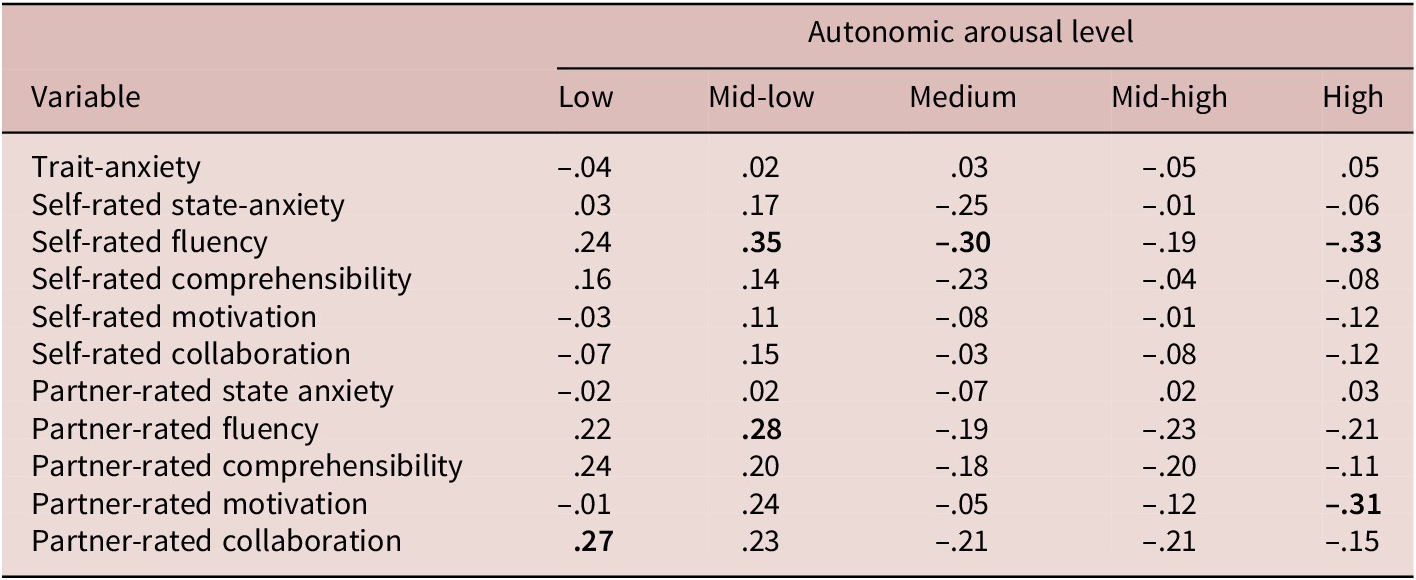
Note: Associations that exceed the benchmark for a small effect size (r > |.25|) are bolded.
The research question also asked if there was an association between L2 speakers’ autonomic arousal during L2 English conversation and social dimensions of their language use. Pearson correlations (two-tailed) were conducted between the proportion of the participants’ arousals at each level and variables capturing their language use and social network characteristics. As shown in Table 2, several associations involving the frequency of speaking and listening to English as well as L1 and L2 network size reached the benchmark for a small relationship with arousal. For speaking and listening to English, both variables were negatively related to high arousals but positively associated with medium-low arousals. In other words, higher rates of English used for oral communication in daily life were associated with fewer high arousals and more medium-low arousals. The opposite pattern was found for L1 network size, as large L1 networks were associated with more medium-high arousals and fewer low and medium-low arousals. Finally, L2 network size had a positive relationship with medium-low arousals. No measures of inclusiveness or closeness were associated with autonomic arousal.
Correlations between social variables and proportion of arousals by level

Note: Associations that exceed the benchmark for a small effect size (r > |.25|) are bolded.
Discussion
While researchers in various disciplines have adopted wearable galvanic skin conductance devices to detect emotional reactions to stimuli to investigate stress relief and management techniques (e.g., Joshi & Kiran, Reference Joshi and Kiran2020), consumer reactions to advertisements (e.g., Ohme et al., Reference Ohme, Reykowska, Wiener and Choromanska2009), or emotion regulation training in clinical populations (e.g., Liverant et al., Reference Liverant, Gallagher, Arditte Hall, Rosebrock, Black, Kind, Fava, Kaplan, Kamholz, Pineles and Sloan2022), the present study exemplifies the use of such devices to understand possible sources of or solutions to anxiety experienced in L2 contexts. Whereas Lindberg et al. (Reference Lindberg, McDonough and Trofimovich2021) used skin conductance to show that L2 speakers’ high arousals are related to certain nonverbal behaviors (increased blinking, glancing away, and touching the face or hair), the current study contributed to this line of research by investigating whether there were any relationships between L2 speakers’ autonomic arousal and their trait- and state-anxiety, their perceptions of the interaction, and their language use.
Although several studies have shown a relationship between autonomic arousal and trait- and state-anxiety (e.g., Gregersen et al., Reference Gregersen, MacIntyre and Meza2014; Sevinç, Reference Sevinç2018; Witt et al., Reference Witt, Brown, Roberts, Weisel, Sawyer and Behnke2006), the current findings revealed no such relationship during L2 interaction in a lab setting. However, autonomic arousal may not always reflect self-perceived anxiety (Gross, Reference Gross1998; Scovel, Reference Scovel1978), especially if interlocutors downgrade their subjective experience with stress or worry. In fact, this disassociation between self-reported anxiety and physiological response has also been found in studies that measured cortisol levels, which have suggested that interindividual differences, such as trait personality characteristics, emotional regulation, reappraisal processes, or metacognitive awareness of L2 speaking, may play a role in the amount of correspondence between self-perceived and biological stress experience (Campbell & Ehlert, Reference Campbell and Ehlert2012; Fischer et al., Reference Fischer, Spoerri, Gmuer, Wingeier, Nater, Gaab, Ehlert and Ditzen2019). Because these interindividual differences were not controlled or measured in this dataset, they may have masked potential links between a physiological index of anxiety and self-reports of trait- and state-anxiety.
Instead, autonomic arousal was associated with self- and partner-ratings of fluency (i.e., fluidity of speech) along with partner-ratings of motivation and collaboration, with positive associations for mid-low and low levels of arousal and negative associations for medium to high levels. Considering that self-perception has been linked to language anxiety (e.g., Gregersen & Horwitz, Reference Gregersen and Horwitz2002; Heng et al., Reference Heng, Abdullah and Yusof2012; MacIntyre et al., Reference MacIntyre, Noels and Clément1997; Szyszka, Reference Szyszka2011), the association between arousals and self-perceptions of fluency is not unexpected. For example, because more anxious L2 speakers tend to underestimate their performance (MacIntyre et al., Reference MacIntyre, Noels and Clément1997), self-derogation may have contributed to their self-perceived lack of fluidity in speaking. Alternatively, dysfluencies while speaking may have made the speakers more self-conscious, contributing to greater levels of arousal. Because increased arousal is typical when more effort is expended during a task (Mackersie & Calderon-Moultrie, Reference Mackersie and Calderon-Moultrie2016), it is also reasonable to expect that one’s level of collaboration and motivation to complete a task might be linked to physiological arousal. However, the results revealed no association between autonomic arousal and self-rated motivation and collaboration, supporting a previous finding where a motivational manipulation (a financial incentive to succeed in the task) had no effect on speakers’ physiological arousal (Larsen et al., Reference Larsen, Saccuzzo and Brown1994). Future research should further investigate the possible relationship between motivational levels and arousal during conversation by measuring motivation dynamically (i.e., eliciting multiple ratings throughout the task) and by using a wide variety of collaborative activities that target diverse topics. Such research might draw upon prior task research to select tasks that vary in terms of their information-exchange requirements, number of interlocutors, or levels of task complexity to explore if such variables impact motivation levels and their relationship to arousal.
Regarding partner-ratings, the present findings showed that higher proportions of high arousals were associated with lower partner motivation levels. In addition, greater frequency of low arousals was associated with higher partner collaboration ratings. These complementary results suggest that the speakers’ perceptions of their partner’s level of engagement in the task may have elicited a certain stress reaction in them, such as when their interlocutors seemed disengaged or uninterested. Thus, similarly to how anxiety may stem from perceptions of one’s interlocutor (Hashemi, Reference Hashemi2011), perceptions of interlocutor behaviors might trigger arousals, especially because perceptions of collaboration, such as interpretations of listener responses, differ across individuals (Cutrone, Reference Cutrone2005). Alternatively, the obtained relationships might reflect the halo effect, where the speakers projected their state of anxiety onto their partners, rating them as more or less engaged. Because people often misattribute their self-perceptions to an irrelevant source (Greifeneder et al., Reference Greifeneder, Bless and Pham2011), the speakers who experienced more versus less anxiety may have also blamed or rewarded their partners for how they felt by downgrading or upgrading the partners in their ratings. Needless to say, the precise nature and directionality of the arousal–engagement relationships must be investigated in future work.
Although it may be expected that high physiological arousal would be related to negative partner-ratings of comprehensibility and fluency, especially because perceptions of an interlocutor’s speech could trigger L2 input anxiety (Elkhafaifi, Reference Elkhafaifi2005; MacIntyre et al., Reference MacIntyre, Noels and Clément1997), this was not the case here. Because the speakers tended to rate their partner as generally comprehensible (M = 81.92, where 100 is easy to understand) and fluent (M = 81.10, where 100 is very fluid speech), they may not have considered their partner’s speech as a source of anxiety. In addition, because language anxiety can be contagious, in the sense that an L2 speaker may sense and reflect the feelings of an anxious interlocutor (Hatfield et al., Reference Hatfield, Cacioppo and Rapson1994), it would be expected that the more anxious the speakers perceived their partner to be, the greater proportion of high arousals they would experience as a reflection of their partner’s anxiety. However, this was not evidenced in our findings, possibly because the speakers were not attuned to their partner’s anxious feelings, which can be “caught” from noticing their emotional facial expressions (Blairy et al., Reference Blairy, Herrera and Hess1999). Indeed, the speakers appeared to only perceive low levels of partner-anxiety, assigning their partner a mean rating of 73.45, where 100 is not at all anxious.
The findings regarding social dimensions of English use revealed that less time spent listening and speaking English per week was related to experiencing higher levels of physiological response during conversation, suggesting that more frequent use of the target language is associated with less severe physiological stress experiences in interaction, similarly to how target-language use is associated with lower foreign language anxiety (Baker & MacIntyre, Reference Baker and MacIntyre2000; Dewaele et al., Reference Dewaele, Petrides and Furnham2008). Indeed, increased contact with the L2 likely increases speakers’ self-confidence and perceived competence, which leads to less perceived anxiety in L2 situations (Baker & MacIntyre, Reference Baker and MacIntyre2000; Matsuda & Gobel, Reference Matsuda and Gobel2004). Although outside the scope of the current study, another language use variable to consider would be speakers’ level of multilingualism, assuming that knowledge of more languages is associated with experiencing less language anxiety (e.g., Dewaele, Reference Dewaele2007). While our participants spoke an average of 2.25 languages (SD = 0.50, range = 2–4), future studies could examine L2 speakers with larger and more varied linguistic repertoires to see the potential benefits of language knowledge (in addition to frequency of L2 use) on anxiety levels during L2 interaction.
Going beyond frequency of L2 use, analysis of L1 and L2 social networks revealed that larger English networks were associated with more medium-low arousals and fewer high arousals. In contrast, larger L1 networks were related to more medium-high arousals. The null findings for closeness and inclusiveness are contrary to what may be expected based on Dewaele et al.’s (Reference Dewaele, Petrides and Furnham2008) findings showing higher levels of anxiety for speakers whose L2 communication is mostly with strangers (low closeness) and lower levels of anxiety for those whose networks include mostly colleagues, friends, and family (high closeness). However, Dewaele et al. did not investigate with how many colleagues, friends, and family members the speakers used their L2 nor captured the frequency of their L2 use. The present results thus extend prior work by showing that having a larger L2 network and a smaller L1 network tends to be associated with lower levels of autonomic arousal (anxiety) for speakers engaged in L2 interaction. Alternatively, those who tend to experience less anxiety during L2 interaction may simply be more comfortable forming L2 friendships.
As an exploratory study based on a relatively small sample size, this study has several limitations. The first limitation is that the results are specific to the skin conductance sensor used, meaning that different sensors or other physiological measures may elicit different findings. Nevertheless, measurements of palmar sweating appear to provide the most accurate measures of affective arousal (Blechert et al., Reference Blechert, Lajtman, Michael, Margraf and Wilhelm2006; Scovel, Reference Scovel1978). Second, while the speakers’ subjective experiences were captured through scalar-based ratings, there was no qualitative component to better understand the reason behind their ratings. Therefore, it would be important for future research to tap into L2 speakers’ thoughts and feelings during episodes of high arousal, which could be achieved through interviews or retrospective recall procedures, to further clarify possible antecedents and consequences of physiological responses. Finally, the present findings are based on correlational evidence, which precludes any causal interpretations, and most obtained associations could be explained through reciprocal (bidirectional) links between variables, which rules out unidimensional explanations of the obtained relationships. Needless to say, longitudinal work is needed to enable researchers to understand the specific nature and directionality of links between L2 speakers’ emotional responses during interaction and their various reactions and behaviors.
In terms of practical applications of the findings, to minimize negative affect during L2 interaction, instructors can raise L2 speakers’ awareness about how their motivation and collaborative behaviors can be negatively associated with their interlocutor’s emotional experience. This also sheds light on the importance of teaching and modeling appropriate interactive strategies, such as using nonverbal responses (e.g., nodding, eye contact) and various reactive and feedback behaviors (e.g., backchanneling, clarification questions, repetition of speakers’ utterance), which can influence one’s perception of their interlocutor (Huang, Reference Huang2020). In addition, especially in L2 contexts, the findings regarding the influence of current language practices highlight the emotional benefits for making the effort to befriend speakers of the target language rather than solely forming connections with people from the same language background. Raising L2 speakers’ awareness of the value of L2 social networks, and when possible, encouraging or even providing opportunities for them to interact with target-language speakers and to develop their own networks, would be a valuable step toward fostering positive emotions during L2 communicative events.
Conclusion
Considering that language anxiety is influenced by situational, social, and psychological variables, such that anxiety cannot easily be defined as a trait (MacIntryre, Reference MacIntyre1995, Reference MacIntyre2007), the goal of this study’s dynamic approach was to use skin conductance, a physiological index of anxiety, to capture changes in affective arousal during L2 conversations and to explore what factors may be related to its occurrence. For L2 speakers engaged in a communicative task, high physiological response may be associated with their self-perceptions of increased dysfluency while speaking and their negative judgments of their partner’s motivation. However, low physiological response appears to be linked to increased L2 interaction associated with having larger L2-specific social networks. These findings call for future investigations of the role of social, motivational, and experiential variables underpinning speaker anxiety in conversation.
Data availability statement
The experiment in this article earned an Open Materials badge for transparent practices. The materials are available at https://www.iris-database.org/iris/app/home/search?query=Lindberg%2C+McDonough+et+al.
Competing interests
The authors declare none.


 Open access

