

I. INTRODUCTION: A MAP FOR A HOSTILE TERRITORY?
“Urban economics” remains an elusive object of study for historians. “The city” was not traditionally a research focus for economists, emerging as a significant topic only after World War II. Today, however, it possesses all the institutional markers that historians and sociologists would typically use to classify distinct fields (Whitley Reference Whitley[1987] 2000; Abbott Reference Abbott2001): a journal, professional societies, JEL codes, handbooks, graduate courses, summer schools, workshop series, and a strong sense of identity that enables researchers to identify themselves as “urban economists.” However, closer examination reveals that each of these markers is fluid, evolving, and ambiguous, challenging the notion of a permanent and independent urban economics field. Urban economists have long shared their professional associations, textbooks, and graduate courses with real estate economists, transportation economists, spatial economists, and regional scientists.Footnote 1 The Journal of Urban Economics, founded in 1974, acknowledged in its inaugural editorial that “urban economics is a diffuse subject, with more ambiguous boundaries than most specialties. The goal of this Journal is to increase rather than decrease that ambiguity" (Mills Reference Mills1974, p. iii).
The unclear status of urban economics is also reflected in quantitative studies that analyze fields not merely as organizational and professional entities but as cognitive or intellectual divisions. François Claveau and Yves Gingras (Reference Claveau and Gingras2016) conducted cluster analysis of bibliometric coupling networks, revealing the emergence of an urban cluster in the early 1960s. This cluster merged with housing, regional, and location clusters before being absorbed into public economics in the late 1970s. When the JEL codes were revised in 1966, American Economic Association (AEA) executives considered granting urban economics its own code: “It is true that this topic has been increasing in importance in recent years,” they noted (Cherrier Reference Cherrier2017, p. 568). However, the hype proved short-lived, and by the 1980s, urban economics was regarded as a small, “peripheral” field (Krugman Reference Krugman1991b, pp. 3–4). Vernon Henderson (Reference Henderson1985, p. xi), a major contributor to the field, described it as a “diffuse field.” He later became the inaugural president of the Urban Economics Association, founded in 2006 to accommodate renewed interest in related topics.
Urban economics is thus one of these applied fields that lacks a clear, stable, and consistent identity, even existence.Footnote 2 Historians cannot assume a priori the existence of a stable community that identifies itself as independent. The purpose of this paper is therefore to develop a hybrid methodology to explore the history of urban economics as a field while acknowledging its elusive character. We combine intellectual history (analyzing published sources) with material from seven individual and institutional archive repositories to unpack intellectual controversies and institution-building strategies. We supplement this analysis with exploratory network analysis based on co-citation techniques to map changes in the size and structure of urban economics communities.Footnote 3
Our approach begins by identifying a stable and distinctive element consistently associated with urban economics over decades: the Alonso–Muth–Mills model (AMM), commonly known as the “monocentric city” model.Footnote 4 It represents a monocentric city where households make trade-offs between land, goods and services, and commuting costs to access workplaces. Land prices decrease with distance from the city center. The model emerged almost simultaneously in William Alonso’s dissertation, published in 1964, Edwin S. Mills’s Reference Mills1967 article, and Richard Muth’s Reference Muth1969 book.Footnote 5 This trifecta is often regarded as a “founding act” of urban economics. Using the Web of Science (hereafter WoS), we collected all articles published between 1965 and 2009 that cited at least one of the three texts and extracted all their references. From this database of works co-cited with Alonso (Reference Alonso1964) and/or Muth (Reference Muth1969) and/or Mills (Reference Mills1967), we constructed a partial map of the field by representing the co-citation networks for authors across five-year periods.Footnote 6 By mapping how frequently the authors most cited alongside Alonso, Muth, or Mills are cited together in successive time windows, we aim to reconstruct some sort of core urban economics community.
Our online appendix provides detailed documentation of our technical choices, including running a community detection algorithm, and presents colored versions of our networks, author centrality tables, and lists of papers most frequently co-cited with AMM for each of our selected time periods. However, we must clarify our approach to these three founding texts in our co-citation analysis and explain what historical evidence this technique can and cannot provide. We do not claim that these three publications remain the foundation of contemporary urban economics. Neither does their work on location theory (why people live where they do in the city) encompass the full range of topics that urban economists have sought to address. These also include urban transportation, urban residential markets, local public finance, urban poverty, and unemployment and development.
Rather, we treat AMM as an enduring identity token. Our approach focuses not on the citation frequency of the three AMM papers over time (which does not substantially affect the networks) but rather on their consistent citation both for their content and increasingly for their “founding” status (Figure 1, online appendix). While some researchers view urban economics as primarily focused on location theory or spatial insights, others emphasize its connections to public economics or labor economics. Yet all of them acknowledge and sometimes cite AMM as a core “urban” model. This makes the three papers effective “seeds” to identify and collect other works associated with urban economics topics beyond location and land use at different points in time. In all articles published in the Journal of Urban Economics between 1974 and 2019, Muth (Reference Muth1969), Alonso (Reference Alonso1964), and Mills (Reference Mills1967) rank as the first, second, and seventh most-cited documents, respectively (Table 1, online appendix).
The use of AMM references to signal intellectual proximity with the field of urban economics, rather than merely with location theory, has a long tradition. In 1972, Robert Solow began a grant application to the National Science Foundation by stating that “the main figures [in urban economics] are Martin Beckmann, Mills, Richard Muth, and William Vickrey.”Footnote 7 In the preface of a later survey book, Richard Arnott (Reference Arnott, Papageorgiou and Pines1998, p. xvii) explained that “the centerpiece of urban economic theory is the monocentric (city) model.” In a seminal paper introducing “The Economic Approach to Cities,” Edward Glaeser (Reference Glaeser2007, p. 6) likewise argues that “the most significant piece of urban economic theory remains the spatial equilibrium model of William Alonso (Reference Alonso1964), which was extended by Mills (Reference Mills1967) and Muth (Reference Muth1969)” (see also Papageorgiou and Pines Reference Papageorgiou and Pines1998). Although our method does not provide an exhaustive mapping of the field of urban economics, using AMM as seeds to build a database of co-cited articles enables us to identify a corpus of authors and texts unequivocally connected to the field. The resulting co-citation networks serve as an approximate, partial, and illustrative map of the prominent figures in urban economics over time, which we combine with qualitative historical research to understand the field’s evolution.Footnote 8
Our narrative highlights a persistent tension at the heart of urban economics. Since the 1950s, when “the city” was first consistently regarded as an economic object, the field has been inhabited by scholars who seek to reclaim distinctive questions, stylized facts, and models of the city. However, it has also attracted economists who view urban phenomena as a subset of labor, public, industrial, transportation, housing, environmental, geographical, or spatial issues. In this case, models developed to address broader questions of discrimination, segregation, location, competition, or growth were applied, dissolving urban economics into other fields, or even into other disciplines. This dynamic explains the alternately strong and fluctuating unity and identity of the field. As we show in the following chronological account of the development of the field, its identity has remained largely contested.
II. AGGLOMERATION (1950–1965)
Urban economists typically trace their roots to the works of German location theorists: Johann von Thünen, known for his agricultural land use model; Alfred Weber, who explored industrial location; Walter Christaller, who developed central place theory; and August Lösch, who proposed an economics of location in the nineteenth and early twentieth centuries (Blaug Reference Blaug1979; Ponsard Reference Ponsard1983; Meardon Reference Meardon2000; Rahman and Dimand Reference Rahman and Dimand2021). This lineage extends to interwar economists, notably Robert Murray Haig, who oversaw the first urban plan for the New York metropolitan region in 1927, and Homer Hoyt, an economist from the Federal Housing Administration. These interwar authors wrote in the context of accelerating urban development, one interrupted by the Great Depression and subsequent war (Kotkin Reference Kotkin2006; Boehm and Corey Reference Boehm and Corey2014). These crises redirected economists’ attention from urban growth and residential location decisions to more pressing issues like mass unemployment and homelessness. As an urban economist later observed, “fledgling urban economists became housing economists or housing finance economists, and urban economics ceased to exist as a distinct field of economic analysis and research” (Kain Reference Kain1975, p. 2).
Urban growth resumed its rapid expansion after World War II alongside urgent housing reconstruction needs. However, this did not immediately spark regained interest among economists. Regional science founder Walter Isard (Reference Isard1949) lamented that Edward Chamberlin stood almost alone in seriously considering space in economic analysis (Rebours Reference Rebours2023, pt. 1). Rather, the rise of urban economic analysis was demand-driven: urban planning in major US cities required economic and demographic projections. The landmark New York Metropolitan Region Study by regional economists Edgar M. Hoover and Raymond Vernon (Reference Hoover and Vernon1959), commissioned by the Regional Plan Association of New York and funded by the Ford Foundation, exemplified this trend. This study and subsequent investigations in Pittsburgh connected the uneven development in newly industrialized regions to the concentration of economic activities and populations in or near large cities through the notion of “external economies” (Perloff Reference Perloff1973). Economists’ new-found interest in explaining the growth of populated areas across the US was shared by geographers like Brian Berry, who drew on central place theory to explain city size distribution. The 1950s and 1960s also saw a “quantitative revolution” in geography, with Berry, William Garrison, Edward Ullman, and Harold McCarthy providing economists with valuable new data on urban structure, size, and dynamics (Barnes Reference Barnes2001; Scott Reference Scott2000).Footnote 9
Another crucial aspect of postwar urban transformation was traffic congestion resulting from growing car ownership in the US. Federal agencies and local governments both enlisted transportation engineers and planners to rationalize regional transport systems (Dupont et al. Reference Dupont-Kieffer, Rivot and Madre2021). The 1956 Federal Interstate Highway Program funded extensive studies to improve traffic forecasts (Weiner Reference Weiner2016). One challenge was to integrate traffic flow dynamics into previously static models designed to map housing and businesses into different zoning areas (Isard Reference Isard1979; Kain Reference Kain1975). This required extensive data collection and new modeling strategies, including recording households’ travel habits through counting vehicles and conducting interviews to determine origins, destinations, and travel purposes.
Engineers and planners also explored gravity and potential models to improve traffic projections. These models drew on analogies between physical and spatial interactions. They conceptualized interactions between population groups and flows as proportional to population size and inversely related to the distance between them (or other friction measures like cost or time). Empirical observations of this inverse “gravity-like” relationship between distance and density in Europe and the US can be traced back at least to the mid-nineteenth century. In the 1940s, astrophysicist John Q. Stewart (Reference Stewart1947) and linguist George K. Zipf (Reference Zipf1949) independently documented numerous applications of this analogy, with Zipf examining city density, intercity phone calls, rail and bus traffic, and even obituaries in New York and marriage licences in Philadelphia. Stewart applied potential models to explain Princeton undergraduates’ residential choices before extending them to rural area density. Urban planners like Harvard PhD Douglas J. Carroll, who led the Detroit and Chicago transportation studies during the mid-1950s, relied on these models to analyze urban flows. John Herbert and Benjamin Stevens (Reference Herbert and Stevens1960), however, explored the combination of microeconomics and simulation to model the Penn-Jersey housing market.Footnote 10
Redesigning transportation systems to accommodate growing automobile use led engineers and planners to model broader urban structural transformation. Their work highlighted suburbanization and the decline of city centers as phenomena requiring explanation. Planners brought these observations to the meetings of the Regional Science Association, founded by Walter Isard in 1954. Isard’s original goal was to understand regional development. Building on German location theorists, he developed a framework in which industrial location was primarily determined by the transportation costs of inputs, intermediary goods, and final products, which were themselves a function of distance between extraction sites, production plants, and markets.Footnote 11 The resulting price variations explained why regions would specialize in different activities. Isard also developed an input-output-based approach that incorporated distance as a decision variable in the production function to analyze inter-regional relations and trade. He subsequently sought to nurture a more interdisciplinary community working on regional science (Isard Reference Isard2003; Rebours Reference Rebours2023). After working at MIT’s Urban Planning department, where he trained urban planners like Stevens, Isard moved to the University of Pennsylvania in 1956, where he promptly established a regional science PhD program.Footnote 12 The first student to graduate was William Alonso.
Before joining Penn, Alonso had received architecture and urban planning degrees from Harvard (Isserman et al. Reference Isserman, Mera, Rey, Waters and Mary2001). In his dissertation, he focused on explaining suburbanization through modeling the residential land market. He adapted von Thünen’s agricultural land use model, which Isard actively promoted, to a city with employment concentrated in a Central Business District (CBD). He modeled individual city dwellers as balancing transportation costs and land rents, thereby explaining the density gradient. His resulting PhD dissertation, Location and Land Use, was completed in 1960 and published in 1964 (McDonald Reference McDonald2007).
Around the same time, Richard Muth, a young economist from the Washington-based think tank Resources for the Future (RFF), spent a snowstorm confinement thinking about how markets determine land values (Muth Reference Muth1979). Milton Friedman had directed him to a study by Colin Clark that offered empirical evidence that urban population density followed a negative exponential formula: the closer to the city center, the denser the population. Shortly thereafter, Muth accepted a position at the University of Chicago, which boasted a long-standing interdisciplinary urban research tradition. In the 1930s, “urban ecologists” led by sociologists Ernest Burgess and Robert Park conducted pioneering studies of the structure of metropolitan areas.Footnote 13 The opening of the Chicago Planning Program in the Social Science Division in 1947 brought public finance economists including Harvey Perloff and Julius Margolis (Kuehn Reference Kuehn2023). Perloff worked on urban rehabilitation projects in Black neighborhoods.Footnote 14 In this intellectual environment, Muth developed a model where housing and agricultural sectors shared featureless land, which he tested empirically and expanded to study population density. This work culminated in his 1969 book, Cities and Housing.
Drafts of Alonso’s and Muth’s work reached inventory specialist Edwin Mills in 1966. Then at the RAND Corporation, he sought to turn models describing growth paths over time with calculus of variation techniques into a model explaining how the interplay of producers’ and workers’ decisions determined city size and structure (Mills Reference Mills2000).Footnote 15 His article “An Aggregative Model of Resource Allocation in a Metropolitan Area” was published the following year (Mills Reference Mills1967). Though Alonso, Muth, and Mills came from different backgrounds and explored slightly different questions (suburbanization, housing prices, resource allocation), all three embraced the growing trend towards writing microfounded models that were tractable enough to yield analytical solutions and highlight simple mechanisms (Cherrier Reference Cherrier2023).They ended up with a shared framework that integrated location and land use with transportation and residential concerns.Footnote 16
German-born Brown University economist Martin Beckmann (Reference Beckmann1969) also sought to explain city size distribution. His research on the efficient utilization of transportation facilities led him to model the determination of equilibrium prices and quantities in urban residential land use under perfect competition. He, too, concluded that rent, density, and income followed power distributions of distances. Another economist who studied the Alonso, Muth, and Mills models was John Kain. His 1961 Berkeley dissertation also identified a trade-off between commuting time and housing space (Kain Reference Kain1962). However, Kain was skeptical of monocentric models, and aimed to model heterogeneity in household demography, durable fixed capital, and multiple and changing locations of employers within the city. In such models, the equilibrium prices could not be derived analytically. He thus developed simulation models that culminated in the Detroit Prototype of the National Bureau of Economic Research (NBER) urban simulation model, engineered with Gregory Ingram and J. Royce Ginn (Ingram et al. Reference Ingram, Kain and Ginn1972).
While teaching at the US Air Force Academy, Kain met then-young researchers John Quigley and Eric Hanushek, as well as RAND economist John Meyer, who had previously conducted cliometrics on slavery and railroad competition (Glaeser Reference Glaeser2014). Together with Martin Wohl, Kain and Meyer used a combination of econometrics, system analysis, and cost-benefit analysis to study alternative means of transportation in the Los Angeles area (Meyer et al. Reference Meyer, Kain and Wohl1965). Their book stressed the limitations of public transportation, a conclusion often summarized as “train, bad; bus, good.” They argued that the development of fixed-rail transit systems was costly for consumers and failed to accommodate the variety of origins and destinations of commuters.
Moreover, Kain connected the trade-off between work commuting time and residential space to racial segregation, by comparing the travel behavior of white and non-white people. He demonstrated that job relocation to the periphery led to increased non-white people’s unemployment due to housing market racial segregation (Kain Reference Kain1962). Using data from Detroit and Chicago, he showed empirically that segregation increased Black workers’ travel distance in their employment searches. Causation did not run from work to residence, he argued, but rather from residence to work. His findings came to be known as the “spatial mismatch hypothesis.” He then pursued work on housing discrimination, which led to improvements in housing price hedonics (Kain and Quigley Reference Kain and Quigley1975). Better estimation of housing quality helped him demonstrate that Black households in St. Louis paid more for housing and that they were less likely to become homeowners.
The emergence of optimization-based models to explain urban location was not enough to establish an economic field. Neither Alonso, who viewed his contributions as part of an interdisciplinary regional science, nor Muth, who engaged in Chicago housing policy debates, cared about institutional entrenchment. But both were influenced and funded by men with a plan. One was Perloff, who moved from Chicago to RFF in 1958. There, he collaborated with his former student Lowdon Wingo, who was then developing a land use model, published in 1961 and often recognized alongside AMM as foundational.Footnote 17 The pair wrote a plea to convince RFF to establish a Committee for Urban Economics (CUE) with Ford Foundation funding. Their motivation stemmed from rapid urbanization and widespread dissatisfaction with the 1950s urban renewal programs, which Perloff had experienced first-hand while working on the rehabilitation of Hyde Park at Chicago (Kuehn Reference Kuehn2023).
Perloff and Wingo’s application to RFF also reflected their dissatisfaction with the state of economic scholarship on cities. Simulations were extremely sensitive to minor changes in parameters and hypotheses, they explained, suggesting a need for stronger theoretical foundations. However, theoretical models of the Alonso–Muth type were perceived as too simplistic: they assumed a single metropolitan center, were static, and overlooked a range of factors, including imperfect competition, the fiscal behavior of local governments, or landlords’ possible preferences for segregation. Each of these refinements was analyzed by scholars working in isolation. “The quality of scholarly work is entirely out of phase with the speed of urbanization … and the complexity of economic problems faced by our metropolitan communities,” Perloff wrote in a 1959 grant application to the Ford Foundation.
They proposed that the CUE would help develop a “common analytical framework,” support the establishment of graduate programs in “urban economics,” fund dissertations in the new field, and coordinate the development of workshops, textbooks, and readers. The Ford Foundation granted $350,000 in 1959 and an additional $900,000 in 1964 for the “conscious development of a new academic field” by the committee (Perloff Reference Perloff1973, p. 291; Hoch Reference Hoch1969, p. 16).Footnote 18 These grants initiated a golden era in which funding flowed abundantly from concerned policymakers and patrons to economists researching urban topics. This caught the attention of a range of prestigious theorists, resulting in the “gentrification” of the emerging field.
III. GENTRIFICATION (1965–1975)
Perloff and Wingo’s agenda was soon vindicated. Two years after the establishment of the CUE, Jane Jacobs published The Death and Life of Great American Cities (Reference Jacobs1961). The book vividly depicted the rise of congestion, pollution, housing segregation and ghettoization, labor discrimination, slums, crime, and local government bankruptcy, which two decades of urban renewal programs had failed to address (Philadelphe Divry Reference Philadelphe Divry2024). These urban problems escalated throughout the 1960s. Despite significant housing and anti-discrimination legislation under Presidents Kennedy and Johnson, economic and racial tensions persisted. This culminated in the 1965 Watts riots. The McCone Commission, tasked with identifying the causes of the riots, pointed to Black unemployment, a conclusion supported by the 1967 Kerner Commission on “Civil Disorders.”Footnote 19 This diagnosis prompted additional legislation, notably the Housing and Urban Development Acts (1965, 1968). As extensively documented by historians, the “research-intensive structure” of Lyndon Johnson’s Great Society and War on Poverty “virtually created a new and well-funded discipline: policy analysis” (Jardini Reference Jardini2013, p. 243; see also Fontaine and Pooley Reference Fontaine and Pooley2021). While previous transportation laws such as the Urban Mass Transportation Act (1964) had already created a demand for data and analytical systems, the numerous bills resulting from the urban crisis expanded the need for coordinated urban planning.Footnote 20
Despite the proliferation of urban institutes and programs, academia lacked coordinated efforts. In 1966, Ford Foundation President McGeorge Bundy launched an “urban grant” call for applications, specifically designed to foster urban interdisciplinary expertise in universities. After months of negotiations, $10.8 million was awarded to four universities—Columbia, Chicago, Harvard, and MIT—to establish fourteen new professorships and set up interdisciplinary urban action programs for research in social sciences, humanities, and engineering. The choice to endow chairs rather than fund research programs was unusual, prompting Ford directors to explain that “we need a generation of urban technologists who have a language in common with those whose primary concerns are the political, social and economic aspects of city life.”Footnote 21 The urban grants were supplemented by support for numerous urban institutes extended in 1970 for three additional years. Public announcements of the 1970 grants emphasized that Ford had already directed $24 million towards the problems of cities, with a focus on developing academic research. Yet, the previous emphasis on “the development of an analytical framework” had disappeared, replaced by an explicit focus on building a “body of knowledge” to provide “a direction for effective action on its problems.” Ford officials’ interest was moving away from basic research toward policy-oriented expertise, which did not always align with economists’ agenda.
The money that the Ford Foundation injected into urban economics via the CUE and the two rounds of urban grants profoundly influenced the field’s institutionalization. The CUE, which closed in 1969, helped set up more than fifty graduate programs and courses and funded numerous readers and textbooks (Perloff Reference Perloff1973).Footnote 22 At Harvard, the first urban grant funded ten chairs, including one in urban economics for Kain. The second grant supported “a set of university-wide interdisciplinary seminars and research on urban problems.” This included seminars on low-income housing and central cities abandonment, directed, respectively, by political scientist Charles Haar and by Kain. Another seminar was on “Urban Resource Allocation.” Its organizers, Martin Feldstein and Richard Musgrave, aimed to bring together students from the Department of Economics and political scientists from the Department of Government and Regional Planning. They hoped that a combined focus on political institutions and allocation and distribution decisions would improve the study of property taxes, the demand for public education, and housing prices.Footnote 23 The Ford money also allowed Kain to turn his NBER simulation model into a teaching tool and funded several graduate works, such as Quigley’s research on housing prices.
At MIT, like Harvard, the Ford grants stabilized the institutional entrenchment of urban economics. Given MIT’s engineering culture, urban research had previously centered on an interdisciplinary approach to city design and quantitative planning, including its architecture and its information and transportation networks. Upon receiving the Ford grant, it was thus only natural to establish an Urban Systems Laboratory (USL) to manage fund allocation.Footnote 24 The Department of Economics was involved, and by the fall of 1967, newly recruited welfare economist Jerome Rothenberg had set up a graduate sequence on urban economics for a joint PhD degree in economics and city planning.Footnote 25 MIT economists focused on unemployment, poverty and racial discrimination, and local finance, thus using the first Ford grant to support faculty research on self-help communities in Mexico and Colombia, urban health, and the analysis of the New York taxi market.Footnote 26
The status of urban economics at MIT at the turn of the 1970s highlights how fashionable and institutionalized it had become: Robert Solow (Reference Solow1972) was working on a theoretical model of urban congestion; his former student Avinash Dixit modeled a trade-off between city center economies of scale and commuting congestion costs. Thomas Rothenberg collaborated with Robert Engle and John Harris to develop a large-scale econometric model of the Boston area, while compiling a reader with radical economist Matt Edel, who was studying the distribution of real estate capital gains. Duncan Foley sought to provide a general equilibrium model of the metropolis. Department Chair Cary Brown and Peter Diamond, both public finance theorists, investigated municipal finance. Robert Hall was studying public assistance, while Paul Joskow examined urban fire and property insurance.Footnote 27 To coordinate these various initiatives, it was decided that the second grant would support a two-year “urban policy seminar.” Organized by Rothenberg and chaired by Diamond, the seminar was attended by more than half of the department’s faculty.
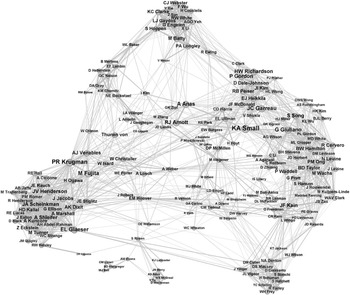
The network of works co-cited with Alonso, Muth, and Mills between 1975 and 1979 (Figure 1) illustrates how two decades of transformation led to the integration, gentrification, and fragmentation of urban economic research.Footnote 28 For visual clarity, Alonso, Muth, and Mills are omitted due to their methodologically constructed centrality. The size of the nodes and links is proportional to the total number of co-citations with other authors. The more frequently two authors are co-cited in our database, the closer together they are in the network. We have applied a threshold for visibility, so that only the most important nodes and edges are represented here. The online appendix provides versions of this and subsequent networks with and without thresholds, and with color-coded communities identified through a detection algorithm.

Figure 1. Co-citation network of most authors cited more than five times in Web of Science articles also citing AMM between 1975 and 1979.
A first notable feature of this network is the intermingling of urban specialists with renowned theorists and econometricians across all clusters: research by scholars such as Solow, Kenneth Arrow, Thomas Schelling, Gary Becker, Charles Tiebout, Zvi Griliches, James Mirrlees, and William Vickrey—six of whom later received Nobel prizes—is cited alongside work by Kain, Wingo, or Harry Richardson. Many scholars viewed cities as laboratories for applying theories, models, and tools developed in other fields. While Solow, Mirrlees (Reference Mirrlees1972), or Schelling directly contributed models addressing congestion, racial segregation, or urban issues, other researchers are cited for relevant contributions outside urban economics (for instance, Becker’s theory of discrimination, or Margaret Reid’s empirical work on consumption).
Solow began a 1972 grant application (referenced in footnote 7) by acknowledging that “the force of events has made urban economics into an important subject,” thus capturing the momentum of the field. But other economists aimed to elevate urban economics from a trendy topic to a distinct field. This endeavor included the aforementioned textbooks, readers, courses, and chairs but also “A Survey of Urban Economics,” published in the Journal of Economic Literature (Goldstein and Moses Reference Goldstein and Moses1973). The field achieved further institutionalization with the founding of the Journal of Urban Economics the following year.Footnote 29 By 1968, James Buchanan was urging agricultural economists to emulate urban economists in safeguarding their independence (Kuehn Reference Kuehn2023, p. 21): the fundamental “presumption of urban economics” was “that the very fact of urbanization, the concentration of people in space, itself modifies the economic constraints on behavior in such a manner as to warrant specialized consideration,” he explained (quoted in Kuehn Reference Kuehn2023, p. 21).
A second characteristic of the network above is its organization into distinct clusters representing various topics and approaches to urban issues. While the Herbert–Stevens–Wilson middle right cluster focused on transportation (like the Ingram–Lowry–Meyer one), the large bottom left and right clusters concentrated primarily on discrimination and segregation, and applied standard microeconomic techniques to explain city structure, size and growth, and local public finance. Kain, who studied both transportation and segregation in labor markets, bridges these communities, as does Wingo, who pursued theoretical and institutional unification.
The 1960s and 1970s were characterized by the rise of local public finance. Charles Tiebout, who had worked as Wolfgang Stolper’s assistant during the 1950s while the latter translated August Lösch’s book on the economics of location into English, proposed an early notable model of spatial sorting. Tiebout proposed that citizens would reveal their preferences for local public goods through mobility as a response to Paul Samuelson’s theory of public goods. He later explored whether private and public local goods would develop along a “Lösch pattern.” He presented his research at the Regional Science Association in the late 1950s and eventually founded a Center for Urban and Regional Studies with geographer Edward Ullman at the University of Washington (Singleton Reference Singleton2015). Economists increasingly incorporated Tiebout’s work, particularly as urban public finance gained prominence.
Other public economists approached urban topics by reassessing Henry George’s proposition that, under certain conditions, a land tax alone could efficiently fund local public goods. William Vickrey, trained in tax theory and interested in applying marginal cost pricing to urban public transportation, reframed George’s idea in the language of contemporary microeconomics. He then became a leading advocate for Georgist principles. Between the late 1960s and the late 1970s, numerous economists, including Vickrey, David Starrett, Frank Flatters, Vernon Henderson and Peter Mieszkowski, Arnott, and Joseph Stiglitz, demonstrated versions of what became known as the “Henry George theorem.”
Archival material and surveys from the 1970s reveal a lack of consensus on urban economics’ core topics, methods, and boundaries. The discussions at the MIT urban seminar exemplified the aspirations and challenges encountered in developing a unified economic framework to study cities. At the inaugural November 1970 meeting, Rothenberg outlined lectures spanning location theory, housing, segregation, race and poverty, transportation, congestion and pollution, and local government. The seminar had three overarching goals: “(1) construct an analytical framework that would connect the disparate concerns of urban economics; (2) collect data; (3) confront theory with data in an econometric model.” “It was agreed that the emphasis of the seminar will be analytic and methodological, rather than policy-oriented,” the minutes continue. At the following meeting, Rothenberg reaffirmed that the “key feature [of urban economics] is the clustering of activities in space.”Footnote 30 His framing was then challenged: “Rothenberg prefers this [definition] to a definition which includes the economic analysis of any issue relevant to cities…some people felt that this approach might be limiting, and that a more eclectic approach would be more productive,” the minutes read. These concerns surfaced both during Duncan Foley’s presentation of a general equilibrium model of Boston, which did not seem to embody “anything uniquely ‘urban,’” and during discussions of Matt Edel’s Marxist research on the potential exploitation of low-income homeowners.Footnote 31
Contemporary surveys of urban economics echoed these uncertainties. Most publications highlighted divisions between competing approaches, sometimes identified as “1) studies of growth, composition … and spatial form of urbanized areas; and 2) analyses of problems such as congestion” (Goldstein and Moses Reference Goldstein and Moses1973, p. 417); or “positive” and “normative” analysis (Mills Reference Mills1972); or “theories” and “problems” (Edel and Rothenberg Reference Edel and Rothenberg1972). These divisions reflected tensions between the uses of simple analytical models versus comprehensive empirical representations of cities, of constrained optimization behavioral assumptions versus models including power relations. For instance, Harry Richardson, an urban economist from Kent University, criticized Solow’s and Mirrlees’s models of congestion, objecting to assumptions of monocentrism, homogeneity, linearities, perfect competition, and similar city size. “It would be a disaster if a policy-oriented field such as urban economics went the way of growth theory,” Richardson concluded (Reference Richardson1973, p. 260). He later praised the approaches by MIT engineer Jay Forrester and radical geographers Henri Lefebvre and David Harvey.
When evaluating the CUE, Perloff (Reference Perloff1973) captured the emerging field’s fundamental tension: while institution building was a sheer success, he wrote, “intellectual progress was more limited.” Urban economists had failed to provide a unified framework to address the CUE’s core focus areas: metropolitan growth, intra-metropolitan organization, urban services and welfare, or urban population and human resources. Even more concerning was the program’s inability to draw connections between traditional areas and new subthemes gaining momentum from deteriorating domestic conditions.
IV. SEGREGATION (1975–1990)
The early 1970s, when a dedicated journal was established and reviews on the New Urban Economics proliferated, were not, it turned out, the beginning of an ascent. They were the peak. On the demand side, public interest and financial support, which had fueled this wave of contributions, quickly waned after the election of Richard Nixon and the reorientation of federal policies. On the supply side, the mix of questions, methods, and conversations with neighboring scholars that had hitherto characterized urban economics became problematic. The 1970s were an era of consolidation in economics: to maintain or gain disciplinary legitimacy, applied fields needed to reorganize around theoretical cores, typically featuring general equilibrium microfounded models (Backhouse and Cherrier Reference Backhouse and Cherrier2017).Footnote 32 Some older fields (macroeconomics and public economics) made this transition, as did newer ones (health, education, household economics). Parts of urban economics followed suit. Others with independent funding sources and policy networks resisted (development, agricultural economics). Likewise, several urban economists developed alternative research programs. Theoretical unification was not in sight.
One influential line of research, later known as “Urban Systems,” was developed by J. Vernon Henderson. A graduate student at Chicago in the early 1970s, he had read Beckmann’s work on location theory and, under the guidance of George Tolley (Blomquist Reference Blomquist2002), he sought to explain city size. At Brown, where he later trained graduate students in urban topics, Henderson focused on explaining urban hierarchies between cities of varying sizes. He developed a general equilibrium theory of urban systems based on the trade-off between the external economies resulting from greater concentration and the diseconomies related to the growing size of the city, such as commuting costs and congestion (Henderson Reference Henderson1974, Reference Henderson1985). Concentration benefits included local external scale economies, land development markets, local governments, and endogenous growth with human capital and knowledge accumulation.
A major perceived shortcoming of 1960s and 1970s urban models was the lack of individual behavioral foundations for agglomeration effects. Several urban economists found such microfoundations in the monopolistic model of product differentiation of Avinash Dixit and Joseph Stiglitz (Reference Dixit and Stiglitz1977), which formalized consumer preference for product variety through a constant-elasticity-of-substitution (CES) utility function. Isard’s former graduate student Masahisa Fujita (Reference Fujita1988) and his Penn student Hesham Abdel-Rahman (Reference Abdel-Rahman1988) adapted this approach.Footnote 33 Fujita aimed to develop a unified theory of urban land use and city size that combined externalities with the Dixit–Stiglitz monopolistic competition model (applied to local non-traded intermediate output). His objective, in his own words, was to revive von Thünen’s bid-rent function approach, one reinterpreted through the prism of the duality approach that had swept several fields of microeconomics since the mid-1960s.
Fujita’s framework initially lacked a dynamic aspect, and he struggled to relax the monocentric hypothesis, despite his earlier work on endogenous polycentricity with his student Hikaru Ogawa. This limitation became significant as new types of business and commercial suburban centers, christened “Edge Cities” by journalist Joel Garreau (Reference Garreau1991), were making headlines. The rapid transformations of American and European cities in the 1980s and 1990s, along with increasing comparisons with Asian cities, made it difficult for urban economists to agree on which stylized facts required urgent explanation. Cities such as Los Angeles or Chicago were sprawling and spreading out, resulting in the decline of density gradients and the development of several employment subcenters in both old and new cities (Anas et al. Reference Anas, Arnott and Small1998). Suburbanization, polycentricity, and city size were also prominent topics in Europe, where trade integration and monetary union preparations dominated (Derycke Reference Derycke2009, p. 247). Metropolitan areas became interdependent systems with specialized centers and a size distribution reminiscent of regional-level city systems. By 1996, Richardson declared Los Angeles “beyond polycentricity.” The rise of service industries, advancements in telecommunications, and falling transportation costs drove these structural changes. Meanwhile, rising homicide rates in American metropolitan areas sparked ongoing academic and media debates about the potential “death of cities” (Glaeser Reference Glaeser1998).
Another fragmenting force was the ongoing debate about whether cities’ spatial structure should be urban economics’ central focus. As Mills and Peter Nijkamp (Reference Mills, Nijkamp and Thisse1987, p. 711) remarked in their introduction to the first handbook fully devoted to urban economics, “during the last decade or so, research by urban economists has shifted its emphasis somewhat from spatial analysis to sectoral and government policy analysis. Housing, public choice, and transportation have been important foci of attention.” Jennifer Roback (Reference Roback1982), then a graduate student at Rochester, wrote down a general equilibrium model explaining wages and rent differentials across cities by differences in the quality of life, in particular the provision of amenities, and differences in productivity. Her analysis built on the work of her supervisor, Sherwin Rosen, on hedonic pricing. Their work initiated a tradition of developing and refining quality-of-life indexes and cost-of-living measurements. In 1973, Michelle White completed a PhD at Princeton under Mills, examining local governments’ zoning and land use. One of her models showed that local officials aimed to maximize net revenue by treating current residents as shareholders (White Reference White1977). William Wheaton, trained at Penn, settled at MIT in 1972, and contributed to the analysis of housing policies. Alex Anas, another 1970s Penn urban economics PhD, sought to bring these models of residential location and transportation to the data. He used discrete analysis to estimate the effect of public transportation on property values and land use.
Growing interest in sectoral analysis was fueled by policy and business demands specifically targeting housing, transportation, and local governance. Combined with increasing microdata availability, the spread of personal computers, and advances in microeconometric techniques and software, this led to an influx of empirical research (Cheshire and Mills Reference Cheshire, Mills and Mills1999). Computable transportation models and real estate forecasting models gained prominence. For instance, the United States Department of Transportation funded Alex Anas’s development of the Chicago Transportation and Land Use Analysis System (CATLAS) in the 1980s, and the Department of Housing and Urban Development commissioned a dynamic market model of Chicago real estate stock adjustment in the 1990s.
Moreover, several contributors, including Harry Richardson (Reference Richardson1988), outright rejected general equilibrium modeling. Some radical economists aligned with Marxist geographers like Doreen Massey, Allen Scott, and David Harvey, who had distanced himself from his earlier quantitative approach (Scott and Storper Reference Scott and Storper2015). Harvey now argued that capitalist accumulation, social structures, and class tensions shaped spatial forms. Another radicalized economist was David Gordon, who completed a PhD in urban labor at Harvard in 1971. Responding to New York’s fiscal crisis in the 1970s, he developed an alternative theory of large city growth that challenged the mainstream emphasis on agglomeration and scale economies. Drawing on Marxist analyses of capitalism’s stages, he argued that urban dynamics were driven by “the problem of labor control,” characteristic of late-stage capitalist accumulation, a phenomenon he termed “CAPITALopolis” (McGahey Reference McGahey2022). The alliance between heterodox economics and critical urban geography, however, began to unravel in the late 1980s as geographers embraced post-structuralist ideas.Footnote 34
This fragmentation is evident in the structure and content of the network shown in Figure 2. Its ring-shaped structure reflects the absence of a central character or hierarchical structure. No “core” set of contributions united economists in the city, nor did clear divisions emerge regarding specific theoretical approaches. Instead, scholars cluster in small groups based on topics and approaches, with a few notable figures like Kain, Anas, or Wheaton serving as bridges. The middle right cluster around Rosen addresses housing, and a transportation cluster with Kain and Anas in the top middle is sandwiched between a cluster of authors, old and new, seeking to explain the inner structures of cities, and the large cluster on the left of older location theorists and transportation economists. Marxist urban scholars form a bottom cluster. The network’s loose structure suggests either an unclear field identity or a deliberately fluid one, with researchers moving from one research question to another, and from theoretical to empirical work.

Figure 2. Co-citation network of most authors cited more than five times in Web of Science articles also citing AMM between 1985 and 1989.
V. RENEWAL?
From Urban to Spatial: Urban Economics Subsumed by the New Economic Geography
In the early 1990s, various theoretical trends that were aimed at explaining the number, size, and evolution of cities matured and competed for dominance. Alongside urban specialists like Henderson (Reference Henderson1988) and Fujita, Paul Krugman of MIT became interested in spatial externalities. He proposed that the drivers of international trade could also explain inter-regional trade and the agglomeration of economic activities in space, in particular in cities (Ehnts and Trautwein Reference Ehnts and Trautwein2012).Footnote 35 The toolbox that he had developed in his “new international trade” theory relied on the Dixit and Stiglitz model. Krugman assumed that firm location decisions resulted from the interaction between monopolistic competition and plant-level increasing returns, iceberg transportation costs, and obstacles to the mobility of goods and factors (Krugman Reference Krugman1991a, Reference Krugman1991b). This framework explained how scale effects leading to regional disparities could arise endogeneously in a general equilibrium setting. Unlike monocentric city models of land use à la AMM, which took city existence and location as given, Krugman’s model was undetermined in that firms and households endogenously choose where to cluster. In a series of papers, he then applied his core-periphery model to explain why the size-distribution of cities followed a power law (see, for instance, Krugman Reference Krugman1996). He systematically contrasted his approach with Henderson’s “neoclassical urban systems theory,” which, he argued, lacked microfoundations and a spatial dimension based on modeling how distance affected individual choices (Krugman Reference Krugman1996, p. 402).
Krugman was a recent John Bates Clark Medalist from the more prestigious international trade field (Dixit Reference Dixit1993) and was working at a premier economics department, and his influence was immediate. Though he was not the first economist to use the Dixit–Stiglitz framework to study the location of economic activity in space, his core-periphery model and associated ambition to lift regional, spatial, and urban economics from their “peripheral” status and unify them through microfounded, tractable, and flexible models (Krugman Reference Krugman1991b, pp. 3–4) quickly garnered attention. In 1992, Fujita invited Krugman to Penn’s Regional Science Department (Fujita and Krugman Reference Fujita and Krugman2004). Their subsequent collaboration culminated in The Spatial Economy (Reference Fujita, Krugman and Venables1999), coauthored with London School of Economics (LSE) international trade specialist Anthony Venables. They summarized their framework as “Dixit-Stiglitz, icebergs, evolution, and the computer,” the latter two addressing multiple equilibria and the lack of closed-form solutions of these models. They acknowledged using “cheap tricks,” “strategic simplifications,” and “grossly unrealistic” hypotheses, but they defended them as “tractable” ways to model various trade-offs and decisions (Fujita et al. Reference Fujita1999, p. 45; Fujita and Krugman Reference Fujita and Krugman2004, p. 150). These statements aligned with Krugman’s long-standing defense of those “silly assumptions” that allowed economists to develop manipulable, solvable, and applicable models, which he viewed as “virtues, not vices” (Cherrier Reference Cherrier2023). Their tractable framework, they concluded, allowed the derivation of agglomeration from individual choices, and could explain not only the size and structure of cities but also their spatial location.
Their achievement received widespread acclaim. Dubbed “a marriage of Marshall and Lösch” by Glaeser (Reference Glaeser2001, p. 113), this approach became known as the “New Economic Geography” (hereafter NEG). A quantitative study by Anthony Rebours (Reference Rebours2023) of the reception of Krugman’s work demonstrates immediate and consistent citation. It fostered exchanges between economists and often-critical geographers. In the 2000 to 2004 co-citation network below (Figure 3), Krugman ranked second in centrality after Kenneth Small, who co-authored a 1998 survey of urban economics in the Journal of Economic Literature (see Table 6.1 in the online appendix). Yet this network also reveals that substantial portions of urban economics remained independent of Krugman’s NEG.

Figure 3. Co-citation network of most authors cited more than five times in Web of Science articles also citing AMM between 2000 and 2004.
These transformations are reflected in the fourth urban economics handbook, edited by Henderson and Louvain spatial theorist Jacques-François Thisse in 2004 with the title Cities and Geographies. Its introduction presented urban research as part of a broader agenda investigating “(a) why economic activities are so spatially concentrated, and (b) what are the consequences of such an unequal distribution for economic agents and the efficiency of the space-economy” (Henderson and Thisse Reference Henderson, Thisse, Vernon and Thisse2004, p. xxvii). Although Henderson and Thisse positioned urban research within a larger spatial or geographical economics field, some chapters nonetheless demonstrated that urban economists had retained autonomy in addressing specific topics.
The handbook’s publication coincided with NEG’s peak influence. Kristian Behrens and Frédéric Robert-Nicoud (Reference Behrens and Robert-Nicoud2009) provide bibliometric evidence that citations to Krugman’s work in Papers in Regional Science peaked in the mid-2000s, a finding supported by other studies (Head et al. Reference Head, Mayer and Ottaviano2017; Duranton et al. Reference Duranton, Henderson and Strange2015, intro.). In the 2005 to 2009 network below (Figure 4), Krugman is located on the extreme left and ranked only nineteenth in centrality (see Table 7.1 in the online appendix). Those researchers who have devoted their careers to urban topics (such as Glaeser and Jan Brueckner) were now more central. References to his work remained significant, but they no longer drove the choice of research questions, or shaped preferences for particular theoretical modeling approaches and empirical strategies. Though this period is too recent for definitive historical analysis, our analysis suggests that over two decades, urban economists reclaimed the city as their main object of study (rather than space or agglomeration). This shift resulted from a combination of theoretical and empirical transformations, internationalization, and renewed attention to multiple topics that, from housing and transportation to public finance and labor, required cross-field and interdisciplinary research.

Figure 4. Co-citation network of most authors cited more than five times in Web of Science articles also citing AMM between 2005 and 2009.
Reclaiming the City
Since the 1990s, Henderson’s urban systems approach was not the only theoretical alternative to Krugman’s core-periphery model. The 1990s and 2000s saw raging debates on the sources of agglomeration effects: intra-firm, intra-industry, interindustry economies of scale; market pooling; home market effect, etc. Chicago economists gradually brought a decade of work on monopolistic competition, increasing returns to scale, and microfoundations to bear on urban phenomena. In 1986, Chicago graduate student Paul Romer proposed a model where spillover effects were modeled as internal to sectors but external to firms.Footnote 36 Robert Lucas (Reference Lucas1988) adopted Romer’s modeling strategy to explain differences in countries’ growth rates in his 1985 Marshall Lectures at Cambridge. In this work, published in Reference Lucas1988, Lucas acknowledged that Jane Jacobs’s The Economy of Cities (Reference Jacobs1969) inspired his idea about the external effects of human capital. Lucas discussed the book with José Scheinkman, who supervised both Romer and Glaeser (Glaeser Reference Glaeser2008, p. 14). While Krugman cited geographers Chauncy Harris’s market potential model and Allan Pred’s base multiplier approaches to support his assumption of firm-level increasing returns, Chicago economists interpreted Jacobs as showing that cities exist because they enable idea spillovers across industries.Footnote 37 Glaeser, together with Hedi Kallal, José Scheinkman, and Andrei Shleifer (Reference Glaeser, Kallal, Scheinkman and Shleifer1992), empirically tested whether knowledge spillovers were of the “Jacobs” type (between industries), or of the “Marshall–Arrow–Romer” type (within industries). They found stronger evidence for the former, though Henderson, Ari Kuncoro, and Matthew Turner (Reference Henderson, Kuncoro and Turner1995) showed this applied to new high-tech industries but not mature capital good industries. Concurrently, Lucas and Chicago graduate student Esteban Rossi-Hansberg (Reference Lucas and Rossi-Hansberg2002) furthered early work by Fujita and Ogawa. They relaxed the monocentricity hypothesis and proposed an equilibrium model of a (symmetric) city where firms and households compete for space and can be located anywhere.
These works also exemplify growing efforts to resolve theoretical controversies over the source of agglomeration effects through empirical work. New Economic Geography, in particular Krugman’s work, relied on “parables” (his 1995 article’s title), “illustrative exemples,” “speculative” models explaining stylized facts, and numerical exemples (Fujita et al. Reference Fujita1999, p. 8). These empirical strategies appeared crude, as both causal inference and structural econometrics techniques were increasingly used to adjudicate theoretical disagreements (Duranton et al. Reference Duranton, Henderson and Strange2015; Head et al. Reference Head, Mayer and Ottaviano2017). The NEG founders had immediately acknowledged that the cost of their tractable models was that they had “proved difficult subjects for empirical work” (Fujita et al. Reference Fujita, Krugman and Venables1999, p. 347). Later research revealed challenges in generalizing their two-country region structure or incorporating asymmetries and heterogeneities, just as individual-level firm and worker data and GIS data enabled more fine-grained analysis (Behrens and Robert-Nicoud Reference Behrens and Robert-Nicoud2009, p. 483; Duranton et al. Reference Duranton, Henderson and Strange2015, fwd.). Key assumptions of NEG models, like plant-level rather than industry increasing returns, or goods’ rather than people’s transportation costs as drivers of agglomeration effects, lacked strong empirical support (Head et al. Reference Head, Mayer and Ottaviano2017; Glaeser Reference Glaeser2007).
The pervasive narrative attributing recent shifts in urban economics to data availability and better causal inference/structural econometrics techniques has yet to be historicized. Surveys and handbooks published every decade since the 1970s have emphasized such data and metrics transformation (see Backhouse and Cherrier Reference Backhouse and Cherrier2017 for economics generally): Mills and Nijkamp (Reference Mills, Nijkamp and Thisse1987, pp. 706–707) wrote about the rise of computer models and numerical simulation and “the explosion of empirical studies of housing markets.” Paul Cheshire and Mills (Reference Cheshire, Mills and Mills1999, p. 1324) pointed to “better econometric techniques and software; more and better data; and, probably most important, ever cheaper and more widely distributed computing power.” Henderson and Thisse (Reference Henderson, Thisse, Vernon and Thisse2004, p. xxviii) referred to the “growing number of empirical studies … using modern econometric methods.”
Another salient feature of the last decades is the internationalization of urban economics, a process both fueled and reflected in the origins of Fujita, Krugman, and Venables. The 2000 to 2004 and 2005 to 2009 networks show fully integrated co-citations of North American, European, and, increasingly, Asian authors. At the LSE, Venables trained a generation of students with a geography background, including Diego Puga, and Thisse mentored young French and Belgian researchers interested in geographical, spatial, urban economics, and industrial organization (Henderson and Zenou Reference Henderson and Zenou2012). These included Gilles Duranton (PhD 1995, EHESS) and Gianmarco Ottaviano (PhD 1996). After theorizing imperfect competition at the Center for Operations Research and Econometrics, Thisse’s interest in the Hotelling model, where product differentiation is modeled as difference in location, led to collaborations with Fujita and Ogawa on spatial competition. He contributed to the development of an institutional infrastructure in which European spatial, regional, and urban economics could thrive: a New Economic Geography Section was created within the Center for Economic Performance in the late 1990s.
A closer look at the 2000s network also reveals field and disciplinary integration. Some 2005 to 2009 co-citation clusters primarily comprise economists, like the upper-left cluster of neoclassical economists who produced microfounded models of the city based on agglomeration and dispersion forces. They connect to another upper-left cluster of housing/public finance scholars, with public economist Jim Poterba and Roback’s landmark contribution as pivotal connections. The network includes other urban public finance specialists such as taxation theorist Peter Mieszkowski from Rice University, and MIT PhD Randall Crane. The 1998 JEL survey on urban structures by Anas, Arnott (who trained in urban computable general equilibrium models in the 1970s, then contributed to multiple topic within urban economics), and Kenneth Small is frequently co-cited with the work of Berkeley’s transit and mobility scholar Robert Cervero and USC Price transportation specialist Genevieve Giuliano. Jan Brueckner’s, Mieszkowski’s, and Mills’s work on suburbanization and sprawl overlapped with that of engineering-trained urban planner Reid Ewing from the University of Utah, and California transportation planner Marlon Boarnet and Susan Handy, who coauthored a widely cited piece on sustainable transportation. The bottom-left cluster showcases several empirical approaches to urban models. These include Daniel McFadden’s econometrics, the simulation model UrbanSim developed by Paul Waddell from Berkeley, and LSE complexity urban planner Michael Batty’s recent Agent-Based Models of geographical systems.
The renewed independence of urban economics is also highlighted by those texts written to navigate the field. Brueckner (Reference Brueckner2011, p. x) had researched several urban topics from urban sprawl to local public economics, housing finance, and transportation. As editor of the Journal of Urban Economics, he warned that because his interest was specifically in urban economics, his textbook contained little material on the New Economic Geography. Glaeser’s Reference Glaeser2007 survey of urban economics largely omitted Krugman’s work. He presented AMM and Rosen–Roback as canonical models and emphasized the growing body of work on causal identification that used spatial policy discontinuities and structural econometrics. The editors of the 2015 Handbook of Regional and Urban Economics (Gilles Duranton, Vernon Henderson, and William Strange) likewise explained that, while its previous volume was heavily focused on “agglomeration at various spatial scales,” the present volume was “a return to more traditional urban topics,” in particular housing (Duranton et al. Reference Duranton, Henderson and Strange2015, pp. xv–xvi). The handbook opened with a section on “Empirical Methods,” indicating a shift from theoretical unification to carving out a common empirical toolbox.
The 2000s’ intellectual renewed autonomy and the internationalization of urban economists were reflected in institutional developments. The Urban Economics Association was informally created in 2006 as urban economics submissions neared 100 at the North American Regional Science Association (NARSC) annual conference. The association initially remained under NARSC’s umbrella, but the group, led by by Henderson and John Quigley, issued independent open calls, chose papers to be presented, and sought independent funding. This initiative doubled paper submissions within a decade and enabled the establishment of annual European meetings beginning in 2011. When the association amicably separated from NARSC in 2017, submissions doubled again (Henderson Reference Henderson2023; Duranton, interview).Footnote 38
VI. CONCLUSIONS
Overall, urban economists’ identity and autonomy underwent successive shifts driven by both external pressures (urban crises and public responses) and internal epistemological changes in standards for “good economic science.” Policymakers and patrons significantly influenced the 1950s and 1960s, while the 1970s to 1990s saw internal pressure to unify applied fields regarding general equilibrium microfounded models. Our narrative also highlights an persistent tension in defining the field’s core object: land use, agglomeration of people and economic activities across space, or whatever happens to, in, and between cities. Other researchers viewed urban research merely as an extension of neighboring fields such as public finance, labor markets and discrimination, innovation, transportation, or housing. These differences in emphasis led to different sets of stylized facts, and agreement on which stylized facts require explanation may help maintain field identity.
The field grappled not only with tensions regarding its core object but also with whether these topics required distinctive tools and models. This issue sparked heated discussions during 1970s MIT seminars and persisted in discussions about how urban economists should respond, if at all, to Krugman’s proposed unified framework for studying the location of economic activity in space. Finding a tractable way to model space remained a persistent challenge, with proposed methods ranging from general equilibrium to simulation and empirical gravity models. While simulation models sold better to public and private clients, it was the application of the Dixit–Stiglitz framework to urban agglomeration and dispersion effects that cemented the field’s status within the discipline. By many accounts, the profession is currently experiencing an “applied turn” or a “credibility revolution,” centered on the establishment of causal inference (gold) standards—a shift from models to methods (Panhans and Singleton Reference Panhans and Singleton2017).Footnote 39 This evolution may reflect a broader tension between differentiation and alignment with broader economic practices.
Beyond the tensions surrounding topics and methods, our qualitative and quantitative analysis reveals another pattern, which we tentatively call the “big name effect.” In every decade since the 1950s, the field has included “native” economists who specialize in urban topics and self-identify as “urban economists” (like Kain, Mills, Quigley, Wingo, Richardson, Henderson, Fujita, Brueckner, Arnott, Anas, and Glaeser), researchers with a more interdisciplinary identity (Alonso), and “big-name” visitors such as some later Nobel laureates. Some, like Becker, Schelling, Reid, and Rosen, contributed to neighboring research questions, with their work becoming relevant through the intersection of public, residential, or labor and urban economics. Others deliberately entered the realm of urban economics, reclaimed some research questions to tackle with new models, then shifted their focus back to other topics—Solow and Mirrlees in the 1970s, and Krugman and Lucas in the late 1980s and 1990s exemplify this pattern.
This final observation raises intriguing questions, not only for the history of urban economics but for the history of fields more generally: Have other fields been characterized by this mixture of contributions from native researchers and prestigious visitors?Footnote 40 As previously explained, the history of economics over the past sixty years has highlighted a tension between specialization (with a new set of fields and associated journals being established) and standardization (with many fields uniting around, first, a set of tractable general equilibrium workhorse models, and, more recently, a common set of empirical methods; see Backhouse and Cherrier Reference Backhouse and Cherrier2017). Were contributions by prestigious visitors interpreted as statements about appropriate topics and modeling strategies? Did “native” researchers from various fields endorse, resist, or ignore those imported standards? How did individual and collective strategies of embracing and/or resisting external influences contribute to the permanence and autonomy of their fields? All these questions underscore the relevance, for historians of economics, of writing field histories.
COMPETING INTERESTS
The author declares no competing interests exist.