





1. Introduction
Subject–verb number agreement (henceforth, S-V agreement) occurs when a verb and its subject agree in their number feature. S-V agreement errors occur when the verb fails to agree with its subject in number as in The key to the cabinets were lost (Bock & Miller, Reference Bock and Miller1991, p. 56). Several first language (L1) studies have reported S-V agreement errors in production (e.g., Bock & Miller, Reference Bock and Miller1991; Vigliocco et al., Reference Vigliocco, Butterworth and Semenza1995) and insensitivity to such errors in comprehension (e.g., Pearlmutter et al., Reference Pearlmutter, Garnsey and Bock1999; Wagers et al., Reference Wagers, Lau and Phillips2009). They are reported to be even more common in the second language (L2; e.g., Jackson et al., Reference Jackson, Mormer and Brehm2018).
This paper examines S-V agreement in the L2 and investigates if the human sentence processing mechanism (henceforth, the parser) operates in an essentially similar fashion across the languages an individual speaks (Foote, Reference Foote2011; Lago & Felser, Reference Lago and Felser2018) or differently in the L1 and L2 due to representational (Clahsen & Felser, Reference Clahsen and Felser2006) or parsing mechanism variances (Clahsen & Felser, Reference Clahsen and Felser2018; Cunnings, Reference Cunnings2017a). L2 speakers’ (L2ers) use of syntactic cues during processing has been a major issue of debate: while some argue that syntax is underused in the L2 (Clahsen & Felser, Reference Clahsen and Felser2006, Reference Clahsen and Felser2018) or it is weighted less heavily than other (linguistic) cues (Cunnings, Reference Cunnings2017a; Deniz, Reference Deniz2022), others claim that, like native speakers, L2ers weight syntactic cues more heavily than nonlinguistic information (e.g., Lago & Felser, Reference Lago and Felser2018). We aim to contribute to this debate by investigating how L2ers use (non)linguistic cues in their sentence processing.
We also investigate, through the phenomenon of (reversed) mismatch asymmetry (Bock & Miller, Reference Bock and Miller1991; Pearlmutter, Reference Pearlmutter2000), if the computation of S-V agreement in L2 relies on similar mechanisms in the comprehension and production modalities. Mismatch asymmetry or plural attraction is the observation that agreement errors are more likely to occur when the attractor noun is plural than when it is singular (e.g., Bock & Miller, Reference Bock and Miller1991; Pearlmutter, Reference Pearlmutter2000; Vigliocco et al., Reference Vigliocco, Butterworth and Semenza1995). This is often attributed to the markedness of plural nouns, resulting in an increased likelihood of interference while computing the number feature of the verb. However, some studies reported a reversed mismatch asymmetry or singular attraction in comprehension (Pearlmutter, Reference Pearlmutter2000; Deniz et al., Reference Deniz, Bakay and Kurt2023), suggesting that agreement could be computed through different operations in comprehension and production (Deniz et al., Reference Deniz, Bakay and Kurt2023; Gillespie & Pearlmutter, Reference Gillespie and Pearlmutter2011; Tanner et al., Reference Tanner, Nicol and Brehm2014a; cf., Badecker & Kuminiak, Reference Badecker and Kuminiak2007; Franck et al., Reference Franck, Colonna and Rizzi2015; Pearlmutter et al., Reference Pearlmutter, Garnsey and Bock1999; Wagers et al., Reference Wagers, Lau and Phillips2009). To our knowledge, S-V agreement computation has not been compared across comprehension and production in the L2 although there is work showing L1 and L2 differences in production (Konopka et al., Reference Konopka, Meyer and Forest2018) as well as comprehension (see above).
We tested L1ers and Turkish L2ers of English in their processing and production of S-V agreement in sentences with complex subject noun phrases (NPs) such as the pond(s) near the trail(s) for the horse(s) and examined the role of syntactic embeddedness and linear distance in cue interference in agreement computation. In such sentences, the processing/production of agreement can be influenced by the closely preceding local noun, horse(s), whose number feature may be easier to recall than that of the head noun, pond(s) (Bock & Miller, Reference Bock and Miller1991; Quirk et al., Reference Quirk, Greenbaum, Leech and Svartvik1972). It is also possible that the number features of the noun that is syntactically closer to the head, trail(s), can affect agreement more than a syntactically distant noun, horse(s), through what is called feature percolation as its features can more easily transmit to the head (e.g., Eberhard et al., Reference Eberhard, Cutting and Bock2005; Franck et al., Reference Franck, Vigliocco and Nicol2002; Nicol et al., Reference Nicol, Forster and Veres1997; Pearlmutter, Reference Pearlmutter2000).
S-V agreement has also been examined in relation to cue retrievals from memory (e.g., Wagers et al., Reference Wagers, Lau and Phillips2009). The cue-based memory retrieval model maintains that linguistic dependencies are formed through an associative, content-addressable cue-based memory retrieval process (Lewis & Vasishth, Reference Lewis and Vasishth2005). It predicts for S-V agreement that upon processing the verb, retrieval cues such as [±plural] are generated and checked against the features of the subject. The target item with matching cues is then retrieved, but this process can be subject to similarity-based interference from partially matching cues of intervening items. Interference is predicted to be inhibitory (i.e., increase processing difficulty) for grammatical sentences because the intervening noun(s)’ features may interfere with retrieving the target from memory (van Dyke, Reference Van Dyke2007). It is predicted to be facilitatory (i.e., ease comprehension) for ungrammatical sentences because then an attractor noun with a mismatching number feature may be erroneously retrieved instead of the target.Footnote 1 Some argue that (e.g., Wagers et al., Reference Wagers, Lau and Phillips2009) the cue-based retrieval mechanism is employed only during reanalysis in comprehension of ungrammatical sentences because, there, the verb’s actual features may conflict with its predicted features and the parser can deploy cue-based retrievals to “recheck” the features during the first pass.
These approaches to S-V agreement computation have also been extended to L2 research. Studies have examined the role of linear distance and structural embeddedness within the context of gender agreement (e.g., Keating, Reference Keating2009) under the Shallow Structure Hypothesis (SSH, Clahsen & Felser, Reference Clahsen and Felser2006) and syntactic/linear cue-weighting under the cue-based memory retrieval model (e.g., Cunnings, Reference Cunnings2017a; Serin Demirler & Deniz, Reference Serin Demirler and Deniz2019).
The SSH maintains that L2 sentence processing is mainly shallow as L2 speakers cannot compute complex syntax due to lack of syntactic detail in their representations (Clahsen & Felser, Reference Clahsen and Felser2006). Although its revised version (Clahsen & Felser, Reference Clahsen and Felser2018) is less restrictive in its predictions for syntactic representations in L2 and attributes the use of linguistic information to weighted constraints, the model still predicts underuse of syntactic information in L2 sentence processing. This results in increased reliance on nonstructural, semantic or pragmatic cues (e.g., Keating, Reference Keating2009; but cf., Hopp, Reference Hopp2010). The SSH does not make specific predictions for the L2 processing/production of S-V agreement. But it is possible to predict under an SSH view that L2 speakers would not show sensitivity to syntactic embeddedness of attractor nouns. This could result in linear proximity to the verb to be more influential than syntactic proximity to the head noun or no reliable difference between the two.
Cunnings (Reference Cunnings2017a) argues that instead of referring to across-the-board sensitivity or insensitivity to syntactic information (or capacity differences), L2 processing can be explained with reference to cue-based memory retrievals. Accordingly, L2 processing involves syntactically detailed parses but is more susceptible to interference than L1 processing due, partially, to differential memory retrieval implementations. L1 speakers rely primarily on syntactic cues in resolving dependencies, but L2 speakers may underweight them due to their more abstract nature (Cunnings, Reference Cunnings2017b). For L2 computation of agreement, Cunnings (Reference Cunnings2017a) argues that as the distance between the subject head and the verb increases, the number of attractor nouns may increase, and the activation level of the cues associated with the head may decay. This may cause the cues from the linearly closer noun to have a higher activation and stronger impact on agreement interpretation.
We aim to contribute to these arguments with data from Turkish speakers of English. We also examine if they can be extended to production in a parallel fashion.
1.1. The production and comprehension of S-V agreement
Originally proposed for S-V agreement production, the Marking and Morphing (MM) model (Eberhard et al., Reference Eberhard, Cutting and Bock2005) attributes agreement errors to faulty or ambiguous mental representation of the subject’s number feature. Singular and plural values for count nouns are 0 and 1, and the head and attractor nouns’ number features both contribute to the number representation of a complex subject. Plural number is grammatically and morphologically marked, while singular is an unmarked/default value; hence, only plural nouns affect the head noun’s number feature. The probability of making an agreement error in production is predicted to increase in presence of a plural distractor in subject NP, and as such, the model predicts plural (but not singular) attraction. Syntactically embedded attractor nouns also have a decreased weight in the summation of number, affecting agreement to a lesser extent than less embedded attractors.
Pearlmutter et al. (Reference Pearlmutter, Garnsey and Bock1999) and Staub (Reference Staub2009) extend the MM model to S-V agreement comprehension. Pearlmutter et al. (Reference Pearlmutter, Garnsey and Bock1999) argue that the comprehension of agreement, like its production, involves a head-overwriting mechanism in which the head NP’s number feature is overwritten by the local NP’s feature as the subject’s number feature is computed on the fly. Staub (Reference Staub2009) similarly argues that when the number feature of a complex NP becomes more ambiguous (i.e., in the presence of number-mismatching attractor nouns), decision times slowdown in proportion to the strength of attraction.
Badecker and Kuminiak (Reference Badecker and Kuminiak2007) and Wagers et al. (Reference Wagers, Lau and Phillips2009) also argue that similar mechanisms govern the comprehension and production of agreement, but they maintain that it is due to cue-based memory retrievals. As in comprehension (see above), the production of the verb’s number feature requires the retrieval of the subject’s number, which may be susceptible to attraction from the intervening nouns between the head noun and the verb.
Nicol et al. (Reference Nicol, Forster and Veres1997) and Tanner et al. (Reference Tanner, Nicol and Brehm2014a), however, argue that comprehension and production of S-V agreement are different. Nicol et al. argue that a feature percolation approach can explain its production but not comprehension because comprehension is incremental, and there is no input for the verb as the NPs are processed. That is, “the nature of computation of [S-V] agreement in production is “forward-specifying,” while in comprehension, it is “backward-checking”” (p. 586).
Tanner et al. (Reference Tanner, Nicol and Brehm2014a) argue that although agreement production can be explained with the MM model, agreement comprehension must be explained through cue-based memory retrievals because Tanner et al.’s ERP and judgment data showed differential attraction in grammatical and ungrammatical sentences. They observed reduced P600 responses, indicating syntactic reanalysis, to plural attractors for ungrammatical but not grammatical verbs although there was some interference in judgment data. Tanner et al. (pp. 206–207) took these to indicate that “initial parsing of verb number relies on a combination of predictive mechanisms in tandem with cue-based retrieval mechanisms, which are susceptible to similarity-based interference, while later processes are more sensitive to the global representation of subject NP number, consistent with the MM model,” and such an approach can indeed “reconcile conflicting findings which have shown no interference in grammatical sentences using on-line measures at the verb (Wagers et al., Reference Wagers, Lau and Phillips2009), but reliable interference in off-line, global measures of sentence comprehension (Nicol et al., Reference Nicol, Forster and Veres1997).”
Deniz et al. (Reference Deniz, Bakay and Kurt2023) examined production-comprehension differences through (reversed) mismatch asymmetry. They investigated if it was a consequence of different comprehension and production processes or due to design differences in previous comprehension and production studies. Using the same materials in production and comprehension experiments and controlling for working memory (WM) demands in production, they showed plural attraction in production and singular attraction in comprehension. They concluded that the mismatch asymmetry in production and the reversed mismatch asymmetry in comprehension were genuine effects attributable to the mechanisms employed in production and comprehension of S-V agreement but not to the methodological discrepancies in previous work.
Although several studies investigated agreement computation in production or comprehension, limited work examined it in comprehension and production in the same study (cf., Deniz et al., Reference Deniz, Bakay and Kurt2023; Staub, Reference Staub2009). The results of such work are mixed, but the emerging findings suggest that plural attraction in production and singular attraction in comprehension may be due to the differential operations of the parser across the two modalities. As far as we are concerned, production/comprehension asymmetry has not been examined in the L2. We contextualize this relatively new question in a study that also tests the more widely discussed questions on the operations of the L2 parser (e.g., Clahsen & Felser, Reference Clahsen and Felser2018; Cunnings, Reference Cunnings2017a).
1.2. Subject–verb agreement in the second language
S-V agreement has been examined from the perspectives of heuristic or combinatorial parsing in the L2 (Tanner et al., Reference Tanner, Inoue and Osterhout2014b), competence and performance deficit (Foote, Reference Foote2011; Jiang, Reference Jiang2004), syntactic/semantic number agreement (e.g., Jackson et al., Reference Jackson, Mormer and Brehm2018) and differential cue-weighting in the L2 (Armstrong et al., Reference Armstrong, Bulkes and Tanner2018; Lago & Felser, Reference Lago and Felser2018; Serin Demirler & Deniz, Reference Serin Demirler and Deniz2019). Age of arrival, proficiency and WM were also investigated. For conciseness, we will only provide an overview of work that is closely related to the questions addressed in the present study (i.e., excluding work such as Jackson et al., Reference Jackson, Mormer and Brehm2018).
Tanner et al. (Reference Tanner, Inoue and Osterhout2014b) examined S-V agreement in English by Spanish learners of English in an ERP experiment. The data for (un)grammatical stimuli such as The winner of the big trophy has/have proud parents showed that a participant’s dominant ERP responses (N400 or P600) varied as a function of certain individual differences. Although proficiency was overall positively correlated with sensitivity to agreement violations, the participants with earlier AoA and higher motivation were more likely to show P600 responses to agreement violations and those with later AoA and lower motivation were more likely to show N400 responses. Tanner et al. argue that experience with L2 can produce within-learner shifts from a more (semantic/lexical) memory-based processing routine, reflected as N400 response, to more combinatorial processing, reflected as P600 response.
L2ers’ difficulty with S-V agreement has also been examined in relation to competence/performance deficit, a context of debate parallel to the SSH (Clahsen & Felser, Reference Clahsen and Felser2006). The competence deficit view attributes difficulty with S-V agreement morphology to its incomplete acquisition and deficiencies at the representation level (Johnson & Newport, Reference Johnson and Newport1989). The performance deficit view attributes them to problems at the performance level, to processes such as accessing, retrieving, or controlling information that has been internalized (Sorace, Reference Sorace1985).
Jiang (Reference Jiang2004) tested Chinese L2ers of English for their sensitivity to number agreement in (un)grammatical sentences in this context. The L2ers in the study did not show sensitivity to number mismatches in self-paced reading experiments, but they did so in an untimed written task. Jiang concluded that the results indicated deficiency at the competence level because if they were due to performance deficiency, then, sensitivity would be shown in both forms of comprehension. The performance on the written task was taken to show explicit knowledge of S-V agreement, not integrated at the competence level.
Foote (Reference Foote2011) tested early and late L1 English-L2 Spanish bilinguals whose L1 and L2 were comparable in morphological marking of plurality but not gender to examine if implicit knowledge could be selective based on the L1 transferability of the structure. Like native speakers, both bilingual groups were sensitive to both types of agreement, but this was more pronounced when the head noun was linearly closer to the verb than when it was distant. The results suggested integrated knowledge of agreement regardless of age of acquisition and agreement type as well as effects of linear distance between the head and the verb.
Sagarra and Herschensohn (Reference Sagarra and Herschensohn2010) examined L2 number and gender agreement in the context of representational accessibility or deficit of uninterpretable (u) features in the L2 which are absent in the L1. Universal Grammar (UG) to L2 would predict availability of u features that check the interpretable gender [+/− feminine] and number [+/− plural] through Agree operations (Chomsky, Reference Chomsky, Martin, Michaels and Uriagereka2000), whereas deficit approaches would not when the L2 is acquired after the critical period (Franceschina, Reference Franceschina2001). The results of a self-paced reading experiment and a grammaticality judgment task showed that intermediate (but not beginner) L1 English-L2 Spanish learners were sensitive to both gender and number agreement and sensitivity to gender agreement was more evident with high WM capacity. Intermediate learners’ sensitivity to semantic (gender) and syntactic (number) agreement violations was taken to reject a strict shallow parsing view in the L2 (Clahsen & Felser, Reference Clahsen and Felser2006), and gender agreement was interpreted to be cognitively more taxing.
Lago and Felser (Reference Lago and Felser2018) investigated if linguistic (syntactic structure) and nonlinguistic (linear distance) constraints are weighted differentially in the L2. L1 German and L1 Russian-L2 German speakers chose a singular or plural verb, in two experiments, for preambles like the smell of the stable(s) of/and the farmer(s). Response times by both groups of participants were affected by the number feature of the NP2, which was more evident for the embedded (of-of) structures than the coordinated (of-and) structures. The results were taken to support similar S-V agreement processing in the L1 and L2 and prioritization of linguistic cues over linear distance.
Armstrong et al. (Reference Armstrong, Bulkes and Tanner2018) examined, in an ERP study, if quantificational cues to number would affect S-V agreement processing by Mandarin speakers. Their test sentences included quantified/unquantified subjects such as Most/The cookies taste/tastes… Although Chinese lacks overt number agreement marking, it marks plurality on NPs through quantification. Armstrong et al. examined if the additional cue (most) to number would improve Mandarin learners’ sensitivity to S-V agreement in English. The acceptability judgment data showed no difference between quantified and unquantified sentences. The ERP data showed sensitivity (a P600 effect) to agreement violations by both groups. Although native speakers showed increased sensitivity to agreement violations in quantified sentences, Mandarin speakers’ sensitivity was reduced. The authors argued that when an additional cue to agreement was present, the L2 group ignored the morpho-syntactic cue to agreement and followed an L1-like strategy. When the quantificational cue was absent, they relied on the only source of agreement, i.e., morpho-syntax.
Serin Demirler and Deniz (Reference Serin Demirler and Deniz2019) examined lexical and morpho-syntactic cues in S-V agreement in English with L1 Turkish-L2 English speakers. Experimental sentences included complex subject NPs with three nouns with(out) the singular quantifier one, for example, the daughters of the/one author(s) of the/one book(s), testing the role of syntactic/linear distance in L2 processing of S-V agreement and the predictions of cue-retrieval from memory. Their eye-tracking data showed that L2ers were sensitive to linear distance; sensitivity to syntactic distance was evident only when the syntactically closer noun’s number feature was marked by lexical information as in the daughters of one author of the books. Serin Demirler and Deniz concluded that L2ers can make syntactically detailed computations like L1ers, but they do so through lexical cues.
The present study also examines Turkish and English as a language pair (see below for motivations) but examines syntactic and linearity cues as well as cue-weighting across comprehension and production modalities.
2. The present study
Turkish and English are different in terms of their number marking and morphological richness. Although otherwise morphologically poor, English overtly marks subject–verb number agreement. Although morphologically rich, Turkish does not always overtly mark plurality on verbs, but does so on nouns (e.g., kadın(−lar) gel-di “woman(-PL) come-PAST”). The verbal suffix for the third person singular is null in Turkish, and the third person plural marking on the verb depends on the subject’s being overt or null (i.e., pro) and its animacy, definiteness and specificity. For all other persons, the verb is morphologically marked (Göksel & Kerslake, Reference Göksel and Kerslake2005).
Previous studies have reported that in strict word-order languages with poor-inflection and overt subjects (e.g., English), agreement is computed through a feature-copying mechanism (e.g., Nicol et al., Reference Nicol, Teller, Greth and Nicol2001) as it would rely more on syntactic agreement. In morphologically rich languages with null subjects (e.g., Spanish), agreement would be realized through semantic feature-unification between the subject and the verb (Franck et al., Reference Franck, Vigliocco and Nicol2002; Nicol et al., Reference Nicol, Teller, Greth and Nicol2001). Inclusion of Turkish and English as a language pair provides an interesting test case because although Turkish, a pro-drop language, is morphologically rich, it is not necessarily so for third-person S-V agreement marking (i.e., our test conditions). Although English is morphologically poor, it marks S-V agreement in more contexts for third person than Turkish. Given this, it is not clear if Turkish speakers would entertain a feature-copying mechanism in their L2 English (given that third-person S-V agreement can be ambiguously marked in Turkish) or a feature-unification mechanism (given the morphological richness in their L1 and an otherwise strong agreement for all other persons). They can be less sensitive than English speakers in S-V agreement marking because of restricted S-V agreement marking for 3rd person in their L1. Alternatively, they can show sensitivity to 3rd person agreement because of the rich inflectional system in their L1.
Two groups participated in the study: L1 Turkish-L2 English speakers with advanced proficiency in English and English native speakers as control. Each group took part in a word-by-word self-paced reading experiment, a read-aloud production experiment and a pen-and-paper sentence completion task in the order given here with breaks in between. The participants also took part in an operational span task to test their WM capacity (Sanchez et al., Reference Sanchez, Wiley, Miura, Colflesh, Ricks, Jensen and Conway2010), but since it was not predictive of the data in any of the experiments, presumably due to ceiling effects, especially for the L2 group (ML2_WM = 43), its results are not reported.
2.1. Participants
Fifty-three L1-Turkish speakers with advanced proficiency in English (20 females, MAge = 30) and 39 L1-English speakers (15 females, MAge = 31.5) participated in all the experiments. One L2er had limited daily L2 use as she resided in Turkey and was excluded from analyses. All other participants (except for three L2ers from Toronto) lived in New York City at the time of data collection.Footnote 2
The participants’ (language) demographics are summarized in Table 1.Footnote 3
(Language) demographics for English as L1 and L2 groups

Table 1. Long description
The table is divided into two main sections.
Section 1: General Demographics for L 1 and L 2 groups.
- L 1 Group: P O B includes U S A (N = 38), Canada (N = 1), and S. Korea (N = 1). Mean age is 31.5. Gender includes 15 females. Highest degrees are High school (N = 5), College (N = 17), Master’s (N = 16), and P h D (N = 2).
- L 2 Group: P O B is Turkey (N = 50). Mean age is 30. Gender includes 20 females. Highest degrees are College (N = 26), Master’s (N = 16), and P h D (N = 8).
Section 2: Language Demographics for L 2 group.
- Mean A O E: 11.4 years.
- Mean A O A: 24.7 years.
- Mean L O S: 5.3 years.
- School Language: Elementary is Turkish (N = 50). Secondary includes Turkish (N = 33), English (N = 15), German (N = 1), and French (N = 1). College is Turkish (N = 5) and English (N = 45). Graduate school is Turkish (N = 2), French (N = 1), and English (N = 41).
- S P R: All 50 participants are Advanced.
- Score in T O E F L: I B T > 90, C B T > 225, P B T > 554.
- Weekly Turkish use: Home Mean = 19.2, Social Mean = 6.5, Work Mean = 0.69 hours.
- Weekly English use: Home Mean = 3.45, Social Mean = 6.4, Work Mean = 24.11 hours.
Note: P O B = place of birth; A O E = age of exposure to English; A O A = age of arrival; L O S = length of stay; S R P = self-reported English proficiency.
Note: POB = place of birth; AOE = age of exposure to English (in years); AOA = age of arrival to an English-speaking country (in years); LOS = length of stay in an English-speaking country (in years); SRP = self-reported English proficiency.
The participants received $10 for compensation. All reported (corrected-to-)normal vision.
2.2. Experiment 1: Self-paced reading
Experiment 1 used a self-paced reading (SPR) task to examine if L1ers and Turkish L2ers of English followed similar strategies in processing English S-V agreement.
2.2.1. Materials
The materials in Experiment 1 (and in Experiments 2, 3) were adapted from Franck et al.’s (Reference Franck, Vigliocco and Nicol2002) production study in English. They included complex subject NPs with three nouns as in (1). All the conditions included grammatical sentences, that is, the verbs and subjects agreed in number (like in Franck et al., Reference Franck, Colonna and Rizzi2015; Hammerly et al., Reference Hammerly, Staub and Dillon2019; Serin Demirler & Deniz, Reference Serin Demirler and Deniz2019). There were eight conditions, manipulating the number feature (singular vs. plural) of the head noun and feature (mis)match between the head and the attractors (match vs. syntactic, linear or double mismatch). The head was either singular (S) as in (1a–d) or plural (P) as in (1e–f). The number feature of the intermediate and local nouns either matched that of the head as in (1a, e) or mismatched it as in (1b–d) and (1f–h). The N2 is syntactically closer to the head noun and N3 is linearly closer to the verb.
(1)
a. SSS:
The e-mail from the secretary of the manager was confidential.
b. SSP:
The e-mail from the secretary of the managers was confidential.
c. SPS:
The e-mail from the secretaries of the manager was confidential.
d. SPP:
The e-mail from the secretaries of the managers was confidential.
e. PPP:
The e-mails from the secretaries of the managers were confidential.
f. PPS:
The e-mails from the secretaries of the manager were confidential.
g. PSP:
The e-mails from the secretary of the managers were confidential.
h. PSS:
The e-mails from the secretary of the manager were confidential.
The conditions with number match between the head and attractor nouns (SSS, PPP) were predicted to be processed the fastest (Eberhard et al., Reference Eberhard, Cutting and Bock2005; cf., Wagers et al., Reference Wagers, Lau and Phillips2009). For the mismatch conditions, there is converging evidence for L1 for interference from the syntactically closer noun to the head (e.g., Eberhard et al., Reference Eberhard, Cutting and Bock2005; Pearlmutter et al., Reference Pearlmutter, Garnsey and Bock1999). For L2 processing of (S-V) agreement, studies have shown either linear (e.g., Foote, Reference Foote2011; Keating, Reference Keating2009; Serin Demirler & Deniz, Reference Serin Demirler and Deniz2019) or syntactic distance effects (Lago & Felser, Reference Lago and Felser2018).
Under an SSH view, L2ers are predicted to underuse syntactic information (Clahsen & Felser, Reference Clahsen and Felser2006, Reference Clahsen and Felser2018). Similarly, L2ers are predicted to give more weight to linearity cues (Cunnings, Reference Cunnings2017a). Given activation-based decay in cue retrievals from memory, the feature mismatch between N3 and the head noun as in (1b,f) can delay the processing of the verb more than the mismatch between N2 and the head noun as in (1c, g). But if the L2ers show sensitivity to N2’s number, that would indicate use of syntactic cues in the L2 like L1 (Lago & Felser, Reference Lago and Felser2018).
The number feature of the head noun was manipulated to test the (reversed) mismatch asymmetry for S-V agreement in the L2. Mismatch asymmetry (plural attraction) is widely reported for L1 in production (e.g., Bock & Miller, Reference Bock and Miller1991). In comprehension, there is emerging evidence for it to be reversed (i.e., singular attraction; Deniz et al., Reference Deniz, Bakay and Kurt2023; Pearlmutter, Reference Pearlmutter2000). The present study tested if the relatively less reported singular attraction in comprehension is also generalizable to L2 processing of S-V agreement. If so, this would reveal as sensitivity to the conditions with plural heads and singular attractors as in (1f–h) but not for singular heads and plural attractors as in (1c–d).
There were 32 experimental sentence sets distributed across eight lists counterbalancing for head noun number and feature (mis)match between the head noun and attractors. Each list contained 32 experimental sentences, intermingled with 64 filler sentences involving structural dependencies or ambiguous constructions, six practice and six implicit warm-up items, totaling up to 108 sentences. A yes/no comprehension question followed each sentence.
2.2.2. Procedure
Experiment 1 (and Experiment 2) was conducted using DMDX, version 4.0.4.8 (Forster & Forster, Reference Forster and Forster2003). Sentences were presented word-by-word in a non-cumulative, SPR paradigm. The task lasted 20–25 minutes.
2.2.3. Data analysis
The data were analyzed using the R statistical computing software (R Core Team, 2019) with linear mixed effects models (Baayen et al., Reference Baayen, Davidson and Bates2008) using the lmer function of the lme4 package (Bates et al., Reference Bates, Maechler, Bolker and Walker2015). Model building proceeded incrementally: we first fitted baseline models with single fixed-effect predictors and then added additional predictors and their interactions. Random-effects structures were evaluated in parallel; all models included random intercepts only, as including random slopes did not improve model fit, χ 2’s ≤ 5.95, p’s ≥ .202. Each successive model was compared to the simpler nested model using likelihood-ratio tests. The p-values were calculated using Satterthwaite approximations for degrees of freedom (Luke, Reference Luke2017) in the lmerTest package (Kuznetsova et al., Reference Kuznetsova, Brockhoff and Christensen2017).
All participants had ≥75% accuracy (M = 91.4%), confirming comprehension. Trials with incorrect responses (4.4%) were eliminated before the analyses. The analyses were run on RTs of the critical region (the 9th word, the main verb) and its spillover region (the 10th word), which were log-transformed before the analyses (Ratcliff, Reference Ratcliff1993). For ease of interpretation, we report the back-transformed (exponentiated) model estimates. Fixed effects were group (L1, L2), the head noun number (singular, plural) and feature (mis)match between the head noun and attractors (match, N2, N3 and double mismatch); random effects were subjects and items.
The best-fitting models were inspected for residual distribution (Baayen & Milin, Reference Baayen and Milin2010) and, through influence.ME, for influential data (Nieuwenhuis et al., Reference Nieuwenhuis, Grotenhuis and Pelzer2012). The final reported models have standardized residuals below/above 2 standard deviations (in the main analyses for both groups and subanalyses for the L1ers) or 3 standard deviations (in the subanalyses for the L2ers) removed (Baayen & Milin, Reference Baayen and Milin2010) and influential data (Nieuwenhuis et al., Reference Nieuwenhuis, Grotenhuis and Pelzer2012), if any, excluded, corresponding to 2.3%–7.4% of data. (See the analysis code for details.)
2.2.4. Results
In both regions, the L2ers had longer RTs than L1ers, critical region: β = 80.11, SE = 34.29, t = 2.52, p = .013; spillover region: β = 130.79, SE = 62.73, t = 2.92, p = .024. The results are reported separately for each region below.
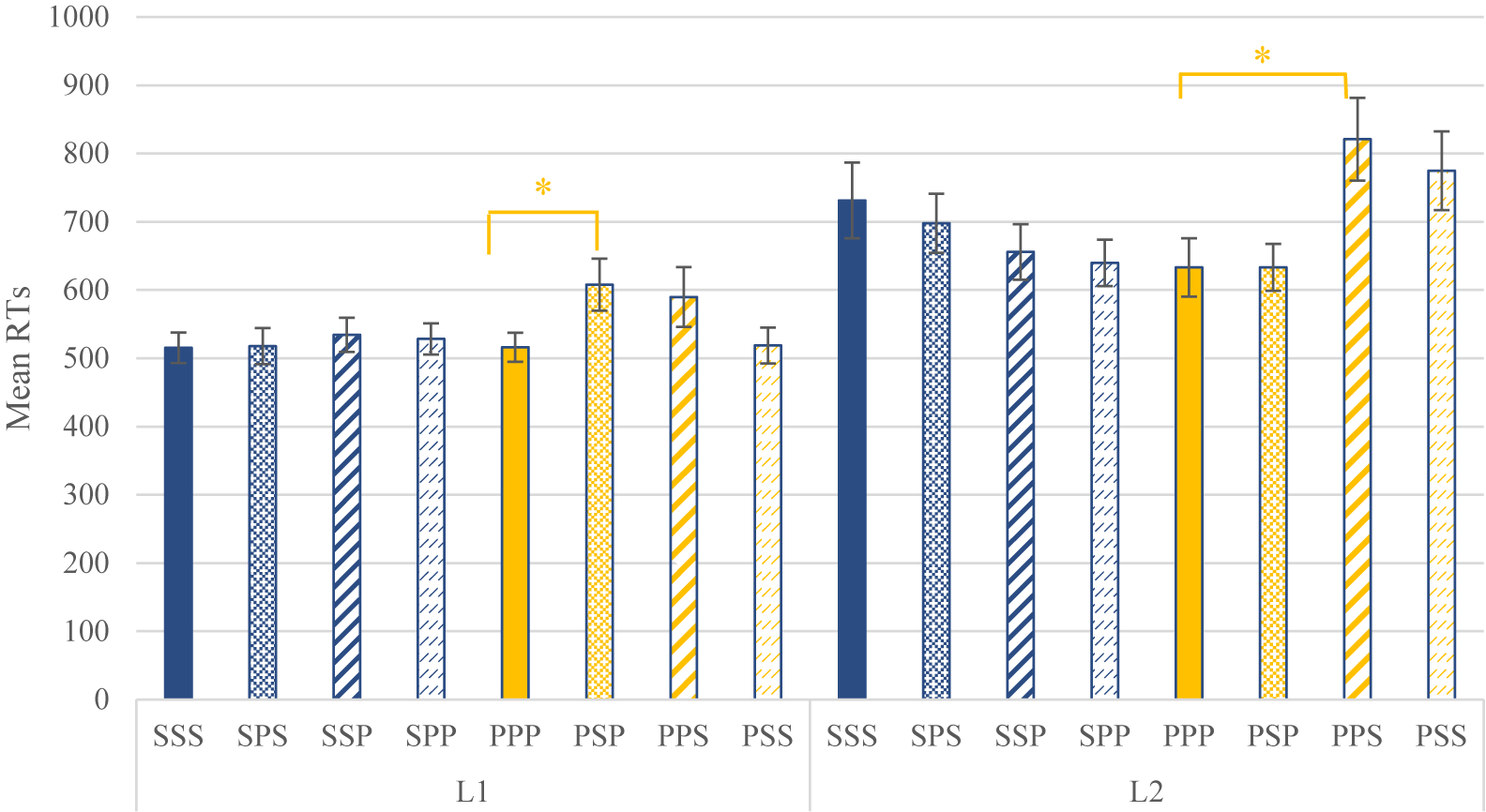
Critical region. Figure 1 shows the data for the critical region.
Mean RTs, with standard errors, for the critical region, by group and condition. “*” denotes significance at the alpha level .05 or smaller.

Figure 1. Long description
The vertical Y axis represents Mean R T s ranging from 0 to 1000 in increments of 100. The horizontal X axis is divided into two primary groups, L 1 on the left and L 2 on the right. Each group contains eight bars representing conditions S S S, S P S, S S P, S P P, P P P, P S P, P P S, and P S S.
In the L 1 group, Mean R T s are relatively stable between 500 and 600. A yellow bracket with an asterisk indicates a significant increase between P P P at approximately 515 and P S P at approximately 610.
In the L 2 group, Mean R T s are generally higher, ranging from 650 to over 800. A yellow bracket with an asterisk indicates a significant difference between P P P at approximately 630 and P P S, which reaches the highest peak in the graph at approximately 820.
Bars are styled with different patterns including solid blue, checkered blue, diagonal blue stripes, solid yellow, checkered yellow, and diagonal yellow stripes. Error bars representing standard error are present atop every bar.
In the critical region, there was a marginal interaction between group, head noun and feature match, β = 91.15, SE = 52.61, t = 1.89, p = .058. The model including an interaction of the three predictors explained the data better than the simpler models with an interaction of head noun and feature match, χ 2(8) = 17.29, p = .027, and group and feature match, χ 2(8) = 18.73, p = .016. We thus examined the L1 and L2 data separately.
The L1 data showed an interaction of plural-head and feature mismatch of N2, β = 37.27, SE = 19.69, t = 1.97, p = .049, and the model with the interaction of head noun and feature match explained the data marginally better than the simpler model with feature match, χ 2(4) = 8.64, p = .071. Thus, the data were examined separately for each head noun condition. The match (SSS and PPP) conditions were taken as the baseline in these analyses. For singular heads, there was no difference between the SSS and any of the mismatch conditions, β’s ≤ 12.81, SE’s ≤ 13.65, t’s ≤ .97, p’s ≥ .33. For plural heads, the PSP condition took longer to read than the PPP condition, β = 27.69, SE = 14.24, t = 2.00, p = .046; there were no significant differences between the PPP and other mismatch conditions, β’s ≤ 15.5, SE’s ≤ 14.10, t’s ≤ 1.12, p’s ≥ .264.
In the L2 data, there was a significant interaction between plural-head and feature mismatch of N3, β = 92.22, SE = 37.83, t = 2.64, p = .008. The models with the two predictors interacting explained the data better than each simple model with feature match or head noun as the predictor, χ 2’s(4/6) ≥ 10.82, p’s ≤ .034. The data were thus inspected for each head noun condition. For singular heads, there was no significant difference between the SSS and any of the mismatch conditions, β’s ≤ 26.47, SE’s ≤ 18.54, t’s ≤ 1.46, p’s ≥ .143. For plural heads, the PPS took longer to read than the PPP condition, β = 43.32, SE = 20.33, t = 2.22, p = .027; there was no difference between PPP and other mismatch conditions, β’s ≤ 17.31, SE’s ≤ 19.29, t’s ≤ .91, p’s ≥ .361.
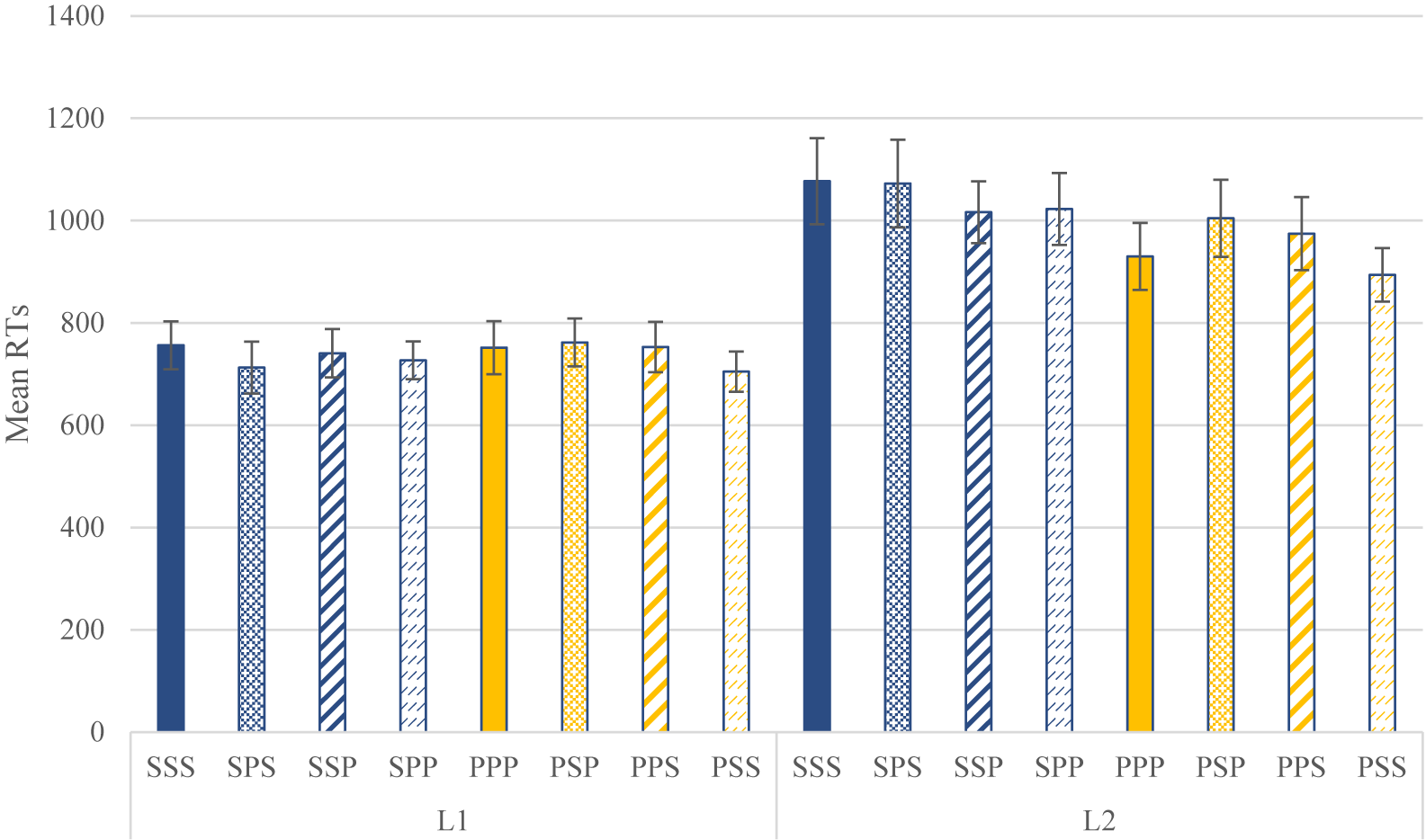
Spillover region. Figure 2 shows the data for the spillover region.
Mean RTs, with standard errors, for the spillover region, by group and condition.

Figure 2. Long description
The y-axis is labeled Mean R T s and ranges from 0 to 1400 in increments of 200. The x-axis is divided into two primary groups, L 1 on the left and L 2 on the right. Each group contains eight bars representing conditions S S S, S P S, S S P, S P P, P P P, P S P, P P S, and P S S. The bars use distinct patterns: solid blue, checkered blue, diagonal striped blue, vertical striped blue, solid yellow, checkered yellow, diagonal striped yellow, and vertical striped yellow.
* In the L 1 group, Mean R T s are relatively stable, hovering between 700 and 800. The highest value is in the P S P condition and the lowest is in the P S S condition.
* In the L 2 group, Mean R T s are significantly higher, ranging from approximately 900 to 1100. The S S S condition shows the highest mean, while the P S S condition shows the lowest.
* Each bar includes a vertical error bar representing standard error. The error bars in the L 2 group are generally larger than those in the L 1 group.
There was a main effect of group, where the L2ers were slower than L1ers, β = 148.76, SE = 65.84, t = 2.52, p = .013, but there was no interaction between any predictors, β’s ≤ 19.56, SE’s ≤ 21.83, t’s ≤ .88, p’s ≥ .378. Since the model with an interaction of group and head noun explained the data better than the simple model with only head noun or group as a predictor, χ 2(2) = 7.23, p = .027, each group’s data were analyzed separately. The L1 data showed no main effect or interaction between the predictors, β’s ≤ 14.29, SE’s ≤ 17.39, t’s ≤ 0.83, p’s ≥ .405. The L2 data showed a marginal effect of head noun where plural-head conditions were read faster than singular-head conditions, β = 29.02, SE = 15.82, t = 1.8, p = .073. There was no other main effect or interaction, β’s ≤ 24.97, SE’s ≤ 23.49, t’s ≤ 1.08, p’s ≥ .28.
2.2.5. Discussion
The results showed a syntactic distance effect for the L1ers and a linear distance effect for the L2ers in the plural-head singular-attractor conditions. The L2ers’ sensitivity to linear distance, as opposed to the L1ers’ sensitivity to syntactic distance, can either indicate that they underused syntactic information (Clahsen & Felser, Reference Clahsen and Felser2006, Reference Clahsen and Felser2018) or were influenced by recency and weighted the linear distance cue more heavily than the syntactic cue for the verb’s number feature (Cunnings, Reference Cunnings2017a). We will address these possibilities in detail in General Discussion.
The mismatch effects were observed only in plural head conditions, extending the observation of singular attraction in L1 comprehension (Deniz et al., Reference Deniz, Bakay and Kurt2023; Pearlmutter, Reference Pearlmutter2000) to L2. Pearlmutter argued, for his findings, that when there are multiple intervening nouns (between the verb and the subject head) whose number features must all be computed, the markedness of the plural head weakens. This increases its vulnerability to attraction. The production data will reveal if this is a true reversed mismatch asymmetry.
2.3. Experiment 2: Production
Previous research showed plural attraction in S-V agreement production (e.g., Bock & Miller, Reference Bock and Miller1991) but singular attraction for its comprehension (e.g., Pearlmutter, Reference Pearlmutter2000). The SPR experiment in this study confirmed singular attraction in comprehension for both groups. To examine if the usual plural attraction is observed in production, and if it can be extended to L2, Experiment 2 included a production task.
2.3.1. Materials
The experimental materials were the same as those in Experiment 1 except that the copula verb was replaced by a length-neutral underscore.
It was predicted that S-V agreement production would be the most accurate in the baseline (SSS, PPP) conditions. For the mismatch conditions, given the results of Experiment 1, it is reasonable to predict a syntactic distance (i.e., N2 mismatch) effect for the L1ers and a linear distance (N3 mismatch) effect for the L2ers, with the reservation that production and comprehension behavior can differ.
If the widely reported plural attraction for production in L1 extends to L2, the L2ers (and the L1ers) will make more errors in singular-head plural-distractor conditions.
The number of experimental, filler, practice, warm-up sentences and reading lists was the same as in Experiment 1.
2.3.2. Procedure
The participants were asked to read the sentences out loud as soon as they appeared on the screen (without preview) and complete those that had a missing component (e.g., the copula verb) as they read them. They moved to the next sentence with a key-press.
2.3.3. Data analysis
Data from two L2 participants were missing in Experiment 2. In some proportion of the sentences (L1: 1.12%; L2: 2.94%), the participants re-read the sentence and changed their insertions to a(n) (un)grammatical form of the verb. Sentence completions were thus categorized as first and revised reading, and the data were analyzed separately for each pass.
The data were analyzed with logistic regression mixed effects models using the glmer function in the lme4 package (Bates et al., Reference Bates, Maechler, Bolker and Walker2015). The fixed-effects structure was identical to that used in Experiment 1. Subject was included as a random effect; models that additionally specified items as random effects did not converge and resulted in singular fits and were not further considered. As the response variable was binary, the models were only inspected for influential data (Nieuwenhuis et al., Reference Nieuwenhuis, Grotenhuis and Pelzer2012). (See the Supplementary Analysis code for details.)
2.3.4. Results
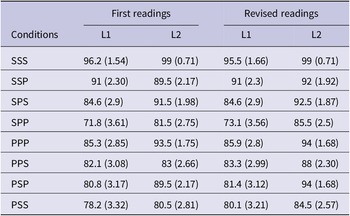
Accuracy in sentence completions was high in both singular-head (first reading: ML1 = 85.90%, ML2 = 90.38%; revised reading: ML1 = 86.06%, ML2 = 92.25%) and plural-head conditions (first reading: ML1 = 81.57%, ML2 = 86.63%; revised reading: ML1 = 82.69%, ML2 = 90.13%). The L1 group’s accuracy did not change after revisions, β = .06, SE = .12, z = .51, p = .609, while the L2 group’s accuracy improved, β = .33, SE = .12, z = 2.70, p = .007. Table 2 shows mean percent accuracy in both readings.
Mean percent accuracies and standard errors (in parentheses) of L1 and L2 speakers in the first and revised readings in the production task

Table 2. Long description
The table is organized into five columns. The first column lists eight conditions: S S S, S S P, S P S, S P P, P P P, P P S, P S P, and P S S. The remaining four columns are grouped under two main headers: First readings and Revised readings, each subdivided into L 1 and L 2 speaker groups. Data is presented as mean percent accuracy followed by standard error in parentheses.
* S S S: First readings L 1 96.2 1.54, L 2 99 0.71. Revised readings L 1 95.5 1.66, L 2 99 0.71.
* S S P: First readings L 1 91 2.30, L 2 89.5 2.17. Revised readings L 1 91 2.3, L 2 92 1.92.
* S P S: First readings L 1 84.6 2.9, L 2 91.5 1.98. Revised readings L 1 84.6 2.9, L 2 92.5 1.87.
* S P P: First readings L 1 71.8 3.61, L 2 81.5 2.75. Revised readings L 1 73.1 3.56, L 2 85.5 2.5.
* P P P: First readings L 1 85.3 2.85, L 2 93.5 1.75. Revised readings L 1 85.9 2.8, L 2 94 1.68.
* P P S: First readings L 1 82.1 3.08, L 2 83 2.66. Revised readings L 1 83.3 2.99, L 2 88 2.30.
* P S P: First readings L 1 80.8 3.17, L 2 89.5 2.17. Revised readings L 1 81.4 3.12, L 2 94 1.68.
* P S S: First readings L 1 78.2 3.32, L 2 80.5 2.81. Revised readings L 1 80.1 3.21, L 2 84.5 2.57.
The accuracy results for the first and revised readings were, in general, similar. We thus report the results for the first reading as they would better reflect initial analyses.
The model including an interaction of the three predictors showed a significant main effect for group, where the L2ers had better accuracy than L1ers, β = 1.14, SE = .47, z = 2.4, p = .016, OR = 3.13; a main effect of head noun, with higher accuracy for singular heads, β = 2.04, SE = .55, z = 3.67, p < .001; OR = 7.69, a marginally significant interaction between group and double mismatch, β = −.95, SE = .50, z = −1.88, p = .059; OR = .359, and an interaction between head noun and feature match, β = −2.48, SE = .63, z = −3.94, p < .001; OR = .73. This model also explained the data better than the simpler models with an interaction of group and head noun, χ 2(12) = 127.85, p < .001, and group and feature match, χ 2(8) = 39.95, p < .001. We thus examined the L1 and L2 data separately.
In the L1 data, there were significant interactions between head noun number and feature mismatch of N2, β = −1.76, SE = .70, z = −2.49, p = .013; OR = .17, and between head noun number and double mismatch, β = −2.21, SE = .69, z = −3.20, p = .001; OR = .11; there was a main effect of head noun number, with higher accuracy for singular heads, β = 1.69, SE = .61, z = 2.79, p = .005; OR = 5.42; and an effect of double mismatch, β = −.73, SE = .38, z = −1.93, p = .053; OR = .408. The models with the two predictors interacting explained the data better than each simple model with feature match or head noun as the predictor, χ 2’s(4) ≥ 26.98, p’s ≤ .001. The data were thus examined separately for singular- and plural-heads. For singular heads, SPS and SPP conditions had lower accuracy than the baseline SSS: SPS, β = −2.18, SE = .61, z = −3.57, p < .001; OR = .11; SPP, β = −3.06, SE = .61, z = −5.05, p < .001; OR = .05. There was no number mismatch effect for plural heads, β’s ≤ −.2, SE’s ≤ .39, z’s ≤ −0.53, p’s ≥ .102.
In the L2 data, there were significant interactions between head noun number and feature mismatch of N2, β = −1.66, SE = .85, z = −1.94, p = .052; OR = 0.19, and between head noun number and double mismatch, β = −1.67, SE = .82, z = −2.04, p = .041; OR = .19; there were main effects of head noun number, β = 1.62, SE = .77, z = 2.09, p = .036; OR = 5.05, feature mismatch of N3, β = −1.32, SE = .389 z = −3.39, p < .001; OR = .27, and double mismatch, β = −1.54, SE = .38, z = −4.02, p < .001, OR = .22, with higher accuracies in singular head and baseline conditions. The models with the two predictors interacting explained the data better than each simple model with feature match or head noun as the predictor, χ 2’s(4) ≥ 13.71, p’s ≤ .008. The data were split by head noun number. For singular head nouns, all the mismatch conditions had lower accuracy than the baseline, β’s ≤ −2.32, SE’s ≤ .77, z’s ≤ −3.02, p’s ≤ .002, OR ≤ .1. For plural heads, the PPS and PSS conditions had lower accuracy than the baseline: PPS, β = −1.32, SE = .38, z = −3.45, p < .001; OR = .27; PSS, β = −1.54, SE = .38, z = −4.06, p < .001; OR = .22.
2.3.5. Discussion
The production data showed, for singular head nouns, an effect of syntactic distance and double mismatch for the L1ers, whereas all mismatch conditions had lower accuracy for the L2ers. There was no effect of number mismatch for plural heads for the L1ers. The L2ers’ accuracy was lower for PPS and PSS, favoring a linear mismatch effect.
The results confirm plural attraction in production for L1ers, which was mainly triggered by syntactic distance. Although both singular and plural attractors affected S-V agreement for the L2ers, plural attractors did so in all mismatch conditions, but singular attraction was observed for NPs linearly closer to the verb. These results suggest that production is more effortful than comprehension in general and more so for L2ers. Although there is a tendency toward it, we cannot claim that reversed mismatch asymmetry truly holds for L2. (See General Discussion for further details.)
For the L1ers, the syntactic proximity of the intervening NPs to the head affected S-V agreement errors. (We assume that the effect observed in double mismatch conditions was triggered by that of NP2.) For the L2ers, syntactic effects appeared only in singular-head conditions. For plural heads, L2ers’ decisions were affected more by linear distance. (We assume that the effect observed in double mismatch conditions was triggered by that of NP3.) We entertain, in interim, that these differences can be attributable to the markedness and encoding of the head noun such that the more marked form’s encoding requires more cognitive resources, making linear distance effects more prevalent for plural-head conditions for the L2ers. When the head noun is singular, the L2ers behave similarly to the L1ers presumably because their cognitive resources are relatively less challenged in such conditions. The overall reduced accuracy in plural-head conditions also supports this observation.
2.4. Pen-and-paper questionnaire
The last experiment, a pen-and-paper questionnaire, was conducted to examine the L2ers’ knowledge of English S-V agreement rules. But the data were also analyzed to examine the L1 and L2ers’ off-line sensitivity to attraction in S-V agreement.
2.4.1. Materials
The materials were the same as in Experiment 2. The task was to choose the singular or plural form of the verb, given as options below the sentence, to complete the sentence.
The number of the experimental sentences and lists was the same as in previous experiments. There were 32 filler sentences including ambiguous constructions. There were no practice or warm-up sentences. Each list had 64 sentences.
2.4.2. Data analysis
Data from five L2 participants were missing in Experiment 3. The analyses were run on accuracy in sentence completions. The model building steps and fixed and random effects were the same as in previous experiments.
2.4.3. Results
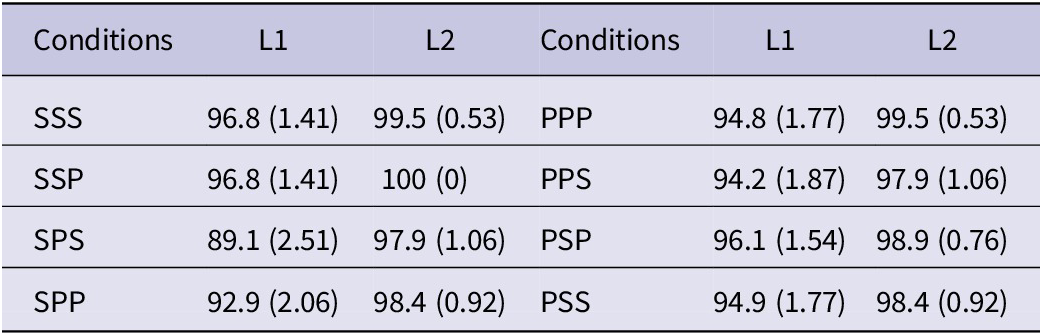
Accuracy was high for both groups (Moverall = 96.8%; singular head noun: ML1 = 93.9%, ML2 = 98.9%; plural head noun: ML1 = 95%, ML2 = 98.7%). Table 3 summarizes the data.
Means and standard errors (in parentheses) of L1 and L2 speakers’ accuracies in the pen-and-paper task

Table 3. Long description
The table is organized into two side-by-side sections, each containing columns for Conditions, L 1, and L 2. Values are presented as means followed by standard errors in parentheses.
Left Section:
* S S S: L 1 is 96.8 (1.41), L 2 is 99.5 (0.53).
* S S P: L 1 is 96.8 (1.41), L 2 is 100 (0).
* S P S: L 1 is 89.1 (2.51), L 2 is 97.9 (1.06).
* S P P: L 1 is 92.9 (2.06), L 2 is 98.4 (0.92).
Right Section:
* P P P: L 1 is 94.8 (1.77), L 2 is 99.5 (0.53).
* P P S: L 1 is 94.2 (1.87), L 2 is 97.9 (1.06).
* P S P: L 1 is 96.1 (1.54), L 2 is 98.9 (0.76).
* P S S: L 1 is 94.9 (1.77), L 2 is 98.4 (0.92).
The analyses showed that the L1ers had lower accuracy in the SPS condition than the baseline SSS, β = −2.14, SE = .74, z = −2.91, p = .003; OR = 0.12. There was no effect of number mismatch for any of the other comparisons for either group, β’s ≤ 1.42, SE’s ≤ 1.13, z’s ≤ 1.25, p’s ≥ .21.
2.4.4. Discussion
The L1 data showed syntactic distance effects, confirming the results in Experiments 1 and 2, and for only singular-head conditions, as in Experiment 2, confirming plural attraction in offline measures.
The high accuracy rates (≥98.8) by the L2ers show that they knew S-V agreement rules in English, confirming that the effects observed in Experiments 1 and 2 were genuine processing effects, comparable to those by the L1ers. Unlike the L1ers, the L2ers’ accuracy was not affected by the mismatching number features of the intervening nouns. This is likely because when there is no time pressure, highly proficient L2ers with substantial experience with their L2 are better able to control their L2 and resist interference from attractor nouns (Lee & Phillips, Reference Lee and Phillips2023). It has also been reported that language behavior in untimed L2 pen-and-paper tasks can be affected by prescriptive/declarative knowledge (Deniz, Reference Deniz2022).
3. General discussion
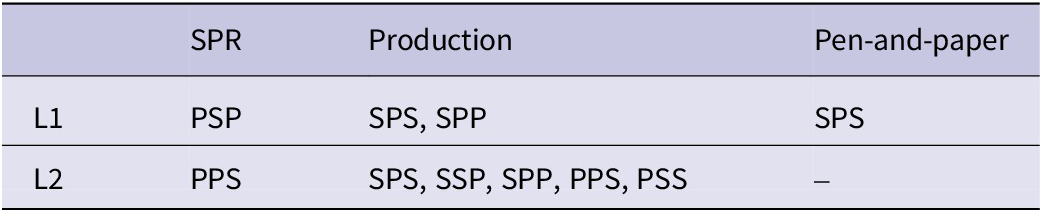
Table 4 summarizes the results.
The conditions showing agreement attraction in the SPR, production and pen-and-paper tasks for L1 and L2 speakers

Table 4. Long description
The table consists of four columns and three rows. The header row lists the tasks: S P R, Production, and Pen-and-paper.
Row 1 for L 1 speakers shows:
- S P R: P S P.
- Production: S P S and S P P.
- Pen-and-paper: S P S.
Row 2 for L 2 speakers shows:
- S P R: P P S.
- Production: S P S, S S P, S P P, P P S, and P S S.
- Pen-and-paper: indicated by two dashes.
The results showed, for the L1ers, singular attraction in the SPR experiment and plural attraction in the production and pen-and-paper tasks. Syntactic proximity was a determining factor in the L1ers’ processing and production behavior. The L2ers also showed singular attraction in the SPR task, but their decisions were affected by the attractor’s linear proximity to the verb. Although the production experiment showed both singular and plural attraction and both linear and syntactic proximity effects, plural attraction and linear proximity were more prominent. Following Tanner et al. (Reference Tanner, Nicol and Brehm2014a) and Deniz et al. (Reference Deniz, Bakay and Kurt2023), we argue that the data indicate different mechanisms for S-V agreement across the production and comprehension modalities, not only for L1 but also for L2. We also argue that L1 and L2ers differ in the sources of attraction and in their cue weighting/encoding in processing and producing S-V agreement.
Let us first examine the production and comprehension differences. It has been argued for L1 (Nicol et al., Reference Nicol, Forster and Veres1997; Tanner et al., Reference Tanner, Nicol and Brehm2014a) that agreement is computed through different mechanisms in production and comprehension. We tested if this was also true for L2ers, through (reversed) mismatch asymmetry which refers to the widely reported plural attraction in production (e.g., Bock & Miller, Reference Bock and Miller1991) to be reversed in comprehension and observed as singular attraction (Deniz et al., Reference Deniz, Bakay and Kurt2023; Pearlmutter, Reference Pearlmutter2000). Like L1ers, the L2ers in the present study showed singular attraction in comprehension. Although their production data showed number attraction for both singular- and plural-head conditions, attraction was evident in all mismatch conditions in singular-head conditions but was triggered by the linearly closer attractors in plural-head conditions. This can be interpreted as a tendency for plural attraction in production. Both the L1 and L2 data showed attraction in more conditions in production than comprehension.
Following Tanner et al. (Reference Tanner, Nicol and Brehm2014a), Nicol et al. (Reference Nicol, Forster and Veres1997) and Deniz et al. (Reference Deniz, Bakay and Kurt2023), we argue that in the L2, like L1, speakers employ different mechanisms for producing and comprehending S-V agreement. Tanner et al. maintain that S-V agreement comprehension can be explained through cue-based memory retrievals, but its production can be explained under the MM model (Eberhard et al., Reference Eberhard, Cutting and Bock2005). They argue that the mechanisms responsible for attraction in comprehension are subsets of those operative in production, and S-V agreement differences between comprehension and production are attributable to the differences between comprehension and production in general. That is, the intended message in production is known to the speaker in advance, including information about the number features of the NPs to be uttered. This results in “more avenues for interference in subject–verb agreement production than in subject–verb agreement comprehension” (Tanner et al., Reference Tanner, Nicol and Brehm2014a, p. 211). We synthesize Tanner et al.’s arguments with Gillespie and Pearlmutter’s (Reference Gillespie and Pearlmutter2011) who attribute agreement errors in production to advance planning and with Pearlmutter’s (Reference Pearlmutter2000) who attribute singular attraction in comprehension to cue strength.
Gillespie and Pearlmutter argue for production that “[i]f the scope of advance planning at a given level is large, multiple items are likely to be simultaneously available, which increases the chance of interference and certain speech errors (Garrett, Reference Garrett and Bower1975)” (p. 1615). That is, nouns planned overlappingly with the head noun are more likely to interfere with verb’s agreement marking. In the case of plural attraction in production (as opposed to singular attraction in comprehension), it is possible that planning for intervening NPs that have a marked [+plural] feature requires more cognitive resources due to enhanced memory encoding. Hence, their planning would be more likely to overlap with that of the head noun. This is also in line with MM’s predictions for plural attraction in production (Eberhard et al., Reference Eberhard, Cutting and Bock2005). It appears that the L1ers planned N1 and N2 together (N2 attraction in the L1 data), but the L2ers most likely planned all three NPs together since their data showed both N2 and N3 attraction. This would be supported by the L2ers’ high WM scores (ML2_WM = 43).
Comprehension, however, is incremental, “restricting the window of temporal co-activation of nouns” (Tanner et al., Reference Tanner, Nicol and Brehm2014a; p. 211). That is, the input is processed as it is received, with multiple levels of prediction for the upcoming items (e.g., Levy, Reference Levy2008). For singular attraction in comprehension, we concur with Pearlmutter (Reference Pearlmutter2000) and maintain that the plural feature of the head NP in existence of singular attractors weakens in a relatively long complex subject with two intervening NPs. Thus, although processing is incremental and speakers are subject to cue-retrievals from memory in their comprehension of S-V agreement, production involves planning for multiple units in advance. Thus, not only the type (singular vs. plural) but also the extent (number of conditions) of attraction is different for comprehension and production.
The increased proneness to error in production is presumably related to the computational burdens of planning and producing an utterance compared to comprehension (MacDonald, Reference MacDonald2013). Considering the reduced saliency of singular heads, it is likely that any distracting plural NP attracted the verb’s agreement. For plural heads though, the linearly closer singular NPs attracted the verb’s agreement in the L2 group. Given our participants’ high accuracy in the pen-and-paper task, we do not think that the source of L2ers’ increased proneness to error in S-V agreement is attributable to their knowledge of L2. They were highly advanced in their L2 and frequently used English daily (see Table 1). Their accuracy was also significantly higher than the L1ers. We thus think that they were like L1ers, even more vigorous, in their command of English S-V agreement rules. The increased likelihood of errors by the L2ers in production is more likely to be due to performance requirements such as limited attentional resources as some of the resources need to be allocated to controlling activation levels of their L1 and L2 (Green, Reference Green and Wei2000), retrieval of lexical elements from the relevant language (de Bot, Reference De Bot, Englund Dimitrova and Hyltenstam2000) and attending to competition between L1 and L2 items for selection (e.g., Poulisse & Bongaerts, Reference Poulisse and Bongaerts1994).
We now turn to the sources of attraction in the L1 and L2 processing of S-V agreement. The SPR data show a clear distinction for the L1 and L2ers. Although the L1ers were mainly affected by the attractor’s syntactic proximity to the subject head (attraction in the PSP condition), the L2ers were affected by its linear distance to the verb (attraction in the PPS condition). Both the L1 and L2ers were affected by the syntactic and linear proximity of the attractors in their production of S-V agreement, but the L2ers were influenced by linear proximity in more conditions than by syntactic proximity. These data suggest either that (i) the L2ers underused syntactic information as predicted by the SSH (Clahsen & Felser, Reference Clahsen and Felser2018) or (ii) they were more susceptible to interference in memory retrieval/gave heavier weight to linear proximity than syntactic information (Cunnings, Reference Cunnings2017a). We believe the latter approach explains the comprehension data better especially when the differences between comprehension and production modalities are taken into consideration. The cue-based memory retrieval approach to L2 processing does not predict L2ers to underuse syntactic information, but it predicts differential weightings of cues in the L1 and L2 due to increased susceptibility to interference in memory retrievals in the L2 (Cunnings, Reference Cunnings2017a). Cunnings (Reference Cunnings2017a) argues for linearity effects in L2 agreement that “slower reading speed in the L2 may lead to enhanced effects of activation-based decay, which could lead to delayed or less robust retrieval of target items, and thus less robust violation effects as dependency length increases” (p. 667). This would be supported by Kaan et al.’s (Reference Kaan, Ballantyne and Wijnen2015) data which showed similar parsing patterns for L1 and L2ers when they were matched in reading speed. Following Kaan et al., we calculated each participant’s average reading speed across all nonfinal words in correctly-answered filler items (about 513 data points per participant). Our L2ers’ RTs (ML2_RT = 721.54) were overall slower than those of the L1ers (M L1_RT = 551.29), t = 3.81, p < .001, in line with Cunnings’ arguments for increased susceptibility to interference and enhanced activation-based decay. It is also possible that the L2 group weighted the linear proximity cue more heavily than the syntactic cue to agreement.
Grüter et al. (Reference Grüter, Lau and Ling2020) argue that language learners are optimally adaptive and L2 processing, in general, is more effortful (Sorace, Reference Sorace2011). If linear proximity was taken to be less effortful and more effective for agreement dependency in the L2, that cue could have been weighted more heavily than the syntactic cue. This would be in line with Deniz’s (Reference Deniz2022) argument that differential cue-weighing in the L2 may be due to L2 sentence processing being less modular than L1 sentence processing especially when the L2 is acquired after certain cognitive developments have taken place (which is the case with our participants).
Note that our results contradict with Lago and Felser’s (Reference Lago and Felser2018) findings on number agreement but are in line with other research on number/gender agreement that showed effects of linearity in the L2 (Foote, Reference Foote2011; Keating, Reference Keating2009). Thus, although our findings concur with the growing body of L2 research showing differential cue weighting/retrieval interference in the L2 (e.g., Deniz, Reference Deniz2022; Grüter et al., Reference Grüter, Lau and Ling2020; Serin Demirler & Deniz, Reference Serin Demirler and Deniz2019; Tanner et al., Reference Tanner, Inoue and Osterhout2014b), this conclusion has the reservation that more work is needed for conclusive remarks.
The language pairing in the present study also informs on L1 effects in L2 processing. Recall that Turkish does not overtly distinguish between third-person singular and plural marking on the verb, but its inflectional morphology is otherwise rich. The Turkish participants were sensitive to S-V agreement in English, suggesting that the lack of overt S-V agreement for the given context did not hinder their sensitivity to S-V agreement in English. This was, perhaps, due to the otherwise rich inflectional system in Turkish. Our data cannot speak to whether this was due to feature unification from their L1 or to their ability to feature-copy in the L2. Future work can investigate that in a design that better controls for factors contributing to these processes.
It is also noteworthy that the L2ers were more accurate in their second responses compared to their first responses in the production task. This was not the case for the L1ers. This suggests that L2ers monitor their production more than L1ers, and despite their advanced proficiency, their language acquisition has not ceased.
Finally, for comprehension, the cue-based retrieval model (Lewis & Vasishth, Reference Lewis and Vasishth2005) does not always predict attraction in grammatical sentences (Wagers et al., Reference Wagers, Lau and Phillips2009). But our data, for both groups, showed attraction effects in S-V agreement in grammatical sentences, which is in line with a large body of work (e.g., Franck et al., Reference Franck, Colonna and Rizzi2015, Hammerly et al., Reference Hammerly, Staub and Dillon2019; Pearlmutter, Reference Pearlmutter2000). This would be predicted in the cue-based memory retrieval account (Lewis & Vasishth, Reference Lewis and Vasishth2005) if mis-retrievals of feature-matching attractors are assumed (Jäger et al., Reference Jäger, Engelmann and Vasishth2015).
Replication package
The analysis codes, reports with model outputs and study materials, are available at https://osf.io/2e9az/overview?view_only=419ab0715b2f444aaca7819fb0beea2f.
Supplementary material
The supplementary material for this article can be found at http://doi.org/10.1017/S1366728926101497.
Acknowledgments
We would like to thank Didem Kurt for her help with annotations on the production data. This work was supported by Boğaziçi University Scientific Research Projects Grant [#13781] to the first author. Partial financial support was received from the City University of New York, Graduate Center, Student Research fund.
Competing interests
The authors declare none.
Data availability statement
Because the study’s IRB approval and the informed consent forms at the time of data collection ensured the participants that the data would be accessible only to the research team, the data are not provided.



 Open access

