


Introduction
Loneliness has been defined as an unpleasant or distressing experience resulting from a perceived qualitative or quantitative deficiency in one's social relationships (Russell et al., Reference Russell, Peplau and Cutrona1980; Peplau and Perlman, Reference Peplau and Perlman1982). As such, loneliness can be emotional or social. Emotional loneliness is derived from a perception of inadequate intimacy in relationships, whereas social loneliness is due to deficits in the quantity of social relationships (Hawkley and Cacioppo, Reference Hawkley and Cacioppo2010).
Transient experiences of loneliness are believed to be adaptive in that they provide motivation to form and maintain social connections in order to promote the survival of genes (Cacioppo et al., Reference Cacioppo, Hawkley, Ernst, Burleson, Berntson, Nouriani and Spiegel2006; Cacioppo and Hawkley, Reference Cacioppo and Hawkley2009; Hawkley and Cacioppo, Reference Hawkley and Cacioppo2010). However, sustained loneliness has been repeatedly linked to many negative psychological and physiological health outcomes across age groups. These outcomes include anxiety and depression (Barg et al., Reference Barg, Huss-Ashmore, Wittink, Murray, Bogner and Gallo2006; Cacioppo et al., Reference Cacioppo, Hawkley and Thisted2010; Age UK South Lakeland, 2018; Lee et al., Reference Lee, Pearce, Ajnakina, Johnson, Lewis, Mann, Pitman, Solmi, Sommerlad, Steptoe, Tymoszuk and Lewis2021), suicidality (Stravynski and Boyer, Reference Stravynski and Boyer2001; Van Orden et al., Reference Van Orden, Witte, Cukrowicz, Braithwaite, Selby and Joiner2010), maladaptive stress responses (Steptoe et al., Reference Steptoe, Owen, Kunz-Ebrecht and Brydon2004; Adam et al., Reference Adam, Hawkley, Kudielka and Cacioppo2006), cognitive decline and Alzheimer's disease (Wilson et al., Reference Wilson, Krueger, Arnold, Schneider, Kelly, Barnes, Tang and Bennett2007; Boss et al., Reference Boss, Kang and Branson2015; Donovan et al., Reference Donovan, Wu, Rentz, Sperling, Marshall and Glymour2017), cardiovascular disease (Momtaz et al., Reference Momtaz, Hamid, Yusoff, Ibrahim, Chai, Yahaya and Abdullah2012; Valtorta et al., Reference Valtorta, Kanaan, Gilbody, Ronzi and Hanratty2016, Reference Valtorta, Kanaan, Gilbody and Hanratty2018), malnutrition (Ramic et al., Reference Ramic, Pranjic, Batic-Mujanovic, Karic, Alibasic and Alic2011), sleep quality (Yu et al., Reference Yu, Steptoe, Niu, Ku and Chen2018), functional decline (Perissinotto et al., Reference Perissinotto, Stijacic Cenzer and Covinsky2012) as well as increased risk of mortality (Holt-Lunstad et al., Reference Holt-Lunstad, Smith and Layton2010, Reference Holt-Lunstad, Smith, Baker, Harris and Stephenson2015).
These negative impacts have associated economic costs. The cost of loneliness to employers in the United Kingdom (UK) has been estimated as being £2.5 billion due to increased staff turnover, reduced productivity, the impact of caring responsibilities and sickness absence related to ill health (New Economics Foundation and Co-op, 2017). The monetised impact of severe loneliness has been estimated as £9,900 per person due to its impact on wellbeing, health and productivity (Peytrignet et al., Reference Peytrignet, Garforth-Bles and Way2020).
Further, loneliness is becoming increasingly prevalent in later life with in excess of 1 million UK residents over the age of 50 reporting that they are chronically lonely (Abrahams, Reference Abrahams2018). This figure is expected to increase to 2 million by 2025 (Abrahams, Reference Abrahams2018). Importantly, as the worldwide population is ageing (United Nations Department of Economic and Social Affairs, Population Division, 2019), the negative health correlates of loneliness are linked to increased strain on the National Health Service in the UK. For example, loneliness in older adults was consistently and positively associated with the number of general practitioner visits in both cross-sectional and longitudinal analyses as well as with Emergency Department visits for women (Burns et al., Reference Burns, Leavey, Ward and O'Sullivan2020).
Due to the multiple negative impacts demonstrated above, the UK government has implemented, or is planning to implement, several initiatives with the goal of reducing loneliness in this age group. This includes strengthening their ‘Tackling Loneliness’ charity network, the awarding of £31.3 million of funding to charities supporting people who experience loneliness and the announcement of an additional £7.5 million to tackle loneliness during winter (Department for Digital, Culture, Media & Sport, 2021).
Clearly loneliness has a negative impact on both individuals and society as a whole. Therefore, it is important to fully understand contributors to this experience in order to reduce its deleterious impact.
Friendships in later life
At its core, loneliness relates to a perceived lack of meaningful social connections and interactions (Reichmann, Reference Reichmann1959; Townsend, Reference Townsend, Shanas, Townsend, Wedderburn, Frus, Milhaj and Stehouwer1968; Cacioppo and Patrick, Reference Cacioppo and Patrick2008). Friendships are a type of social connection which appear to be particularly important to older adults, with evidence indicating that people in this age group are more satisfied with their friendships than their younger counterparts (Nicolaisen and Thorsen, Reference Nicolaisen and Thorsen2017). Additionally, research has shown that a preference for emotionally close social partners increases with age (Carstensen, Reference Carstensen1992).
Socio-emotional selectivity theory (Carstensen et al., Reference Carstensen, Isaacowitz and Charles1999) provides a framework for this observation. This theory posits that the perception of time causes individuals to prioritise particular social goals which are in competition with one another. Younger individuals who perceive time to be expansive focus on the pursuit of future-oriented knowledge-based goals. In contrast, those who perceive time as limited, such as older adults, become more focused on present-oriented goals. These present-focused goals include the aim of emotional satisfaction. As such, selectivity of social partners in this age group is increased with a preference for high-quality relationships emerging. Older adults are thought to construct their social world to match these social goals. This leads to a reduction in social network size beginning in early adulthood and results in a network which excludes novel social partners and maintains those that are already emotionally close (English and Carstensen, Reference English and Carstensen2014). Thus, highlighting the notion that existing close friendships become more important with age.
Friendships and loneliness in older adults
Studies have repeatedly shown that in older adults, friendships are a greater determinant of loneliness than relationships with family members (e.g. Shiovitz-Ezra and Leitsch, Reference Shiovitz-Ezra and Leitsch2010). For example, it has been shown that interactions with friends reduce loneliness to a greater extent than interactions with close relatives, including children, grandchildren and neighbours (Lee and Ishii-Kuntz, Reference Lee and Ishii-Kuntz1987; Mullins et al., Reference Mullins, Johnson and Andersson1987; Pinquart and Sörensen, Reference Pinquart and Sörensen2001; Steed et al., Reference Steed, Boldy, Grenade and Iredell2007). Having close friends who reside in close proximity is more important than having relatives that do (Eshbaugh, Reference Eshbaugh2009) and those with networks composed mainly of kin appear to be more vulnerable to loneliness and negative psychological wellbeing (Silverstein et al., Reference Silverstein, Chen and Heller1996). Additionally, 50 per cent of those who report having no friends also report feeling lonely (Holmén et al., Reference Holmén, Ericsson, Andersson and Winblad1992), suggesting that social connections which are not friendships, such as kinship, may be less important in terms of loneliness in some cases.
As pointed out by Pinquart and Sörensen (Reference Pinquart and Sörensen2001), an explanation for a stronger association between friendships and loneliness in comparison to familial relationships and loneliness may lie in the quality of those relationships. Friendships tend to be of higher quality than familial relationships, as the latter are more likely based on obligation and may also involve care-giving responsibilities (Bengtson et al., Reference Bengtson, Cutler, Mangen, Marshall, Binstock and Shanas1985). Given the importance of shared experiences, interests, attitudes and lifestyle for friendships, these relationships may offer more insight into understanding loneliness than family relationships (Rawlins, Reference Rawlins, Coupland and Nussbaum1995).
Further evidence for the importance of friendships in relation to loneliness has been demonstrated. For example, Eshbaugh (Reference Eshbaugh2009) found that in older women living alone, having close friends who reside within 50 miles was a significant negative predictor of loneliness. A similar finding was evident in work by Mullins and Dugan (Reference Mullins and Dugan1990) in older adults living in independent living facilities. Further, a lack of friends was reported as a reason for feeling lonely in Finnish older adults (Savikko et al., Reference Savikko, Routasalo, Tilvis, Strandberg and Pitkälä2005). Additionally, frequency of contact with friends has been evidenced as having a negative relationship with loneliness in older adults across marital statuses (Pinquart, Reference Pinquart2003).
Quantity of friends and loneliness
As outlined above, friendships are clearly important in terms of reducing loneliness. In this context, it is important to note that research has consistently demonstrated that the quantity of friends has a negative association with loneliness. This has been found in adolescents (Lodder et al., Reference Lodder, Scholte, Goossens and Verhagen2017), children (Nangle et al., Reference Nangle, Erdley, Newman, Mason and Carpenter2003), sophomore high school students (Russell et al., Reference Russell, Cutrona, McRae and Gomez2012) and older adults (Shiovitz-Ezra and Leitsch, Reference Shiovitz-Ezra and Leitsch2010). The association between this objective parameter and subjective loneliness has repeatedly been found despite the consensus being that loneliness is a subjective experience. Despite this association, there has been limited investigation of the ways in which the number of friends contributes to this. One notable exception is research exploring the discrepancy between an individual's ideal and actual number of friends (Russell et al., Reference Russell, Cutrona, McRae and Gomez2012) which finds a curvilinear relationship between this discrepancy and loneliness in college students. Here, loneliness decreases as the number of actual friendships rises towards the number of ideal friendships. Once the ideal number of friendships is passed, loneliness begins to increase again. The authors explain this non-linear relationship in relation to the cognitive-discrepancy model of loneliness (Thibaut and Kelley, Reference Thibaut and Kelley2017). Here, a loss or gain of a friend when the number of friendships is close to an individual's ideal number may be especially important for determining loneliness. However, a loss or gain may be less important when the number is far above or below this ideal number.
Studies, apart from that of Russell et al. (Reference Russell, Cutrona, McRae and Gomez2012), have overlooked the possibility that the relationship between the quantity of friends and loneliness may be curvilinear. The presence of a non-linear relationship may be indicative of a limit to the effect of increasing friends on loneliness. Work by Brummett et al. (Reference Brummett, Barefoot, Siegler, Clapp-Channing, Lytle, Bosworth, Williams and Mark2001) suggests that the link between the number of social contacts and risk of mortality in coronary patients is non-linear. Here, the mortality rate was highest in those with three or fewer social contacts. When four social contacts were present, the risk was reduced by more than half and remained at a similar level with further additions of social contacts. It is possible that a similar relationship may be present between the number of friends and loneliness, given the previously established links between loneliness and coronary heart disease (Valtorta et al., Reference Valtorta, Kanaan, Gilbody, Ronzi and Hanratty2016). The presence of a limit makes theoretical sense as it has previously been established that there is a constraint on the number of emotionally close relationships an individual can maintain within their social network, with an increase in emotional closeness linked to a reduction in network size (Roberts et al., Reference Roberts, Dunbar, Pollet and Kuppens2009). Additionally, studies have shown that intimacy in friendships differentiates between those who are lonely and those who are not (Williams and Solano, Reference Williams and Solano1983; Hamid, Reference Hamid1989; Drageset et al., Reference Drageset, Kirkevold and Espehaug2011), although not in all cases (Mullins and Mushel, Reference Mullins and Mushel1992). It is therefore plausible that, as more friends are added to a person's network, the emotional closeness within the network is decreased, which in turn impacts on how lonely the individual feels; thus, creating a natural limit. It is also possible that individuals experiencing loneliness may surround themselves with acquaintances as a coping strategy which could suggest a curved association between number of friends and loneliness.
As mentioned above, there are a variety of negative psychological outcomes associated with loneliness. Similarly to loneliness, previous research has shown that friendships have been linked to improved mental health. Quantity of friends is related to reduced levels of depression in older adults (Potts, Reference Potts1997). Friendship support has been linked to better affect balance in the same age group (Montpetit et al., Reference Montpetit, Nelson and Tiberio2017). Subjective isolation from friends is linked to a greater increase in both depression and psychological distress than subjective isolation from family (Taylor et al., Reference Taylor, Taylor, Nguyen and Chatters2018). An increase in the number of friends is linked to a reduction in stress (van der Horst and Coffé, Reference van der Horst and Coffé2012). Older adult friendships are linked to better psychological wellbeing in comparison to family relationships (Nussbaum, Reference Nussbaum, Hummert, Wiemann and Nussbaum1994). Similarly, friendship networks have been shown to have a stronger relationship with psychological wellbeing than kin-based networks (Cable et al., Reference Cable, Bartley, Chandola and Sacker2013). Finally, a lower number of social relationships has been linked to the maintenance of low negative affect and high negative affect (Huxhold et al., Reference Huxhold, Fiori, Webster and Antonucci2020).
Of note, friendship closeness has also been associated with reduced levels of depression in both older adults (Bishop, Reference Bishop2008) and adults (Taylor et al., Reference Taylor, Chae, Lincoln and Chatters2015). As outlined previously, increasing a person's number of friendships may reduce levels of this closeness within their social network. This reduction in closeness to network contacts may in turn lessen the impact of the number of friends on depression creating a natural limit. However, as with loneliness, there has been little exploration of whether the number of friends relates to psychological health outcomes and there has been no exploration of what an optimal number of friends may be in terms of these outcomes in this age group.
Quantity versus quality
It is important to note here that quality of friendships has often been indicated as being important in terms of loneliness. Higher-quality friendships are related to lower levels of loneliness. This association has been found in the oldest old (Long and Martin, Reference Long and Martin2000), during adolescence (Lodder et al., Reference Lodder, Scholte, Goossens and Verhagen2017) and in children (Parker and Asher, Reference Parker and Asher1993). This relationship has also been found for social relationships more generally in older adults; with higher-quality social relationships predicting lower levels of loneliness (Pinquart and Sörensen, Reference Pinquart and Sörensen2001).
Quality within friendships is therefore clearly important with regards to loneliness. As it is known that relationship closeness is correlated with relationship quality (e.g. Crespo et al., Reference Crespo, Davide, Costa and Fletcher2008), we argue that it is more appropriate to focus on the ways in which close and, therefore, high-quality friendships impact loneliness rather than more peripheral, low-quality friendships. This allows the exploration of the impact of these arguably more important friendships in relation to loneliness in older adults. Further, this encompasses both the theoretical quantitative social and qualitative emotional aspects of loneliness as highlighted above.
The present study
As illustrated, a closer inspection of the relationship between number of close friends and loneliness and its psychological health correlates is warranted. To this end, the present study aimed to extend previous findings in the following key ways. First, the study aimed to determine the relationship between the number of close friends and loneliness along with three of its associated psychological health outcomes: depression, anxiety and stress. Crucially, the existence of a non-linear relationship was explored. A further aim was to determine the optimal number of close friends for each of these parameters. As outlined above, a negative relationship between number of close friends and loneliness and each of the associated psychological wellbeing measures has previously been established. Here, we expected to replicate those findings. However, no hypothesis was made in relation to a potential curvilinear relationship. Instead, we posed the research question:
(1) Is there a curvilinear relationship between number of close friends and loneliness in older adults?
As the second aim was exploratory, no hypothesis was made in this regard either. Again, a research question was posed:
(2) What is the optimal number of close friends in terms of loneliness in this age group?
Method
Design
The present study was an exploratory, cross-sectional and correlational investigation into the relationship between number of close friends and loneliness, depression, anxiety and stress in older adults.
Participants
A target sample size of 400 was pre-registered, which was primarily determined by cost. Due to time constraints, this number fell somewhat short of the target. However, this number is still sufficient to perform the analysis (one predictor per 25 cases, Harrell, Reference Harrell2015; also Schmidt, Reference Schmidt1971; Roscoe, Reference Roscoe1975; Tabachnik and Fidell, Reference Tabachnik and Fidell2009; Austin and Steyerberg, Reference Austin and Steyerberg2015). A total of 350 UK residents aged 65 or over responded to an online questionnaire. This was advertised via the recruitment platform Prolific (Palan and Schitter, Reference Palan and Schitter2018), Facebook adverts and via word of mouth. The Facebook and Prolific adverts were targeted specifically to UK residents aged 65 plus. Those who completed the questionnaire via Prolific were paid £2 upon completion. To be eligible to take part in the study, participants were required to not have had a current clinical diagnosis of depression or anxiety. The initial sample consisted of 350 respondents (138 male, 211 female and one participant did not specify).
Measures
Key dependent variables
Loneliness. There were four dependent variables examined in this study. The first was loneliness as measured by the University of California, Los Angeles, Loneliness Scale version 3 (UCLA-3; Russell, Reference Russell1996). The UCLA-3 is a 20-item self-report scale designed to measure an individual's subjective feelings of loneliness. Participants are asked how often each statement is descriptive of them (e.g. How often do you feel that you lack companionship?). Items are on a scale ranging from 1 (never) to 4 (often) and nine items are reverse scored. All items are summed to give one loneliness score; a higher score represents greater levels of loneliness. Version 3 of this scale has demonstrated good internal reliability (Cronbach's α = 0.96) (e.g. Russell, Reference Russell1996), with the reliability for the present study being 0.94, and has demonstrated a uni-dimensional factor structure (Russell, Reference Russell1996).
Psychological wellbeing. The three psychological wellbeing measures were all assessed via the short version of the Depression Anxiety Stress Scales (DASS-21; Lovibond and Lovibond, Reference Lovibond and Lovibond1995). The DASS-21 consists of 21 items and consists of three seven-item subscales measuring depression, anxiety and stress separately. Participants are asked how much each statement has applied to them over the past week (e.g. I found it hard to wind down). Items are on a scale ranging from 0 (never) to 3 (almost always). Items are summed for each scale separately and multiplied by two to allow comparison to the original 42-item DASS. No items are reverse scored. A higher score in a subscale represents a greater level of that particular psychological state. The separate depression, anxiety and stress scales have all repeatedly demonstrated good internal reliability (all Cronbach's α > 0.80) (e.g. Osman et al., Reference Osman, Wong, Bagge, Freedenthal, Gutierrez and Lozano2012). Reliability for the present study is as follows: anxiety (Cronbach's α = 0.80), stress (Cronbach's α = 0.88) and depression (Cronbach's α = 0.90). The DASS-21 has repeatedly demonstrated a three-factor structure representing the three separate scales (e.g. Crawford and Henry, Reference Crawford and Henry2003; Norton, Reference Norton2007; Sinclair et al., Reference Sinclair, Siefert, Slavin-Mulford, Stein, Renna and Blais2012; Scholten et al., Reference Scholten, Velten, Bieda, Chi Zhang and Margraf2017). Table 1 contains the descriptive statistics for each of the dependent variables.
Sample characteristics

Notes: N = 335. SD: standard deviation. GCSE: General Certificate of Secondary Education.
Key independent variable
The main independent variable of interest was the number of friends participants reported having. This variable was elicited by asking participants to ‘Please indicate how many close friends you currently have’. The question eliciting the number of close friends was modelled after Russell et al. (Reference Russell, Cutrona, McRae and Gomez2012). However, instead of asking participants to indicate this number on a seven-point Likert scale ranging from ‘none’ to ‘11+’, we asked participants to provide the actual number, as the number of friends is better operationalised as a count variable. The definition of a close friend was left to the interpretation of the participant based on previous findings that friendships are not easily defined in older adults (Adams et al., Reference Adams, Blieszner and DeVries2000).
Covariates
Four demographic covariates were included in this study as they have previously been linked to one or more of the dependent variables. Age was included as a continuous variable. Gender was included as a categorical variable with female being the reference category. Marital status was included as a categorical variable with response options being ‘In a relationship’, ‘Married/registered civil partnership’, ‘Separated but still married or in a registered civil partnership’, ‘Divorced’ and ‘Widowed’. The reference category for this variable was ‘Single, never married or in a civil partnership’. Highest attained level of education was also included as a categorical variable with response options being ‘Some secondary school’, ‘GCSE (General Certificate of Secondary Education) or equivalent’, ‘A-level or equivalent’, ‘Undergraduate degree’ and ‘Postgraduate degree’. The reference category for this variable was ‘Primary school’.
Other measures were collected as part of a separate study but are not reported on here (the ideal number of friends, the Satisfaction With Life Scale (Diener et al., Reference Diener, Emmons and Larsen1985), as well as three other measures of loneliness – the short De Jong Gierveld Scale (de Jong-Gierveld and van Tilburg, Reference de Jong-Gierveld and van Tilburg1999), the short Social and Emotional Loneliness Scale for Adults (DiTommaso et al., Reference DiTommaso, Brannen and Best2004) and a direct measure of loneliness). For a study containing this information, see https://osf.io/5f2ph/?view_only=6617265f58804de9b0145806375bb6a6.
Procedure
Ethical approval was granted by the local ethics committee. Data were collected between May and July 2019. Once informed consent was obtained, participants completed all measures via an online questionnaire hosted by Qualtrics (see https://www.qualtrics.com). The demographic measures were completed first followed by each of the scales. The order these were presented in was randomised. The questions relating to the number of ideal and actual friends were completed last. The whole questionnaire took no longer than 20 minutes to complete.
Analytical approach
All analyses were performed using R version 3.6.1 (R Core Team, 2017). Observations which contained missing data for the independent variable and dependent variables were removed (13 cases), as were two outliers where the number of friends was listed as 105 (30 standard deviations (SD) away from mean) and age as 66,123 years. Finally, due to the presence of extreme values and asymmetry (skewness = −1.37), the data were winsorised to 3 SD for the number of friends (12 friends) variable (12 cases). This resulted in a final sample of 335 participants; 290 of whom were recruited via Prolific and 45 via social media.
The data met the assumptions of non-multicollinearity, homoscedasticity and non-autocorrelation. The loneliness data met the assumption of normally distributed residuals. The three DASS variables all exhibited some skew in the distribution of residuals. However, this is to be expected given that most respondents were not currently experiencing high levels of depression, anxiety or stress. However, regression is relatively robust, therefore we used this technique (Berry, Reference Berry1993) and we further assessed the robustness of these models with other techniques (e.g. segmented regression).
Prior to performing regression analyses, some demographic factor levels were grouped to result in a more equal N per cell. For marital status, single and undisclosed were combined into one level. As were separated and divorced. For education, primary and secondary school were combined. Based on a visual inspection of the data and a plot of residuals, the fit of polynomial regression models was assessed for all dependent variables. It was found that a quadratic model had the best fit to the data in each case. This was based on the model with a statistically significant reduction in residual sum of squares as indicated by a chi-squared difference test. A Davies Test was then employed to test for a non-constant regression parameter in the predictor. This was followed by segmented regression via the segmented package (Muggeo, Reference Muggeo2008) and multivariate adaptive regression spline analysis (‘mars’) via the earth package (Milborrow et al., Reference Milborrow, Hastie and Tibshirani2011) to determine and confirm a breakpoint in the data. The segmented package utilises an algorithm which determines the breakpoint iteratively. Similarly, the earth package uses an algorithmic approach to examine breakpoints in the data. We also performed additional analyses including robustness checks (see https://osf.io/5f2ph/?view_only=6617265f58804de9b0145806375bb6a6).
Results
Sample characteristics
Sample characteristics and descriptive statistics are presented in Table 1. In the final sample, 60 per cent of participants were female and 40 per cent were male. The mean age of participants was 69 years (SD = 4.29). Most participants reported being married or in a civil partnership (62%) and 35 per cent reported having completed an undergraduate degree. The average number of close friends reported was four. All were residents of the UK.
Main analysis
Correlations
The bivariate correlations are presented in Table 2. Number of friends was significantly negatively associated with each of the dependent variables. Loneliness was significantly positively associated with each of the psychological wellbeing variables.
Zero-order correlations for study variables
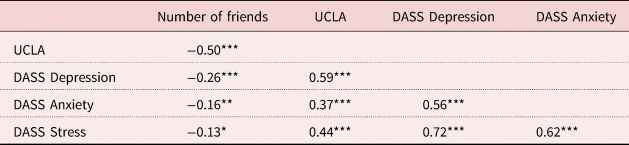
Notes: N = 335. UCLA: University of California, Los Angeles, Loneliness Scale. DASS: Depression Anxiety Stress Scales.
Significance levels: * p < 0.05, ** p < 0.01, *** p < 0.001.
Regressions
Hierarchical ordinary least squares regression analysis with the inclusion of a quadratic term was performed for each of the outcome measures to test for a curvilinear relationship.
Loneliness. After adjusting for all demographic information, the final model was significant (F(12,322) = 15.09, p < 0.001). In this model, both the linear term for number of close friends (B = −4.78, p < 0.001) and the quadratic term (B = 0.27, p < 0.001) remained significant. As quadratic relationships are difficult to interpret from coefficients alone, see Figure 1.
Loneliness as a function of the number of close friendships.
Notes: Curvilinear fit with 95 per cent confidence intervals. Breakpoint is determined by segmented regression.

Of the demographic covariates, only being married or in a civil partnership, in comparison to being single, was a significant predictor of loneliness (B = −6.29, p = 0.006). Those with this particular marital status reported less loneliness than those who were single. This final model explained 34 per cent of the variance in loneliness scores (Table 3).
Hierarchical ordinary least squares regression analysis to predict loneliness

Notes: N = 335. Standard errors are in parentheses. Ref.: reference category. GCSE: General Certificate of Secondary Education. df: degrees of freedom.
Significance levels: † p < 0.1, * p < 0.05, ** p < 0.01, *** p < 0.001.
As suggested by the plot, there appears to be a point at which the effect of the number of close friends on loneliness is greatly reduced. A Davies Test indicated that there was a significant difference between the slopes when segmenting the regression line at 3.90 friends (p < 0.001). Breakpoint analysis via the ‘segmented’ package further supported that a breakpoint could be elicited at this point (ψ = 3.86, 95% confidence interval (CI) = 2.77, 4.94). Multivariate adaptive regression spline analysis further suggested a knot at four close friends. This analysis suggests that the effect of additional close friends on loneliness is diminished once around four close friends are reached.
Depression. After adjusting for all demographic information, the final model was significant (F(12,322) = 4.43, p < 0.001). In this model, both the linear term for number of close friends (B = −2.16, p < 0.001) and the quadratic term (B = 0.15, p < 0.001) remained significant. The plot in Figure 2 demonstrates this relationship.
Depression as a function of the number of close friendships.
Notes: Curvilinear fit with 95 per cent confidence intervals. Breakpoint is determined by segmented regression.

Table 4 summarises all models on depression. Of the demographic covariates, gender was a significant predictor of depression (B = −2.72, p < 0.01), with men reporting less depression than women. Educational attainment was also a significant predictor of depression (Table 4: all dummy variables p < 0.01). Those who reported that they had received an education past primary school level reported less depression than those that had not. This model explained 11 per cent of the variance in depression scores.
Hierarchical ordinary least squares regression analysis to predict depression
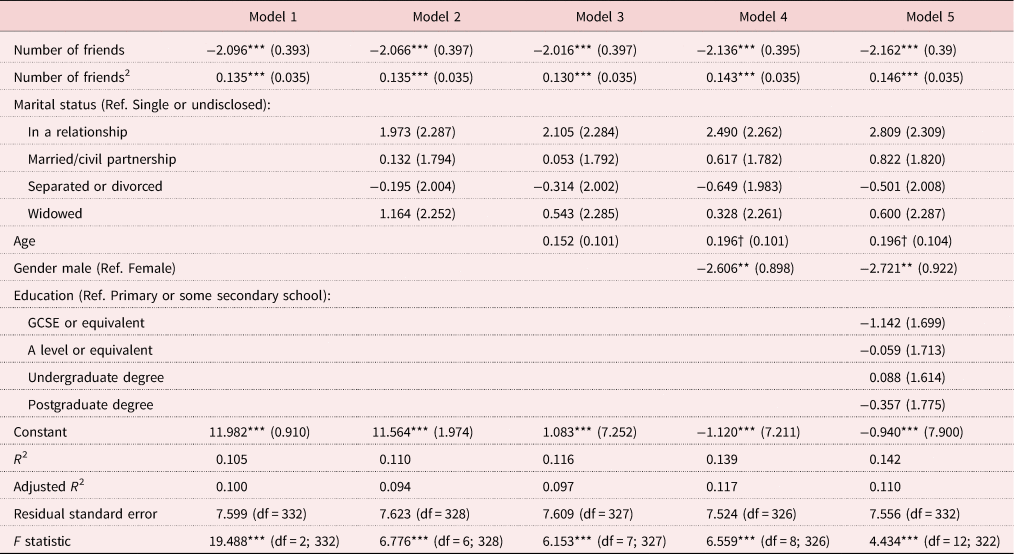
Notes: N = 335. Standard errors are in parentheses. Ref.: reference category. GCSE: General Certificate of Secondary Education. df: degrees of freedom.
Significance levels: † p < 0.1, ** p < 0.01, *** p < 0.001.
Similar to the effect for loneliness, there appeared to be a point at which the effect of number of close friends on depression is greatly reduced. A Davies Test indicated that there was a significant difference between the slopes when segmenting the regression line at 2.16 friends (p < 0.001). Breakpoint analysis via the ‘segmented’ package in R confirmed that a breakpoint could be elicited at this point (ψ = 2.17, standard error (SE) = 0.491, 95% CI = 1.19, 3.12). Multivariate adaptive regression spline analysis further suggested a knot at two close friends. This analysis suggests that the effect of additional close friends on depression is diminished once a cut-off of around two close friends is reached.
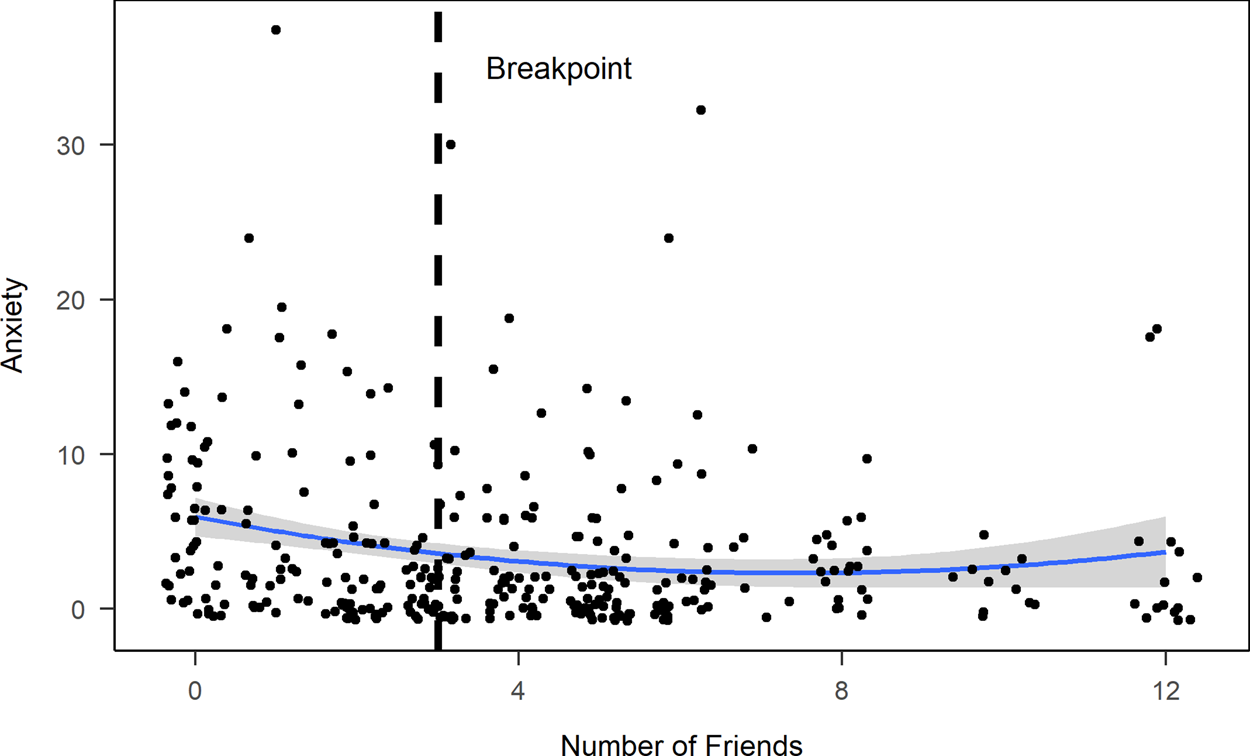
Anxiety. After adjusting for all demographic information, the final model was significant (F(15,319) = 1.74, p = 0.043). In the final model, both the linear term for number of close friends (B = −0.74, p = 0.001) and the quadratic term (B = 0.04, p = 0.014) remained significant. This quadratic relationship is illustrated in Figure 3. None of the demographic covariates were significant predictors of anxiety. This model explained 3.2 per cent of the variance in anxiety scores. For all coefficients, see Table 5.
Anxiety as a function of the number of friendships.
Notes: Curvilinear fit with 95 per cent confidence intervals. Breakpoint is determined by segmented regression.
Hierarchical ordinary least squares regression analysis to predict anxiety

Notes: N = 335. Standard errors are in parentheses. Ref.: reference category. GCSE: General Certificate of Secondary Education. df: degrees of freedom.
Significance levels: † p < 0.1, * p < 0.05, ** p < 0.01, *** p < 0.001.
Figure 3 suggests a breakpoint after which there is no additional reduction from adding close friends. A Davies Test indicated that there was a significant difference between the slopes when segmenting the regression line at 2.51 friends (p < 0.01). Breakpoint analysis confirmed that a breakpoint could be elicited at this point (ψ = 2.51, 95% CI = 1.02, 4.0). Multivariate adaptive regression spline analysis further suggested a knot at three close friends. This analysis suggests that the effect of additional close friends on anxiety is diminished once a threshold of approximately three close friends is reached.
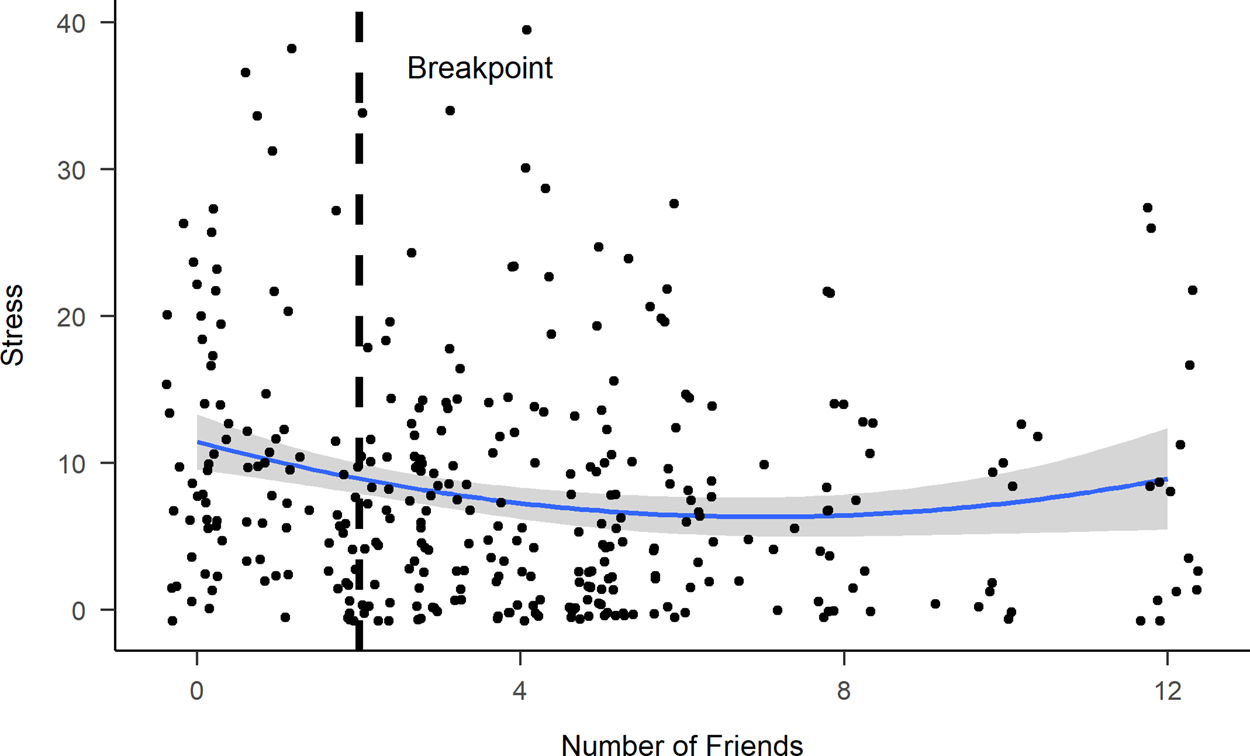
Stress. After adjusting for all demographic information, the final model was significant (F(12,322) = 2.448, p < 0.001). In this model both the linear term for number of close friends (B = −1.51, p < 0.01) and the quadratic term (B = 0.11, p < 0.05) remained significant. This relationship is illustrated in Figure 4.
Stress as a function of the number of close friendships.
Notes: Curvilinear fit with 95 per cent confidence intervals. Breakpoint is determined by segmented regression.
Of the demographic covariates, being in a relationship was a significant predictor of stress (B = 6.15, p < 0.05). Those who were in a relationship reported more stress than those who were single. This model explained 4.9 per cent of the variance in stress scores. For all coefficients, see Table 6.
Hierarchical ordinary least squares regression analysis to predict stress

Notes: N = 335. Standard errors are in parentheses. Ref.: reference category. GCSE: General Certificate of Secondary Education. df: degrees of freedom.
Significance levels: † p < 0.1, * p < 0.05, ** p < 0.01, *** p < 0.001.
Figure 4 suggests the presence of a threshold above which there is no further reduction in stress with a further increase of reported close friends. A Davies Test indicated that there was a significant difference between the slopes when segmenting the regression line at 2.05 friends (p < 0.05). Breakpoint analysis confirmed that a breakpoint could be elicited at this point (ψ = 2.05, SE = 0.64, 95% CI = 0 0.80, 3.30). Multivariate adaptive regression spline analysis further suggested a knot at two friends. This analysis suggests that the effect of additional close friends on stress is diminished once around two friends are reached.
Discussion
The purpose of this study was to explore the relationship between the reported number of close friends and loneliness, depression, anxiety and stress in older adults. Our findings demonstrated significant inverse curvilinear relationships between the number of close friends and each of these parameters. These findings support those of previous studies which demonstrated a negative relationship between the quantity of friends and loneliness (Mullins and Dugan, Reference Mullins and Dugan1990; Nangle et al., Reference Nangle, Erdley, Newman, Mason and Carpenter2003; Shiovitz-Ezra and Leitsch, Reference Shiovitz-Ezra and Leitsch2010; Russell et al., Reference Russell, Cutrona, McRae and Gomez2012; Lodder et al., Reference Lodder, Scholte, Goossens and Verhagen2017). The present findings are also in line with previous work demonstrating that having a greater quantity of friends is associated with better self-reported mental health (Nussbaum, Reference Nussbaum, Hummert, Wiemann and Nussbaum1994; Potts, Reference Potts1997; Bishop, Reference Bishop2008; van der Horst and Coffé, Reference van der Horst and Coffé2012; Cable et al., Reference Cable, Bartley, Chandola and Sacker2013; Montpetit et al., Reference Montpetit, Nelson and Tiberio2017; Taylor et al., Reference Taylor, Taylor, Nguyen and Chatters2018; Huxhold et al., Reference Huxhold, Fiori, Webster and Antonucci2020). Russell et al. (Reference Russell, Cutrona, McRae and Gomez2012) have previously demonstrated that there is an inverse curvilinear relationship between the discrepancy between the number of actual and ideal friendships and loneliness in college students. However, we believe a curvilinear relationship for the effect of close friends on each outcome measure has gone untested previously.
Inspection of the plots for each of the outcome measures shows that there are relatively few individuals who report having many friends whilst simultaneously experiencing high levels of loneliness, depression, anxiety or stress. We have discussed the notion that having a large social network may reduce emotional closeness across the relationships within it (Roberts et al., Reference Roberts, Dunbar, Pollet and Kuppens2009) and, in turn, this lack of emotional closeness may increase feelings of loneliness (Williams and Solano, Reference Williams and Solano1983; Hamid, Reference Hamid1989; Drageset et al., Reference Drageset, Kirkevold and Espehaug2011). It may be that whilst these individuals report having many close friends, these relationships are not actually providing the closeness, connection and understanding needed to stave off loneliness and its maladaptive correlates due to the size of their networks. However, further work, ideally of a longitudinal nature, is needed to corroborate this.
It is therefore possible that a small cluster of observations could be driving the quadratic fit. However, we believe that this is unlikely to be the case. Bootstrapping, which reduces the weight of extreme cases, further supported the curvilinear relationship (see https://osf.io/5f2ph/?view_only=6617265f58804de9b0145806375bb6a6). Further, we conducted segmented regression using both the ‘segmented’ and ‘earth’ packages to determine breakpoints in the data. These approaches reduce the effect of outliers and consistently detected breakpoints in the data (see https://osf.io/5f2ph/?view_only=6617265f58804de9b0145806375bb6a6).
Thus, each of our mental health-related variables demonstrated that there was a point past which the addition of more close friends no longer has a substantial beneficial effect. An increase of close friends was associated with a decrease in loneliness until four close friends were reached, for depression this number was found to be two close friends, for anxiety three close friends and for stress the threshold was two close friends. A slightly larger threshold value for loneliness in comparison to the other mental health variables is to be expected, as loneliness is more directly related to social connections and interactions than the other psychological wellbeing outcomes. The presence of a friendship threshold in terms of loneliness could be due to a reduction in emotional closeness to network members as network size is increased (Roberts et al., Reference Roberts, Dunbar, Pollet and Kuppens2009).
It is encouraging that the threshold for the number of close friends in each instance appears to be relatively low. Making and maintaining meaningful social connections takes time and effort (Lang et al., Reference Lang, Wagner, Wrzus and Neyer2013). However, given that on average a person's closest group of contacts, known as their support group, has been found to include around five members (Dunbar and Spoors, Reference Dunbar and Spoors1995), it is possible that many older adults will already have met this number, or be close to it. The elucidation of these thresholds for close friendships is important as they can allow those involved in loneliness and mental health interventions to focus their limited resources on increasing social interaction opportunities for those with few or no close friends. This would be with the ultimate aim of reducing the negative physical and psychological impacts of loneliness as well as reducing the economic cost and strain on health services associated with loneliness. As research has previously shown that perceived quality of relationships has a protective effect against loneliness (Pinquart, Reference Pinquart2003; Hawkley et al., Reference Hawkley, Hughes, Waite, Masi, Thisted and Cacioppo2008), those with more friendships than a threshold could be encouraged to improve the quality and closeness of their friendships, rather than increase the number of friends they have.
A successful intervention to reduce loneliness could include elements of the previously successful ‘Friendship Program’ (Hamid, Reference Hamid1989). This programme encourages reflection on one's own aspirations for friendships as well as reflection on current friendships. It also incorporates education around attitudes and experiences in the process of building friendships. This includes actively utilising those already-established but lesser-used connections for support and by encouraging a proactive approach to maintaining and deepening friendships. The programme has been found to both improve the quality of current friendships as well to increase the number of friendships. Further benefits of improving the quality of these relationships include having increased resilience to adversity (Graber et al., Reference Graber, Turner and Madill2016) and a more adaptive stress response (Calhoun et al., Reference Calhoun, Helms, Heilbrin, Rudolph, Hasting and Prinstein2014).
Alternatively, these individuals could be included in interventions with the aim of improving the other contributing factors to loneliness and psychological wellbeing such as health status and mobility (Theeke, Reference Theeke2009). These could include cognitive-based interventions to improve mobility (Marusic et al., Reference Marusic, Verghese and Mahoney2018) and physical activity interventions to improve mobility (Yeom et al., Reference Yeom, Keller and Fleury2009) and health status (Hwang and Braun, Reference Hwang and Braun2015); as well as directly targeting psychological wellbeing with the aim of reducing loneliness in tandem. In this regard, a variety of interventions have been shown to be successful, including psychotherapy and behavioural interventions (Pinquart et al., Reference Pinquart, Duberstein and Lyness2007). In particular, reminiscence therapy has repeatedly demonstrated a positive outcome in relation to depressive symptoms and subjective wellbeing (for a review, see Yen and Lin, Reference Yen and Lin2018). This type of therapy involves recalling events from the past and sharing them with an observer or group who listen without making comment.
The present study has a number of strengths. To our knowledge, it is the first to explore the possibility of a curvilinear relationship between the quantity of close friends and loneliness, as well as its associated psychological wellbeing outcomes in an older adult population. It is also the first to assess the presence of breakpoints within this relationship. As mentioned previously, for both of these analyses robust techniques were employed to increase confidence in our findings.
We also focused explicitly on close friendships and did not include any peripheral friendships. This is because emotional closeness has repeatedly been shown to be more important than network size and frequency and contact with friends in terms of loneliness (Williams and Solano, Reference Williams and Solano1983; Hamid, Reference Hamid1989; Drageset et al., Reference Drageset, Kirkevold and Espehaug2011). Close friends also appear to be more important than less-close friends in regards to subjective wellbeing (van der Horst and Coffé, Reference van der Horst and Coffé2012). We asked participants specifically to include only friends whom they thought of as close, although the interpretation of a close friend was left to the participant; this reduced any confusion about who to include in this number. This clarity has not always been present in previous studies (e.g. Pinquart, Reference Pinquart2003; Savikko et al., Reference Savikko, Routasalo, Tilvis, Strandberg and Pitkälä2005; Steed et al., Reference Steed, Boldy, Grenade and Iredell2007).
However, the current study is not without its limitations. Firstly, the present research was an online study only available to those with access to the internet. Many older adults do not have this access (Yu et al., Reference Yu, Ellison, McCammon and Langa2016) and/or autonomy with internet use (Hargittai et al., Reference Hargittai, Piper and Morris2019) and so the current findings are not representative of the UK population. Second, the definition of a close friend was left to each participant's own interpretation. Respondents were able to decide what a close friend meant to them, and to allocate their personal contacts accordingly. Although in previous studies, similar to ours, no definition for friendships has been given (e.g. Mullins and Dugan, Reference Mullins and Dugan1990; Russell et al., Reference Russell, Cutrona, McRae and Gomez2012), individual interpretations may differ between participants and providing an explicit definition, such as in the study of Williams and Solano (Reference Williams and Solano1983), may have resulted in different findings. However, we believe that leaving this concept open to interpretation allows for more accurate inclusion of those to whom respondents feel close, rather than forcing them to exclude contacts based on a definition which may be incompatible with respondents' own views. This is something that has been cautioned against previously by Adams et al. (Reference Adams, Blieszner and DeVries2000), who outline that it is not suitable to assign a definition of friendship to individuals as many do not share the same criteria for this type of relationship. Therefore, future research may benefit from repeating the study to include face-to-face data collection for those without access to the internet and potentially the incorporation of an established definition of a close friend and comparing if this differs from a respondent's definition.
As mentioned previously, we focused on only close friendships. Doing so allowed the determination of the number of high-quality and rewarding friendships that individuals should focus on to reduce loneliness and improve psychological wellbeing. This is important as these emotionally close friendships require bilateral effort, time and other resources to initiate and maintain and, as such, are more costly in comparison to less-emotionally close relationships (Roberts and Dunbar, Reference Roberts and Dunbar2011). However, despite the importance of these close relationships in terms of loneliness, more peripheral friendships could still be having an impact on our outcome measures. It may be beneficial for future work to take into account these friendships also.
Further, the present study did not explicitly take into account the impact of the quality of friendships on loneliness and mental health. Although we have mentioned the minority of participants who may have been experiencing low levels of closeness in the friendships they reported, as participants were asked specifically about close friends, it is likely that many of these contacts represent high-quality relationships. Regardless, as the quality of friendships has been linked to loneliness and mental health (e.g. Wheeler et al., Reference Wheeler, Reis and Nezlek1983; Mullins and Dugan, Reference Mullins and Dugan1990), future studies would benefit from also including the quality or emotional closeness of these friendships explicitly as a covariate to determine whether the effect of the number of friends remains after adjusting for this.
Similarly, the present study did not account for the types of support that can be exchanged within friendships. Both emotional and instrumental support within social networks have been shown to predict levels of loneliness (e.g. Sanchez et al., Reference Sanchez, Gierveld and Delgado2014). Including the type of support both given and received within close friendships in future analyses could assist in unpicking the aspects of these friendships which are most optimal in preventing loneliness in this age group.
It is important to note that the number of close friendships is not the only aspect of an individual's social network with implications for loneliness within this age group. Structural and compositional aspects of this network can also explain loneliness and its associated negative outcomes. For example, it has been demonstrated that social network size as well as brokerage and embeddedness can predict loneliness in older adults (Kim et al., Reference Kim, Kwak, Youm and Chey2021). Compositionally, the presence of a romantic partner is protective against loneliness (Martina, Reference Martina2021). This could potentially be due to the increased opportunity for accruing additional friends within a social network. The inclusion of such parameters in the above analyses would provide a deeper understanding of the effect of the number of close friendships on loneliness in older adults after controlling for these aspects.
In terms of additional future directions, as well as a replication, and taking into account the aforementioned issues, future research should establish who these close friends are. We know that these are emotionally close relationships but is there a difference in the impact on loneliness and psychological wellbeing in terms of the length of the relationship and whether these contacts belong to a dense network? Is it preferable to have contact with these friends in a certain way for a certain length of time or at a particular frequency? Or is the content of the interactions more important? Previous research suggests that network density is important in terms of happiness and subjective wellbeing (Huang et al., Reference Huang, Western, Bian, Li, Côté and Huang2019) and that frequency of contact has a differential effect on subjective wellbeing dependent on the mode utilised (van der Horst and Coffé, Reference van der Horst and Coffé2012). Therefore, these nuances are possible and should be explored in order to inform interventions further. Importantly, the current investigation was cross-sectional in nature. It may well be possible that there is a limit to the benefit of increasing the number of friendships over time. It also may be possible that having a larger number of friends leads to improved wellbeing. However, we cannot rule out the possibility of reverse causation. A longitudinal design would be necessary to determine this in future.
For now, we conclude that there is a nonlinear relationship between the reported number of friends and loneliness, depression, anxiety and stress in older adults. We further conclude that based on the present data there appears to be a limit to the beneficial effect of increasing the number of friends in this population. The findings are in need of corroboration incorporating a more representative sample of this population and future work is necessary to qualify further the nature of these friendships. However, these findings have important implications in the development and provision of loneliness and psychological wellbeing interventions.
Financial support
This research received no specific grant from any funding agency in the public, commercial or not-for-profit sectors.
Conflict of interest
The authors declare no conflicts of interest.
Ethical standards
Ethical approval was obtained from Ethics Committee of the Faculty of Health and Life Sciences at Northumbria University (reference number 16881).


 Open access

