

Spanish virtuoso Andrés Segovia (1893–1987) wrote the following in the preface of the Douze Études (Twelve Studies) for guitar by Brazilian composer Heitor Villa-Lobos (1887–1959):
Here are twelve “Studies” written with love for the Guitar by the brilliant composer Heitor Villa-Lobos. They simultaneously include surprisingly efficient formulas for developing both hands’ technique and “altruistic” musical beauties with no pedagogical goals, concert works with permanent aesthetic value …Villa Lobos has given to the history of the guitar fruits of his talent as lush and tasty as those of Scarlatti and Chopin.
I have decided not to change any of the fingerings that Villa Lobos himself has chosen for performing his works. He understands the guitar perfectly, and if he has chosen a particular string and a particular fingering to produce a specific phrasing, we must strictly obey his wish, even if it forces us to make a greater technical effort.
I do not want to conclude this brief note without publicly thanking the illustrious Maestro for the honor he has bestowed upon me by dedicating these ‘Studies’ to me.Footnote 1
Such a laudatory text would not surprise anyone familiar with the official narrative surrounding the relationship between the Spaniard and the Brazilian: A friendly collaboration that helped expand the classical guitar repertoire. However, the relationship between the guitarist and the composer was more conflicted than this narrative suggests. Several sources demonstrate that Segovia had reservations about Villa-Lobos's music, expressing criticism regarding its clarity and equilibrium from both ethical and aesthetic perspectives.
Segovia successfully installed the myth that he single-handedly modernized the guitar in the twentieth century—a perception shaped and facilitated by specific media, intellectual, social, and political conditions.Footnote 2 One of his arguments was that he expanded the instrument's repertoire by commissioning pieces from “nonguitarist” composers, meaning authors who did not play the guitar themselves. He believed that the predominance of guitarist-composers had marginalized the instrument within the realm of art music. Around the same period, when he asked Federico Moreno Torroba to compose for the instrument, other artists such as Manuel de Falla, encouraged by guitarist Miguel Llobet, began to write guitar music. This initiated a process that significantly enlarged its repertoire. Segovia skillfully crafted a misleading perception that this expansion was a direct and exclusive result of his commissioning efforts.
Nevertheless, it is undeniable that Segovia and the repertorio segoviano have had a significant impact on shaping the guitar canon. Scholars and commentators have suggested that this collection of works largely reflects Segovia's conservative musical preferences.Footnote 3 Some critics go as far as to argue that by focusing on soliciting works from composers who shared his inclination toward tonal music, Segovia missed an opportunity to commission pieces from composers such as Arnold Schoenberg, Igor Stravinsky, and Béla Bartók. According to these detractors, Segovia's choices would have condemned the guitar to a second-hand, uniformly conservative repertoire. These assertions, however, do not take into consideration the neocolonial context in which Villa-Lobos wrote his guitar pieces.
Based on archival work in Brazilian, Spanish, and U.S. archives, this article questions the homogeneity of the repertorio segoviano. Specifically focusing on Segovia's collaborations with Villa-Lobos, I argue that this corpus of works contains traces of coloniality: The transhistoric expansion and perpetuation of colonial domination in Latin America.Footnote 4 The relationship between Segovia and Villa-Lobos was more contentious than the official narrative suggests—tensions stemming from their dominant personalities, divergent approaches to guitar composition, and conflicting musical ideologies. Indeed, although Segovia's stance aligned with Francoist and European conservative aesthetics, Villa-Lobos embraced a transcultural approach to music mediated by the “coloniality of power.”Footnote 5 In appropriating subaltern sonorities, exoticizing local ecosystems, and blending styles perceived as ideologically incompatible by European musical analysts, his hybrid compositions served as means to navigate the colonial pressures he faced both in the center and the periphery of the Western world.Footnote 6 Despite their conflicts, Segovia and Villa-Lobos managed to negotiate these disparities in their musical collaborations, working together to advance their respective careers. This article ultimately foregrounds that elite composers from the periphery played an essential role in the modernization of the guitar in the twentieth century, thereby questioning historiographies that detach the instrument from the social, political, and cultural messiness of colonial difference and the coloniality of power.
Latin American coloniality and the division of the transcultural labor
Postcolonial theory, although valuable in examining decolonization processes in Asia and Africa, has certain limitations when applied to Latin America. Spanish and Portuguese colonialism differed from other forms of occupation by incorporating Creoles into the power structure and social organization.Footnote 7 This co-optation of a significant segment of viceregal society complicates the application of terms like “colonial” and “independence” to Latin American struggles for sovereignty. Creole nation states continued enacting the coloniality of power upon Afro-descendants, Indigenous peoples, and other subaltern communities.Footnote 8 Because colonialism has been an uninterrupted practice in Latin America, postcolonial theory fails to explain the transhistoric configurations of what Walter Mignolo calls colonial difference: “The classification of the planet in the modern/colonial imaginary, by enacting coloniality of power, an energy and a machinery to transform differences into values.”Footnote 9 Unlike other postcolonial spaces, Latin America does not function as a residue of colonialism, but rather as a site where coloniality has been perpetrated and perpetuated. Coloniality is thus not simply a remnant of European imperialism but a force that has also been enacted and deployed by creole subjects and institutions—a phenomenon “produced both in dominant and dominated languages and cultures.”Footnote 10
Coloniality gave rise to forms of modernity and modernism that lacked inclusivity and homogeneity.Footnote 11 Unsurprisingly, Latin American modernists perceived local modernity as incomplete and backward, leading them to anxiously seek synchronization with the modern world through imitation, appropriation, and adaptation of European models. These elite artists and intellectuals also sought to infuse the techniques developed in the Global North with local symbols and traditions—raw materials for a modern yet national Self. This fusion of the local and the global, the traditional and the modern, has led scholars like Beatriz Sarlo to characterize Latin American modernism as a “culture of mixture.”Footnote 12 Among the theories developed to analyze these processes of hybridization, transculturation has emerged as one of the most influential ones.Footnote 13 Coined by anthropologist Fernando Ortiz, transculturation has evolved into a theoretical framework for understanding how agents from the periphery actively select and reinvent the styles put into circulation by dominant cultures. Transculturation thus foregrounds “the consciousness of a society's own, historically specific, cultural manifestations—in contact with but differentiated from other societies.”Footnote 14
Musicology has effectively utilized transculturation to explain how modernist composers, whether consciously or unconsciously, resolved “the tensions within the web of ideologies that surrounds [them], and also [their] actual, if temporary, meaningful solution to those conflicts.”Footnote 15 One common manifestation of sonic transculturation was the blending of altered modernist models with sounds indexing local primitivism among the cosmopolitan intelligentsia: Purified sounds that, in the mind of European and Latin American elites, represented exotic difference. In hybridizing phagocyted modernist techniques and reconfigured subaltern sonorities, these composers produced works that diverged from those produced by European musicians. This process allowed them, with the support of writers advocating for transculturation, to accumulate social capital both in the Global North and South.
Certainly, epistemologies of purification have been intertwined with transculturation and the coloniality of power in Latin America. This paradox, Ana María Ochoa Gautier writes, is grounded on an uneven, neocolonial division of the sonic labor: “While creative transculturation is a practice that can be embodied by certain figures (avant-garde composers, folklorists, musicians of the popular identified as valid, and writers) it depends on others whose proper place is to represent ‘the local’ without deviating from it.”Footnote 16 In order for hegemonic transculturators to embody hybridity and successfully navigate center–periphery relations, subaltern communities must remain on the periphery of the division of musical labor—fixed essences that can only gain visibility and audibility through the civilizing efforts of the modernist elite. In other words, transculturation is not merely shaped by or a response to the coloniality of power—it is an expression of it. By perpetuating these hierarchical structures and valuing certain voices and cultural forms over others, transculturation becomes a means through which the elites exert control and exercise their dominance over subaltern communities.
Villa-Lobos participated in these relations of labor and coloniality. As a transculturator from the elite, he possessed the agency to purify and hybridize local difference. The country's intelligentsia celebrated Villa-Lobos's fusion of cosmopolitan models and purified subalternity, perceiving his music as revealing the country's true essence, significantly mediating epistemologies of difference in Brazil. His transcultural approach also facilitated his integration into elite art circles in the Global North, establishing him as a musical ambassador for Brazil. To achieve this, Villa-Lobos skillfully adapted his music and statements to meet Euro-American expectations of Latin American music. Indeed, the Villa-Lobos scholarship has shown that the composer's musical and rhetorical expressions changed constantly throughout his life, sometimes embracing and sometimes rejecting nationalism, universalism, modernism, and traditionalism.Footnote 17 I contend that these fluctuations were informed by and a response to the anxieties aroused by colonial difference and the coloniality of power. Both in Europe and the Americas, Villa-Lobos engaged in numerous debates, relations, and institutions throughout his life, leveraging the privileges and disadvantages, capitals and precarities, of a composer from the periphery of the Western world. This multifarious musicalization of the coloniality of power left traces of colonial difference in the repertorio segoviano.
The ethics and aesthetics of Segovia
Segovia's opposition to avant-garde music remained unwavering throughout his life, directing his criticism toward various musical styles. In the interwar period, for example, he had critical words for neoclassicism, telling composers to not write “in the Poulenc or Milhaud style.”Footnote 18 This does not imply an alignment with the Second Viennese School as can be seen in a letter he wrote to Italian composer Mario Castelnuovo-Tedesco in 1951:
I think of writing to [Schoenberg], this time directly, that it is time that he thinks of God, and that he writes for the guitar a work where he repents of all his sins pseudo-scientific-musical, returning to the melodic and consonant faith with a sincere humility…And as sometimes we chose a humble hermitage to solicit the divine grace, he chooses the Guitar for the same purpose, instead of the sumptuous home of the orchestra, the piano, etc., etc.Footnote 19
In the years that followed, Segovia continued to criticize dodecaphonism, expressing his disapproval of critics who disregarded tonal languages. In a conversation with Castelnuovo-Tedesco in 1962, he described them as “cowards: when one announces some modern works of the nondodecaphonic composer, they try to avoid them or to pan them.”Footnote 20 Until his death, Segovia consistently urged composers to create music without “surrendering [themselves] to current cacophonies,”Footnote 21 stating that performers should not be executing “noises but music.”Footnote 22 His categorization of diverse dissonant, atonal, and serial languages as noise went beyond aesthetics and held ethical implications:
Moral decay has shocked art. The war has caused this commotion. We have advanced in technological terms, but we have lost our moral responsibility … Music should be exactly like our life. Like plants, it must absorb the heat of the land and the sun …I think that no barriers should be imposed on art, but both Romanticism and Impressionism …were steps that have taken place within music and not outside of it. Sometimes some good composers seem scared, frightened to speak with clarity. The market machine is against them, favoring extravagance and mediocrity. But each musician has studied his instrument and has dreamed of being famous. Why, then, do they accept this kind of horror they are forced to perform? This is a form of mental cowardice … But there is still hope: little by little the cowardly minority is losing its influence and the true art is beginning to win once again.Footnote 23
He was even more radical in his critique of modernist and avant-garde music as noise in intimate spaces, as he stated in this letter to his biographer Alberto López:
Composers who seek parasitic dissonances, which desmelodizan [de-melodize] music and turn it into a harsh punishment for the ear, because even when God touched their forehead with his finger, they slothfully refuse to seek originality in the continuation [of tradition]. When we're talking about talentless prevaricadores [those who fail to do their duty], this also means a lack of virility to endure with moral integrity the discipline of labor and open their sinful fleshes to the holocaust of art's pure love.Footnote 24
Segovia's utilization of the concept of noise in an ideological sense aligns with a long-standing tradition in Western thought, which has often depicted noise as the antithesis of music.Footnote 25 As discussed later, he infused the category of noise with elements of primitivism and even a sense of monstrosity when referring to Villa-Lobos. This intentional association aimed to place the Brazilian outside the established norms of European musical tradition, thus emphasizing his peripheral Otherness.
Segovia's aversion to avant-garde music led him to avoid composers whose compositions disregarded tonality and formalism. For example, he never included in his repertoire the works that Darius Milhaud and Frank Martin specifically wrote for him—Segoviana and Quatre Pièces Brèves, respectively. These compositions diverged from the techniques commonly employed by guitar composers, such as the use of open strings, parallel chords, and unaccompanied melodies. Milhaud's concise piece employed a multitonal structure that juxtaposed different tonal areas, deviating from Segovia's preference for tonal music. Similarly, Martin's composition incorporated extensive dodecaphonic elements, despite presenting some tonal suggestions.
Unsurprisingly, Andrés Segovia demonstrated a strong inclination toward tonality, balance, order, and formal clarity in the music he performed. He often sought collaboration with composers who shared his preference for tonal and metrical music, such as Federico Moreno-Torroba, who remained committed to traditionalist ideas about Spanish culture, maintaining an “anachronistic nationalistic aesthetic” throughout his life.Footnote 26 Furthermore, Segovia frequently requested composers to incorporate baroque, classical, and romantic forms into their compositions, emphasizing the establishment of strong tonal centers. His correspondence with Manuel Ponce serves as a notable example that highlights Segovia's conservative and traditional approach to music:
I want you to write some brilliant variations for me on the theme of the Folias de España, in D minor, and which I am sending you a copy of from a Berlin manuscript. In a style that borders between the Italian classicism of the 18th century and the dawning of German romanticism.Footnote 27
He frequently made these requests to his closest collaborators. For example, he asked Castelnuovo-Tedesco to write works in traditional forms and imitate the style of eighteenth- and nineteenth-century composers such as François Couperin, Luigi Boccherini, and Niccolò Paganini.Footnote 28
Segovia also applied his musical ethics to composers. See, for instance, his appraisal of Ponce and Manuel de Falla:
One day in Cremona, Falla came to my room while I was working on [Ponce's] Variaciones y Fugas sobre Las Folías de España. He listened with attention, and he was so interested that sometimes he interrupted me to ask me, more with a gesture than his voice, who had composed them. Holding my answer until the end, I said: “Ponce.” And from Falla's generous chest this exclamation arose: “I'm so happy that he wrote them!” That is, he was happy that such a noble and beautiful work was born from such a noble and beautiful soul, that the created thing was a truthful reflection of its creator, that there was no disparity between the artist's moral nature and his or her art. For once, the miracle happened … For once? No. There was Falla, who was an example and paragon of such a difficult duality.Footnote 29
The baptism of Falla and Ponce reflects broader ideologies surrounding music in Spain during the first half of the twentieth century.Footnote 30 In the years leading up to, during, and after the Spanish Civil War (1936–39), conservative factions advocated for a radical form of nationalism, increased state intervention in cultural production, criticism of modernist music, the use of art for propaganda purposes, and the glorification of Spain's perceived Catholic essence. They argued that Spanish artists should draw inspiration from composers of the past, particularly from the Counter-Reformation period. Alongside this, they promoted the incorporation of Spanish folk music, presenting these centuries as representative of the nation's essence. The political right framed this return to balance, order, and reason as a counterpoint to the perceived revolutionary nature of the time, which they associated with modernist music.
However, Segovia's aesthetic stance also aligns with that of nationalist musicians and critics who existed outside the Schoenberg–Stravinsky debate in interwar Europe. In France, for example, although Satie, Stravinsky, and Les Six were simultaneously drawing on past influences and rejecting Debussyism as they shaped their radical neoclassical style, right-wing composers and commentators perceived their approach to historical styles as an artificial “artistic formula” that merely represented a “codification of ‘disorder.’”Footnote 31 In addition to advocating for a revival of France's classical spirit, right-wing thinkers emphasized cultural values such as emotion and lyricism, reviving the romantic qualities of heightened sensibility, intuition, and inspired insight. In line with this sentiment, Segovia not only embraced romanticism but also found appreciation for impressionism, as indicated in a previously quoted statement. Faced with morally objectionable avant-garde techniques dominating Europe at the time, Segovia encouraged composers to embrace a wide range of past styles, from baroque to impressionism. He saw these musical traditions, both immediate and distant, as ethically acceptable artistic responses to the perceived moral decay associated with the avant-garde.
Segovia's conceptualization of contemporary music as noise, as well as his preference for romantic expression and traditional forms, were heavily influenced by these prevalent ideas. However, larger neocolonial dynamics complicate the notion of a uniformly conservative repertoire often attributed to the repertorio segoviano. Although Segovia sought out composers whose musical style aligned with his own ideology, the complex interplay of colonial difference and the coloniality of power adds further layers of nuance to this corpus.
Modernity and coloniality in Brazil
Brazil's historical trajectory sets it apart from other Latin American countries and gives it a distinctive position within the neocolonial framework of Latin America.Footnote 32 The emergence of Rio de Janeiro as the metropolitan center of the Portuguese Empire in the early nineteenth century, prompted by João VI's relocation to escape the Napoleonic threat, had significant implications. Brazil was elevated to the status of a kingdom in 1817 and peacefully transitioned to independence as an empire in 1822 before becoming a republic in 1889. Brazil's relationship with its colonizer, Portugal, which itself occupied a semiperipheral position in the colonial world system, added complexity to its neocolonial experience. This unique positioning gave rise to a heightened sense of peripherality and self-perceived alterity, generating considerable anxiety during the modernist period. The dynamics of Brazil's historical context, combined with its colonial legacy, contributed to an artistic landscape and epistemological framework that diverged from European and North American paradigms.
The process of modernization that Brazil underwent in the early twentieth century coincided with a vibrant modernist movement. Three neocolonial preoccupations converged in the modernist agenda of the Brazilian elites, as pointed out by literary scholar Carlos Jáuregui.Footnote 33 First, there was a desire for and anxiety about embracing modernity, reflecting the tension between a longing for progress and the uncertainties it entailed. Second, there existed a complex interplay between nationalism and cosmopolitanism, as the modernists aimed to forge a distinct Brazilian identity while engaging with global influences. Finally, the modernists exhibited a simultaneous celebration and condemnation of the cultural changes brought about by modernization, grappling with the challenges of balancing tradition and innovation. As the Brazilian modernists sought to synchronize with global modernity, they had to navigate the incorporation of the latest modernist techniques while addressing their own nationalist concerns. They faced the question of whether the adoption of foreign artistic forms implied an inherent inferiority, leading to a complex negotiation between the desire for originality and the perceived need to overcome the status of being mere imitators. This tension shaped their artistic endeavors and influenced their engagement with the broader neocolonial dynamics of the time.
Modernism gained national notoriety in February 1922 when a group of artists and intellectuals organized the Semana de Arte Moderna (Week of Modern Art). Controversies and conflicts marked the 5 days of concerts, lectures, and exhibitions as conservative groups actively confronted the modernists. The modernists openly criticized the prevailing late romanticism that dominated Brazilian culture at the time. As literary scholar Miguel Gomes writes, “scandal, insults, and rumors were the dish of the day … the Modernism's rallying cry was radicalism.”Footnote 34 The event's organizers ultimately wanted to update local culture while discovering the country's “ethos.”Footnote 35 Influential thinker Mario de Andrade expressed the idea that a modern national culture had not yet fully formed and emphasized the need for a sophisticated blending of “raw materials” derived from Brazil's “primitive peoples” in order to achieve a unified transcultural identity.Footnote 36 This pursuit of a cohesive transcultural Self was shared by other modernists, including poet Guilherme de Almeida, who stressed the importance of embracing a broader Brazilian identity rather than focusing on specific regional characteristics: “A major danger threatens us: regionalism … it is necessary to avoid regionalism: it is necessary to simply be Brazilian. Brazilian does not mean: ‘regionalist.’”Footnote 37
After the Semana de Arte Moderna, concerns about neocolonial transculturation became more prominent within the modernist movement. In 1924, Oswald de Andrade, a prominent writer, published an essay that advocated for the transformation of national “raw materials” into fetishized commodities using cosmopolitan techniques. According to Andrade, this was necessary in order to integrate Brazil into global modernity. In 1928, Andrade published the Manifesto Antropófago (Anthropophagus Manifesto), which further radicalized his ideas on transculturation. The manifesto reimagined the neocolonial stereotype of the cannibal, arguing that modern national culture would finally emerge through the act of consuming, assimilating, and reinventing foreign influences. Through this process of “cannibalization,” the Other would be incorporated and become part of the Self: “We must assimilate all embryonic European aesthetic tendencies, assimilate them, elaborate them in our subconscious, and produce something new, something ours.”Footnote 38 However the anthropophagites went beyond merely cannibalizing cosmopolitan models; they also aimed to assimilate and transform local subaltern differences, making them a fundamental part of their modern subjectivity. The aphorism in the Manifesto Antropófago, which celebrates the Tupi (an Indigenous community historically associated with cannibalism), serves as an illustration of the incorporation of marginalized communities into the fabric of the modern national identity: “To be Tupi, or not to be Tupi, that is the question.”Footnote 39
Getúlio Vargas's coup of 1930 had a profound impact on the discourses surrounding modernity and modernism in Brazil. The subsequent establishment of the Estado Novo (New State) aimed not only to consolidate Vargas's power but also to position Brazil as an active participant in the global modernization process. This vision was achieved by intertwining elements of nationalism, populism, and mestiçagem (racial mixture) within the framework of the Estado Novo. Mestiçagem put forth the notion that Brazil's racial composition, resulting from the fusion of Indigenous, African, and European blood, was a source of strength and unique identity. In its efforts to co-opt and nationalize subalternity, the Estado Novo assimilated various regional cultures, traditions, and histories into a singular narrative that reinforced the idea of a cohesive national identity. The valorization of racial mixture and colonial difference allowed Brazil to assert a distinct modernity different from that of the Global North. The Estado Novo's appropriation of subalternity was not without controversy, as it disregarded or suppressed alternative narratives and marginalized voices that did not fit into the constructed national identity. Nevertheless, the regime's pursuit of modernity, symbolized by its emphasis on mestiçagem and the homogenization of subalternity, left an indelible mark on the discourses surrounding modernism in Brazil during that era.
Villa-Lobos played an active role in these conversations, engaging with various artistic movements and ideologies throughout his life. From becoming the musical representative of the Semana de Arte Moderna to socializing with modernists in Paris and even participating in the Vargas regime, he consistently strived to reconcile these diverse influences within his musical compositions and public image.
Villa-Lobos and the neocolonial condition
Villa-Lobos's musical education reflects the musical diversity of modern Rio de Janeiro. Coming from a privileged background, he received early instruction in art music from his father. Later, he received cello training and connected with fellow musicians at the city's conservatory. Although the established musical community favored the techniques of composers like Vincent d'Indy, Giacomo Puccini, Camille Saint-Säens, and Richard Wagner,Footnote 40 there is evidence that the works and ideas of Schoenberg and Debussy also had a wide circulation among conservatory musicians.Footnote 41 Simultaneously, Villa-Lobos actively engaged with the choro scene, immersing himself in popular music as a chorõe (choro player).Footnote 42 This deep involvement in popular music had a profound and lasting impact on his own musical creations. In other words, Villa-Lobos emerged as a musician deeply rooted in a vibrant musical environment, a social space where the exchange of sounds from cosmopolitan centers fostered a sense of belonging to a “global music scene” among its inhabitants.Footnote 43
In a context dominated by late-romantic languages, his extensive use of Debussyean techniques elevated him as the most modernist composer in Brazil. His incorporation of these techniques elevated him to the position of a unique and ideal musical ambassador for the Semana de Arte Moderna. Although the modernists perceived much of the country's art music as derivative, they recognized Villa-Lobos's compositions as a transcultural path toward global modernity. As writer Graça Aranha expressed: “Brazil's aesthetic remodeling, initiated by Villa-Lobos's music … will liberate art of the dangers that threaten it, of the inopportune archaism, academicism, and provincialism.”Footnote 44 Similarly, Mario de Andrade held an optimistic view of Villa-Lobos's ability to tap into the transcultural essence of Brazil, envisioning him as the one who would ultimately unveil the nation's truly modern ethos.Footnote 45
Villa-Lobos shared the belief that a distinct national music had yet to emerge in Brazil, and he took it upon himself to undertake the transcultural task of its creation. This involved transforming foreign languages and models through his own “consciousness” and “artistic soul”Footnote 46 while drawing inspiration from local raw materials. According to Villa-Lobos, Brazil's disjunctive subalternity had hindered the nation from attaining the “indispensable and characteristic unity” found in metropolitan countries like Germany and France.Footnote 47 It became the transculturator's responsibility to unveil Brazil's modern ethos by blending subaltern sounds with the latest musical developments originating from metropolitan centers.
Driven by a desire to showcase his modernist prowess to the world, Villa-Lobos embarked on a journey to Paris in 1923. “I'm coming here not to learn,” he allegedly stated once in France, “but to show what I can do.”Footnote 48 Nevertheless, modernism held different connotations in the metropolitan center compared to the colonial periphery. The Debussyist techniques that had caused significant controversy in Brazil were considered outdated in France, where the radical neoclassicism of composers such as Stravinsky, Satie, and Les Six was in vogue. Marianne Wheeldon has illustrated how the rejection of Debussyism—seen as representative of prewar aesthetics—laid the foundation for the rise of neoclassicism and the prioritization of counterpoint, smaller chamber and orchestral works, and notions of absolute music among the interwar avant-garde in Paris.Footnote 49 Given that Villa-Lobos's music during this period heavily relied on impressionistic harmonic structures, extramusical concepts and imagery, and the evocative vagueness characteristic of Debussy's music, it is unsurprising that Jean Cocteau deemed his compositions as mere imitations of outdated styles.Footnote 50
Amid the prevailing dominance of neoclassical techniques, Villa-Lobos ventured to incorporate elements associated with composers like Satie and Les Six, including counterpoint and linear structures, into his compositions. Drawing inspiration from Stravinsky, he embraced rhythmic irregularities and delved into intense and unconventional sonorities. However, in order to avoid accusations of mere imitation, Villa-Lobos integrated sonic references to Brazil's folk music, popular music, and natural landscapes.Footnote 51 He confidently asserted that he had developed these techniques even before his arrival in Paris, occasionally misrepresenting the compositional dates of his neoclassical works. A critique published in the Revue Musicale in 1924 exemplifies this:
The metric diversity and complexity of these works are extraordinary and the display of timbres is rich and demonstrates a sophisticated refinement … It seems that the very Stravinskyan Trio [para oboém clarinete e fagote] was composed when Villa-Lobos barely knew Stravinsky by name. Therefore, there is an interesting link to be established between the Sacre and the South American indigenous. In the Nonetto, he seems to have nevertheless succeeded in dominating their materials, imposing a European form on them.Footnote 52
It is true that Villa-Lobos had prior exposure to neoclassical techniques during his interactions with Milhaud, who visited Brazil between 1917 and 1919. Nevertheless, it is noteworthy that Villa-Lobos made deliberate efforts to establish himself as an “intuitive modernist.”Footnote 53 He went to great lengths to create an exotic persona around himself, fabricating stories about encounters with Amazonian cannibals and presenting himself as an enfant terrible. These actions were aimed at constructing an image of peripheral alterity, despite his privileged position within the Brazilian intelligentsia. Villa-Lobos recognized that, as a composer from the periphery, he could harness colonial difference as an expression of the coloniality of power, effectively navigating the aesthetic debates dominating the European metropoles in the interwar period.
According to music theorist Rodolfo Coelho de Souza, Villa-Lobos's interwar music is underpinned by a hybrid compositional framework that diverges from European standards.Footnote 54 As Villa-Lobos did not adhere to any specific technical orthodoxy, he felt unrestricted in his exploration of tonal and atonal techniques that would be considered incompatible by composers in metropolitan centers. Coelho de Souza observes that Villa-Lobos created post-tonal symmetrical collections that juxtaposed, alternated, and clustered octatonic, pentatonic, diatonic, and whole-tone materials, often incorporating “odd notes”—notes that do not belong to these atonal, nonfunctional collections. However, Villa-Lobos's music still exhibited phraseological syntax that suggested tonality, employing techniques like melodic liquidation, sudden contrasts for intensification, energy and tempo reduction, and changes in register and texture. Coelho de Souza concludes that this convergence of tonality and atonality is prevalent in most of Villa-Lobos's music from that period.
One of the notable outcomes of Villa-Lobos's transcultural, exoticist approach was the Choro series, a collection of works that merged various post-tonal techniques with sonic markers of subaltern difference. As he stated in 1926, it “represents a new form of musical composition in which various modalities of our savage and popular music are synthesized.”Footnote 55 As Florencia Garramuño contends, choro became a vehicle through which twentieth-century Brazilian artists created exotic forms of modernism.Footnote 56 Villa-Lobos, well-versed in the genre, further reinforced its primitivist indexicality by incorporating sonic and rhetorical references to indigeneity, blackness, and nonhuman entities associated with the Amazon rainforest, foreshadowing the core tenets of mestiçagem. These sonic allusions were juxtaposed with post-tonal techniques developed by Bartok and Stravinsky, resulting in overwhelming aural experiences. As he wrote in a letter to Oswald de Andrade: “You will have the chance to listen to [Choro No. 3] Brazilian Pica-Pau [Woodpecker] in the voices of one hundred truly professional artists, [who will] terrify the Parisian public with those savage inflections that you already know.”Footnote 57
Simultaneously, this novel reliance on sounds perceived as national coincided with an interwar universalist nationalism that aimed to establish international yet distinctively national musical and institutional parallels with the newly formed League of Nations. The International Society for Contemporary Music (ISCM) provides a notable example as it sought to promote contemporary music and international cooperation while also reinforcing national sovereignty. By presenting musicians associated with modernist and universalist nationalist tendencies as representatives of their nations’ musical worlds, the ISCM emphasized their national identities. Villa-Lobos, relying on Brazilian “national sounds” in his compositions, aligned with these endeavors and effectively positioned himself as Brazil's musical ambassador in European circles. However, this did not elevate him beyond the status of a peripheral composer. As Giles Master aptly points out, the internationalism of the ISCM functioned “within a fundamentally colonial paradigm in which Europe was assumed to be both the default location of culture and the primary arena of international affairs.”Footnote 58 Villa-Lobos's involvement in European internationalism entailed the construction of “strategic otherness,”Footnote 59 an ongoing process in which he utilized colonial difference to leverage power relations, even if temporarily.
An initially brief visit to Brazil in 1930 coincided with Vargas's military intervention. Amid economic instability, Villa-Lobos accepted a position within the regime, becoming its official composer. Villa-Lobos scholars argue that his involvement in the Estado Novo led him to abandon a radical modernism in favor of a more conservative musical nationalism. The Bachianas Brasileiras stands out as a notable result of this perceived shift, featuring a fusion of sonorities inspired by Bach's music with elements drawn from Brazil's unique sonic world. Villa-Lobos further reinforced this perceived move toward conservative neoclassicalism by composing symphonies, concertos, and string quartets in classical forms. However, I contend that this periodization fails to fully capture Villa-Lobos's musical transformations during the 1930s and 1940s. It overlooks the neoclassical continuities present in his work and, more importantly, fails to recognize how his transcultural framework, as both a response to and an exertion of the coloniality of power, continued to shape his artistic output.
Indeed, the composition of the Bachianas Brasileiras and the utilization of traditional forms was influenced not only by internal dynamics within the Estado Novo but also by ongoing tensions stemming from Villa-Lobos's peripheral participation in debates over nationalism and universalism in the Global North. These years coincided with Villa-Lobos's remarkable success in the United States. His first performance at the 1939 New York World's Fair sparked a response from U.S. commentators who interpreted his music's primitivistic qualities as being “[i]nsusceptible to sublimation and unmediated by universality,” thereby “a poor vehicle for sameness-embracing.”Footnote 60 In addition to describing him as “not wholly articulate,”Footnote 61 these critics raised eyebrows at his nationalist rhetoric, which they perceived as echoing the right-wing ideologies dominating Europe at the time. In the face of new imperial expectations regarding peripheral art, Villa-Lobos began to assert that “patriotism in music” was “very dangerous” and cautioned against using folklore in a “blindly nationalistic way” as it “belongs to the universal expression of the artist in all lands.”Footnote 62 Embracing the universalist principles favored in the United States, he incorporated musical quotations from composers such as Bach, Beethoven, Chopin, and Wagner into his concertos, symphonies, string quartets, and Bachianas Brasileiras. Over time, U.S. commentators came to perceive his music as “ingratiating but conventional,” thus “raising none of the vexing questions associated with Caliban's domain.”Footnote 63 Villa-Lobos transitioned from embodying Shakespearean fears of uncontrollable otherness to becoming a cultivated composer capable of translating subaltern difference into a universal language.
Nevertheless, the fact that Villa-Lobos composed the Bachianas Brasileiras and engaged with classical forms and genres does not imply that he abandoned his transcultural, anthropophagic approach. On the contrary, as discussed earlier, Villa-Lobos's modernism had long involved a process of cannibalizing the radical neoclassical techniques prevalent in interwar Paris. It is thus inaccurate to label his Estado Novo period as a new neoclassical phase. Instead, it represents a continuation of his quest to develop a hybrid compositional framework where the past and the present, the classical and the modern, are freely fused in order to resolve the internal and external tensions enacted by coloniality.
Villa-Lobos and the guitar
Villa-Lobos's guitar repertoire, albeit extensive, showcases shared technical and expressive elements. A prime example of this can be found in his early-known piece, Valsa de Concerto No. 2 (1904). First, Villa-Lobos makes adept use of the guitar's capacity to traverse fixed positions along the neck, resulting in an abundance of melodic and harmonic parallelism throughout the piece. Second, he incorporates the fourth, fifth, and sixth strings of the guitar into the melodic fabric, exploiting the timbral and vibratory potentials of the lower strings—an approach influenced by his proficiency in playing the cello and choro guitar. Lastly, Villa-Lobos employs an idiosyncratic key on the guitar, E major, which allows him to leverage harmonics and open strings, creating innovative chords and sonorities unique to the instrument.
In Villa-Lobos's subsequent guitar compositions, he began incorporating the rhythms he had learned as a chorõe in a more systematic manner. Although the individual short pieces comprising the Suite Populaire Brasileira featured syncopation commonly associated with choro music,Footnote 64 it was in his Choro No. 1 (1920) that this well-known rhythm became the defining characteristic. Prior to the 1920s, Villa-Lobos viewed the guitar primarily as a popular instrument rather than a concert instrument, resulting in the composition of brief and musically straightforward pieces.Footnote 65 However, this perception changed when he met Segovia, Llobet, and Sainz de la Maza in the 1920s. Precisely, it was in Paris that Villa-Lobos recognized the guitar's potential for developing a transcultural musical language, leading him to explore more ambitious and innovative compositions.
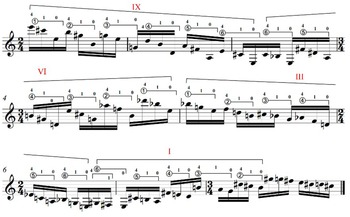
This anthropophagic guitarism fully crystallized in his seminal work for the instrument, the Douze Études. This opus, composed in Paris during two distinct periods (1923–25 and 1927–30), represents a pinnacle of technical and compositional ambition. Building upon his earlier compositions from the 1920s, the studies feature atonal symmetrical collections connected by unconventional notes as well as vibrant rhythms, dynamic intensity, and direct linear progression, drawing significant inspiration from the radical neoclassical influences of composers like Stravinsky, Satie, and Les Six. Villa-Lobos expanded upon the distinctive guitar-specific techniques already present in his earlier guitar works, incorporating chordal parallelism, harmonic and open strings, rhythmically and melodically intricate bass lines, and direct polytonal counterpoint to develop a hybrid neoclassical style. An example can be found in Study No. 12, where a distinctly atonal melody is played over a fixed mechanical motion—originally E2 (finger four), C#2 (finger one), and E1 (open string)—executed on each string before transitioning from the ninth to the fifth, then to the third, and ultimately to the first fret. The passage culminates with a quasi-chromatic descending scale (Figure 1).
Excerpt Study No. 12 by Heitor Villa-Lobos. Transcription by the author.

The Douze Études follow a conspicuously anthropophagic progression. They begin with a “Prelude” (as he titled Study No. 1 in the 1928 manuscript) reminiscent of the opening prelude from The Well-Tempered Clavier. This introductory study is followed by three technically demanding pieces that draw inspiration from traditional guitar methods, incorporating their mechanics and classical language. From Study No. 4 onward, the compositions take on a more atonal and vigorous character, featuring pronounced elements of exoticism. Starting with the study originally titled “Etudo Amazônico,” intensity and atonality as well as references to indigenous, choro, folkloric, and Amazonian sounds characterize the three final studies. The already mentioned Study No. 12 concludes with a three-bar fortississimo strum of an A1-D#1-E1-G#1-B1 chord that resolves to A minor. In essence, the structure of the Douze Études exemplifies the transcultural ideology that underlies Villa-Lobos's radical neoclassicism. It can be interpreted as a musical tale of anthropophagous empowerment that concludes with an assertive affirmation of colonial difference.
During the Estado Novo period, Villa-Lobos's guitar works, including the Cinco Prelúdios (1940) and the Concerto para Violão e Orquestra (Concerto for Guitar and Orchestra, 1953), prominently feature explicit references to Brazilian soundworlds. In the case of the Cinco Prelúdios, each piece, except for the third prelude paying homage to Bach, is dedicated to a specific aspect of Brazilian culture and society. These include the sertanejo (rural character), the capadócio carioca (Rio de Janeiro's outlaw), the índio brasileiro (indigenous people), and the vida social carioca (Rio de Janeiro's elite social life). The Cinco Prelúdios thus celebrate social cohesion and, to some extent, the idea of racial mixture within Brazilian society. From a guitaristic standpoint, the Cinco Prelúdios continue to incorporate the mechanical, rhythmic, melodic, and harmonic elements found in the Douze Études, albeit in a less technically demanding manner. Commentators often draw connections between the Cinco Prelúdios and the Concerto para Violão e Orquestra, considering them a departure from the disruptive style of the Douze Études. However, these compositions still embody the fundamental elements of Villa-Lobos's transcultural guitarism—a method that received harsh criticism from Segovia.
Relationship between Segovia and Villa-Lobos
Although both the guitarist and the composer acknowledged that they had met during a musical soiree in Paris in 1924, their recollections of the encounter differed significantly. These contradictory accounts serve as a clear illustration of the tensions that characterized their relationship. Segovia provided this version of the encounter:
I had barely heard any of [Villa-Lobos's] works at that time but his name was familiar to me … When I had finished playing, Villa-Lobos came to me and said in a confidential tone, “I too play the guitar.” “Wonderful!” I answered. ‘Then you must be able to compose directly for the instrument.’ Holding out his hand, he asked me to let him take the guitar. He then sat down, put the guitar across his knees and held it firmly to his chest as though he was afraid it would try to get away from him. He looked sternly at the fingers of his left hand as though imposing obedience on small children; his eyes then shifted to the fingers of the right hand, as though to warn them of punishment if they hit the wrong string, and when I least expected it, he attacked a chord with such force that I let out a cry, thinking the guitar had cracked. He burst out laughing and with childlike glee said to me, “Wait, wait…” I waited, restraining with difficulty my first impulse, which was to save my poor instrument from such vehement and frightening enthusiasm.
He made several attempts to begin playing but then gave up. For lack of daily practice, something which the guitar is less ready than any other instrument to forgive, his fingers had grown clumsy.Footnote 66
Villa-Lobos recalled the meeting differently:
I saw a young man with lush hair surrounded by women. I found him arrogant, pretentious, but nice. Portuguese violinist Costa asked Segovia if he had met Villa-Lobos without telling him that I was there … Segovia said that he found my pieces anti-guitaristic and that employed resources foreign to the instrument. Costa said, ‘Well, Segovia, Villa-Lobos is here.’ I came forward and asked him, ‘Why do you find my works anti-guitaristic?’ Somehow surprised, Segovia … explained to me that, for example, the little finger is not used in the classical guitar. I then asked, ‘Ah! You don't use it? I'll cut it off, then, I'll cut it off.’ Segovia tried to refute, but I came forward and said: ‘Give me the guitar, give it to me!’ Segovia doesn't share his guitar with anyone and tried to resist. But it was in vain. I sat down, played, and finished the party. Segovia later asked me where I had learned to play. I told him I was not a guitarist but knew the technique of Carulli, Sor, Aguado, Carcassi, etc. Segovia faked indifference and left. The following day he came to my house with [Spanish pianist] Tomás Terán. I told him that I had a dinner party and that he should return later. He also left. He came back later, and we played guitar until 4 AM. He commissioned a guitar Study and the friendship that grew among us was so big that, instead of one, I made twelve for him: “Twelve Studies for Guitar.”Footnote 67
Within the context of this article's arguments, three disparities hold particular relevance. First, Segovia initially regarded Villa-Lobos's guitar music as being in opposition to the nature of the instrument itself, deeming it antiguitaristic. Second, the Spaniard characterized the Brazilian through tropes associated with noise and savagery. Third, the alleged origins and development of the Douze Études.
Although the studies were not published until 1953, the manuscripts found in the Villa-Lobos Museum in Rio de Janeiro reveal that the composer initiated their composition in the early 1920s, finalizing a complete manuscript by 1928. Notably, the initial draft bears a Max Eschig letterhead and does not make any mention of Segovia, who published his commissioned works with Schott Music. Essentially, Villa-Lobos composed the Douze Études without seeking Segovia's input, possibly accounting for the latter's disapproval of the piece.
The correspondence between Ponce and Segovia demonstrates that the latter did not hold Villa-Lobos in high regard. The first reference to the Brazilian was on August 26, 1939, when the Spaniard stated: “After Castelnuovo, I will cite some studies, among the twelve that Villa-Lobos has composed for me. But there is a great unevenness between the two [composers].”Footnote 68 On October 22, 1940, Segovia continued his critique while reviewing a Villa-Lobos concert in Uruguay:
The music was dreadful, Villalobos’, most of all. That of other the composers, vulgar and foolish. The symphonic concert that followed this, had still less people and they turned up their noses upon hearing the bellowing from the piano in the Concerto for orchestra and said instrument, attributed to Villalobos, and the macabre laments from the Cello, when it was its turn. It turned out that one had to congratulate the composer in approximately this manner; ‘My sincere congratulations, because you have attained as horrible a result as you wished for the work…’ The II performance of Chamber music was last night, and the theater exhibited the desolate aspect of a desert. We were thirty people. As a consequence, all the pomp with which Villalobos and his army have been presented, achieved no public effectiveness. The music lover has withdrawn, because all over the world, the stridency, discord and brutal noise in some musical substituting for music is found less interesting each time. But from that comes an observation, which is what motivated this whole story … And that is that your coming to Uruguay, should be officially supported … [and] do something similar to what the Ambassador of Brazil has done for Villalobos. With the difference that with you there would not be a separation between the official and the public part, because your talent is true and nor feigned, and to everyone's liking … He [later] came to the house supplied with six preludes for guitar, dedicated to me, and which combined with the twelve earlier studies for guitar, make up sixteen works [sic] … From this swollen number of compositions I do not exaggerate in telling you that the only one that is of any use is the study in E major that you heard me practice there. Among the two from the last batch, there is one, which he himself attempted to play, of lethal boredom. It attempts to imitate Bach and by the third cycle of a descending progression—or regression, therefore—with which the works begins, it makes one want to laugh.Footnote 69
I quote the letter at length because it serves as an example of Segovia's assessment of Villa-Lobos's work and persona. The guitarist systematically applied his ethical and aesthetic interpretations of modern and avant-garde music to the composer's compositions, perceiving them as noisy. Nevertheless, unlike European avant-garde composers, Segovia associated Villa-Lobian noise with primitivism and monstrosity, drawing on evolutionary tropes. While Schoenberg was seen as a pseudoscientist, Villa-Lobos was depicted as an underdeveloped “savage.” By intertwining noise and savagery, Segovia portrayed Villa-Lobos as an untamed outsider within Western art music. In contrast, European modernists, despite facing moral criticisms, were still regarded as culturally evolved.
This does not imply that Segovia assessed every Latin American composer as a savage other, as evidenced by his angelic assessments of Ponce. However, it is consistent with Segovia's ideology to critique avant-garde composers from the Global South through a lens of cultural evolutionism. It is worth noting that Segovia also used tropes of savagery and monstrosity when discussing the music and persona of Mexican composer Carlos Chávez, as expressed in this letter to Castelnuovo-Tedesco:
On the same occasion, they played a ferocious composition by Chavez, brutal, antimusical and ugly from beginning to end!…Pointless to say that the public, who completely filled the room quite large—almost entirely left, before listening again to such horror, leaving only a hundred lunatics, with ears blocked…! Chavez did not worry at all about it. With a repulsive smile, he said—‘I am agreeably surprised to see that so many people stayed for the second hearing…’ It was so cynical.Footnote 70
This critique combines ethical and aesthetic judgments, merging cultural evolutionism with musical conservatism in its evaluation of Chávez's music and persona. The parallels in Segovia's statements about Chávez and Villa-Lobos, who were both avant-garde composers from the periphery, indicate the presence of a broader and consistent colonial ideological framework. This position reflects the power dynamics and hierarchical relations between the center and periphery, as well as the construction of cultural superiority and inferiority based on notions of “civilization” and “savagery.”
However, Segovia eventually came to recognize the potential benefits of collaborating with Villa-Lobos. The preserved correspondence between the two, found in the Villa-Lobos Museum, reveals that their relationship deepened during the 1940s, ultimately resulting in the publication of the Douze Études, accompanied by the praising preface mentioned in the introduction, as well as the creation of the guitar concerto. In contrast to his earlier sentiments expressed to Ponce, Segovia conveyed a fervent interest in Villa-Lobos's music in these letters. For example, on July 18, 1948, he wrote:
We plan to return to Europe in early September, on a ship that stops in Rio [de Janeiro]; I could show you what I've been working on there. I find your works profoundly pleasant. It's evident that you love the guitar and not too much the guitarists as you make them work hard. The guitar sounds magnificent, and I would not want you to be satisfied with only these works, but rather, after listening to the results, write more pieces if you like the experience.
If you have already copied the other studies, send them to me. I have already worked on No 7, No 5, and I am polishing No 8, which I like profoundly … However I remember the first one in arpeggio and others that you did not include.Footnote 71
A revised version of the text narrating their first encounter solidified Segovia's public shift toward Villa-Lobos. Published in 1972, this piece had an additional paragraph acknowledging the 1924 soiree as the genesis of the Douze Études: “Villalobos [sic] passionately offered me his support: ‘I will compose twelve studies for you’ and it seemed that he had already composed them.’”Footnote 72 In addition, he started incorporating Villa-Lobos's compositions into the repertorio segoviano, positioning him as a significant contributor to his mission of elevating the guitar's standing. Humberto Amorim proposes that Segovia's shift in attitude can be attributed to strategic rather than purely musical reasons.Footnote 73 It is noteworthy that Segovia approached Villa-Lobos in the 1940s, precisely when Villa-Lobos started gaining recognition and success in the United States. During this period, Segovia faced financial problems and difficulties performing in North America due to his controversial remarks criticizing the Spanish left and expressing support for General Francisco Franco.Footnote 74
Despite including some of Villa-Lobos's works in his repertoire, Segovia's attitude toward the composer remained ambiguous. Although he stated in letters that he was working on the Douze Études, he only played three in his recitals: The first, seventh, and eighth. Furthermore, he delayed the debut of the guitar concerto for years. Even though he told Villa-Lobos on July 6, 1952, that he wanted to premiere the work in November,Footnote 75 he apologized for not doing so on January 31, 1953, assuring him that the work “was in the programs of [the concerts in] Paris, Switzerland, and England. Barbirolli wants to conduct the world's first performance.”Footnote 76 Nevertheless, he apologized for not performing it yet on November 17, 1954.Footnote 77 On May 6, 1955, he wrote that he had placed the “cadenza on his desk so that everything is ready for the fall's first concert.”Footnote 78 Finally, the concerto premiered in 1956 in Houston, Texas, marking the only time Segovia performed the work, which he never recorded.
However, the delay in the concerto's debut by Segovia does not imply that he did not have an impact on its form and content. In reality, he actively sought to influence Villa-Lobos with his musical ideology. This can be seen in a recommendation he made to the composer on September 20, 1948:
The Studies better suited for the guitar are, above all, No 1. That arpeggio formula is a happy discovery, and though simple, the harmonies it goes through are beautiful and expressive. I would even recommend you not to change anything from that study and use it as it is, for example, as a long phrase in the concert's last movement, accompanied by a melodic line distributed among the wood and string instruments and some rhythmical accents here and there in the other components of the orchestra. It would be delightful, I can see it.Footnote 79
An aesthetic and ethical critique of avant-garde music followed his suggestion to model the concerto after the studies he perceived as more melodically, harmonically, and formally conservative:
Do not let this Concerto project cool down. Write without listening to the minority that has declared itself resolved to ruin music, as they cannot embellish it, but rather with the highest musical truth of your existence, which was magnifically provided by the Good Lord. The work that the artist has created in the service of trends and fashions will inevitably perish, and the other will last forever.Footnote 80
Considering Segovia's previous criticism of Villa-Lobos's music as noisy and savage, it is evident that the Spanish guitarist was attempting to exert control over Villa-Lobos's anthropophagic tendencies.
The necessity for mediation extended beyond Villa-Lobos and was inherent in Segovia's overall approach to commissioning. Benjamin Bruant's analysis of Segovia's interactions with Castelnuovo-Tedesco regarding his guitar compositions provides various instances of Segovia's modus operandi.Footnote 81 Exploiting the composers’ lack of expertise on the guitar, Segovia took the liberty of consistently modifying the drafts they submitted, claiming that certain passages were unplayable on the instrument. Even after the works were completed, Segovia continued his editorial practice by making significant alterations to the final manuscripts. As he lectured Castelnuovo-Tedesco in 1964:
I repeat that you do not understand anything about the technique of the guitar. You have the gift of identifying yourself with the spirit of the instruments, but the guitar is a thing apart. You can not study it like the violin, the cello, etc., etc., in the treatise on Compositions, and your familiarity with it [the guitar] ends where the inner knowledge of its technique begins. You will ALWAYS need the help of a guitarist to make your compositions SOUND in the guitar. And the completer and more refined will be the knowledge that he has of his instrument, the better they will sound because THERE ARE SO MANY WAYS OF FINGERING A PHRASE.Footnote 82
The defensive and angry tone of the letter highlights Segovia's awareness of the power he held as a mediator for the works he commissioned. This mediation allowed him not only to make technical adjustments but also to exert influence over the stylistic aspects of the compositions. The correspondence between Ponce and Segovia supports this understanding, as Segovia utilized his knowledge of guitar mechanics to shape aesthetic decisions. According to Alejandro Madrid, however, this technical mediation did not entirely limit Ponce's artistic agency.Footnote 83 Despite Segovia's conservative preferences, the Mexican composer managed to negotiate his own modernist aspirations in his guitar music. This dynamic was even more pronounced in the case of Villa-Lobos, whose deep understanding of the guitar and development of a compositional style rooted in its inherent characteristics limited Segovia's ability to exert full mediation.
The cadenza held particular significance for Segovia when it came to shaping the concerto. As the final manuscript illustrates, it is evident that Villa-Lobos initially did not intend to include such a section in the concerto. In fact, he marked “cadenza” with a different pencil in the upper corner of the first page, indicating this addition after completing the manuscript. Additionally, the original title of the composition was “Fantasia Concertante,” but Villa-Lobos later modified it to “Concerto para Violão e Orquestra” using another pencil. This suggests that Villa-Lobos initially conceived the work as a fantasia but, in response to Segovia's request for a cadenza, transformed it into a concerto.
Composed while working for the Estado Novo and premiered in the United States, Villa-Lobos had to negotiate his own modernist anxieties, Segovia's conservative influence, and the expectations of Brazilian and U.S. audiences when writing the concerto. Unlike the Douze Études, where the mediation of Segovia was minor, the guitar concerto was significantly shaped by the Spaniard's demands. Villa-Lobos addressed these pressures through a transcultural approach to colonial difference and the coloniality of power–neocolonial tensions that were engraved in the work and the repertorio segoviano.
Coelho de Souza argues that the guitar concerto continues Villa-Lobos's anthropophagic method as it freely hybridizes indices of subaltern difference and neoclassical techniques while simultaneously balancing tonal convergence and atonal divergence.Footnote 84 Although the Concerto para Violão e Orquestra showcases extensive utilization of post-tonal techniques, it displays a stronger emphasis on tonality and diatonic phrasing compared to Villa-Lobos's previous guitar compositions. Coelho de Souza convincingly argues that this diatonic sonority in the concerto was influenced by Segovia, who consistently emphasized the significance of melodic form and content in their correspondence.
In the introduction of the concerto, Villa-Lobos employs various techniques to construct a nonfunctional tonal language, incorporating modal, static, and quartal modes and harmonies. As shown in Figure 2, the fundamental material of this passage consists of pentatonic groups, initially utilizing an E-A-D-G-C collection that serves as the harmonic foundation for this section. The A♭1 in measure 1 of the piano reduction (played by the trombone in the orchestra) is an example of what Coelho de Souza calls an odd note. The entrance of the guitar, which is organized around a collection made up of the instrument's open strings (E-A-D-G-B-E), further strengthens the quartal harmony of the section.
Excerpt First Movement Concerto para Violão e Orquestra (Piano Reduction). Transcription by the author.

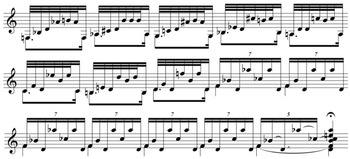
Villa-Lobos also exploits the unique characteristics and potential of the guitar to craft atonal and nonfunctional elements within the concerto. An example can be found in the cadenza, where a fixed position on the guitar (originally an E1-Bb1-D-A♭-B collection) is traversed across the instrument through a series of ascending major thirds and descending minor seconds, while consistently incorporating the guitar's second open string (B) (see Figure 3). This progression ultimately resolves to a D-F-Bb-Cb1-E1-A1 chord, showcasing Villa-Lobos's innovative exploration of sonic possibilities on the guitar within a neoclassical framework.
Excerpt Cadenza Concerto para Violão e Orquestra. Transcription by the author.

Villa-Lobos incorporates several intertextual references to his own compositions within the concerto, including pieces for the guitar such as Study No. 4 and Prelude No. 4. Although these quotations could be interpreted as a response to Segovia's suggestions to base the concerto on preapproved works, they also indicate a stylistic coherence within a broader compositional project. Specifically, the inclusion of the opening of Introduçao aos Choros (Introduction to the Choros, 1929; see Figure 4) and the melody from the second section of Choro No. 5 “Alma Brasileira” (Brazilian Soul, 1925; see Figure 5)—works often regarded as exemplifying Villa-Lobos's anthropophagic modernism of the 1920s—demonstrates that intertextuality served as a means to navigate various (neo)colonial pressures and anxieties. In other words, Villa-Lobos aimed to position the concerto within a broader transcultural framework, alongside accommodating Segovia's requests.
Reference to Introduçao aos Choros. Transcription by the author.

Reference to Choro No. 5 “Alma Brasileira.” Transcription by the author.

The quote from Choro No. 5 is also one of several references to subaltern difference within the concerto. As Villa-Lobos himself explained: “In the first movement's second part ‘Poco Meno,’ a new section begins with an completely original theme, evoking the style of certain melodies of popular songs from Northeastern Brazil.”Footnote 85 Given the prominence of the guitar in northeastern music, it is therefore not surprising that Villa-Lobos employed escalas nordestinas. According to Amorim, Villa-Lobos utilized the Dorian, Mixolydian, and Lydian modes (with a flattened seventh) from these scales to create a sense of diatonicism, as requested by Segovia.Footnote 86 By integrating these musical elements, Villa-Lobos aimed to simultaneously please Segovia's conservatism, seduce imperial listeners via exoticism, ease the tensions enacted by colonial difference among the Brazilian intelligentsia by employing a symbolic form of racial mixture, and fulfill his own desire to renew the guitar languages available at the time. The Concerto para Violão e Orquestra is thus a work shaped by, responding to, and exercising the coloniality of power.
Conclusion
This article has foregrounded the role of colonial difference and the coloniality of power in the modernization of the guitar during the twentieth century. It has explored how actors from the Global South navigate spaces and engage in debates within the Global North, utilizing alterity as a means to gain cultural and social capital. Villa-Lobos, as a complex figure, exhibited a fluidity in his declarations, sometimes embracing and other times criticizing nationalism, universalism, and various musical aesthetics, depending on the context. However, these apparent inconsistencies can be better understood when examined through the lens of coloniality. Villa-Lobos, as a composer from the peripheral elite, sought to navigate and resolve both internal and external (neo)colonial tensions through transculturation. Although his actions and choices were informed by his position within a neocolonial system, he also capitalized on the mechanisms of the coloniality of power, thereby playing a significant role in shaping local epistemologies of difference in Brazil.
Segovia, as a guitarist influenced by Eurocentric and culturally evolutive perspectives, exerted significant pressure on Villa-Lobos. Segovia aimed to modernize the guitar and expand its repertoire by incorporating compositions from nonguitarist composers. Leveraging his expertise in the instrument, he sought to shape these works according to his conservative views during the composition and editorial processes. However, overly emphasizing Segovia's agency in the modernization of the guitar perpetuates imperialistic understandings of art music. Peripheral composers who collaborated with him, such as Villa-Lobos, found ways to navigate and bypass his impositions. The Brazilian, in particular, developed a transcultural and idiosyncratic guitar style that Segovia could not significantly alter.
In questioning purified narratives and facile historiographies of the guitar's modernization, this article has not argued that the entire repertorio segoviano is pervaded by neocolonial overtones. Indeed, other power dynamics beyond coloniality influenced Segovia's collaborations with European composers like Tansman and Castelnuovo-Tedesco, factors such as the peripheral position of the guitar in art music circles, individual agencies and capitals, and varied social, political, and aesthetic positions. By highlighting the tense relationship between Segovia and Villa-Lobos, as well as examining how Villa-Lobos navigated neocolonial pressures in both the Global North and the Global South, I have demonstrated that the repertorio segoviano is far from being a uniformly conservative repertoire. Rather, it is a corpus that contains traces of the messiness of colonial difference and the coloniality of power.
Acknowledgments
Early versions of this article have benefitted greatly from comments by Susan McClary, Daniel Party, Carmen Peña, Mauricio Valdebenito, Alejandro Vera, and two anonymous reviewers, all of whom I thank wholeheartedly. This article is supported by ANID Fondecyt Postdoctorado 3220114 and ANID Millennium Science Initiative Program NCS2022_016
Competing interests
None.
Luis Achondo is Fondecyt postdoctoral fellow at Universidad Católica de Chile. He holds a PhD in musicology and ethnomusicology from Brown University. His research focuses on Latin American expressive cultures in contexts of violence and precarity. His projects have been generously funded by Fulbright, Tinker, and Chile's National Agency for Research and Development, and his work has been published in Twentieth-Century Music, Ethnomusicology Forum, Soccer and Society, and Journal of Musicological Research.



 Open access

