

Introduction
On 2 November 1944, US representative to the United Nations War Crimes Commission (UNWCC) Herbert Pell sought advice from the Secretary of State on a vote between two rival reports on war crimes prosecution.Footnote 1 The majority report reflected dominant thinking within his government and among many US officials. It argued that Germany’s launching of World War II was not itself illegal, and that only Nazi violations of existing laws of war should be prosecuted.Footnote 2
By contrast, the minority report, written by Czechoslovak representative Bohuslav Ečer, advocated a dramatic departure from dominant legal thinking. Ečer advocated retroactively criminalizing the launching of an aggressive war and creating an international tribunal to try Nazi leaders.Footnote 3 Ečer’s report picked up on multiple long-standing debates in legal circles across Europe and the US, but it represented a powerful and original synthesis. Though Ečer was a largely unknown legal scholar representing a small state’s government-in-exile, his arguments helped sway US policymakers, influencing what has since become an enduring international norm criminalizing individuals for aggression, codified in the Nuremberg Charter and later reaffirmed in the Rome Statute founding the International Criminal Court.
Identifying Ečer’s role contributes to Nuremberg’s political history but also reveals a blind spot for IR scholarship on normative change. In their landmark ‘norm life cycle’ model, Finnemore and Sikkink theorize ‘norm entrepreneurs’ as agents with ‘strong notions about appropriate or desirable behaviour in their community’, who push normative change until it reaches a tipping point and cascades through the international system.Footnote 4 They cite the norms of treating medical personnel and the wounded as neutrals or noncombatants as ‘clearly traceable to one man’, International Committee on the Red Cross founder Henry Dunant. Outraged by suffering during the Battle for Solferino, Dunant formulated and promoted new normative ideas that spread through the international system.
Dunant’s advocacy is a poignant example, but who else merits the ‘norm entrepreneur’ label and how should scholars understand their role in international politics? Literature citing Finnemore and Sikkink reveals considerable conceptual stretching, using the term norm entrepreneur to describe diverse actors differently positioned in processes of normative change, including collective bodies such as the EU, the Russian Orthodox Church, Sweden, China, and Microsoft, as well as individuals such as the UN Secretary General and Mia Farrow, among others.Footnote 5 All have undeniable influence, yet few are parallels to Dunant, who both innovated new ideas and advocated them internationally. While some are agents that promoted others’ ideas, others represent structures that helped institutionalize norms. The concept of norm entrepreneurship is thus overly broad, often concealing agency involved in normative change, rather than illuminating it.
To address this gap, we offer a new agentive model of norm entrepreneurship focused on iterative processes of ideational innovation. We advocate building a new bridge between IR and history of political thought (HPT) to trace how agents develop ideas and spread them in their political contexts. Synthesizing Blau’s account of HPT as ‘detective work’ and scholarship on process tracing ideas,Footnote 6 we argue that forensic historical work – which we label ‘idea tracing’ – can provide a richer account of diverse forms of agency involved in normative change. We demonstrate how scholarship can adapt the careful textual analysis methods of HPT to better distinguish ideational innovators from the challengers that refine ideas, and the norm advocates that translate them to key audiences and institutions.
Beyond contributing to historical IR by developing forensic methods to better uncover agency, our model makes multiple contributions to IR theory. First, our model helps inform the use of historical methods to identify inchoate international norms prior to their spread and even assist practitioners interested in nurturing them. Second, and relatedly, our approach helps identify previously overlooked processes of ideational transfer. Only by appreciating the contingency of such transfers can scholarship account for the role of ideas in international politics. Third, by highlighting the oft-neglected ideational antecedents of norms, our approach can help combat biases towards powerful actors and institutions that obscure the diverse contributions of marginalized actors to international politics. By adopting economic models like Schelling’s ‘tipping point’ and the concept of ‘entrepreneurship’ uncritically into accounts of normative change, scholars have ironically skewed an agent-oriented concept towards structural factors. Our model helps rebalance such accounts.
We make this case in five sections. First, we outline agency-relate limitations in scholarship on norm entrepreneurship. Second, we propose our new idea tracing framework. Third, we review existing literature on the criminality of aggression and the gap our empirical contribution addresses. The fourth section, divided in four parts, draws on archival research conducted in three countries (US, UK, and Czechia) and utilizing digital archives to trace the emergence of ideas around the crime of aggression during WWII. We bring this ‘detective work’ together in the illustrative case of Bohuslav Ečer – a largely forgotten legal scholar whose ideas influenced pivotal WWII debates. In the fifth section, we consider alternative accounts of normative change in relation to our case, highlighting our approach’s added value.
Norm entrepreneurship and normative change
Since the rise of constructivism in the late 1980s, IR scholarship on norms has expanded considerably. Commonly defined as ‘a standard of appropriate behavior for actors with a given identity’, scholars initially theorized norms as elements of international politics’ social structure.Footnote 7 Contra rationalists, constructivists demonstrated that norms inform logics of appropriateness that ‘influence both the formation and change of actors’ preferences and identities’.Footnote 8 Over the past two decades, scholarship has expanded to analyze how norms influence behaviour, how they are socialized, and norm emergence – ‘how an idea reaches intersubjective status in a community’.Footnote 9
As this literature has developed, Finnemore and Sikkink’s norm life-cycle model has remained a touchstone, bridging the first generation that sought to demonstrate the explanatory power of norms and the second more concerned with normative change. Their model has three stages. The first, norm emergence, consists of norm entrepreneurs ‘attempt[ing] to convince a critical mass of states (norm leaders) to embrace new norms’. Eventually, these norms reach a ‘tipping point’, leading to the second stage, a ‘norm cascade’, when the norm spreads more rapidly. Finally, in the third stage, actors internalize the norms and they achieve a ‘taken-for-granted’ quality, becoming constitutive of actors’ identities and interests.Footnote 10
Many potential norms do not progress through all three stages. However, because the model is cumulative, norm entrepreneurs have received considerable attention as catalysts of normative change. Subsequent scholarship has thus characterized a wide variety of actors as norm entrepreneurs, ranging from states (large and small)Footnote 11 to multinational corporationsFootnote 12 and powerful individuals.Footnote 13 This scholarship has likewise studied norm entrepreneurship within transnational advocacy networksFootnote 14 and even norm ‘antipreneurship’ to preserve the status quo.Footnote 15
This literature has offered insight into diverse processes of normative change, but also created ambiguity regarding the role of ideational innovation in norm entrepreneurship. First, a lack of clear definition of who (or what) is a ‘norm entrepreneur’ in Finnemore and Sikkink’s model creates confusion regarding whether the term best describes innovators of new ideas, prominent advocates, or early adopting institutions. To their credit, Finnemore and Sikkink mention the utility of genealogy and process tracing methods in studying norm entrepreneurs.Footnote 16 Yet, they do not engage scholarship on historical methods to demonstrate how to differentiate norm entrepreneurs from other power brokers, making this aside seem counter to their focus on structural processes of diffusion. While IR scholars have long recognized the importance of balancing agentive and structural accounts of international politics,Footnote 17 concrete approaches to identifying agents and tracing their impacts on normative change remain scarce. Much scholarship either offers broad structuralist explanations of normative change or contextualist intellectual histories that do not systematically reconstruct how diverse agents innovate, transform, disseminate, and adopt normative ideas.
The ambiguity of the label ‘norm entrepreneur’ does not merely create historical inaccuracies. It also creates multiple downstream biases in the study of norms. First, by crediting states and celebrities as norm entrepreneurs, rather than the thinkers who produced ideas that sway opinion, scholarship often arrives too late in the process of norm emergence to analyze how agents form new ideas and spread them to advocates. Second and relatedly, by neglecting ideational innovation as a process, existing frameworks leave scholars unable to meaningfully analyze the ecology of new ideas that powerful actors adapt and seize upon. Finally, in certain cases, when scholarship gives undue credit to powerful actors, this approach risks overlooking contributions from already marginalized international political actors whose insights are appropriated or distorted downstream in the process of normative change. This is certainly true of our case. Although Ečer was undoubtedly an elite figure in Czechoslovak society, his position was constrained internationally. Coming from a small, occupied state, he was marginalized from negotiations between the four major Allied powers prior to the Nuremburg Tribunal. He faced challenges such as limited English skills and weak networks, which meant that he was only gradually taken seriously in key legal circles. Further, his legacy was largely obscured for 40 years under communist rule and dispersed across multiple archives. By theorizing his oft-overlooked contributions we develop a framework that can be extended to study agents further marginalized due to other hierarchies in the international system (including racist, imperialist, and gender-based).
An ideational model of norm emergence
Our argument joins what Jennifer Pitts refers to as an emerging ‘historicizing moment’ in scholarship on international law,Footnote 18 which, we note, joins the broader rise of the historical IR research community.Footnote 19 Scholars have demonstrated multiple advantages of turning to history in the study of international law, including preventing anachronism, illuminating the ‘productive power’ of law in codifying ‘particular hierarchies of social order’,Footnote 20 and even encouraging legal practitioners to identify ‘hidden legal potentials’ to ‘generate more progressive outcomes’.Footnote 21 In particular, our approach builds on the pioneering work of Martti Koskenniemi, who employed intellectual history to capture shifts in ‘attitudes and preconceptions about matters international’ that constituted a ‘sensibility’ conducive to the codification of international legal principles.Footnote 22 In his From Apology to Utopia, Koskenniemi began a research program that analyzed developments in international law through ‘argumentative chains seen through a historical perspective’ and he expanded on this approach in his subsequent Gentle Civilizer of Nations to further situate international legal practitioners in their historical contexts.Footnote 23 While his work did not specifically theorize agency in ideational innovation or engage scholarship on norm entrepreneurhsip, it nonetheless demonstrates historical methods’ ability to combat the structural determinism of dominant approaches and highlight the contingent role played by international legal practitioners.
While these contributions note the potential of history to reveal both broader ideational and structural developments, we turn to methods developed in HPT for a more specific purpose – highlighting the role of agency in normative change. Our work thus takes inspiration from the Cambridge School tradition of HPT as pioneered by Quentin Skinner, which stressed authorial intention instead of uncovering timeless ideas or broader social contexts.Footnote 24 We agree with Skinner that ‘ideas presuppose agents’ and argue that, by studying how ideas in historical texts reveal authors’ intentions in addressing real world political problems, we can better grasp the contingent role of agency in normative change.Footnote 25 However, in contrast to previous scholarship on the history of international law, our focus is on adapting HPT methods to IR to help identify the complex pathways ideas take and, therefore, better understand the origins of normative change.
To help capture ideational development, we advocate a thicker definition of ideas. Much IR scholarship on ideas has stripped them down to their core elements, defining ideas as, for example, ‘beliefs held by individuals’ or ‘knowledge, values, and strategic concepts’, to better capture their discrete causal impacts on decision-making.Footnote 26 By contrast, we define ideas as proposals or plans of action and normative ideas as proposals to achieve values-based goals. This conceptualization helps historicize ideas by linking them to the problems they are developed to address, allowing for richer accounts of both change over time and how texts respond to their audiences and circumstances. We emphasize that agents sharing common underlying beliefs nonetheless often introduce distinct proposals for achieving these goals to respond to unique political circumstances. For example, while the underlying normative belief that slavery is wrong motivated abolitionist politics for centuries, our thicker definition of ideas as proposals to achieve abolition in the face of shifting political constraints allows for richer analysis of how approaches developed over time, including, for example, plans for revolution, manumission, revolt, and emancipation via democratic procedures. This definition thus encourages a relational understanding of agency, situated in its socio-political context.Footnote 27 In developing ideas for texts, agents must consider not only the merits of the proposal, but also the broader political context that constitutes the problem, the likely audience, the genre of the writing, its presentation and publication, and an array of other contextual factors.
Though we take inspiration from HPT, our framework adapts these historiographic insights to the social scientific mores of IR, specifically by demonstrating how HPT can inform process tracing methods investigating the role of agency in ideational development.Footnote 28 We refer to ours as an ‘idea tracing’ model which consists of three stages: ideational innovation, ideational refinement, and ideational transfer. Though the contextual origins of ideas stretch back endlessly in time, this model focuses on how agents produce texts to solidify free-floating ideas and convey them to relevant audiences. Ideas themselves may not be directly empirically observable, but (in the language of process tracing) they have distinct observable implications in texts they inspire. Our approach thus offers a methodological toolkit for scholars to bring the rich detail characteristic of HPT to bear on debates in IR.
The first stage of our model concerns the initial process of ideational innovation and the analysis of primary texts. Adrian Blau adopts the metaphor of detective work to guide analysis of texts’ meaning.Footnote 29 Like detectives, Blau writes, textual interpreters assemble as much relevant evidence as possible, including primary texts, supplementary texts speaking to motivations, other texts cited by or known to have influenced the author, and relevant information on historical context. Additionally, through careful examination of how scholars adapted past ideas to new problems, scholars can discern authors’ creative input. Though traditional ‘Whiggish’ histories may overstate the enduring innovations of acclaimed thinkers,Footnote 30 analysis more sensitive to authors’ contexts may identify creativity in the way authors repackage, synthesize, and adapt existing ideas to meet new political circumstances. Drawing on these materials, historians of political thought abductively form hypotheses about what authors intended – they interpret texts in relation to evidence, remaining open to alternative arguments and what new evidence might tip scales in their favour. Though evidence often underdetermines potential conclusions and new evidence or arguments can continually be brought to bear on debates, falsifying some hypotheses or lending support to others. Following Blau, Fleming refers to this as a ‘forensic’ approach to understanding texts’ meaning according to primary source evidence.Footnote 31
The second stage of our model builds on existing work on argument in IR, but shifts its focus to ideational development. Rather than highlighting how arguments translate directly to political action via persuasion and compromise,Footnote 32 we highlight how multiple potential challenges to ideas – including arguments, new evidence, or contextual changes – push agents to refine ideas themselves. In this sense, while challenges can serve as a distal cause of political action, they do so only via an intermediary stage in which another actor accepts an idea following a challenge. Our model thus understands challenges to ideas as leading to one of four options: a rejection of all potential ideas and push for further innovation, a single idea’s victory, synthesis of multiple ideas into a new one, or the proliferation of potential ideas that have remained viable. This final option of proliferation is poorly captured in existing literature’s focus on connecting ideas to policy outcomes, but vital (particularly in our case) to understanding the often-unlikely journeys of ideas in becoming reasons for political action.
The final stage of our model focuses on the transition from subjective to intersubjective. It captures how novel normative ideas are taken up by norm advocates and promoted as candidates for shaping broader normative change. Here, in keeping with our Cambridge School of HPT-inspired approach, we further emphasize the agency of audiences.Footnote 33 While much scholarship on norm entrepreneurship insinuates a process of passive internalization, we highlight the contingency of transfers from ideational innovator to norm advocate and onwards. In rare cases like Dunant, the innovator of an idea serves as its first prominent advocate in the international arena. However, more often it is actors who already possess international prominence, and not ideational innovators themselves, that have the relevant social capital to advocate ideas to broader international political audiences.
Together, these stages disaggregate the label of norm entrepreneurship into component parts. Each stage is deeply influenced by structural factors but catalyzed by agency. The framework we offer facilitates idea tracingFootnote 34 to help locate agency in norm entrepreneurship.
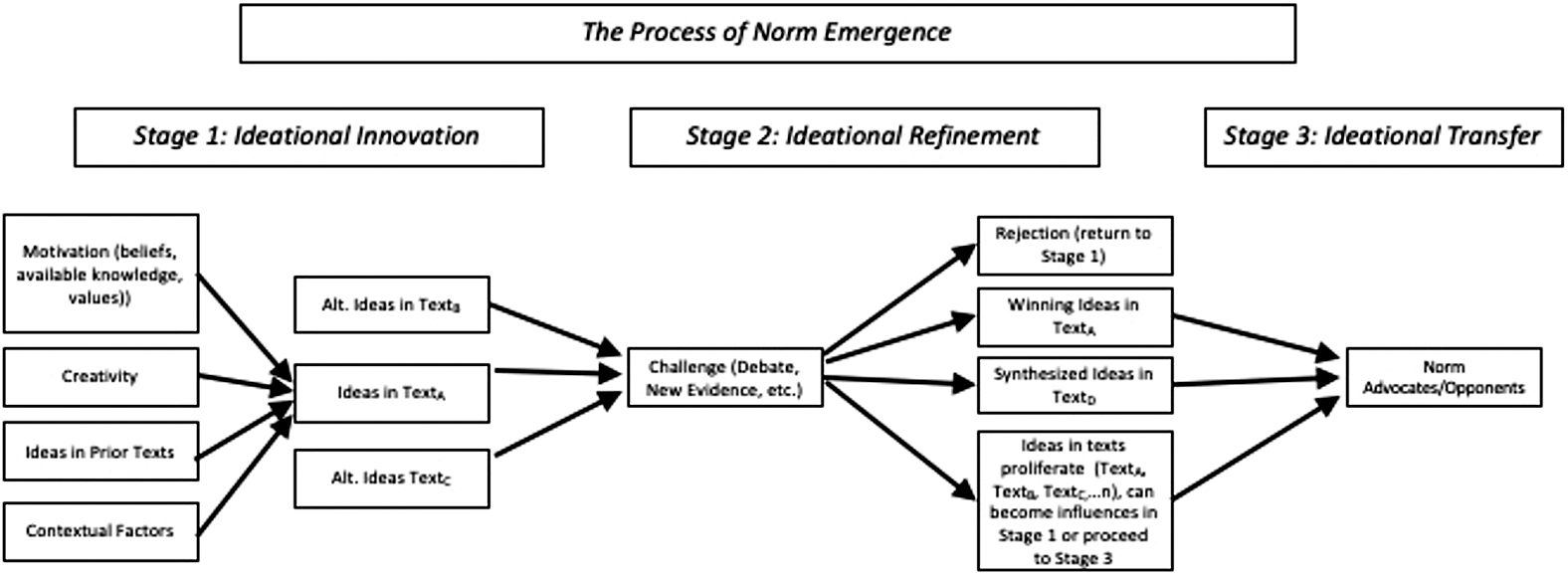
Like Finnemore and Sikkink’s, our model is ideal-typical. Though presented sequentially, it is best understood as an isolated linear pathway within an iterative process, situated in a complex open system.Footnote 35 Typically, prior to being adopted by norm advocates and spreading socially, multiple challenges and thinkers exert their influence on ideas. Our case highlights two prominent challenges prior to Ečer’s ideas’ adoption by key American policymakers. Likewise, ideas do not necessarily proceed through the stages and many ideas that fail to gain traction nonetheless serve as motivation for subsequent innovation.
Because of this non-linearity, we advocate investigating the emergence of specific norms by working forensically, in a detective-like fashion, building an explanatory narrative from available evidence. This process begins by focusing on a particular norm and its history – drawing on existing accounts of the norm’s emergence or archival materials to identify gaps, contradictions, or limitations in dominant explanations. Having identified an area for further empirical investigation – a ‘crime’, in our metaphor – scholarship then works backwards, assisted by the model, abductively forming a working theory of the case. Though this theory may inevitably be incomplete or flawed, it serves as a hypothesis to focus empirical analysis, generating observable implications to identify in primary materials. If the hypothesis survives empirical tests and refinement, a narrative account emerges tracing this pathway over time. And because available primary evidence often underdetermines any given account, resulting narratives can subsequently be compared with alternatives to judge their relative strengths and weaknesses. Though detectives often may never establish with complete certainty a discrete pathway, this process often allows them to identify what happened beyond a reasonable doubt. The resulting agentive account can then be put in conversation with more structurally oriented analysis to offer a multifaceted picture of normative change.
Working backwards from the Nuremberg Charter
Before World War II, international criminal law was a piecemeal, largely unenforced, and underwhelming field – more a political and normative goal than a substantive area of jurisprudence. The primary examples of international legal precedents at the time, the 1899 and 1907 Hague Conventions, were limited in scope and lacked enforcement mechanisms.Footnote 36 Following World War I, the Allied governments created the Commission on Responsibilities at the Paris Peace Conference to debate individual responsibility for war crimes. Ultimately, the Allies included Articles 227–230 in the Treaty of Versailles stating they would prosecute Kaiser Wilhelm II for an unspecified ‘offence against international morality’ and other German leaders for ‘violation of the laws and customs of war’.Footnote 37 However, few Germans were ultimately prosecuted and the Kaiser avoided trial, living in exile in the Netherlands until his natural death in 1941.Footnote 38
The Nuremberg Charter, negotiated at the London Conference in the summer of 1945, sought to overcome existing precedents’ shortcomings and codify new frameworks to hold leaders of belligerent regimes accountable. IR scholarship, as well as work in history and international law, has thus identified Nuremberg as pivotal in transforming normative ideas into international legal standards.Footnote 39
Among the norms the Nuremberg Charter codified, a particularly important one stemmed from Article 6, holding individual political leaders criminally responsible for ‘planning, preparation, initiation or waging a war of aggression’.Footnote 40 This individual-level criminalization constituted a milestone in long-standing international efforts to ban war that dated back to the Congress of Vienna in 1815.Footnote 41 It has since become a foundational principle of international criminal law. Beyond the failures of the Versailles Treaty, two additional developments encouraged the shift. First, the Covenant of the League of Nations (LoN), adopted in December 1924, included in its preamble that the contracting parties (states) premised the organization’s development on ‘acceptance of obligations not to resort to war’.Footnote 42 Second, in 1928 the leaders of 15 states – including the US, Germany, the UK, France, Japan, and Italy – signed the Kellogg-Briand Pact that condemned recourse to war and bound states to settling disputes through ‘pacific means’.Footnote 43 Eventually, 47 more states would sign, representing a majority of the world at the time.Footnote 44 However, while these treaties constituted major steps in developing an international norm against using war as an instrument of national policy, they lacked specificity or clear enforcement mechanisms. Their limitations became clear after Japan’s 1931 invasion of Manchuria, which was referred to the LoN for deliberation but failed to result in consensus regarding consequences at either the individual or state level.Footnote 45
Existing literature on the Nuremberg Charter’s Article 6 reveals several gaps regarding how these inter-war efforts ultimately transformed into Nuremberg’s holding individuals criminally responsible for wars of aggression in front of an international tribunal. Traditionally, scholarship focused disproportionately on the US, as the American position dominated the 1945 London Conference.Footnote 46 This scholarship credits the leadership of US Chief Prosecutor and Supreme Court Justice Robert Jackson,Footnote 47 as well as the pivotal behind-the-scenes role of Lieutenant Colonel Murray C. Bernays, who authored pivotal US policy documents in late 1944 and worked closely with Jackson in London into the summer of 1945.Footnote 48 Jonathan Bush has alternatively highlighted William Chanler, an attorney in the War Department, whose letters on the definition of war crimes were passed to Secretary of War Henry Stimson in late 1944.Footnote 49
Recent scholarship has begun to demonstrate that these American accounts have been biased and disproportionately focused on norm advocates, occluding pivotal ideational innovators, particularly those outside the English-speaking world. Francine Hirsch has written on the Soviet experience at Nuremberg and highlighted the legal ideas of Aron Trainin, a legal scholar who was part of the Soviet delegation to the 1945 London Conference. In July 1944, Trainin published The Criminal Responsibility of the Hitlerites arguing that Nazi leaders could be held accountable for crimes against peace by establishing their complicity in a conspiracy undertaken by the criminal Nazi party organization. By late 1944 this text had been translated into English and circulated among Allied policymakers, including Ečer.Footnote 50 However, as we demonstrate, Trainin’s formula for holding individual Nazi leaders responsible for crimes against peace via their complicity was ultimately rejected by American policymakers and Bernays turned to Ečer’s alternative ideas, which omitted Trainin. Though he was certainly an ideational innovator with regards to other points of the Charter, Trainin’s influence on this issue was indirect.
Alternatively, a new strand of scholarship has returned to the years prior to the London Conference to uncover multiple important, yet oft-misunderstood fora in which prominent political and legal thinkers debated various issues related to punishing war crimes.Footnote 51 These included the UNWCC and its more academic predecessors, the 1941 Cambridge Commission for Penal Reconstruction and Development, and the 1942–1943 London International Assembly (LIA).Footnote 52 While the Cambridge Commission and LIA were not government affiliated, the UNWCC was founded in October 1942 as an Allied international organization to document war crimes via reports from occupied countries.Footnote 53 A year later, at a meeting of Allied representatives establishing the commission, UK Lord Chancellor John Simon recognized the UNWCC would require a ‘Committee of legal experts’ to advise Allied governments on what actions constituted war crimes worth documenting.Footnote 54 The UNWCC thus expanded to develop two (sometimes competing) mandates. First, it compiled lists of war criminals in both Europe and Asia for eventual prosecution – in whatever form. Second, it spawned a series of committees – including its often-radical Legal Committee (Committee III) – which debated the legal issues at stake. The UNWCC forwarded recommendations to Allied governments and, occasionally, sought press coverage for its work.
For decades, the UNWCC’s importance went unappreciated, reflecting the dismissive attitudes of many leaders from the period. Throughout its existence, the USSR refused to participate in protest of its Union Republics not being granted seats. Though the US and UK sent eminent representatives – Pell was a former ambassador and congressman, and a friend of President Roosevelt – senior leaders frequently derided the UNWCC as feckless and undermined its initiatives. Until 1945, Winston Churchill rejected the very idea of trying Nazi leaders, favouring instead summary executions.Footnote 55 Even as US leaders embraced the idea of an international tribunal in late 1944, many still regarded the UNWCC – which had argued precisely for that outcome – with derision. In a January 1945 joint memo on war crimes for President Roosevelt prior to the Yalta conference, the US Attorney General, Secretary of State, and Secretary of War dismissed the UNWCC as having ‘no investigative or prosecuting authority’, adding that it had ‘been widely and publicly criticized for the paucity of the results of its work’.Footnote 56 Likewise, Telford Taylor, an assistant to Jackson at Nuremberg, wrote in his memoir that the UNWCC was ‘politically weak’ and ‘played no significant role in shaping the Nuremberg enterprise’.Footnote 57
However, recent scholarship, building on the release and digitization of the UNWCC archive, has begun to uncover the impact of the LIA, UNWCC, and other wartime fora via non-traditional channels.Footnote 58 A core contribution has been identifying oft-overlooked figures influential in the emergence of norms on international criminal law. These included East European thinkers like Hersch Lauterpacht and Raphael Lemkin, who advocated concepts such as crimes against humanity and genocide, respectively, as well as less familiar names we reference below.Footnote 59 As von Lingen argues, these thinkers – most of whom were exiled in London during World War II – constituted an ‘epistemic community’, whose ideas laid the groundwork for rapid advances during the Nuremberg process.Footnote 60
Our work builds on these findings, unravelling the skein of linkages from this period to trace the development of ideas regarding individual responsibility for wars of aggression. Within the UNWCC’s epistemic community, Bohuslav Ečer’s ideational innovation stood out, as did the surprising consonance between his synthetic ideas and those eventually codified in the Nuremberg Charter.Footnote 61 This led us to abductively hypothesize that Ečer constituted an important innovator of ideas later codified at Nuremberg, including the criminality of aggression. Further, while researching Ečer, we found evidence that his political thought and activism were obscured by the post-war Czechoslovak communist government’s suppression, supporting our hypothesis that his contributions were overlooked.Footnote 62
To identify the intellectual linkages between Ečer and key norm advocates at the London Conference, we consulted physical archives in Prague, London, Washington, and Wyoming, as well as digital archives of the UNWCC, the Truman Presidential Library, the US Department of State, and Yale Law School. We developed an initial chronology and then, drawing on our model, traced his ideational development through our three stages. In the first stage, we focus on Ečer’s early ideas, developed during his exile in France. The second stage is divided in two parts, reflecting development via challenges at the LIA and UNWCC respectively. In the third stage, we trace Ečer’s subsequent influence, following linkages outside the UNWCC to an initial norm advocate, Murray Bernays, and, ultimately, Robert Jackson. In each, we employ both in-depth textual analysis and further forensic process tracing via correspondence, minutes of meetings, and other official documents.
Bohuslav Ečer as norm innovator
Stage 1: Ideational innovation
Ečer’s biography and early work reveal key motivations, context, ideational influences, and early texts (most notably his MA thesis) that he refined substantially for the LIA and UNWCC. Born in 1893 to the large family of a travelling salesman in Moravská Hranice, Moravia (then Austria-Hungary), Ečer worked as a manual labourer from an early age to support his family.Footnote 63 These experiences inspired socialist sympathies and he became an active member of the Communist Party in Czechoslovakia,Footnote 64 only to be expelled in 1928 for criticizing the influence of the USSR.Footnote 65 He subsequently joined the Social Democrats and became deputy mayor of Brno in 1935.Footnote 66 Socialism provided early ideational influences, though Ečer’s activism was also later informed by the context of Nazi influence in Czechoslovakia. In September 1938, Ečer delivered eight lectures in London on why Britain should resist Hitler.Footnote 67 Enraged by the Munich Agreement that granted Hitler German-inhabited Sudetenland, Ečer returned the following month on another tour.Footnote 68 The West’s Munich ‘betrayal’ proved a core motivation for Ečer’s activism and proof of ‘German criminality’.Footnote 69 After the war, he reflected that he’d been inspired to ensure there was ‘[n]ever again another Munich under a different name’.Footnote 70
After the 1939 Nazi occupation of Czechoslovakia, Ečer was allegedly interrogated twice by the Gestapo. He fled to Belgrade in 1939,Footnote 71 then to Paris in 1940 and, upon the Nazi invasion of France, to the free port of Marseille.Footnote 72 During this period, Ečer consolidated his ideas about Nazi criminality while studying for a graduate degree in Nice.Footnote 73 His 1942 MA dissertation, handwritten in French, made initial arguments he would further in London, including that the war was illegal and that an international tribunal should be convened to try Nazi leaders for launching it.Footnote 74 Recognizing that existing international criminal law was insufficient to achieve these ends, Ečer argued for political initiative to create new norms that would deal with ‘crimes against humanity as a whole’.Footnote 75 Ečer drew on diverse French, English, and Czech political and legal theorists to make his core arguments, including Friedrich Martens, Emer de Vattel, Henri Donnedieu de Vabres, and H. Hale Bellot. His dissertation referred to the war as a ‘monstrosity’ and, in letters from the period, he indicated his core motivation was to find a legal formula to remedy injustice against small states in Eastern Europe and exact revenge for Munich, the 1939 executions of students in Prague, and, later, the June 1942 German massacres in Lidice and Ležáky following the assassination of Reinhard Heydrich.Footnote 76 Though the dissertation lacked the specificity of his later work, the core ideas Ečer embraced during this period were the criminality of launching the war itself – and not merely war crimes taking place within it – and that political initiative was required to change international law to retroactively hold German leaders responsible.Footnote 77
Stage 2a: Ideational refinement at the LIA
On 6 October 1942, Ečer arrived in London, where he would lead the Czechoslovak delegation at the LIA. Though an unofficial forum, the LIA transmitted recommendations to the US and UK governments and hosted numerous experts and governmental officials, including future Nobel laureate René Cassin, Dame Adelaide Livingstone, and former UK Lord Chancellor Frederic Maugham. Four days after arriving, Ečer authored an initial memo restating his motivations: ‘[t]his craving [for justice] is perhaps even stronger than the desire for food. … The human society, then, which has been attacked, maimed and outraged by criminal aggressors is entitled to bring them to trial and to inflict due penalties upon them’.Footnote 78 The LIA would prove a pivotal forum in refining Ečer’s ideas. In less than a year, he authored five reports advocating sweeping changes in international law, debating peers to strengthen arguments for the UNWCC.
At the LIA, Ečer focused on three primary challenges to holding Nazi leaders accountable. First were the dominant legal doctrines of nullum crimen sine lege (there is no crime without a law) and nulla poena sine lege (there is no punishment without law), which together implied that any actions taken by Germany which were not illegal when taken could be neither prosecuted nor punished. Due to the dearth of existing international criminal law, this doctrine would constrain Allied efforts at bringing Nazi leaders to justice. Second was the risk that Nazi war criminals would employ the ‘plea of superior orders’ to claim they were solely following orders of their superiors. This eventually became known as the ‘Nuremberg defense’, as it was employed even by members of Hitler’s inner circle. Third, and finally, the doctrine of sovereign immunity meant that, even if Nazi leaders were found to have violated law, foreign courts would not have jurisdiction. Taken together, these constraints made international criminal law a far more limited tool than Ečer desired.
Some LIA members – including its chairman, the Belgian judge and future UNWCC member Marcel de Baer, and the UK’s Viscount Maugham – recognized these barriers as legitimate and thus offered an array of workarounds to facilitate the prosecution of select Nazis by an international tribunal under existing conventions.Footnote 79 Ečer, however, saw them as mere political obstacles to be navigated via innovative thinking. He clashed with these more prominent members, arguing that ‘the Nazi regime has created a moral situation unheard of and unanticipated by classic penal codes and by the classic penal doctrine’ and thus political initiative was required to create new precedents that would facilitate the retroactive prosecution of Nazi leaders.Footnote 80 Ultimately, Ečer refined four key ideas at the LIA that would enable international tribunals to hold individuals responsible for aggression: the criminality of aggressive war, the idea of collective responsibility, the illegitimacy of the defense of superior orders for Nazi war criminals, and the idea that sovereign immunity did not apply during wartime. Though not uniformly adopted, Ečer helped pull the conference in a more radical direction through intense intellectual exchanges.
First, Ečer argued that launching and conducting an aggressive war was a crime under existing laws, not a legitimate tool of statecraft. Though members of the LIA largely agreed that Nazi Germany was morally at fault for launching WWII, some, including de Baer, argued that because treaties like Kellogg-Briand did not reference criminality or punishments, they could not be prosecuted.Footnote 81
Ečer disagreed, arguing that negotiating Nazi liability in a peace treaty would dilute justice as had occurred following World War I. He argued that the Kellogg-Briand pact provided an impetus to create new precedents criminalizing aggressive war that could be enforced retroactively. Echoing his master’s dissertation, Ečer wrote that treating aggressive war as the foremost international crime ‘correspond[ed] to the spirit of the Pact, its purpose and meaning’. He acknowledged that ‘the Pact does not speak in the language of criminal law, that it is only half finished, and that it does not lay down either sanctions or penalties. It bears all the marks of a compromise solution. That is why it completely failed as an instrument of prevention’. However, it could also be used as ‘a means for punishing the authors of a war’ as ‘[i]t is in the interest of justice that the leaders of Germany and the other Axis States should also be expressly condemned for this greatest and most fundamental crime of theirs: the preparation and launching of the Second World War. This is also in the interest of the new world order of peace’. Ečer directly confronted the LIA Chairman, arguing his proposal was a roundabout means of pursuing the same goal. ‘Even de Baer feels it’, Ečer wrote. ‘Whether the Germans agree or not is, of course, of minor importance’.Footnote 82
The next ideas Ečer developed and promoted at the LIA were the collective responsibility of Nazi organizations and the illegitimacy of the defense of superior orders. Fear that Nazi leaders would evade responsibility by arguing that they were merely following superior orders from Hitler motivated extensive debate at the LIA. A sub-committee note on the subject recalled that following WWI Paul von Hindenburg offered to declare himself solely responsible for German war crimes, thereby absolving all others.Footnote 83 The Dutch representative and future UNWCC representative, J. M. de Moor, compiled relevant legal precedents for dealing with the defense of superior orders in European states and suggested multiple principles for Allied courts to consider, including the degree of unlawfulness of the war crime, the knowledge a defendant would be expected to have of its unlawfulness, the difference in rank and position between the defendant and superior, and the degree of discretion the defendant was likely to have had to disobey.Footnote 84
Ečer disagreed. He believed Nazi Germany’s crimes made a mockery of previous precedents, creating a political need for new legal standards. Still polishing his English, on 29 March 1943, Ečer submitted a second report in French arguing that ‘it is not solely criminal individuals, but larger categories entirely of people that are in advance in accord with all of the crimes, accepting criminal orders not as a constraint but, on the contrary, like a natural thing’. Ečer cited the handbooks governing membership in varied Nazi organizations, including the Nazi Party, the SA, the SS, the Waffen-SS, the police, the Gestapo, and the civil service. In contrast to conscripted soldiers in the German military, Ečer argued that these organizations were voluntary. Though the organizations mandated following superior orders, members joined voluntarily, and were, according to the organizations’ by-laws, permitted to leave when they felt they could no longer complete their duties. For Ečer, this meant members of these organizations were collectively responsible for the group’s war crimes. ‘The juridical situation of these Germans is similar to that which a member of a voluntary criminal gang finds himself in. The crimes they are ordered and they execute are their own crimes!’ Ultimately, Ečer rejected the plea of superior orders for these members.Footnote 85 This comparison of Nazi organizations with gangs would eventually join related French and Soviet arguments (notably Aaron Trainin’s), as well as US advocacy to help mould precedent at Nuremberg.
The final point Ečer innovated at the LIA related to limitations on the doctrine of sovereign immunity. Chairman de Baer had previously written with regards to the Kellogg-Briand Pact that ‘there is no way of imposing a judicial punishment on a statesman for merely having violated a treaty’, reflecting widespread assumptions that the doctrine of sovereign immunity meant Axis leaders could only be dealt with politically or militarily.Footnote 86
Ečer, again, favoured a radical departure to hold heads of state accountable in court. He argued that, considering ‘the totalitarian States and especially the German Nazi State … [t]he notion of sovereignty appears now in a new light’ and, therefore, the ‘jurist must infer the legal consequence: he must try to master this new reality by law’.Footnote 87 He reviewed a wide array of historical precedents, including German leaders’ impunity following WWI, to argue for a new approach.
The immunity of Heads of State from the criminal jurisdiction of foreign States is based upon the mutual respect of sovereignty between the States who are members of the international community; When a Head of State or his State systematically violates this mutual duty and especially when his State invades or occupies a foreign country or a part of it, against its will, or engages into the war with a State as a consequence of such an aggression, he loses the right to personal immunity towards his adversary.Footnote 88
According to Ečer, Allied leaders should try Axis Heads of State in a court ‘and not by a political body’ to avoid making their crimes subject to post-war political negotiations. Though, with regards to the other three ideas, Ečer’s and alternatives proliferated after the LIA, on this point Ečer’s idea won out. Convinced by his report, the LIA voted to recommend that ‘an International Criminal Court, and not a political body’ have jurisdiction over Axis leaders.Footnote 89
Stage 2b: Ideational refinement at the UNWCC
At the Moscow Conference of October 19–30, 1943, Churchill, Roosevelt, and Stalin signed a joint declaration declaring their intention to send war criminals ‘back to the countries in which their abominable deeds were done in order that they may be judged and punished according to the laws of those liberated countries’.Footnote 90 Yet many Allied leaders (namely Churchill) still believed top Nazi leaders should ultimately face summary executions, rather than fair trials. The idea of an international tribunal was, at the time, a fringe position.
Ečer became the Czechoslovak government-in-exile’s primary representative to the UNWCC in London when it began in October 1943. He would ultimately resign in the summer of 1945 in protest of the UNWCC’s marginalization, three years prior to its completion, and use his German language ability to assist in Allied interrogations of captured Nazi leaders. Nevertheless, he proved an outspoken participant who did not shy away from conflict, noting in a January 1945 letter that he had already attended 150 meetings, given six presentations, delivered 14 lectures, and published seven papers.Footnote 91 Ečer understood his responsibility as persuading commission members from major powers of his approach – particularly the UNWCC’s first Chairman, the UK’s Cecil Hurst. ‘It was not a pleasant polemic with the honourable and old Englishman, but it was necessary so that there are no confusions in our work from the start’.Footnote 92
Ečer’s first report to the UNWCC’s Committee III, submitted in April 1944, addressed the pivotal question of the commission’s mandate. He argued that the Allies should reimagine the category of war crimes to include the broader crime of aggression and downstream barbarities. The document returned to a variety of arguments from the LIA, supplemented with references to Allied leaders’ recent public statements, to again argue Nazi aggression was criminal. He concluded, ‘the preparation and launching of the present war are crimes not only in moral or historical sense but in the sense of and according to the criminal laws of the invaded countries, and at the time crimes against the whole of mankind according to the general principles of international law’. He added that these prior treaties, coupled with recent statements from Allied leaders like the Moscow declaration, should be understood as ‘successive expressions of a general will in statu nascendi’ on the necessity to prosecute the ‘fundamental crime’ of aggression.Footnote 93
Ečer’s report persuaded Committee III,Footnote 94 but the UNWCC’s chairman had the issues reopened by a sub-committee consisting of Ečer, the US Deputy Representative Hodgson, de Moor, and an outside expert – British legal theorist Arnold McNair, who had previously participated in the 1941 Cambridge Commission. On 18 August 1943, McNair submitted a note objecting to Ečer’s views. He began by writing that he was ‘dealing with the lex lata [existing law] and not with the lex ferenda [future law]’. He thus wrote that ‘to assume that the United Nations intend to adhere to the view that retrospective criminal legislation, whether it may take the form of a multi-partite treaty or of municipal statutes, is contrary to accepted principles of law’. McNair interpreted violations of treaties like Kellogg-Briand as ‘analogous to a breach of contract or to a delict but not to a crime, as is evidenced by the general rule that only compensatory damages, and not penal or vindictive damages, can be awarded against a State’. He opined that no judge, operating within an American or English legal system, would agree that violating the treaty was criminal and argued it would be a ‘profound mistake’ for the UNWCC to promote that interpretation. In his conclusion, he extended this argument beyond the question of aggression to Ečer’s other core arguments – including about the plea of superior orders and the immunity of heads of state – arguing that the UNWCC should accept the limitations of existing international criminal law.Footnote 95
On 27 September 1944, the sub-committee endorsed McNair’s note with Ečer casting its sole dissenting vote. Ečer later wrote that the conflict had become a ‘wrangle between an excellent British expert of international renown and a Czechoslovak delegate of a very little known name’.Footnote 96 Ečer decided to author a minority report reiterating his views and rebutting those of McNair.Footnote 97
Ečer’s minority report became a key document of his career. He drew on the wide array of evidence accumulated through his wartime activism. First, he argued that successive international conventions – including the LoN Covenant and Kellogg-Briand – revealed the intentions of the ‘public conscience’ to outlaw aggressive war. He supported this argument with citations to scholars and commentators, as well as statements from Stalin, Churchill, and Roosevelt. Further, he cited commentary on the pacts from then US Secretary of War Stimson, Briand, and Kellogg themselves, as well as the writings of UNWCC peers including Renée Cassin and Marcel de Baer. He concluded that ‘Public opinion entirely approves all these declarations, statements or views’ and that ‘“[p]ublic conscience” is an important source of law in general and of international law in particular’. This argument furthered multiple conclusions he had developed previously: first, that preparing and launching the war should be considered ‘crimes against the whole of mankind according to the general principles of international law’; second, that Axis leaders should not have immunity in front of foreign courts; and, third, that these issues were squarely within the UNWCC’s mandate.Footnote 98
On October 10 and 17, 1944 McNair and Ečer’s rival reports were debated by the entirety of the UNWCC. Ečer opened the first session with a direct challenge to the commission’s conservative members, warning that ‘[t]his law could really kill justice if it were interpreted in a narrow sense’.Footnote 99 Ultimately, the Australian, Yugoslav, Chinese, and Polish representatives supported Ečer’s conclusions over McNair’s, while the US Deputy Representative and French representative André Gros (a future London Conference participant), agreed in part with Ečer, arguing that ‘the preparation of aggressive war [is] a crime, though it is not a war crime’.Footnote 100 However, due to a lack of consensus, the commission moved to send the reports to member governments for consultation. Though multiple governments issued statements in support of Ečer’s minority report, the US, UK, and others failed to respond.Footnote 101 The result was what we refer to as ideational proliferation with the two alternative proposals circulating among Allied policymakers and no resolution at the UNWCC.
Stage 3: Ideational transfer
By mid 1944, an eventual Allied victory seemed likely, yet no major power had formulated an official policy on how to deal with post-war justice.Footnote 102 The UNWCC had issued multiple proposals, but these were predominantly advocated by Allied governments-in-exile, not major powers. Scrambling to fill the vacuum, policymakers in Washington, London, and Moscow began debating proposals to supersede the UNWCC and its small state membership. Nevertheless, the dominant approaches cultivated by leading powers – especially the US – were not formulated de novo, but rather built upon existing ideas. In this way, Ečer’s ideas found powerful advocates among US policymakers.
In summer 1944, Lieutenant Colonel Murray Bernays, head of the War Department’s Special Projects Office, was charged with formulating the US approach.Footnote 103 In a June 1945 letter to his wife, he reflected on parallel constraints to those Ečer had faced. ‘The trouble was that the lawyers in this field were thinking traditionally, whereas international law, which is statesmanship taking form in law, can only be handled by men who think creatively’.Footnote 104 Ultimately, Bernays would draw on Ečer’s innovative ideas, refining them further and serving as an important norm advocate.
On 15 September 1944, Bernays authored a memo building on ideas that rhymed more with Trainin’s than Ečer’s. Bernays suggested charging members of ‘the Nazi Government and its Party and State agencies, including the SA, SS, and Gestapo’ with ‘conspiracy to commit murder, terrorism, and the destruction of peaceful population in violation of the laws of war’. This would then allow the court to find ‘[t]hat every member of the Government and organization on trial is guilty of the same offence’.Footnote 105 Though the Secretaries of State, War, and Navy initially endorsed Bernays’ proposal to the president,Footnote 106 it generated pushback, leading to its rejection. Judge Green Hackworth, for example, raised doubts about the nature of the crime to which Nazi organizations would be charged with conspiring. A subsequent draft contended that the Nazis conspired to ‘achieve domination of other nations and peoples by deliberative violation of the rules of war’, but this formulation raised further questions surrounding the nature of ‘rules of war’.Footnote 107 Assistant Attorney General Herbert Weschler denounced Bernays’ proposal as deviating too far from existing international criminal law, while Joseph E. Davies, whom Roosevelt had appointed to coordinate war crimes policy, opposed Bernays’ conspiracy formulation and the idea of retroactive legislation.Footnote 108
The debate between Ečer and McNair reached US policymaking debates at this crucial moment, as Bernays’ initial plan lost steam and he searched for creative alternatives. On 2 November 1944, Pell forwarded Ečer’s minority to the Secretary of State seeking advice on how to vote.Footnote 109 Upon receipt, Ečer’s ideas quickly circulated among US policymakers. The Secretary of State forwarded the dueling reports to Secretary of War Henry Stimson on November 15 and, 12 days later, Stimson responded instructing Pell to postpone a final vote. Though the UNWCC was solely an advisory body, Stimson noted that a US vote would be ‘referred to and cited in any future consideration of the subject’. Stimson wrote in a postscript that he regarded the debate as ‘so important, – that I request an opportunity for the expression of my personal views by the Sec’y.’Footnote 110
Though this delay left the Ečer-McNair debate unresolved in London, unbeknownst to the UNWCC its contents were picked up by American policymakers. The exact number of leading US officials that encountered Ečer’s minority report is uncertain, but it included Secretaries of State Hull and Stettinius, Secretary of War Stimson, Bernays, William Chanler, and the Judge Advocate General’s (JAG) office.Footnote 111 Bernays told his wife that the Ečer-McNair’s debate led to ‘progress being made in a backhanded sort of way’. It inspired ‘the larger question [being] thrown open for consideration, namely, whether the launching of the present war was a crime. I thought it was, and said so’.Footnote 112
Ečer and McNair both found champions among US policymakers. JAG officials circulated a draft response echoing McNair, while Bernays rejected the approach and echoed Ečer’s minority report in his alternative. ‘The JAG’s opinion, which never got past the draft stage, was a perverse piece of work if I ever saw one,’ Bernays wrote. JAG’s draft argued that ‘the alleged absolute right to wage war as a lawful adventure in conquest’ had precedent in 18th and 19th century nationalism and thus was not illegal under international law. Mockingly, Bernays wrote that JAG concluded, ‘Domination of the world is legal; therefore, there is nothing unlawful in conspiring to achieve world domination by illegal means’.Footnote 113
Archival documents from the following weeks reveal how Bernays served as a norm advocate translating Ečer’s ideas into US policymaking and, ultimately, the IMT Charter. On 4 January 1945, Bernays and his subordinate authored a revised plan for war crimes prosecution that addressed head on ‘whether the launching of the present war by the Axis powers is a crime for which the Axis leaders are liable to trial and punishment’. Though the memo did not cite Ečer directly, the documentary record indicates this question’s origins were the Ečer-McNair debate. Bernays and Brown noted that, according to existing US policy, launching the war ‘does not constitute a “war crime” in the strict legal sense’. Nevertheless, they concluded that, though the war may not be a ‘war crime’ as traditionally understood, it does constitute a crime ‘for which its instigators may be tried and punished’.
Bernays and Brown’s evidence overlapped substantially with Ečer’s minority report, which they had received approximately two months prior. Though they dropped Ečer’s reference to the LoN Covenant as precedent (the US was not a member), both cite the same portions of the Geneva Protocol of 1924, and both include the same quote from Stimson’s tenure as Secretary of State that the Kellogg-Briand pact made war illegal. While Ečer was critical of the US failure to try German officials after WWI, they wrote ‘whatever may have been the law at the time of the Versailles Conference, the law of today condemns aggressive war as an international crime, triable and punishable as such’.Footnote 114
On 8 January 1945 – four days after the memo’s circulation – McCloy, Bernays, Hackworth and Wechsler met with Samuel Rosenman, a top Roosevelt advisor. They endorsed a joint plan based on Bernays and Brown’s draft that resonated deeply with Ečer’s ideas. It advocated an international tribunal to prosecute the preparation and launching of a war of aggression – which, like Ečer, they referred to as a ‘total war’. It also advocated charging the SA, SS, and Gestapo with ‘joint participation in the formulation and execution of a broad criminal plan of aggressive warfare … a multitude of specific violations of the laws of war, and a conspiracy to achieve domination of other nations and people by the foregoing unlawful means’.Footnote 115 Though this included conspiracy-like charges, echoing Trainin, it rested on Ečer’s understanding aggression as the fundamental Nazi crime. Besides its omission of the UNWCC, its approach otherwise proved in line with Ečer’s normative ideas – including the criminality of aggression, the forfeiting of sovereign immunity in wartime, and treatment of groups like the SA, SS, and Gestapo as voluntary.
This plan ultimately became the basis for the US approach at the London Conference that summer. Jackson served as a second norm advocate, helping the Ečer-inspired approach win out over any objections from the other three powers.Footnote 116 On 8 August 1945, the four major powers signed the IMT’s Charter, codifying multiple points for which Ečer had advocated the prior three years. The first crime with which the charter charged Nazi leaders was ‘CRIMES AGAINST PEACE: namely, planning, preparation, initiation or waging of a war of aggression, or a war in violation of international treaties, agreements or assurances’. It allowed for trying individual Nazis ‘as members of organizations or groups’ deemed criminal. The Charter also included Article 7 disallowing the doctrine of sovereign immunity and Article 8 barring the plea of superior orders, except to mitigate punishment in exceptional cases.Footnote 117
Though Ečer did not participate in the London Conference, multiple conclusions within it are traceable to ideas he innovated and promoted over the prior three years – more so, perhaps, than he even realized. In a letter to Pell, his ally on the UNWCC, from 31 August 1945, he wrote, ‘I certainly do not exaggerate when I state that this agreement of the Four Powers is, to a great extent, a result of our work and our efforts’.Footnote 118 Ečer’s reading was echoed by Robert Jackson who, in a June 1946 letter, four months prior to the trials’ conclusion, reached the same conclusion:
After my arrival in London to represent the United States in negotiating the Agreement for the trial of war criminals, one of the first persons I met was General Ecer … As a member of the War Crimes Commission, he already had given the problems detailed and scholarly attention. His efforts to make certain that the war criminals were brought to trial were untiring. He contributed not only to the determination to try them, but he cooperated enthusiastically in our efforts to devise a workable procedure. He made important contributions to the plan for adjudging the criminality of the Nazi organizations. In any appraisal of the trial of war criminals, General Ecer is entitled to high credit.Footnote 119
Alternative accounts and added value
Dominant approaches to norm entrepreneurship, informed by Finnemore and Sikkink’s model, typically focus outsized attention on powerful norm advocates and their audiences. In our case, this model might inaccurately focus on Bernays and Jackson – prominent US figures – rather than Ečer and other exiled innovators behind their ideas. Our case illustrates how our framework can help rebalance accounts, better locating agency in normative change. In this section we consider three alternative frameworks of normative change – the argument and persuasion account, the pragmatist account, and the rationalist account – demonstrating our approach’s added value to each.
The closest alternative to our framework comes from Neta Crawford, who similarly premises her model on a critique of dominant accounts’ lack of attention to normative content, in favour of the material resources that facilitate change.Footnote 120 Crawford focuses on mechanisms of persuasion in normative argument. She includes ideas – which she understands primarily as normative beliefs – as inputs into the model that impact policymaking, rather than as continuously developing objects for analysis. This thinner conceptualization of ideas, as well as focus on the role of ideas role within pre-specified arguments, creates avenues for our elaboration.
Though Crawford’s bracketing of ideational innovation to facilitate analysis is understandable, it can create problems. As our analysis of Ečer demonstrates, a novel idea developed academically, introduced in one forum, and rejected in another, then travelled via an unlikely channel to another, more powerful thinker, who found the idea useful and adapted it into an elite international debate. The focus in Crawford’s framework on discrete arguments’ policy impacts obscures how important arguments are often indecisive, resulting in ideational proliferation and subtle evolution rather than persuasion or rejection. This was notably the case with the Ečer-McNair debate, where the most important outcome was that Ečer’s ideas survived a challenge and, along with McNair’s, continued to circulate in normative discourses. Our idea tracing model thus proves useful in cases where a pivotal discrete argument cannot be identified prior to analysis or when specific policy outcomes do not follow directly from ideas. Even in cases where such arguments can be identified, our methods and framework can supplement Crawford’s to analyze the development of ideas both before and after they enter an argument.
A second alternative approach to norm emergence comes from IR’s practice turn.Footnote 121 Practice turn scholars de-emphasize the role of idea-driven action and instead focus on actors’ embodied practices. As Pouliot writes, ‘most of what people do in world politics, as in any other social field, does not derive from conscious deliberation or thoughtful reflection. Instead, practices are the result of inarticulate, practical knowledge that makes what is done appear “self-evident” or commonsensical’.Footnote 122 Though much practice-turn literature focuses on the operation of internalized norms, Schmidt adds insights from pragmatist philosophy to study processes of normative change. Specifically, he adds an emphasis on actors’ reflexivity, arguing that when one practice becomes obsolete actors often draw on existing habits to engage in what he labels ‘deliberative innovation’ that allows the actor ‘to move forward under new circumstances that have rendered old understandings obsolete’.Footnote 123 Actors thus draw on existing practices to address new problems. As these approaches spread, they develop new norms.
While this account is sufficient in cases where new problems can be readily addressed by adjacent existing habits, it is theoretically too thin to understand more complex cases of ‘deliberative innovation’, particularly when this innovation stems from ideational contestation. As we demonstrate, the problem of individual leaders’ impunity for launching aggressive war, combined with the limitations of existing international law, were not merely environmental stimuli that required pragmatic adaptation of habits. Rather, they presented significant intellectual problems subject to extensive wartime debate. Our framework helps account for this innovation process and is particularly vital for scholarship interested in accurately crediting multiple innovators of ideas, rather than solely powerful advocates included in oftentimes elite and exclusionary deliberative processes.
Finally, it’s worth considering how our model compares to long-standing rationalist literature on norms that was Finnemore and Sikkink’s original target. Perhaps the best-known rationalist model, Axelrod’s evolutionary approach, treats norms solely as a dependent variable. Axelrod models norm emergence as a reflection of actors’ rational calculation of costs and benefits. He argues that, over time, actors will emulate behaviours employed by other actors that are deemed beneficial and avoid those deemed costly.Footnote 124 In this model, the normative content of ideas is epiphenomenal – the true cause of a norm’s emergence is the benefits it offers actors and processes of emulation.
While it is beyond the scope of this piece to rehash previous debates contrasting rationalists’ logic of consequences with constructivists’ logic of appropriateness (our argument clearly favours the latter), we engage Axelrod’s framework simply to demonstrate two ways in which incorporating idea tracing furthers even rationalist models. First, Axelrod’s evolutionary model assumes the availability of multiple contrasting approaches to a problem that actors can ‘trial and error’, adapting to better performing options over time. However, as our case shows, a vibrant ecosystem of potential ideas cannot be assumed a priori. When the major powers began to wrestle with the issue of trying Nazi war criminals in 1944, they found existing ideas lacking. With no feasible and concrete US or UK proposal circulating, Bernays instead turned to radical ideas from marginal international actors, including legal theorists like Ečer and Trainin. Accordingly, an emphasis on the origins of ideas can help clarify which ideas are available, avoiding foolhardy assumptions of an optimally competitive marketplace of ideas. Second, we demonstrate that US policymakers expressed little consensus as to the costs and benefits of varied approaches to Nazi war crimes prosecution. While the broader strategy of enforcing consequences on Nazi leaders was widely agreed upon, the relative costs and benefits of a conspiracy approach, criminalizing aggression, or sending war criminals to occupied states for trial in domestic courts, were not sufficiently agreed upon to guide cost-benefit analysis. Ultimately, knowing whether Ečer’s formula proved most beneficial is impossible, as no trial and error took place – rather, the Nuremberg Charter created a degree of path dependency and has exerted normative influence for decades. Therefore, even in the hard case of contributing to a rationalist alternative, our idea tracing model can add value.
Conclusion
While existing scholarship on norm entrepreneurship has paid ample attention to the structural factors and powerful actors that spread norms, it often overlooks the origins of normative ideas and their development. This has resulted not only in misunderstandings of norm emergence, but also misappropriations of credit and the further marginalization of less powerful actors. In the case of new norms pioneered at Nuremberg, outsize focus on the US has diverted scholarly attention away from pivotal wartime international fora where scholars like Bohuslav Ečer, a legal theorist from a small, occupied state, championed radical ideas that travelled via unlikely pathways to US policymakers. Our idea tracing model, which draws on methods from history of political though, can help IR better account for these agentive contributions and develop richer accounts of normative change.
While in individual cases our framework can thicken accounts of normative change and the ideational ecosystem available to norm advocates, it also holds promise for comparative work interested in where ideas come from and how they develop. Even when norms are traceable to specific agreements like the Nuremberg Charter, scholars often have incomplete understandings of the origins of normative ideas. Future scholarship interested in how once radical ideas become mainstream can employ our framework in comparative cases to better understand processes of ideational innovation, as well as trends among the oftentimes idiosyncratic pathways that translate ideas to policymaking. Indeed, those interested in promoting normative change in international politics would be wise to better account for the broader ecosystem of available ideas, looking out for unlikely proposals that may contain potential solutions to enduring dilemmas.
Supplementary material
The supplementary material for this article can be found at https://doi.org/10.1017/S0260210526101752.
Acknowledgements
The authors would like to thank Antara Datta, A. Dirk Moses, Chad Bryant, Naďa Trenčanská (Ečer’s granddaughter), Michal Dudáš, Ben O’Loughlin, Jennifer Mitzen, Peter Katzenstein, Laura Sjoberg, Jarrod Hayes, and the editors and anonymous reviewers from Review of International Studies. Thanks are also due to Dan Plesch for hosting the UNWCC’s digital archive. This paper is the outcome of a multipart research project. Previous papers from this project were presented to UCL’s SSEES Research Group, Cornell University’s Einaudi Center, Ohio State University’s Political Science Graduate Workshop, and UMass Lowell’s Political Science Research Workshop.


 Open access

