




Introduction
The discussion of issues related to heritage and preservation has flourished in popular music studies in recent years. Respective studies have explored music museums and their challenges (Baker et al. Reference Baker, Istvandity and Nowak2018; Leonard Reference Leonard2007, Reference Leonard2010; Fairchild Reference Fairchild2017), grassroots activism and online documentation of heritage objects (Bennett and Strong Reference Bennett and Strong2018; Kaun and Stiernstedt Reference Kaun and Stiernstedt2014), DIY music preservation (Baker and Huber Reference Baker and Huber2013), community archives (Baker Reference Baker2017; Flinn Reference Flinn2007) and ‘heritage rock’ (Bennett Reference Bennett2009). Such research has often focused on the authority of heritage and cultural preservation (Roberts and Cohen Reference Roberts and Cohen2014), usually characterised by a tripartite split between (a) officially authorised institutions like state-funded museums, (b) commercial heritage industries and (c) the community that assembles material artefacts, often by less canonical artists, and exhibits them in self-authorised collections offline and online. Relevant academic studies have tended to concentrate either on celebrities, who are honoured in governmental or commercial places of preservation (Adelt Reference Adelt2017), or on ‘users of culture’, as the research on DIY and community heritage practices demonstrates (Baker Reference Baker2017; Baker and Huber Reference Baker and Huber2013; Flinn Reference Flinn2007).
This article focuses on a group currently understudied in popular music heritage research: record producers and their work environment, the recording studio. In their roles as artistic executives of the music industry and intermediaries between artists and audiences, producers are crucial for the creation of popular music. Some established prestigious, culture-laden studios are highly appreciated by music fans as the birthplaces of some of their favourite records. Inspired by Atton's (Reference Atton2014) account of musicians who curate their discographies themselves to actively shape the historiography of their contribution to popular music's material culture, this research gives producers a voice. It allows them to express how their legacy – their records and studios – should be preserved as heritage, regardless of the motives of third parties such as state or commercial institutions (Roberts and Cohen Reference Roberts and Cohen2014).
This research is based on an interview study with three record producers. The article aims to examine how the producers regard the heritage value of recording studios based on their experience of working in these environments, how they have documented and preserved their productions, and how they keep the memory of their studios and their work alive. The investigation begins with a discussion of recording studios as ‘mythological’ places full of ‘inextricable magic’ (Gibson Reference Gibson2005, p. 201f), which in general understanding led to romanticised notions (Bates Reference Bates2012; Bennett Reference Bennett2016; Gibson Reference Gibson2005). Studios like Abbey Road in London and Hansa in Berlin still benefit from their iconic status, while some of the closed ones have been preserved by conversion into museums. The examination continues with several considerations: how can museums be authorised, how can a recording studio function as a museum and what makes such museums attractive to different audiences. The producer interviews cast a perhaps unexpected light on the generally romanticised notions of recording studios. As will become apparent, their accounts do not support the ‘magical aura’ of studios but rather present them as places of pressure and anxiety for producers and musicians alike. Ensemble recordings that, in romanticised notions, capture musical interaction and spontaneous creativity in the flow of the moment are rare. Much of the studio time is spent on countless takes and the subsequent editing needed to achieve the desired level of performance quality. In line with viewing recording studios as functional places required for music-making, two of the three producers are sceptical about the usefulness of studios as museums. The interviews, however, reveal that choosing items to exhibit in a studio museum is difficult owing to the widespread lack of documentation in the production process and studio facilities. The absence of photos, videos and other artefacts showing the actual production work limits the exhibits to equipment. Considering studios hardly worth preserving as formal heritage sites, the producers still wish to keep the memory of their workplaces and the recordings made there alive. In a self-authorised fashion, they refrain from using traditional websites and create media memories instead through historical artefacts such as guest books and album cover photos that are shared with the community. Altogether, the producers demonstrate a surprisingly pragmatic and unemotional view of their workplaces. For them, it is the final musical product in the form of a ‘record’ that needs to be preserved.
Method
Three rock and metal producers from Germany were interviewed for this study. The chosen method of interpretative phenomenological analysis (IPA) aims to ‘explore the participant's view of the world and to adopt, as far as is possible, an “insider's perspective” of the phenomenon under study’ (Smith Reference Smith1996, p. 263f). Interpretative phenomenological analysis studies are conducted with a purposefully selected sample for which the research question is meaningful (Smith, Flowers and Larkin Reference Smith, Flowers and Larkin2009, p. 49). Smith et al. (2009, p. 51) recommend a sample size of three, warning that it is ‘more problematic to try to meet IPA's commitments with a sample which is “too large”, than with one that is “too small”’.
The German scene holds a limited pool of potential participants because several influential rock producers and studio operators have passed away or are no longer available after they closed their studios and retired. The three recruited participants belong to a handful of internationally renowned professionals who already produced rock and metal bands in Germany in the 1970s and 1980s. They were interviewed and featured in music and recording magazines (e.g. Böhm Reference Böhm2002; Fey Reference Fey2015; Mineur Reference Mineur2002; Mischkoswki Reference Mischkowski2014), city books (Ebbert Reference Ebbert2016) and documentaries of record companies (Gehlke Reference Gehlke2017).
Two of the producers have been running their recording studio for over 30 years, and one producer worked in various rented studios. This sample enabled a comparison between different types of producers and experiences from most of the main rock studios in Germany. Harris Johns (born 1950) ran his Music Lab in West Berlin, lasting from 1978 to 2015. Siegfried Bemm (born 1956) opened his Woodhouse Studio in Hagen in 1977 and has operated it ever since. Karl Bauerfeind (born 1963) has been producing in small to high-end rented studios around the world since the late 1980s. All three professionals produced most of the German rock and metal music that became popular in Europe, Japan and South America in the 1980s and 1990s. They also worked with renowned bands from all over Europe, Great Britain and North and South America.
The face-to-face interviews took place on 30 November 2019, 19 November 2019 and 20 November 2019 for Johns, Bemm and Bauerfeind, respectively, and lasted approximately 6 hours in total (Bauerfeind 2:35:20; Bemm 1:50:23; Johns 1:28:57). The interview schedules were semi-structured, differing between the producers operating and renting a studio. In line with the phenomenological method, each case was first examined independently to ensure the individuality of the experience and then compared with the other statements. Websites and social media presences were considered as well to relate the producers’ statements to the information they present to their fan community.
Recording studios as ‘mythological’ places and heritage sites
The proliferation of the leisure industry and its blending with heritage tourism (Connell and Gibson Reference Connell and Gibson2002; Gibson and Connell Reference Gibson and Connell2005) has led to an interest in recording studios as the iconic and mythological sites of popular music creation. The reasons for such mythologisation are manifold but often related to the spatial conditions of music production, in terms of both acoustics and atmosphere. Studios are places where creativity emerges from the interplay of people, technology and space, bringing out the best in the songwriting and performance of artists (Bates Reference Bates2012). Before digitisation, the acoustic properties of live rooms were decisive for the sonic result. As Gibson and Connell (Reference Gibson and Connell2005, p. 58) highlight, ‘Musicians have repeatedly argued that there is an inexplicable “magic” to certain recording rooms, which has drawn them, time and again, to particular studios’. This ‘magic’ is well documented, for example, by artists who have worked in Berlin's Hansa Studio (Gibson Reference Gibson2005, p. 201f). In addition to the acoustic qualities of the rooms, the equipment also influences the resulting sound. Top-class studios, run by major labels such as EMI's Abbey Road (Bennett Reference Bennett2016, p. 397) and Atlantic Records’ Apex in New York (Simons Reference Simons2004, pp. 48–53), had developers build custom-made equipment for the studio that created a unique sound. With the mass production of consoles by Solid State Logic, Neve, Harrison or Focusrite since the late 1960s, studio equipment became more standardised. By the turn of the millennium, digital production software increasingly replaced analogue hardware, democratising studio tools and making studios less distinguishable (Leyshon Reference Leyshon2009; Théberge Reference Théberge2004).
Changes in the recording industry owing to technological democratisation and the sale of digital music led to shrinking budgets, resulting in either the closure or significant restructuring of top studios and independent recording facilities (Leyshon Reference Leyshon2009; Théberge Reference Théberge2004). Abbey Road, one of the few major studios still in operation, refocused its services on post-production and mastering in the 1980s (Bennett Reference Bennett2016, p. 397). Many other studios were sold for different commercial purposes or converted into museums and other heritage sites popular with music tourists (Gibson and Connell Reference Gibson and Connell2005). The Motown premises in Detroit have remained untouched since the company moved to Los Angeles in 1972. In 1985, the original Motown property was turned into a historical museum.
The key attraction is the tiny 20-by-15-foot Studio A, where the vast majority of Motown's hits were recorded. The ‘Snakepit’, as the session players called it, was open 24 hours a day, seven days a week, from 1959 until the move to L.A. It really does look like it's been untouched for over two decades; it's crammed with many old instruments, including a Hammond B3 organ owned by studio-band leader Earl Van Dyke, a well-hammered Steinway, and assorted music stands with sheet music still on them. (Perry and Glinert Reference Perry and Glinert1996, p. 192)
Other studios that had to close were also preserved as museums. Sun Studio in Memphis, the place where Elvis Presley first recorded, was shut in 1959. Twenty-eight years later, in 1987, it was restored for recording and eventually converted into a museum in 2003. Its highlights are the tiny 18-by-30-foot live room, the original two-track recorder and the microphone used to record Elvis (Perry and Glinert Reference Perry and Glinert1996, p. 134). Sometimes studios are integrated into existing museums. For example, the RCA Studio B in Nashville has found its place in the Country Music Hall of Fame museum. Similarly, in 2007 the studio of the German krautrock band Can, active from 1971 and 1978, was reconstructed in the Pop and Rock Museum in Gronau. Lesser-known studios were also converted into museums in honour of the influential musicians who recorded there. To give two examples: Norman Petty Studio in Clovis, California, has been turned into a Buddy Holly museum, and Chess Studio in Chicago, known for recordings of Howlin Wolf, Muddy Waters, John Lee Hooker and Chuck Berry, became a small blues and R'n’B museum (Perry and Glinert Reference Perry and Glinert1996, pp. 174, 287).
The heritage of numerous studios, however, was lost. Phil Spector's Gold Star Studio in Los Angeles burned down, while many others turned into new businesses: American Sound Studio in Memphis was demolished and replaced by a car parts store, Muscle Shoals Sound Studio became a second-hand store for refrigerators and ovens, Sound 80 Studio in Minneapolis is used as a warehouse, J&M Studios in New Orleans and Sigma Sound in Philadelphia are now apartments, and Northwest Recorders in Portland has become a declared state landmark. The only reminder of Stax Studios in Memphis, which was demolished to make space for a soup kitchen, is a commemorative plaque (Gibson Reference Gibson2005, p. 203; Perry and Glinert Reference Perry and Glinert1996, pp. 61, 83f, 106, 132f, 140, 201, 247, 289). For studios to become sites of pilgrimage, closure is not a prerequisite. Although it was never formally a museum, Abbey Road is a major attraction of the city of London (Bennett Reference Bennett2016). Similarly, Windmill Lane Recording Studios in Dublin is a major attraction for city tours, as many U2 albums were recorded there (Gibson and Connell Reference Gibson and Connell2005, p. 61f).
Recording studios as museums
Since Bennett's (Reference Bennett2009) influential writing on ‘heritage rock’, which highlighted the traditional perception of rock music as unworthy of heritage, there has been some discussion about the challenges of popular music museums (Baker et al. Reference Baker, Istvandity and Nowak2018; Roberts and Cohen Reference Roberts and Cohen2014) and the fundamental question of whether they make any sense at all (Reynolds Reference Reynolds2011, p. 3). Despite critical voices, the number of popular music museums around the world dedicated to composers, genres or instruments has been growing steadily (Baker et al. Reference Baker, Istvandity and Nowak2018; Fairchild Reference Fairchild2017; Leonard Reference Leonard2010). For recording studios as museums, several questions seem relevant: what is the appeal of studio museums? Which artefacts should be exhibited? Who is to authorise such museums?
As far as the appeal of recording studios is concerned, the previous considerations have suggested that these ‘mythological places’ most likely attract the attention of music fans for three interrelated reasons: a particular interest in a record company like Motown, certain artists such as David Bowie who recorded at particular studios like Hansa and, more rarely, seminal producers like Phil Spector. Famous artists associated with a recording studio are the main reason for general interest. Even for a renowned studio like Abbey Road, it is not so much the studio itself that attracts tourists but the fact that it ‘hosted recording sessions of many multi-platinum selling British popular music artists’ (Bennett Reference Bennett2016, p. 397).
Artefacts curated in popular music museums typically include commodified products like records, tickets for live shows, concert posters, magazines and books, as well as objects not accessible to consumers, such as artists’ costumes or belongings, instruments, personal letters or record contracts (Leonard Reference Leonard2007). Commercial enterprises like the Hard Rock Café chain are based purely on the latter with little claim to heritage. Popular music cannot exist without this ‘material anchor’ (Leonard and Knifton Reference Leonard, Knifton, Cohen, Knifton and Leonard2015), which distinguishes it from art museums where the art itself can be hung on the walls. In popular music, it is the artists’ personal belongings, their instruments and other objects of production such as microphones that need to be exhibited because of the abstract, intangible nature of music (Fairchild Reference Fairchild2017). A museum based on a recording studio will therefore probably include the equipment used in the production of a popular album. A studio museum, like a general popular music museum, will present instruments but would probably show recording equipment instead of costumes and other memorabilia from the everyday life of the artists. This is the case at the Sun Studio museum. Even at Abbey Road, when a rare public lecture is given, it is accompanied by a ‘museum-like display of past recording technologies’ with ‘many 1960s recording technologies […] on display’ (Bennett Reference Bennett2016, p. 413). This is different at RCA Studio B. As part of Nashville's Country Music Hall of Fame, it exhibits the artefacts of a genre with its artists, and the studio is merely a supplement to a more comprehensive popular music curation. Another approach is the Can Studio in Gronau, the only studio museum in Germany. It is a fully functional reconstruction of the original studio that contains no other memorabilia nor any written explanations of the artefacts. The studio design itself is what matters. It is in these more original, possibly ‘more authentic’ studio museums, that the ‘aura’, ‘vibe’, ‘alchemy’, ‘magic’ or ‘wizardry’ (Bates Reference Bates2012; Bennett Reference Bennett2016; Gibson Reference Gibson2005), all intangible factors important for nostalgia, are best felt. Recording spaces and technologies have been said to evoke nostalgia because of the close connection between popular culture and recorded music (O'Brien Reference O'Brien2004). Heritage sites deliberately utilise this nostalgia as an ‘engagement strategy’ (Leonard and Knifton Reference Leonard, Knifton, Cohen, Knifton and Leonard2015, p. 163). Even for visitors who have not experienced the original place, event or scene, nostalgic feelings can be evoked (Keightley and Pickering Reference Keightley and Pickering2012; Leonard and Knifton Reference Leonard, Knifton, Cohen, Knifton and Leonard2015). ‘Ersatz nostalgia’ (Appadurai Reference Appadurai1996, p. 78), a ‘nostalgia without lived experience or collective historical memory’, allows music fans to imagine what might have taken place in a specific space at a certain time, which in the case of a recording studio can give rise to idealised notions of recording sessions of appreciated artists.
The question of the authorisation and legitimisation of museums and other forms of heritage is important because it affects their value and form and is tied to strategic intentions and power relations. Roberts and Cohen (Reference Roberts and Cohen2014) propose three analytical categories for popular music heritage: official, self-authorised and unauthorised. Official heritage is authorised by government bodies and supported by elite social groups and official organisations that reproduce canonical values. This heritage is tangible in the form of concrete objects or monuments that give special status to the artefacts, or what they stand for, and declare them worthy of protection. The elitist nature of these heritage objects is reflected by formal selection criteria and limited nomination powers that normally exclude the voice of the wider public (Roberts and Cohen Reference Roberts and Cohen2014, pp. 244–7). Self-authorised heritage can take several forms (Roberts and Cohen Reference Roberts and Cohen2014, pp. 247–54). The music and media industries have authorising power because they legitimise the status of artists, artefacts and sites as heritage icons through charts, iconic events, box-set editions, documentaries and other journalistic outputs. The more democratic character of self-authorised heritage is seen in the possibility for musicians, audiences, entrepreneurs and organisations to participate in the discourse. As Roberts and Cohen (Reference Roberts and Cohen2014) show, self-authorised awarding bodies like the Heritage Foundation, Music Heritage UK and the Performing Right Society, as well as industry professionals, friends, family and fans of musicians, have nominating powers. Because of the power of affiliated organisations, celebrity endorsers, charitable status and high-profile events, self-authorised heritage is often similar to officially authorised heritage. The third type, unauthorised heritage, can be understood as ‘heritage-as-praxis’ rather than ‘heritage-as-object’. While officially authorised and self-authorised heritage are backwards-looking, unauthorised heritage is concerned with everyday practices and contemporary artists and cultures and thus does not draw attention to itself. It can act as anti-heritage by deliberately challenging the dominant meanings and ideological assumptions of formally recognised forms of heritage (Roberts and Cohen Reference Roberts and Cohen2014, pp. 254–7).
Closed and operating recording studios can be heritage sites, and their type of authorisation often overlaps or changes over time. Several renowned recording studios began as self-authorised sites and only later became officially authorised. The Sun Studio was reopened as a self-authorised museum in 1987 by a private investor. In 2003, it was added to the American National Register of Historic Places, the federal government's official list of places and objects deemed worthy of preservation (NRHP 2003a). Similarly, the preservation of RCA Studio B was initiated and self-authorised by the Country Music Association, subsequently chartered by the Country Music Foundation and eventually funded and officially authorised by the state of Tennessee ‘to preserve, celebrate, and share the important cultural asset that is country music’ (Country Music Hall of Fame 2019). Although Abbey Road Studios are still operating, they regularly organise heritage events that are self-authorised. The studio is not a museum, but in 2010 the building was officially listed as English Heritage Grade II, the third-highest category, to protect it from major alterations. Minister of Culture Margaret Hodge justified the decision by stating that the studio had ‘produced some of the very best music in the world’, and the Department for Culture, Media and Sport acknowledged the studio's ‘outstanding cultural interest’ (BBC 2010). Since the studios are several decades old and associated with renowned artists and record labels, they are suited as ‘heritage-as-object’ (Roberts and Cohen Reference Roberts and Cohen2014). That is reflected in the official recognition of their buildings in many cases, even if the merit lies in the production work that was done in the studio inside the building.
The producer interviews
Studio places and ‘magic’
The literature has often pointed to the intangible ‘magic’ that has drawn musicians into certain studios or contributed to the greatness of an album (Bates Reference Bates2012; Bennett Reference Bennett2016; Gibson Reference Gibson2005). Although a variety of musicians, engineers and producers shared their experiences, the presentation has been one-sided, only reporting on the positive sides of famous studios. This article shows a lesser-known side. While studios indeed seem to have an atmosphere, it often is more detrimental than beneficial or ‘magical’. The interviewed producers showed a pragmatic view, as they emphasised the musicians’ high level of stress and anxiety in the studio and the further increased pressure that weighs on them when working in renowned studios. ‘Magical moments’ of collaborative creativity were rare. Instead of recording inspired group performances, many rock productions are tedious, requiring substantial overdub recording and laborious editing.
Bauerfeind experienced many studios around the world and had a clear idea of the environment that worked for him and his clients. He emphasised that he does not like to work in renowned studios because of the pressure it creates.
These studios live from who was there. When we were in the studio in New York, Elton John mixed his single in the big studio next door. Maybe that impresses you a little bit, but honestly, it doesn't matter. I always felt uncomfortable in the big, fancy studios because you don't have a comfort zone. You have this big room, everybody works there, and a certain pressure builds up because, of course, you can't blame a bad result on the studio. Normally, you always have the possibility of excuses. The moment you go into a studio like that, there are no excuses anymore. There the really big, successful records were made, why can't you do that?
In his experience, working in renowned studios improves neither the performance nor the creativity of the artists. Musicians, sensitive by nature, reacted to very subtle ‘vibes’ that needed to be controlled to avoid negative impact on the artistic expression. Bauerfeind remembered beautiful and well-equipped studios, where productions had to be interrupted because ‘something didn't feel right’. An investigation into the history of these places revealed that the buildings had previously been, for example, an animal experiment institute or an orphanage for children with behavioural problems. Continuing the work in another studio solved the problem. The studio's house rules would also affect the creative process since banalities like having to clean up after a meal or following no-smoking rules, which are common in high-profile studios, could seriously hamper creativity. For him, low rental costs that ensured sufficient time to work and the feeling of safety were the two most important qualities of a studio.
Bemm agreed with Bauerfeind on most points. In his experience, it was crucial for musicians not to feel like they were in a studio. The studio atmosphere did not help musicians to perform at all, so Bemm tried to distract from it.
You should make sure that there is no ‘studio atmosphere’. As a matter of principle, I don't receive the musicians in the studio. We start with a coffee in the studio kitchen and talk about everything but music. After three-quarters of an hour, when everyone has relaxed a bit, we go downstairs, and I make sure that the technology doesn't take centre stage; it's about the music. This means the person himself [sic] should feel comfortable, feel at home and should not freeze in awe of the ‘Starship Enterprise’. One tries to keep the technology out of it, to take it as a matter of course, not to burden the musician with it, but to put him in a safe situation. If they manage to feel at home, then 90% of the job is already done. And if they don't start shaking when they play the guitar, then that's good, because that's always the problem. You must get the musicians into a safe situation, where they think, nothing can happen to me, everything is all right, I am safe here. That is very important.
Although Johns did not explicitly address the studio atmosphere, his accounts of renowned productions suggest that ‘magical moments’ were rare. During his entire time as a producer, he only recorded one album live; all others were done with an overdub approach because the musicians often struggled to perform their parts. While there were creative moments in the studio, most of the time was spent on recording multiple takes and tedious editing.
Altogether, the producers agreed that there was hardly any ‘magic’ to studios because of the atmosphere of pressure they create. Specific spaces could well be inspiring, yet the producers’ main objective was to make the musicians feel comfortable, as this helped them make the most of their abilities. In real-world practice, the studio choice was more about the atmosphere, which should not fuel any insecurities. The producers’ experiences thus paint a picture that differs from the literature, one without the romanticising notion of studios as ‘magical places’ full of inspiration and creative ensemble performances (Bates Reference Bates2012; Bennett Reference Bennett2016; Gibson Reference Gibson2005).
Characteristics, value and problems of studio museums
Transforming a studio into a museum poses several challenges. The acoustics are one of the main assets of recording studios (Leyshon Reference Leyshon2009; Théberge Reference Théberge2004). While some museums, such as Sun Studio, have been set up in the original premises, others were relocated. Can Studio, for example, moved from a former cinema to a generic museum space. Such a decision may seem insignificant, but it does have a substantial impact on the authenticity of the heritage object since it influences the relationship to space and place (Connell and Gibson Reference Connell and Gibson2002; Gibson Reference Gibson2005; Gibson and Connell Reference Gibson and Connell2005). This problem is aggravated by the fact that studios move from time to time and that the premises can differ fundamentally. Therefore, one of the defining qualities of a studio, the rooms (Bates Reference Bates2012; Gibson Reference Gibson2005; Leyshon Reference Leyshon2009), is rarely consistent.
Of the interviewed producers, Johns and Bemm each had their studios at four different locations. Johns's Music Lab began in a small former stationery shop in Berlin; the next two ‘versions’ were in factory buildings. The latter was his most renowned and largest studio with about 330 square metres. His last studio was in the countryside in a former tavern. He named it ‘Spiderhouse’ because it felt inappropriate to keep the old name in a new place, although the equipment in every studio was similar. At the beginning of his career, Bemm converted the woodshed in his parents’ garden (Figure 1) in Hagen into a studio, hence the name Woodhouse. When he became more professional, he had to move to an industrial area. In Dortmund, he found a disused barn for his second studio. After the property was sold, the studio moved back to Hagen into a former gym. This was his largest studio with 700 square metres. Eventually, the Woodhouse relocated back to Bemm's birthplace, where he set up the studio in his basement while keeping the equipment. These two examples demonstrate how studios transform drastically, making it nearly impossible to convert or reconstruct them in a museum.
Original Woodhouse studio in 1977.

On the question of whether recording studios should be preserved as museums, the producers had different opinions, which revealed varying notions about the nature of such museums. Johns was surprised by the very idea of studios as museums. As a former studio operator of almost 40 years, his main concern was whether a potential Music Lab museum would generate income – a question not unfounded (Baker et al. Reference Baker, Istvandity and Nowak2018, p. 7). Johns was also concerned about the possibility of reconstructing the rooms and their acoustics. Furthermore, the studio's equipment had been continuously changing apart from his analogue Soundcraft console, which he eventually sold when he adopted digital music production in the early 2000s. For these economical, technical and physical reasons, he did not regard studio museums as feasible. Rock journalists regularly interview him about his work and collaboration with the record label Noise (Gehlke Reference Gehlke2017). Yet the city of Berlin had never shown any interest in preserving anything related to his Music Lab. In the unlikely event that he should ever decide to set up a heritage site for his former studio, Johns could probably not hope to obtain official authorisation and support from the city (Roberts and Cohen Reference Roberts and Cohen2014). Self-authorising this venture would make it highly authentic. However, he would still need the sponsorship of professional companies, former clients, fans or charities, less so for authorisation than for funding.
Bauerfeind was similarly sceptical about studio museums, especially since the large number of technical and artistic steps leading to a final record was too complex to be limited purely to equipment and rooms. He also doubted that the technical equipment would be as interesting for a wider public as the stage costumes exhibited in regular popular music museums.
The ultimate question would be, what is the value for the people who see it? This works in a setting like the Hard Rock Café, which displays instruments of artists or the jacket Elvis wore. Memorabilia. Would they make sense in a studio? For production work, there are just too many factors involved to get the result. The people who worked on it and all the technology. […] So, for me, the question would be, why? It would be like saying ‘grandma's cake always tasted really good, did she do it with a Krupp mixer? Or did she touch it with her hand’ or whatever … I'd say, I think your grandmother had a feeling how much of that to throw in, when to throw it in, and how to do it so that the blender that mixed the cake would play the least role.
Not believing in the magic of studios, Bauerfeind did not see anything special in the equipment used either. Only on request from his clients did he sometimes rent gear from famous bands like the Rolling Stones, Fleetwood Mac or ABBA. These devices were just tools for him, which he did not consider worth exhibiting.
Bemm regularly receives public attention for his studio and gladly gives interviews for special features in music (Mineur Reference Mineur2002) and recording (Fey Reference Fey2015; Mischkoswki Reference Mischkowski2014) magazines. He is the only producer who thought that studio museums could make sense. His Woodhouse has already been included in city books of Hagen (Ebbert Reference Ebbert2016) and temporary city exhibitions (Wahnbaeck Reference Wahnbaeck2018), displaying newspaper and magazine articles, the studio history, technical equipment and photos of artists who came to the city because of the studio. For such events, he has lent some of his gear. Bemm stressed he hoped that his equipment would be preserved in a museum when his studio closed, although he had not yet received any such requests. If he decided to be actively involved in preserving his studio, the interest from his hometown Hagen suggests that he might receive official authorisation because of the cultural value it has brought and could still bring to the community. Bemm explained that although he had a successful studio in neighbouring Dortmund between 1982 and 1992, the city showed no interest in his work. It seems one must have their roots in a town, and so it was his status as a ‘child of Hagen’ that made him and his studio valuable there. Although he mainly produced rock and metal bands, his studio was interesting for Hagen in its self-proclaimed image as a pop music hotspot, despite the city's musical heyday being the Neue Deutsche Welle in the late 1970s and early 1980s, which is still nostalgically celebrated today (Wahnbaeck Reference Wahnbaeck2018). This backwards-looking and mainstream-oriented musical legacy is ideally suited for officially authorised heritage (Roberts and Cohen Reference Roberts and Cohen2014, p. 256). However, even if the attempts to preserve his studio's heritage were not officially authorised, Bemm could self-authorise it and hope to find sponsors in the local community or wider music scene. His professional network and numerous industry awards would probably help since the power of the music and media industries should never be underestimated (Roberts and Cohen Reference Roberts and Cohen2014, p. 248).
When asked about what to exhibit, Bemm considered the technical recording and production equipment because this was the essence of the studio. His most treasured item is the custom-built Raindirk Symphony mixing console, not only because of its rarity but also because of the art created on it: ‘What music has flowed through there is quite incredible. There's a lot of history going on; the console is the heart of the studio’. This inseparable connection to the recorded art extended to the tape machine as the other important component of the analogue production process.
Then there is the tape machine where the things were recorded on, where all the gentlemen made their magnetic sound recordings on. It was always the same machine. I bought it in Holland. The first Heintje [Simons] albums were recorded on this machine, so it has a certain history.
The value of the tape machine derives from the celebrity status of the musicians who ‘contaminated’ it positively (Belk Reference Belk1988). When Bemm stopped recording analogue, he advertised the tape machine at an online auction but then changed his mind and kept it for posterity: ‘I thought to myself, there's so much history written on it, I cannot sell it’. Bemm believes in what he calls the ‘status of the equipment’, the historical and cultural value of production gear, regardless of who has used it: ‘This is not without history, even if it is only a technical object. It is history, and I have a lot of history here in the house, especially when it comes to technology. The equipment I have goes back … For example, I have microphones that are much older than me’. He emphasised the value of vintage microphones like the Telefunken 250 series and technologically significant samplers and synthesisers from manufacturers including Akai, Oberheim and Yamaha. Such instruments are exhibited, for example, in the Swiss Museum and Center for Electronic Music Instruments, in Fribourg, a museum dedicated exclusively to such equipment. This indicates that the heritage value of a studio can be defined not only by the artists who recorded there but also by the historical and cultural value of the equipment, similar to the Swiss instruments museum that is authorised by the city, manufacturers and academic institutions.
Apart from these material objects, Bemm thought about other memorabilia for a potential Woodhouse museum. One of those items was a wooden sign with the name ‘Woodhouse’ as the trademark of the studio. Another crucial element of his studio was his kitchen. The small wooden table, part of the studio since 1982 and today his kitchen table, represented the ‘soul’ of the studio, and many musicians left their names on it. Bemm stressed that everybody, whether unknown artist or star, drank coffee at this table. Only in this kitchen can visitors find artefacts of Bemm's production success: ‘I have a lot of gold and platinum awards; you won't see them anywhere around here. There's only one; it's on top of the cupboard. This is the first album I did with [Peter] Maffay, the X album, his first metal album. And it's hidden here; it's the only one visible here in the house’ (Figure 2). Bemm gives the impression not to be comfortable with exhibiting his awards in a museum context. For him, awards are meaningless because the music is all that counts. However, he is aware of his fame and told of others who have taken advantage of it. For example, another studio on the premises of Bemm's third studio offered commercial tours around his legendary ‘Woodhouse Studio’, which was a fraud he had to stop.
Platinum award hidden in the kitchen of Bemm's Woodhouse Studio.

The two producers most sceptical of studio museums, Johns and Bauerfeind, found writing a book about their production work a more appropriate way to preserve their musical legacy. Johns drew his motivation from the scene's wish to get insights into the production processes of the more renowned bands he had worked with. Likewise, what happened in the studio was much more interesting to Bauerfeind than the studio itself. However, he admitted one could not reconstruct the processes accurately and therefore criticised historiographical reconstructions of renowned productions. Not even those involved in the production could remember exactly what happened. His book's motto hence would be ‘based on a true story; everything is fictional’. Such critical reflection from a practitioner's perspective resembles the ideology of the ‘new museology’ (Atton Reference Atton2014; Vergo Reference Vergo1989), whereby creators have agency over the curational content, including its narrative discourses.
Documenting and preserving production work
For studios to serve as heritage sites or be part of exhibitions, there must be a material anchor (Fairchild Reference Fairchild2017; Leonard and Knifton Reference Leonard, Knifton, Cohen, Knifton and Leonard2015). The previous reflections on recording studios as museums have suggested that the building, rooms and equipment can be exhibited, similar to the clothing of musicians displayed in popular music museums (Leonard Reference Leonard2007). While old music equipment may have heritage value in itself, its use on certain albums and by esteemed artists contributes much to its symbolic value (Belk Reference Belk1988). Just like stage dresses, devices gain heritage value when there is evidence of their connection to performances, productions and artists through photos, videos or other means. These help the observer to make connections between the object and what it represents. In the case of a studio, such references can take the form of signs or markings. For example, Sun Studio's live room is not remarkable architecturally. Yet the marked position where Elvis Presley stood during the recordings fosters imagination of what renowned recording sessions might have been like (Keightley and Pickering Reference Keightley and Pickering2012; Leonard and Knifton Reference Leonard, Knifton, Cohen, Knifton and Leonard2015). Photos are important for the documentation of heritage as evidenced, for example, by the fact that the American National Register of Historic Places accompanies the text-based nomination documents with photo galleries, as in the case of Sun Studio (NRHP 2003b). While this particular gallery contains only photos of the building and rooms, photos with bands working in the studio would generally enhance the heritage value even more. Other facts collected for officially authorised heritage studios include the wider neighbourhood, the shape and size of the building and its rooms, the arrangement of windows, the materials used for floors, walls and ceilings, and other factors related to acoustic treatment (see e.g. NRHP 2003a).
Recording studios can be of interest to various audiences. A more general audience may be satisfied with the rooms, equipment, photos and videos, but those interested in music production may wish to know more about how the recording sessions took place. In The Great British Recording Studios Howard Massey (Reference Massey2015) examines seminal British studios in great depth, while David Simons (Reference Simons2004) focuses on important studios in New York in his Studio Stories. Photos from recording sessions, analyses of the acoustic qualities of the studios, discussions about equipment and influential engineers and producers, as well as all kinds of ‘stories’ and mythologies are the focus of such documentaries. Anthony Meynell (Reference Meynell2017) examines the technological, performative and creative production practices by re-enacting the differences in staging techniques in British and American recordings made in the late 1960s at Columbia Studios in Los Angeles and EMI Studios in London. He observes differences in the creative approaches of The Byrds and The Beatles, but many details of how technology was used could not be reconstructed. This problem is inherent in the field of the ‘art of record production’, where the investigation into renowned recordings is of great interest but limited by outsiders’ perspectives or by temporal distance and faded memories.
As Bemm's experience with temporary exhibitions has demonstrated, newspaper and magazine articles, the studio history, technical equipment and photos are suitable exhibits. Some of these items, such as articles, can be gathered in retrospect since they were published publicly. Many other forms of documentation like photos, videos, guest books and factual knowledge about the studio and recording sessions rely on either the producer or clients having collected them; otherwise, it is nearly impossible to reconstruct them later.
The interviewed producers value the collaborative process highly when working in the studio. Documenting the collaborative process, however, is not entirely possible and disturbs the creative flow. Bauerfeind recognised this and therefore tried to document at least the technical processes. The other two producers admitted not to have documented their work at all. When asked whether the artist's name played a role in such considerations, Bemm and Johns stressed this was not the case.
It was not only the producers’ indifference towards celebrities but also the fact that the production schedule did not allow for documentation owing to the rock boom in the 1980s and 1990s, which they regret in retrospect. This was a common problem in the scene. The only documentation common in German studios was guest books but mostly in smaller independent studios, less so in well-known houses like Hansa. These guest books were not curated by the studio owners but filled with content by their clients, as Bemm explained.
Of course, I have a guest book from the ‘80s, but I stopped using it at some point because I honestly had no time to think about it. There must surely be photo material that was taken more by other people than by me. There were no digicams back then. For me it was always like that, pff, you had to work, I didn't think about photos. There are two or three small video clips and a few photos of the original Woodhouse Studio, but other people took them.
Bemm started with his guest book when he had enough photos after several years of operating his Woodhouse. However, not giving it much thought, he did not continue the book. This book from the period between 1980 and 1988 is, apart from newspaper and magazine articles, the only documentation of the Woodhouse Studio but it has never been digitised.
The guest books of Johns's Music Lab emerged similarly, at first mainly as photo albums. They were lying around in the studio, and the artists started writing, drawing or glueing objects like broken guitar picks to them (Figure 3).
Page of Tankard's entry in Music Lab‘s guest book.

According to Johns, the common overdub recording approach meant long waiting times for the musicians, who bridged it by occupying themselves with the guest books. In so doing, they not only designed their page but also started commenting on the pages of other bands, as Johns explained.
The bands still talk about them. Some of them greeted and insulted each other in the albums. There were some bands, and they kept coming back to the studio. For example, if Tankard were in the studio, it was pretty clear that if they wrote something about Sodom, Sodom would read it sometime because they eventually came back too. A lot of bands have recorded at least three albums with me.
Even Bauerfeind, who was generally not interested in the nostalgia surrounding record productions, agreed that guest books were worth preserving. Johns digitised some pages of his eight guest books and occasionally posts them on social media. Yet he did not want to give too much away because his planned book about the Music Lab would largely be based on the guest books.
Johns's reluctance to give access to his guest books is hardly surprising, considering what remains of the Music Lab. All equipment was sold and the studio archive emptied. Whenever possible, he sent the master tapes and session reels to the record labels or else he destroyed the objects. Bauerfeind and Bemm keep their audiotapes and digital production data as part of their business for as long as they work, but neither would preserve these historical documents indefinitely. Despite being the original musical artefact from which all reproductions are made, the producers are not emotionally attached to it. For them, the most important object of their work is the released record, seeing all material resources used in the production mainly as tools. Because of this indifference, all that remains of their work is records and guest books.
Websites and social media
Traditional museums and other physical exhibitions are costly and require funding, which usually involves some formal authorisation and support from official government bodies, companies or charities (Roberts and Cohen Reference Roberts and Cohen2014). As the interviews demonstrate, the producers have not received any such offers that would allow them to preserve their studios’ heritage in a permanent exhibition. An alternative would be ‘DIY preservation’, which Bennett (Reference Bennett2009) has observed in more recent popular music heritage ventures, especially when it comes to non-canonical, subcultural forms of popular music that falls beneath the radar of official heritage. Unlike officially authorised heritage in the form of monuments or objects preserved in museums, DIY preservation is often carried out online. As Baker (Reference Baker2017, p. 488) notes, such preservation through social media or more traditional websites can serve as virtual heritage sites for popular music's past and ‘have great meaning for their followers and the potential to be a significant resource for scholars exploring diverse historical practices, processes and networks of popular music culture’. Likewise, Bennett and Strong (Reference Bennett and Strong2018, p. 371) argue that online heritage can act as ‘an important vessel for memory and remembering’, fulfilling individual and collective nostalgic longings. Social media are especially valuable in their interactive functionality because they enable
music fans to utilise their personal memories in displays of attachment to particular genres of music and music scenes […]. Among the assemblage of discursive and rhetorical devices available to these fans is the re-telling of particular eras of music, (local) scene histories, and ‘classic performances’ […]. (Bennett and Strong Reference Bennett and Strong2018, p. 372)
While online practices as informal heritage can be more limited in terms of funding and visibility than officially authorised heritage, they allow for more diverse preservation of subcultural heritage, thus undermining or bypassing the dominant and hegemonic ideologies, narratives and intentions of traditional stakeholders and intermediaries of popular music heritage (Roberts and Cohen Reference Roberts and Cohen2014). The preservation moves from physical buildings and objects to digital representations in the form of photos, videos or textual accounts and facilitates discourse between the curators and other members of the community. Furthermore, these platforms can be curated either by dedicated fans (Bennett and Strong Reference Bennett and Strong2018; Flinn Reference Flinn2007) or by anybody involved in music creation as self-authorised heritage projects, making them more inclusive and democratic than physical heritage institutions (Roberts and Cohen Reference Roberts and Cohen2014). Online heritage sites are empowering, affordable, allow wide dissemination across borders and social groups and enable fans and the original ‘actors’ to share memories and meanings with the community. Moreover, they enable curation without the interference and strategic interest of external parties, as is the case with officially authorised heritage sites (Roberts and Cohen Reference Roberts and Cohen2014).
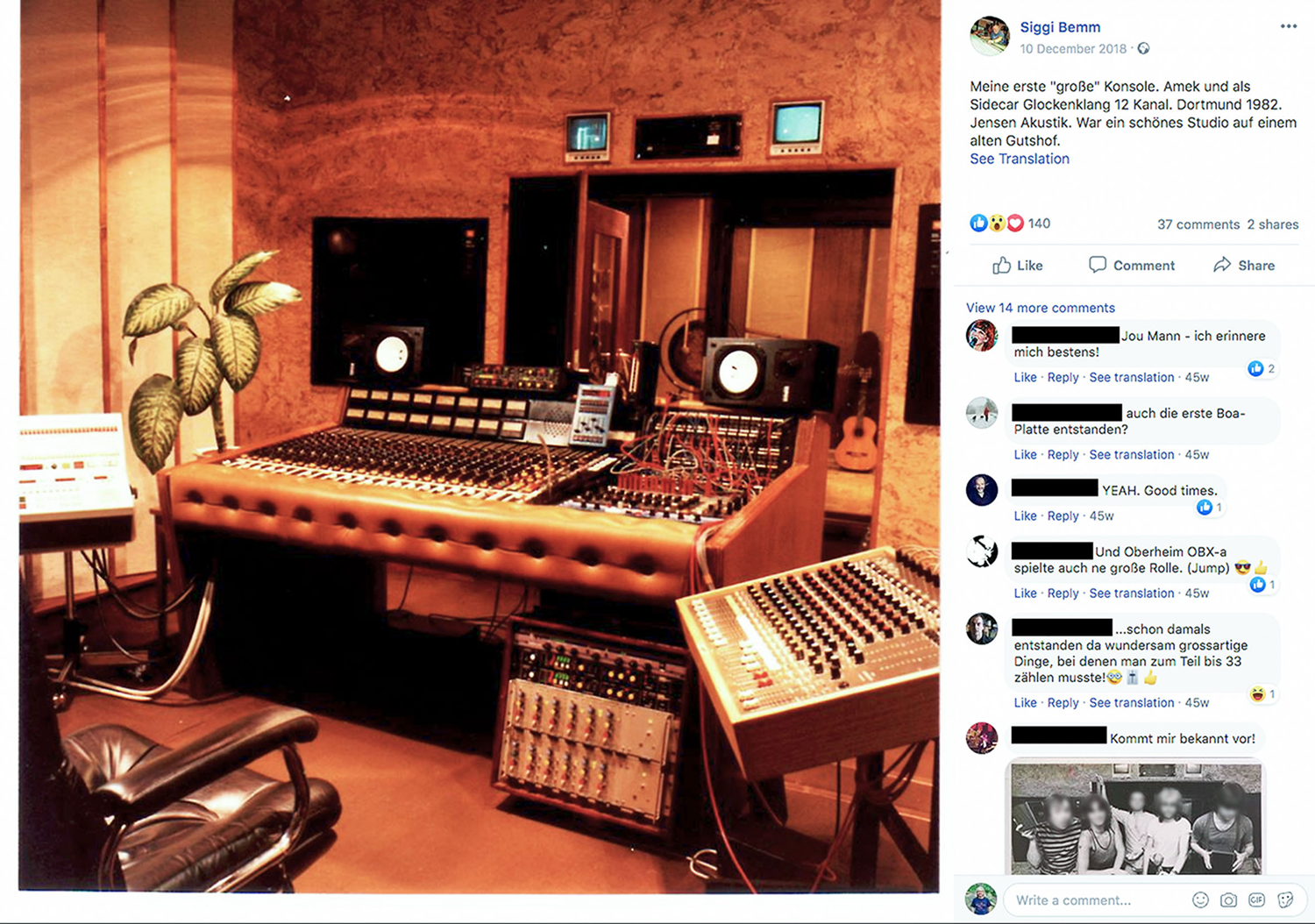
The interviewed producers saw different value in traditional websites and social media. All cared relatively little for websites. Bauerfeind discontinued his professional web appearances, hardly interested in the heritage value of his work. Likewise, Bemm was emotionally unattached, maintaining his studio websiteFootnote 1 primarily as a means for new clients to contact him but not to document the Woodhouse studio. Johns's Music Lab websiteFootnote 2 is a relic from the early 1990s, which he keeps for remembrance. Instead of websites, BemmFootnote 3 and JohnsFootnote 4 curate their studios on Facebook in a self-authorised DIY fashion. Yet despite the potential of social media for utilising personal memories (Bennett and Strong Reference Bennett and Strong2018, p. 372), Bemm's primary motivation for using Facebook is to stay in touch with colleagues and musicians. Sometimes he posts pictures of current work in the studio but very rarely so artefacts from older productions: ‘Why would I? It's finished, the people can buy the records’. Although he is proud of his studio, Bemm hardly ever posts photos of it, as it is ultimately only a tool for making records. Exceptions are photos of the control room of the first Woodhouse (Figure 4) and the console of the second studio (Figure 5). The comments from the community suggest that some visitors are musicians who indulge in reminiscences, while others wish to know whether personally meaningful records were made with the depicted equipment.
Control room of the first Woodhouse studio in Hagen in 1978.

Control room of the second Woodhouse studio in Dortmund in 1982.
Johns's motivation for social media is different because he is eager to keep the memory of his Music Lab alive. He regularly posts photos of his records that influenced the scene (Figure 6), their anniversaries (Figure 7), media coverage of bands he had produced (Figure 8) and excerpts of his guest books. These artefacts are less focused on the studio itself but on the result of the production work that took place in the Music Lab.
Helloween's (1985) Walls of Jericho album that became inspirational for European heavy metal.

The first Music Lab production entering the charts, Sodom's (1989) Agent Orange.

Journalistic writing on the success of Kreator's (1986) Pleasure to Kill produced by Johns.

The posts are mainly for ‘fans and bands, for the people who were in the studio. And to preserve history’, Johns explained. Most of the comments and shares are from band members who recorded in the Music Lab, suggesting that there is a desire to relive cherished moments spent in the studio and to remember the time when heavy metal boomed in the 1980s and 1990s. Johns and his former clients thus use the Facebook page to revel in memories. Boym (Reference Boym2001, p. 49f) defines such behaviour as ‘reflective nostalgia’, perfect snapshots of memorable experiences. At the same time, the page allows them to indulge in ‘restorative nostalgia’ (Boym Reference Boym2001, p. 42ff) to keep alive the memory of past times full of excitement and the forgone glory of the early German metal scene. This nostalgic function not only includes the musical objects created and what they stand for, but it is also an opportunity to re-establish connections between people, as Johns explained: ‘When I post something from a band, it often happens that people reappear with whom I haven't had contact for a long time. I like that’. Given the nature of social media, the form of connection is not unidirectional (Bennett and Strong Reference Bennett and Strong2018, p. 372). The page enables community members to post photographic memories of meaningful artefacts like covers of albums and music magazines featuring bands produced in the Music Lab (Figure 9). In this way, they all contribute to ‘creating myths of community’ (Garde-Hansen Reference Garde-Hansen, Garde-Hansen, Hoskins and Reading2009, p. 146), which serves the primary memorial purpose of the page.
Reunion of Canadian Voivod and their former producer Harris Johns.

An analysis of the Music Lab's Facebook page confirms Johns's assessment that the community consists mainly of bands and fans from the 1980s and 1990s who are now in their fifties or older, male and white. Younger people, so thinks Johns, would probably not be interested in his studio unless they were inspired by the bands he produced. Overall, the community is only of modest size, and most posts are by Johns himself, which accords with research on media memories on Facebook showing that, on average, user posts account for about 2 per cent of the engagement (Kaun and Stiernstedt Reference Kaun and Stiernstedt2014). However, such rare contribution from the visitors does not demotivate him.
Despite Johns's intention to provide some history about his Music Lab, he does not present a chronological history. Instead, he occasionally uses Facebook in response to current events, such as celebrating anniversaries of released records or posting photos of recently deceased artists who recorded at his studio. As Garde-Hansen (Reference Garde-Hansen, Garde-Hansen, Hoskins and Reading2009) notes, social media elude a narrative form; their purpose is to ‘perform memory’ in scattered locations or artificial collections such as photo albums. This can be seen on the Music Lab page, which organises photographic memories in albums categorised by the specific versions of the studio, by decades, by individual bands and photos in an uncategorised timeline.
In their study on a youth radio station in the former German Democratic Republic, Kaun and Stiernstedt (Reference Kaun and Stiernstedt2014, p. 1161) come to a positive conclusion about social media despite their shortcomings:
Even if only a few users contribute actively, one of the functions of the page is, thus, the constant collection of information and memorabilia, which means at the same time sharing memories about DT64 and the media landscape of which it was a part, both of which have long disappeared. In that sense, the Facebook page can be seen as an attempt to stretch DT64's time into the future.
Johns's efforts similarly preserve the memory of his studio for the time being, at least for the interested community. Sceptical of studio museums and believing that it is the bands and not the studio that matter, social media are a more appropriate form for him to preserve his legacy than traditional heritage exhibitions that display physical objects such as studio equipment and rooms.
Conclusion
Recording studios fascinate many music enthusiasts because of the mythological aura that surrounds them. Some renowned studios have been converted into museums, others still functioning offer guided tours by appointment and yet others have become, although closed to the public, sites of pilgrimage. This research aimed to explore what record producers think about integrating studios in popular music heritage, what forms of preservation they consider suitable for production work and how they preserve their studios and productions themselves. Contrary to the often-romanticised notions of recording studios, the producers were surprisingly pragmatic and unemotional about these places. Even if they feel flattered when journalists, music fans, city authorities and scholars show interest in their studios and work, they are generally not convinced by studio museums. For them, a studio is primarily a tool for making music. At best it may be inspiring, but more often the studio is a place of pressure, full of insecurities and anxieties. Therefore, the producers feel that the studio as a physical space with its equipment is hardly worth preserving as a heritage object. The final product is the most valuable item to them and not its material basis, such as studio rooms, equipment or original master tapes used to make a record. On a personal level, they may indulge in nostalgia, especially with virtual communities on social media, but other than that, the only important artefact of popular music production is the released record. Two of the three producers reject technological determinism as an underlying source of the mythologised ‘magic’ common in the production discourse. If there is ‘magic’ in record production, it lies in the interaction between the people involved, which takes place in particular rooms and is captured by technology. The people taking part in making the record deserve attention, not the material environment. That is the main reason the producers see little sense in studio museums. This intangible human factor cannot be exhibited and would be missing while the tangible objects cannot compensate for this. In a way, their idea of a studio museum resembles art museums, where the result is to be valued and not their contextual objects. Unlike in art museums, however, it would be a challenge in popular music studio museums to let the ‘art’ speak for itself because of the cacophony this would create.


 Open access

