




Morphological awareness refers to a learner’s ability to reflect on, analyze, and manipulate morphemes and the internal structure of words (Carlisle, Reference Carlisle and Feldman1995, Reference Carlisle2000; Kuo & Anderson, Reference Kuo, Anderson, Koda and Zehler2008). It is widely recognized in the literature as a precursor to reading development across languages and writing systems (Verhoeven & Perfetti, Reference Verhoeven and Perfetti2017). Morphological awareness developed in one language can transfer and aid reading subskills in a second language, even among bilingualsFootnote 1 reading typologically distinct languages (Ke et al., Reference Ke, Miller, Zhang and Koda2021, Reference Ke, Zhang and Koda2023). There is emerging evidence of morphological awareness deficits in children with developmental dyslexia, characterized by severe word reading difficulties (Georgiou et al., Reference Georgiou, Vieira, Rothou, Kirby, Antoniuk, Martinez and Guo2023; McBride et al., Reference McBride, Wang and Cheang2018; Sodoro et al., Reference Sodoro, Allinder and Rankin-Erickson2002). For instance, in a recent meta-analysis by Georgiou et al. (Reference Georgiou, Vieira, Rothou, Kirby, Antoniuk, Martinez and Guo2023), they found that individuals with dyslexia in languages such as Arabic, Chinese, English, Finnish, French, Greek, and Hebrew face significant challenges in morphological awareness. However, meta-analytic evidence on the diagnostic value of morphological awareness for bilingual children with reading difficulties is limited. This meta-analytic review has two objectives: first, to determine if Chinese-English bilingual children with reading difficulties (RD) have an MA deficit alongside phonological awareness (the ability to detect and manipulate language sounds, Sodoro et al., Reference Sodoro, Allinder and Rankin-Erickson2002) and word reading in their first and second languages (L1 and L2); second, to examine if effect sizes are influenced by moderators such as RD severity, age, diglossia context (Cantonese vs. Mandarin-speaking societies), and methodological design.
The research is expected to have three implications: Theoretically, by providing new empirical evidence on whether MA deficits co-occur in L1 and L2 reading among bilingual RD children of morphosyllabic Chinese and morphophonemic English, this study will contribute to our understanding of bilingual reading difficulties from a cross-linguistic perspective. Methodologically, it considers a range of moderators that are developmentally, contextually, or methodologically relevant. While our primary focus is on RD/dyslexia, the methodological framework and cross-linguistic perspective adopted in this study are relevant to broader disability studies (e.g., Zhang D. et al., Reference Zhang, Ke, Anglin-Jaffe and Yang2023). Practically, it supports diagnostic assessment decisions for bilingual children in Chinese-speaking societies. The prevalence of Chinese dyslexia ranges from 4% to 10% in the Chinese mainland and Hong Kong (as cited in Zhang L. et al., Reference Zhang, Xia, Zhao, Shu and Zhang2023), but definitions and diagnostic criteria vary across Chinese diaspora societies like Beijing, Hong Kong, and Taipei (McBride et al., Reference McBride, Wang and Cheang2018). The findings will offer insights into the role of MA assessment as a diagnostic tool for Chinese-English bilingual children with reading difficulties in different Chinese-speaking societies.
Literature review
Theories linking morphological awareness to reading development
Carlisle (Reference Carlisle and Feldman1995, Reference Carlisle2000) was among the first to define morphological awareness as “conscious awareness of the morphemic structure of words and [the] ability to reflect on and manipulate that structure.” Carlisle’s (Reference Carlisle2000) study with English-speaking learners at Grades One, Three, and Five showed that morphological awareness was significantly associated with reading comprehension across the grade levels. One main reason perhaps is that morphologically complex words are prevalent, particularly in written texts (Nagy & Anderson, Reference Nagy and Anderson1984).
Over the past three decades, the interest in the role of morphology in reading, both in L1 and L2, has grown (L1 theories: Carlisle, Reference Carlisle and Feldman1995, Reference Carlisle2000; Kirby and Bowers, Reference Kirby, Bowers, Cain, Compton and Parrila2017; Levesque et al., Reference Levesque, Breadmore and Deacon2021; Perfetti, Reference Perfetti2007; Perfetti & Hart, Reference Perfetti, Hart, Vehoeven, Elbro and Reitsma2002; Ziegler and Goswami, Reference Ziegler and Goswami2005; L2 theories: Chung et al., Reference Chung, Chen and Geva2019; Koda, Reference Koda2005, Reference Koda, Koda and Zehler2008). According to the Lexical Quality Hypothesis (Perfetti, Reference Perfetti2007; Perfetti & Hart, Reference Perfetti, Hart, Vehoeven, Elbro and Reitsma2002), successful reading comprehension depends on high-quality lexical knowledge represented by orthography, phonology, morphosyntax, meaning, and the binding of these four features. Kirby and Bowers (Reference Kirby, Bowers, Cain, Compton and Parrila2017) later proposed that morphology is the binding agent of phonological, orthographic, and semantic features of words. For children with RD, morphological awareness may compensate for the weak phonological skills (as cited in Georgiou et al., Reference Georgiou, Vieira, Rothou, Kirby, Antoniuk, Martinez and Guo2023). According to Ziegler and Goswami’s (Reference Ziegler and Goswami2005) psycholinguistic grain-size theory, the availability of a specific processing unit during word reading depends on the orthographic consistency and availability of the spoken unit in oral language. To bypass their phonological difficulties during word reading, individuals with dyslexia may resort to larger and more consistent grain-size units such as morphemes.
Substantial empirical evidence shows that morphological awareness is a critical predictor of the three major aspects of learning to read (Verhoeven & Perfetti, Reference Verhoeven and Perfetti2022), namely, becoming linguistically aware, acquiring word identification skills, and learning to comprehend. In (2021), Levesque et al. attempted to illuminate precise mechanisms by which morphology impacts word reading, spelling, and reading comprehension, and they proposed that morphological decoding and morphological meaning analysis are two important pathways through which morphology predicts reading development. In the reading literature, another widely cited theory is the Simple View of Reading (SVR), which posits that reading comprehension is the product of decoding and listening comprehension (Gough & Tunmer, Reference Gough and Tunmer1986; Hoover & Gough, Reference Hoover and Gough1990). Duke and Cartwright (Reference Duke and Cartwright2021, p.530) pointed out that “Morphological awareness is not named in the SVR or many other models of reading, yet research has documented the contributions of morphological awareness to reading, including through word recognition and language comprehension.”
The review above is based on L1 reading literature. In L2 reading, researchers are more concerned about the mechanisms through which one can transfer L1 morphological awareness to facilitate L2 reading development. According to Koda’s (Reference Koda2005, Reference Koda, Koda and Zehler2008) transfer facilitation model, there are complex interactions among L1 morphological awareness, evolving L2 morphological awareness, L2 linguistic knowledge (e.g., vocabulary knowledge), and L2 reading skills that develop subsequently. Furthermore, compared to other L1 metalinguistic resources (e.g., phonological awareness), the transfer facilitation of morphological awareness in L2 reading is constrained by L1-L2 distance. This is confirmed by Ke and Xiao’s (Reference Ke and Xiao2015) review of studies on the cross-linguistic transfer of morphological awareness between morphosyllabic Chinese and morphophonemic English, two typologically distinct languages. They found that there were small-to-moderate correlations between L1 and L2 morphological awareness in Chinese-English bilingual reading development, and that L2 exposure and task demands had notable impacts on cross-linguistic transfer. These findings highlight the complex nature of morphological awareness transfer, underscoring the importance of considering both linguistic and contextual factors when examining bilingual reading development.
Morphological awareness as a marker of Chinese and English reading difficulties
Chinese orthography is morphosyllabic, with characters representing morphemes at the syllable level (DeFrancis, Reference DeFrancis1984). In contrast, English orthography is morphophonemic, as English spelling represents word sounds while maintaining consistency in morpheme representation, even when pronunciation changes (Abbott et al., Reference Abbott, Fayol, Zorman, Casalis, Nagy and Berninger2016). Despite these typological differences, morphological awareness is a marker of reading difficulties in learners of both Chinese (e.g., Cheah et al., Reference Cheah, McBride, Meng, Lee and Huo2025; Ho et al., Reference Ho, Chan, Tsang and Lee2002; Pan et al., Reference Pan, Meng, Lee, Ng and McBride2024; Peng, Reference Peng, Wang, Tao and Sun2017) and English (e.g., Siegel, Reference Siegel2008).
In Chinese, Ho et al. (Reference Ho, Chan, Tsang and Lee2002) were among the first to propose that Chinese dyslexic children can have impairments in one or more of the four cognitive and linguistic domains, including rapid naming, orthographic processing, visual processing, and phonological processing. Building upon and expanding Ho et al.’s (Reference Ho, Chan, Tsang and Lee2002) empirical work in Hong Kong, Peng et al. (Reference Peng, Wang, Tao and Sun2017) conducted a meta-analysis of 81 studies published between 1964 and 2015 to investigate the deficit profiles of Chinese children with RD, and they identified two additional domains: working memory (cognitive) and morphological awareness (linguistic). Interestingly, Peng et al. (Reference Peng, Wang, Tao and Sun2017) did not find any significant moderating effect of location (Hong Kong versus mainland), which was echoed by Cheah et al. (Reference Cheah, McBride, Meng, Lee and Huo2025) in the cognitive and linguistic deficit profiles of Chinese readers across different Chinese diaspora societies (including Beijing, Hong Kong, Taipei). Cheah et al. (Reference Cheah, McBride, Meng, Lee and Huo2025) assessed 91 children with dyslexia from Hong Kong, Beijing, and Taipei using the same set of Chinese literacy tests to identify dyslexia subtypes. Cluster analysis based on four cognitive-linguistic skills revealed four subtypes: orthographic deficit, phonological deficit, morphological deficit, and global deficit, each with distinct cognitive profiles. The distribution of these subtypes was consistent across the three regions, indicating that the nature of Chinese dyslexia is stable despite differences in literacy experiences. Cheah et al. (Reference Cheah, McBride, Meng, Lee and Huo2025) also pointed out that different definitions and diagnostic criteria have been adopted in existing literature and highlighted the importance of assessing morphological awareness, along with orthographic processing, rapid automatized naming, and phonological awareness across different Chinese-speaking societies. In English, Siegel (Reference Siegel2008) compared the relation of morphological awareness to reading and spelling skills of children with dyslexia, children who are typical readers, and children who are English language learners. She found that students with dyslexia had significantly lower scores than normally achieving readers on the morphological awareness tasks, and that there were no significant differences between English language learners and the English L1 students.
Lately, some researchers have begun to examine the potential co-occurrence of cognitive and linguistic profiles in two languages among Chinese-English bilingual learners with or without RD (e.g., with RD: Chung & Ho, Reference Chung and Ho2010; Gao et al., Reference Gao, Zheng, Liu, Nichols, Zhang, Shang, Ding, Weng and Liu2019; Zhou et al., Reference Zhou, McBride-Chang, Law, Li, Cheung, Wong and Shu2014; without RD: Zang et al., Reference Zang, Wong and Lau2024). For example, Zhou et al. (Reference Zhou, McBride-Chang, Law, Li, Cheung, Wong and Shu2014) tracked the developmental pattern of Chinese and English reading skills in Hong Kong children with and without dyslexia from six to eight years of age. They observed that children with dyslexia manifested clear difficulties in vocabulary knowledge and morphological awareness in both Chinese and English reading. In the mainland China context, Gao et al. (Reference Gao, Zheng, Liu, Nichols, Zhang, Shang, Ding, Weng and Liu2019) investigated reading acquisition in a large representative sample of 1,824 Chinese-English bilingual children in Grades Four and Five from both urban and rural schools in Beijing and identified a 36% co-occurrence in reading difficulties between L1 Chinese and L2 English. In other words, L1 Chinese reading difficulty significantly increases the risk of L2 English reading difficulty. Gao et al. (Reference Gao, Zheng, Liu, Nichols, Zhang, Shang, Ding, Weng and Liu2019) recommended that, in addition to the assessment of L1 reading skill, the assessment of L2 reading skills is critical in early L2 readers, as a poor reader in one language may not necessarily be a poor reader in another language. More recently, Zang (Reference Zang, Wong and Lau2024) conducted a study comparing the predictors of word reading between Chinese-English bilingual children and Chinese-dominant monolingual children in mainland China. They found that, in terms of Chinese word reading, both morphological and orthographic awareness emerged as significant predictors in the monolingual group, whereas in the bilingual group, only morphological awareness was significant, and the contribution of phonological awareness was insignificant in either group. The findings suggest that, for bilingual readers, morphological awareness is more influential than phonological awareness in the development of word reading ability.
Previous meta-analyses
To date, there has been little meta-analytic evidence examining the morphological deficits in bilingual learners with RD. However, there are pertinent meta-analyses on the effectiveness of literacy intervention in remediating reading difficulties in Chinese (Ruan et al., Reference Ruan, Maurer and McBride2024) or English (Goodwin & Ahn, Reference Goodwin and Ahn2010), morphological, oral language, and phonological deficits in monolingual readers of different languages and writing systems (Georgiou et al., Reference Georgiou, Vieira, Rothou, Kirby, Antoniuk, Martinez and Guo2023; Melby-Lervåg & Lervåg, Reference Melby-Lervåg and Lervåg2012), and the impacts of morphological awareness on bilingual reading development among normally developing children (Ke et al., Reference Ke, Miller, Zhang and Koda2021, Reference Ke, Zhang and Koda2023) and deaf and hard-of-hearing (DHH) students (Zhang D. et al., Reference Zhang, Ke, Anglin-Jaffe and Yang2023).
Ruan et al. (Reference Ruan, Maurer and McBride2024) compared the efficacy of different reading interventions on literacy outcomes for Chinese children. In particular, they found that morphological training had a significant and medium effect on improving Chinese literacy skills, which was comparable between younger and older children. Similarly, for English reading, Goodwin and Ahn (Reference Goodwin and Ahn2010) reported a significant and medium impact of morphological instruction on various reading-related outcomes for children with reading difficulties, English language learners, and English L1 children. Notably, Goodwin and Ahn (Reference Goodwin and Ahn2010) found that the effect sizes were larger for children with reading difficulties and English language learners.
From a cross-language and cross-writing system perspective, Georgiou et al. (Reference Georgiou, Vieira, Rothou, Kirby, Antoniuk, Martinez and Guo2023) reviewed 40 studies covering child readers of seven languages (Arabic, Chinese, English, Finnish, French, Greek, and Hebrew). Their meta-analytic findings indicated that children with dyslexia experience significant difficulties in morphological awareness compared to their age-matched controls, and that the group differences in morphological awareness increase with age. Ke et al. (Reference Ke, Miller, Zhang and Koda2021) also identified a significant moderating effect of age when examining morphological awareness as a cross-language shareable resource in child bilingual readers without RD. Ke et al. (Reference Ke, Miller, Zhang and Koda2021) conducted a systematic review and meta-analysis of 34 studies and investigated the strength of associations between L1 and L2 morphological awareness and L2 reading development in child L2 learners. The correlation effect sizes between L2 morphological awareness and L2 reading comprehension are larger as age increases; yet the correlation effect sizes remain unchanged between L1 morphological awareness and L2 reading outcomes. In another meta-analysis, Ke et al. (Reference Ke, Zhang and Koda2023) compared the correlation effect sizes between morphological awareness and reading outcomes in L1 and L2 and observed that the effect sizes are consistently larger in L2. Ke et al. (Reference Ke, Zhang and Koda2023) conjectured that bilingual readers might rely more heavily on morphological awareness when reading in their L2 than in their L1.
In addition, Zhang D. et al. (Reference Zhang, Ke, Anglin-Jaffe and Yang2023) reported the first meta-analysis examining the correlations between morphological awareness and reading-related abilities among deaf and hard-of-hearing (DHH) students, revealing strong associations with word reading, vocabulary knowledge, and reading comprehension across multiple languages and educational contexts. Their findings underscore the critical role of morphological awareness as a foundational skill for literacy development in DHH learners, paralleling its significance in other populations with reading challenges, such as children with dyslexia. By highlighting the importance of morphology-based instruction for diverse learner groups, including those with sensory or learning disabilities, Zhang D. et al. (Reference Zhang, Ke, Anglin-Jaffe and Yang2023)’s study not only fills a notable gap in the literature on DHH students but also reinforces the broader relevance of metalinguistic skills within disability studies.
Viewed collectively, the diagnostic value of morphological awareness assessment has been confirmed by previous empirical and meta-analytic studies for monolingual learners with reading difficulties in Chinese only, English only, or across different languages and writing systems; however, to date, there is little meta-analytic evidence evaluating morphological awareness deficits in bilingual children with reading difficulties from a cross-language perspective, as well as the moderating factors that may influence the magnitude of these deficits. Accordingly, the present research focused on four potential moderators—RD severity, age, diglossia context, and methodological design—which were theoretically and empirically motivated to account for potential sources of heterogeneity in effect sizes across studies. First, RD severity (i.e., poor readers vs. diagnosed dyslexia) was included because previous research has demonstrated that the magnitude of cognitive and linguistic deficits may differ depending on the strictness of diagnostic criteria and the severity of reading difficulties (Cheah et al., Reference Cheah, McBride, Meng, Lee and Huo2025). Second, age was examined as a moderator given robust evidence that the role of morphological awareness in reading development increases with age and grade level, and that deficits may become more pronounced over time (Georgiou et al., Reference Georgiou, Vieira, Rothou, Kirby, Antoniuk, Martinez and Guo2023). Third, the diglossia context (Cantonese-speaking vs. Mandarin-speaking societies) was considered to capture the influence of linguistic environment and instructional practices, as prior studies have suggested that dialectal and orthographic differences may impact the development and manifestation of reading-related skills (McQuade et al., Reference McQuade, Pan, Ho, Ong, Ng, Meng and McBride2024; Peng et al., Reference Peng, Wang, Tao and Sun2017). Finally, methodological design (types of control or comparison groups) was included to address the possibility that study design choices—such as the selection of control groups—could systematically affect observed effect sizes (Goodwin & Ahn, Reference Goodwin and Ahn2010; Georgiou et al., Reference Georgiou, Vieira, Rothou, Kirby, Antoniuk, Martinez and Guo2023). By systematically examining these moderators, the meta-analysis aimed to provide a more nuanced understanding of the variability in morphological awareness deficits among Chinese-English bilingual children with reading difficulties. While our primary focus is on RD/dyslexia, the methodological framework and cross-linguistic perspective adopted in this study are relevant to broader disability studies, including studies of the DHH population, as they emphasize the importance of recognizing diverse learner profiles and the intersectionality of language and disability. Our results advocate for more inclusive diagnostic criteria and intervention strategies that account for the unique experiences of bilingual children with disabilities, thereby informing both research and practice in disability studies and related fields.
The present research
To reiterate, the main purpose of this meta-analytic review is to expand the existing understanding of the role of morphological awareness in diagnosing reading difficulties (RD) among Chinese-English bilingual children. It is guided by three research questions (RQs):
RQ1: What are the definitions, assessment tasks, and diagnostic criteria of RD in the selected studies of Chinese-English bilingual children?
RQ2: Do Chinese-English bilingual children with RD experience a morphological awareness deficit in addition to phonological awareness and word reading deficits in Chinese and English, respectively? If yes, what are the sizes of the deficits?
RQ3: Are the deficit sizes moderated by RD severities, age, diglossia context (Cantonese Chinese-speaking versus Mandarin Chinese-speaking societies), and methodological design?
Three predictions are formulated based on the aforementioned literature review:
Prediction One: There has been heterogeneity in the definitions, assessment tasks, and diagnostic criteria of RD across Chinese diaspora societies (i.e., Beijing, Hong Kong, Singapore, and Taipei), yet a more standardized and consistent practice in Hong Kong.
Prediction Two: Chinese-English bilingual children with RD experience a morphological awareness deficit in addition to phonological awareness and word reading deficits in both L1 Chinese and L2 English. The effect sizes of morphological awareness and phonological awareness are larger in L2 English than those in L1 Chinese because L2 readers rely more on metalinguistic awareness.
Prediction Three: It is anticipated that age will be the only significant moderator, as morphological awareness tends to play a more crucial role at higher grade levels in both Chinese and English. In contrast, nonsignificant moderating effects are expected from factors such as the severity of reading difficulties, diglossia context, or methodological design. This is based on the understanding that morphological awareness has consistently been identified as a significant predictor of reading development in both Chinese and English, irrespective of diglossia contexts or the presence of learning difficulties among diverse learners.
Methodology
Literature search
The literature search proceeded in three major stages (as shown in Figure 1). First, an initial search was completed in May 2024. This included: (1) a Boolean search of databases (Web of Science and PsycINFO) with a combination of four keywords (i.e., reading difficulties OR dyslexia AND Chinese AND English) that appeared in the abstracts; and (2) a manual search was conducted by checking the references in existing meta-analyses and reviews (i.e., Ke et al., Reference Ke, Miller, Zhang and Koda2021, Reference Ke, Zhang and Koda2023; Goodwin & Ahn, Reference Goodwin and Ahn2010; Georgiou et al., Reference Georgiou, Vieira, Rothou, Kirby, Antoniuk, Martinez and Guo2023; McBride et al., Reference McBride, Wang and Cheang2018; Ruan et al., Reference Ruan, Maurer and McBride2024). These steps yielded 12 primary studies and 25 independent samples. Second, to update the database, another manual search was conducted via Google Scholar in October 2024. As a result, two studies (Chung et al., Reference Chung, Li, Lam, Fung and Liu2022; Tong et al., Reference Tong, Deng and Tong2022) with four independent samples were added. Third, an expanded search was conducted in October 2025 to ensure comprehensive coverage. This included: (1) updating the systematic database search across all five databases (Web of Science, PsycINFO, Scopus, ERIC, and LLBA); (2) manual-searching six key journals that specialize in reading research (i.e., Annals of Dyslexia, Dyslexia, Journal of Research in Reading, Reading Research Quarterly, Reading & Writing, and Scientific Studies of Reading), following the search strategy of a relevant prior meta-analysis (Melby-Lervåg & Lervåg, Reference Melby-Lervåg and Lervåg2012); (3) conducting a forward and backward citation search on Google Scholar for all included studies; and (4) setting the study publication time between 2000 and 2025. We identified one potential study (i.e., McQuade et al., Reference McQuade, Pan, Ho, Ong, Ng, Meng and McBride2024), but decided that the dataset might overlap with Pan et al. (Reference Pan, Meng, Lee, Ng and McBride2024)’s. Therefore, no additional studies meeting the inclusion criteria were identified during the final expanded search. The final dataset thus consists of 14 primary studies (comprising 29 independent samples).
Literature search procedures.

Inclusion and exclusion criteria
Given the scope of this search, the selected studies must (1) include children with reading difficulties, (2) have a Chinese morphological awareness measure and another measure of either phonological awareness and word reading, (3) include reading-related measures in both Chinese and English, (4) written in English, and (5) report Hedge’s g or provide sufficient statistical information to calculate the effect size. Review and repetitive reports were excluded. To assess study quality, we reported instrument reliability as a key indicator, following the approach of Ke et al. (Reference Ke, Miller, Zhang and Koda2021) in their meta-analysis. As shown in Appendix 1, the mean and median reliability coefficients were all above .80, indicating that the reading measurements were reliable.
Coding and data analyses procedures
To answer RQ1, descriptive information of each independent sample was entered into an Excel file (see Table 1). Coding was first entered by the second author. The first author then recoded all cells. To answer RQ2 and RQ3, coding of the effect sizes was conducted by the two coders in a similar way. The intercoder reliability (Cronbach’s alpha) for effect size was .90. For categorical variable coding, Cohen’s kappa was .89. The first author resolved the inconsistencies by triple-checking. For studies that did not report Hedge’s g, effect size conversion was conducted via the Campbell Collaboration calculator (Littell & White, 2018). Regarding the size of g, the rule of thumb is that small, medium, and large effect sizes are at or above .30, .50, and .80, respectively.
Definitions, diagnostic assessment, and diagnostic criteria adopted in the primary studies

a One: less severe RD; Two: more severe RD with diagnosed dyslexia.
b a review of the subtests suggested that no MA test was reported in Chung and Ho (Reference Chung and Ho2010). N.A. = not applicable.
The coding of the moderator focused on four factors: (1) RD severity (two levels: poor readers vs. dyslexia); (2) Diglossia context (two levels: Cantonese-speaking vs.
Mandarin-speaking); (3) methodological design (two levels: Chinese RD vs. age-matched /reading control; Chinese RD vs. age-matched /English RD/bilingual RD); and (4) age (in years). Comprehensive Meta-analysis (CMA) Version 4 was employed to conduct subsequent analyses. The complete CMA files with coding are available at: https://osf.io/s3wz8/overview?view_only=4cf91fb65bec4fe48da0cd4e225db505.
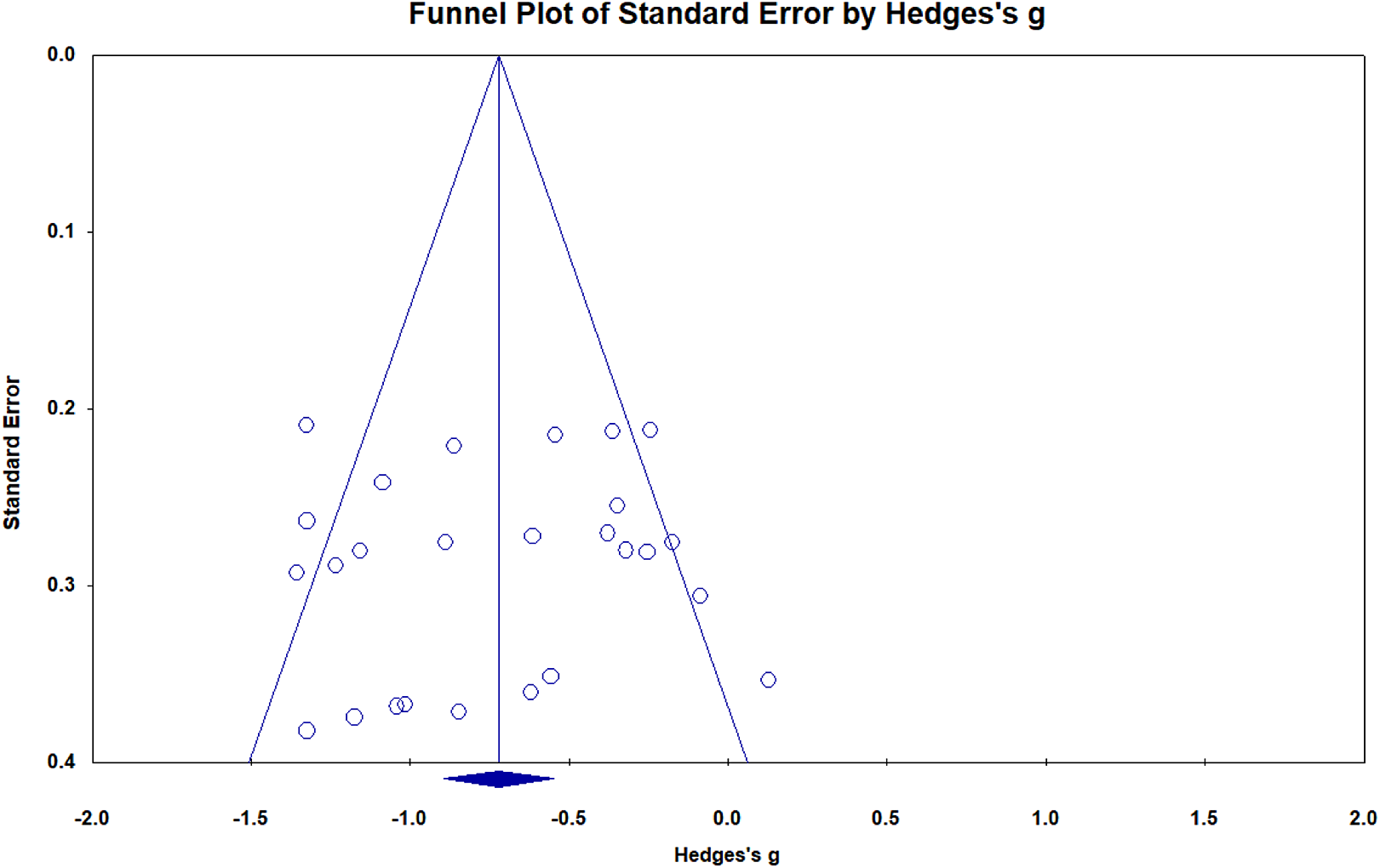
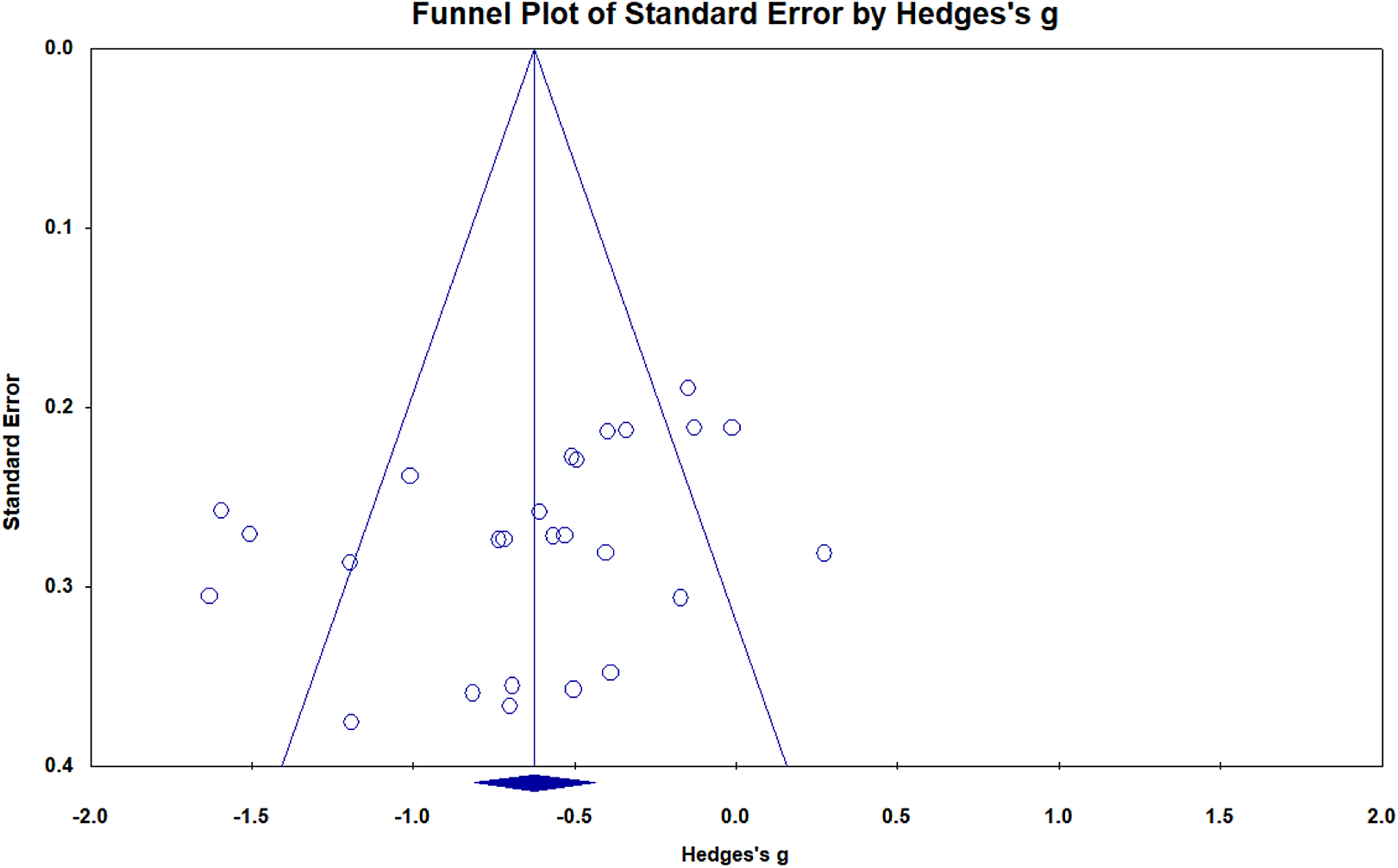
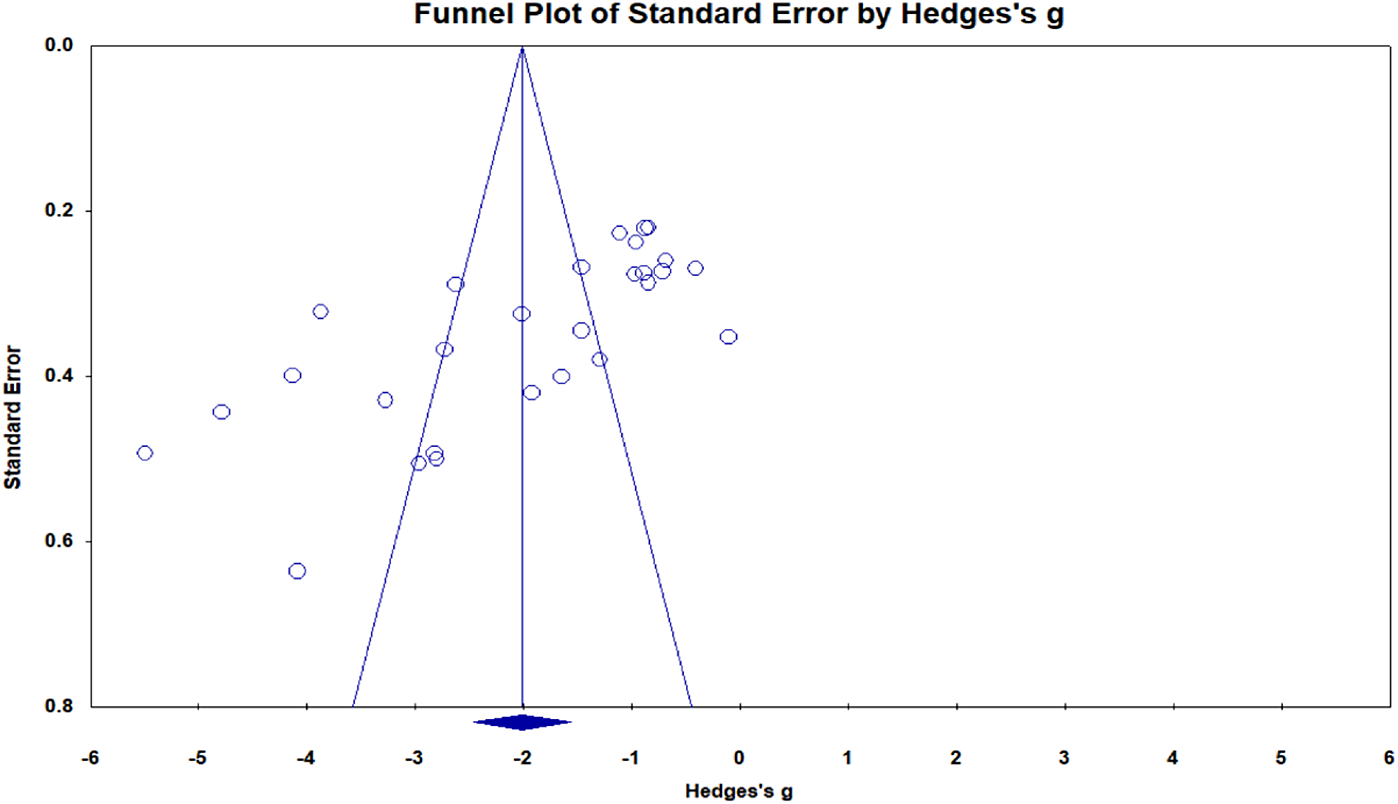
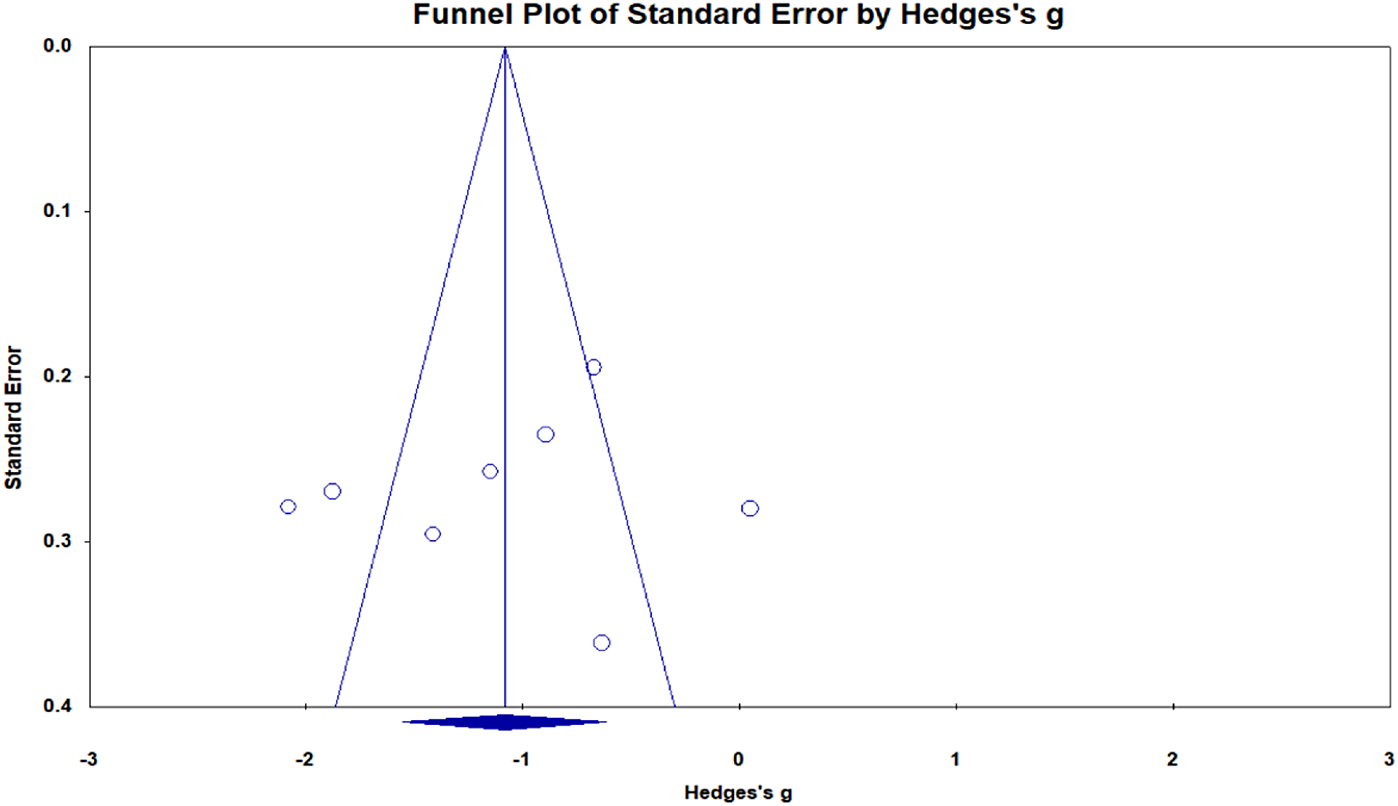
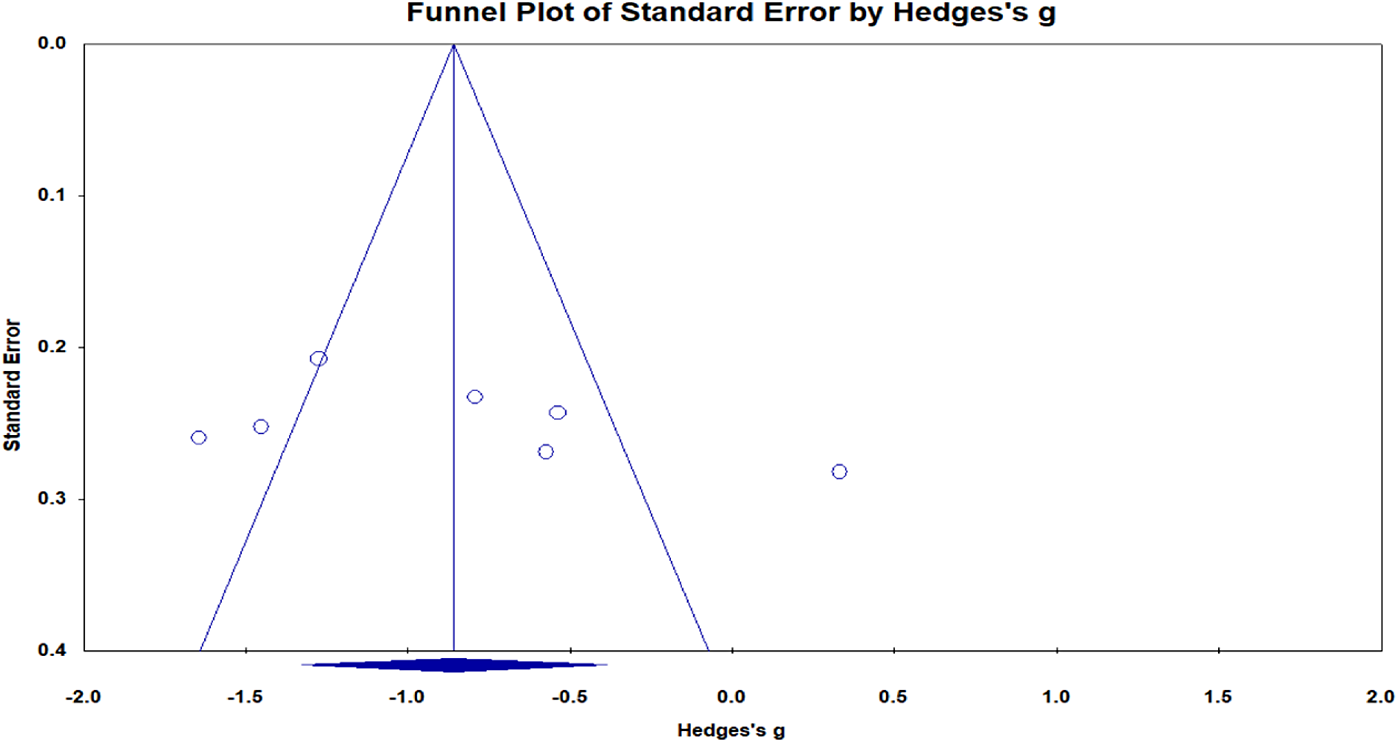
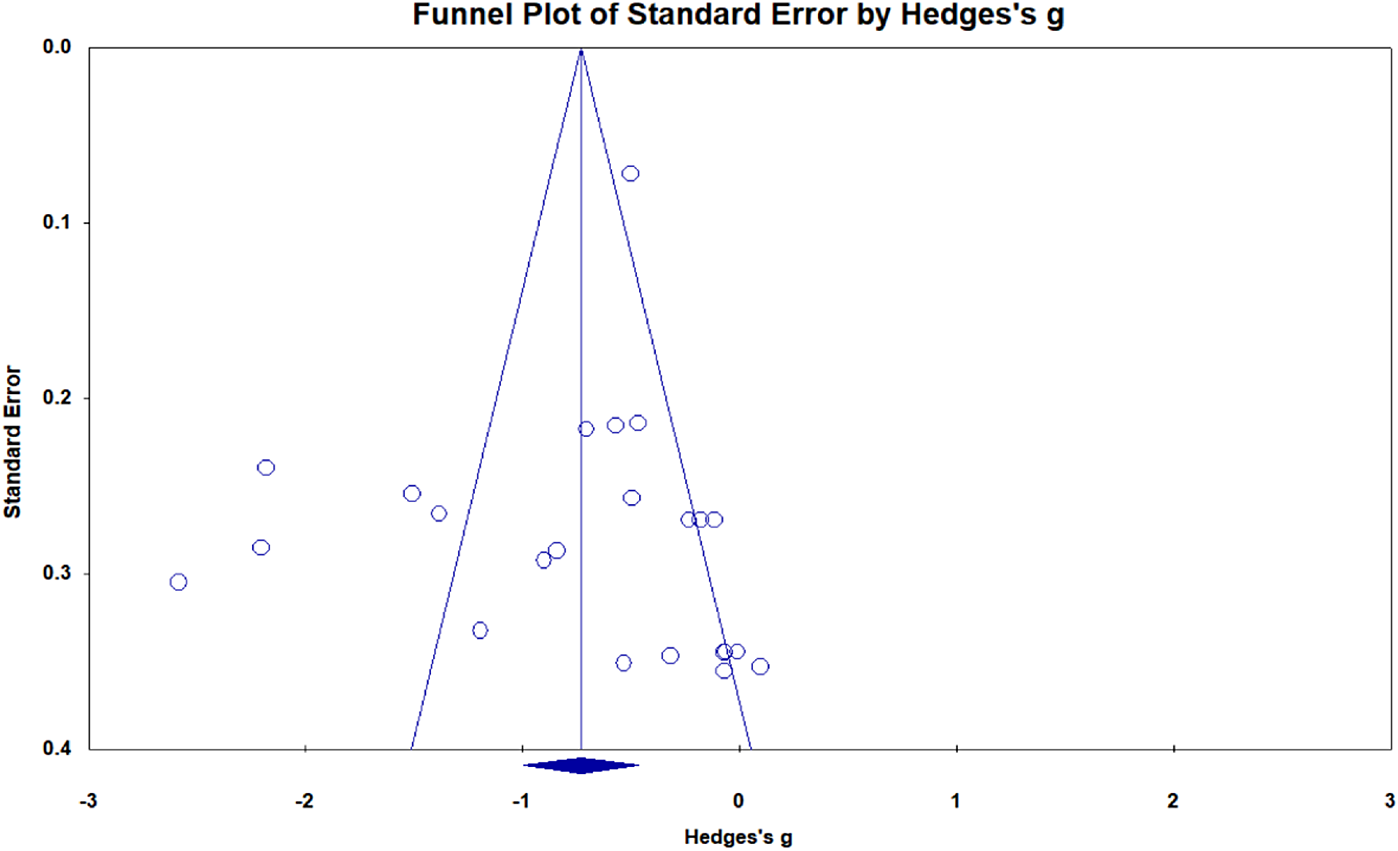
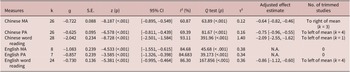
First, publication bias was checked via three steps: (1) both published journal articles and an unpublished doctoral dissertation (i.e., Shen, Reference Shen2023) were included in the meta-analysis; (2) Funnel plots for random-effects models were used to determine the presence of retrieval bias. No asymmetric funnels were identified (see Figures 2–7). (3) The results of Duval and Tweedie’s (Reference Duval and Tweedie2000) trim and fill were reported in Table 2 below.
Funnel plot for Chinese morphological awareness.

Funnel Plot for Chinese Phonological Awareness.

Funnel plot for Chinese word reading.

Funnel plot for English morphological awareness.

Funnel plot for English phonological awareness.

Funnel plot for English word reading.

Descriptive statistics for the Mean Differences Between the RD and Control Groups

Note. MA = morphological awareness; PA = phonological awareness; N.A. = not applicable.
Second, potential outliers were examined for the six target outcome variables (i.e., morphological awareness, phonological awareness, and word reading in Chinese and English, respectively) and removed if the standard residuals were bigger than 2.5 in either positive or negative direction (see also Ke et al., Reference Ke, Miller, Zhang and Koda2021). Therefore, three independent samples from Chung et al. (Reference Chung, Li, Lam, Fung and Liu2022) were removed for the outcome of Chinese morphological awareness, and Chung and Ho (Reference Chung and Ho2010), as well as Kalindi et al. (Reference Kalindi, McBride, Tong, Wong, Chung and Lee2015), were removed for the outcome of English word reading.
Finally, in order to investigate whether there was variability among the correlations across primary studies, a heterogeneity test (Q test; Hedges & Olkin, Reference Hedges and Olkin1985) was conducted. A significant value on the heterogeneity test would provide evidence for variability among the correlations, and I2 indicates the proportion of the heterogeneity that is real rather than due to chance. Given that three moderator variables in this study are categorical, a heterogeneity test (Q test) was performed based on random-effects modeling, both within and across the subgroups created by the moderator analyses. Additional meta-regressions were run with age (in years) as a continuous variable for outcomes with at least 10 independent samples (after Ke et al., Reference Ke, Zhang and Koda2023).
Results
An overview of selected studies
As mentioned above, a total of 14 studies and 29 independent samples (N = 4,516) were selected from the literature. Children of the selected studies were from four Chinese diaspora societies: Beijing (k = 5), Taipei (k = 1), and Singapore (k = 1), where Mandarin Chinese is the main medium of instruction, as well as Hong Kong (k = 22), where Cantonese Chinese is dominant. Methodologically speaking, eight samples included comparisons across dyslexia vs. age-matched or reading control groups, while 21 samples compared reading performance among groups with L1 Chinese RD/dyslexia vs. L2 English RD/dyslexia only or bilingual RD/dyslexia or age-matched control groups. The same test batteries were administered to the RD/dyslexia groups and the control groups.
RQ1: What are the definitions, assessment tasks, and diagnostic criteria of RD in the selected studies of Chinese-English bilingual children?
An initial screen of the independent samples resulted in two types of studies: Type One included studies with less severe RD (e.g., labeled by ‘poor reading’, ‘word reading difficulties’, or ‘reading comprehension difficulties’), and Type Two studies involved more severe and persistent RD (i.e., diagnosed with dyslexia). Therefore, our analyses of the definitions, diagnostic criteria, and assessment tasks of RD were categorized into two types according to RD severity. As shown in Table 1 below, out of the 14 studies, only six have provided definitions of RD or dyslexia.
The results indicated that children with RD have been referred to as poor readers, having reading scores in the bottom 25% of all children (e.g., Cheah et al., Reference Cheah, Ye, Lui, McBride and Maurer2023; McBride-Chang et al., Reference McBride-Chang, Liu, Wong, Wong and Shu2012; Tong et al., Reference Tong, McBride, Shu and Ho2018). As to the main diagnostic assessment task, word reading was used in four studies (e.g., Chung et al., Reference Chung, Li, Lam, Fung and Liu2022; McBride-Chang et al., Reference McBride-Chang, Liu, Wong, Wong and Shu2012; McBride-Chang et al., Reference McBride-Chang, Shu, Chan, Wong, Wong, Zhang, Pan and Chan2013; Tong et al., Reference Tong, Tong and McBride-Chang2015), reading comprehension in two studies (i.e., Tong et al., Reference Tong, McBride, Shu and Ho2018; Tong et al., Reference Tong, Deng and Tong2022), and word dictation in one study (i.e., Cheah et al., Reference Cheah, Ye, Lui, McBride and Maurer2023). For example, in McBride-Chang et al. (Reference McBride-Chang, Liu, Wong, Wong and Shu2012)’s study with Hong Kong children, their criteria for selecting “poor readers” were (a) scoring in the lowest 25% of all participants on the respective word reading test (b) consistently across the 2 most recent years of testing.
Regarding dyslexia, it has been defined as a specific learning difficulty marked by difficulties in the development of literacy- and language-related skills, particularly in word reading and spelling accuracy and fluency. In the Hong Kong context, the primary studies (i.e., Chung & Lam, 2010; Pan et al., Reference Pan, Meng, Lee, Ng and McBride2024) were generally consistent in their diagnostic criteria, namely, dyslexic children attained a literacy composite score of seven or below on the Hong Kong Test of Specific Learning Difficulties (HKT-SpLD, Ho et al., Reference Ho, Chan, Tsang and Lee2000), or at least one standard deviation below their respective age in the Hong Kong Test of Specific Learning Difficulties in Reading and Writing for Primary School Students (HKT-P(II), Ho et al., 2007). The HKT- SpLD consists of five domains: literacy (word reading, reading fluency, word dictation), rapid naming, phonological awareness, phonological memory, and orthographic skills; whereas the HKT-P(II) measures the same five domains plus verbal working memory. Notably, in the primary studies, four used the complete standardized test (e.g., Chung & Ho, Reference Chung and Ho2010; Chung & Lam, Reference Chung and Lam2020; Pan et al., Reference Pan, Meng, Lee, Ng and McBride2024; Wong et al., Reference Wong, McBride‐Chang, Lam, Chan, Lam and Doo2012); two selected standardized subtests like word reading, reading fluency, and word dictation (e.g., Pan et al., Reference Pan, Meng, Lee, Ng and McBride2024; Zhou et al., Reference Zhou, McBride-Chang, Law, Li, Cheung, Wong and Shu2014); and another used word reading as the main diagnostic assessment (e.g., Kalindi et al., Reference Kalindi, McBride, Tong, Wong, Chung and Lee2015). Kalindi et al. (Reference Kalindi, McBride, Tong, Wong, Chung and Lee2015) categorized poor bilingual readers whose Chinese and English word reading performance was within the lowest 20%, and average readers who scored in the top 30%. In one study conducted in Beijing, three main assessment tools were used—nonverbal IQ, written vocabulary, and reading fluency (Pan et al., Reference Pan, Meng, Lee, Ng and McBride2024)—but each tool had its own diagnostic standard: scoring above the 50th percentile, performing three standard deviations below the grade average, or falling below the mean score for the relevant grade level, respectively. In Singapore, a lack of established assessment was noted according to Shen (Reference Shen2023); rather, dyslexic children were identified through local learning support programs. In Taipei, as reported in Pan et al. (Reference Pan, Meng, Lee, Ng and McBride2024), four assessment domains were identified, including character identification, character writing, IQ, and school education experience. In Pan et al. (Reference Pan, Meng, Lee, Ng and McBride2024)’s study, for character identification and writing, dyslexic children were diagnosed if they scored two standard deviations below the mean.
To answer RQ1, there have been inconsistent practices in terms of the definitions, diagnostic assessment tasks, and diagnostic criteria of RD/dyslexia in the selected studies of Chinese-English bilingual children across Chinese-speaking societies. Although morphological awareness assessment was included in all primary studies, MA performance was not considered in any of the diagnostic criteria.
RQ2: Do Chinese-English bilingual children with RD experience a morphological awareness deficit in addition to phonological awareness and word reading deficits in Chinese and English, respectively? If yes, what are the sizes of the deficits?
The meta-analytic results are shown in Table 2. In L1 Chinese, there were significant differences in the means between the RD and control groups in Chinese morphological awareness (g = –0.722, 95% CI: –0.895, –0.549, k = 26, z = –8.187, p<.001), Chinese
phonological awareness (g = –0.625, 95% CI: –0.811, –0.439, k = 26, z = –6.578, p<.001), and Chinese word reading (g = –2.042, 95% CI: –2.501, –1.584, k = 28, z = –8.728, p<.001). In L2
English, there were also significant differences in English morphological awareness (g = – 1.083, 95% CI: –1.551, –0.615, k = 8, z = –4.533, p<.001), English phonological awareness (g = –0.857, 95% CI: –1.326, –0.398, k = 7, z = –8.857, p<.001), and English word reading (g = – 0.730, 95% CI: –0.995, –0.464, k = 24, z = –5.381, p<.001). Interestingly, the effect sizes were large for word reading, and medium for morphological awareness and phonological awareness in L1 Chinese; yet large for morphological awareness and phonological awareness, and medium for word reading in L2 English.
To answer RQ2, the results confirmed that Chinese-English bilingual children with RD experienced a significant morphological awareness deficit in addition to phonological awareness and word reading deficits in both L1 Chinese and L2 English. The size of the morphological awareness deficit was medium in L1 Chinese and large in L2 English.
RQ3: Are the deficit sizes moderated by RD severities, age, diglossia context (Cantonese Chinese-speaking versus Mandarin Chinese-speaking societies), and methodological design?
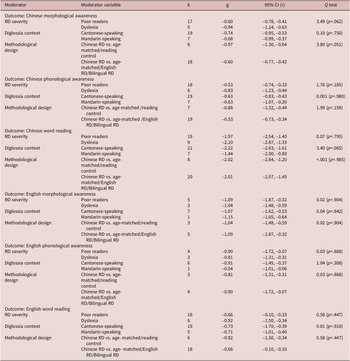
As shown in Table 2 above, the Q test analyses for the six focal outcomes (i.e., morphological awareness, phonological awareness, and word reading in L1 Chinese and L2 English, respectively) indicated significant between-study variation (ps<.001) and the sizes ranged from moderate to large (I 2 between 60.87% and 93.11%). Moderator analyses were first conducted for three categorical variables, namely RD severities, diglossia context, and methodological design (as shown in Table 3).
Categorical Moderator Analyses Results

Surprisingly, no significant effects were identified among the categorical moderators, except for two marginal effects. One was the influence of methodological design on the mean difference in L1 Chinese morphological awareness (Q = 3.80, p = .051). The effect size for the studies that compared Chinese RD vs. age-matched /reading control groups was large (g = – 0.97, k = 8, 95% CI: –1.30, –0.64), yet the effect size for those comparing Chinese RD vs. age- matched /English RD/Bilingual RD was moderate (g = –0.60, k = 18, 95% CI: –0.77, –0.42).
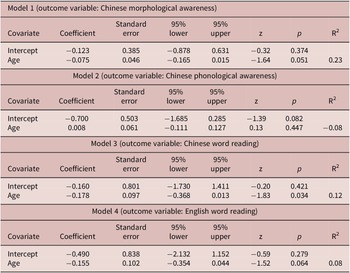
Regarding the influence of age, primary studies with at least 10 independent samples for a target outcome and age information were included for meta-regression analyses. As a result, four mete-regression models were examined with L1 Chinese morphological awareness (k = 26), L1 Chinese phonological awareness (k = 26), L1 Chinese word reading (k = 28), and L2 English word reading (k = 28). The results are shown in Table 4. Age was found to have a statistically significant effect on L1 Chinese word reading deficit (coefficient = –0.178, z = –1.83, p = 0.034), and a marginally significant effect on L1 Chinese morphological awareness (coefficient = –0.075, z = –1.64, p = 0.051), and L2 English word reading (coefficient = –0.155, z = –1.52, p = 0.064). Additionally, age explained about 12%, 23%, and 8% of the within-study variance, respectively.
Meta-regression modeling results

To answer RQ3, this research explored the interrelationships between four potential moderators and six deficit outcomes in L1 Chinese and L2 English and only identified a statistically significant moderating effect of age on L1 Chinese word reading. Age was also found to have marginally significant effects on L1 Chinese morphological awareness and L2 English word reading. As children’s age increased, the mean differences in L1 Chinese morphological awareness, L1 Chinese word reading, and L2 English word reading between RD groups and control groups were larger.
Discussion
This research aimed to provide meta-analytic evidence for the association between a morphological awareness deficit and Chinese-English bilingual children with RD and to explore potential moderator effects. There were three major findings: (1) across the four Chinese diaspora societies (i.e., Beijing, Hong Kong, Singapore, and Taipei), there have been inconsistent practices in the definition of RD or dyslexia, setting diagnostic criteria, and adopting diagnostic assessment tasks. Despite all 14 primary studies assessed morphological awareness, word reading, rather than morphological awareness, has been the main diagnostic assessment tool. (2) This meta-analytic review, nevertheless, has confirmed that Chinese-English bilingual children with RD experienced a significant morphological awareness deficit in addition to phonological awareness and word reading deficits in both L1 Chinese and L2 English, and that the size of the morphological awareness deficit was medium in L1 Chinese and large in L2 English. And (3), among the four potential moderators (i.e., RD severities, age, diagnostic context (Cantonese-speaking vs. Mandarin-speaking), and methodological design), only age has been found to be significant moderator because when children’s age increased, the mean differences in L1 Chinese morphological awareness, L1 Chinese word reading, and L2 English word reading between RD groups and control groups were larger.
The first finding partially confirmed Prediction One, namely, there has been a more standardized and consistent practice in the definitions, assessment tasks, and diagnostic criteria of RD in Hong Kong as compared to other Chinese diaspora societies (i.e., Beijing, Singapore, and Taipei). In the Hong Kong context, two standardized tests (i.e., the Hong Kong Test of Specific Learning Difficulties/HKT-SpLD; Ho et al., Reference Ho, Chan, Tsang and Lee2000; the Hong Kong Test of Specific Learning Difficulties in Reading and Writing for Primary School Students/HKT-P(II), Ho et al., 2007) were used in the primary studies. Although both tests involved multiple literacy components, some researchers only used subtests of word reading or the word reading scores to categorize child participants into RD vs. control groups (e.g., Kalindi et al., Reference Kalindi, McBride, Tong, Wong, Chung and Lee2015; Zhou et al., Reference Zhou, McBride-Chang, Law, Li, Cheung, Wong and Shu2014). In other words, word reading assessment seemed to be the main diagnostic tool in studies of Chinese-English bilingual children with RD. However, this practice is not supported by the second finding of this meta-analytic review, which suggested that Chinese-English bilingual children with RD experienced a significant morphological awareness deficit in addition to phonological awareness and word reading deficits in both L1 Chinese and L2 English. Therefore, Prediction Two has been confirmed.
Prediction Three is also confirmed since age was the only significant moderator for three deficit outcomes, including L1 Chinese morphological awareness, L1 Chinese phonological awareness, and L2 English word reading. This finding is consistent with previous meta-analyses of monolingual readers with RD across different languages (i.e., Georgiou et al., Reference Georgiou, Vieira, Rothou, Kirby, Antoniuk, Martinez and Guo2023) and those of bilingual readers without RD (e.g., Ke et al., Reference Ke, Miller, Zhang and Koda2021, Reference Ke, Zhang and Koda2023). Notably, no significant moderating of age on L1 Chinese phonological awareness was found, while, as children’s age increased, the size of morphological awareness was larger. This may suggest that morphological awareness and phonological awareness deficits are both significant in L1 Chinese children with RD, yet morphological awareness carries more weight longitudinally. The nonsignificant moderating effects of RD severities, diglossia context, or methodological design have confirmed that morphological awareness is an important predictor of Chinese-English reading development across a diverse learner population and Chinese diaspora contexts. Yet, the lack of a significant moderating effect of diglossia context (Cantonese-speaking vs. Mandarin-speaking) on phonological awareness in neither L1 Chinese nor L2 English might be due to the mixture of Beijing, Singapore, and Taipei samples in this small-scale meta-analysis. In previous empirical research comparing bilingual reading developmental patterns in Beijing and Hong Kong alone (e.g. McQuade et al., Reference McQuade, Pan, Ho, Ong, Ng, Meng and McBride2024), it was conjectured that Beijing students with Pinyin training were more phonologically sensitive than Hong Kong counterparts, and that phonological awareness was a significant predictor of L2 English word reading for Beijing students whereas morphological awareness was a significant predictor of L2 English word reading for Hong Kong students.
It is also worth noting that both the present meta-analysis and Zhang D. et al. (Reference Zhang, Ke, Anglin-Jaffe and Yang2023) underscore the critical role of MA in literacy development among populations with reading challenges, demonstrating strong associations between MA and key reading outcomes such as word reading. A notable similarity is that both meta-analyses found MA to be a robust predictor of reading outcomes across diverse linguistic and educational contexts, and both suggest the importance of morphology-based instruction for learners with disabilities—whether RD/dyslexia or DHH. However, while Zhang D. et al. (Reference Zhang, Ke, Anglin-Jaffe and Yang2023) focused on DHH students and reported high correlations between MA and reading outcomes across multiple languages, this research specifically examined Chinese-English bilingual children with reading difficulties, capturing the magnitude of MA deficits relative to controls. Additionally, Zhang D. et al. (Reference Zhang, Ke, Anglin-Jaffe and Yang2023) reported moderating effects of language type and task characteristics, whereas the present meta-analysis identified age as a significant moderator of the deficits in L1 Chinese morphological awareness, L1 Chinese word reading, and L2 English morphological awareness.
The pronounced morphological awareness deficits observed in both L1 Chinese and L2 English among children with RD confirm that metalinguistic skills are transferable across languages, yet are also shaped by language context and exposure (Chung et al., Reference Chung, Chen and Geva2019; Koda, Reference Koda2005). Notably, the larger effect sizes for morphological awareness in L2 English suggest that bilingual learners may increasingly rely on morphological strategies when reading in an additional language (Ke et al., Reference Ke, Zhang and Koda2023). The moderating effect of age further implies a growing reliance on morphological processing as children encounter more complex texts, highlighting the importance of both early and sustained support. These findings call for a re-examination of current diagnostic tools and practices, which often prioritize word reading and phonological skills, and may overlook the critical role of morphological awareness assessment and instruction in supporting bilingual children with reading difficulties.
Conclusions, implications, and limitations
This meta-analysis, based on 14 primary studies and 29 independent samples with Chinese-English bilingual children with reading difficulties (RD) across four Chinese diaspora societies (Beijing, Hong Kong, Singapore, and Taipei), lends support for the diagnostic value of morphological awareness assessment for bilingual children with reading difficulties. For one, Chinese-English bilingual children with RD, regardless of their RD severity and diglossia contexts, experience a significant and moderate morphological awareness deficit along with significant phonological awareness and word reading deficits in both L1 Chinese and L2 English. Notably, in L2 English, the size of morphological awareness is larger than that of phonological awareness and word reading. For another, the size of the morphological awareness deficit is enlarged as children’s age increases, which suggests that morphological awareness assessment also carries a longitudinal diagnostic value. These findings, when considered with recent meta-analyses of other populations such as DHH students (Zhang D. et al., Reference Zhang, Ke, Anglin-Jaffe and Yang2023), reinforce the universal importance of morphological awareness for literacy development among diverse learners with disabilities. Practically speaking, it should be noted that the review of the primary studies has clearly suggested that although morphological awareness has been measured in all selected studies, researchers have tended to treat word reading assessment, rather than morphological awareness, as the main diagnostic tool. Based on the meta-analytic evidence of this research, it is recommended that morphological awareness should be added to the diagnostic tool, especially for bilingual reading development among children with RD.
It should be acknowledged that there are four limitations with this research, which invite further investigation. First, the sample size was relatively small. The independent sample sizes for two outcomes (i.e., English morphological awareness and phonological awareness) were below 10; thus, meta-regression modeling could not be conducted. Future meta-analyses should be replicated with a larger sample pool. Second, this research has considered factors that are developmentally, contextually, and methodologically relevant. Future research may consider analyzing potential assessment-related factors to explore whether different measures affect the sizes of the three deficits in morphological awareness, phonological awareness, and word reading, respectively. Third, this research did not include any studies published in Chinese. Future replication studies may consider incorporating publications in languages other than English. Finally, this research did not differentiate between minority bilinguals who live in societies where their L1 is a minority and must learn and use a society’s L2 for survival, versus majority bilinguals for whom their L1 is the majority, but they opt to learn and use an L2 in an immersion environment to gain the benefits of bilingualism (Zang et al., Reference Zang, Wong and Lau2024). The minority vs. majority bilingual categorization should be considered in moderator analysis in the future.
Data availability statement
The experiment in this article earned Open Data and Open Materials badges for transparent practices. The materials and data are available at: osf.io/s3wz8.
Funding statement
This work was supported by a Departmental General Research Fund grant for the project “Computerized Dynamic Assessment of Morphological Awareness: Predicting Chinese Word Reading in Chinese-speaking and Non-Chinese-speaking First Graders in Hong Kong” (Project ID: P0050995).
Competing interests
None.
Appendix 1. Instrument Reliability Information (Cronbach’s Alpha) Reported in Independent Samples

Notes. Reliability is Cronbach’s alpha, except for Shen (2022) which reported a Spearman-Brown coefficient. MA = morphological awareness.



 Open access

