




Introduction
The origins and development of Neolithic economies and cultures in China are complex and diverse—understandably so in such a geographically vast and varied landmass. The quantities of complex data arising from new excavations and from re-analyses of existing materials can be overwhelming, especially to a Western audience unfamiliar with the many cultural entities of the Chinese Neolithic. It is therefore important that we approach new evidence through generic models for the relationships between socio-economic and cultural change, while recognising that the Chinese Neolithic also needs to be studied on its own terms—as is the case for any particular region of the world.
The most prominent generic model for the spread of the Neolithic is the ‘farming/dispersal’ hypothesis (Bellwood & Renfrew Reference Bellwood and Renfrew2002; Bellwood Reference Bellwood2005). This proposes that during the Early and/or Mid-Holocene, continental-wide movements of human populations were both made possible and motivated by a reliance on domesticated plants and animals. Such population movements are represented by the spread of Neolithic material culture and led to the distribution of the major language families throughout the world. The dispersing populations either interbred with or replaced indigenous hunter-gatherers in the colonised territories. In Europe, for instance, the dispersal of farming communities from Anatolia involved the widespread replacement of Mesolithic hunter-gatherers across the continent and, ultimately, in Britain (Skogland et al. Reference Skoglund, Malström, Raghavan, Storå, Willerslev, Gilbert, Götherström and Jakobsson2012). Similarly, Stevens and Fuller (Reference Stevens and Fuller2017) argued that major population movements in East Asia were a consequence of established rice and millet agriculture that arose after 4000 BC.
The progress in ancient DNA (aDNA) analysis has provided support to the farming/dispersal hypothesis by confirming that the changing geographic distributions of Neolithic material culture are predominatly a consequence of the dispersal of human populations, rather than the spread of ideas and technology alone. Indeed, aDNA has demonstrated that prehistoric population dispersals were more frequent and extensive than archaeologists had previously anticipated (Reich Reference Reich2018). More contentious, however, is whether those populations were necessarily reliant on an established farming economy. As evident from the use of pottery by hunter-gatherers in East Asia (Habu Reference Habu2010; Shoda et al. Reference Shoda2020), or monumental architecture by hunter-gatherer-cultivators in South-west Asia, such as at Göbekli Tepe in Turkey (Dietrich et al. Reference Dietrich, Heun, Notroff, Schmidt and Zarnkow2012) and WF16 in southern Jordan (Mithen et al. Reference Mithen, Finlayson, Al-Najjar, Smith, Jenkins and Maričević2018), the presence of ‘Neolithic’ material culture does not necessarily reflect a farming economy. As such, its spread across continental regions need not imply the movement of farming populations, which is a fundamental tenet of the farming/dispersal hypothesis. In this article, we consider the economic base behind the appearance and spread of Neolithic Beixin Culture in the Haidai region of northern China, thereby testing the applicability of the farming/dispersal hypothesis to this region of East Asia. The Beixin Culture provides an especially important case study due to its contribution to the formation of early Chinese civilisation.
The Haidai region and the Beixin Culture
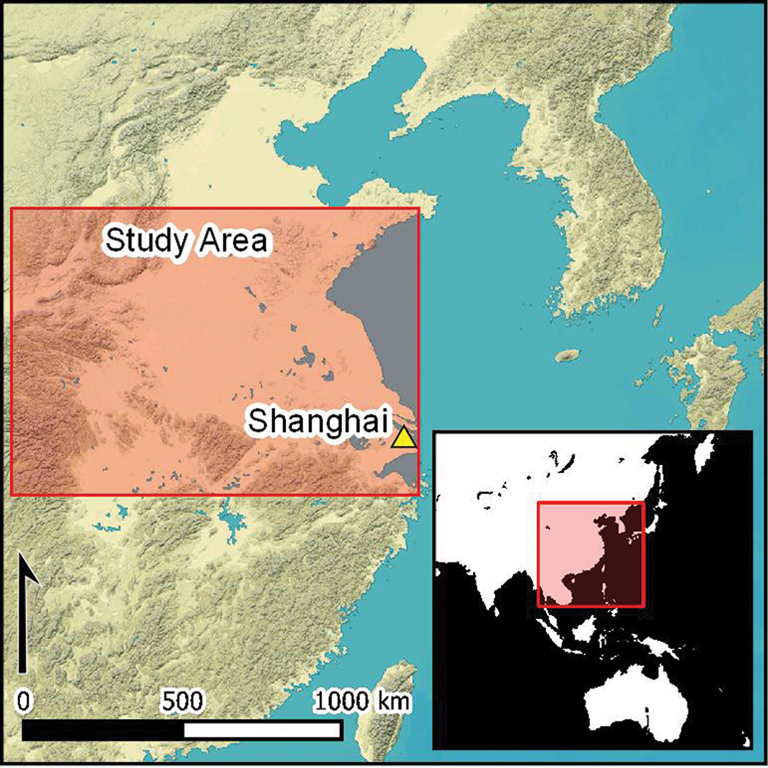
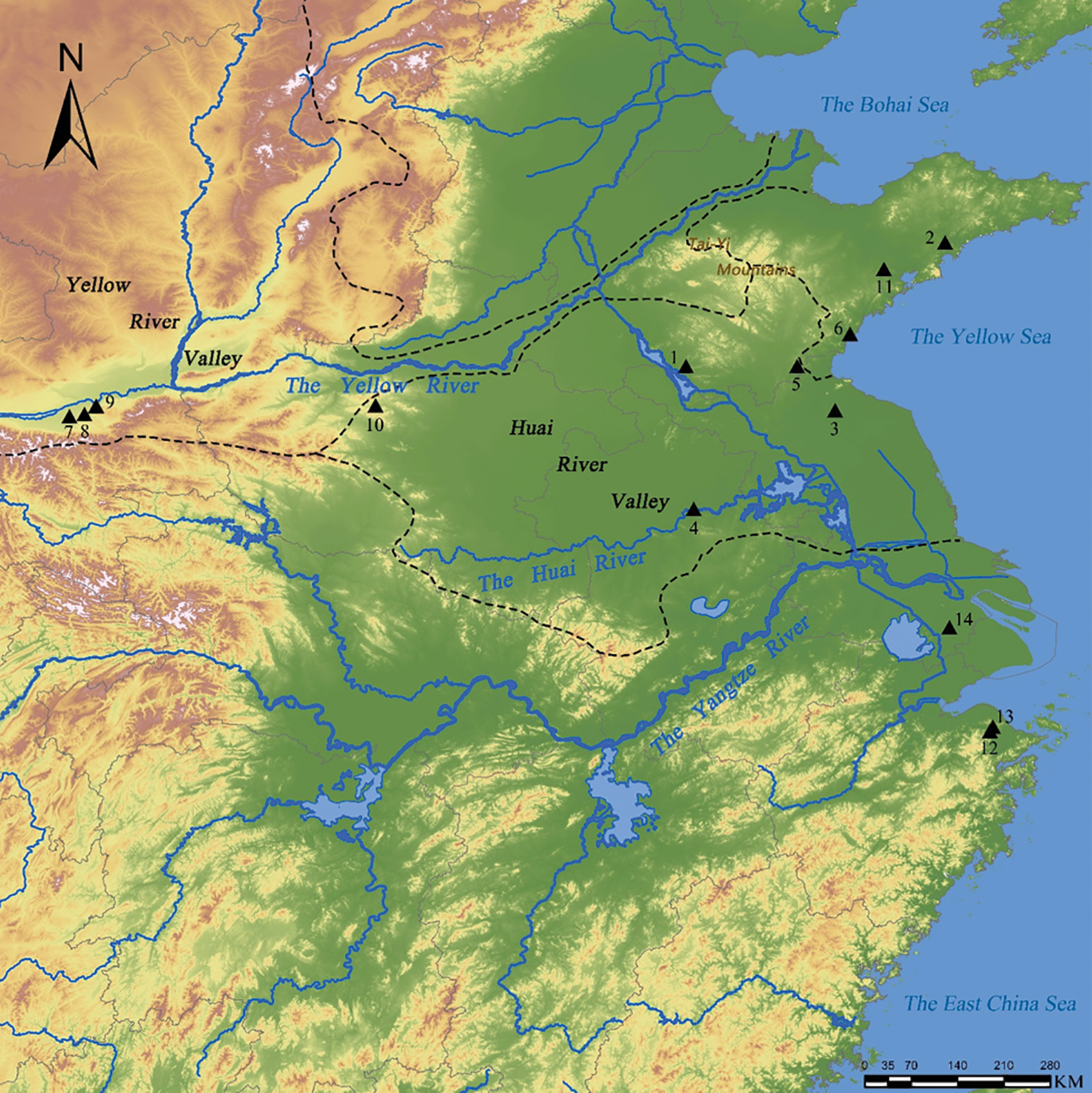
The Haidai region is located in northern China between the Lower Yellow River Valley to the north and the Lower Huai River Valley to the south, core areas of early millet and rice agriculture respectively (Bellwood Reference Bellwood2005) (Figure 1). The two valleys are separated by the Tai-Yi Mountains, which are surrounded by gentle hills to the east and south and an extensive alluvial floodplain to the north and west that is drained by numerous tributaries of the Yellow and the Huai Rivers.
The Haidai region of northern China, showing sites referred to in the text: 1) Guanqiaocunnan; 2) Beiqian; 3) Dayishan; 4) Shuangdun; 5) Dongpan; 6) Nantunling; 7) Yuhuazhai; 8) Banpo; 9) Jiangzhai; 10) Yuanqiao; 11) Zhaojiazhuang; 12) Hemudu; 13) Tianluoshan; 14) Caoxieshan (map by Z. Rao).
The Haidai region hosted a sequence of Neolithic cultures, identified primarily by changes in ceramic technology and design: the Houli, Beixin, Dawenkou and Longshan Cultures. The latter represents one of the earliest manifestations of Chinese state society, featuring a fully developed agricultural economy (Luan & Wagner Reference Luan, Wagner, Wagner, Luan and Tarasov2009; Song Reference Song2011). To establish the chronology of culture change in the Haidai region, Long et al. (Reference Long, Wagner and Tarasov2017) undertook a Bayesian analysis of the 275 radiocarbon dates then available (Table 1). Their results, however, should be viewed with caution, due to the insufficient contextual information for many of the samples and a reliance on wood charcoal, rather than seeds (Rao et al. Reference Rao, Guo and Jin2018). The most notable chronological gap in Long et al.'s (Reference Long, Wagner and Tarasov2017) sequence is that between the Houli and Beixin Cultures. Houli settlements are found to the north of the Tai-Yi Mountains and are characterised by plain, round-based ceramic vessels (Figures 1–2). Houli subsistence was based predominantly on hunting and gathering, with some use of rice and millet suggesting low-level food production, although direct evidence for cultivation has yet to be confirmed (Jin Reference Jin2012).
Houli (a–f) and Beixin (g–i) Culture pottery: a) basin, pen; b & g–h) bowl, bo; c & j) jar, guan; d & f) cauldron, fu; k) three-legged cauldron, sanzu fu; i & l) tripod, ding (all photographs courtesy of F. Luan).

Modelled onset and end dates of Neolithic cultures in the Haidai region from Long et al. (Reference Long, Wagner and Tarasov2017).

The earliest Beixin Culture sites date to c. 5000 BC and are found to the south of the Tai-Yi Mountains. The majority of the approximately 100 known sites, however, are located on the floodplains to the north and north-east of the mountains and are later than the Beixin settlements from the south of the Tai-Yi Mountains (Liu & Chen Reference Liu and Chen2012: 184). Beixin ground stone tools are characterised by a more diverse repertoire of forms and greater standardisation of production than those associated with the Houli Culture, and include digging implements, sickles, adzes and grinding stones. Similarly, Beixin ceramics are more diverse in shape and are decorated (Figure 2). The defining ceramic vessel type of the Beixin Culture is the ding, a tripod with three small legs, which continues into the succeeding Dawenkou and Longshan Cultures (Luan & Wagner Reference Luan, Wagner, Wagner, Luan and Tarasov2009; Liu & Chen Reference Liu and Chen2012: 184).
During the fifth millennium BC, Beixin settlements spread throughout the Haidai region, reaching the eastern coastal region by the fourth millennium, as represented by the site of Beiqian (3770–2860 BC). The domestic structures of the Beixin Culture are distinct from those of the earlier Houli Culture in that they are circular and semi-subterranean, rather than rectangular and constructed on the ground surface. They are also smaller, have single rather than multiple hearths, and a single room and entrance, rather than partitioning (Luan Reference Luan, Wagner, Luan and Tarasov2009).
The Beixin Culture employed a range of mortuary practices with no obvious signs of social stratification (Wang Reference Wang, Wagner, Luan and Tarasov2009; Liu & Chen Reference Liu and Chen2012). Cemeteries were separate from habitation areas, with most burials being single individuals placed in a supine, extended position. The few known multiple burials comprise an adult and an infant, or adults of the same sex. Some burials were placed in stone-lined cists, while some children were buried within urns. The majority of burials lack grave goods. When present, they comprise small numbers of utilitarian objects made of stone, bone and ceramic. Of the 62 graves excavated at the Dayishan cemetery, for example, 16 contained grave goods, 43 contained one to five objects, and three contained six or seven objects. On this basis, Wang (Reference Wang, Wagner, Luan and Tarasov2009) and Liu and Chen (Reference Liu and Chen2012) concluded that the Beixin Culture was egalitarian.
The Beixin Culture probably originated in the Huai River Valley, as suggested by similarities in its material culture with that from Shuangdun, the type-site of the Shuangdun Culture, where both rice and millet were being cultivated from 5000–4800 BC (Luan Reference Luan, Wagner, Luan and Tarasov2009; Han Reference Han2012; Luo et al. Reference Luo, Gu, Yang, Zhang, Liang, Li, Huang and Zhang2019). Luan (Reference Luan, Wagner, Luan and Tarasov2009) proposed that the Beixin Culture was a millet- and rice-based farming economy. His only evidence, however, was the presence of millet grain impressions in ceramics, from which it is not currently possible to differentiate between wild and domesticated strains of millet (and rice). The only direct archaeobotantical data for the Beixin Culture comes from the Dongpan and Nantunling settlements, but evaluation of this evidence is limited by the small sample sizes (Chen Reference Chen2007; Jin et al. Reference Jin, Wagner, Tarasov, Wang and Liu2016). The Beixin Culture expanded north and east to the coast. Here, both animal and plant remains, along with isotope data from human skeletal remains from the Beiqian site, suggest the exploitation of a combination of terrestrial and marine resources (Wang & Jin Reference Wang and Jin2013; Song & Wang Reference Song and Wang2016). Jiao (Reference Jiao2016) interprets this evidence as representing low-level food production, involving limited cereal cultivation and broad-spectrum gathering. Such a mixed economy could, however, attest a specific coastal adaptation that is unrepresentative of the Beixin Culture settlements to the south and north of the Tai-Yi Mountains. What was that economy? Was it reliant on domesticated plants and animals as the farming/dispersal hypothesis would suggest? Or was it consistent with the mixed hunting, gathering and cultivation economy found at later Beixin settlements in coastal regions? The archaeobotanical and dating results reported in this article provide the first evidence to address these questions.
Guanqiaocunnan
The Beixin settlement of Guanqiaocunnan was discovered in 2014–2015 during the construction of the Central Primary School of Guanqiao Town (Figure 1). This building work required the excavation of a Western Han-period (206 BC– AD 8) cemetery containing 30 vertical pit burials. Several of these burials had cut through a number of ash pits of Neolithic date. A further series of ash pits was discovered nearby within an area of burnt clay fragments, the latter interpreted as the remnants of Neolithic house floors (Figure 3). In total, 17 ash pits, labelled H1–17, were surveyed and partially excavated by a team from Shandong University.
Plan of the excavations at Guanqiaocunnan (drawing by H. Wu & E. Jamieson).

The morphology of the ash pits, along with the ceramics and stone tools that they contained, are indicative of the Middle Beixin Culture (4600–4300 BC) (Department of Archaeology and Museology, Shandong University & Tengzhou Han Dynasty Carved Stone Museum 2019). Ten of the ash pits also yielded faunal remains. Over 600 fragments were recovered from pit H9, for example, representing domesticated pig, and wild animals, including birds, deer, fish, freshwater mussels, turtle and other carnivores.
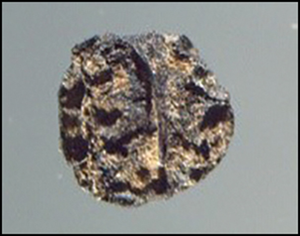
Thirty-nine sediment samples were collected for flotation and phytolith extraction (for methods, see the online supplementary material (OSM)). All but one of these samples have yielded charred seeds, fruits and charcoal, the exception being a sample from the lowest layer in pit H9. Among the 4530 plant remains, including 4488 seeds and fruits and 32 fragments of nutshell, we have identified 26 different species. The full dataset is provided in Table S1 in the OSM, which categorises the plant remains as cultigens, weedy plants, water plants and fleshy fruits and nuts—a selection of which are illustrated in Figure 4. Phytolith analysis is ongoing.
A selection of plant remains from Guanqiaocunnan: 1) foxtail millet (Setaria italica); 2) broomcorn millet (Panicum miliaceum); 3) rice (Oryza sativa); 4) soybean (Glycine max); 5) purple perilla (Perilla sp.); 6) Rough cocklebur (Xanthium strumarium L.); 7) wild soybean (Glycine soja); 8) Lespedeza bicolor; 9) jujube (Ziziphus sp.); 10) wild grape (Vitis sp.); 11) Cayratia sp.; 12) Japanese bush cherry (Cerasus japonica) (Thunb.) Lois); 13) acorn (Quercus sp.); 14) shell of prickly water lily fruit (Euryale ferox); 15) hazelnut (Corylus sp.); 16) Taxodiaceae (photographs by J. Yang).

Dating
Three samples of broomcorn millet (Panicum miliaceum) and two of foxtail millet (Setaria italica) were selected for direct radiocarbon dating at the Peking University AMS radiocarbon facility, each requiring a combination of 10–11 grains to provide sufficient carbon after pre-treatment. Four samples of rice (Oryza sativa) were also submitted (Table S2). The dates provide a largely consistent range of c. 4300–4000 BC, and attest to the contemporaneity of the sampled ash pits (Figure 5).
Radiocarbon dates on charred cereal remains from Guanqiaocunnan (figure by K. Su).

The archaeobotanical assemblage
Cereals are the most important component of the assemblage, being found in all of the 39 samples—a ubiquity of 100 per cent—and representing 92 per cent of the 4530 seeds recovered. These are followed by weedy plants (66 per cent ubiquity, 4 per cent of the seed assemblage) and nuts/fruits (42 per cent ubiquity, 4 per cent of the seed assemblage).
Cereals
The overall state of preservation of the cereal grains precludes identification of traits indicative of domestication. Given that the cultivation of broomcorn and foxtail millet and rice is attested in the Yellow River Valley by c. 5800 BC (Zhang et al. Reference Zhang, Lu, Gu, Wu, Zhou, Hu, Xin and Wang2012), however, it is reasonable to assume that the samples from Guanqiaocunnan are of domesticated varieties. Measures of relative percentage and ubiquity (Figure 6b) indicate that broomcorn millet was the most important crop at Guanqiaocunnan, followed by foxtail millet. In terms of frequency, both species (broomcorn with 64.98 per cent and foxtail with 25.47 per cent) substantially outnumber the quantity of rice grains (0.92 per cent) recovered. In terms of the number of samples in which they appear (their ubiquity), however, rice has a level of 44.73 per cent, foxtail 76.31 per cent and broomcorn 94.73 per cent, indicating that the differences in ubiquity are much smaller than that of percentage presence within the seed assemblage. Thus, we suggest that all three cereal types were important in the Guanqiacounnan economy.
Percentages and ubiquities of plant types at Guanqiaocunnan (figure by S. Chen & E. Jamieson).

Nuts and fruits
Nine nut and fruit species were recovered from Guanqiaocunnan. Two nut taxa, oak (Quercus sp.) and hazel (Corylus sp.), are likely to have been important food resources, with oak acorns having a notably higher ubiquity (26 per cent) than hazel (Figure 6c). A sample from ash pit H8 contained large quantities of charred acorns, with 31 whole specimens and 500 fragments. Hazel has a ubiquity of 11 per cent, higher than wild grape and jujube (both at 5.26 per cent). Terrestrial fruit taxa include two from the Vitaceae family (wild grape: Vitis sp. and Cayratia sp.), one from the Rhamnaceae family (jujube: Ziziphus jujuba), one from the Rosaceae family (Japanese bush cherry: Cerasus japonica) and one from the Taxodiaceae family. In addition to these terrestrial taxa, two aquatic plant taxa were also identified: 14 prickly water lily fruits (Euryale ferox) from two samples and seven fragments of water chestnut (Trapa sp.) from one sample. It is notable that nut and fruit fragments are primarily represented amongst the one per cent of fragments that cannot be assigned a taxon but which might have made an important contribution to the diet.
Weedy plants
Some 176 fragments of weedy plants were identified across all samples, constituting a small proportion of the entire assemblage. Based on traditional plant-use from documentary sources and the present-day ecology of these species, they can be further divided into three groups: edible wild grasses, potentially arable weeds and other ruderals (Wang & Zhou Reference Wang and Zhou2000; Qiang Reference Qiang2009; Li et al. Reference Li, Yin, Huang, Liu, Li and Wu2013; Wu et al. Reference Wu, Jin, Wang and Wang2013). In terms of percentage and ubiquity, edible grasses dominate the weedy plant assemblage (Figure 6d). The edible wild grasses, some three per cent of the overall assemblage, include seven taxa: Siberian cocklebur (Xanthium sibiricum), sambucus (Sambucus williamsii), summer grass (Kochia scoparia), wild soybean (Glycine max), purple perilla (Perilla sp.), pale persicaria (Polygonum lapathifolium) and Chinese lantern (Physalis alkekengi). Among these taxa, two types of oil plant—wild soybean and purple perilla—have the highest percentage levels and ubiquity among the weedy species (Figure 6e). The potential arable weeds are crabgrass (Digitaria sp.), barnyard grass (Echinochloa sp.) and green bristlegrass (Setaria viridis). These amount to one per cent of the total, and all have high ubiquities. All of the ruderal taxa have low percentages and ubiquities, comprising less than 0.2 per cent of the total.
Interpretation: a mixed economy of cultivation and wild-resource exploitation
Our results indicate that both cereals and wild plants were important as food and for other uses at Guanqiaocunnan. To assess their relative importance, it is necessary to consider both taphonomic and nutritional variables. We first note that the range of materials acquired from the ash-pits indicates that these pits were used for rubbish disposal, rather than food storage. The plant remains may therefore have been introduced via activities such as the sweeping of house floors, plant processing and cooking. During crop processing and food preparation, larger grains, and fruits and nuts, are less likely to be lost on floors, as they are easy to spot and recover. By contrast, smaller grains are less visible and may be lost more frequently. Table 2 shows how the seeds of broomcorn millet are around eight times smaller than those of rice and therefore perhaps more likely to have been lost during food preparation. Consequently, we should be cautious when interpreting the numerical dominance of millet over rice grains at Guanqiaocunnan as evidence for the relative importance of the former.
Variation in weight, volume and nutritional content of plant foods found at Guanqiaocunnan.

1 The data are taken from: https://www.calorieking.com/us/en/foods/ (accessed 6 September 2019).
Broomcorn millet provides a similar number of calories per 100g to rice, soybean, prickly water lily fruit and acorns, but only half the calorific content of hazelnut (Table 2). Drawing on the data presented in Table 2, the 2944 grains of broomcorn millet would have provided 3294 calories, while the seven hazelnuts would have provided 574. When we consider the greater likelihood of millet grains surviving than nuts, it is evident from their much higher calorific content that hazelnuts might have been at least an equivalent source of food as that of millet. While we can reasonably assume that the cultigens, aquatic plants, fruits and nuts were collected or cultivated for food, the role of the weedy plants is more difficult to interpret. Although many of them are edible, their presence in the ash pits suggest that the charred weedy plant remains may have derived from the discard of material used in bedding and crafting activities, or from weeds growing within the pits between periods of deposition and burning. As arable weeds, it is possible that they were unintentionally harvested along with the millets. A further factor to consider is that different food plants have different opportunities for becoming charred, depending on how they are processed. Some plant foods may have avoided charring entirely, and hence would not have survived in the archaeological record. Despite these challenges, the Guanqiacunnan assemblage offers several informative features.
Prominence of wild plant foods
The most notable feature is the relatively high percentage, diversity and ubiquity of wild plants in the Guanqiacunnan assemblage, when compared with contemporaneous sites in the Middle Yellow River Valley. At the site of Yuhuazhai, for example, plant remains suggest a mixed economy of cultivation and wild plant exploitation (Zhao Reference Zhao2017), but both the diversity and the percentage of edible wild plants—especially the nuts and fruit—are much lower than at Guanqiacunnan. Unfortunately, however, this comparison cannot be developed due to the lack of a published ubiquity analysis or cultural contexts for the Yuhuazhai plant remains. Nevertheless, it seems clear that the inhabitants of Yuhuazhai were less reliant on wild plants than those of Guanqiacunnan. Isotopic data from the nearby sites of Banpo and Jiangzhai indicate the dominance of millet consumption at these sites (Cai & Chou Reference Cai and Chou1984; Guo et al. Reference Guo, Hu, Gao, Wang and Richard2011), while a settlement catchment analysis at Yuanqiao suggests that people relied predominantly on millet cultivation and less on wild plant food (Qin et al. Reference Qin, Zhang and Fuller2010). We therefore suggest that the inhabitants of Guanqiaocunnan consumed more wild plant food than those in the Middle Yellow River valley.
Rice, millet and the predominance of broomcorn over foxtail millet
The combination of millet and rice cultivation at Guanqiacunnan is also notable. Both broomcorn and foxtail millet are dryland crops. Conversely, rice requires either managed paddy fields, for which there is no evidence at Guanqiaocunnan, or wetlands. The existence of sufficiently wet conditions for rice cultivation at the site is suggested by the presence of aquatic plant remains, while suitable patterns of seasonality derived from the Mid-Holocene East Asian Summer Monsoon (An et al. Reference An2000). Although the earliest known rice paddies in the Haidai region are found at the Longshan Culture site of Zhaojiazhuang (2400–1800 BC; Jin et al. Reference Jin, Yan, Udatsu, Lan, Wang and Tong2007), the sites of Hemudu, Tianluoshan and Caoxieshan in the Yangtze River Valley are contemporaneous with Guanqiaocunnan (Zou & Gu Reference Zou, Gu and Yan2000; Zheng & Sun Reference Zheng, Sun, Qin, Li, Wu and Chen2009; Wen et al. Reference Wen, Sun, Xie and Sun2014). Considering the influence of the Mid-Holocene climatic optimum, we suggest that the latitude difference between Guanqiaocunnan and Caoxieshan (the latter being much farther to the south) hardly affects our comparison. Close to Guanqiaocunnan, modern-day Yutai County is famous for its high-quality rice and aquatic plants. Thus, it is reasonable to conclude that both dry and wetland cultivation of cereals was practised at Guanqiaocunnan, combined with the substantial exploitation of wild food plants.
The dominance of broomcorn millet over foxtail millet is also notable. Broomcorn millet produces fewer seeds per plant than foxtail millet, but it matures earlier and has a shorter life cycle of 60+ days, compared to 90+ days for foxtail millet (Pursglove Reference Pursglove1972; Liu et al. Reference Liu, Hunt and Jones2009). Broomcorn millet can also grow in relatively poor soils (Weisskopf Reference Weisskopf2010). Although it has lower yields than foxtail millet, the early maturation of broomcorn millet can be attractive, as it mitigates the risk of food shortage during the summer. Chinese classical writings refer to broomcorn millet as a pioneer species used for establishing new land for cultivation and as an insurance crop in case of drought (e.g. Qimin Yaoshu volume 2 Shuji; see Shi & Tan Reference Shi and Tan2015). The dominance of broomcorn millet at Guanqiaocunnan may indicate an economic system still based predominantly on hunting and gathering, but using cereal cultivation to buffer against risk, whereas the contemporaneous Yuhuazhai site in the Yellow River Valley has a predominance of foxtail millet over broomcorn millet, which may indicate a heavier reliance on farming. The fully developed farming economies of the Late Dawenkou and Longshan Cultures in the Haidai region had also shifted to cultivating the more productive foxtail millet (He et al. Reference He, Lu, Zhang, Wang and Huan2017), and provide extensive evidence for storage (The Institute of Archaeology, Chinese Academy of Social Sciences 1988).
Nuts and fruit storage at Guanqiaocunnan
While there is no definitive evidence for food storage at Guanqiaocunnan, the condition of the nuts and fruits suggests that they may have been stored. Pit H8 contained a large quantity of charred acorns, with 31 intact specimens and 500 fragments. While such storage is possible either as whole nuts or as flour/meal, it is unclear whether the acorns were being intentionally stored at Guanqiaocunnan. Although no grinding stones have been recovered from Guanqiaocunnan, use-wear and starch analyses at other Beixin sites indicate that such stones were used for processing cereals as well as nuts—especially acorns (Liu & Chen Reference Liu and Chen2012). The discovery of storage pits provides strong evidence for acorn storage at Tianluoshan in the Lower Yangtze River Valley (Fuller et al. Reference Fuller, Qin, Zhao, Zheng, Leo, Chen and Sun2011). Additionally, two species of aquatic plants found at Guanqiaocunnan—water chestnut and prickly water lily fruit—are also suitable for storage. Chinese classical writings refer to their cultivation techniques and processing methods, indicating that dried water chestnuts and prickly water lily fruit can be stored for longer periods and exchanged over longer distances (Shi & Tan Reference Shi and Tan2015). The production of these crops in modern southern Shandong Province still plays an important role for the local economy (Li et al. Reference Li, Yin, Huang, Liu, Li and Wu2013). Further evidence, of course, is required to demonstrate the practice of storage within the Beixin Culture.
Discussion
The archaeobotanical assemblage from Guanqiaocunnan confirms the greater reliance of the Beixin Culture on cultivated cereals than the earlier Houli Culture, as proposed by Luan (Reference Luan, Wagner, Luan and Tarasov2009) and Jin (Reference Jin2012). The Beixin economy was, however, far removed from the intensive millet-based agriculture of the subsequent Longshan Culture (Song Reference Song2011). The Beixin still made substantial use of wild plants and animals, as evidenced by both Guanqiaocunnan and Beiqian, suggesting that this mixed economy was characteristic of the Beixin Culture as a whole. Despite being hunter-gatherer-cultivators, by 4600 BC this culture had spread across the Huai River region into southern Haidai, and to both the north and east of the Tai-Yi Mountains by 3800 BC. This geographic distribution challenges the farming/dispersal hypothesis premise that Early and Mid-Holocene dispersals of Neolithic culture arose from the movements of populations reliant on farming economies. More particularly, it challenges Stevens and Fuller's (Reference Stevens and Fuller2017) proposition that early cultivation practices are unlikely to have caused major shifts in the distribution of East Asian populations.
The Beixin Culture shares similarities with the Early Neolithic (Pre-Pottery Neolithic A) of the Levant in terms of combining cereal cultivation with a primary reliance on hunting and gathering—an approach that promoted cultural innovation, as manifested in ceramics in China and in stone vessels and architecture in the Levant (e.g. at Jerf el Amar, Dhra‘ 1 and WF16; Willcox & Stordeur Reference Willcox and Stordeur2012; Colledge & Conolly Reference Colledge, Conolly, Finlayson and Kuijt2018; Mithen et al. Reference Mithen, Finlayson, Al-Najjar, Smith, Jenkins and Maričević2018). Unlike the Pre-Pottery Neolithic A of the Levant, the Beixin Culture shows a similar geographic dispersal pattern to that of Neolithic farmers in other regions of the world, notably in Europe.
Although evidence is restricted to the site of Guanqiaocunnan, this indicates that the Beixin Culture represents the dispersal of a culturally Neolithic human population with an economy based primarily on hunting and gathering and involving the small-scale cultivation of both rice and millet. Our case study questions the strict distinction between economies based on hunting and gathering and those on farming that underlie the farming/dispersal hypothesis of Bellwood and others (Bellwood & Renfrew Reference Bellwood and Renfrew2002; Bellwood et al. Reference Bellwood2005; Stevens & Fuller Reference Stevens and Fuller2017). As far as we can see, however, this has no bearing on whether those Early and Mid-Holocene dispersals led to the distribution of major language families in the world.
Conclusion
Ethnographic studies consistently demonstrate that subsistence economies involve the exploitation of both wild and domesticated plants, with variable degrees of importance and different roles (Freeman Reference Freeman2012). While we agree that agriculture provided a new dynamic for population dispersals during the Early and Mid-Holocene, advances in archaeological analysis now support models of human dispersals based on subsistence mosaics (e.g. Crowther et al. Reference Crowther, Prendergast, Fuller and Boivin2018). As such, the farming/dispersal hypothesis obscures as much as it explains. The Beixin Culture appears to provide a further example of population dispersal supported by a subsistence mosaic—in this case with a primary reliance on the gathering of wild foods. Confirmation of this dispersal model requires further excavation, the analysis of additional archaeobotanical assemblages and aDNA analysis of both human and animal skeletal material from across the Haidai region, and East Asia more widely.
Acknowledgements
We thank Fengshi Luan, Jingang Yang, Hao Wu, Kai Su, Zongyue Rao and Elaine Jamieson for helping to prepare the figures, and Roger Matthews and the two anonymous peer reviewers for their useful comments on a previous version of this manuscript.
Funding statement
We thank the China National Natural Science Foundation (41771230) for supporting the archaeobotanical study, and the Leverhulme Trust for supporting the Visiting Professorship of Guiyun Jin to the University of Reading for 2018-19 (VP1-2017-00).
Supplementary material
To view supplementary material for this article, please visit https://doi.org/10.15184/aqy.2020.63


 Open access

