


Over the last decade, the distribution of the rising burden of diet-related chronic diseases across areas of the world has changedReference Schmidhuber and Shetty1, because of major modifications in nutrition trends. While the issue has a relatively long history in North American and Northern European countries, the first to implement ad hoc nutrition policies, more recently the adverse health consequences of poor dietary patterns have extended to previously unaffected developingReference Schmidhuber and Shetty1 and Southern European countriesReference Schmidhuber and Traill2, Reference Mazzocchi and Traill3.
The present paper aims to provide a cross-national analysis of nutrition trends across the world over the last four decades, using the only available source for internationally comparable nutrient intake data: the Food Balance Sheets (FBS) of the Food and Agriculture Organization of the United Nations (FAO). International comparisons with country-level data are based on an aggregate indicator of distance from the World Health Organization (WHO) nutrient goals4. It should be stressed that FBS data are affected by several shortcomings. Nutrient intake data are obtained through conversion factors from food availability figures and these are computed through the national accounting disappearance method. While this method is known to be biased due to difficulties in accounting for retailing and household waste, here it is assumed that measurement problems are less relevant when considering time patterns. Schmidhuber and TraillReference Schmidhuber and Traill2 provide a detailed analysis of convergence trends across countries in the European Union (EU) based on an indicator of bilateral distance built on the calorie intakes for 426 different products. They show a distinct and growing similarity across EU countries. In this paper we integrate their analysis using a different indicator, one which measures distance from a selection of WHO nutritional recommendations4 for all countries included in the FAOSTAT database. Srinivasan et al. Reference Srinivasan, Irz and Shankar5 have looked at the compliance with WHO norms on a product-by-product level. Our indicator does not refer to individual products, but to aggregate nutrient intakes and other recommendations referring to specific food intakes (e.g. sugar, fruit & vegetables). Furthermore, we focus on the healthiness of the diet (as defined by the WHO recommendations4) rather than its composition. There are inherent limits in this sort of analysis. First, it is not possible to account for all WHO dietary recommendations due to data availability constraints. Second, it is necessary to assume a relative weight for each of the different recommendations. Third, there is a potential aggregation issue, since countries with high internal disparities might still return a healthy diet on average. Nevertheless, the suggested approach may be powerful in exploring trends, as it allows comparisons among countries whose diets are very different in terms of composition because of cultural and tradition factors.
Methods
We suggest a methodology for building an aggregate indicator of compliance with the WHO recommendations. The indicator is based on FAOSTAT data, thus allowing comparisons between our results with those obtained by Schmidhuber and TraillReference Schmidhuber and Traill2. The indicator is computed for 149 countries in the FBS dataset over the period 1961–2002, and its flexible definition allows generalisation to alternative baselines and to varying dimensions of the recommendation set. Two hypotheses are tested using appropriate statistical methods: (1) whether there has been a significant improvement in compliance with WHO norms over time; and (2) whether disparities among and within different world areas have decreased.
The Recommendation Compliance Index
Using FAOSTAT data, an indicator of distance from the WHO recommendations can only be built on a subset of aggregate nutrient goals because information on specific targets such as fibre is lacking, although we are able to account for recommendations on saturated fats and trans-fats.
The indicator must be able to synthesise nutrient intake proportions with actual food intakes, such as fruit and vegetables, as this provides a useful benchmarking tool to investigate dietary trends over time and across countries. We name this indicator the Recommendation Compliance Index (RCI).
A detailed description of the indicator and its construction is provided in the Appendix; here it may suffice to summarise the main steps.
1. For each of the WHO recommendations, considering lower and upper bounds, a measure of distance is built as follows: if the actual intake value lies within the boundaries, then distance is 0; otherwise distance is computed as the difference between the observed intake and the nearest (lower or upper) boundary of the target intake, divided by the maximum potential difference. This creates a measure of distance between 0 (target met) and 1 (maximum distance from the nutrition goal).
2. Distances for the individual nutrient targets are aggregated using a weighted average, where weights express the relative importance of each nutrition goal. Since goals are not entirely independent (e.g. it is impossible not to meet at least one target), a normalisation is provided so that the aggregated indicator also lies between 0 (maximum distance from the ‘perfect’ diet) and 1 (all goals met).
Testing for changes in compliance and convergence in nutrition patterns
We apply two statistical testing methodologies to test: (1) whether the RCI has changed significantly over time, considering all countries and different groups of countries; and (2) whether a convergence process exists, i.e. variability has decreased significantly over time.
The first question can be answered through a test on the equality of means in different time periods. We perform paired comparisons for mean values in three time periods, 1961 (the initial year of the sample), 1981 (the mid-sample point) and 2002 (the final year). Since the RCI has a truncated distribution (its values lie between 0 and 1), the critical values of the t-test for paired samples are obtained through bootstrapping.
The second question is a classical problem of convergence analysis. Empirical analysis of convergence consists in observing whether certain features of the units under comparison grow closer (converge) or apart (diverge) over time. We use the notion of σ-convergence, widely employed in the macroeconomic literatureReference Baumol6–Reference Barro and Sala-i-Martin8. In general, σ-convergence occurs when variability decreases over time. A formal test consists of checking whether  where
where  is the variance in the base year and
  is the variance in the final year of the sample. While the ratio between the two variances is an appropriate test for the hypothesisReference Lichtenberg9, the distribution of the test statistic might depart from the usual F-distribution because of serial correlation in the data. Adjusted testing strategies have been developedReference Carree and Klomp10, or alternatively – as we do in this study – appropriate critical values can be computed trough bootstrapping. Thus, we apply the original test statistic proposed by LichtenbergReference Lichtenberg9:

where  is the estimated variance of the RCI in the base year and
  is the variance among the countries in the final year.
Application and results
The time pattern of the RCI across countries shows the evolution of dietary trends in relation to the WHO nutrition goals. In our application we start from seven basic indicators based on the dietary recommendations listed Table 1.
Basic indicators for the WHO nutrient goals based on FAOSTAT data4

WHO – World Health Organization.
*The actual recommendation of 400 g per capita per day is increased by 50% to account for household waste, which affects FAOSTAT figures (see Schmidhuber and Traill2).
The basic indicators are built as described in the Appendix and are subject to the following constraints:

Sensitivity to the weights
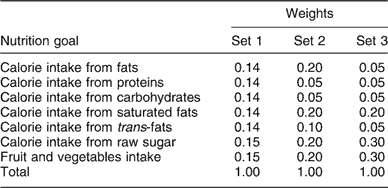
An issue in building the indicator is the weighting of each nutrient goal. Since there is no objective evidence on the relative importance of each WHO recommendation, different sets of weights can be chosen. However, the time patterns of the indicator are likely to be loosely related to its absolute levels. To explore the robustness of the indicator patterns to changes in the weights, we compute the indicator for three different sets of weights and explore the bivariate correlations of the resulting RCIs, computed for each of the countries in the sample. High correlations indicate robustness to changing weights. The three sets of weights are shown in Table 2.
Alternative sets of weights for the RCI
RCI – Recommended Compliance Index.
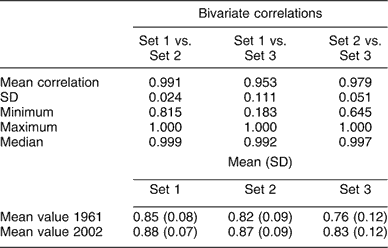
The first set assigns an approximately equal weight to all recommendations. The second set gives additional weight to the recommendation on fats (50% altogether) and those on sugar and fruit and vegetables (20% each), reducing the importance of carbohydrate and protein targets (10% in total). The third set places the same weight on fruit and vegetable intake (30%), sugar intake (30%) and the three recommendations on fats (30% in total, 20% of which on the saturated fats goal). Summary statistics and correlations under the three alternative weighting scenarios are shown in Table 3.
Bivariate correlations and mean values of the RCI computed with different sets of weights
RCI – Recommended Compliance Index; SD – standard deviation.
The RCI is shown to be robust to changes in the weighting system for almost all countries. For all pairs of correlations, the median correlation is very close to 1 and only for three countries (Bangladesh, Mozambique and Cambodia) does the correlation fall below 0.70. Thus, the set of weights has a low impact on RCI dynamics, while it has some influence on the absolute level (which is larger for the first set) and on variability (higher for the third set).
In all three cases, an increase in the overall mean value is observed. For the rest of the discussion we refer to the second (intermediate) set, which shows high correlations with both of the alternative sets and places a relatively higher weight on fats, sugar and fruit and vegetables, usually recognised as more relevant to health than the goals for proteins and carbohydrates.
Figure 1 shows the time trend of the RCI for a selection of countries, using FAOSTAT data for the period 1961–2002. Countries like France, Greece, Spain and Italy met all seven of the nutrient goals in the early 1960s, but they have progressively worsened their position. Their distance from the ‘ideal’ diet is now as large as it is for the UK and the USA, where the aggregate dietary indicator shows a positive trend over most of the sample period.
Time trend of the Recommendation Compliance Index (RCI) for a selection of countries over the period 1961–2002 under the second (intermediate) weighting set (see text)

Figure 1 already shows a convergence process for some countries belonging to the Organisation for Economic Co-operation and Development (OECD), although this means a worse diet for Southern European countries. Using the statistical tests introduced in the previous sections, it is possible to assess changes in mean levels and variability for the RCI, distinguishing between different groups of countries. For this purpose we use some basic country classification rules taken from the FAOSTAT database and cluster countries into three subgroups: OECD countries, developing countries and least developed countries. Figure 2 shows how the RCI means and variances for these subgroups evolve through time, while Table 4 summarises the results of mean comparison and convergence tests.
Mean (top) and variance (bottom) of the Recommendation Compliance Index (RCI) over the period 1961–2002 for subgroups of countries (OECD – Organisation for Economic Co-operation and Development)

Mean equality and convergence test on RCIs for groups of countries

RCI – Recommended Compliance Index; OECD – Organisation for Economic Co-operation and Development; SD – standard deviation.
Values in bold (italics) denote significance at the 1% (5%) level, using bootstrapped critical values.
Results from the statistical tests
The RCI mean value increases over time for OECD and developing countries, but is stable for least developed countries. The average for OECD countries clearly shows how the RCI mean value is regularly increasing towards the ‘ideal diet’. The trend also exists, to a lesser extent, for developing countries, but the average value is smaller and there is no evidence of gap reduction between developing and developed countries. The line for least developed countries is almost flat, showing no improvement between 1961 and 2002, which means that the positive trend in the world average is mainly driven by the improving dietary patterns in developed countries. Mean comparison tests confirm that the improvements are statistically significant, while there is no significant change in compliance levels for least developed countries.
Considering the whole sample, there is no evidence of reduction in disparities and – as one might expect – improvements in dietary patterns seem to be related to economic wealth. The only group of countries where variability decreases is the OECD one. For all other groupings, variability oscillates around a steady value. Furthermore, variability for OECD countries is decreasing at a very fast rate, especially since 1981. These visual patterns of Fig. 2 are largely confirmed by the application of the σ-convergence test, which detects convergence only within the group of OECD countries.
Conclusions
This paper contributes to research on dietary patterns and the diet–health relationship by suggesting an aggregate indicator of compliance with dietary recommendations and exploring its evolution over time for different groups of countries. We test whether diets have become healthier over time (according to WHO targets) and whether dietary patterns are becoming more similar in terms of their compliance with the WHO recommendations. Evidence shows that OECD countries are by far the closest to the WHO nutritional recommendations and they are increasingly similar in terms of adherence to those norms. While developing countries also show a trend towards a better diet on average, it seems that disparities within this large group of countries are not decreasing and not all countries are following a virtuous path. Least developed countries are the most distant from the WHO recommendations and there is no evidence of improved diets or a reduction in disparities. The results are conditional to the limitations and availability of FAOSTAT data, but the RCI approach allows the study of dietary patterns on a global scale which goes beyond analysis at the individual food level and takes into account nutrient targets.
Acknowledgements
The dataset used for this study stems from a previous collaboration between M.M. and the FAO. However, this research and the data processing were carried out independently from the above collaboration and with no specific funding. FAO is not responsible for any information provided or views expressed. We would like to thank the anonymous reviewers for their constructive remarks, Josef Schmidhuber (FAO) for his precious help and suggestion in collecting the data, Michele Donati (University of Parma) for his mathematical advice and Alex Lobb (University of Reading) for comments on the paper draft, although we are solely responsible for any error or omission.
Appendix
Let us define with li and ui the lower and upper limit, respectively, of the WHO recommendations for each of a set of n intake goals,  . The basic indicator for a specific recommendation is defined by:

where
- xik
is the actual (observed from FAOSTAT) nutrient (food) intake corresponding to recommendation i and country k, with xik ≥ 0, as it expresses quantities or percentages;
- xMAX
is the maximum value for nutrient (food) intake, where applicable;
- li
is the lower limit (where applicable) of the WHO recommendation for each of a set of n dietary recommendations,
 ;
;- ui
is the upper limit (where applicable) of the WHO recommendation;
is an indicator function which is equal to 1 when the actual data fall outside the limits set by the WHO recommendation.
 ;
;The numerator in equation (A1) measures the distance from the recommended bracket, while the denominator allows one to standardise the basic indicator between 0 and 1. The following step is the aggregation of the basic indicators into a composite one, as follows:

where wi is the weight given to the ith recommendation. The RCI in equation (A2) is equal to 1 when all nutrition targets are met (the ‘perfect diet’). Since the xik are not independent of one another (e.g. the percentage of calories from fats, carbohydrates and proteins is constrained to sum to 100%), the summation  is always smaller than 1.
Hence, it is necessary to solve a simple linear programming problem to standardise the composite indicator to lie between 0 (the diet furthest away from WHO recommendations) and 1 (perfect diet):

where  and
and  are the n × 1 vectors of values for a generic set of basic indicators and for the original variables, respectively;
  is the (fixed) vector of weights; and the constraint Ax ≤ b reflects the relationships across the basic variables. Both the indicator in equation (A2) and
  are conditional to the predetermined set of weights.



