


Introduction
Birds are one of the most hunted vertebrate groups (Alves et al., Reference Alves, Lopes and Romeu2016) and are threatened as a result of habitat loss and/or exploitation for various forms of use (Alves et al., Reference Alves, Leite, Souto, Bezerra and Loures-Ribeiro2013a,Reference Alves, Leite, Souto, Bezerra and Loures-Ribeirob). Passeriformes are in particular demand, especially as pets, because of their colourful plumage and attractive song (Alves & Rocha, Reference Alves, Rocha, Alves and Albuquerque2018), which have stimulated commercial exploitation (Alves et al., Reference Alves, Lopes and Romeu2016; Roldán-Clarà et al., Reference Roldán-Clarà, Toledo and Espejel2017). The annual global commercial exploitation of wild birds for pets has been estimated to be worth EUR 2 million (van Uhm, Reference van Uhm2016). In Brazil, the breeding and trade of birds for pets is unregulated in many areas (Alves et al., Reference Alves, Leite, Souto, Bezerra and Loures-Ribeiro2013a,Reference Alves, Lima and Araujob; Nascimento et al., Reference Nascimento, Czaban and Alves2015) and there is little information on the bird trade or its value. The last national report about trafficking of wild fauna estimated that 2–5 million live birds are trafficked annually (Renctas, 2001), threatening some species (Alves et al., Reference Alves, Nogueira, Araujo and Brooks2010). Passeriformes are hunted in Brazil by traffickers and passarinheiros (who train and raise songbirds; Fernandes-Ferreira et al., Reference Fernandes-Ferreira, Mendonça, Albano, Ferreira and Alves2012; Oliveira et al., Reference Oliveira, Lopes and Alves2018). There is a large commercial bird trafficking network in the north-east that is having a marked impact on the conservation of songbirds (Oliveira et al., Reference Oliveira, Borges, Faria Lopes, Vasconcellos and Alves2020).
In Brazilian Amazonia poaching is also common, although prohibited. Impacts on the ecosystem include the progressive replacement of species, extinction, and the increase of zoonotic diseases (Bragagnolo et al., Reference Bragagnolo, Gama, Vieira, Campos-Silva, Bernard and Malhado2019). In the Amazon, local culture has a strong influence on the use of wild animals as food and medicine (Morsello et al., Reference Morsello, Yagüe, Beltreschi, van Vliet and Adams2015; El Bizri et al., Reference El Bizri, Morcatty, Valsecchi, Mayor and Ribeiro2020). For example, in the municipality of Abaetetuba, Pará state, deforestation rates are high (INPE, 2015), as is hunting pressure, and the municipality is a trafficking route for wild animals and their parts (Renctas, 2001; Baía Júnior et al., Reference Baía Júnior, Guimarães and LePendu2010). There is, however, a lack of information about human–bird interactions and the status of any commercial network for trade in Passeriformes.
Ethnoornithological studies help characterize bird use, breeding and ecology (Roldán-Clarà et al., Reference Roldán-Clarà, Toledo and Espejel2017), and contribute to the development of conservation strategies in the pursuit of social and environmental well-being (Roldán-Clarà et al., Reference Roldán-Clarà, López-medellín, Espejel and Arellano2014). Here we provide information to support the management of wild avifauna in the eastern Amazonia of Brazil, focusing on the use, management and sale of Passeriformes in Abaetetuba. Specifically, we (1) identify the species used and the main factors that influence their economic value, (2) describe captive management, (3) assess local ecological knowledge about the species, (4) evaluate the relative influence of socio-economic and cultural factors on the customs and traditions of bird keepers, and (5) identify commercial networks and distribution routes.
Study area
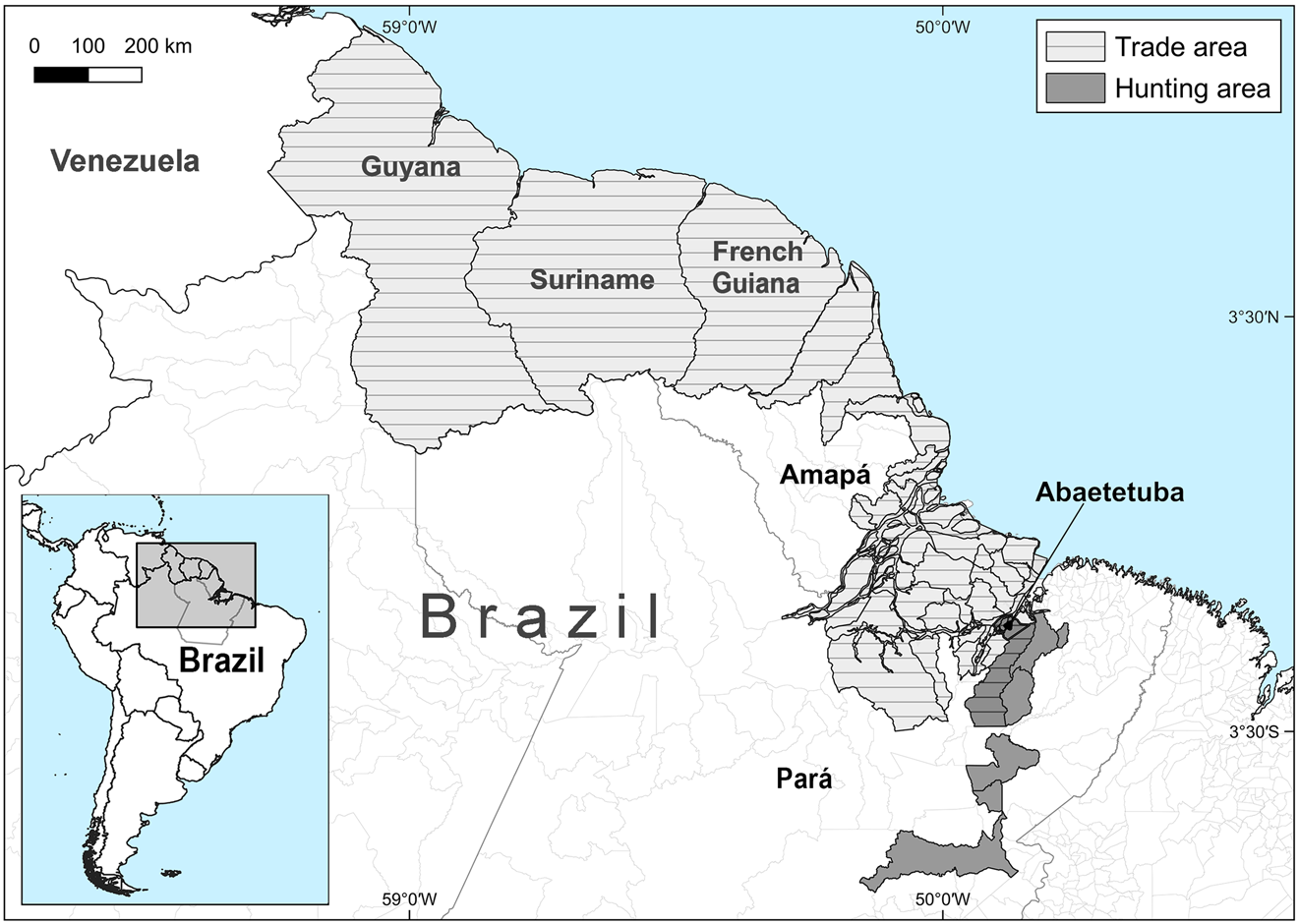
The study was conducted during December 2017–September 2018 in the municipality of Abaetetuba in Pará state, Brazil (IBGE, 2017). The 1,611 km2 municipality has a population of 156,292 (IBGE, 2018; Fig. 1).
Location of the municipality of Abaetetuba in Pará state, Brazil, where we characterized the ethnoornithological knowledge of passerine bird keepers who capture, train, breed and sell wild species, and the areas where Passeriformes are hunted and commercialized beyond Abaetetuba.
Methods
Data collection
Initially, we held informal talks and interviews with local residents to identify people involved in bird keeping, and subsequently identified bird keepers using snowball sampling (Bailey, Reference Bailey1994; Albuquerque et al., Reference Albuquerque, Cruz da Cunha, Lucena and Alves2014). We held informal conversations in the streets, street markets or bird keepers' homes with 96 bird keepers, explaining the objectives of the study in accessible language (i.e. without the use of technical terms), and we invited the bird keepers to participate in the study. Semi-structured interviews and direct observation of bird management were conducted with the 60 men and two women who consented to participate. Socio-economic, cultural and ethnoornithological data (knowledge about the biology of Passeriformes, reasons for breeding, opinions on the characteristics of species, including beauty, song and territoriality, details of trapping locations and techniques, captive management, economic value and commercialization) were collected during the interviews (Supplementary Material 1). We also asked participants whether they were registered with the environmental agency, which is a legal requirement for owning wild animals.
Species were identified at the Museu Paraense Emilio Goeldi (Belém, Brazil) from photographs taken when the interviews were conducted. The field guide by Sigrist (Reference Sigrist2009b) was used to assist in species identification. Nomenclature follows the Comitê Brasileiro de Registros Ornitológicos (CBRO, 2015).
Data analysis
The data were analysed both qualitatively and quantitatively (Vergara, Reference Vergara2012). From compilation of the interview data, photographs and our observations, we identified bird species involved in the trade network, and the various forms of use (hunting, breeding for pets, commercialization), captive management techniques used, the main actors involved and their empirical knowledge, and how the trade network functions. To determine the level of use of each species among the people interviewed, we calculated the use value of each species as U/n, adapted from Phillips et al. (Reference Phillips, Gentry, Reynel, Wilkin and Galvez-Durand1994), where U is the number of interviewees who cited the species and n is the total number of interviewees (62).
The sale price of birds involved in the commercial network were converted from BRL to USD using the exchange rate on 29 September 2018 (USD 1.00 = BRL 4.05). For tests involving the sale price of each species, the median of the highest values cited by interviewees was used. Use of the median avoids any bias caused by potential heteroscedasticity (Gotelli & Ellison, Reference Gotelli and Ellison2010). We used the median of the values (USD) indicated by the interviewees as the price of an individual of each species, and then defined five price range categories in USD (very low: ≤24.69; low: 24.70–123.44; high: 123.45–246.90; very high: ≥ 247.00). We then examined whether the binary variables song, beauty and territoriality of bird species, jointly, were predictors of the sale price of wild origin or captive-bred birds, using permutational multivariate analysis of variance (PERMANOVA) based on similarity matrices with Euclidean distance and 9,999 randomizations (Anderson, Reference Anderson2001), and ordination with a principal coordinates analysis to visualize the results (Gotelli & Ellison, Reference Gotelli and Ellison2010). To examine whether the price range (very low, low, high, very high) was influenced separately by each of song, beauty or territoriality, we used the Kruskal–Wallis test, a non-parametric analysis, if the assumption of homogeneity of variance was rejected at P = 0.05, and otherwise ANOVA, which is a parametric test (Gotelli & Ellison, Reference Gotelli and Ellison2010).
A second PERMANOVA (Anderson, Reference Anderson2001) using Gower's distance, a method that allows the simultaneous analysis of quantitative and qualitative data, with 9,999 randomizations (Gower, Reference Gower1971), was used to examine whether the socio-economic and cultural characteristics of interviewees influenced whether they were principally a hunter, local seller, trainer, breeder or external seller (i.e. someone who sells birds outside the municipality). These categories were defined based on the roles that the study participants appeared to play in bird keeping and trade. To visualize differences in the bird keeper categories in this PERMANOVA, we constructed an ordination using principal coordinates analysis (Gotelli & Ellison, Reference Gotelli and Ellison2010). R 3.0.2 (R Core Team, 2019) was used for all statistical analyses.
Results
We found that a total of 23 species of Passeriformes, in five families, were bred and sold (Table 1). The species with the highest use and economic values was the chestnut-bellied seed-finch, Sporophila angolensis (0.77, USD 5,400). The bird keepers suggested that in the previous 10 years, populations of S. angolensis, the great-billed seed-finch Sporophila maximiliani and the buff-throated saltator Saltator maximus had decreased (Plate 1) and that S. angolensis and S. maximus were no longer readily encountered in the region. These birds were hunted in north-east and south-east Pará. The causes cited by bird keepers for the decrease in these species were (1) increase in demand, (2) capturing of the young, (3) urban expansion into rural areas, (4) monocultures of oil palm Elaeis guineensis, and (5) use of herbicides and pesticides in agricultural areas.
Passeriformes with reduced populations, according to reports by interviewees: (a) Sporophila angolensis, (b) Sporophila maximiliani and (c) Saltator maximus. Photos: Samantha Silva.

Species of Passeriformes observed in the wild bird or captive bred trade network in the eastern Amazonia of Brazil, with their Red List status (IUCN, 2020), the hunting techniques used to catch them, the environments in which they were hunted, their use value (see text for details), and minimum and maximum economic value in trade (per individual).

1 LC, Least Concern; EN, Endangered.
2 Nt, net trap; Ps, preseiro; Tl, trap with lid; Vg, visgo.
3 Ag, agriculture area; Fp, floodplain; Fr, primary and secondary forest.
Information from the semi-structured interviews and our observations of bird management indicated that the commercial price of a bird depended on (1) whether the species was commercialized, (2) whether it was male (the song of males is more greatly appreciated than that of females, and they can be used for hunting), (3) its skill in singing or having strong territoriality), (4) the availability of the species in the wild, (5) its ability to adapt to captivity, (6) its health, (7) whether it already molted, and (8) its genealogy, for birds in captivity. The most important biological characteristics cited by the bird keepers for identifying a bird species are: (1) song, (2) plumage color, (3) size, and (4) shape and size of the beak. Differentiating the sex of the animals only occurs during the reproductive phase, after moulting, as males and females normally differ in colour.
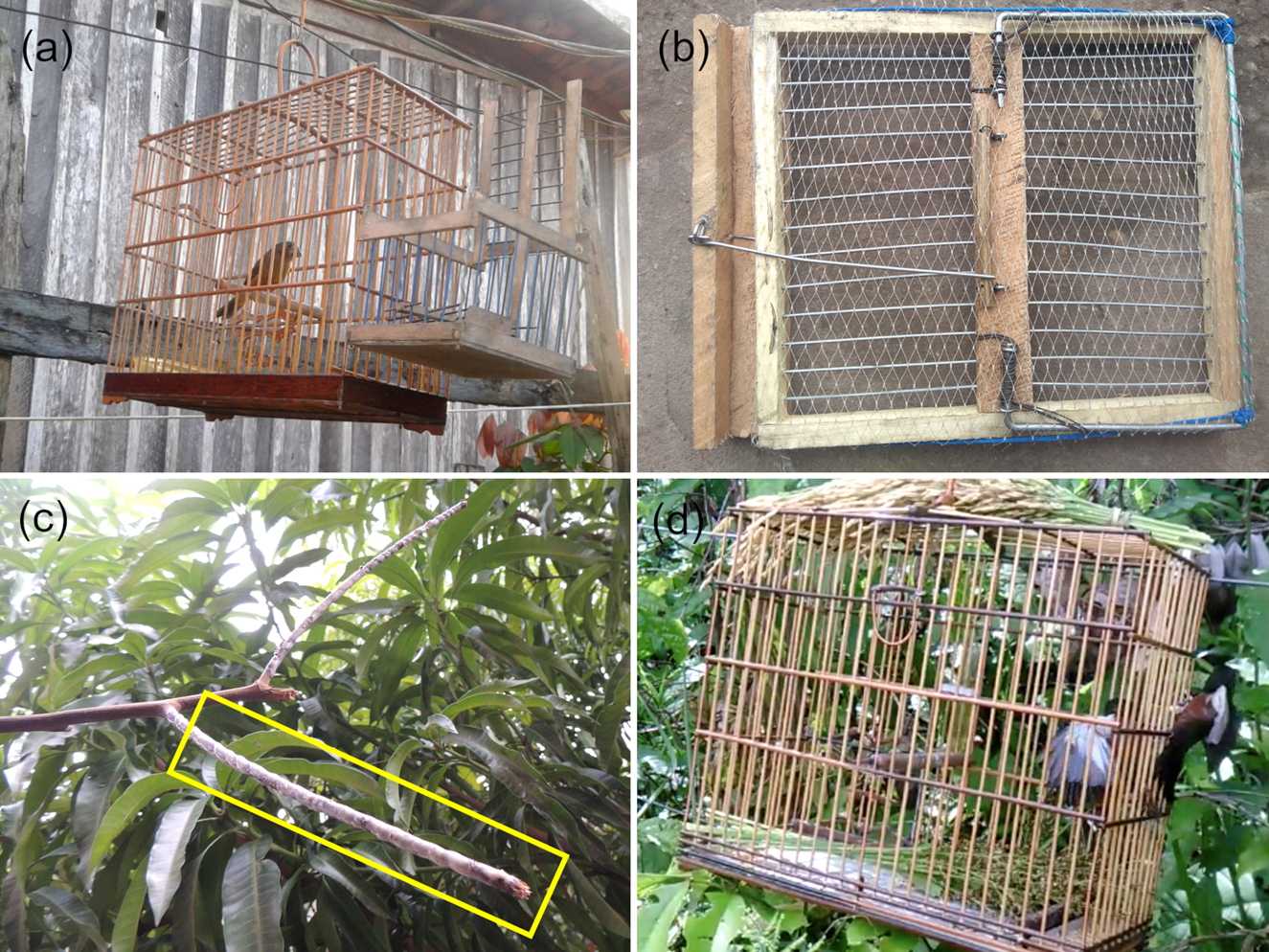
We documented four traditional techniques used to catch birds (Plate 2): (1) The arapuca is a trap comprising a small cage with a trigger attached to the bottom of the lid, which is attached to another, larger cage. A bird is placed in the larger cage to attract another bird of the same species, with its song. When a bird lands, the trigger is fired and the lid closes. This technique was used by 29% (n = 18) of the interviewees. (2) The arapuca de rede also comprises a cage containing a bird, to attract another bird, but with a net on the side of the cage that is triggered when a wild bird touches the net. This technique was used by 19% (n = 12) of the interviewees. (3) Visgo is a sticky substance prepared from the resin of trees, such as Hevea brasiliensis. The resin is chewed or heated until it has a sticky consistency, and is then applied to the surface of branches or sticks, trapping birds that land. This technique was used by 11% (n = 7) of the interviewees. (4) Preseiro is a term used for caged birds trained to catch wild birds, and takes advantage of the territorial characteristics of some species. The preseiro attracts a wild bird, usually of the same species, and they start a dispute. The bird keeper waits until the preseiro is holding the wild bird with its feet or beak and then approaches and catches it with his hands. This technique was used by 32% (n = 20) of the interviewees.
Hunting techniques used to catch wild birds in Abaetetuba: (a) trap with lid, (b) net trap, (c) visgo, (d) preseiro. Photos: (a–c) Samantha Silva, (d) provided by a bird keeper and reproduced with permission.
Training a preseiro starts with a bird (S. maximus, Sporophila collaris, S. americana or S. angolensis) caught as a fledgling. Captive-bred birds are generally not used for this purpose. The training of a preseiro takes place in the forest, where the bird keeper stimulates the contact of the bird with other wild birds. The breeders use a model bird, with the physical characteristics of the species, to assist in the training. The skill of the preseiro is assessed based on how fast it can secure and then release a bird, when prompted by the bird keeper, without hurting it.
The PERMANOVA analysis using Euclidean distance revealed that the price of birds depends jointly on their song, beauty and territoriality (pseudo F = 4.896, P < 0.003). The first and second axis of the principal coordinates analysis explained 86.8% and 8.6% of the variance in the data, respectively (a total of 95.4% of the variance). Birds with preseiro characteristics tended to be more expensive, with median values starting at USD 247, followed by birds that were good singers or beautiful (Fig. 2). Analysing the influence of song, beauty and territoriality separately on price indicated that beauty alone did not have a significant effect (H (3, N = 23) = 6.122, P = 0.106), although territoriality (H (3, N = 23) = 13.654, P = 0.003) and song (H (3, N = 23) = 9.982, P = 0.019) both had significant effects on price.
Principal coordinates analysis of the influence of the song characteristics, beauty and whether a bird was a good preseiro (see text for details) on the commercial price of 23 species of Passeriformes (each symbol represents one species). Prices were categorized as very low (USD ≤24.69), low (24.70–123.44), high (123.45–246.90) or very high (≥ 247.00). The arrows indicate the direction of influence of the three variables (song, beauty, preseiro), and the triangle delimits species in the very high price category.

Sporophila angolensis and S. maximiliani were bred by three (4.8%) of the bird keepers. Reproduction begins in the second year of life. For males, this occurs after the second molting of feathers, when they change colour. The process from copulation to separation is c. 35 days. Starting during the second month of life, the birds are exposed daily to the sounds of their own species, so they learn to repeat the song. A bird is considered a good singer when it can sing for > 2 minutes.
The commercial network involved five main groups (Fig. 3): hunters, local sellers, trainers, breeders and external sellers. Eighteen of the people we interviewed were hunters. They were men, mostly 21–30 years old, with high school education and a monthly income of USD 235.50–493.85. Nine had hunted for > 10 years and train preseiros, and all 18 had learnt the practice from their parents. The birds they captured were destined for local sellers or trainers. Most of the hunters caught birds in Abaetetuba (94.4%) and other municipalities of north-east (44.4%) and south-east (22.2%) Pará State (Fig. 1).
The commercial network involving Passeriformes in Abaetetuba, Pará state, Brazil (Fig. 1), as determined through interviews with 62 bird keepers.
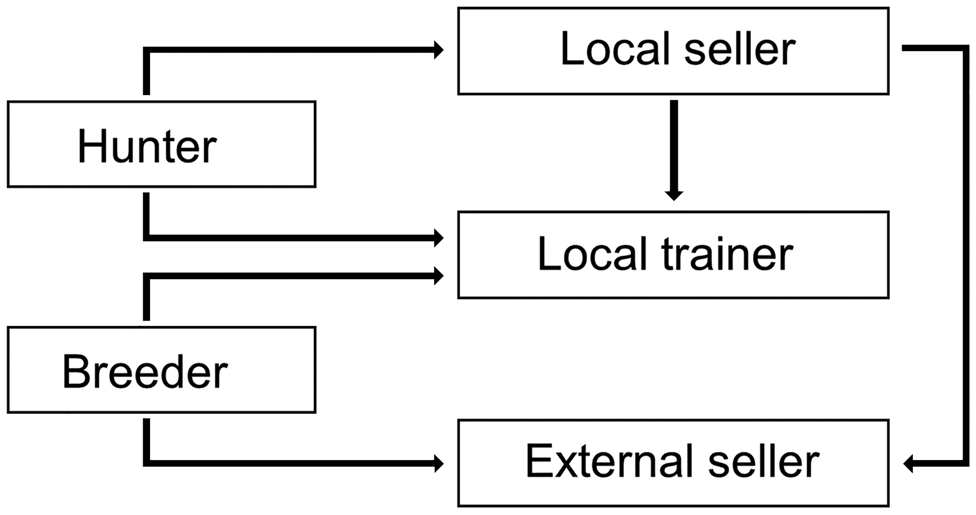
Thirteen of the people we interviewed were local sellers, acting as middlemen in the commercial bird network. They received birds from hunters and resold them to local bird keepers and external sellers. Selling occured at open markets or in the house of the bird keeper. They were men, not registered with environmental agencies, had conducted the activity for > 10 years, most were 21–30 years of age, with high school education and a monthly income of USD 235.50–493.85. Only three of the local sellers reported they sometimes hunted and trained birds.
Twenty-six of the people we interviewed were trainers. They obtained birds from local sellers or directly from hunters for the primary purpose of rearing a pet rather than using it for breeding. Generally, they were men, most (96.2%) were not registered with environmental agencies, with a high school education and a monthly income of USD 235.50–493.85. Twelve of the trainers had conducted this activity for > 10 years. Among the trainers, nine said they trained preseiros for leisure, and later released the birds, and six participated in bird song competitions.
Three of the people we interviewed were breeders, breeding birds in captivity for sale to local trainers and external sellers. This group comprised men > 30 years old who were not registered with environmental agencies. All participated in bird singing competitions and two trained preseiros.
Two men identified as external sellers, buying the birds from local sellers and breeders and reselling them in other national locations (in the states of Pará and Amapá) and international locations on the border of Suriname, French Guiana and Guyana (Fig. 1). The birds were also bought and resold in Abaetetuba. The men were 36 and 40 years of age, with high school education. They usually bought chicks at a low price, trained them to hone their singing and territorial skills, and resold them for a higher price.
The PERMANOVA analysis using Gower's distance revealed differences in the socio-economic and cultural characteristics of the five categories of interviewees (hunter, trainer, local seller, breeder and external seller; pseudo F = 3.005, P < 0.0119). The first and second principal coordinate axes explain 40.8 and 33.5%, respectively, of the variance in the data (74.3% of total variance). The variable that best described the structure among the bird keeper categories was family influence (Fig. 4).
Ordination of socio-economic and cultural variables (NT, does not train preseiros; TP, trains preseiros; ST, student; EM, employed; NE, unemployed; RT, retired; ED, education level; MT, management time; AG, age; IN, income; FI, family influence; EI, economic influence) to examine their influence on whether the 62 people interviewed are hunters, breeders, local trainers, local sellers or external sellers (i.e. to areas beyond Abaetetuba). The double-ended arrow indicates that the influence of economy is high amongst local sellers, and that of family amongst hunters.

Discussion
Our findings demonstrate the existence of a national and international commercial network for the sale of 23 species of birds in the eastern Amazonia of Brazil, based in Abaetetuba, Pará state. The network involves hunters, trainers, breeders and sellers motivated by both cultural and economic influences. These birds are in high demand and provide an attractive income. Similarly to Daut et al. (Reference Daut, Brightsmitha, Mendoza, Puhakkac and Petersond2015), we found that birds in the family Thraupidae are the most commonly sold. In Brazil, birds of this family are the most frequently bred and traded (Fernandes-Ferreira et al., Reference Fernandes-Ferreira, Mendonça, Albano, Ferreira and Alves2012; Oliveira et al., Reference Oliveira, Lopes and Alves2018). It contains species that have some of the most highly appreciated songs amongst songbirds in the Americas (Sigrist, Reference Sigrist2009a). Species of Sporophila (Thraupidae) were the most common in local trade (39% of the species cited). This has also been observed in other regions (Nascimento et al., Reference Nascimento, Czaban and Alves2015; Oliveira et al., Reference Oliveira, Lopes and Alves2018) and is probably a national pattern.
Sporophila angolensis is widely distributed in Brazil (del Hoyo et al., Reference del Hoyo, Elliott and Sargatal2011), and we found it to be one of the most frequently used species. However, this species is less popular in the north-east of Brazil despite a strong culture of bird keeping in this region (Souto et al., Reference Souto, Torres, Sousa, Lima, Vieira and Pereira2017). Its prominence in Amazonia may be because bird keepers, in addition to appreciating its song, use this species as a preseiro to hunt. Although S. angolensis is categorized as Least Concern on the IUCN Red List (BirdLife International, 2018), the interviewees reported that the species can be difficult to find in the wild. Turdus fumigatus, which also has high use and economic importance, is also less used in other regions of Brazil, probably because it mostly occurs in Amazonia (del Hoyo et al., Reference del Hoyo, Elliott and Sargatal2011). However, studies in other areas have shown that species of Turdus are commonly raised and traded, primarily Turdus rufiventris (Souto et al., Reference Souto, Torres, Sousa, Lima, Vieira and Pereira2017; Oliveira et al., Reference Oliveira, Lopes and Alves2018), which does not occur in Amazonia (del Hoyo et al., Reference del Hoyo, Elliott and Sargatal2011). For S. maximus, its high economic value could be related to its hunting skills as a preseiro, and to its declining population population in Abaetetuba, even though it is widely distributed in Amazonia.
Our research did not suggest any direct relationship between whether a species is endemic and its importance in local trade. Of the species endemic to Amazonia, only S. americana was among the four species with the highest use value (del Hoyo et al., Reference del Hoyo, Elliott and Sargatal2011). This differs from north-east Brazil, where the species most held in captivity were also more typical of the regional avifauna (Fernandes-Ferreira et al., Reference Fernandes-Ferreira, Mendonça, Albano, Ferreira and Alves2012). This could be related to the environmental characteristics of each region. Species of Oscines, a suborder of Passeriformes that includes songbirds, are mostly associated with areas of open vegetation, as found in north-east Brazil, whereas species of the suborder Suboscines are more associated with forest vegetation (Sick, Reference Sick2001).
Besides availability, the characteristics that most influenced bird prices were singing ability and skill as a preseiro. Species with the latter characteristic (S. maximus, S. collaris, S. americana and S. angolensis) were among the most expensive in the commercial network. Although we found that S. maximiliani is one of the most expensive species, it is not used as a preseiro to hunt. However, in addition to its highly appreciated song, it is the only threatened species of the 23 species bred and sold in Abaetetuba, categorized as Endangered on the IUCN Red List (BirdLife International, 2019); it is difficult to find and, consequently, has a high economic value. This species has been the target of hunters and traffickers and, consequently, it is difficult to observe it in the wild (Ubaid et al., Reference Ubaid, Silveira, Medolago, Costa, Francisco, Barbosa and Adir2018).
Male birds were preferred by bird keepers because of their stronger territoriality and more melodious song compared to females, and birds that were descendants of song competition champions were also in high demand. Females were selected for breeding based on the number of eggs they laid, hatching success of their eggs, and the number of surviving offspring, phenotypic characteristics, and whether they were bird singing tournament champions. The cultural importance of breeding birds for song competitions has been reported elsewhere (e.g. Indonesia: Jepson et al., Reference Jepson, Ladle and Sujatnika2011; Taiwan: Su et al., Reference Su, Cassey and Blackburn2014). Conversely, in Australia, where this practice is uncommon, song characteristics do not affect the price of birds (Vall-llosera & Cassey, Reference Vall-llosera and Cassey2017).
All but one of the hunting techniques we observed are passive as they involve trapping effort and capture time independent of the active action of the hunter (Lee, Reference Lee, Robinson and Bennett2000). These techniques involve methods similar to those used by hunters in Mexico (Roldán-Clarà et al., Reference Roldán-Clarà, Toledo and Espejel2017) and elsewhere in Brazil (Souto et al., Reference Souto, Torres, Sousa, Lima, Vieira and Pereira2017; Oliveira et al., Reference Oliveira, Lopes and Alves2018). The only exception is the preseiro technique. Araujo (Reference Araujo2000) reported the use of preseiro birds (S. angolensis) in Amazonia, a unique practice that has not been recorded in other locations. It was the technique most used among the bird hunters we spoke with.
Socio-economic variables appeared to be only weak motivators for bird keepers to become breeders and did not differentiate the actors involved in the commercial bird network. This corroborates findings from Indonesia, where bird breeding was not found to be strongly correlated with social profile (Jepson & Ladle, Reference Jepson and Ladle2009). However, family, cultural heritage and economic motivations appear to be influential. Bird trapping, in particular, is a cultural practice (Alves et al., Reference Alves, Souto, Albuquerque, Alves and Albuquerque2018). In addition to being an important motivator for wild meat consumption in Amazonia (Morsello et al., Reference Morsello, Yagüe, Beltreschi, van Vliet and Adams2015), cultural characteristics are also a motivator for hunting animals for use as pets. Although people use wild birds for many reasons (e.g. for food, and for medicinal and mystic/religious purposes; Roldán-Clarà et al., Reference Roldán-Clarà, López-medellín, Espejel and Arellano2014; Santos-Fita et al., Reference Santos-Fita, Naranjo, Estrada, Mariaca and Bello2015), we found that songbirds were only being used as pets, or for trading as pets.
It is possible that the commercial routes used by bird traders in Pará lie mainly along rivers or the coast. Renctas (2001) identified rivers as the main way of moving hunted wild animals in northern Brazil, and the border with the Guianas is an important destination for trafficked wild animals from Brazil because of the absence of enforcement there (Destro et al., Reference Destro, Pimentel, Sabaini, Borges, Barreto and Lameed2012). The lucrative trade in Passeriformes has stimulated hunting (Regueira & Bernard, Reference Regueira and Bernard2012) and, combined with other factors such as habitat loss and deforestation, has resulted in a decrease in the diversity of the local avifauna (Alves et al., Reference Alves, Leite, Souto, Bezerra and Loures-Ribeiro2013a,Reference Alves, Lima and Araujob). This, in turn, can affect key ecological functions (e.g. seed dispersal by frugivorous birds) and disrupt food webs (Kohorn, Reference Kohorn, Cain, Bowman and Hacker2011).
Mitigating the negative impacts of this commercial network will be challenging and will require a range of strategies, including (1) increasing monitoring and enforcement of wildlife regulations, (2) development of education programmes to demonstrate the importance of preserving the local avifauna, and (3) improved regulation of bird keeping. The large number of interviewees that were not registered with environmental agencies indicates a widespread lack of knowledge about the legal requirements for bird keeping and/or the difficulties associated with negotiating the bureaucratic barriers associated with legally obtaining birds for trade.
Breeding wild species in captivity is a conservation strategy, as this activity can decrease illegal trade and provide individuals for restocking wild populations (Burivalova et al., Reference Burivalova, Ming, Hua, Lee, Prawiradilaga and Wilcove2017). In Indonesia, bird conservation projects have used flexible political instruments to incentivize the commercialization of birds bred in captivity (Kristiano & Jepson, Reference Kristianto and Jepson2011; Jepson, Reference Jepson2016). Thus, conservation measures could be more effective with the introduction of a market-based system (Jepson et al., Reference Jepson, Ladle and Sujatnika2011). The suggestion is not to prohibit breeding but to find strategies for sustainable use, to encourage legal breeding in captivity. Thus, education regarding breeding of Passeriformes in captivity could be useful for species that are widely exploited commercially (e.g. S. maximiliani, S. angolenses and S. maximus).
Birdwatching ecotourism is another underdeveloped activity in Brazil, although it has been shown to produce significant value if done well (Dias, Reference Dias2011), with economic benefits for local communities (Steven et al., Reference Steven, Morrison and Castley2014). A study in Białowieża Forest, Poland, estimated that bird watching contributed nearly USD 2.2 million annually to the local economy (Czeszczewik et al., Reference Czeszczewik, Ginter, Mikusiński, Pawłowska, Kałuża, Smithers and Walankiewicz2019). In the USA, 47 million people spend USD 9.3 billion per year on bird-related activities (Rosenberg et al., Reference Rosenberg, Dokter, Blancher, Sauer, Smith and Smith2019). Incentives such as the improvement of existing protected areas to attract birdwatchers, from Brazil and other countries, and education of bird keepers as guides could form part of a long-term conservation strategy for avifauna. However, our findings show that culture encourages the hunting of songbirds, and that the high commercial value of some species, and thus the potential profit, encourages trade. The challenge is to maintain the cultural aspects of the hunting and keeping of songbirds, but to minimize any concomitant negative effects on their conservation.
Acknowledgements
We thank Alexandre Aleixo (Museu Paraense Emílio Goeldi), for help with species identification; Palmira Ferreira (the manager at Secretaria do Estado de Meio Ambiente e Sustentabilidade–Pará); Marília Ribeiro for preparing the map figures; Michele Singh (Caribbean Agricultural Research and Development Institute) for assistance; and Pró-Reitoria de Pesquisa e Pós-Graduação, Universidade Federal do Pará for support. SS and BB thank Coordenação de Aperfeiçoamento de Pessoal de Nível Superior for the fellowship linked to Programa de Pós-Graduação em Biodiversidade e Conservação at Universidade Federal do Pará. LB thanks Coordenação de Aperfeiçoamento de Pessoal de Nível Superior for the fellowship (N°88882.315775/2019-01) linked to Programa de Pós-Graduação em Zoologia at Universidade Federal do Pará and Museu Paraense Emílio Goeldi.
Author contributions
Study conception, analysis and interpretation, writing: all authors; data collection: SS.
Conflicts of interest
None.
Ethical standards
All required permissions for our surveys and data collection were provided by the Human Research Ethics Committee of the Health Sciences institute Federal University of Pará (CAAE: 79382717.8.0000.0018), and this research otherwise abided by the Oryx guidelines on ethical standards.


 Open access

