


Introduction
Dementia is a syndrome caused by impairment in multiple cognitive domains, such as memory, language, executive functioning, or visuoconstruction. It is caused by several neurodegenerative diseases, of which Alzheimer’s disease is the most prevalent (Scheltens et al., Reference Scheltens, De Strooper, Kivipelto, Holstege, Chételat, Teunissen, Cummings and van der Flier2021). Cognitive impairment does not emerge overnight, but rather develops gradually over many years, passing through a stage of mild cognitive impairment (MCI) and eventually culminating in dementia. Although we are yet to find a cure for any of the neurodegenerative diseases causing dementia, detecting dementia in the earliest possible stage is important for adequate treatment and patient management (Robinson et al., Reference Robinson, Tang and Taylor2015). Brief cognitive screening instruments with good accuracy for detecting cognitive impairment are essential for initial diagnostic evaluation. Currently, the most widely used screeners are the Mini-Mental State Examination (MMSE; Folstein et al., Reference Folstein, Folstein and McHugh1975) and the Montreal Cognitive Assessment (MoCA; Nasreddine et al., Reference Nasreddine, Phillips, Bédirian, Charbonneau, Whitehead, Collin, Cummings and Chertkow2005).
Developed in 1975, the MMSE is a household name for cognitive screening. It was originally developed to evaluate cognition in elderly psychiatric patients and has a strong emphasis on orientation, language comprehension and production, and memory recall. A meta-analysis showed that the MMSE might contribute especially well to dementia diagnosis in settings where dementia prevalence is low (Creavin et al., Reference Creavin, Wisniewski, Noel-Storr, Trevelyan, Hampton, Rayment, Thom, Nash, Elhamoui, Milligan, Patel, Tsivos, Wing, Phillips, Kellman, Shackleton, Singleton, Neale, Watton and Cullum2016), e.g., in primary care settings. However, this makes the MMSE potentially less suitable for memory clinics. In the nearly 50 years since the MMSE’s introduction, our understanding of Alzheimer’s disease has changed substantially. Consequently, the MMSE has become outdated and ill-equipped for answering today’s clinical and research questions. Accordingly, an important drawback is that the MMSE does not seem to pick up subtle cognitive deficits (Bergeron et al., Reference Bergeron, Flynn, Verret, Poulin, Bouchard, Bocti, Fülöp, Lacombe, Gauthier, Nasreddine and Laforce2017; Galasko et al., Reference Galasko, Klauber, Hofstetter, Salmon, Lasker and Thal1990; Mitchell, Reference Mitchell2009; Naugle & Kawczak, Reference Naugle and Kawczak1989; Tombaugh & McIntyre, Reference Tombaugh and McIntyre1992), rendering it less useful for the detection of MCI.
The MoCA was introduced in 2005 with the specific goal of being able to detect MCI as well (Nasreddine et al., Reference Nasreddine, Phillips, Bédirian, Charbonneau, Whitehead, Collin, Cummings and Chertkow2005). Compared to the MMSE, the MoCA focuses less on orientation, assesses memory encoding and retrieval in more detail, and introduces executive tasks. Further, the MoCA has a “Memory Index Score” (MIS), that can be calculated based on the free, cued, and multiple choice recall of five words. The MIS may provide additional insight into the memory performance of the patient or participant. Studies have shown that the MoCA is more sensitive and has better diagnostic accuracy for distinguishing unimpaired from impaired cognition than the MMSE (Jia et al., Reference Jia, Wang, Huang, Su, Du, Jiang, Wang, Wang, Wang, Su, Xiao, Wang and Zhang2021; Pinto et al., Reference Pinto, Machado, Bulgacov, Rodrigues-Júnior, Costa, Ximenes and Sougey2019; Trzepacz et al., Reference Trzepacz, Hochstetler, Wang, Walker and Saykin2015), although it is less specific (Larner, Reference Larner2012). On the other hand, a recent meta-analysis concluded that the quality of evidence from just seven studies was too low to make recommendations about the clinical utility of the MoCA for the detection of dementia (Davis et al., Reference Davis, Creavin, Yip, Noel-Storr, Brayne and Cullum2021).
As the MMSE and MoCA are used in parallel and serve similar purposes, situations may arise where clinicians and researchers need to crosswalk scores from one instrument to the other, for example, when clinicians obtain test scores from an external provider who uses the other screener, or when researchers model longitudinal global cognitive performance and want to use historically acquired scores on one screener in conjunction with newly acquired scores on the other. To do this, it is necessary to know to what extent the two screeners are alike in a memory-clinic population and how well the scores on both screeners can be compared. Previous efforts to link scores of the MMSE and MoCA in Alzheimer’s disease and dementia populations (Bergeron et al., Reference Bergeron, Flynn, Verret, Poulin, Bouchard, Bocti, Fülöp, Lacombe, Gauthier, Nasreddine and Laforce2017; Roalf et al., Reference Roalf, Moberg, Xie, Wolk, Moelter and Arnold2013), as well as in other diseases (Saczynski et al., Reference Saczynski, Inouye, Guess, Jones, Fong, Nemeth, Hodara, Ngo and Marcantonio2015; van Steenoven et al., Reference van Steenoven, Aarsland, Hurtig, Chen-Plotkin, Duda, Rick, Chahine, Dahodwala, Trojanowski, Roalf, Moberg and Weintraub2014), have provided conversions from MoCA to MMSE scores, although they do not mention accounting for potentially relevant patient characteristics like age and education in their crosswalk tables.
In this study, we aimed to examine to what extent the MMSE and MoCA yield equivalent assessments of global cognition in a single, large, and diagnostically diverse memory clinic population. First, we describe total and item-level scores for both screeners in our sample. Next, we investigate how total scores of both screeners are affected by age, sex, education, and diagnosis. Further, we analyze how the scores of the two screeners relate to each other, and how this relationship may be influenced by age, sex, education, and diagnosis. Finally, we created crosswalk tables that allow scores to be converted between the two screeners in both directions.
Methods
Participants and procedures
We included consecutive participants from the Amsterdam Dementia Cohort (van der Flier & Scheltens, Reference van der Flier and Scheltens2018), which comprises individuals who visited the outpatient memory clinic of Alzheimer Center Amsterdam for extensive dementia screening. The screening procedures include medical history, neurological examination, neuropsychological assessment, magnetic resonance imaging, and lumbar puncture (van der Flier & Scheltens, Reference van der Flier and Scheltens2018). Diagnoses are made at baseline in multidisciplinary consensus meetings following the initial visit and in accordance with research criteria for subjective cognitive decline (SCD; Jessen et al., Reference Jessen, Amariglio, van Boxtel, Breteler, Ceccaldi, Chételat, Dubois, Dufouil, Ellis, van der Flier, Glodzik, van Harten, de Leon, McHugh, Mielke, Molinuevo, Mosconi, Osorio, Perrotin, Petersen, Rabin, Rami, Reisberg, Rentz, Sachdev, de la Sayette, Saykin, Scheltens, Shulman, Slavin, Sperling, Stewart, Uspenskaya, Vellas, Visser and Wagner2014), MCI ( Petersen et al., Reference Petersen, Caracciolo, Brayne, Gauthier, Jelic and Fratiglioni2014), Alzheimer’s disease dementia (AD dementia; McKhann et al., Reference McKhann, Knopman, Chertkow, Hyman, Jack, Kawas, Klunk, Koroshetz, Manly, Mayeux, Mohs, Morris, Rossor, Scheltens, Carrillo, Thies, Weintraub and Phelps2011), frontotemporal dementia (FTD; Rascovsky et al., Reference Rascovsky, Hodges, Knopman, Mendez, Kramer, Neuhaus, van Swieten, Seelaar, Dopper, Onyike, Hillis, Josephs, Boeve, Kertesz, Seeley, Rankin, Johnson, Gorno-Tempini, Rosen, Prioleau-Latham, Lee, Kipps, Lillo, Piguet, Rohrer, Rossor, Warren, Fox, Galasko, Salmon, Black, Mesulam, Weintraub, Dickerson, Diehl-Schmid, Pasquier, Deramecourt, Lebert, Pijnenburg, Chow, Manes, Grafman, Cappa, Freedman, Grossman and Miller2011), vascular dementia (VD; Román et al., Reference Román, Tatemichi, Erkinjuntti, Cummings, Masdeu, Garcia, Amaducci, Orgogozo, Brun, Hofman, Moody, O’Brien, Yamaguchi, Grafman, Drayer, Bennett, Fisher, Ogata, Kokmen, Bermejo, Wolf, Gorelick, Bick, Pajeau, Bell, DeCarli, Culebras, Korczyn, Bogousslavsky, Hartmann and Scheinberg1993), dementia with Lewy bodies (McKeith et al., Reference McKeith, Boeve, Dickson, Halliday, Taylor, Weintraub, Aarsland, Galvin, Attems, Ballard, Bayston, Beach, Blanc, Bohnen, Bonanni, Bras, Brundin, Burn, Chen-Plotkin, Duda, El-Agnaf, Feldman, Ferman, ffytche, Fujishiro, Galasko, Goldman, Gomperts, Graff-Radford, Honig, Iranzo, Kantarci, Kaufer, Kukull, Lee, Leverenz, Lewis, Lippa, Lunde, Masellis, Masliah, McLean, Mollenhauer, Montine, Moreno, Mori, Murray, O’Brien, Orimo, Postuma, Ramaswamy, Ross, Salmon, Singleton, Taylor, Thomas, Tiraboschi, Toledo, Trojanowski, Tsuang, Walker, Yamada and Kosaka2017; DLB; McKeith et al., Reference McKeith, Dickson, Lowe, Emre, O’Brien, Feldman, Cummings, Duda, Lippa, Perry, Aarsland, Arai, Ballard, Boeve, Burn, Costa, Del Ser, Dubois, Galasko, Gauthier, Goetz, Gomez-Tortosa, Halliday, Hansen, Hardy, Iwatsubo, Kalaria, Kaufer, Kenny, Korczyn, Kosaka, Lee, Lees, Litvan, Londos, Lopez, Minoshima, Mizuno, Molina, Mukaetova-Ladinska, Pasquier, Perry, Schulz, Trojanowski and Yamada2005), primary progressive aphasia (PPA; Gorno-Tempini et al., Reference Gorno-Tempini, Hillis, Weintraub, Kertesz, Mendez, Cappa, Ogar, Rohrer, Black, Boeve, Manes, Dronkers, Vandenberghe, Rascovsky, Patterson, Miller, Knopman, Hodges, Mesulam and Grossman2011), and primary psychiatric disorder (PPD; American Psychiatric Association, 2013). In addition, patients who received a diagnosis of dementia due to a different etiology were grouped, as were patients who had a non-dementia neurologic diagnosis. From the Amsterdam Dementia Cohort, we selected participants with any of these diagnoses and who concurrently completed the MMSE and MoCA during their initial visit between May 2018 and November 2023. We did not select participants whose diagnosis remained undetermined after the initial visit. This study was approved by the medical ethical review board of VU University Medical Center. All participants provided written informed consent prior to undergoing study procedures, in accordance with the Declaration of Helsinki.
Materials
Screeners
The MMSE includes items assessing orientation, memory recall, object naming, attention, understanding of verbal and written commands, writing, and visuoconstruction (Folstein et al., Reference Folstein, Folstein and McHugh1975). The Montreal Cognitive Assessment (MoCA) includes items assessing orientation, visuoconstruction, processing speed, picture naming, memory recall, attention, vigilance, verbal fluency, mental flexibility, and abstraction (Nasreddine et al., Reference Nasreddine, Phillips, Bédirian, Charbonneau, Whitehead, Collin, Cummings and Chertkow2005). A Memory Index Score can be computed from the memory tasks within the MoCA as a separate score reflecting memory performance. We used official Dutch translations of the MMSE (by Kok & Verhey, Reference Kok and Verhey2002) and MoCA version 8.1.
The MMSE and MoCA were administered consecutively, in that order, as part of the routine procedure in the diagnostic workup by medical doctors who were trained in administration of both instruments; both instruments were administered by the same doctor during the same session. Where tasks overlapped (serial sevens, orientation), these were only asked once and used for scoring both instruments.
Total scores for both screeners range 0–30, with higher scores representing better global cognitive functioning. On the MoCA, one point is added for those with 12 or fewer years of education, unless they already scored the maximum of 30 points (Nasreddine et al., Reference Nasreddine, Phillips, Bédirian, Charbonneau, Whitehead, Collin, Cummings and Chertkow2005). The MIS ranges 0–15 and is based on the recall of five words, where free recall is awarded three, cued recall two, and multiple choice recall one point. Item-level data were recorded from November 2018 onward and were available from n = 1,956 patients (84.1%) on the MMSE, and n = 1,999 (86.0%) on the MoCA.
To mark impaired cognitive functioning, the MMSE uses a conventional cutoff of < 24 (Folstein et al., Reference Folstein, Folstein and McHugh1975), while a conventional cutoff of < 26 has been suggested for the MoCA (Nasreddine et al., Reference Nasreddine, Phillips, Bédirian, Charbonneau, Whitehead, Collin, Cummings and Chertkow2005). Normative data for the MMSE, provided through the Advanced Neuropsychological Diagnostic Infrastructure (de Vent et al., Reference de Vent, Agelink van Rentergem, Schmand, Murre and Huizenga2016), and MoCA (Kessels et al., Reference Kessels, de Vent, Bruijnen, Jansen, de Jonghe, Dijkstra and Oosterman2022), adjusted for age, sex, and education, exist for the Dutch population and may be used to classify scores as impaired (i.e., when < 2.5% of people with the same age, sex, and education would have the same score or lower).
Education
Educational attainment was self-reported by the patient and/or their study partner and classified according to the 7-point standardized Dutch education system of Verhage (Verhage, Reference Verhage1964). We converted this to years of education.
Statistical analyses
All analyses were run in R version 4.3.2 (R Core Team, 2023). Differences between diagnostic groups in age, education, and sex were investigated using linear or logistic regressions as appropriate, with post-hoc adjustments for multiple testing employing the Tukey’s Honest Significant Difference method. The correlation between MMSE and MoCA was tested using Pearson’s correlation, in the entire sample and in each diagnostic group separately.
Ceiling effects were described and classified as excessive when > 15% attained the maximum score, according to existing guidelines (Terwee et al., Reference Terwee, Bot, de Boer, van der Windt, Knol, Dekker, Bouter and de Vet2007), both in the whole sample and in each diagnostic group. We further tabulated how often scores on the MMSE and MoCA fell above or below both conventional and age, sex, and education (i.e., norm)-adjusted cutoffs. Agreement between cutoffs was determined using kappa values, where a kappa < 0.40 was considered to indicate poor agreement, a kappa between 0.40 and 0.75 to indicate fair to good agreement, and a kappa of ≥ 0.75 to indicate excellent agreement.
The influence of age, sex, education, and diagnosis on MMSE and MoCA total scores was analyzed in separate, univariate linear regressions with the screener serving as the outcome, and each characteristic as the predictor. A multivariate model combining all characteristics was also run. Next, we investigated how MMSE and MoCA scores related to each other in linear mixed models where MMSE and MoCA were treated as repeated assessments. We then investigated interactions between the screener (MMSE or MoCA) and age, sex, education, and diagnosis in separate models. A model containing all interactions was also run.
We performed equipercentile equating between MMSE and MoCA scores, using the frequency estimation technique and including as covariates the patient characteristics that significantly interacted with the relationship between the two screeners. Standard errors were estimated over 500 bootstrap samples. This process was performed twice: once to equate MoCA scores to raw MMSE scores, and once to equate MMSE scores to raw MoCA scores. The resulting equated scores were rounded to the closest integer to correspond to possible total scores.
Results
We selected 2,325 patients (63.2 ± 8.6 years; 43% women; median education 10 years) out of 2,502 with concurrent MMSE and MoCA, excluding 177 (7%) because they did not receive a definitive diagnosis following the initial visit. Table 1 shows the baseline characteristics of the total sample, as well as each diagnostic group. Diagnostic groups differed in terms of age (with PPD, SCD and FTD patients being the youngest), education (with MCI patients receiving most education), and sex distribution (with DLB patients being predominantly male; see Table 1).
Baseline demographics

Note: Data are shown as mean ± standard deviation, except as noted otherwise. 1 Data available for n = 2,170 (93.3%). AD = Alzheimer’s disease, DLB = dementia with Lewy bodies, FTD = frontotemporal dementia, IQR = interquartile range, M = median, MCI = mild cognitive impairment, MIS = Memory Index Score, MMSE = Mini-Mental State Examination, MoCA = Montreal Cognitive Assessment, PPA = primary progressive aphasia, PPD = primary psychiatric disorder, SCD = subjective cognitive decline, VD = vascular dementia.
Describing the screeners
In the entire sample, the mean MMSE total score was 25.0 ± 4.6, while the mean MoCA total score was 21.2 ± 5.4. Both MMSE and MoCA scores were highest in SCD and lowest in AD dementia. Scores on both screeners were similar between the different types of dementia, except that they were lower in AD dementia than in all other types of dementia (see Table 1). MoCA-MIS largely differed in the same direction between groups as the MoCA total score. However, whereas the MoCA total score differed between MCI and FTD, DLB, VD, PPA and other types of dementia, MoCA-MIS did not. Conversely, while MoCA total scores did not differ between MCI and other neurological disorders, MoCA-MIS did. All pairwise differences are shown in detail in Supplemental Table 1. Total scores on MMSE and MoCA correlated strongly in the whole sample (r = 0.86, 95% confidence interval [95%CI] = [0.85, 0.87], p < .001), and differed by diagnostic group. Particularly, the correlation was lower among individuals with SCD (r = 0.56, 95%CI = [0.50, 0.61]) and MCI patients (r = 0.55, 95%CI = [0.46, 0.63]). All correlations by diagnostic group are shown in Supplemental Table 2.
MoCA scores were lower than MMSE scores across all diagnostic groups. Score distributions are shown in Figure 1, revealing that patients in most diagnostic groups achieved scores along almost the full score span on both screeners. A total of 230 patients (9.9%) scored at the ceiling of the MMSE, while only 33 (1.4%) scored at the ceiling of the MoCA. Among SCD patients, the MMSE showed a ceiling effect with 152 (24.7%) scoring 30 points. The MoCA did not show this effect: 26 SCD (4.2%) scored 30 points on the MoCA. The number of patients scoring at the ceiling in each diagnostic group are displayed in Supplemental Table 3. Based on the conventional cutoffs, 653 patients (28.1%) performed abnormally on the MMSE, while 1,807 patients (77.7%) performed abnormally on the MoCA. Agreement between conventional cutoffs was 50.3%, with a kappa of 0.20, indicating poor agreement. Using norm-adjusted cutoffs, 1,168 patients (50.6%) performed abnormally on the MMSE and 654 patients (28.3%) on the MoCA. Agreement between norm-adjusted cutoffs was 73.8%, with a kappa of 0.48, indicating fair agreement. A breakdown of classifications according to both cutoffs by diagnosis is shown in detail in Supplemental Table 3.
Side-by-side MMSE and MoCA total score distributions, by diagnostic group.

Regarding item-level analyses, we observed that whereas the MMSE has several items where patients across all groups got full or nearly full credit (e.g., immediate recall, object naming, stage commands), most items of the MoCA showed more variation and had a larger proportion of patients who got no or almost no points (e.g., cube drawing, spontaneous delayed recall, and phonetic fluency). A visualization of the number and proportion of patients for each response option by diagnostic group is displayed in Supplemental Figure 1 and shown in Supplemental Tables 4 (for MMSE) and 5 (for MoCA).
Influence of patient characteristics
Older individuals had lower MMSE and lower MoCA scores, as did women and individuals with fewer years of education. Compared with individuals with SCD, all patients with other diagnoses had significantly lower scores. The age effect disappeared when including diagnosis in the same model. These results are shown in Supplemental Table 6.
Age (estimate (B) = −0.03, 95%CI = [−0.04, −0.02]), sex (B = −0.25, 95%CI = [−0.47, −0.02]), education (B = 0.15, 95%CI = [0.12, 0.19]) and diagnosis individually modified the relationship between MMSE and MoCA scores. When combined into a single model, age (B = −0.01, 95%CI = [−0.03, −0.00]), education (B = 0.14, 95%CI = [0.10, 0.18]), and diagnosis interacted significantly with the screener, but sex did not (B = −0.16, 95%CI = [−0.38, 0.05]; see Table 2). The full models are shown in Supplemental Table 7.
Estimates of patient characteristics’ influence on the relationship between MMSE and MoCA total scores
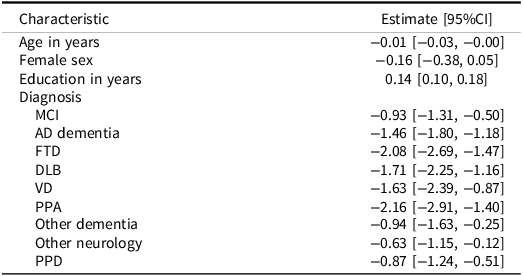
Note: All estimates derived from a single linear mixed model. Displaying the interactions of each characteristic with the screener variable (MMSE or MoCA). The reference for screener was MMSE (i.e., showing estimate for MoCA); the reference for diagnosis was SCD (i.e., showing each diagnosis compared to SCD). AD = Alzheimer’s disease, B = estimate, DLB = dementia with Lewy bodies, FTD = frontotemporal dementia, MCI = mild cognitive impairment, MMSE = Mini-Mental State Examination, MoCA = Montreal Cognitive Assessment, PPA = primary progressive aphasia, PPD = primary psychiatric diagnosis, SCD = subjective cognitive decline, VD = vascular dementia, 95%CI = 95% confidence interval.
Linking
Equipercentile equating of MMSE and MoCA scores was performed, accounting for age, sex, education, and diagnosis. The resulting crosswalk tables are shown in Table 3 and a visualization of the equated scores is shown in Supplemental Figure 1. R scripts to crosswalk scores from one screener to the other can be made available upon request from the corresponding author.
Equated scores for both MMSE and MoCA
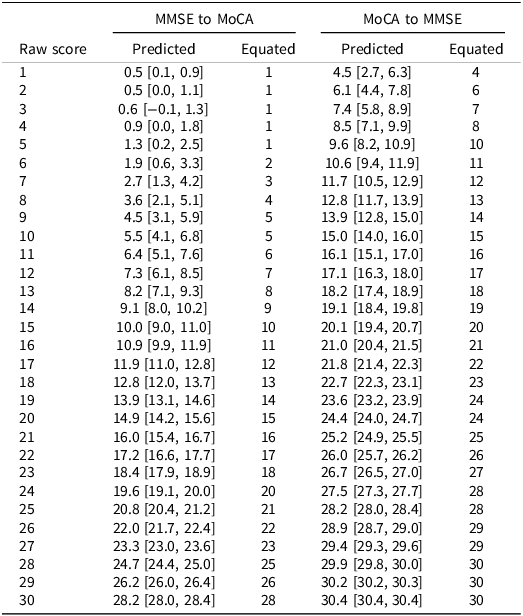
Note: The “Predicted” column shows the predicted score on the second screener corresponding to the raw score on the first screener, based on equipercentile equating with age, education, and diagnosis as covariates. Data displayed as estimate [95% confidence interval]. The “Equated” column shows the predicted score rounded to the nearest integer. MMSE = Mini-Mental State Examination, MoCA = Montreal Cognitive Assessment.
Discussion
In this study, we demonstrated how MMSE and MoCA scores compare: scores on both screeners are influenced by age, sex, education, and diagnosis, but these factors also affect how the two relate with one another. MoCA scores were lower than MMSE scores across all diagnostic groups, and they were somewhat less often classified as impaired. We provide a crosswalk table to link the scores of both screeners, accounting for the differential effects of age, education, and diagnosis, so that scores obtained with one may be used to infer scores on the other.
Conceptually, the MMSE is the ‘easier’ of the two screeners: it takes less time to complete, has fewer instructions, and may be less burdensome to the patient. As a result, MMSE scores were higher across all diagnostic groups, with approximately one in ten patients scoring at the ceiling of the scale. At the same time, we observed that MMSE scores in all diagnostic groups ranged across nearly the entire score range, aligning with previous research that showed that MMSE scores are specific nor sensitive for dementia-related diagnoses (Galasko et al., Reference Galasko, Klauber, Hofstetter, Salmon, Lasker and Thal1990; Mitchell, Reference Mitchell2009). Conversely, the MoCA includes more advanced executive and visuospatial tasks, and a more elaborate assessment of memory. MoCA scores were generally lower and the total score range was somewhat more restricted than that of the MMSE. Moreover, only about one in one hundred patients attained a ceiling score. Still, the question remains whether MoCA scores are simply lower than MMSE scores across the board, or whether they represent a better, more fine-grained assessment of general cognitive functioning.
As one possible answer, several MMSE items showed a limited range in scores across diagnoses, with most patients getting all or most points available. These items included immediate recall, object naming, reading a sentence, and following stage commands. This implies that these items are unlikely to yield a meaningful signal for cognitive impairment, at least in a memory clinic setting, because all or most patients with various diagnoses perform well on those tasks. At the same time, performance on other items seemed markedly lower in certain diagnostic groups, which might aid differential diagnosis. For example, relatively more patients with Alzheimer’s disease dementia or dementia with Lewy bodies had difficulty performing the serial sevens task, compared to patients with FTD or primary progressive aphasia. In contrast, many MoCA items showed a larger variability of scores, including some items that even a proportion of otherwise cognitively unimpaired individuals have difficulty with (e.g., phonetic fluency and spontaneous delayed memory recall). Consequently, one could say that the MoCA is more challenging, rendering it potentially better able to detect more subtle cognitive impairments. Like the MMSE, some MoCA items also seemed more impaired in specific diagnostic groups. A confrontation naming task – like the one in the MMSE, but with three animals instead of two objects – proved especially characteristic of primary progressive aphasia, and very few patients with Alzheimer’s disease dementia spontaneously recalled three or more out of five words after a short delay. As such, it seems both instruments can reveal cognitive impairments among those with different dementia diagnoses that are potentially characteristic to specific etiologies, although the MoCA might be better suitable for detecting more subtle cognitive impairments than the MMSE. We did not find studies that have previously compared the MMSE and MoCA at the item-level.
Both instruments appear to be influenced by educational attainment, age, and sex, in addition to diagnosis. Those who received fewer years of formal education performed systematically lower than those with more years of education, even with the extra point added to the MoCA total score for those with 12 or fewer years of education. An education effect has been described before for both screeners (Crum et al., Reference Crum, Anthony, Bassett and Folstein1993; Gagnon et al., Reference Gagnon, Hansen, Woolmore-Goodwin, Gutmanis, Wells, Borrie and Fogarty2013; Kessels et al., Reference Kessels, de Vent, Bruijnen, Jansen, de Jonghe, Dijkstra and Oosterman2022; Zamarian et al., Reference Zamarian, Karner, Bodner, Djamshidian and Delazer2021). Furthermore, women had lower scores than men. A previous study found that only MoCA scores, not MMSE scores, were lower in women (Engedal et al., Reference Engedal, Gjøra, Bredholt, Thingstad, Tangen, Ernstsen and Selbæk2021). While MMSE and MoCA scores decreased with age, this effect was negligible when accounting for the other patient characteristics. It should be noted here that our sample was relatively young, with a mean age of 63 years. Even though approximately a quarter of the sample was over 70 years old, the effects of age might be different among even older individuals. Aside from influencing the total scores on each individual screener, age, education, and diagnosis also moderated the relationship between the two. MoCA scores were lower with older age, compared to MMSE scores, and higher with more formal education. Finally, the differences between diagnostic groups were larger for MoCA scores than for MMSE scores.
As a result, for the linking of the total scores on both screeners, it is important to account for these differential effects. It seems that previous efforts to link MMSE and MoCA scores did not account for characteristics that we have found to be relevant, like age and education (Bergeron et al., Reference Bergeron, Flynn, Verret, Poulin, Bouchard, Bocti, Fülöp, Lacombe, Gauthier, Nasreddine and Laforce2017; Roalf et al., Reference Roalf, Moberg, Xie, Wolk, Moelter and Arnold2013; Saczynski et al., Reference Saczynski, Inouye, Guess, Jones, Fong, Nemeth, Hodara, Ngo and Marcantonio2015; van Steenoven et al., Reference van Steenoven, Aarsland, Hurtig, Chen-Plotkin, Duda, Rick, Chahine, Dahodwala, Trojanowski, Roalf, Moberg and Weintraub2014). Another potential issue is the directionality of the crosswalk table: using a MoCA score to predict an MMSE score is not the same as using an MMSE score to predict a MoCA score. Particularly, in three of the four aforementioned tables, MoCA scores of 28–30 corresponded with an MMSE score of 30 (Bergeron et al., Reference Bergeron, Flynn, Verret, Poulin, Bouchard, Bocti, Fülöp, Lacombe, Gauthier, Nasreddine and Laforce2017; Roalf et al., Reference Roalf, Moberg, Xie, Wolk, Moelter and Arnold2013; Saczynski et al., Reference Saczynski, Inouye, Guess, Jones, Fong, Nemeth, Hodara, Ngo and Marcantonio2015; van Steenoven et al., Reference van Steenoven, Aarsland, Hurtig, Chen-Plotkin, Duda, Rick, Chahine, Dahodwala, Trojanowski, Roalf, Moberg and Weintraub2014), which means that an MMSE score of 30 cannot be converted to a MoCA score as it corresponds to three possible values. Thus, crosswalk tables that allow conversions in both directions are needed. Bergeron et al. (Reference Bergeron, Flynn, Verret, Poulin, Bouchard, Bocti, Fülöp, Lacombe, Gauthier, Nasreddine and Laforce2017) previously provided a bidirectional cross-walk table, although their actual MMSE scores did not go below 20, thus disallowing conversion from an MMSE score of < 20. Comparing the cross-walk tables from Bergeron et al. (Reference Bergeron, Flynn, Verret, Poulin, Bouchard, Bocti, Fülöp, Lacombe, Gauthier, Nasreddine and Laforce2017) to the ones presented here, the MoCA scores converted from the MMSE in our study are approximately two points higher across the range of scores, while MMSE scores converted from the MoCA were highly similar.
With the MMSE’s psychometric limitations, researchers and clinicians might decide to adopt the MoCA instead to screen for cognitive deficits. Yet, exchanging one instrument for the other can create issues for the interpretation of historically acquired data from the old instrument in relation to new data from the new instrument. To facilitate this transition, the crosswalk tables we present here enable users to interpret a new score on the MoCA in relation to previously acquired scores on the MMSE, or to place previously collected MMSE scores on the MoCA scale. One other previous study has also provided crosswalk tables in both directions, stratified by diagnosis (Roheger et al., Reference Roheger, Xu, Hoang, Eriksdotter and Garcia-Ptacek2022). While this addresses some of the concerns raised in the previous paragraph, our study included a wider variety of diagnoses, including individuals without dementia. Thus, in this paper, we publish crosswalk tables converting total scores across the entire score range in both directions based on a large and diagnostically diverse sample. These tables provide clinicians and researchers with a robust conversion of total scores between the two screeners.
An important strength of this study was the large sample of well-characterized memory clinic patients who completed both screeners at the same visit. Particularly, our sample represented various types of dementia, including a substantial number of patients with rarer forms of dementia (such as FTD and primary progressive aphasia). A limitation was that the overlapping assignments (serial sevens, orientation) within both screeners were performed only once, as a result of which the total scores are, by definition, correlated. Furthermore, our sample was relatively young and highly educated, and results thus do not generalize to the entire global population. When using the crosswalk tables presented here, clinicians and researchers should verify whether the effects of age and education on the association between MMSE and MoCA exist in their samples as well, especially outside of the Netherlands, as education systems differ by country, and in older populations.
In conclusion, we show that the MMSE and MoCA are both influenced by patient characteristics including age, education, and diagnosis, and differentially so. Our work allows a score on one to be linked to a score on the other, in either direction, through the use of crosswalk tables adjusted for relevant patient characteristics. This allows data from both screeners to be analyzed jointly, thus potentially fostering collaborations among clinicians and researchers, increasing sample sizes and lengthening follow up durations, so previously collected data and data still to be collected can be used optimally to answer new research questions as they arise.
Supplementary material
The supplementary material for this article can be found at https://doi.org/10.1017/S1355617724000341
Data availability statement
The data used in this study can be made available upon reasonable request to the corresponding author.
Funding statements
MAD received salary support from Alzheimer Nederland (WE.06-2023-02), paid to his institution. MB, AMG, AEL, AEV, YALP, and RP report no disclosures relevant to the manuscript. SAMS received grant support from Health Holland (LSHM19051, LSHM20084, and LSHM22026-SGF), and Zon-MW (#7330502051 and #73305095008). SAMS provided consultancy services for Biogen, Boehringer, and Toyama. SAMS is the developer of the Amsterdam IADL Questionnaire and received license fees from Green Valley, VtV Therapeutics, Alzheon, Vivoryon, and Roche. All funding was paid to her institution. WMF and SAMS are recipients of TAP-dementia (www.tap-dementia.nl), receiving funding from ZonMW (#10510032120003) in the context of Onderzoeksprogramma Dementie, part of the Dutch National Dementia Strategry. Gieskes-Strijbis fonds also contributes to TAP-dementia. WMF is a recipient of ABOARD (A Personalized Medicine Approach for Alzheimer’s Disease); a public–private partnership receiving funding from ZonMW (#73305095007) and Health∼Holland, Topsector Life Sciences & Health (PPP-allowance #LSHM20106). More than 30 partners participate in ABOARD. Research programs of WMF have been funded by ZonMW, NWO, EU-JPND, EU-IHI, Alzheimer Nederland, Hersenstichting CardioVascular Onderzoek Nederland, Health∼Holland, Topsector Life Sciences & Health, stichting Dioraphte, Gieskes-Strijbis fonds, stichting Equilibrio, Edwin Bouw fonds, Pasman stichting, stichting Alzheimer & Neuropsychiatrie Foundation, Philips, Biogen MA Inc., Novartis-NL, Life-MI, AVID, Roche BV, Fujifilm, Eisai, Combinostics. WMF holds the Pasman chair. WMF has been an invited speaker at Biogen MA Inc., Danone, Eisai, WebMD Neurology (Medscape), NovoNordisk, Springer Healthcare, European Brain Council. WMF is consultant to Oxford Health Policy Forum CIC, Roche, Biogen MA Inc., and Eisai. WMF is member of steering commission of NovoNordisk evoke/evoke+. WMF participated in advisory boards of Biogen MA Inc., Roche, and Eli Lilly. All funding is paid to her institution. WMF is member of the steering committee of PAVE and Think Brain Health. WMF was associate editor of Alzheimer, Research & Therapy in 2020/2021. WMF is associate editor at Brain.
Research of Alzheimer Center Amsterdam is part of the Neurodegeneration research program of Amsterdam Neuroscience. Alzheimer Center Amsterdam is supported by Stichting Alzheimer Nederland and Stichting Steun Alzheimercentrum Amsterdam. The sponsors of this study had no role in the design, methods, subject recruitment, data collection, analysis, or preparation of this article.
Competing interests
None.


 Open access

