





1. Introduction
A common method for examining how bilinguals manage two languages is the language switching paradigm, which reveals cognitive costs when switching between languages (Broersma et al., Reference Broersma, Carter and Acheson2016; Jevtović et al., Reference Jevtović, Duñabeitia and de Bruin2020). These costs dissociate between two types of control: switch costs, which index reactive, trial-level control and mixing costs, which index proactive, sustained control (Bobb & Wodniecka, Reference Bobb and Wodniecka2013). Consistent with the Inhibitory Control Model (ICM; Green, Reference Green1998) and the Adaptive Control Hypothesis (ACH; Green & Abutalebi, Reference Green and Abutalebi2013), these costs are determined through a bilingual’s individual experience, which shapes how they manage each of their languages in real-time. Measures of bilingual cognition – such as language dominance and proficiency – have been used to account for these individual differences. Higher L2 proficiency is typically associated with reduced switch and mixing costs, while L1-dominant speakers tend to show faster naming for cognate words that overlap in form and meaning (Bonfieni et al., Reference Bonfieni, Branigan, Pickering and Sorace2019; Broersma et al., Reference Broersma, Carter and Acheson2016).
Although language switching studies have relied on measurable cognitive variables like proficiency, bilinguals’ language attitudes – their beliefs, emotions and dispositions toward each language – also affect L2 language use, motivation and identity (Han et al., Reference Han, Li and Filippi2022; Li & Wei, Reference Li and Wei2022; Moradi & Chen, Reference Moradi and Chen2022). Despite being integral to bilingual language experience, few studies have examined whether an affective variable like language attitudes can be used to provide insights into moment-to-moment, reactive language processing (Revniuk & Bátyi, Reference Revniuk and Bátyi2023). Extending the ACH and ICM, this study explores whether cognitive and affective components of bilingual experience – proficiency and language attitudes – can account for individual differences in reactive control and cognate facilitation.
1.1. Language switching and bilingual cognitive control
The ICM (Green, Reference Green1998) posits that bilingual speakers must suppress their nontarget language to prevent interference when using the target language. This requires two different types of control: reactive (trial-level, moment-to-moment) and proactive (sustained) control. These mechanisms similarly account for the importance of interactional context when switching between languages, as proposed by the ACH (Green & Abutalebi, Reference Green and Abutalebi2013). Compared to single-language environments, dual-language settings involve frequent switching, meaning bilinguals must recruit both reactive and proactive control mechanisms to maintain switching efficiency in both languages (Abutalebi & Green, Reference Abutalebi and Green2016; Bonfieni et al., Reference Bonfieni, Branigan, Pickering and Sorace2019; Green & Abutalebi, Reference Green and Abutalebi2013).
The mechanisms of these two control types have been explored extensively through language switching tasks, where bilinguals are asked to name pictures in their L1 or L2 in response to an on-screen cue. Here, reactive control is indexed using switch costs (the delay that occurs during a “switch trial” between both languages) and proactive control via mixing costs (the difference in reaction times between mixed- and single-language trials; Bobb & Wodniecka, Reference Bobb and Wodniecka2013).
Studies measuring reactive control tend to uncover asymmetrical switch costs when reactivating a dominant L1 after L2 use, resulting in slower L2 → L1 naming during switch trials. In contrast, studies exploring proactive control using mixed- and single-language trials (i.e., mixing costs) show a reversed dominance effect – a delay when naming pictures from the dominant (L1) to nondominant (L2) language. This effect has been attributed to the sustained effort required to inhibit the L1 throughout mixed- and single-language blocks (Gade et al., Reference Gade, Declerck, Philipp, Rey-Mermet and Koch2021; Goldrick & Gollan, Reference Goldrick and Gollan2023; Gollan et al., Reference Gollan, Sandoval and Salmon2008; Gollan & Ferreira, Reference Gollan and Ferreira2009; Meuter & Allport, Reference Meuter and Allport1999).
Individual differences in switch and mixing costs have typically been explained via measures such as proficiency, exposure and language dominance (Bonfieni et al., Reference Bonfieni, Branigan, Pickering and Sorace2019; Han et al., Reference Han, Li and Filippi2022; Jevtović et al., Reference Jevtović, Duñabeitia and de Bruin2020; Li & Gollan, Reference Li and Gollan2018; Liu et al., Reference Liu, Jiao, Wang, Wang, Wang and Wu2019; Meuter & Allport, Reference Meuter and Allport1999; Zhu et al., Reference Zhu, Blanco-Elorrieta, Sun, Szakay and Sowman2022). Here, the reversed dominance effect is more prevalent in balanced bilinguals (i.e., individuals who are equally fluent in both languages) compared to L1-dominant (unbalanced) bilinguals, since the former are more likely to overshoot when trying to make both languages equally accessible (Declerck et al., Reference Declerck, Özbakar and Kirk2021; Li et al., Reference Li, Ferreira and Gollan2022; Liu et al., Reference Liu, Li, Jiao and Wang2021). In contrast, since L1-dominant bilinguals need to exert greater effort when inhibiting the L1 during L2 production, they experience greater asymmetric switch costs when lifting this inhibition and switching back to the L1 (Bonfieni et al., Reference Bonfieni, Branigan, Pickering and Sorace2019; Jevtović et al., Reference Jevtović, Duñabeitia and de Bruin2020; Li & Gollan, Reference Li and Gollan2018; Zhu et al., Reference Zhu, Blanco-Elorrieta, Sun, Szakay and Sowman2022).
Picture naming studies have also included voluntary (e.g., freely choosing which language to use) and involuntary (e.g., forced) trials to account for switch and mixing costs. Involuntary switching usually incurs a switch cost, especially among less proficient speakers, as it forces bilinguals to recruit reactive control mechanisms to switch between languages as quickly as possible (Bonfieni et al., Reference Bonfieni, Branigan, Pickering and Sorace2019; Broersma et al., Reference Broersma, Carter and Acheson2016; Han et al., Reference Han, Li and Filippi2022). In contrast, when bilinguals are free to choose which language to use, they exhibit a mixing benefit, since voluntary switching more closely resembles natural language settings (Jevtović et al., Reference Jevtović, Duñabeitia and de Bruin2020; Sánchez et al., Reference Sánchez, Struys and Declerck2022; Smith et al., Reference Smith, Seitz, Koutnik, Mckenna and Garcia2020; Zhu et al., Reference Zhu, Blanco-Elorrieta, Sun, Szakay and Sowman2022). However, this advantage disappears for L1-dominant bilinguals, who show asymmetric costs even in voluntary contexts, corroborating findings that less proficient or less balanced bilinguals face heightened response inhibition challenges (Bonfieni et al., Reference Bonfieni, Branigan, Pickering and Sorace2019; Broersma et al., Reference Broersma, Carter and Acheson2016; Meuter & Allport, Reference Meuter and Allport1999; Revniuk & Bátyi, Reference Revniuk and Bátyi2023).
1.2. Cognate facilitation in bilingual language switching
Cognates – translation-equivalent words with overlapping form and meaning across languages (e.g., the English–Dutch banana–banaan) – receive parallel activation from both language systems. This leads to a well-documented cognate facilitation effect: faster and more accurate recognition or production compared to noncognates (Costa et al., Reference Costa, Caramazza and Sebastian-Galles2000; Broersma et al., Reference Broersma, Carter and Acheson2016, Reference Broersma, Carter, Donnelly and Konopka2020; Declerck et al., Reference Declerck, Özbakar and Kirk2021; Dijkstra et al., Reference Dijkstra, Van Hell and Brenders2015; Gastmann & Poarch, Reference Gastmann and Poarch2022; Poarch & van Hell, Reference Poarch and van Hell2012; but see Gastmann et al., Reference Gastmann, Schimke and Poarch2025). This effect is explained by the BIA+ model, which posits an integrated bilingual lexicon where cross-language co-activation facilitates access (Dijkstra & van Heuven, Reference Dijkstra and Van Heuven2002). Cognate status is often quantified using normalized Levenshtein distance (NLD), which calculates orthographic similarity between translation pairs (Schepens et al., Reference Schepens, Dijkstra and Grootjen2012). Lower NLD scores (e.g., milk–melk) indicate stronger cognateness, while matching cognates and noncognates on variables such as frequency and length is essential for isolating lexical overlap (Dijkstra et al., Reference Dijkstra, Grainger and van Heuven1999; Friel & Kennison, Reference Friel and Kennison2001; Otwinowska & Szewczyk, Reference Otwinowska and Szewczyk2019).
In picture naming tasks, cognates are reliably named faster, especially in a bilingual’s weaker language, suggesting that overlap boosts access via the dominant lexicon (Costa et al., Reference Costa, Caramazza and Sebastian-Galles2000; Hoshino & Kroll, Reference Hoshino and Kroll2008; Poarch & Van Hell, Reference Poarch and van Hell2014). However, facilitation is not unconditional: highly proficient bilinguals may exhibit reduced or even inhibitory cognate effects in the weaker language, alongside null effects in the dominant language, consistent with stronger top-down control (Broersma et al., Reference Broersma, Carter and Acheson2016; Kheder & Kaan, Reference Kheder and Kaan2021; Santesteban & Costa, Reference Santesteban and Costa2016). Under language switching, facilitation extends to switch trials, or cognate switch facilitation, where cognates reduce switch costs by partially pre-activating the upcoming target representation (Bonfieni et al., Reference Bonfieni, Branigan, Pickering and Sorace2019; Broersma, Reference Broersma, Schmid and Lowie2011; Li & Gollan, Reference Li and Gollan2018). Also termed triggered code-switching, this suggests that bilinguals can be more prone to switching languages immediately after naming a cognate (Broersma, Reference Broersma, Schmid and Lowie2011; Broersma et al., Reference Broersma, Carter, Donnelly and Konopka2020).
Naming a cognate can also slow response times on the following trial – known as post-cognate slowing (Broersma et al., Reference Broersma, Carter and Acheson2016). This slowing is attributed to two mechanisms: (1) residual co-activation of the nontarget language, increasing cross-language competition on the following trial and (2) enhanced reactive control recruitment after resolving cognate conflict (Broersma et al., Reference Broersma, Carter and Acheson2016; Li & Gollan, Reference Li and Gollan2018). Post-cognate slowing can also be manipulated through switch probability, response–stimulus interval, or language dominance, which differentially affect how long cross-language activation persists versus how strongly control is recruited (Bonfieni et al., Reference Bonfieni, Branigan, Pickering and Sorace2019; Broersma et al., Reference Broersma, Carter and Acheson2016). For instance, Broersma et al. (Reference Broersma, Carter and Acheson2016) found evidence of post-cognate slowing by comparing trial-to-trial transitions (e.g., cognate to noncognate vs. noncognate to noncognate), with slower naming on noncognate trials following cognates among groups of highly proficient Welsh–English bilinguals.
Together, these effects reflect a dual dynamic in bilingual lexical access: form-level facilitation operating early and automatically, alongside lemma-level competition and control operating later (Li & Gollan, Reference Li and Gollan2018). Within the ICM (Green, Reference Green1998), the net behavioral outcome is thus shaped by (a) proficiency, with higher proficiency predicting weaker cognate facilitation due to stronger global inhibition; (b) language context, with mixed-language blocks amplifying control demands relative to single-language blocks and (c) control strategy, with reactive control favoring larger post-cognate slowing and proactive control favoring overall reduced cognate facilitation (Broersma et al., Reference Broersma, Carter and Acheson2016; Jevtović et al., Reference Jevtović, Duñabeitia and de Bruin2020; Santesteban & Costa, Reference Santesteban and Costa2016).
1.3. Language switching and language attitudes
Language attitudes constitute a theoretically grounded individual-difference factor that has been shown to systematically shape language use, control and switching behavior (Li & Wei, Reference Li and Wei2022; Moradi & Chen, Reference Moradi and Chen2022; Yim & Clément, Reference Yim and Clément2021). Contemporary work converges on the tripartite model of attitude, where attitudes are conceptualized as interrelated components of Cognition (beliefs and evaluations), Affect (emotional responses) and Behavior (action tendencies). This framework originates in social psychology (Eagly & Chaiken, Reference Eagly and Chaiken1993; Zanna & Rempel, Reference Zanna, Rempel, Bar-Tal and Kruglanski1988) and has since been formalized in sociolinguistics as the dominant model of language attitudes (Cooper & Fishman, Reference Cooper and Fishman1977; Garrett, Reference Garrett2010).
In particular, Li & Wei (Reference Li and Wei2022) developed and validated the Language Attitudes Scale – Student Form (LASS) in a sample of over 5,000 multilingual students. The scale demonstrated a stable three-factor structure based on the tripartite model (Cognition–Affect–Behavior) across four language varieties (dialect, ethnic language, Putonghua and English) using confirmatory factor analysis. Language attitudes showed moderate-to-strong correlations with both self-perceived proficiency (r ≈ .14–.62) and exam-based achievement, with the strongest and most consistent effects observed for English. Importantly, attitudes uniquely predicted achievement even when conceptually separated from motivation. These findings support the view that language attitudes – evaluated using the tripartite model – constitute a theoretically autonomous, measurable and behaviorally consequential individual-difference variable in bilingual language use (Li & Wei, Reference Li and Wei2022).
Language attitudes have also been used as a predictor of language switching behavior. Speakers with positive attitudes toward their L2 have indicated that they switched more freely compared to those who felt anxious or identified less with one language (Amin, Reference Amin2020; Dewaele & Wei, Reference Dewaele and Wei2014; Han et al., Reference Han, Li and Filippi2022; Moradi & Chen, Reference Moradi and Chen2022; Moradi & Gupta, Reference Moradi, Gupta, Widodo, Wood, Gupta and Cheng2017). These sentiments lead to speakers with more positive L2 attitudes to engage in more frequent, regular practice in juggling languages – a dimension that has been shown to attenuate inhibitory control among highly proficient bilinguals (Amin, Reference Amin2020; Bonfieni et al., Reference Bonfieni, Branigan, Pickering and Sorace2019; Han et al., Reference Han, Li and Filippi2022).
Further supporting this interaction between attitudes and switching behavior is how bilinguals in majority and minority language settings manage languages. In a Dutch (majority) and Frisian (minority) context, children exhibit an asymmetry in switching from Dutch to Frisian. This asymmetry reflects sociolinguistic realities, where inserting Dutch into Frisian is frequent and socially accepted, while inserting Frisian into Dutch is not, requiring speakers to maintain language boundaries more strictly when speaking Dutch (Bosma & Blom, Reference Bosma and Blom2018). Similar effects were observed among Uyghur (minority)–Chinese (majority) bilinguals, where greater L2 exposure and sociolinguistic pressure to use the dominant Chinese predicted larger switch costs when switching into L2 than into L1 (Wu & Struys, Reference Wu and Struys2021). Together, these studies illustrate that bilingual language control is dynamically modulated by societal language hierarchies, interactional norms and individual language experience, shaping both behavioral switch costs and underlying control architecture (Han et al., Reference Han, Li and Filippi2022; Yim & Clément, Reference Yim and Clément2021).
Despite the breadth of code-switching and language-switching research on language attitudes, attitudinal measures have only been tested in one language control task to date. Numerous aspects of language background (proficiency, frequency of use and attitudes) were assessed using the Bilingual Language Profile (BLP; Birdsong et al., Reference Birdsong, Gertken and Amengual2012) among a sample of Hungarian–English bilinguals (Revniuk & Bátyi, Reference Revniuk and Bátyi2023). Consistent with research on proficiency effects (Bonfieni et al., Reference Bonfieni, Branigan, Pickering and Sorace2019; Broersma et al., Reference Broersma, Carter and Acheson2016), Revniuk & Bátyi (Reference Revniuk and Bátyi2023) found a clear asymmetrical switch cost favoring the dominant language. However, in line with findings from bilingual recognition tasks measuring reactive control, no significant correlations were found between switch costs and individuals’ language attitude ratings or frequency of use (Revniuk & Bátyi, Reference Revniuk and Bátyi2023). Given that frequency of use (i.e., exposure) and proficiency have been reliable measures of switch costs among diverse bilingual populations (Bonfieni et al., Reference Bonfieni, Branigan, Pickering and Sorace2019; Broersma, Reference Broersma, Schmid and Lowie2011; Broersma et al., Reference Broersma, Carter and Acheson2016, Reference Broersma, Carter, Donnelly and Konopka2020; Santesteban & Costa, Reference Santesteban and Costa2016; Vorwerg et al., Reference Vorwerg, Suntharam and Morand2019), further research is needed to uncover whether an affective variable like language attitudes can provide any insight into reactive control, switch costs and dominance effects in language switching.
1.4. The present study
Although the relationship between switch costs and individual differences (e.g., proficiency, exposure) has been investigated, comparatively few studies have explored how individual differences in language proficiency and language attitudes modulate reactive control, and how these interact with cognate facilitation (Bonfieni et al., Reference Bonfieni, Branigan, Pickering and Sorace2019; Broersma et al., Reference Broersma, Carter and Acheson2016; Revniuk & Bátyi, Reference Revniuk and Bátyi2023). Given that language attitudes are strongly associated with language switching tendencies and frequency of use among bilingual speakers (Li & Wei, Reference Li and Wei2022; Villaabrille et al., Reference Villaabrille, Generalao, Mametes and Bacatan2024; Yim & Clément, Reference Yim and Clément2021), this study extends prior work (Bonfieni et al., Reference Bonfieni, Branigan, Pickering and Sorace2019; Broersma et al., Reference Broersma, Carter and Acheson2016; Revniuk & Bátyi, Reference Revniuk and Bátyi2023) through the inclusion of an affective variable – language attitudes (Li & Wei, Reference Li and Wei2022) – alongside cognitive measures in an exploration of reactive control.
The research questions (RQs) for our study are as follows:
RQ1: To what extent do Dutch–English bilinguals exhibit switch costs in reaction times and naming accuracy in both directions (L1 → L2 and L2 → L1), and are these costs modulated by cognitive (proficiency, exposure, AoA) and affective (attitudes) variables?
RQ2: Does cognate status (cognate vs. noncognate) affect reaction times and naming accuracy, and is this effect modulated by cognitive and affective variables?
RQ3: Are directional switch-cost asymmetries (L1 → L2 vs. L2 → L1) modulated by cognate status, and do these effects interact with cognitive and affective variables?
Based on the research questions outlined above, the study tested the following predictions:
Prediction 1: Switch costs will be observed between L1 → L2 and L2 → L1. These costs will be asymmetrical: bilinguals with lower proficiency and less positive attitudes toward their L2 are expected to show higher costs from L2 to L1. By contrast, higher L2 proficiency, exposure and more positive L2 attitudes are predicted to modulate this asymmetry (Bonfieni et al., Reference Bonfieni, Branigan, Pickering and Sorace2019; Broersma et al., Reference Broersma, Carter and Acheson2016; Jevtović et al., Reference Jevtović, Duñabeitia and de Bruin2020; Revniuk & Bátyi, Reference Revniuk and Bátyi2023; Wu & Struys, Reference Wu and Struys2021).
Prediction 2: Cognate words will be named faster and more accurately than noncognate words, reflecting the cognate facilitation effect (Declerck et al., Reference Declerck, Özbakar and Kirk2021; Peeters et al., Reference Peeters, Dijkstra and Grainger2013; Poarch & van Hell, Reference Poarch and van Hell2012; Poarch & van Hell, Reference Poarch and van Hell2014; Poort & Rodd, Reference Poort and Rodd2017). However, this facilitation is expected to vary as a function of L2 proficiency, exposure and attitudes. Specifically, higher-proficiency bilinguals and those with more positive L2 attitudes are predicted to show overall reduced cognate facilitation, particularly in their L2, due to stronger top-down inhibitory control that diminishes reliance on cross-linguistic overlap. Conversely, lower-proficiency bilinguals are expected to show robust facilitation, especially in their weaker L2, as they benefit more from parallel activation across languages (Bonfieni et al., Reference Bonfieni, Branigan, Pickering and Sorace2019; Broersma et al., Reference Broersma, Carter and Acheson2016; Santesteban & Costa, Reference Santesteban and Costa2016).
Prediction 3: An interaction is predicted between switch direction (L1 → L2 vs. L2 → L1), cognate status and individual background factors. Namely, higher-proficiency participants and those with more positive L2 attitudes are expected to show reduced switch costs during L2 → L1 switches involving noncognate-to-cognate transitions, that is, cognate switch facilitation (Bonfieni et al., Reference Bonfieni, Branigan, Pickering and Sorace2019; Broersma et al., Reference Broersma, Carter and Acheson2016, Reference Broersma, Carter, Donnelly and Konopka2020; Declerck et al., Reference Declerck, Özbakar and Kirk2021; Han et al., Reference Han, Li and Filippi2022; Poort & Rodd, Reference Poort and Rodd2017).
2. Method
2.1. Design
This study involved a picture naming task using E-Prime 3.0 (Psychology Software Tools, 2016b), designed to elicit concrete nouns in either Dutch or English. Reaction times and responses were captured by the Chronos response and stimulus device (Psychology Software Tools, 2019). The design for the study was adapted from Broersma et al.’s (Reference Broersma, Carter and Acheson2016) picture naming experiment, involving language switching blocks and cognate words. After scanning a QR code on a poster (with versions in Dutch and English), participants were required to provide consent for the study, book an in-person appointment using Google Calendar, and fill in an online questionnaire via Qualtrics (2024) with 35 items (Supplementary Appendix S3).
Participants were required to complete the questionnaire before the in-person picture naming experiment, which was conducted on-site in the E-Prime laboratory at the University of Groningen (UG) in the Netherlands. This study was conducted in accordance with the UG’s ethical guidelines, completed and archived under reference number 101542752 with confirmation provided by the Central Ethical Review Committee (CETO).
2.2. Participants
Thirty-four participants took part in the study (mean age = 22.7 years; SD = 3.0); 24 identified as female, nine as male and one as nonbinary. Based on self-reported proficiency scores, all participants were predominantly L1 Dutch-dominant Dutch–English bilinguals, with native or near-native fluency in English. AoA data corroborated this, showing that participants acquired Dutch from birth (M = 0.3 years, SD = 0.8), while English was acquired on average at 7.6 years (SD = 3.2), indicating a majority of sequential bilinguals – individuals who acquired their L2 after establishing their L1, typically beyond the age of three (Unsworth, Reference Unsworth2013).
All participants were either students or young professionals living in or near the city of Groningen. Most were current university students, while the remainder had completed either HBO-level (applied bachelor’s) or WO-level (research university bachelor’s or master’s) degrees. A small subset reported part-time or full-time employment, and a minority were temporarily unemployed, indicating a predominantly tertiary-educated, early-career sample. Participants were recruited through flyers posted around campus at the UG, the UG’s online portal Brightspace, personal contacts and social media channels, including LinkedIn. Participants received €6 upon completing the questionnaire and in-person picture-naming experiment.
2.3. Materials
Questionnaire: Prior to the task, each participant completed an online questionnaire via Qualtrics (2024). The questionnaire (Supplementary Appendix S3) included three sections:
-
1. Demographics and Language Acquisition (5 items): Age, gender, socioeconomic status and self-reported AoA (e.g., “At what age did you acquire [started learning/started developing proficiency in] Dutch/English?”).
-
2. Language Proficiency and Exposure (20 items): General questions rated on a Likert scale (0–10) assessing self-rated L1/L2 proficiency (e.g., “Please rate your proficiency level in writing, speaking, reading and understanding for Dutch and English”) and exposure (e.g., “Using the scales, please rate how likely it is you would use Dutch or English in each scenario”).
-
3. Language Attitudes (10 items): Questions assessing perceived language attitudes rated on a Likert scale (0–10), for example, “Do you feel emotionally attached to [Dutch/English]?” and “Do you feel comfortable when hearing [Dutch/English]?” These questions were adapted from Li & Wei’s (Reference Li and Wei2022) LASS, a verified, reliable and psychometrically sound measure of language attitudes.
Stimuli: The stimuli for this experiment were adapted from Broersma et al. (Reference Broersma, Carter and Acheson2016), including the distribution, total number of items and acceptance criteria for stimuli. This study altered the amount of filler words, lowered to 130 noncognates instead of 159, and ensured there was no word repetition. The full stimulus list consisted of a total of 274 items, made up of clearly depictable concrete nouns with high name agreement: 72 experimental cognate and noncognate items, 194 fillers and 10 practice items.
Each item was assessed for syllable length, letter length and log10 frequency in English and Dutch using the SUBTLEX-UK and NL databases (Van Heuven et al., Reference Van Heuven, Mandera, Keuleers and Brysbaert2014), and cognate status was determined using normalized Levenshtein distance (NLD) (Schepens et al., Reference Schepens, Dijkstra and Grootjen2012). This resulted in cutoffs of NLDs ≥0.6 classified as cognates and NLDs ≤0.4 classified as noncognates. Items that fell between this range (e.g., NLD ≈ 0.5) were either excluded entirely (e.g., the language pair pipe – pijp) or qualitatively reassessed as noncognates (e.g., flower – bloem) based on clear orthographic and phonetic differences (Costa et al., Reference Costa, Comesaña and Soares2022; Frances et al., Reference Frances, Navarra-Barindelli and Martin2021; Strangmann et al., Reference Strangmann, Antolovic, Hansen and Simonsen2023; Tiffin-Richards, Reference Tiffin-Richards2024).
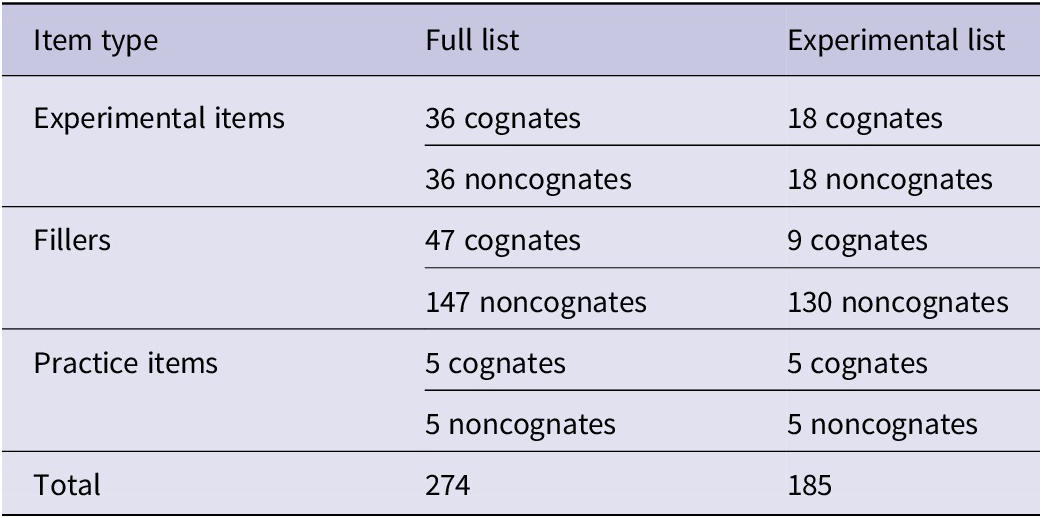
From the full stimulus list, four experimental lists were created containing a total of 185 items (Table 1). Each participant was randomly assigned one of these lists (A–D), and the distribution of the stimuli in each list was randomized while keeping the order of cognate items, fillers and switch trials intact. The structure of the final experimental lists was adapted from Broersma et al. (Reference Broersma, Carter and Acheson2016) and modified to account for the reduction of filler words, resulting in 36 experimental items, 139 fillers and 10 practice items, with 22 total switch trials. Switch trials were fixed across all four lists: cognates were separated by 2–14 noncognates, and switch trials were separated by 5–14 nonswitch trials. After the 10 practice items, each list included a break between the 87th and 88th items (of the total 175), which appeared after and before four nonswitch trials, respectively. Because 175 is odd, each list ended up having 90 L1 (Dutch) and 85 L2 (English) trials per person, equating to a total of 12 Dutch and 15 English cognate words per participant, and 78 Dutch and 70 English noncognate words.
Distribution of stimuli across the source list and the experimental lists

Experimental items in the full list were paired according to cognate status, syllable length (only mono- or disyllabic items) and English log10 lexical frequency (allowing for a 10% margin). These criteria resulted in 18 monosyllabic and 18 disyllabic pairs in the full list, and a series of independent samples t-tests confirmed that there were no significant differences in syllable count between conditions (EN: t(70) = 0.00, p = 1.00; DU: t(70) = 0.00, p = 1.00), nor in lexical frequency across log10-transformed or Zipf-scaled frequencies (all p > .10). Filler items in the full list did not adhere to the same criteria: cognates and noncognates did not need to match and items ranging between 1 and 4 syllables in Dutch and/or English were accepted as fillers. Full stimulus materials are available in Supplementary Appendix S4.
Procedure: The experiment was conducted in a soundproof booth at the UG, with participants completing a cued picture-naming task in E-Prime 3.0 (Psychology Software Tools, 2016b). One participant entered at a time, and the researcher remained outside during the session. Before starting, participants turned off sound-producing devices, entered their participant code and received on-screen and verbal instructions. They were told to name images as quickly and accurately as possible using single-word responses in the cued language. If they did not know the word, they were instructed to wait for the trial to time out after 4000 ms. Participants were also instructed to wait until they had fully spoken the word before pressing the far-right button on the Chronos response and stimulus device (Psychology Software Tools, 2019) to continue, which enabled millisecond-level measurement of response onset and trial control.
Each trial began with a 1000 ms fixation cross (white on black), followed by a 500 ms language cue – either the Union Jack (English) or the Netherlands flag (Dutch) – centered on the screen. Colored pictures of concrete nouns, taken from the MultiPic database (Duñabeitia et al., Reference Duñabeitia, Crepaldi, Meyer, New, Pliatsikas, Smolka and Brysbaert2018), then appeared in the center, with the flag remaining in the top-right corner to maintain the cued language. Participants named each image aloud into a microphone and then pressed the button on the Chronos device to proceed. A grey frame appeared around the image when the voice key detected speech onset. Voice onset was recorded using E-Prime’s voice key and exported via E Data Aid 3.0 (Psychology Software Tools, Inc., 2016a).
Participant responses were also transcribed for accuracy, with responses numerically coded as incorrect (0) or correct (1). Responses were incorrect if they were: (1) named in the wrong language, representing a delayed switch (e.g., continued naming of a cued L2 English stimulus in L1 Dutch or vice versa), (2) if the named word was from a broader semantic category instead of a concrete noun (e.g., insect instead of ant) or (3) a completely different word form (e.g., glas instead of melk). Correct responses included acceptable synonyms (e.g., hak for hiel) or plural forms (e.g., drums for drum) if they aligned with the intended target.
2.4. Data analysis
All data were analyzed using R (version 4.5.0) in RStudio (version 2025.05.1 + 513; Posit Software, 2024), with packages including lme4 (Bates et al., Reference Bates, Mächler, Bolker and Walker2015), lmerTest (Kuznetsova et al., Reference Kuznetsova, Brockhoff and Christensen2017), sjPlot (Lüdecke, Reference Lüdecke2021), emmeans (Lenth, Reference Lenth2021), simr (Green & MacLeod, Reference Green and MacLeod2016) and tidyverse (Wickham et al., Reference Wickham, Averick, Bryan, Chang, McGowan, François and Yutani2019). Custom fonts were enabled for plotting using showtext (Qiu, Reference Qiu2022) and Google Fonts. E-Prime data for 34 participants were loaded and pre-processed. The full R Markdown script used for data processing and analysis is available as Supplementary Appendices S1 and S2.
Outlier procedure and data exclusion: Outliers were removed in three steps: (1) all voice key errors (0 ms), (2) all RTs < 200 ms and (3) values >2.5 SDs above each participant’s mean RT. The 2.5 SD criterion was chosen as a conservative compromise that reduces the influence of extreme responses while minimizing data loss in a relatively small sample (Berger & Kiefer, Reference Berger and Kiefer2021; Loenneker et al., Reference Loenneker, Buchanan, Martinovici, Primbs, Elsherif, Baker, Dudda, Đurđević, Mišić, Peetz and Röer2024; Poarch et al., Reference Poarch, Van Hell and Kroll2015).
In total, 503 of 5,950 trials (8.5%) were dropped – 23 DU cognates (5.6%) and 29 EN cognates (5.7%), along with 186 DU noncognates (7.0%) and 265 EN noncognates (11.1%) – leaving 5,447 responses. After merging with survey data, an additional 33 cases with missing values (0.6%) were removed, resulting in 5,414 usable responses. Of these, 423 responses (7.8%) were coded as incorrect. As final RTs were analyzed only for accurate trials with valid timings, the linear mixed-effects models (LMEs) were based on 4,991 correct trials (92.2% of usable responses). Although English noncognates showed slightly higher exclusion rates, this difference was modest and did not systematically favor any critical switch–cognate combination, making substantial bias in the fixed-effect estimates unlikely.
Predictor construction and centering: Qualtrics survey data were cleaned and merged by participant number. Composite scores were calculated for English and Dutch self-rated proficiency (writing, speaking, reading and listening), exposure (e.g., use in family, school and media) and attitudes, based on the tripartite model (cognitive, affective and behavioral; Li & Wei, Reference Li and Wei2022). AoA for English was also recorded and included in the models as an exploratory predictor, given its theoretical relevance to bilingual lexical access and language control (Bonfieni et al., Reference Bonfieni, Branigan, Pickering and Sorace2019; Unsworth, Reference Unsworth2013). All continuous predictors were centered around their means to improve interpretability and reduce multicollinearity (Iacobucci et al., Reference Iacobucci, Schneider, Popovich and Bakamitsos2017; Shieh, Reference Shieh2011). The cleaned RT dataset was then merged with the centered survey scores. Switch direction (e.g., L1 → L2, L2 → L1) was included as a categorical predictor.
Accuracy and RT modelling: Response accuracy was analyzed using logistic regression and generalized linear mixed-effects models (GLMMs) to test whether cognates were named more accurately and whether individual differences moderated switch accuracy. For RT analyses, LMEs were fitted with switch type, cognate status and centered individual difference variables (proficiency, exposure, attitudes and AoA) as fixed effects, including random intercepts for Participant and Word.
Because switch type and cognate status varied within participants, random slopes for these predictors were initially specified. However, both maximal and simplified slope structures failed to converge or produced singular fits, reflecting characteristics of the design: each word appeared only once, switch trials were sparse (22 per participant), and several condition combinations were represented by few observations. In line with recommendations for model parsimony when random slopes are not identifiable (Barr et al., Reference Barr, Levy, Scheepers and Tily2013; Bates et al., Reference Bates, Mächler, Bolker and Walker2015), we therefore report results from a reduced model with random intercepts only. Given this structure, fixed-effect estimates – particularly for higher-order interactions – should be interpreted with appropriate caution. Switch direction and cognate transitions (e.g., noncognate → cognate) were modeled as categorical predictors to capture lexical transition effects, following prior work (Broersma et al., Reference Broersma, Carter and Acheson2016).
3. Results
3.1. Accuracy analysis
To examine predictors of response accuracy, a series of generalized linear mixed-effects models (GLMMs) with a binomial link function was conducted. Participant and Word were included as random intercepts, with nonswitch L1 → L1 trials as the reference level.
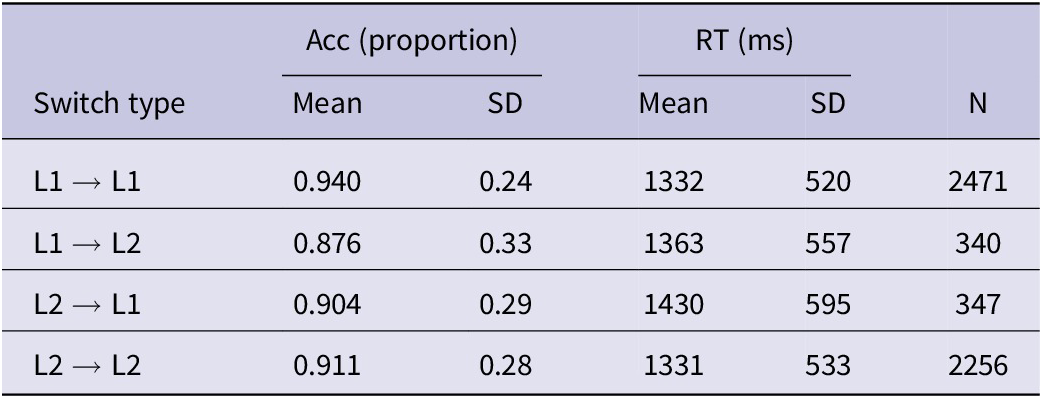
Accuracy was significantly lower for L1 → L2 (β = −1.26, SE = 0.27, z = −4.67, p < .001) and L2 → L1 (β = −0.53, SE = 0.27, z = −1.98, p = .047) switch trials, as well as for L2 → L2 (β = −0.63, SE = 0.16, z = −4.05, p < .001) control trials. See Table 2 for a breakdown.
Descriptive statistics for accuracy (Acc) and reaction time (RT) across switch conditions

Although English proficiency and (β = −0.21, SE = 0.17, z = −1.23, p = .22) English exposure (β = 0.01, SE = 0.07, z = 0.08, p = .93) did not independently predict accuracy, L2 proficiency significantly moderated the effect of switch type: accuracy was higher for L1 → L2 switches (β = 0.50, SE = 0.24, z = 2.08, p = .037) and L2 → L2 control trials (β = 0.52, SE = 0.15, z = 3.56, p < .001) among more proficient English speakers. This effect is visualized in Supplementary Figure S1. Dutch proficiency had no significant main effect or interactions (ps > .13), but Dutch exposure was associated with a slight decrease in accuracy (β = −0.14, SE = 0.06, z = −2.19, p = .029).
Neither Dutch (β = −0.05, SE = 0.11, z = −0.48, p = .63) nor English attitudes (β = 0.11, SE = 0.11, z = 0.98, p = .33) independently predicted accuracy. However, Dutch attitudes significantly interacted with L1 → L2 (β = −0.66, SE = 0.24, z = −2.79, p = .005) and L2 → L1 (β = −0.47, SE = 0.24, z = −1.98, p = .047) switch trials (Supplementary Figure S2). AoA did not independently predict accuracy (β = 0.09, SE = 0.06, z = 1.59, p = .11), but it significantly interacted with L2 → L2 control trials (β = −0.15, SE = 0.04, z = −3.45, p < .001). No interaction was observed for L1 → L2 (β = 0.01, p = .92) or L2 → L1 (β = 0.06, p = .40) switch conditions.
Although cognates were named slightly more accurately (93%) than noncognates (92%), logistic regression confirmed that this difference was not statistically significant (β = −0.15, SE = 0.14, z = −1.06, p = .29). Additionally, no significant main effects or interactions were observed involving cognate status with L2 proficiency or exposure, Dutch proficiency or exposure, either attitude variable, or English AoA (all ps > .28).
3.2. Cognate analysis
A linear mixed-effects model was conducted to examine the effect of cognate status on naming latencies. Cognate status did not show a significant effect (β = 74.34, SE = 38.99, t(234.57) = 1.91, p = .058), visualized in the box plot in Supplementary Figure S3.
A set of linear mixed-effects models assessed whether the cognate effect was modulated by individual difference variables. Interactions between cognate status and English proficiency or exposure, Dutch proficiency or exposure and attitudes toward either language all failed to significantly moderate the cognate effect (all ps > .072). However, a significant interaction emerged between cognate status and English AoA (β = −11.58, SE = 5.35, t(4746.45) = −2.17, p = .03), suggesting that the cognate facilitation effect was more pronounced at lower values (e.g., earlier acquisition) of English AoA (Supplementary Figure S4). Across all models, the cognate effect remained only marginally significant (β range ≈ 73–76 ms, ps ≈ .05–.06), providing limited evidence of consistent moderation by individual background variables.
3.3. Reaction time analysis
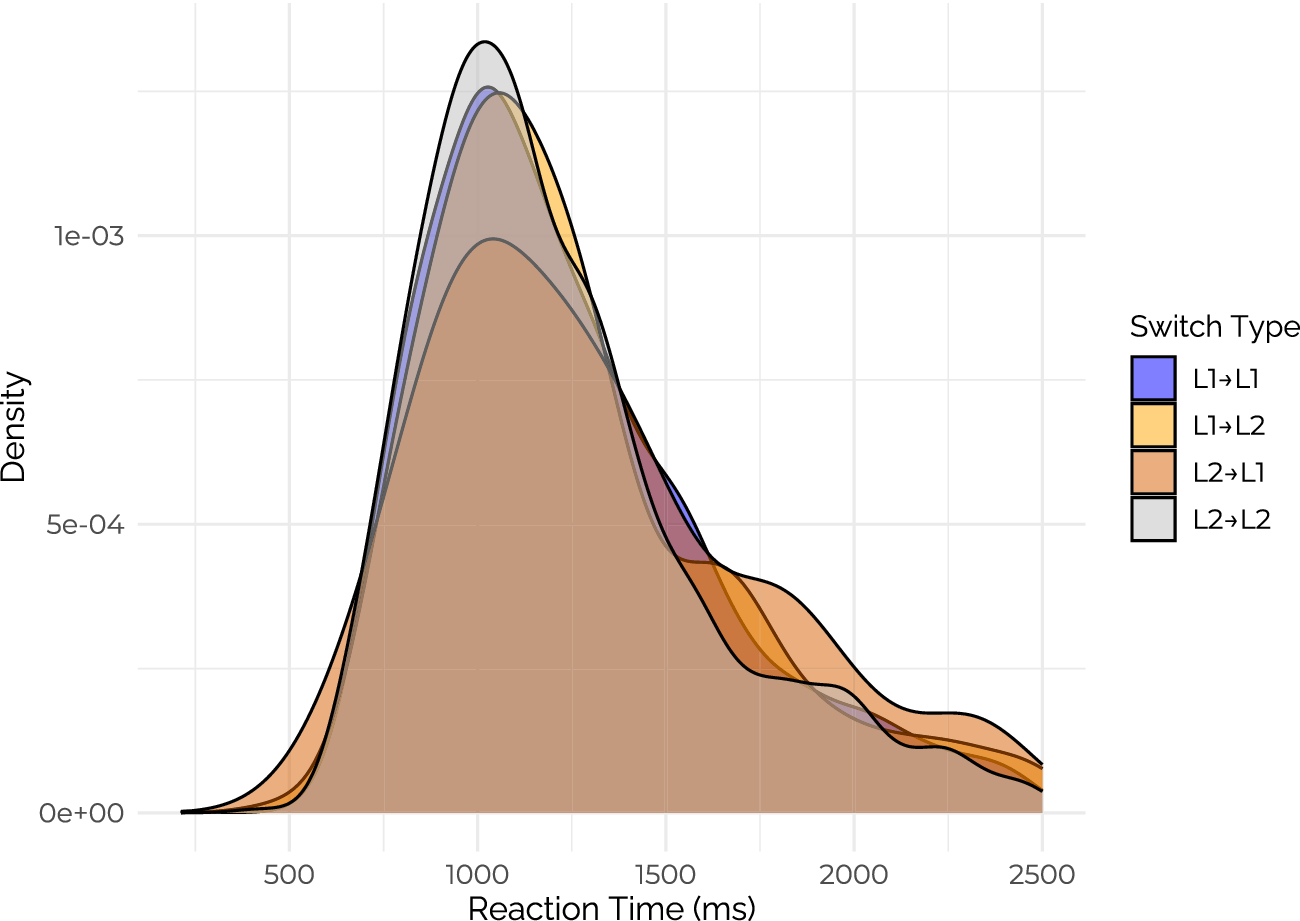
Results of a linear mixed-effects model testing the effect of switch type on reaction times showed that switch trials were associated with slower naming latencies. Compared to reference level L1 → L1 trials, participants were slower on L1 → L2 (β = 70.53, SE = 30.18, t(4931.77) = 2.34, p = .020) and L2 → L1 (β = 89.40, SE = 30.60, t(4848.44) = 2.92, p = .004) trials. L2 → L2 control trials did not significantly differ from baseline (β = 10.54, SE = 15.23, t = 0.69, p = .49). These effects have been visualized in the density plot in Figure 1.
Density plot of global switch costs.

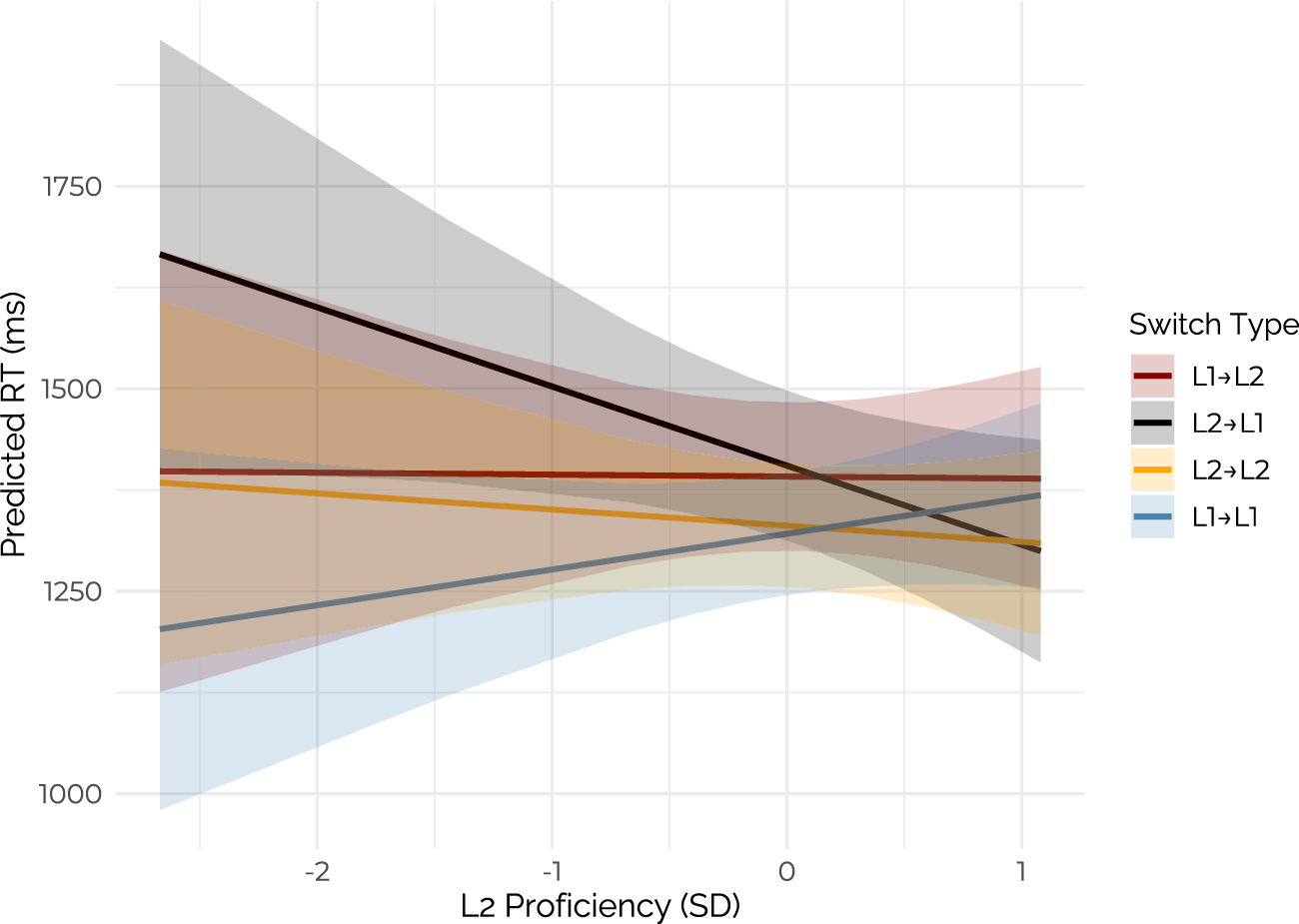
An interaction model with English proficiency revealed that L2 → L1 and L2 → L2 switch costs were moderated by L2 proficiency. Higher proficiency was associated with faster naming in both L2 → L1 (β = −141.83, SE = 29.23, t(4775.81) = −4.85, p < .001) and L2 → L2 (β = −64.03, SE = 14.84, t(4803.16) = −4.32, p < .001) conditions (see Figure 2). L2 exposure also had an effect: more exposure was associated with reduced switch cost for L2 → L1 trials (β = −34.02, SE = 14.15, t(4783.52) = −2.41, p = .016).
L2 proficiency effects by switch type.
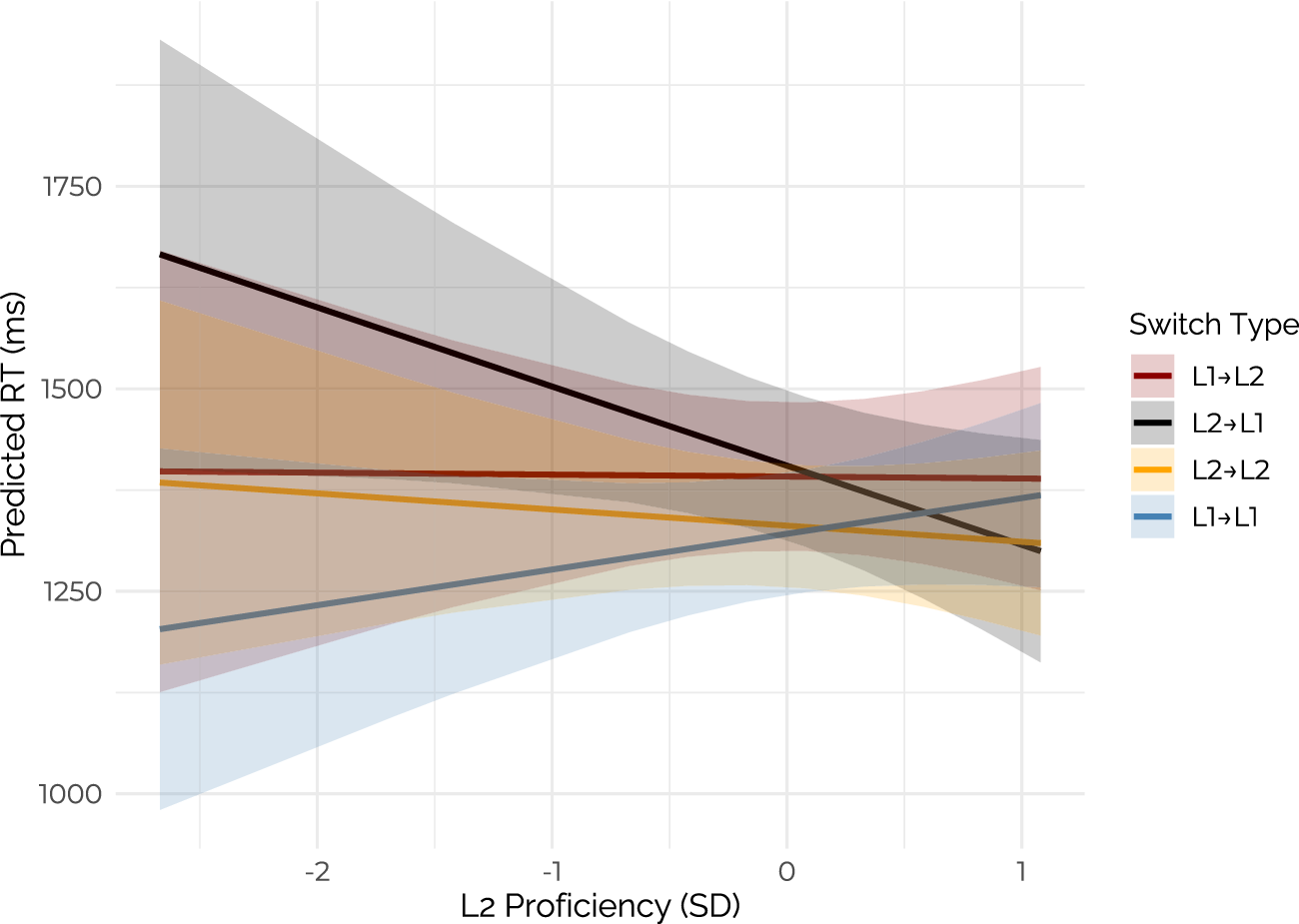
Additionally, the interaction between Dutch proficiency and switch type was significant for L2 → L1 trials (β = −237.11, SE = 73.78, t(4797.01) = −3.21, p = .001), while control L2 → L2 trials (β = −57.11, SE = 34.12, t(4823.73) = −1.67, p = .094) and L1 → L2 switch trials (β = −27.65, p = .68) showed no significant effects. In contrast, Dutch exposure did not significantly predict reaction times (β = 4.44, p = .84), nor interact with any switch type condition (all ps > .27). BIC values later confirmed that the model including L2 proficiency (74875.20) was the best fitting compared to L2 exposure (74900.98), L1 proficiency (74897.70) and L1 exposure (74907.50), validating that L2 proficiency was the overall best fitting model and predictor of switch cost attenuation.
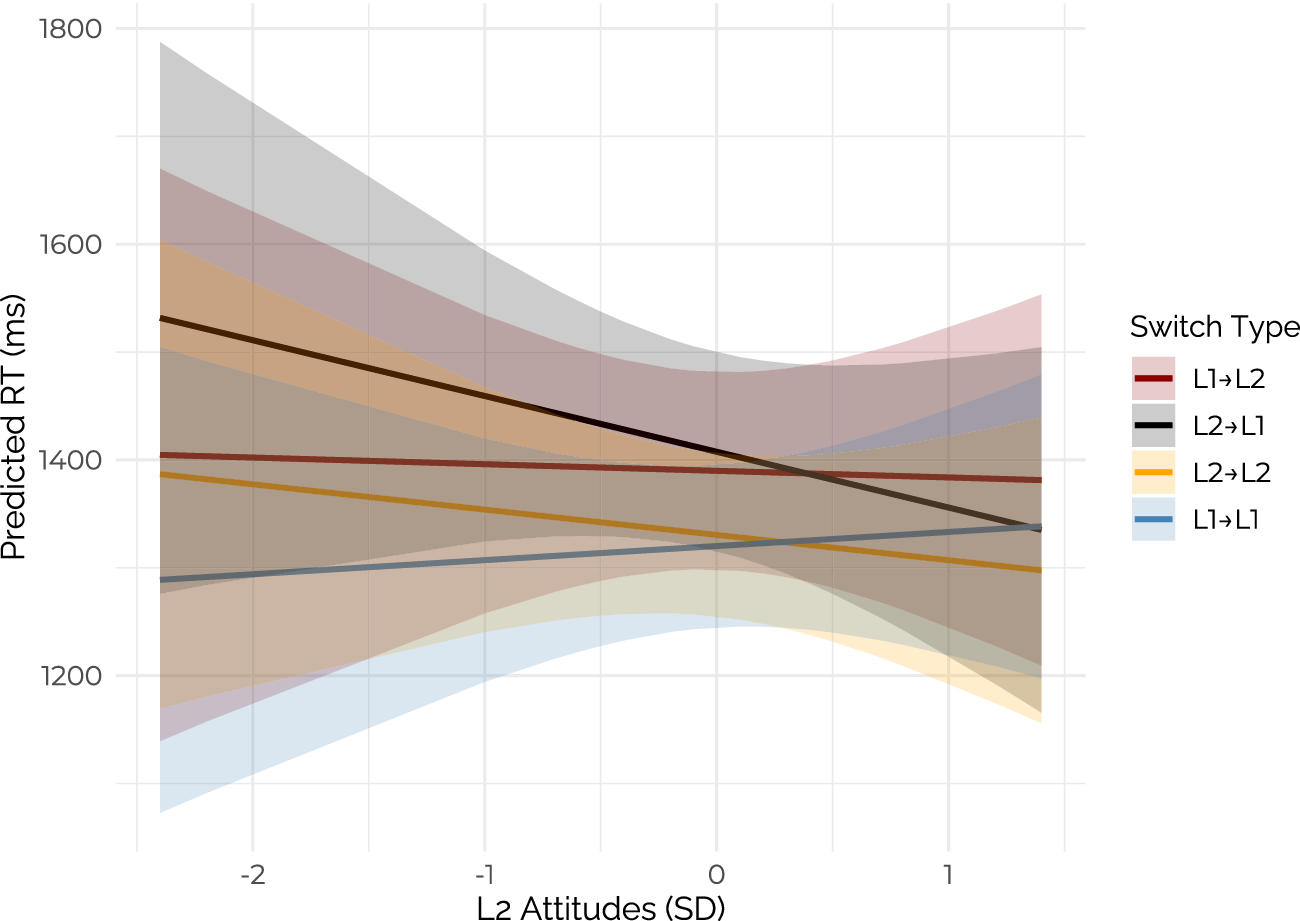
English attitudes also moderated switch costs. While the main effect of attitudes was nonsignificant (β = 13.06, p = .76), negative interactions were observed for L2 → L1 switch (β = −64.78, SE = 31.39, t(4758.63) = −2.06, p = .039) and L2 → L2 control (β = −36.52, SE = 16.11, t(4796.90) = −2.27, p = .023) trials (see Figure 3). In contrast, Dutch attitudes did not significantly predict RTs (β = 48.83, p = .11), nor did they interact with switch type in any condition (all ps > .24).
L2 attitude effects by switch type.

The main effect of English AoA on global switch costs was nonsignificant (β = −4.86, SE = 11.81, t = −0.41, p = .68), and no interaction was found with L1 → L2 (β = 4.60, SE = 8.68, t = 0.53, p = .60) and L2 → L1 (β = 5.23, SE = 8.84, t = 0.59, p = .56) switch trials, nor for L2 → L2 (β = 2.31, SE = 4.25, t = 0.54, p = .59) control trials.
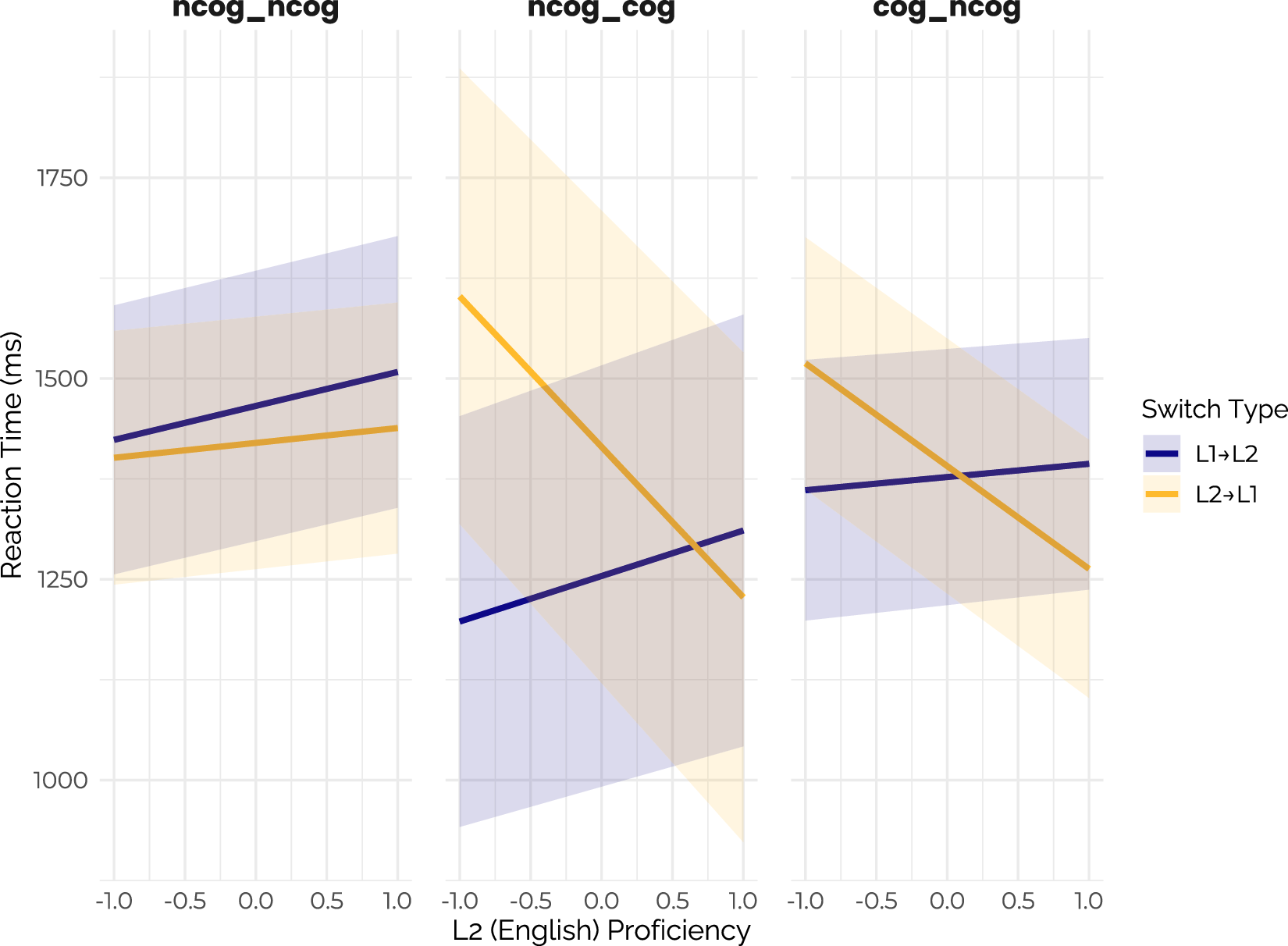
Additional models tested whether cognate facilitation effects were further modulated by switch direction and individual differences. The reference level in these interactions was for noncognate→noncognate transitions, so all effects are interpreted relative to control switch conditions with no lexical overlap. A significant three-way interaction emerged for the L2 → L1, cognate→noncognate condition and L2 proficiency (β = −146.73, SE = 66.70, t(4776.15) = −2.20, p = .028; see Figure 4). All other three-way interactions were nonsignificant (ps > .06), and neither Dutch proficiency nor exposure significantly moderated any three-way interactions (all ps > .13).
L2 proficiency, cognate status, and switch type.

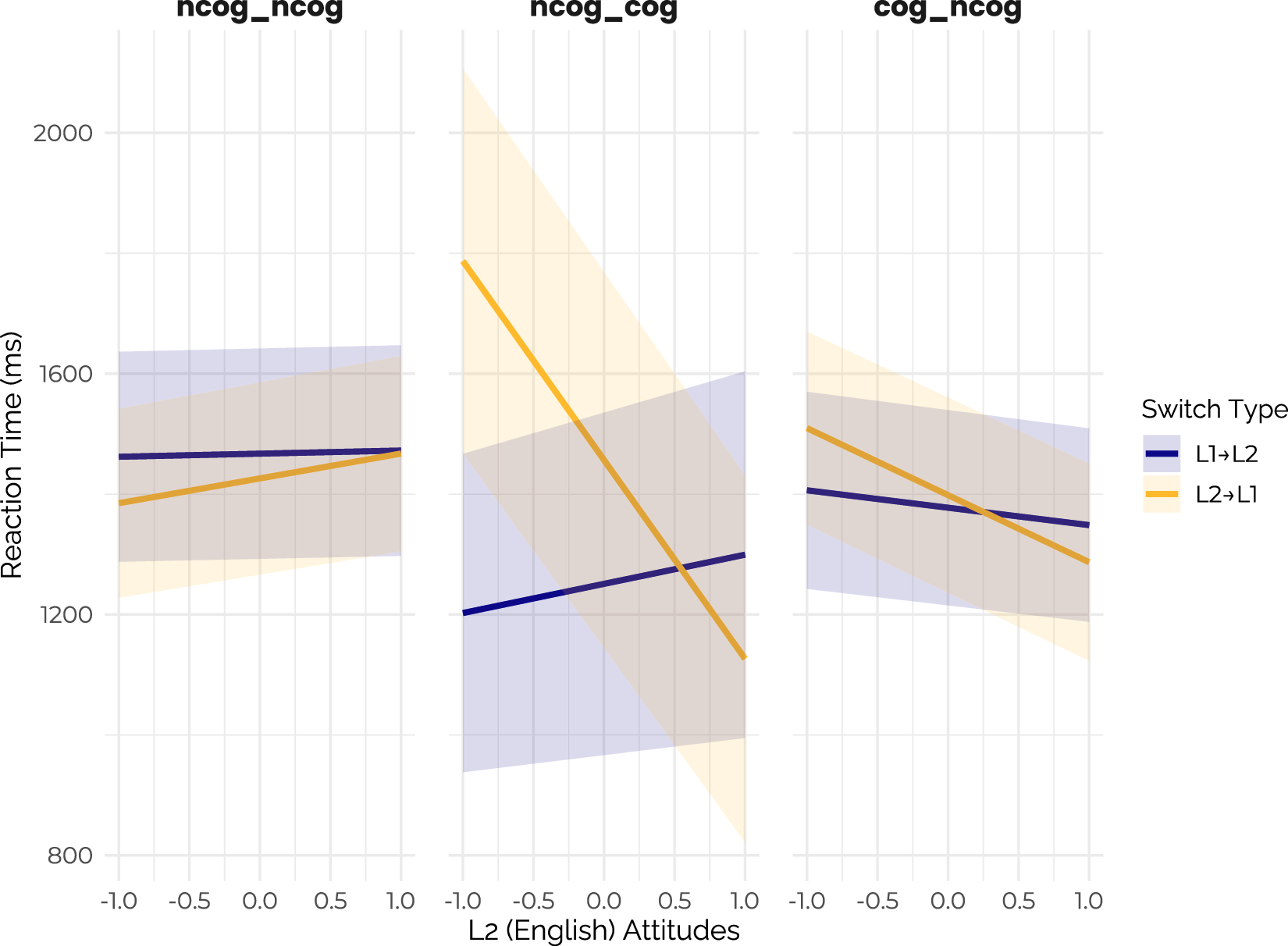
English language attitudes also modulated switch costs, with a significant three-way interaction observed for the L2 → L1, noncognate→cognate condition (β = −331.34, SE = 121.21, t(4782.86) = −2.73, p = .006; Figure 5). No other three-way interactions reached significance (ps > .09), including interactions with Dutch attitudes (all ps > .16) and English AoA (all ps > .34).
L2 attitudes, cognate status, and switch type.

Follow-up analyses: A series of follow-up analyses was conducted to examine whether language attitudes and L2 proficiency contributed independently to switch-related reaction times. Pairwise correlations revealed a positive relationship between English proficiency and English attitude scores (r = .52, p < .001), but no correlation between Dutch proficiency and Dutch attitudes (r = .006, p = .67). Next, variance inflation factor (VIF) diagnostics were obtained using the car package in R (Fox & Weisberg, Reference Fox and Weisberg2019). A VIF value of 1 indicates no collinearity, while values above 5 or 10 suggest problematic multicollinearity that can distort regression estimates (Akinwande et al., Reference Akinwande, Dikko and Samson2015). In the present data, all VIF values – including for proficiency (1.48), exposure (1.79), attitudes (1.75) and English AoA (1.18) – were well below 2, indicating no multicollinearity concerns and confirming that each of these predictors contributed nonredundant information to the model.
Nested model comparisons were also performed using likelihood ratio tests (Vexler et al., Reference Vexler, Tsai and Hutson2014). For English, adding attitude (and its interaction with switch type) to a model already containing proficiency significantly improved model fit (χ2(4) = 27.34, p < .001). Conversely, adding proficiency to a model already containing attitudes did not improve fit (χ2(4) = 0.56, p = .97). This pattern suggests that English attitudes accounted for unique variance in reaction times beyond proficiency. For Dutch, the absence of correlation between proficiency and attitudes, together with VIF values near 1, similarly indicates statistical nonredundancy.
Although these contrasts exist, it is important to note that they are indicative of independence in predictive variance in both languages rather than independence at the construct level. Attitudes and proficiency may remain theoretically and developmentally related, even when their contributions to reaction-time variance are statistically distinguishable within the present models.
Power analysis: Post hoc power analyses were conducted using simulation-based methods implemented in simr, based on the fitted LMEs, 4,991 observations, α = .05 and 1,000 simulations per effect. The central replication effect involving Switch Direction × English Proficiency (β ≈ −142 ms) showed excellent power (~99%), indicating a highly reliable detection of the established interaction. The three-way interaction involving Switch Direction × Cognate Transition × Attitudes (β ≈ −330 ms) showed good power (~76%), suggesting adequate sensitivity for large effects despite the model’s complexity. The three-way interaction involving Switch Direction × Cognate Transition × English Proficiency (β ≈ −150 ms) showed moderate power (~60%), indicating reduced reliability and a need for independent replication. Finally, exploratory two-way interactions involving Attitudes and AoA showed limited power (≈55–60%) for small-to-moderate effects (β ≈ −12 to −65 ms). Accordingly, these effects should be interpreted as provisional. No a priori power analysis was conducted due to the exploratory nature of these individual-difference moderators.
4. Discussion
The aim of this study was to examine how individual differences in bilingual experience – specifically, L2 proficiency, exposure and language attitudes – modulate reactive control processes, and how these individual differences affect switch costs and cognate processing in Dutch–English bilinguals. Switch costs were observed in both L1 → L2 and L2 → L1 conditions, with asymmetrical L2 → L1 costs modulated by L2 proficiency, exposure and attitudes. Moreover, L1 proficiency attenuated costs in the L2 → L1 condition but not in others, indicating that participants with higher L2 and L1 proficiency (a more balanced language profile) showed reduced asymmetric switch costs. Overall, these results suggest that an L1-dominant, less positively L2-aligned language profile was associated with the observed asymmetrical switch costs in our experiment (Bonfieni et al., Reference Bonfieni, Branigan, Pickering and Sorace2019; Broersma et al., Reference Broersma, Carter and Acheson2016).
While cognate words were named slightly more accurately than noncognates, this difference was not statistically significant – reaction time data revealed only a marginal cognate facilitation effect. Although individual variables such as L2 proficiency, exposure and attitudes did not significantly moderate this effect, English AoA did. Later L2 acquisition was associated with slower RTs for cognate words, suggesting reduced cross-language facilitation in late (L1-dominant) bilinguals. This finding also extends prior work by Bonfieni et al. (Reference Bonfieni, Branigan, Pickering and Sorace2019), who similarly included AoA as a measure, although it should be taken as provisional given the limited power (~60%) of the interaction. During switch trials, a three-way interaction was also observed wherein higher L2 proficiency selectively modulated L2 → L1 switch costs during cognate→noncognate transitions – indicative of a modulation in post-cognate slowing (Broersma et al., Reference Broersma, Carter and Acheson2016).
Overall, the results of our experiment identified L2 proficiency as the driving force behind reductions in switch costs among the participants (Bonfieni et al., Reference Bonfieni, Branigan, Pickering and Sorace2019; Broersma et al., Reference Broersma, Carter and Acheson2016). These results corroborate established findings on switch costs and the modulating effects of L2 proficiency (Bonfieni et al., Reference Bonfieni, Branigan, Pickering and Sorace2019; Broersma et al., Reference Broersma, Carter and Acheson2016; Meuter & Allport, Reference Meuter and Allport1999; Revniuk & Bátyi, Reference Revniuk and Bátyi2023). Moreover, the fact that switch costs for L2 → L1 outweighed the cost for L1 → L2, and that L2 proficiency only attenuated costs on the L2 → L1 and L2 → L2 trials, points to an overall asymmetric switch cost. Accordingly, it was likely more balanced bilingual participants who were able to effectively disengage from one language and engage the other during switch trials between English and Dutch (Bonfieni et al., Reference Bonfieni, Branigan, Pickering and Sorace2019; Broersma et al., Reference Broersma, Carter and Acheson2016).
The mechanisms driving these asymmetric switch costs – inhibitory control and cognitive flexibility – were also reflected in the accuracy analysis. Overall accuracy was lowest for L1 → L2 and L2 → L2 trials compared to L2 → L1, with higher L2 proficiency significantly attenuating costs on both switch types. Since incorrect responses were categorized by participants accidentally naming a cued English stimulus in Dutch, or producing incorrect word forms, the drop in accuracy likely reflects failures of inhibitory control (i.e., difficulty re-engaging the weaker L2 after L1-only trials). This nuanced discrepancy would not have appeared in the RT analysis, which focused solely on the latency of spoken onset (Bonfieni et al., Reference Bonfieni, Branigan, Pickering and Sorace2019).
Further supporting this interpretation is that greater L1 exposure and later AoA for English (an L1-dominant language profile) were similarly associated with decreased naming accuracy. Specifically, Dutch exposure was associated with a slight decrease, while English exposure showed no such effect. Later AoA for English also predicted reduced accuracy during L2 control trials, suggesting that delayed acquisition of the L2 selectively compromised naming accuracy under nonswitch conditions. Together, these findings underscore that the L1-dominant bilinguals in our study faced greater difficulty with accurate L2 production, particularly when shifting out of the dominant L1 (Bonfieni et al., Reference Bonfieni, Branigan, Pickering and Sorace2019).
These results also help explain the lack of a pronounced cognate effect in our study. In Broersma et al.’s (Reference Broersma, Carter and Acheson2016) study, L1 (English)-dominant bilinguals took longer to name cognate words in their weaker L2 (Welsh) and even showed no cognate advantage in their L1. In contrast, the L2-dominant and balanced bilinguals continued to exhibit cognate facilitation in both languages. Given that the majority of participants in our study were also L1-dominant bilinguals, they likely experienced comparable inhibitory demands on cognate trials when disengaging from the weaker L2. This would have resulted in a “tug-of-war” between lemma-level competition and phonological/orthographic facilitation – especially in a forced-switching paradigm that taxes inhibitory control mechanisms (Broersma et al., Reference Broersma, Carter and Acheson2016; Liu et al., Reference Liu, Timmer, Jiao and Wang2020). These dynamics likely underlie the lacking cognate effect and are further supported by the finding that earlier English AoA (characteristic of an L2-dominant or balanced profile) moderated the main effects of cognate status in our study (Bonfieni et al., Reference Bonfieni, Branigan, Pickering and Sorace2019; Broersma et al., Reference Broersma, Carter and Acheson2016).
Producing a cognate can also induce lingering cross-language activation in L1-dominant bilinguals, resulting in post-cognate interference on subsequent trials – particularly when switching into the dominant L1 (Broersma et al., Reference Broersma, Carter and Acheson2016). The three-way interaction observed in our study extends these findings by showing that higher L2 proficiency selectively attenuated asymmetric L2 → L1 switch costs on cognate→noncognate transitions, consistent with reduced post-cognate interference (Bonfieni et al., Reference Bonfieni, Branigan, Pickering and Sorace2019; Broersma et al., Reference Broersma, Carter and Acheson2016; Green, Reference Green1998; Green & Abutalebi, Reference Green and Abutalebi2013). While Broersma et al. (Reference Broersma, Carter and Acheson2016) reported uniform post-cognate slowing across dominance groups (English-dominant, Welsh-dominant and balanced), their sample consisted exclusively of highly proficient bilinguals. By contrast, the restricted group structure of our sample (L1-dominant vs. balanced) may have amplified proficiency-related variance, allowing L2 proficiency to emerge more clearly as a moderator of these effects. Although this interaction should be interpreted cautiously, given its moderate power, it highlights a promising direction for future work.
Meanwhile, more positive L2 attitudes were associated with selective modulation of switch costs and cognate-related facilitation, particularly on L2 → L1 transitions. Ultimately, these findings reflect sociolinguistic frameworks positing that more positive attitudes toward the L2 result in more frequent switching between languages, and by extension, a more balanced language profile (Han et al., Reference Han, Li and Filippi2022; Li & Wei, Reference Li and Wei2022; Moradi & Chen, Reference Moradi and Chen2022; Villaabrille et al., Reference Villaabrille, Generalao, Mametes and Bacatan2024; Yim & Clément, Reference Yim and Clément2021). Language attitudes are thus integrally tied to the degree to which proficiency and exposure influence language control, since they are inherently connected to L2 achievement, motivation and language switching frequency (Amin, Reference Amin2020; Dewaele & Wei, Reference Dewaele and Wei2014; Green & Wei, Reference Green and Wei2014; Li & Wei, Reference Li and Wei2022; Moradi & Gupta, Reference Moradi, Gupta, Widodo, Wood, Gupta and Cheng2017; Villaabrille et al., Reference Villaabrille, Generalao, Mametes and Bacatan2024). To create a coarse analogy, although someone might be technically proficient after many years of driving, they may still treat driving as a utilitarian task. In contrast, someone who actively enjoys driving is more likely to practice under diverse and demanding conditions, leading to greater functional expertise. A similar distinction may apply to bilingual language use: positive affective alignment with the L2 likely promotes a richer switching experience beyond exposure alone.
These patterns were reflected in our study: participants who had more positive L2 attitudes showed reduced asymmetric switch costs (Bonfieni et al., Reference Bonfieni, Branigan, Pickering and Sorace2019; Broersma et al., Reference Broersma, Carter and Acheson2016; Han et al., Reference Han, Li and Filippi2022). These attenuative effects were selectively observed for the L2, as L1 attitudes had no significance in any of the two- or three-way interaction terms. Additionally, although L2 attitudes did not impact naming accuracy, which was high overall, more favorable attitudes toward the L1 negatively impacted L1 → L2 and L2 → L1 switch accuracy. This finding suggests that affective alignment with the L1 over the L2 could be indicative of an L1-dominant language profile, reflecting a reduced ability to inhibit the dominant language during switch trials (Bonfieni et al., Reference Bonfieni, Branigan, Pickering and Sorace2019; Broersma et al., Reference Broersma, Carter and Acheson2016; Santesteban & Costa, Reference Santesteban and Costa2016).
Moreover, when switching into cognates, positive L2 attitudes showed a 330 ms attenuation from L2 to L1 during noncognate-to-cognate transitions. This effect was significantly larger than the effect of L2 proficiency on the same switch direction. Consistent with cognates acting as “triggers” in code-switching contexts, these results likely reflect that more frequent code-switchers have a propensity to be “triggered” by cognate words (Broersma, Reference Broersma, Schmid and Lowie2011; Broersma et al., Reference Broersma, Carter and Acheson2016, Reference Broersma, Carter, Donnelly and Konopka2020). Accordingly, participants with more positive L2 attitudes – indicative of more frequent language switching tendencies – would have experienced more pronounced cognate switch facilitation (Broersma et al., Reference Broersma, Carter and Acheson2016, Reference Broersma, Carter, Donnelly and Konopka2020; Han et al., Reference Han, Li and Filippi2022).
Together, these findings provide preliminary evidence that reactive control in language switching is not shaped by proficiency and exposure alone but may also be systematically related to affective alignment with the L2, as indexed using the LASS (Li & Wei, Reference Li and Wei2022).
4.1. Limitations and future directions
Although this study effectively incorporated language attitudes using an adapted version of the LASS (Li & Wei, Reference Li and Wei2022), future research should consider conducting a pilot validation of these measures within a Dutch bilingual context. This is especially recommended given the exploratory nature of the lower-powered two-way attitudinal interactions. Although the well-powered three-way attitudinal interaction we observed is noteworthy, follow-up work is needed to build upon and further validate these findings. Ultimately, we hope this study will help in developing more holistic models of bilingual language processing using similar language-switching paradigms alongside adapted versions of the LASS (Li & Wei, Reference Li and Wei2022) and the tripartite model of attitude (Cooper & Fishman, Reference Cooper and Fishman1977; Garrett, Reference Garrett2010).
Additionally, while our sample size (N = 34) is in line with similar language switching paradigms investigating individual differences in language switching (Calabria et al., Reference Calabria, Hernández, Branzi and Costa2011; Jiao et al., Reference Jiao, Duan, Liu and Chen2022; Liu et al., Reference Liu, Chang, Li, Liu, Chen, Zhang and Wang2018; Meuter & Allport, Reference Meuter and Allport1999), the number of additional variables observed in our study could have increased the likelihood of a Type I error. Our results should therefore be interpreted cautiously and require further investigation with larger and more diverse samples – including early, sequential and late L2 bilinguals – before any definitive conclusions can be made.
Finally, although the forced-switching paradigm we used was ideal for indexing switch costs as a marker of reactive control, it may not fully capture the naturalistic dynamics of bilingual language use in everyday contexts. Future research would benefit from complementing our approach with insights into proactive control – such as measuring mixing costs or incorporating voluntary-switch trials (Broersma et al., Reference Broersma, Carter and Acheson2016) – to further validate the mechanisms uncovered in our study.
5. Conclusion
Our study suggests that reactive control can be determined not only through cognitive measures but also through insights into a bilingual’s affective alignment with their L2. Asymmetric switch costs were reduced among participants with higher L2 proficiency, corroborating findings from Bonfieni et al. (Reference Bonfieni, Branigan, Pickering and Sorace2019) and Broersma et al. (Reference Broersma, Carter and Acheson2016). Interactions with language attitudes also provide preliminary evidence that a sociolinguistic measure can be used to extend psycholinguistic insights into bilingual language control (Purpuri et al., Reference Purpuri, Treccani, Filippi and Mulatti2024; Van de Velde et al., Reference Van de Velde, Pinget, Voeten, Demolin, Kristiansen, Franco, De Pascale, Rosseel and Zhang2022). Together, the findings from our study call for further replication incorporating the LASS (Li & Wei, Reference Li and Wei2022) and the tripartite model (Cooper & Fishman, Reference Cooper and Fishman1977; Garrett, Reference Garrett2010), advancing more holistic measures of language control to reflect the lived complexity of bilingual speakers.
Supplementary Material
The supplementary material for this article can be found at http://doi.org/10.1017/S1366728926101205.
Data availability statement
The anonymized data and code used in this study are available via OSF (https://osf.io/qwbr9/?view_only=1b8d72911bc744b9b2914d92dc4b6cb1). All supplementary materials included in Appendices S1–S3, including the R Markdown file, questionnaire and full stimulus list, as well as the participant data, are available at https://osf.io/qwbr9.
Acknowledgments
This study was conducted as part of the Research Master’s in Linguistics at the University of Groningen. We thank Carla Arnold and Gerrit Jan Kootstra for their valuable feedback and guidance. Additional thanks to the participants and to the psycholinguistics lab at the Faculty of Arts of the UG for technical support.
Competing interests
The authors declare no competing interests.


 Open access

