


Previously you could send a homogeneous message to the country, but there’s so much divisiveness and polarization on so many issues that that’s become almost impossible. (Allen Adamson, quoted in Deighton and Coffee (Reference Deighton and Coffee2023))
I. Introduction
The United States has witnessed a surge in political polarization and party disparities since 2010, particularly during presidential elections.Footnote 1 This trend is reflected in people gravitating toward like-minded individuals while distancing themselves from opposing views. Political beliefs affect workplace decisions through perceptions of economic conditions (e.g., Campbell et al. (Reference Campbell, Converse, Miller and Stokes1960)). Previous studies highlight this influence in various contexts: analysts and CEOs publish more optimistic forecasts and disclosures under politically aligned presidencies, executives leave jobs over political mismatches, and judges impose harsher sentences on politically misaligned cases (e.g., Fos, Kempf, and Tsoutsoura (Reference Fos, Kempf and Tsoutsoura2022), Kempf and Tsoutsoura (Reference Kempf and Tsoutsoura2021), Arikan et al. (Reference Arikan, Kara, Masli and Xi2023), and Gormley, Kaviani, and Maleki (Reference Gormley, Kaviani and Maleki2025)). Thus, understanding how executives adapt their corporate culture messaging in response to national political shifts is essential given its impact on firm productivity and value.
Guiso, Sapienza, and Zingales (Reference Guiso, Sapienza and Zingales2015) identify key corporate culture values from firms’ websites: integrity, teamwork, innovation, quality, and respect.Footnote 2 Li et al. (Reference Li, Mai, Shen and Yan2021) quantify these values using earnings call language and link cultural messaging with outcomes and firm performance. We explore how political changes affect corporate culture messaging through presidential administrations and periods of heightened polarization using Li et al.’s (Reference Li, Mai, Shen and Yan2021) 5 corporate culture scores, along with overall culture scores and sentiment. The nationwide political shifts serve as moments of informational events, revealing shifts in stakeholder preferences. We also examine how corporate cultural messaging varies not only in response to political shifts but also in accordance with political alignment—whether corporate culture messaging differs under different presidencies for likely-Democrat and likely-Republican firms.
Corporate culture evolves in response to internal dynamics and external pressures, including societal and political shifts (e.g., Gorton and Zentefis (Reference Gorton and Zentefis2022), Grennan and Li (Reference Grennan, Li, Hilary and McLean2023)).Footnote 3 We hypothesize that executives strategically adjust corporate culture messaging in response to political shifts. At the extensive margin, executives politically aligned with the ruling party may reinforce the prevailing societal culture in their corporate messaging driven by the pride mechanism in the dominant political climate. As such aligned executives would amplify cultural messaging, highlighting cultural strength, more than their misaligned counterparts. In contrast, during periods of heightened polarization, such expressions of pride may decline, consistent with the literature on conformity and herd mentality (see Lieberman and Asaba (Reference Lieberman and Asaba2006)). We posit that when polarization increases, executives refocus their messaging toward products while scaling back any official messaging, including cultural messaging, that may signal political alignment to mitigate risks of potential political backlash. As one executive put it: “The easiest thing to do is just to stay out of the conversation” (see Maurer (Reference Maurer2023)).
At the intensive margin, we hypothesize that shifts in political alignment influence executives’ messaging around specific cultural values—particularly innovation, quality, and respect.Footnote 4 Politically aligned executives, given their greater optimism and positive economic outlook, are more likely to emphasize “innovation” as part of broader investment increases (e.g., Rice (Reference Rice2024)). In contrast, politically misaligned executives, perceiving economic uncertainty, cut costs, including overall and innovation-specific investments. Cost-cutting measures risk lowering product and service quality. To deflect attention away from these potential problems, executives may scale back cultural messaging that emphasizes “innovation” and “quality.” Moreover, to navigate the political climate, firms started “green-hushing” in 2023 by reducing discussions of partisan issues related to climate and diversity, equity, and inclusion (DEI).Footnote 5 Since the cultural value of “respect” is closely tied to diversity and inclusion, we posit that executives may similarly engage in “culture-hushing” and avoid highlighting “respect.”
To empirically examine the relationship between political shifts and corporate culture messaging, we analyze how presidential elections, rising polarization, and firms’ political alignment are statistically associated with corporate messaging patterns. Following previous research that treats U.S. elections as political shocks (e.g., Jens (Reference Jens2017), Dahl, Runjing, and Mullins (Reference Dahl, Runjing and Mullins2022), and Kempf et al. (Reference Kempf, Luo, Schafer and Tsoutsoura2023)), we consider the elections from 2002 to 2021 to examine whether executives alter their corporate culture messaging in response to evolving political sentiment. We also examine corporate culture messaging in the context of rising political polarization using Azzimonti’s (Reference Azzimonti2018) Partisan Conflict Index (PCI), which increased beginning in 2010.Footnote 6 To identify political alignment during presidencies, we classify firms as likely-Democrat and likely-Republican using the political leaning of the headquarters’ location, following Dahl et al. (Reference Dahl, Runjing and Mullins2022) and Meeuwis et al. (Reference Meeuwis, Parker, Schoar and Simester2022).Footnote 7 We also examine firms in battleground states, as these firms are exposed to more balanced views (e.g., Gulen and Myers (Reference Gulen and Myers2024)).
We find that corporate culture messaging intensifies when firms are more likely to be politically aligned with the presidential party: executives of likely-Republican firms emphasize innovation, quality, respect, and overall corporate culture more during George W. Bush’s (Republican) term than Barack Obama’s (Democrat) term when compared with executives from likely-Democrat firms. This aligns with our expectation on the intensive margin that executives of politically misaligned firms reduce cultural messaging on innovation, quality, and respect. These results suggest that corporate culture messaging changes with political shifts.
However, our findings indicate that after the 2010 increase in political polarization, corporate culture messaging declines significantly for both likely-Democrat and likely-Republican firms, while tone becomes more positive. This reduction in corporate culture messaging during periods of increased polarization aligns with our expectations on the extensive margin. Moreover, executives from both likely-Democrat and likely-Republican firms conveyed similar messages about their corporate culture and adjusted sentiment similarly during the highly polarized presidency of Barack Obama and the first term of Donald Trump. Using a difference-in-differences framework, we document relatively smaller reductions in cultural messaging on innovation, quality, respect, and overall culture for likely-Democrat firms during periods of increased political polarization. For example, executives from likely-Democrat firms decreased innovation-related language in earnings calls by 3%, while those from likely-Republican firms reduced it by 10%.Footnote 8 In short, as polarization rises, executives talk less about corporate culture and converge in their culture messaging. In contrast, executives of firms in battleground states, being exposed to more balanced political environments, maintained consistent corporate culture messaging and sentiment before and after 2010. This stability underscores the importance of political shifts for corporate culture messaging for executives of firms headquartered in areas with more distinct political leaning.
Our findings show that executives change their cultural messaging in response to political shifts, including presidential elections and polarization. While ruling out endogeneity is difficult, reverse causality is less likely in our sample (e.g., executives’ discussions of cultural values, such as teamwork and quality, are unlikely to escalate national polarization), and we aim to further reduce such concerns with 4 tests. We verify that the parallel trend assumption holds in periods of lower polarization. We also find consistent results using the PCI directly. In addition, to better isolate the impact of political change, we analyze two distinct subsamples: firms exposed only to national political shifts and those also affected by local changes, such as county voting patterns or headquarters relocations. Our results persist in both subsamples. Finally, we examine exogenous geographic shocks to polarization, including areas that experienced a significant increase in the Republican vote share in the 2016 election, following Dahl et al. (Reference Dahl, Runjing and Mullins2022), proxying for areas subject to the China shock (e.g., Autor et al. (Reference Autor, Dorn, Hanson and Majlesi2020)) and areas that experienced significant changes in media partisanship after the entry of the Sinclair Broadcast Group (e.g., Martin and McCrain (Reference Martin and McCrain2019)). Across all tests, executives message less about corporate culture when polarization increases.
Next, we examine whether corporate culture messaging aligns with actual outcomes: whether executives “walk the talk” or engage in strategic communication, especially along the political dimension. Following Li et al. (Reference Li, Mai, Shen and Yan2021), we proxy integrity by restatements, teamwork by joint venture and alliance formation, innovation by patents, quality by best employer listing, and respect by top brand listing. Consistent with Li et al. (Reference Li, Mai, Shen and Yan2021), we confirm the contemporaneous significant cross-sectional relationship between cultural messaging and outcomes. However, when firms adjust cultural messaging along the political dimension—similar to Mian, Sufi, and Khoshkhou (Reference Mian, Sufi and Khoshkhou2023) and Duchin, Gao, and Xu (Reference Duchin, Gao and Xu2025), who document discrepancies between messaging and real outcomes—we find no consistent corresponding outcome changes, suggesting strategic communication rather than genuine cultural shifts.
Our baseline regressions incorporate two-way fixed effects at the firm and year levels and the difference-in-differences setting to examine the changes in the language describing corporate culture within the firm given nationwide political changes, including presidential elections and polarization changes. We acknowledge the limitations of our analysis. While two-way fixed effects estimators are widely used, they face challenges in the presence of heterogeneous treatment effects and overlapping influences (e.g., de Chaisemartin and D’Haultfœuille (Reference de Chaisemartin and D’Haultfœuille2023)). Some tests are conducted at the industry level, which may conflate industry characteristics with other underlying factors or broader trends. For example, industry classification is used to approximate the geographical dispersion of firms’ operations due to small sample sizes among multi-headquartered firms. Moreover, time-series analyses linking cultural messaging and outcomes have inherent limitations (e.g., Li et al. (Reference Li, Mai, Shen and Yan2021)). Despite these limitations, our findings are robust to excluding the years of the financial crisis and the COVID-19 pandemic, including firms that span all presidencies, and examining firms with geographically concentrated and dispersed operations. In addition, we provide baseline comparisons: in the same industry executives message more about innovation in likely-Democrat firms but in likely-Republican firms they emphasize quality and respect; such emphases occur during presidential political alignment. We also consider another important medium of firms’ communication—shareholder meetings—in addition to earnings calls. By extending corporate culture dictionaries to shareholder meeting transcripts, we find that corporate culture messaging varies with political factors.
We contribute to the literature on corporate culture (e.g., Guiso et al. (Reference Guiso, Sapienza and Zingales2015), Graham et al. (Reference Graham, Grennan, Harvey and Rajgopal2022), Li et al. (Reference Li, Mai, Shen and Yan2021), and Grennan and Li (Reference Grennan, Li, Hilary and McLean2023)). Culture, which represents a fundamental aspect of a firm, is challenging to measure quantitatively. However, recent advances in natural language processing have allowed researchers to assess the dynamics of culture. Grennan and Li (Reference Grennan, Li, Hilary and McLean2023) call for the first steps in this new research agenda to isolate “events that serve as catalysts for cultural change.” Our study closely aligns with theirs, as our findings highlight the importance of political shifts, including presidencies and polarization, for corporate culture messaging. As such, we add a perspective on corporate culture messaging and strategic communication. We also contribute to the literature on political alignment, which shows that executives’ partisan perceptions influence corporate tangible outcomes, such as investment and leverage (see Knill et al. (Reference Knill, Liu and McConnell2022), Rice (Reference Rice2024)). Unlike these studies, we focus on intangible outcomes and show that political alignment and polarization are also linked to corporate culture messaging. In addition, we contribute to the literature examining firms’ “political hedging,” where executives reduce discussions of polarizing issues and balance political donations (e.g., Christensen et al. (Reference Christensen, Jin, Sridharan and Wellman2022), Mkrtchyan, Sandvik, and Zhu (Reference Mkrtchyan, Sandvick and Zhu2024)). We find that during periods of heightened polarization, similar caution is strategically exercised for cultural messaging.
II. Background and Related Literature
In this section, we summarize key related work, beginning with polarization and political alignment. Political beliefs shape how individuals interpret events: Republicans and Democrats often perceive the same political developments differently, leading to divergent expectations of future economic conditions. Surveys show that Republicans become more optimistic about the U.S. economy after a Republican president’s election, while Democrats become more pessimistic.Footnote 9 These differing economic outlooks influence tangible decisions: politically aligned individuals have higher birth rates, better credit ratings, larger portfolio equity allocations, more optimistic earnings guidance, lower accounting conservatism, increased investment, and greater perceived leverage (e.g., Kempf and Tsoutsoura (Reference Kempf and Tsoutsoura2021), Dahl et al. (Reference Dahl, Runjing and Mullins2022), Knill et al. (Reference Knill, Liu and McConnell2022), Meeuwis et al. (Reference Meeuwis, Parker, Schoar and Simester2022), Arikan et al. (Reference Arikan, Kara, Masli and Xi2023), and Rice (Reference Rice2024)).Footnote 10
Beyond political shifts from presidential elections, we examine shifts in polarization. Increased polarization influences voting (e.g., DellaVigna and Kaplan (Reference DellaVigna and Kaplan2007), Martin and McCrain (Reference Martin and McCrain2019)), and trading, as Pan et al. (Reference Pan, Pikulina, Siegel and Wang2024) document a positive relation between the equity portfolio distance along the environmental and social preferences and the political distance among U.S. counties. Azzimonti’s (Reference Azzimonti2018) PCI shows a sharp increase in U.S. political polarization following the 2008 financial crisis. Economic hardship has fueled polarization and far-right support in various contexts (see Aldasoro et al. (Reference Aldasoro, Doerr, Haonan and Princeton2023), Gyöngyösi and Verner (Reference Gyöngyösi and Verner2022)). Other contributing factors include globalization, automation, immigration, disasters, and media bias (e.g., Guriev and Papaioannou (Reference Guriev and Papaioannou2022)). Autor et al. (Reference Autor, Dorn, Hanson and Majlesi2020) show that the China shock, which displaced U.S. manufacturing jobs, intensified polarization in affected regions. Dahl et al. (Reference Dahl, Runjing and Mullins2022) apply this framework to the 2016 U.S. presidential election, identifying areas with the largest rightward vote shifts as experiencing a polarization shock. Polarization also rises in regions where the local media covers more national news or provides a right-wing slant (e.g., Martin and McCrain (Reference Martin and McCrain2019), Dasgupta et al. (Reference Dasgupta, Guo, Ren and Shu2021), Knill et al. (Reference Knill, Liu and McConnell2022), and Pan et al. (Reference Pan, Pikulina, Siegel and Wang2024)). The PCI measure and geographic shocks allow us to gain useful insights into how cultural messaging evolves in response to polarization.
As rising polarization is linked to greater political risk, another strand of related literature examines how firms mitigate this risk. Kim et al. (Reference Kim, Kim, Pantzalis and Park2019) find that firms hedge against legislative uncertainty and enhance growth opportunities by balancing political donations across Republican and Democratic candidates. This “political hedging” reduces firm risk, as reflected in lower earnings and return volatility (e.g., Christensen et al. (Reference Christensen, Jin, Sridharan and Wellman2022)). Moreover, Hassan et al. (Reference Hassan, Hollander, van Lent and Tahoun2019) show that firms facing heightened political risk increase political donations, lobbying, and cash holdings while cutting back on hiring and tangible investment. Giambona et al. (Reference Giambona, Graham, Harvey and Bodnar2018) show that 83% of firms manage geopolitical risk through operations by scaling back activities. Similarly, to mitigate risk, firms reduce and carefully approach their discussions on partisan issues, often instead shifting focus to their products (see Bhagwat et al. (Reference Bhagwat, Warren, Beck and Watson2020), Cassidy and Kempf (Reference Cassidy and Kempf2024), and Mkrtchyan et al. (Reference Mkrtchyan, Sandvick and Zhu2024)). We add to this literature by examining whether executives adjust their corporate culture messages in response to changing political polarization.
Corporate culture plays a crucial role in firm outcomes.Footnote 11 Edmans (Reference Edmans2011) finds that the firms ranked as the best workplaces have higher future abnormal returns, and Hilary and Hui (Reference Hilary and Hui2009) show that firms in highly religious counties, often associated with conservative cultures, face lower risk exposure. Liu (Reference Liu2016) documents that corporate culture has a strong impact on corporate misconduct. O’Reilly (Reference O’Reilly1989) and Kreps (Reference Kreps, Alt and Shepsle1990) explain the persistence and resistance of culture to change, though governance, board diversity, and ownership shifts can drive cultural evolution (e.g., Guiso et al. (Reference Guiso, Sapienza and Zingales2015), Grennan (Reference Grennan2022a), and Cai et al. (Reference Cai, Grennan and Qiu2024)). Corporate culture also varies with a firm’s competitive position, employee turnover, and executive ownership (e.g., Graham et al. (Reference Graham, Grennan, Harvey and Rajgopal2022)). Rajan, Ramella, and Zingales (Reference Rajan, Ramella and Zingales2023) show that corporate goals serve as a reflection of culture, evolving beyond shareholder wealth maximization to include stakeholder priorities such as customers, employees, suppliers, and broader societal concerns (e.g., environmental, social, and governance; ethics). Building on this research, we examine how corporate culture messaging evolves in response to political shifts, considering firms’ political affiliations. In addition, we assess whether these messaging changes reflect strategic communication or genuine cultural shifts by analyzing related firm outcomes.
Our study also contributes to the literature on strategic communication. Mkrtchyan et al. (Reference Mkrtchyan, Sandvick and Zhu2024) and Bhagwat et al. (Reference Bhagwat, Warren, Beck and Watson2020) examine strategic corporate messaging on sociopolitical partisan issues related to gun ownership, abortion, immigration, climate, and DEI in official communication, including earnings calls and company reports. Cassidy and Kempf (Reference Cassidy and Kempf2024) examine executives’ private communication, showing that while S&P 500 executives tweet about climate change and DEI, these tweets do not have a strong return association. Relatedly, executives highlight their environmental progress in conference calls even when their divested establishments continue to pollute at prior levels (Duchin et al., Reference Duchin, Gao and Xu2025). A related article by Jiao and Ren (Reference Jiao and Ren2024) highlights the link between the partisanship of the top management team and corporate culture. Hu et al. (Reference Hu, Jiang, John, Ju and Li2023) also find declines in culture messaging following exogenous regulatory shocks reducing fiduciary duties. Unlike these studies, we focus on corporate culture messaging related to non-partisan issues, such as integrity, quality, and respect. In addition, our study differs by examining how corporate culture messaging and firm outcomes respond to national politics, including election-driven changes in political alignment and polarization.
III. Hypotheses Development
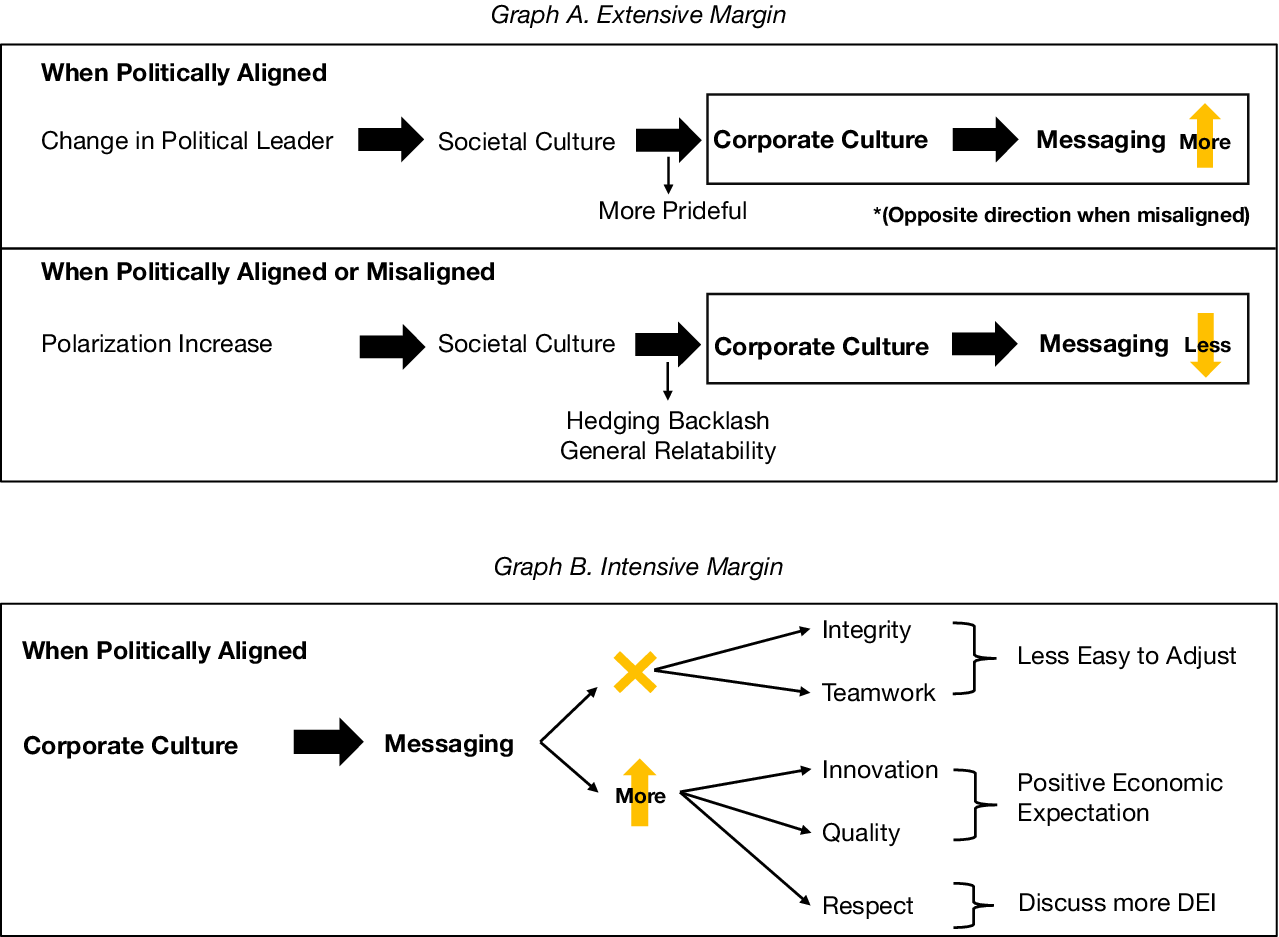
We examine whether corporate culture messaging changes with political shifts and summarize our hypotheses and expectations along the extensive and intensive margins in Figure 1. At the intensive margin, we aim to understand which corporate culture values—integrity, teamwork, innovation, quality, and respect—are elevated and downplayed along political lines. Political shifts from presidential elections affect firms’ political alignment. For example, firms located in counties that vote Republican, likely-Republican firms, align with a Republican president but are misaligned with a Democrat president. Existing literature finds that political alignment influences perceptions of economic well-being and sensitivity to political backlash. However, these factors are unlikely to influence integrity (related to accountability, honesty, and transparency) or teamwork (related to collaboration) as these fundamental values should persist, regardless of economic or political perceptions (e.g., Hilary and Hui (Reference Hilary and Hui2009)). In contrast, we hypothesize that shifts in alignment and “political hedging” influence how executives message about innovation, quality, and respect. These values, as the media notes, encompass “buzzwords ripe for attack, like ‘innovation,’ ‘sustainability,’ [and] ‘DEI,’ [and are] business principles-turned-corporate fads” (see Borchers (Reference Borchers2024)).
Figure 1 shows the theoretical mapping of the influence of political changes on corporate culture messaging. Graph A presents the extensive margin, with our main area of focus highlighted by a box. Graph B presents the intensive margin, building from the elements shown within the boxed area in Graph A.

The corporate value of innovation is associated with being adaptable, taking advantage of opportunities, and seizing growth initiatives. Executives’ focus on opportunities and growth—particularly innovation—should be more pronounced when they are politically aligned with the president, given their more optimistic perception of economic growth (e.g., Knill et al. (Reference Knill, Liu and McConnell2022), Arikan et al. (Reference Arikan, Kara, Masli and Xi2023)) and even increased investment (e.g., Rice (Reference Rice2024)). Therefore, we conjecture that politically aligned executives are more likely to highlight innovation, while misaligned executives downplay it. Similarly, political misalignment and a weaker economic outlook may lead to cost-cutting measures that compromise quality, prompting executives to minimize discussions about quality to avoid drawing attention to the issue.
Politically misaligned executives, beyond having a more negative perception of economic growth, may also fear political backlash. To mitigate this risk, they may participate in “political hedging” by donating to political entities, reducing hiring and tangible investment, and carefully avoiding discussions of topics related to abortion, guns, DEI, the environment, and the climate (see Hassan et al. (Reference Hassan, Hollander, van Lent and Tahoun2019), Bhagwat et al. (Reference Bhagwat, Warren, Beck and Watson2020), and Mkrtchyan et al. (Reference Mkrtchyan, Sandvick and Zhu2024)). As respect—encompassing diversity, community, and environmental concerns—is the corporate culture value most linked to DEI and sustainability, we hypothesize that executives seeking to avoid backlash will downplay discussions of respect. Overall, we hypothesize the following:
Hypothesis 1. Political shifts influence corporate culture messaging, such that politically misaligned executives message less about corporate culture dimensions of innovation, quality, and respect.
Hypothesis 1 on differences in corporate culture messaging between politically aligned and misaligned firms assumes that executives actively discuss corporate culture. Without this communication, observing meaningful differences in how messaging changes would be difficult. As there is no relationship without communication, a significant reduction in cultural messaging could make firms appear more similar. Therefore, we take a “big picture” perspective, at the extensive margin, to understand whether executives change their overall corporate culture messaging along the political dimension and when they significantly reduce their messaging.
According to Grennan and Li (Reference Grennan, Li, Hilary and McLean2023), corporate culture can evolve in response to shocks in internal and external systems, people, and events. Similarly, Gorton and Zentefis (Reference Gorton and Zentefis2022) find that corporate culture progress does not happen automatically but through external pressure. Political events, in particular, influence societal culture. For example, Acemoglu and Jackson (Reference Acemoglu and Jackson2015) show that political leaders and presidents can shape societal norms and values through policies or rhetoric. This societal culture can spill over to corporate culture as corporate executives politically aligned with the president feel pride associated with the “winning” political party and societal culture (e.g., Hodson (Reference Hodson1998)). Pride can amplify the alignment between societal and corporate culture, leading aligned executives to discuss corporate culture and emphasize its strengths more than misaligned executives. This supports Hypothesis 1, which is that aligned executives are more likely to highlight specific corporate culture dimensions. Lieberman and Asaba (Reference Lieberman and Asaba2006) discuss how, in periods of heightened tension and division, executives may be less inclined to express pride openly, consistent with the literature on conformity and herd mentality.
Executives tend to avoid or downplay discussions of partisan topics during periods of heightened political polarization, which reflect greater societal divisiveness (e.g., Bhagwat et al. (Reference Bhagwat, Warren, Beck and Watson2020), Mkrtchyan et al. (Reference Mkrtchyan, Sandvick and Zhu2024)). While the five corporate culture dimensions are inherently non-partisan, we conjecture that executives adjust their messaging on these values depending on political alignment. As a result, even non-partisan messaging may carry implicit political signals, increasing the risk of political backlash, especially during highly polarized periods. Just as executives refocus discussions on products and minimize partisan topics when polarization rises, they may also reduce corporate culture messaging altogether. Therefore, we hypothesize:
Hypothesis 2. Political shifts influence corporate culture messaging such that executives reduce such messaging when political polarization increases.
Changes in corporate culture messaging following political shifts in Hypotheses 1 and 2 may reflect actual changes in corporate culture or be a form of strategic communication. Li et al. (Reference Li, Mai, Shen and Yan2021) show that corporate culture messaging aligns with actual corporate outcomes; e.g., executives that message more about innovation tend to produce more patents and citations. However, for political shifts to drive actual changes in corporate culture, we should observe a direct link between messaging and outcomes. For example, increases in innovation messaging aligning with greater patent activity would suggest a substantive cultural shift. Conversely, if messaging changes occur without corresponding shifts in outcomes, corporate culture messaging in response to political shifts likely serves as a form of strategic communication rather than an actual cultural transformation. Thus:
Hypothesis 3. Changes in corporate culture messaging in response to political shifts reflect strategic communication.
IV. Empirical Design
A. Data
We collect county-level presidential election voting data from the MIT election lab (https://electionlab.mit.edu/), which is available from 2000 to 2020. We identify the county as Democratic or Republican using county voting choices in presidential elections. We collect the PCI from the Federal Reserve Bank of Philadelphia. Firm headquarters data come from the University of Notre Dame, where headquarters location is gathered from the 10-K and 10-Q header sections via textual analysis (https://sraf.nd.edu/sec-edgar-data/10-x-header-data/). Also, to control for economic condition, macroeconomic variables are collected from the Federal Reserve Bank of St. Louis (https://fred.stlouisfed.org/). We collect the county population from the Census to control for the size of the county (https://www.census.gov/data/datasets.html). We collect data on the Sinclair network acquisitions from SDC Platinum and include additional acquisitions from Dasgupta et al. (Reference Dasgupta, Guo, Ren and Shu2021).
Firm-level cultural variables of integrity, teamwork, innovation, quality, and respect are from Li et al. (Reference Li, Mai, Shen and Yan2021), who use seed words from Guiso et al. (Reference Guiso, Sapienza and Zingales2015) and natural language processing to form cultural dictionaries and apply them to earnings calls; stable scores are available from 2002 to 2021.Footnote 12 All culture variables are scores from word counts of tokens normalized by the document length. Sentiment measures from earnings calls come from Hassan et al. (Reference Hassan, Hollander, van Lent and Tahoun2019).Footnote 13 We follow the same firm selection as Li et al. (Reference Li, Mai, Shen and Yan2021), excluding financial firms, banks, and utilities with SIC codes 6000–6999 and 4900–4949. Furthermore, in separate analysis, we identify culture from the firms’ shareholder meeting transcripts using the dictionary from Li et al. (Reference Li, Mai, Shen and Yan2021). Firm accounting information comes from Compustat. The full sample, which is from 2002 to 2021, consists of 36,415 firm-level observations.
B. Empirical Specification
We examine whether and how executives change their corporate culture messaging in response to nationwide political changes in the United States. In addition, we ask whether likely-Republican firms adjust their corporate culture emphases differently from likely-Democrat firms. Our main specification uses two-way fixed effects at the firm and year level:
 $$ \mathrm{CULTURE}\_{\mathrm{SCORE}}_{i,t}={\displaystyle \begin{array}{l}\mathrm{POLITICAL}\_{\mathrm{FACTOR}}_t\times \mathrm{LIKELY}-\mathrm{DEM}{.}_{i,t}\\ {}+\hskip2px \mathrm{POLITICAL}\_{\mathrm{FACTOR}}_t\\ {}\times {\mathrm{BATTLEGROUND}}_{i,t}+{\mathrm{CONTROLS}}_{i,t}\\ {}+\hskip2px {\mathrm{FIRM}}_i+{\mathrm{YEAR}}_t+{\delta}_{i,t},\end{array}} $$
where CULTURE_SCORE i,t are scores of firm’s i corporate culture emphasis on integrity, teamwork, innovation, respect, quality, sentiment, and the sum of culture measures in year t. Two factors represent POLITICAL_FACTOR t. First, we use presidential changes and create indicator variables equal to 1 for each year of individual presidencies (e.g., BUSH t, OBAMA t, and TRUMP t). Second, for political polarization, we use POST_2010, an indicator that equals 1 after 2010, when polarization experiences a large increase in PCI level, or PCI t, the actual index. Next, LIKELY_DEM.i,t (LIKELY_REP.i,t) is an indicator variable that equals 1 for firms located in counties that vote for Democratic (Republican) candidates in presidential elections.Footnote 14 In addition, BATTLEGROUND i,t is an indicator that equals 1 for years when firms are located in battleground states (listed in Supplementary Material Table IA.1). Firm-level controls (CONTROLS i,t) for firm i in year t, include profitability, measured by return on assets (ROA) and profit margin; liquidity; leverage; size; and sales growth. We also control for the number of words in earnings call transcript and for local factors through local population.Footnote 15
The interaction term POLITICAL_FACTOR t × LIKELY_DEM., with POST_2010 t as the POLITICAL_FACTOR t, enables us to compare the average emphasis on CULTURE_SCORE i,t between likely-Democrat and likely-Republican firms before and after 2010. Similarly, the interaction term POLITICAL_FACTOR t × LIKELY_DEM.i,t, using BUSH t and TRUMP t as a POLITICAL_FACTOR t, allows us to examine differences in the average emphasis put on CULTURE_SCORE i,t by likely-Democrat versus likely-Republican firms during the Bush and Trump presidencies as compared with Democratic presidencies. FIRM i and YEAR t are firm and year fixed effects. Standard errors are generally clustered at the firm level. Variable definitions are in the Appendix.
We also examine changes in corporate culture messaging across time and estimate the following firm fixed effects specification:
 $$ \mathrm{CULTURE}\_{\mathrm{SCORE}}_{i,t}={\displaystyle \begin{array}{l}\mathrm{POLITICAL}\_{\mathrm{FACTOR}}_t\times \mathrm{LIKELY}-\mathrm{DEM}{.}_{i,t}\\ {}+\hskip2px \mathrm{POLITICAL}\_{\mathrm{FACTOR}}_t\times \mathrm{LIKELY}-\mathrm{REP}{.}_{i,t}\\ {}+\hskip2px \mathrm{POLITICAL}\_{\mathrm{FACTOR}}_t\\ {}\times {\mathrm{BATTLEGROUND}}_{i,t}+\mathrm{ELEC}.\_{\mathrm{YEAR}}_t\\ {}+\hskip2px {\mathrm{CONTROLS}}_{i,t}+{\mathrm{FIRM}}_i+{\mu}_{i,t}.\end{array}} $$
This firm fixed effects specification allows us to examine how different firms, specifically LIKELY_DEM.i,t, LIKELY-REP.i,t, and BATTLEGROUND i,t, update corporate culture emphases over time, given political shifts. For example, using POST_2010 as the POLITICAL_FACTOR i,t allows us to examine changes in corporate culture emphasis before and after 2010 for LIKELY_DEM.i,t firms, as well as LIKELY_REP.i,t and BATTLEGROUND i,t firms. Standard errors are clustered at the firm and year levels. The indicator ELEC._YEAR t equals 1 for election years. In this specification, we also include additional time-varying annual macroeconomic controls for the consumer price index (CPI) and gross domestic product (GDP).
C. Descriptive Statistics
Table 1 provides a summary of statistics. Panel A shows the mean, median, 25th and 75th percentiles, standard deviation, and the number of observations for cultural and economic firm-level variables. Among the cultural messages, innovation is the most discussed category of corporate culture, with its mean almost twice that of other categories. Panel B provides annual observations for firms that are likely-Democrat and likely-Republican and those headquartered in battleground states. Similar to Meeuwis et al. (Reference Meeuwis, Parker, Schoar and Simester2022), our data are tilted toward Democratic locations. Yet the number of firms in battleground states remains steady throughout our sample. Panel C presents corporate culture scores by industry. Corporate culture is heterogeneous across industries: SIC 7 has the highest overall culture score at 19.57, and SIC 1 has the lowest at 11.12. In addition, innovation is the highest for service industries (SICs 7 and 8), at 6.64. Grennan and Li (Reference Grennan, Li, Hilary and McLean2023) provide time-series charts of corporate culture characteristics by industry.

V. Results
This section explores whether executives adjust their corporate culture messaging in response to different political environments. First, we assess whether firms with different political alignments emphasize distinct cultural aspects under Republican versus Democratic presidents. Second, we investigate whether corporate culture messaging shifts with varying levels of polarization, validating these results using exogenous geographic shocks. We also differentiate between strategic communication and actual reforms by analyzing corresponding outcomes. Finally, we examine cross-sectional differences between likely-Democrat and likely-Republican firms.
A. Corporate Culture and Different Presidencies
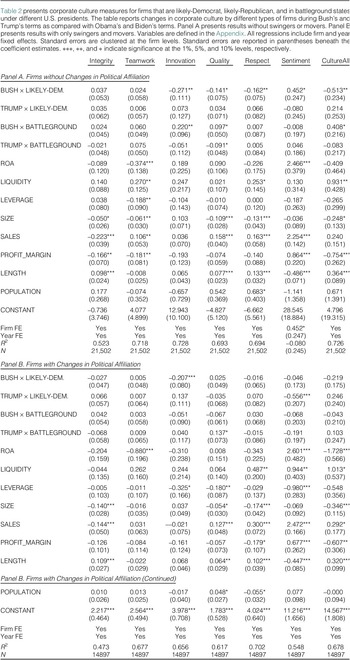
We begin our examination of whether and how executives alter their corporate culture messaging in response to political shifts by considering presidential elections. Specifically, we assess whether likely-Republican firms alter their messaging differently from likely-Democrat firms across the Bush, Obama, Trump, and Biden presidencies, with particular interest in the unexpected 2016 election. Table 2 compares within-firm changes in corporate culture messaging using equation (1), in a difference-in-differences setting with firm and year fixed effects.

Our sample includes firms with stable political orientations and those experiencing shifts due to headquarters relocations or county vote swings. To isolate the impact of political shocks on corporate culture messaging from firm-level changes, we use firm fixed effects and separate sample analyses. Table 2, Panel A focuses on firms headquartered in politically stable areas, and Panel B examines firms undergoing political orientation shifts. This approach aligns with that of Arikan et al. (Reference Arikan, Kara, Masli and Xi2023), who analyze accounting disclosures and CEO optimism on the basis of political alignment with the U.S. president, validating their findings using firms with stable CEO political preferences.
Table 2, Panel A results show an important shift in how executives message their corporate culture. In the earlier years, during Bush’s term, likely-Democrat firms talked less about innovation, quality, respect, and overall corporate culture but used a more positive tone. In contrast, likely-Republican firms talked more about innovation, quality, respect, and overall culture, consistent with political alignment with the Bush presidency. These results support Hypothesis 1.
Under Trump, the previously observed differences in corporate culture messaging between likely-Democrat and likely-Republican firms are no longer statistically significant. Specifically, when comparing the terms of Democrats Obama and Biden to Republican Trump, we do not find meaningful differences in corporate culture messaging. This contrasts sharply with the trends observed during the Bush presidency. During Trump’s term, corporate culture messaging among likely-Democrat and likely-Republican firms appears more similar than different.Footnote 16 We verify that the results are not specific to multinational firms in Supplementary Material Table IA.2, Panel A.Footnote 17 Finally, firms in battleground states talked more about innovation and quality during Bush’s presidency than Democrat presidencies but messaged less about quality and all other corporate culture dimensions during the presidencies of Obama, Trump, and Biden.
In Table 2, Panel B, we confirm the similarity in corporate culture messaging during Trump’s term, examining a subsample of firms that move or are in counties that swing their political support. These results need to be interpreted with caution, however, as determining the accurate political preferences of this subsample is difficult. Overall, we document a significant shift in corporate culture messaging between our sample’s earlier and later periods. While during Bush’s term, politically aligned likely-Republican firms talked more about corporate culture and emphasized different corporate culture attributes than likely-Democrat firms, during Trump’s term, likely-Democrat and likely-Republican firms became similar in how they updated their corporate culture emphases as compared with Obama’s and Biden’s terms.
B. Corporate Culture and Political Polarization
Next, we continue to focus on how executives alter their corporate culture messaging in response to political shocks, considering changes in partisan polarization as a source of political variation. Our proxy for this national political shock is a significant rise in partisan polarization after 2010, as indicated by the PCI. Table 3 presents these results. Panel A compares the shifts from before and after 2010 for likely-Democrat, likely-Republican, and battleground firms using equation (2), with firm fixed effects. We employ firm fixed effects regressions to gain deeper insights into the gradual changes in corporate culture emphases over time, where we control for the recession years and overall economic conditions. Panels B and C of Table 3 use equation (1) in a difference-in-differences framework with firm and year fixed effects to compare within-firm changes in corporate culture messaging before and after increased polarization, addressing potential endogeneity concerns. Similar to Table 2, Table 3 analyzes firms by political stability. Panel B focuses on firms headquartered in areas with stable voting patterns, and Panel C examines firms experiencing shifts in political orientation.

Table 3, Panel A results show that all firms, regardless of their political preference, chose to talk less about all corporate culture aspects but increased their sentiment after 2010. In other words, both likely-Democrat and likely-Republican firms updated their corporate culture messaging similarly after 2010 by becoming more neutral and talking less about corporate culture. However, the reductions in teamwork for all firms and innovation for likely-Democrat firms were not statistically significant. Battleground firms also exhibited a notable decline in innovation emphasis. These results support Hypothesis 2.
We next assess whether the decline in corporate culture messaging after 2010, amid rising political polarization, differed between likely-Democrat and likely-Republican firms using a difference-in-differences approach. Table 3, Panel B presents the results. While both groups reduced their cultural messaging, likely-Democrat firms maintained a greater emphasis on innovation, quality, respect, and overall culture than likely-Republican firms. These findings align with those in Table 2, reinforcing the notion that increased polarization contributed to greater similarity in corporate culture emphasis across firms during the Obama and Trump presidencies. Notably, apart from a decline in innovation emphasis, firms in battleground states did not significantly adjust their cultural messaging, highlighting the roles of firm political alignment and exposure in shaping these changes.
Table 3, Panel C presents the results using equation (1) for firms that experience a shift in political alignment due to swing-area headquarters or relocation. Consistent with previous findings, likely-Democrat firms continue to emphasize integrity, innovation, and overall culture more than likely-Republican firms after 2010. These patterns, also seen in Panel B and Supplementary Material Table IA.3, suggest that firms in politically balanced “purple” states maintain consistent cultural messaging despite rising polarization. This highlights the role of more balanced political associations for corporate culture messaging.
We verify that the parallel trends assumption holds. Following Faccio and McConnell (Reference Faccio and McConnell2023), we observe that likely-Democrat and likely-Republican firms did not exhibit statistically significant cultural messaging differences before the increase in polarization.Footnote 18 Supplementary Material Figure IA.2 presents plots of coefficients of the interaction between likely-Democrat firms and specific years from 2005 to 2021. Consistent with Table 3, Panel B, we find that after 2010, likely-Democrat firms show an upward trend in innovation, quality, respect, and overall culture compared with likely-Republican firms, indicating increased messaging. However, no significant pre-2010 trends suggest prior cultural differences. We observe similar non-discernible trends before and after 2010 for integrity, teamwork, and sentiment. Overall, firms reduce cultural messaging after 2010 amid rising political polarization, with likely-Republican firms exhibiting a sharper decline in innovation, quality, respect, and overall culture than likely-Democrat firms.
C. Geographic Shocks to Political Polarization
Next, we aim to confirm that executives reduce corporate culture messaging when political polarization increases. In addition to the within-firm and across-time variation results in Table 3, we examine firms exposed to exogenous geographic shifts in polarization. We hypothesize that firms in areas with increasing polarization will message less about their corporate culture. Thus, we compare firms in regions with rapidly rising polarization with those in politically stable areas to assess differences in corporate culture messaging.
First, we examine areas with significant changes in media partisanship, given its influence on political orientation (e.g., DellaVigna and Kaplan (Reference DellaVigna and Kaplan2007)). Martin and McCrain (Reference Martin and McCrain2019) and Dasgupta et al. (Reference Dasgupta, Guo, Ren and Shu2021) show that the entry of Fox Corporation and Sinclair Broadcasting Group—both favoring Republican rhetoric—led to increased Republican votes in affected areas. Accordingly, Republican-leaning areas that saw the entry of these media platforms became more polarized toward the Republican party. We hypothesize that firms in increasingly polarized areas, particularly likely-Republican firms classified by voting patterns as defined by Meeuwis et al. (Reference Meeuwis, Parker, Schoar and Simester2022), reduce cultural messaging following the entry of partisan media. To test this, we use Sinclair’s acquisitions as a geographic shock to polarization.Footnote 19
Second, we examine areas with sharp increases in Republican vote shares in the 2016 election. We follow the methodology from Dahl et al. (Reference Dahl, Runjing and Mullins2022) and Autor et al. (Reference Autor, Dorn, Hanson and Majlesi2020) that underscores voting and polarization shifts in areas where local labor markets are negatively influenced by the “China shock” due to trade-related competition with China. We identify counties that already leaned Republican and saw a sharp increase in Republican vote share in the 2016 election as those experiencing heightened polarization toward the Republican party. Given this trend, we expect firms in these areas—classified as likely-Republican—to reduce their corporate culture messaging.
Table 4 presents the results of how corporate culture messaging responds to two geographic shocks that intensified political polarization. Panel A focuses on Sinclair’s entry, and Panel B examines extreme increases in Republican vote shares in the 2016 election. All models include firm and year fixed effects, with standard errors clustered at the firm level. Consistent with Table 3, Panel A, shows that firms reduce cultural messaging as polarization increases. As Sinclair’s expansion into already-Republican-leaning areas further polarized these regions, executives of firms in these areas reduced all aspects of cultural messaging, with significant declines in innovation and overall culture. The variable SINCLAIR_ACQ indicates Sinclair’s entry into an area, and its interaction with LIKELY-REP. reveals that likely-Republican firms reduced cultural messaging following Sinclair’s introduction.

Table 4, Panel B further supports reductions in cultural messaging when polarization increases: in counties with the largest Republican vote share increase between 2008 and 2016 elections (REPUB_POLAR), executives of these likely-Republican firms reduced messaging on integrity and respect. Focusing on the Obama and Trump (first term) presidencies, we find that executives of firms in highly polarized areas consistently reduced messaging on most corporate culture aspects while using more positive sentiment, echoing Table 3 results.Footnote 20 Overall, leveraging geographic shocks—partisan media entry and extreme vote share shifts—we continue to find reductions in corporate culture messaging as polarization rises, supporting Hypothesis 2.
D. Outcomes: Do Firms “Walk the Talk” or Simply “Talk”?
So far, we have examined how corporate culture messaging responds to political shifts: there is a statistically significant negative relation between polarization and cultural messaging and between political misalignment, especially during the period of lower polarization, and cultural messaging on innovation, quality, and respect. Next, we aim to understand whether these politically motivated changes in cultural messaging reflect real cultural change or are merely strategic communication. If messaging is strategic, increase in, for example, innovation messaging would not align with actual innovation outcomes. Conversely, genuine cultural change would manifest in both messaging and outcomes.
To distinguish between these possibilities, we move beyond analyzing how messaging responds to politics and instead examine whether firm outcomes tied to cultural values also vary with political factors. Li et al. (Reference Li, Mai, Shen and Yan2021) find that, in the cross-section, cultural messaging aligns with actual corporate outcomes and propose the following proxies: integrity (restatements), teamwork (joint ventures and alliances), innovation (citations), quality (best employer listings), and respect (top brand listings). We collect data from various sources: Audit Analytics for restatements (integrity), SDC Platinum M&A module for joint venture and alliance data (teamwork), Noah Stoffman’s website (innovation), and Brand Finance’s brandirectory (http://brandirectory.com) for top brands (quality).Footnote 21 The “Great Place To Work” Institute ranks “100 best companies to work for in America,” which Li et al. (Reference Li, Mai, Shen and Yan2021) use to proxy for respect. Footnote 22 Table 5, Panel A results confirm Li et al.’s (Reference Li, Mai, Shen and Yan2021) results in our data set: corporate culture messaging reflects actual corporate outcomes contemporaneously in the cross-section.

Table 5, Panel B presents results using the same specifications as Tables 2 and 3 but replaces the culture variables with the corresponding firm outcomes. To differentiate whether cultural messaging reflects actual change or strategic communication we examine whether corresponding firm outcomes shift similarly along the same political dimension as messaging. Columns 1–3 examine variation along political alignment (as in Table 2), and columns 4–6 focus on political polarization (as in Table 3). Because our tests along the political dimension span across time, we limit the analysis to outcomes with time-series variation: restatements (integrity), joint ventures (teamwork), and patent-related information (innovation).
If corporate culture messaging truly reflects underlying cultural changes, then, under the same political shock, the corresponding firm outcomes should exhibit shifts similar to those observed in cultural messaging. Specifically, when examining political alignment (columns 1–3), Table 2, Panel A suggests that during Bush’s term, politically misaligned, likely-Democrat, firms would display lower innovation outcomes, with integrity and teamwork outcomes remaining similar to those of aligned, likely-Republican firms. During Trump’s first term, likely-Democrat and likely-Republican firms exhibited similar cultural messaging, so we would expect minimal differences in corporate outcomes across political alignment. However, Table 5, Panel B reveals inconsistencies with these expectations. During Bush’s term, likely-Democrat firms have more restatements, joint ventures, and patent citations compared to likely-Republican firms, contrary to the expectation of lower innovation and similar integrity and teamwork outcomes. Additionally, during Trump’s first term, although restatements and citations yield nonsignificant results similar to cultural messaging, teamwork outcomes diverge: likely-Democrat firms increase joint ventures, despite similar teamwork messaging across political alignments.Footnote 23 In the polarization analysis (columns 4–6), we again find limited alignment between cultural messaging and corresponding outcomes. Table 3, Panel B implies that, under high polarization, likely-Democrat firms should exhibit higher innovation outcomes and similar integrity and teamwork outcomes compared to likely-Republican firms. However, the observed differences in Table 5, Panel B are statistically insignificant for all corresponding outcomes.
Overall, these findings suggest that cultural messaging in politically sensitive contexts is more strategic than substantive, supporting Hypothesis 3 and aligning with prior literature on strategic communication of values (e.g., Mian et al. (Reference Mian, Sufi and Khoshkhou2023), Duchin et al. (Reference Duchin, Gao and Xu2025)). While our analysis is limited in scope, the evidence points toward cultural messaging along the political dimension is better interpreted as a form of strategic signaling rather than evidence of genuine cultural transformation. Future research should explore why executives selectively engage in strategic cultural communication along the political dimension (e.g., Grennan (Reference Grennan2022b), Bloch and Kranton (Reference Bloch and Kranton2024)) and how this behavior varies for specific cultural values.
E. Cross-Sectional Differences in Corporate Culture
Our main analysis investigates how corporate culture messaging evolves over time in response to political shifts. We also confirm that in the cross-section, cultural messaging aligns with corporate outcomes (e.g., Li et al. (Reference Li, Mai, Shen and Yan2021)), yet find support for strategic communication along the political dimensions. Building on this, we examine whether cross-sectional differences in cultural messaging exist between likely-Democrat and likely-Republican firms, and whether political alignment influences these patterns. Therefore, we estimate:
 $$ {\displaystyle \begin{array}{l}\mathrm{CULTURE}\_\mathrm{SCOR}{\mathrm{E}}_{i,j,k,t}=\mathrm{REP}\_\mathrm{PRES}\_\times \_\mathrm{LIKELY}-\mathrm{DEM}.\\ {}\hskip17.7em +\hskip2px \mathrm{DEM}\_\mathrm{PRES}\_\times \_\mathrm{LIKELY}\_\mathrm{DEM}.\\ {}\hskip17.7em +\hskip2px \mathrm{REP}\_\mathrm{PRES}\_\times \_\mathrm{BATTLEGROUND}\\ {}\hskip17.7em +\mathrm{DEM}\_\mathrm{PRES}\_\times \_\mathrm{BATTLEGROUND}\\ {}\hskip17.7em +\mathrm{ELEC}\_\mathrm{YEA}{\mathrm{R}}_t\_\times \_\mathrm{LIKELY}\_\mathrm{DEM}.\\ {}\hskip17.7em +\hskip2px \mathrm{ELEC}\_\mathrm{YEA}{\mathrm{R}}_{\mathrm{T}}\_\times \_\mathrm{BATTLEGROUND}\\ {}\hskip17.7em +\mathrm{CONTROL}{\mathrm{S}}_{i,t}+\hskip2px {\mathrm{INDUSTRY}}_j+{\mathrm{S}\mathrm{TATE}}_k\\ {}\hskip17.7em +{\mathrm{YEAR}}_t+{\varepsilon}_{i,j,k,t},\end{array}} $$
where the interaction term REP_PRES_×_LIKELY-DEM. (DEM_PRES_×_LIKELY-DEM.) allows us to examine the differences in corporate culture emphases by likely-Democrat firms compared with likely-Republican firms in the same industry and state given political (mis)alignment based on county voting patterns at firms’ headquarter locations. The interaction terms with Battleground allow us to examine corporate culture emphases by firms in battleground states versus other firms. Finally, INDUSTRY j, STATE k, and YEAR t are industry (using Fama–French 30), state, and year fixed effects, respectively. Standard errors are clustered at the firm level.
Table 6, Panel A provides cross-sectional comparisons of cultural messaging along firms’ political alignment (for baseline comparisons sans alignment, see Supplementary Material Table IA.5). At likely-Democrat firms, cultural messaging during Democrat presidencies emphasizes innovation and conveys more positive sentiment. However, at likely-Republican firms, cultural messaging during Republican presidencies, is more about quality and respect. These emphases could be related to litigations considerations consistent with prior research.Footnote 24 In contrast, we observe no significant difference in corporate culture messaging by executives of firms in battleground states and other firms. We extend this analysis to specific election years in Supplementary Material Table IA.5 and find similar messaging across firms in the period of heightened polarization during the 2016 election. Overall, our findings underscore the role of political alignment in shaping executives’ corporate culture messaging.

F. Robustness
In this section, we verify the robustness of our results. First, in Table 7, Panel A, we verify that our results in Table 3, Panel A, examining cultural messaging before and after a significant polarization increase in 2010, are robust to measuring political polarization directly with the PCI. Supplementary Material Table IA.6 presents additional robustness checks; our results become even more significant with robust standard errors (Panel A). The results remain robust in a subsample of firms that span most presidencies, ensuring that corporate culture messaging reflects consistent trends rather than sample-specific anomalies (Panel B). The results are also robust to encompassing firms for which political preferences are difficult to identify in Panel C, to excluding dynamic periods, such as the 2008 financial crisis and the 2020 COVID-19 pandemic, in Panel D, and, in untabulated analysis, to alternative firm classification based on executives’ political donations Hutton, Jiang, and Kumar (Reference Hutton, Jiang and Kumar2014). These combined analyses strongly support the robustness of our main findings.

In Supplementary Material Table IA.2, we examine whether geographic dispersion affects executives’ cultural messaging by comparing firms with concentrated versus dispersed operations. While geographically concentrated firms might be more reliant on local resources and, therefore, more sensitive to local political dynamics, our results are similar for concentrated and dispersed firms. This suggests that the headquarters’ location—the central hub for decision-making and communication—is important for executives’ cultural messaging regardless of geographic dispersion.
Finally, in Table 7, Panel B, we extend our analysis of political shifts on corporate cultural messaging beyond earnings conference calls by applying the culture dictionary of Li et al. (Reference Li, Mai, Shen and Yan2021) to shareholder meetings.Footnote 25 While both mediums share structural similarities, such as agenda and Q&A sessions, shareholder meetings allow for broader questions beyond financial metrics. Executives can tailor their communication to different mediums: Grennan (Reference Grennan2022b) documents inconsistencies in banks’ corporate culture messaging to employees, investors, and the community. Such inconsistencies across audiences highlight strategic communication. Consistent with Grennan (Reference Grennan2022b), we find executives emphasize different cultural dimensions during shareholder meetings and earnings calls, further supporting strategic communication. Despite these differences, cultural messaging in shareholder meetings also changes with political shifts. During Republican presidencies, likely-Republican and likely-Democrat firms increase messaging on integrity, respect, and general cultural values. However, likely-Democrat firms focus more on innovation, while likely-Republican firms emphasize teamwork. These findings highlight the role of political alignment in shaping corporate cultural messaging.
VI. Conclusion
The political environment has a profound impact on societal dynamics and corporate decision making, with executives’ political preferences shaping tangible corporate outcomes (see Knill et al. (Reference Knill, Liu and McConnell2022), Rice (Reference Rice2024)). We examine whether and how executives update intangible aspects, corporate culture messaging in earnings calls, in response to significant shifts in the political environment and given firms’ political leaning. Using five key corporate culture aspects—integrity, teamwork, innovation, quality, and respect—we find that executives adjust cultural messaging on both extensive and intensive margins in response to changes in political alignment around presidential elections and changes in political polarization. On the extensive margin, executives of politically aligned firms emphasize their corporate culture through a “pride” mechanism. However, during periods of heightened polarization, concerns over relatability and hedging against possible backlash, lead all executives to broadly reduce cultural messaging. On the intensive margin, politically misaligned executives curtail messaging on innovation, quality, and respect due to lower perceived growth opportunities.
During the polarized post-2010 period, spanning the Obama and Trump (first term) presidencies, cultural messaging became more similar across firms, contrasting with the earlier, less polarized Bush presidency, when executives of likely-Republican firms—then politically aligned—messaged more about corporate culture aspects of innovation, quality, and respect than those of likely-Democrat firms. Following the 2010 increase in political polarization, all firms, regardless of political leaning, reduced corporate culture messaging. We verify this decline using exogenous geographic shocks, including the introduction of partisan media and extreme voting shifts associated with the “China shock.”Footnote 26 These results suggest that executives’ political perceptions influence not only tangible firm outcomes, such as investment policy, but also intangible aspects of corporate culture. However, the lack of alignment between changes in cultural messaging and corresponding corporate outcomes indicates that shift in corporate culture messaging along the political dimension are more reflective of strategic communication than of genuine cultural changes.
Appendix. Variable Definitions
Corporate culture (Source: Li et al. (Reference Li, Mai, Shen and Yan2021) for dictionaries and scores and Hassan et al. (Reference Hassan, Hollander, van Lent and Tahoun2019) for sentiment)
- INTEGRITY
-
Culture score for integrity in earnings calls.
- TEAMWORK
-
Culture score for teamwork in earnings calls.
- INNOVATION
-
Culture score for innovation in earnings calls.
- QUALITY
-
Culture score for quality in earnings calls.
- RESPECT
-
Culture score for respect in earnings calls.
- SENTIMENT
-
Overall firm-level sentiment (positive/negative) in earnings calls
- CULTUREALL
-
A sum of 5 culture scores for integrity, teamwork, innovation, quality, and respect.
Political variables (Source: MIT Election Lab and Compustat)
- LIKELY-DEM.
-
An indicator that equals 1 for counties with Democrat presidential victories.
- LIKELY-REP.
-
An indicator that equals 1 for counties with Republican presidential victories.
- BATTLEGROUND
-
An indicator that equals 1 for firms located in battleground states. Following Gerber et al. (Reference Gerber, Huber, Dowling, Doherty and Schwartzberg2009), battleground states are determined by sorting states by Democratic two-party vote share and selecting those where the absolute difference between the cumulative electoral votes and 270 is <= 75.
- REP._PRES.
-
An indicator that equals 1 for the year during a Republican presidency.
- DEM._PRES.
-
An indicator that equals 1 for the year during a Democrat presidency.
- BUSH
-
An indicator that equals 1 for the year during Bush’s presidency.
- OBAMA
-
An indicator that equals 1 for the year during Obama’s presidency.
- TRUMP
-
An indicator that equals 1 for the year during Trump’s presidency.
- POST_2010
-
An indicator that equals 1 for the years after and including 2010.
- PCI
-
Political conflict index from Azzimonti (Reference Azzimonti2018), provided by the Federal Reserve Bank of Philadelphia, measures political disagreement among U.S. federal politicians.
- ELEC._YEAR
-
An indicator that equals 1 for elections years 2004, 2012, and 2016 (we exclude 2008, 2009, and 2020 from our analysis).
Culture outcomes (Source: Audit Analytics, SDC, Edmans (Reference Edmans2011), Kogan et al. (Reference Kogan, Papanikolaou, Seru and Stoffman2017), and BrandDirectory)
- RESTATEMENTS
-
An indicator that equals 1 for the firm that had a restatement.
- JOINT_VENTURE_STRATEGIC_ALLIANCE
-
The number of joint ventures or strategic alliances the firm had for the year.
- PATENT_NUM.
-
The number of patents the firm had for the year.
- CITATIONS
-
The average number of citations the firm had for the year.
- TOP_BRAND
-
An indicator that equals 1 if the firm was included in the top brand ranks.
- BEST_EMPLOYER
-
An indicator that equals 1 if the firm was included in the best employer ranks.
Firm, economic, and location characteristics (Compustat, Federal Bank of St. Louis, and Census)
- ROA, %
-
Firm’s ROA, calculated as (NI/AT).
- LIQUIDITY, %
-
Firm’s liquidity, calculated as (CHE/AT).
- LEVERAGE, %
-
Firm’s book leverage, calculated as (DLC + DLTT)/AT.
- SIZE
-
Firm’s asset size, measures by the natural logarithm of total assets, AT.
- SALES, %
-
Firm’s annual sales growth, calculated as ((SALE t – SALE t–1)/SALE t–1).
- PROFIT_MARGIN, %
-
Firm’s profitability, measured by the profit margin as (IB/REVT).
- LENGTH
-
Natural logarithm of the length of document (e.g., earnings call or shareholder meeting transcript), calculated as ln(length).
- POPULATION
-
Natural logarithm of county population at the firm’s headquarter location.
- GDP
-
GDP of the U.S. for each year.
- CPI
-
CPI of the U.S. for each year.
Supplementary Material
To view supplementary material for this article, please visit http://doi.org/10.1017/S002210902510224X.



 Open access

