


The prevalence of adolescent obesity has increased dramatically over the past three decades( Reference Han, Lawlor and Kimm 1 ) and even though preliminary evidence suggests a slowing in such trends( Reference Olds, Maher and Zumin 2 ), recent data show that approximately one in five adolescents in Western countries is obese( 3 – 5 ). Obesity during adolescence is of particular concern due to the immediate and long-term negative health and psychological effects, including an increased incidence of cardiovascular risk factors, adult obesity, obesity-related co-morbidities, low self-esteem and reduced health-related quality of life( Reference Tsiros, Coates and Howe 6 , Reference Nadeau, Maahs and Daniels 7 ). Central in the development of adolescent obesity is eating behaviour( Reference Affenito, Franko and Striegel-Moore 8 ). Several studies have shown an association between consumption of energy-dense foods and excessive weight in young people( Reference Guyenet SJ & Schwartz 9 , Reference Du and Feskens 10 ). Despite such associations, studies have consistently shown that adolescents as a group have unhealthy and sometimes erratic eating habits( Reference Dwyer, Evans and Stone 11 , Reference Story, Neumark-Sztainer and French 12 ), characterised by snacking on energy-dense foods, including those high in fat, sugar and salt( Reference Linde, Wall and Haines 13 – Reference Currie, Robert and Morgan 15 ).
Television (TV) viewing is the most prevalent leisure-time activity among young people in Western countries( 16 – Reference Rideout, Foehr and Roberts 18 ), with many adolescents far exceeding the recommendations of <2 h of TV viewing daily. Data from the USA suggest that adolescents are engaged in screen media for over 7·5 h/d, with most of this devoted to TV viewing( Reference Rideout, Foehr and Roberts 18 ). Adolescents who spend large amounts of time watching TV are at particular risk of unhealthy eating behaviours( Reference Pearson and Biddle 19 ). For example, TV viewing has been associated with increased meal frequency and food intake( Reference Sonneville and Gortmaker 20 , Reference Chaput, Klingenberg and Astrup 21 ) and more specifically, it is positively associated with energy intake and consumption of energy-dense foods and beverages, and negatively associated with consumption of fruit, vegetables and fibre( Reference Pearson and Biddle 19 , Reference Chaput, Klingenberg and Astrup 21 ). Variations in eating behaviours according to TV viewing are of particular concern as they could parallel other negative health consequences of excessive TV viewing( Reference Salmon, Tremblay and Marshall 22 ) and they may represent a pathway by which TV viewing may lead to poorer health. However, little is known about the potential mechanisms by which TV viewing is associated with unhealthy eating behaviours among adolescents.
A potential explanation for the association between TV viewing and eating behaviours among adolescents stems from the existing literature on the determinants of dietary behaviour. There is evidence that home availability of unhealthy foods (e.g. energy-dense snack foods) is associated with unhealthy eating behaviours, including lower fruit and vegetable consumption( Reference Ding, Sallis and Norman 23 ) and higher consumption of energy-dense snack foods and drinks( Reference Ezendam, Evans and Stigler 24 , Reference Campbell, Crawford and Salmon 25 ). Furthermore, it is plausible that TV viewing could be associated with home availability of particular foods. For example, while watching TV, adolescents are exposed to many advertisements about food( Reference Kelly, Chapman and King 26 , Reference Powell, Szczypka and Chaloupka 27 ); TV is the largest single media source of messages about food( Reference Marquis 28 ) and predominantly these advertised foods are high in sugar and fat( Reference Adams, Tyrrell and Adamson 29 , 30 ). Furthermore, several studies have shown that young people's TV viewing is associated with food preferences, requests to purchase foods and drinks advertised, parental willingness to purchase these products and the availability of these food items in the home( Reference Chamberlain, Wang and Robinson 31 – Reference Boyland, Harrold and Kirkham 36 ). To our knowledge, however, no studies have examined whether home availability of energy-dense snack foods mediates the association between TV viewing and consumption of energy-dense snack foods among adolescents. Understanding the mediators of the associations between TV viewing and consumption of energy-dense snack food in adolescents is important to inform the development of nutrition promotion interventions.
The present study therefore aimed to examine: (i) the associations between adolescent TV viewing and frequency of consumption of energy-dense snack foods; (ii) the association between adolescent TV viewing and perceived home availability of energy-dense snack foods; and (iii) whether associations between adolescent TV viewing and energy-dense snack food consumption are mediated (explained) by perceived home availability of energy-dense snack foods.
Methods
Study procedure
As part of a cohort study investigating dietary habits among adolescents in Melbourne, Australia, adolescents were administered self-completion questionnaires between September 2004 and July 2005. Study procedures were approved by the Ethics Committee of Deakin University, the Victorian Department of Education and Training, and the Catholic Education Office. Survey participant recruitment and study procedures have been provided in previous publications( Reference MacFarlane, Crawford and Ball 37 , Reference Savige, Ball and Worsley 38 ). In brief, all co-educational state (government) and Catholic secondary schools (Years 7–12) with enrolments over 200, located in the southern metropolitan region of Melbourne and the non-metropolitan region of Gippsland, to the east of Melbourne, were invited to participate in the study. Of the seventy schools (forty-seven metropolitan and twenty-three non-metropolitan) that met these criteria, thirty-seven schools (twenty metropolitan and seventeen non-metropolitan) agreed to participate.
Participants
All students (n 9842) from Year 7 (aged 12–13 years) and Year 9 (aged 14–15 years) from participating schools were invited to participate. Teachers distributed parental consent forms via students. Parental consent was obtained for 4502 (46 %) of all eligible students. Due to absence from school on the day of testing, teachers administered an online food habits survey to 3264 adolescents during class time when they had access to computers. The present analyses are based on the subset of 2984 (30 %) adolescents who had non-missing data for all of the variables examined in the present study.
Measures
Adolescent consumption of energy-dense snack foods
Consistent with other large-scale studies of dietary intake and eating behaviours of adolescents( Reference Neumark-Sztainer, Wall and Perry 39 ), food intake was assessed using a brief FFQ. This FFQ was based on previously validated indices of food intake( Reference Marks, Webb and Rutishauser 40 ) and is described in detail in previous publications( Reference MacFarlane, Crawford and Ball 37 , Reference Savige, Ball and Worsley 38 ). Respondents indicated how frequently they had consumed thirty-seven food items during the previous month. The seven response categories ranged from ‘never or not in the last month’ to ‘several times a day’. The present analyses are based on a subset of three items from the FFQ: confectionery (e.g. chocolates and lollies/sweets), sweet biscuits/cookies and potato crisps/salty snacks. The frequency of consumption of the three items in the past month was converted to a daily equivalent, which is an established method( Reference Willett 41 ) that has been used in other dietary studies( Reference Neumark-Sztainer, Wall and Perry 39 , Reference Mishra, Ball and Arbuckle 42 ). A daily equivalent score for the three items was calculated as follows: ‘not in the last month’ = 0·00, ‘several times per month’ = 0·11, ‘once a week’ = 0·14, ‘a few times a week’ = 0·36, ‘on most days’ = 0·71, ‘once per day’ = 1·00 and ‘several times per day’ = 2·50. The daily equivalents of the three items were then summed to create a daily estimate of energy-dense snack food consumption.
Adolescent television viewing
Adolescents reported how much time (hours/minutes) they usually spend watching TV/DVD/movies on a typical school day (Monday to Friday), which was converted to min/d. Adolescents reported how much time (hours/minutes) they usually spend watching TV/DVD/movies on a typical Saturday and Sunday. The latter were converted to min/d, summed and divided by two to create average viewing on a weekend day.
Home availability
Perceived availability of different foods within the home environment was assessed with items adapted from Project EAT (Eating Among Teens)( Reference Neumark-Sztainer, Wall and Perry 39 ). Respondents were asked how frequently (ranging from 1 = ‘never/rarely’ to 4 = ‘always’) the following items were available within the home: cakes or sweet biscuits; potato crisps or salty snacks; chocolate or lollies. The frequency of home availability of energy-dense snack food items was summed (Cronbach's α = 0·80).
Statistical analysis
All analyses were conducted using the statistical software package Stata 11. Descriptive statistics including frequencies, means and standard deviations were calculated for all study variables according to gender and year level of adolescent participants.
First, linear regression analyses were used to examine associations between adolescent TV viewing and energy-dense snack consumption, between TV viewing and perceived home availability of energy-dense snack foods, and between perceived home availability of energy-dense snack foods and adolescent energy-dense snack food consumption. Second, as suggested by Cerin et al.( Reference Cerin, Taylor and Leslie 43 ), the mediating effects of home availability on the association between TV viewing and adolescent energy-dense snack food consumption were assessed using the Freedman–Schatzkin test of mediation( Reference Freedman and Schatzkin 44 ). The Freedman–Schatzkin test is based on the difference in the unstandardised regression coefficients for the association between an independent variable (e.g. TV viewing) and a dependent variable (adolescent energy-dense snack consumption), unadjusted (τ) and adjusted (τ′) for the proposed mediator(s). The significance of the mediating effect is computed by dividing this difference (τ−τ′) by its standard error and comparing the obtained value with a t distribution with n − 2 degrees of freedom. R 2 was used to provide an indication of the proportion of variance in energy-dense snack consumption accounted for by each model. All regression models were adjusted for year level of the adolescents and accounted for potential clustering by school (unit of analyses) using the ‘cluster’ command.
Results
Slightly more of the adolescent sample were girls (53 %) and in Year 7 of secondary school (61 %). Table 1 displays the means and standard deviations of the study variables for the total sample and according to gender and year level. Several small but significant differences were found. Boys reported higher frequency of home availability of energy-dense foods and reported watching more TV on a weekend day compared with girls. Adolescents in Year 9 reported higher frequency of home availability of energy-dense foods and reported watching more TV on a school day and on a weekend day compared with adolescents in Year 7. All further analyses were stratified by gender, adjusted for year level and accounted for potential clustering by school (unit of analyses).
Description of outcome, mediating and predictor variables according to gender and year level of Australian adolescent participants in 2004–2005
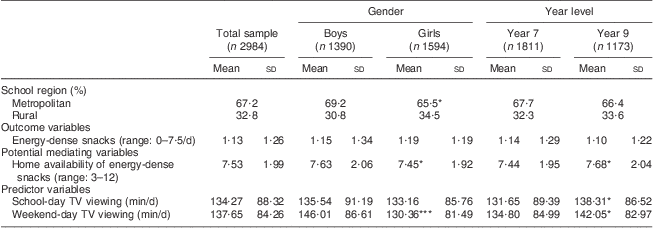
TV, television.
Chi-squared tests (for school region) and independent t tests (for all continuous variables) examining differences in means by adolescent gender and year level: *P < 0·05, **P < 0·01, ***P < 0·001.
School-day and weekend-day TV viewing were significantly associated with energy-dense snack consumption (τ in Table 2). TV viewing accounted for 5 % (school day) and 4 % (weekend day) of the variance in energy-dense snack consumption among boys and 5 % (school day and weekend day) of the variance in consumption of energy-dense snacks among girls. Linear regression analyses revealed that school-day and weekend-day TV viewing were positively associated with perceived home availability of energy-dense snack foods among adolescent boys and girls (Table 3). Further linear regression analyses revealed that perceived home availability of energy-dense snack foods was positively associated with consumption of energy-dense snack foods among adolescent boys (β = 0·26; 95 % CI 0·22, 0·31; P < 0·001) and girls (β = 0·28; 95 % CI 0·24, 0·33; P < 0·001).
Effects of adjustment for perceived home availability of energy-dense snack foods on the association between TV viewing and adolescent energy-dense snack consumption among Australian adolescents in 2004–2005 (n 2984)

TV, television.
τ, unstandardised regression coefficient for association between TV viewing and adolescent energy-dense snack food consumption, adjusting for school year and accounting for potential clustering by school (unit of analyses) using the ‘cluster’ command, before adjustment for mediator; τ′, unstandardised regression coefficient for association between TV viewing and adolescent energy-dense snack food consumption, adjusting for year level and accounting for potential clustering by school (unit of analyses) using the ‘cluster’ command and mediator (perceived home availability of energy-dense snack foods); τ−τ′, difference between the two regression coefficients, which when divided by its se, can be compared with a t distribution with n – 2 degrees of freedom.
Significance of the association: ***P < 0·001.
Associations between TV viewing and home availability of energy-dense snacks (potential mediator) among Australian adolescent boy and girls in 2004–2005

TV, television.
Linear regression analyses, controlling for year level and accounting for potential clustering by school (unit of analyses) using the ‘cluster’ command.
Significance of the association: ***P < 0·001.
Table 2 shows the mediating effects of perceived home availability of energy-dense snack foods on the association between school-day and weekend-day TV viewing and adolescent energy-dense snack consumption among adolescent boys and girls. When perceived home availability was added to each model predicting energy-dense snack consumption by TV viewing (i.e. separately for school day and weekend day), the β value for the association between TV viewing and energy-dense snack consumption was significantly decreased for both boys and girls. However, the association between TV viewing and energy-dense snack consumption remained significant (P < 0·001) in all models. This suggests that perceived home availability partly mediates the association between TV viewing and energy-dense snack consumption. The proportion of variance in energy-dense snack consumption explained by TV viewing increased when perceived home availability was added to each model (see Table 2).
Discussion
Recent reviews have identified an association between TV viewing and unhealthy eating among adolescents( Reference Pearson and Biddle 19 , Reference Chaput, Klingenberg and Astrup 21 ); however, little is known about potential mechanisms in the home environment that underpin the association between TV viewing and unhealthy eating. The present study is one of the first to examine both the direct and indirect associations between TV viewing and energy-dense snack food consumption. The results of the present study show that both school-day and weekend-day TV viewing were positively associated with home availability of energy-dense snack foods and energy-dense snack food consumption. Furthermore, associations between TV viewing and energy-dense snack food consumption were partially mediated by home availability of energy-dense snack foods. Acknowledging the cross-sectional study design, our findings give weight to the likely importance of addressing TV viewing behaviours, as well as home availability of foods, in interventions aimed at promoting healthy eating among adolescents.
Sedentary behaviour has become a significant issue in public health over the past decade, both for adults( Reference Owen, Healy and Matthews 45 ) and young people( Reference Tremblay, Leblanc and Kho 46 ). Operationally defined as ‘sitting time’, sedentary behaviour has often been assessed in respect of screen time and especially time watching TV. However, while research has shown there to be consistent links between TV viewing and unhealthy weight status in young people, associations are often quite small( Reference Marshall, Biddle and Gorely 47 ). This may be due to several factors, including little or no association between TV viewing and moderate-to-vigorous physical activity( Reference Marshall, Biddle and Gorely 47 ), except for some periods of the day, such as immediately after school( Reference Atkin, Gorely and Biddle 48 ), as well the presence of coexisting behaviours such as diet. TV viewing has been shown to coexist with unhealthy eating behaviours( Reference Pearson and Biddle 19 ). It may be diet as well as time being sedentary watching TV that accounts for indicators of poor health, including weight status. Our findings support the view that TV viewing in young people is associated with energy-dense snack food consumption. Although only 4–5 % of the variance is explained by this association, this is likely to be highly meaningful in terms of weight status. As argued by Hill( Reference Hill 49 ), ‘small changes’ to lifestyle may have significant health effects. This is likely to be true in the context of highly frequent, repeated behaviours such as TV and snacking.
The present study showed that perceived home availability of energy-dense snacks was positively associated with adolescent energy-dense snack consumption. Such findings add to previous research highlighting the important role of food availability within the home( Reference Ezendam, Evans and Stigler 24 , Reference Pearson, Ball and Crawford 50 ). It has long been known from behaviour modification studies that environmental manipulation, such as food visibility and availability, can have potent effects on behaviour( Reference Mahoney and Mahoney 51 ). Simple strategies, such as reductions in purchase of energy-dense foods, their concealment in the home or family rules about frequency and location of their consumption, may be helpful. The present study also showed that TV viewing was positively associated with home availability of energy-dense snacks. Such findings corroborate previous research showing that while young people are watching TV they are exposed to numerous advertisements about food (usually unhealthy)( Reference Kelly, Chapman and King 26 ) and that this translates into young people's food preferences, requests to purchase foods and drinks advertised, parental willingness to purchase these products and the availability of these food items in the home( Reference Chamberlain, Wang and Robinson 31 – Reference Coon and Tucker 35 ). In addition, the present study demonstrated that the perceived availability of energy-dense snack foods in the home partially accounts for the association between TV viewing and energy-dense snack food consumption. Such findings suggest that home availability of energy-dense foods could potentially be influenced by targeting reductions in TV viewing, which could also result in reductions in energy-dense snack food consumption. The involvement of parents and targeting the home environment are likely to be particularly important in such efforts.
Alternative explanations for several of the present findings are possible. That is, adolescents watching more TV may have been consuming more of all sorts of snacks, including healthy snacks. It is also possible that TV viewers consumed more energy-dense snacks because they had less access to fruits and vegetables in the home. To test these possibilities we conducted additional analyses. In the additional analyses, we examined associations of TV viewing with perceived home availability of fruit and vegetables. Results showed negative associations between TV viewing and fruit and vegetable availability, but these were of very small magnitude (B = −0·002 for boys and −0·001 for girls). Further, there were no associations between TV viewing and fruit/vegetable consumption for either boys (B < −0·001) or girls (B < −0·001). Therefore it appears unlikely that TV viewers are consuming more of all sorts of snacks; or that the increased consumption of energy-dense snacks among those viewing more TV is strongly attributable to lower availability of fruits and vegetables in the home.
In considering these findings it is important to acknowledge the limitations of the study. The reach of the whole study was modest (46 %); however, this is comparable to other large-scale longitudinal studies. All data were collected by self-report and are subject to socially desirable response bias or other misreporting. The cross-sectional study design does not permit causal inferences to be drawn; potentially a third unmeasured variable could account for the associations observed. Strengths of the study include the large regionally diverse sample of adolescents and parents, and the use of powerful statistical mediation techniques.
Conclusions
The results of the present study suggest that TV viewing has a significant role to play in adolescent unhealthy eating behaviours. Future research should assess the efficacy of methods to reduce adolescent energy-dense snack food consumption by targeting parents to reduce home availability of energy-dense foods and by reducing TV viewing behaviours of adolescents.
Acknowledgements
Sources of funding: This work was supported by the Australia Research Council (DP0452044), the William Buckland Foundation, a National Medical Research Council Senior Research Fellowship (479513) to K.B. and a VicHealth Senior Public Health Research Fellowship to D.C. Conflicts of interest: There are no conflicts of interest. Authors’ contributions: N.P. carried out the statistical analyses and drafted the paper. S.J.H.B. and L.W. contributed to the drafting of the paper. K.B., D.C. and A.W. were involved in the design and conduct of the study and contributed to the drafting of the paper. All authors read and approved the final manuscript.



