





Highlights
-
• Explore how bilingualism enhances creative potential
-
• Identify linguistic factors and cognitive mechanisms explaining bilingual creativity
-
• Plurilingual creativity framework makes a paradigm shift
-
• PICK educational program fosters plurilingual, intercultural and creative skills
-
• Link linguistic diversity with enhanced creativity in a global context
1. Introduction to the relationship between bilingual and creative practices
In an increasingly interconnected and diverse global landscape, the relationship between language and cognitive processes has become a focal point of academic inquiry. Over the last few decades, researchers studying bilingual cognitive and linguistic development have made significant progress. Their findings advance the stance that bilingual development may establish unique mental architectures that could lead to cognitive advantages later in life (Bialystok & Craik, Reference Bialystok and Craik2022). One of these advantages appears to be the capacity for creative thinking.
However, scholars in bilingualism and creativity initially did not see the importance of studying the relationships between the two phenomena. A review paper by Ricciardelli (Reference Ricciardelli1992b) reported 24 studies conducted between 1965 and 1992. In the following decade, this scarce research was supplemented by six dissertation studies (Fleith, Reference Fleith1999; Garcia, Reference Garcia1996; Konaka, Reference Konaka1997; Martorell, Reference Martorell1992; Stephens, Reference Stephens1997; Stone, Reference Stone1992) and six peer-reviewed journal articles (Burck, Reference Burck2004; Fleith et al., Reference Fleith, Renzulli and Westberg2002; Garcia, Reference Garcia2003; Karapetsas & Andreou, Reference Karapetsas and Andreou1999; Matthews, Reference Matthews2002; Paduch, Reference Paduch2005), as well as one book (Calderón & Minaya-Rowe, Reference Calderón and Minaya-Rowe2003), which addressed the theme in the context of potential impact of bilingual education on students’ creativity. Furthermore, two additional studies (Aguirre, Reference Aguirre and Castellano2003; Granada, Reference Granada and Castellano2003) focused on educating students identified as bilingual and gifted. In total, approximately 40 studies on the relationship between bilingualism and creativity were conducted over 40 years.
It took one more decade to revive the theme. Kharkhurin’s (Reference Kharkhurin2005) dissertational work initiated a longitudinal project studying cognitive processes underlying the relationship between bilingualism and creativity, which received the term bilingual creativity (Kharkhurin, Reference Kharkhurin, Kecskes and Albertazzi2007, Reference Kharkhurin2008, Reference Kharkhurin2009, Reference Kharkhurin2010a, Reference Kharkhurin2010b, Reference Kharkhurin2011). During this period, seven additional studies addressing the relationship between bilingualism and creative and insightful problem-solving appeared in various publications (Adi-Japha et al., Reference Adi-Japha, Berberich-Artzi and Libnawi2010; Cushen & Wiley, Reference Cushen and Wiley2011; Dotan-Eliaz et al., Reference Dotan-Eliaz, Sommer and Rubin2009; Hommel et al., Reference Hommel, Colzato, Fischer and Christoffels2011; Lasagabaster, Reference Lasagabaster2000; Lee & Kim, Reference Lee and Kim2010, Reference Lee and Kim2011). The first milestone in this journey was Kharkhurin’s (Reference Kharkhurin2012) monograph, which developed a theoretical framework for the research at the intersection of these two areas. Since then, the field has gradually expanded, and at the moment of writing this article, over two dozen peer-reviewed empirical studies have been published (Booton et al., Reference Booton, Hoicka, O’Grady, Chan and Murphy2021; Fürst & Grin, Reference Fürst and Grin2018, Reference Fürst and Grin2021, Reference Fürst and Grin2023; Ghonsooly & Showqi, Reference Ghonsooly and Showqi2012; Han, Reference Han2022; Jończyk et al., Reference Jończyk, Naranowicz, Dębowska-Kozłowska and Bromberek-Dyzman2024; Kharkhurin, Reference Kharkhurin2017b; Kharkhurin & Altarriba, Reference Kharkhurin and Altarriba2016; Kharkhurin & Wei, Reference Kharkhurin and Wei2015; Kim & Runco, Reference Kim and Runco2022; Kostandyan & Ledovaya, Reference Kostandyan and Ledovaya2013; Lange et al., Reference Lange, Hopman, Zemla and Austerweil2020; Leikin, Reference Leikin2013; Leikin & Tovli, Reference Leikin and Tovli2014; Leikin et al., Reference Leikin, Tovli and Malykh2014; Leikin et al., Reference Leikin, Tovli and Woldo2020; Onysko, Reference Onysko2016; Rabia & Alattawna, Reference Rabia and Alattawna2022; Sampedro & Peña, Reference Sampedro and Peña2019; Storme et al., Reference Storme, Çelik, Camargo, Forthmann, Holling and Lubart2017; Werkmann Horvat et al., Reference Werkmann Horvat, Bolognesi and Kohl2021; Xia et al., Reference Xia, An and Guo2022; Yang et al., Reference Yang, Wu, Duñabeitia, Jiang and Li2021; Yemez & Dikilitaş, Reference Yemez and Dikilitaş2022; Zheng et al., Reference Zheng, Denervaud and Durrleman2023). A significant milestone was a meta-analysis of 312 effect sizes from 39 studies demonstrating a positive effect of bilingualism on creativity (Acar et al., Reference Acar, Balayar, Ozcelik and Kharkhurin2024).
Evidently, the scientific community has realized the importance of merging these two fields of study and has made a significant breakthrough in research on the relationship between bilingualism and creativity. A comparison of the first and second editions of the book “Introduction to Bilingualism: Principles and Processes” (Altarriba & Heredia, Reference Altarriba and Heredia2008, Reference Altarriba and Heredia2018) highlights this progress. In the first edition, Simonton (Reference Simonton, Altarriba and Heredia2008) expressed disappointment in the lack of research on the topic: “almost no research directly relevant to this topic has been published since then, making its results still pertinent to the present discussion” (p. 150). However, in the second edition, just ten years later, Kharkhurin (Reference Kharkhurin, Altarriba and Heredia2018) already presented the first theoretical framework supported by solid empirical data. This comparison shows a significant advancement in the field of research on bilingual creativity in the last decade.
This research, however, needs a systematic overview of the obtained empirical data and a theoretical framework for summarizing these findings and outlining directions for future research. These are the goals of the present article. First, we recap the existing data to pinpoint the major tendencies in bilingual creativity. Second, we formulate the theoretical framework accounting for the empirical findings and explaining the relationship between bilingualism and creativity. Third, we propose a paradigm shift specifying directions for future research in bilingual creativity. Finally, we present a practical aspect of this research: its contribution to education.
2. Early research
Most early studies in bilingual creativity compared bilingual and monolingual participants. This approach could be ascribed to a so-called ‘monolingual’ perspective (Gogolin, Reference Gogolin1994, Reference Gogolin2002) generally adopted in bilingualism research. The monolingual perspective on bilingualism reflects an approach that historically dominated linguistic and educational discourses, often considering proficiency in a single language as the norm. This perspective stems from a monolithic understanding of language, wherein the idealized speaker is expected to be fluent in one language, with any deviation from this norm viewed as a potential impediment or deficit. Hence, the dominating discourse strived to defend bilingualism by demonstrating bilingual speakers’ linguistic and cognitive advantages over their monolingual counterparts (overview in Nikoladis & Smithson, Reference Nikoladis, Smithson, Altarriba and Heredia2018). Creativity was considered one of these cognitive advantages (Kharkhurin, Reference Kharkhurin, Altarriba and Heredia2018).
2.1. Creative cognition
The creative cognition approach posits creativity as an outcome of standard cognitive processes (Ward & Kolomyts, Reference Ward, Kolomyts, Kaufman and Sternberg2019). It is built on the premise that creative outputs are novel (i.e., original or unexpected) and appropriate (i.e., useful or meeting task constraints; see Mayer, Reference Mayer, Runco and Pritzker1999, for an overview) and that these outputs emerge from applying ordinary cognitive functions to existing knowledge (Ward, Reference Ward2007). Creative performance is thus seen as a function of specific cognitive processes and the depth and adaptability of the knowledge structures they engage with (Ward et al., Reference Ward, Smith and Vaid1997), suggesting that enhancing cognitive functioning could boost creativity.
This approach defines creative capacity as the ability to engage in repeated cycles of divergent and convergent thinking (Guilford, Reference Guilford1967). The key distinction between these thinking styles lies in their cognitive processes: convergent thinking is a focused, attention-intensive process aimed at identifying a single correct solution to a problem (Runco et al., Reference Runco, Dow and Smith2006), while divergent thinking operates in the subliminal, characterized by defocused attention and associative thought, exploring multiple, innovative solutions to open-ended problems (Mumford et al., Reference Mumford, Mobley, Uhlman, Reiter-Palmon and Doares1991). Guilford identified four primary attributes of divergent thinking: fluency (the rapid generation of multiple ideas), flexibility (the ability to explore different problem-solving strategies), elaboration (the detailed development and execution of an idea), and originality (the generation of unique ideas). The evaluation phase employs convergent thinking to sift through the possibilities produced during divergent thinking, culminating in selecting the most effective solution. This dynamic interplay between divergent and convergent thinking underpins the creative process, leading to novel and useful outcomes.
The association of creativity with divergent thinking has led to the development of various divergent thinking tests such as the Alternative Uses Test (Guilford et al., Reference Guilford, Christensen, Merrifield and Wilson1978), Consequences Test (Christensen et al., Reference Christensen, Merrifield and Guilford1953), Instances Test (Wallach & Kogan, Reference Wallach and Kogan1965), Plot Titles (Berger & Guilford, Reference Berger and Guilford1969), Remote Associates Test (Mednick & Mednick, Reference Mednick and Mednick1967), Uses of Objects Test (Getzels & Jackson, Reference Getzels and Jackson1962), and Torrance Tests of Creative Thinking (TTCT; Torrance, Reference Torrance1966). The latter is a widely used creativity test developed to evaluate children’s divergent thinking abilities. It includes verbal and figural tasks assessing fluency, flexibility, elaboration, and originality. The Abbreviated Torrance Test for Adults (ATTA; Goff & Torrance, Reference Goff and Torrance2002) is a shorter version comprising three verbal and figural tasks, with three minutes each. Various divergent thinking tests have been used in studies related to bilingual creativity.
2.2. Empirical evidence
Ricciardelli (Reference Ricciardelli1992b) presented an overview of the studies between 1965 and 1992. Twenty-three out of 24 were conducted with children and only one with college students. All studies made comparisons between bilingual and monolingual groups. Most found that bilingual children performed better on verbal and nonverbal divergent thinking tests. Bilingual children outperformed their monolingual counterparts on fluency (e.g., Carringer, Reference Carringer1974; Jacobs & Pierce, Reference Jacobs and Pierce1966; Ricciardelli, Reference Ricciardelli1992a), flexibility (e.g., Carringer, Reference Carringer1974), elaboration (e.g., Srivastava & Khatoon, Reference Srivastava, Khatoon and Annamalai1980; Torrance et al., Reference Torrance, Gowan, Wu and Aliotti1970), and originality (e.g., Cummins & Gulutsan, Reference Cummins, Gulutsan and Carey1974; Okoh, Reference Okoh1980). Only a few studies reported no group difference in TTCT performance (e.g., Gowan & Torrance, Reference Gowan and Torrance1965; Whitney, Reference Whitney1974), and one study (Torrance et al., Reference Torrance, Gowan, Wu and Aliotti1970) comparing Chinese- and Malayan-English bilingual and Chinese and Malayan monolingual children on TTCT found monolingual superiority on figural fluency and flexibility. In the only study with college students (Lemmon & Goggin, Reference Lemmon and Goggin1989), the performance of Spanish-English bilingual and English monolingual undergraduates was compared on cognitive ability tasks that required concept formation, mental reorganization, abstract and divergent thinking, and mental flexibility. The results showed that the monolingual participants tended to score higher than their bilingual counterparts on most cognitive skill measures. However, further analysis of high and low-proficiency bilingual subgroups (distinguished based on their picture naming score in Spanish) indicated that the bilinguals’ low performance should be attributed to participants with limited skills in Spanish.
This last finding offers an insight into the possible negative impact of bilingualism on creativity through Cummins’s (Reference Cummins1976) threshold hypothesis, which posits that cognitive benefits of bilingualism emerge only when individuals achieve a certain proficiency level in both languages. Ricciardelli (Reference Ricciardelli1992a) supported this with evidence that bilinguals proficient in both languages outperformed monolinguals in divergent thinking, while those with lower proficiencies did not. Therefore, the reported negative effects of bilingualism on creativity might stem from insufficient language proficiency. However, verifying this link is challenging, as many earlier studies lacked detailed language assessment information.
2.3. Methodological drawbacks
In fact, these earlier studies had many methodological flaws that led to premature interpretations of results and caused the academic community to approach bilingual creativity with a grain of salt. Kharkhurin (Reference Kharkhurin, Altarriba and Heredia2018) presented a detailed discussion of these methodological issues; here, we briefly discuss the main points.
Most studies used the tests of divergent thinking. Although divergent thinking is considered an essential component of creative thinking, equating these two types seems conceptually flawed (Acar & Runco, Reference Acar, Runco, Kaufman and Sternberg2019). A whole plethora of creativity assessment techniques addressing various aspects of creativity was excluded from bilingual creativity research.
A similar issue was observed with an assessment of bilingualism. Bilingual individuals vary in their proficiency across the languages they speak, the age at which they acquire their languages, cultural and heritage backgrounds, and the contexts in which they acquire and use their languages. Nonetheless, the early studies ignored these variations. Many of them did not even assess participants’ language proficiency.
The disregard of these variations led to one of the major methodological glitches contaminating not only bilingual creativity research but also bilingualism research at large. It arises from a procedure that assigns participants to bilingual and monolingual groups. As Hakuta and Diaz (Reference Hakuta, Diaz and Nelson1985) pointed out, “In the real world, there is no such thing as random assignment to a bilingual and monolingual group” (p. 329), and it is almost impossible to control all variables that may have an impact on this distinction. Early studies did not consider participants’ comparative language proficiency and circumstances of language acquisition and use when selecting them for a group. The large dispersion of participants’ linguistic and geographic backgrounds made drawing clear conclusions about the bilingual population challenging.
3. Recent research
Therefore, more recent studies attempted to compensate for those drawbacks and paid particular attention to study design, participant selection, and language and creativity assessments. Table 1 provides an overview of the research conducted between 1992 and 2024. These studies demonstrated substantial improvement in the methodology.
3.1. Methodological improvements
3.1.1. Adult participants
First, although many studies continued testing children, they were already outnumbered by research conducted with college students and adults (see Table 1). It is essential to distinguish the research conducted with children and adults because language development, cognitive processes, and educational practices differ across different life stages.
Summary of the research conducted between 1992 and 2024
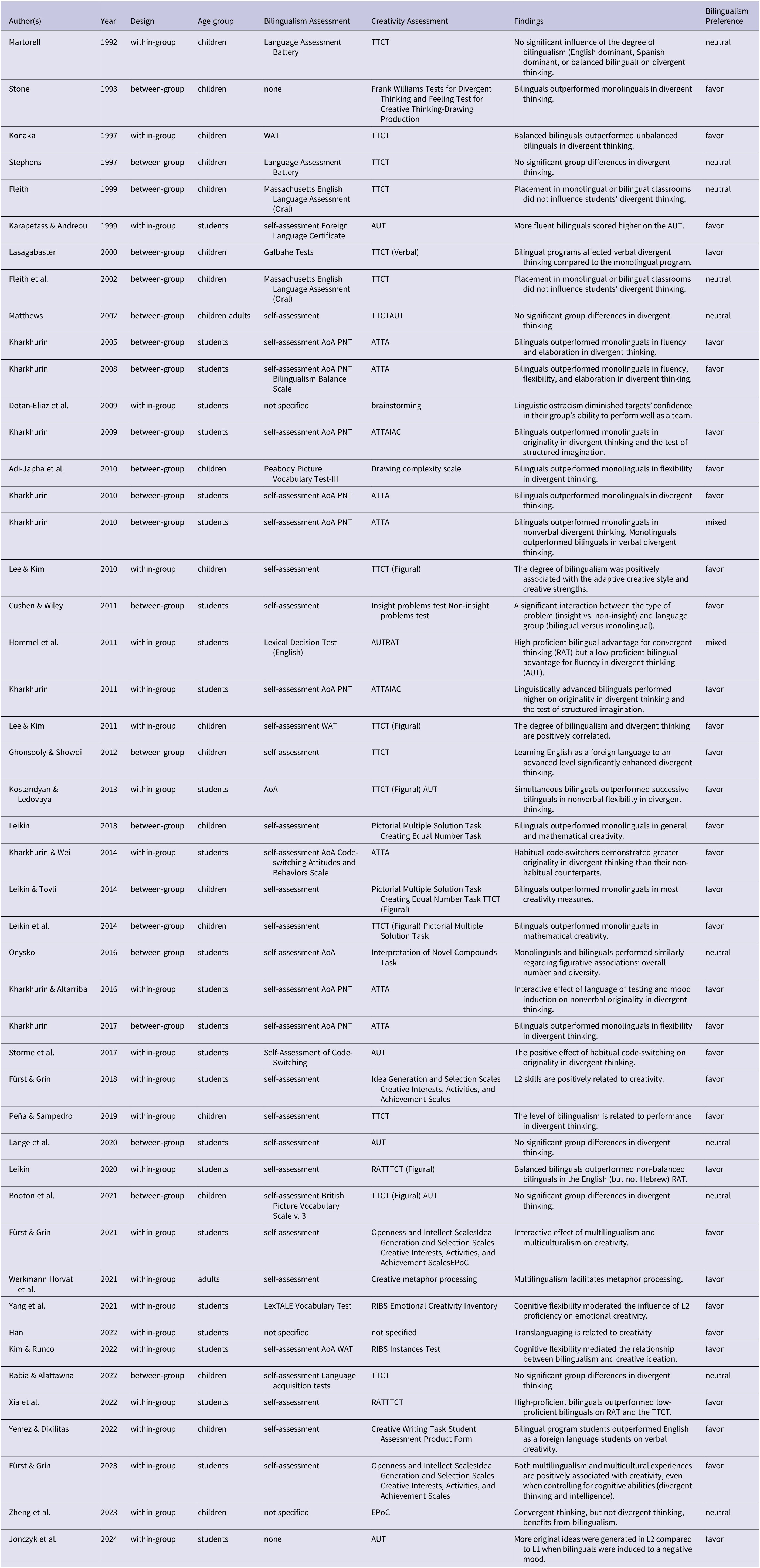
Note. Within-group design compared different types of bilinguals, whereas between-group design compared bilinguals and monolinguals. AoA = age of acquisition. WAT = Word Association Test (Lambert, Reference Lambert1956). PNT = Picture Naming Test (Kharkhurin, Reference Kharkhurin2005). TTCT = Torrance Tests of Creative Thinking (Torrance, Reference Torrance1966). AUT = Alternative Uses Test (Guilford et al., Reference Guilford, Christensen, Merrifield and Wilson1978). IAC = Invented Alien Creatures Task (Ward, Reference Ward1994). ATTA = Abbreviated Torrance Test for Adults (Goff & Torrance, Reference Goff and Torrance2002). RAT = Remote Associates Test (Mednick & Mednick, Reference Mednick and Mednick1967). EPoC = Evaluation of Potential Creativity (Lubart et al., Reference Lubart, Besançon and Barbot2011). RIBS = Runco Ideational Behavior Scale (Runco et al., Reference Runco, Plucker and Lim2001). The Bilingualism Preference column indicates whether the results favor bilingualism, are neutral, or mixed.
Children acquire languages during a critical period (Lenneberg, Reference Lenneberg1953) marked by rapid growth and sensitivity to environmental input. In contrast, adults learn additional languages beyond this period, facing challenges due to less neuroplasticity and established linguistic patterns. Consequently, research on bilingualism in children often focuses on the cognitive advantages of early bilingual exposure and its neuroplastic impacts on development. Studies on adults, however, examine the capacity for cognitive improvement through later language learning and its effects on cognitive aging. Additionally, the social and cultural contexts of language learning vary between children, influenced by family, peers, and education, and adults, whose language acquisition is shaped by factors like immigration, acculturation, and professional environments.
3.1.2. Different types of bilinguals
Second, although many studies continued comparing bilinguals and monolinguals, they were also outnumbered by research comparing different types of bilinguals and multilinguals (see Table 1). The earlier studies employed a between-group design. The criteria used to assign participants to bilingual and monolingual groups were often poorly specified and inconsistent from study to study.
Moreover, there is a growing debate about the validity of comparing bilinguals to monolinguals. This traditional comparison critiqued within the linguistic multi-competence framework (Cook & Wei, Reference Cook and Wei2016) assumes a monolingual norm, viewing second language (L2) competence as merely supplementary to first language (L1) skills. However, bilingualism is argued to enrich an individual’s linguistic capabilities and cognitive functions, leading to fundamentally different cognitive and conceptual structures in bilinguals compared to monolinguals (Cook, Reference Cook, Cook and Li2016). Furthermore, bilinguals’ experiences are highly diverse, encompassing variations in proficiency levels, the age of L2 acquisition, contexts of language use, and cultural backgrounds. This complexity suggests that mere comparisons between bilinguals and monolinguals might overlook bilingualism’s unique cognitive and cultural dimensions.
Therefore, it is crucial to recognize that bilinguals are not a homogenous population. Comparing different types of bilinguals is vital for a comprehensive understanding of the complexities and variations within the field.
3.1.3. Bilingualism assessment
Third, the earlier studies barely used any assessment of bilingualism, relying on some general assumptions about participants’ ethnic background or educational setting instead (see Kharkhurin, Reference Kharkhurin, Altarriba and Heredia2018, for examples). In contrast, with very few exceptions, recent studies employed one or another form of language assessment.
In the best tradition of the monolingual approach, participants’ degree of bilingualism was assessed as their L2 proficiency. Most of these studies used the self-rating of four primary language skills (speaking, writing, listening, and reading; see Table 1). This approach offers a practical method for gauging perceived proficiency, particularly in time-constrained lab settings. The self-rating scales demonstrated reliability and validity and adequately reflected language abilities (Li & Zhang, Reference Li and Zhang2021). However, their validity may be compromised by accuracy, subjectivity, social desirability bias, lack of objective criteria, and contextual factors. Therefore, they should be considered alongside other language proficiency measures, such as standardized tests. Some studies in bilingual creativity employed tests such as the Word Association Test (Lambert, Reference Lambert1956), Peabody Picture Vocabulary Test (Dunn & Dunn, Reference Dunn and Dunn2007), British Picture Vocabulary Scale (Dunn & Dunn, Reference Dunn and Dunn2009), LexTALE Vocabulary Test (Lemhöfer & Broersma, Reference Lemhöfer and Broersma2012), and Picture Naming Test (Kharkhurin, Reference Kharkhurin2005). These tests do not examine all four primary language skills. Instead, they evaluate specific aspects of linguistic aptitude, such as language perception, language production, and vocabulary knowledge. Although these tests may have a limited scope of application, at least they help classify participants accordingly.
In addition to language proficiency, some studies included the age of L2 acquisition (AoA) to evaluate bilingualism (see Table 1). However, only four of them (Cushen & Wiley, Reference Cushen and Wiley2011; Kharkhurin, Reference Kharkhurin2008; Kim & Runco, Reference Kim and Runco2022; Kostandyan & Ledovaya, Reference Kostandyan and Ledovaya2013) related this variable to the measures of creativity.
Moreover, most of these studies revealed a lack of understanding that assessing bilingualism should extend beyond proficiency and age of acquisition. It is crucial to consider cultural and contextual factors when assessing bilingualism. The oversight of neglecting these factors has led to a shift in how we perceive bilingualism.
3.1.4. Creativity assessment
Fourth, the earlier studies univocally used various divergent thinking tests. Because they focused on children, the preference was given to TTCT, which was explicitly designed for this population. This tradition continued in the later studies (see Table 1). Recall the creative cognition paradigm, which considers creative thinking a combination of divergent and convergent thinking. Therefore, the studies in bilingual creativity employed the tests of divergent and convergent thinking.
The adult version of the TTCT, the ATTA, was actively used with college students. Another popular test, the Runco Ideational Behavior Scale (Runco et al., Reference Runco, Plucker and Lim2001), evaluates creative ideation through 23 items on a 5-point Likert scale, assessing responses to open-ended problems on four divergent thinking traits. The most comprehensive test, Evaluation of Potential Creativity (Lubart et al., Reference Lubart, Besançon and Barbot2011), assesses children and adolescents’ creative potential across sectors like graphic-artistic and verbal-literary, offering scores for divergent-exploratory and convergent-integrative thinking within each.
Only a few studies shifted their focus toward other aspects of creativity and employed assessments such as the Invented Alien Creatures Task (Ward, Reference Ward1994), Creative Achievement Scale (Carson et al., Reference Carson, Peterson and Higgins2005), Emotional Creativity Inventory (Averill, Reference Averill1999), and Drawing complexity scale (Kellogg, Reference Kellogg1970).
However, these studies still demonstrated an ignorance of the multifaceted construct of creativity. Looking ahead, neglect of the complexity of the phenomenon of creativity was one of the crucial reasons for the paradigm shift.
3.2. Empirical evidence
The reviewed studies presented evidence in favor of bilingualism. Seventy percent of those comparing bilingual and monolingual groups demonstrated that bilinguals outperformed monolinguals on creativity measures, 25 percent obtained no significant difference, and only one study reported mixed results (see Table 1). Specifically, Kharkhurin (Reference Kharkhurin2010a) compared the performance of Russian-English bilingual and English monolingual college students residing in the USA on the verbal and nonverbal indicators of the ATTA. The results demonstrated a bilingual advantage in nonverbal creativity and a monolingual advantage in verbal creativity. These findings were explained by the facilitatory effect of bilingualism in nonverbal and inhibitory in the verbal domain, as well as for creativity.
The picture was even more dramatic with the data collected from different types of bilinguals. Ninety percent of these studies demonstrated the positive effect of bilingualism, with only one study revealing no effect and one producing mixed results (see Table 1). Specifically, Hommel and his colleagues (Reference Hommel, Colzato, Fischer and Christoffels2011) observed that highly proficient Dutch-English college students exhibited lower divergent thinking fluency but higher convergent thinking compared to less proficient German-English peers, although methodological concerns cast doubt on these findings. Notably, the study’s use of the RAT as a measure of convergent thinking – contrary to its common classification as a divergent thinking test – complicates interpretations of these results (Lee & Therriault, Reference Lee and Therriault2013; Wu et al., Reference Wu, Huang, Chen and Chen2020). In fact, this is the only study that demonstrated a low-proficient bilingual advantage in divergent thinking. However, this advantage was found for fluency but not other divergent thinking traits.
The empirical evidence obtained with different types of bilinguals allowed for a deeper exploration of the relationship between bilingualism and creativity. It helped to identify factors that facilitate cognitive processes underlying bilingual creativity.
3.3. Bilingual developmental factors
At least three developmental factors and four cognitive mechanisms could explain the positive relationship between bilingualism and creativity.
3.3.1. Language proficiency
Language proficiency undoubtedly plays a primary role in relating bilingualism to divergent thinking performance. Studies conducted with different types of bilinguals in various geographic locations and cultural contexts have confirmed the effect of language proficiency on one’s creative capacities (see Kharkhurin, Reference Kharkhurin, Altarriba and Heredia2018, for an overview). Bilinguals with high proficiency in English and Russian showed superior performance on elaboration in ATTA compared to their less proficient counterparts (Kharkhurin, Reference Kharkhurin2008). Furthermore, highly proficient Farsi-English bilinguals outperformed their unbalanced and moderately proficient counterparts in ATTA’s fluency (Kharkhurin, Reference Kharkhurin2009). Additionally, Lee and Kim (Reference Lee and Kim2011) found that more balanced Korean-English bilinguals scored higher on the composite TTCT index than their less-balanced counterparts.
These findings are complemented by another study conducted with bilinguals with different proficiency levels in English (Kharkhurin, Reference Kharkhurin2011), which revealed that more linguistically proficient bilinguals scored higher on ATTA’s originality and IAC. Similar findings were obtained in more recent studies, which used other measures of creativity. Fürst and Grin (Reference Fürst and Grin2018) found that L2 skills were systematically and positively related to selecting and generating ideas, creative activity, and achievement. Yang and his colleagues (Reference Yang, Wu, Duñabeitia, Jiang and Li2021) demonstrated that L2 proficiency directly affected bilinguals’ cognitive flexibility and cognitive and emotional creativity. In the most recent study (Jończyk et al., Reference Jończyk, Naranowicz, Dębowska-Kozłowska and Bromberek-Dyzman2024), Polish-English bilinguals were induced with a positive or negative mood through exposure to classical music excerpts and were asked to generate alternative uses for everyday objects in L1 and L2. They generated more original ideas in L2 than in L1 when induced into a negative mood. Somewhat similar results were obtained by Kharkhurin and Altarriba (Reference Kharkhurin and Altarriba2016), who found two conditions beneficial for Arabic-English bilinguals’ nonverbal originality: a positive mood state when tested in a stronger language and a negative mood state when tested in a weaker language.
In addition to bilinguals’ advantages on divergent thinking tests, their language proficiency positively correlated with convergent thinking (assuming that the assessment tool used in the following studies indeed measures convergent thinking). For example, Xia et al. (Reference Xia, An and Guo2022) reported that the high-proficient group had higher scores on the RAT. Leikin and his colleagues (Reference Leikin, Tovli and Woldo2020) also showed that balanced bilinguals outperformed non-balanced bilinguals in the English (but not Hebrew) version of RAT. A similar finding was obtained by Hommel et al. (Reference Hommel, Colzato, Fischer and Christoffels2011), who reported a high-proficient bilingual advantage on this test.
3.3.2. Age of language acquisition
The second factor is the age at which individuals acquire their languages. Traditionally, there are two types of bilinguals: simultaneous and sequential (McLaughlin, Reference McLaughlin1984). Simultaneous bilinguals learn both languages from the onset of language acquisition. In contrast, sequential bilinguals learn their L2 after age five when the essential components of their L1 are already in place. Sequential bilinguals can be further categorized into early and late learners, depending on the age at which they acquire L2 (Genesee, Reference Genesee1978).
Kostandyan and Ledovaya (Reference Kostandyan and Ledovaya2013) found that simultaneous bilinguals scored higher on flexibility than sequential bilinguals who started learning one of the two languages two to four years later. Kharkhurin (Reference Kharkhurin2008) demonstrated that Russian-English bilinguals who acquired L2 at a younger age also scored higher on fluency and flexibility. Similarly, bilinguals who acquired their L2 (English) by age six were better able to solve insight problems than those who acquired L2 after this age (Cushen & Wiley, Reference Cushen and Wiley2011).
3.3.3. Sociocultural context
The third factor in bilingual creativity reflects the context of language acquisition and use. Previous studies often ignored the fact that many bilinguals are immigrants, migrant workers, members of minority groups, or international students. They acquired each language in its respective cultural environment, where different cultural cues are available (Pavlenko, Reference Pavlenko2000). Therefore, they could adopt various multicultural values and beliefs besides acquiring several languages. Studies on acculturation support this view by showing that language acquisition is often accompanied by adopting the cultural values and norms of the country where the language is learned (e.g., Birman et al., Reference Birman, Trickett and Vinokurov2002).
On the other hand, creativity research showed that the environment’s economic, political, social, and cultural aspects can considerably impact both levels of creative potential and how creativity is evaluated (e.g., Lubart, Reference Lubart and Sternberg1999). Sociocultural values and norms shape the concept of creativity, which may affect how creative potential is expressed. Therefore, if bilinguals acquire their languages in different countries, they will likely be exposed to different sociocultural environments, which may increase their creative potential.
Cross-cultural research shows that the effect of bilingualism on creative performance is often confounded with the effect of biculturalism (see Kharkhurin, Reference Kharkhurin2012, for a discussion). For instance, Kharkhurin (Reference Kharkhurin2008) found that the length of residence in a new cultural environment relates to bilingual college students’ fluency, flexibility, and elaboration. Similarly, Maddux and Galinsky (Reference Maddux and Galinsky2009) demonstrated that the amount of time MBA students from 40 different nations had lived abroad significantly predicted creative solutions to the Candle-Mounting Problem (Duncker, Reference Duncker1945) when the effect of bilingualism was controlled. Two recent studies (Fürst & Grin, Reference Fürst and Grin2021, Reference Fürst and Grin2023) revealed that multilingual and multicultural experiences were positively associated with various measures of creativity.
Another line of research proposes that the specific settings of the sociocultural environment to which an individual was exposed may modulate the impact of bilingualism on creativity (e.g., Kharkhurin, Reference Kharkhurin2010b; Leung et al., Reference Leung, Maddux, Galinsky and Chiu2008). This idea stems from cross-cultural research in creativity, which demonstrates that variations in socialization, self-perception, self-expression, education, and social conduct may modulate the differences in the creative performance of people from different cultures (e.g., Kharkhurin & Samadpour Motalleebi, Reference Kharkhurin and Samadpour Motalleebi2008; Niu & Sternberg, Reference Niu and Sternberg2001; Zha et al., Reference Zha, Walczyk, Griffith-Ross, Tobacyk and Walczyk2006). Hence, if individuals’ creative potential can be influenced by their experience with different cultures, variations in bilinguals’ cultural settings may impact different aspects of their creative thinking. For example, Kharkhurin (Reference Kharkhurin2010b) compared Farsi-English bilingual and Farsi monolingual college students residing in the Middle East with their Russian-English bilingual and English monolingual counterparts residing in the USA. The study demonstrated that the interaction between bilingualism and the sociocultural environment significantly influenced creative performance. It also speculated that the cultural distance between the environments to which bilingual groups were exposed in their respective countries could play a role in an individual’s creative behavior.
3.4. Cognitive mechanisms of bilingual creativity
Further, four mechanisms were identified to account for the positive correlation between bilingualism and creativity: language-mediated concept activation (LMCA), selective attention, code-switching, and metaphor.
3.4.1. Language Mediated Concept Activation
Kharkhurin (Reference Kharkhurin2017b) proposed the LMCA to explain bilinguals’ advantage in divergent thinking. Divergent thinking is perceived as the ability to generate a wide range of ideas by connecting different, often unrelated, mental representations (Guilford, Reference Guilford1967). The activation of distant conceptual representations is accomplished through the spreading activation mechanism (McClelland & Rumelhart, Reference McClelland and Rumelhart1985), which transfers activation between related conceptual features. The conceptual system’s distributed nature was demonstrated in priming studies, showing that semantically related words influence each other within and between languages (e.g., Unsworth, Reference Unsworth2023). The translation equivalents automatically activate each other through shared conceptual representations (e.g., ‘concept mediated translation’ in Kroll & de Groot, Reference Kroll, de Groot, de Groot and Kroll1997), and variations in these representations across languages (e.g., Paradis, Reference Paradis, de Groot and Kroll1997) can activate additional concepts from different categories. Hence, the simultaneous activation of different conceptual representations assumed to stimulate divergent thinking could occur through bilinguals’ languages. Therefore, the LMCA was argued to encourage divergent thinking.
This hypothesis was tested in a study with Russian-English bilingual and Russian monolingual college students (Kharkhurin, Reference Kharkhurin2017b). They received a translingual priming test and the ATTA. The former was a lexical decision priming test, in which a prime and a target were not related in Russian (language of testing) but were related through their translation equivalents in English (spoken only by bilinguals). Bilinguals scored higher than monolinguals on flexibility in divergent thinking, and the translingual priming effect could explain their performance on this component.
This study also revealed a relationship between the translingual priming effect and the age of L2 acquisition and proficiency in this language. Therefore, these bilingual developmental factors were proposed to shape LMCA by influencing the directionality and strength of connections in bilingual memory.
Specifically, language proficiency may determine the strength of connections between lexical and conceptual systems. Higher proficiency leads to stronger links to the conceptual system, which results in a broader range of concepts being available for the LMCA. Individuals with high language proficiency use the LMCA mechanism more effectively, while those who are not proficient have weaker connections and less effective use of the LMCA.
Similarly, people who learn languages at a young age may develop a greater sensitivity to underlying concepts and more refined connections between lexical and conceptual representations, fostering efficient LMCA. Late bilinguals may have less efficient LMCA due to an asymmetry in lexical access (see Kroll & de Groot, Reference Kroll, de Groot, de Groot and Kroll1997, for detailed discussion).
Thus, greater proficiency and early acquisition lead to stronger links between lexical and conceptual systems and more readily available conceptual representations for LMCA.
3.4.2. Selective attention
If the LMCA explained the bilingual advantage in divergent thinking, the second cognitive mechanism, selective attention, explained the bilingual advantage in convergent thinking.
Convergent thinking is a process of finding the best solution to a particular problem by narrowing down a pool of diverse ideas to a single creative solution (Cropley, Reference Cropley2006). It involves exploring, criticizing, and evaluating possible options to select the best fit for the problem. Efficient selective attention appears to be a key factor supporting creative problem-solving by helping narrow down many possible solutions to a single original solution.
Bilingual individuals have an advantage in selective attention due to their extensive practice with two active language systems. When using multiple languages, they encounter lexical retrieval conflicts resolved by efficient attentional control (Bialystok & Craik, Reference Bialystok and Craik2022). Selective attention influences the activation and suppression of linguistic representations. It directs individuals’ focus toward relevant linguistic cues and facilitates the retrieval of appropriate lexical items and grammatical structures from their mental lexicon. Moreover, it enables individuals to inhibit irrelevant linguistic information, preventing interference from languages not currently in use. Kharkhurin (Reference Kharkhurin2011) identified two control mechanisms of selective attention that can enhance bilinguals’ divergent thinking. Facilitating relevant information could activate a variety of unrelated concepts and enable the individual to work through these concepts effectively. The inhibition of irrelevant information can improve the individual’s capacity to generate original and valuable ideas.
3.4.3. Code-switching
Empirical evidence demonstrates that selective attention maintains linguistic control during code-switching, shaping the decision to switch between languages during communication (e.g., Calabria et al., Reference Calabria, Hernandez, Branzi and Costa2012; Weissberger et al., Reference Weissberger, Wierenga, Bondi and Gollan2012). Code-switching – alternating and mixing different languages in the same episode of speech production – is the third mechanism facilitating creativity. Code-switching enables individuals to seamlessly navigate between linguistic systems, drawing upon diverse linguistic resources to express thoughts, convey meanings, and negotiate social interactions. By embracing code-switching, individuals may engage in flexible cognitive processing, presumably enhancing their ability to generate novel ideas, solve problems, and adapt to diverse communicative contexts.
The studies in translanguaging – a dynamic language practice where bilingual or multilingual individuals effortlessly use their entire linguistic repertoire to achieve effective communication (Garcia & Wei, Reference Garcia and Wei2014, for review and Treffers-Daller, Reference Treffers-Daller2024, for critical appraisal) – viewed code-switching not just as a combination of different grammatical structures but as an expressive and creative performance (e.g., Wei & Wu, Reference Wei and Wu2009). For example, Bhatia and Ritchie (Reference Bhatia and Ritchie2008) explored different aspects of linguistic creativity that arise when bilingual people mix languages in everyday verbal communication.
Empirical studies provided evidence for the relationship between code-switching and divergent thinking. Kharkhurin and Wei (Reference Kharkhurin and Wei2015) found that individuals who frequently and regularly code-switch exhibit higher levels of originality in ATTA compared to those who do not code-switch in their daily communication. Storme and his colleagues (Reference Storme, Çelik, Camargo, Forthmann, Holling and Lubart2017) found that participants with higher levels of habitual language switching who were instructed to switch languages during the AUT produced more original ideas. However, participants with lower habitual language switching levels generated more original ideas when instructed to use only one language.
3.4.4. Metaphor
Divergent thinking operates on establishing elaborate associations that link concepts from distant categories. The LMCA stimulates divergent thinking by activating distant conceptual representations triggered by shared lexical features of the translation equivalents in two languages. A similar mechanism of activating unrelated conceptual representations can underlie metaphor processing. Hence, the fourth mechanism linking bilingualism and creativity appears to be a metaphor.
A metaphor is an analogy between two instances conveyed using one instead of another (Lakoff & Johnson, Reference Lakoff and Johnson1980). A capacity to build metaphors helps an individual engage numerous concepts or categories in simultaneous information processing, which extends a bridge between multiple, often unrelated ideas. Many researchers see a metaphor as a source of selective comparisons that can offer new perspectives on a problem, highlight or create similarities to other domains, and yield insights for problem redefinition (e.g., Kuhn, Reference Kuhn and Ortony1993). Their studies suggest that metaphor processing could benefit creative engagement (Ward et al., Reference Ward, Smith and Vaid1997).
Bilingual metaphor processing has become a new direction in bilingualism research (e.g., Jankowiak et al., Reference Jankowiak, Rataj and Naskręcki2017; Segal & Gollan, Reference Segal and Gollan2018; Xue et al., Reference Xue, Yang and Zhao2014). For example, Furlong (Reference Furlong2009) reported studies demonstrating an enhanced use of metaphors by bilinguals compared to monolinguals.
Onysko (Reference Onysko2016) compared the interpretation of novel unpredictable and complex compounds (a new lexeme formed by combining two or more lexemes, e.g., ‘firedog’) by bilinguals and monolinguals. He found that bilingual individuals preferred associating compound words with existing idiomatic expressions or homophones related to some of the compounds’ constituents. That is, they demonstrated interpretation by analogy, which, per the definition above, can be considered a trigger of divergent thinking. However, bilingual participants revealed no significant differences with their monolingual counterparts in preference for a figurative association, which involves conceptual metaphors (mapping abstract concepts onto concrete, perceptual domains) or metonymy (the association of concepts through contiguity or proximity, where one concept is used to represent another based on a close relationship between them). In other words, although bilinguals seemed to use different analytical strategies, they revealed no advantage in metaphor processing.
Note that this study made a methodological mistake typical for early studies in bilingual creativity: it compared bilinguals and monolinguals. Werkmann Horvat et al. (Reference Werkmann Horvat, Bolognesi and Kohl2021) looked at different types of multilinguals and how they interpret more or less creative metaphors. They distinguished between groups with less multilingual experience (average number of foreign languages = 1.9, average age of acquisition of their strongest L2 = 10.5 years old, and average daily use of their strongest L2 = .2 hours a day) and more multilingual experience (average number of foreign languages = 3.1, average age of acquisition of their strongest L2 = 5.5 years old, and average daily use of their strongest L2 = 2.1 hours a day). The more creative metaphors were novel metaphors that were difficult to comprehend and interpret. The less creative metaphors were easy to comprehend and interpret. There was no significant group difference in the interpretation of less creative metaphors. However, participants with more multilingual experience interpreted more creative metaphors significantly better. Specifically, they showed more semantic sensicality in judging more creative metaphors.
These findings demonstrate that multilingual experience provides access to more comprehensive semantic representations. Individuals with more multilingual experience can more easily access the less obvious semantic aspects of concepts used in metaphors. This conclusion suggests that bilingual metaphor comprehension can be related to cognitive flexibility. Moreover, it is plausible to assume that bilingualism should enhance metaphor production, explaining increased verbal or literary creativity. Unfortunately, no study to date has related metaphor processing to divergent thinking.
4. Explanation of the link between multilingualism and creativity
4.1. Multilingual creative cognition approach
The reviewed empirical evidence led to formulating the theoretical framework of multilingual creative cognition (MCC; Kharkhurin, Reference Kharkhurin and Jones2015). The MCC paradigm is grounded in the following premises. Research in bilingual cognitive development conducted over the last 50 years provided evidence supporting the notion that speaking more than one language extends an individual’s cognitive capacities (see overview in Bialystok, Reference Bialystok and Francis2021). There is a strong argument in the literature that bilingual development may result in establishing specific architectures of the mind that are likely to promote later cognitive advantages (Bialystok & Craik, Reference Bialystok and Craik2022). On the other hand, according to the creative cognition approach (Ward & Kolomyts, Reference Ward, Kolomyts, Kaufman and Sternberg2019) presented above, creativity is considered a product of normative cognitive functioning. Hence, if acquiring and using multiple languages facilitates general cognitive functioning and results in more elaborate cognitive structures and functioning, it may also facilitate creative functioning (Kharkhurin, Reference Kharkhurin2012).
The reasoning presented here is based on research that primarily involved bilingual individuals. However, extending this logic to people who speak more than two languages is plausible. In fact, some participants included in the bilingual group of these studies could speak more than two languages. For example, in Kharkhurin’s (Reference Kharkhurin2008) study, many Russian-English bilingual participants were exposed to their ethnic languages in addition to Russian, and some even reported taking foreign language classes. Similarly, Farsi-English bilingual participants in the UAE sample (Kharkhurin, Reference Kharkhurin2009) knew other languages that they had learned either in a classroom setting (such as French and Spanish) or a natural multilingual environment (such as Arabic and Urdu). Therefore, instead of referring to bilinguals, we use the term MCC to refer to multilingual individuals.
The MCC framework embraces the multilingual developmental factors and cognitive functions that, on one side, benefit from the use of multiple languages and, on the other, facilitate creative thinking. These factors and functions were presented in the previous section.
4.2. A situated cognition approach
The major disadvantage of the MCC is that it focuses on the cognitive processes underlying creative thinking and disregards environmental factors. The situated cognition approach offers a perspective that can potentially fill this gap (van Dijk et al., Reference van Dijk, Kroesbergen, Blom and Leseman2018). It posits that cognitive processes are deeply embedded within and shaped by the sociocultural and physical contexts in which they occur (Brown et al., Reference Brown, Collins and Duguid1989). From this perspective, cognition is not solely an individual and internal phenomenon but is intricately intertwined with the social, cultural, and environmental factors that surround it. In this regard, the linguistic and cultural diversity experienced by multilingual individuals creates unique cognitive environments that influence how they perceive, interpret, and generate creative ideas. The previously cited research provided empirical evidence of the importance of sociocultural factors in explaining the relationship between bilingualism and creativity.
In situated cognition, an individual interacts with the environment and perceives opportunities for action that emerge from it. These affordances allow individuals to interact with their surroundings and achieve their goals adaptively (Chemero, Reference Chemero2003). Affordances are not inherent properties of objects or environments but are relational and context-dependent, shaped by the individual’s goals, abilities, and experiences (Gibson, Reference Gibson1979).
Affordances provide the perceived opportunities for action that inspire and guide creative endeavors within the environment. Creativity often involves perceiving and leveraging affordances in novel and innovative ways, allowing individuals to explore alternative perspectives, generate original ideas, and solve complex problems (Chemero, Reference Chemero2003). Glăveanu (Reference Glăveanu2013) included affordances in his 5As model, suggesting that understanding how individuals perceive and interact with their environment can provide valuable insights into the creative process.
Multilingual experience can enrich an individual’s perception of affordances by providing diverse linguistic and cultural frameworks that shape their interactions with the environment. In Okoh’s (Reference Okoh1980) words, bilinguals have “two windows or corridors through which to view the world” (p. 164). As individuals navigate multiple languages and cultures, they develop a heightened sensitivity to the environmental cues and subtle nuances available in different linguistic and cultural contexts. This heightened sensitivity can extend to the perception of affordances, boosting their creative capacities. The idea that multilingual individuals’ heightened sensitivity can lead to developing their creative abilities was also entertained by works in plurilingualism. For example, Furlong (Reference Furlong2009) said, “Given high-level plurilinguals’ increased perceptual awareness, they are likely to gain new insights, create new analogies and experience creative moments in any domain where perception is at work” (p. 365).
The introduction of the concepts of affordances and plurilingualism in the equation of multilingual and creative practices questions the ecological validity of the MCC approach.
5. Shift in paradigm
The MCC approach seems to adopt a limited viewpoint on using multiple languages and engaging in creative endeavors. It emerged from conventional understandings of bilingualism and creative thinking, focusing mainly on the cognitive processes underlying creativity and how linguistic abilities can enhance them.
It becomes evident that most research discussed so far largely overlooked the extensive spectrum of multilingual individuals. These studies predominantly concentrated on bilingual immigrants who arrived in the host country speaking their mother tongue and attempted to acquire the autochthon language with various degrees of success. At the same time, it is essential to acknowledge that multilingualism can extend beyond the combination of a heritage language and a host language, to recognize various forms of linguistic diversity, and to consider the scenario where individuals may possess skills in more than two languages (Fürst & Grin, Reference Fürst and Grin2018).
Additionally, as discussed earlier, individuals fluent in multiple languages frequently have extensive multicultural experiences. Given the substantial evidence linking multicultural experiences with enhanced creativity (Maddux et al., Reference Maddux, Lu, Affinito and Galinsky2021), it is imperative to meticulously account for multicultural experiences when analyzing the connection between multilingualism and creativity (Fürst & Grin, Reference Fürst and Grin2023).
Furthermore, creativity assessment has traditionally been limited to a single measurement method, specifically divergent thinking tasks. Although there is no doubt that it is an essential component of creative thinking and a strong indicator of creative potential (Acar & Runco, Reference Acar, Runco, Kaufman and Sternberg2019), it is imperative to call for a broader, multivariate approach to evaluate creativity.
Finally, recent scholarly discussions on the acquisition and use of multiple languages have promoted a broader perspective, mainly through studies in multilingualism (e.g., Cenoz, Reference Cenoz2013; Herdina & Jessner, Reference Herdina and Jessner2002) and plurilingualism (Piccardo et al., Reference Piccardo, Germain-Rutherford and Lawrence2021). Likewise, discussions on creativity have evolved to encompass more comprehensive conceptualizations, as evidenced by various models emphasizing its intricate and multidimensional nature (e.g., Csikszentmihalyi, Reference Csikszentmihalyi and Simonton2014; Glăveanu, Reference Glăveanu2013; Kharkhurin, Reference Kharkhurin2014; Lubart, Reference Lubart2017; Sternberg & Karami, Reference Sternberg and Karami2022).
Therefore, having a paradigm shift that considers these factors became paramount. A more extensive analysis is required to fully understand the relationship between multilingualism and creativity, which should encompass a broader range of situations and scenarios.
6. What needs to be changed
6.1. Participants selection
Moving away from a monolingual perspective appeals to careful participant selection. Finding monolingual participants is challenging, especially in linguistically diverse areas, because they are inevitably exposed to other languages (Kharkhurin, Reference Kharkhurin, Altarriba and Heredia2018). Moreover, per earlier discussion, it does not seem prudent to compare multilinguals and monolinguals because they may have different organizations of mental representations (Cook & Wei, Reference Cook and Wei2016). These considerations necessitate conducting studies with different types of multilingual individuals. Additionally, the diversity in participants’ linguistic, cultural, and geographic backgrounds adds layers to the research that must be carefully managed to ensure validity.
First, assessing all the languages the participants speak is crucial for the integrity of the research on multilingualism. Studies demonstrate that individuals often categorized as bilinguals actually have exposure to multiple languages, whether through heritage, education, or environmental immersion (Kharkhurin, Reference Kharkhurin2008, Reference Kharkhurin2009). This linguistic diversity within supposedly bilingual groups can lead to methodological inconsistencies and affect the reliability of research findings.
Second, it is essential to differentiate between individuals who learned L2 in a classroom setting and those who acquired it through immersive, real-life experiences. This distinction is important because real-world language use, intertwined with cultural experiences, significantly influences linguistic proficiency and cognitive frameworks (e.g., de Groot, Reference de Groot2000; Paradis, Reference Paradis2000). Immersive learning leads to deeper linguistic involvement and acculturation, affecting conceptual systems uniquely (Pavlenko, Reference Pavlenko, Kroll and de Groot2005).
Third, variations in linguistic and cultural backgrounds can influence the development of creative potential differently, as demonstrated in studies comparing bilinguals with varying language pairs (e.g., Kharkhurin, Reference Kharkhurin2010b). The working of the LMCA suggests that the variations in lexical and conceptual characteristics of bilinguals’ languages may also influence the organization of bilingual memory. The larger the typological gap between two languages, the more significant the variation in how mental representations of a word or phrase and its translated counterpart are structured (Paradis, Reference Paradis2004). Hence, we need to control the typological distance between the languages spoken by participants.
Fourth, conducting multilingualism research with adults is essential because it allows for examining long-term cognitive effects and the stability of bilingual advantages into adulthood, providing insights into how lifelong multilingualism shapes cognitive resilience (Bialystok et al., Reference Bialystok, Craik and Luk2012) and potentially creative thinking. Furthermore, adult participants offer a broader perspective on applying multiple languages in diverse contexts, enhancing our understanding of the complex relationship between language use, cognitive flexibility, and creativity in real-world settings (Costa & Sebastián-Gallés, Reference Costa and Sebastián-Gallés2014).
6.2. Assessment of multilingual experience
We have repeatedly stated that multilingual individuals have different linguistic and cultural backgrounds. They also vary in the circumstances of language acquisition and use. Moreover, each individual may learn and use each language differently.
To fully understand an individual’s multilingual experience, we must take a holistic approach that examines the complex interplay between language, culture, and identity-related factors. This includes assessing language proficiency across all known languages, understanding the diverse contexts in which each language is utilized, and measuring the depth of cultural exposure and its influence on the individual’s identity and societal attitudes. The history of how each language was acquired offers insights into linguistic development, while socioeconomic factors reveal the practical benefits of multilingualism. Additionally, examining cognitive and psychological adaptation, social networks, educational background, economic opportunities, efforts in language maintenance, digital literacy, and the impact of interlingual relationships, personal motivations for language learning, societal attitudes, and globalization on language practices provides a comprehensive view.
Multilingual experience assessments are typically comprehensive and involve a multidimensional approach, such as The Language Experience and Proficiency Questionnaire (Marian et al., Reference Marian, Blumenfeld and Kaushanskaya2007). This questionnaire collects detailed information on an individual’s language history, proficiency, and experience across multiple languages. It provides insights into the languages they know, the context in which they learned these languages, their proficiency levels, and how often they use them daily. The questionnaire is available in 38 different languages. Another tool is the Multilingual and Multicultural Experience Questionnaire (Kharkhurin, Reference Kharkhurin2012). It consists of 114 questions that assess participants’ experience with multiple languages, their language preferences and use in various settings, degree of bilingual balance, their exposure and preferences to various cultures, multicultural competence, psychological acculturation, and languages and cultures of their parents. Other tools are also available, which researchers and practitioners can customize to fit specific study or assessment needs (e.g., Li et al., Reference Li, Zhang, Yu and Zhao2019).
However, the complexity of this multifaceted experience poses a significant challenge in ensuring that the richness of multilingual contexts is adequately captured and reflected in empirical findings. Research in bilingualism and multilingualism grapples with the issue of translating the holistic and intricate nature of multilingual experience into a manageable set of quantitative variables amenable to statistical analysis.
Several studies of multilinguals’ personality traits used a total number of spoken languages to assess participants’ experience with multiple languages (e.g., Dewaele & Stavans, Reference Dewaele and Stavans2012; Dewaele & van Oudenhoven, Reference Dewaele and van Oudenhoven2009). Dewaele and Wei (Reference Dewaele and Wei2013) complemented this score with the mean proficiency score calculated for all languages spoken by participants. Kharkhurin and his colleagues (Reference Kharkhurin, Koncha and Charkhabi2023a) added habitual code-switching and built a composite score using the regression equation.
Other scholars made attempts to treat language experience and use as a multifaceted construct that is shaped by factors such as the age of acquisition, history of language acquisition, and context and frequency of language use (e.g., Gullifer et al., Reference Gullifer, Kousaie, Gilbert, Grant, Giroud, Coulter and Titone2021; Gullifer & Titone, Reference Gullifer and Titone2021; Titone & Tiv, Reference Titone and Tiv2022). For example, Gullifer and Titone (Reference Gullifer and Titone2020) introduced the notion of language entropy to capture “individual differences in the social diversity of language use, including the interactional context of language usage” (p. 284). This metric is derived as a sum of the proportion of a language used in a particular context multiplied by the logarithmic function of this proportion for all languages spoken by a language user.
6.3. Assessment of multicultural experience
Further, we have already discussed that multilingual individuals not only master several languages but also embrace diverse multicultural values, significantly influencing their creative potential and its development. Research highlights the profound impact of social and cultural aspects on creativity (e.g., Kharkhurin & Yagolkovskiy, Reference Kharkhurin and Yagolkovskiy2021; McCarthy, Reference McCarthy2019), suggesting that any comprehensive creativity model must include cultural perspectives (Glăveanu, Reference Glăveanu2010).
Research on bilingual creativity often relied on simplistic assessments, such as self-report questionnaires focusing narrowly on participants’ exposure to different cultures. These studies emphasized the significance of arrival age and residence duration in a new country, noting their distinct influences on cognitive function and cultural identity (e.g., Tsai et al., Reference Tsai, Ying and Lee2000). For example, Kharkhurin (Reference Kharkhurin2008) explored these factors and revealed that the length of residence in the new cultural environment related to bilinguals’ performance on fluency, flexibility, and elaboration in divergent thinking. Similarly, Maddux and Galinsky (Reference Maddux and Galinsky2009) demonstrated a significant correlation between time spent abroad and an ability to overcome functional fixedness in creative problem-solving. In a recent study, Fürst and Grin (Reference Fürst and Grin2023) constructed a multicultural experience variable based on the number of countries visited, the number of important countries, and the rating of importance of these countries and found that it correlated with creative personality and creative activity.
While it may be tempting to attribute cross-cultural effects on creative performance to cross-cultural exposure, it is crucial to recognize that such exposure does not fully capture the psychological impact of acculturation (Kharkhurin, Reference Kharkhurin2012). The psychological effects of integrating into a new culture are more complex than simple exposure suggests. This consideration highlights the importance of gaining a deeper understanding of how acculturation affects creativity (Tropp et al., Reference Tropp, Erkut, Coll, Alarcon and Garcia1999).
Therefore, we must employ more nuanced methodologies to capture the complexity of multicultural experiences. Several psychometric tools can be used to measure an individual’s ability to function effectively in cross-cultural settings and their level of exposure and integration with multicultural interactions. These tools include but are not limited to the Multicultural Experience Questionnaire (Narvaez et al., Reference Narvaez, Endicott and Hill2010), which evaluates both experience and desire for multicultural interactions, and the Multicultural Experience Assessment scale (Aytug et al., Reference Aytug, Kern and Dilchert2018), distinguishing between multicultural exposures and multicultural interactions, which are measured based on frequency, duration, and breadth.
6.4. Assessment of intercultural competence
Due to extensive exposure to diverse cultural norms, values, and practices, an individual may develop intercultural competence. This process involves learning to navigate cultural differences, developing empathy towards other cultural perspectives, and acquiring the ability to adapt one’s behavior appropriately in diverse social contexts, thereby transforming multicultural exposure into practical intercultural skills.
The ‘may’ is essential because mere exposure to other cultures is insufficient. One needs to learn from this experience and acquire new skills actively. Interacting with various cultures gives individuals insights and understanding critical for effective intercultural communication and behavior. Thus, multicultural experience contributes to the foundation of knowledge and understanding of different cultures, while intercultural competence involves actively applying this understanding in real-world interactions.
The academic discourse on intercultural competence is marked by diverse models often presenting contrasting viewpoints, reflecting their varied disciplinary origins and domain-specific applications (e.g., Byram, Reference Byram1997; Deardorff, Reference Deardorff2009; Griffith et al., Reference Griffith, Wolfeld, Armon, Rios and Liu2016, for an overview). Models based on personality traditions emphasize traits conducive to intercultural interaction (e.g., van der Zee & van Oudenhoven, Reference van der Zee and van Oudenhoven2000), while those informed by intelligence research focus on cognitive capabilities for navigating cultural differences (e.g., Earley & Ang, Reference Earley and Ang2003). Other frameworks prioritize attitudes and worldviews (e.g., Bennett, Reference Bennett and Paige1993) or the competencies required for professional success in global contexts (e.g., Sternberg, Reference Sternberg2005). Integrative approaches recognize the multifaceted nature of intercultural competence and embrace multidisciplinary perspectives (e.g., Bird et al., Reference Bird, Mendenhall, Stevens and Oddou2010; Javidan & Teagarden, Reference Javidan and Teagarden2011; Leung et al., Reference Leung, Ang and Tan2014). For example, Leung and his team view it as synthesizing intercultural traits, attitudes, worldviews, and capabilities.
The proliferation of assessment tools measuring intercultural competence stems from the demands of the globalized world for individuals from diverse professions and educational settings to interact effectively across cultural boundaries. These tools provide nuanced insights into individuals’ abilities to navigate and bridge cultural differences, fostering better communication, collaboration, and understanding in multicultural environments. Each tool, with its unique focus, aims to capture various dimensions of intercultural competence, reflecting the complex, multifaceted nature of effectively engaging with cultural diversity.
The Multicultural Personality Questionnaire (van der Zee & van Oudenhoven, Reference van der Zee and van Oudenhoven2000) evaluates cultural empathy, open-mindedness, social initiative, emotional stability, and flexibility. The Cultural Intelligence Scale (Van Dyne et al., Reference Van Dyne, Ang and Koh2015) measures an individual’s capability to operate effectively in cross-cultural settings. The Intercultural Development Inventory (Hammer et al., Reference Hammer, Bennett and Wiseman2003) assesses the ability to shift cultural perspective and adapt behavior appropriately to cultural differences and commonalities. The Cross-Cultural Adaptability Inventory (Davis & Finney, Reference Davis and Finney2006) assesses an individual’s potential for cross-cultural effectiveness. The Intercultural Sensitivity Scale (Chen & Starosta, Reference Chen and Starosta2000) measures an individual’s ability to modify behavior in a culturally appropriate manner. The Integrative Intercultural Competence Survey (Khukhlaev et al., Reference Khukhlaev, Gritsenko, Pavlova, Tkachenko, Usubian and Shorokhova2021) measures an individual’s ability to function effectively in intercultural communication. It distinguishes four subscales: intercultural stability (individual personality characteristics that allow a person to be resistant to stressful situations of intercultural communication), intercultural interest (desire to communicate with people from other cultures, interest in culture and cultural differences), lack of ethnocentrism (respect and acceptance of cultural diversity) and management of intercultural interaction (wide range of communication skills, essential for intercultural communication). These are just a few instruments that provide nuanced insights into how individuals navigate and integrate into diverse cultural contexts and contribute uniquely to understanding the multifaceted nature of intercultural competence and adaptability.
Finally, the previous discussion highlighted the importance of acknowledging the connection between language proficiency and cultural understanding. Effective communication and collaboration across cultures involves more than just linguistic ability. It requires cultural empathy, awareness, and adaptability. This holistic approach should be reflected in the assessment instrument, addressing the ramifications of both multilingual and multicultural experiences. Note that even the most elaborate questionnaires mentioned above mainly assess cross-linguistic and cross-cultural exposure and do not capture the competencies resulting from multilingual and multicultural experiences.
The solution to this issue is the Plurilingual and Pluricultural Competence scale (PPC; Galante, Reference Galante2022), which was informed by sociolinguistics theories in educational linguistics, including translanguaging and plurilingualism (see extensive discussion of plurilingualism below). It consists of 22 items scored on a 4-point Likert scale, which assesses multilingualism and multiculturalism as a unified competence. However, a nuanced view of the PPC encompasses four distinct dimensions: plurilingual conversation, plurilingual cognition, intercultural tolerance, and intercultural skills (Belova & Kharkhurin, Reference Belova and Kharkhurin2024). These dimensions can be grouped as plurilingual competence and intercultural competence, respectively.
6.5. Assessment of creativity
The creative cognition approach was a reliable methodology to investigate the cognitive processes related to bilinguals’ creative thinking. However, it became evident that the concept of creativity is much more intricate and multifaceted (Runco, Reference Runco2014). This complexity is reflected in various models such as 5As (Attention, Attitude, Association, Amplification, Analogies; Glăveanu, Reference Glăveanu2013), 7Ps (Potential, Person, Process, Perception, Product, Press, Persuasion; Kharkhurin & Charkhabi, Reference Kharkhurin and Charkhabi2021; Rhodes, Reference Rhodes1961; Runco, Reference Runco2003; Simonton, Reference Simonton, Runco and Albert1990), 7Cs (Curiosity, Complexity, Challenge, Connection, Collaboration, Confidence, Creation; Lubart, Reference Lubart2017), and 8Ps (Purpose, Press, Person, Problem, Process, Product, Propulsion, Public; Sternberg & Karami, Reference Sternberg and Karami2022). These models outline different dimensions of creativity that should be considered when studying the subject matter. These frameworks highlight the multifaceted nature of creativity, suggesting that a single dimension cannot fully capture it. A holistic approach incorporating multiple perspectives and methodologies is recommended to evaluate creativity effectively, ensuring a comprehensive understanding of its dynamic and varied expressions.
Many assessment instruments have been crafted to evaluate various facets of creativity. Integrating these tools within multilingualism research facilitates a holistic exploration of the interconnection between linguistic diversity and creative thinking.
Rather than compiling an extensive yet non-exhaustive inventory of creativity assessment instruments, it is prudent to delineate the dimensions of creativity as identified by the models above and offer illustrative examples of assessment tools pertinent to each dimension.
The first dimension, potential creativity, focuses on the underlying cognitive processes and habitual patterns essential across a diverse spectrum of creative activities. This dimension assesses the foundational capabilities that enable creative thought and innovation. Here belong the divergent thinking tests such as ATTA, RIBS, and EPoC, but also a test of structured imagination (the IAC), which probes an ability to violate a standard set of category properties, helping to think outside the box. Kharkhurin (Reference Kharkhurin2009) used this test to demonstrate that bilinguals show greater ability for non-standard thinking than monolinguals.
The second dimension, creative personality, entails a scholarly inquiry into identifying and elucidating the traits, characteristics, and cognitive styles that differentiate individuals with high levels of creativity from their less creative counterparts. This investigative domain aims to delineate the specific psychological and behavioral markers associated with enhanced creative potential. It includes a direct assessment of creative personality. For example, the Creative Personality Scale (Gough, Reference Gough1979) identifies personality traits associated with creativity through adjectives that individuals select to describe themselves. The Creative Person Profile (Martinsen, Reference Martinsen2011) measures emotional instability, ambition, associative orientation, motivation, need for originality, agreeableness, and flexibility. This dimension also includes a range of assessments of creative self-perception, which embraces several related ideas of self-rated creativity, creative personal identity, creative metacognition, and creative self-efficacy (Kharkhurin, Reference Kharkhurin2017a). For example, the Khatena-Torrance Creative Perception Inventory (Khatena & Torrance, Reference Khatena and Torrance1998) assesses individuals’ perceptions of their creativity by asking them to evaluate their creative abilities and attitudes towards creativity. The Creative Mindset Scale (Karwowski, Reference Karwowski2014) measures beliefs about the malleability of creativity, assessing whether individuals view creative abilities as fixed traits or skills that can be developed. In addition, this dimension includes assessments for motivation for creativity, such as the Creativity Motivation Scale (Zhang et al., Reference Zhang, Hoxha, Aljughaiman, Gómez-Arízaga, Gucyeter, Ponomareva and Ziegler2018), which evaluates an individual’s drive towards engaging in creative endeavors, such as learning, accomplishing, and doing new things. This dimension may also encompass evaluations of particular personality traits validated as creativity-related characteristics. For example, openness to experience and extraversion from the Big Five personality traits (e.g., Gosling et al., Reference Gosling, Rentfrow and Swann2003) or tolerance and intolerance of ambiguity (Budner, Reference Budner1962). It also contains assessments of cognitive styles in creative problem-solving, such as the Kirton Adaption-Innovation Inventory (Kirton, Reference Kirton1999), distinguishing between more adaptive (structured) and innovative (unstructured) approaches. Finally, given that research on bilingual creativity is still conducted with children, one can use the Scale for Rating Behavioral Characteristics of Superior Students (Renzulli et al., Reference Renzulli, Hartman and Callahan1971) to evaluate learning aptitude, motivational levels, creative personality traits, and leadership capabilities in young learners.
The third dimension, creative perception, emphasizes an individual’s capacity to discern creative qualities within oneself, others, and the surrounding environment. There is an opinion that the genesis of creative thinking is rooted in creative perception (Kharkhurin & Charkhabi, Reference Kharkhurin and Charkhabi2021). First, we notice creative elements and then contemplate our observations. This process of contemplation initiates creative thinking. Preference for complexity was identified as one of these creative elements, which can be assessed by the Barron-Welsh Art Scale (Barron & Welsh, Reference Barron and Welsh2005), measuring creativity and aesthetic sensitivity through preferences for abstract images.
The fourth dimension evaluates the environment, whether in workplaces, schools, or communities, that fosters and enhances the generation of new ideas, innovative solutions, and creative outcomes. A creative environment fosters creativity by providing psychological safety for risk-taking, embracing diversity for richer perspectives, and offering autonomy to pursue individual interests. Essential resources and a stimulating physical space encourage exploration and idea generation. Intellectual challenges provoke deep thinking, while effective collaboration and open communication facilitate the exchange of ideas. Recognizing and rewarding creative efforts further motivates creativity. Most assessment tools were developed for organizational settings. For example, the Situational Outlook Questionnaire (Isaksen et al., Reference Isaksen, Lauer and Ekvall1999) measures the climate for creativity and innovation within organizations or groups. It assesses environmental and situational factors that can facilitate or hinder creative output. The KEYS (Amabile et al., Reference Amabile, Conti, Coon, Lazenby and Herron1996) assesses organizational climate factors that affect creativity, including encouragement of creativity, autonomy, resources, pressures, and organizational impediments. Team Climate Inventory (Anderson & West, Reference Anderson and West1998) measures aspects of team climate conducive to innovation, such as participative safety, support for innovation, vision, and task orientation. Several instruments have been developed to evaluate the creative school environment, such as Creative Climate in the School Questionnaire (Karwowski, Reference Karwowski2011) and Support for Creativity in a Learning Environment (Richardson & Mishra, Reference Richardson and Mishra2018). Lebuda and her colleagues (Reference Lebuda, Jankowska and Karwowski2020) constructed the Climate for Creativity in Parent–Child Relationship Questionnaire to measure and diagnose parental behaviors that may either stimulate or block a child’s creative development.
The fifth dimension, creative product or manifest creativity (Fürst & Grin, Reference Fürst and Grin2018), is directed toward the observable outputs of creativity, including specific interests, activities, and achievements within particular domains. The Creative Achievement Questionnaire (Carson et al., Reference Carson, Peterson and Higgins2005) measures an individual’s creative achievements across various domains, such as the arts, science, writing, and invention. It assesses creative productivity and the real-world application of creative ideas. The Biographical Inventory of Creative Behaviors (Silvia et al., Reference Silvia, Rodriguez, Beaty, Frith, Kaufman, Loprinzi and Reiter-Palmon2021) assesses everyday creative behaviors and activities. It is designed to capture the frequency and diversity of creative engagement in daily life, offering insights into an individual’s creative potential and habits.
These tools present various ways of assessing creativity, from quantifying individual creative potential to identifying environmental factors that affect creative output and specific cognitive strategies in problem-solving. These instruments, when integrated into research methodologies, have the potential to expand the scope and understanding of the MCC.
7. A new paradigm for empirical research – plurilingual creativity
Recent scholarly discourse has catalyzed a paradigm shift, prompting a reevaluation of the intricate interplay between linguistic and cultural diversity and creativity.
The paradigmatic shift in the conceptualization of language practices over the past three decades marks a significant departure from the traditional, separatist perspectives on bi-/multilingualism. This evolution reflects an increasing recognition of the interdependence of languages within bilingual individuals (Cummins, Reference Cummins1979) and a reevaluation of linguistic diversity, now seen as a resource rather than a challenge (Sánchez-Ruiz, Reference Sanchez-Ruiz, Editors-in-Chief: Mark and Steven2011). Current discussions in applied linguistics have increasingly adopted a more comprehensive approach (e.g., Cenoz, Reference Cenoz2013; Conteh & Meier, Reference Conteh and Meier2014; Cook & Wei, Reference Cook and Wei2016), culminating in the introduction of the concept of plurilingualism (Piccardo et al., Reference Piccardo, Germain-Rutherford and Lawrence2021).
The plurilingualism framework opposes the additive perspective on bi-/multilingualism and advocates a holistic view that perceives languages as components of a singular, dynamic linguistic repertoire. Within this paradigm, languages are understood as complex adaptive systems that develop and transform through contextually situated practices (Larsen-Freeman & Todeva, Reference Larsen-Freeman and Todeva2021), signifying a substantial shift towards acknowledging language use’s fluid and interconnected nature.
Individuals identified as plurilingual extend beyond merely being proficient users of multiple languages. They encompass those who actively use several languages, achieving varying proficiency levels without necessarily mastering each one. The Common European Framework of Reference for Languages elucidates this by noting that plurilingual individuals may articulate thoughts in one language while comprehending in another, seamlessly navigate between languages as contextually appropriate or required, and facilitate communication among parties lacking a mutual linguistic framework (Council of Europe, 2018). The acquisition of diverse languages, coupled with understanding the distinct sociocultural and emotional milieus in which these languages are learned, significantly enhances an individual’s practical communicative abilities and linguistic relationships. Such competencies are pivotal for plurilinguals, enabling them to adeptly navigate culturally nuanced situations, thereby underscoring the intrinsic value of plurilingualism in fostering effective intercultural communication (Council of Europe, 2018; Piccardo, Reference Piccardo, Piccardo, Germain-Rutherford and Lawrence2021).
Further, as previously elucidated, exposure to diverse cultures can significantly enhance intercultural competence, which combines traits, attitudes, and capabilities to ensure effective functioning in multicultural contexts (Leung et al., Reference Leung, Ang and Tan2014). Individuals learn to navigate differences, develop empathy, and adapt behavior in diverse contexts, transforming their multicultural exposure into practical skills.
Another paradigmatic shift occurred in conceptualizing creativity, now regarded as a multifaceted construct or syndrome (Runco, Reference Runco2014). This perspective allows for an examination of creativity from various dimensions: the creative individual, the creative process, the perception of creative affordances, the resultant creative products, the contextual environment fostering creativity, the capacity to convince others of the value of one’s creative contributions, and the propensity for engaging in creative endeavors. Consequently, this approach necessitates an analysis encompassing a wide array of factors, including cognitive processes, personality traits, personal experiences, motivational dynamics, attitudes, socioeconomic and sociocultural contexts, and educational influences.
Finally, the paradigm shift towards integrating plurilingualism and creativity within educational frameworks marks a significant evolution in pedagogical strategies. The model of plurilingual creative education (Kharkhurin et al., Reference Kharkhurin, Kashirskaya and Pasechnik-Lyle2024) synthesizes the methodologies of plurilingual and intercultural education with those of creative education. This integrative approach is endorsed across numerous European nations, reflecting a broad consensus on its value (Beacco et al., Reference Beacco, Byram, Cavalli, Coste, Cuenat, Goullier and Panthier2016; Candelier et al., Reference Candelier, Camilleri Grima, Candelier, Castellotti, de Pietro, Lőrincz and Schröder-Sura2013). Furthermore, the imperative of fostering creative education is acknowledged by various governmental entities as a strategic investment in the intellectual capital and future prosperity of students and nations alike (e.g., Commission of European Communities, 2008; Craft, Reference Craft and Tan2007). A more detailed examination of this model is provided in the subsequent section.
Examining these paradigmatic shifts has led to the development of a novel framework for research in multilingual and creative practices, termed Plurilingual Creativity (Kharkhurin, Reference Kharkhurin, Piccardo, Germain-Rutherford and Lawrence2021). This conceptual framework foregrounds the agency of plurilingual individuals who possess a diverse, albeit sometimes asymmetrically developed, array of languages – their language repertoire. It acknowledges the paramount role played by the confluence of multilingual and multicultural experiences alongside the critical significance of intercultural competence. Furthermore, it recognizes the inherently multidimensional essence of creativity. Collectively, Plurilingual Creativity explores the nexus between linguistic abilities and creative endeavors, considering a wide array of influencing factors, including cognitive processes, personality traits, personal experiences, motivation, attitudes, and socioeconomic, sociocultural, and educational contexts.
Some scholars articulate a strongly favorable perspective regarding the link between plurilingualism and creativity. Furlong (Reference Furlong2009), for instance, posits that the cognitive capacity for creativity is notably enhanced in plurilinguals’ minds, attributing this to their expanded perceptual awareness of the world. In a parallel vein, Piccardo (Reference Piccardo2017) invokes Dynamic System Theory alongside the theory of affordances to construct a theoretical framework elucidating the potential synergies between plurilingualism and creativity. She conceptualizes both phenomena as complex systems and advocates for “the potential for individuals to embrace a holistic, complex view of languages and cultures and to experience empowerment in the process of perceiving and exploring linguistic and cultural diversity, hybridity and interconnections, thus discovering and liberating their full creative repertoire” (p. 1).
8. Empirical evidence for plurilingual creativity
The empirical investigation aims to test the relationship between plurilingualism and creativity as complex phenomena that must be approached as multidimensional constructs. We used the following rationale.
Plurilingual creativity aims to alter all major components of the MCC framework. Instead of traditional factors such as language proficiency and age of acquisition, the notion of language repertoire has been introduced and supplemented with multicultural experience and intercultural competence constructs. These modifications should reflect the complexity of the phenomenon of plurilingualism.
Hence, in the first wave of empirical investigation, we explore the implications of these modifications for creativity as perceived in the MCC framework, namely, divergent thinking. The second wave replaces divergent thinking with other aspects of creativity that better reflect this phenomenon’s complexity and explore their relationship with the aforementioned plurilingual factors.
Furthermore, we also consider other contributors to plurilingual creativity: factors that are not directly related to language and creative practices but may potentially contribute to the link between the two.
Amid the pandemic, we conducted a massive online data collection through social media to empirically investigate the principles of plurilingual creativity. Two hundred and sixty-one multilingual individuals (47 male and 214 female) aged between 17 and 66 (M = 27.64, SD = 11.98) participated in the project. Most participants were residents of Russia (171) and Kazakhstan (60). All participants reported high proficiency in Russian, the language of the survey. All participants spoke at least one foreign language (37.50% – one, 39.80% – two, 13.80% – three, and 6.89% – four). The average age of the first foreign language acquisition was 8.00 (SD = 3.68), the second – 16.00 (SD = 8.66), the third – 20.00 (SD = 9.83), and the fourth – 24.00 (SD = 11.37). They were exposed to the first foreign language on average for 20.00 years (SD = 11.37), to the second – 13.00 (SD = 10.68), to the third – 12.00 (SD = 9.09), and to the fourth – 8.00 (SD = 6.11).
Participants received a battery of instruments that measured multilingual and multicultural experience, intercultural competence, and various aspects of creativity and personality.
Multilingual experience was calculated based on three indicators: the total number of languages, overall language proficiency, and code-switching. The multicultural experience was assessed by the Multicultural Experience Questionnaire (Narvaez et al., Reference Narvaez, Endicott and Hill2010) and intercultural competence – by the Integrative Intercultural Competence Survey (Khukhlaev et al., Reference Khukhlaev, Gritsenko, Pavlova, Tkachenko, Usubian and Shorokhova2021).
Creativity was evaluated using several rubrics. Divergent thinking was measured by a modified version of Guilford’s (Reference Guilford1967) Unusual Uses Test. Creative personality was assessed by the creative personality subscale from the adapted Rating Behavioral Characteristics of Superior Students (Renzulli et al., Reference Renzulli, Hartman and Callahan1971). The motivation for creativity was assessed by the Creativity Motivation Scale (Zhang et al., Reference Zhang, Hoxha, Aljughaiman, Gómez-Arízaga, Gucyeter, Ponomareva and Ziegler2018).
In addition, we assessed personality-related factors such as the Big Five personality traits (Gosling et al., Reference Gosling, Rentfrow and Swann2003), tolerance and intolerance of ambiguity (Budner, Reference Budner1962), and motivation (Renzulli et al., Reference Renzulli, Hartman and Callahan1971).
The first wave of regression analyses showed that multilingual experience, multicultural experience, and intercultural competence interactively contributed to divergent thinking (Kharkhurin et al., Reference Kharkhurin, Koncha and Charkhabi2023a). They also revealed the moderating role of personality traits (extraversion and neuroticism) in the links between plurilingual and pluricultural factors and divergent thinking (Kharkhurin et al., Reference Kharkhurin, Koncha and Charkhabi2023c), as well as the mediating role of tolerance and intolerance of ambiguity in the influence of these factors on divergent thinking (Kharkhurin et al., Reference Kharkhurin, Koncha and Charkhabi2023b). Moreover, plurilinguals’ motivational characteristics mediated the contribution of plurilingual factors to divergent thinking (Kharkhurin & Koncha, Reference Kharkhurin and Konchasubmitted-b). This evidence demonstrates that the holistic approach inherent to plurilingualism revealed the same pattern of positive influence on divergent thinking.
A second wave of regression analyses using moderation models obtained the following evidence. Multilingual experience, multicultural experience, and intercultural competence interactively contributed to creative personality and motivation for creativity (Kharkhurin & Koncha, Reference Kharkhurin and Konchasubmitted-a). Moreover, motivational characteristics moderated the interactive effect of multilingual experience and intercultural competence on motivation for creativity (Reference Kharkhurin and KonchaKharkhurin & Koncha, R&R). This evidence shows that plurilingualism is also related to other measures of creativity.
It is evident that all these findings are only the initial stage in a comprehensive research process. Additional data needs to be gathered from various linguistically and geographically diverse locations to establish the credibility of the plurilingual creativity paradigm. For example, the replication study with 209 native Chinese multilingual participants, which data we just finished analyzing, revealed similar moderation and mediation patterns concerning divergent thinking, creative personality, and motivation for creativity.
The evidence we gathered led us to draw a strategic conclusion about education.
9. Implications for education
As we can see, the academic community has shown an interest in exploring the potential links between using multiple languages and creativity. However, the educational sector has not yet capitalized on the benefits of integrating programs that cultivate creative thinking and plurilingual abilities. Remarkably, programs promoting creativity operate separately from those offering language development. Researchers and educators in the two fields have mutually exclusive training, having been educated in either creativity or language-related disciplines, but not both. Moreover, programs that offer multilingual teaching tend to overlook the importance of nurturing intercultural competence, an essential part of the experience with multiple languages (Council of Europe, 2018). Plurilingual and intercultural education is being promoted in many European countries, and its approach is essential for preparing students for a globalized world (Beacco et al., Reference Beacco, Byram, Cavalli, Coste, Cuenat, Goullier and Panthier2016; Candelier et al., Reference Candelier, Camilleri Grima, Candelier, Castellotti, de Pietro, Lőrincz and Schröder-Sura2013).
The effectiveness of a program that combines multiple languages, interculturality, and creativity can be inferred from empirical findings and theoretical considerations discussed in this article. They present a case for a relationship between linguistic, cultural, and creative competencies. Evidently, these competencies can be nurtured through education, aligning with modern educational goals of preparing students for a globalized world.
The new Plurilingual Intercultural Creative Keys educational program (PICK: https://pick.hse.ru/en/; Kharkhurin et al., Reference Kharkhurin, Kashirskaya and Pasechnik-Lyle2024) aims to fill the gap. It intends to form an individual’s systemic adaptation by developing creative, intercultural, and linguistic competencies. The PICK program adopts a holistic approach encompassing the educational environment’s curricular, psychological, and sociocultural aspects. It advocates for subtle yet impactful curriculum modifications. This goal is accomplished by changing an educator’s pedagogy. The program is intended for teachers, tutors, and homeschooling parents. The PICK program includes three training modules on creative, intercultural, and linguistic competencies, respectively. This training is complemented by three clusters of lectures and workshops, assisting participants in developing students’ intrinsic motivation, establishing a favorable psychological climate, and optimizing classroom activities. While implementing PICK methods and techniques, participants receive psychological and methodological support from the PICK experts who monitor the implementation progress.
10. Conclusion
In conclusion, the evolving body of research on the relationship between multilingualism and creativity has underscored the dynamic interplay between linguistic diversity and creative thought. Initial studies highlighted a divergent thinking advantage among bilinguals compared to monolingual individuals, albeit marred by methodological limitations. Subsequent research in multilingual creative cognition, with its refined methodologies, not only corroborated these early findings but also shed light on developmental factors that bolster creative cognition in multilingual individuals despite facing challenges in broader applicability.
The advent of plurilingual creativity research has significantly broadened our understanding, illustrating how plurilingual factors synergistically enhance various creativity facets. This growing body of work reveals that active engagement in plurilingual and pluricultural interactions can mitigate the constraints personality traits may impose on creative pursuits. Such insights support the plurilingual creativity framework, positing it as a catalyst for adapting to the complexities of the modern world (Kharkhurin et al., Reference Kharkhurin, Kashirskaya and Pasechnik-Lyle2024). This notion is further reinforced by studies indicating that plurilingualism and creative engagement play a pivotal role in buffering against emotional burnout (e.g., Kashirskaya et al., Reference Kashirskaya, Belova and Kharkhurin2024).
These developments naturally extend into the educational sphere, prompting the development of an educational program to nurture plurilingual, intercultural, and creative competencies. By integrating these elements, the program aims not only to foster a deeper understanding and appreciation of linguistic and cultural diversity but also to equip individuals with the creative skills necessary to navigate and thrive in an increasingly complex and interconnected world.
Acknowledgments
The article was prepared in the framework of a research grant funded by the Ministry of Science and Higher Education of the Russian Federation (grant ID: 075-15-2022-325). We gratefully acknowledge Teodora Tatić’s contribution to the compilation and analysis of the research conducted between 1992 and 2024.


 Open access

