





Introduction
International literature indicates that entrepreneurship is not just a secondary economic activity but acts as a structural mechanism influencing the dynamics of economic and social growth by developing innovation capacities, stimulating the creation of new production and distribution networks and expanding the economic base of community participation. Comparative indicators from the Global Entrepreneurship Monitor report show that high levels of entrepreneurial activity and patterns of business creation are associated with high levels of competitiveness and economic adaptability in various contexts, making this phenomenon a functional indicator for understanding economic transformations in contemporary economies (Baldegger et al., Reference Baldegger, Gaudart, Wild and Apalkova2024).
This study aims to analyse how to apply the principles of environmental education – teaching in, for, with and through the environment – as well as environmental education for family and community sustainability in informal rural contexts, particularly through tourism activities. It also seeks to provide practical recommendations for integrating non-formal environmental education into tourism and local development policies while strengthening the role of female entrepreneurship as an environmental and cognitive actor.
In the Moroccan context, the institutional framework in the field of entrepreneurship has evolved through a legislative framework favourable to entrepreneurship, with the 2011 Constitution providing for sustainable development and the right to a healthy environment, while Law 18-00 provides support for small and medium-sized enterprises, with a particular focus on rural and mountainous areas, which has created a favourable environment for women’s initiatives in the social and solidarity economy (Constitution of the Kingdom of Morocco, 2011).
Moroccan authorities have supported the legislative framework for entrepreneurship through a series of national and international programmes designed to stimulate innovation, facilitate access to financing and strengthen the capacities of women and small businesses. Among these programmes are the National Initiative for Human Development and the second component of the Green Morocco Plan as examples, with particular support for rural women to create projects in the social and solidarity economy (Mziouka & Igamane, Reference Mziouka and Igamane2025).
Morocco is geographically distinguished by great diversity, including the Atlantic and Mediterranean coasts as well as the mountain ranges of the Rif, the High Atlas, the Middle Atlas and the Anti-Atlas. Mountainous areas account for about 25% of the national territory, concentrating 70% of water resources and 62% of forest cover (Conseil Économique, Social et Environnemental, 2022). This variation leads to an uneven distribution of economic opportunities, with mountain communities facing limited access to markets and infrastructure, which drives them to develop local entrepreneurship rooted in environmental resources, such as sustainable agriculture, traditional crafts and eco-friendly mountain tourism (Berkes et al., Reference Berkes, Colding and Folke2000).
In this context, territorial space becomes a structuring factor for rural women’s entrepreneurship, where women are compelled to capitalise on environmental and cultural resources to create sustainable economic projects, benefiting from social capital and community networks that enhance their ability to move from a position of female proletariat to that of active economic actors. This highlights the interaction between the natural environment and local social and cultural structures in supporting women’s entrepreneurship (Igamane, Reference Igamane2016).
Moroccan traditional knowledge includes inherited agricultural and craft practices, forms of family cooperation and networks of solidarity, constituting a central social and cultural capital for rural communities. This knowledge is invested in the development of women’s entrepreneurial projects, such as agricultural cooperatives and eco-tourism.
Literature review
In the context of gender and local development, scientific studies have shown that integrating traditional knowledge and environmental practices into innovative entrepreneurial projects, such as ecotourism and traditional agriculture, enhances the economic and environmental benefits for rural communities (UNESCO, 2003).
International agreements such as the Convention on Biological Diversity emphasise the importance of protecting the traditional knowledge of local communities, which is considered a strategic resource for addressing the challenges of climate change and ecosystem degradation (BIOLÓGICA-CBD, Reference BIOLÓGICA-CBD1992).
In the rural context, women play a crucial role in passing on informal environmental education due to their daily connection with the land, traditional agricultural practices and crafts. Berkes emphasised that effective environmental learning often occurs through practice and daily experience, with women being key actors in transmitting this knowledge across generations.
Women’s entrepreneurship in rural Morocco is experiencing rapid growth, linked to economic, social and environmental transformations, particularly the expansion of organic farming projects, local production and ecotourism. Traditional knowledge plays a vital role in this dynamic, serving as a framework for understanding that preserves women’s connection to nature and ensures the continuity of environmental practices from generation to generation. In this context, environmental education emerges as a central mechanism for developing genuine environmental awareness among rural women entrepreneurs (Montanari & Bergh, Reference Montanari and Bergh2019).
Scholarly work on women’s entrepreneurship in tourism increasingly adopts a critical perspective that challenges optimistic narratives of empowerment. Rather than assuming tourism as an inherently inclusive development pathway, the literature emphasises that outcomes remain uneven and are structurally conditioned by persistent inequalities, gendered divisions of labour and institutional constraints within tourism governance systems (Figueroa-Domecq et al., Reference Figueroa-Domecq, Pritchard, Segovia-Pérez, Morgan and Villacé-Molinero2015).
Bibliometric evidence on women’s entrepreneurship in tourism further highlights that the field is characterised by enduring structural constraints, including limited access to financial capital, unequal decision-making power and gendered segmentation within tourism value chains (Rodríguez-Vera et al., Reference Rodríguez-Vera, Rando-Cueto and de las Heras Pedrosa2025).
Sociological research emphasises that women’s entrepreneurship in rural tourism is not an individual economic act but a socially embedded process shaped by gendered institutions, socio-cultural norms and power asymmetries that influence access to resources, networks and decision-making spaces (Jennings & Brush, Reference Jennings and Brush2013). This perspective underscores that entrepreneurial activity is structurally conditioned rather than individually driven, reflecting broader patterns of inequality within rural development systems.
Institutional organisation serves as an empowerment mechanism for women; however, its effectiveness depends on the presence of strong social networks that provide access to knowledge capital and practical skills. In this context, such networks enhance women’s ability to connect traditional knowledge systems with mountain tourism activities, thereby contributing to environmental and socio-economic development processes (Igamane & El Mouatassem, Reference Igamane and El Mouatassem2024).
The study by Montanari and Bergh provides empirical evidence that environmental learning serves as a direct driver of women’s economic empowerment, particularly through strengthening sustainable resource management practices and enabling the transformation of environmental knowledge into income-generating activities, thereby reinforcing the link between environmental awareness and livelihood improvement in rural contexts.
From a sociological perspective, environmental education is conceptualised not merely as knowledge transmission but as a form of social and environmental capital that integrates traditional knowledge into broader economic and developmental initiatives (Bourdieu, Reference Bourdieu2011). Within this framework, knowledge becomes a resource embedded in social relations and community practices rather than an individual cognitive process. Women play an essential role in rural areas in the transfer of informal environmental education through daily practice and lived experience, particularly in relation to agriculture, land use and craft-based activities (Berkes & Turner, Reference Berkes and Turner2006), ensuring intergenerational continuity of ecological knowledge and strengthening community resilience.
The study by (Altinay et al., Reference Altinay, Toros, Vatankhah and Seyfi2026) further highlights that women entrepreneurs in tourism contribute not only to economic activities but also to cultural and social dimensions by preserving local identity and reproducing traditional practices within contemporary development contexts, positioning women as key actors in both cultural sustainability and rural transformation processes. A clear research gap emerges regarding the limited integration of mountain tourism, female entrepreneurship, traditional knowledge and non-formal environmental education within a unified analytical framework, which is essential for understanding their combined role in shaping sustainable socio-ecological systems in rural tourism settings.
Conceptual framework
This approach draws on several knowledge systems, which can be summarised as follows:
-
1. Environmental Education: From Normative Framework to Social Action
Environmental education is defined as an educational process aimed at raising awareness of the environment and developing responsible behaviours toward nature, based on four fundamental principles: learning in the environment, with the environment, for the environment and learning about the environment (Chawla, Reference Chawla2007).
Environmental education is not limited to formal institutions but also encompasses informal education within daily life, traditional practices and rural tourism spaces, where knowledge is transformed into practical experience, fostering interactions between the environment, visitors and rural women.
-
2. Rural Women’s Leadership: Social, Economic and Environmental Effectiveness
Recent research (Altinay et al., Reference Altinay, Toros, Vatankhah and Seyfi2026) indicates that rural women’s leadership is a multidimensional driver of empowerment that redefines their social status and strengthens their productive and environmental participation. Women’s leadership helps transform traditional knowledge into sustainable economic projects, strengthens social capital through cooperatives and local networks, creates jobs related to mountain tourism and integrates environmental practices into local economic activity.
Thus, rural women become key players in environmental education and protection within their tourism projects and traditional products.
-
3. Traditional Knowledge: A Living Knowledge System Within Social Ecology
Traditional knowledge is collective knowledge passed down through generations concerning plants, water, rain-fed agriculture, ecological cooking and practical know-how in natural resource management. Berkes et al. (Reference Berkes, Colding and Folke2000) consider this knowledge an asset of environmental heritage, a tool for informal environmental education, a foundation for the development of sustainable tourism practices and a basis for promoting responsible behaviour among visitors.
-
4. Rural Tourism: A Space for Learning Through Experience
Rural tourism represents a space for learning through experience, transcending its economic function to become a platform for transmitting environmental knowledge and cultural and social values. Through field activities such as workshops, hikes and interaction with plants, individuals gain direct knowledge of the environment (Berkes, Reference Berkes2009), fostering communication between participants and the local community and contributing to the building of social and cultural capital (Bourdieu, Reference Bourdieu2018).
This lived experience and symbolic interaction with the environment also promote collective awareness of sustainable development and involve marginalised groups, particularly rural women, in educational and economic activities (Vygotsky, Reference Vygotsky1978).
-
5. Environmental Sustainability: The Framework of Local Practices
Environmental sustainability in local practices represents an interaction between humans and nature within a social and cultural context. Rural women contribute to environmental conservation through water conservation, the use of renewable resources, sustainable cooking and housing practices and the preservation of native plants (Berkes, Reference Berkes2004), thereby reproducing traditional knowledge and collective values and strengthening social and cultural capital (Bourdieu, 2018).
Daily interaction with the environment fosters experiential learning and socialisation and contributes to a collective awareness of sustainable development (Vygotsky, Reference Vygotsky1978).
Theoretical framework
Experiential Learning (Kolb, Reference Kolb2014): Hikes and practical workshops in mountain huts allow for the creation of an integrated learning cycle (experience–reflection–conclusion–application), embodying the concept of learning in and with the environment through direct contact with nature.
Traditional Environmental Knowledge as Social Ecology: The local knowledge held by women concerning medicinal plants, rain-fed agriculture, ecological cooking and water management constitutes a living knowledge system that goes beyond simple oral transmission to build sustainable environmental practices and forms essential content for informal environmental education.
Socio-environmental Socialisation (Chawla, Reference Chawla2007): The “local educator” plays a central role in raising environmental awareness. In mountain tourism, this function is embodied by rural women who integrate local interpretation into practice. Researchers in environmental education emphasise this role.
Learning through Observation and Modelling (Bandura & Walters, Reference Bandura and Walters1977): By observing women’s environmental practices such as water conservation, sustainable plant harvesting and the use of natural materials tourists translate their knowledge into action and reinforce their learning through practice.
Learning through Practice Binet: Environmental awareness is acquired through active participation in activities such as ecological cooking workshops, plant harvesting, product preparation and trail cleaning (Binet, Reference Binet2010).
Research question and hypotheses
Given current environmental challenges and the aforementioned context, the central research question can be formulated as follows:
How does women’s entrepreneurship in rural areas, through traditional knowledge and daily practices, contribute to promoting environmental education and achieving environmental sustainability within the rural tourism experience?
This study is based on the hypothesis that women’s entrepreneurship in rural areas constitutes a fundamental mechanism for producing sustainable environmental knowledge. It combines experiential learning with daily practices and integrates the local dimension into the experiential tourism space. This issue is addressed through five specific hypotheses:
H1 – Environmental Education: Rural women entrepreneurs transmit environmental and biodiversity knowledge through traditional practices, enhancing participants’ environmental understanding.
H2 – Education in the Environment: Learning embedded in natural and community contexts fosters experiential engagement with the environment.
H3 – Education for the Environment: Sustainable practices implemented by rural women entrepreneur’s support biodiversity conservation and natural resource protection.
H4 – Environmental Education: Collaboration with local communities and the natural environment strengthens environmental interaction and participation in sustainable ecotourism.
H5 – Women’s Leadership and Sustainability: Women’s leadership in environmental practices promotes family and community sustainability in mountain tourism by supporting knowledge transmission and ensuring the continuity of sustainable practices.
Methodology
Drawing on Berkes and Turner (Reference Berkes and Turner2006), this study adopts a qualitative socio-ecological design to examine how rural women entrepreneurs in Taounate region produce, transmit and adapt environmental knowledge through their everyday interactions with both natural and social environments. The mountainous landscape, traditional agro-pastoral systems and strong human–environment interdependencies provide a rich empirical setting for exploring environmental learning as a situated and practice-based process rather than a formal or institutionalised activity.
Taounate region is located in the Fes-Meknes region and had a population of 612,650 according to the 2024 census, 84% of whom live in rural areas (High Commission for Planning, 2024). The socio-economic and ecological characteristics of this region underscore the importance of everyday environmental learning, particularly given the limited access to formal environmental education programmes and the high illiteracy rate, especially among women.
Agricultural activities, traditional practices, local social organisations and rural tourism are essential vectors for the expression of informal environmental education rooted in lived experience. Berkes further argues that the deep connection between the population and the land and natural environment makes Taounate a prime location for understanding how environmental education functions within social ecology (Berkes, Reference Berkes2004).
A qualitative research design informed by ecological anthropology and feminist environmental sociology was employed. The objective was not statistical generalisation but the generation of contextualised, in-depth insights into women’s roles in socio-ecological knowledge systems. A purposive sampling strategy was used to select information-rich cases among women directly involved in managing rural tourism accommodations. The sample evolved iteratively from four initial sites to eleven accommodations, following a logic consistent with theoretical sampling principles (Glaser & Strauss, Reference Glaser and Strauss2017).
The final sample comprised 32 participants, with sample adequacy determined through data saturation. Saturation was considered achieved when additional interviews no longer generated new conceptual categories, consistent with established qualitative standards (Guest et al., Reference Guest, Bunce and Johnson2006). Rather than statistical representativeness, the study prioritises analytical transferability to comparable rural mountain tourism contexts characterised by similar socio-ecological and gendered entrepreneurial configurations (Patton, Reference Patton2015).
Data were generated through participant observation and semi-structured interviews. Participant observation involved repeated field visits to rural tourism accommodations, focusing on everyday socio-ecological practices, resource management, agro-ecological activities and knowledge transmission processes. Field engagement enabled the documentation of environmental learning as it emerges through direct interaction with ecological systems, local resources and tourism-related practices.
Semi-structured and structured interviews were conducted with 11 accommodation managers (including cooperatives, individual enterprises and private projects) and 12 women cooperative members. Interviews addressed environmental practices, traditional knowledge transmission, ethical orientations toward nature and socio-ecological responsibilities within rural tourism systems. Data collection was conducted through face-to-face, telephone and digital tools (WhatsApp and Google Forms), with interview durations ranging from 35 to 65 minutes.
All data were analysed using a thematic qualitative approach supported by NVivo. The analysis followed an iterative three-stage process: initial coding of meaningful textual segments, thematic clustering of codes into conceptual categories and analytical refinement to ensure coherence and interpretive rigour. NVivo functionalities (Node Summary, Word Frequency Query and Coding Query) were used to support systematic data organisation and to trace analytical patterns. Outputs were exported to Microsoft Excel to structure analytical tables used in the presentation of findings.
A reflexive approach was integrated throughout the research process. Reflexive journals were maintained to systematically document field contexts, interactional dynamics and evolving analytical interpretations. These records were regularly reviewed, following Patton (Reference Patton2015), to critically interrogate emerging assumptions and ensure that interpretations remained grounded in participants’ perspectives, thereby enhancing analytical rigour and reducing positional bias.
Methodological rigour was ensured through triangulation of participant observation, interviews and systematic coding procedures, as well as transparent documentation of analytical decisions to enhance validity and reproducibility (Castro & Ferreira, Reference Castro and Ferreira2019).
Results
Analytical framework and data structure of the findings
This section outlines the analytical framework and data structure based on semi-structured and unstructured interviews, participant observation and NVivo-assisted analysis. Tables are used to organise and present findings, enhancing analytical clarity and the interpretation of empirical evidence.
In qualitative research, tables are not a quantitative tool but an interpretive device for condensing and structuring field data. Miles, Huberman and Saldaña (Miles et al., Reference Miles, Huberman and Saldana2014) highlight that matrices and tables are essential tools in qualitative analysis, enabling the identification of patterns and the movement from raw data to interpretive meaning.
Building on this framework, the analysis is organised into three interconnected layers: (1) social actors in rural tourism; (2) practices of environmental knowledge; and (3) socio-ecological processes captured through hypotheses H1–H5.
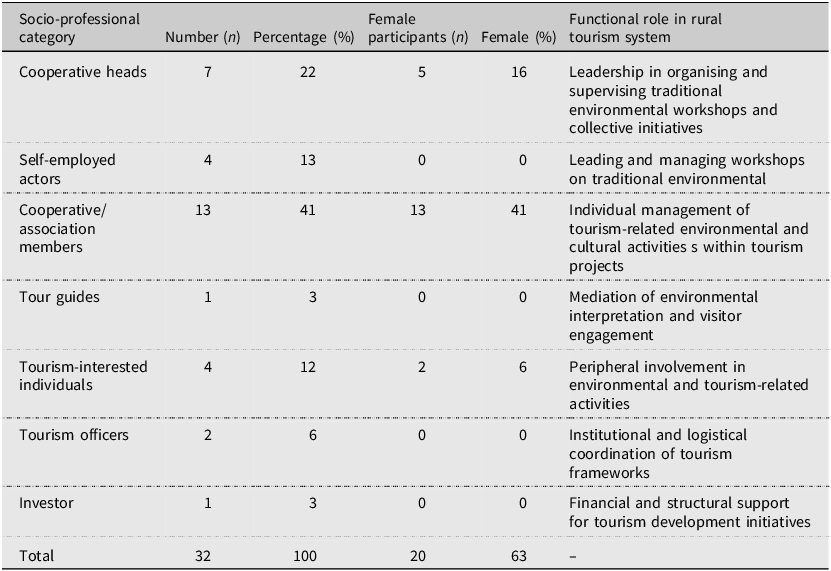
Table 1 provides a socio-structural reading of the actors involved in rural tourism, not as a descriptive enumeration of categories, but as an analytical mapping of how environmental knowledge, authority and practice are socially distributed within a polycentric rural system. The results reveal a differentiated yet interdependent configuration in which cooperative members – particularly women – constitute the structural core of environmental and cultural practice. Their predominance (41%) indicates that environmental knowledge is not externally introduced but internally produced and socially anchored within everyday cooperative life, confirming Berkes (2009) argument that ecological knowledge is fundamentally embedded in social organisation and lived practice.
Distribution of participants by socio-professional category and roles in tourism

Table 1. Long description
The table presents data on participants categorized by their socio-professional roles in tourism, including cooperative heads, self-employed actors, cooperative/association members, tour guides, tourism-interested individuals, tourism officers, and investors. It details the number and percentage of participants in each category, the number and percentage of female participants, and their functional roles in the rural tourism system. Cooperative members, particularly women, form the largest group at 41 percent, indicating a strong internal production of environmental knowledge within cooperative life.
Source: Self-generated using NVivo coding and participatory observation data (2025).
Cooperative heads (22%) occupy a mediating governance position, linking organisational coordination with the implementation of environmental workshops and collective activities. Their role is not merely administrative but also epistemic, as they facilitate the circulation of ecological knowledge across actors and spaces. Other categories, such as tourism officers, guides and investors, function as enabling or infrastructural agents, ensuring logistical continuity rather than direct knowledge production. This differentiated distribution reflects what Ostrom (Reference Ostrom2009) conceptualises as polycentric governance systems, where authority and responsibility are dispersed across multiple interacting nodes rather than concentrated in a single institutional centre.
This socio-structural configuration is empirically confirmed by participant narratives:
Yes, through direct awareness-raising with visitors and the involvement of local women.
This statement illustrates that environmental mediation is not institutionalised but socially enacted through interaction, dialogue and situated engagement. This finding aligns (Vygotsky, Reference Vygotsky1978) perspectives, which emphasise that knowledge emerges through socially mediated interaction.
Overall, Table 1 demonstrates that rural tourism is structured through a gendered and decentralised social ecology in which rural women occupy a central epistemic position as mediators of environmental knowledge, while other actors contribute to governance, facilitation and structural support.
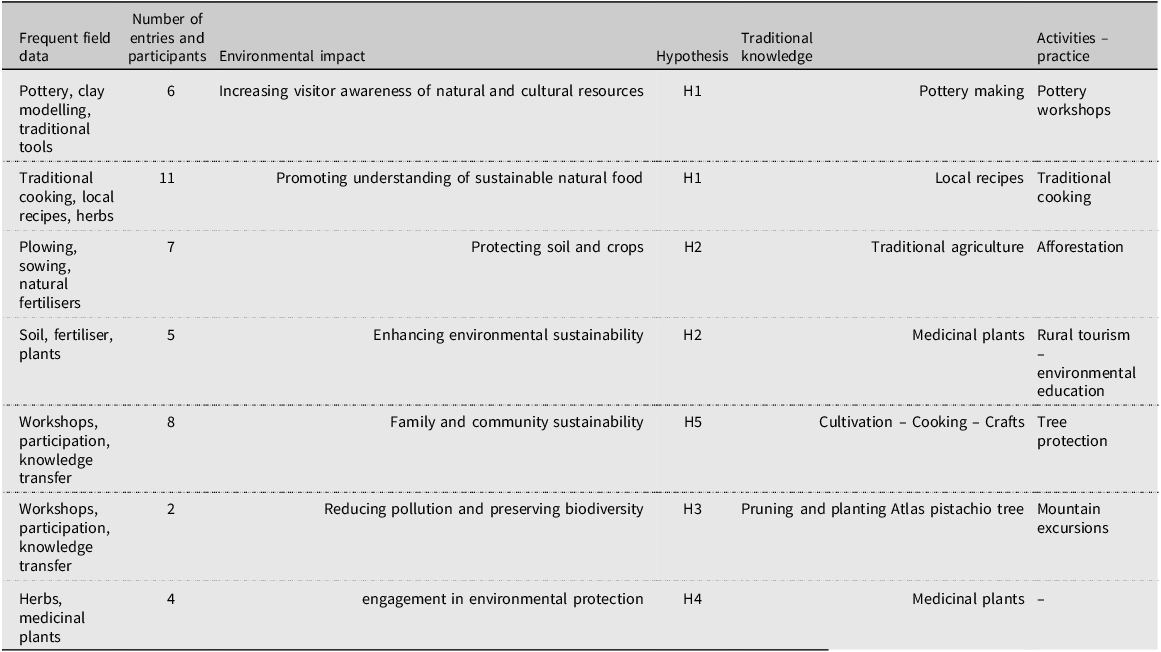
Table 2 examines how environmental education is enacted through everyday practices, revealing that learning is not institutionalised but embedded in lived cultural, ecological and tourism-related activities. Across the dataset, three interconnected clusters emerge: cultural-material practices, ecological production practices and participatory tourism experiences. These clusters operate as situated pedagogical environments where environmental knowledge is constructed through embodied engagement with materiality, nature and social interaction.
Frequent practices and their environmental impact

Table 2. Long description
The table presents data on the environmental impact of different practices, including pottery, traditional cooking, plowing, soil management, workshops, and herbal practices. It lists the number of entries and participants for each practice, along with their environmental impact, hypotheses, traditional knowledge involved, and associated activities. Notable trends include the high number of participants in traditional cooking and workshops, and the focus on sustainability and biodiversity preservation across various practices.
Source: Self-generated using NVivo coding and participatory observation data (2025).
From a theoretical standpoint, this configuration strongly reflects John Dewey’s (Dewey, Reference Dewey1938; Schmidt, Reference Schmidt2010) principle of “learning by doing,” where knowledge is not transmitted abstractly but emerges through action within real-life contexts. In this sense, environmental learning is not preparatory or anticipatory; it is generated within the act of doing itself. As Dewey (Reference Dewey1938) argues, experience is not an external condition of learning but its very substance, a principle clearly observable in rural tourism practices.
Cultural-material practices such as pottery, traditional cooking and handicrafts function as embodied learning environments where ecological knowledge is transmitted through sensory engagement, repetition and tacit observation. Similarly, agricultural practices – plowing, composting, irrigation and medicinal plant use – constitute experiential ecological systems in which learners acquire environmental understanding through direct interaction with soil, plants and seasonal cycles. One participant summarises this embedded rationality by stating:
We use traditional agricultural tools and avoid chemical inputs.
This illustrates a form of ecological rationality rooted in practice rather than formal environmental awareness programmes.
Participatory tourism further intensifies this learning process by transforming visitors from passive observers into active participants in ecological production. Guided tours, workshops and hands-on activities create conditions for what Kolb (Reference Kolb1984) defines as experiential learning, where knowledge emerges through the cycle of concrete experience, reflection and action. One participant explains:
Tourists learn through direct experience such as mountain walking and discovering local plants…
This experiential engagement suggests that environmental awareness is not simply transmitted as cognitive knowledge but is constructed through embodied, practice-based participation. Rather than being an individual acquisition, environmental learning emerges as a socially situated process shaped by everyday interactions, material conditions and inherited dispositions. In this regard, this perspective resonates with Vygotsky’s (Reference Vygotsky1978) theory of socially mediated learning, as well as with (García-Rosell et al.,), who conceptualise tourism as a co-creative system in which knowledge is collectively produced through interaction among actors.
This dynamic is reflected in participants’ narratives. As one participant explained:
We have an organic garden where we produce tomatoes, potatoes, peppers, eggplants, and almost all the vegetables we need. We also learned these practices from our parents.
Another participant added:
We learned to respect natural resources, to use water rationally, and to clean the forest after each tourist excursion.
A critical reading of these accounts reveals that such practices are embedded in broader socio-cultural structures rather than being neutral or purely technical. These narratives point to the centrality of intergenerationally transmitted dispositions – what can be understood, in Bourdieusian terms, as a form of ecological habitus – through which environmental practices are internalised and reproduced without formal codification. At the same time, they challenge dominant institutional narratives that frame sustainability as a top-down regulatory process. Instead, environmental responsibility appears as a situated form of everyday labour, much of which – particularly that performed by rural women remains insufficiently recognised within formal environmental governance frameworks.
From this perspective, rural tourism emerges not only as a space of knowledge co-creation but also as a site where environmental practices are enacted, negotiated and potentially appropriated within broader economic structures. Sustainability thus appears as a lived socio-material process but also as a contested field shaped by inequalities in recognition, resources and power.
Overall, Table 2 shows that environmental education in rural tourism is fundamentally experiential, embodied and relational. It is produced through action, sustained through practice and reinforced through interaction, fully consistent with Dewey’s (Reference Dewey1938) learning-by-doing model and (Kolb, Reference Kolb2014) experiential learning cycle, as well as contemporary co-creation theories in tourism studies, where value and meaning are jointly produced between experience providers and participants through direct interaction and shared experiences (Prahalad & Ramaswamy, Reference Prahalad and Ramaswamy2004).
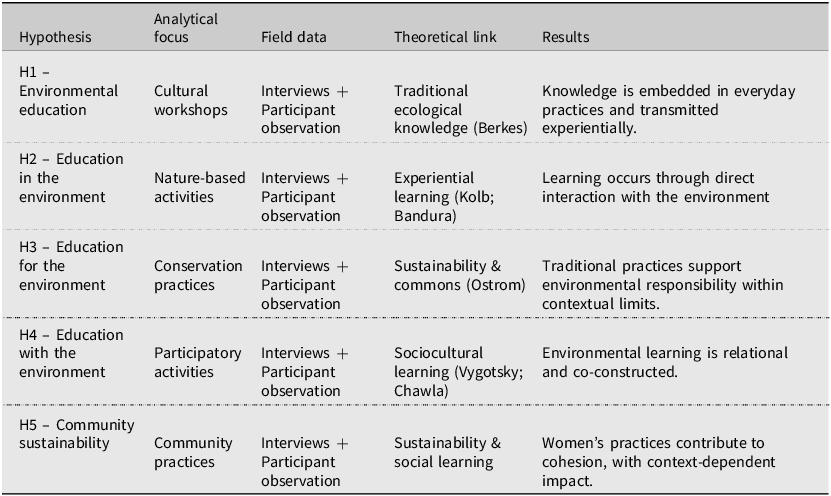
Table 3 provides a synthetic interpretation of the five hypotheses (H1–H5) within a unified socio-ecological framework, conceptualising rural tourism as a complex learning system in which environmental knowledge emerges through the articulation of cultural immersion, situated practices, relational interaction and gendered mediation. Rather than treating each hypothesis as an independent analytical category, the findings reveal an interdependent structure where learning is produced through everyday engagement with ecological and social environments. This interpretation aligns with the understanding of traditional ecological knowledge as a dynamic, place-based system embedded in lived practice and socially transmitted across generations (Berkes Reference Berkes1999; Berkes & Turner, Reference Berkes and Turner2006; Berkes et al., Reference Berkes, Colding and Folke2000).
Socio-ecological learning system

Table 3. Long description
The table compares five hypotheses on socio-ecological learning systems, focusing on cultural workshops, nature-based activities, conservation practices, participatory activities, and community practices. It includes columns for hypothesis, analytical focus, field data, theoretical link, and results. Each row details the specific focus, methods, theoretical links, and outcomes for each hypothesis, highlighting how environmental knowledge emerges through cultural immersion, situated practices, relational interaction, and gendered mediation.
Source: Self-generated using NVivo coding and participatory observation data (2025).
With regard to the integrated logic of H1–H2 (cultural and ecological immersion as experiential learning), the results demonstrate that environmental awareness is primarily generated through direct participation in culturally grounded and ecologically embedded activities. Practices such as traditional agriculture, artisanal production and engagement with local biodiversity function as experiential entry points into environmental understanding. One participant explains: “Tourists learn from rural tourism activities traditional agriculture, handicraft production, and the use of local herbs while being guided toward respect for nature.” This statement illustrates that environmental knowledge is not transmitted as abstract information but constructed through embodied participation in real-life contexts. This finding is consistent with Kolb’s (1984) experiential learning theory, which posits that knowledge emerges through the transformation of concrete experience into reflective understanding. It also resonates with Vygotsky’s (Reference Vygotsky1978) sociocultural theory, which emphasises that cognition is socially mediated and context-dependent. In this sense, immersion operates not merely as exposure to nature but as a process of meaning-making through situated action within socio-ecological systems.
Responsibility emerges from everyday rural practices rather than formal regulation. Activities such as organic farming, water conservation, waste management and soil care are embedded in daily life, as reflected in participants’ accounts of natural farming and respect for local resources. These insights align with commons-based governance, where sustainability is shaped by local norms and collective self-regulation (Ostrom, Reference Ostrom2009), and with perspectives that view stewardship as rooted in practice, adaptation and long-term environmental observation (Berkes et al., Reference Berkes, Colding and Folke2000). Thus, sustainability appears as a lived, socially embedded process rather than a formalised system.
In relation to H4 (relational co-production of environmental knowledge), the findings show that environmental learning is interactive and co-constructed between local actors and visitors rather than transmitted unidirectionally. Tourism activities function as participatory spaces where meaning is negotiated through shared practice, as reflected in participants’ views of tourists as active partners. This shift from consumption-based tourism to co-productive learning aligns with mediated learning perspectives, where knowledge emerges through dialogue, collaboration and social interaction Vygotsky (Reference Vygotsky1978). Evidence from Dar Lalla Azhour and “La Ferme Biologique” further demonstrates that workshops, ecological walks and participatory farming activities transform tourism into informal learning environments based on interaction and shared experience.
Finally, concerning H5 (gendered mediation and intergenerational ecological transmission), the findings underscore the central role of rural women as mediators of environmental knowledge within mountain tourism contexts. Women are not only participants in rural tourism activities but also key agents in the preservation and transmission of ecological knowledge across household and community domains.
As one participant, a representative of a local tourism association, explains, rural women can be considered pioneers in mountain tourism due to their role as carriers of traditional knowledge and their centrality in both domestic and tourism-related practices. She states that they are “reliably engaged inside and outside guesthouse settings.”
At the same time, she highlights the persistence of patriarchal structures in rural areas, where husbands, brothers, or sons often accompany and support women in carrying out tourism-related tasks. Accordingly, she cautions against assigning responsibility for rural tourism and environmental education solely to women, framing it instead as a collective and socially embedded process requiring continuous shared support.
These findings support an understanding of rural tourism as an “open social institution” through which environmental knowledge is continuously reproduced through everyday practices. They are consistent with (Shaw et al., Reference Shaw, Agarwal and Bull2000), who links women’s participation in natural resource management to enhanced ecological resilience. In this sense, rural women function as knowledge brokers who sustain intergenerational ecological continuity through everyday socio-material practices.
Overall, Table 3 conceptualises rural tourism as an integrated socio-ecological learning system structured around four interdependent mechanisms: experiential immersion (H1–H2), embedded environmental stewardship (H3), relational co-production of knowledge (H4) and gendered mediation (H5). Environmental knowledge is not formally transmitted but emerges through embodied practices, social interaction and everyday engagement with ecological systems.
The synthesis of findings across Tables 1–3 demonstrates that rural tourism operates as an integrated socio-ecological learning system structured around four interdependent mechanisms: experiential immersion, embedded environmental stewardship, relational co-production of knowledge and gendered mediation. Across these dimensions, environmental knowledge is not formally transmitted through institutional frameworks but emerges as a situated, embodied and practice-based process rooted in everyday engagement with cultural and ecological systems.
The findings further confirm that local actors play a decisive role in sustaining this system of environmental learning. In particular, women within cooperatives and community-based initiatives function as key mediators of intergenerational knowledge transmission. Through their involvement in agriculture, food practices, handicrafts and natural resource management, they contribute to the continuity and reproduction of socio-ecological knowledge within rural contexts. Their role is therefore not peripheral but constitutive of the sustainability dynamics embedded in rural tourism systems.
In parallel, the analysis reveals a transformation in the role of tourists, who shift from passive consumers of rural landscapes to active co-producers of environmental knowledge. Through direct participation in local practices, visitors become embedded in experiential and relational learning processes, thereby reinforcing the co-constructed nature of environmental awareness within tourism encounters.
Overall, this study confirms that rural tourism constitutes an informal yet structured arena of environmental education, in which sustainability-oriented knowledge is continuously produced through embodied practice, social interaction and the integration of cultural and ecological systems. This framing positions rural tourism not merely as an economic or leisure activity but as a dynamic socio-ecological space where learning, sustainability and community practice are fundamentally intertwined.
Discussion
This study examines environmental education processes within rural ecotourism contexts, focusing on how knowledge, practices and social relations shape socio-ecological learning systems. Based on participants’ lived experiences, it explores how environmental understanding is constructed and transmitted through everyday practices and interactions, with particular attention to the role of rural actors, especially women, in sustaining environmental knowledge.
Environmental knowledge is continuously reproduced through everyday socio-material practices embedded in rural life, particularly through women’s engagement in agricultural, domestic and community-based activities (H1). This process aligns with Shaw et al. (Reference Shaw, Agarwal and Bull2000), who highlight women’s role in strengthening ecological resilience through locally grounded resource management practices, as well as with commons-based socio-ecological perspectives that view environmental governance as emerging from collective, place-based knowledge systems Ostrom (Reference Ostrom1990). Accordingly, rural women act as key knowledge transmitters, embedding environmental understanding within daily routines and ensuring its continuity through embodied, experiential and intergenerational practices.
The shelter includes a group of working women … we bake traditional bread in a traditional oven, consume oil ground in a traditional mill, and prepare olives processed using stone pressing and dried with herbs. In addition, we engage in beekeeping through both traditional and modern hives, while production remains natural as bees forage across forests, dams, and grazing areas.
Environmental awareness in the studied context is primarily constructed through embodied engagement with agricultural and cultural practices (H2). Participants emphasised that learning occurs through direct interaction with land, crops and traditional production systems. Irrigation, planting and craft-based activities such as pottery serve as informal learning spaces where ecological understanding is developed through practice. Environmental knowledge is thus materially embedded and emerges through engagement with ecological cycles. In addition, tourism activities such as mountain walking and plant identification foster sensory, emotional and spatial learning, consistent with Dewey’s experiential philosophy and extending Kolb’s experiential learning cycle toward situated and collective learning processes (Kim & Stepchenkova, Reference Kim and Stepchenkova2015).
For irrigation, we dig water channels using a hoe and an axe, and we carry out planting according to the agricultural calendar. We also organize workshops through which not only visitors but also local boys and girls participate. We conduct pottery workshops in which we produce items used at home for drinking, storing black olives, and decoration by transforming them into plant pots.
The findings also highlight the centrality of experiential immersion in natural environments as a mechanism of environmental learning further reinforcing H2 through sensory and place-based engagement. Tourism activities such as mountain walking and plant identification create conditions for direct sensory engagement with biodiversity. One participant explained how immersive experiences foster environmental awareness and responsibility.
Tourists learn through direct experience such as mountain walking and discovering local plants, which makes them more aware of the impact of their actions on nature.
Another key dimension concerns environmental stewardship as an embedded and collective governance practice supporting H3 on education for environmental sustainability. The data show that environmental responsibility is not externally imposed but internally regulated through everyday actions such as water conservation, waste management and organic farming. Participants emphasised routine practices of environmental care, reflecting an internalised ecological ethic in which sustainability is enacted through daily life. This aligns with Ostrom’s (Reference Ostrom2009) theory of commons governance, which explains how sustainable resource management emerges through locally embedded norms and collective responsibility.
We daily rationalize water consumption, collect and sort waste, and maintain the cleanliness of natural pathways.
In addition, traditional agricultural practices, particularly the use of natural fertilisers, are presented as practical alternatives to chemical inputs, reflecting a broader ecological logic of balance between humans and nature and reinforcing the material dimension of sustainability practices directly aligning with H3.
Our reliance on natural fertilizer, which we produce using traditional methods, protects both the soil and human beings from the toxicity of chemical fertilizers.
Another key dimension concerns the relational co-production of environmental knowledge between visitors and local communities upporting H4 on co-creative environmental learning in ecotourism contexts. Tourists are not passive recipients but active participants in knowledge creation through their engagement in daily rural practices. As participants noted, immersion in local activities enables visitors to experience the environment as insiders rather than observers. This reflects a shift toward co-creative learning systems in which knowledge emerges through interaction and shared practice. From a sociocultural perspective, learning is socially mediated and constructed through interactional meaning-making processes Vygotsky (Reference Vygotsky1978).
The participation of tourists in daily traditional activities immerses them in the natural environment of the region as if they were locals rather than passing visitors.
However, this process is not without tension, as rural tourism may also involve the commodification and selective representation of traditional ecological knowledge, raising questions about authenticity and power relations in knowledge production (Rastegar et al., Reference Rastegar, Higgins-Desbiolles and Ruhanen2023).
Finally, women’s environmental leadership in the studied rural context emerges as a situated, practice-based form of governance embedded in everyday socio-ecological life, supporting H5 on women’s leadership and socio-ecological sustainability. Rather than being expressed through formal authority, it operates through the capacity to coordinate, organise and sustain environmental practices within household and community settings, reflecting a continuum of socio-ecological practice ranging from knowledge transmission to environmental leadership, as evidenced in “Dar Lalla Zhour,” where women are actively engaged in food production, ecological practices and knowledge transmission within tourism-based activities. However, empirical evidence also reveals that such leadership is relational and negotiated within existing socio-cultural structures.
As one rural tourism association noted, “Rural women can be considered pioneers in mountain tourism and environmental education, as they are the main holders of traditional knowledge and are relied upon both inside and outside guesthouses. However, patriarchal norms and traditional cultural representations remain present in rural contexts, where the presence of a husband, brother, or son often provides support in tourism-related activities. Therefore, rural tourism and environmental education cannot be considered solely the responsibility of women, but rather a collective system requiring shared and continuous support to ensure sustainable environmental practices.”
This view is consistent with studies on women’s environmental leadership, which emphasise that agency is shaped within a socio-cultural framework defined by gender norms and simultaneously enabled and constrained by them. Sustainability is thus understood not only as an outcome of ecological knowledge but also as the result of everyday practices of organisation and governance through which environmental continuity is socially reproduced within socio-ecological systems.
In this context, women’s environmental leadership operates within a socio-cultural framework in which agency is both enabled and constrained. However, this form of leadership also reveals the complexity of gendered environmental roles, as it is often practised within informal structures of care and responsibility. While it contributes to the continuity of ecological practices, it also raises critical questions about the boundary between empowerment and the unequal distribution of unpaid or under-recognised labour in rural economies (Elmhirst, Reference Elmhirst, Perreault, Bridge and McCarthy2015; Kabeer, Reference Kabeer2021).
Building on this conceptual framework, the empirical findings show a differentiated but coherent support for H1–H5, confirming that environmental learning in rural ecotourism is an emergent socio-ecological process co-produced through embodied practice, social interaction, collective governance and gendered structures.
H1–H2 are strongly supported through place-based experiential learning, H3 through integrated collective stewardship and H4 through co-creative knowledge production between local actors and visitors. H5 is more complex, indicating that women’s environmental leadership is central yet structurally negotiated within socio-cultural constraints.
From a theoretical standpoint, the findings extend existing frameworks on environmental education, socio-ecological systems and experiential learning by shifting from treating them as separate explanatory categories to viewing them as a relational and co-evolving system of knowledge production. Rather than considering women’s entrepreneurship, traditional knowledge and environmental education as distinct variables, the study conceptualises environmental learning as a constitutive process through which socio-ecological relations are continuously produced and reconfigured in rural ecotourism contexts. This reconceptualisation moves beyond linear models toward a relational and process-based understanding of socio-ecological transformation (Dewey, Reference Dewey1938; Kolb, Reference Kolb2014; Vygotsky, Reference Vygotsky1978).
Taken together, the hypotheses represent interdependent dimensions of a single socio-ecological system, where environmental education is continuously produced through the interaction of practice, participation and social relations.
Conclusion
This study, grounded in empirical fieldwork conducted in rural tourism settings in the Taounate region of Morocco, provides a sociologically informed understanding of how rural tourism functions as a site for the production, circulation and transformation of knowledge. Within a context where rurality remains structurally dominant, with approximately 84% of the population living in rural areas, the findings demonstrate that rural women entrepreneurs occupy a pivotal position in mediating between traditional ecological knowledge and contemporary forms of environmental awareness and practice.
Through qualitative data analysis using NVivo and participatory field observations, the study shows that rural tourism extends beyond economic exchange to function as socio-cultural spaces where environmental, social and cultural values are continuously produced and negotiated. Practices such as pottery, traditional cooking, organic farming, hiking, tree planting and plant conservation operate as embodied forms of experiential learning that foster knowledge sharing, social participation and the development of social and cultural capital in rural life.
From a sociological perspective, informal environmental education in the Taounate region is deeply embedded in daily practices and collective knowledge systems. The recurring themes identified – medicinal plant use, traditional agriculture, forest and biodiversity protection, harvesting of aromatic species and local food preservation systems – reflect a situated environmental rationality transmitted through practice rather than formal instruction. In this sense, rural tourism operates as a hybrid arena in which knowledge is preserved, adapted and recontextualised in response to contemporary environmental and developmental challenges.
The study further highlights rural women entrepreneurs as key agents of socio-ecological mediation. Their role extends beyond economic entrepreneurship to include cultural brokerage, educational facilitation and environmental stewardship. In doing so, they contribute to the development of alternative models of rural development that integrate sustainability, community participation and gendered forms of agency. This positions women not only as beneficiaries of development processes but also as active co-producers of local environmental governance.
Theoretically, the findings contribute to broader debates in environmental sociology, rural studies and development theory by reinforcing the relevance of experiential learning, social learning and commons-based approaches in explaining how environmental knowledge is generated and sustained in rural contexts. They also extend gender and sustainability scholarship by highlighting women’s leadership as both a structural and symbolic dimension of rural socio-ecological governance.
This theoretical positioning extends beyond existing explanatory frameworks by moving from their application to proposing a relational and process-oriented understanding of socio-ecological transformation, in which entrepreneurship, knowledge systems and environmental learning are mutually constitutive rather than analytically separate domains.
Although the study provides rich qualitative insights, it remains geographically limited to the Taounate region. This limitation opens avenues for future comparative research across different rural contexts in Morocco and beyond, particularly to examine variations in rural tourism models and their implications for environmental behaviour, community resilience and socio-economic transformation.
In conclusion, rural tourism in Taounate should be understood not merely as an economic sector but as a complex socio-educational field in which traditional knowledge systems, environmental practices and women’s agency intersect. Methodologically, the study also demonstrates the value of combining NVivo-assisted qualitative analysis with participatory observation, offering a robust framework for investigating socio-ecological dynamics within environmental sociology.
Acknowledgements
The authors would like to express their sincere gratitude to all individuals and institutions who contributed to the completion of this work. Their support and assistance were invaluable throughout the research process.
Ethical statement
The authors declare that this study was conducted in accordance with established ethical standards for academic research. No ethical approval was required for this study, and the authors declare that there are no conflicts of interest associated with this work.
Financial support
This study received no specific grant from any funding agency, commercial or not-for-profit sectors.
Author Biographies
Fatma Mziouka is a researcher in sociology at Sidi Mohamed Ben Abdellah University. She holds a Master’s degree in Rural Sociology and Development (2021) and is currently a fifth-year PhD candidate. Her research focuses on the social and solidarity economy, rural development, women’s entrepreneurship, traditional knowledge and environmental sustainability. Drawing on experience in teaching, educational administration and civil society engagement, she has presented at international conferences, including the Arab Council for the Social Sciences conference in Beirut, and has published two peer-reviewed articles on development and rural women’s entrepreneurship.
Saadeddine Igamane is a professor-researcher in sociology at Sidi Mohamed Ben Abdellah University, where he directs the Laboratory for Cultural and Social Research and Studies and coordinates the Master’s Program in Sociology of the Social and Solidarity Economy. He holds two PhDs, one in Sociology and another in Economics. His research focuses on sociology of work, entrepreneurship, digital labour, SSE, precarity and public policy evaluation. With over twenty years of field experience, he has published more than 70 peer-reviewed articles and book chapters and leads national and international research and consultancy projects on social inclusion and sustainable development.

 Open access

