

Introduction
On 7 October 2023, the Jewish holiday of Simchat Torah, Hamas launched a series of coordinated attacks on southern Israel, sparking the Israel-Hamas war. Hamas fired over 3000 rockets into Israel in a matter of hours while its militants breached the border between Gaza and Israel at multiple points. In a coordinated assault, they went on to attacks nearby Israeli communities as well as the Nova music festival, killing, raping, and kidnapping civilians. The attack’s death toll, mostly civilians, surpassed 1200, and more than 240 people were kidnapped and taken into Gaza (Fassin, Reference Fassin2024: 8). The Israeli state quickly declared war and commenced airstrikes on Gazan Hamas targets the same day.
Seventy-nine years earlier, on 7 October 1944, Jewish Sonderkommando prisoners at the Auschwitz II-Birkenau camp rose up against their captors. The Sonderkommando were units of prisoners enlisted to carry out much of the labour inherent to the murder and disposal of their fellow inmates. The ‘Sonderkommando revolt’, as it is often known, hinged on an attempt to blow up the camp’s crematoria using explosives smuggled from a munitions factory located within the Auschwitz complex (Graif, Reference Graif2014). The revolt saw 250 inmates and 3 camp guards killed and led to the reprisal execution of around 200 further camp prisoners, including 4 women who had smuggled the explosives (Graif, Reference Graif2014; Putnam, Reference Putnam2023).
In this article, we take advantage of these two events’ coinciding anniversaries to explore how Holocaust memory is comparatively instrumentalized on social media in relation to ongoing conflict in the Middle East. To do this, and to fruitfully interrogate digital Holocaust memory in politically sensitive contexts, we adapt Michael Rothberg’s concept of multidirectional memory (Reference Rothberg2009; Reference Rothberg2019). We ask two questions: how did social media users on X react to Auschwitz-Birkenau State Museum’s commemoration of the eightieth anniversary of the Sonderkommando revolt on the first anniversary of 7 October 2023 Hamas attacks? And how can the concept of multidirectional memory be used to understand the comparative instrumentalization of Holocaust memory on social media? Guided by these questions, we first outline how Holocaust memory has been politically instrumentalized since 7 October 2023 and indicate a crisis of purpose and comparison that has subsequently beset those fields that study it. Thereafter, we position our analysis with respect to the wider literature on digital Holocaust commemoration and contestation, specifically the need for more research into how regular social media users respond to the commemorative use of social media platforms by Holocaust memorial and education institutions (HMEIs).
Approaching mnemonic instrumentalization as a form of ‘working memory’ and an active, laboursome, adaptive engagement with the past given present circumstances (Rigney, Reference Rigney2005; Assmann, Reference Assmann2011; Bar-Gil, Reference Bar-Gil2025), we then acknowledge that the alignment of the anniversaries of the Sonderkommando revolt and 7 October 2023 Hamas attacks creates a generative yet fraught context in which to apply Michael Rothberg’s concept of multidirectional memory (introduced Reference Rothberg2009). In this respect, we adapt Rothberg’s schematic of multidirectional memory (Reference Rothberg2019) in terms of the comparative instrumentalization of Holocaust memory and empathetic and polarised forms of its commemoration and contestation. Our aim with this is to nuance understandings of social media users’ reactions to HMEI’s social media-based commemorative efforts and to complicate any simplistic and reductionist equation of instrumentalization directly with antisemitism.
Empirically, and as detailed in an intervening methods section, we analyse social media user engagements with a series of posts that commemorated the Sonderkommando revolt published by Poland’s Auschwitz-Birkenau State Museum’s account (@auschwitzmuseum) on X (formerly Twitter), around the eightieth anniversary of the revolt and the first anniversary of the 7 October 2023 Hamas attacks. Based on a close reading and abductive coding of the comments and quote reposts that @auschwitzmuseum’s Sonderkommando revolt posts received, we show how social media users comparatively instrumentalized Holocaust memory to reinforce and legitimate opposing moral and political judgements of the 7 October 2023 Hamas attacks and the consequent Israel-Hamas war.
Background: Holocaust memory in the year after 7 October 2023
Holocaust memory, like collective memory in general, is dynamically shaped by a myriad of social and political factors in the present (Erll, Reference Erll2025). Reflecting this, political leaders, most prominently Israeli Prime Minister Benjamin Netanyahu and US President Joe Biden, quickly drew parallels between the Holocaust and the Hamas attacks (see Benjamin, Reference Benjamin2023). The latter recurrently stated that 7 October 2023 had become ‘the deadliest day for Jewish people since the Holocaust’ (Benjamin, Reference Benjamin2023). Following numerous other similar mnemonic references, the former turned to the Holocaust again in January 2024 after the UN (2024) had begun collecting evidence of war crimes committed by both Hamas and the Israeli state, and the International Court of Justice (ICJ) ruled that Israel should do all possible to prevent genocide in Gaza (UNOHCHR, 2024). In a television address, Netanyahu rejected the charges of genocide against Israel and stated:
On the eve of the International Holocaust Remembrance Day, I again pledge as Israel’s Prime Minister: never again. (Netanyahu, Reference Netanyahu2024).
In March 2024, the UN special rapporteur on the Occupied Palestinian Territories, legal scholar and human rights expert, Francesca Albanese, reported reasonable grounds to believe that the Israeli state’s military operations in Gaza were genocidal (Albanese, Reference Albanese2024). She reported, at that time, 30,000 Palestinians dead, including over 13,000 children, 12,000 more presumed dead, 71,000 injured, the destruction of 70 per cent of Gaza’s residential areas, and the forced displacement of 80 per cent of its population. Elsewhere, Albanese also invoked the Holocaust when criticizing Israel’s military actions in Gaza. In one X post, she wrote:
…after the Holocaust, we should instinctively know that Genocide starts with dehumanizing the Other. If Israel’s current attack agst (sic) Palestinians doesnt prompt our strong reaction, the darkest page of our recent history has taught us nothing. (Albanese, Reference Albanese2023)
For this and other public comments, she was accused of Holocaust trivialization and antisemitism (see ADL, 2024). Still, by late 2024, following an escalating humanitarian crisis in Gaza caused by the Israeli state cutting off electricity, fuel, and water to the territory, there was growing support for the view that the Israeli state’s actions were amounting to genocide. This was bolstered by International Criminal Court (ICC) arrest warrants for Netanyahu and his former minister of defence for war crimes and crimes against humanity (Malik, Reference Malik2024).
The increasingly polarised political use of the Holocaust in the year after 7 October 2023 indicates a new phase in its instrumentalization. On one side, the propagandistic and power-based use of Holocaust memory, including the ‘Never Again’ sloganFootnote 1 relates to the Israeli state’s longer-term strategy to normalise the view that its creation was solely the outcome of the Holocaust and should be secured by pre-emptive military defence (Arad, Reference Arad2003; Wermenbol, Reference Wermenbol2021, Reference Wermenbol2025). On the other side, it relates to the Holocaust’s mnemonic use within post-World War II human rights regimes (Levy and Sznaider, Reference Levy and Sznaider2004). While the latter instrumentalization and the universalist notion of ‘Never Again Anyone’ have long held sway internationally, it is increasingly challenged by the former instrumentalization’s resurgence and a particularist notion of ‘Never Again Us’ (see Wermenbol, Reference Wermenbol2025), further thrusting HMEIs into spaces of polarised political debate.
This has happened not only against the backdrop of Israel’s escalating military interventions in the Middle East but also rising antisemitism across the world, both on and offline (Gruber et al., Reference Gruber, Loy and Poensgen2024; Katzin and Rudberg, Reference Katzin and Rudberg2024; Schwartz et al., Reference Schwartz, Leiba, Feldman, Spence, Oratz, Wald and Roth2025). The result has been a ‘Catch-22’ situation for many HMEIs. The term ‘Catch-22’, coined by Joseph Heller as the title of his 1961 novel, describes paradoxical circumstances that cannot be escaped due to contradictory limitations. We use ‘Catch-22 commemoration’ to analytically acknowledge how HMEIs are expected by some to justify their focus on the Holocaust, given the current violence in the Middle East, while simultaneously avoiding accusations of Holocaust distortion, trivialization, and even antisemitism by others who, in extremis, equate concern for Palestinian civilians with support for Hamas. Catch-22 commemoration here relates to a double-bind that HMEIs find themselves in when trying to placate two polarised forms of Holocaust instrumentalization: one that applies a universalising human rights principle to all instances of actual or potential genocide, and the other that is nationalistic, propagandistic, and reserved only for one group, usually Jews and/or Israeli citizens (see Wermenbol, Reference Wermenbol2025).
This Catch-22 situation was indicated when Auschwitz-Birkenau State Museum excluded speeches from politicians when marking the eightieth anniversary of the camp’s liberation, events made more controversial by the impossibility of Netanyahu attending due to Poland’s ICC membership (Lanicek and Alba, Reference Lanicek and Alba2025). This was prescient, given the controversy caused when the Irish President Michael Higgins discussed Gaza on the same day at Ireland’s Holocaust Memorial (McGreevy, Reference McGreevy2025). Controversy also surrounded the eightieth anniversary of Buchenwald’s liberation. Philosopher Omri Boehm, grandchild of a Holocaust survivor, was invited to talk about reconciling universalist and particularist notions of ‘Never Again’, but this invitation was then retracted after pressure from the German Israeli embassy (Boehm, Reference Boehm2025; Nöstlinger, Reference Nöstlinger2025). On X, the embassy accused Boehm of relativizing the Holocaust ‘under the guise of scholarship’ via its comparison with the NakbaFootnote 2 and diluting its memory ‘with his discourse on universal values, thereby robbing it of its historical and moral significance’ (Botschaft Israel, Reference Botschaft2025).
These events reveal how sensitivities associated with researching Holocaust memory have scaled up since 7 October 2023 to the point where Holocaust Studies, Genocide Studies, and, relatedly, Memory Studies have been beset by a polarising crisis of confidence and purpose (Novis-Deutsch and Adams, Reference Novis-Deutsch and Adams2024; Schmutz, Reference Schmutz2024; Verdeja, Reference Verdeja2025). This crisis partly concerns whether the Holocaust should be the primary evaluative measure for other mass atrocities and whether critiquing the Israeli state, including accusing it of genocide, is antisemitic (Verdeja, Reference Verdeja2025). It hinges on deeply rooted debates about the comparability of the Holocaust and its paradoxical status as simultaneously unique and universal: morally unique in its evil but universal in that all cases of genocide have subsequently been measured against it (Verdeja, Reference Verdeja2025). These debates animate the theory of multidirectional memory (Rothberg, Reference Rothberg2009), which – as detailed later – we adopt and adapt here as an overarching conceptual framework. They also increasingly play out online, particularly on social media, often serving to determine the boundaries between digital Holocaust commemoration and contestation.
Literature review: Digital Holocaust commemoration and contestation during anniversaries
Digital Holocaust commemoration emerged with the earliest uses of digital technology and the internet to preserve and disseminate Holocaust survivor testimonies and collections by museums and memorials in the late 1990s and early 2000s (see Reading, Reference Reading2003; Bar-Gil, Reference Bar-Gil2025). The arrival of social media further transformed the digital commemoration of the Holocaust, widening the productive capacity to engage in it beyond just those actors officially tasked with safeguarding its memory (see Walden, Reference Walden2021; Bar-Gil, Reference Bar-Gil2025). Since then, numerous studies have addressed how social media platforms, including YouTube, Facebook, Twitter (now X), Instagram, and TikTok, have been used to commemorate the Holocaust and how, in turn, their technological affordances have shaped digital Holocaust memory more broadly (see Makhortykh, Reference Makhortykh2019; Henig and Ebbrecht-Hartmann, Reference Henig and Ebbrecht-Hartmann2022; Ben-David et al., Reference Ben-David, Meyers and Neiger2024; Richardson-Walden and Marrison, Reference Richardson-Walden and Marrison2024). The growth in this research partly reflects an intensification in digital Holocaust commemoration during the COVID-19 pandemic. Social distancing mandates led HMEIs to use social media as alternatives (and subsequently supplements) to their earlier, long-term reliance on in-person activities, especially as the pandemic coincided with the 75th anniversaries of the liberation of the last Nazi concentration and extermination camps (see Ebbrecht-Hartmann, Reference Ebbrecht-Hartmann2021; Walden, Reference Walden2022).
A comprehensive review of research dedicated to digital Holocaust memory is beyond the scope of this article, but can be found, to some extent, elsewhere (see Manca, Reference Manca2021a; Tirosh and Mikel-Arieli, Reference Tirosh and Mikel-Arieli2023). This article intervenes in the field specifically in relation to social media users’ online engagement with HMEIs and how this contributes to a ‘blurring of boundaries between official and grassroots commemoration’ while also entailing challenging forms of contestation (Manca, Reference Manca2021a, 244). For instance, in their review of the field between 2010 and 2019, Tirosh and Mikel-Arieli (Reference Tirosh and Mikel-Arieli2023) note that while social media has partially decentralised and democratised digital Holocaust memory, user narratives rarely stray from those promoted by HMEIs. Conversely, Manca and Passarelli (Reference Manca and Passarelli2023) have quantitatively studied the motivations, interests, and online activities of followers of HMEI social media accounts across Germany and Italy, revealing how they actively reshape commemorative content through comments, shares, and visual engagement. This research indicates that while there may be continued debate over exactly how social media redistributes agency and influence over digital Holocaust memory, there is consensus that these are no longer the sole preserve of HMEIs (see Bar-Gil, Reference Bar-Gil2025).
This, in turn, amplifies the sort of ‘Catch-22’ situations that HMEIs face. Not least because they usually rely on independent donors and governmental subsidies, meaning that at best, they must skirt those schismatic topics that are common online and, at worst, avoid them altogether (Kansteiner, Reference Kansteiner and Hoskins2017). This limits the public engagement potential of social media, as HMEIs often do not interact with those users who comment on their posts. Much research acknowledges the struggles of HMEIs to engage regular social media users (see Manca, Reference Manca2021a, Reference Manca2021b; Manca et al., Reference Manca, Passarelli and Rhem2022; Walden, Reference Walden2022), but more qualitative analyses of social media users’ reactions to the online commemorative content of HMEIs are needed. In her review of the field (also between 2010 and 2019), Manca (Reference Manca2021a, 244–245) called for more research into the ethical dilemmas that arise when HMEIs engage audiences via social media from a multidirectional perspective. In line with this and following Manca and Passarelli (Reference Manca and Passarelli2023), we focus qualitatively on the interactions between social media users and one HMEI to explore how the social media accounts of the latter serve as a forum for participatory commemoration, yet also facilitate contestation.
We recognise, in other words, that user reactions to HMEI posts, especially in politically sensitive situations, are not always commemorative in character. They can also involve Holocaust contestation, with social media providing new ways to disseminate antisemitic content. Digital antisemitism has grown alongside a general increase in reported antisemitic incidents in many countries, linked, as with the intensification of digital Holocaust commemoration, to the impact of the COVID-19 pandemic. Its growth also reflects political shifts towards the far-right, preceding and following 7 October 2023, in which far-right actors have also increasingly weaponised accusations of antisemitism against their political opponents (see Divon and Ebbrecht-Hartmann, Reference Divon, Ebbrecht-Hartmann and Boffon2022; Hübscher and von Mering, Reference Hübscher, von Mering, Hübscher and von Mering2022). In using working definitions of antisemitism that include Holocaust denial, distortion and inversion – like those of the International Holocaust Remembrance Alliance (IHRA)Footnote 3, many studies acknowledge the links between digital antisemitism and digital Holocaust memory (see also UNESCO, 2022). However, with a few exceptions (see Neiger et al., Reference Neiger, Meyers and Ben-David2023; Novis-Deutsch et al., Reference Novis-Deutsch, Lederman, Adams and Kochavis2023), there is still little research that explicitly considers the interplay of digital Holocaust commemoration and contestation as we do here.
This is often more pronounced during anniversaries, which provide a mnemonic rhythm in scheduling remembrance, creating opportunities for planned contestation and to sustain or revive commitment to political causes (Merrill and Lindgren, Reference Merrill and Lindgren2018; Richardson-Little et al., Reference Richardson-Little, Merrill and Arlaud2022; Rigney, Reference Rigney2025). This is especially the case during so-called ‘benchmark’ anniversaries, like the first or eightieth, because these are societally afforded greater significance (Forrest, Reference Forrest1993). Here then, we recognise that the affordances of social media do not take hold in a vacuum but combine with broader social conditions, including rhythms of remembrance and the affective and emotional labour of their users in shaping digital Holocaust memory (see Bar-Gil, Reference Bar-Gil2025). Additionally, insofar as events can share anniversaries (see Leggewie, Reference Leggewie and Tamm2015), these moments lend themselves to multidirectional forms of memory where different events can mnemonically coalesce or contend.
Conceptual framework: Multidirectional memory and comparative instrumentalization
Rothberg’s concept of multidirectional memory challenges the idea that memories of different historical traumas must compete for recognition (Reference Rothberg2009; Reference Rothberg2019; Reference Rothberg2022). Resonating with theories of postmemory (Hirsch, Reference Hirsch1997) and cosmopolitan memory (Sznaider and Levy, Reference Sznaider and Levy2002), which stresses the transnationality of Holocaust memory in a globalised world (see also Eder et al., Reference Eder, Gassert and Steinweis2017), multidirectional memory moves beyond these to a relational understanding of collective remembrance whereby remembering one mass atrocity can open space for remembering others. Rather than being a zero-sum game, multidirectional memory is ‘subject to ongoing negotiation, cross-referencing, and borrowing’ across political, geographical, social, and historical contexts (Rothberg, Reference Rothberg2009: 3). Compatible also with theories that stress the ‘travelling’ of memory throughout digitally connected media, sites, and scales, often via an ecology metaphor (Erll, Reference Erll2011; Hoskins, Reference Hoskins2018), we deploy multidirectional memory in a digital setting here, partly because of its specification with respect to our empirical focus, the Holocaust, and in response to others’ calls to better accommodate HMEI’s digital practices in a multidirectional perspective (Manca, Reference Manca2021a: 245; Manca, Reference Manca2024). While potentially underestimating the governance and circulation dynamics of social media platforms, the concept is well-suited to our primary interest in how social media users respond to HMEIs online by composing comparative relations between different events and posts.
In short, such actions resonate with the concept’s use in revealing how memory of historical atrocities can be redeployed to interrogate and critique other acts of large-scale violence without erasing their specificity. In this vein, Rothberg (Reference Rothberg2009) has shown how Holocaust memory became instrumental in both conceiving of and acting upon colonial violence, helping to kickstart a decolonial turn in Memory Studies by placing the Holocaust within broader histories of empire, colonialism, and racial violence (Silverman, Reference Silverman2013).
However, the concept has faced critique, ‘caught up in the old question of the uniqueness of the Holocaust’ and debates regarding its comparability linked to shifting broader ‘memory regimes’ in countries like Germany (Rothberg, Reference Rothberg2022; Kékesi and Zombory, Reference Kékesi and Zombory2023: 1665; see also Kubik and Bernhard, Reference Kubik, Bernhard, Bernhard and Kubik2014). It has also been accused of de-politicising memory by departing from an empirical assumption that colonisation and the Holocaust were earlier viewed as separate, thus elevating memory over political-ideological commitment as a main pathway to solidarity (Kékesi and Zombory, Reference Kékesi and Zombory2023). Rothberg later acknowledged that multidirectional memory is not completely beyond competition because almost any political position can instrumentalize it (Reference Rothberg2019: 123). Furthermore, he conceptualised political, moral, and ethical positionality and responsibility of those human actors – whether academic, institutional, political, or public – who employ multidirectional Holocaust memory via the notion of the implicated subject (Reference Rothberg2019). Accordingly, although we do not treat social media users who respond to HMEIs online strictly as implicated subjects, we do recognise them to be mnemonic actors with political, moral, and ethical positions and responsibilities.
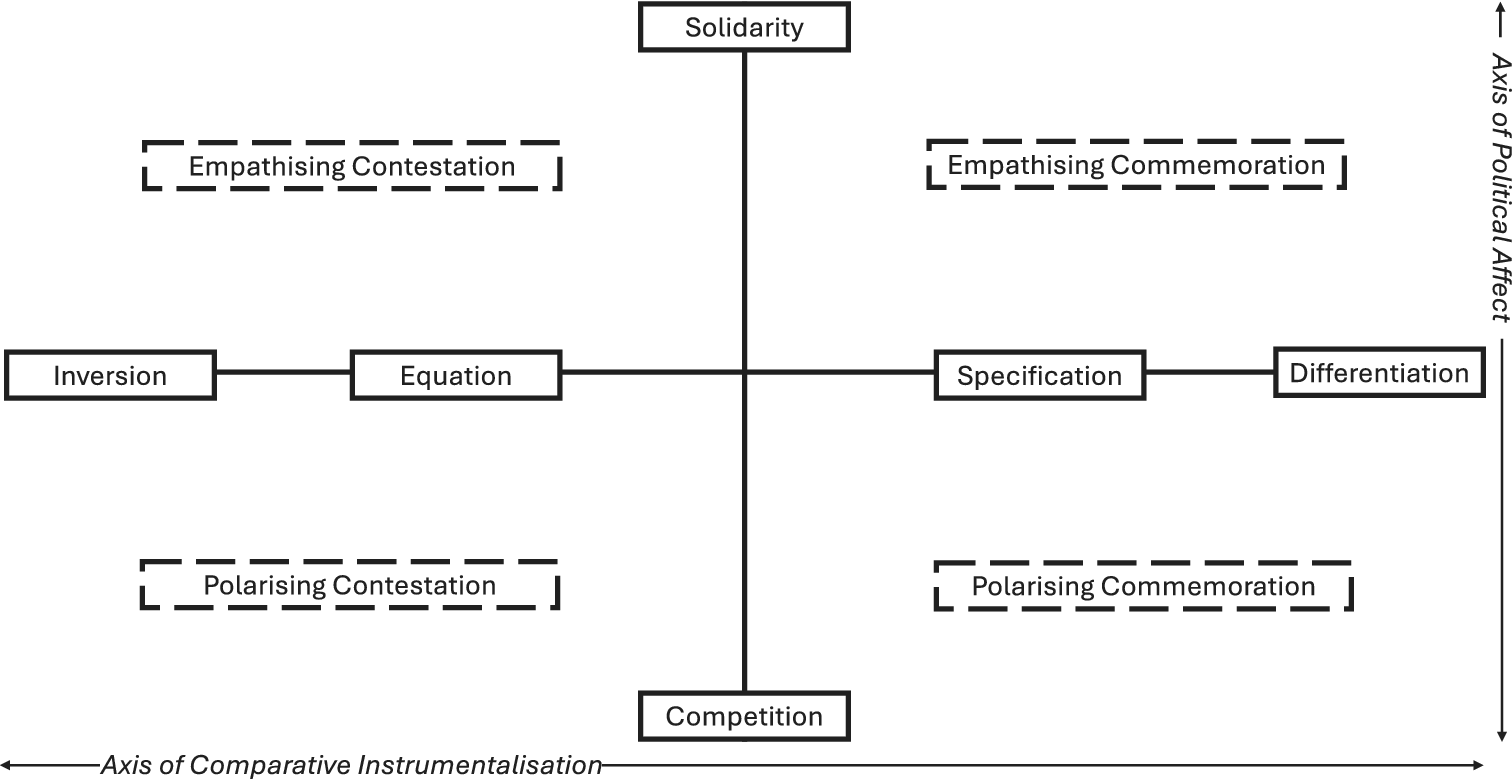
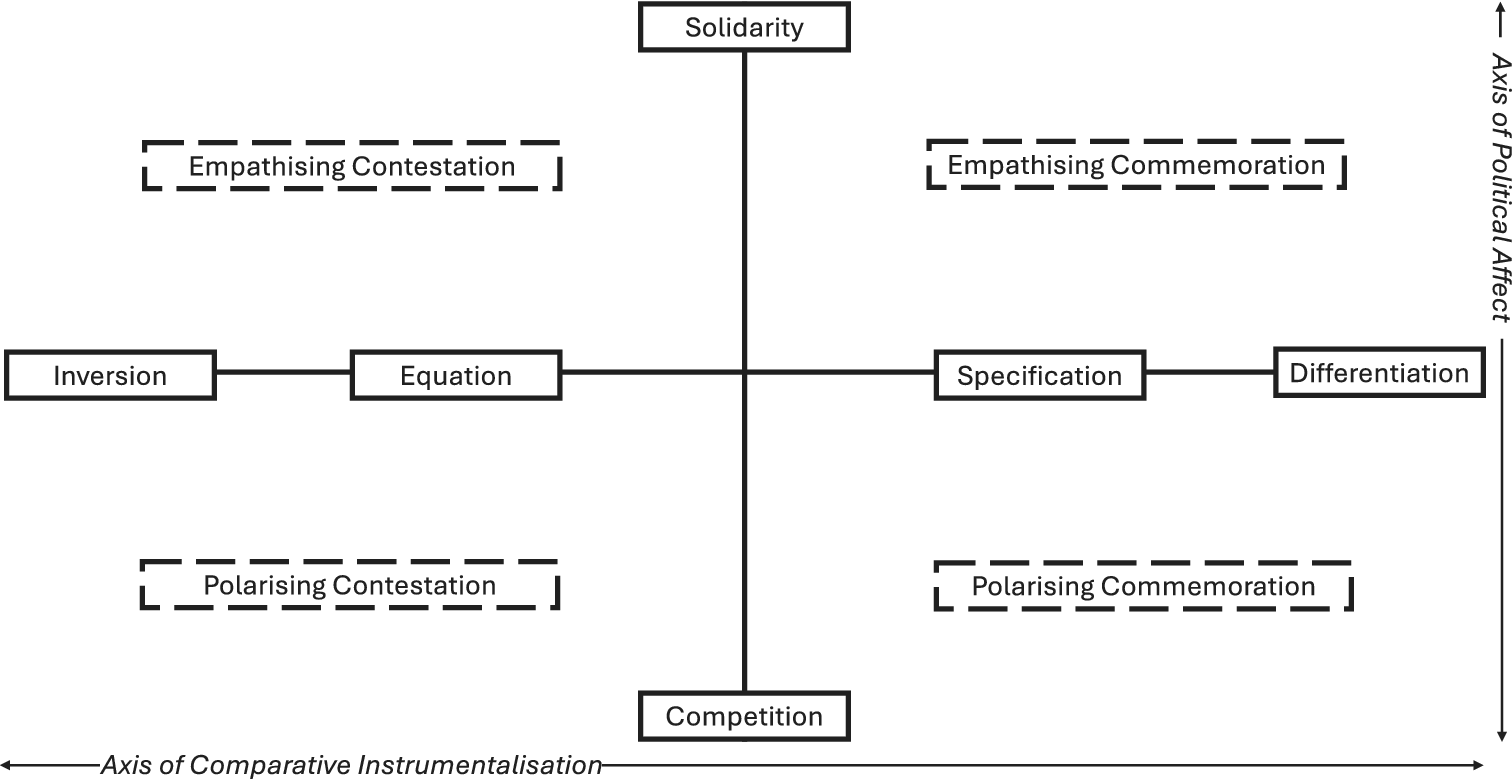
We do this in connection with Rothberg’s effort ‘to develop an ethics of comparison that can distinguish politically productive forms of memory from those that lead to competition, appropriation, or trivialization’ (Reference Rothberg2019: 123). To this end, Rothberg mapped multidirectional memory deployed in ‘politically charged situations in which complex forms of implication are at play’ (Reference Rothberg2019: 124). He did so with a schematic quadrant divided by a horizontal axis of comparison spanning from equation (on the left) to differentiation (on the right) and a vertical axis of political affect descending from solidarity (at the peak) to competition (at the base) (Reference Rothberg2019: 125). In turn, Rothberg identified a radically democratic politics of multidirectional memory with the top-right of the quadrant involving ‘differentiated empirical history, moral solidarity with victims of diverse injustices, and an ethics of comparison that coordinates the asymmetrical claims of those victims’ (Reference Rothberg2019: 124). This sort of multidirectional memory, he claimed, offers greater political potential than that which is characteristic of the bottom-left of the quadrant that subsumes ‘histories under a logic of equation or sets victims against each other in an antagonistic logic of competition’ (Reference Rothberg2019: 124).
We build on Rothberg’s approach by conceiving instrumentalization as a form of ‘working memory’, which dynamically serves a present or future end rather than being an end in itself (Rigney, Reference Rigney2005; Assmann, Reference Assmann2011; Merrill and Rigney, Reference Merrill and Rigney2024). Furthermore, the idea of ‘working memory’ accommodates the affective and emotional labour involved in users’ production of Holocaust content. Such labour, Bar-Gil (Reference Bar-Gil2025) argues, collaborates with platform affordances and algorithms, yet can outweigh these in decision-making processes about what to post and when. In conceiving instrumentalization as working memory, we problematise its use with respect to Holocaust memory as predominantly a derogatory term without denying its possible links to Holocaust denial, distortion and inversion, and, in turn, antisemitism (see Becker et al., Reference Becker, Troschke, Bolton and Chapelan2024).Footnote 4 While our analysis is not primarily concerned with identifying antisemitism, instrumentalization is usually invoked at the nexus between Holocaust memory and antisemitism in two ways. First, as a form of Holocaust distortion considered to unacceptably instrumentalise the symbolic power of the Holocaust via forms of comparison (see Troschke, Reference Troschke, Becker, Troschke, Bolton and Chapelan2024). Second, as accusations that Jews instrumentalise the Holocaust ‘to obtain power, wealth, or to further the interests of Jews or of Israel’ (Becker, Reference Becker, Becker, Troschke, Bolton and Chapelan2024b: 273).
Our intention here is also to pursue a more nuanced understanding of comparative rhetoric and instrumentalization in the context of digital Holocaust memory and to resist those political forces that might be seeking to normalise the idea that comparing the Holocaust in any way always amounts to Holocaust distortion, relativization, or trivialization.Footnote 5 Here we find existing guidelines, including IHRA’s example-based working definition of antisemitism (see fn. 3), too broad, complicating their application in cases of comparison. Like Rothberg, we emphasise that relational and ethical Holocaust comparisons do not have to ‘lead to a blockage of empathy’ but can be catalytic to it (Reference Rothberg2022: 1325).
With these objectives in mind, we adapted Rothberg’s schematic (Figure 1), in terms of an axis of comparative instrumentalization that accommodates not only comparative rhetorical strategies ranging from equation to differentiation but also those of inversion – as a reversed form of equation – and specification as a form of comparison that avoids differentiation at its most competitive, and which resists comparison altogether (e.g., apples and pears c.f. Legg, Reference Legg2022).Footnote 6 Additionally, we complement Rothberg’s axis of political affect by refocusing on instrumentalization’s implication for Holocaust memory, labelling each of the schematics’ quadrants in terms of their measure of commemoration and contestation, empathy, and polarisation. With this conceptual schematic, we seek to nuance discussions of the Holocaust’s comparison and add to a growing analytical toolbox surrounding the study of digital Holocaust memory (see Manca, Reference Manca2024).
A conceptual schematic of the comparative instrumentalization of Holocaust memory (Source: Based on Rothberg, Reference Rothberg2019).
Within this schematic framework, we also conceive commemoration as upholding the exceptional mnemonic status of the Holocaust and its potential capacity to prevent contemporary instances of violence and genocide, whether turned to inclusionary (‘Never Again Anyone’) or exclusionary political ends (‘Never Again Us’). Contestation, as we conceive here, diminishes, intentionally or otherwise, the Holocaust’s preventative capacity even while potentially maintaining its mnemonic status.
In turn, we conceive the equation to operate as a reductionist and oversimplifying rhetorical strategy that ignores differences. It is not employed as a means of detailed comparative analysis but rather to force associations between events and often, with respect to Holocaust memory, to competitively apportion judgement and blame. While it might shallowly indicate solidaristic intentions, it still limits, or in other words contests, Holocaust memory’s preventative potential (empathising contestation). It can also be formative of flattened binary positionalities: used to either diminish or amplify the significance of different mass atrocities (polarising contestation). The Holocaust equation is thus politically problematic, and especially in its inverted form (inversion), which relies on the reversal of historical victim and perpetrator groups, and is therefore indicative of Holocaust distortion (UNESCO, 2022; Troschke, Reference Troschke, Becker, Troschke, Bolton and Chapelan2024).
Differentiation foregrounds differences, and specification highlights differences and similarities, indicating more analytically comparative strategies that seek to better understand the Holocaust and other mass atrocities. Differentiation and specification both empower Holocaust memory with respect to its potential to help prevent future mass atrocities (empathising commemoration). These are usually the sorts of comparative instrumentalization that responsibly maintain the moral currency of Holocaust memory, ensuring its significance as a vital and pivotal point in human history across both Western and non-Western memory cultures (Rothberg, Reference Rothberg2022; Adams and Lederman, Reference Adams and Lederman2024). However, these comparative strategies, in their most extenuated and competitive form, can also serve polarising purposes (polarised commemoration), for instance, when two cases are considered so specific or different as to prevent comparison or when factual specificity is used to support commemorative prioritization (see Legg, Reference Legg2022).
Material, case, and method
We use this conceptual schematic (Figure 1) to make sense of a targeted subsample of social media content identified during a broader, cross-platform social media ethnography of Holocaust memory around the first anniversary of the 7 October Hamas attacks (see Postill and Pink, Reference Postill and Pink2012). During this ethnography, we noted recurrent references to the Sonderkommando revolt and its co-occurring anniversary. Amplified among these was an X post from Auschwitz-Birkenau State Museum (@auschwitzmuseum). Here, we focus on this and other relevant X posts from @auschwitzmuseum, as well as the comments and quote reposts they received.
Located in Poland, the Auschwitz-Birkenau State Museum is one of the oldest HMEIs. It holds charitable status and is funded by a mix of Polish and international donors, both public and private. It also maintains the most extensive online presence of any former Holocaust concentration and extermination camp as overseen by its internationally well-known press officer, Pawel Sawicki (Dalziel, Reference Dalziel2021; Manca, Reference Manca2021a). The museum joined Twitter in 2012 and, since then, has used its account on the platform as a means of Holocaust memorialisation and education, posting content multiple times a day to its large follower count. It has remained active on the platform even after Twitter’s 2022 purchase and subsequent rebranding as X by Elon Musk – changes that led many other HMEIs to leave the platform, citing a misalignment of values and ethical concerns (Oremus, Reference Oremus2025). Today, it has the X account with the largest follower count among all HMEIs still active on the platform, indicating its considerable mnemonic influence online. This follower count and influence are likely partly due to its location on-site at a former concentration and extermination camp and its commitment to making Holocaust research resources publicly accessible (Dalziel, Reference Dalziel2021). It is also known for facilitating the formation of digital mnemonic communities insofar as using X and other social media platforms not only to broadcast to online audiences as many HMEIs do but also to engage them in debate and dialogue (see Dalziel, Reference Dalziel2021). This made it an intuitive choice for further study. X, given its recent ideological realignment and growing polarisation, represented an obvious platform through which to explore the Holocaust’s comparative instrumentalization. X’s behavioural norms, as contoured by its interactive and algorithmic parameters, are now largely unmoderated while it remains one of the largest social media platforms.
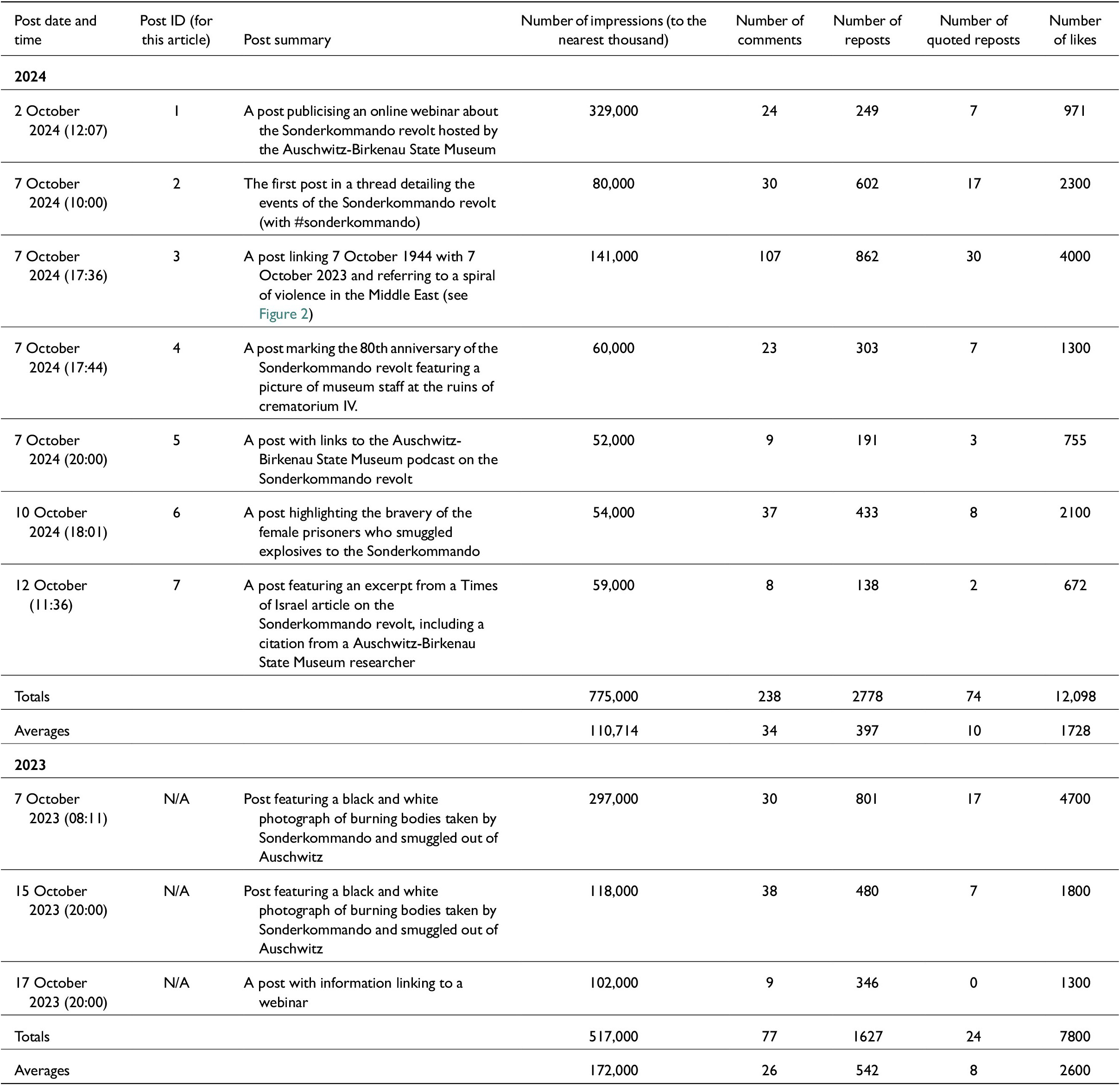
Reflecting the site specificity of the event, @auschwitzmuseum posted about the Sonderkommando revolt on 7 October 2024 and in the 3-week period spanning 1 and 22 October 2024, we identified a further six posts about the revolt using the search term ‘Sonderkommando’.Footnote 7 These seven posts, four of which were published on the anniversary, are summarised in Table 1. Along with the comments and quote reposts they received, these posts provide the main dataset that we analyse in this article. In comparison to the same period in 2023, these posts represent a modest growth in posting activity about the Sonderkommando revolt, as also shown in Table 1. While @auschwitzmuseum posted fewer anniversary Sonderkommando revolt posts in 2023, on average, these were liked and reposted more than their 2024 counterparts, functions that are traditionally, although not exclusively, associated with agreement and amplification. However, on average, they were commented on and quote repost less than their 2024 counterparts, functions that provide users with greater opportunities to also disagree with the original post (see Ben-David et al., Reference Ben-David, Meyers and Neiger2024).
@auschwitzmuseum X posts that mentioned ‘Sonderkommando’ and their engagement metrics between 1 and 22 October 2024 and 1 and 22 October 2023
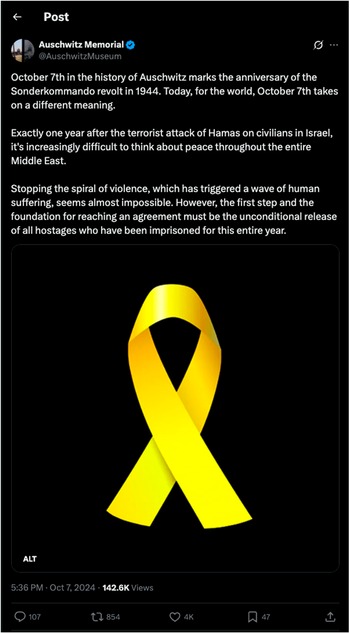
Post 3 (as of April 2025).
We collected the seven 2024 posts, all their comments (n = 238), and quote reposts (n = 74) manually via screenshots. Transcripts and summaries of these posts, along with engagement metadata, were then compiled in a spreadsheet. User comments and quote reposts were anonymised at the point of transcription, and all data were stored securely on password-protected and encrypted computers and servers according to the data protection policies of our home university and in accordance with the rules of the external funder of the research project to which this study contributes.
Our sampling strategy was designed with the explicit aim of creating a rich yet interpretively manageable dataset, an analytically sufficient slice of a wider digital Holocaust memory phenomenon that allowed close engagement with our data (see Manca, Reference Manca2024). Our reliance on this small but ‘rich data’ set also sought to provide insight, nuance, and context, complementing ‘big data’ approaches. These seek generalizable rather than contextual findings and rely on large quantities of material that are usually machine-collected and machine-analysed, and are gaining traction in the field of digital Holocaust memory studies (see Ben-David et al., Reference Ben-David, Meyers and Neiger2024; Brown, Reference Brown and Bachman2024; Neiger et al., Reference Neiger, Meyers and Ben-David2023). Here, our sampling approach intentionally prioritised information richness, contextual specificity, and analytic depth rather than numerical scale (see Malterud et al., Reference Malterud, Siersma and Guassora2016; Hennink and Kaiser, Reference Hennink and Kaiser2022). Speaking to the digital ethnographic roots of this study, we align ourselves with Stepnik’s (Reference Stepnik2024) assertion that in expansive digital settings, delimitation is a methodological necessity, not a shortcoming, which enables reflexivity, ethical accountability, and meaningful interpretation. Accordingly, we treat our data as analytically sufficient, allowing close attention to the sorts of subtle comparative instrumentalization that might be obscured by a large-scale aggregated dataset.
The posts, comments, and quote reposts were then qualitatively coded in an abductive manner, informed by but also informing the conceptual schematic introduced in the previous section (Figure 1) (see Van Hulst and Visser, Reference Van Hulst and Visser2025). Here, posts, comments, and quote reposts (see Table 1) that employed multidirectional memory were first identified and then allocated to one of the four types of comparative instrumentalization (empathising commemoration, empathising contestation, polarising commemoration, and polarising contestation). In practice, posts, comments, and quote reposts sometimes bridged or contained elements of more than one of these categories, but for heuristic reasons, we allocated each example only to one type. The coding was conducted initially by the first author and then by the second, followed by a process of ‘collaborative data analysis’ (see Cornish et al., Reference Cornish, Gillespie, Zittoun and Flick2014), where we agreed on the interpretation of each example. Often this involved identifying comparative phrases, including ‘is’ or ‘like’, and ascertaining the affective or emotive tone of the examples by, for example, paying attention to the use of expletives.
While social media platforms are still often approached unproblematically as ‘public’, we acknowledge that the circulation of user-generated content beyond its originally intended context, including in academic research, can cause harm (Zimmer, Reference Zimmer2010; Williams et al., Reference Williams, Burnap and Sloan2017). For ethical reasons, we do not include direct quotations for any user besides @auschwitzmuseum, which we treat as akin to a public figure’s account (Williams et al., Reference Williams, Burnap and Sloan2017). Instead, we have paraphrased example comments and quote reposts according to the ethical best practice of ‘fabrication’ (Markham, Reference Markham2012). This is an ethically justified practice that involves adapting textual user-generated content to ensure its authors cannot be identified by using internet search engines or the search functions of individual social media platforms (see also Franzke et al., Reference Franzke, Bechmann, Zimmer and Ess2020).Footnote 8
Analysis: Mapping X users’ comparative instrumentalization of Holocaust memory
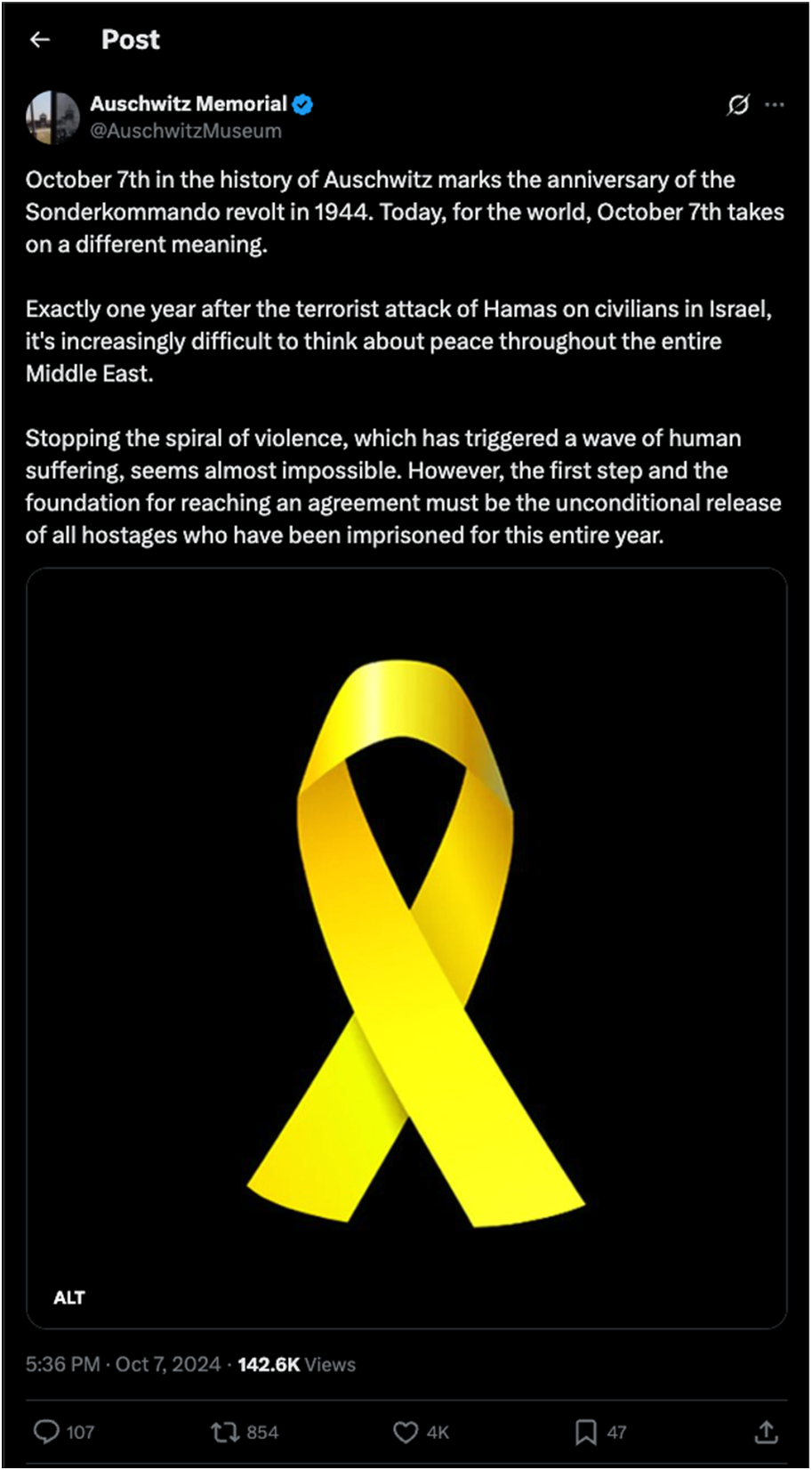
Of the seven Sonderkommando posts from @auschwitzmuseum, post 3 (see Table 1) – that which originally gained our attention – was the most multidirectional in character. Accompanied by a yellow ribbon, a symbol used to convey support for hostages (see Yaqub, Reference Yaqub2007), the post drew historical parallels between the 7 October 1944 and 2023, positioning both as markers of Jewish suffering and resistance (Figure 2). Noting that the global contemporary significance of the latter outweighed that of the former, the post referred to the ‘spiral of violence’ and ‘wave of human suffering’ triggered by the 7 October 2023 Hamas attacks and their negative impact on the pursuit of peace in the Middle East. In alluding to the violence of Israel’s subsequent invasion of Gaza and the suffering of Palestinian civilians, the post seemingly attempted a form of empathetic commemoration. However, with these phrases, it also relied on a bureaucratic register that suggested strategic restraint in line with the ‘Catch-22’ scenario that HMEIs currently find themselves in. Such ostensibly bureaucratic language foregrounds suffering while stripping away politics (see Fassin, Reference Fassin2011), gesturing toward universality yet silently privileging certain actors. Relatedly, in referring only to Hamas terrorists and Israeli civilians and hostages, and calling for the unconditional release of the latter without mentioning Palestinian civilians, the post obscured historical context, producing an asymmetry of meaning revealed by what was left uncommunicated.
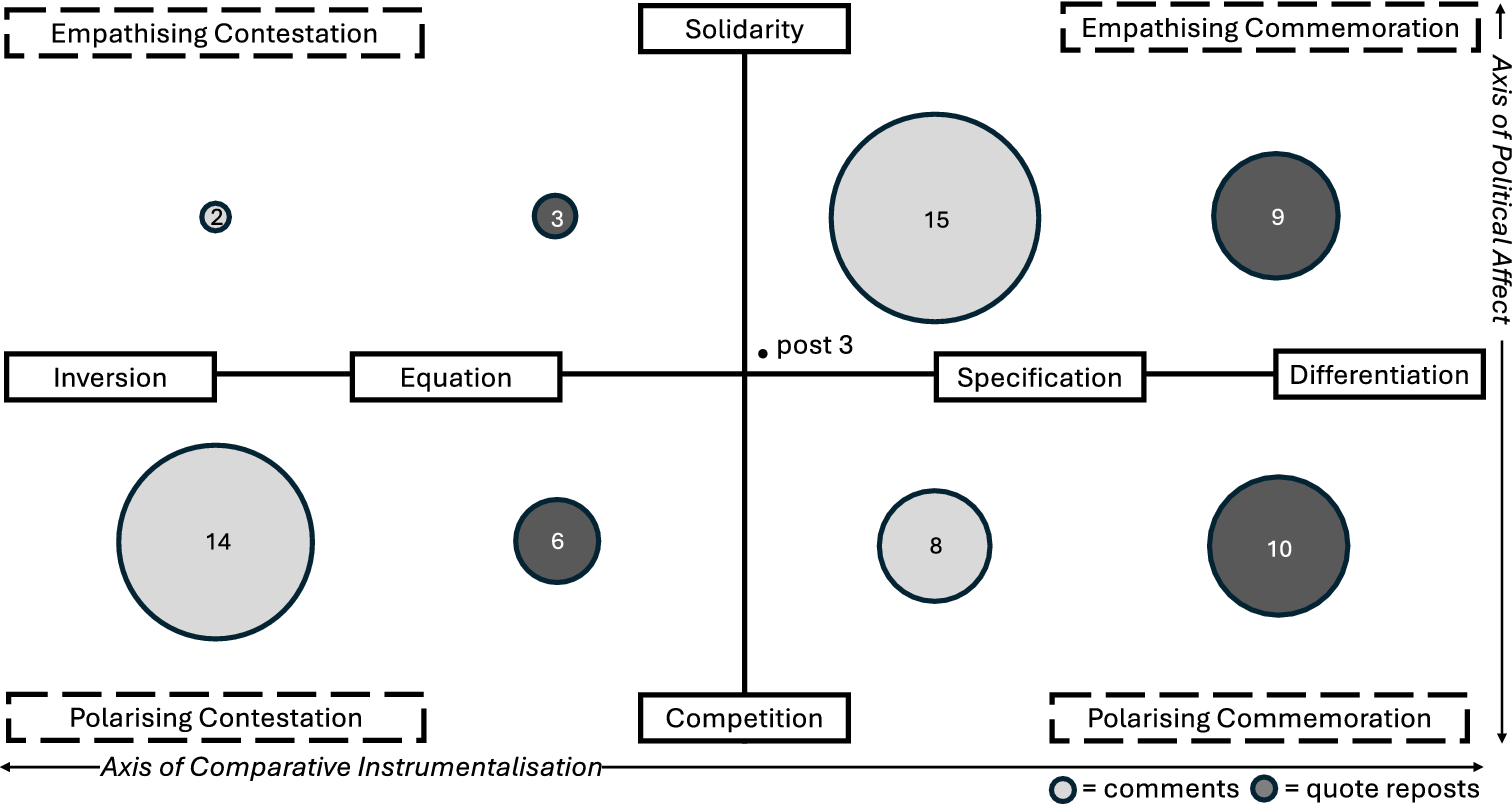
In short, the post may have sought empathetic commemoration but can also be critiqued for foreclosing broader discussions of accountability and reciprocal suffering in ways symptomatic of both empathising contestation and polarising commemoration. Thus, it can be placed in the bottom-left of the top-right quadrant of our conceptual schematic (see Figure 3), a well-meant yet flawed attempt to use commemoration to affect political solidarity.
The distribution of comments and quote reposts across the four categories of multidirectional Holocaust memory.
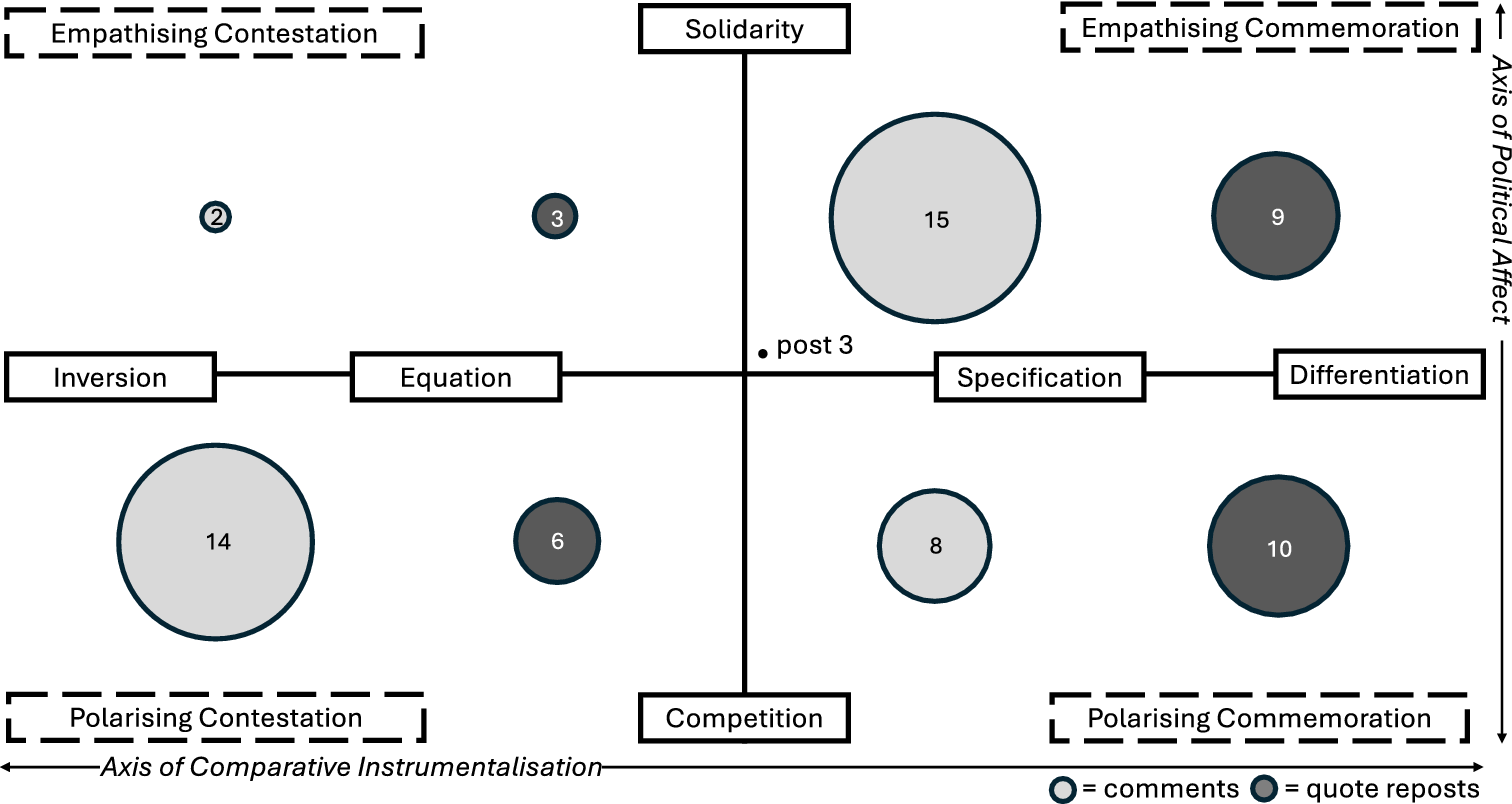
Post 3 received not only the most comments and quote reposts in general (see Table 1) but also therein those of an explicitly multidirectional character. The other six Sonderkommando posts from @auschwitzmuseum were not explicitly multidirectional, although some of them might be considered implicitly so due to the coinciding anniversaries. Still, and perhaps because of the coinciding anniversaries as well as the nature of post 3, they all also garnered comments and quote reposts that relied more explicitly on multidirectional memory. The remaining, non-explicitly multidirectional comments and quote reposts were otherwise usually characterised by simple emoji and gif responses (hearts, candles, yellow ribbons, etc.) and commemorative statements akin to so-called ‘commemoration clicktivism’ (see Merrill, Reference Merrill2017) or else spam. In total, we identified 39 comments (of 238) and 28 quote reposts (of 74) that could be categorised as one of the four types of multidirectional memory covered by our conceptual schematic (see Figure 3). While the small sample size prevents generalizable interpretations, more empathetic commemoration comments and quote reposts were identified than any other of the categories. This may reflect the digital architecture of X insofar as rendering @auschwitzmuseum’s posts most visible, at least initially, to the account’s large follower count, which can be expected to have been generally supportive. Thereafter, the identified content mostly employed polarised contestation, polarised commemoration, and empathetic contestation in that order (Figure 3). Each of the four categories is qualitatively analysed below.
Empathetic commemoration
User reactions that conveyed empathetic commemoration often highlighted the importance of Holocaust memory to the pursuit of peace between Israel and Palestine. In this respect, they often suggested a favourable interpretation of post 3 (see Figure 3). This is illustrated by the paraphrased examples below.
Agreed. A two -state solution via diplomacy is needed. If not, we will be memorializing Gaza in eighty years’ time. End the violence.
Another commemoration of another 7 October , tragically different.
Never forget what happened then. Never forget what is happening now. No Genocide, No Terror.
A ceasefire will bring them home. Pray for peace in the region. No to all genocides.
Some of these examples indicate the significance attached to Holocaust memory within the aim to prevent genocide, as well as the view that the Israeli state’s actions in Gaza had become genocidal. But one also hints towards polarised commemoration, insofar as suggesting that events in Gaza had not yet met the threshold for future memorialization.
Other users employed empathetic commemoration while critiquing @auschwitzmuseum, drawing attention to the silences in the account’s original posts. These did not contest the potential of Holocaust memory to prevent future mass atrocities as such, but rather @auschwitzmuseum for not helping to realise this potential. The paraphrased examples below reveal again the ‘Catch-22’ scenario HMEIs currently face.
Great account which importantly keeps Holocaust memory alive. But as it has done before, this is a one -sided view of the Middle East situation. No mention of Palestinians or the genocide and war crimes they are suffering.
All the Holocaust victims you post about deserve our prayers but to mention just one side here is wrong.
For these X users, @auschwitzmuseum’s reference to a ‘spiral of violence’ and a ‘wave of human suffering’ insufficiently captured the plight of Palestinian civilians, but recalling this plight is not incompatible with remembering the Holocaust. In other words, these users seek to preserve the moral authority of Holocaust memory by insisting it remain open to dialogue and comparison. In turn, they seek to project solidarity via critique. Far from relativizing, this critique sustains Holocaust memory’s role as a resource for global solidarity.
Overall, the sort of comparative instrumentalization of Holocaust memory indicated by these user reactions exemplifies how multidirectional memory can catalyse empathy (see Rothberg, Reference Rothberg2019). Users’ reactions suggest that they believe Holocaust memory can support empathetic solidarity with all those caught up in the contemporary Middle East conflict. Here, comparative specification is upheld to such a degree as to both preserve Holocaust memory and use it to call for contemporary justice.
Empathetic contestation
Other responses to @auschwitzmuseum’s post indicate empathetic contestation, namely comparative instrumentalization that relies on symbolic equation turned towards solidaristic ends. These pursue solidarity but in flattening and equating details of the Holocaust, Sonderkommando revolt, Hamas terror attacks, and subsequent Israeli military response, they also challenge the capability of Holocaust memory to prevent genocide in the present or future, hollowing out its meaning for a human rights agenda. Responses that exemplified this type of multidirectional memory often quoted @auschwitzmuseum’s posts, adding simple messages and hashtags that equated the two anniversaries. Some simply included the two dates: 7 October 1944–7 October 2023, a dash serving to connect the Sonderkommando revolt and Hamas terror attacks in terms of the remembrance of lost Jewish lives, past and present. Such responses did not then substantively engage differences across these temporal contexts. While seeking a solidaristic effect and reinforcing Holocaust memory, they lacked comparative depth and revealed the limits of comparatively shallow multidirectional memory. While empathetic, they risk superficiality, leaning on symbolic gestures rather than close analysis and specification. Furthermore, this simplistic form of comparative instrumentalization was partly predetermined by the coinciding anniversaries in ways that mostly excluded the drawing of solidaristic connections between Israeli and Palestinian victims.
These connections were, however, implicitly inferred through the use of #NeverAgainisNow, a hashtag that has been adopted in various settings to suggest the Holocaust is being repeated in the present. In 2019, for example, the hashtag was used by young American Jewish activists to protest the inhumane conditions of immigration detention centres (see Merrill et al., Reference Merrill, Keightley and Daphi2020: v–vii). Since 7 October 2023, the hashtag and slogan has emerged again (see Bergen, Reference Bergen2025) to infer the Holocaust is currently being repeated – usually, but not exclusively, with reference to Israel’s military operations in Gaza, equating now with then and the Holocaust’s past victims with the contemporary victims (again predominantly Palestinian civilians but also Israeli civilians) of the present conflict. While the use of this hashtag entails a certain ambiguity that tracks the two different notions of Never Again discussed above, other examples of empathetic contestation were clearer.
For example, when solidaristic connections between Jews of the past and Palestinians of the present were drawn along lines of resistance rather than victimhood, as the example below highlights:
Both events, like the Warsaw ghetto uprising, are literally the same.
Here, the significance of Holocaust memory is maintained, but the Sonderkommando revolt and Hamas terror attacks, along with the Warsaw ghetto uprising, are all equated as the actions of the oppressed against their oppressors to the problematic point of inversion, where the contemporary Israeli state implicitly takes the place of the past Nazi state.
Polarised contestation
Those user responses identified as embodying polarised contestation still relied on shallow comparative strategies but turned these towards competitive rather than solidaristic ends, and without explicitly emphasizing the mnemonic significance of the Holocaust. At best, this reflected the view that the instrumentalization of Holocaust memory towards a human rights agenda had failed, in line with the crises of fields like Genocide, Holocaust, and Memory Studies, and has been surpassed by the Israeli state’s propagandistic, power-based approach (see Arad, Reference Arad2003; Wermenbol, Reference Wermenbol2021, Reference Wermenbol2025). At worst, it reflected the disregard for the significance of the Holocaust in general. Here, we find some of the most antagonistic and problematic comparative instrumentalizations of Holocaust memory, where equation shifts into inversion and Holocaust distortion, coupled regularly with hostile accusations and expletives. Some paraphrased examples, which align with other equative comments like Zionism = Fascism, include:
You came so close to comprehending who the Nazi and Sonderkommando of today are.
Never again (but Israel can do as much of it as it fu*king likes)
In another example, users commented by linking to a video post from another X account, which showed an individual protesting against Israel’s war in Gaza at Auschwitz-Birkenau State Museum shortly before the anniversary. With a Palestinian flag on their back, the individual carried a placard that read on one side, ‘Israel created the largest death camp in history’ and on the other ‘Israel is doing to Palestinians what Germany did to the Jews.’
From the other side of the polarised political debate, another commentator played on the historical contentiousness of the Sonderkommando when equating them with Dutch pro-Palestinian protestors.
The Sonderkommando of 2024 are staging sit -ins at stations across the Netherlands. Just as in the past. #pallywappies #7oct #israel #jewhate
In this case, the hashtag inclusion of the derogatory term ‘pallywappy’ to refer to the protestors further indicates that the role of the Sonderkommando is equated on this occasion not along lines of resistance but of complicity, resonating with far-right, Islamophobic conspiracy theories of white genocide and racial replacement (see Ekman, Reference Ekman2022). The argument being that by protesting on behalf of Palestinian civilians, these Dutch activists would ultimately contribute to the suffering of their own people.
As all these examples indicate, unlike empathetic contestation, which still promises avenues for the more detailed comparative instrumentalization of Holocaust memory, polarising contestation forecloses opportunities for dialogue, specification, and differentiation, revealing in turn how the instrumentalization of Holocaust memory can lead to Holocaust distortion. They indicate a tendency to collapse historical difference through oversimplified analogy or inversion, flattening Holocaust memory for polemics and blame. Here, Holocaust memory is mobilised to intensify division and propagate distortion, supporting Rothberg’s (Reference Rothberg2019) identification of equation and inversion as politically problematic strategies.
Polarised commemoration
Polarised commemoration also forecloses the solidaristic potential of multidirectional Holocaust memory via differentiation and separation rather than equation and inversion. This is a competitive mode of comparative instrumentalization which, in its most extreme, considers the Holocaust or another event as non-comparable and otherwise suggests a commemorative hierarchy (see Legg, Reference Legg2022). Instead of catalysing empathy, Holocaust memory here functions as a form of authority and exclusion. The Holocaust’s mnemonic significance is often affirmed but its relational and preventative potential is also often restricted. This is a discursive space of ‘Never Again to us’ rather than ‘Never Again to anyone’. Here comments and quote reposts regularly relied on hashtags that in this context conveyed extreme differentiation, including #BringThemHome, which reemphasised the prioritisation of Israeli hostages while reinforced relative absence of Palestinian civilian victims in post 3.
7 October - a contradictory anniversary! Happy anniversary for the Sonderkommando revolt in Auschwitz. But then the greatest loss of Israeli life in our own country in its history.
A stark reminder of Jewish bravery: a bravery that lives and thrives today despite Jews’ many enemies #NeverForget
Some users held the Sonderkommando revolt as commemoratively separate from the Hamas terror attacks as an act of resistance that should be celebrated rather than mourned. Others, as was the case for some empathetic commemoration, drew lines of comparison across time in terms of Jewish resistance but ultimately differentiated this resistance from the actions of ‘enemies’ as solely worthy of commemoration. Such commentary delegitimises dissent against Israeli state actions and enforces a specific relationship between the Holocaust and the conflict in the Middle East.
Other users contended that the Sonderkommando revolt should not be commemorated, given Israel’s military actions in Gaza, as the following paraphrased examples convey:
Screw your 7 October
It is despicable to commemorate the Holocaust alongside the Gaza genocide.
That you post this while carrying out a genocide is indefensible. Condemning Israel when commemorating Auschwitz would be one thing. But this is hypocrisy. You are the terrorists, those committing genocide. Free Palestine. F•ck Israel.
While some of these examples share similarities with empathetic commemoration critiques of @auschwitzmuseum’s posts, which seek to better foreground solidaristic multidirectional memory, their competitive and polarising stance takes precedence. This is clearly indicated by turns of phrase that accuse @auschwitzmuseum of carrying out genocide or at least being complicit in the Israeli state’s power-based approach to Holocaust memory (see Arad, Reference Arad2003). The last example is interesting in this respect because while it seems to be concerned with preserving the possibility of instrumentalizing Holocaust memory within a human rights agenda that seeks to prevent the repetition of genocide, they fail to acknowledge the ‘Catch-22’ situation that @auschwitzmuseum finds itself in, nor interpret the account’s post in a more generous way that might create better conditions for the sort of empathetic commemoration they seek. Polarised commemoration thus reveals tension between memory’s symbolic weight and its comparative instrumentalization for nationalist or exclusionary ends. It highlights the risk Rothberg (Reference Rothberg2019) warns against: comparison that shifts from solidarity to competition, and remembrance that becomes a zero-sum assertion of legitimacy.
Impressions of implication
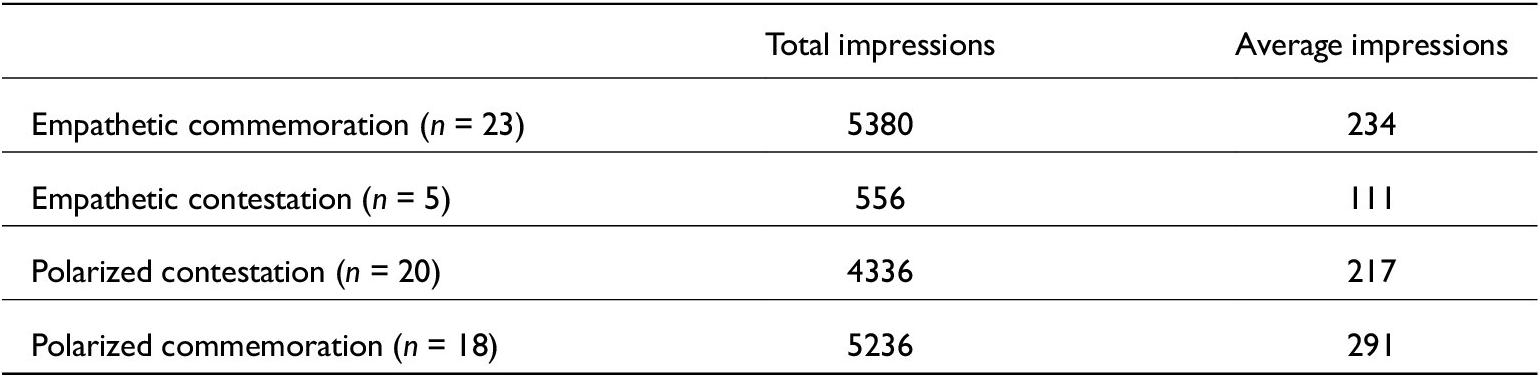
Taking the X users behind the analysed comments and quote reposts to be implicated in multidirectional Holocaust memory (Rothberg, Reference Rothberg2019) encourages the further consideration of the impact of their comparative instrumentalizations. One way to gauge this is via the visibility they achieve on X via impressions – the number of times a post or quote repost is seen by users, regardless of whether they interact with it (like, comment, repost, quote repost) or not. Removing a single quote repost with 14,000 impressions, given its outlier status, and considering the total and average impressions of the four modes of multidirectional memory hints towards their overall influence and visibility within X (see Table 2).
The total and average impressions received by the comments and quote reposts of each of the four categories of multidirectional Holocaust memory
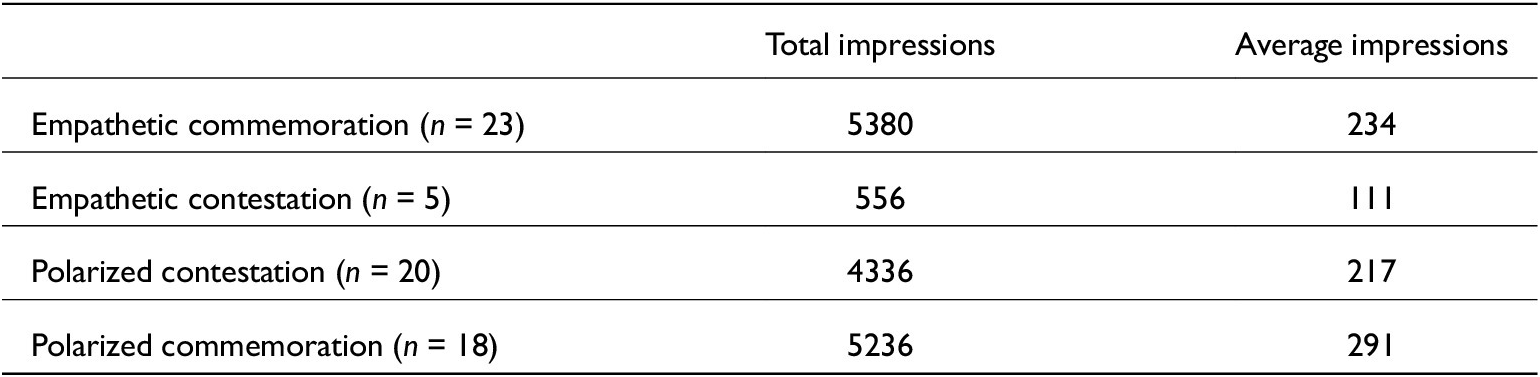
What stands out is that while empathetic commemoration posts and comments commanded the greatest number of impressions overall, it was those that indicated polarised commemoration that did so, on average. This aligns with those hypotheses and findings that suggest divisive content on X drives user engagement (see Milli et al., Reference Milli, Carroll, Wang, Pandey, Zhao and Dragan2025). It also suggests how a zero-sum approach to memory might gain precedence in a platform setting determined by understandings of social media ‘likes’ and attention economies (see Goldhaber, Reference Goldhaber1997; Gerlitz and Helmond, Reference Gerlitz and Helmond2013). With polarisation begetting polarisation, these patterns further raise the stakes for those HMEIs who wish to use social media to enact forms of empathetic multidirectional memory. Matters we take up further in the conclusion.
Conclusion
In this article, we have demonstrated how anniversaries operate as catalytic moments in which Holocaust memory becomes entangled with other mass atrocities, contemporary or otherwise, amplifying opportunities for both commemoration and contestation. More specifically, we have shown how coinciding anniversaries can drive multidirectional memory in social media settings and how the overlapping eightieth anniversary of the Sonderkommando revolt and first anniversary of the 7 October Hamas terror attacks revealed the heightened vulnerability and visibility of Holocaust memory in a time of acute political conflict. Our analysis of a small yet rich dataset of X posts, comments, and quote reposts indicated multiple, overlapping, but also often oppositional interpretations of Holocaust memory.
Returning to our first research question, we found that those X users who reacted to Auschwitz-Birkenau State Museum’s commemoration of the eightieth anniversary of the Sonderkommando revolt on the first anniversary of 7 October 2023 Hamas attacks often did so by employing one of four types of comparative instrumentalization: empathetic commemoration, empathetic contestation, polarized contestation, and polarized commemoration.
In response to our second research question, we revealed these types of the Holocaust’s comparative instrumentalization through the application of a conceptual schematic derived and adapted from Rothberg’s theory of multidirectional memory (2009). These findings thus demonstrate how that theory can be productively used to analyse the comparative instrumentalization of Holocaust memory on social media in a nuanced manner.
While the demonstration of this schematic might be considered limited with respect to the size of the dataset to which it was applied, it was this small yet rich dataset that simultaneously allowed the schematic’s abductive development. It is, however, our hope that the schematic adapted here following Rothberg (Reference Rothberg2019) might be applied to larger social media datasets in future research. Overall, the conceptual schematic that we promote reveals how the digital commemoration and contestation of the Holocaust is shaped by institutional messaging and, critically, social media users who reposition Holocaust memory within contemporary debates, including those about current conflicts in the Middle East.
While user efforts at empathetic commemoration – reaffirming the Holocaust’s preventative potential while seeking to project solidarity between disparate victim groups were widespread, via both specified and differentiated forms of comparative instrumentalization – such efforts were challenged by the various responses of other users. First, by those who empathetically pursued solidarity but via simple modes of comparative instrumentalization involving equation and inversion in ways that might limit the moral salience of Holocaust memory (empathetic contestation). Second, by those who used equations and inversion towards more competitive and polarising ends. leading to the distortion of Holocaust memory (polarised contestation). And third, by those who engaged in polarised commemoration who used the memory of the Sonderkommando revolt to prioritise the victims of either the Hamas attacks or Israel’s military actions in Gaza over the other, and employing an extreme form of differentiation that denied these events relationality, undermining the preventative potential of Holocaust memory in general.
Across the analysed material, users applied different forms of comparative instrumentalization to draw a host of historic and contemporary actors into forms of mnemonic relationality along lines of victimhood and resistance, commemoration, and contestation. Among others, these actors included: Sonderkommando and regular Jewish victims of the Holocaust; the Holocaust’s Nazi perpetrators; the Israeli and foreign civilian victims and hostages of the 7 October 2023 Hamas terror attacks; those who carried out the attacks; the Palestinian civilian victims of the subsequent but also preceding Israeli military actions in Gaza, including those imprisoned by the state of Israel; and pro-Palestinian and pro-Israel protestors and activists. In doing this, social media users, in addition to HMEIs like Auschwitz-Birkenau State Museum, to which they respond, and scholars, like us, who seek to contribute to the fields of Holocaust, Genocide, and Memory Studies by studying these responses, become implicated in the multidirectional memory of the Holocaust. All will influence whether the ethical, moral, and preventative potential of Holocaust memory is realised or whether it will, alternatively, slide into becoming a political hazard.
Some of our findings sadly suggest the latter is occurring, not least the amplified visibility of forms of polarised commemoration on X. As this article was finalised for submission, the second anniversary of the 7 October 2023 Hamas terror attack came and passed. Three days later, a ceasefire between Hamas and Israel involving the return of Israeli hostages and the withdrawal of the Israeli military from Gaza was brokered. There was hope that perhaps these steps, as suggested by the @auschwitzmuseum X post that first caught our attention, would be precursors to peace in the region. As this article passed through peer review, the body of the last Hamas hostage was recovered by Israel (Graham-Harrison, Reference Graham-Harrison2026). Humanitarian aid to Gaza, however, has remained restricted, stretching its humanitarian crisis, and the killing of Palestinian civilians by the Israeli military has continued (Devi, Reference Devi2026). ‘Peace’ also creates a political occasion to forget (see Malik, Reference Malik2025), and it was notable that on the eighty-first anniversary of the Sonderkommando revolt, @auschwitzmuseum made no attempt to relate Holocaust memory to the events unfolding in the Middle East. This is potentially the result of the deepening of that ‘Catch-22’ situation that HMEIs face. We hope that this article might help HMEIs navigate this situation because, with polarisation begetting polarisation, there is a moral imperative to resist silence.


 Open access

