


Introduction
Winter wheat has higher yield potential than spring wheat in the Canadian prairies; however, several agronomic and marketing obstacles limit its widespread adoption by producers. The greatest impediment to expansion of winter wheat production is the execution of specialized agronomic practices to ensure winter survival, which is affected by many climatic and management factors. In addition to cultivar winter hardiness, seeding date and seeding rate can have a large influence on overwinter survival of winter cereals (Fowler Reference Fowler1982). Successful winter wheat production in the Canadian prairies generally requires direct seeding of cold-hardy cultivars into standing stubble in late summer. Over the winter the stubble catches snow, which provides sufficient insulation to moderate soil temperatures and enhance winter wheat survival (Fowler Reference Fowler2012). From 2014 to 2017, the average area seeded to winter wheat in the Canadian prairies was 260,000 ha, with a 99% survival rate based on harvested area (Statistics Canada 2018). Thus, agronomic practices have been successful for improving overwinter survival in this region; however, widespread production of winter wheat continues to be limited by the condensed time frame between previous crop harvest and subsequent planting of winter wheat for optimal crop establishment.
Winter wheat is competitive with summer annual weeds (Beres et al. Reference Beres, Clayton, Harker, Stevenson, Blackshaw and Graf2010a, Reference Beres, Harker, Clayton, Bremer, Blackshaw and Graf2010b); however, the potential exists for winter annual weeds to compete aggressively with the crop (Blackshaw Reference Blackshaw1993). In western Canada, downy brome and Japanese brome are two weed species that can interfere with winter wheat (Blackshaw Reference Blackshaw1994). Both Bromus spp. became more prevalent in the southern Canadian prairies in the 1980s, primarily because of increased emphasis on winter cereal production and producer adoption of zero tillage (Douglas et al. Reference Douglas, Thomas and Derksen1990). The most recent mid-season weed surveys conducted in Alberta ranked downy brome as the 35th most abundant species in annual crops (Leeson et al. 2010), whereas annual brome species were ranked 38th in Saskatchewan (Leeson Reference Leeson2016).
Japanese and downy bromes are self-pollinated winter annual grasses, germinating in late fall and overwintering as semidormant seedlings or rosettes (Beck Reference Beck2016); however, some germination may occur in early spring (Upadhyaya et al. Reference Upadhyaya, McIlvride and Turkington1986). The ability of these two Bromus species to survive freezing winter temperatures is similar to or exceeds the hardiest winter wheat cultivars (O’Connor et al. Reference O’Connor, Gusta and Paquette1991). Both species flower in late May and are prolific seed producers, often producing between 38,000 and 94,000 seeds m–2 (Beck Reference Beck2016). Stahlman and Miller (Reference Stahlman and Miller1990) reported that downy brome at densities of 24, 40, and 65 plants m−2 reduced winter wheat yields by 10%, 15%, and 20%, respectively. Yield loss in winter wheat was two to five times higher when downy brome emerged within 3 wk of winter wheat emergence, compared with downy brome that emerged 6 wk after wheat emergence (Blackshaw Reference Blackshaw1993). Little information is available on yield losses from Japanese brome interference in winter wheat; however, Li et al. (Reference Li, Du, Yuan, Guo, Li and Wang2016) reported an economic threshold of four to five plants m–2 in wheat in China. Geier and Stahlman (Reference Geier and Stahlman1996) reported that Japanese brome was more sensitive to sulfosulfuron than downy brome, indicating that these species may differ in their tolerance to herbicide. Winter annual Bromus spp. management is critical to assure winter survival of winter wheat and adequate stand densities in the subsequent spring (Miller et al. Reference Miller, Menalled and Burrows2013).
Integrated weed management (IWM) is defined as a holistic approach to weed management that integrates weed control practices such as increasing seeding rates, competitive cultivars, fertilizer placement, and varied seeding dates to provide the crop with a competitive advantage over weeds (Harker and O’Donovan Reference Harker and O’Donovan2013). Herbicide stewardship, including herbicide rotation and tank-mixing, can be a key component of an IWM program, as repeated herbicide application with the same site of action can select for herbicide-resistant biotypes (Beckie and Harker Reference Beckie and Harker2017). Currently, two acetolactate synthase (ALS)–inhibiting herbicides, pyroxsulam and thiencarbazone, are registered for Japanese brome control (Anonymous 2015). Pyroxsulam is also registered for downy brome control when applied in fall or for downy brome suppression with spring application. Fall application of pyroxsulam, sulfosulfuron, propoxycarbazone, or propoxycarbazone plus mesosulfuron provided better downy brome control in winter wheat than spring applications in two separate studies conducted in Kansas, USA (Geier et al. Reference Geier, Stahlman, Peterson and Claassen2011; Reddy et al. Reference Reddy, Stahlman and Geier2013). Repeated ALS inhibitor use has selected for ALS inhibitor–resistant biotypes of downy brome (Kumar and Jha Reference Kumar and Jha2017); thus, the need for identification of alternate herbicide sites of action is critical. Pyroxasulfone, a very-long-chain fatty acid elongase (VLCFAE) inhibitor (Tanetani et al. Reference Tanetani, Kaku, Kawai, Fujioka and Shimizu2009), is labeled for downy brome control in the US Pacific Northwest (Lyon et al. Reference Lyon, Hulting, Morishita and Young2015). In western Canada, pyroxasulfone has demonstrated activity on wild oat (Avena fatua L.) (Tidemann et al. Reference Tidemann, Hall, Johnson, Beckie, Sapsford, Willenborg and Raatz2014) but has not been evaluated on Bromus spp. in this environment. Flumioxazin is a protoporphyrinogen oxidase (PPO) inhibitor that also can have activity on Bromus spp. when applied alone or in combination with pyroxasulfone (Lyon et al. Reference Lyon, Cowan, Appel, Rood and Wetzel2013); however, the use of flumioxazin for Bromus spp. management has not been evaluated in the Canadian prairies.
The objectives of this study were to test the efficacy of (1) ALS-inhibiting herbicides applied POST in fall or spring, and (2) alternative herbicide sites of action (PPO and/or VLCFAE inhibitors) applied preplant in fall for control of downy and Japanese brome in winter wheat production systems.
Materials and Methods
Site Description, Experimental Design, and Site Management
This research consisted of two experiments placed side by side with the same treatments. For ease of identification, downy brome was seeded in the first experiment, whereas Japanese brome was seeded in the second experiment. Experimental sites were established at two locations in Alberta (AB), Canada, near Lethbridge (49.68°N, 112.75°W) and Kipp (49.73°N, 113.0°W), and one location in Saskatchewan (SK), Canada, near Scott (52.28°N, 108.95°W), over three growing seasons (2012 to 2014). All sites were rainfed. The key soil parameters at each site are summarized in Table 1. A randomized complete block design with four replications was used for both experiments. Individual plot size was 6 m by 1.45 m at Lethbridge and Kipp, and 5 m by 2 m at Scott.
Summary of experiment establishment and soil parameters 2012–2014.

a Abbreviations: AB, Alberta; SK, Saskatchewan; SOM, soil organic matter.
Seven herbicide treatments were applied in both experiments: pyroxsulam, thiencarbazone, flumioxazin, pyroxasulfone (two rates), a tank-mixture of flumioxazin plus pyroxasulfone, and two formulations of flucarbazone (WDG, water-dispersible granule; SC, suspension concentrate). The SC formulation of flucarbazone contains a safener, cloquintocet-mexyl, which may reduce potential for crop phytotoxicity. To evaluate the effect of herbicide application timing, pyroxsulam, both flucarbazone formulations, and thiencarbazone were applied POST in fall (late September/early October) or in spring (two- to three-leaf stage). Pyroxasulfone alone (two rates), flumioxazin, and a tank-mix combination of pyroxasulfone and flumioxazin were applied preplant (surface-applied 3 to 5 d prior to seeding). A nontreated check was included. The treatment details are described in Table 2.
Herbicide treatment descriptions.

a Abbreviations for formulations are as follows: NIS, non-ionic surfactant; OD, oil dispersion; SC, suspension concentrate; WDG, water-dispersible granule.
b Preplant: surface-applied 3 to 5 d prior to seeding; fall POST: applied in late September/early October; spring POST: applied at two- to three-leaf stage.
Winter wheat ‘CDC Falcon’ (Fowler Reference Fowler1999) was planted at 300 seeds m–2 at a depth of 2.5 cm in 23- to 31-cm rows, which varied depending on the site. The winter wheat was direct-seeded into standing stubble using no-till plot seeders equipped with knife openers and on-row packing. The plots were seeded on undisturbed chem fallow at Scott and standing barley stubble at Kipp and Lethbridge. Glyphosate was applied to the experimental area at a rate of 900 g ae ha–1 prior to seeding. Seeding dates for each site-year are summarized in Table 1. To supplement natural populations, downy and Japanese brome seeds were surface-broadcast prior to planting at a rate targeting 150 plants m–2. The brome seeds were sourced from naturalized populations at the Kipp site. All plots received nitrogen, phosphorus, potassium, and sulfur fertilizers prior to seeding based on fall soil test results. Nitrogen was side-banded or mid-row banded at seeding time with P, K, and S applied in the seed row. Broadleaf weed control was achieved with a spring POST application of bromoxynil (Conquer®, Nufarm, 2618 Hopewell Place NE #350, Calgary, AB, Canada T1Y 7J7) and pyrasulfatole (Infinity, Bayer Crop Science Inc., Suite 200, 160 Quarry Park Boulevard SE, Calgary, AB, Canada T2C 3G3 ) at respective rates of 170 and 30 g ai ha–1 when the winter wheat was at the three- to four-leaf stage. All herbicides were applied with a sprayer calibrated to deliver a carrier volume of 100 L ha–1 at 275 kPa pressure.
Winter wheat densities were recorded in fall (late October/early November). Two sampling areas (two rows by 1 m) were selected in each plot. The same two sampling areas were also used for spring (early May) destructive plant counts. Bromus spp. control and winter wheat herbicide injury were visually assessed 21 to 28 and 50 d after the spring POST herbicide applications, using a scale of 0 meaning no visual effect and 100 meaning complete plant death. Winter wheat head counts were taken on a one-row by 1-m area at the front and back of each plot near crop maturity. Winter wheat and Bromus spp. biomass were collected from two randomly selected quadrats (0.25 m2 each) in the front and in the back of each plot just prior to crop maturity. Plant biomass was clipped at the soil surface, and winter wheat and Bromus spp. plants were separated. The numbers of culms of the Bromus spp. that produced at least a single spikelet were also counted at this time. Samples were dried at 60 C for 2 d, and dry weight was determined. The entire plot was harvested with a plot combine, grain collected, dried to 13.5% moisture content, and weight recorded.
Statistical Analysis
Data analyses were conducted using the GLIMMIX procedure of SAS (Version 9.4, SAS Institute Inc., Cary, NC). The replication and site (location-by-year combinations) effects were considered random, whereas the treatment effect was considered fixed. The MIXED procedure was run first to generate an initial estimate of all covariance parameters. Then, these covariance parameters were used in a final analysis using the GLIMMIX procedure with the PARMS statement (SAS Institute 2013). Heterogeneity of variance was modeled using the RANDOM statement of the GLIMMIX procedure or REPEATED statement of the MIXED procedure with group option set to year. The COVTEST statement of the GLIMMIX procedure was introduced to conduct likelihood ratio significant tests (variance estimate is different from 0) for covariance parameters. A Gaussian error distribution was applied to the PROC GLIMMIX portion of this analysis. For analysis of percentage control of Bromus spp. and percentage injury of winter wheat, one GLIMMIX procedure was run with a beta error distribution and default logit link function using the parameterization defined previously. The ilink option was used with the LSMEANS statement for all PROC GLIMMIX analyses with a non-Gaussian error distribution to trigger an inverse link function to back-transform the means to their original data scale. Visual injury ratings are presented only for the downy brome experiment, as the results for the Japanese brome experiment were similar. For all analyses, least significant differences (at α = 0.05) are presented with least-square means as a measure of precision and to compare mean difference.
A grouping methodology was used to explore system responses and variability of winter wheat yield and Bromus spp. biomass as described by Francis and Kannenberg (Reference Francis and Kannenberg1978). The mean and coefficient of variation (CV) were estimated for each treatment combination across years and replications. Means were plotted against CV for each herbicide treatment and used to categorize the biplot data into four quadrants/groups, which included high mean grain yield/brome biomass with low variability (Group I), high mean grain yield/brome biomass with high variability (Group II), low mean grain yield/brome biomass with high variability (Group III), and low mean grain yield/brome biomass with low variability (Group IV).
Results and Discussion
Climatic Conditions
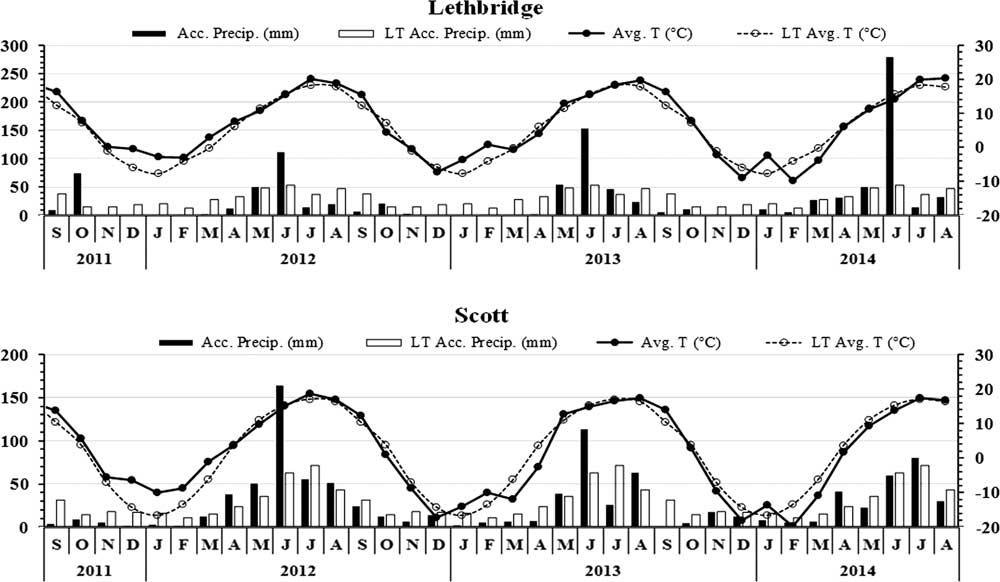
Mean monthly temperatures were near the 30-yr long-term average at all sites (Figure 1). The only notable deviation from this trend was in 2011 to 2012, during which the winter was warmer than the long-term average at all sites. Precipitation accumulation patterns were also near normal except for higher rainfall for the months of June in all 3 yr at Lethbridge and Kipp, AB, and the first 2 yr at Scott, SK. Generally, maximum water consumption in winter wheat occurs in June and July (Alberta Agriculture and Forestry 2011); thus, the above-average precipitation in June probably benefited winter wheat growth in this region.
Winter Wheat Stand Density and Injury
Herbicide treatments did not markedly influence winter wheat stand density in fall or spring compared with the nontreated check (Tables 3 and 4). However, pairwise comparisons in the downy brome experiment revealed that pyroxsulam application resulted in lower plant densities than flucarbazone formulations (Table 3). Additionally, thiencarbazone and pyroxasulfone plus flumioxazin treatments resulted in lower fall and spring densities than pyroxasulfone applied alone at the highest rate (150 g ai ha–1). This was not consistent with the results in the Japanese brome experiment, in which pairwise comparisons indicated no significant differences between treatments. Despite significant plant stand differences in the downy brome experiment, the magnitude of the difference was less than 5%; thus, the reduction would be of little biological significance, as spring plant densities exceeding 200 plants m–2 are sufficient for optimum winter wheat yields (Beres et al. Reference Beres, Clayton, Harker, Stevenson, Blackshaw and Graf2010a). Lower winter wheat head densities were recorded in the nontreated checks, probably because of weed competition, but there was no difference between herbicides in either experiment (Tables 3 and 4).
Responses of winter wheat plant stand, head density, biomass, and grain yield to herbicide treatments in the downy brome experiment.

a Abbreviations for formulations are as follows: SC, suspension concentrate; WDG, water-dispersible granule.
Responses of winter wheat plant stand, head density, biomass, and grain yield to herbicide treatments in the Japanese brome experiment.

a Abbreviations: Pyroxasulfone 112, pyroxasulfone applied at 112 g ai ha–1; Pyroxasulfone 150, pyroxasulfone applied at 150 g ai ha–1; SC, suspension concentrate; WDG, water-dispersible granule.
Almost all herbicide treatments displayed some level of winter wheat injury (1% to 15%) at all site-years when assessed 21 to 28 d after the spring POST application (Table 5). At Scott in 2012 and 2013, the injury assessment at 50 d after herbicide application was higher (up to 16%) compared to the assessment at 21 to 28 d (less than 5%). Injury ratings of 10% or more were recorded at Scott with fall applications of pyroxsulam (2013), fall- and spring-applied flucarbazone WDG (2012), fall-applied flucarbazone SC (2012, 2013), and fall-applied thiencarbazone (2012) (Table 5). The reason for the higher injury recorded at Scott is not fully understood; however, Scott is generally a harsher environment for winter wheat production than Lethbridge or Kipp. Winter air temperatures at Scott are generally lower than Lethbridge, with both locations receiving similar winter snowfall levels (Figure 1). Winterkill risk assessment models indicate that Scott is three times more likely to experience winter injury than Lethbridge (Savdie et al. Reference Savdie, Whitewood, Raddatz and Fowler1991). Thus, the harsher winter environment at Scott could have reduced the crop’s ability to tolerate herbicides. Despite slightly higher injury at Scott in 2012 and 2013, overall injury at other sites was acceptable. No injury was observed with pyroxasulfone, even at rates as high as 150 g ai ha–1. Our results were consistent with those of Hulting et al. (Reference Hulting, Dauer, Hinds-Cook, Curtis, Koepke-Hill and Mallory-Smith2012) and Sadasivaiah et al. (Reference Sadasivaiah, Perkovic, Pearson, Postman and Beres2004), who noted that pyroxasulfone applied at a rate of 150 g ai ha–1 resulted in less than 8% injury in winter wheat. Also, Soltani et al. (Reference Soltani, Shropshire and Sikkema2016) reported that flumioxazin did not injure winter wheat when applied 1 to 4 wk prior to planting in early September; however, they noted some injury with later applications and seeding dates.
Monthly accumulated precipitation and mean temperature at Lethbridge, Alberta and Scott, Saskatchewan during the experimental period. Climatic conditions at Kipp and Lethbridge were considered similar, and for this reason only climatic conditions in Lethbridge and Scott were summarized. Abbreviations: Acc. Precip, monthly accumulated precipitation during the experimental period; LT Acc. Precip., long-term (30-yr) average accumulated precipitation; Avg. T, monthly averaged temperature during the experimental period; LT Avg. T., long-term (30-yr) average temperature.
Visual winter wheat injury from herbicide treatments assessed 21 to 28, and 50 d after spring POST herbicide application in the downy brome experiment.

a Abbreviations: Pyroxasulfone 112, pyroxasulfone applied at 112 g ai ha–1; Pyroxasulfone 150, pyroxasulfone applied at 150 g ai ha–1; SC, suspension concentrate; WDG, water-dispersible granule.
b Simple weighted means derived from Excel.
c Means estimated from analysis of variance for individual sites or all sites.
d Parenthetical values are the standard error of the back-transformed means.
Downy Brome Control
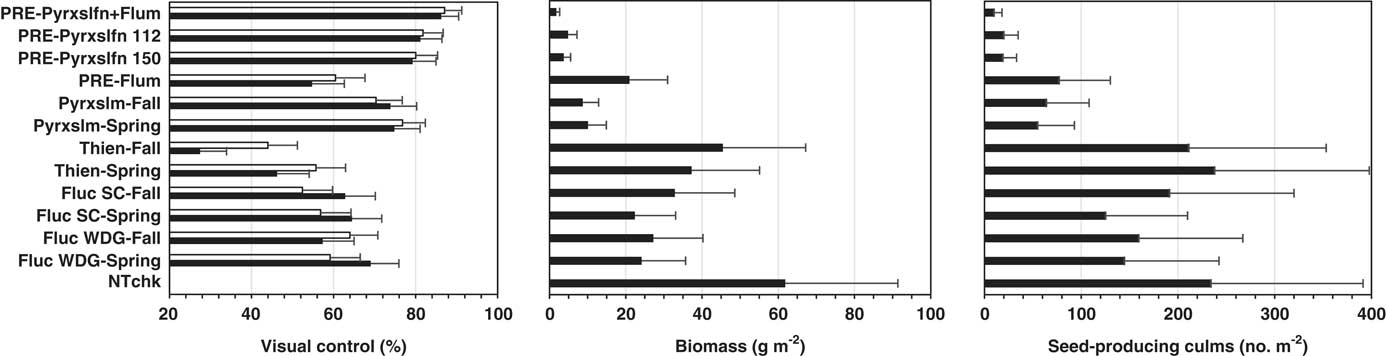
Herbicides containing pyroxsulam and pyroxasulfone provided greater than 70% and 80% control, respectively, when assessed at both 21 to 28 and 50 d after the spring POST application (Figure 2). In addition, these herbicides reduced downy brome biomass and seed-producing culms by 85% and 67% to 87%, respectively, compared with the nontreated check. All other treatments provided between 50% and 70% control of downy brome, with the exception of fall-applied thiencarbazone, which provided less than 50% control. Flucarbazone treatments reduced downy brome biomass by 60% to 65%, whereas all other treatments reduced biomass by less than 55%. Flucarbazone (SC formulation), thiencarbazone, and flumioxazin treatments did not reduce the number of downy brome seed-producing culms compared to the nontreated check. These results were similar to those of Kumar et al. (Reference Kumar, Jha and Jhala2017), who reported that a spring POST application of pyroxsulam provided 61% control of downy brome, whereas pyroxasulfone at rates of 89 g ai ha–1 and higher resulted in better than 80% control, depending on rate, application timing, and formulation. Based on orthogonal contrasts, application timing of the ALS-inhibiting herbicides did not affect downy brome control rating, biomass, or number of seed-producing culms (unpublished data). This is contrary to the findings of Geier et al. (Reference Geier, Stahlman, Peterson and Claassen2011), who reported higher levels of downy brome control when pyroxsulam, sulfosulfuron, propoxycarbazone, or propoxycarbazone plus mesosulfuron were applied in fall compared with spring.
Back-transformed mean responses to herbicide treatments for downy brome. For brome control, solid and empty bars are respective means for assessments conducted at 21 to 28 and 50 d after spring POST herbicide application. Error bars indicate the standard error of the respective means. Abbreviations: PPF, preplant fall application; Pyrxslfn+Flum, pyroxasulfone and flumioxazin tank-mix; Pyrxslfn 112 g, pyroxasulfone applied at 112 g ai ha–1; Pyrxslfn 150 g, pyroxasulfone applied at 150 g ai ha–1; Flum, flumioxazin applied at 88 g ai ha–1. Pyrxslm-Fall, pyroxsulam applied in fall; Pyrxslm-Spring, pyroxsulam applied in spring; Thien-Fall, thiencarbazone applied in fall; Thien-Spring, thiencarbazone applied in spring; Fluc SC-Fall, flucarbazone (SC) applied in fall; Fluc SC-Spring, flucarbazone (SC) applied in spring; Fluc WDG-Fall, flucarbazone (WDG) applied in fall; Fluc WDG-Spring, flucarbazone (WDG) applied in spring. NT check, nontreated check. SC, suspension concentrate; WDG, water-dispersible granule.
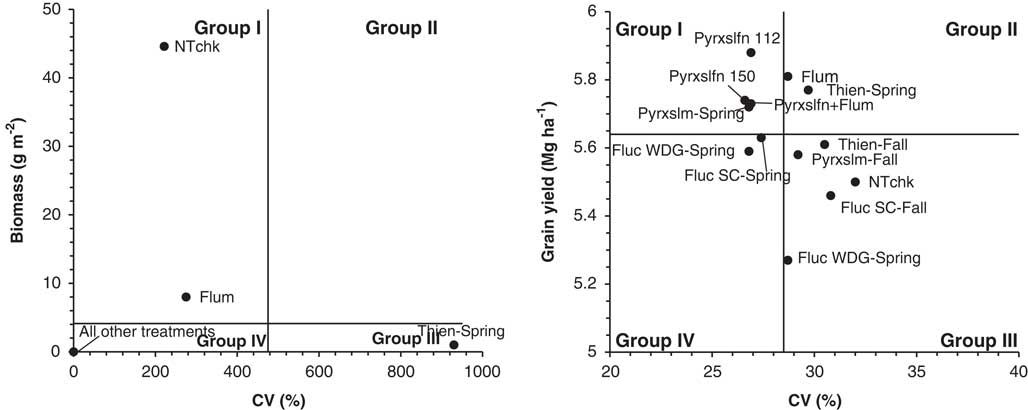
The biplot of downy brome biomass and corresponding CV indicated that the pyroxasulfone plus flumioxazin treatment resulted in the lowest mean and variation in biomass (Group IV) (Figure 3). Pyroxasulfone applied alone resulted in low biomass but much higher variation. Pyroxsulam applied in the fall or spring, both formulations of flucarbazone applied in the spring, and flumioxazin also resulted in below-average biomass and variation. Both formulations of flucarbazone applied in the fall, and thiencarbarbazone applied in the fall or spring, resulted in above-average biomass and below-average variation.
Biplots summarizing means versus corresponding coefficient of variation (CV) for weed biomass (left) and winter wheat grain yield (right) in downy brome experiment. The four groups are characterized by high mean brome biomass and low CV (Group I); high mean brome biomass and high CV (Group II); low mean brome biomass and high CV (Group III); and low mean brome biomass and low CV (Group IV). Abbreviations: Pyrxslfn+Flum, pyroxasulfone and flumioxazin tank-mix; Pyrxslfn112 g, pyroxasulfone applied at 112 g ai ha–1; Pyrxslfn 150 g, pyroxasulfone applied at 150 g ai ha–1; Flum, flumioxazin applied at 88 g ai ha–1. Pyrxslm-Fall, pyroxsulam applied in fall; Pyrxslm-Spring, pyroxsulam applied in spring; Thien-Fall, thiencarbazone applied in fall; Thien-Spring, thiencarbazone applied in spring; Fluc SC-Fall, flucarbazone (SC) applied in fall; Fluc SC-Spring, flucarbazone (SC) applied in spring; Fluc WDG-Fall, flucarbazone (WDG) applied in fall; Fluc WDG-Spring, flucarbazone (WDG) applied in spring. NTchk, nontreated check. SC, suspension concentrate; WDG, water-dispersible granules. All of the pyroxasulfone and flumioxazin treatments were applied prior to planting.

Japanese Brome Control
Herbicide treatments containing pyroxasulfone and fall applications of pyroxsulam and flucarbazone provided greater than 90% Japanese brome control at 21 to 28 d after POST applications (Figure 4). Thiencarbazone, flumioxazin, and spring applications of pyroxsulam and flucarbazone provided 70% to 78% control. At 50 d after POST applications, all treatments resulted in greater than 90% control, with the exception of flumioxazin (73% control). All treatments provided at least 87% Japanese brome biomass reduction, except flumioxazin, for which biomass was reduced 72%. There was no difference among the herbicides in the number of seed-producing culms, with treatments reducing culms by 73% to 99%, compared to the nontreated check.
Back-transformed mean responses to herbicide treatments for Japanese brome. For brome control, solid and empty bars are respective means for assessments conducted at 21 to 28 and 50 d after spring POST herbicide application. Error bars indicate the standard error of the respective means. Abbreviations: PPF, preplant fall application. Pyrxslfn+Flum, pyroxasulfone and flumioxazin tank-mix; Pyrxslfn112 g, pyroxasulfone applied at 112 g ai ha–1; Pyrxslfn 150 g, pyroxasulfone applied at 150 g ai ha–1; Flum, flumioxazin applied at 88 g ai ha–1. Pyrxslm-Fall, pyroxsulam applied in fall, Pyrxslm-Spring, pyroxsulam applied in spring; Thien-Fall, thiencarbazone applied in fall; Thien-Spring, thiencarbazone applied in spring; Fluc SC-Fall, flucarbazone (SC) applied in fall; Fluc SC-Spring, flucarbazone (SC) applied in spring; Fluc WDG-Fall, flucarbazone (WDG) applied in fall; Fluc SC-Spring, flucarbazone (WDG) applied in spring. NT check, nontreated check. SC, suspension concentrate; WDG, water-dispersible granule.

Biplot analysis indicated that most treatments resulted in low weed biomass and variation (Group IV), with the exceptions of flumioxazin (high biomass and variation) and spring-applied thiencarbazone (low biomass, high variation) (Figure 5). Thus, spring-applied thiencarbazone provided less consistent control of Japanese brome than the other treatments.
Biplots summarizing means versus corresponding coefficient of variation (CV) for weed biomass (left) and winter wheat grain yield (right) in Japanese brome experiment. The four groups are characterized by high mean brome biomass and low CV (Group I); high mean brome biomass and high CV (Group II); low mean brome biomass and high CV (Group III); and low mean brome biomass and low CV (Group IV). Abbreviations: Pyrxslfn+Flum, pyroxasulfone and flumioxazin tank-mix; Pyrxslfn112 g, pyroxasulfone applied at 112 g ai ha–1; Pyrxslfn 150 g, pyroxasulfone applied at 150 g ai ha–1; Flum, flumioxazin applied at 88 g ai ha–1. Pyrxslm-Fall, pyroxsulam applied in fall; Pyrxslm-Spring, pyroxsulam applied in spring; Thien-Fall, thiencarbazone applied in fall; Thien-Spring, thiencarbazone applied in spring; Fluc SC-Fall, flucarbazone (SC) applied in fall; Fluc SC-Spring, flucarbazone (SC) applied in spring; Fluc WDG-Fall, flucarbazone (WDG) applied in fall; Fluc WDG-Spring, flucarbazone (WDG) applied in spring. NTchk, nontreated check. SC, suspension concentrate; WDG, water-dispersible granule.All of the pyroxasulfone and flumioxazin treatments were applied prior to planting.
Winter Wheat Biomass and Grain Yield
In the downy brome experiment, winter wheat biomass and grain yield did not differ between the treated and nontreated plots; however, these parameters did respond to the timing of POST herbicide application (Tables 3 and 4). Winter wheat biomass and grain yield were reduced when pyroxsulam, flucarbazone (both formulations), and thiencarbazone were applied in the fall compared with the spring (Tables 3 and 4). Despite significant differences, the magnitude of these differences was small. Spring application resulted in 0.69 Mg ha–1 and 0.23 Mg ha–1 higher biomass and grain yield, respectively, which is less than a 5% difference in both cases (unpublished data). Application timing did not affect winter wheat biomass in the Japanese brome experiment; however, it did result in a similar yield advantage (0.2 Mg ha–1) for fall application compared with spring.
In the downy brome experiment, the biplot indicated that fall-applied flucarbazone, fall-applied thiencarbazone, and the nontreated check were categorized as low-yield and high-yield variation (Group III) (Figure 3). Spring-applied pyroxsulam resulted in the lowest yield variation, with treatments containing pyroxasulfone demonstrating high yield and low variation as well. In the Japanese brome experiment, spring-applied pyroxsulam and treatments containing pyroxasulfone resulted in above-average yield and below-average variation (Figure 5). Spring-applied flucarbazone resulted in slightly below-average yields with variation similar to the spring pyroxsulam- and pyroxasulfone-containing treatments. Flumioxazin and spring-applied thiencarbazone provided yields similar to spring-applied pyroxsulam and the pyroxasulfone-containing treatments, with slightly above-average variation. Fall application of thiencarbazone, pyroxsulam, and flucarbazone formulations resulted in slightly below-average yields with above-average variation.
The lack of difference in winter wheat yield (averaged among sites) between the treated and nontreated plots in both experiments was probably due to low weed densities in our studies and an asynchrony between weed and crop emergence (Blackshaw Reference Blackshaw1993; Reddy et al. Reference Reddy, Stahlman and Geier2013; Stahlman and Miller Reference Stahlman and Miller1990). Blackshaw (Reference Blackshaw1993) concluded that at densities of 50 to 400 plants m–2, downy brome caused two to five times greater reductions in yield when it emerged within 3 wk after winter wheat than when it emerged 6 wk after wheat. We did not record weed densities; however, the downy brome biomass recorded in our nontreated checks were similar to the biomass recorded by Blackshaw (Reference Blackshaw1993) at densities of less than 50 downy brome plants m–2. In addition, the mean numbers of seed-producing culms in our nontreated checks were 235 and 133 m–2 for downy and Japanese brome, respectively (Figures 2 and 3). Hulbert (Reference Hulbert1955) reported that the number of culms per downy brome plant increased from 1.9 to 13.3 as plant density decreased from 1,970 to 60 plants m–2; thus, the densities in our studies were relatively low. Stahlman and Miller (Reference Stahlman and Miller1990) reported that downy brome densities of less than 40 plants m–2 resulted in less than 15% reduction in winter wheat yield; however, densities as high as 100 plants m–2 did not reduce yields if downy brome emerged 21 d after the crop.
Almost all herbicide treatments and timing combinations resulted in some level of winter wheat injury. The highest injury was caused by flucarbazone applied in the fall at Scott. Winter wheat injury (Table 5) was similar to the results of Wiersma et al. (Reference Wiersma, Durgan and Martinson2003), who noted up to 16% injury in eight hard spring wheat cultivars tested with twice the labeled rate of flucarbazone. In the present study, the injury from fall-applied flucarbazone did not result in yield reductions compared with other treatments as a result of the ability of winter wheat to recover over the growing season.
In terms of weed control, pyroxsulam- and pyroxasulfone-containing herbicides provided consistent control of downy brome, whereas most of the herbicides were effective on Japanese brome. These results are consistent with Sebastian et al. (Reference Sebastian, Nissen and De Souza Rodrigues2016) and Geier and Stahlman (Reference Geier and Stahlman1996), who reported higher sensitivity of Japanese brome than downy brome to both imazapic and indaziflam, and sulfosulfuron, respectively. Pyroxsulam and treatments containing pyroxasulfone resulted in greater than a 65% reduction in downy brome seed-producing culms, indicating a potential reduction in seed return. Sebastian et al. (Reference Sebastian, Nissen, Sebastian and Beck2017) reported that downy brome biomass and the soil seed bank recovered within 1 to 2 yr after glyphosate treatments were terminated and suggested if downy brome were controlled consecutively for 4 to 5 yr, the soil seed bank could be dramatically reduced. Rinella et al. (Reference Rinella, Masters and Bellows2010) reported that seed production of Japanese brome was reduced by more than 95% when aminopyralid or picloram were applied at three different plant growth stages. All of the products tested in the present study were effective at reducing the number of Japanese brome seed-producing culms. Sequential applications of pyroxasulfone applied PRE followed by imazamox or pyroxsulam applied POST provided higher levels of downy brome control than when the products were applied alone (Kumar et al. Reference Kumar, Jha and Jhala2017). Thus, sequential applications of the efficacious preplant and POST herbicides evaluated in this study may reduce Bromus spp. seed production even further. The potential to manage seed return of Bromus spp. suggests long-term management implications from this study.
The efficacy of the pyroxasulfone-containing treatments may assist in delaying ALS inhibitor-resistance in Bromus spp. ALS inhibitor-resistance has been identified in downy brome (Kumar and Jha, Reference Kumar and Jha2017); however, it has not yet been found in western Canada. Tank-mixing different herbicide sites of action is recommended for delaying the evolution of herbicide resistance (Beckie and Reboud Reference Beckie and Reboud2009); thus, growers should consider applying pyroxasulfone plus flumioxazin combined with cultural practices such as increased seeding rates, competitive cultivars, and banded fertilizer N (Beres et al. Reference Beres, Clayton, Harker, Stevenson, Blackshaw and Graf2010a; Blackshaw Reference Blackshaw1994; Harker and O’Donovan Reference Harker and O’Donovan2013) for management of Bromus spp. in winter wheat.
Pyroxsulam, pyroxasulfone, and pyroxasulfone plus flumoxazin provided consistent, efficacious control of both Japanese and downy brome. Flucarbazone and thiencarbazone also controlled Japanese brome, whereas flumioxazin provided suppression only. The present research suggests that alternative herbicide sites of action could augment management of Bromus spp. in western Canadian winter wheat production, and potentially also reduce selection pressure for ALS inhibitor-resistance if used judiciously in an IWM program.
Acknowledgments
This project was funded through AAFC’s Growing Forward Program, Developing Innovative Agri-Products (DIAP), which matched funds provided by Ducks Unlimited Canada, Alberta Winter Wheat Producers Commission, Alberta Wheat Commission, Saskatchewan Winter Cereals Development Commission, and Winter Cereals Manitoba Inc. Expert technical support was provided by R. Dyck, S. Simmill, C. Gampe, M. Gretzinger, and a large regiment of summer students. No conflicts of interest have been declared.


 Open access

