

According to Huntington (Reference Huntington1981, 33): “The distinctive aspect of the American Creed is its antigovernment character. Opposition to power, and suspicion of government as the most dangerous embodiment of power, are the central themes of American political thought.” The logic of the American Constitution is that majorities are required for change but that it also is necessary to protect minority interests. The system of checks and balances forces most majorities to grow and broaden before they are empowered. It provides an incentive for public officials to negotiate and compromise.
In early 2025, Donald Trump ignored this constitutional imperative. Instead of persuasion, compromise, and negotiation, he employed unilateral action. The president had a need to legitimate such a mode of governing in a system designed to decentralize power and in a political culture suspicious of it. The primary option available to him and his supporters was to claim a broad mandate from the people.
MANDATES
There are three diverse strands in the scholarly study of presidential mandates. First, there is the issue of presidents claiming a mandate. A second question focuses on the plausibility of a president actually receiving a mandate to pursue certain policies, regardless of what the White House claims. Third, there is the matter of broad perception of a mandate that may aid presidents in obtaining support for their policies in Congress.
Claiming a Mandate
The first issue in the mandate literature concerns presidents claiming a mandate. Azari (Reference Azari2014) found that contemporary presidents, governing in a highly polarized context, claim popular mandates to manage unruly and competing elements within their own party and to overcome staunch resistance from the opposition party. As Ellis and Kirk (Reference Ellis and Kirk1995) pointed out in their analysis of nineteenth-century mandate claims, by persuading others that he possesses a mandate from the voters to pursue a particular policy agenda, a president can disguise his leadership under the pretense of simply carrying out “the will of the people.” The presidential mandate thus enables presidents to lead while seeming to follow, to exercise power over the people under the guise of empowering the people.
Trump’s second presidency is transpiring in an environment of intense partisan polarization, and he has chosen to rely heavily on unilateral policy making. The literature leads us to predict that he would make extreme claims of having received a mandate in an attempt to accord legitimacy to his actions.
The Plausibility Problem
The most straightforward evidence of a mandate is that a clear majority of the populace has shown through its votes that it supports certain policies proposed by the winning candidate. Yet, by their very nature, elections rarely provide clear indications of the public’s thinking on individual proposals. If presidential elections are to provide majority support for specific policies, the following conditions must be met: (1) voters must have opinions on policies; (2) voters must know candidates’ stances on the issues; (3) candidates must offer voters the alternatives that the voters desire; (4) there must be a large turnout of voters; (5) voters must vote on the basis of issues; and (6) there must be a correlation between voters’ support and their policy views.
Political scientists have shown repeatedly that the notion of elections imparting a popular mandate for a president to pursue particular policies is inherently implausible. The first five conditions rarely are met, if ever (Dahl Reference Dahl1990; Edwards Reference Edwards1983, 18–23). For this reason, it is difficult to discern the relationship between voters’ policy preferences and a president’s victory at the polls. When asked about his mandate in 1960, John F. Kennedy reportedly replied, “Mandate, schmandate. The mandate is that I am here and you’re not” (Ladd Reference Ladd1985, 3).
Even landslide elections are difficult to interpret. For example, Kelley (Reference Kelly1983, 72–125) found that in Lyndon Johnson’s 1964 victory, the current issues gave the president his base of support and concerns over the relative competence of the candidates won the swing vote for him. In 1972, however, the question of competence dominated the election. Although traditional domestic issues associated with the New Deal were salient, they actually favored George McGovern, not the landslide winner, Richard Nixon.
There are two additional complicating factors. First, there may be no majority opinion on an issue, even among those who have an opinion. Public opinion polls often encourage respondents to choose one of a restricted number of possible answers. However, opinion on any issue usually is fragmented, providing no majority opinion to identify.
Second, voters may be concerned with several issues in an election, but they have only one vote with which to express their views. Citizens may support one candidate’s position on some issues yet vote for another candidate because of concern for other issues or general evaluations of performance. In 1984, voters preferred Walter Mondale to Ronald Reagan on the issues of defense spending, aid to the Contras, environmental protection, protection of civil rights, and helping the poor and disadvantaged—but most voted for Reagan for president (Los Angeles Times Poll 1984; Wattenberg Reference Wattenberg1986, 154). When they cast their ballots, voters signal only their choice of candidate, not their choice of the candidates’ policies. We should be cautious in inferring support for specific policies from the results of this process, for the vote is a blunt instrument for expressing voters’ views. Therefore, regardless of the president’s claims, previous research leads us to expect that Trump did not receive broad support for his policy stances.
The Perception Predicament
Electoral mandates can be powerful symbols in American politics because they accord added legitimacy and credibility to the newly elected president’s proposals. Moreover, concerns for both representation and political survival encourage members of Congress to support the president if they feel the people have spoken (Edwards Reference Edwards1989, ch. 8; Grossback, Peterson, and Stimson Reference Grossback, David and Stimson2006).
More important, mandates change the premises of decisions. Following the 1932 presidential election, the essential question became how government should act to fight the Great Depression rather than whether it should act. Similarly, following the 1964 election, the dominant question in Congress was not whether to pass new social programs but rather how many to pass and how much to increase spending. In 1981, however, the tables were turned. Reagan’s victory placed a stigma on big government and exalted the unregulated marketplace and large defense efforts. He had won a major victory even before the first congressional vote.
Merely winning an election does not give a president a mandate, however. Every election produces a winner, but mandates are much less common. Even large electoral victories such as Nixon’s in 1972 and Reagan’s in 1984 carry no guarantee that Congress, the public, the media, and officials will interpret the results as mandates from the people to support the president’s policies.
Space limitations do not allow me to pursue the matter of perceptions of a mandate in the 2024 presidential election. However, the issue is less critical than it might be for other administrations because Trump is relying so heavily on unilateral power. This mode of governing emphasizes claiming a mandate and defending its plausibility, issues that are discussed in the following sections.
DATA AND METHODS
There is no official definition for an electoral mandate; however, in common usage, it refers to the public decisively voting in support of not only a candidate but also of the new president’s policies. How do we recognize a mandate? We could examine media portrayals of an electoral victory (Grossback, Peterson, and Stimson Reference Grossback, David and Stimson2006; Hershey Reference Hershey1994) or broad understandings of the meaning of an election (Edwards Reference Edwards1989, ch. 8), which have been particularly useful in studying Congress’s response or popular understandings of an election outcome. For purposes of democratic legitimacy, however, it is best to examine the election results and what voters were thinking as they cast their vote and in the immediate aftermath of the election. Our focus must be extended to the aftermath because Trump raised issues on which he did not campaign but on which he claimed a mandate.
The best way to determine the public’s thinking is through analyzing high-quality public opinion polls. Fortunately, there currently are many high-quality polls, so our findings can be triangulated and less subjected to the misdirection of outliers. All of the data referenced in this article are in the public domain, and both the data and the methods are straightforward and transparent.
DID TRUMP CLAIM A MANDATE?
I predicted that Donald Trump would claim that the public had awarded him a strong mandate for his policies. Americans elected him as president in November 2024, only the second time a chief executive has been elected to nonconsecutive terms. The first was Grover Cleveland, elected in 1884 and 1892. On Election Night, president-elect Trump declared that “America has given us an unprecedented and powerful mandate” (YouTube 2024). Later, he told Time Magazine (2024) that “The mandate was massive.”
President Trump and his supporters advanced claims of an impressive mandate to provide critical legitimacy for the extraordinary changes he initiated immediately after taking office. For example, Elon Musk asserted in the Oval Office that “The people voted for major government reform and that’s what the people are going to get. They’re going to get what they voted for” (Davis et al. Reference Davis, Stein, Natanson, Rein and Romm2025). White House Press Secretary Karoline Leavitt proclaimed: “The president was given a mandate to implement transformative, monumental change” (Arnsdorf and Allison Reference Arnsdorf and Allison2025). Stephen Miller, the White House Deputy Chief of Staff and perhaps the president’s most influential aide, declared: “The whole will of democracy is imbued into the elected president” (CBS News 2025).
The president continued to refer to his mandate in a wide range of situations. When Trump wanted Iran to end support for Houthi terrorists, he told its leaders he had won “one of the largest mandates in presidential history” (Trump Reference Trump2025a). Three days later, when he wanted to impeach a troublesome judge, he told his followers he had won an “an overwhelming mandate….I’m just doing what the voters wanted me to do” (Trump Reference Trump2025b).
It is clear, then, that President Trump claimed an extraordinary mandate to pursue his policies. Given the prominent role that the president’s claims play in his attempts to legitimate his mode of governing, it is important to evaluate them systematically. We should expect that the president’s claims would be exaggerated, but the uniqueness of his presidency and the historic significance of his policy changes demand that we rigorously assess their accuracy.
OVERALL ELECTION RESULTS
The place to begin the analysis is an examination of the overall election results. Trump won slightly less than a majority of the vote: 49.8%. Administration officials often note that the president received almost 77 million votes but they ignore the fact that 78.4 million voters did not vote for him (Office of the Clerk, US House of Representatives 2025).
Trump won approximately 1.5% more of the vote than Vice President Kamala Harris—a margin that is one of the smallest since 1824, the beginning of mass popular voting. There were 50 presidential elections in the 200 years preceding 2024. The winning candidate in 40 of them received a larger percentage of the vote than Trump did. Only in five of these elections—1844 (1.4%), 1880 (0.1%), 1884 (0.7%), 1960 (0.2%) (see Edwards Reference Edwards2024, 68, 71–73, questioning the view that Kennedy won the popular vote), and 1968 (0.7%)—did the winning candidate have a smaller margin of victory than Trump did in 2024. Of course, in 1824, 1876, 1888, 2000, and 2016, the winner actually lost the popular vote. Thus, Trump performed more poorly than 80% of his predecessors in the era of mass voting.
Congressional election results also may indicate strong public support for the current president. However, in 2024, the Republicans lost a seat in the House. They did pick up four seats in the Senate, but only one was from a competitive state (i.e., Pennsylvania).
EARLY OPINION
What were people thinking when they cast their vote or as Trump began his second presidency? Only 48% of the public held a favorable view of the president at election time (Gallup poll 2024). When a Fox News poll of registered voters taken shortly before Inauguration Day asked: “Would you characterize Donald Trump’s 2024 election victory as a mandate or not?,” 42% replied “yes” but a majority of 51% responded “no.” Of the registered voters who responded, 54% viewed the election as mostly a rejection of President Joe Biden and Harris, whereas only 41% viewed the result as an endorsement of Trump (Fox News poll 2025). Similarly, election analyst Peter Enns found that voters chose Trump not because they wanted to see his divisive policies implemented but rather because they were frustrated with the state of the economy during Biden’s presidency (Stein Reference Stein2024). In early January, a slight majority of the public (51%) were pessimistic or concerned about Trump’s presidency (New York Times–Ipsos poll 2025).
Only 32% of registered voters believed Trump should advance his agenda and policies, even if it caused division, whereas 65% thought the president should look for opportunities to collaborate with Democrats, even if it meant compromising (Fox News poll 2025). In another poll, 63% of the public wanted the president to try his best to collaborate with Democratic congressional leaders to accomplish things, even if it meant disappointing those who voted for him (Pew Research Center poll 2025a).
When asked how congressional Republicans should respond to the president’s initiatives, 23% of the respondents stated that they should support whatever Trump wanted; however, 77% replied that even his own party’s members of Congress should push back when they disagreed with him (CBS News–YouGov poll 2024). Among Republicans in the public, 55% responded that Republicans in Congress did not have an obligation to support Trump’s policies with which they disagreed (Pew Research Center poll 2025a).
More broadly, 65% of the public believed it would be “too risky” to give Trump more power to directly address many of the nation’s problems. Only 33% agreed that “many of the country’s problems could be dealt with more effectively if Trump didn’t have to worry so much about Congress or the courts.” Even more Americans (78%) opposed the idea of giving presidents more power in general (Pew Research Center poll 2025a).
By February, before Trump had been in office for a month, 57% of the public believed the president had already exceeded his authority as president; 54% wanted the next Congress to be controlled by Democrats to function as a check on Trump (Washington Post–Ipsos poll 2025a; see also CNN poll 2025; New York Times–Siena College poll 2025; Pew Research Center poll 2025d; Washington Post–ABC News–Ipsos poll 2025).
CAMPAIGN ISSUES
The best argument for Trump’s claim that he was elected with a broad mandate to bring about aggressive policy change is that he always said he would. However, did Trump campaign on the issues on which he acted early in his term so he could reasonably claim a mandate to initiate major changes in policies regarding them? For many of the issues, he did not. For example, Trump never mentioned buying Greenland in any of his public speeches or interviews during the 2024 campaign; neither did he suggest that Canada become part of the United States or that the United States take back control of the Panama Canal. Of equal significance, he never mentioned the US Agency for International Development (USAID) (Baker Reference Baker2025), and he certainly never stated that he would fire a significant percentage of the doctors and researchers at the National Institutes of Health. Therefore, voters cannot be said to have given him a mandate to act on such matters.
Elon Musk and DOGE
During the 2024 campaign, Trump made no secret of the fact that he planned to tap Elon Musk to head a government efficiency commission (Coster and Slattery Reference Coster and Slattery2025), and Musk served as a top surrogate for Trump in the battleground state of Pennsylvania. Vice President JD Vance (Reference Vance2025) summed up the administration’s argument in a post on Musk’s social media platform X: “No one voted for Elon Musk. They did however vote for Donald Trump, who promised repeatedly to have Elon Musk root out wasteful spending in our government.” Musk (Reference Musk2025) shared Vance’s post, adding emojis of the American flag and “100%.”
However, Trump never mentioned firing tens of thousands of government employees or dismantling congressionally approved and funded programs. Moreover, an examination of television ads in the 2024 presidential campaign exposes the weakness of the administration’s claim. The Trump campaign and outside groups backing him did not mention Musk in any of their broadcast or cable television ads (AdImpact 2025). There was an expenditure of $658 to air an ad by rapper EO one time. The ad mentions Musk’s name but not what he would be doing in a Trump administration (AdMo 2024).
Instead of radical change, the top issues in the campaign’s ads were immigration, inflation, crime, and taxes—many of the concerns that voters stated were most important to them. According to Republican pollster Kristen Soltis Anderson (Reference Anderson2025), fewer than half of Trump voters identified mass firings or tariffs as a top priority. Instead, Trump voter priorities looked like voter priorities overall: reduce the cost of living, deport criminal undocumented immigrants, and secure the southern border.
How did the public respond after Trump had empowered Musk? In both December 2024 and January 2025, 53% of registered voters disapproved of Musk having a prominent role in the Trump administration (Quinnipiac University poll 2024, 2025a). Shortly before Inauguration Day, the public opposed Musk and Vivek Ramaswamy heading a task force to identify cuts in government programs (HarrisX–Harris poll 2025; see also Associated Press–National Opinion Research Center poll 2025). Pluralities also disapproved of eliminating entire federal agencies and numerous federal jobs (Associated Press–National Opinion Research Center poll 2025).
After less than a month into Trump’s second term, 55% of registered voters believed that Musk had excessive power in making decisions affecting the United States (Quinnipiac University poll 2025b), and 54% thought it was a “bad thing” for Musk to play a prominent role in the government (CNN poll 2025; but see CBS–YouGov poll 2025b). Americans disapproved by a similarly wide margin (52% to 26%) of Musk “shutting down federal government programs that he decides are unnecessary.” Moreover, 63% of Americans were concerned about Musk’s team acquiring access to data about them (Washington Post–Ipsos poll 2025a).
By March, 71% of the public wanted Musk to have little or no influence in the Trump administration (Economist–YouGov poll 2025); 60% disapproved of the way Musk and the Department of Government Efficiency (DOGE) were dealing with workers employed by the federal government; and 54% believed that Musk and DOGE were hurting the country (Quinnipiac University poll 2025c). By early April, 57% of voters believed that Musk had too much power in making decisions affecting the United States (Quinnipiac University poll 2025d), and 57% had an unfavorable opinion of him (Reuters–Ipsos poll 2025f; see also New York Times–Siena College poll 2025; Washington Post–ABC News–Ipsos poll 2025).
What about the results of DOGE’s efforts? Majorities supported the general goal of downsizing government (Reuters–Ipsos poll 2025b, 2025f). However, 52% believed that Trump and Musk had gone too far in their efforts to cut federal spending, and 57% opposed firing tens of thousands of federal workers (Reuters–Ipsos poll 2025f, 2025g; see also CNN poll 2025; Pew Research Center poll 2025d; Washington Post–ABC News–Ipsos poll 2025; Washington Post–Ipsos poll 2025a). Moreover, 60% opposed closing the Department of Education (Quinnipiac University poll 2025c; Reuters–Ipsos poll 2025f; Washington Post–ABC News–Ipsos poll 2025). Clear majorities opposed the attempt to shut down entire US government agencies, such as USAID and the Consumer Financial Protection Bureau (CNN poll 2025; New York Times–Siena College poll 2025; Reuters–Ipsos poll 2025d, 2025f; Washington Post–ABC News–Ipsos poll 2025; Washington Post–Ipsos poll 2025a, 2025b). The public also opposed cutting funding for medical research (Washington Post–ABC News–Ipsos poll 2025). Tellingly, there was stronger support for expanding government services, including health care, in the 2024 American National Election Study (ANES) than at any time since the ANES began asking this question in 1982 (Tesler Reference Tesler2025a).
Immigration
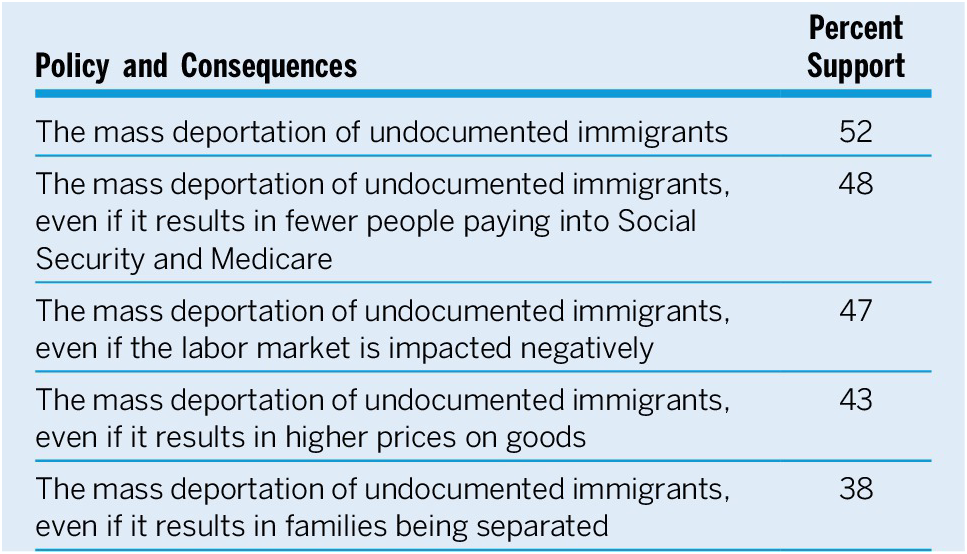
Another major initiative in the early months of the second Trump presidency focused on immigration. During the campaign, the president promised to begin deporting all undocumented immigrants immediately on taking office. Right after the election, there was a slight majority in favor of “mass deportation” (Washington Post–Ipsos poll 2025a), but support decreased below majority support when the public was asked about the probable consequences of this policy (table 1).
Public Opinion on Mass Deportation of Undocumented Immigrants

Table 1 Long description
The table consists of two columns: Policy and Consequences, and Percent Support. The data is presented in five rows:
1. The mass deportation of undocumented immigrants: 52 percent support.
2. The mass deportation of undocumented immigrants, even if it results in fewer people paying into Social Security and Medicare: 48 percent support.
3. The mass deportation of undocumented immigrants, even if the labor market is impacted negatively: 47 percent support.
4. The mass deportation of undocumented immigrants, even if it results in higher prices on goods: 43 percent support.
5. The mass deportation of undocumented immigrants, even if it results in families being separated: 38 percent support.
Source: Scripps News Poll 2024.
Question: “To what extent do you support or oppose the following?”
Source: Scripps News Poll (2024).
In December 2024, a majority of voters (55%) stated that they preferred giving most undocumented immigrants in the United States a pathway to legal status (Quinnipiac University poll 2024). A week before Trump’s inauguration, a Fox News poll (2025) of registered voters found that only 30% favored deporting all undocumented immigrants. In late January, a Quinnipiac University poll (2025a) found that 44% of registered voters—still a minority—agreed with this sentiment. Other polls near the time of the inauguration found small majorities that favored deporting all immigrants who were in the United States illegally (CBS–YouGov poll 2025a; New York Times–Ipsos poll 2025; YouGov poll 2025a).
Opinion on immigration was fluid. By Trump’s fifth week in office, only 32% of the public responded that all immigrants who were in the United States illegally should be deported. This group included slightly more than half (54%) of Republicans and only 10% of Democrats (Pew Research Center poll 2025b). The public supported deporting criminals (Associated Press–National Opinion Research Center poll 2025; HarrisX–Harris poll 2025; New York Times–Ipsos poll 2025), especially violent criminals (see also Washington Post–Ipsos poll 2025a) and those on public assistance (HarrisX–Harris poll 2025). However, Americans strongly opposed deporting those who had a job, those who had not been convicted of a violent crime (Associated Press–National Opinion Research Center poll 2025), parents of children born in the United States (Washington Post–Ipsos poll 2025a), those who came to the United States as children (i.e., the “Dreamers”) (New York Times–Ipsos poll 2025; National Public Radio poll 2025; Washington Post–Ipsos poll 2025a), and those married to a US citizen (table 2). In addition, 55% disapproved of suspending asylum applications from people seeking to live in the United States (Pew Research Center poll 2025a). The Cooperative Election Study (2024) found similar results.
Which Immigrants in the US Illegally Should Be Deported?
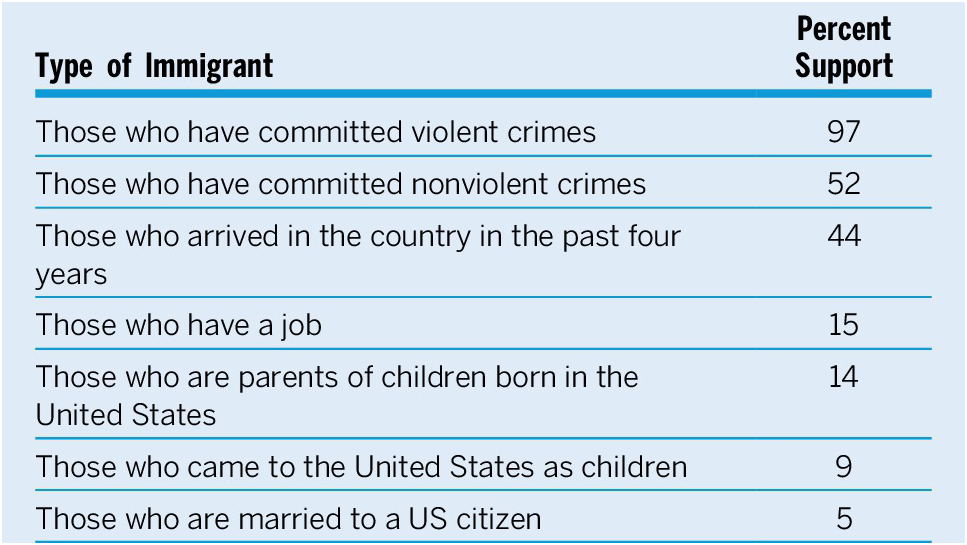
Table 2 Long description
The table consists of two columns: Type of Immigrant and Percent Support. The data is organized as follows:
* Those who have committed violent crimes: 97 percent.
* Those who have committed nonviolent crimes: 52 percent.
* Those who arrived in the country in the past four years: 44 percent.
* Those who have a job: 15 percent.
* Those who are parents of children born in the United States: 14 percent.
* Those who came to the United States as children: 9 percent.
* Those who are married to a U S citizen: 5 percent.
The data is sourced from a Pew Research Center Poll 2025 b, answering the question: In deciding whether immigrants living in the United States illegally should be deported, which of the following groups should be deported?
Question: “In deciding whether immigrants living in the United States illegally should be deported, which of the following groups should be deported?”
Source: Pew Research Center Poll (2025b).
Birthright Citizenship
One of Trump’s clearest campaign promises was ending birthright citizenship, which grants citizenship to most children born in the United States—including those born to undocumented immigrants. Only about 33% of the public supported ending this constitutional right. Clear majorities opposed changing the long-standing policy (Associated Press–National Opinion Research Center poll 2025; CBS–YouGov poll 2025a; Ipsos poll 2025; National Public Radio Poll 2025; Pew Research Center poll 2025a; Public Policy Institute of California poll 2025; Quinnipiac University poll 2024, 2025a; Reuters–Ipsos poll 2025c; Washington Post–ABC News–Ipsos poll 2025; Washington Post–Ipsos poll 2025a).
Taxes
During his campaign, Trump promised to extend the 2017 tax cuts, and the public favored this. However, the support was at a high level of abstraction. The public never favored the original bill (Edwards Reference Edwards2021, 73–79), and they did not support the massive 2025 budget and tax bill that contained the extension (KFF Health Tracking poll 2025; Pew Research Center poll 2025e; Washington Post–Ipsos poll 2025b). Moreover, the public favored raising taxes on those earning more than $400,000 per year (Cooperative Election Study 2024; Washington Post–Ipsos poll 2025b), which is contrary to provisions in both the 2017 and the 2025 tax bills.
Tariffs
Shortly after the election, and in the face of Trump’s frequent promises to use tariffs to rebuild American manufacturing while raising enormous revenue in the process, Americans did not support them (Associated Press–National Opinion Research Center poll 2025; Quinnipiac University poll 2024; Reuters–Ipsos poll 2024a, 2024b; Scripps News poll 2024). During the following months, as Trump threatened, imposed, paused, and raised tariffs, the public opposed his actions—especially regarding Mexico and Canada—and supported only modest tariffs on China (Associated Press–National Opinion Research Center poll 2025; CBS–YouGov poll 2025a, 2025b; CNN Poll 2025; HarrisX–Harris poll 2025; New York Times–Ipsos poll 2025; New York Times–Siena College poll 2025; Pew Research Center poll 2025c, 2025d; Reuters–Ipsos poll 2025a–2025g; Washington Post–Ipsos poll 2025a; YouGov poll 2025a).
Foreign Aid
Gutting foreign aid was an unexpected action early in the second Trump presidency. Given that foreign aid traditionally has been the policy that people are least likely to support (Associated Press–National Opinion Research Center poll 2023), it is not surprising that majorities favored this action. It is surprising that the majorities were so small. Approximately 45% of the public opposed cuts in foreign aid (Reuters–Ipsos poll 2025d, 2025e, 2025f; see also Doherty et al. Reference Doherty, Bryan, Hanania and Pajor2020; Williamson Reference Williamson2019). In February 2025, Americans favored humanitarian assistance to other countries, including disaster relief, food security, and alleviating poverty (Tesler Reference Tesler2025b; YouGov poll 2025b, 2025c). By April, majorities opposed cutting foreign aid that provided food and health services for people in less-developed countries (Washington Post–ABC News–Ipsos poll 2025).
Acquiring Territory
The president’s expansive view of American power included his proposals to expand the United States and control the area around it. The public did not agree. Instead, large majorities disapproved of taking back the Panama Canal (HarrisX–Harris poll 2025; Marquette Law School poll 2025; Reuters–Ipsos poll 2025a, 2025e. See also Quinnipiac University poll 2025a); acquiring Greenland through purchase or the vote of its citizens (CBS/YouGov poll 2025a; HarrisX/Harris poll 2025; Pew Research Center poll 2025c; Quinnipiac University poll 2025a; Reuters–Ipsos poll 2025a, 2025e; Suffolk University poll 2025); and annexing Canada (HarrisX/Harris poll 2025; Reuters–Ipsos poll 2025a).
CONCLUSION
As expected, Donald Trump made extraordinary claims of receiving a mandate from voters to transform the federal government and its policies. The absence of a mandate for transformational change is not unusual; indeed, research has shown that such a mandate rarely occurs. In almost all instances, the most a president can hope for is public support for a change in direction rather than an endorsement of details, for new priorities instead of policy particulars. What was distinctive in 2025 was the president claiming a mandate for using unilateral power for transformational change.
The evidence is clear that the second Trump administration did not receive a mandate for sweeping change from the American people—despite the president’s claims to the contrary. Instead, he won a narrow victory in which the public signaled a desire to move in a conservative direction on some policies. They did not support, however, transforming public policy and restructuring the federal government. Americans favored tightening immigration, not mass deportations. They wanted the president to work with Congress, not govern without it. They supported more efficient government, not dismantling agencies. Thus, claims of a mandate cannot legitimize President Trump’s unprecedented exercise of unilateral power.
The evidence is clear that the second Trump administration did not receive a mandate for sweeping change from the American people—despite the president’s claims to the contrary.
CONFLICTS OF INTEREST
The author declares that there are no ethical issues or conflicts of interest in this research.

 Open access

