





Introduction
With about 75 million hectares of farmland globally, organically managed land represents about 1.6% of the total agricultural area of the world and this share has grown strongly in the recent past (Reganold and Wachter, Reference Reganold and Wachter2016; Willer et al., Reference Willer, Schlatter and Trávníček2023). The reasons for the popularity of organic farming are likely to be found in its practices which are assumed to better safeguard ecosystem services in the long-term (Scialabba and Müller-Lindenlauf, Reference Scialabba and Müller-Lindenlauf2010; Niggli, Reference Niggli2015; Eyhorn et al., Reference Eyhorn, Muller, Reganold, Frison, Herren, Luttikholt, Mueller, Sanders, Scialabba, Seufert and Smith2019). However, organic farming systems can often not reproduce the yields and yield stabilities of conventional farming systems (Bergström and Kirchmann, Reference Bergström and Kirchmann2016; Knapp and van der Heijden, Reference Knapp and van der Heijden2018) which is why additional innovative farming approaches are likely to be needed to ensure long-term food security (Reganold and Wachter, Reference Reganold and Wachter2016).
Organic farming has been shown to have various beneficial effects on soil and plant properties (Reganold et al., Reference Reganold, Palmer, Lockhart and Macgregor1993; Maeder et al., Reference Maeder, Fliessbach, Dubois, Gunst, Fried and Niggli2002; Schärer et al., Reference Schärer, Dietrich, Kundel, Mäder and Kahmen2022) as well as on ecosystem services and social systems (Reganold and Wachter, Reference Reganold and Wachter2016; Santoni et al., Reference Santoni, Ferretti, Migliorini, Vazzana and Pacini2022), although the size of these effects is a matter of debate (Bergström and Kirchmann, Reference Bergström and Kirchmann2016).
As a special branch of organic farming, biodynamic farming has a worldwide significance of about 252,000 ha (0.3% of organic farming area), about one third of which (i.e., ca. 84,000 ha) is found within the agricultural area of Germany (Paull and Hennig, Reference Paull and Hennig2020). Regulated by the International BioDynamic Association, biodynamic farming represents an alternative approach to farming trying to keep production chains as local as possible, respond to climatic and pathogen threats and preserve agricultural biodiversity at a high level (Maeder et al., Reference Maeder, Fliessbach, Dubois, Gunst, Fried and Niggli2002; Soustre-Gacougnolle et al., Reference Soustre-Gacougnolle, Lollier, Schmitt, Perrin, Buvens, Lallemand, Mermet, Henaux, Thibault-Carpentier, Dembelé, Steyer, Clayeux, Moneyron and Masson2018; Brock et al., Reference Brock, Geier, Greiner, Olbrich-Majer and Fritz2019). Biodynamic farming is characterized by the use of different specific so-called preparations. Biodynamic spray preparations are based on fermented cow dung (horn manure) and silica flour (horn silica; see Masson Reference Masson2014). To obtain horn manure, cow dung is filled into cow horns and buried in the soil for fermentation. After unearthing the horns, the manure is stirred in water and the suspension is sprayed onto the soil (Table 1). Biodynamic compost preparations are based on plant parts that are fermented in sheaths taken from animals (e.g., cow intestine, deer bladder, Table 1) and then are added to the composting farmyard manure (FYM). According to the biodynamic pioneer Rudolf Steiner (Reference Steiner2010), the objectives in the development of biodynamic preparations were to improve (i) fertilizer and soil activity, (ii) plant health, and (iii) food quality. Increasing yield was not a direct goal in the development of the preparations.
Overview of biodynamic spray and compost preparations

All preparations except the valerian preparation are buried in the soil and unearthed after a certain amount of time before they are used.
Different experiments were undertaken in the past to investigate the effects of biodynamic farming practices on soils, plants, and biodiversity. Most of the studies available were carried out with biodynamic spray preparations (Brock et al., Reference Brock, Geier, Greiner, Olbrich-Majer and Fritz2019) and revealed contrasting results. In a recent study in organic vineyards, biodynamic field sprays were shown to improve soil aggregate stability when compared to treatments without biodynamic sprays (Fritz et al., Reference Fritz, Lauer, Wilkening, Masson and Peth2021b). In three-year trials with three varieties of pumpkin and potato, treatments with the spray preparations led to higher nutrient availability and enzyme activity in the soil (Juknevičienė et al., Reference Juknevičienė, Danilčenko, Jarienė and Fritz2019; Vaitkevičienė et al., Reference Vaitkevičienė, Jarienė, Ingold and Peschke2019), higher secondary plant compounds (Jarienė et al., Reference Jarienė, Vaitkevičienė, Danilčenko, Tajner-Czopek, Rytel, Kucharska, Sokół-Łętowska, Gertchen and Jeznach2017; Juknevičienė et al., Reference Juknevičienė, Danilčenko, Jarienė, Živatkauskienė, Zeise and Fritz2021; Malagoli et al., Reference Malagoli, Sut, Kumar and Dall'Acqua2022) and a higher yield in some trials (Spiess, Reference Spiess1978; Sharma et al., Reference Sharma, Laddha, Sharma, Gupta, Chatta and Pareeek2012; Juknevičienė et al., Reference Juknevičienė, Danilčenko, Jarienė and Fritz2019; Vaitkevičienė et al., Reference Vaitkevičienė, Jarienė, Ingold and Peschke2019). In a study on the effects of biodynamic preparations, the germination properties of beans were shown to be improved in the generation following the application of the preparations (Fritz and Köpke, Reference Fritz and Köpke2005). Despite such positive effects of biodynamic spray preparations, other experiments reported no effects (Raupp and König, Reference Raupp and König1996; Jayrasee and George, Reference Jayrasee and George2003; Bacchus, Reference Bacchus2010; Krauss et al., Reference Krauss, Berner, Perrochet, Frei, Niggli and Mäder2020). One possible reason for this apparent inconsistency of results has been seen in a potential adaptogenic system-regulating effect of the spray preparations (Raupp and König, Reference Raupp and König1996) meaning that spray preparations only increase yield under unfavorable growing conditions. This would result in greater yield stability.
In the long-term trial by Maeder et al. (Reference Maeder, Fliessbach, Dubois, Gunst, Fried and Niggli2002) using compost and spray preparations, biodynamically cultivated systems were shown to have slightly enhanced soil aggregate stability, higher soil microbial biomass, higher enzyme activity in the soil, and higher microbial functional diversity as compared with an organic, non-biodynamic system (Fließbach et al., Reference Fließbach, Oberholzer, Gunst and Mäder2007). Moreover, lower emissions of nitrous oxide and methane from the soil were found for biodynamic farming systems in the same experiment (Skinner et al., Reference Skinner, Gattinger, Krauss, Krause, Mayer, van der Heijden and Mäder2019). However, Maeder et al. (Reference Maeder, Fliessbach, Dubois, Gunst, Fried and Niggli2002) did not detect any yield differences between biodynamic and organic crop management over 21 yrs in winter wheat, potatoes, and grass/clover.
Based on the same trial as we use in this study, Zaller and Köpke (Reference Zaller and Köpke2004) showed biodynamic preparation of FYM to significantly decrease soil microbial basal respiration and metabolic quotient compared with non-amended FYM or FYM amended with only the Achillea preparation (no. 502). After 100 days, decomposition of buried cotton strips was significantly faster in plots which received completely amended FYM than in plots which received either no FYM, FYM without preparations or FYM with only the Achillea preparation. Furthermore, the application of completely amended FYM led to significantly higher biomass and abundance of endogeic or anecic earthworms than in plots which received non-amended FYM (Zaller and Köpke, Reference Zaller and Köpke2004). More recently, and in the same field trial that we report of, Rodas-Gaitan et al. (Reference Rodas-Gaitan, Fritz, Dahn, Köpke and Joergensen2022) showed that in the long term the soil microbial community was altered by the Achillea compost preparation in comparison to a compost treatment without biodynamic preparations. Yet, whether these differences at the soil level are also reflected in crop yields of this long-term experiment remained an open question.
Therefore, we investigated the effects of biodynamic compost preparations on crop yields in this 27-yr long-term organic field trial located near the city of Bonn in the central-western part of Germany. Specifically, we tested whether biodynamic compost preparations have an impact on yields and yield stability of various arable crops in an organic crop rotation, by comparing the effects of biodynamically amended compost with non-amended compost and a no-compost control (Suppl. Fig. 1).
Material and methods
Site description
The experimental field site is located within the municipality of Hennef near Bonn, Germany (50°47′11.14″ N, 7°16′38.64″, 65 m a.s.l.), and is part of the certified organic research farm Wiesengut which belongs to the University of Bonn. Not far from the river Sieg, the farmland is characterized by a loamy Fluvisol soil (Rodas-Gaitan et al., Reference Rodas-Gaitan, Fritz, Dahn, Köpke and Joergensen2022) and has been under organic management since 1986. Seasonal (Mar-Aug) average precipitation sums up to 408 mm and temperatures average at a seasonal mean of 14.3°C (Fig. 1, Suppl. Fig. 2). The long-term field trial was established in 1993 and, from then on, has compared three different compost application practices (two biodynamic approaches, one classically organic approach) alongside with a control. The biodynamically and the organically managed plots received composted FYM from the farm-owned organic suckler cow herd while the control did not receive any FYM. For the FYM treatments, the FYM was composted for about 90 days prior to its application starting each autumn. The biodynamic treatments received biodynamic compost preparations added to the FYM (see below). Seven main crops were cultivated in a 6-field crop rotation: grass/red clover (Trifolium pratense L.), potatoes (Solanum tuberosum L.), winter wheat (Triticum aestivum L.), faba bean (Vicia faba L.), spring wheat (T. aestivum L.), oats (Avena sativa L.), and winter rye (Secale cereale L.) with an undersown mixture of grass and red clover (Table 2). In one year, maize (Zea mays L.) was additionally cultivated on the plots (2012; Table 2).
(a) Mean seasonal temperature (mean ± SD, n = 6 months [March–August]) and (b) seasonal precipitation of the years 1993 to 2022 for the experimental study site Wiesengut near Bonn, Germany.

Absolute yield values (mean ± SE, n = 6 plots per treatment) for the different crops in all years of the experiment and results of the nested ANOVA for the impact of FYM application on yields vs no FYM application

The nested factor comprised the respective biodynamic preparation treatment (1 = all preps, 2 = Achillea prep, 3 = no prep). In 1995 and 2016 grass/clover yields were assessed on a treatment and not on a replicate basis. Hence, we do not have data on yield variation in these years. Tukey's test results for the 4 treatments within single years are provided in Figure 2.
Experimental design
The experiment comprised four treatments with six replications each (Suppl. Fig. 1), in a randomized block design (4 × 10 m area per plot with a core area of 8 × 3 m). The four treatments comprised the application of FYM with or without biodynamic preparations. The different treatments were (1) composted FYM with addition of six biodynamic compost preparations (FYM + all preps: nr. 502 yarrow preparation [Achillea millefolium]; nr. 503 chamomile preparation [Matricaria chamomilla]; nr. 504 stinging nettle preparation [Urtica dioica]; nr. 505 oak bark preparation [Quercus robur]; nr. 506 dandelion preparation [Taraxacum officinale]; nr. 507 valerian preparation [Valeriana officinalis]; for details see Masson (Reference Masson2014)), (2) composted FYM with addition of the biodynamic preparation nr. 502 (FYM + Achillea: yarrow preparation [A. millefolium]), (3) composted FYM fertilization without any biodynamic preparation (FYM) and (4) no composted FYM application at all (no FYM [control]). All other agricultural practices were kept identical among all treatments (e.g., sowing, weed management, soil management). The Achillea treatment (2) was chosen since soil potassium levels were low before the experiment started and the biodynamic Achillea preparation (no. 502) was suggested by its inventor Rudolf Steiner to be linked to potassium processes in the soil (Steiner, Reference Steiner2010).
For each FYM treatment, one FYM pile of about 1.5 t weight was prepared each year in accordance with the recommendations by Masson (Reference Masson2014). In case the treatment comprised biodynamic preparations, 50 cm deep holes were bored into the FYM pile with a sharpened wooden stick at five different locations. The solid biodynamic compost preparations nr. 502 to nr. 506 (see above) were mixed with some FYM, shaped as a ball and added into the holes at a quantity of 9-10 g per 1.5 t of FYM. After adding the preparations, the holes were closed with FYM. In case the FYM received only the Achillea preparation, only one hole was bored into the pile and the preparation added as described above. For the liquid preparation nr. 507 (Valeriana), the respective amount was added to 8 Liter of tap water and stirred in changing directions of rotation. Then the water was sprayed on top of the respective FYM pile. For the treatments that did not receive any biodynamic preparations, the respective amount of untreated tap water was sprayed on top of the piles. All piles were covered with straw and left composting for a rotting period of 60–110 days (long-term average: 90 days) under similar conditions before being mixed with a manure spreader and then added to the plots in the order [1. FYM, 2. FYM + Achillea, 3. FYM + all preps] in February or March each year. FYM was incorporated into the soil using a moldboard plough. All types of composted FYM exhibited very similar pH (8.43 ± 0.1) and concentrations of nutrients: on average 338 ± 16 g organic C kg−1, 27 ± 3 g kg−1 total N, 20 ± 2 g kg−1 available K and 4 ± 0.5 g kg−1 available P (mean ± SE). Biodynamic compost preparations did not add meaningful amounts of nutrients to the FYM piles. The experimental plots except the control received the differently treated composted FYM at a rate of on average 26 t ha−1 yr−1 at about 25% dry matter (Suppl. Fig. 2). Over the 27 yrs all plots (treatment and control) of the trial were uniformly supplied with equal amounts of phosphorus (28 kg ha−1 yr−1) and potassium (11 kg ha−1 yr−1) by mineral fertilizers and additional manure from the farm-owned livestock. The control plots did not receive any additional N fertilization. At no point crops were irrigated during the whole experimental period.
Preparation of biodynamic preparation
The biodynamic compost preparations (Table 1) were obtained from the biodynamic research organization (Forschungsring e.V., Darmstadt, Germany) who prepared the preparations according to the biodynamic preparation guidelines. For the yarrow preparation (nr. 502), flowers of yarrow (A. millefolium) are stuffed into a red deer bladder in spring and then hung up in a sunny spot over summer. From autumn to spring, they are buried in humus-rich soil. The chamomile preparation (nr. 503) is produced by stuffing chamomile flowers (M. chamomilla) into a small intestine in autumn which then gets buried over winter until next spring. The preparation nr. 504 consists of whole wilted common nettle plants (U. dioica) which are harvested shortly before flowering. They are buried in humus-rich soil without any sheath at a depth of approximately 50 cm for a whole year. The English oak (Q. robur) preparation (nr. 505) comprises finely crushed oak bark which gets buried in a pet's skull from autumn to spring. For the dandelion preparation (nr. 506), dandelion flowers (T. officinale) are wrapped in a crisp in autumn and are buried at a depth of 50 cm in the soil until next spring. The valerian preparation (nr. 507) is made by squeezing flowers of valerian (V. officinalis) in June. The sap is then fermented under air exclusion.
The two field preparations horn manure (nr. 500) and horn silica (nr. 501) were not used in this experiment. When used, they are applied as field sprays to the soil. Horn manure is produced by burying cow manure stuffed in a cow horn from autumn to spring. Horn silica consists of finely ground quartz which is buried in a cow horn from spring to autumn.
Sampling
The cultivated combinable crop species were harvested on a central 3 × 8 m area of each experimental plot using a plot combine machinery (Hege, Waldenburg, Germany) and absolute yields were determined for each plot. Potato yields were expressed as fresh matter yield, grass clover yields as dry matter and cereal grain yields were normalized to 14% water content. Additionally, 1000 grain masses were determined for spring wheat, winter wheat, winter rye, and faba bean. For a single year of maize cropping within the long-term trial, plant height of maize plants was measured once during the season after cobs had formed (20 September 2012).
Statistical analyses and data handling
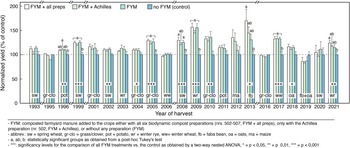
All analyses were carried out in R version 4.3.0 with its packages agricolae (de Mendiburu, Reference de Mendiburu2021), ggplot2 (Wickham, Reference Wickham2016), plotrix (Lemon, Reference Lemon2006), RColorBrewer (Neuwirth, Reference Neuwirth2022) and tidyr (Wickham, Vaughan and Girlich, Reference Wickham, Vaughan and Girlich2023). For all statistical analyses the level of significance was set at P < 0.05. The statistical significance of differences in yield among treatment groups in each year was tested by a post-hoc Tukey's test (Fig. 2). Differences in yield between the treatments that received FYM and the control in each year were determined by a two-way nested ANOVA with the factors FYM (yes or no) and biodynamic compost preparation (nested factor; 1 = all preps, 2 = Achillea prep, 3 = no prep; Figure 2, Table 2). To compare yields among years and crops, we calculated relative yields for each year by normalizing the values of each treatment group on the mean of the control group in each year (Fig. 2). For the statistical analyses across years we incorporated ‘year’ as a random factor (Fig. 3). To visually compare yields across years, we normalized yield values of each year on the mean of the control across all years (Fig. 3b). To determine the power, i.e., the minimum detectable yield difference that our design would allow for, we conducted a power analysis on our experiment based on the observed standard deviation of the control treatment (s = 18.05%) and the number of years (n = 21) and replications (n = 6) used in the trial.
Normalized yields of the different cultivated crops and treatments during the experimental period (mean ± SE; n = 6 plots per treatment and year). Yield amounts were normalized on the mean of the unfertilized control in each year.

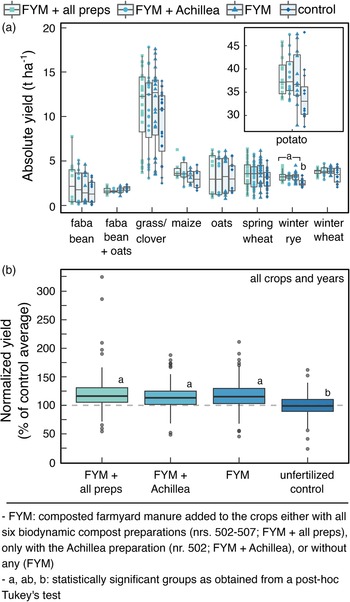
(a) Boxplots for the absolute dry matter yields (potato: fresh matter yield) of the different crops cultivated at the experimental site across years depending on the treatment (n = 12 [fb], 6 [fb + oa], 26 [gr/clo], 6 [ma] 12 [oa], 30 [sw], 18 [wr], 12 [ww] plots per treatment) and (b) boxplots for the normalized yields across crops and years for the three different treatment groups. Yields were normalized on the mean of the control across all years and year was incorporated into the statistical analysis as a random factor (n = 128).

To assess yield stability, standard and adjusted coefficients of variation (cv) were calculated as proposed by Döring and Reckling (Reference Döring and Reckling2018). Since adjusted cv is a comparably young approach which needs further validation, we also tested for the relationship between standard and adjusted cv by simple linear regression.
Results
Mean seasonal temperature was quite constant throughout the experiment while seasonal precipitation varied from more than 600 mm in 2007 to just over 300 mm in 2003 (Fig. 1). In many years, the yields of the plots which were fertilized with farmyard manure (FYM + all preps, FYM + Achillea and FYM) were significantly higher than the yields of the no FYM control treatment (Fig. 2, Table 2). However, no year revealed statistically significant differences among the yields of biodynamically (FYM + all preps; or FYM + Achillea) and organically (FYM) fertilized plots. For the grass/clover plots in 1995 and 2016 we could only obtain means of the yield due to harvesting constraints and were, thus, not able to calculate standard errors. These means were, however, very similar among treatment groups (Fig. 2, Table 2). An intercropping system of faba bean and oats in 2019 did not show any differences in yield as well (Fig. 2, Table 2) and also individual crops of the two species within the mixture exhibited similar yields among treatments (Suppl. Fig. 3, Table 2).
Even when all available values for yields of the different treatments were pooled and year was accounted for as a random factor, no statistically significant differences between biodynamically amended FYM and non-treated FYM application could be determined neither on a crop level (Fig. 3a) nor across all crops (Fig. 3b). Within individual crop species, when normalized yield data was pooled across years, most crops did not statistically respond to treatments. Only the yields of winter rye showed clearly higher values in plots that received FYM than in control plots (Fig. 3a). Normalized yield across all years and crops was significantly higher in the three treatments which received composted FYM than in the control treatment (Fig. 3b).
In a power analysis on our experiment, we calculated the level of difference in normalized yield between the treatments that our data would allow us to detect, based on the observed standard deviation of the control treatment (s = 18.05%) and the number of years (n = 21) and replications (n = 6) used in the trial. This revealed a detectable relative yield difference of 1.1%.
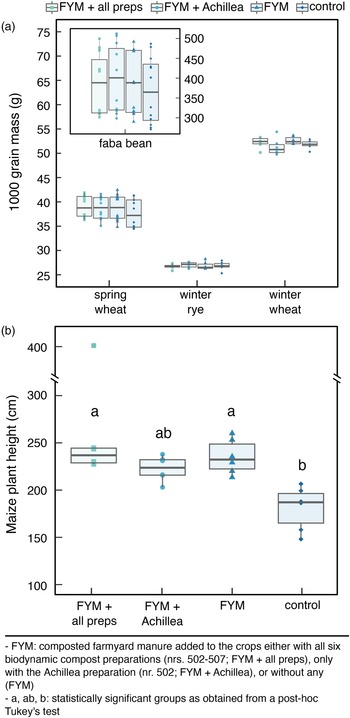
Similar to overall yield data, 1000 grain mass in faba bean, spring wheat, winter rye, and winter wheat showed no differences among all treatments and years (Fig. 4a). Yet, FYM treatments turned out to induce increased height growth in maize plants compared to the control treatment in one year of maize cultivation at the research site (Fig. 4b).
(a) Boxplots for the 1000 grain mass of different crops cultivated at the experimental site across years depending on the treatment (n = 12 [fb], 12 [sw], 6 [wr, ww]). Yields were normalized on the mean of the control across all years and yield was incorporated into the statistical analysis as a random factor. (b) Boxplots for height of maize plants in September 2012 (n = 6 plots per treatment).

Yield stability over the years of the experiment was similar among treatments in the grass/clover plots and showed significantly higher values in the FYM treatments as compared to the control in spring wheat (Fig. 5, Table 3). The adjusted coefficient of variation showed a clear linear relationship with the standard (unadjusted) coefficient of variation with an almost 1:1 slope (Suppl. Fig. 4).
Boxplots of the adjusted coefficient of variation (cv) concerning yield stability in each of the six subplots for each treatment over time. Only the clover/grass crops and the spring wheat crops were cultivated often enough to allow for the calculation of a cv.

Standard and adjusted coefficients of variation (mean ± SE, n = 6 plots per treatment) for yield stability within the different treatments over the time of the experiment in the two crops grass/clover and spring wheat

Discussion
Here, we report the effects of biodynamic compost preparations on yield and yield stability of arable crops in an organic crop rotation over 27 yrs. We found that biodynamic compost preparations did not have a significant impact on yields and yield stability in any of the tested crop species while fertilization with composted FYM led to significantly higher yields as compared to non-fertilized crops. Neither of the studied agronomic parameters (yield, plant height, thousand grain mass) was affected by the compost preparations in our trial. The very small detectable relative yield difference (1.1%) that we found in our power analysis suggests that the lack of significant difference between the treatments with and without biodynamic compost preparations was not due to insufficient power of the experiment.
Intermediate results of our long-term trial, reported after 9 yrs of experimentation, already suggested that biodynamic compost preparations did not have a statistically significant impact on crop yields (Zaller and Köpke, Reference Zaller and Köpke2004) and are, thus, in line with our findings after a period of 27 yrs.
Other studies confirm this picture of biodynamic compost preparations having no significant yield effect. In experiments of Carpenter-Boggs, Reganold and Kennedy (Reference Carpenter-Boggs, Reganold and Kennedy2000b), biodynamic compost preparations did not influence shoot biomass and grain yield as well as grain carbon and protein content in lentil and wheat cultivation.
Also, in accordance with our results, Heitkamp, Raupp and Ludwig (Reference Heitkamp, Raupp and Ludwig2011) found that biodynamic preparations had no yield effect over 31 yrs in potatoes, winter rye, and clover. In contrast to our trial design, however, these experiments used biodynamic compost preparations together with the field spray preparations, which were not used in our trial.
Only a few studies so far have investigated the effect of compost preparations as a separate factor (Carpenter-Boggs, Reganold and Kennedy, Reference Carpenter-Boggs, Reganold and Kennedy2000a; Zaller and Köpke, Reference Zaller and Köpke2004; Reeve et al., Reference Reeve, Carpenter-Boggs, Reganold, York and Brinton2010; Rodas-Gaitan et al., Reference Rodas-Gaitan, Fritz, Dahn, Köpke and Joergensen2022) and an influence of the compost preparations on yield was only partially observed by Reeve et al. (Reference Reeve, Carpenter-Boggs, Reganold, York and Brinton2010) while all the other studies conclude with no effects on yield.
While crop yields have mostly been reported to be unaffected by the biodynamic compost preparations, several experiments showed effects on quality parameters. In trials by Reeve et al. (Reference Reeve, Carpenter-Boggs, Reganold, York, McGourty and McCloskey2005), the variant with all biodynamic preparations had a significantly more favorable ratio of yield to pruning weight for producing high-quality wine grapes. The wine grapes of the preparations variant had a significantly higher Brix value and significantly higher total phenols and total anthocyanins content. In a trial in Geisenheim, Germany, conducted by Döring et al. (Reference Döring, Frisch, Tittmann, Stoll and Kauer2015) and Meissner et al. (Reference Meissner, Athmann, Fritz, Kauer, Stoll and Schultz2019), the parameters for producing high-quality wine grapes were also slightly better when all biodynamic preparations were used as compared to the organic variant. Differences in individual parameters were not significant, but a clear differentiation was found in the overall evaluation in a principal component analysis. The wine quality in the Geisenheim trial (Döring et al., Reference Döring, Frisch, Tittmann, Stoll and Kauer2015) was rated better for the wines which derived from grapevines cultivated with all preparations in both the sensory and image-forming methods (crystal structures of wine, in which encoded images are analyzed according to ageing criteria; Fritz et al., Reference Fritz, Döring, Athmann, Meissner, Kauer and Schultz2021a).
Based on the idea of a potential system-regulating effect of the spray preparations (Raupp and König, Reference Raupp and König1996), it could be hypothesized that the compost preparations would lead to lower fluctuations of yields, i.e., higher yield stability. In contrast, however, our results gave no indication of any positive effects on yield stability across years. However, the application of composted FYM did significantly increase temporal yield stability, when compared to the control. This is likely due to increased nutrient availability and water holding capacity of FYM-fertilized soils (Ahrends et al., Reference Ahrends, Siebert, Eyshi Rezaei, Seidel, Hüging, Ewert, Döring, Rueda-Ayala, Eugster and Gaiser2020, Schärer et al., Reference Schärer, Dietrich, Kundel, Mäder and Kahmen2022). In general, application of FYM resulted in higher yields as compared to the no FYM control in most years of our experiment which is in line with many previous studies (Reganold et al., Reference Reganold, Palmer, Lockhart and Macgregor1993; Pfiffner and Mäder, Reference Pfiffner and Mäder1997; Carpenter-Boggs, Reganold and Kennedy, Reference Carpenter-Boggs, Reganold and Kennedy2000b; Maeder et al., Reference Maeder, Fliessbach, Dubois, Gunst, Fried and Niggli2002; Fließbach et al., Reference Fließbach, Oberholzer, Gunst and Mäder2007; Bacchus, Reference Bacchus2010; Reeve et al., Reference Reeve, Carpenter-Boggs, Reganold, York and Brinton2010; Heitkamp, Raupp and Ludwig, Reference Heitkamp, Raupp and Ludwig2011).
Despite a lack of effects on yield and yield stability, biodynamic compost preparations have generated research interest in other domains, in particular with respect to effects on soil quality. In trials by Reeve et al. (Reference Reeve, Carpenter-Boggs, Reganold, York and Brinton2010), composts treated with compost preparations had a higher microbial activity than composts without preparations. Zaller and Köpke (Reference Zaller and Köpke2004) found a higher basal respiration in the plots that received only the Achillea preparation. Also, earthworm abundance was found to differ while total earthworm biomass and numbers remained the same among treatments (Zaller and Köpke, Reference Zaller and Köpke2004). Based on the same trial as we use in this study, Rodas-Gaitan et al. (Reference Rodas-Gaitan, Fritz, Dahn, Köpke and Joergensen2022) found a significant change in the Multi Substrate Induced Respiration Method (soil respiration of 17 different substances) in the treatment with the Achillea compost preparation in a discriminant analysis. This is presumably due to changes in the soil microbial community. In system comparison trials between biodynamic (i.e., the use of spray and compost preparations) and organic cultivation, it has been found that biodynamic preparations are likely to influence the networking of the microbiome in the soil. In soils that received FYM amended with biodynamic preparations, the networks between bacteria had a significantly lower modularity and co-exclusion and significantly higher clustering. According to Ortiz-Álvarez et al. (Reference Ortiz-Álvarez, Ortega-Arranz, Ontiveros, de Celis, Ravarani, Acedo and Belda2021), these networks are therefore more stable under stress conditions. Thus, in further trials it would be of interest to investigate whether changes in the soil microbial community play a significant functional role and if so, what relevance and implications derive from it.
For the biodynamic spray preparations, an effect model with plant growth-promoting microorganisms has been proposed by Milke et al. (Reference Milke, Rodas-Gaitan, Meissner, Masson, Oltmanns, Möller, Wohlfahrt, Kulig, Acedo, Athmann and Fritz2024) who observed a colonization of the microbiome from the spray preparations into the soil. For biodynamic compost preparations an equivalent explanation for the observed effects on soil traits is still missing. A first recently published metagenomic study delivers further hints on how to interpret functional diversity of the affected microbiomes (Vaish et al., Reference Vaish, Soni, Singh, Garg, Ahmad, Manoharan and Trivedi2024). Despite the lack of yield effects, it would, therefore, be rewarding to investigate the effects of biodynamic compost preparations on compost and soil microbes and their physiology in isolated laboratory experiments as well as under a broad spectrum of different field and site conditions.
Conclusions
Biodynamic compost preparations showed no effect on yield and yield stability in 27 yrs of organic crop rotation even though they were previously shown to impact some parameters of the soil biological community. In none of the tested crop species we could find any significant effect on crop yields or temporal yield stability. The application of composed FYM, however, led to significant increases in both yield and yield stability as compared to the no FYM control. While the relevance of an altered soil respiration by the Achillea preparation has not been clarified yet, our results show that biodynamic compost preparations can hardly be considered superior to non-treated compost from an agronomic point of view.
Supplementary material
The supplementary material for this article can be found at https://doi.org/10.1017/S1742170524000218.
Competing interests
None.




 Open access

