


The US Department of Agriculture's (USDA) automated multiple-pass method (AMPM) is a five-step, multiple-pass, interviewer-administered, computerized, 24 h dietary recall method. The AMPM has been used in association with the USDA Foods Surveys Research Group and the Department of Health and Human Services, National Center for Health Statistics for dietary data collection called ‘What We Eat in America’ as part of the National Health and Nutrition Examination Survey(1, 2). The AMPM is designed to estimate current dietary intake and strives to minimize the problem of misreporting(Reference Raper, Perloff and Ingwersen3). This 24 h dietary recall method requires only short-term memory, is less burdensome to participants than food records, takes a nominal amount of time to complete and can be used in less-educated populations. The 24 -h dietary recall has also been recommended as the dietary assessment method of choice for estimating energy and nutrient intakes for obesity interventions(Reference Johnson4, Reference Probst and Tapsell5).
An important factor for accurately assessing nutrient intakes with a dietary recall method is determining the number of recalls that are needed to reflect usual intake. Several investigators have calculated the number of days that are required for accurate estimation of nutrient intake in adults(Reference Basiotis, Welsh and Cronin6–Reference Nelson, Black and Morris8). In one study of twenty-nine adults who measured and recorded their food intake daily for 1 year, Basiotis et al.(Reference Basiotis, Welsh and Cronin6) reported that three dietary records were sufficient to estimate energy intake for both men and women. Others have suggested that three 24 h dietary recalls were best for estimating energy intake in normal-weight women(Reference Ma, Olendzki and Pagoto9).
The number of days that dietary intake should be collected can be determined by estimating within-subject variance, which is the day-to-day variation in each individual's nutrient intake, and between-subject variance, which is the extent that individuals’ nutrient intake varies from one another(Reference Cai, Shu and Hebert10–Reference Persson, Winkvist and Ninuk16). Several factors such as sex, day of the week, season, culture and environment influence nutrient variation(Reference Beaton, Milner and Corey17–Reference Willett19). Limited research has evaluated the contribution of body weight to nutrient variability. A previous study on sources of variation in dietary intake determined by the 24 h dietary recall method did not report body weight results(Reference Beaton, Milner and Corey17).
The present study determined the number of 24 h dietary recalls using the USDA's AMPM required to estimate nutrient intake in overweight and obese adults. In addition, the study quantified sources of variation in dietary intake, such as day of the week, season, sequence of diet interviews (training effect), diet interviewer, body weight and within- and between-subject variances in the intake of selected nutrients.
Experimental methods
The present study was part of an investigation to determine the effects of protein consumption on body composition assessment. The main study design was a randomized controlled clinical trial that investigated the effects of consuming a non-energy-restricted high-protein diet on body composition in free-living overweight and obese individuals for 6 months. Supplemental protein was provided as the treatment; added energy from supplements equalled 1674 kJ (400 kcal)/d. Mean protein intake (dietary intake and treatment) did not exceed 25 % of the daily energy intake of participants.
Subjects
Overweight and obese men and women aged 35–65 years were recruited by advertisement from the greater Washington, DC, metropolitan area. Inclusion into the study was based on complying with the following criteria: having a BMI of at least 28 kg/m2 but <38 kg/m2; fasting blood glucose <126 mg/dl; blood pressure <160/100 mmHg; total plasma cholesterol <240 mg/dl; and being a non-smoker. Exclusion criteria for women included: having given birth during the previous 12 months; being pregnant or planning to become pregnant during the study; lactating; and initiating hormone replacement therapy or changing the hormone replacement therapy within 3 months of the start of the study. Common exclusion criteria for men and women included: a history or presence of kidney disease, liver disease, gout, certain types of cancer, thyroid disease, gastrointestinal disease, other metabolic diseases or malabsorption syndromes; type 2 diabetes requiring the use of oral diabetic medication or insulin; a history of eating disorders; routine participation in a heavy exercise programme or initiation of an exercise programme during the study; loss of 10 % of body weight within the past 12 months or planning to initiate a weight-loss programme during the next 10 months; having been following the Atkins, South Beach or a similar diet in the 3 months before the start of the study; and use of prescription or over-the-counter antiobesity medications or supplements (e.g. phenylpropanalamine, ephedrine, caffeine) during and for at least 6 months before the start of the study. Study entry was approved by a physician on the basis of the participant's medical history, blood and urine test results collected during recruitment, and a physical examination. All participants gave their informed consent and the protocol and consent forms were approved by the Institutional Review Board of Medstar Research Institute, Hyattsville, MD, USA. The participants were compensated for taking part in the study.
Dietary assessment
Dietary recalls were conducted every 10 d in the morning (interview days were chosen to ensure equal representation of weekend days and weekdays) for approximately 6 months, using the USDA's AMPM. Briefly, the AMPM is a five-step, multiple-pass, interviewer-administered, computerized, 24 h dietary recall method. In the first step, participants are asked to inform the diet interviewer about the foods and beverages that they had consumed in the previous 24 h (the quick list). The second step involves probing for foods that are documented as being frequently forgotten. The third step queries for the time and occasion at which the foods were consumed. The fourth step includes more detailed questions to gather descriptions and amounts of foods consumed with the use of the USDA Food Model Booklet. The fifth step provides one last opportunity to elicit forgotten foods. The USDA Food Model Booklet assists participants in estimating portion sizes and contains standard-sized pictures of drinking glasses, mugs and bowls; pictures of pats and mounds for estimating foods that mound when served; circles for estimating foods such as pancakes and tortillas; a 5-inch × 5-inch grid for estimating foods such as lasagna, meatloaf and cornbread; pictures of twelve blocks that estimate food thickness; pictures of two different wedges to assist with visualization of food on a plate; drawings of shapes that include a rectangle, cylinder and wedge that show how to describe food dimensions; and pictures of a chicken breast, wing and leg that show how to describe chicken pieces(Reference Raper, Perloff and Ingwersen3).
To minimize interviewer effects, all diet interviewers participated in a rigorous, standardized 2-week training programme provided by the USDA's Food Survey's Research Group. All 24 h recalls were completed in person and were recorded on all days of the week (Monday–Sunday) by seven female diet interviewers. Participants were scheduled for 1 h diet interviews from 06.30 to 09.30 hours per day. Three diet interviewers conducted three individual face-to-face 24 h dietary recalls, each within 3 h/d; nine 24 h dietary recalls were conducted per day.
Coding of nutrient intake
The USDA Food and Nutrient Database for Dietary Studies, version 2·0, was used to assign codes to all foods and amounts reported by participants during their dietary interviews(1). Each food was assigned a code from the database and each portion consumed was converted into a specified weight. The nutrient composition of the portion eaten was determined by using the Food and Nutrient Database, which provides the nutrient composition, including the energy, protein, fat, carbohydrate and mineral contents, of foods commonly consumed in the USA.
Body composition
Body weight was measured on an electronic scale (Lynz model; Mettler Toledo, Columbus, OH, USA) to the nearest 0·01 kg and height was measured to the nearest 0·1 cm with a stadiometer (Holtain Limited, Crymych, UK) at the study baseline. BMI was defined as weight in kilograms divided by the square of height in metres (kg/m2). Waist and hip circumference measurements, taken to the nearest 0·1 cm, were obtained.
Body composition assessment was carried out by dual-energy X-ray absorptiometry with a model QDR 4500A fan-beam instrument (Hologic Inc., Bedford, MA, USA). Lean soft tissue mass and fat mass were assessed by using software for the QDR 4500A (Whole Body Analysis software version 8·26A; Hologic Inc.). Participants were positioned for whole-body scans according to the protocol recommended by the manufacturer (participants lay supine on the absorptiometer table with limbs close to their bodies).
Analysis and statistics
Variance components were estimated using the MIXED procedure in the SAS statistical software package version 9·1 (SAS Institute, Cary, NC, USA). The following formula was used to estimate the number of days required to obtain a specified level of correlation between observed and usual (assumed as the true average over 6 months) intake:
![\[--><$$>D\, = \,[{{r}^2} /(1\, - \,{{r}^2} )]\,\times \,s_{\ \!\!\, \rm w}^{2} /s_{\ \, \!\!\rm b}^{2} \eqno\rm<$$><!--\]](https://static.cambridge.org/binary/version/id/urn:cambridge.org:id:binary:20160921032826841-0649:S1368980011000358:S1368980011000358_eqnU1.gif?pub-status=live)
where D is the number of 24 -h recalls required, r is the unobservable correlation between the observed and true average nutrient intakes of participants and s 2w and s 2b are the within- and between-subject variances, respectively. For this analysis, r is equal to 0·9, which means that <0·1 % of the participants would be misclassified in the extreme portion, opposite of the true intake when nutrient intake is divided into quarters(Reference Nelson, Black and Morris8, Reference Palaniappan, Cue and Payette20).
A random-effects model was constructed to estimate the variance associated with day of the week, season of the year, sequence (the position in the series of the 24 h dietary recalls obtained), diet interviewer, body weight, within-subject variation and between-subject variation. Season of the year was defined as winter (February and March), spring (April and May) or summer (June and July). A maximum of fifteen observations were made for each participant from which the components of variability were estimated. This analysis was applied separately to the data for men and women.
Results
Subject characteristics
In all, 99 % of participants completed at least fourteen and 70 % completed fifteen 24 h dietary recalls. Men and women completed 506 and 564 dietary recalls, respectively, for a total of 1070 used for this analysis. The mean number of days between 24 h dietary recalls was 10·0 (sd 3·3) d. Each participant completed at least two 24 h dietary recalls for all days of the week. Men and women on average reported consuming 17·4 (sd 5·9) and 15·7 (sd 5·6) foods per 24 h dietary recall.
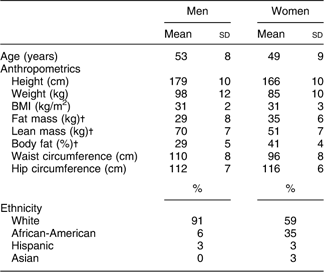
The mean BMI of the participants indicated that they were obese (BMI ≥ 30 kg/m2). Body weight stayed constant throughout the duration of the study (data not reported). The physical characteristics of the participants at baseline are presented in Table 1. Mean energy and nutrient intakes of the participants obtained from the 24 h dietary recalls collected over 6 months are reported in Table 2.
Baseline characteristics of overweight and obese adultsFootnote *
* n 73 (34 men and 39 women).
† n 71 (34 men and 37 women).
Mean daily energy and nutrient intakes of overweight and obese adultsFootnote *
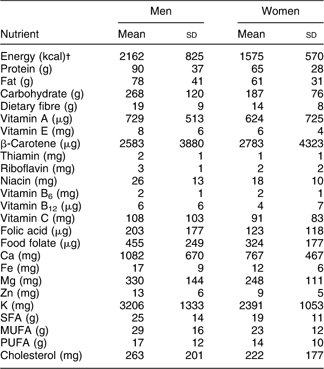
* n 73 (34 men, 39 women), from the 24 h dietary recalls collected over 6 months. Data exclude nutrients from treatments.
† 1 kcal = 4·184 kJ.
The Estimated Energy Requirement (EER) prediction equations from the Dietary Reference Intakes (DRI) were determined for adults aged ≥19 years. EER (kJ (kcal)/d) was determined for men and women with the use of the sedentary physical activity coefficient. The EER values of the participants were determined to be 11 221 kJ (2682 kcal)/d and 8443 kJ (2018 kcal)/d for men and women, respectively. Results from the 24 h dietary recalls with the inclusion of the added energy from the study supplement (1674 kJ (400 kcal)/d) show a mean energy intake of 10 719 kJ (2562 kcal)/d for men and 8263 kJ (1975 kcal)/d for women. These results show that the mean reported energy intake of the participants from the 24 h dietary recalls is in agreement with the EER prediction equations from the DRI(Reference Otten, Hellwig and Meyers21).
The mean reported intake of participants from the 24 h dietary recalls does not agree with the DRI for protein or carbohydrate. Men reported consuming 173 % of the RDA for protein and 206 % of the RDA for carbohydrate. Women reported consuming 141 % of the RDA for protein and 144 % of the RDA for carbohydrate. Participants were overweight and obese and therefore their dietary intake may be greater than the DRI because of increased food intake. The DRI for dietary fat has not been determined; hence, information is not reported(Reference Otten, Hellwig and Meyers21).
The number of 24 h recalls required to estimate nutrient intake
In men, with the use of the within- and between-subject variances to determine the number of 24 h dietary recalls required, a duration of up to 10 d was determined to be necessary to estimate energy, macronutrient and mineral intakes with an accuracy of r = 0·9 (Table 3). Estimation of usual intakes of fatty acids and dietary cholesterol was shown to require up to 16 d and 21 d, respectively. Estimation of usual vitamin intake required 3–24 d, depending on the particular vitamin. For women, in general, more days of dietary recalls were required to estimate usual intake with the same accuracy as in men. For example, up to 15 d were required to estimate energy and macronutrient intakes and up to 45 d were required to estimate usual intake of vitamins.
The number of 24 h dietary recalls required for adequate estimation of energy and nutrient intakes in overweight and obese adultsFootnote *
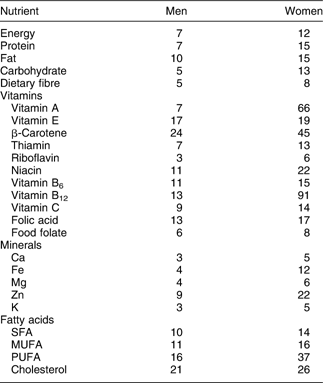
Estimation of nutrient intake is determined from the correlation between observed and true average intakes in which number of days = [r 2/(1 − r 2)] × s 2w/s 2b, where r = the unobservable correlation coefficient between observed and true average intake of individuals and s 2w/s 2b = within-subject/between-subject variance ratio.
* n 73 (34 men and 39 women).
Variance component analysis
The contribution of variance from day of the week was highest for dietary cholesterol and was approximately 7 % and 3 % of total variance for men and women, respectively (Table 4). For energy and other nutrients, day of the week contributed ≤2 % to the total variance. Men's body weight contributed <5 % of total variance, with the exception of contributing 13 % to vitamin C. Women's body weight contributed <2 % of total variance. The within- and between-subject variance components were the major contributors to total variance in both men and women (Table 4). Season, sequence and dietary interviewer contributed <2 % of the total variance in men and women (data not reported).
Contribution of day, body weight, between-subject variance and within-subject variance to total nutrient variability in overweight and obese adultsFootnote *
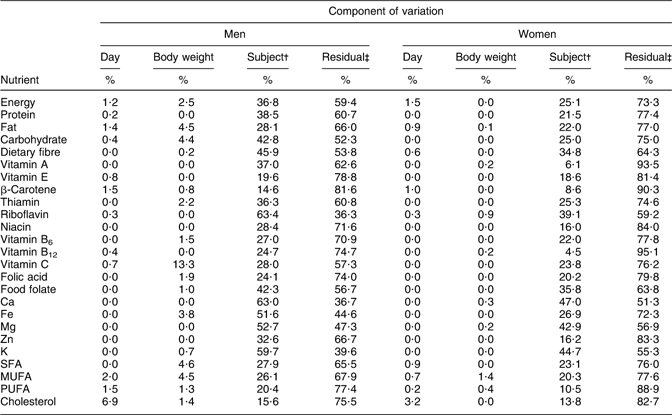
Values in the table are the percentages of variance in consumption of the particular nutrient. Data are obtained from a PROC MIXED model used to fit the ANOVA, with each source of variability fitted as a random effect.
* n 73 (34 men and 39 women).
† Between-subject variance.
‡ Within-subject variance.
Discussion
Assessment of dietary intake is an important component of many public health research studies on free-living individuals. To accurately assess intake, it is necessary to know how many 24 h dietary recalls would be needed(Reference Beaton22). The results of the present study provide a basis for determining this number in overweight and obese adults. Our data show that the number of 24 h recalls required is highly dependent on the degree of accuracy required and the variability in the nutrient of interest. Research that includes dietary modification in groups of individuals may require at least the estimation of energy and macronutrient intakes. Our results indicate that it requires 5–10 d in men and 12–15 d in women to estimate energy and macronutrient intakes during a 6-month period, with an accuracy of r = 0·9 and accounting for within- and between-subject variances. Several studies have suggested that 3–7 d are required to estimate energy intake in normal-weight adults(Reference Basiotis, Welsh and Cronin6–Reference Nelson, Black and Morris8, Reference Palaniappan, Cue and Payette20). Our study is compelling because of the rising incidence of obesity, as it determines the number of days required to estimate energy and nutrient intakes in overweight and obese adults. In addition, the present research suggests that more days may be required to estimate energy intake in overweight and obese adults when compared with normal-weight adults.
Variation in nutrient intake by day of the week was not evident. These results differ from those reported by Beaton et al.(Reference Beaton, Milner and Corey17, Reference Beaton, Milner and McGuire18) who conducted a similar study on men and women in which they found daily variation among women for some nutrients, which included energy and carbohydrate, but none for men. However, Beaton et al. included 24 h dietary recalls obtained on weekdays only (Mondays, Wednesdays, Thursdays and Fridays). Our results may have differed because we collected 24 h dietary recalls on all days of the week including weekend days in order to estimate the true day-to-day variability. Our research suggests that in our participants similar types of foods were consumed daily compared with a modification of foods or particular combinations of foods. Season was also not a main contributor to nutrient variation, although recent research has reported seasonal variation in energy intake in overweight men and women(Reference Ma, Olendzki and Li23).
An important finding of our study was that sequence and dietary interviewers made little to no contribution to variation in nutrient intake. These results suggest that there was no training effect because of the sequence in which the 24 h dietary recalls were obtained. This finding is similar to the highly standardized EPIC-SOFT 24 h dietary recall program that was used for each of the ten European countries participating in the European Prospective Investigation into Cancer and Nutrition (EPIC), which showed no statistical difference with interviewer effect in the majority of countries participating(Reference Slimani, Ferrari and Ocke24). The absence of any differences among the diet interviewers in the present study also shows the effectiveness of the USDA's AMPM. The standardized training for the AMPM provided by the USDA's Food Surveys Research Group was likely important in minimizing this potential source of variation that increases the precision of the dietary recall instrument and ultimately decreases measurement error. The effectiveness of the USDA's five-step AMPM in assessing food intake has been validated in normal-weight, overweight and obese men and women(Reference Blanton, Moshfegh and Baer25–Reference Moshfegh, Rhodes and Baer28). Previous research that compared actual food intake with recalled intake showed that the USDA's AMPM could assess energy intake to within 10 % of actual intake in normal-weight and overweight women. Obese women recalled food intake more accurately than did normal-weight and overweight women(Reference Conway, Ingwersen and Vinyard27). In a similar study, the USDA's AMPM was able to accurately assess energy and macronutrient intakes in men independently of their BMI(Reference Conway, Ingwersen and Moshfegh26). These studies lacked the repeated measures necessary to estimate the contributors to variance. In the present study, we focused on determining the number of 24 h dietary recalls required to estimate nutrient intake in an overweight and obese population and not on the accuracy of the USDA's AMPM.
Within- and between-subject variations are the major contributors to total variance(Reference Cai, Shu and Hebert10, Reference Cai, Yang and Xiang11, Reference Nyambose, Koski and Tucker15, Reference Oh and Hong29). Body weight, day of the week, season, sequence and dietary interviewer each makes only a small contribution to total nutrient variation. There are likely other unknown physiological, socio-economical and environmental factors included in the within-subject variance component that need to be identified.
The strengths and limitations of our study design warrant consideration. Traditionally, the USDA's AMPM is used in survey research. Our study is unique because this is the first time that multiple measurements (>2 d) of the AMPM 24 h dietary recall have been obtained to estimate nutrient intakes in overweight and obese individuals participating in a free-living nutrition research study; few studies have collected multiple 24 h dietary recalls. A primary limitation of our study was that each participant received a schedule of the days on which their 24 h dietary recalls would have to be recorded. The scheduling may have caused the participants to alter their food intake, perhaps to minimize the 24 h dietary recall time. However, we found no significant differences in dietary recall time from baseline to the end of our study; the mean dietary recall time was 20 (sd 6) min. Another limitation may be that misreporting in the 24 h dietary recall can contribute to within- and between-subject variations, which may affect the number of 24 h dietary recalls necessary for accurate estimation of nutrient intake(Reference Mennen, Bertrais and Galan7). The use of a validated method such as the USDA's AMPM may have helped minimize this error. In addition, the participant population may limit the generalizability to other studies such as those that include smokers. The study design may also have affected the participants’ dietary intake; however, there was no detectable effect of study treatment on changes in energy, protein, carbohydrate or fat intake as reported from the 24 h dietary recalls during the course of the intervention for men and women (data not reported).
We found in our study that obtaining approximately three non-consecutive days, such as every 10 d, of 24 h dietary recalls per month using USDA's AMPM 24 h dietary recall over a period of approximately 6 months is required for estimation of energy and macronutrient intakes in overweight and obese men and women. In addition, our research suggests that day-to-day changes were the major contributors to variance in nutrient intake in overweight and obese men and women. This information is important to researchers planning to conduct studies on people that include collecting dietary intake data. Determining the number of 24 h dietary recalls required to estimate energy and nutrient intakes is essential for assessing the effect of diet in nutrition and health studies, as well as the effectiveness of obesity and other lifestyle interventions.
Acknowledgements
The present research received no specific grant from any funding agency in the public, commericial or not-for-profit sectors. The authors have no conflict of interest to declare. K.S.S., D.J.B., A.J.M. and L.A.I. were responsible for conducting the study, as well as for data collection and interpretation of results; S.V.R. and K.S.S. were responsible for the statistical analyses of data; K.S.S. was responsible for writing the manuscript. All authors provided input during the preparation of the manuscript and approved the final version submitted for publication.



