

Prelude
“I was talking about time,” the formerly enslaved Sethe tells Denver, her daughter, in Toni Morrison’s Pulitzer Prize–winning Beloved (1987).Footnote 1 “It is so hard for me to believe in it,” Sethe continues, “Some things go. Pass on. Somethings just stay. I used to think it was my rememory. You know. Something you forget. Other things you never do. But it’s not. Places, places are still there.”Footnote 2 In prose that unfurls fragments of meaning and memory, Morrison plots, through Sethe, an interiority steeped in transatlantic ventures, Afrodiasporic visions, and plantation violences. However, this is no straightforward cartography. The topic of time that Sethe begins with melds into the concept of place by the end of the passage; their distinctions dissolve both in and beyond what Sethe calls her rememory. At once “a noun and a verb, a thing and an action,” theorizes literary scholar Marianne Hirsche,Footnote 3 the language, landscape, and liminality of rememory finds its analogue in what the African American composer Undine Smith Moore called her “inner world.”Footnote 4 I therefore begin this essay in the productive counterpoint between Black women’s vocabularies of remembrance and reimagining to set the stage for the “diasporic interdisciplinarity” that guides my discussion of Moore.Footnote 5
Remembering Petersburg, Virginia
Born on August 25, 1904, in Jarratt, Virginia—several decades on from the Reconstruction-era setting of Morrison’s Beloved, and many miles east of its Ohio and Kentucky geographies—Undine Smith Moore’s formative years and professional flowering unfolded through the brutalities of Jim Crow segregation. Slavery and its afterlife both haunted and fomented her trajectory. She was the descendant of enslaved grandparents, the daughter of working-class parents (James William Smith and Hardie Turnbull Smith), and was largely raised in the Black enclave of Petersburg, Virginia (to which her family moved in 1908).Footnote 6 “Viewed objectively by its obvious limitations, one might question Petersburg as a good place for a musician to grow up,” Moore remarked, noting how those of her race were “[b]arred from theaters and all but the gallery of the Academy of Music” (in Lynchburg, Virginia).Footnote 7 Nevertheless, a collective self-sufficiency defined her community, countering systemic limitations and transforming her locale into a wellspring of musical and communal nourishment.
“As a woman, as a Black woman, as a musician,” Moore recounted, “I think the town of Petersburg was a good choice for me when my family decided to leave Jarratt….In the first place, the lives of Black people in Petersburg were saturated with music of one kind or another.”Footnote 8 Supplanting whites-only concert venues and the demeaning experience of segregated seating were the “Sunday school, the church, [and] the church socials and suppers,” offering an abundance of performance opportunities for vocalists and instrumentalists of all levels.Footnote 9 There was also “a veritable fascination with piano study” as elders would use the prestige associated with learning music to motivate those of Moore’s generation: “The progress of children was inquired about in the community and noted with pleasure. The favorite question asked to test advancement of children (in this instance, more often girls than boys) was ‘You playing sheet music yet?’”Footnote 10 By inquiring about young girls’ ability to read music, the older generation framed this mode of music making neither as a means of imitating whiteness and reinforcing “sonic color lines,”Footnote 11 nor as an ornamental pursuit that would boost desirability and marriage prospects (in perpetuation of deeply Victorian attitudes that often permeated white and Black middle-class households).Footnote 12 Rather, this question emanated from a collective desire to see young Black girls be pushed intellectually, to build self-esteem against sexist and racist underestimations of their capabilities, and to extend the language of possibility so that a young girl of warm brown complexion and Southern roots might envision a life in classical music. Moore came to internalize and radiate these blessings and wishes:
To live in a society where one’s favorite art is highly regarded, highly valued, where one’s progress is a source of pride to the family and the entire community is enough to create in a child a fine sense of self-worth and a high level of aspiration.Footnote 13
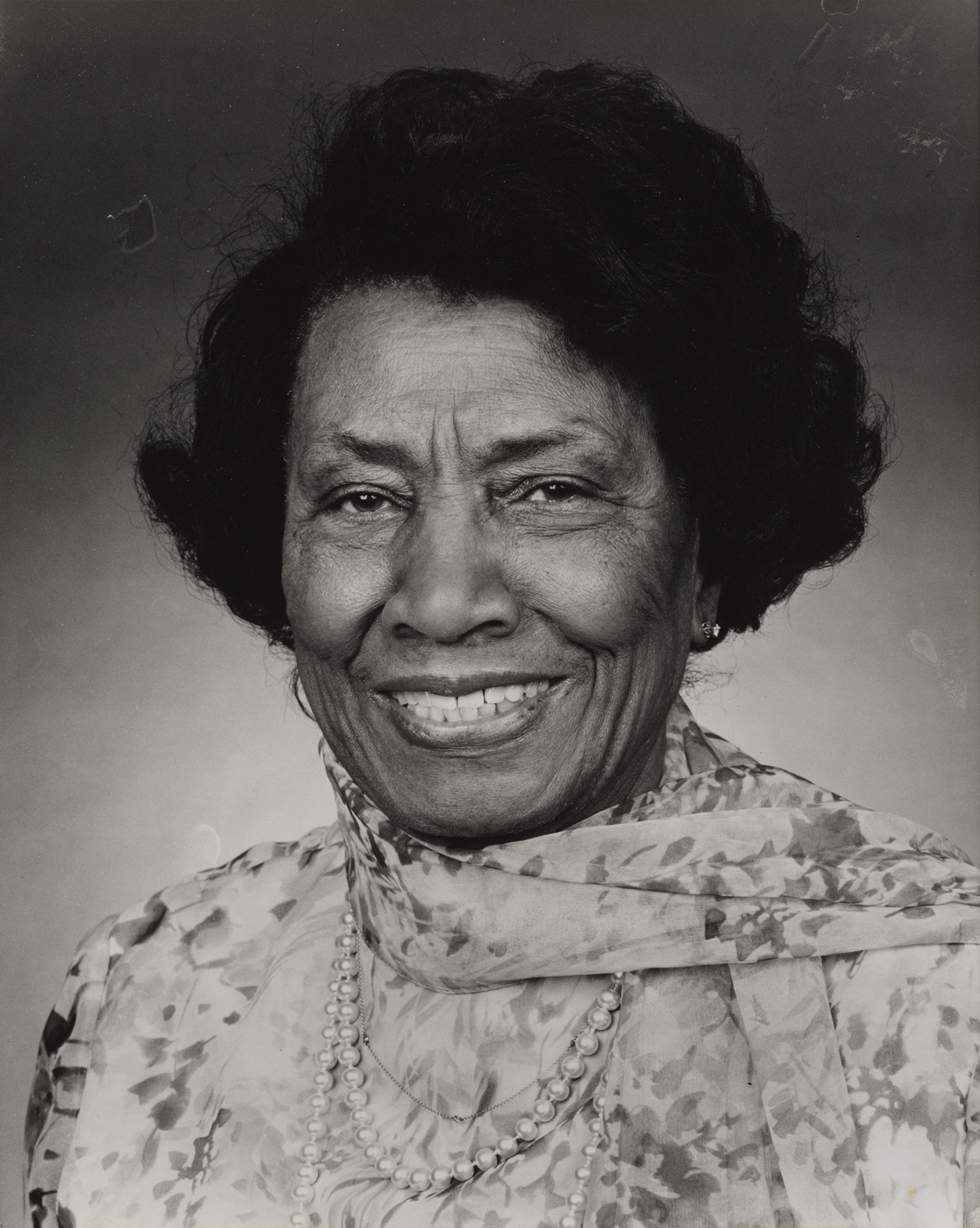
With the support of her parents, piano teachers, and community, Moore pursued further musical study at Fisk University (where she was the first recipient of a Juilliard scholarship that would fund her studies at Fisk), the Eastman School of Music, the Manhattan School of Music, and Columbia University. Unlike other Southern-born Black composers who continued to develop their careers in the North, Midwest, and even overseas—such as Little Rock’s Florence Price and William Grant Still, who largely made their names in Chicago and New York (respectively); or the Atlanta-born Howard Swanson who studied with Nadia Boulanger, spent prolonged periods in Europe, and eventually relocated to New York; or Lexington, Kentucky’s Julia Perry, who not only operated in New York’s modernist scene (moving in circles with Aaron Copland and Leonard Bernstein) but also trained in the European modernist epicenters of Paris (with Boulanger) and Italy (with Luigi Dallapiccola)—Moore returned to her Virginia roots and began what would become her legendary tenure at the HBCU Virginia State College (now Virginia State University) from 1927 to 1972.Footnote 14 That she went on to be known as the “Dean of Black Women Composers” attests to how intertwined her pedagogical and compositional identities were, not to mention her towering presence in the Black concert tradition writ large (fig. 1).
Undine Smith Moore, Governor’s Award in the Arts, Virginia 1985, Box 72, Photographs and scrapbooks, 1923–2005, Undine Smith Moore papers, manuscript collection no. 1155, Stuart A. Rose Manuscript, Archives, and Rare Book Library, Emory University, Atlanta, GA.

Petersburg, on the one hand, planted the seeds of Moore’s musical aspiration. On the other, however, it was also this “proximity to Petersburg,” comments Tammy L. Kernodle—this “connection to land and blood memory…about the horrors of slavery and the contesting of slavery” on Petersburg’s Civil War battle sites—that instilled in Moore a palpable sense of a harrowing past still present, inside her, in situ.Footnote 15 In her compositions (as well as her teaching, albeit the subject for another paper), “blood memory” functioned, with “diasporic interdisciplinarity,”Footnote 16 as a theory and practice of self- and sense-making—“a noun and a verb, a thing and an action” in the vein of rememoryFootnote 17—that filled in the brutal fractures of history, bridged the past with what is contemporary, and reminded Moore that places, places are still there.
Undine Smith Moore, Situated Knower, Griot in Spacetime
I am curious not only about the significance of physical place on Moore’s craft, but of the inner world that profoundly shaped her outer self and sound—that is, the metaphysical place from which these various and intersecting vocabularies of remembrance and reimagining emerge. Memory mattered to Moore, as reflected in her many compositions that storified—exaltingly, mournfully, and even ragefully—Afrodiasporic lives, lores, and landscapes.Footnote 18 For example, her 1953 Before I’d Be a Slave for solo piano (which forms one of the case studies here) reworked a high-modernist musical palette to conjure the visceral, physical, and spiritual torment of her enslaved ancestors and to honor their radical, revolutionary aliveness. She would later engage a similarly dissonant language in the first two movements of her 1987 three-movement Soweto for piano trio (her final work before she passed away on February 6, 1989). Soweto was Moore’s rageful response to the contemporary events of the 1986 Soweto Massacre, which unfolded through late August of that year.Footnote 19 She noted how a “So-we-to” rhythmic motive had sprung from her “inner life,” waking her from her sleep early one morning and leading her to deduce, “There must have been deep internal turmoil to bring that word to me. I felt I did not choose the word. The word chose me.”Footnote 20 The resulting piano trio evinced her solidarity with South Africa’s anti-apartheid movement and offered, in her own words, commentary on “the persistence and value of memory.”Footnote 21
In another of her landmark compositions, the Pulitzer-nominated 1981 oratorio Scenes from the Life of a Martyr (to the Memory of Martin Luther King, Jr.), Moore again foregrounded an aesthetic of remembrance, not only through the quasi-Negro spiritual atmosphere of the music itself, but from the very first line of the narration (which borrows from the twentieth-century English poet Stephen Spender): “What is precious is never to forget.”Footnote 22
Thus, in this essay I ask: what might it mean to learn from the Dean not only who she was and what she did, but how she remembered and reimagined? How she translated her remembrances and reimaginings into searing musical commentary? How she moved as “a cultural worker” who “maintained the continuous cycles of preservation, transformation, and transmission that define diasporic musical culture,” to quote Kernodle?Footnote 23 And how her movements (musical and metaphysical) reveal the “science, community, and magic” of her avant-garde, to invoke Guthrie P. Ramsey (who contextualizes Moore in a mid-century Afro-modernist explosion of exigent, Black conscious artistry across multiple genres)?Footnote 24
To answer these questions, I explore as my first case study the text and delivery of Moore’s speech, “On Becoming a Virginia Composer,” which exists in handwritten as well as recorded audio form in the Undine Smith Moore papers of the Stuart A. Rose Manuscript, Archives, and Rare Book Library at Emory University in Atlanta, Georgia. The speech took place on November 12, 1984, at the Virginia Museum of Fine Arts (and included Before I’d Be a Slave in a concert of the composer’s works, which is also captured in the recorded audio). Therein, Moore discussed topics of time, place, a collapsed conceptualization of both, and her multidimensional interior (reiterating the themes of this essay’s prelude):
In the process of becoming a composer, an artist, or really in creating anything, perhaps just in the process of being, we are enormously dependent on our mysterious inner selves. Here are those powerful inner forces that sometimes seem unrelated to conscious thought; those forces not subject to ordinary logic or laws.
In our ordinary world, we marvel at the speed of the rockets; how fast they travel covering vast distances! But sometimes there are evidences from our inner selves that there is no need of transport.Footnote 25
…because places, places are still there, harbored in the inner self, the inner world, or the inner life (to borrow Moore’s vocabulary), or in the rememory (to borrow Morrison’s/Sethe’s).
This essay is attentive to Moore’s depiction of the spatiotemporally fluid realm that she called her “inner world.” My interest here builds on the observations of the late musicologist and pianist Helen Walker-Hill, who identifies memory as a recurring topic in Moore’s spoken thoughts and music.Footnote 26 Moore’s engagement with memory reflects, as Walker-Hill writes, the composer’s understanding of “the importance of subconscious memories in the creative process,” as well as the understanding of memories as “a source of strength in the struggle for survival.”Footnote 27 I therefore pick up on this thread to advance scholarship on the shades of remembrance—memory, rememory, cultural memory, and blood memory—that shaped Moore’s inner world.Footnote 28
I additionally advance the argument that Moore’s inner world abided by what Michelle M. Wright calls “Epiphenomenal time, or the ‘now’ through which the past, present, and future are always interpreted.”Footnote 29 Contextualizing her definition, Wright explains:
Bringing together Blackness as constructed and Blackness as phenomenological is not as difficult as it might at first appear, because both modes comprise notions of space and time, or “spacetime.” Our constructs of Blackness are largely historical and more specifically based on a notion of spacetime that is commonly fitted into a linear progress narrative, while our phenomenological manifestations of Blackness happen in what I term Epiphenomenal time, or the ‘now’ through which the past, present, and future are always interpreted.Footnote 30
This nonlinear and non-delineated conception of spacetime, with a capacious knowing of both the “now” and her Blackness, characterized Moore’s inner world, in which, to quote the composer from her 1984 address, “There is no separation—No Now, No Then, No Here, No There.”Footnote 31 Although Wright uses the now in her theorization while Moore unuses it, stressing the no now, both articulate similar laws and logics. For Wright, it is “the moment of the now,” in Epiphenomenal spacetime, “through which we imagine the past and also move into future possibilities.”Footnote 32 Thus, the site of intersection in the now of Wright’s Epiphenomenal time evidently corresponds with the site of no separation in the no now of Moore’s inner world.
Drawing on Wright’s theorizations and an array of scholarship that heeds Katherine McKittrick’s call to complement “Black texts and narratives” with “reading practices that reckon with black life as scientifically creative,” I consider how Moore’s praxis feeds into the wider art and science of Black women’s knowledge production.Footnote 33 I articulate Moore as a “situated knower,” per Patricia Hill Collins’s Black feminist framings of how Black women use their position as “situated knowers” within a “heterogenous composition” of epistemologies to respond diversely to common challenges. I recognize memory as a common challenge for the inner world that must negotiate the genealogical severances of the Middle Passage, chattel slavery, and other “sites/sights” of Black (biological and social) death.Footnote 34
And yet, the art and science of Black women’s knowledge production is also a project in heterogeneous “black aliveness, or a poetics of being” to reference Kevin Quashie.Footnote 35 It is a project in “black life and livingness…tied to creative, intellectual, physiological, and neurological labor,” to quote Katherine McKittrick—and “What one can also take from black music,” McKittrick continues, “are the ways these counter-narratives to colonialism and racist violence are psychic and physiological experiences.”Footnote 36 I therefore locate “the art” of Moore’s knowledge production in the porously historical and Afrofuturist musical worldmaking that emanated from her psychic and physiological experiences. This line of argument, importantly, alerts us to Black women’s own musical interventions as Afrofuturists—beyond Sun Ra and other male music makers more readily associated with this creative, intellectual, physiological, and neurological aesthetic.Footnote 37
As for “the science” of Moore’s knowledge production, I think of cosmologist Chanda Prescod-Weinstein’s statement that “[i]n general relativity, the geometries of space-times emerge though a dynamical relationship between the space-time landscape and matter-energy that inhabits it” and, subsequently, I read and listen to Moore in the context of “being the landscape, making the landscape, wrestling the landscape, and making geometries of [her] own.”Footnote 38 Like the spatiotemporally fluid epistemological mapping of Morrison’s Sethe, this essay traverses the interior geometries and geographies of Moore’s creative and intellectual process, which intersects with the “palimpsestic memory” of the Black diaspora writ large.Footnote 39 These geometries and geographies evidence both the extraordinary logics and laws of Moore’s description and Prescod-Weinstein’s assertion that “the cosmos is a Black aesthetic. Our ancestors and contemporaries are griots of space-time.”Footnote 40
Indeed, I identify Moore as a griot of spacetime and fully embrace the allusions therein to African cosmology and the venerated griots of West African societies.Footnote 41 Reading and hearing Moore in this way allows us to think through and beyond the trauma of the Middle Passage and chattel slavery and into “sites/sights” of revolutionary aliveness that reflect epistemologies of pre-European encounter, anti-slavery resistance, and post-slavery self-making. Although literary critic Jean Wyatt rightly demonstrates in her reading of Beloved that dislocation and “temporal distortion” are markers “of trauma” and expressions of “psychic suffering”Footnote 42 (and recent interventions on the intersections of music, trauma, and memory by Maria Cizmic and others certainly inform my thinking about MooreFootnote 43), I am cautious here not to align Moore’s spatiotemporal experiences solely with a narrative of Black trauma and (biological and social) death when it is also Moore’s “aliveness” that “sets the parameters for understanding loss, pain, belonging, for countenancing love, grace, healing,” to borrow Quashie’s language.Footnote 44 In sum, Moore composes in a heterogeneous cosmos of Black female intellectuality that continues to necessitate expansive engagement.
I begin with Moore’s “On Becoming a Virginia Composer” speech. I then return to the archive with Moore’s handwritten Before I’d Be a Slave (1953) for solo piano, which was also performed after her speech. The intervention I wish to make with regard to the score is not so much as a musicologist, or as a theorist, but as a pianist who has studied this work and feels the shock of its power every time I play it. Before I’d Be a Slave is one of Moore’s most audacious works, not only for the subject matter that it takes up but also for the brute force and deep psychological engagement it demands from the pianist. Moore’s extended piano writing generates a choreography of immense physicality and rage, externalizing the interior lives of the enslaved while also reflecting the turmoil that stirred her own inner world. Before I’d Be a Slave unleashes, as Moore’s daughter Mary Moore Easter describes, “a tremendous amount of emotional anger.”Footnote 45 As far as Tammy L. Kernodle is aware, this piece is “one of the first examples of Black female anger being sonically represented in the concert hall,” making Moore’s composition a precursor “not only [of] the Spiritual’s integration into a repertoire of resistance songs used by activists in the Black civil struggle, but also [of] the anger expressed in the protest songs of Nina Simone a decade later.”Footnote 46 The audacious demands of Moore’s protest piece thus sit in what Quashie describes as the “long arc of black women’s thinking across various genres,” from Sojourner Truth and Nikki Giovanni to Toni Morrison and others.Footnote 47
In this sense, then, my essay is also about the prescience of Moore’s praxis, that is, the infinitude of her Afrofuturism. “Whether through literature, visual arts, or grassroots organizing,” explains Ytasha L. Womack, “Afrofuturists redefine culture and notions of blackness for today and the future.”Footnote 48 This essay is therefore attentive to both the Afrodiasporic rememory and Afrofuturist reimagining in Moore’s inner world that brought forth a philosophical and compositional voice which, I argue, still resounds.
Chronillogical Interventions at the Virginia Museum of Fine Arts
Because places are still there—places “choked with buildings, monuments, libraries and intellectual legacies raised from colonial pillage,” places entrenched in “a legacy of uneven geographies” and anti-Black foundationsFootnote 49—African-descended activists and artists across the continent and diaspora have long been compelled to redefine the landscape, and to reimagine place “as the location of co-operation, stewardship, and social justice rather than just sites to be dominated, enclosed, commodified, exploited, and segregated,” as Katherine McKittrick and Clyde Woods put it in Black Geographies and the Politics of Place.Footnote 50 Indeed, the site of Moore’s “On Becoming a Virginia Composer” speech—Richmond’s Virginia Museum of Fine Arts—was not simply a venue. It was, and remains, a house of memory, steeped in the earliest history of white supremacist domination, enclosure, commodification, exploitation, and segregation in the United States.
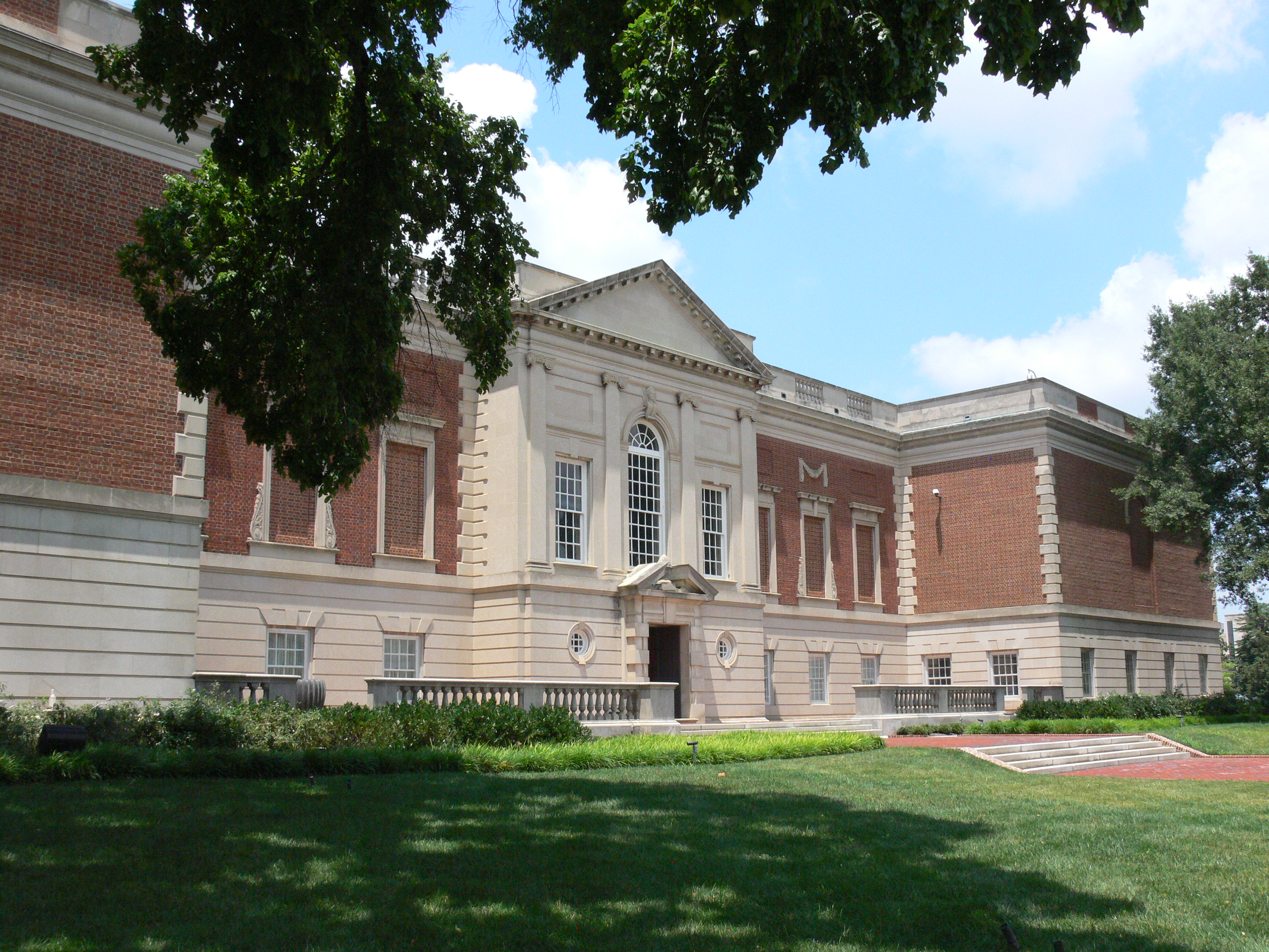
Located on 200 N. Arthur Ashe Boulevard, a street renamed in 2019 for the Richmond-born tennis star, civil rights icon, and AIDS activist Arthur Robert Ashe, Jr., the Virginia Museum of Fine Arts, today, boasts a wealth of visual collections, gathered from around the globe. However, immediately belying its prestige are the very grounds on which it stands. Violence and bloodshed haunt this house of memory, generating legacies that the museum continues to grapple with today (fig. 2).
Morgan Riley, Photograph of the original main entrance of the Virginia Museum of Fine Arts in Richmond, Virginia (now a secondary entrance). From left to right: the 1970 wing, the 1936 wing, and the 1955 wing), July 9, 2011. CC BY 3.0 <https://creativecommons.org/licenses/by/3.0>, via Wikimedia Commons.
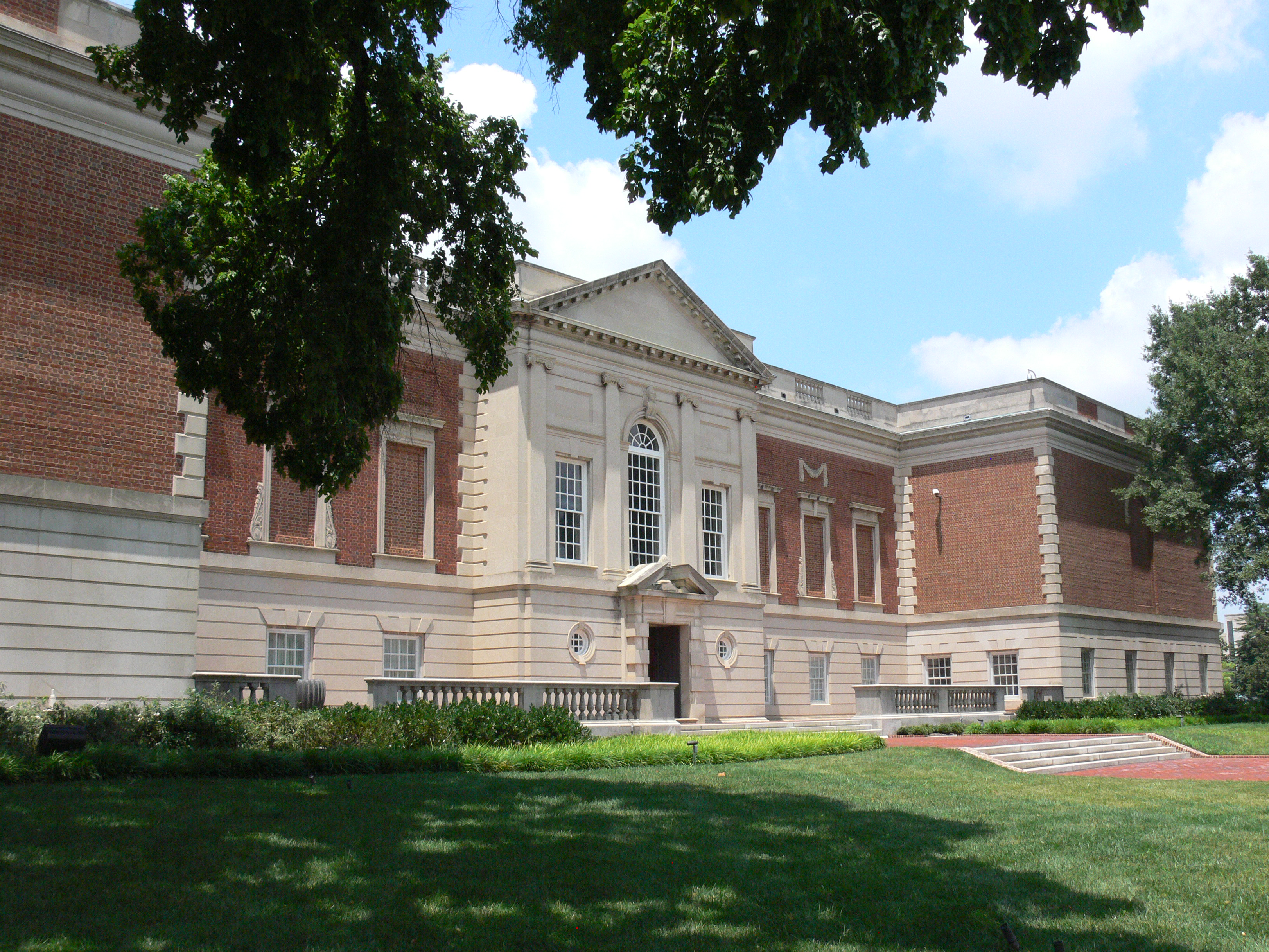
At the time of English colonial encounter in the early seventeenth century, the land that would later become the museum’s grounds “stood at the western perimeter of the chiefdom of Powhatan made up of a broad alliance of Algonquin speaking tribes,” as documented in the museum’s own “History of the VMFA Grounds.”Footnote 51 Colonial expansion in Virginia radically reconfigured the demographics of this geography, paving the way for successive ownerships of the museum’s grounds that (per the project of white supremacy) profited off the enslavement of African-descended people and the genocide of Indigenous Americans.
From an English colony during the seventeenth and eighteenth centuries to the capital of the Confederacy during the American Civil War, Richmond’s identity continued to be entangled in white supremacist nation-building endeavors. Even the fall of Richmond on April 3, 1865, precipitating the eventual defeat of the Confederate States, simply consolidated its image as a bastion of white supremacy. After the Civil War, the grounds became a monument to a bygone era of slavery and a literal safe space for the relics of the Confederacy. From 1885 to 1941, this was the site of the R. E. Lee Camp Confederate Soldiers’ Home—a lodging for veterans—named for Confederate General Robert E. Lee. What is more, statues of Confederate heroes (including Lee) proliferated in the vicinity, delusionally countering the realities of their defeat with the propagandistic iconography of victory. Further still, it was in 1936, amid these violent truths, propagandized narratives, and unresolved tensions, that the Virginia Museum of Fine Arts opened its doors to a deeply segregated public.
How heavily did the weight of this still-present past bear down on Moore when she remarked, “…what an honor it is to be here in this elegant place…”?Footnote 52 As she reminded the audience of her birthplace in Jarratt, Virginia— “…a thriving town now” but “at the time of my birth, it was just a little place not far from Zuni and Skippers”—she inserted the subtext of this segregated geography, evoking the predominantly Black locales of her Jarratt and neighboring Zuni and Skippers. It is curious, though, that her mention of Zuni and Skippers drew a light wave of laughter from the audience. Were they tickled by the cultural gulf between Moore’s “now” (i.e., a decorated composer and retired university professor) and “then” (i.e., a girl of humble beginnings)? Or were they troubled by the reminder that the Virginia Museum of Fine Arts was a historically whites-only institution built on Black labor, and that for a significant portion of Moore’s adult life, both she and her communities would have been barred from its doors, were they to visit as patrons?
Nervous laughter is laughter too.
Moore continued to stir the subtext:
And the possibility that I would someday be a speaker at the great Virginia Museum of Fine Arts is a possibility which I could not have dreamed. From my heart, I thank all of you—all those who have brought me here.Footnote 53
I hear in the final statement—“all those who have brought me here”—a gratitude that exceeded the spacetime of Moore’s present moment and extended to ancestors known and unknown. Informing this interpretation is the way that Moore’s speech flowed thereafter. As we will see, she interspersed the chronological narrative around her then-eighty years on Earth with what I conceptualize as a type of wondrously dexterous chronillogical storytelling.Footnote 54 McKittrick would likely identify the latter as “psychically refusing the delimiting elapse of colonial space-time.”Footnote 55 Indeed, Moore’s storytelling rejected the hegemony of “linear spacetime,” which, asserts Michelle M. Wright, dictates the “white Western linear progress narrative” and “despite contrary findings…dominates the Western imagination to such a degree that it is difficult to think of space and time functioning in any other fashion.”Footnote 56 Using a combination of chronological signposts and chronillogical detours, Moore evocatively (and provocatively) relayed the braided genealogies, geographies, and geometries of her being, becoming, and belonging as a classical composer.
After words of gratitude and acknowledgment to her hosts, audience, and (I posit) other presences, Moore proceeded to challenge the theme of her talk: “I have had a problem with the title of my remarks—in a vague way related to my childhood conception of the Composer,” she began.
I thought of Composers as being set apart, unearthly beings, removed from any connection with ordinary living—not quite celestial, but of high estate—existing, floating, not in heaven, but still in some sort of shadowy, magical region—a little Valhalla-esque.
Then, one day I experienced a great shock!—A Revelation! A tremendous thought came to me: “George Washington and the Composer Haydn were both born in 1732.” Think of it! Haydn was living on this same Earth at the same time.
From that moment, Composers became earthly beings—But though they now went about living, walking around like everybody else, in my mind they still continued to retain a little bit of the halo of my original fantasy. So even in my maturity, perhaps 50 to 60 years later, though I always made up music, I was careful to describe myself as “a Teacher who composes, rather than a Composer who Teaches.” When I stopped teaching, there I was—“Undine Smith Moore – Composer.”—I will tell you, even tonight, [I’m] feeling a little “edgy.” Have I promoted myself unduly to that old, fair, fantasy land?Footnote 57
Moore had evidently internalized a more Eurocentric view of the composer, set apart from their social milieu (which stood in contradistinction to the Black music makers from her Petersburg childhood, whose craft entwined both community and creativity and allowed her to see herself reflected). Also contributing to her unease in standing in the light of “Undine Smith Moore – Composer” was the identity she had forged in a tradition of Black classical practitioners (encompassing Florence Price, Carl Diton, Robert Nathaniel Dett, Helen Hagan, and William DawsonFootnote 58) who, at various points in their careers, claimed their titles as teachers first and foremost, and prioritized music education in HBCUs as a means to enact social change in a segregated world. These contexts, of course, entwined with the “double jeopardy” of Moore’s Black womanness that arose when confronted with the white maleness and deifying culture of the classical music world.Footnote 59
As documented in her interview for The Black Composer Speaks (1978), Moore unequivocally cited the “evil effects of racism” as the cause of her imposter-like relationship to the word and world of the composer, laying blame to “a society which educated me to feel my ‘otherness,’ that left me ignorant of that which was accessible to those of the dominant group with similar talent.”Footnote 60 To claim the identity of “the Composer” was, therefore, for Moore to draw empowerment from what Elizabeth Alexander theorizes as the “Black interior”—“that is, black life and creativity behind the public face of stereotype and limited imagination….a metaphysical space beyond the black public everyday toward power and wild imagination”; it was to activate, as Alexander writes, that “inner space in which black artists have found selves that go far, far beyond the limited expectations of what black is, isn’t, or should be.”Footnote 61 Even though whiffs of Imposter Syndrome would return throughout Moore’s talk,Footnote 62 this was not a tale of defeat.
Beneath the surface of her opening self-deprecation was the voice of a woman in tune with her humanness, attuned to “being human as praxis,” rooted, grounded, and down to earth/Earth.Footnote 63 Aware of the land on which she stood and the history the museum held, I suggest that Moore—as virtuosic wordsmith and orator—used this ostensibly timid mode of introduction to charm and disarm the audience seated in this once-segregated house of memory before venturing to her next narrative stop: her inner world.
To communicate this inner world to her audience, Moore structured the next part of her speech in an alternating pattern, constituting a zoomed in, sensory anecdote, and a zoomed out, philosophical assessment. First was a story about the intermingled smells of childhood, flowers, and death in her Petersburg:
When 7-year-old John Bragg stepped on a rusty nail in one of those long ago days before penicillin and the antibiotics, his funeral was held in the Pocahontas Chapel where a riot of orange blossoms perfumed the air. I, not old enough to go to school, watched from the sidewalk across the street. To this day more than 70 years later, the merest whiff of the scent of orange blossoms transports me back to that day of my childhood. It is not correct to say I am transported, for I am not carried back. I am simply there.Footnote 64
Orange blossoms diffused not only their own aromatic perfume but also the scent of youth (of Moore’s own livingness and of the seven-year-old John Bragg’s premature end), of Powhatan traces memorialized in Pocahontas Chapel, of colonial Christianity entrenched in the very construction of the chapel, and of Black religiosity and ritual steeped in John Bragg’s funeral rites. One whiff and Moore was “transported”—but she both used this verb (“the scent of orange blossoms transports me back to that day of my childhood”) and unused it (“It is not correct to say I am transported, for I am not carried back”) to expose its limitations and to reject the linear spacetime it reinforced. Places are still there, she echoed.
Zooming out, Moore explained:
Sometimes our inner world, this home of our creativity, shows its power with great drama calling our attention to that which we have not known was lodged within ourselves. This may be—rather, is often something we saw when we did not know we were seeing; something we heard when we did not know we were hearing.Footnote 65
Signaling a pivot from the olfactory of her first sensory anecdote, through the visual (i.e., “something we saw when we did not know we were seeing”), to the auditory (i.e., “something we heard when we did not know we were hearing”), Moore’s next sensory anecdote invoked the Afrodiasporic soundscape of her Jarratt:
…I was born in Jarratt, Virginia, and in that three-year old time before my family moved to Petersburg, I must have heard the voices of Touse and Thee Andrews passing the farm at night, giving their special “hollers.” I did not know I was hearing. And yet, about five or six years ago in the archives of the Library of Congress, where I had gone to do some research, I sat listening to a recording of early blues and hollers. Suddenly, I found myself weeping, crying almost to the point of embarrassment. The timbre of the voices of Touse and Thee had come back to me after all these years from some place deep in myself which I did not know existed.Footnote 66
As with John Bragg, there is something profoundly commemorative, even restitutionary, about the way Moore spoke the names of Touse and Thee Andrews. The audience did not know them, and I cannot trace them in the public record beyond another variation of this anecdote in which Moore identifies the singers as her aunts,Footnote 67 but we—the audience, myself, and my readers—are made to honor them by hearing (or reading) Moore say their names.Footnote 68 We are made to reckon with the un- and under-documented reality of Black life, not to mention the perennially un- and under-recognized legacy of “black sounds.”Footnote 69 Captured and captive in the Library of Congress (another a house of memory embroiled in the nation’s slave economy), Black voices, largely recorded by white collectors, lay in wait for their listeners. For Moore, however, the early blues and hollers that she heard invoked flesh and blood, name and place. In the midst of her research, perhaps she not only sensed the timbral echoes of Touse and Thee but also vestiges of slavery, the Middle Passage, and the yodelized styles of Black antebellum folk cultures that “derived from Pygmy singing by way of Kongo peoples.”Footnote 70 In any case, this was an experience of nostos (“return home”) and -algia (“pain”)—one that overwhelmed her with an array of ineffable emotions, evoked “home,” and used and unused the notion of “return.” She was simply there, in a “‘now’ through which the past, present, and future are always interpreted.”Footnote 71
Moore had her own language for it. Zooming out once again, she said:
Our inner world on which the artist depends gives us a strong mysterious sense that there is no separation—No Now, No Then, No Here, No There.Footnote 72
Later in her speech, Moore segued into a more conventional chronology of her life story. “Now, I owe you some facts of a different kind,” she noted wryly, reorienting her audience in the more familiar contours of linear spacetime.Footnote 73 Nevertheless, in this portion of my essay, I wanted to spend time with her amorphous inner world for the clues it holds about Moore’s being, becoming, and belonging as a classical composer.
The multisensory and multidimensional qualities of Moore’s memories point to a rootedness in (over transcendence of) her humanness. Furthermore, her music followed suit, not seeking to transcend the human condition, but to dig deeper into it, illuminating her findings through the lens of Black female creative genius. Unlike Haydn, whom she cited in her opening remarks, the rhetoric of “transcendence” and “universalism” that gripped many European composers in the Age of Enlightenment was not connotative of her outlook. That the Age of Enlightenment had “a twin, born at the same time, the Age of Scientific Racism,” as Toni Morrison puts it, meant that such rhetoric would, by design, always refute Black intellectuality, creativity, and aliveness.Footnote 74 The ostensibly neutral vocabularies of “transcendence” and “universalism” were, in reality, steeped in a grammar of white supremacy. Still, Moore’s inner world gifted her with alternative, audacious, and vividly alive vocabularies and contexts for being, becoming, and belonging.Footnote 75 Her inner world supplied the interior fuel of her self-definition and worldmaking as a Black woman composer.Footnote 76
In her closing remarks, Moore signaled this sustenance, sounding the spiritual wisdom of her ancestors in Epiphenomenal time,
In conclusion, as I continue on my way, I keep before me those lines from our elders:
“Stay in the field,
O stay in the field, children.
Stay in the field
Until the war is ended.”Footnote 77
These lines (which Moore also used in the opening narration for Scenes from the Life of a Martyr), in turn, distilled the sentiments of Matthew 24: 6 (KJV): “And ye shall hear of wars and rumours of wars: see that ye be not troubled: for all these things must come to pass, but the end is not yet.”
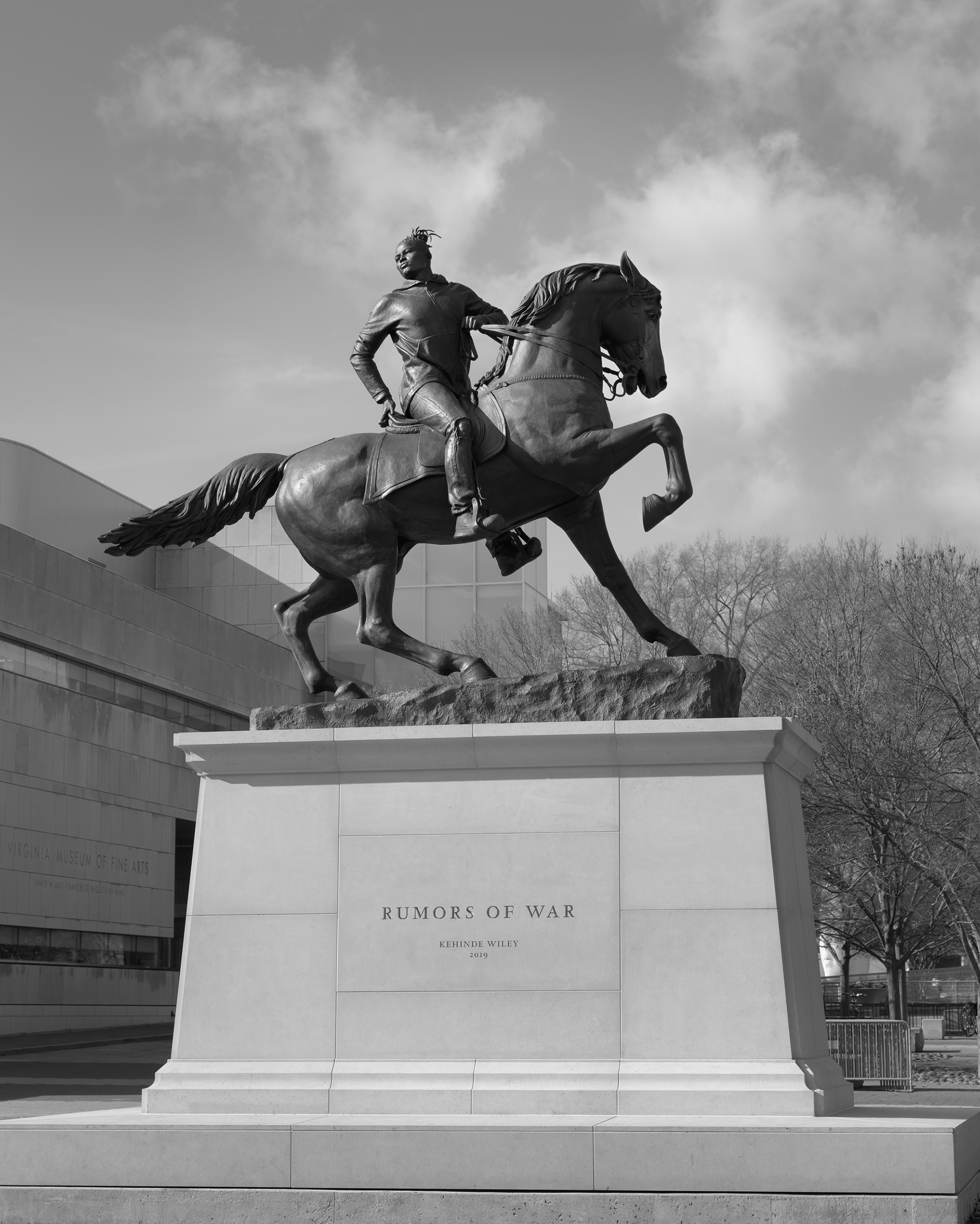
The critically acclaimed African American artist Kehinde Wiley would later invoke this same passage for his sculpture, Rumors of War (2019), which would be unveiled at its permanent home of the Virginia Museum of Fine Arts on December 10, 2019 (fig. 3).Footnote 78 Thirty-five years on from Moore’s speech, Wiley’s melding of traditional equestrian portraiture with the twenty-first-century Black male subject (wearing cultivated locs and modern attire) would stand in defiance of the white supremacist iconography of Confederate soldiers on horseback in Richmond and across the United States.Footnote 79 Moore, of course, would not witness the unveiling of Wiley’s sculpture, but along the genealogies, geographies, and geometries of her inner world—which claimed extraordinary laws and logics of “no separation,” of “No Now, No Then, No Here, No There”—how far-fetched would it be to posit that Moore was simply there?
Kehinde Wiley (American, b. 1977), Rumors of War, 2019, Bronze, stone (pedestal) 328⅞”H × 305⅞”W × 189⅝”D 835.34 cm × 776.92 cm × 481.65 cm. Virginia Museum of Fine Arts, Richmond. Purchased with funds provided by Virginia Sargeant Reynolds in memory of her husband, Richard S. Reynolds, Jr., by exchange, Arthur and Margaret Glasgow Endowment, Pamela K. and William A. Royall, Jr., Angel and Tom Papa, Katherine and Steven Markel, and additional private donors, 2019.39. Photo: Travis Fullerton © Virginia Museum of Fine Arts.

Interlude
If writing is thinking and discovery and selection and order and meaning, it is also awe and reverence and mystery and magic. I suppose I could dispense with the last four if I were not so deadly serious about fidelity to the milieu out of which I write and in which my ancestors actually lived. Infidelity to that milieu—the absence of the interior life, the deliberate excising of it from the records that the slaves themselves told—is precisely the problem in the discourse that proceeds without us. How I gain access to that interior life is what drives me….
—Toni Morrison, “The Site of Memory,” (1987)Footnote 80
“All of it is now it is always now there will never be a time when I am not crouching and watching others who are crouching too…the man on my face is dead…”Footnote 81 This is the first monologue of Beloved, Morrison’s titular character and Sethe’s revenant, other daughter. She is the sole victim of the infanticide that Sethe attempts on her three young children that came before Denver (i.e., Howard, Buglar, and Beloved).Footnote 82 Sethe plans their biological death to protect them from the social death of their enslavement and succeeds with Beloved, maintaining “…if I hadn’t killed her she would have died….”Footnote 83 The ghost of baby Beloved haunts the Cincinnati home in which Sethe and Denver live. Full of spite and “venom,”Footnote 84 the infant’s specter drives her brothers away. Eventually, it is only the mother and (living) daughter that remain, until Beloved reappears as a nineteen-year-old, the age she would have been had Sethe not killed her.
Beloved’s first monologue reveals how her biological death thrusts her into a now that is always now, a now that Morrison communicates via unpunctuated, circuitous, irregularly paced, and unusually spaced prose. “Beloved subjects the reader, too, to a temporal and spatial disorientation that mimics that of the captives on the slave ships,” observes Jean Wyatt.Footnote 85 The crouching others and dead man on Beloved’s face invoke the dark, claustrophobic hold of the vessel. There is no separation. No now, no then, no here, no there. She has passed through the birth canal of her mother only to find herself in the belly of the ship and slavery’s birth canal of the Middle Passage (to evoke Christina Sharpe’s In the Wake).Footnote 86 However, buried in Beloved’s monologue is what literary scholar Katy Ryan identifies as “an often overlooked passage,” in which “a woman ‘is not pushed’ into the sea but chooses to go.”Footnote 87 The unnamed woman possesses what Beloved never knew during her brief time on Earth, that is, the capacity to choose death as a dimension of revolutionary aliveness—the capacity to self-determine what Sethe decided for her:
Oh, freedom!
Oh, freedom!
Oh, freedom over me!
And before I’d be a slave
I’ll be buried in my grave
And go home to my Lord and be free
—Negro spiritual and Freedom SongFootnote 88
Interior Lives and Revolutionary Aliveness in Moore’s Music
If Moore’s compositions were “thinking and discovery and selection and order and meaning,” to quote Morrison, then they were also “awe and reverence and mystery and magic.” With her inner world as muse, Moore communed with the interior lives and revolutionary aliveness of her ancestors, known and unknown, named and unnamed. With no sense of separation between people and places of the past, Moore’s artistry blended with pre-colonial African cosmology wherein, explains Samuel A. Floyd, Jr., the “musical artistry of Africans supported their ritual in a profoundly mystical universe, a universe in which African peoples sought union with the invisible—God, lesser gods, spirits, and the living dead—a universe in which ‘the use of euphemism, symbol, allegory, and secret’ were a normal part of the oral expressions of society.”Footnote 89 Negro spirituals continued this tradition, with euphemism, symbol, allegory, and secret comprising their very fabric.
Elaborates Hildred Roach in her comprehensive volume, Black American Music, “Because they functioned as practical tools for emotional and physical escape, multifold purposes were assigned to the spirituals from religious expression to communication (by code).”Footnote 90 Roach continues, “Spirituals were further laden with obsessions about ‘freedom land,’ ‘home,’ utopias, ‘Jesus,’ deliverer, or ‘Saviour [sic].’ Some ambiguity or dual meaning could have pointed to ‘Jesus’ or ‘Savior’ as either the God of Christianity, Ntoa, the supernatural spirits of ancestors,”Footnote 91 or even Harriet Tubman, the “astronomer extraordinaire,” as Chanda Prescod-Weinstein calls her, “who knew how to read the land and the stars and used this knowledge to facilitate her work as a conductor of the Underground Railroad.”Footnote 92 “Canaan” might have stood for the Underground Railroad, northern destinations, post-Emancipation promises, or eternal paradise; “Home” might have meant “Heaven or Africa.”Footnote 93 “In any case,” Roach concludes, “the slaves were eventually forced to resort to the use of words and actions of a significance contrary to that outwardly spoken or suggested.”Footnote 94
For Moore, the hidden meanings and “multifold purposes” of these sacred songs were some of the most profound points of access into the interior lives of her ancestors. Where spirituals contemplated an embrace and/or choice of biological death, what they revealed was “a cosmology that [did] not separate supernatural from natural, individual from community.”Footnote 95 There is no separation. Where spirituals intimated suicidal ideation, what they explored was an audaciously powerful “revolutionary suicide…fueled by hope” in contradistinction to a quietly powerless “reactionary suicide…fueled by despair,” which would, centuries on, be expressed unequivocally in Black Panther cofounder Huey P. Newton’s Revolutionary Suicide (1973).Footnote 96 “I think of the songs of my own people—a people who surely faced the idea of death unflinchingly in their music,” said Moore, asserting, “There is a courage in the spiritual ‘Dig My Grave’ that is almost arrogant: ‘Dig my grave long and narrow/Make my coffin long and strong.’ If you made that song up you are not quivering in fear.”Footnote 97 The audacity to embrace and/or choose death as “not a plummet to doom, but a launch into flight; not an outcome of self-abnegation, but as an act of self-assertion; not a bog of hopelessness, but an outburst of radical hope hurled into another world,” to borrow the words of interdisciplinary Afromanticist La Marr Jurelle Bruce, lay at the heart of what I explore here as revolutionary aliveness.Footnote 98 And “Before I’d Be a Slave” was yet another audacious spiritual in the repertoire of Black collective survival.
Moore’s Before I’d Be a Slave, composed for solo piano in 1953, arose out of a commission from Barbara Hollis for the Modern Dance Group of Virginia State College. As a former member of the Katherine Dunham Dance Group, Hollis would not simply have been a dancer and choreographer, but a student of Afrodiasporic artistry—of the cultural and kinetic themes and variations across the continent and diaspora, and of its capacity to transfigure the racialized constraints of classical ballet.Footnote 99 Under the renowned anthropologist-practitioner Katherine Dunham, founder of the Dunham Technique, Hollis would have understood her craft as literal “embodied discourse,” to borrow Brittney C. Cooper’s terminology,Footnote 100 and embraced “the Black body as a (performative) site of knowing,” after Michelle M. Wright.Footnote 101 Moreover, as an exponent of a Black concert dance that, like its musical counterpart, worked out new avant-garde modernisms through the midcentury, Hollis would have found the ideal collaborative partner in Moore.
Moore thus wrote this work with the movement and connectedness of African-descended bodies in mind.Footnote 102 At the same time, however, its impetus also stemmed from her own interior life: “It is a piece which reflects a particular hostility and frustration I felt in a personal situation of some difficulty,” she said in her interview from The Black Composer Speaks.Footnote 103 Moore did not identify the situation itself, choosing, instead, to center her emotional response in her account. What started as a piece based on “a personal situation of some difficulty” then became a narrative of community and collective freedom, as embodied by the Modern Dance Group. Moore’s process evinced a now that is always now, a now of no separation, where her inner self converged with spatiotemporally diverse choreographies and cartographies of Afrodiasporic resistance. The result was a composition that exhibited “the multidimensionality of Blackness,” to borrow from Wright: Moore’s inner world served as “an intersecting site for a broad variety of collective epistemologies”—not an overriding domain that would center Moore as the individual and “[subsume] all those collective identities” per the properties of linear spacetime, but an inclusive, nonhierarchical episteme that harbored the “endless valences of Blackness in the Diaspora” in Epiphenomenal spacetime.Footnote 104
Further evidence of Moore’s rejection of conventional linearity in favor of a more chronillogical aesthetic lies in the fact that the music came first and the title came decades later. (Personally, I had always wondered why Moore did not quote “Before I’d Be a Slave,” making it an anomaly among her works named for Negro spirituals; it turns out that the composition was yet to find its title.) Regardless of its unnamed state, the work was, according to Moore, “[p]erhaps the most interesting piece I ever wrote for piano.” But by her own admission, she never had it professionally engraved: “It is short, but quite difficult. Who would have published it? And, if published, who would have played it?”Footnote 105 The piece would have stood out among the Negro spiritual arrangements for which she was known. It is abrasive, violent, and angry, and in a “misogynoiristic” climate that would readily weaponize “Peaches,” “Sapphire,” and other variations on the Angry Black Woman stereotype to shut down Black women’s “uses of anger” in the face of oppression, where would be the commercial appeal?Footnote 106
Still, commercial appeal was not Moore’s priority. She leaned into a musical language that was more extreme than anything she had written before (or after, until composing her 1987 Soweto): “I am usually stylistically addicted to mild dissonance, but this piece is sharply dissonant and much more irregular rhythmically.”Footnote 107 When asked by her interviewers about the name of this composition, Moore replied, “The piece has no title. If I were to christen it now, I might call it Warrior.”Footnote 108 Moore continued to deliberate as shown by the word “perhaps” on the cover page of the work’s handwritten score (in her Emory archive): “Title—Perhaps: Before I’d Be a Slave,” it reads. This suggests, then, that Moore produced the archived score that I consult here after her 1978 interview, and that it was later that the name Before I’d Be a Slave eventually stuck.Footnote 109
Taken in conjunction with The Black Composer Speaks interview, what I also ascertain from her program notes (quoted below), is that, through her compositional process, her inner world spoke Epiphenomenally with the stories of her enslaved ancestors:
It follows a program which I would hope is evident in the music without verbal explanation—In general:
The frustration and chaos of slaves who wish to be free.
In the depths—a slow and ponderous struggle marked by attempts to escape—any way—Being Bound—almost successful attempts at flight.
Tug of war with the oppressors.
A measure of freedom won—Some upward movement less lacerating.
Continued aspiration—Determination—Affirmation.Footnote 110
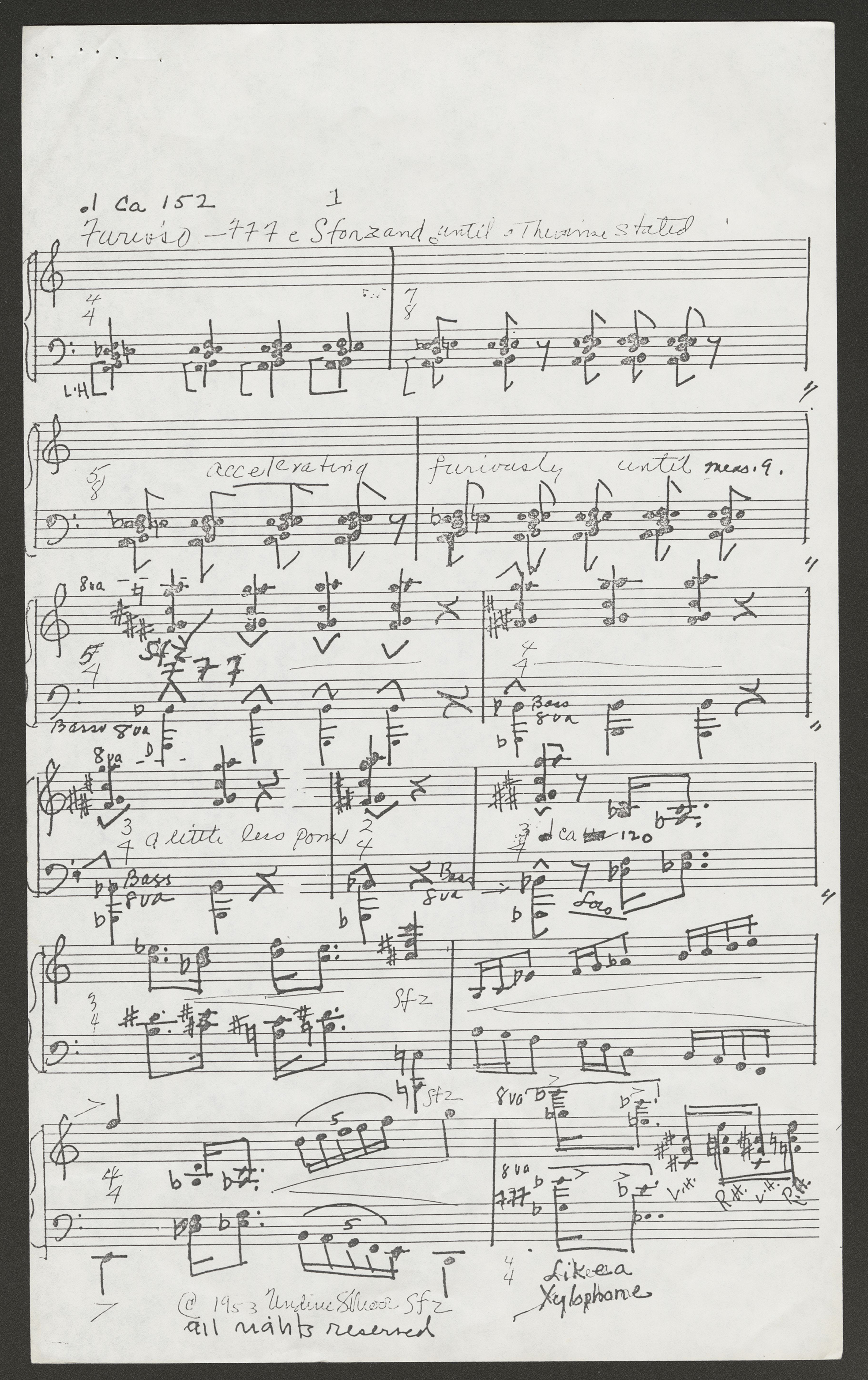
Atop the first page of Moore’s handwritten score reads the instruction “Furioso” with a tempo marking of quarter note = ca. 152, denotative of frantic movement and momentum and the “frustration and chaos of slaves who wish to be free” (fig. 4).Footnote 111 There is no key signature. The first measure places the fingers of the left and right hand in too-close proximity; they are locked in a tight, claustrophobic configuration. Submerged in the bass clef, the left hand takes the A-B dyad at the bottom of the stave (which can be played with the third and second finger for an equally weighted sound or the third finger and thumb, with the latter giving a more percussive edge). Meanwhile, the right hand assumes a cramped and confined pinched position for the chromatic tetrachord that starts on the D in the middle of the stave: fingers one, two, three, and four take the respective semitone intervals of D, E flat, E natural, and F. These cluster chords pulsate with fff e sforzando energy across the opening four measures of the piece, first as quarter notes in a 4/4 time signature, then as eighth notes in a 7/8 time signature, and finally as eighth notes in 5/8 that gather pace (“accelerating furiously until measure 9,” writes Moore). The effect is a spatial and temporal distortion, compounded by the rhythmic diminution and accelerando that imbue the pounding pianism with a restless spirit.
Page 1 of Undine Smith Moore, Before I’d Be a Slave (1953), 2, Box 27, Folder 9, Undine Smith Moore papers, manuscript collection no. 1155, Stuart A. Rose Manuscript, Archives, and Rare Book Library, Emory University, Atlanta, GA.

Tension arises between the increasingly active rhythms and the static chord spellings. The murky textures and taut strictures of the opening reflect a certain hopelessness and airlessness, but the unrelenting rhythmic kineticism of the first four measures will soon unlock the fingers from their static dyads and tetrachords, bursting into passages with widespread tessituras, contrary motion scales, and brilliant bitonal colors that exude “Great Power.” With this change of direction, the music begins to anticipate the “attempts at flight,” “upward movement,” and “continued aspiration” that shape the rest of the piece.
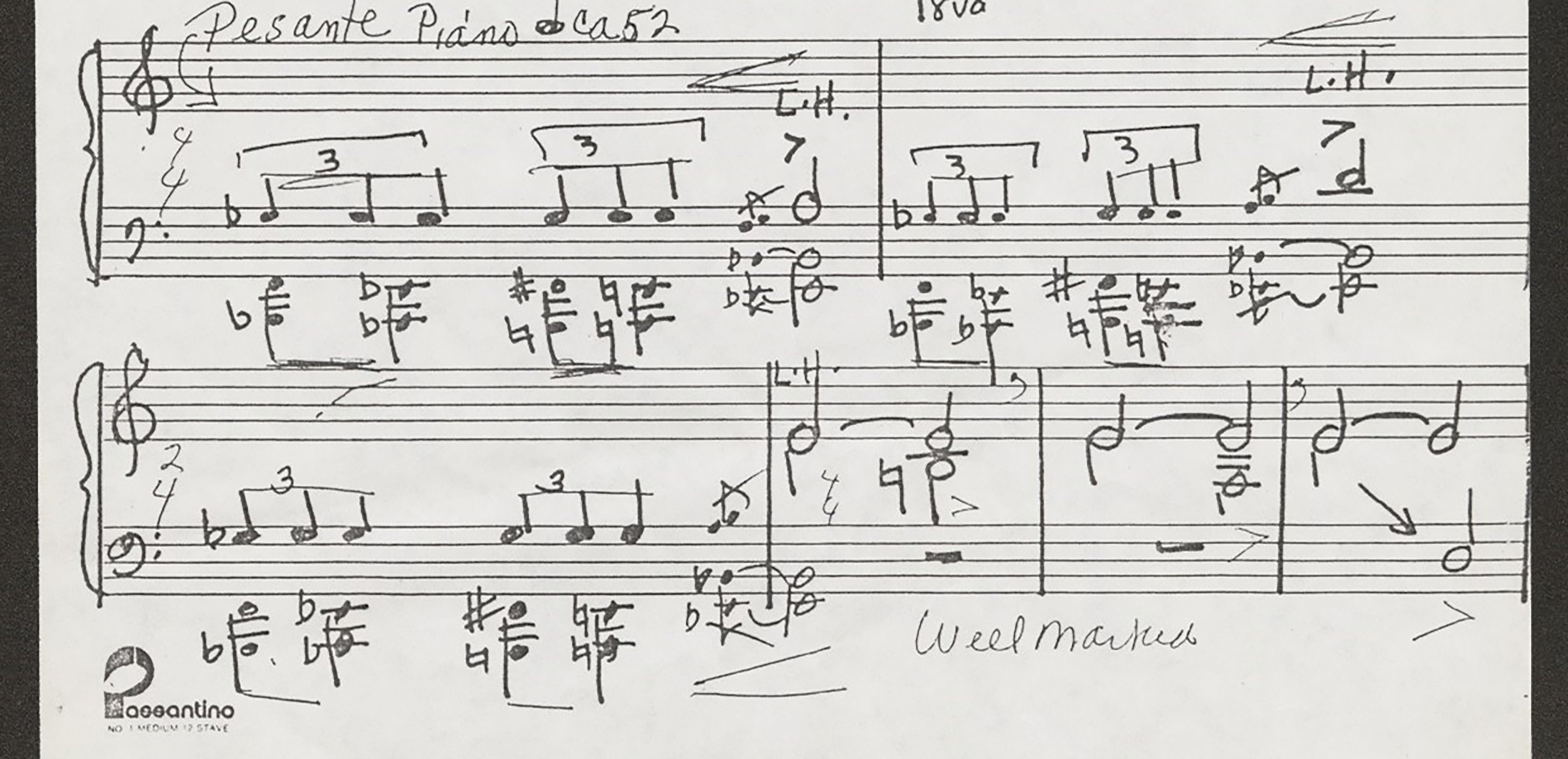
The next theme, however, returns to “the depths.” Marked pesante with a tempo marking of quarter note = 52, the left-hand trudges through a pattern of quintal harmonies (fig. 5). Its circuitousness resembles Beloved’s first monologue. The pattern crouches in the lower registers of the instrument: it is morose, dirgelike, heavy, and aimless. Its eighth-note movement slowly grinds against the eighth-note triplets of the right hand, whose melody does little to resolve the major/minor ambivalence of the open-fifths accompaniment. Evocative, again, of spatiotemporal distortion, the largo pacing of the three-over-two polyrhythms and their submerged, unmoored tonalities reflect the “slow and ponderous struggle” of Moore’s description. However, this boundedness is soon countered by boundless leaps into the higher registers on the next page of the score (see fig. 6).
Excerpt from page 2 of Undine Smith Moore, Before I’d Be a Slave (1953), 2, Box 27, Folder 9, Undine Smith Moore papers, manuscript collection no. 1155, Stuart A. Rose Manuscript, Archives, and Rare Book Library, Emory University, Atlanta, GA.

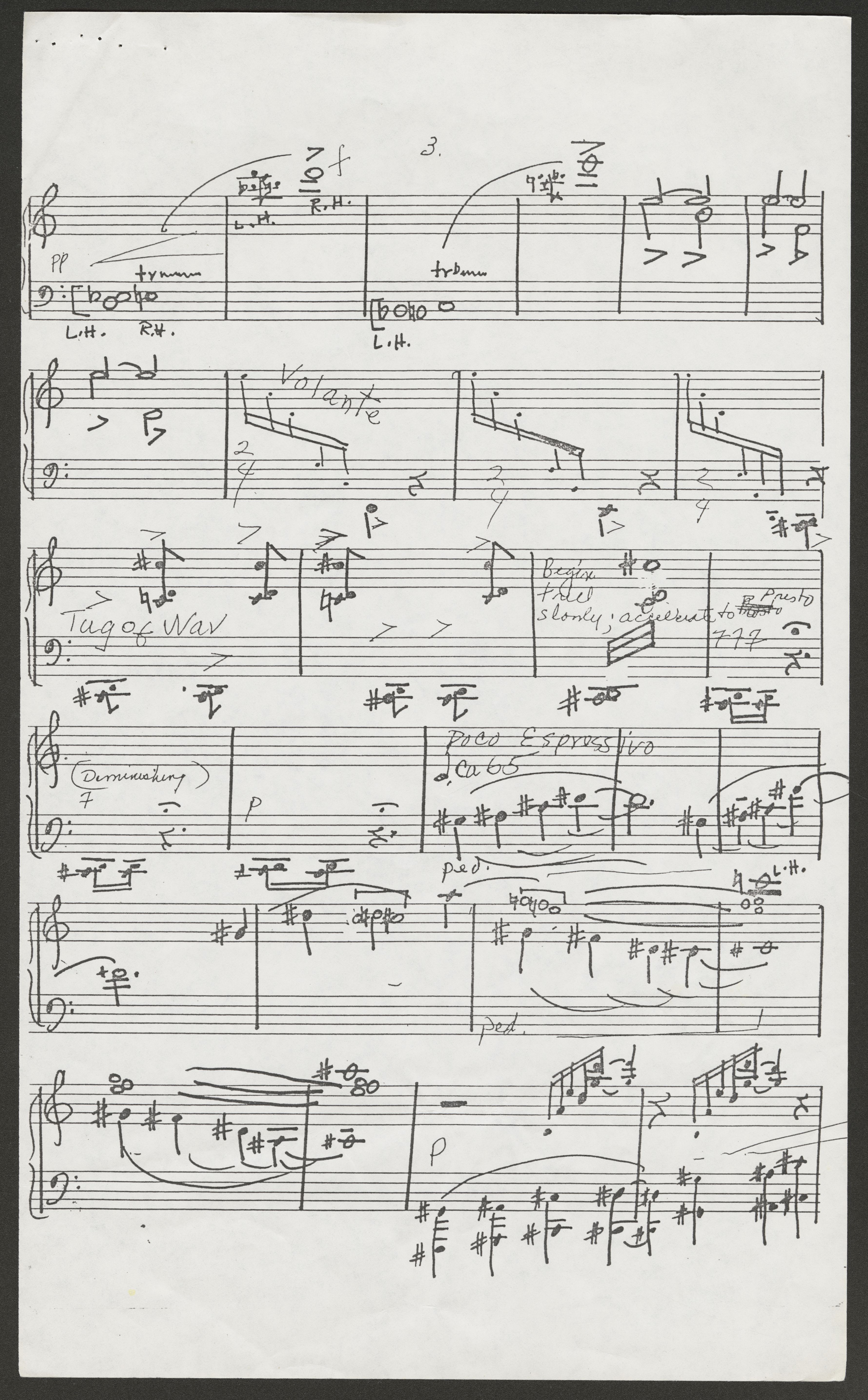
Page 3 of Undine Smith Moore, Before I’d Be a Slave (1953), 2, Box 27, Folder 9, Undine Smith Moore papers, manuscript collection no. 1155, Stuart A. Rose Manuscript, Archives, and Rare Book Library, Emory University, Atlanta, GA.

Figure 6 Long description
The image displays a handwritten musical score with various annotations and instructions. The score includes multiple staves with notes, dynamics, and tempo markings. Key annotations include 'pesante', 'lento', 'Tag of War', 'Poco Espressivo', and 'Diminuendo'. The score features instructions for both hands, with specific notations for the left hand (L.H.) and right hand (R.H.). There are also indications for pedaling and expressive markings such as 'pp', 'p', and 'f'. The score is divided into several measures with different time signatures and key signatures. Annotations and instructions are written in cursive and print, providing detailed performance directions.
Their upward motion, though, is soon countered by volante descents, which are then subsumed in a “Tug of War” (fig. 6). The left hand plays a semitone dyad comprising C sharp and D (below the bass-clef stave) as the right hand pulls in the other direction with a spread chord that builds up from middle C and includes D (a tone above) and C sharp (in an augmented octave). Aided by its higher register, the dissonance of the C sharp slashes through the texture, sounding pain, struggle, and tumult. The push and pull between the hands begin slowly, building into an aggressive trill that accelerates to presto, per Moore’s instruction. It is a dramatic gesture that, like many of the physically demanding moments in this piece, “draws attention to the physical nature of music and raises the possibility that music’s bodily performance—in addition to its composed and sonic attributes—can serve as a way to bear witness to suffering,” as Maria Cizmic writes of other piano repertoire that enacts memory and pain.Footnote 112 This passage indeed bears witness to suffering, but it later moves into a form of resolution—not in the harmonic sense, but in the context of revolutionary aliveness.
After the tug of war between the hands, the left-hand cluster appears to prevail, sounding two fff sixteenth notes in one measure; but when it repeats in the next measure, the dynamic says forte with “Diminishing” in parenthesis (fig. 6). Then, when it repeats for a third and final time, its sounding is piano. With fermatas after each of the three declamations, has the enemy retreated? Or are these notes, perhaps, the sounds of the enslaved drawing their last breath?
Out of however we might interpret these ashes, a measure of freedom—whether in life or in death—has been won (as Moore writes in the program note). Conjuring “awe and reverence and mystery and magic,”Footnote 113 the left hand moves into the piano’s middle registers, with an ascending four-quarter-note motive built on black-note pentatonicism (marked poco espressivo, quarter note = ca. 65 in fig. 6). Moore is drawing on the melodic vernacular of early African American folksong, which perseveres over a stretch of thirteen measures, even as white-note countermelodies cut through and generate dissonance. Still, to suggest that the juxtaposition of black and white notes here is a literal display of the Black-white racial binary might be to put forward an interpretation of the piece where “whiteness is the actor and Blackness is the reactor” in this freedom narrative (to quote Michelle M. Wright).Footnote 114 Instead, I argue that even though white supremacy is undoubtedly a presence, with its violence particularly exteriorized in the preceding “Tug of War” passage, the work finds resolution in Black agency. We might, then, hear these closing dissonances beyond black and white binaries and more as a reflection of the kaleidoscopic complexity that constitutes the Black interior.
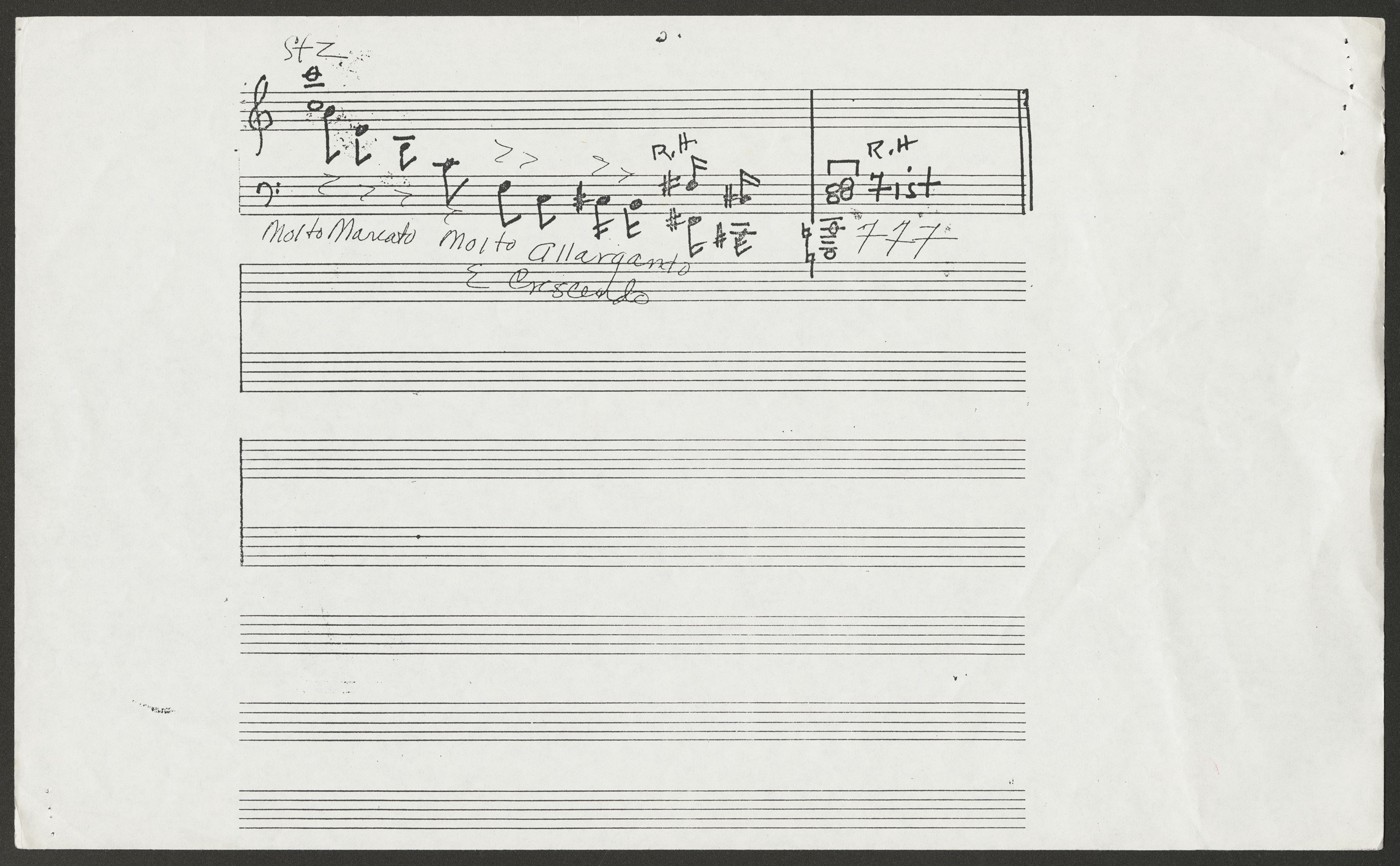
A rhapsodic cantabile e espressivo passage over the course of three measures embodies the “continued aspiration” toward liberation. The single lines of its two-part counterpoint thicken into determined, molto espressivo octaves that lead to a consolidation of textures as both the right- and left-hand octaves come together in bold unison. The pesante instruction in this section no longer signifies the slow and ponderous struggle represented in figure 5, but, instead, expresses the intentionality of fearless self-reclamation. Although a repeated descending passage across the three measures that precede the work’s final measure (captured in fig. 7) returns the musical narrative to its bass-clef sonorities, this is not “a plummet to doom,” nor “an outcome of self-abnegation,” nor “a bog of hopelessness,” to recall La Marr Jurelle Bruce.Footnote 115 Rather, it is a deliberate, allargando grounding that utilizes the resonant power of the bass notes to sound its “affirmation.” In the final measure (fig. 7), the left hand is splayed out in a resonant octave across the lowest Cs of the keyboard, while a right-hand fist hammers a C-D-E-F tetrachord in the octave above.Footnote 116 The pianist has therefore moved from pinching chaotic, chromatic tetrachords through the opening measures to punching a bold, diatonic resolution at the end in the same register. That the clenched fist emits more force than pinched fingers signals the move from Black powerlessness to Black power.Footnote 117 Subverting the bass clef’s original connotations of despair, the closing fff gesture sounds an aesthetic refusal of “unfreedom,”Footnote 118 one that bespeaks a courage that is almost arrogant, to recall Moore.
Page 5 of Undine Smith Moore, Before I’d Be a Slave (1953), 2, Box 27, Folder 9, Undine Smith Moore papers, manuscript collection no. 1155, Stuart A. Rose Manuscript, Archives, and Rare Book Library, Emory University, Atlanta, GA.

For its 1953 premiere, the score’s cover page reveals that Moore “taped the music for its only first performance.”Footnote 119 “Only” is struck out and replaced (in a different pen) by “first,” showing that the work began to develop more of a performance history, especially in the last decade of Moore’s life. One documented performance was the concert that closed her November 12, 1984, “On Becoming a Virginia Composer” speech at the Virginia Museum of Fine Arts. Captured on the concert’s recording in the Emory archive are also three songs that joined Before I’d Be a Slave in contesting the racist socio-spatial politics of the museum: her 1981 setting of Langston Hughes’s “I, Too” for mixed chorus and piano, her 1955 setting of Hughes’s “Mother to Son” for mixed chorus with alto solo (and with piano accompaniment in this performance), and her 1981 setting of Phillis Wheatley’s “On Imagination” for mixed chorus and piano.Footnote 120
To offer brief analysis, “I, Too” conveys a message of Black collective resistance and resilience through the first-person perspective. Moore’s strident opening, however, contrasts that of another famous setting: Margaret Bonds’s tenderer art song, which forms the third movement of her 1959 Three Dream Portraits. Moore’s “I, Too,” bursts forth with vocal leaps of an octave and flattened ninth against fortissimo open-fifth chords in the piano accompaniment. Additionally, where Bonds adheres more to the chronological flow of Hughes’s lines in her setting for solo voice, Moore fractures their linearity among the choir, for example, splintering the “I, Too” refrain through canon and call-and-response techniques. Moore moves through clouds of modal and chromatic tension to rays of consonance that mirror the Black protagonist’s resolve and, across the final measures, illuminate the closing words, “I, too, am America.”
“Mother to Son” musicalizes the mother’s “stair” symbolism (“Well, son, I’ll tell you:/Life for me ain’t been no crystal stair”) and metaphors for perseverance (“Don’t you fall now,” “I’se still climbin”) with ascending and descending figures that capture the vagaries of progress, but never lose their sense of momentum. “On Imagination” undulates with pentatonic color. It is a celestial reverie; and with lyrics drawn from the following stanza of Wheatley’s eponymous 1771 poem, Moore’s “On Imagination” asserts that the cosmos is, indeed, a Black (woman’s) aesthetic:
Imagination! who can sing thy force?
Or who describe the swiftness of thy course?
Soaring through air to find the bright abode,
Th’ empyreal palace of the thund’ring God,
We on thy pinions can surpass the wind,
And leave the rolling universe behind:
From star to star the mental optics rove,
Measure the skies, and range the realms above.
There in one view we grasp the mighty whole,
Or with new worlds amaze th’ unbounded soul.Footnote 121
To sound Wheatley’s Afrofuturist visions of Black revolutionary aliveness in the very geography that informed Enlightenment thinker and Founding Father Thomas Jefferson’s Notes on the State of Virginia (1785), in which he denounced Wheatley’s intellectuality and deemed her poetry “below the dignity of criticism,” was a programming choice of profound audacity.Footnote 122 Having the final say, however, was a song without words—a piece where the composer knew its narrative before she knew its name: Before I’d Be a Slave. Played by a pianist unidentified in the recording who led with a compelling sense of drama and shape, the piece was invoked in the narrative of Moore’s being, becoming, and belonging as a composer. The work’s final fist-chord gesture sounded the punctuating affirmation of her arrival, her inner world, and “all those who have brought me here.”Footnote 123 Absorbed into the walls of the Virginia Museum of Fine Arts were genealogies, geographies, and geometries of Blackness that troubled the building’s very foundations.
Postlude
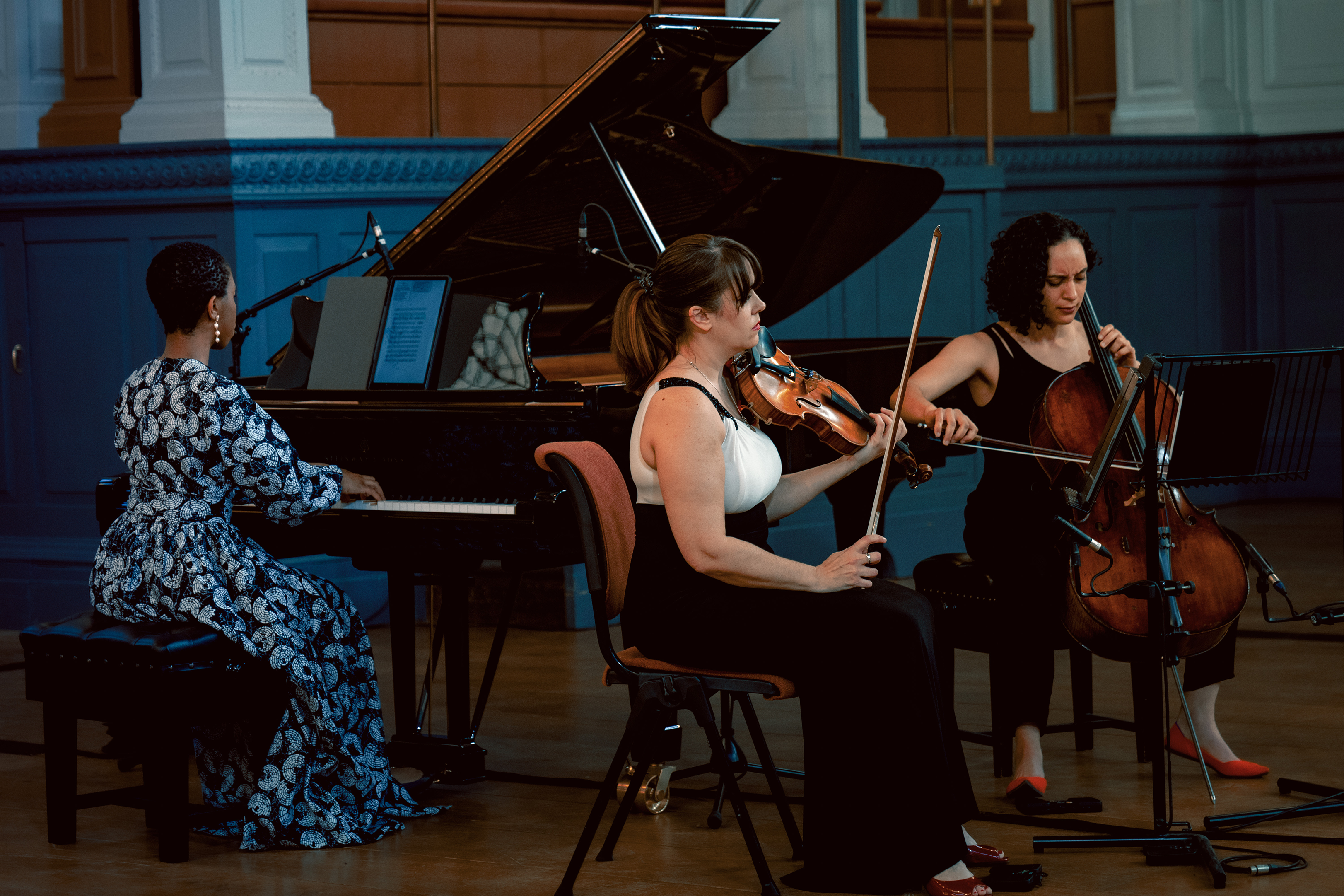
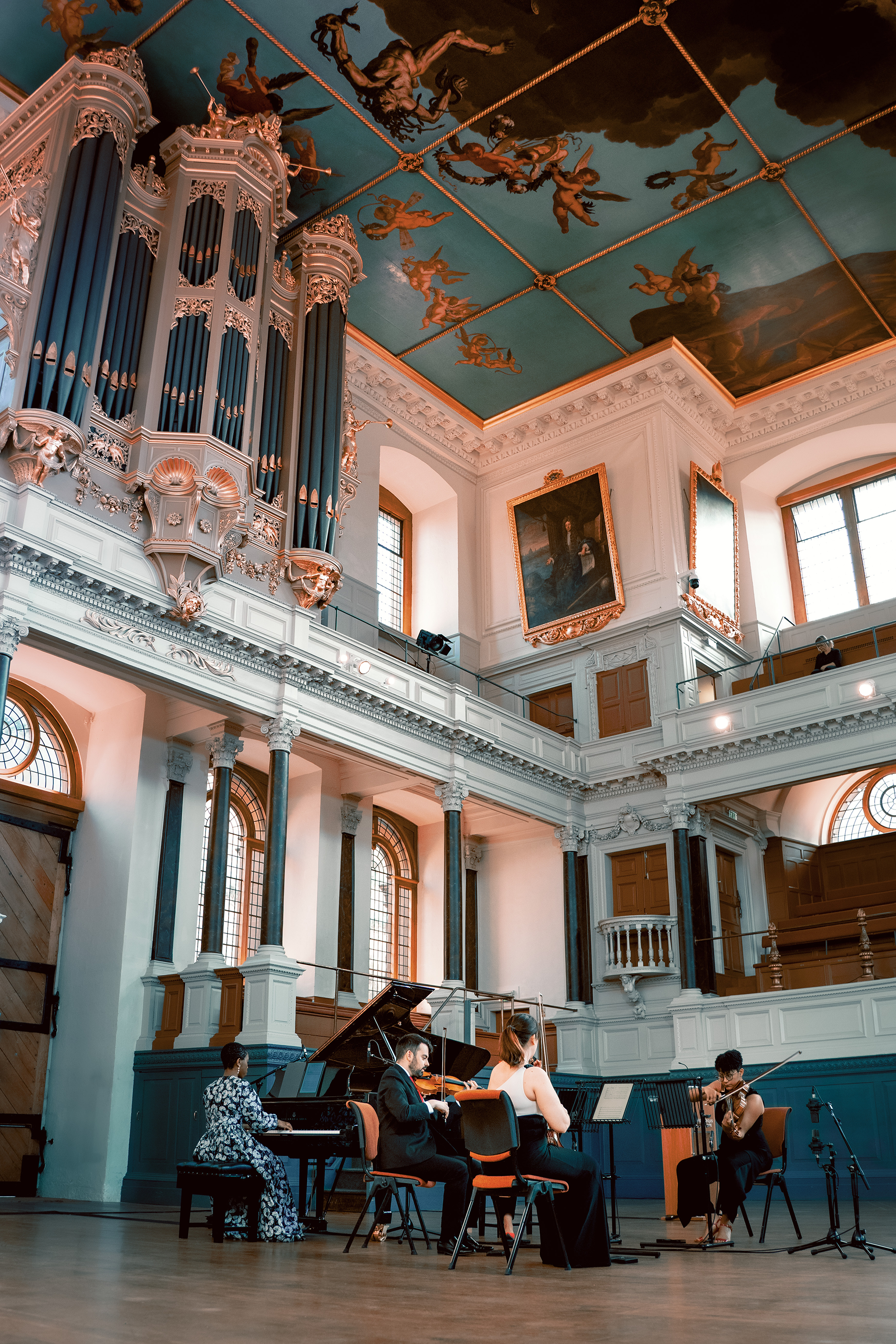
On May 8, 2022, I premiered Moore’s final composition, her 1987 Soweto for piano trio, at the University of Oxford’s Sheldonian Theatre.Footnote 124 Alongside me were violinist Gabriela Diaz and cellist Francesca McNeeley from Castle of our Skins.Footnote 125 As a concert that sought to delve into the vast geographies of Blackness and the musical vehicles in which they have been memorialized, performing a program titled “Chamber Music from the African Continent and Diaspora” in a space laden with histories of anti-Blackness was a deliberate choice—audacious, even, in the vein of Moore’s “On Becoming a Virginia Composer” presentation.Footnote 126 It was one that invoked the epiphanic sentiments of Nikki Giovanni’s 1968 poem (for nina), from which Castle of our Skins derives its name:
We are all imprisoned in the castle of our skins
and some of us have said so be it
if I am in jail my castle shall become
my rendezvousFootnote 127
Performance was our rendezvous—a meeting place for the variety of Black continental and diasporic narratives, inextricably tied to the very place in which we sat with our instruments. Our rendezvous became, after Morrison, the site of (re)memory, where places are still there; after Wright, the site of intersection, in which “one is manifesting the past in the present moment”;Footnote 128 and after Moore, the site of no separation—no now, no then, no here, no there. We were, after all, within walking distance of the statue of the British imperialist Cecil Rhodes, a founding father of South Africa’s apartheid regime, honored in stone as the centerpiece of Oxford’s Oriel College.
When the refrain of Black Lives Matter returned after the murder of George Floyd in the city of Minneapolis on May 25, 2020, Rhodes’s statue once again faced scrutiny. Ever vivid were the imbricated spacetimes of present-day institutionalized anti-Blackness in the United States and the blood-soaked history of British imperialism. The Rhodes Must Fall campaign that led to the removal of his statue at the University of Cape Town in 2015 reignited in Oxford five years later, but the outcome was ultimately, Rhodes Must Stay.Footnote 129 Thus, amid the enduring legacy of Cecil Rhodes, Castle of our Skins and I filled the cavernous dome of our venue with the sounds, sorrows, and celebrations of the historically suppressed (fig. 8 and fig. 9).
“Chamber Music from the African Continent and Diaspora,” May 8, 2022, Sheldonian Theatre at the University of Oxford, photography by Ashley Sealy.

“Chamber Music from the African Continent and Diaspora,” May 8, 2022, Sheldonian Theatre at the University of Oxford, photography by Ashley Sealy.

Soweto—borne of Moore’s inner life, scored as an expression of anti-apartheid protest, and rendered a tribute to the poignancy of memory—allowed us, as performers, to communicate wider vocabularies for what the past, present, and future mean to the chronillogically expansive and cartographically unbound Black interior. Soweto, too, gave us wider vocabularies for where the past, present, and future lie within a heterogeneous body of simultaneously real and surreal, cryptic and comprehendible, and kindred and contradictory Black creative and intellectual practice. Soweto, of course, invites deeper discussion beyond the scope of this essay, but as I revisit the memory of our performance, I am again reminded of what I described earlier in this essay as the infinitude of Moore’s Afrofuturism.
Decades on from her passing, Moore’s inner world continues to resonate.
Supplementary material
The supplementary material for this article can be found at https://doi.org/10.1017/S1752196325101107
Acknowledgments
The research behind this article was made possible by a Stuart A. Rose Manuscript, Archives, and Rare Book Library Short-Term Fellowship in the area of African American History and Culture at Emory University that I received in 2024 for my project, “Undine Smith Moore: The Dean of Black Women Composers.” I am indebted to Undine Smith Moore’s daughter, Professor Mary Moore Easter, who has continued to support my scholarship on Moore and who granted me permission to include Moore’s image and scores in this article. I also acknowledge with gratitude the Virginia Museum of Fine Arts and Ashley Sealy for permission to present the additional photographs featured here. Finally, I express thanks to Lucy Caplan for encouraging me to think about Toni Morrison and Undine Smith Moore in conversation, and to the editor of this journal and my anonymous reviewers.
Competing interests
The author declares none.
Samantha Ege is a musicologist and pianist. She is the author of South Side Impresarios: How Race Women Transformed Chicago’s Classical Music Scene and co-editor of The Cambridge Companion to Florence B. Price. Her writing also appears in the Journal of the American Musicological Society, American Music, Women and Music, and New York Times. For her latest recording project, she performs as the soloist on Avril Coleridge-Taylor: Piano Concerto and Orchestral Works with the BBC Philharmonic Orchestra.


 Open access

