



Introduction
Within the Andean worldview, everything that exists is interwoven with symbolic relationships that encompass social, economic and political practices and activities. In this framework, inanimate elements and objects such as mountains, rivers or rocks are regarded as living beings and, in many cases, are considered worthy of worship and adoration as representations of deities or ancestors (e.g. Sillar Reference Sillar2009; Bray Reference Bray and Bray2015; Allen Reference Allen2016). These relationships were particularly pertinent in pre-Hispanic times, when a sacralisation of various elements of the Andean landscape occurred (Nash Reference Nash1993; Bouysse-Cassagne Reference Bouysse-Cassagne2005; Platt et al. Reference Platt, Bouysse-Cassagne and Harris2006; Cruz Reference Cruz2009; Platt & Quisbert Reference Platt and Quisbert2010; D’Altroy Reference D’Altroy2015). Sacred elements or places, known as wakas, played a fundamental role in the expansion of the Inca Empire, or Tawantinsuyu, and the reproduction of Incan ideology during the latter half of the fifteenth century AD and the early sixteenth century AD (D’Altroy Reference D’Altroy2015). Through the control of these wakas, the Incas exercised symbolic and effective power over conquered territories in different Andean areas (Ceruti Reference Ceruti2007; Vitry Reference Vitry, Terra and Andrade2008; Cruz Reference Cruz2009; Cruz et al. Reference Cruz, Crubézy and Gérard2013; D’Altroy Reference D’Altroy2015; Ibacache et al. Reference Ibacache, Cantarutti, Berenguer and Salazar2016; Castro & Ceruti Reference Castro, Ceruti and Shimada2018; Acuto & Leibowicz Reference Acuto and Leibowicz2020). In its expansion from Cusco, Peru, the Empire enveloped many wakas within its rule that had previously been worshipped by pre-Inca populations (e.g. Nielsen & Walker Reference Nielsen, Walker, Zarankin and Acuto1999; Vitry 2023).
Among the wakas ultimately under the control of the Incas were numerous mountains and their summits. This domination formed part of the symbolic legitimisation strategies employed by imperial power over local populations, involving the appropriation and re-signification of the mountain cult that developed in pre-Inca times. Many mountains were regarded by Andean communities as deities and places of origin for their mythical founding ancestors (e.g. Beorchia Nigris Reference Beorchia Nigris1985; Ceruti Reference Ceruti2007; Cruz Reference Cruz2009; Acuto & Leibowicz Reference Acuto and Leibowicz2020; Vitry 2023). Consequently, by exercising control over the mountains, the Incas became the exclusive intermediaries with the supernatural world and local deities, supplanting the mythical ancestors of the dominated populations and establishing a form of paternity over these groups (Acuto & Leibowicz Reference Acuto and Leibowicz2020; Coloca & López Reference Coloca and López2021).
While pre-Incan Andean populations considered the mountains as wakas, they do not appear to have undertaken ascents, nor did they construct features on the summits (Vitry Reference Vitry, Terra and Andrade2008, 2023). In contrast, the Tawantinsuyu demonstrated its power over the mountains through the performance of ceremonies and the construction of architecture at the summits or in their surroundings (Reinhard Reference Reinhard2006; Ceruti Reference Ceruti2007; Vitry 2023). Within the diversity of this architecture, some structures were considered ushnus. This type of Inca construction is linked to ceremonial spaces in which offerings and libations were made to deities or ancestors (Raffino Reference Raffino1981; Hyslop Reference Hyslop1990; Farrington Reference Farrington and Diez Marín1999; McEwan Reference McEwan, Meddens, Willis, McEwan and Branch2014; Meddens Reference Meddens, Meddens, Willis, McEwan and Branch2014). The architectural variability of the ushnus includes rectangular, quadrangular or trapezoidal platforms, some with a staircase or ramp.
Inca mountain sites have been interpreted as high-altitude sanctuaries, shrines or pilgrimage centres (Beorchia Nigris Reference Beorchia Nigris1985; Schobinger Reference Schobinger1999; Reinhard Reference Reinhard2006; Ceruti Reference Ceruti2007; Cruz et al. Reference Cruz, Crubézy and Gérard2013; Mignone Reference Mignone2017; Vitry 2023), but more generally, these are sacred mountains with archaeological evidence. Among the ceremonies carried out at sites located on or near mountain summits, the capacocha, an Inca ritual involving human sacrifice, was one of the most important (e.g. Beorchia Nigris Reference Beorchia Nigris1985; Reinhard & Ceruti Reference Reinhard and Ceruti2010; Bachraty & Nautré Reference Bachraty and Nautré2023; Vitry 2023).
Mining sites located or associated with different mountains were also valued by the Incas for their symbolic power as sacred places (Núñez Reference Núñez1999; Cruz et al. Reference Cruz, Crubézy and Gérard2013; Salazar et al. Reference Salazar, Berenguer and Vega2013; D’Altroy Reference D’Altroy2015; Soto & Salazar Reference Soto and Salazar2016). In the Andean worldview, mountains and mines were considered wakas (Bouysse-Cassagne Reference Bouysse-Cassagne2005), highlighting the inseparable relationship between economic and religious aspects within a complex worldview. Consequently, the symbolic domination exercised by the Incas over the waka mines legitimised the appropriation of mining resources by the Empire. This economic-symbolic link arguably provides one of the main motivations for the expansion of the Tawantinsuyu into the central-southern Andes, as most Inca high-altitude sanctuaries in this region are located in mining areas. Thus, it has been suggested that, for the Incas, the sacredness of the mountains was not only related to majesty, height, morphology or location, but also to other notable aspects such as mining wealth (Cruz Reference Cruz2009; Platt & Quisbert Reference Platt and Quisbert2010).
Here, we consider Inca Viejo, a mountain with evidence of mining and ritual activity, and its wider context within the Puna (highlands) of north-western Argentina (Figure 1). This mountain provides a source of turquoise that was exploited in pre-Hispanic times, particularly throughout the Inca period (López et al. Reference López, Coloca, Rosenbusch and Solá2018). The main mine, Cueva Inca Viejo, is near the summit (López et al. Reference López, Coloca, Rosenbusch and Solá2018, Reference López, Coloca, Orsi, Araya, Seguí, Rosenbusch and Solá2020). The material recovered from this archaeological mine site provides various indicators that characterise the sacralisation of landscape elements during the southward expansion of the Inca Empire. To elucidate whether Mount Inca Viejo was considered a sacred mountain within the Inca worldview, it is necessary to situate it within the broader framework of strategies of symbolic control carried out by the Incas. Towards this aim, we adopt a regional approach, comparing archaeological data from Mount Inca Viejo and other sacred mountains to the north (Quevar, Acay and Chañi), the east (Meléndez), the south (Ratones, Archibarca, Tebenquicho, Antofalla and Galán) and the west (Aracar, Arizaro, Macón, Socompa and Llullaillaco). Thus, we expect that these analyses will allow us to identify Mount Inca Viejo as another relevant sacred mountain within the Inca worldview and, more broadly, to contribute to the characterisation of the strategies of symbolic and ritual domination used by the Tawantinsuyu in the Andes.
Location of Inca Viejo and Abra de Minas (figure by authors).

Mount Inca Viejo
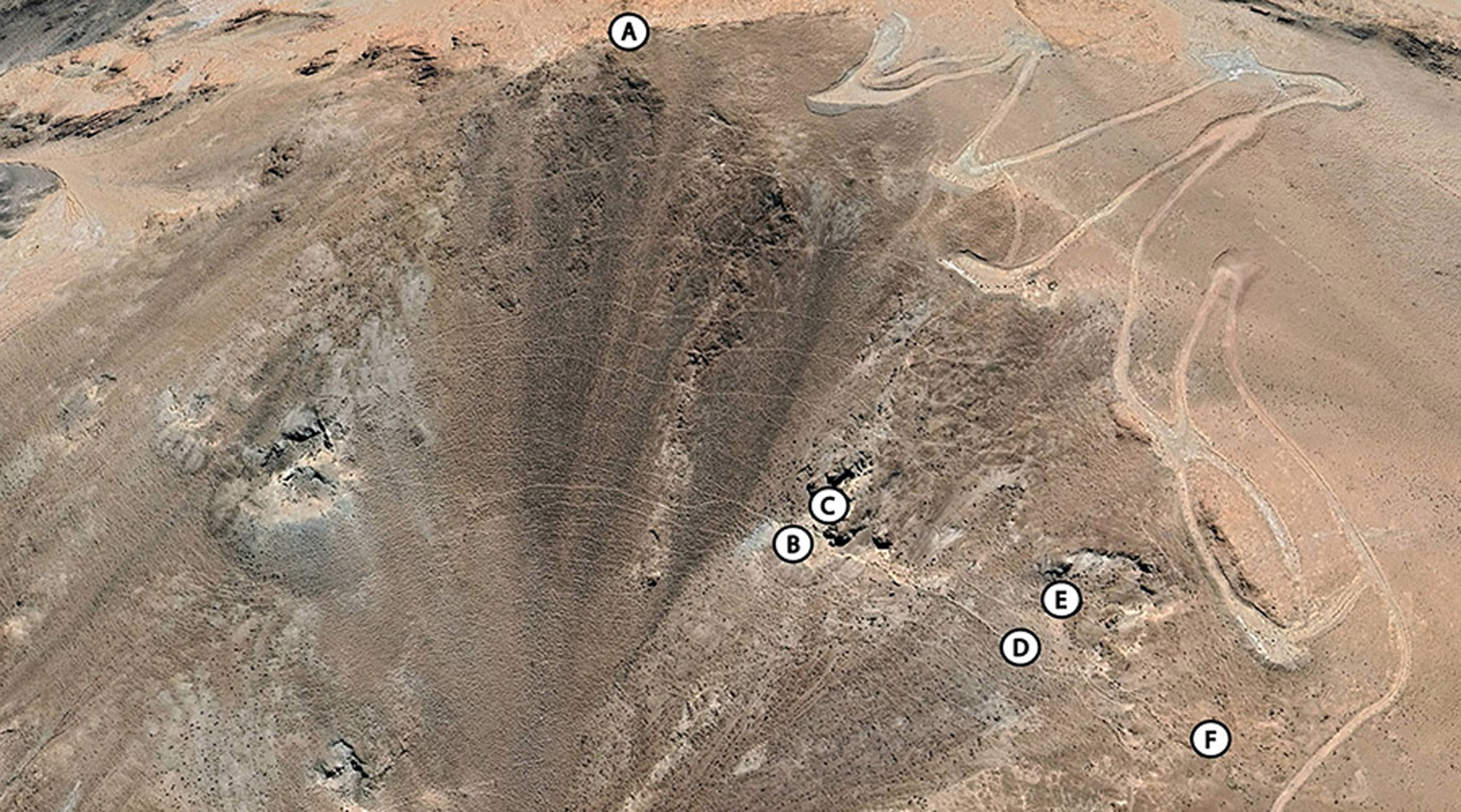
Mount Inca Viejo is located in the Ratones basin, in the Puna of Salta, north-western Argentina, reaching a maximum height of 4420m above sea level (m asl) (Figure 2). It rises around 700m above the surface level of the Ratones salt flat. The archaeological record at Mount Inca Viejo largely reflects mining-ritual practices (López et al. Reference López, Coloca, Rosenbusch and Solá2018; Coloca & López Reference Coloca and López2021). Although the record spans pre-Inca and Inca periods (between c. AD 700 and 1500), the Empire’s appropriation and modification of the mountain highlights a period of economic and ceremonial significance during the latter half of the fifteenth century and the early sixteenth century (López et al. Reference López, Coloca, Orsi, Araya, Seguí, Rosenbusch and Solá2020). This importance stemmed from the mountain’s mining potential, especially as a source of turquoise and other copper minerals. Various indicators of pre-Hispanic mining are recognised, such as wells and galleries associated with built structures, lithic hammers and anvils (Figure 2; Coloca & López Reference Coloca and López2023). At the summit sits a quadrangular structure (6.2 × 6.2m) of carved rocks and double-row walls (Figure 2A); similar architecture is observed elsewhere on the mountain (Figure 2E & F). Additionally, Inca roads were recorded (Figure 2D), including a main one that ran from north to south on the eastern slope of the mountain.
Inca-era archaeological features on Mount Inca Viejo (figure by authors).

On the western slope, at 4312m asl, is Cueva Inca Viejo, a pre-Hispanic cave mine that has a main chamber (Figure 2C) and secondary galleries opened for the exploitation of minerals (López et al. Reference López, Coloca, Orsi, Araya, Seguí, Rosenbusch and Solá2020). Inside, an archaeological assemblage related to mining and ritual activities was recorded (see below), along with wall paintings including motifs of llama caravans, anthropomorphic figures and other figurative and geometric representations. On the slope at the entrance to the cave, an ushnu-type ceremonial structure with a platform and staircase was completely covered by sediments and rocks until its rediscovery in 2017 (Figure 2B; López et al. Reference López, Coloca, Orsi, Araya, Seguí, Rosenbusch and Solá2020). Within this structure, three monoliths were found, two whole and one fragmented, that are reminiscent of standing stones recorded in other Inca ceremonial contexts (Coloca & López Reference Coloca and López2021). The cave and its surroundings have previously been interpreted as a waka mine (e.g. López et al. Reference López, Coloca, Rosenbusch and Solá2018); here, this interpretation is explored further, concurrently with the assessment of Mount Inca Viejo as a sacred mountain, particularly during the Inca Period.
Further east on the mountain is the Abra de Minas site (4250m asl), a settlement with 92 structures. Inca architecture is observable in the compound perimeter enclosures (kanchas), a rectangular ‘great hall’ (Kallanca) and a quadrangular platform that would correspond to an ushnu (López et al. Reference López, Coloca, Orsi, Araya, Seguí, Rosenbusch and Solá2020; Coloca & López Reference Coloca and López2021). This settlement may have functioned as both an enclave to control the mining of Inca Viejo and as a residence for miners (López et al. Reference López, Coloca, Orsi, Araya, Seguí, Rosenbusch and Solá2020).
Sacred mountains in north-western Argentina
In pre-Hispanic times, particularly during the Inca period, many Andean mountains were held as sacred, which is why they were often referred to as high-altitude sanctuaries. Atop these mountains, shrines are characterised by the remnants of rituals or ceremonies, including the capacocha (Beorchia Nigris Reference Beorchia Nigris1985; Schobinger Reference Schobinger1999; Reinhard Reference Reinhard2006; Ceruti Reference Ceruti2007; Cruz et al. Reference Cruz, Crubézy and Gérard2013; Vitry 2023). Yet the sacredness of a mountain was not solely related to its height, other features, such as the presence of minerals of symbolic value, water flows, morphology and location, also played a part (Cruz Reference Cruz2009; Platt & Quisbert Reference Platt and Quisbert2010).
Although variability is recognised in the composition of sacred mountain sites, certain recurring features can be identified, such as ceremonial structures or platforms, monoliths, animal and plant remains (e.g. Spondylus sp. shells, bird feathers and firewood), minerals, anthropomorphic and zoomorphic figurines, and human or animal sacrifices (Beorchia Nigris Reference Beorchia Nigris1985; Reinhard & Ceruti Reference Reinhard and Ceruti2005; Vitry 2023). Such sites have also been interpreted as pilgrimage centres (e.g. Mignone Reference Mignone2017; Leibowicz et al. Reference Leibowicz, Moyano, Ferrari, Acuto and Jacob2018), yet whether they represent a destination for pilgrims or a stage for ceremonies, the activities performed at these mountain-top sites were related to the cult of the mountains.
The Inca domination of the mountains in the central-southern Andes involved a high level of organisation, reflected in the shared archaeological attributes of high-altitude sites. In addition to ritual indicators (platforms, monoliths, sacrifices, etc.), Inca domination can also be defined through the presence of kanchas—located at the foot or on the slopes of mountains—ceramics, stone working, textiles, metallurgy, mining and associated roads and accessory constructions, particularly on the summits (Raffino Reference Raffino1981).
In contrast to earlier periods, the Incas invested a considerable amount of labour in creating this high-altitude landscape, marking the materialisation of Inca control over the mountains (Vitry Reference Vitry, Terra and Andrade2008, 2023). It has been proposed that several Andean mountains were integrated into a spatial and religious formation delineated by ceques, imaginary lines that connected different sectors of the Empire, with the heart of Tawantinsuyu in Cusco, Peru, serving as the main reference point (Rowe Reference Rowe1981; Bauer Reference Bauer1998; Zuidema Reference Zuidema2010; McEwan Reference McEwan, Meddens, Willis, McEwan and Branch2014; D’Altroy Reference D’Altroy2015). Within this framework, a recurrence of sacred mountains has been observed, with high-altitude archaeological traces predominantly found in the southern regions of the Empire, particularly in what was known as Collasuyu. Most of the more than 200 currently identified Inca mountain sites (96%) are in north-western Argentina, northern Chile and southern Peru (Vitry 2023).
In the Argentine Northwest, where this research is focused, certain attributes of sacred mountains vary, including the presence or absence of human burials, which are generally associated with the capacocha ritual (Reinhard & Ceruti Reference Reinhard and Ceruti2005). As a result, sacred mountains and their significance within the Inca worldview have been classified hierarchically based on archaeological findings. For example, Antonio Beorchia Nigris’s 1985 book, El enigma de los santuarios indígenas de alta montaña, considered a key reference for the archaeology of high-altitude Andean sites due to its systematic compilation of available information, distinguishes between first-, second- and third-order mountains. In this classification, first-order mountains may contain sacrifices, figurines and ceremonial platforms, among other evidence, while second- and third-order mountains display less diversity and a reduced richness of elements deemed relevant to the Incas. Within our study region, five mountains can be classified as first-order. These are mountains located towards different cardinal points of Inca Viejo (Figure 3). To the north are Quevar (6130m asl), Acay (5950m asl) and Chañi (5896m asl); to the south Galán (5912m asl); and to the west Llullaillaco (6739m asl) (Beorchia Nigris Reference Beorchia Nigris1985; Reinhard & Ceruti Reference Reinhard and Ceruti2005, Reference Reinhard and Ceruti2010). Other sacred mountains of the second- or third-orders are also recognised to the east (Meléndez: 6020m asl), to the south (Ratones: 5252m asl; Archibarca: 5629m asl; Tebenquicho: 5830m asl; and Antofalla 6100m asl) and to the west (Aracar: 6095m asl; Arizaro 5764m asl; Macón: 5611m asl; and Socompa: 6180m asl) (Beorchia Nigris Reference Beorchia Nigris1985; Ceruti Reference Ceruti2003, Reference Ceruti2007; Leibowicz et al. Reference Leibowicz, Moyano, Ferrari, Acuto and Jacob2018; Vitry 2023).
The locations of sacred mountains mentioned in the text (figure by authors).

Regional comparison of archaeological evidence from sacred mountains
A summary of comparative evidence, including archaeological elements or indicators highlighted in previous sections, for Mount Inca Viejo and various sacred mountains from the Inca period is presented in Table 1. This includes references to the presence of ceremonial platforms or structures, monoliths, evidence of animal and/or plant remains, textiles, anthropomorphic and zoomorphic figurines, human sacrifices, kanchas, ceramics, associated mining records and Inca roads (Raffino Reference Raffino1981; Beorchia Nigris Reference Beorchia Nigris1985). Due to their importance in ceremonial contexts, the animal evidence is further separated to consider the presence of feathers and shell fragments from Spondylus, a marine bivalve of high symbolic value for the Incas that originates from the Pacific coast of Ecuador (Reinhard Reference Reinhard2006), nearly 3000km from the study region.
Comparison between the archaeological indicators of Inca Viejo and different sacred mountains in the region. Features that are present on each mountain are indicated by an x.

* Located in Abra de Minas (near Inca Viejo). ** Only a human tibia was found on the summit.
All the mountains analysed in the study region have ceremonial structures (Beorchia Nigris Reference Beorchia Nigris1985), some of which may be considered ushnus (Reinhard & Ceruti Reference Reinhard and Ceruti2005; McEwan Reference McEwan, Meddens, Willis, McEwan and Branch2014). In the cases of Quevar and Inca Viejo, these structures feature stairs or ramps (Figure 4). At Quevar, the access ramp to the platform, flanked by walls, may have originally included steps; however, it has deteriorated considerably (Reinhard & Ceruti Reference Reinhard and Ceruti2005; Ceruti Reference Ceruti2007). The ceremonial structure at Inca Viejo, located on the entrance slope to the main chamber of the cave mine, boasts a staircase of 19 steps, delineated on both sides by double-row walls (López et al. Reference López, Coloca, Rosenbusch and Solá2018, Reference López, Coloca, Orsi, Araya, Seguí, Rosenbusch and Solá2020). This staircase shares construction characteristics similar to those recorded at the large Inca settlement of El Shincal, situated more than 200km south of Mount Inca Viejo in the valleys of Catamarca, Argentina (Raffino Reference Raffino1981; Giovannetti Reference Giovannetti2015).
Comparison between the ceremonial platforms of Inca Viejo (A) and Quevar (B) (figure by authors).

Inca Viejo and Quevar are also linked by the presence of monoliths, which hold considerable importance within the Inca worldview. These monoliths are associated with the representation of notable deities or ancestors in the context of offering and libation ceremonies conducted at ushnus (McEwan Reference McEwan, Meddens, Willis, McEwan and Branch2014; Meddens Reference Meddens, Meddens, Willis, McEwan and Branch2014). Various chroniclers mentioned the existence of these monoliths at the main ushnu in Cusco, the heart of the Inca Empire (Cobo Reference Cobo1956 [1653]; Pizarro Reference Pizarro1968 [1571]; de Acosta Reference De Acosta2008 [1590]). Generally, the stones are elongated and/or conical in shape with multiple smooth surfaces though they did not require a significant investment of labour (Figure 5A).
Archaeological evidence associated with Inca rituality at Inca Viejo and surrounding areas (figure by authors).

Monoliths have also been found on other sacred mountains in the region: Meléndez, Antofalla and possibly Galán (Beorchia Nigris Reference Beorchia Nigris1985; Leibowicz et al. Reference Leibowicz, Moyano, Ferrari, Acuto and Jacob2018). In more distant areas, they have been recorded on mountains such as Mercedario, Ascotán, Azufre, Tambillo and Misti (Beorchia Nigris Reference Beorchia Nigris1985). The recurrent presence of monoliths in sacred Andean mountains and their association with ceremonial structures or ushnus reflect their central role in Inca ritual practices (McEwan Reference McEwan, Meddens, Willis, McEwan and Branch2014; Meddens Reference Meddens, Meddens, Willis, McEwan and Branch2014).
Animal and plant remains are identified at almost all the sacred mountains in the study region (Table 1). Firewood is frequently found on or in the vicinity of the summit, while animal bones, particularly from camelids, have also been found at several sites and recorded offerings include the remains of various plant species, such as coca and corn. At Inca Viejo, corn (Zea mays), carob (Prosopis sp.), chañar (Geoffroea sp. decorticans/spinosa) and cebil (Anadenanthera colubrina) were recovered from inside the cave (López et al. Reference López, Coloca, Orsi, Araya, Seguí, Rosenbusch and Solá2020). Textiles of both plant and animal origin (e.g. twines, ropes) have also been identified at Inca Viejo (Seguí et al. Reference Seguí, Araya and Rucci2021), as has a Spondylus sp. bead (Figure 5B), which was recovered from an offering inside the cave. Spondylus shell has been identified at Quevar, Galán and Llullaillaco, first-order sacred mountains (Beorchia Nigris Reference Beorchia Nigris1985).
The role of feathers in the personal ornamentation of the Inca elites and as offerings in the form of mantles are described by Spanish chroniclers (e.g. Cobo Reference Cobo1956 [1653]; Pizarro Reference Pizarro1968 [1571]). Nearly 2000 feathers from both distant (eastern jungles) and local bird species were recovered from within Cueva Inca Viejo (Figure 5C). The jungle species include parrots and macaws (Psittaciformes), while local species include flamingos (Phoenicopteriformes), raptors (Falconiformes) and ducks (Anseriformes) found in the salt flats of the Puna. The feathers were recorded as offering mantles at the entrances to the secondary mining galleries, although many may have also been part of ornaments or headdresses, given the presence of ties made of vegetal and/or animal material (Seguí et al. Reference Seguí, Araya and Rucci2021). On Quevar, Chañi, Galán and Llullaillaco, feathers were used to ornament anthropomorphic figurines or chuspas (bags) (e.g. Reinhard & Ceruti Reference Reinhard and Ceruti2005, Reference Reinhard and Ceruti2010). Although no figurines were found at Inca Viejo, their presence cannot yet be ruled out as excavations are ongoing.
Discoveries of human remains at mountain summits generate considerable interest and it has been suggested that the Incas conducted human sacrifices as part of the capacocha rituals (Beorchia Nigris Reference Beorchia Nigris1985; Reinhard & Ceruti Reference Reinhard and Ceruti2010; Bachraty & Nautré Reference Bachraty and Nautré2023; Vitry 2023). To date, the discovery of human burials is rare among the sacred mountains of the Incas (Vitry 2023); in the mountains examined in this study, such burials have been recorded only on Quevar, Llullaillaco, Chañi and Acay (the latter containing just a human tibia). Yet, it is possible that there are burials at other sites that have not yet been found, so further excavations are required. In this context, the braids of human hair found at Cueva Inca Viejo (Figure 5D) are particularly pertinent, as these materials are typically associated with funerary contexts at other Puna sites (López Campeny Reference López Campeny2006/2007).
The presence of typical Inca architectural elements, such as kanchas, as well as ceramics featuring distinctive shapes and decorations, is not clearly recurrent across the analysed mountains (Raffino Reference Raffino1981). Nevertheless, these indicators are demonstrative and cannot be overlooked in this analysis, as they are crucial for characterising Inca occupations. The kanchas on Inca Viejo are located in the Abra de Minas enclave, a site where Inca ceramics, including globular vessels and plates with ornithomorphic handles, are particularly abundant (Figure 5E). Similar ceramics are found at first-order mountain sites such as Quevar, Llullaillaco and Chañi, where complete vessels associated with human sacrifices are also recorded (Reinhard & Ceruti Reference Reinhard and Ceruti2010).
Finally, several of the sacred mountains in the study region have been linked to mining and Inca roads. This relationship is seen at Quevar, Acay, Chañi and Meléndez (Raffino Reference Raffino1981; Beorchia Nigris Reference Beorchia Nigris1985; Leibowicz et al. Reference Leibowicz, Moyano, Ferrari, Acuto and Jacob2018), while either mining or Inca roads are observed independently at other mountains. In the case of Inca Viejo, mining is central to the analysis of the economic/symbolic role of this mountain for the Incas, particularly regarding the exploitation of turquoise, one of the most valuable minerals for the Empire’s elites (López et al. Reference López, Coloca, Rosenbusch and Solá2018). Various access roads lead to the main mine and an Inca road runs along the eastern slope in a north-south direction (Raffino Reference Raffino1981).
Discussion
Comparison of sacred mountains in the study region indicates recurring archaeological elements from the Inca period, many of which are also found at Inca Viejo (Table 1), allowing us to recognise it as a significant sacred mountain within the Inca worldview. In this regard, it shares several characteristics with high-altitude first-order Inca sites (Beorchia Nigris Reference Beorchia Nigris1985), notably with Quevar, one of the primary sacred mountains in the region. Both mountains, for instance, feature ushnus with stairs or ramps and monoliths that represent deities or ancestors (Reinhard & Ceruti Reference Reinhard and Ceruti2005; López et al. Reference López, Coloca, Rosenbusch and Solá2018, Reference López, Coloca, Orsi, Araya, Seguí, Rosenbusch and Solá2020).
These and other shared attributes between Inca Viejo and Quevar may relate to contemporary Inca occupations that expanded their worldview in the region; from the summit of Inca Viejo, Quevar can be seen to the north, approximately 100km away (Figure 6). This visual relationship extends to other sacred mountains mentioned here, such as Galán, Antofalla, Tebenquicho and Ratones (Figure 6). The proximity of Ratones to Inca Viejo (15km south-west) and the orientation of the ushnu on Inca Viejo towards this prominent peak (5252m asl) suggest a potential connection that warrants further investigation. To the east of Inca Viejo rises Mount Luracatao (5903m asl), which may also have been considered sacred by the Incas, although this peak has yet to be explored through systematic archaeological investigation.
Views of the sacred mountains of the region from the summit of Mount Inca Viejo. Towards the east, only Mount Luracatao can be seen, which has no archaeological evidence of Inca rituality so far (figure by authors).

While many of the compared indicators highlight the significance of Inca Viejo for the Inca Empire, seeking to define it as a first-, second- or third-order mountain site is arguably redundant. These sites and mountains likely fulfilled different roles within the Inca worldview. Mount Inca Viejo was particularly associated with mining rituals, while other mountains feature sacred sites at or near their summits, some linked to the capacocha rituals (e.g. Quevar, Llullaillaco and Chañi). It is important to recognise that these ritual practices should not be viewed as mutually exclusive; many Andean mountains with ceremonial evidence at their summits, including that related to capacocha, also bear mineral or mining associations (Cruz et al. Reference Cruz, Crubézy and Gérard2013; Bachraty & Nautré Reference Bachraty and Nautré2023).
In the south-central Andes, a strong connection between mining and the sacralisation of mountains is often observed (Bouysse-Cassagne Reference Bouysse-Cassagne2005; Platt et al. Reference Platt, Bouysse-Cassagne and Harris2006; Cruz et al. Reference Cruz, Crubézy and Gérard2013). Moreover, mining has been identified as a key factor in understanding the motivations behind Inca expansion in the Argentine Northwest (González Reference González1980; Raffino Reference Raffino1981). Consequently, the archaeological evidence collected from Mount Inca Viejo permits a greater understanding of symbolic-ritual aspects of the economic framework that could have motivated the arrival of the Incas within the region. Specifically, the waka of Inca Viejo constitutes an important case study for addressing the role of mining in the sacralisation of the south-central Andean mountains by the Inca Empire.
Conclusion
Numerous mountains in the central-southern Andes were sacred to the Incas, but the roles of these mountains were diverse, reflecting the broad ritual, economic and political spectra of the Inca worldview. It is, therefore, more appropriate to refer to them as ‘sacralised mountains’, rather than using terms like ‘high-altitude sanctuaries’, which may be more restrictive or less encompassing of the variability in practices developed. Comparative analysis of sacralised mountains in north-western Argentina highlights both the archaeological diversity of the sites and, consequently, the multiplicity of ways in which the symbolic and ritual dominance of the Inca Empire was materialised, as well as the recurrence of certain practices and elements. Consideration of archaeological material from Mount Inca Viejo within this context allows us to recognise its status as a sacralised mountain and, in turn, elucidates the Incas’ symbolic and direct control over mining resources as part of their strategies for domination, both regionally and across the broader Andes.
Acknowledgements
We acknowledge the support of the Consejo Nacional de Investigaciones Científicas y Técnicas (CONICET) and the Institute of Archaeology of the University of Buenos Aires (UBA).
Funding statement
This work was funded by CONICET (PIP 11220210100135CO) and UBA (UBACyT 20020220400121BA).



