


Asian Indian adults express differentiated body fat (BF) patterns(Reference Raji, Seely and Arky1). This observation is supported by several studies showing that Asian Indian adults have higher BF-for-BMI than Caucasians(Reference Banerji, Faridi and Atluri2–Reference Wang, Thornton and Russell4). As most of the available biomedical literature about ethnic health disparities refers to Caucasians as the standard, we lack comparative data about non-Caucasian ethnic groups. Potential differences can thus only be hypothesised by crossing data comparing each non-Caucasian group with Caucasians.
Guadeloupe is mainly inhabited by two ethnic groups. Africa-originating Guadeloupians, the majority group, are descended from the African slaves who were brought to this former French colony to work on sugar cane plantations more than two centuries ago. Asian Indians are the biggest minority on the island and are descended from the migrants who came to replace the slaves, who refused to continue working for the colonists when slavery was abolished.
As previously reported elsewhere in the world(Reference Knight, Smith and Whittles5–Reference McKeigue, Shah and Marmot8), Asian Indians are particularly prone to type 2 diabetes in Guadeloupe(Reference Costagliola, Delaunay and Moutet9), with a disease prevalence that exceeds three times the overall prevalence on the island. The specificities of Asian Indian anthropometry led the WHO(10, Reference Choo11) to decrease the BMI cut-offs for defining obesity in this population. Asian Indians have a tendency to centralise BF stores(Reference Knight, Smith and Whittles5–Reference Ramachandran, Snehalatha and Viswanathan7) especially in the visceral compartment(Reference Bjorntorp12), what is widely documented to increase the risk of incidence of insulin resistance and type 2 diabetes. It therefore seems reasonable to hypothesise differentiated BF patterning in Asian Indian Guadeloupians and the rest of the island population. But, to our knowledge, no study to date has sought to compare the anthropometry of Asian Indian descendants and African descendants, at least in Guadeloupe and the Caribbean region. We only know that Asian Indians are fatter and have higher BF-for-BMI than Caucasians(Reference Banerji, Faridi and Atluri2–Reference Wang, Thornton and Russell4) and that black Americans, despite higher BMI, have an undifferentiated relationship between BF and BMI compared with Caucasians(Reference Gallagher, Visser and Sepulveda13).
Moreover, although evidence of the anthropometric specificities in Asian Indians is growing, such data are lacking for adolescents. Nevertheless, the Bogalusa Heart Study(Reference Freedman, Khan and Dietz14) reported that 25 % of obese adults were obese as children, and several studies(Reference Serdula, Ivery and Coates15) have documented that obesity in adolescence predisposes to obesity in adulthood. We previously(Reference Sinnapah, Antoine-Jonville and Hue16) evidenced a tendency of Asian Indian adolescents to have lower daily levels of physical activity than their island counterparts, which would predispose them to BF excess. We thus sought to determine the anthropometric profile of Asian Indian adolescents from Guadeloupe and compare it with that of their island counterparts; we expected to find differentiated BF patterning, including higher BF and a tendency toward a relative excess of central fat in Asian Indians.
Methods
Sample
The data used in the present study were collected from September 2006 to January 2008. The study sample was obtained by randomised sampling of ten classes from five schools randomly selected from a complete list of the schools on the island. Any school declining to participate (n 1) was replaced by another randomly selected school. An informational note was distributed to every student of the selected classes. Of the students, 78 % gave their informed consent to participate, for a total of 1498 adolescents. They were screened for Indian ethnicity and every Asian Indian student (n 180) was matched for age and sex with three students of other origin (controls; n 540). Ethnicity was defined as previously described(Reference Sinnapah, Antoine-Jonville and Hue16, Reference Sinnapah, Antoine-Jonville and Donnet17). Subjects were categorised according to their geographical origin, thus as Asian Indians when they defined themselves and both their parents as India-originating Guadeloupians without mixed origin. They were defined as controls when they defined neither themselves nor either of their parents as originating from India.
Anthropometric measurements
For all the anthropometric measurements, subjects were lightly clothed and had to remove all jewellery, hair clips, shoes and metal objects. Height (m) and weight (kg) were measured to the nearest cm and 100 g, respectively, and were used to calculate the BMI as the ratio between the weight and the squared height. The obesity status was defined according to the International Obesity Task Force (IOTF) reference(Reference Cole, Bellizzi and Flegal18). Standing waist circumference (WC) and hip circumference (HC) were measured as the smallest circumference between the lower rib margin and the iliac crest and the maximum circumference over the buttocks, respectively. The waist:hip ratio (WHR) was calculated as the ratio between WC and HC.
Bicipital, tricipital, subscapular and supra-iliac skinfold thicknesses were measured twice and averaged on the left side of the body to the nearest mm using a Harpenden skinfold calliper. The sum of these four skinfold thicknesses (S4ST) was used as an indicator of subcutaneous fat. BF content (BF percentage; %BF) was estimated by bioelectrical impedance (BIA) (Tanita BC 418 MA; Tanita Corp., Arlington Heights, IL, USA). Each anthropometric measurement was performed by the same investigator to avoid inter-investigator variability. The Pearson's coefficients of determination estimating the intra-observer reliability were significant, with 0·97 for circumferences and 0·92, 0·95, 0·93 and 0·96 for bicipital, tricipital, subscapular and supra-iliac skinfolds, respectively (P < 0·05).
Statistical analysis
The study sample was divided into two subgroups: the < 14 years age group and the ≥ 14 years age group. We performed three-way ANOVA to test the hypothesis of an influence of sex, ethnicity and age class on the quantitative anthropometric parameters. When interactions were evidenced, post hoc Scheffé tests were conducted to locate the statistical differences. The effects of ethnicity and sex on height-adjusted weight were tested by two-way analyses of covariance. We also studied the effect of ethnicity on %BF adjusted on weight, BMI, S4ST and WC successively, with two-way analyses of covariance including sex and ethnicity as independent variables. The goal of this approach was to determine whether the adjustment of whole BF on subcutaneous and truncal fat cancelled the potential effect of ethnicity. A forward stepwise multiple regression was performed to study the relationship between %BF and WC, BMI, S4ST, ethnicity, age and sex, with inclusion and exclusion P set at 0·05. We retained an α risk – that is, the risk to erroneously reject the null hypothesis of an effect of one variable on another – of 0·05 throughout the study.
As the BMI threshold for appropriately screening the cardiovascular risk in Asian adults is lower than that commonly used in Caucasians, we tested the hypothesis of a higher cardiovascular risk in Asian Indians from a population of non-obese adolescents. Successive univariate two-way ANOVA were performed, with ethnicity and sex as the independent variables and %BF, WC, WHR and S4ST as the dependent variables.
Results
The first- and second-order effects of sex, ethnicity and age class on the anthropometric parameters are presented in Table 1. No third-order effect was evidenced. The main results of the study concerning the effect of ethnicity are summarised in Fig. 1.
(Mean values and standard deviations)

WC, waist circumference; HC, hip circumference; WHR, waist:hip ratio; S4ST, sum of four skinfold thicknesses (bicipital, tricipital, subscapular and supra-iliac).
* Significant age class effect (P < 0·05; ANOVA).
† Significant sex effect (P < 0·05; ANOVA).
‡ Significant ethnicity effect (P < 0·05; ANOVA).
*/† Significant age class–sex interaction effect (P < 0·05; ANOVA).
*/‡ Significant age class–ethnicity interaction effect (P < 0·05; ANOVA).
†/‡ Significant sex–ethnicity interaction effect (P < 0·05; ANOVA).
Main results of the study of the effect of ethnicity on the anthropometric profile of 720 Guadeloupian adolescents. (a) BMI. Values are means, with standard deviations represented by vertical bars. (b) Percentage body fat (%BF). Values are means, with standard deviations represented by vertical bars. ‡ Mean value was significantly different from that of the controls (P < 0·05). (c) Sum of the four skinfold thicknesses (bicipital, tricipital, subscapular and supra-iliac; S4ST). Values are means, with standard deviations represented by vertical bars. ‡ Mean value was significantly different from that of the male controls (P < 0·05). It should be observed that although BMI was not different between ethnicities, the %BF was higher in Asian Indians, including when %BF was adjusted on weight or BMI. This higher %BF was associated with higher subcutaneous fat estimated by S4ST only in males.

The present study comprised 51·67 % girls and 48·33 % boys. The mean age was 13·4 (sd 1·4) years. The youngest subjects were aged 11 years and the oldest were aged 17 years. Stature and body mass were influenced by age (P < 0·001 for both) and ethnicity (P < 0·001 and P < 0·05, respectively). Asian Indians were smaller and lighter (P < 0·001 for both). Sex had a significant effect on these variables only in the ≥ 14 years age group (P < 0·001 and P < 0·01, respectively). Height-adjusted weight did not statistically differ with ethnicity (P = 0·925), sex (P = 0·084) or age class (P = 0·164). BMI was higher in the ≥ 14 years age group than in the younger subjects (P < 0·001). The sex and ethnic differences in this index were not statistically significant (P = 0·427 and P = 0·415, respectively).
Waist and hip circumferences and waist:hip ratio
WC and HC were influenced by age class (P < 0·01 for both), with higher values in the ≥ 14 years age group. A significant (P < 0·05) sex × ethnicity interaction revealed the modulation of the sex effect (P < 0·01) by ethnicity. Post hoc analyses indicated that females had smaller WC only in the Asian Indian group (P < 0·001) and they had greater HC only in the control group (P < 0·001). WHR was lower in the ≥ 14 years age group (P < 0·05) and in females (P < 0·001). A sex × ethnicity interaction effect was found (P < 0·01), ethnicity being associated with WHR only in males with higher WHR among the Asian Indians (P < 0·01).
Sum of the four skinfold thicknesses
S4ST did not differ significantly by age class (P = 0·366). A sex × ethnicity interaction effect was noted (P < 0·05) and the post hoc Scheffé analysis identified a sex difference only in controls (P < 0·001), with control males having lower S4ST than females. Ethnicity influenced S4ST only in males (P < 0·01), with lower values in controls.
Body fat content
The %BF estimated by bioimpedance analysis was higher in Asian Indians than in controls (P < 0·001), with 22·9 (sd 6·7) v. 21·1 (sd 6·2) %. Females were fatter than males (P < 0·001), with 25·3 (sd 5·0) v. 18·6 (sd 5·5) %. The effect of sex (P < 0·001) was modulated by age (P < 0·01): %BF did not differ in females between age classes (P = 0·392), whereas %BF in males was 2 units lower in the ≥ 14 years age group (P < 0·05). The two-way analysis of covariance showed that %BF estimated by BIA was influenced by sex and ethnicity even after adjustment on weight and BMI separately (P < 0·001 for all), with higher values in Asian Indians. The effects of these two independent variables on WC-adjusted BIA-estimated %BF were also significant (P < 0·001 for both). The adjustment of %BF estimated by BIA on subcutaneous fat, for which S4ST was considered to be an indicator, increased the α risk to P = 0·211 for the principal effect of ethnicity, while sex remained a significant factor (P < 0·001). No sex × ethnicity interaction was revealed by the analyses of covariance.
International Obesity Task Force status
The prevalence of obesity defined according to the IOTF standard did not significantly differ with sex (P = 0·747), ethnicity (P = 0·925) or age class (P = 0·575), with an overall obesity prevalence of 5·69 (95 CI % 5·67, 5·71) %. OR were 0·96 (95 % CI 0·46, 1·99) for Asian Indians and 0·90 (95 % CI 0·47, 1·70) for males.
Non-obese adolescents
The two-way ANOVA for the adolescents who were not obese (n 679) showed (Table 2) that females had higher S4ST and %BF (P < 0·001 for all) and Asian Indians had higher S4ST and %BF (P < 0·01 for both). A sex × ethnicity interaction effect on WC was observed. The post hoc analysis indicated that ethnicity modulated the effect of sex, with only Asian Indian males showing higher WC (P < 0·001). We initially conducted multiple regression analyses in each sex group to take the potential effect of this variable into account in the model of BF. As the relative weights of the predictors were comparable and the predictors retained through the stepwise forward analyses were the same, we chose to report the results of the regression analysis on the whole sample, with the two sexes being mixed. This analysis excluded WC (P = 0·350) from the regression model (r 2 0·81) with the following regression equation:

(Mean values and standard deviations)
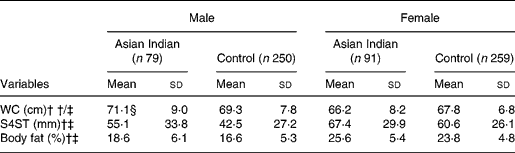
WC, waist circumference; S4ST, sum of four skinfold thicknesses.
† Significant sex effect (P < 0·05; ANOVA).
‡ Significant ethnicity effect (P < 0·05; ANOVA).
†/‡ Significant sex–ethnicity interaction effect (P < 0·05; ANOVA).
§ Mean value was significantly different from that of the Asian Indian females (P < 0·05; post hoc Scheffé analysis).
Asian Indians and males were coded as 1 and controls and females as 0. The calculation of standardised coefficients of regression showed that S4ST was the best predictor of %BF with βS4ST = 0·51 (95 % CI 0·45, 0·57), followed by sex with βsex = − 0·35 (95 % CI − 0·39, − 0·32), BMI with βBMI = 0·30 (95 % CI 0·24, 0·35), age with βage = − 0·11 (95 % − 0·15, − 0·08) and ethnicity with βethnicity = − 0·06 (95 % CI − 0·09, − 0·02) (P < 0·01 for all).
Discussion
The main findings of the present study were that Guadeloupian Asian Indian adolescents had higher %BF than controls, even after adjustment on weight or BMI, and that BMI showed no evidence of association with ethnicity. Together, these findings suggest that ethnicity might have had a differentiated influence on each of the anthropometric indicators.
Ethnicity
The concept of ethnicity is built on the crossing of genotype and culture. Its semantic boundaries are therefore hard to clearly define, and most authors, including ourselves, estimate it by indicators. We retained geographical origin as the indicator, so the subjects were considered as Asian Indians if they defined themselves and their four grandparents as originating from India. Loue has suggested that operationalising ethnicity in this manner ‘fails to encompass, explain or define the complexities and nuances that underlie’ ethnicity(Reference Loue19). We therefore suggest that what we assessed and called ethnicity in fact represents only one of the plural dimensions that theoretically define ethnicity and thus does not include the acquired parameters that would complete the definition. The ethnicity that we assessed is therefore innate as it is given from birth and, in this sense, it cannot be influenced by any environmental variable that it exists before, by definition. Although we acknowledge that the adolescents self-reported this variable, which may thus, theoretically at least, be subject to some self-reporting bias, it seems implausible that they would have changed their geographical origins to another between Europe, Africa and India due to environmental factors. Consequently, given that we assessed principally the innate dimension of ethnicity, we assume that the associations observed between this parameter and the others in the present study can only reflect a factorial relationship, as there are only three possible origins for a statistical association between a parameter A and a parameter B: A might be a factor or a cofactor of B, B might be a factor or a cofactor of A and, finally, A and B might be markers of each other as they might be influenced by the same factor C.
We hypothesise that the partially acquired anthropometric characteristics, which were shown to be associated with ethnicity, were very unlikely to influence ethnicity, as geographical origin is an innate parameter that cannot be influenced by parameters that do not pre-exist it. The exception would be an environmental factor that influences the future anthropometry of offspring and directly or indirectly leads mothers to migrate or not at some point between conception and birth. Only in this type of case would ethnicity, defined by geographical origin, be only a marker of anthropometry and not a factor or at least a cofactor.
Consequently, and subject to the validity of our starting assumptions, we consider that the statistical associations observed in the present study necessarily imply that ethnicity based on geographical origin directly or indirectly influences the anthropometric variables it is associated with. The ultimate question is: how does geographical origin influence human anthropometry?
Population
In France, 95 to 99 % of the 11- to 18-year-old population attends school. We therefore randomly sampled the schools of Guadeloupe and assumed that participating subjects would be representative of the entire 11- to 17-year-old population on the island. However, in agreement with the Declaration of Helsinki, we only recruited voluntary students. Of the adolescents, 78 % agreed to participate, which we found satisfactory, and 22 % declined. Although the self-exclusion of 22 % of the targeted population may have biased the estimations produced in the present study, we had no reason to think that the determinants of these self-exclusions were covariates of ethnicity. We thus assumed that this potential sampling bias affected the two ethnic groups to the same extent. The absolute values reported in the present study should be carefully interpreted, however, particularly regarding any extrapolation to the entire 11- to 17-year-old island population.
Body mass and stature
Asian Indians are known to be born ‘thin-fat’, with low birth weights(Reference Yajnik, Fall and Coyaji20), but few studies have dealt with the anthropometric specificities of Asian Indian children and adolescents, whether living in India or elsewhere. In one study(Reference Prakash and Pathmanathan21), Asian Indian adolescents were reported to have shorter stature than Caucasian adolescents. Given the substantial impact of environmental factors on human growth, it is difficult to draw conclusions from such studies, but it should be noted that the stature difference reported by Prakash & Pathmanathan(Reference Prakash and Pathmanathan21) between Asian Indian and British adolescents was observed only after 12 years in females and 14 years in males. In the present study, the effect of ethnicity on stature persisted from the first age class to the second and was thus not modulated by age. This finding suggests that this differentiated height begins before adolescence and perhaps from a very early age, as several studies have reported lower birth weights and heights in Asian Indians. A cross-sectional study of height in Guadeloupians, taking ethnicity into account from birth to young adulthood, would probably be useful. Asian Indian adolescents have also been shown to have lower weight, which is consistent with the lower height. It should be noted that the adjustment of weight on height cancelled the effect of ethnicity on this parameter.
BMI, fat mass and obesity
Although a certain number of anthropometric specificities in Asian Indian adults(10) and newborn infants(Reference Yajnik, Fall and Coyaji20) have been documented, little is known about adolescent BMI in this ethnic group. Although Asian Indian descendants are known to have lower BMI than Caucasians in adulthood, the comparison we performed does not support such a difference in adolescence between them and a mainly Africa-originating group, as the lower stature in the first was associated with lower body mass. However, the relationship between BMI and BF is known to be influenced by numerous factors, including ethnicity. Such an influence might explain the increased cardiovascular risk at a lower range of BMI scores observed in Asian Indian adults(Reference Vikram, Pandey and Misra22) and adolescents(Reference Vikram, Misra and Pandey23). Moreover, Asian Indian adults are documented to have higher BF-for-BMI than Caucasians in the USA(Reference Banerji, Faridi and Atluri2, Reference Chandalia, Abate and Garg3) although it seems that black and Caucasian American adults do not differ regarding this parameter(Reference Gallagher, Visser and Sepulveda13). Thus, although the ANOVA did not reveal an effect of ethnicity on BMI, it did not necessarily rule out the hypothesis of higher %BF in the Asian Indian adolescents compared with the mainly Africa-originating controls.
Indeed, the three-way analyses of covariance revealed that the Asian Indian Guadeloupian adolescents had higher BF-for-BMI than the controls. A potential limitation of this observation is that ethnicity has been documented(Reference Going, Nichols and Loftin24) to possibly modulate the relationship between body impedance and total body water (TBW), from which the %BF is calculated. Indeed, the equations initially published for Caucasians are not necessarily applicable to Asian Indian men and women(Reference Rush, Chandu and Plank25). The available data, however, indicate that the prediction equations published for Caucasians overestimate the TBW and fat-free mass of Asians(Reference Lee, Song and Kim26, Reference Borgonha, Petracchi and Ferro Luzzi27) while they underestimate them in blacks(Reference Zillikens and Conway28, Reference Sun, Chumlea and Heymsfield29). As a consequence and given the literature, although the absolute values of BF in the present study should be considered carefully, the potential overestimation of TBW in Asians may mechanistically lead to an underestimation of BF, while the potential underestimation of TBW in blacks may lead to an overestimation of BF. We can thus assume that the BF difference observed in the present study with a common equation might be underestimated. This would not decrease the validity of our comparison but, on the contrary, would decrease the α risk. Moreover, the present results were consistent with previous data reported in adults(Reference Banerji, Faridi and Atluri2, Reference Chandalia, Abate and Garg3), and we thus postulated that the bioimpedance differences reflected higher %BF in the Asian Indians.
This anthropometric characteristic suggests the hypothesis of an increased cardiovascular and metabolic risk, as the pathogenic impact of BF starts from an early age(Reference Goran, Ball and Cruz30) and the metabolic consequences of obesity are evident at lower absolute amounts of total BF in South Asians than in Caucasians(Reference Forouhi, Byrne and Wild31). Asian Indian adolescents may be predisposed to the metabolic syndrome or some of its features because of the two-units greater %BF.
Moreover, the prevalence of obesity as defined by the IOTF was not greater in the Asian Indian adolescents, despite higher %BF. This obviously indicates a difference in the relationship between BMI and %BF in the Asian Indians and the controls and raises questions about the appropriateness of using common BMI charts for these two ethnic groups: the two-way ANOVA revealed that even among non-obese adolescents, Asian Indians had higher subcutaneous and overall adiposity than controls. This finding in Asian adults led the WHO to lower the BMI threshold that defines adult obesity, and the results of the present study underline the need to determine appropriate growth curves for Asian Indian adolescents, as well.
Circumferences and skinfold thicknesses
BF distribution modulates the impact of BF excess(Reference Weiss32). Central adiposity impairs insulin metabolism because of its anatomic location(Reference Despres, Lemieux and Tchernof33) and the Asian Indian tendency toward this distribution is thought to contribute to their overexposure to insulin resistance and type 2 diabetes mellitus(Reference Abate and Chandalia34). It is thus interesting that the adjustment of %BF on S4ST, its main predictor according to the multiple regression analysis, cancelled the statistical effect of ethnicity. This raises questions about the role of subcutaneous fat in the relative excess of BF observed in Asian Indians. However, the interaction effect of sex and ethnicity on skinfold thicknesses makes interpreting the results quite complex, as the effect of ethnicity was clearly demonstrated only in males. Moreover, as greater skinfold thicknesses were evidenced only in female controls, it is possible that a differentiated timing in sexual maturation would explain the delay in sexual dimorphism, which is accentuated with puberty, in the Asian Indians of the present study(Reference Rolland-Cachera35, Reference Wells36). Nevertheless, not being able to conclude that two groups are different does not mean that the groups are similar. This refers to the β risk, which is the risk of erroneously accepting the null hypothesis of non-difference. The statistical analyses that we used were designed to evidence differences and not equalities. Although we did not evidence a sex difference in S4ST in the Asian Indians, we did not evidence sex equality, especially as the mean values of these parameters were higher in the females of our sample. It therefore can be hypothesised that a bigger sample size would have permitted greater statistical power, that is to say, a greater capacity of the analysis to provide evidence from a sample of a difference that exists in the whole population.
Conclusion
To our knowledge, the data on the adolescent descendants of Asian Indian migrants are very sparse, despite the high metabolic and cardiovascular risks in this ethnic group. The first major result of the present study was that Asian Indian adolescents from Guadeloupe had more BF than their island counterparts, confirming what has been observed elsewhere in adults. The hypothesis that these adolescents are more exposed to overweight-related diseases at short and longer term should thus be considered and an epidemiological study of the prevalence of these diseases in Guadeloupian adolescents is needed. The second major result of the present study was that the relationship between BMI and %BF was mediated by ethnicity, as previously reported in Asian Indian adults and other ethnic groups. If specific growth curves are needed in Guadeloupe, these curves should take ethnicity into account. Finally, the differences in the relationships between male and female anthropometry, expressed by the circumferences and skinfold thicknesses, suggest a differentiation in the sexual maturation of Asian Indians and their island counterparts. A longitudinal study of Guadeloupian adolescents over the course of pubertal development should improve our understanding of the ethnic-based anthropometric disparities observed in this period.
Acknowledgements
This research received no specific grant from any funding agency in the public, commercial or not-for-profit sectors.
S. S. designed the study, led the recruitment, made the measures and wrote the article. S. A.-J. participated in making the measures and in the process of writing. O. H. thoroughly reviewed and corrected the article.
There are no potential conflicts of interest.



