

Introduction
In 2019, 37 researchers from 16 countries collaboratively published the Eat-Lancet report (Willett et al., Reference Willett, Rockström, Loken, Springmann, Lang, Vermeulen, Garnett, Tilman, DeClerck, Wood, Jonell, Clark, Gordon, Fanzo, Hawkes, Zurayk, Rivera, De Vries, Majele Sibanda, Afshin, Chaudhary, Herrero, Agustina, Branca, Lartey, Fan, Crona, Fox, Bignet, Troell, Lindahl, Singh, Cornell, Srinath Reddy, Narain, Nishtar and Murray2019), which advocates for the global adoption of a predominantly plant-based diet, and significant reductions in consumption of animal products such as dairy, in order to reduce greenhouse gas emissions from methane, as well as to avoid severe environmental degradation (Steinfeld et al., Reference Steinfeld, Gerber, Wassenaar, Castel, Rosales and De haan2006; Scarborough et al., Reference Scarborough, Appleby, Mizdrak, Briggs, Travis, Bradbury and Key2014). The first advisory report from the UK's Committee on Climate Change in 2020 also echoes these recommendations, arguing that a shift away from meat and dairy consumption must be encouraged if the UK is to reach its net-zero greenhouse gas emission target by 2050 (Committee on Climate Change, 2020). One way to achieve this is the use of milk substitute products (i.e., plant-based milk), which have a lower environmental impact in terms of greenhouse gas emissions and land degradation than dairy milk (Clune et al., Reference Clune, Crossin and Verghese2017; Poore & Nemecek, Reference Poore and Nemecek2018).
Due to concerns over health, animal welfare and the climate emergency, it is now estimated that almost a quarter (23%) of the British public drink milk substitutes, with this proportion even higher in younger populations (Mintal, 2019). As the popularity of milk substitutes increases, little is known about the availability and labelling of such items in UK supermarkets. There is also considerable disagreement about how these products should be labelled and described. In the European Union (Court of Justice of the European Union, 2017) and the UK (Department for Environment: Food & Rural Affairs, 2013), existing regulation states that the term ‘milk’ can only be used on labelling to describe products that originate from animals. This means that combining words like ‘oat’ and ‘soya’ with ‘milk’ to describe plant-based products is not permitted. In contrast, in some other jurisdictions (e.g., Australia), terms such as ‘soya milk’ are permitted on labels. In the USA, the Food and Drug Administration (FDA) also allows milk substitute products to use the term ‘milk’; however, the dairy industry has petitioned the FDA and US Congress against this for several decades (Food and Drug Administration, 2018; Welch, Reference Welch2019).
Those who wish to prohibit the term ‘milk’ on milk substitute labelling argue that people have traditionally associated this term with animal products, and therefore – when used on plant-based products – it could mislead consumers about the products’ potential uses, ingredients, and/or nutritional value (Food and Drug Administration, 2018; Gleckel, Reference Gleckel2020). In contrast, opponents of such regulations insist that using the term ‘milk’ on product labels does not confuse consumers. They maintain that, on the contrary, these terms are necessary to prevent confusion by more precisely communicating the potential uses of products. Plant-based food companies argue that the animal agriculture sector attempts to hide the fact that these milk substitutes can be used for milk substitution (Gleckel, Reference Gleckel2020), while the dairy industry argues that the regulation of the term ‘milk’ on milk substitute labelling is needed to protect consumers (Welch, Reference Welch2019).
Research in this area is limited. However, a survey of 1,000 adults by the International Food Information Council in October 2018 found that the majority (~75%) of US adults understand which products contain animal-based ingredients and which do not when shopping for products that carry the label ‘milk’. In fact, fewer than 10% of respondents believed that coconut, soy, cashew and rice ‘milk’ contained animal-based ingredients (International Food Information Council Foundation, 2018). A small experimental study (Gleckel, Reference Gleckel2020) also showed that consumers were no more likely to think that plant-based products come from an animal if the product's name incorporates words traditionally associated with animal products (such as butter) than if it does not. However, although this study assessed dairy confusion regarding plant-based food labelling, it used butter substitutes and not milk substitutes.
We conducted an observational survey of the availability and labelling of milk substitutes in UK supermarkets, with a view to understanding how these products are displayed and marketed. We then conducted an experimental study to address the gap in literature in relation to the impact of using the word ‘milk’ on milk substitute labelling on consumers’ understanding of these products. The primary aims of this study were to assess whether adding the term ‘milk’ to milk substitute labels would (1) more accurately communicate the potential uses of milk substitutes to consumers or (2) confuse consumers about which products come from an animal source. A secondary aim was to assess whether adding the term ‘milk’ to milk substitute labelling would, as per the Eat-Lancet report (Willett et al., Reference Willett, Rockström, Loken, Springmann, Lang, Vermeulen, Garnett, Tilman, DeClerck, Wood, Jonell, Clark, Gordon, Fanzo, Hawkes, Zurayk, Rivera, De Vries, Majele Sibanda, Afshin, Chaudhary, Herrero, Agustina, Branca, Lartey, Fan, Crona, Fox, Bignet, Troell, Lindahl, Singh, Cornell, Srinath Reddy, Narain, Nishtar and Murray2019), increased intention to use these products.
Study 1 – observational study
Method
Study design
This study was an observational study of supermarket websites. The top four UK supermarket chains, representing approximately 65% of the total market share for supermarkets operating in the UK in 2022 (Statista, 2022), were included.
Study aims
The primary aim was to describe the absolute (the total number of products) and relative (the proportion compared to dairy milk) availability of milk substitutes in UK online supermarkets. The secondary aims were to describe (1) the labelling on the front of milk substitute packaging; (2) the supermarkets’ description of milk substitutes; (3) the location on the supermarket website where dairy milk and milk substitutes appear in the returned list of items when searching the term ‘milk’ and (4) the price of dairy milk and milk substitutes.
Outcome measures
The primary outcomes were absolute availability (the total number of products) and relative availability (the proportion compared to dairy milk) of milk substitutes. Secondary outcomes included labelling descriptions, descriptions given by supermarkets, the position (page number) and the price of products.
Procedure
A single researcher visited the online websites of the four supermarket chains in July 2021 without logging in to an existing account. Pre-defined terms were searched on each of the websites and relevant items were recorded (see Supplementary Methods). The availability of dairy milk and milk substitute was recorded, along with information about the product labelling (on the front of the product only), the supermarkets’ description of the product, the position (page number, the product was found on when the term ‘milk’ was searched) and the price. Further information can be found in Supplementary Methods.
Although we did not anticipate that searching from a different location, or at a different time, would alter the results; for consistency, all data were collected by the same researcher, from the same location (in the UK), from the same IP address, within a two-week period. One week prior to data collection, we also conducted 10 pilot searches for each supermarket from three different devices/locations/times. During these pilot searches, screenshots of search results when the term ‘Milk’ was searched were compared. No substantial differences (no differences of >10%) were seen between the top 20 items displayed.
Results
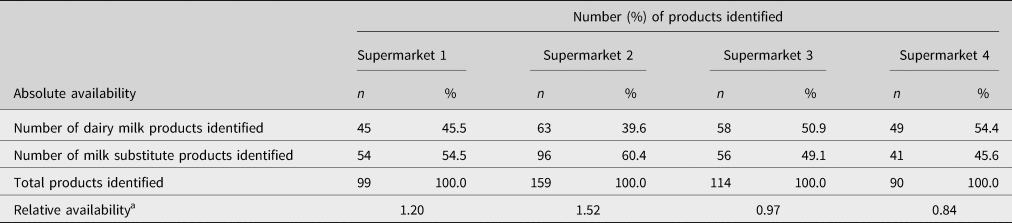
The absolute and relative availabilities of milk substitutes are presented in Table 1. For three of the four supermarket chains, the relative availability of milk substitutes compared to dairy milk products was roughly even (relative availability 0.84–1.20). For Supermarket 2, the relative availability of milk substitutes was 52% more than that of dairy milk products (Table 1).
The absolute availability (the total number of products) and the relative availability (the proportion compared to dairy milk) of milk substitutes – observational study

a The proportion of milk substitute products compared to dairy milk products.
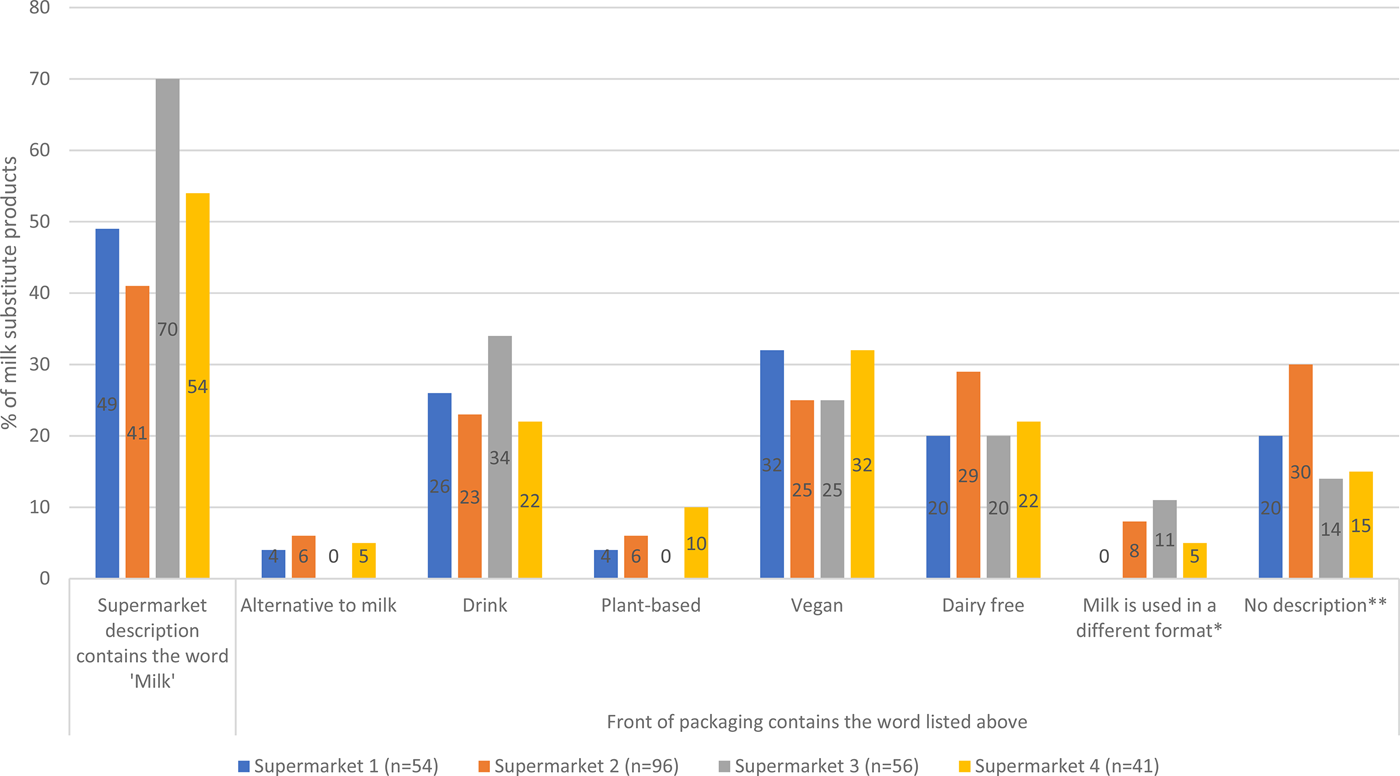
All four supermarket chains frequently used the term ‘milk’ in their online descriptions of milk substitutes (Figure 1). No description on the front of packaging, other than the brand or main ingredient, was recorded for 14–30% of milk substitute products across supermarket chains (Figure 1). The most popular terms used in product labelling of milk substitutes were ‘drink’, ‘vegan’ and ‘dairy free’ (Figure 1).
Product labelling (of milk substitutes only). *The term ‘milk’ is used in a different format on the front of the product packaging (e.g., M”lk, mi!k, mylk, etc.). **No other description other than the main ingredient and/or brand was found on the front of the product packaging.

Of the milk substitute products available in the four supermarkets, 52, 1, 7 and 0%, respectively, were not found at all when the term ‘milk’ was searched (i.e., these milk substitute products could only be found if a search term such as ‘oat drink’ was used not when ‘milk’ was searched) (Supplementary Table S1). For those milk substitute products that were found when using the search term ‘milk’, the mean page that each product was found on was page 6, while dairy milk were always found on the first page. This was consistent across Supermarkets 1, 2 and 4. For Supermarket 3, all products were displayed on one continuous page (Supplementary Table S1).
For all supermarkets, milk substitutes tended to have a higher price per volume compared to dairy milk products (Supplementary Table S1). Across all supermarkets, the mean price per litre of dairy milk was £0.94 (standard deviation (SD) 0.31, range: 0.44, 2.00), while for milk substitutes this was £1.54 (SD 0.55, range: 0.55, 2.67).
Discussion
Milk substitutes are readily available in the top four UK supermarket chains, at least on par with dairy milk. Milk substitute labelling is varied both between products and supermarket chains, and although the term ‘milk’ cannot appear in milk substitute labelling, it is often used by supermarkets in their online descriptions. Milk substitutes often appear further down search pages (compared to dairy milk) and are consistently higher in price than dairy milk.
Although we kept data collection consistent by using the same device, location and time, it is possible that seasonal and/or location variations would be seen for these products. It is also possible that search results may have differed based on previous searches made by a device. We tried to account for this by searching all of the supermarket websites from a device not normally used for online shopping and without logging in to an existing account.
We also acknowledge that we were unable to record labelling information on the back and sides of products due to the online nature of the study. Future research may wish to consider slogans occasionally used in milk substitute labelling, or within milk substitute advertising, such as ‘wow no cow’ (labelling) and ‘not your mother, not your milk’ (advertising). However, despite these limitations, we still believe this study provides a useful snapshot of milk substitute availability and labelling in the UK, which has been previously unavailable.
Study 2 – experimental study
Method
Study design
This was an experimental online study using a parallel-group between-participant design conducted using the online survey software Qualtrics (Qualtrics, Provo, UT, version March 2022). Participants were presented with images of 20 drink cartons comprising 10 milk substitute cartons and 10 ‘other drink cartons and for each carton they were asked to respond to three different questions. Participants were randomised using the Qualtrics online platform (Qualtrics, 2022) to one of the two conditions:
1. No Milk Labelling Condition: Where milk substitutes were not labelled with the term ‘milk’ as per current UK labelling regulations and
2. Milk Labelling Condition: Where milk substitutes were relabelled with the term ‘milk’.
The study was pre-registered on the Open Science Framework, and the protocol and statistical analysis plan were uploaded prior to data collection (https://osf.io/c74ka/). There were no deviations from the pre-registered protocol or the statistical analysis plan.
Study hypotheses
Our primary hypothesis was that participants in the Milk Labelling Condition would correctly identify more milk substitutes as being a product that could be added to a cup of tea or coffee compared to participants in the No Milk Labelling Condition. Our secondary hypothesis was that participants in the Milk Labelling Condition would misidentify more milk substitutes as animal source products compared to participants in the No Milk Labelling Condition. We also hypothesised that:
(i) participants in the Milk Labelling Condition would be faster at identifying milk substitutes as products that could be added to a cup of tea or coffee compared to the No Milk Labelling Condition;
(ii) participants in the Milk Labelling Condition would be slower at identifying milk substitutes as non-animal source products compared to the No Milk Labelling Condition and
(iii) participants in the Milk Labelling Condition would be more likely to choose a milk substitute to put in their cup of tea/coffee or a bowl of cereal in the future compared to participants in the No Milk Labelling Condition.
Participants and recruitment
Participants were recruited using the Prolific online platform in March 2022 (www.prolific.co). Participants were reimbursed £0.63 on completion, in line with recommended reimbursement from Prolific.
An equal number of male and female participants were recruited, and the platform provided only pre-screened participants (≥18 years old, a current resident in the UK and fluent in English) with a link to the study on the Qualtrics platform.
Measures
In response to the drink cartons shown to them, participants were asked the following questions:
1) ‘Please select whether you think someone would add each of the products to a cup of tea or coffee. This includes those products which would be added to tea or coffee by someone using the product to replace dairy milk (yes/no/unsure).’
An answer of ‘yes’ was deemed to correctly identify the milk substitute (therefore, not correctly identified was deemed to be an answer of ‘unsure’ or ‘no’).
2) ‘Please select whether you think each product listed below comes from an animal source or not (yes/no/unsure).’
An answer of ‘yes’ or ‘unsure’ was deemed to misidentify the milk substitute (therefore, not misidentified was deemed to be an answer of ‘no’).
3) ‘Please select whether you think, in the future, you may purchase each product below to add to your tea or coffee (or for another such use, for example, to be added to a smoothie or bowl of cereal) (yes/no/unsure).’
An answer of ‘yes’ was deemed to be a selection (therefore, an answer of ‘unsure’ or ‘no’ was deemed to be not selected).
The primary outcome was the number of milk substitutes the participant correctly identified as a product that could be added to a cup of tea or coffee (out of 10). The secondary outcome was the number of milk substitutes the participant misidentified as coming from an animal source (out of 10). Tertiary outcomes were (i) the number of milk substitutes the participant selected as a product they would purchase in the future (out of 10), (ii) whether any milk substitutes selected as a product the participant would purchase in the future, (iii) the time taken to respond to question 1 (in seconds) and (iv) the time taken to respond to question 2 (in seconds). All outcomes were novel and developed for this study.
Procedure
Participants in both conditions were presented with a study question alongside 20 drink cartons, listed in a random order, on one continuous page (the participant needed to scroll down to see all drink cartons).
These 20 drink carton images were made up of 10 milk substitute cartons and 10 ‘other drink’ cartons. Images of all cartons were the front of currently available products found during our observational study. The milk substitute cartons varied in the labelling depending on the condition assigned to each participant: the No Milk Labelling Condition had the original unmodified design, while the Milk Labelling Condition had a modified version that included the term ‘milk’ on labelling (this modification involved the replacement of the term ‘drink’ if applicable, but all other labelling and/or imaging remained the same).
The 10 ‘other drink’ cartons included the front of five dairy milk products (including semi-skimmed, skimmed and whole milk) and five other drink cartons (e.g., fruit juice). These 10 cartons were the same for both conditions and were unmodified in both conditions. They were used for filler purposes only to distract participants from the true nature of the study.
For each of the 20 drink cartons, participants were asked to respond to each question by selecting either yes, no or unsure. The participant was only able to move on to the next question once all products had a response. After the participant had completed this, the same 20 drink cartons for their condition appeared, in a new random order, and a further question was presented. There were three questions in total. The responses to questions 1 and 2 were timed, which participants were aware of.
Participants then completed demographic questions and additional measures (Supplementary Method), including questions relating to their dairy milk and milk substitute consumption.
Sample size
As we were using novel outcome measures, we conducted a pilot study that replicated the main study to assess the feasibility of questions 1 and 2 and to estimate the pooled SD for the primary and secondary outcomes. The pilot study recruited 50 participants, of which 41 (82%) passed the attention check and were included in the following calculations. These participants were not included in the main experimental study discussed here as only the primary and secondary outcomes were assessed during this pilot study. For pilot study results, see Supplementary Table S2.
We considered that a meaningful (but conservative) difference between study conditions for the primary outcome would be one more correct answer in the Milk Labelling Condition compared to the No Milk Labelling Condition. Given a pooled SD of 2.88, estimated from the pilot study, this equates to an effect size of Cohen's d = 0.35. Therefore, for a two-sided independent t-test of the primary outcome (the number of ‘yes’ answers), with an alpha level of 5 and 90% power to detect the above effect size, we estimated that we required 346 participants (173 in each condition). To allow for any attention check fails and attrition, we recruited an additional 20% equating to 416 participants.
A power calculation for the secondary outcome, using a meaningful (but conservative) difference of one more correct answer, can be seen in Supplementary Methods and suggested using at least 34 participants per condition.
Statistical analysis
SPSS version 28 was used to analyse all data. All analyses were pre-registered. In line with the sample size calculation, an independent t-test was conducted to compare the primary (the number of milk substitutes the participant said could be added to a cup of tea or coffee – ‘yes’ responses) and secondary outcomes (the number of milk substitutes the participant said comes from an animal source – ‘yes’ or ‘unsure’ responses) between study conditions.
Additionally, as per our pre-registered statistical analysis plan, other models and transformations were explored, and a binary logistic generalised linear model was considered most appropriate to compare the count data (out of 10) for the primary, secondary and first tertiary outcome (how many milk substitutes the participant would purchase in the future) between the two study conditions. The second tertiary outcome (would the participant purchase any milk substitute in the future) was compared between study conditions using a logistic regression model to predict whether participants reported that they would purchase a milk substitute (or not) in the future. A general linear model (GLM) was used to compare the timed tertiary outcomes (time to respond to questions 1 and 2) between study conditions. Pre-specified covariates of baseline dairy milk consumption and baseline milk substitute consumption were added to each model as a secondary analysis. Where appropriate, the mean difference, or odds ratio (OR), is reported alongside a 95% confidence interval (CI) and associated p-value. Model diagnostics suggested that the residuals for all models were satisfactory.
All pre-specified and two unplanned sensitivity analyses can be found in Supplementary Table S3. The unplanned sensitivity analyses included an analysis which included those that failed the attention check due to an imbalance between conditions (Supplementary Figure S1) and an analysis which excluded milk substitute number 6 which produced outlying results for all outcomes (Supplementary Table S5). Results remained similar for all sensitivity analyses (Supplementary Table S3).
Results
The CONSORT diagram in Supplementary Figure S1 shows that from 416 participants who were directed to the study, data from 352 were included for analysis (Milk Labelling Condition n = 184, No Milk Labelling Condition n = 168). The mean age was 38 years (SD = 13.2), 50% were female and 57% reported having a bachelor's degree or higher (see Supplementary Table S4 for demographic characteristics).
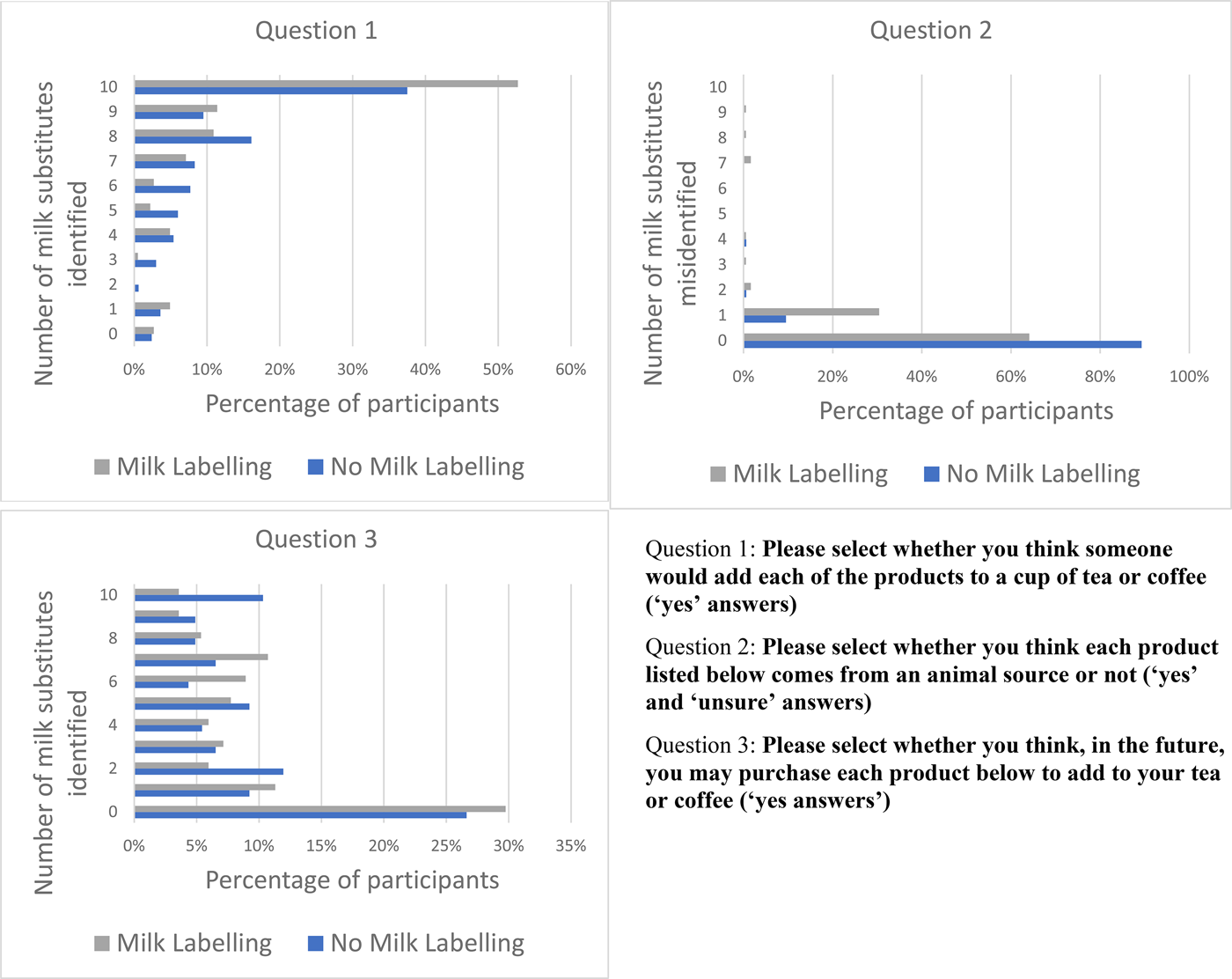
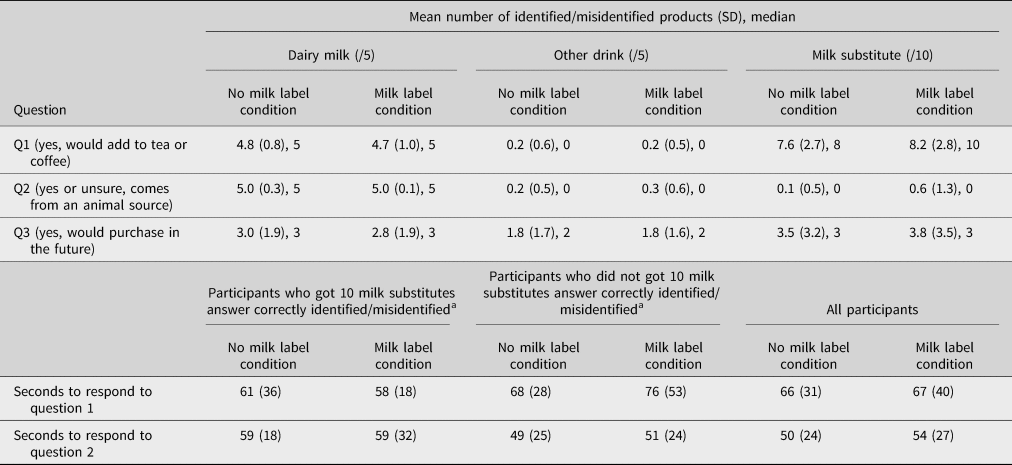
The mean number of identified/misidentified milk substitutes that participants gave out of 10 for each question is presented in Figure 2 and Table 2. Table 2 also contains the mean number of identified/misidentified dairy milk and other drinks. Responses for all three questions, for all milk substitute products, can be found in Supplementary Table S5.
The number of identified/misidentified answers (out of 10) given for all study questions between study conditions. Question 1: Please select whether you think someone would add each of the products to a cup of tea or coffee (‘yes’ answers). Question 2: Please select whether you think each product listed below comes from an animal source or not (‘yes’ and ‘unsure’ answers). Question 3: Please select whether you think, in the future, you may purchase each product below to add to your tea or coffee (‘yes answers’).

The mean and median number of identified/misidentified given for each of the three different product categories (dairy milk, milk substitutes and other drinks), for each of the three questions, between study conditions

Q1: Please select whether you think someone would add each of the products to a cup of tea or coffee.
Q2: Please select whether you think each product listed below comes from an animal source or not.
Q3: Please select whether you think, in the future, you may purchase each product below to add to your tea or coffee.
SD, standard deviation.
a Identified for question 1 and misidentified for question 2.
Primary hypothesis (would add to a cup of tea or coffee)
In line with our hypothesis, there was evidence from both the t-test and the binary logistic model that participants in the Milk Labelling Condition correctly identified more milk substitutes (i.e., the participant answered ‘yes’) (8.2, SD = 2.8) as being a product that could be added to a cup of tea or coffee compared to participants in the No Milk Labelling Condition (7.6, SD = 2.7): t-test – mean difference = 0.6, 95% CI 0.3, 1.2, p = 0.040; binary logistic model – OR = 1.4 (reference category: No Milk Labelling condition), 95% CI = 1.1, 2.1, p = 0.042.
Figure 2 shows the percentage of participants getting all 10 milk substitutes correct (i.e., correctly identifying that they could be added to a cup of tea or coffee). In total, 53% of participants in the Milk Labelling Condition correctly identified all milk substitutes, compared to 38% in the No Milk Labelling Condition.
Secondary hypothesis (comes from an animal source)
In line with our hypothesis, there was evidence that participants in the Milk Labelling Condition misidentified more milk substitutes as being a product that came from an animal source (i.e., the participant answered ‘yes’ or ‘unsure’) (0.6, SD = 1.3) compared to participants in the No Milk Labelling Condition (0.1, SD = 0.5): t-test – mean difference = 0.5, 95% CI 0.2, 0.7, p < 0.001; binary logistic model – OR = 4.7 (reference category: No Milk Labelling condition), 95% CI = 2.3, 9.6, p < 0.001.
Figure 2 shows the percentage of participants who did not misidentify any milk substitutes (i.e., they got zero for this outcome). In total, 64% of participants in the Milk Labelling did not misidentify any milk substitutes, compared to 89% in the No Milk Labelling Condition.
Tertiary hypotheses (would purchase in the future)
There was no clear evidence that participants in the Milk Labelling Condition identified either more milk substitutes (3.8, SD = 3.5) (binary logistic model: OR = 1.2 [reference category: No Milk Labelling condition], 95% CI = 0.8, 1.6, p = 0.37) or at least one milk substitute (logistic regression: OR = 1.1 [reference category: No Milk Labelling condition], 95% CI = 0.9, 1.2, p = 0.51) as being a product they would purchase in the future, compared to those in the No Milk Labelling Condition (3.5, SD = 3.2).
Contrary to our hypothesis, there was no clear evidence that participants in the Milk Labelling Condition were faster at identifying milk substitutes as products that could be added to a cup of tea or coffee (67 s, SD = 40) compared to the No Milk Labelling Condition (66 s, SD = 31) (GLM: mean difference = 0.8, 95% CI 0.7, 0.8, p = 0.830) (Table 2).
Also contrary to our hypothesis, there was no evidence that participants in the Milk Labelling Condition were slower at identifying milk substitutes as non-animal source products (54 s, SD = 27) compared to the No Milk Labelling Condition (50 s, SD = 24) (GLM: mean difference = 3.7, 95% CI 1.7, 9.1, p = 0.193) (Table 2).
Results between study conditions remained similar when pre-specified covariates of baseline dairy milk consumption and baseline milk substitute consumption were added to each model (Supplementary Table S3). During this analysis, the main effects for participants’ baseline milk substitute consumption showed evidence of a significant main effect, with participants who reported consuming more milk substitutes at baseline correctly identifying more milk substitutes in questions 1 and 2 (Supplementary Table S3).
Discussion
In support of our primary hypothesis, participants in the Milk Labelling Condition correctly identified 0.6 more milk substitutes as a product they would add to a cup of tea or coffee compared to those in the No Milk Labelling Condition. Although this did not meet our pre-specified requirement of one for a meaningful difference, there was statistical evidence for a difference between conditions in the hypothesised direction, and the confidence intervals were consistent with the possibility of a meaningful difference.
Similarly, in support of the secondary hypothesis, there was evidence that participants in the Milk Labelling Condition misidentified more milk substitutes as being a product that came from an animal source compared to participants in the No Milk Labelling Condition. Again the mean difference of 0.5 did not meet our pre-specified recruitments for a meaningful difference. However, in this case, the 95% CI did not include a meaningful difference, suggesting that any true effect is likely to be below this value.
There was no clear evidence of a difference between study conditions in the time it took to respond to questions 1 and 2. There was also no clear evidence of a difference between the two study conditions when identifying milk substitutes as products that participants would like to purchase in the future. The study was representative of the UK population in terms of gender and age (Office of National Statistics, 2011). The study is also, as far as we are aware, the first experimental study to consider confusion over milk substitute labelling.
Nevertheless, the study has some limitations. Firstly, due to slightly higher than anticipated attrition and attention check fail rates (Supplementary Figure S1), the No Milk Labelling condition was slightly under the pre-stated sample size of 173 participants. Additionally, our study was only powered to detect what we considered a meaningful effect size and was underpowered to detect an effect size smaller than this. Secondly, our sample had a slightly elevated representation of adults who had a bachelor's degree or higher, compared to the UK population (57 compared to 35%) (Office of National Statistics, 2011). Thirdly, the study took place in an online setting, and therefore, the environment in which the participants took part could not be controlled and therefore external factors could have affected decision making (i.e., hypothetical decision making online may not translate into a real-world setting) (Clarke et al., Reference Clarke, Pechey, Kosīte, König, Mantzari, Blackwell, Marteau and Hollands2021). Finally, responses to the questions may depend on an individual's taste and preference. For example, soya milk can be known to curdle in hot tea or coffee, and coconut milk may not be considered a suitable flavour for some individuals to add to their tea or coffee. We recognise this as a limitation, and in support of this, some references were made to flavour in the comments section of the study (Supplementary Table S6). Additionally, hunger was not assessed during this study, which has previously been shown to affect responses to questions relating to food; however, randomisation between study conditions should have accounted for this.
General discussion
As seen in our observational study, milk substitutes are readily available in the top four UK supermarket chains; however, labelling is varied both between products and between supermarket chains, although the term ‘milk’ cannot currently appear on milk substitute packaging.
During our experimental study, when the term ‘milk’ was added to milk substitute packaging, participants were more likely to identify milk substitute use in tea and coffee. Although the difference was smaller than anticipated, it was in the hypothesised direction, and the 95% CI was consistent with a potentially meaningful difference. Results also showed that 53% of participants in the Milk Labelling Condition correctly identified all milk substitutes, compared to 38% in the No Milk Labelling Condition. Combined, these results would suggest that further clarification, using the term ‘milk’, on milk substitute labelling could help consumers’ decision making when considering a product's use.
However, also as hypothesised, there was also evidence that participants in the Milk Labelling Condition misidentified more milk substitutes as being a product that came from an animal source compared to participants in the No Milk Labelling Condition, the difference was smaller than anticipated and the 95% CI did not include a meaningful difference. However, the number of participants who were confused was very small; across both conditions, only 12 (3%) participants misidentified more than one milk substitute as coming from an animal source.
As these two hypothesised results would require contradictory policy recommendations in the UK (whether to add the term ‘milk’ to milk substitute packaging or keep current regulations where the term ‘milk’ cannot be used on milk substitute packaging), it must be considered which is more valuable; is it more important that consumers know how milk substitute products can be used or is it more important that consumers incorrectly assume that milk substitute products come from an animal source? Due to the small number of participants that were confused as to whether milk substitutes came from an animal source during our experimental study, and that there is growing evidence that there must be a planetary shift away from dairy consumption to meet global environmental targets, we suggest that the former should be prioritised. In fact, future studies may wish to consider clearer labelling for both milk substitutes and dairy milk products, by labelling dairy milk with the main ingredient, for example, ‘dairy milk’ or ‘cows milk’, while milk substitutes are also more clearly labelled, with, for example, ‘soya milk,’ so that the product's use can be communicated. Education and future research regarding the use and source of milk substitutes should be prioritised.
These opposing, and smaller-than-expected, results may be due somewhat to the age of participants in our experimental study. The mean age was 38 years, and as milk substitue consumption is higher in younger populations (Mintal, 2019), it is possible that our participants were just not familiar enough with milk substitutes to identify their use or source. Although 40% of participants in the study reported drinking milk substitutes, and this was above the estimated average of 23% the UK (Mintal, 2019), the mean number of times per week that milk substitutes were reportedly consumed was only twice (Supplementary Table S4). Additionally, our secondary analysis showed that there was evidence of a significant association between baseline milk substitute consumption and the identification of milk substitutes (Supplementary Table S3), suggesting that familiarity with milk substitutes aids their identification. Considering that consumers’ food familiarity and purchasing behaviour is affected by age (Meneely et al., Reference Meneely, Strugnell and Burns2009), future research should strongly consider this.
The clarification of the purpose of milk substitutes on their labels seems particularly important, given the high number of milk substitute products available to consumers (as found in our observational study). For 14–30% of milk substitutes, we found no information beyond the brand or main ingredient was being provided on the front of product packaging and although the term ‘milk’ was often used by the supermarket in the online description, in real-world supermarket settings, any clarity that comes from this is not available to consumers.
Milk substitutes were also less visible than dairy milk in online supermarkets, with these either not listed when the search term ‘milk’ was used, or only present much further down the search list than dairy milk. Additionally, during our observational study, milk substitutes were also consistently higher in price than dairy milk, which is not unexpected considering dairy milk is commonly a loss-leading staple in supermarkets (Clay et al., Reference Clay, Sexton, Garnett and Lorimer2020). This higher price may, at least in part, explain why we did not see any difference between conditions in wanting to purchase milk substitutes in the future (one comment was made about milk substitutes being too expensive in the open comment section of the experimental study [Supplementary Table S6]). This lower visibility and increased price are likely to reduce milk substitute purchasing in the real world.
Although the policy recommendation here is for clearer labelling on milk substitute packaging, it is important to note that due to huge variety, dairy milk and milk substitutes are not comparable in terms of nutritional profiles (Mäkinen et al., Reference Mäkinen, Wanhalinna, Zannini and Arendt2016; Chalupa-Krebzdak et al., Reference Chalupa-Krebzdak, Long and Bohrer2018), and we recognise that this is something our studies did not consider. Although the substitution of dairy milk with a milk substitute is unlikely to be of concern if formulated into a nutritionally equivalent product (Mäkinen et al., Reference Mäkinen, Wanhalinna, Zannini and Arendt2016), it may pose issues in populations with suboptimal dietary intake (Zhang et al., Reference Zhang, Hughes and Grafenauer2020). Any switch should be carefully considered, with focus on the many nutrient-fortified milk substitutes that exist.
Our results warrant replication. Future work should focus on establishing what would be considered a meaningful difference between adding the term ‘milk’ to milk substitute packing, compared to it not being present, as our experimental study was underpowered to detect a smaller effect size than 0.35. Work to determine more precisely what would constitute a minimum effect size of interest is therefore necessary. Future research, preferably in a real-world setting, should then further consider whether inconsistent labelling and/or a lack of clarity of the product's use is confusing for consumers. Future research which focuses on ingredient labelling, using specific terms such as ‘dairy’, ‘soya’ and ‘oat’, is advised as it is possible that using more specific terms for both dairy milk and milk substitutes could lead to a better understanding of both product types. Possible eco-labels, which condense information provided on the products’ environmental footprint, could also be considered as this has been shown in previous research to promote more sustainable choices in meal selection (De-Loyde et al., Reference De-loyde, Pilling, Thornton, Spencer and Maynard2022).
Conclusions
Our observational study shows that milk substitutes are readily available online in the top four UK supermarket chains. The labelling of such products was varied, and the price was consistently higher than dairy milk. Our experimental study showed that adding the term ‘milk’ to the packaging of milk substitutes increased understanding of the product's use and also increased confusion about whether the product came from an animal source.
These results were smaller than we anticipated, but in the hypothesised direction. Future research should consider what would constitute a minimum effect size of interest. Replicating our experimental study, in a real-world setting, including the consideration of age, with the potential for future policy leading to clearer labelling on milk substitute packaging, is also warranted.
Supplementary material
To view supplementary material for this article, please visit https://doi.org/10.1017/bpp.2023.19.
Data availability
The data and analysis code that form the basis of the results presented here are available from the University of Bristol’s Research Data Repository (http://data.bris.ac.uk/data/): https://doi.org/10.5523/bris.2fx58ht2n92uy2isojba82wv3p.
Acknowledgments
We would like to thank Andante Singer who collected the data for the observational study. We would also like to thank all the participants who took part in the experimental study.
Funding source
No external funding.
Competing interest
No author declares a financial relationship with any organisation(s) that might have an interest in the submitted work, and no other relationships or activities that could appear to have influenced the submitted work.
Ethics approval
The experimental study was approved by the Faculty of Science Research Ethics Committee at the University of Bristol, UK (approval code: 10313). The observational study did not require ethical approval.


 Open access

