

Political scientists increasingly identify discriminatory attitudes toward out-groups as a key factor shaping individuals’ political attitudes and decision-making in ways that significantly impact aggregate-level outcomes (Gothreau, Arceneaux, and Friesen Reference Gothreau, Arceneaux and Friesen2022). For example, as numerous studies on discriminatory attitudes toward women have found, sexism shapes men’s stance on a range of evidently gendered political processes, including evaluations of women and men candidates (Carian and Sobotka Reference Carian and Sobotka2018; Mansell et al. Reference Mansell, Harell, Thomas and Gosselin2021); reactions to political scandal (Barnes, Beaulieu, and Saxton Reference Barnes, Beaulieu and Saxton2020); and preferences toward public policies such as gender quotas (Batista Pereira and Porto Reference Batista Pereira and Nathália2020), public breastfeeding (Huang, Sibley, and Osborne Reference Huang, Sibley and Osborne2020), the gender pay gap (Connor and Fiske Reference Connor and Fiske2019), and women’s reproductive rights (Jelen Reference Jelen2015; Strickler and Danigelis Reference Strickler and Danigelis2002).
But discrimination against women can also shape less explicitly gendered political processes, such as voting behavior (Valentino, Wayne, and Oceno Reference Valentino, Wayne and Oceno2018). For instance, sexism is one of the most prominent factors explaining support for Donald J. Trump in the 2016 U.S. presidential election (Bracic, Israel-Trummel, and Shortle Reference Bracic, Israel-Trummel and Shortle2019; Cassese and Holman Reference Cassese and Holman2019; Ratliff et al. Reference Ratliff, Redford, Conway and Smith2019), and it also explains support for the Republican Party in congressional races (Cassese and Barnes Reference Cassese and Barnes2019; Schaffner Reference Schaffner2022). Broader animosity toward out-groups seems to yield a similar effect: as Mason, Wronski, and Kane (Reference Mason, Wronski and Kane2021) show, antagonism toward minorities is a core factor underlying support for Trump in 2016, irrespective of voters’ party identity.
While political scientists recognize discriminatory attitudes toward out-groups as important for understanding a range of explicitly related and seemingly unrelated individual political preferences and behaviors, core questions remain about why certain individuals display discriminatory attitudes toward out-groups, while others do not. In the current study, we contribute to growing efforts in this area by examining the role of psychological traits, namely, secure versus fragile self-esteem, in shaping discriminatory attitudes toward women.
Traditionally, to investigate the characteristics of individuals more likely to hold negative and hostile attitudes toward out-groups, political scientists have looked to contextual, sociodemographic, and attitudinal factors such as ideological orientation (Christopher and Mull Reference Christopher and Mull2006), religiosity (Peek, Lowe, and Williams Reference Peek, Lowe and Williams1991), or value hierarchies (Mikołajczak and Pietrzak Reference Mikołajczak and Pietrzak2014). However, using factors such as ideological orientation to explain the development of discriminatory attitudes is challenging because of concerns about directionality and endogeneity.
In an effort to overcome some of these challenges, recent work has sought to move beyond attitudinal traits to investigate the psychological characteristics of individuals who display discriminatory attitudes toward women. In this literature, insecurity about changes in social hierarchies has stood as an important factor shaping discrimination toward out-groups. For example, the conceptual lenses of “fragile masculinity” or “precarious manhood”—which have gained traction outside academia—build on the notion that men’s (failed) efforts to protect their dominant social status explain discriminatory attitudes toward women (DiMuccio and Knowles Reference DiMuccio and Knowles2020). While these concepts offer a useful framework with which to explore the underlying determinants of sexist attitudes, difficulties with consistent measurement of insecurities resulting in variation in men’s sense of masculine identity have imposed challenges to capturing such personality traits (Crocker et al. Reference Crocker, Luhtanen, Cooper and Bouvrette2003).Footnote 1
We contribute to efforts to identify personality characteristics associated with attitudes toward women by evaluating a measure of insecure identity that is not contingent on a specific form of masculine identification. We apply a measure of secure versus fragile self-esteem to identify individuals with personal insecurities and to explore how these insecurities influence their attitudes toward women and gendered political processes.
Drawing on scholarship in developmental and personality psychology, we argue that, for a small subset of individuals, negative attitudes and appraisals of women are the result of maladaptive personality characteristics: psychological processes directed toward protecting an individual’s sense of self and personal efficacy by directing their personal insecurities outward toward others as social aggression. Within this model, negative stereotypes of women as incapable, weak-minded, helpless, or deceitful compensate for, or distract from, individuals’ fragile sense of self-esteem—a source of anxiety and insecurity that threatens their well-being. Following from this literature, individuals’ identification with negative stereotypes toward women is motivated by their desire to alleviate the significant and persistent psychological stresses resulting from their self-perceived inadequacy.
While fragile self-esteem is a personality trait characterized by a general increase in social aggression, building on theories of masculine insecurity, we argue that identification with negative stereotypes toward women emerges from social and psychological factors that motivate men to compete for status and to depict women as a lower-status group. Furthermore, in alignment with scholarship showing that sexism and antagonism toward women are expressions of willingness to maintain social hierarchies (Cassese and Holman Reference Cassese and Holman2019; Gothreau, Arceneaux, and Friesen Reference Gothreau, Arceneaux and Friesen2022), we hypothesize that individuals whose implicit (private internal) view of self is negative relative to their explicit (externalized, “self-reported” social) view of self—in other words, those whose self-esteem is fragile (Kernis et al. Reference Kernis, Lakey, Heppner and Kernis2008)—are more likely to hold sexist attitudes and negative perceptions of women than individuals with positive implicit and explicit views of self.
We test our expectations with data from an online survey of U.S.-based adults (N = 487) that included a self-esteem Implicit Association Test (IAT), as well as a battery of questions measuring explicit self-esteem. Contrasting respondents’ baseline assessment of implicit self-esteem captured through the IAT with their explicit, self-reported level of self-esteem allows us to construct a measure of fragile self-esteem. Using this measure, we investigate how individuals’ self-esteem relates to their (1) sexist attitudes toward women in general, (2) gendered preferences for leadership, and (3) non-explicitly gendered electoral preferences.
Our results support our expectation that individuals’ self-esteem significantly shapes their attitudes and preferences. We find that, compared to secure self-esteem, fragile self-esteem in men is associated with a higher propensity to hold hostile (aggressive/domineering) sexist attitudes, but not benevolent (protective/paternalistic) sexist attitudes. We also find that individuals with fragile self-esteem display greater preference for men in political leadership and leadership in general, as well as increased approval of former U.S. president Donald Trump, disapproval of Trump’s first impeachment, and greater probability of Republican partisanship.
Taken together, these findings provide unique insight into the development and expression of discriminatory attitudes toward an out-group, and they suggest that for some individuals, leadership preferences and party and candidate identification may relate to the psychological motivations to protect one’s insecure sense of self. Aligned with research showing that support for Donald Trump is associated with out-group animosity, our findings have important implications for the study of identity, leadership preferences, and electoral behavior.
Identity, Self-Esteem, and Attitudes Toward Women
The term “fragile masculinity” has gained ground well beyond academic studies, and it is now used colloquially to describe situations in which men display negative attitudes toward women in response to a perceived social threat. Formally, “fragile masculinity” refers to a state of anxiety or insecurity among men who perceive themselves as “failing to meet cultural standards of masculinity,” including success in public or private spheres (DiMuccio and Knowles Reference DiMuccio and Knowles2020, p. 25). Accompanying fragile masculinity is a suite of compensatory attitudes or strategies adopted by men to secure their male/masculine status. These strategies include reduced support for gender equality, an aversion to femininity, and the adoption of sexist and homophobic attitudes (Dahl, Vescio, and Weaver Reference Dahl, Vescio and Weaver2015; Kosakowska-Berezecka et al. Reference Kosakowska-Berezecka, Besta, Adamska, Jaśkiewicz, Jurek and Vandello2016; Weaver and Vescio Reference Weaver and Vescio2015; Willer et al. Reference Willer, Conlon, Rogalin and Wojnowicz2013).
In addition to fragile masculinity, psychologists, who long ago established the role of insecurity and competition in driving socially aggressive behaviors, have developed their own theory of “precarious manhood” to explain men’s development of negative attitudes toward women (Vandello et al. Reference Vandello, Bosson, Cohen, Burnaford and Weaver2008). Comparable to fragile masculinity, the theory of precarious manhood maintains that a combination of evolutionary, developmental, and social pressures drives men to perpetually compete for status, the most important predictor of male reproductive success. This incessant contest creates a lasting state of anxiety and insecurity that can motivate men to adopt “risky and maladaptive behaviors” or to reject “adaptive and beneficial” behaviors in an attempt to secure their status as men (Vandello and Bosson Reference Vandello and Bosson2013 p. 1).Footnote 2
Supporting the theoretical arguments proposed by precarious manhood and fragile masculinity, research that employs randomized primes across psychological fields demonstrates that negative attitudes toward others are shaped by personality insecurities. Specifically, among men, exposure to threats to masculinity can result in increased anxiety and aggressive ideation (Bosson et al. Reference Bosson, Vandello, Burnaford, Weaver and Wasti2009), discomfort and anger (Dahl, Vescio, and Weaver Reference Dahl, Vescio and Weaver2015), stress (Berke et al. Reference Berke, Reidy, Miller and Zeichner2017; Caswell et al. Reference Caswell, Bosson, Vandello and Sellers2014; Kramer, Himmelstein, and Springer Reference Kramer, Himmelstein and Springer2017), and intolerant aggression (Bosson et al. Reference Bosson, Weaver, Caswell and Burnaford2012). For example, as Vandello et al. (Reference Vandello, Bosson, Cohen, Burnaford and Weaver2008) find, men, but not women, who are told that they underperformed on a knowledge task are more likely to feel threatened and, in turn, to have physically aggressive thoughts (Vandello et al. Reference Vandello, Bosson, Cohen, Burnaford and Weaver2008).Footnote 3 In a study of discriminatory behavior during online video games, Kasumovic and Kuznekoff (Reference Kasumovic and Kuznekoff2015) demonstrate a similar pattern between insecurity and aggression: during competitive play, motivated but unsuccessful men are significantly more likely to express aggression toward women-voiced players regardless of this target’s game performance.Footnote 4
These findings cohere with evolutionary psychological research on status-seeking behavior and male aggression. According to this research, to maintain status, men who perceive their social position as threatened are more likely to direct aggression toward lower-status individuals, which traditionally includes women and ethnic out-groups (Betzig Reference Betzig1986; Smuts Reference Smuts1992; Winegard, Winegard, and Deaner Reference Winegard, Winegard and Deaner2014). In sum, the academic literature strongly points to insecure masculine identity as a key trait for understanding attitudes toward women.
As recent scholarship conveys, however, insecurity can also shape political behaviors more broadly. As Carian and Sobokta (Reference Carian and Sobotka2018) find, threats to masculinity result in greater general preferences for a man president as well as support for Donald Trump during the 2016 election. Similarly, Willer et al. (Reference Willer, Conlon, Rogalin and Wojnowicz2013) find that threats to masculinity prompt higher support for President George W. Bush and the Iraq War. Meanwhile, Mansell et al. (Reference Mansell, Harell, Thomas and Gosselin2021) find that during a nonpolitical real-effort task giving men negative feedback about their gender group’s poor task performance results in greater preferences for men in political leadership. Despite their focus on different dynamics and populations, these studies concur that aggression toward out-groups is often a product of insecure or negative feelings toward oneself.
Challenges to Measuring Insecure Masculine Identity
One challenge with evaluating the relationship between insecurities and negative attitudes and behaviors is reliably capturing this personality trait. Fragile masculinity and precarious manhood refer to a persistent psychological state resulting from feelings of inadequacy or insecurity; however, the causes of this state are often specific to an individual’s identity—for example, how they feel about their career successes. Because the trigger(s) of these psychological states vary with each man’s identity (e.g., threats to career versus threats to sexuality), fragile masculinity and precarious manhood are challenging constructs to measure and validate within the wider population.Footnote 5
Given these challenges, much of the research on status threats examines the role of insecurity in shaping out-group attitudes by exposing study participants to threat, thus priming this general psychological state. Studies that employ general threats to identity—for example, through general primes that feminize the treatment group—to measure fragile masculinity or precarious manhood face two important limitations: (1) primes may have only a fleeting effect on individual’s insecure psychological status, and (2) primes may capture an individual’s propensity to feel threatened when exposed to particular scenarios, but they may not necessarily capture an individual’s level of personal insecurity. Consequently, research on the relationship between personal insecurity and sexist attitudes would benefit from a measure that can more effectively capture personal insecurity as a psychological, individual-level trait.
Psychologists have long established that individuals’ perceptions of self vary greatly. To capture this variation, the psychology literature has developed several classifications of self-perception. Besides having low or high self-esteem, individuals’ self-esteem may also be secure or fragile (Jordan et al. Reference Jordan, Spencer, Zanna, Hoshino-Browne and Correll2003). As the literature conveys, secure high self-esteem is defined as (1) stable over time and not prone to daily fluctuations, (2) independent of one’s performance on key tasks, and (3) publicly and privately congruent (Kernis et al. Reference Kernis, Lakey, Heppner and Kernis2008). Conversely, fragile high self-esteem encompasses the opposite, and it is (1) highly unstable over time, (2) contingent on task performance, and (3) implicitly and explicitly discordant Fragile self-esteem is distinct from, but relates to, one’s sense of personal efficacy, which (1) refers to an individual’s belief in their capacity to accomplish the behaviors necessary to produce outcomes and (2) is applied universally to all human endeavors (Chen, Gully, and Eden Reference Chen, Gully and Eden2001).
Behaviors that exemplify discordant fragile self-esteem show striking resemblance to those associated with fragile masculinity and precarious manhood. In addition, and different from much of the work on status and identity threat, the scholarship on self-esteem examines insecurity as a personal trait—not as a primed, and potentially momentary, condition.
Specifically, as this scholarship shows, individuals with fragile high self-esteem hold “favorable, but shallow” feelings or representations of self-worth (Kernis et al. Reference Kernis, Lakey, Heppner and Kernis2008), and they tend to display similar maladaptive behaviors as men with insecure masculine identities (Jordan et al. Reference Jordan, Spencer, Zanna, Hoshino-Browne and Correll2003). Past research also shows that individuals with fragile self-esteem discriminate against minoritized groups. For example, Jordan et al. (Reference Jordan, Spencer and Zanna2005) find that after experiencing a threat to their self-competency in the form of negative performance feedback, individuals with fragile self-esteem, but not those with secure self-esteem, show greater discrimination toward an ethnic out-group compared to an ethnic in-group. In an experimental study in which participants evaluated the competency and personality of an ethnic out-group, Kernis et al. (Reference Kernis, Abend, Goldman, Shira, Paradise and Hampton2005) find that fragile self-esteem is associated with greater derogation toward the candidate compared to individuals with concordant secure esteem. Additionally, Kernis et al. (Reference Kernis, Paradise, Whitaker, Wheatman and Goldman2000) find that fragile self-esteem is associated with weak autonomy and goal-directed behavior, indicating that, as a group, they struggle with efficacy and motivation, a well-established predisposition for personal insecurity. As both women and minoritized groups have traditionally occupied lower-status positions within Western societies, we might expect that individuals with fragile self-esteem would be more likely to display similar discriminatory attitudes or behaviors toward these groups. However, to our knowledge, this relationship has not yet been tested.
Importantly, fragile self-esteem is distinct from congruent explicit and implicit low self-esteem—which is associated with adverse outcomes, including lower life satisfaction, depressive symptoms, and suicidal ideation, but not with social aggression (Jordan and Zeigler-Hill Reference Jordan, Zeigler-Hill and Zeigler-Hill2013). In other words, individuals with the psychological trait of fragile self-esteem are more likely to display aggression or discrimination in response to personal threats than individuals with secure self-esteem, even when secure self-esteem is low.
Individuals with fragile self-esteem are also more likely to display self-enhancement, a psychological motivation to compensate for insecurities. As Bosson et al. (Reference Bosson, Brown, Zeigler-Hill and Swann2003) show, fragile self-esteem is associated with unrealistic optimism, greater identification with a highly flattering personality profile, and reduced proximity between their actual self and ideal self. The identification with unrealistic self-representations is often indicative of attempts to compensate for, or protect oneself from, an insecure sense of self.
Finally, individuals with fragile self-esteem are more likely to display verbal defensiveness, an implicit psychological response to feelings of threat and insecurity (Epstein and Morling Reference Epstein, Morling and Kernis1995; Feldman Barrett and Fong Reference Feldman Barrett and Fong2002; Kernis, Grannemann, and Barclay Reference Kernis, Grannemann and Barclay1989; Zeigler-Hill Reference Zeigler-Hill2006).
The tendency to display aggressive behaviors in response to personal threat places individuals with fragile self-esteem in approximation to the expectations of the fragile masculinity and precarious manhood literatures, and it suggests that one of the factors underlying fragile or precarious identities may be an incongruence between their implicit and explicit sense of self-esteem. Critically, this literature offers guidance on capturing secure versus fragile self-esteem as an individual-level trait. Employing this measure thus allows us to explore whether attitudes that are explicitly gendered, as well as less explicitly gendered attitudes, are shaped by given individual-level insecurities—that is, insecurities that exist even in the absence of a primed out-group threat.
Hypotheses
We investigate the role of individual-level self-esteem in shaping negative attitudes toward women. Applying this psychological construct to the study of negative assessments of women and gendered political attitudes, we expect that individuals who display discordant fragile self-esteem will be more likely to hold negative attitudes toward women. Since previous studies have shown that insecurities prompt individuals to be particularly aggressive toward out-groups (which are often the source of the insecurity), we anticipate that discordant fragile self-esteem will be a stronger source of negative attitudes toward women among men than among women.
As a variety of studies show, hostile and benevolent sexism operate differently in shaping political attitudes. For example, those who exhibit benevolent sexism—which captures identification with classic stereotypic gender roles (Glick and Fiske Reference Glick and Fiske1996)—display higher levels of support for gender quotas (Batista Pereira and Porto Reference Batista Pereira and Nathália2020), while hostile but not benevolent sexism predicts electoral support for former U.S. president Donald J. Trump (Cassese and Holman Reference Cassese and Holman2019; Glick Reference Glick2019; Owen and Wei Reference Owen and Wei2020). Because aggressive displays by fragile individuals are triggered in response to a perceived personal threat, we anticipate that, when it comes to sexist attitudes toward women in general, discordant fragile self-esteemFootnote 6 will be more strongly associated with hostile sexism—which relates to sexist antipathy—as opposed to benevolent sexism. Formally, we hypothesize the following:
H 1 : Fragile self-esteem will be positively associated with sexist attitudes compared to secure positive self-esteem.
H 2 : Fragile self-esteem will be more strongly associated with hostile sexism than with benevolent sexism.
H 3 : The relationship between fragile self-esteem and hostile sexism will be stronger in men in comparison to women.
Aligned with recent literature linking sexism to preferences for masculine leadership and support for former U.S. president Donald J. Trump and the Republican Party, we also expect the following:
H 4 : Fragile self-esteem will be positively associated with preferences for men in leadership compared to secure positive self-esteem.
H 5 : The association between fragile self-esteem and preferences for men in leadership will be stronger in men in comparison to women.
H 6 : Fragile self-esteem will be associated with support for the Republican Party and former U.S. president Donald J. Trump.
H 7 : The association between fragile self-esteem and support for the Republican Party and former U.S. president Donald J. Trump will be greater in men in comparison to women.
Research Design
Data for the full study was collected through an online survey hosted by Qualtrics in May 2020.Footnote 7 Participants were recruited from Amazon Mechanical Turk (MTurk) using a two-step collection design. Recruitment was restricted to U.S. residents over the age of 18. In the pre-survey, N = 1,319 participants completed a four-minute questionnaire of questions about sociodemographic characteristics, political attitudes, and electoral preferences (the questions can be found in Appendix A in the supplementary materials online). Participants who completed this short survey and successfully passed our attention checks and bot screening were invited to participate in the main survey. For the main survey, participants completed the IATFootnote 8 and additional questions about political attitudes. Completing the main survey took approximately 18 minutes. Participants were compensated US$0.40 for completing the pre-survey and US$2.30 for completing the main survey.
A total of 652 unique participants logged into the main survey, with 542 unique participants completing both the pre-survey and the main survey, a completion rate of 82.3%. The cleaning of the IAT data followed standardized practices outlined by Carpenter et al. (Reference Carpenter, Pogacar, Pullig, Kouril, Stephen, LaBouff, Isenberg and Chakroff2019). During data processing of IAT results, 51 observations were screened out. Dropping participant IAT data is a normal feature of the IATgen data cleaning procedure and a consequence of removing observations that display a high number of errors or abnormally long or short latencies.Footnote 9 There is no association between dropped observations and demographic characteristics in the sample. Four additional observations were dropped from participants who failed attention checks included in the main survey.
The final sample comprises 487 respondents. Our sample is well balanced in terms of gender, with 51.54% men and 48.46% women. The mean age of respondents is 39.57 years (SD = 12.1; min = 20, max = 78). Similar to other surveys employing recruitment with MTurk, our sample is more educated and less racially diverse than the general U.S. population (Levay, Freese, and Druckman Reference Levay, Freese and Druckman2016): 64.68% of respondents have a bachelor’s degree or higher, and 79.47% identify as white. A full summary of sample characteristics is listed in Appendix A. Between February and March 2018, we also conducted a pilot study involving 405 participants. Analyses of pilot data were used to inform the design of the current study and to conduct tests of robustness for H 1 – H 3 .Footnote 10
Measuring Fragile Self-Esteem
Variations in self-esteem may derive from instability, contingency, or discordance. We focus on variations in self-esteem resulting from discordance because it can be more reliably measured using online data collection methods.Footnote 11 Therefore, for the remainder of the article, references to secure or fragile self-esteem pertain to traits that emerge from, respectively, congruence or discordance between public and private perceptions of self.Footnote 12
Following protocols from psychology (Kernis et al. Reference Kernis, Lakey, Heppner and Kernis2008), we capture discordant fragile self-esteem by interacting an explicit measure of self-esteem with an implicit measure of self-esteem. Using standard practices from psychology, our interpretation of results focuses on comparing the difference in attitudes between secure versus fragile self-esteem by calculating the interaction effect between the dichotomous measure of implicit self-esteem and the continuous measure of explicit self-esteem (Jordan and Zeigler-Hill Reference Jordan, Zeigler-Hill and Zeigler-Hill2013; Kernis et al. Reference Kernis, Lakey, Heppner and Kernis2008).
Explicit self-esteem is measured with the short Rosenberg self-esteem scale (RSE) (Rosenberg Reference Rosenberg1965), the standard measure of explicit self-esteem in psychology (Oakes, Brown, and Cai Reference Oakes, Brown and Cai2008). The short scale consists of 10 questions measured on a 7-point Likert-scale, which are combined to create a single composite measure (see Appendix C for the questions). In our study, questions of the RSE were asked in the main survey prior to the IAT. For simplicity, we recode the RSE to a scale that runs from 0 to 60, with higher values corresponding to higher public evaluations of self. Within our sample, this variable ranges from 0 to 60, and it has a mean of 43.99, a standard deviation of 12.66, and a reliability estimate of α = 0.9407.
Implicit self-esteem is measured with an IAT, a standard and well-validated tool to measure implicit self-esteem (Greenwald, McGhee, and Schwartz Reference Greenwald and Farnham2000; Karpinski Reference Karpinski2004).Footnote 13 A measure of cognitive latency, IATs compare the difference in the speed at which individuals associate positive and negative target words with objects capturing the strength of an individual’s automatic association between mental representations and objects in memory (Greenwald, McGhee, and Schwartz Reference Greenwald, McGhee and Jordan1998). Following the method of Karpinski (Reference Karpinski2004), implicit self-esteem is assessed by having participants assign positive and negative concepts to themselves and to an unspecified other to capture an individual’s private self-evaluations.
During the IAT, the evaluative dimension was labeled “pleasant” or “unpleasant,” and the self-dimension was labeled “self” or “unspecified other.” Five target words were used for each category, as follows:
-
• Pleasant: smart; capable; success; worthy; proud
-
• Unpleasant: dumb; useless; failure; inept; ashamed
-
• Self: I; me; my; myself; mine
-
• Unspecified other: them; their; they; themselves; its
Based on the results of the IAT, implicit self-esteem is measured using a standardized D-score, which can range from –2.5 to +2.5. In our sample, implicit self-esteem ranges from –1.023 to 1.416, with a mean of 0.517 and standard deviation of 0.362 (see Appendix D). Consistent with most studies on implicit self-esteem (Karpinski Reference Karpinski2004), this indicates that, overall, individuals in our sample had a positive view of self.
The interaction of implicit and explicit measures of self-esteem that allows us to capture variation in congruent and discordant views of self is a widely employed and well-validated practice in research on psychological disorders, including bulimia nervosa, depression, and narcissism (Cockerham et al. Reference Cockerham, Stopa, Bell and Gregg2009; Di Pierro, Mattavelli, and Gallucci Reference Di Pierro, Mattavelli and Gallucci2016; MacKinnon, Newman-Taylor, and Stopa Reference MacKinnon, Newman-Taylor and Stopa2011; Risch et al. Reference Risch, Buba, Birk, Morina, Steffens and Stangier2010; Vater et al. Reference Vater, Ritter, Schröder-Abé, Schütz, Lammers, Bosson and Roepke2013), but to our knowledge, it has not yet been explored in political science.
To facilitate analyses and interpretation of interaction terms, we recode our measure of implicit self-esteem into a two-tier categorical variable (positive versus negative) in which +0.00000001 / + 2 = 1 (n = 450) and –2/0.000 = 2 (n = 37).
A symmetric coding is selected to ensure that enough observations are available in the negative/low esteem category and to create a reference category in which individuals have a strong high/positive sense of self-esteem. For robustness checks, we also conduct analyses with an alternative asymmetric coding (–2.00/+0.075: +0.07601/+2.00). This alternative coding increases the number of observations in the negative esteem category to n = 55 by including participants with weak positive implicit self-esteem. Results from our analyses with this alternative measure are similar to our main estimates (see Appendices V–AB and AF–AH).Footnote 14
The total number of participants who display negative implicit self-esteem in our sample is relatively small (n = 37; 13 men and 24 women). The low prevalence of this psychological trait is consistent with rates of psychological disorders such as depression, which occurs in about 9.5% of Americans age 18 and over (Johns Hopkins Medicine n.d.). From a behavioral perspective, a prevalence of 7.6% among our sample (5% among men) suggests that negative implicit self-esteem may provide a fruitful avenue for further investigating the psychological factors shaping sexism and gendered political attitudes and behaviors. From a statistical perspective, however, the low occurrence of this trait within our sample poses methodological challenges, as results are more vulnerable to the effect of sample variability than psychological traits with more balanced distributions. Consequently, observing a relationship between sexism and fragile self-esteem in both our main study and the pilot is important to the evaluation of our hypotheses.
Comparing Implicit and Explicit Self-esteem
As detailed and discussed in Appendix E, we find a significant correlation between implicit self-esteem (IAT) and explicit self-esteem (coef. = 0.058; p < .001). Finding a significant correlation between implicit and explicit self-esteem is atypical of self-esteem research (Bosson et al. Reference Bosson, Brown, Zeigler-Hill and Swann2003; Greenwald and Farnham Reference Greenwald and Farnham2000; Karpinski Reference Karpinski2004), but it is not without precedent (Johnson Reference Johnson2016; Krizan and Suls Reference Krizan and Suls2008; Oakes, Brown, and Cai Reference Oakes, Brown and Cai2008). As our sample is older and more demographically balanced than most studies on self-esteem, the most likely explanation is that the observed difference is due to sample characteristics.
Reliability
To demonstrate construct reliability, we regress our measure of secure and fragile self-esteem on multiple psychological measures associated with insecure, unstable, or aggressive psychological characteristics: (1) affective cognition (anger rumination, displaced aggression, revenge planning) (Denson, Pedersen, and Miller Reference Denson, Pedersen and Miller2006); (2) affective competitiveness (Newby and Klein Reference Newby and Klein2014); (3) self-worth that is contingent on the perception by others, and self-worth that is contingent on competitive success (Crocker et al. Reference Crocker, Luhtanen, Cooper and Bouvrette2003); and (4) social dominance orientation (Ho et al. Reference Ho2015). Each of these measures displays strong internal reliability (α > 0.850).Footnote 15 They are also independently correlated with our measure of hostile and benevolent sexism (see Appendix E).
Fragile self-esteem, compared to secure self-esteem, is significantly associated with the measure of revenge planning and social dominance orientation. Furthermore, we find significant three-way interactions between fragile self-esteem and respondents’ gender on the measures of affective competition, anger rumination, displaced aggression, revenge planning, and contingent-competitive self-worth (see Appendix F). No significant correlations are observed on the measure of contingent-other self-worth.
These analyses indicate that individuals with fragile self-esteem are more likely to score highly on these traits in comparison to individuals with secure self-esteem and that this relationship is significantly stronger in men. These results provide support for the reliability of the measure.
Finally, to assuage the concern that other sociodemographic characteristics—and not self-esteem—are driving our findings, we also examine whether fragile self-esteem is a trait more likely to be held by particular groups of respondents. To do this, we assess the correlation between religious identification and ethnicity and respondents’ likelihood of displaying fragile self-esteem. As shown in Appendix H, we find that neither religiosity nor nonwhite ethnicity is a statistically significant predictor of fragile self-esteem (coef. = 0.132; p < .421; coef. = 0.190; p < .609).
Dependent and Control Variables
We measure individuals’ attitudes toward women with three sets of dependent variables. First, to capture negative attitudes toward women and to test H 1 – H 3 , we use the measures of hostile and benevolent sexism developed by Glick and Fiske (Reference Glick and Fiske1997). These measures are constructed from a series of 22 explicit survey questions, asked in the main survey prior to the IAT. Each question is measured using a 6-point Likert-scale, in which higher values correspond to more sexist attitudes. Combining answers to all questions, we produce a summative measure that ranges from 0 to 110. In our sample, the variable sexism ranges from 0 to 98, with a mean of 45.3, a standard deviation of 21.5, and a reliability estimate of α = 0.926.
This measure can be deconstructed into subscales that measure two types of sexism: hostile and benevolent. A measure of sexist antipathy, the hostile sexism scale pertains to perceptions of women as deceitful and intent on male repression, while benevolent sexism refers to classically positive yet stereotypically gendered perceptions of women as cherished, pure, and in need of protection from external threat (Glick and Fiske Reference Glick and Fiske1996).
Second, to test H 4 and H 5 , we employ four measures of gendered preferences for political leadership: (1) belief that leadership is naturally a male domain; (2) belief that politics is naturally a male domain; (3) preference to vote for a man or a woman; and (4) belief in the importance of gender balance in government. Each variable is coded so that higher values pertain to less gender-egalitarian attitudes (i.e., preferences for men in political office).
Third, to further explore the significance of fragile self-esteem in shaping non-explicitly gendered political preferences and to test H 6 and H 7 , we also employ individuals’ preferences on five political issues as dependent variables: (1) approval of President Donald Trump’s leadership; (2) approval of the leadership of Nancy Pelosi, Speaker of the U.S. House of Representatives;Footnote 16 (3) disagreement with the first (2019) impeachment of President Donald Trump;Footnote 17 (4) partisan identification; and (5) party vote intention in the 2020 U.S. presidential election. Table 1 provides a descriptive summary of our 11 dependent variables.
Measures of gendered sociopolitical preferences
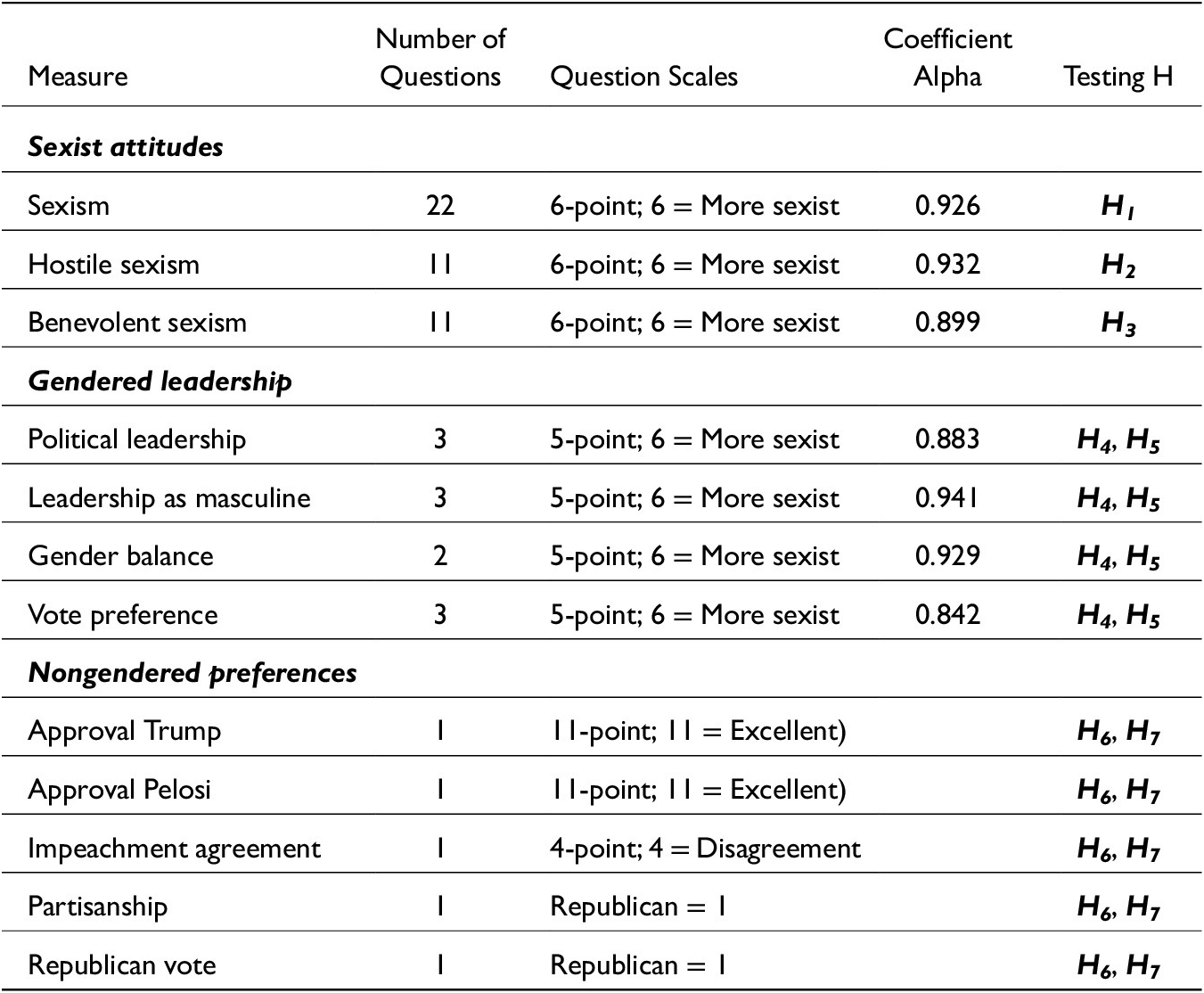
Note: Reliability based on the sample of N = 487. Full questions are provided in the appendix (p. 102).
Analysis
We begin by investigating the relationship between self-esteem and sexist attitudes. We employ a series of ordinary least squares (OLS) regressions with robust standard errors. Our interpretation of results focuses on the interaction between implicit and explicit self-esteem, which expresses the difference in outcomes between secure and fragile self-esteem (Brambor, Clark, and Golder Reference Brambor, Clark and Golder2006). To further demonstrate the significance of these results, we estimate the linear differences in effects between individuals with fragile and secure self-esteem, computed with a linear combination function that uses the results of our fitted models (Hainmueller, Mummolo, and Xu Reference Hainmueller, Mummolo and Xu2019). In all our models, we include controls for the respondent’s age, education, ethnicity, gender, income, sexual orientation, and religiosity. A summary of these control variables is available in Appendix J, and their reliability scores are detailed in Appendix K. A series of post hoc power analyses demonstrates that we have sufficient statistical power to test our hypotheses (see Appendix L).
In analyses that do not interact our measures of implicit and explicit self-esteem, we find no significant correlations between implicit self-esteem and the full measure of sexism or either of the hostile or benevolent subscales (see Appendix M). Nevertheless, we find a large and significant negative correlation between explicit self-esteem and our three measures of sexism: the combined scale (coef. = –3.671; p < .0001), as well as the independent hostile (coef. = –2.043; p < .001) and benevolent (coef. = –1.628; p < .001) subscales (see Appendix N). This indicates that, in general, individuals with higher levels of explicit self-esteem display lower levels of sexism. That is, on average, individuals who are publicly more confident in themselves are less negative toward others—a result that is consistent with the literature on aggression (Sandstrom and Jordan Reference Sandstrom and Jordan2008; Suter et al. Reference Suter, Urben, Pihet, Bertoni and De Ridder2015).
These analyses, however, do not account for the disconnect between private and public notions of self. A small share of individuals who publicly display confidence are expected to have discordant private views of self. Our expectation is that these individuals will display opposite attitudes toward women compared to individuals for whom private and public views of self are congruent.
To explore this and to test H 1 , we produce models that interact our measures of implicit and explicit self-esteem. As reported in Appendix O, we find a positive but marginally significant relationship between fragile self-esteem and the combined sexism scale (coef. = 4.635; p < .060). This is equivalent to an 9.80 percentage point increases in sexism between individuals with strongly secure self-esteem and those with strongly fragile self-esteem (coef. = 10.799; p < .019).Footnote 18 As shown in Appendix AC, we find a significant effect in the same direction in our analysis of pilot data (coef. = 5.172; p < .034). Consequently, for H 1 , we reject the null: fragile self-esteem is positively associated with sexism compared to secure self-esteem.
H 2 considers the separate correlations between fragile self-esteem and the hostile and benevolent subscales. As shown in Appendix P (Table 55), and consistent with our expectations, we find a significant positive association between fragile self-esteem and hostile sexism (coef. = 4.574; p < .011). This translates into a 14.6% increase on the scale of hostile sexism between individuals with strongly secure and those with strongly fragile self-esteem (coef. = 8.027; p < .016). Also consistent with our expectations, we find no relationship between fragile self-esteem and benevolent sexism (see Appendix P, Table 56). These associations between the hostile and benevolent sexism subscales and fragile self-esteem are also observed in the pilot data, summarized in Appendix AD (hostile: coef. = 3.300; p < .011 and benevolent: coef. = 1.872; p < .198). Consequently, for H 2 , we reject the null. Figure 1 summarizes these results.
The predicted effect of explicit “self-reported” self-esteem on hostile and benevolent sexism, among individuals with high and low implicit esteem. Figure displays predictive margins of the effect of self-esteem on sexism from Tables 55 and 56 in the appendix with 95% confidence intervals.
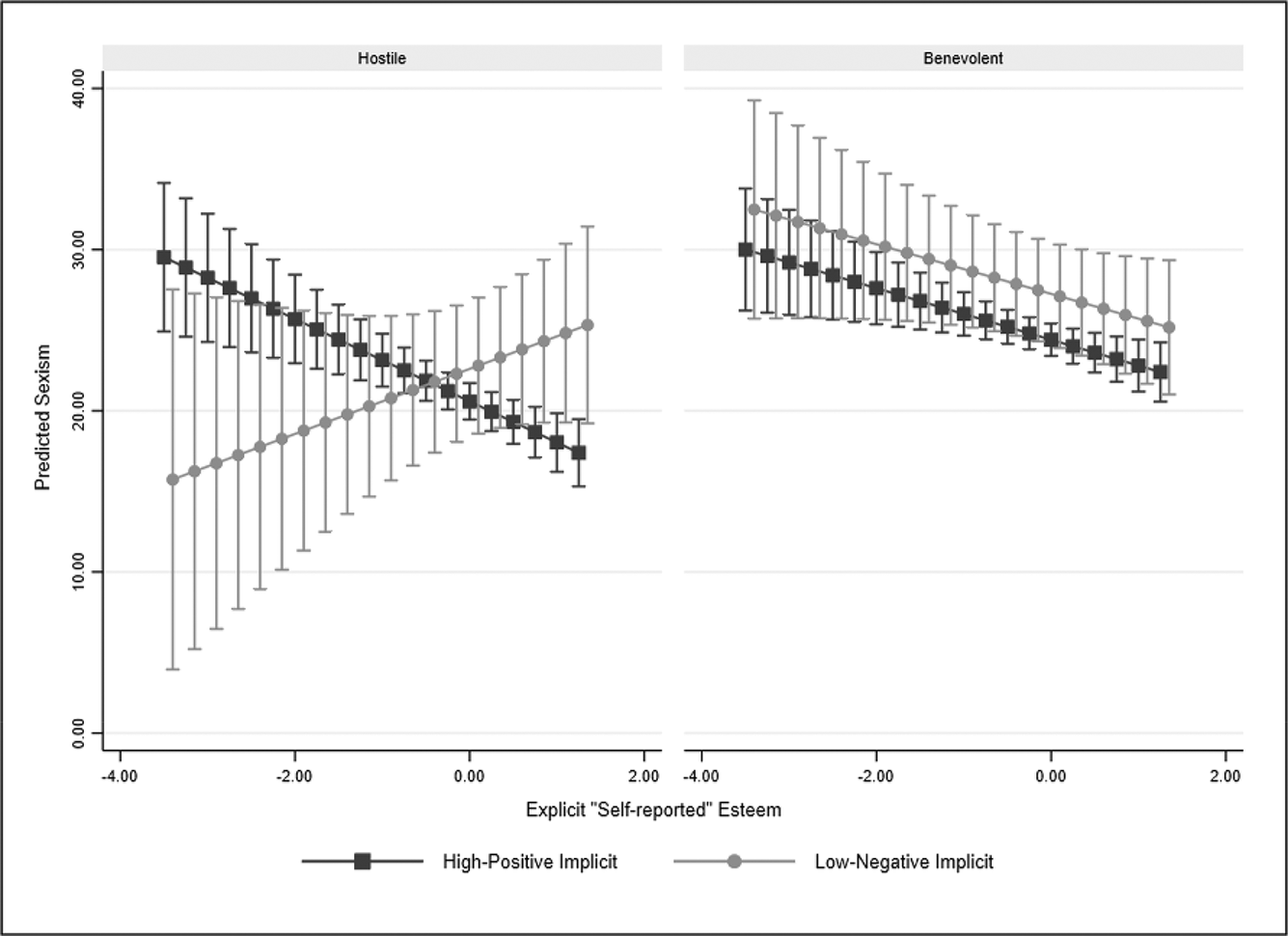
Also noteworthy, as shown in Figure 1, individuals with high implicit but low explicit self-esteem (left side of the dark gray line) display higher levels of hostile sexism than individuals with low implicit and high explicit self (i.e., fragile self-esteem, as shown in the right side of the light gray line). Often referred to as “false modesty,” past research in psychiatry has shown that individuals with high implicit and low explicit self-esteem are more likely to hold negative representations of both themselves and others. This includes higher negative self or other schemas and persecutory delusions (MacKinnon, Newman-Taylor, and Stopa Reference MacKinnon, Newman-Taylor and Stopa2011), adaptive and maladaptive perfectionism (Cockerham et al. Reference Cockerham, Stopa, Bell and Gregg2009; Zeigler-Hill and Terry Reference Zeigler-Hill and Terry2007), and narcissistic personality (Vater et al. Reference Vater, Ritter, Schröder-Abé, Schütz, Lammers, Bosson and Roepke2013). Based on these associated traits, it is not surprising that individuals with high implicit and low explicit self-esteem also hold more sexist attitudes compared to individuals with concordant high self-esteem.
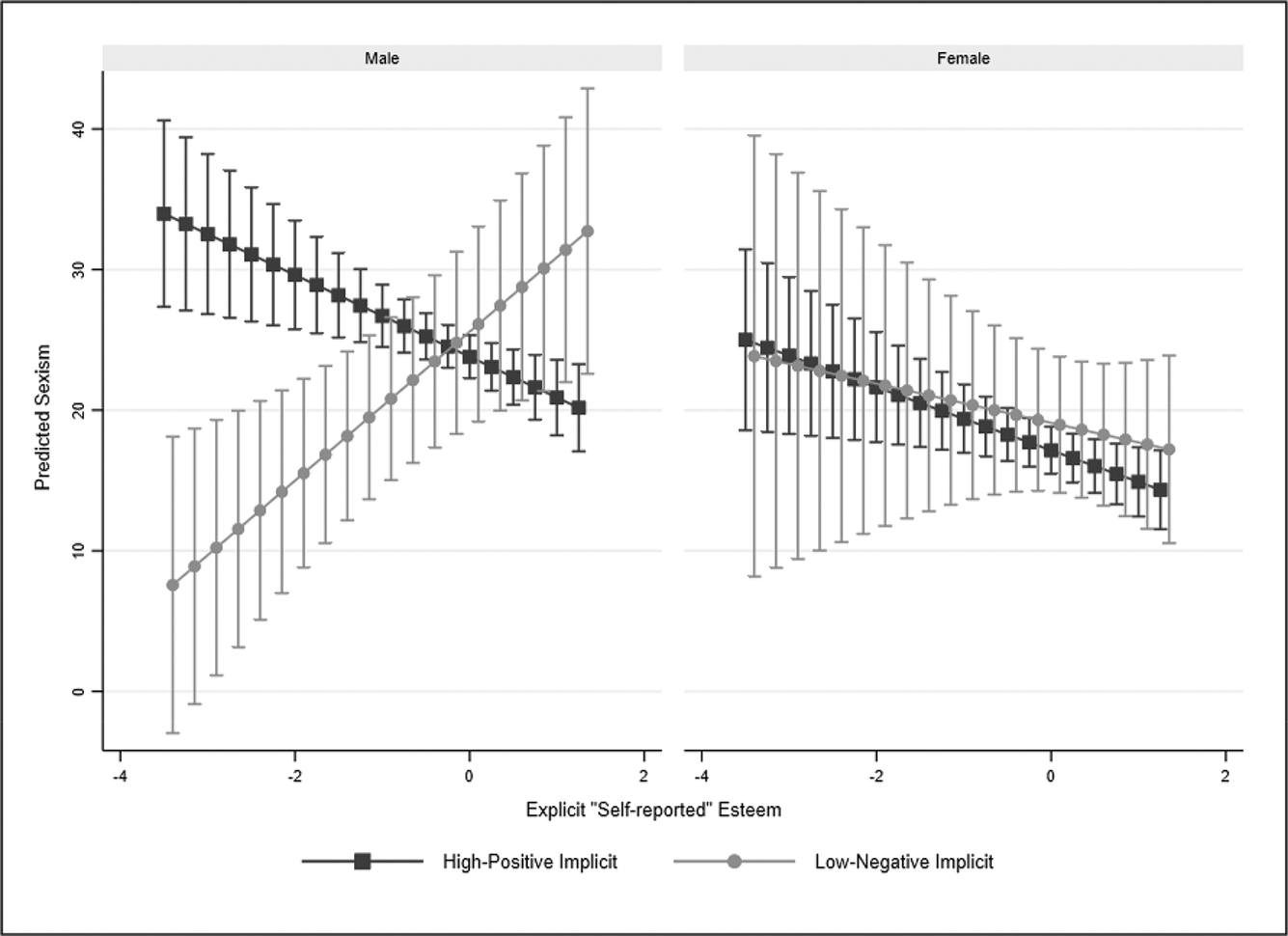
As outlined in H 3 , we expect men who display fragile self-esteem to be more likely to hold sexist attitudes than women with the same trait. Accordingly, we evaluate H 3 by predicting hostile sexism as a three-way interaction, combining our two-way interaction of explicit and implicit self-esteem with a third gender term. As expected, we find that in comparison to women, the effect of fragile self-esteem on hostile sexism is significantly larger in men; in fact, as shown in Figure 2, our previously reported results testing H 2 seem to be largely driven by men with fragile self-esteem—not women who have the same trait.Footnote 19 As reported in Appendix Q, the difference in sexism translates to a 23.16% increase in sexism between men who are high on explicit self-esteem but differ on implicit esteem (coef. = 12.738; p < .020); meanwhile, the estimated effect is only 5.26% among women (coef. = 2.891; p < .436). Given the small number of participants in the sample who display fragile self-esteem, caution is required when generalizing this interaction to the larger population. In addition, this gender interaction effect is not observed in the results of the pilot study, as shown in Appendix AE (although we believe that failure to replicate these results may be explained by higher dropout rates among men respondents during the IAT in the pilot study; see Appendix B).
The predicted effect of explicit “self-reported” self-esteem on hostile sexism, among individuals with high and low implicit esteem (by respondents’ gender). Figure displays predictive margins of the effect of self-esteem on sexism from Table 57 in the appendix with 95% confidence intervals.
The predicted effect of explicit “self-reported” self-esteem on gendered leadership preferences, among individuals with high and low implicit esteem. Figure displays predictive margins of the effect of self-esteem on sexism from Tables 59–62 with 95% confidence intervals.

Overall, our initial findings suggest that fragile self-esteem may indeed be a factor shaping gendered attitudes that has remained underexplored in political science but that provides promising potential avenues for research. To further examine the potential significance of fragile self-esteem to understanding political processes, we assess its relationship to measures of explicitly and non-explicitly gendered political preferences.
As outlined in H 4 , we expect that fragile self-esteem, compared to secure self-esteem, will be associated with stronger preferences for men in leadership positions. As reported in Appendix R and shown in Figure 3, we find a significant positive relationship between fragile self-esteem and preference for men in political leadership (coef. = 1.209; p < .021), and preference for men as leaders in general (coef. = 1.502; p < .005). This translates into a 24.41% increase in preference in political leadership (coef. = 2.929; p < .002) and a 29.31% increase in general preference for men as leaders (coef. = 3.517; p < .002) between individuals high in explicit self-esteem but who differ in implicit esteem. Fragile self-esteem is also positively, albeit marginally, associated with the variable disagreement with the need for greater gender balance in government (coef. = 0.539; p < .078). This is equal to a 7.61% increase, although the difference between individuals who differ in implicit esteem fails to reach significance (coef. = 0.609; p < .298). Finally, we find no significant relationship between fragile self-esteem and preference to vote for a male political candidate (coef. = 0.609; p < .298). In sum, two of our four models provide support for H 4 and suggest that fragile self-esteem is a factor underlying some preferences for men in (political) leadership.
Contrary to H 5 , we do not find that preferences for men in leadership are stronger among men with fragile self-esteem compared to women who display the same trait (see Appendix S). This finding is unexpected, as we anticipated that fragile self-esteem would predict negative attitudes toward one’s gender out-group. This could be the result of our measures of attitudes toward masculine leadership not capturing attitudes toward out-groups as cleanly as our measures of sexism.
Individuals have multiple identities, so in the same way that fragile self-esteem shapes men’s hostile attitudes toward women, fragile self-esteem in women could prompt them to be more hostile toward marginalized out-groups compared to women with secure self-esteem. Additionally, voters often use politicians’ gender to make broader assessments about candidates in low-information elections. For example, studies find that voters perceive men politicians as more conservative than women (Koch Reference Koch2002; McDermott Reference McDermott1998). Thus, it is possible that fragile self-esteem indistinguishably shapes the attitudes of men and women respondents toward men in leadership because women respondents are also using shortcuts about men in leadership to advance their policy priorities toward out-groups. For example, if non-immigrant women with fragile self-esteem believe that men politicians will be tougher on immigration than women politicians, then their attitudes toward men in leadership will be similar to those of men with fragile self-esteem—even if the mechanism underpinning these preferences is different (i.e., not a consequence of fragile masculinity or precarious manhood).
Finally, we explore the relationship between fragile self-esteem and five non-explicitly gendered political preferences ( H 6 ). Since some of our dependent variables are binary, a combination of OLS and logistic regressions with robust standard errors are used to examine the relationship between fragile self-esteem and electoral behaviors.
Consistent with H 6 , and reported in Appendix T and Figure 4,Footnote 20 we find that fragile self-esteem, compared to secure self-esteem, is positively associated with approval for President Trump’s leadership (coef = 1.156; p < .006), disagreement with President Trump’s first impeachment (coef = 0.314; p < .048), and probability of identifying with the Republican Party (coef = 0.885; p < .036), and it is marginally statistically associated with the intention to vote Republican in the 2020 election (coef = 0.960; p < .059). Between individuals with strong fragile and secure self-esteem these correspond to increases of 15.65% (coef = 2.929; p < .002) in approval of Trump’s presidency, 6.93% (coef = 0.277; p < .408) in disagreement with Trump’s impeachment, and 25.98% (coef = 1.260; p < .023) in the probability of identifying as a Republican. Interestingly, we find no statistically significant association between fragile self-esteem and approval or disapproval of Speaker of the House Nancy Pelosi (coef = –0.150; p < .762).
The predicted effect of explicit “self-reported” self-esteem on nongendered preferences, among individuals with high and low implicit esteem. Figure displays predictive margins of the effect of self-esteem on sexism from Tables 67–70 in the appendix with 95% confidence intervals.
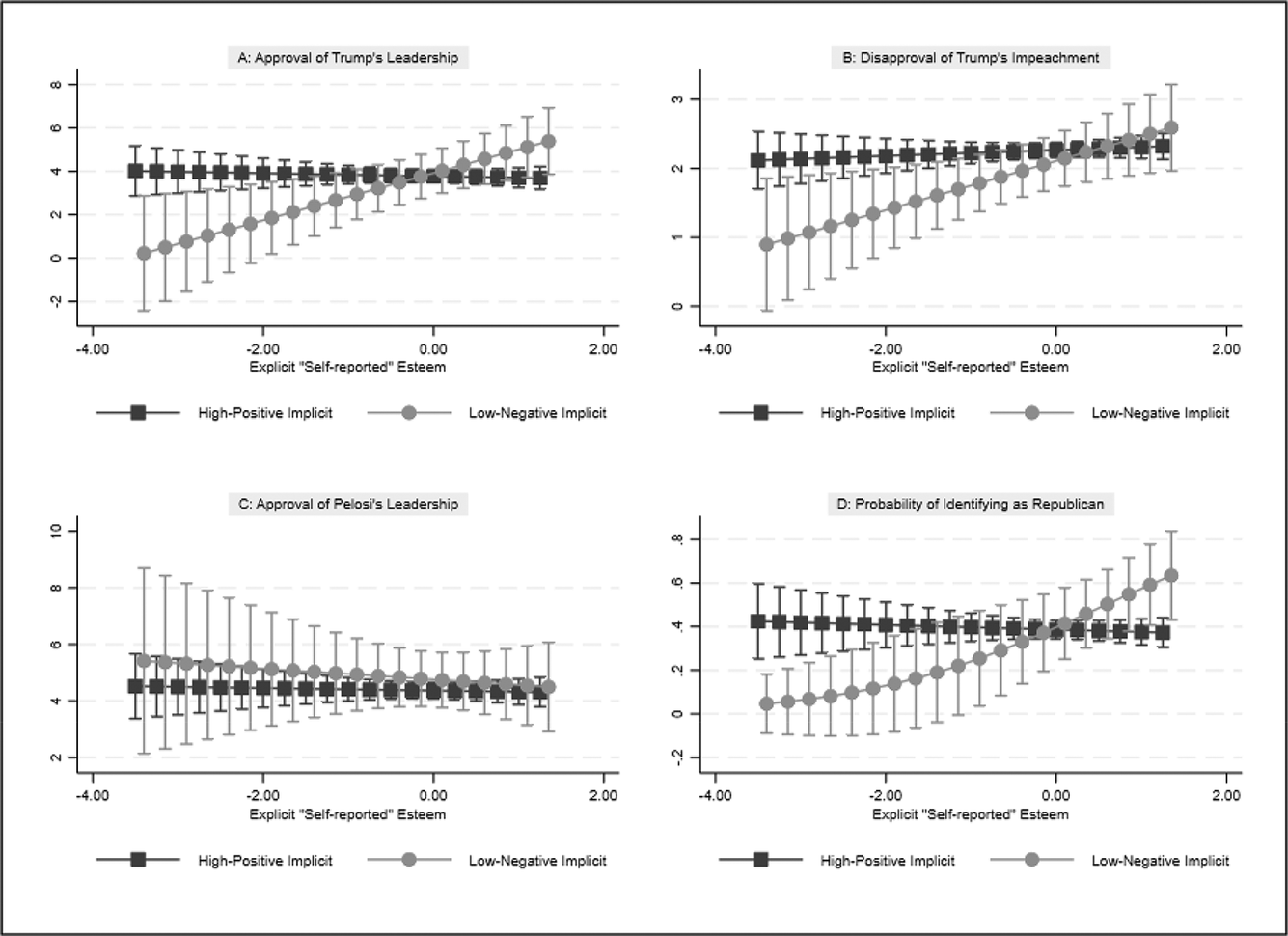
As before, and contrary to H 7 , we find no significant interaction between fragile self-esteem and respondents’ gender on any of these measures (see Appendix U). This reinforces the notion that fragile self-esteem may shape negative attitudes toward out-groups among both men and women. Exploratory analyses in Appendix AI, which employ a measure of attitudes toward immigrants as the dependent variable, provides further support for this. Aligned with a growing literature linking out-group animosity to broader political attitudes and behavior (Mason, Wronski, and Kane Reference Mason, Wronski and Kane2021; Valentino, Wayne, and Oceno Reference Valentino, Wayne and Oceno2018), our findings suggest that certain personality traits, including fragile self-esteem, may be at the root of negative attitudes toward out-groups.
Conclusion
We employ data from an online survey of U.S. adults to examine the role of an underexplored set of personality traits—fragile versus secure self-esteem—in shaping sexist attitudes and explicitly and non-explicitly gendered political preferences. In contrast with previous research which assessed the relationship between insecurity and attitudes toward women by priming threats to identity, the measure utilized in this study provides a more direct estimate of insecure personality that exists in the absence of a primed threat. As indicated by our findings, this measure allows us to capture a key yet underexplored psychological motivation underpinning sexist attitudes and gendered political preferences.
Specifically, we find that, compared to secure self-esteem, fragile self-esteem is positively associated with hostile—but not benevolent—sexism. Consistent with our expectations about fragile self-esteem’s role in shaping attitudes toward out-groups, we find that while this association is strongly observed in men, there is no evidence of this effect in women.
Fragile self-esteem is also associated with gendered political preferences among men and women respondents. That is, compared to secure self-esteem in both men and women respondents, fragile self-esteem is associated with preferences for men in leadership. In addition, fragile self-esteem in both men and women is associated with non-explicitly gendered preferences, including approval for President Trump’s leadership, disagreement with President Trump’s first impeachment, and Republican partisanship. The role of fragile self-esteem in shaping men’s and women’s leadership preferences suggests that broader out-group animosity (e.g., women’s negative attitudes toward immigrants and their perceptions that men politicians, Trump, and the Republican Party are better able to deliver on these preferences) may underpin our results.
While fragile self-esteem is present in only a small percentage of individuals in the population, our results suggest that this psychological trait may be important for understanding the development and persistence of gendered (and broader out-group) attitudes within the population and that greater attention must be given to how the psychological facets of identity influences politics. Our results also indicate that political science should give greater attention to how the pursuit of security, both physical and psychological, affects individuals’ sociopolitical attitudes and preferences. As our results on women respondents suggest, our measure of fragile self-esteem may prove useful for studying the psychological motivations of otherness and predicting individuals more likely to hold prejudicial attitudes toward a variety of out-groups.
Our work also contributes to ongoing efforts to improve measures of personality traits in surveys. As recent scholarship shows, when answering surveys, individuals possibly align their answers to explicit questions about personality traits to their political preferences (Bakker, Lelkes, and Malka Reference Bakker, Lelkes and Malka2021). Conversely, it is also possible that what someone says in surveys and what someone feels are not necessarily equivalent. In the current study, it is precisely the error between explicit and implicit scales that offers significant explanatory insight into individuals’ attitudes. Instead of a problem, discordance in measurement may provide windows of opportunity for capturing hard-to-measure individual-level characteristics—offering possibilities for political scientists to investigate how complex psychological traits influence political phenomena.
As we convey throughout, however, there are challenges in centering the study of political preferences in complex psychological characteristics—and our study faces several limitations. As is largely known, not observing a statistical difference in preferences for leadership among men and women respondents does not mean that the factors underlying these preferences are the same for men and women. In fact, we believe that men’s out-group hostility toward women (and potentially other groups) and women’s hostility to other out-groups (e.g., immigrants) may be underpinning our null results for H 5 and H 7 . Our ability to disentangle these mechanisms in the current study are limited; further work could investigate the ways in which fragile self-esteem interacts with individuals’ different identities to shape out-group hostility and broader political attitudes. We acknowledge that some other psychological mechanism may be responsible for the similarity in men’s and women’s attitudes. For example, men and women with fragile self-esteem may feel more psychologically secure with having men in leadership. Further research to disentangle these mechanisms is required. Additionally, as a rare personality trait in the general population, it is difficult to recruit a large group of participants who display fragile self-esteem. Future studies on fragile self-esteem will benefit from using larger and comparative samples which allow for more detailed investigation of gendered effects, as well as interactions with other identity and psychological traits.
Supplementary Materials
To view supplementary material for this article, please visit http://doi.org/10.1017/S1743923X22000083.


 Open access

