Historical context
It is estimated that at least 30–35 000 Polish citizens of the pre-war Pomeranian province, Poland, were executed by the Nazis during October and November of 1939 (Bojarska Reference Bojarska1972). This massacre became known as the Pomeranian Crime of 1939 (Ceran Reference Ceran2018). During the first months of the Second World War, 12 000 people were killed in the forests around Piaśnica. Similarly, forests near Szpęgawsk were used by the Nazis to hide the bodies of 7000 victims. Some Polish historians point out that the crimes should be understood as the prelude to later Nazi genocides committed during the Second World War (Steyer Reference Steyer1967). One of the approximately 400 sites that saw mass executions during the bloody autumn of 1939 in the Pomeranian province was located on the northern outskirts of Chojnice. Due to the mass killings that took place in this area, local people named the site ‘Death Valley’.
A further massacre occurred on the northern outskirts of Chojnice in 1945. As one witness testified after the war, a column of approximately 600 Polish prisoners from Bydgoszcz, Toruń, Grudziądz and neighbouring villages, under the escort of the Gestapo, was taken to Death Valley during the second half of January 1945. They were executed there, and the witness speculated that the bodies of the victims were burned to cover up the evidence. Although exhumations were carried out in the autumn of 1945 and the remains of 168 people were found, it was evident from the exhumation reports that not all human remains were discovered and exhumed. Discovering, mapping and analysing the material remains of these crimes from the Second World War were among the aims of the project ‘An archaeology of Death Valley’.
Evidence of Nazi Germany's crimes in Death Valley
Our research consisted of five stages: 1) desk-based investigation (archival research); 2) ethnographic research; 3) above-ground, non-invasive archaeological research; 4) below-ground, non-invasive archaeological research; and 5) test excavations (see also Sturdy Colls Reference Sturdy Colls2015).
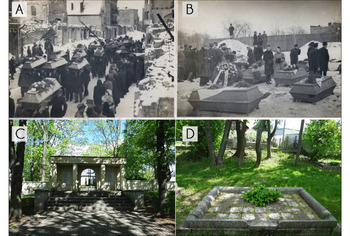
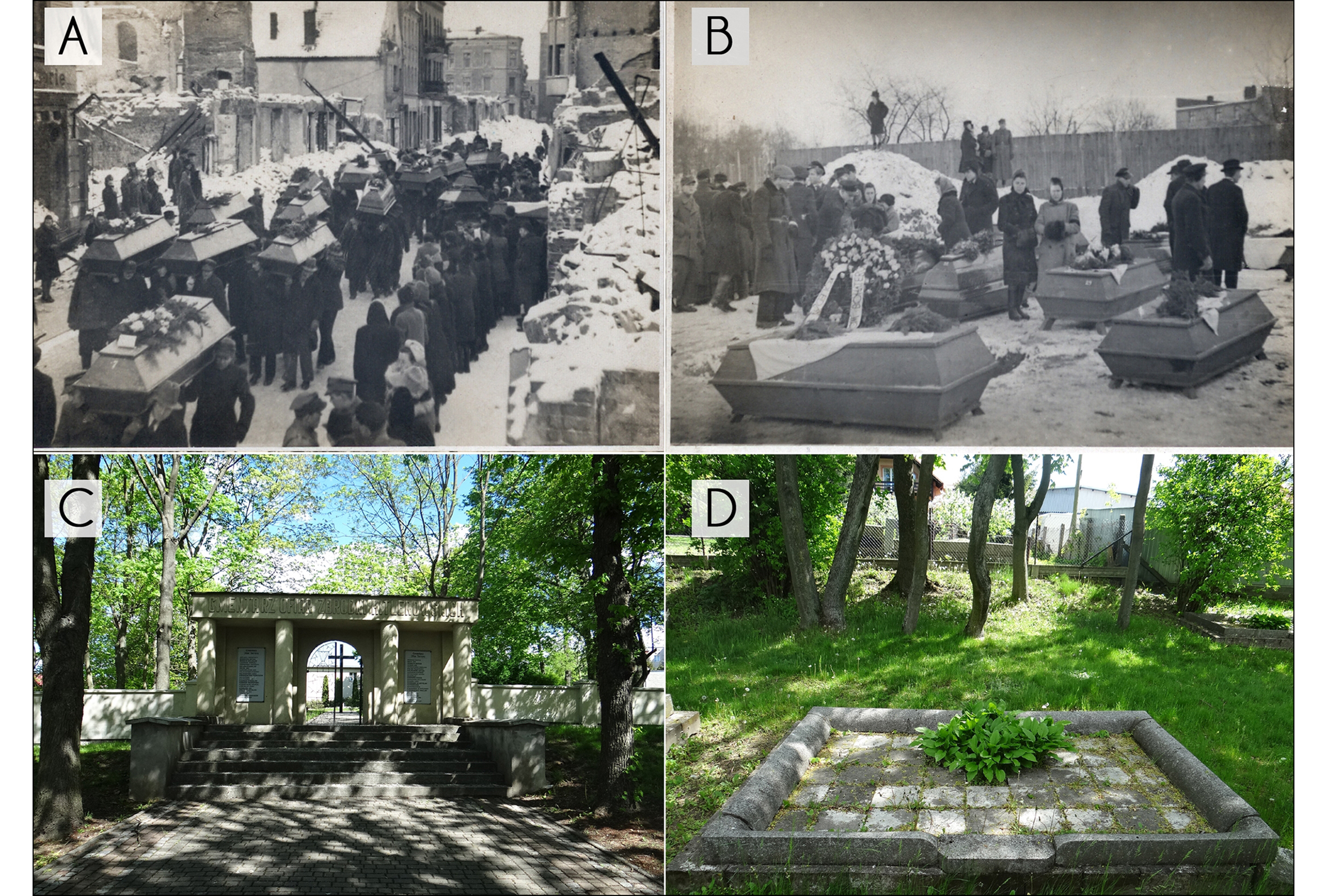
Archival research in Polish institutions enabled us to analyse more than 1000 pages of documentation related to Nazi mass killings in Chojnice: attempts to discover mass graves, reports from exhumations and records related to official burials of the victims at the Cemetery of the Victims of Nazi Crimes in Chojnice (Figure 1).
The heritage of the Pomeranian Crime of 1939: A–B) photographs of the funeral of victims murdered in ‘Death Valley’ (source: Historical-Ethnographic Museum of Julian Rydzkowski in Chojnice); C) gateway to the Cemetery of the Victims of Nazi Crimes in Chojnice (photograph by D. Kobiałka); D) one of the mass graves in the Cemetery of the Victims of Nazi Crimes in Chojnice (photograph by D. Kobiałka).
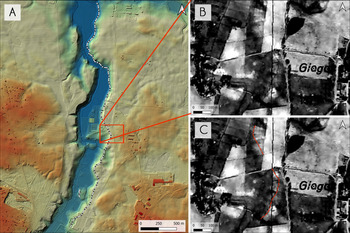
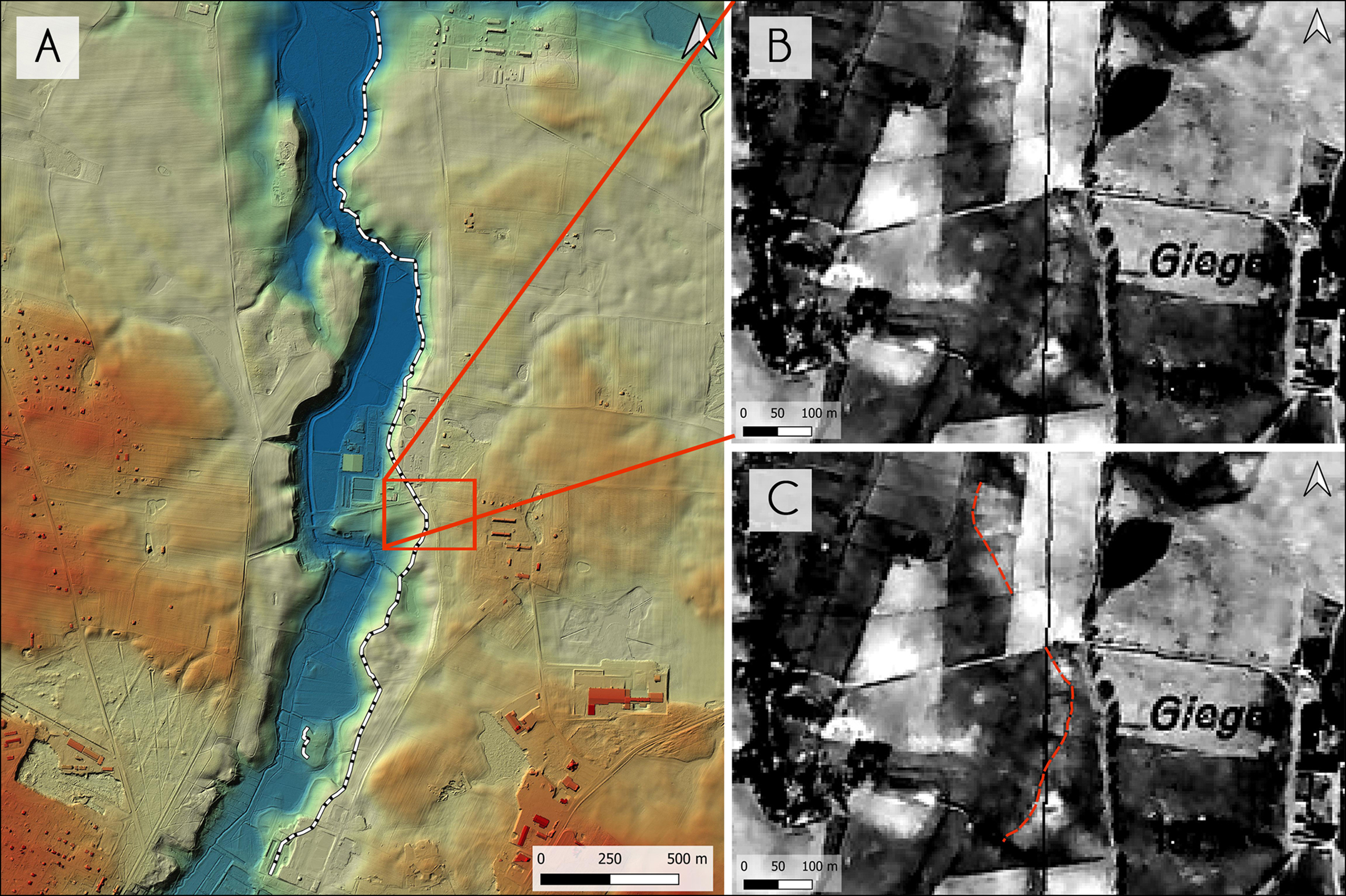
Archaeological field investigations combined non-invasive methods and excavation. Lidar derivatives were prepared and these were analysed alongside historical aerial images. This allowed us to document a line of preparatory trenches dug by the Polish Army in case of war with the Third Reich. A few months after they were dug, these trenches were used by the Nazis to hide the bodies of their victims. Executions took place at the trenches. The victims fell into the trenches or their bodies were thrown there by the perpetrators. Later the trenches were backfilled with soil (Figure 2).
Trenches used as mass graves by the Germans in ‘Death Valley’ in 1939: A) reconstruction of a line of trenches based on lidar data (prepared by M. Kostyrko); B) aerial image documenting a line of trenches in Death Valley in 1940 (source: Bunderarchiv); C) a red dashed line indicates a line of trenches in Death Valley (source: Bunderachiv, prepared by M. Kostyrko).
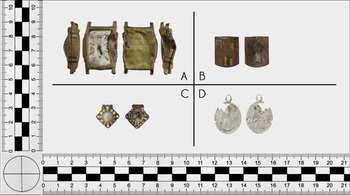
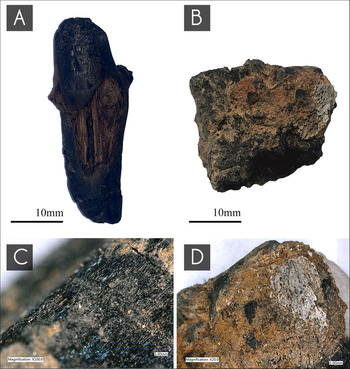
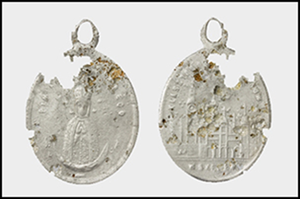
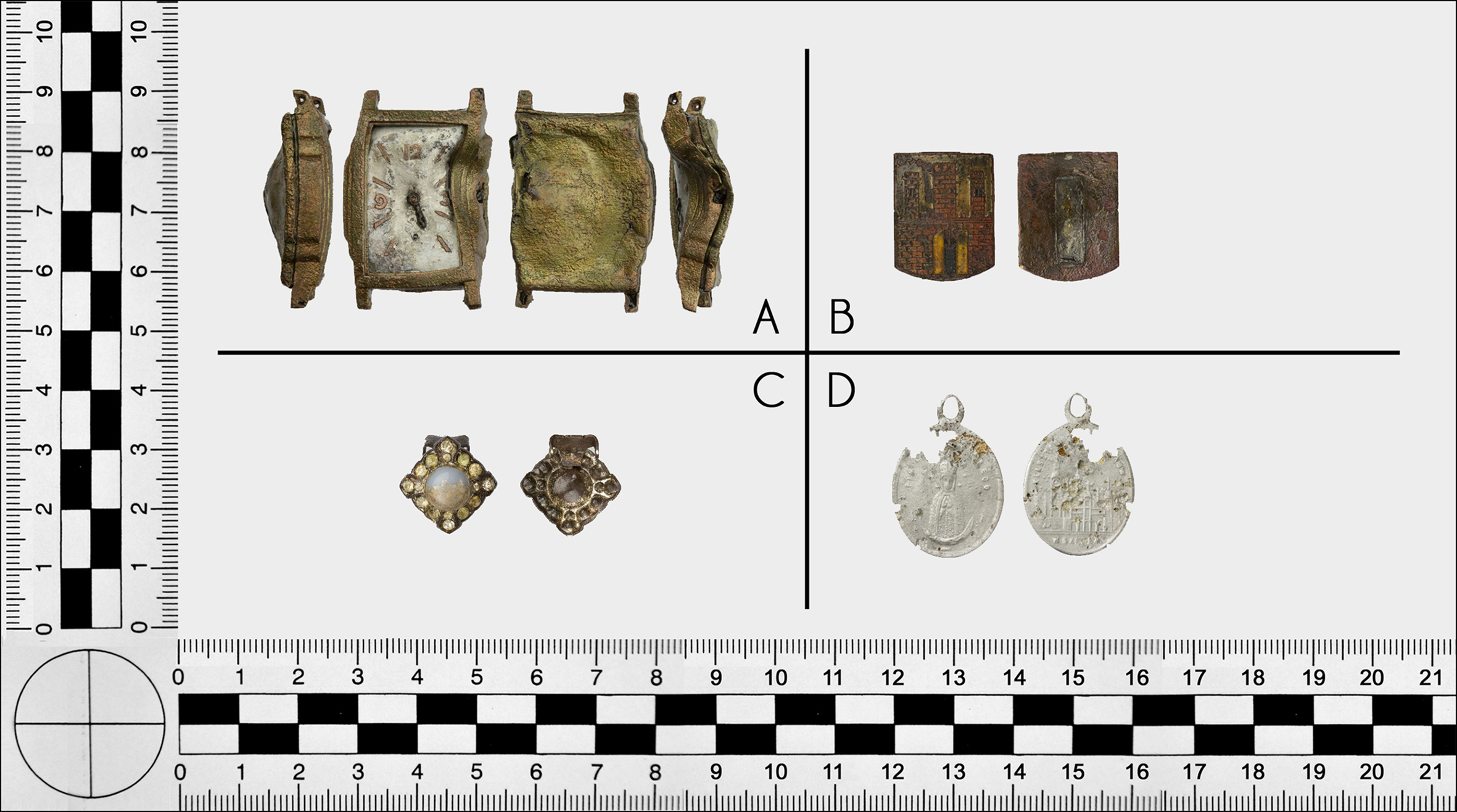
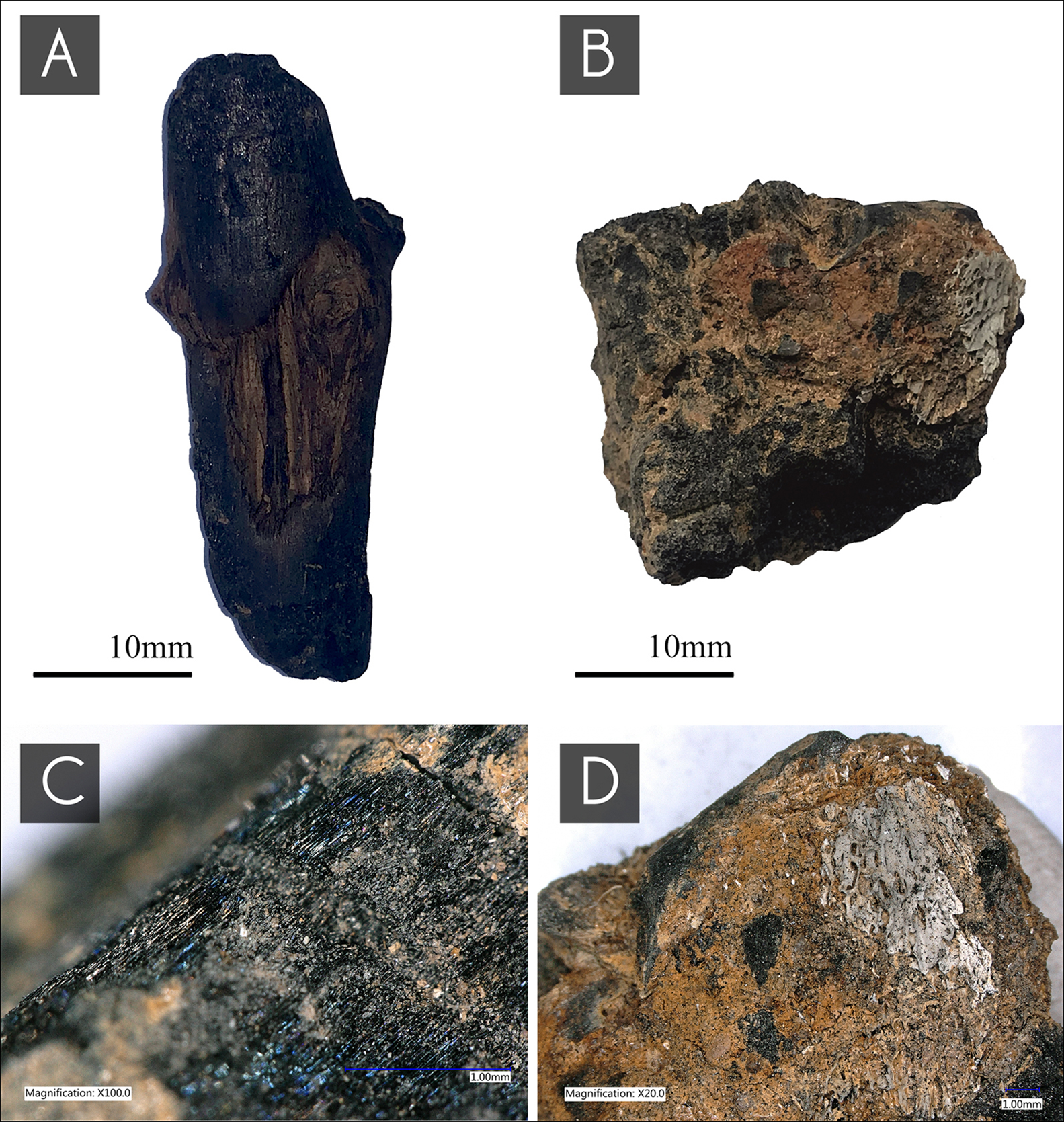
An area of almost 4ha was the subject of geophysical surveys (ground-penetrating radar, an electromagnetic survey and a resistivity survey). Many anomalies were documented. Without doubt, some of these can be linked with the massacres in Death Valley during the Second World War. Metal-detector surveys were also a crucial element of our project. Eight test trenches were opened at various locations on the northern outskirts of Chojnice. A total of 349 artefacts was discovered during the field research. Musket bullets and civilian buttons are among the finds that can be dated to the nineteenth century. Most objects, however, must be interpreted in the context of mass killings from the autumn of 1939 and the second half of January 1945, evidenced by personal belongings of the victims (Figure 3) as well as objects lost by the Nazis, together with various bullet and shell casings. We located the spot where the victims from January 1945 were killed and are believed to have been burned in a stack formation. Preserved fragments of wood confirm the accuracy of the witness testimonies, according to which the bodies, and the stack, were doused with a flammable substance and set on fire (Figure 4). The presence of valuable items belonging to the victims demonstrates that the bodies were not robbed; these artefacts also allow the possibility of identifying individuals through their possessions.
Personal belongings of the victims murdered in ‘Death Valley’ in the second half of January 1945: A) wristwatch; B) badge with crest of Toruń; C) earring (written records suggest women were among the victims killed in Death Valley); D) holy medal (photographs by A. Barejko).
Examples of charred wood (A–B) used to build a stack on which the bodies of victims were burned; C) blue stains on the wood are left by a flammable substance; D) fragments of burned human bones preserved on the surface of the wood (photograph by J. Rennwanz).
The discovery of the cremated bones of victims is the most important result of the project. They were even located (scattered) on the surface of the ground. The archival research yielded a list of potential victims known to have been taken to Death Valley in the second half of 1945. The column probably consisted mostly of members of the Polish resistance movement. We hope to be able to tell some of the families what happened to their relatives who, for decades, were assumed to have vanished without trace in Chojnice in January 1945. The human remains were examined by a physical anthropologist and forensic medical expert. Attempts to identify the victims through DNA sampling are also planned. After examination and analysis, the remains will be reburied in Death Valley and the site will become an official war cemetery.
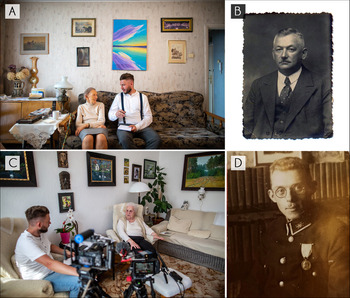
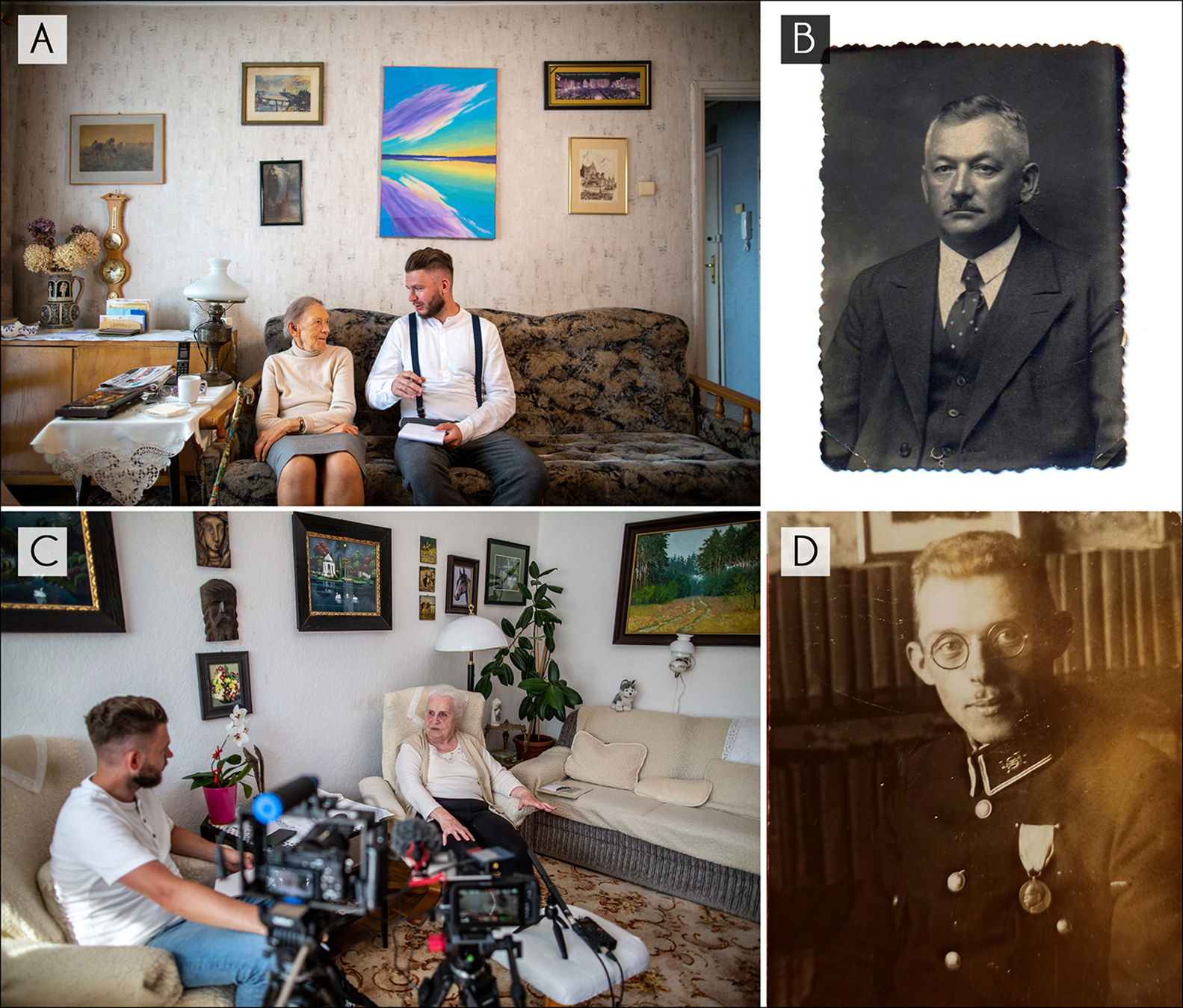
The final component of the project consisted of engagement with the local community, both in the provision of ‘living lessons of archaeology in Death Valley’ to exchange knowledge about the massacre and the project research, and in ethnographic field research. The citizens of Chojnice were interviewed and many unpublished memories and written records, as well as photographs of the victims, were documented. These supplement and complement information gathered during the research (Figure 5).
Ethnographic research: A) Urszula Steinke, who lost her father in 1939 in ‘Death Valley’, with author Dawid Kobiałka (photograph by D. Frymark); B) Alojzy Słomiński, the father of Urszula Steinke (source: U. Steinke's private archive); C) Aleksandra Lubińska, who lost her father in 1939 in Death Valley, with author Dawid Kobiałka (photograph by D. Frymark); D) Władysław Kręcki, the father of Aleksandra Lubińska (source: A. Lubińska's private archive).
Conclusion
Wojciech Buchholc, describing Nazi Germany's crimes in Chojnice during the Second World War, had a deeply phenomenological understanding of the northern outskirts of the town: “One cannot be here alone for a long time. One experiences some mysterious fear and anxiety” (Reference Buchholc1947: 27; authors’ translation). He also noted that the events will be remembered through the very materiality of the local landscape. Indeed, fragments of that surviving landscape—preserved Polish trenches from 1939—were documented during the field research and material evidence of the massacre of January 1945, such as the personal belongings of the victims, bullets, shell casings, burned wood and cremated human ashes, were discovered during the undertaking of the project. Despite the Nazis' efforts to hide their crimes, material evidence of the killings, preserved to the present day and discovered in 2020, bears witness to the massacre and tells the story 75 years later.
The discoveries at Death Valley have resulted in the opening of an official prosecution case by the National Institute of Remembrance, Poland, against those responsible for the massacre. Although the perpetrators are most likely dead, their crimes will not be forgotten.
Funding statement
This project was financed by the Ministry of Culture and National Heritage, Poland (02359/20/FPK/DDK).