




Non-technical Summary
The free-living, stalkless comatulids make up the bulk of living crinoid diversity and are the only crinoids remaining in shallow water, but compared to the stalked crinoids their fossil record is fragmentary and understudied, especially outside Europe. We present new Albian (113–100.5 million years old) fossil comatulids from the Glen Rose Formation, central Texas, and study their morphology and evolutionary relationships. New material comprises the previously described species Decameros wertheimi and Semiometra klari?, the new species Semiometra alveoradiata n. sp., and a new genus and species Castaneametra hodgesi n. gen. n. sp. In addition to being exceptionally variable, this species is the largest known comatulid, has the most cirri (claw-like appendages with which comatulids hold onto the substrate) of any known comatulid, and exhibits odd features otherwise unknown in comatulids. We infer how it lived and how it is related to other comatulids, argue for its origin from small Semiometra-like ancestors in a brief Albian North American radiation, and suggest new interpretations of early comatulid relationships based on our findings. Respiratory demands associated with large size, along an evolutionary lengthening of development time, may explain some features of this strange, giant new species.
UUID: http://zoobank.org/c684e652-c03c-4963-8daa-ccf26b64d73c
Introduction
Comatulid crinoids or feather stars make up most of the known diversity of crinoids today and are the only crinoids present in shallow water, being prominent members of coral reef communities in the Caribbean and especially the Indo-West Pacific (Messing, Reference Messing, Waters and Maples1997). Comatulids are characterized by the loss of a fixed stalk during development and the formation instead of a relatively large, cirrus-bearing ossicle called the centrodorsal (although several lineages have apparently reverted to the stalked condition through paedomorphosis; Rouse et al., Reference Rouse, Jermiin, Wilson, Eeckhaut and Lanterbecq2013). By comparison with the Recent fauna, their fossil record remains patchy and poorly known, with some indication that their record is under sampled relative to other crinoids (Purens, Reference Purens2016).
Fossil comatulids are only rarely preserved with more than the elements of the calyx intact (e.g., Shibata and Oji, Reference Shibata and Oji2007; Baumiller and Fordyce, Reference Baumiller and Fordyce2018; Eléaume et al., Reference Eléaume, Roux and Philippe2020), and usually are represented only by one element of the calyx, the centrodorsal. The taxonomy of fossil comatulids relies heavily on this single element, whereas much of modern comatulid taxonomy references the arms, pinnules, and cirri. Due to this incommensurability, most extinct taxa are without clear affinities to modern groups, especially in the Mesozoic (Ausich et al., Reference Ausich, Mironov, Eléaume and Hess2011).
Given the emerging consensus from molecular phylogenetics on the relationships among living comatulids (Hemery et al., Reference Hemery, Roux, Ameziane and Eléaume2013; Rouse et al., Reference Rouse, Jermiin, Wilson, Eeckhaut and Lanterbecq2013; Taylor et al., Reference Taylor, Rouse and Messing2023), the fossil record of this group would benefit greatly from new, systematically valuable characters; computed tomography may be especially valuable in this regard (Saulsbury, Reference Saulsbury2020; Saulsbury and Zamora, Reference Saulsbury and Zamora2020). Finally, the comatulid record suffers from geographic disparities in attention (Saulsbury and Baumiller, Reference Saulsbury and Baumiller2022). Their fossils are restricted to Europe and North Africa (Salamon et al., Reference Salamon, Jain, Brachaniec, Duda, Płachno and Gorzelak2022) during the Jurassic and first appear outside of the West Tethys in the Cretaceous of the Americas, but these western hemisphere faunas provide only a limited window into the fauna of the young Atlantic. They comprise the putative palaeantedonid Roiometra Clark, Reference Clark1944, from the Albian of the Villeta Group near Naranjillo, Cundinamarca, Colombia, the notocrinid Loriolometra Gislén, Reference Gislén1924, from the Duck Creek Formation near the top of the Albian in the vicinity of Fort Worth, Texas (Nestell and Tenery, Reference Nestell and Tenery1988), and Decameros d'Orbigny, Reference d'Orbigny1850, and Semiometra Gislén, Reference Gislén1924, from a limestone cave in the latest Aptian–Albian Glen Rose Formation between Austin and San Antonio, Texas (Peck and Watkins, Reference Peck and Watkins1972), about 200 feet below the Salenia texana Zone (see below).
We present new fossil comatulids from the lower member of the Glen Rose Formation (Fig. 1), including a new genus and species representing the largest known comatulid by centrodorsal size. New specimens come from 15 localities between Austin and San Antonio representing one of two marker beds from lower Glen Rose unit 2, or else the undifferentiated lower member or lower member unit 2. Localities 1, 6, and 10 correspond to the Salenia texana Zone at the top of Unit 2. This roughly 2-meter-thick bed is situated just below the bivalve-rich Corbula bed that defines the boundary between the upper and lower members of the Glen Rose and is considered to coincide with the maximum flooding surface for the higher-order “K2” sequence encompassing the entire Glen Rose Formation (Scott et al., Reference Scott, Molineux, Löser, Mancini and Scott2007; Smith and Rader, Reference Smith and Rader2009). The Salenia texana Zone yields the highest species diversity of the Glen Rose Formation (Ward and Ward, Reference Ward, Ward and Scott2007), including well-preserved whole fossils of echinoids, bivalves, gastropods, orbitolinid foraminifers, the distinctive alga Porocystis, and encrusting bryozoans (Smith and Rader, Reference Smith and Rader2009; Martha et al., Reference Martha, Taylor and Rader2019).
Map of south-central Texas showing localities where comatulids were collected, along with the extent of the upper and lower members of the Glen Rose Formation. The exact positions of localities 1 and 5 are uncertain. Geologic map derived from (Stricklin et al., Reference Stricklin, Smith and Lozo1971) and (Peters et al., Reference Peters, Husson and Czaplewski2018).
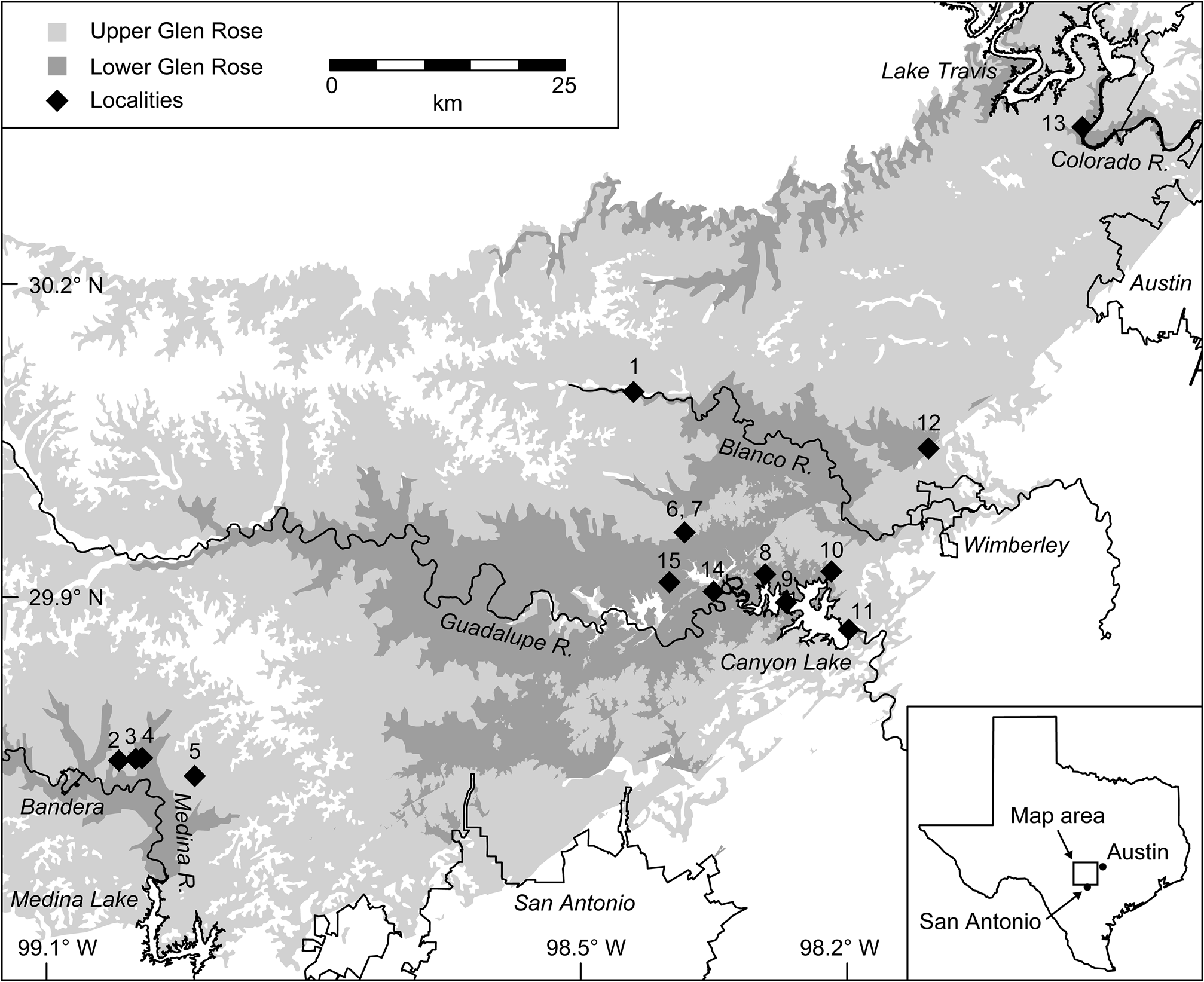
The Salenia texana Zone is thought to represent an open marine, soft-bottom, deeper shelf setting (Smith and Rader, Reference Smith and Rader2009). Localities 9, 14, and 15 correspond to the echinoid marker bed, one cycle down from the Salenia texana Zone at the base of lower Glen Rose unit 2. The echinoid marker bed corresponds to a maximum flooding surface in the lower-order “C2” cycle and was inferred by Smith and Rader (Reference Smith and Rader2009) to represent a perireefal, firm- or hard-bottom habitat. All Semiometra, and a single specimen of the new genus and species, come from these echinoid marker bed sites. Other localities discussed in this paper are not as well constrained stratigraphically but are all close in space to the boundary between the lower and upper Glen Rose (Fig. 1). The Aptian–Albian boundary occurs within unit 1 of the lower Glen Rose, suggesting an Albian (113–100.5 Ma) age for all comatulids.
We present new material from four species: two have been previously described by Peck and Watkins (Reference Peck and Watkins1972), one is a new species of Semiometra, and the last is a bizarre form known to collectors for over half a century, warranting placement in a new genus in the Notocrinidae and representing the largest known comatulid based on centrodorsal size. We use morphometry, computed tomography, cladistic analysis, and comparison with living forms to explore its paleobiology and phylogenetic affinities. Our findings highlight principles of scaling in crinoids and suggest substantial reinterpretations of phylogeny among early comatulids.
Materials and methods
Study of specimens
Specimens were cleaned ultrasonically for study with photography, microscopy, scanning electron microscopy (SEM), and X-ray micro-computed tomography (μCT). We used a Leica M165 C digital stereo microscope for microphotography. Specimens chosen for SEM study were sputter coated with gold and visualized with a JEOL JSM-7800FLV Scanning Electron Microscope. Specimens chosen for μCT study were scanned at the University of Michigan Computed Tomography in Earth and Environmental Science (CTEES) facility with a Nikon 62 XT H 225ST industrial μCT system using a tungsten reflection target. Scan settings were 70–110 kV and 100–200 μA, with resolutions of (8–40μm). Reconstructed scans were studied and rendered using AMIRA 5.2.2 (TGS Software, San Diego, CA).
We used morphometric study of well-preserved specimens of Castaneametra hodgesi n. gen. n. sp. to test whether this highly variable form could be reasonably subdivided or whether any variation could be ascribed to geography or allometry. Linear measurements were taken with calipers, and volume was measured by immersing specimens in water. We tested for allometry by regressing the logs of various measurements against log centrodorsal diameter and using likelihood ratio tests to compare an unconstrained linear model against one in which the slope was fixed to represent isometric scaling.
Phylogenetic inference
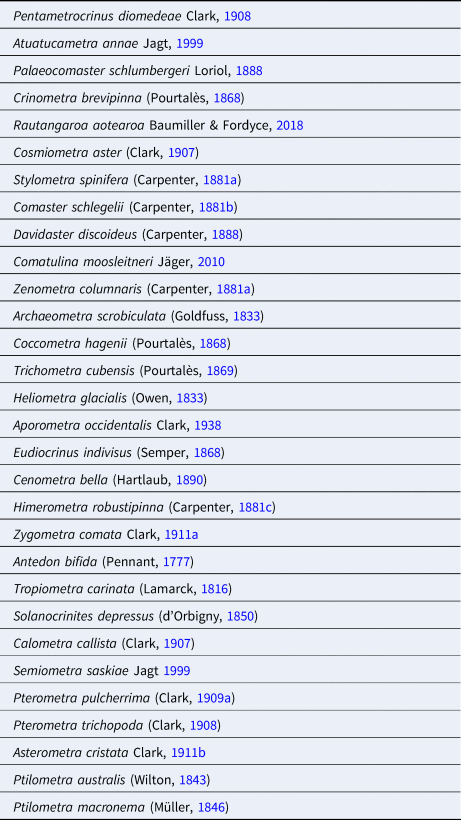
We used TNT v1.1 (Goloboff et al., Reference Goloboff, Farris and Nixon2003) to infer the phylogenetic affinities of the Glen Rose comatulid fauna using maximum parsimony on a character matrix of 24 continuous and 32 discrete characters for 24 extant and 15 extinct comatulid species (Table 1). Our approach follows and builds on that of Saulsbury and Baumiller (Reference Saulsbury and Baumiller2022): the topology of extant comatulids was fixed to that inferred under maximum likelihood for an alignment of four molecular loci, so that TNT only considered alternate placements for fossil species. No character weights were used; continuous characters were scaled such that the greatest possible distance between two taxa for a continuous character was equal to one change in a discrete character. To visualize the distribution of systematically important characters, we mapped synapomorphies on the tree for binary discrete characters relevant to the placement of Glen Rose species.
Species of comatulid crinoids utilized in phylogenetics analysis.
Repositories and institutional abbreviations
Types, figured specimens, and other specimens examined in this study are deposited in the following institutions: the Non-vertebrate Paleontology Laboratory (NPL), Austin, USA, or the Maastricht Natural History Museum (NHMM), Maastricht, the Netherlands.
Systematic paleontology
Class Crinoidea Miller, Reference Miller1821
Subclass Articulata Zittel, Reference Zittel1879
Order Comatulida Clark, Reference Clark1908
Family Decameridae Rasmussen, Reference Rasmussen, Moore and Teichert1978
Genus Decameros d'Orbigny, Reference d'Orbigny1850
Type species
Decameros ricordeanus Rasmussen, Reference Rasmussen1961, p. 253.
Decameros wertheimi (Peck and Watkins, Reference Peck and Watkins1972)
Figure 2
- Reference Peck and Watkins1972
Solanocrinites wertheimi Peck and Watkins, p. 411, pl. 1, figs. 1–12, 17, 18, 21, 22.
- Reference Rasmussen, Moore and Teichert1978
Decameros wertheimi; Rasmussen, p. T877.
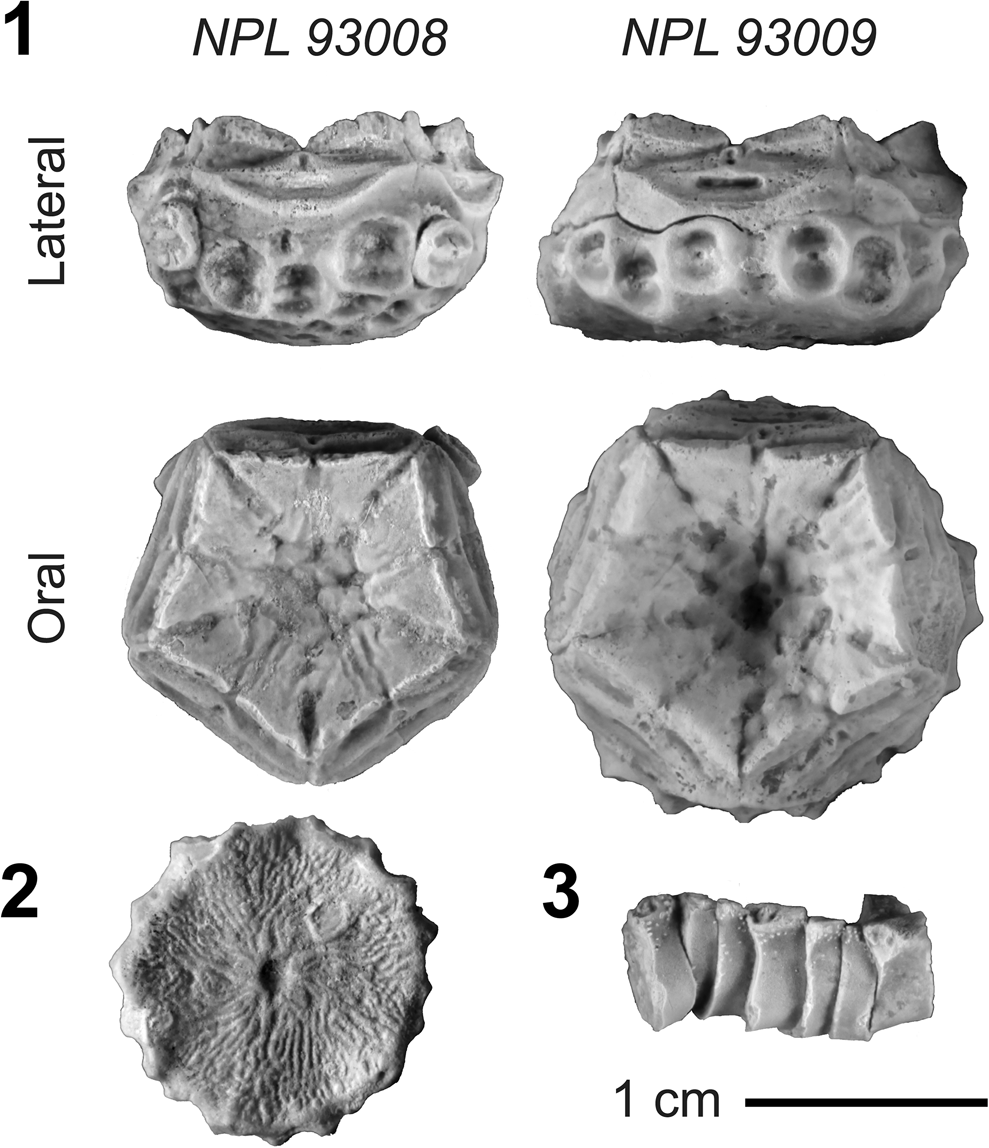
Decameros wertheimi (Peck and Watkins, Reference Peck and Watkins1972) from the Glen Rose Formation. (1) Lateral and oral aspects of two specimens, demonstrating the allometric changes in relative centrodorsal size described by (Peck and Watkins, Reference Peck and Watkins1972). (2) Oral view of centrodorsal (NPL 93016) showing extensive reticulating coelomic furrows. (3) Lateral view of arm fragment (NPL 92948) including seven articulated brachials.
Holotype
Calyx with attached cirrals (UT 45622) from the Glen Rose Formation, central Texas, USA (Peck and Watkins, Reference Peck and Watkins1972, pl. 1, figs. 9, 10).
Description
New specimens closely match the description of Peck and Watkins (Reference Peck and Watkins1972). Large comatulids, centrodorsal commonly > 1 cm in diameter (Fig. 2.1). Centrodorsal bowl-shaped in small specimens, less rounded in larger specimens. Usually only a single row of large cirrus sockets with articular tubercles on either side of cirral nerve lumen. Aboral pole of centrodorsal broad, more or less rugose, without dorsal star. Adoral side of centrodorsal carved by reticulating network of grooves corresponding to coelomic diverticulae (Fig. 2.2). Centrodorsal cavity tiny. Basals robust and rhomboid, visible in the radial cavity, about 30% of the diameter of the radial ring. Radials with free surface, without pronounced ornamentation. No subradial cleft. Aboral ligament pit wide, as much as one-third of the width of the fulcral ridge. Broad, conical radial cavity. Brachials joined only by muscular articulations, without syzygies or synarthries (Fig. 2.3).
Materials
Centrodorsals, calyces (centrodorsals with articulated radial rings), and arm fragments; 25 specimens: NPL 92894, 92948, 92956–92960, 93008–93019, 93027, 103187–103191.
Remarks
New specimens confirm the remarks by Peck and Watkins (Reference Peck and Watkins1972) regarding allometry within this species: the free surface of the radials is fully obscured in small specimens but partly obscured in large ones; small calyces are almost as tall as they are wide but large specimens are wider; and the centrodorsal is bowl-shaped in small specimens and disc-shaped in large ones. These allometric trends are paralleled in the congener Decameros ricordeanus d'Orbigny, Reference d'Orbigny1850 (Saulsbury and Zamora, Reference Saulsbury and Zamora2020).
Family Notocrinidae Mortensen, Reference Mortensen1918
Genus Semiometra Gislén, Reference Gislén1924
Type species
Antedon impressa Carpenter, Reference Carpenter1881d, p. 135.
Semiometra klari? Peck and Watkins, Reference Peck and Watkins1972
Figures 3, 4.1, 4.3, 4.5
- Reference Peck and Watkins1972
Semiometra minuta Peck and Watkins, p. 413, pl. 1, figs. 13–15, 19, 20.
- Reference Peck and Watkins1975
Semiometra klari; Peck and Watkins, Reference Peck and Watkins1975, p. 426.
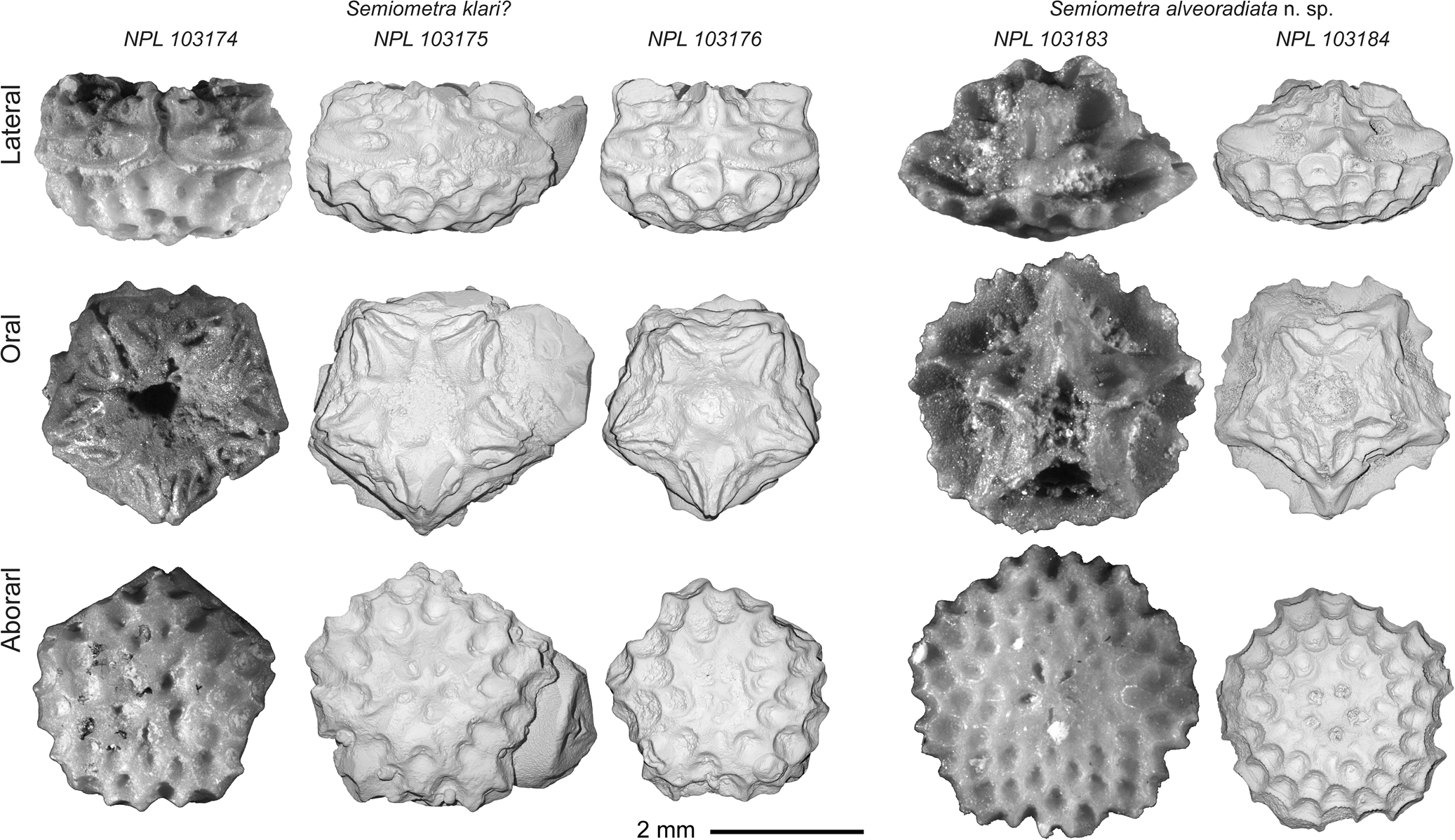
Semiometra from the Glen Rose Formation in lateral, oral, and aboral aspects. Includes photographs (NPL 103174, NPL 103183, holotype) and renders of 3D models generated from CT scans (NPL 103175–103176, NPL 103184, paratype).
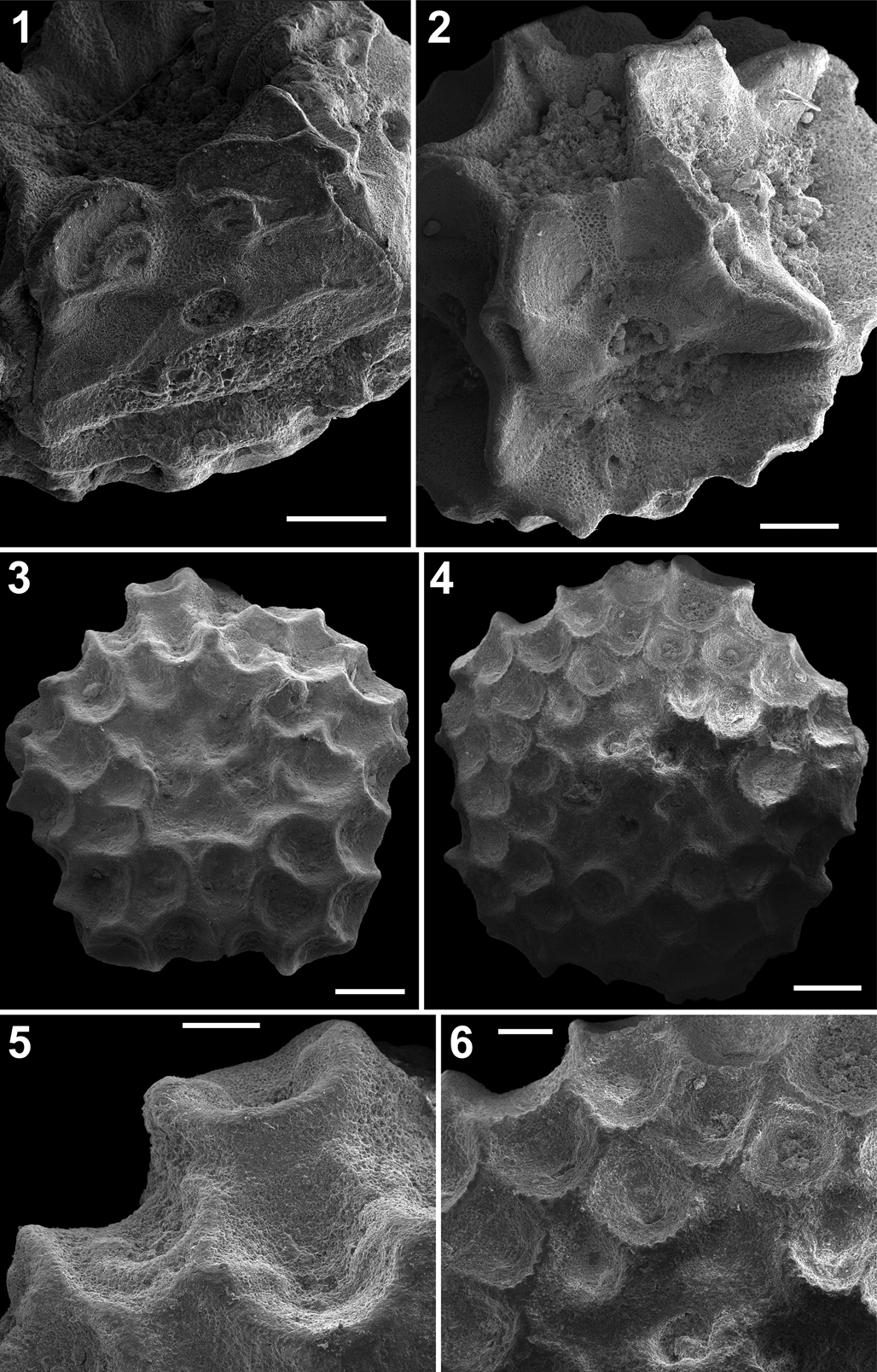
SEM images of Semiometra klari? (1, NPL 103175; 3, 5, NPL 103179) and Semiometra alveoradiata n. sp. (2, NPL 103183, holotype; 4, 6, NPL 103184, paratype). (1, 2) Radials, oblique view. Scale bars = 500 μm. (3, 4) Centrodorsals, aboral view. Scale bars = 500 μm. (5, 6) Cirral sockets, aboral view. Scale bars = 200 μm.
Holotype
Calyx with attached arms (UT 45632) from the Glen Rose Formation, central Texas, USA (Peck and Watkins, Reference Peck and Watkins1972, pl. 1, figs. 19, 20).
Description
Centrodorsal 1.8–2.8 mm in diameter, 0.8–1.3 mm in height, more bowl-shaped than disc-shaped (Fig. 3). Cirrus-free aboral pole about one-third of the diameter of the centrodorsal, typically with a depression in the center (Fig. 4.3). Cirrus sockets large for the genus, up to 0.5 mm in diameter. Cirrus sockets slightly protruding, without marginal crenulae, with faint tubercles to left and right of cirral nerve lumen (Fig. 4.5). On average two rows of cirrus sockets. Subradial cleft present; each subradial cleft is connected by internal canals with one radial pit adorally and one cavity of the dorsal star aborally. Radials without free surface. Radial faces nearly parallel with oral-aboral axis, creating a broad radial cavity. Muscle fossae separated from adoral ligament fossae by prominent knobs (Fig. 4.1) on either side of ambulacral groove. Ibr1-2 synarthrial.
Materials
Three radial rings (NPL 103180–103182) and 6 complete calyces (NPL 103174–103179), including one with attached Ibr1 (NPL 103175).
Remarks
This material is difficult to compare with Semiometra klari Peck and Watkins, Reference Peck and Watkins1972, because the preservation styles are very different. The latter specimens are embedded in matrix and include much of the articulated skeleton, with details of the calyx obscured by overlying arms. Nevertheless, our material matches S. klari in most respects. The centrodorsal bears a central depression in the aboral pole, cirrus sockets are in two rows and without distinct ornamentation, and the radial faces are nearly parallel to the oral-aboral axis. We note only two possible differences. The distinct knobs on the radials of our specimens (Fig. 4.1) were not observed by Peck and Watkins (Reference Peck and Watkins1972), but their specimens are somewhat worn and may not be expected to preserve subtle details like this. A more substantial difference is that, in their specimens, the radial ring extends to the edge of the centrodorsal only interradially, whereas in ours it completely covers the oral side of the centrodorsal (Fig. 3). However, in our view, this does not justify erecting a new species, given the potential of the centrodorsal to vary within species.
Types
Non-vertebrate Paleontology Lab (NPL), University of Texas, Austin. Holotype, NPL 103183. Paratype, NPL 103184. Canyon Lake Boat Ramp 7 (29.8949°N, 98.2688°W). Glen Rose Formation, lower member, unit 2.
Diagnosis
Cirrus sockets with crenulated margins, irregularly arranged in typically three rows. Centrodorsal flat rather than rounded or bowl-shaped. Aboral pole small, without central depression. Radial faces sloped back, exposing adoral surface of centrodorsal radially. Ridge between adoral ligament fossa and muscle fossa (ligamento-muscular ridge) makes a low angle with the fulcral ridge and curves adorally at the edges. Radial cavity moderate in size, one-quarter to one-third the diameter of the centrodorsal.
Occurrence
Albian, Glen Rose Formation, lower member, unit 2, echinoid marker bed (Smith and Rader, Reference Smith and Rader2009).
Description
Centrodorsal 2–3 mm in diameter and < 1 mm in height, generally low cone-shaped rather than bowl-shaped (Fig. 3). Cirrus-free aboral pole about one-third the diameter of centrodorsal (Fig. 4.4). Aboral pole comes to a point without a central depression. A few scars of defunct cirrus sockets may be seen near aboral pole. Cirrus sockets relatively small for the genus, about 1/3 mm. Cirrus sockets with conspicuous marginal crenulae but no prominent articular tubercles (Fig. 4.6). Holotype with 64 irregularly arranged cirrus sockets. Subradial cleft present, connected by canals with radial pits and dorsal star (Fig. 7.6) as in S. klari?. Radials without free surface. Radials reach edge of centrodorsal only interradially, adoral side of centrodorsal exposed over broad area. Radials high but concave and recessed, with broad muscle fossae (Fig. 4.2). Radial nerve canal oval-shaped rather than rounded rectangular as in some S. petitclerci Caillet, Reference Caillet1922. No knobs on muscle fossae as in S. klari?. Ligamento-muscular ridge between muscle fossae and adoral ligament fossae makes a low angle with the horizontal, sloping up at edges (Fig. 4.2).
Etymology
The species name combines the prefix alve- (cavity, recession) with radiata, indicating the recessed radials.
Materials
Three complete calyces, NPL 103183–103185.
Remarks
Semiometra alveoradiata n. sp. differs markedly from both the S. klari of Peck and Watkins and from our S. klari? in the concavity and size of the radials, the slope and details of the radial face, the size of and ornamentation on the cirrus sockets, and the shape of the aboral pole (Fig. 4). This form is similar to the Oxfordian S. petitclerci but differs from it in having a more rounded radial nerve canal, a broader radial cavity, and in possessing cirrus sockets with marginal crenulae. Semiometra alveoradiata n. sp. is also distinct from the Barremian S. barremiensis Jäger, Reference Jäger2010, in having a lower ligamento-muscular ridge, fewer cirrus sockets, cirrus sockets with marginal crenulae, and a broader radial cavity.
Semiometra sp.
Materials
NPL 103192; 206 centrodorsals.
Remarks
Isolated centrodorsals could not be reliably identified to species level.
Genus Castaneametra new genus
Type species
Castaneametra hodgesi new species.
Diagnosis
As for type species by monotypy.
Etymology
In its size, shape, and heft, the new form resembles the fruits of the chestnut, Castanea, and in life the many crowded, narrow cirri might have resembled a chestnut's spiny burr. The suffix -metra has been associated with comatulid genera since the description of Actinometra Müller, Reference Müller1841, whose name means approximately “radiating from the heart,” perhaps referring to the disposition of the arms (C.G. Messing, personal communication, June 2017).
Remarks
As for type species.
Castaneametra hodgesi new species
Figures 5, 6, 7.1–7.5, Supplementary Movies S1–S4
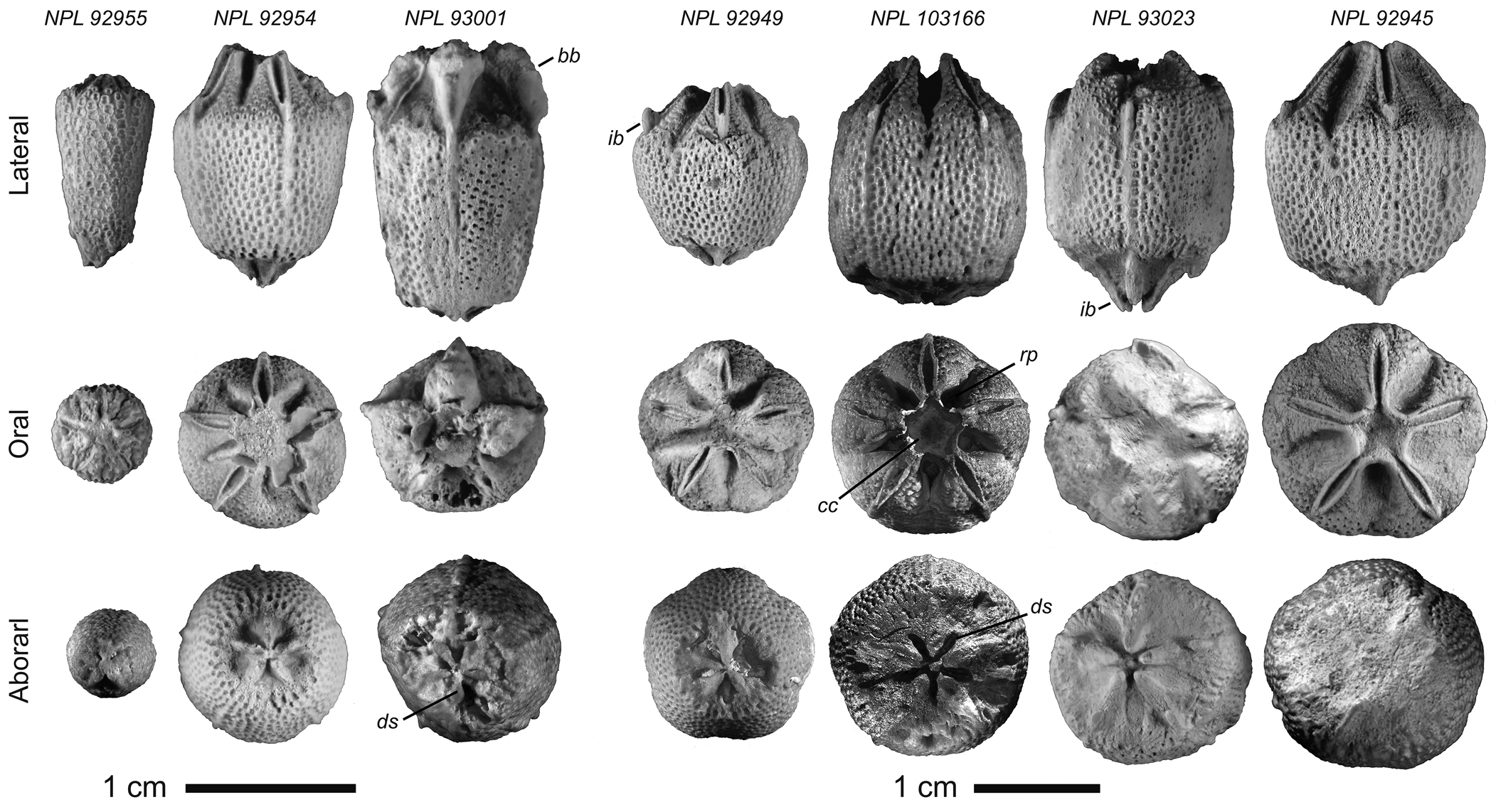
Castaneametra hodgesi n. gen. n. sp. from the Glen Rose Formation in lateral, oral, and aboral view; (holotype, NPL 93001; paratype, NPL 103166). Interradius at top and radius at bottom for oral and aboral views. bb = basals; cc = centrodorsal cavity; ds = dorsal star; ib = interradial buttresses; rp = radial pits.
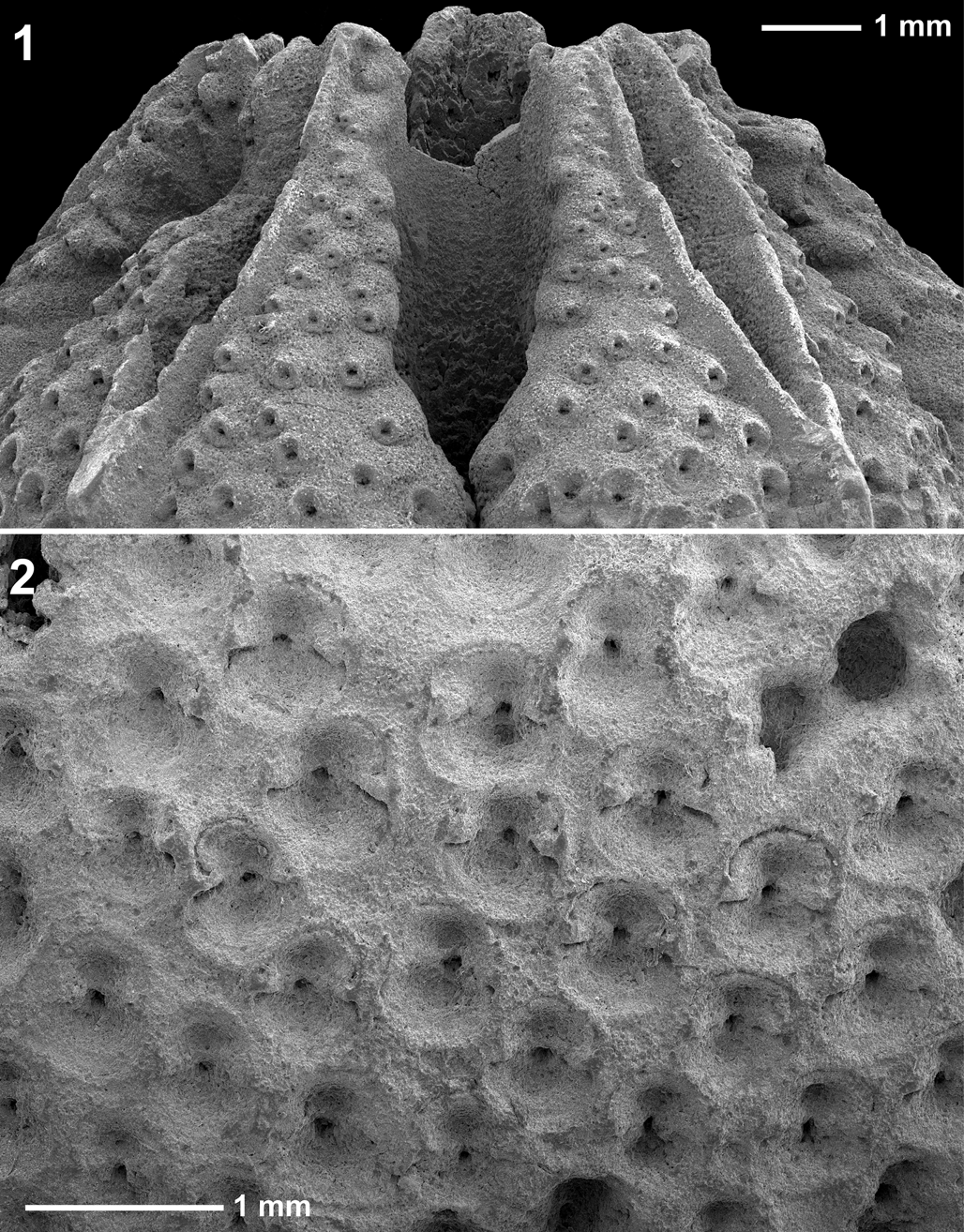
SEM images showing details of cirrus sockets in Castaneametra hodgesi n. gen. n. sp. (paratype, NPL 103166). (1) Lateral view, detail of oral end of centrodorsal showing developing cirrus sockets. (2) Lateral view, detail showing mature cirrus sockets.
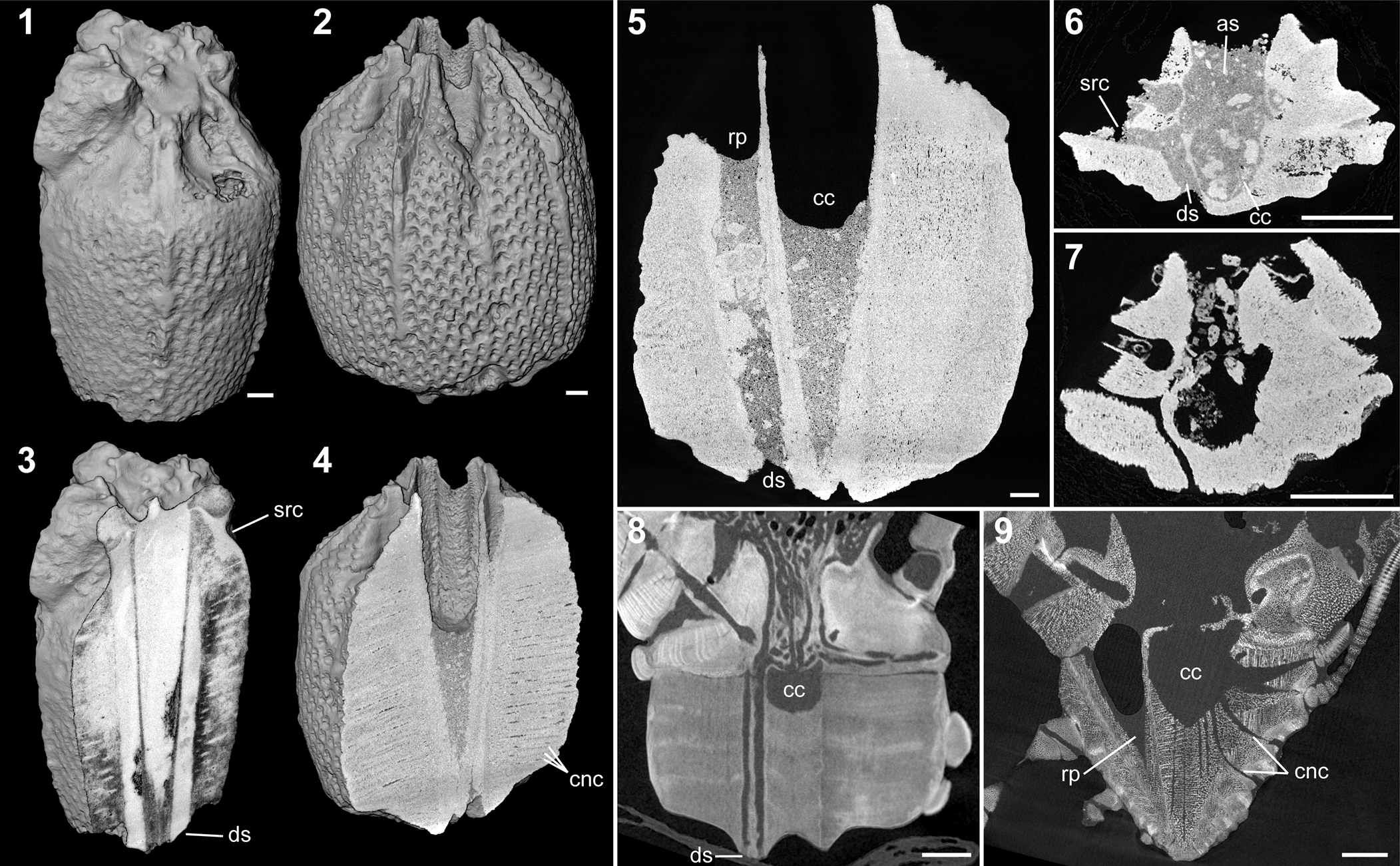
Features of internal anatomy in fossil and extant comatulids as revealed by μCT scanning. Scale bar = 1 mm in all images. Scans in (7, 8) taken from Saulsbury (Reference Saulsbury2020). Interradius to right in (5–9). (1) Render of NPL 93001, holotype, Castaneametra hodgesi n. gen. n. sp., oblique view. (2) Render of NPL 103166, paratype, Castaneametra hodgesi n. gen. n. sp., oblique view. (3) Same view as (1), but with the render sliced to show X-ray impedance along a section plane intersecting cirral nerve canals, radial pits, and centrodorsal cavity. (4) Same view as (2) but sliced to show X-ray impedance along a section plane intersecting cirral nerve canals and centrodorsal cavity. (5) NPL 103166, paratype, 2D slice through axis. (6) NPL 103183, holotype, Semiometra alveoradiata n. sp., 2D slice through axis showing configuration of internal cavities. (7) Maastrichtian Semiometra saskiae Jagt, Reference Jagt1999, Maastricht Natural History Museum NHMM K1018a, paratype, 2D slice through axis. (8) Recent Pterometra pulcherrima Clark, Reference Clark1909a, 2D slice through axis. (9) Recent Notocrinus virilis Mortensen, Reference Mortensen1917, 2D slice through axis. as = axial sinus; cc = centrodorsal cavity; cnc = cirral nerve canals; ds = dorsal star; rp = radial pits; src = subradial cleft.
Types
NPL, University of Texas, Austin. Holotype, NPL 93001. Paratype, NPL 103166. In front of mobile home supply store, State Highway 16 S (29.7450°N, 99.0011°W). Glen Rose Formation, lower member, unit 2.
Diagnosis
Centrodorsal tall, truncated conical to ovoid, and very large, up to 18 mm in diameter and 25 mm tall, with broad cirrus-free aboral pole (Fig. 5). Oral surface of centrodorsal steeply slopes down from rim of centrodorsal cavity to edge of basals. About 20 rows of irregularly arranged functional cirrus sockets with 10 per row for around 200 per radius and 1000 per individual. Functional cirrus sockets tiny, without crenulation, with wedge-shaped articular tubercles (Fig. 6.2). Five to ten rows of immature cirrus sockets without articular features, arranged in cascading columns on either side of radial pits (Fig. 6.1). Centrodorsal cavity conical and deep, extending almost to the aboral pole (Fig. 7.5). Radial pits and dorsal star joined by spacious, through-going canals (Fig. 7.3, 7.5). Centrodorsal with prominent interradial buttresses running from aboral pole to rim of centrodorsal cavity. Interradial buttresses articulate with basals, forming a petal-shaped cradle with more or less crenelated margin. Basals massive and wedge-shaped.
Occurrence
Albian, Glen Rose Formation, lower member, unit 2, echinoid marker bed and Salenia texana marker bed.
Description
Cirrus sockets crowded together, slightly taller than wide (Fig. 6.2). Paratype with 230 cirrus sockets in radius (Fig. 7.2), including immature ones. Cirral nerve canals emerge from centrodorsal cavity in two columns per radius, one on either side of the radial pit (Supplementary Movies S1, S3). Cirral nerve canals pass around the radial pit and emerge in an irregular arrangement. Interradial buttresses typically extend beyond the aboralmost ring of cirrus sockets and taper distally to either a set of 5 points (e.g., Fig. 5, NPL 93023) or a single point (e.g., Fig. 5, NPL 92954). Buttresses do not extend beyond the aboral pole in all specimens (e.g., Fig. 5, NPL 103166), in which case the aboral pole is mostly flat. Buttresses may also be partly overgrown by cirrus sockets (e.g., NPL 92949). Interradial buttresses sculpted at oral end in apparent mold of aboral face of basals. This cradle-shaped articulation is usually sloped down from the rim of the centrodorsal cavity, although it may swoop up at the edges (Fig. 5, NPL 92949). It is usually deep, with crenelated or notched margins. These margins may join with the raised rim of the centrodorsal cavity to form a continuous, stellate rim (Fig. 5, NPL 103166 and NPL 92945), comparable to Albian Loriolometra from Texas (Nestell and Tenery, Reference Nestell and Tenery1988, fig. 1E, H). Openings to the radial pits typically extend down the side of the radial surface of the centrodorsal, with cirral nerve canals bending around the radial pits (Supplementary Movie S3). Radial pits wide in bore, about the same diameter at oral and aboral ends, about half the diameter of the centrodorsal cavity at its widest (Fig. 7.1–7.5). Centrodorsal cavity is a deep conical pit extending almost to the dorsal pole, separated from the radial pits by a thin wall. Basals bulky and polygonal, tallest and broadest close to the axis, tapering to points extra-axially. Basals articulate with each other in the radius but do not cover radial pits.
Etymology
Named in honor of the late Floyd Hodges, who discovered the first specimens of this form over 50 years ago.
Materials
Centrodorsals, including one with 3 attached basals (Fig. 5, NPL 93001, holotype); 49 specimens: NPL 89451, 92890–92893, 92945–92946, 92949–92955, 92989–93007, 93020–93026, NPL 103166–103173, NPL 103186.
Remarks
Castaneametra hodgesi n. gen. n. sp. exhibits enormous variability, but we can detect no clusters in shape space or any correspondence between locality and form (see Results), so we assign all material to a single species. This species is also an extreme form. With around 1000 cirri it has several times more cirri than any other feather star; the closest runner-up is probably among certain living heliometrines possessing up to 200 cirri (Ausich et al., Reference Ausich, Mironov, Eléaume and Hess2011). In terms of calyx size, it is probably the largest described comatulid (see Results). Finally, the morphology of the basals and interradial buttresses is unique among the comatulids, although some zenometrids have robust basals that rest on interradial ridges in a similar way (Messing et al., Reference Messing, White and Beach2001, fig. 2A, B).
Despite these oddities, Castaneametra n. gen. comes reasonably close to Rasmussen's (Reference Rasmussen, Moore and Teichert1978) diagnosis for the Notocrinidae, especially in possessing a dorsal star and large radial pits. Moreover, phylogenetic analysis recovers it in a clade with notocrinids Loriolometra and Semiometra (see Results). It shares with Semiometra a set of internal canals linking subradial clefts, dorsal star, and radial pits; it may share these with other notocrinids too. It does not fit within any notocrinid genera (Oxfordian–Maastrichtian [Eocene?] Semiometra, Albian–Santonian Glenotremites Goldfuss, Reference Goldfuss1829, Albian–Campanian Loriolometra, Cenomanian Remesimetra Sieverts-Doreck, Reference Sieverts-Doreck1958, Coniacian–Santonian Schlueterometra Rasmussen, Reference Rasmussen1961, and Eocene–Recent Notocrinus Mortensen, Reference Mortensen1917).
Results
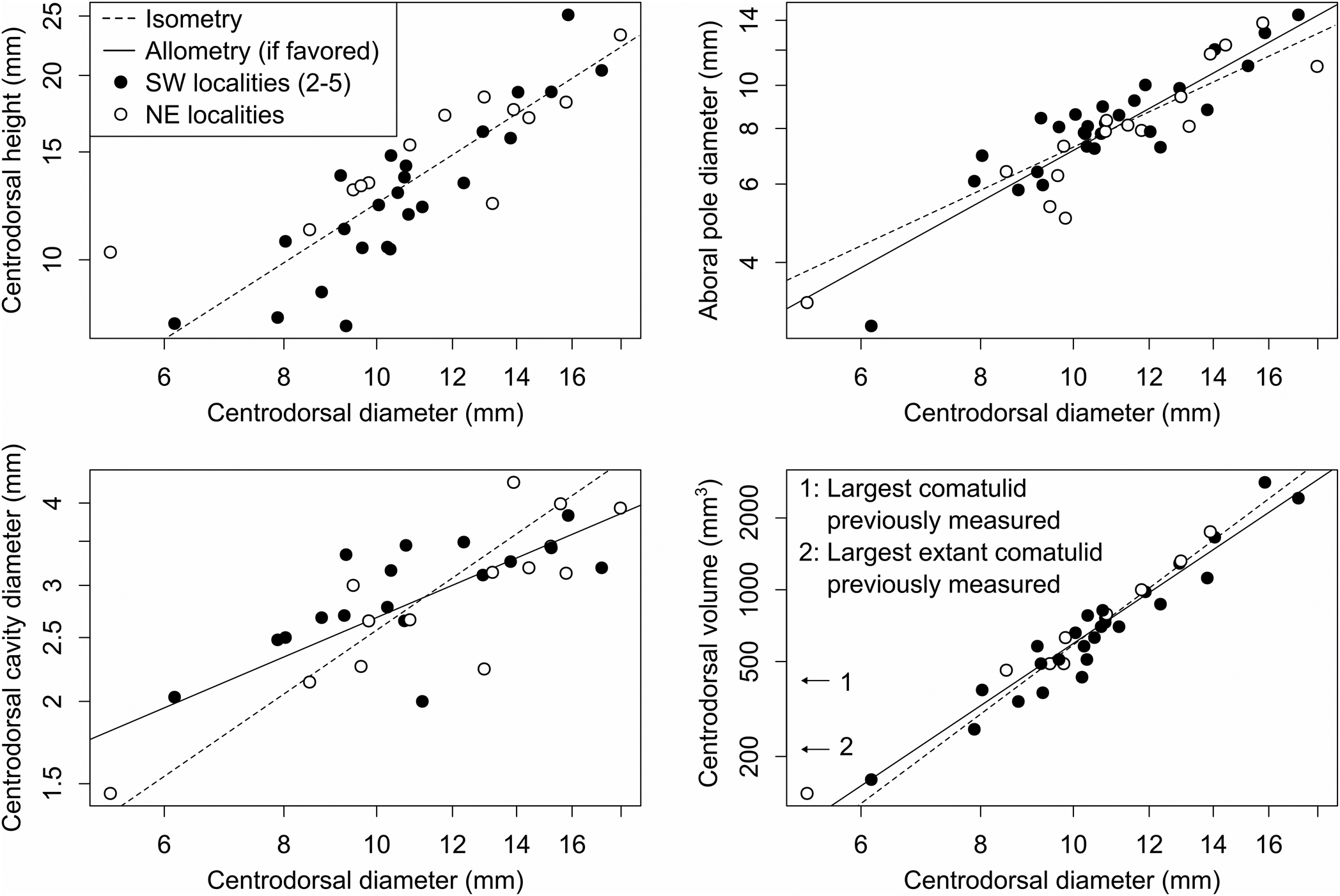
Castaneametra hodgesi n. gen. n. sp. varies roughly 12-fold in diameter, 100-fold in volume, 2-fold in “conicity” (the ratio of the diameters of the aboral pole and the broadest point of the centrodorsal), 2-fold in the proportional diameter of the centrodorsal cavity, and 2-fold in aspect ratio (Fig. 8). Variation is continuous rather than clustered and does not appear to correspond with locality (shown in Fig. 8 for southwest vs. northeast localities). Some shape variation can be attributed to allometry: likelihood ratio tests support weak positive allometry (relative to centrodorsal diameter) in the size of the aboral pole as a proportion of centrodorsal diameter and weak negative allometry in relative centrodorsal cavity size and centrodorsal volume (Fig. 8). A previous study surveyed calyx volume across comatulids using 3D models generated from μCT scans; the largest extant (Davidaster rubiginosus Pourtalès, Reference Pourtalès1869) and extinct (Decameros ricordeanus) comatulids from those findings are plotted in Figure 8. Notably large comatulids not included in that study include the extant Nemaster grandis Clark, Reference Clark1909b (Meyer, Reference Meyer1973) and the Late Jurassic Palaeocomaster karsensis Radwańska, Reference Radwańska2005, both of which have been reported with centrodorsal diameters in excess of 14 mm. The larger centrodorsals of C. hodgesi n. gen. n. sp. nevertheless represent, to our knowledge, the largest of any described comatulid.
Morphometry and scaling in Castaneametra hodgesi n. gen. n. sp.. Slope of allometric scaling shown if favored over isometric scaling by a likelihood ratio test. Sizes of largest comatulids measured by Saulsbury (Reference Saulsbury2020) shown in bottom right panel.
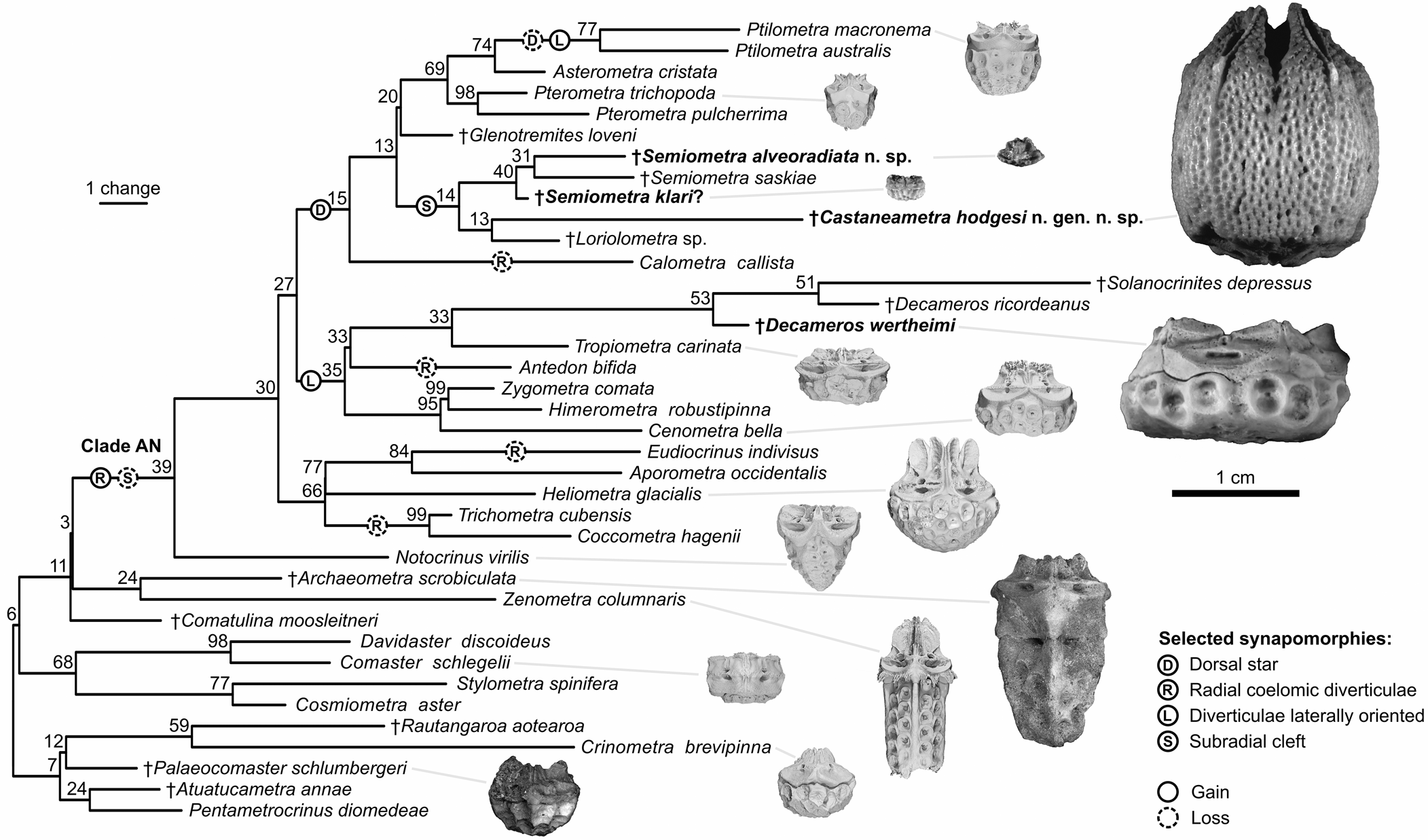
Phylogenetic analysis recovers a single most parsimonious tree in which C. hodgesi n. gen. n. sp. forms a clade with the notocrinid Loriolometra sp., represented by a collection of Campanian specimens (RT000–RT010) from Le Musée Vert, Le Mans, France, and then with the two species of Semiometra from the Glen Rose and another from the Dutch Maastrichtian (Fig. 9). This placement is tenuous: C. hodgesi n. gen. n. sp. sits on one of the longest branches in the cladogram, and bootstrap frequencies are low. Nevertheless, this placement is supported by synapomorphies in systematically important characters including the presence of radial coelomic diverticulae, radial pits opening to a dorsal star, and a subradial cleft. In other respects, our findings recapitulate recent phylogenetic analyses of fossil feather stars (Saulsbury and Baumiller, Reference Saulsbury and Baumiller2022). This includes the placement of D. wertheimi among the other solanocrinitoids, supported by four synapomorphies (Fig. 9). The notocrinid Glenotremites loveni Carpenter, Reference Carpenter1880, is recovered as sister to the asterometrids and ptilometrids.
Single most parsimonious tree of Recent and fossil comatulids, shown with branch lengths corresponding to number of changes required by the phylogeny. Branches have non-integer lengths because of the inclusion of continuous characters. Numbers at nodes are rounded support values from 1000 bootstrap replicates. Also shown are most parsimonious character histories for discrete characters discussed in the text. Glen Rose comatulids bolded. Calyces for select species are shown at the same scale; only the centrodorsal is shown for Castaneametra n. gen. Specimen images from Saulsbury and Baumiller (Reference Saulsbury and Baumiller2022) and rendered from shapefiles from Saulsbury (Reference Saulsbury2020). Clade AN discussed in text.
Discussion
Systematics and ancestry
Cladistic analysis recovers Castaneametra n. gen., Semiometra, and two other fossil notocrinid genera, Loriolometra and Glenotremites, in different places around a major, unnamed comatulid clade, which has been recovered in all previous molecular phylogenetic analyses (Hemery et al., Reference Hemery, Roux, Ameziane and Eléaume2013; Rouse et al., Reference Rouse, Jermiin, Wilson, Eeckhaut and Lanterbecq2013; Cohen and Pisera, Reference Cohen and Pisera2017) (Fig. 9). This clade corresponds to clade B4 of Hemery et al. (Reference Hemery, Roux, Ameziane and Eléaume2013) minus the Zenometridae, and according to the World Register of Marine Species (Messing et al., Reference Messing, Gondim and Taylor2023) encompasses 314 living species, over half of extant comatulid diversity. We refer to it as clade AN here, as the smallest monophyletic group including both Antedon Fréminville, Reference Fréminville1811, and Notocrinus. Because fossil notocrinids are non-monophyletic within clade AN, Notocrinidae might be concluded to be a “wastebasket taxon,” but this is hard to accept for such a morphologically and stratigraphically coherent group. Instead, we suggest that the fossil notocrinids include or closely resemble the most recent common ancestor of clade AN, and that the similarities among notocrinids are plesiomorphic rather than derived or convergent. This hypothesis is supported by both temporal and morphological evidence. Clade AN diverges close to the base of comatulid phylogeny; likewise, the earliest notocrinid, the Bathonian (168.3–166.1 Ma) Semiometra abnormis Carpenter, Reference Carpenter1880, appears within 35 million years of the earliest comatulid, the Hettangian (201.3–199.3) Palaeocomaster styriacus Kristan-Tollmann, Reference Kristan-Tollmann1988.
Furthermore, our cladistic analyses support an ancestral condition for clade AN closely matching Semiometra: the ancestor is inferred to possess radial coelomic diverticulae that are dorsally rather than laterally oriented. In fossil notocrinids, these diverticulae appear as radial pits and, in some forms, the dorsal star. If Semiometra resembles the ancestral condition in clade AN, then this condition has been repeatedly modified or lost subsequently: Notocrinus and Aporometra Clark, Reference Clark1938, have dorsally oriented diverticulae that do not connect with a dorsal star (Fig. 7.9), as in the notocrinid Schlueterometra (not included in our analysis). In two clades (“L” in solid circles in Fig. 9), coelomic diverticulae have secondarily become laterally oriented, typically appearing as furrows or depressions on the centrodorsal (Saulsbury, Reference Saulsbury2020); and many lineages have lost coelomic diverticulae altogether (“R” in dashed circles in Fig. 9), potentially representing an allometric effect of size reduction in these lineages (Saulsbury, Reference Saulsbury2020). Among living representatives of clade AN, the hypothetical ancestral condition is apparently only retained in the Asterometridae (Pterometra and Asterometra, Fig. 9), in which bundles of coelomic canals reach all the way to the dorsal surface of the centrodorsal (Fig. 7.8). Despite having a complex history of evolutionary transitions, coelomic diverticulae are the only apparent synapomorphy for clade AN (excluding the presence of irregularly arranged cirrus sockets, which also appear outside this clade), so this feature deserves further study.
Albian Decameros and the notocrinids Castaneametra n. gen., Semiometra, and Loriolometra together make up the apparently short-lived Cretaceous North American comatulid fauna. The absence of comatulids from the Late Cretaceous North American fossil record may signify true absence, as that record, including the fossiliferous Coastal Plain, preserves taphonomically comparable marine invertebrates including stalked crinoids and other echinoderms (Saulsbury and Baumiller, Reference Saulsbury and Baumiller2022).
Based on the phylogeny, we suggest that the American notocrinids represent a single local radiation originating from a lineage of Semiometra that dispersed there out of the West Tethys. This scenario is surprising given the dramatic size differences among these forms (Fig. 9), but otherwise they are largely morphologically coherent. Semiometra originated long before in the Middle Jurassic and persisted until the latest Cretaceous, and Loriolometra appears later in the Late Cretaceous of Europe, but Castaneametra apparently does not persist in the record longer than a single lower-order sequence stratigraphic cycle. Castaneametra n. gen. may thus represent a short-lived endemic; no other living or fossil comatulids look like it, and it probably left no preserved descendants.
Paleobiology
Reconstructing C. hodgesi n. gen. n. sp. as an organism is challenging because it lacks living analogues in several respects. First, it has many times more cirri than any living form. Meyer (Reference Meyer1973) observed that comatulids with many cirri were commonly exposed in an elevated, rheophilic position as opposed to hidden cryptically within reef substrate. This may be the case for C. hodgesi n. gen. n. sp. The Salenia texana Zone is inferred to be soft-bottom rather than reefal (Smith and Rader, Reference Smith and Rader2009), so it may not have had access to complex infrastructure in which to live cryptically. Some living comatulids elevate themselves by perching on other organisms (Meyer and Macurda, Reference Meyer and Macurda1980), but no high-tiered organisms are known from the lower Glen Rose unit 2. Alternately, some living comatulids elevate themselves off the substrate with their cirri (Meyer and Macurda, Reference Meyer and Macurda1980). This is not a common feeding posture on soft substrates (Messing et al., Reference Messing, Meyer, Siebeck, Jermiin, Vaney and Rouse2006), but a comatulid with a thousand cirri might be less prone to sink into the substrate than one with a few dozen.
A second mystery is the anatomical identity of the radial pits. There is some evidence that the radial pits in extant crinoids are tissue-lined coelomic spaces containing circulating fluid (Saulsbury, Reference Saulsbury2020), but no extant comatulids are known to have radial pits connected with both a subradial cleft and a dorsal star. In C. hodgesi n. gen. n. sp. the subradial cleft is huge, so if the radial pits were lined with tissue, that tissue would be exposed to the environment in the clefts unless the radials had an enormous free surface, perhaps 5 mm in height. The discovery of more-complete specimens would be especially interesting in this regard.
Beyond their novelty, giants like C. hodgesi n. gen. n. sp. have genuine biological interest as potentially illustrating laws of scaling with special clarity (Gould, Reference Gould1974). A recent study showed that coelomic cavities in the crinoid calyx are more complex in larger species, often being elaborated into fan-shaped, linear, or dorsoventrally oriented networks of canals, and argued that this pattern of allometric scaling was a necessary consequence of respiratory demands (Saulsbury, Reference Saulsbury2020). On this hypothesis it makes sense that, as the largest comatulid, C. hodgesi n. gen. n. sp. has exceptionally roomy internal cavities. Physiological modeling (Farmanfarmaian, Reference Farmanfarmaian and Boolootian1966) indicates that without a means for delivering oxygenated fluid into the calyx, an echinoderm the size of C. hodgesi n. gen. n. sp. would suffocate. Because Semiometra already possessed the same unique configuration of internal canals, this lineage of tiny precursors could be said to have been preadapted to gigantism. Decameros also achieved sizes beyond the range of living species around the same time as C. hodgesi n. gen. n. sp. (Saulsbury and Zamora, Reference Saulsbury and Zamora2020), yet it is not clear why two comatulid lineages—or three if the bizarre Uintacrinus and Marsupites are included among the comatulids (Milsom et al., Reference Milsom, Simms and Gale1994)—independently converged on gigantism during the Cretaceous. Dissolved oxygen concentration is thought to dictate the maximum size possible for crinoids (Brom et al., Reference Brom, Salamon, Ferré, Brachaniec and Szopa2015), but Cretaceous seawater was probably not more oxygenated than modern oceans (Song et al., Reference Song, Wignall, Song, Dai and Chu2019). A satisfactory understanding of size evolution in crinoids will await deeper physiological study and surveys of body size (Salamon et al., Reference Salamon, Brachaniec, Paszcza, Kołbuk and Gorzelak2023), especially in a phylogenetic context.
Conclusion
Some extraordinary features of C. hodgesi n. gen. n. sp. could perhaps be explained by considering it as a product of peramorphosis, or an evolutionary lengthening of development. Peramorphosis (and heterochrony more generally) has been considered an “easy” means of translating minor developmental regulatory changes into major morphological innovations (McNamara and McKinney, Reference McNamara and McKinney2005), and has been invoked, for example, to explain the origin of the giant pseudoplanktonic crinoid Seirocrinus Gislén, Reference Gislén1924, in the Jurassic (Simms, Reference Simms1988). A peramorphic origin for Castaneametra n. gen. could explain its geologically sudden appearance on a very long morphological branch (Fig. 9). It would also explain its size and especially its many cirrus sockets, as these are added to the centrodorsal throughout development in comatulids. More generally, study of this strange North American giant and its relatives suggests the need for substantial revisions of early comatulid phylogeny, illustrates principles of scaling in crinoids, and sheds light on the Mesozoic comatulid fauna outside the relatively well-studied West Tethys.
Acknowledgments
We are indebted to the many local collectors who donated specimens for study, including E. Elliot, M. Falk, E. Rose, J. Hinte, M.K. Smith, R. Scott, B. Thompson, and the late F. Hodges, who made the earliest collections of Castaneametra hodgesi n. gen. n. sp. known to us in the early 1970s. C. Sumrall kindly made specimens available to us. We also thank L. Boucher, who helped coordinate photography and museum access during a visit to the UT Austin Non-vertebrate Paleontology Laboratory, and L. Appleton, who helped organize and accession new material.
Competing interests
The authors declare no competing interests.
Data availability statement
Supplementary data and movies are available in a Zenodo repository at zenodo.org/doi/10.5281/zenodo.11238227. Supplementary Data 1 lists identifiers and localities for all new specimens. Supplementary Data 2 gives descriptions, latitudes and longitudes, and stratigraphy for all localities. Supplementary Data 3 contains morphometric data for Castaneametra hodgesi n. gen. n. sp. Supplementary Movies 1 and 2 show reconstruction from computed tomographic scan of holotype, NPL 93001, in slicing planes perpendicular and parallel to oral-aboral axis, respectively. Supplementary Movies 3 and 4 show reconstruction from computed tomographic scan of paratype, NPL 103166, in slicing planes perpendicular and parallel to oral-aboral axis, respectively.


 Open access

